 Skip to article
|
Skip to article |
|
Loan Pricing in the Mortgage Market General Findings from the 2005 HMDA Data Disposition of Applications, Selected Categories of Loan Products, and the Secondary Market The 2005 HMDA Data on Loan Pricing |
Higher-Priced Home Lending and the 2005 HMDA DataRobert B. Avery, Kenneth P. Brevoort, and Glenn B. Canner, of the Division of Research and Statistics, prepared this article. Caitlin G. Coslett and Sean M. Wallace provided research assistance. Since 1975, the Home Mortgage Disclosure Act (HMDA) has required most mortgage lending institutions with offices in metropolitan areas to disclose to the public information about the geographic location and other characteristics of the home loans they originate or purchase during each calendar year. Disclosure of home-lending activity is intended to help the public determine whether institutions are adequately serving their communities' housing finance needs, to facilitate enforcement of the nation's fair lending laws, and to guide public- and private-sector investment activities. Although the act is intended to help achieve important public policy goals, the law itself does not include mandates or restrictions on lending--that is, it does not direct lenders to make loans to particular areas or persons, nor does it direct them to make certain kinds of loans or to refrain from certain loan terms or practices. Taken together, the nearly 8,850 lenders currently covered by the law account for an estimated 80 percent of home lending nationwide. Consequently, HMDA data likely provide a representative picture of most home lending in the United States. The information thus provided is rich, but it is limited: The data reveal a great deal about what the lending patterns are but relatively little about what causes the patterns. Nonetheless, by drawing attention to these patterns, the data promote further analysis and discussion that can deepen understanding of their causes and encourage marketplace efficiency by fostering competition. The Congress has amended HMDA on several occasions to extend the reach of the law to more institutions and to expand the types of information that must be disclosed. The most sweeping legislative amendments occurred in 1989; they required the disclosure of application and loan-level information for home loans, including the disposition of applications and the income, sex, and race or ethnicity of the individuals applying for credit. Analysis of this information has prompted widespread public discussion about the fairness of mortgage lending decisions, as the disclosures revealed wide disparities in the rates of approval of loan applications across racial and ethnic lines. The disclosures triggered debate about the proper interpretation of the data and about the meaningfulness of the disparities in the disposition of loan applications and in lending patterns.1 The disclosures also led many lenders to strengthen their fair lending compliance programs and to expand their outreach to underserved communities. Periodically, the Federal Reserve Board reviews each of the regulations that it promulgates, including Regulation C, which implements HMDA.2 As a result of the Board's most recent review of Regulation C, a number of important changes were made to the reporting requirements, changes that substantially increase the types and the amount of information made available about home lending (for details, refer to the appendix).3 The Board stated that the revisions were intended to keep the regulation in step with recent developments in mortgage markets and with the revised standards of classification for the collection of information on race and ethnicity as established by the Office of Management and Budget (OMB).4 The 2004 HMDA data, the first to reflect the recent revisions to Regulation C, were released to the public by individual lending institutions in the spring of 2005. In September 2005, the Federal Financial Institutions Examination Council (FFIEC) made publicly available various summary reports (statistical tables) pertaining to each lender and lending activity in each metropolitan statistical area, along with a comprehensive data file that included all the reported information (except the dates of loan applications and of credit decisions).5 At that time, the staff of the Federal Reserve Board prepared the first comprehensive assessment of the expanded data, which was published as an article in the Federal Reserve Bulletin.6 The most important change made to Regulation C is the requirement that lenders disclose pricing information for loans with prices above designated thresholds; such loans are referred to here as "higher-priced loans." The new pricing data allow a better understanding of lending activity in the higher-priced segment of the mortgage market, a market segment that has grown substantially over the past decade or so in response to improvements in information processing technology and in the ability of lenders to measure and price for credit risk. Greater understanding of the market and an improved ability to monitor the activities of individual lenders in the higher-priced market segment are important because the expansion of such lending, though affording some consumers greater access to credit, has been accompanied by a variety of concerns. The concerns relate to the appropriateness of loan terms and lending practices, constraints on consumer shopping and on access to the full range of credit opportunities, the competitiveness of the higher-priced market, and the potential for unequal treatment of borrowers on the basis of race, ethnicity, or some other characteristic protected by law. A review of the 2004 HMDA data found that, in the aggregate, less than one-fifth of borrowers took out higher-priced loans. However, the data also showed that the incidence (measured as the proportion of borrowers) of higher-priced lending varied substantially across racial and ethnic lines: Blacks and Hispanic whites were more likely, and Asians less likely, to have received higher-priced loans than non-Hispanic whites. Information included in the HMDA data on borrower or loan characteristics, such as income and amount borrowed, was insufficient to account fully for the variation in loan pricing across groups. Many factors routinely used by lenders to underwrite and price loans--including loan-to-value (LTV) ratios, debt-to-income (DTI) ratios, and measures of borrower credit history (for example, a credit history score)--are not included in the HMDA data and, consequently, cannot be accounted for in an analysis of pricing differences that relies on these data alone. Differences in loan-pricing outcomes, such as those revealed in the HMDA data, have increased concern about the fairness of the lending process. Lenders are responsible for ensuring compliance with fair lending laws, and the expanded HMDA data may both encourage and facilitate improved compliance efforts. The regulatory agencies charged with enforcement of the fair lending laws also use the expanded data to facilitate enforcement activities. This article reviews the 2005 HMDA data, which have just been released to the public. The 2004 article covered a wide range of topics, including ways in which the expanded data might be used to aid fair lending enforcement, but this article is more limited: The focus here is primarily on the loan-pricing aspects of the data, including those that permit an assessment of the effects of the changing interest rate situation in 2004 and 2005 on the disclosure of higher-priced lending. To identify the effects on lending patterns of changing interest rates, the analysis presented here uses adjusted sets of the 2004 and 2005 HMDA data in an attempt to distinguish the loans that exceeded the pricing thresholds solely because of a changed interest rate situation from other higher-priced loans. This section of the analysis relies on monthly surveys of loan terms and pricing conducted by Freddie Mac and the Federal Housing Finance Board to help gauge the effects of changing interest rates over the period. The analysis indicates that the substantial narrowing of the difference between short- and long-term interest rates in 2005 compared with 2004 not only increased the overall share of reported loans that exceeded the pricing thresholds established by Regulation C but also affected to some degree the gap in loan-pricing outcomes among groups of borrowers sorted by their race or ethnicity. The analysis further reveals that changes in interest rates substantially affected the types and the proportions of loans that exceeded the price-reporting thresholds. Because of a combination of (1) the procedure specified in Regulation C for determining which loans are higher priced and (2) the rules governing how annual percentage rates (APRs) are calculated for adjustable-rate loans, adjustable-rate loans were much more likely than fixed-rate loans with similar risk profiles to be below the HMDA price-reporting thresholds in 2004 but were about as likely as fixed-rate loans to be above the threshold by the end of 2005. One consequence of this changed relationship is that certain populations--such as those residing in the western part of the country--that used adjustable-rate loans relatively more often than fixed-rate loans likely witnessed a relatively larger increase in reported higher-priced lending in 2005. Loan Pricing in the Mortgage MarketOver the past decade or so, the mortgage market has changed markedly. Before that, mortgage lenders offered consumers a relatively limited array of loan products at prices (interest rates, points, and fees) that varied not by the creditworthiness of the borrower but by loan type (for example, conventional or government-backed), loan characteristic (for example, amount borrowed, term to maturity, or LTV ratio), type of structure securing the loan (for example, traditional "site built" home or factory-manufactured unit), and ownership status (owner-occupied or nonowner-occupied). Effectively, borrowers either did or did not meet the underwriting criteria for a particular product. Those who met the criteria paid about the same price; those who did not were denied credit. Advances in technology, better access to information on the credit histories of individuals, increased competition, and the maturation of a robust secondary market for loans representing the full spectrum of credit risks have helped spur remarkable changes in the mortgage market. Most prominent has been credit pricing based explicitly on risk. Today, much more so than in the past, differences in the creditworthiness of different borrowers can lead to different prices for the same product.7 Applicants who are less creditworthy or who are unwilling or unable to document their creditworthiness or income are increasingly less likely to be turned down for a loan; rather, they are offered credit at higher prices.8 Explicit risk-based pricing has expanded opportunities for homeownership and has allowed individuals, including those who are otherwise credit constrained, to more readily purchase homes or to borrow against the equity they have accumulated in their homes. Borrowers in the higher-priced market generally fall into one of two market segments--"subprime" or "near prime." Individuals in the subprime category typically pay the highest prices because they pose greater credit or prepayment risk or are otherwise more costly to serve. In practice, the dividing line between these two "nonprime" market segments can be somewhat amorphous, as can the line between the prime and nonprime markets. Moreover, the thresholds that separate these market segments can change as market interest rates move, as lenders' appetites for interest rate or credit risk change, and as technological improvements allow for more-precise risk assessment. Estimates of the annual volume of nonprime lending vary, but all sources agree that the nonprime market segment has grown substantially in recent years. One source estimates that from 1994 to 2005, the dollar volume of subprime loans increased from about $35 billion to more than $600 billion. Further, subprime lending is no longer a minor portion of the mortgage market. Subprime loans are estimated to have accounted for 20 percent of all mortgage originations in 2005, up from less than 5 percent in 1994.9 Concerns about Loan PricingAs price flexibility has emerged in the mortgage market, so have concerns about the fairness of pricing outcomes. Such considerations generally fall into three broad categories: In the first category are concerns about possible discrimination based on the race or ethnicity of the borrower. These concerns are heightened because, for some loans, prices are determined on an individual basis and not strictly according to credit risk, cost factors, or competitive conditions. In the second category are concerns about whether borrowers in the higher-priced segment of the loan market have sufficient resources (for example, time, information, and financial experience) to shop effectively for the loan terms most appropriate to their circumstances. These concerns relate to both borrower and lender behavior. For example, some borrowers may not shop or negotiate for the best available rates and terms because they need funds immediately and are focused primarily on the amount they can borrow and the size of the monthly payment, not on the interest rate, fees, or other loan features. And some lenders may engage in aggressive "push" marketing that may confuse borrowers about the cost and terms of loans. Finally, concerns have been raised about whether competition is adequate to ensure that borrowers in the higher-priced segment of the loan market are provided with the full range of credit opportunities. Some believe that prime-market lenders are not present, or do not offer or promote their prime products sufficiently, in certain geographic markets, including neighborhoods that have larger minority populations. In this view, limited access to prime lenders and the products they offer diminishes the opportunities for borrowers in affected communities to obtain lower-priced loans. These concerns are extraordinarily complex and beyond the scope of this article. The Federal Reserve Board's recent hearings on home equity lending sought to collect more information about these and other concerns raised by the rapid growth of the higher-priced segment of the market.10 Determining What Pricing Information Is ReportedIn 2002, the Federal Reserve Board amended Regulation C to require the disclosure of pricing information for higher-priced loans. In establishing the loan-pricing disclosure rule, the Board sought to select thresholds that would limit regulatory burdens by focusing data reporting on only those loans in the higher-priced segment of the market.11 Specifically, for loans with spreads above designated thresholds, revised Regulation C requires the reporting of the spread between the APR on a loan and the rate on Treasury securities of comparable maturity. The thresholds for reporting differ by lien status: 3 percentage points for first liens and 5 percentage points for junior, or subordinate, liens.12 The different thresholds for first and junior liens are intended to reflect differences in the credit risk and other features of the loans in these two different markets. To better interpret the reported pricing information, the Board has also required institutions to report the lien status for each loan. In limiting the reporting of price information to only the higher-priced segment of the market, the Board weighed the costs and benefits of more-expansive data collection and reporting and determined not to adopt more-expansive reporting requirements. The Board also chose to refer to loans with prices that exceed the reporting threshold as "higher-priced loans" rather than as "subprime loans." The correspondence between subprime loans and loans with prices exceeding the threshold is not precise. The Board's regulation sets the price-reporting thresholds in such a way that the number or proportion of loans reported as higher priced can vary from year to year even if the size and the share of the subprime market have stayed the same. Reasons for Loan-Price VariationMortgage pricing is complex and reflects a wide range of factors. Many of these factors are easily quantifiable and objectively measured. Some, however, are less readily quantified--for example, the extent of negotiations, if any, between lender and borrower. The expanded HMDA data include few of the factors that may help explain variations in the prices of reported loans. Even if all of the readily quantifiable factors were included in the data, they would not necessarily fully explain loan pricing because some factors are difficult to measure. Important factors not included in the HMDA data include the costs of raising the funds to be lent; considerations related to credit risk, such as those reflected in the borrower's credit history, LTV ratio, or DTI ratio; prepayment risk (the risk that a loan will be prepaid before the term of the loan); overhead expenses, such as those related to providing offices and to compensating staff for finding prospective borrowers and underwriting loans; loan-servicing costs; and possibly the extent of negotiations between creditor and borrower. Market conditions and competition also bear on pricing, as local economic conditions--including, importantly, those of local housing markets--can influence the demand and supply of credit.13 Finally, the legal situation in a state, including foreclosure rules, may affect loan pricing by constraining to a greater or lesser degree the ability of lenders to recover and dispose of the collateral used to back loans that are in default. Mortgages are typically priced at a spread above the yields on Treasury securities or on other, similar instruments or indexes of funding costs that correspond to the time a loan is expected to be outstanding. Each of the factors noted earlier may influence the magnitude of the spread. Elevated credit risk for loans in the higher-priced mortgage market results in substantially higher default and foreclosure rates and costs and, consequently, in higher price levels. Prepayment risk is also greater for higher-priced loans not only because borrowers in the higher-priced market have an incentive to refinance when interest rates fall (as do borrowers in the lower-priced market segment) but also because they have an incentive to prepay when their credit history improves to the point that they qualify for lower-priced credit.14 Because credit and prepayment risks are higher for loans in the higher-priced segment of the market, such risks tend to vary more in this market segment. Lenders active in the higher-priced market may also face a cost structure different from that faced by lenders focused on the lower-priced segment of the market. Lenders focused on the higher-priced market segment may face steeper funding costs, may incur higher marketing expenses, and may have a much lower flow-through rate--that is, the number of applications processed to successfully extend a loan may be higher for such lenders than for lenders that deal primarily with borrowers with few credit problems or with the ability to make large down payments. Discretionary, or Flexible, PricingSome creditors provide their loan officers and agents working on their behalf (for example, mortgage brokers or loan correspondents) with rate sheets that indicate the creditors' baseline prices by loan product (for example, conventional loans of various types), owner-occupancy status, loan characteristic (for example, amount of loan, prepayment penalty option, term to maturity, or LTV ratio), and borrower creditworthiness (as reflected in, for example, a credit history score or DTI ratio). Rate sheets vary across lenders. For some lenders, the rate on the sheet is a "sticker" price; for others, it is the minimum accepted price; and for still others, it is the actual target price. Some lenders have a single rate sheet for the entire organization (for each loan product); others have different rate sheets for different geographic markets that reflect local market competition and costs. Rate sheets can change daily with changes in basic economic conditions, such as market interest rates. Loan rates paid by borrowers can deviate from the interest rates shown on sheets for many reasons. For example, the rates on the sheets may not reflect differences in loan origination costs. Also, in some cases, loan officers and brokers are allowed to deviate from prices on rate sheets as market conditions, including the extent of competition, warrant or allow. Deviations may also occur because of negotiated outcomes. Loan officers or brokers may benefit from pricing flexibility through higher compensation by obtaining a price above the rate stated on a rate sheet (or above prices obtained by others). Borrowers differ in their propensity to negotiate--for example, borrowers with less experience in the mortgage market, such as first-time homebuyers, may be less likely than experienced borrowers to negotiate. These differences in negotiating propensities may be correlated with race, ethnicity, or sex. For example, minorities are disproportionately first-time homebuyers. Discretionary, or flexible, pricing may be a legitimate business practice. Properly developed, monitored, and administered, discretionary pricing programs may help to ensure that markets allocate resources in an efficient way. However, when loan officers have latitude in deviating from rate sheets or in determining which rate sheet applies to each borrower, the lender runs the risk that differential treatment on a basis prohibited by law may arise. For this reason, the Interagency Fair Lending Examination Procedures provide that discretionary pricing should be considered an examination "risk factor" when a lender's risk for engaging in pricing discrimination is evaluated.15 Variations in Loan-Processing ChannelsThe delivery channels through which borrowers obtain loans vary across lenders, and such variation may affect loan pricing. On the one hand, underwriting and pricing may be centrally controlled even though applications for credit may begin through different channels, such as the Internet, the mail, or a visit to a bank office. On the other hand, in complex financial organizations with numerous bank branches, multiple affiliates (both bank and nonbank), decentralized loan production offices, and third-party brokerage operations, each application may be subject to a different underwriting and pricing regime depending on its point of initiation. The 2004 HMDA pricing data suggested that the delivery channel through which a borrower obtains a loan may matter. For example, the incidence of higher-priced lending was significantly higher for borrowers who lived outside the assessment areas of lenders covered by the Community Reinvestment Act of 1977 (CRA) than for those who lived inside these areas.16 The HMDA data do not provide a reason for this pattern, but several explanations that warrant further research are possible. For example, the difference may be due, at least in part, to a reliance on different delivery channels for loans within and outside these lenders' assessment areas. Differences in the incidence of higher-priced lending across groups may also arise if different channels tend to serve different customer groups. For example, mortgage brokers or loan correspondents that originate loans on behalf of a depository institution (commercial bank, savings association, or credit union) may focus on the subprime market, while the depository institution may offer a broader range of mortgage products through its retail branch network. If mortgage brokers or loan correspondents that focus on the subprime market tend to work disproportionately with borrowers from minority neighborhoods, then the depository institution's overall pricing pattern may show a higher incidence of higher-priced lending for minorities than for whites. General Findings from the 2005 HMDA DataFor 2005, lenders covered by HMDA reported information on roughly 30.2 million home-loan applications--11.7 million for purchasing one- to four-family homes, 15.9 million for refinancing existing home loans, 2.5 million for improving one- to four-family dwellings, and the balance for loans on multifamily dwellings for five or more families (table 1). 17 These applications resulted in some 15.6 million loan extensions. Lenders also reported information on about 5.9 million loans they purchased from other institutions and on some 397,000 requests for pre-approvals of home-purchase loans that either were turned down by the lender at the time the pre-approval was sought or were granted but not acted on by the applicant (data not shown in table). The total number of reported applications and purchased loans increased about 2.8 million, or 7 percent, from 2004; most of the increase was for applications for home-purchase loans. The number of applications for loans to refinance an existing loan fell about 1 percent, likely because of an increase in interest rates in 2005.Skip table 1
From the 2005 HMDA data, the FFIEC prepared disclosure statements for 8,848 HMDA-reporting institutions--3,904 commercial banks, 974 savings institutions, 2,047 credit unions, and 1,923 mortgage companies (table 2). Of the mortgage companies, 70 percent were independent entities--that is, institutions that were neither subsidiaries of depository institutions nor affiliates of bank holding companies (data derived from table). The disclosure statements consisted of 78,193 distinct reports, each covering the lending activity of a particular institution in each metropolitan statistical area (MSA) in which it had a home or branch office (table 1, last column). The total number of reporting institutions was little changed from 2004, as was the distribution of reporters by type of institution.skip table 2
Lender SpecializationMortgage companies, as distinct from depository institutions, received more than 60 percent of all the home-loan applications reported in the 2005 HMDA data, although such companies accounted for only about one-fifth of the reporting institutions (table 3). Among mortgage companies, those affiliated (either directly or indirectly) with a depository institution tended to be very active lenders: The 576 mortgage company affiliates processed 24 percent of the applications in 2005.Skip table 3
Different types of lending institutions tend to specialize in different types of home loans, although less so than in the past. The most notable change has been the diminished role that mortgage companies play in originating government-backed loans. In 2005, mortgage companies accounted for nearly 64 percent of government-backed originations. As recently as 2002, their share of originations of this type had been 83 percent. Depository institutions extended 71 percent of reported home-improvement loans and about 88 percent of multifamily loans (data not shown in tables). Commercial banks accounted for about half the loans for manufactured homes in 2005. Activity and Size of LenderAlthough the number of lending institutions covered by HMDA is large, most of these institutions, whether measured by asset size or by some measure of lending activity (such as the number of reported applications or loans), are small (table 3). For 2005, 60 percent of the reporting institutions each provided information on fewer than 250 loans or applications, accounting for just 1.6 percent of all the reported data. At the other end of the spectrum, 6 percent of reporting institutions each provided information on 5,000 or more loans or applications, but these few highly active lenders accounted for 88 percent of all the reported data. Asset size is available only for depository institutions. Asset size and lending activity are highly correlated. For example, the 707 depository institutions with assets of $1 billion or more reported 86 percent of all applications reported by depositories, whereas the 4,236 HMDA-reporting depository institutions with assets of less than $250 million accounted for only about 5 percent of the applications (percentages derived from table 3). Many HMDA reporters are affiliated with each other. If individual HMDA reporters are aggregated to their highest level of corporate organization (such as a bank holding company), the concentration of mortgage lending nationwide is evident. The twenty-five organizations reporting the largest number of applications and loans accounted for 54 percent of the 2005 data, a proportion essentially unchanged from 2004 (data not shown in tables). Disposition of Applications, Selected Categories of Loan Products, and the Secondary MarketThe HMDA data provide opportunities to categorize applications and loans in a wide variety of ways. For the analysis here, applications were grouped into twenty-five product categories based on loan and property type, purpose of the loan, and lien and owner-occupancy status.18 For each product category, information is provided on the number of total and pre-approval applications, application denials, originated loans, loans with prices above the thresholds, loans covered by the Home Ownership and Equity Protection Act of 1994, and the mean and median APR spreads for loans priced above certain thresholds (table 4).skip table 4
Because the transition rules regarding the reporting of data create problems for assessing some of the 2004 and 2005 data on loan pricing, as they do for assessing the data on manufactured homes and pre-approvals, the analysis that follows excludes "transition" applications--that is, those submitted before January 1, 2004 (data on these applications are shown as memo items in tables 4 and 5). Otherwise, information is given on all applications reported under HMDA.skip table 5
Disposition of ApplicationsHMDA data are the only publicly available source of information on the disposition of individual applications for home loans. Because the data include information on the race, ethnicity, and sex of applicants as well as the type and purpose of the loan and the location of the property, the disposition of applications can be assessed along many dimensions. The HMDA data for 2005 indicate that lenders approve most of the applications they receive, although the proportion approved or denied varies somewhat by loan purpose and product and by lien status. In general, denial rates are notably higher for refinancings and for home-improvement loans than for home-purchase loans, perhaps because of the prequalification and financial counseling activities that many prospective borrowers go through before purchasing a home (table 4). Denial rates are lower for government-backed loans than for conventional loans and are especially high for loans to purchase manufactured homes. Requests for pre-approval are denied at a higher rate than applications initiated through a pre-approval program (table 5). Compared with denial rates in 2004, those in 2005 are slightly higher for conventional home-purchase and refinance loans and are either unchanged or slightly lower for other loan products. Overall, the denial rate for all loans in 2005 was 27.1 percent, compared with 26.5 percent in 2004. Conventional and Government-Backed LoansAs in 2004, most applications (about 95 percent in 2005) for loans to purchase owner-occupied one- to four-family homes (either site-built or manufactured) were for conventional loans--that is, non-government-backed loans (table 4). The remainder were for government-backed forms of credit, mostly those involving the Federal Housing Administration (FHA). The share of all HMDA-reported loans backed by the FHA has been declining over the past several years, from about 16 percent in 2000 to less than 3 percent in 2005 (data not shown in tables). Of all first-lien home-purchase loans reported in 2005, the FHA share was 5 percent. New, more flexibly underwritten conventional loan products are attracting borrowers who, in the past, might otherwise have sought FHA backing, particularly those borrowers seeking loans with high LTV ratios. Also, in some areas, high and rapidly rising home prices have diminished borrower interest in the FHA program as FHA insurance limits have fallen behind increases in local home values. In some parts of the country, FHA-insured products account for a negligible share of the market. In the metropolitan division that includes San Francisco, for example, only two of the roughly 23,000 first-lien home-purchase loans were FHA-insured in 2005. Owner-Occupancy StatusSome believe that part of the strength in housing markets over the past several years is due to a growing number and share of home sales to investors or individuals purchasing second homes, as distinct from buyers who intend to make the units being purchased their primary residence. HMDA data can be used to document the role of investors and second-home buyers in the housing market because the data indicate whether the property to which an application or loan relates is intended as the borrower's principal dwelling (that is, as an owner-occupied unit).19 A limitation to using mortgage lending information to gauge the activity of investors and second-home buyers is that a portion of these buyers do not use mortgages; rather, they pay cash for the properties or take out commercial loans. (Of course, some owner-occupants also purchase homes solely with cash.) In 2005, lenders covered by HMDA reported on roughly 3 million applications for nonowner-occupied properties (data derived from table 4). About half of these applications were conventional first liens for home purchase. The HMDA data indicate that the share of reported lending for nonowner-occupied purposes remained steady from 1990 through the mid-1990s, primarily in the range of 4.5 percent to 6.0 percent (whether measured in number of loans or dollar amount of loans), and then began rising (table 6). In 2005, the nonowner-occupied share of the home-purchase loan market in terms of number of loans was about 17 percent and in terms of dollar amount of loans was roughly 16 percent. Both figures rose from 2004, when the shares were 15 percent and 13 percent respectively.skip table 6
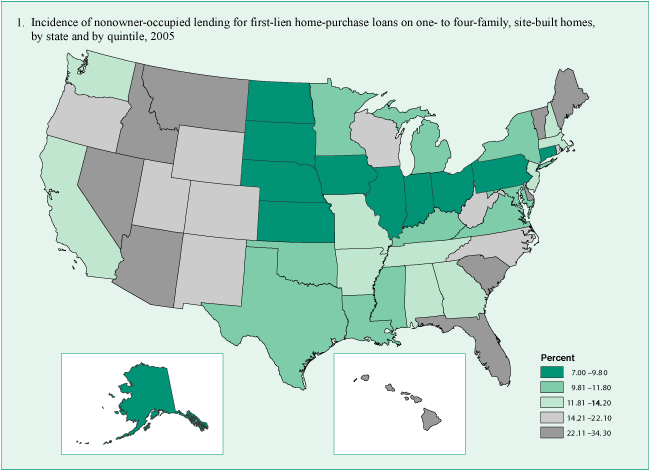
The extent of lending for nonowner-occupied properties varies considerably by geography (figure 1). Some of the states with the highest incidence of such lending in 2005 included Florida, Nevada, Hawaii, South Carolina, and Vermont, all of which have significant second-home markets. Each of these states has also experienced elevated shares of lending for nonowner-occupied properties for the past several years.
Piggyback LendingThe expanded HMDA data provide an opportunity to measure the extent to which homebuyers are simultaneously obtaining first- and junior-lien loans. Such simultaneous borrowing has been a feature of the conventional mortgage marketplace for some time but has grown in importance in recent years as lenders have marketed products intended to offer consumers an alternative to private mortgage insurance (PMI) or, in some cases, a line of credit that may be used for a variety of purposes. Simultaneous borrowing of this type is often referred to as a "piggyback" loan or an "80-10-10" loan. Many first-time homebuyers have few assets available to satisfy down-payment and closing-cost requirements, and thus they can ordinarily qualify for a mortgage only with a high LTV ratio and some type of mortgage backing that protects the lender in case of default. Other borrowers have the financial capacity to make a large down payment but prefer not to do so. Traditionally, lenders and secondary-market purchasers have sought protection in case of borrower default for loans with high LTV ratios. PMI reduces a lender's credit risk by insuring against losses associated with borrower default up to a contractually established percentage of the claim amount. PMI premiums are paid by the borrower, usually as an add-on to the monthly mortgage payment. Typically, PMI is required on conventional loans with LTV ratios above 80 percent. Over the past few years, lenders have become more active in self-insuring by waiving PMI requirements if a borrower simultaneously takes out a first-lien loan with an LTV ratio of 80 percent or more and a junior-lien loan at a higher price to cover the remaining portion of the loan. The combined loans are often competitive on a price basis with a single loan involving PMI and offer the borrower a tax advantage because the interest payments on the junior-lien loan are generally tax-deductible, whereas the PMI premiums are not. Piggyback loans are not identified as such in the HMDA data. However, the data provide a basis for identifying piggyback loans if one assumes that two conventional home-purchase loans involving properties in the same census tract, from the same lender, with identical time of application and closing, and with the same owner-occupancy status, borrower income, race or ethnicity, and sex involved the same borrower and the same home. Since 2004, the identification process has been improved by the addition of lien status, which earlier could only be approximated by comparing the size of loans that were matched. For 2005, we estimate that about 85 percent of the junior-lien home-purchase loans for owner-occupied properties can be matched to a first-lien loan by this process.20 The expanded HMDA data document the importance of the junior-lien home-purchase loan market. For 2005, lenders reported on a total of 1.37 million junior-lien loans used for the purpose of home purchase, up 74 percent from 2004 (data not shown in tables). The vast majority of junior-lien loans are conventional loans: Only a very small number (fewer than 1,000 nationwide) of the junior-lien loans issued in 2005 involved government-backed forms of credit (table 4). Overall, for 2005, we estimate that 22 percent of the reported first-lien home-purchase loans on owner-occupied site-built homes for one to four families involved a junior-lien or piggyback loan reported by the same lender, up from nearly 14 percent in 2004 (table 7).skip table 7
Piggyback lending varies by borrower income and race or ethnicity as well as by geography and loan characteristic.21 Minority borrowers, borrowers with middle or upper incomes, and borrowers who purchased homes in lower-income census tracts are more likely to use piggyback loans to purchase homes than non-Hispanic whites or lower-income borrowers.22 The apparent inconsistency between the results for borrower income and those for census-tract income appears to be driven by the relatively high incidence of the use of piggyback loans by middle- and upper-income borrowers purchasing homes in lower-income areas. Piggyback lending is also related to the amount borrowed, as larger first-lien loans are more likely to be associated with piggyback lending than are smaller loans. Regionally, piggyback lending is most common in the western region of the country and is particularly frequent in California, Nevada, and Colorado. Piggyback lending is closely related to the location of a property relative to the lender's assessment areas as defined by the CRA. Borrowers who are obtaining loans to purchase homes in the CRA assessment areas of their lenders are much less likely to use piggyback loans than are borrowers purchasing homes outside of their lenders' assessment areas or borrowers obtaining loans from lenders not covered by the CRA (independent mortgage companies and credit unions).23 Although the HMDA data do not provide an explanation for this finding, one possibility is the availability of special low-down-payment lending programs for homebuyers purchasing homes in lenders' CRA assessment areas, programs that would tend to diminish the need for a junior-lien loan to provide a source of down payment when purchasing a home. The incidence of piggyback lending varies across neighborhoods according to the distribution of credit scores among those with outstanding mortgages, the distribution of educational attainment levels of neighborhood residents, and the proportion of minority residents in the neighborhood.24 The incidence of piggyback lending is higher in areas that have larger proportions of mortgage borrowers with low credit scores and that have larger minority populations and is smaller in areas that have larger proportions of residents with more than a high-school education. These three relationships generally hold regardless of the level of census-tract income (data not shown in table). Loans for Manufactured HomesUntil the release of the 2004 data, users of HMDA data had no certain way to identify which applications and loans involved manufactured homes.25 To help overcome this limitation, the Department of Housing and Urban Development (HUD) produced annually a list of reporting institutions (typically about twenty) that it believed were primarily in the business of extending such credit.26 Users of the HMDA data often relied on the HUD list to identify, albeit imperfectly, loans and applications related to manufactured homes. This practice had its own limitations: It could not be used to identify applications and loans related to manufactured homes reported by lenders not on the HUD list, and data users often assumed that all loans by lenders on the list were for manufactured homes when some were not. The expanded HMDA data resolve this problem by including a code to identify applications and loans for manufactured homes. The 2005 HMDA data indicate that roughly 4,400 lenders extended more than 256,000 manufactured-home loans, a loan volume up slightly from that in 2004. Among these lenders, the ten that extended the largest number of manufactured-home loans accounted for 29 percent of the loans, and the top twenty accounted for 39 percent (data not shown in tables). Loans for manufactured homes entail more credit risk than do most other forms of secured credit extended to consumers. Lender caution is reflected in the very high denial rates on applications for loans backed by manufactured homes. As noted, past HMDA data did not distinguish applications for manufactured homes from those for site-built properties. Analysis of the HUD list of manufactured-home loan specialists suggested that such lenders had very high denial rates and that, for lenders offering both manufactured-home loans and other home loans, a distorted picture of their propensity to deny credit could easily be drawn. The 2005 data document the importance of distinguishing applications for manufactured homes from those for site-built properties. For example, denial rates for applications for conventional first-lien home-purchase loans on manufactured homes were 52.6 percent in 2005, compared with 16.4 percent for such applications related to the purchase of one- to four-family site-built homes (table 4). Manufactured housing also differs from site-built homes in that it serves relatively more lower-income households but fewer minorities. Of those obtaining loans to purchase manufactured homes, 38 percent were of lower income, whereas of those borrowing to purchase site-built homes, about 20 percent had lower incomes (table 8). On average, minority borrowers have lower incomes than do non-Hispanic white borrowers, but only about 15 percent of manufactured-home purchasers were members of a racial or ethnic minority group, whereas about 28 percent of purchasers of site-built homes were minorities.skip table 8
Secondary-Market ActivityHMDA data document the importance of the secondary market for home loans. Of the 21.5 million home loans originated or purchased in 2005 by lenders covered by HMDA, 14.9 million, or nearly 70 percent, were sold in 2005 (data not shown in tables).27 Prominent in the secondary market are government-sponsored enterprises (GSEs)--in particular, Fannie Mae and Freddie Mac. For the most part, the purchases of Fannie Mae and Freddie Mac in 2005 consisted of conventional first-lien loans originated to purchase homes or to refinance existing loans. These two GSEs accounted for 28 percent of all loans purchased by all secondary-market institutions as reported in the HMDA data. Fannie Mae and Freddie Mac, however, focus on the purchase of conventional home loans within size limits established each year by the Federal Housing Finance Board. Among such loans, these two GSEs accounted for about 32 percent of the purchased conventional conforming loans.28 Moreover, mortgage loans purchased by Fannie Mae and Freddie Mac are largely resold in the form of mortgage-backed securities. Other types of purchasing institutions active in the secondary market include private securitization pools (12 percent of all loans sold); mortgage, finance, and insurance companies (13 percent); depository institutions (6 percent); Ginnie Mae (3 percent); affiliates of institutions covered by HMDA (16 percent); and "other" purchasers (22 percent).29 The 2005 HMDA Data on Loan PricingThe expanded HMDA data allow analysis of loan pricing along a number of dimensions, including by loan product, across lenders and markets, and by financial and personal characteristics of borrowers. The results of this analysis have implications for fair lending enforcement and CRA supervision activities and for consumer financial education efforts. The release of the 2005 HMDA data adds a time dimension to the analysis that can be undertaken because data users now have two years of loan-pricing information at their disposal. However, caution is warranted, as the different interest rate situations in 2004 and 2005 affected the reported pricing data in important ways. The Interest Rate Situation and the Reporting of Higher-Priced LoansYear-to-year changes in the number or proportion of loans with prices that exceed the thresholds for reporting price information under HMDA must be interpreted with great care. It is tempting to assume that a change in the incidence of higher-priced lending from one year to the next simply reflects changes in the volume of subprime lending activity. This simple interpretation ignores a number of factors that may influence the incidence of reported higher-priced lending. An important consideration is the difference between the criteria used to distinguish loans that are reportable under HMDA as higher priced and the factors that truly reflect the elevated credit risks or costs associated with subprime lending. The difference means that there is not a direct correspondence between higher-priced and subprime lending. Three factors may lead to changes in the reporting of higher-priced lending. The first is lenders' business practices, particularly lenders' willingness or ability to bear credit risk. For example, an increase in competitive conditions in the higher-credit-risk portion of the market has driven down margins and encouraged lenders to offer a wider range of products. The second factor that may affect the reporting of higher-priced lending is consumers' borrowing practices or credit-risk profiles. Changes in borrower credit-risk profiles can alter the incidence of subprime lending even when the interest rate situation is stable. Such changes reflect real fluctuations in economic behavior or conditions rather than an artifact of the HMDA reporting criteria. The credit-risk profile of the population of borrowers can vary as changes in general economic conditions encourage one group or another to be relatively more active in the homebuying or refinancing markets or to alter the types of refinancings that are undertaken (for example, the share that involves cashing out equity). The credit-risk profiles of borrowers may also be affected by local economic conditions. For example, when local house prices are high relative to incomes or rise rapidly, more borrowers may have to stretch financially to qualify for loans, and the result is an increase in the pool of borrowers with high DTI or LTV ratios, both of which are related to elevated credit risk. The third factor is the interest rate situation--specifically, the relationship between short- and long-term interest rates. Generally, interest rate changes can significantly affect whether loans are reported as higher priced but are less likely to affect the credit-risk component of loan pricing. The credit-risk component can be affected if interest rate movements influence the loan-product mix that borrowers use: In some years, for example, adjustable-rate loans may be relatively more attractive than fixed-rate loans. The Interest Rate Situation and the Yield CurveThe yield curve displays how the yield on financial instruments, such as U.S. Treasury securities, varies with maturity and, therefore, reflects the relationship between short- and long-term interest rates. The yield curve is typically upward sloping--that is, short-term rates are typically lower than long-term rates. It usually has such a slope because longer-term investments ordinarily involve greater risk (credit risk, market interest rate risk, and inflation premium), and consequently investors require a higher return to be willing to invest their funds for longer periods. Over the past twenty years, longer-term rates (for example, the average annual yield on thirty-year Treasury securities) have almost always exceeded shorter-term rates (for example, the average annual yield on five-year Treasuries), a pattern illustrated by the positive difference in these rates over time (figure 2). Sometimes, however, the yield curve is relatively flat--that is, short-term rates are close to long-term rates; occasionally, the yield curve inverts, and short-term rates rise above long-term rates. A review of the rate spreads between five-year and thirty-year Treasury securities over the past two decades indicates that 2003 and 2004 were somewhat unusual years by historical standards because the yield curve was particularly steep during this time, and consequently the gap between longer- and shorter-term rates was particularly large. Changes in the shape of the yield curve affect the reporting of higher-priced loans under HMDA. Because most mortgages prepay in a relatively short period (well before the stated term of the loan is reached), lenders use relatively short-term interest rates to set mortgage rates. For example, lenders often price thirty-year mortgages according to interest rates on maturities of fewer than ten years, and they frequently price certain loan products, such as adjustable-rate mortgages, on the basis of much shorter terms than those for fixed-rate loans. But for most loans, Regulation C requires lenders to use longer-term rates (for terms of twenty years or more) to determine whether to report a loan as higher priced because the stated maturity of most loans, particularly first-lien loans, exceeds twenty years. Thus, a change from one year to the next in the relationship between short- and long-term rates can cause a change in the proportion of loans that are reported as higher priced, all other things being equal. For example, if short-term rates rise relative to long-term rates, then the number and proportion of loans reported as higher priced will increase even if all other factors that may influence the number and proportion of higher-priced loans, such as the business practices of lenders and the credit-risk profiles and borrowing practices of borrowers, remain constant. Conversely, if short-term rates fall relative to long-term rates, then the number and proportion of loans reported as higher priced will fall even if all other possibly influential factors remain constant. Changes in the Yield Curve from 2004 to 2005The yield curve at the start of 2004 (the first year lenders were subject to the price disclosure provisions of HMDA) was upward sloping: In mid-January, for example, the yield on five-year Treasuries was 2.97 percent, and the yield on thirty-year Treasuries was 4.87 percent. Over the course of the year, the difference narrowed as shorter-term rates rose and longer-term rates fell slightly. By early January 2005, the yield on five-year Treasuries had risen to 3.71 percent, and the yield on thirty-year Treasuries had fallen to 4.72 percent. Shorter-term interest rates continued to rise through 2005 (4.33 percent at the end of December), while longer-term rates were essentially unchanged (4.75 percent). Thus, although at the beginning of 2004 short-term rates were well below long-term rates, by the end of 2005 short- and long-term rates were much closer. Because of the changes in the relationship between short- and long-term interest rates, the gap between the effective interest rate (measured by the APR on the loan) on most mortgages and the HMDA threshold for reporting higher-priced loans narrowed markedly between 2004 and 2005. For example, for loans priced during the week of January 15, 2004, the average APR on conventional first-lien fixed-rate thirty-year prime loans reported by Freddie Mac was 5.72.30 As a result, a gap of 215 basis points, or 2.15 percentage points, separated the APR of the typical prime loan priced that week and the HMDA reporting threshold. By December 15, 2005, the gap between the calculated APR and the HMDA threshold had narrowed to 140 basis points. Although factors other than interest rate changes may also have influenced the proportion of higher-priced loans reported under HMDA, this example clearly demonstrates that even if such factors (including business practices or consumer credit-risk profiles) had remained the same, the proportion of higher-priced loans reported under HMDA would have increased in 2005. Although the year is not complete, the yield curve for 2006 has experienced further flattening and, if other conditions remain the same, will likely result in an even greater incidence of higher-priced lending as defined by Regulation C. Through mid-July 2006, the gap between the calculated APR on conventional first-lien fixed-rate thirty-year prime loans reported by Freddie Mac and the HMDA threshold had decreased to about 120 basis points. The Interest Rate Situation and the Relative APRs of Fixed- and Adjustable-Rate LoansThe Federal Reserve Board's Regulation Z requires that, in calculating the APR for adjustable-rate loans, lenders assume that the interest rate situation at the time of origination will continue for the term of the loan. When the yield curve is steep, it suggests that the market expects short-term interest rates to rise, yet the APR calculation for adjustable-rate loans assumes that interest rates will stay the same.31 Because of this regulatory construct, when the yield curve is positively sloped, the APRs for adjustable-rate loans tend to be lower than those for fixed-rate loans of similar term and credit risk. Thus, the flattening of the yield curve over the 2004-05 period had two effects. First, as noted earlier, it narrowed the gap between the longer-term rates used for the HMDA reporting threshold and the shorter-term rates used for pricing loans. Second, the flattening narrowed the APR gap between adjustable- and fixed-rate loans because, as short-term interest rates increased, it reduced the effect of the comparatively low APR calculations for adjustable-rate loans.32 The likely result of the flattening of the yield curve was an increase in the proportion of adjustable-rate loans that exceeded the HMDA price-reporting thresholds. The increase occurred because many relatively high-rate adjustable-rate loans that would not have been reported as higher priced in 2004 because of comparatively low APRs were reported that way in 2005. To illustrate this effect, we show the APRs of the prime thirty-year fixed-rate loans, the prime one-year adjustable-rate loans, and the prime five-year adjustable-rate loans reported in the Freddie Mac mortgage interest rate survey for 2004-05 (figure 3).33 The bottom three lines of the figure represent the differences (gaps) between the effective rates (APRs) reported by Freddie Mac and the HMDA reporting threshold. As noted earlier, the reporting gap between the typical prime thirty-year fixed-rate loan and the reporting threshold narrowed from 215 basis points at the beginning of 2004 to 140 basis points at the end of 2005. For one-year adjustable-rate loans, the gap narrowed much more, from 404 basis points at the beginning of 2004 to only 75 basis points at the end of 2005. Although the differences between the APRs on fixed- and adjustable-rate loans and the reporting threshold decreased for both types of loans, the decrease for adjustable-rate loans was much larger. Thus, the gap between the APRs on fixed- and adjustable-rate loans, which was substantial at the beginning of 2004, had been virtually eliminated by the beginning of 2005. This finding suggests that, as an artifact of regulation, geographic areas with different percentages of fixed-rate versus adjustable-rate loans might have shown different incidences of higher-rate loans in 2004. That is, in 2004, areas with larger shares of adjustable-rate loans likely had fewer higher-priced loans than areas with larger shares of fixed-rate loans. This effect should have been much smaller in 2005 (and in the first half of 2006) because interest rates on adjustable- and fixed-rate loans were closer together. The Interest Rate Situation and Junior-Lien LoansThe effects of the changing yield curve are reflected primarily among first-lien loans, which typically have long terms to maturity. The effect on junior-lien loans is likely much less, as these loans typically have maturities considerably shorter than those of first-lien loans and are priced accordingly. Also, the HMDA price-reporting threshold for junior-lien loans is set 2 percentage points higher than that for first-lien loans, a fact that may make the price reporting for junior-lien loans less sensitive to changes in the yield curve. Real Incidence of Higher-Priced LendingChanges in the incidence of higher-priced lending caused by the yield curve effects described earlier are to a large extent an artifact of the way Regulation C defines a higher-priced loan. That is, they reflect changes in the way the threshold and APRs (particularly for adjustable-rate loans) are computed and not necessarily changes in the business practices of lenders or in the credit-risk profiles or preferences of consumers. It is difficult to speculate on the importance of the latter two factors in explaining changes in the "real" incidence of higher-priced lending over time. The 2004-05 period was characterized by a relatively robust housing market without equity declines or economic downturns. However, rapidly rising home prices in several areas of the country may have put upward pressure on LTV and DTI ratios, particularly for first-time homebuyers, many of whom stretched financially to buy homes. These changes may have increased the proportion of homebuyers who obtained higher-priced loans. The effects may have differed geographically, as rates of home-price appreciation and the levels of home prices varied across the country. Analysis of HMDA data provides support for this conjecture, as it shows a positive correlation between the rate of house-price appreciation in a state and the loan-to-income ratio of homebuyers.34 Industry sources provide some support for the view that the incidence of higher-priced lending experienced a real increase from 2004 to 2005. Most of the increase seems to have taken place in the near-prime, or "alt-A," market. For example, Inside Mortgage Finance Publications reports that from 2004 to 2005, the subprime share of the overall market rose somewhat, from 18.5 percent to 20 percent.35 But over the same period, the near-prime portion of the market rose substantially more, from 7 percent to 13 percent. Incidence of Higher-Priced LendingMost loans reported in 2005 were not higher priced as defined under Regulation C, although the incidence of higher-priced lending was significantly greater in 2005 than in 2004. For 2005, 26.2 percent of all reported loans (excluding loans with application dates before 2004) were higher priced (table 4). This percentage represents an increase of nearly 70 percent over the 15.5 percent rate in 2004. The incidence of higher-priced lending varies considerably across loan products. First, in almost all cases, government-backed loans--insured by the Federal Housing Administration (FHA) or guaranteed by the Veterans Administration (VA)--have much lower incidences of higher-priced lending than do comparable conventional loan products. For example, in 2005, among first-lien home-purchase loans for site-built homes, 24.6 percent of conventional loans had APRs above the pricing threshold versus only 0.9 percent of government-backed loans. Second, with few exceptions, first-lien loans have a lower incidence of higher-priced lending than do junior-lien loans for the same purposes. For example, in 2005 the incidence of higher-priced lending for conventional first-lien refinance loans was 25.7 percent, whereas for comparable junior-lien loans it was 30.2 percent. Third, manufactured-home loans exhibit the greatest incidence of higher pricing across all loan products, a result consistent with the elevated credit risk associated with such lending. For 2005, nearly 60 percent of the conventional first-lien loans used to purchase manufactured homes were higher priced. In the secondary market, the vast majority of the purchases by Fannie Mae and Freddie Mac involved loans with prices below the thresholds for reporting price information under HMDA (data not shown in tables). In total, institutions reporting under HMDA indicated that 3 percent of their loan sales to these two GSEs had involved higher-priced loans and that Fannie Mae had purchased the bulk of the loans.36 Other secondary-market purchasers were active in buying higher-priced loans, which accounted for more than half the sales of private securitization pools; about one-third the sales of insurance companies, mortgage bankers, finance companies, and credit unions; and about one-third the sales of "other" purchasers. Rate Spreads for Higher-Priced LoansThere is considerable variation across loan products in the incidence of higher-priced lending, but variation across products in mean and median APR spreads as reported in the HMDA data is much smaller. For example, for 2005, the mean APR spreads reported for higher-priced conventional first-lien loans for the purchase or refinancing of an owner-occupied site-built home were both about 4.8 percent (table 4). Reflecting, at least in part, the changing interest rate situation, the levels of the average spreads for these two large loan product categories were both about 70 basis points higher in 2005 than in 2004. Because the threshold for reporting is set higher for junior liens than for first liens, higher-priced junior-lien products have higher mean and median spreads than do higher-priced first-lien loans. However, unlike the average spreads for first-lien loans, those for junior liens rose little between 2004 and 2005. As noted earlier, the typical junior-lien loan has a term to maturity that is much shorter than that for first-lien loans, and so its funding cost typically depends more on shorter-term sources of funds; consequently, the flattening of the yield curve had much less effect on price reporting for junior-lien products. In fact, the mean spreads reported for the refinancing of junior-lien loans were actually somewhat lower in 2005 than in 2004. Loans for manufactured homes differ from other loan products in that they generally have the highest mean spreads. As with the pricing of junior-lien loans, prices on loans for manufactured homes were little changed from 2004, an indication that most of these loans have shorter terms to maturity than do most first-lien loans. Although the changes in the means and the medians are consistent with an upward shift in the distribution of reported interest rates from 2004 to 2005, the changes in the distribution of spreads for higher-priced loans are somewhat puzzling. In 2004, for conventional first-lien products, almost 60 percent of the higher-priced loans fell within 1 percentage point of the reporting threshold, and the percentage declined in each subsequent pricing segment (refer to segment ranges--such as 3-3.99, 4-4.99, and so on--in table 4). The pattern was similar to the truncated upper tail of a normal (bell-shaped) distribution--that is, the distribution was monotonically declining. For 2005, the pattern was quite different. Only about 27 percent of the higher-priced loans fell within 1 percentage point of the reporting threshold, and the percentage increased in the next two pricing segments before declining thereafter. This nonmonotonic pattern is not what one would expect if the changes in interest rates in 2004-05 uniformly shifted the distribution of loan rates. The pattern is not a consequence of reporting by any one (highly active) lender or for any one loan product or area of the country. Interestingly, this pattern does not hold for junior liens, which exhibited the same declining segment share of a truncated normal curve for 2005 as they did for 2004. As in 2004, only a very small proportion of the higher-priced first-lien loans reported in 2005 had spreads that exceeded 7 percentage points. Similarly, only a small proportion of most types of junior-lien loans had spreads of 9 percentage points or more. For example, among the higher-priced conventional first-lien loans used to purchase owner-occupied site-built homes, only 3.6 percent had spreads that exceeded 7 percentage points (in 2004, the share of loans of this type with rate spreads exceeding 7 percentage points was 1.4 percent). Among the conventional junior-lien loans, only those for home improvement had large proportions (about 25 percent) with rate spreads above 9 percentage points. Pre-Approval Programs and Loan PricingSince 2004, the HMDA data have included information about certain types of requests for pre-approval of home-purchase loans. But for purposes of reporting under Regulation C, pre-approval programs pertain only to requests for home-purchase loans, and consequently the data do not include pre-approval information for applications involving a refinance or home-improvement loan. As with the 2004 data, the data for 2005 indicate that the incidence of higher-priced lending is notably lower for conventional loans for site-built homes that were initiated through a pre-approval program than for all such loans. For example, for conventional loans secured by a first lien on a site-built home, the incidence of higher-priced lending for loans initiated through a pre-approval program was 15.2 percent (table 5), whereas the rate for all similar first-lien conventional loans was 24.6 percent (table 4). The pattern differs for conventional loans to purchase manufactured homes: Loans initiated through a pre-approval program were more likely to be higher priced. Perhaps those who seek pre-approvals for manufactured homes are more likely to be stretching financially and feel a need to provide prospective sellers with some assurance that they will qualify for credit. For borrowers who received higher-priced loans for site-built homes, the data do not suggest any meaningful differences in actual prices paid, as the mean and median spreads were quite similar whether or not a borrower went through a pre-approval program. For those obtaining loans to buy manufactured homes, the mean and median spreads were about 100 basis points higher for loans initiated through pre-approval programs. Differences among Lenders in the Propensity to Make Higher-Priced LoansAs in 2004, most of the nearly 8,500 lenders covered by HMDA reported extending few if any higher-priced loans in 2005: Nearly 3,200 lenders made no such loans, and an additional 2,000 reported only between one and nine higher-priced loans (data not shown in tables). Toward the other end of the spectrum, about 1,120 lenders reported making at least 100 higher-priced loans; these more-active lenders accounted for 98 percent of all reported higher-priced loans. Moreover, the ten lenders with the largest volume of higher-priced loans extended 59 percent of all such loans, a share that had increased from 38 percent in 2004. Lenders extending large numbers of higher-priced loans can be quite different from other lenders in business orientation. Some lenders focus on the higher-priced segment of the market and extend nearly all their loans to near-prime or subprime borrowers. However, many institutions serve a broader market, including borrowers from the prime and nonprime market segments. If one considers a lender that devotes 60 percent or more of its business to higher-priced lending a "specialist" in this business segment, then among the roughly 1,120 lenders reporting at least 100 higher-priced conventional home loans, 346, or 4 percent of all reporting institutions, can be characterized as specialists. It should be kept in mind that the HMDA data can be used to gauge a lender's business focus only roughly, as some prime loans will exceed the HMDA price-reporting threshold and some subprime loans may not reach the threshold. Loans Covered by HOEPAUnder the Home Ownership and Equity Protection Act of 1994 (HOEPA), certain types of mortgage loans that have rates or fees above specified levels require additional disclosures to consumers and are subject to certain restrictions on loan terms.37 Under the 2002 revisions to Regulation C, the HMDA data indicate whether a loan is subject to the protections of HOEPA. Coverage under HOEPA is determined by a two-part test that considers both the APR and the dollar amount of points and fees. The APR portion of the coverage test is similar to the method used to determine which loans are higher priced under HMDA. The difference relates to the rules for choosing the specific Treasury security to use for determining coverage under the two regulations. In the case of HMDA, determining which loans are higher priced requires using the Treasury security of comparable maturity for the fifteenth day of the month preceding the date on which the loan rate was set. For HOEPA, the APR portion of the coverage test requires using the Treasury security of comparable maturity for the fifteenth day of the month preceding the month in which the application was received. Another difference is that the APR spreads for determining HOEPA coverage are 8 percent and 10 percent for first- and junior-lien loans respectively. Before the release of the 2004 data, little information was publicly available about the extent of HOEPA-related lending or the number or type of institutions involved in this activity. Although the expanded HMDA data provide important new information, the data fail to capture all HOEPA-related lending. Some HOEPA loans are extended by institutions not covered by HMDA, and some HOEPA loans made by HMDA-covered institutions are not reported under Regulation C, which implements HMDA. Most notably, if the proceeds of a home-secured loan are not used to refinance an existing home loan or to finance home improvement, then the loan may be covered by HOEPA but is not reportable under Regulation C.38 The extent of HOEPA-related lending not reported under HMDA is unknown. Incidence of HOEPA-Related LendingFor 2005, more than 1,300 lenders reported nearly 36,000 loans covered by HOEPA, an increase of 53 percent from 2004 (table 4). As in 2004, most lenders did not report extending any HOEPA loans in 2005. For 2005, HOEPA-related lending appears to have been quite concentrated: The ten lenders that reported the largest number of HOEPA originations accounted for 70 percent of all reported HOEPA loans (data not shown in tables). At the other extreme, 730 institutions reported making only one or two HOEPA loans. Although the incidence of HOEPA-related lending was up significantly over that reported in 2004, such lending still accounted for a very small proportion of the market. HOEPA loans accounted for less than one-half of 1 percent of all the originations of home-secured refinance or home-improvement loans reported for 2005 (data derived from table 4). The volume of HOEPA-related lending, like that of higher-priced lending, was affected by the flattening of the yield curve from 2004 to 2005. However, it is impossible to determine precisely how much of the increased volume of HOEPA-related lending was due to changes in interest rates because, as noted earlier, HOEPA coverage is based not only on APR levels but also on the dollar amount of loan points and fees. Characteristics of HOEPA-Related LendingFor 2005, the vast majority of HOEPA loans involved conventional loan products: Only a very small percentage of such loans were government backed. About 60 percent of the reported HOEPA loans involved conventional first-lien loans (of these, more than 80 percent were for refinancings), and about 40 percent involved conventional junior-lien loans (more than half of these were for refinancings). Reported HOEPA lending varies among borrowers sorted by borrower income, race, and ethnicity and among census tracts sorted by census-tract income, population, and location. However, the data do not indicate that HMDA-reportable HOEPA lending is focused primarily on lower-income or minority individuals or on those residing in lower-income neighborhoods or neighborhoods with high concentrations of minority individuals. For example, although reported HOEPA loans were extended to borrowers in all income groups, nearly two-thirds were extended to middle- and upper-income borrowers (data not shown in tables). Similarly, more than 70 percent of the reported HOEPA loans were extended to non-Hispanic white borrowers. Most of the homes securing HOEPA loans were in middle- or upper-income areas, and a large proportion were in areas where the minority population was less than 20 percent of the census-tract population. Pricing Analysis Using Adjusted 2004 and 2005 DataAs discussed earlier, the flattening of the yield curve over the 2004-05 period affected the proportion of loans reported as higher priced because of the way the price-reporting threshold and the adjustable-rate APR are determined. The size of these effects cannot be quantified precisely with the limited information available in the HMDA data. However, we can compute rough estimates of the magnitude of the yield curve effects on the incidence of higher-priced lending, although our estimates likely understate the effects. Effects on Loan Pricing of the Method for Setting the HMDA Price-Reporting ThresholdTo estimate the effect on loan pricing of the way the HMDA price-reporting threshold is determined, we use an adjusted set of the 2004 and 2005 HMDA data that enables us to identify those loans that exceeded the pricing thresholds solely because of a change in the interest rate situation. We separate all reported higher-priced loans into two groups: (1) those that would have been reported under any interest rate situation that prevailed during the 2004-05 period and (2) those that were reported only because of the interest rate situation that existed at the time the loan was made. In separating the higher-priced loans, we assume that a nonprime borrower would receive a loan rate that is no less than a constant markup over the rate on a "prime mortgage" and that this markup (discussed below) is independent of interest rates. Thus, our exercise is to determine how much above the interest rate for a prime mortgage a cutoff would need to be set such that a loan priced above the cutoff would have been reported under any interest rate situation prevailing in 2004-05. To conduct the exercise, we must determine the prime rate that would apply to each loan. In reality, the prime rate can vary from day to day and from product to product, depending on the term of the mortgage, the type of rate (fixed or adjustable), the date the loan price was set, the geographic location in which the loan was made, and other factors. The only portion of this information that is explicitly included in the HMDA data is location. Nevertheless, the necessary information can be approximated. Almost 80 percent of first-lien prime mortgages have a fixed rate of interest, according to LoanPerformance, and most of these have a thirty-year term to maturity.39 The date the loan price was set (the lock date) is not reported in the HMDA data, but the application and origination dates are recorded. We approximate the loan terms and the lock dates for all conventional first-lien mortgages by assuming that they are all thirty-year fixed-rate mortgages and that the day on which the mortgage pricing was set is halfway between the date of application and the date the loan was originated.40 Because terms vary so much for junior-lien loans, we conduct this exercise only for first-lien loans. To estimate the prime rate, we use the weekly Freddie Mac Primary Mortgage Market Survey. The survey reports the average contract rates and points for all loans and the margin for adjustable-rate loans.41 We use this information to estimate the average APR for adjustable- and fixed-rate loans prevailing each week. We calculate the "adjusted spread" for each loan in the HMDA data as the difference between the estimated prime fixed APR and the applicable HMDA threshold in effect on the date the loan was estimated to have locked. We estimate that a loan with an adjusted spread of 228 or more basis points above prime would have been reported as higher priced regardless of the date of origination during 2004-05--that is, 228 basis points is the minimum spread for a loan to have been reported as higher priced during this period. Loans with adjusted spreads between 140 basis points and 228 basis points would have been reported as higher priced if originated on some days during the period but not on others. Loans with adjusted spreads below 140 basis points would not have been reported under any circumstances during this time frame. We compute incidences and APR spreads for 2004 and 2005 that have been "spread adjusted" for changes in the yield curve. These figures are computed in exactly the same way as the overall incidences and mean APR spreads, as shown in tables 4 and 5, except that those loans with adjusted spreads below 228 basis points are deemed not to be higher priced. And the adjusted spreads are spreads above the markup over the rate on a prime mortgage rather than spreads above the yield on a comparable-maturity Treasury security. By construction, the adjusted spreads for higher-priced loans have a minimum of 228 basis points instead of 300. Overall, the incidence of higher-priced lending for conventional home-purchase loans on owner-occupied site-built homes was 11.5 percent in 2004 and 24.6 percent in 2005, an increase of 13.1 percentage points (table 9). The spread-adjusted estimates for the same period were 10.4 percent and 21.5 percent respectively, an increase of 11.1 percentage points. This comparison suggests that 2 percentage points, or roughly 15 percent, of the total difference in reported higher-priced lending for this product can be attributed solely to the flattening of the yield curve. For refinancings for similar properties, about 2 percentage points of the 10.2 percent increase in higher-priced lending for refinance loans can be attributed solely to the yield curve.skip table 9
Estimated mean APR spreads are also lower after spread adjustment for the two conventional loan products. The mean APR spreads for conventional first-lien home-purchase loans, and for conventional first-lien refinance loans, on owner-occupied site-built homes were both about 4.8 percentage points before spread adjustment and 3.7 percentage points and 3.8 percentage points respectively using the spread-adjusted 2005 data. The unadjusted spreads increase about 70 basis points, and the adjusted spreads increase about 40 basis points. Effects of APR Calculations on Pricing of Adjustable-Rate LoansThe spread adjustments just described address only the effect that the flattening of the yield curve had on the gap between the HMDA reporting threshold and the interest rate at which long-term mortgages are typically priced, approximated by the Freddie Mac prime APR for thirty-year fixed-rate loans. Our spread adjustment reflects what the yield curve effect would have been if all first-lien loans reported in the HMDA data had been thirty-year fixed-rate mortgages. However, many loans included in the HMDA data are adjustable-rate loans, and, as noted earlier, the flattening of the yield curve also affected the gap between the calculated APRs on adjustable-rate mortgages and the calculated APRs on fixed-rate mortgages. At the beginning of 2004, a one-year adjustable-rate loan would have been treated comparably for purposes of HMDA price reporting to a thirty-year fixed-rate mortgage (of the same term to maturity) with an adjusted spread 200 basis points lower (refer to figure 3). By the beginning of 2005, this gap had been virtually eliminated. The implication of this narrowing of the gap is that, relative to fixed-rate loans, fewer adjustable-rate loans would have met the HMDA price-reporting thresholds in 2004 than in 2005. Fully quantifying this effect would be difficult even if the HMDA data distinguished fixed- from adjustable-rate loans. As shown in figure 3, applying the same method to one-year adjustable-rate loans that we employed for fixed-rate loans would necessitate using an adjusted threshold of about 400 basis points above the APR on the Freddie Mac prime one-year adjustable-rate loan. This approach would potentially exclude a large share of the higher-priced adjustable-rate loans reported under HMDA and would reflect only changes at the higher end of the subprime market. To provide some rough approximations as to what the effect might have been, we use information on the mix of adjustable- and fixed-rate loans for each state as derived from the LoanPerformance database. States are arrayed into quintiles based on the percentage of loans originated in 2005 that had an adjustable rate (table 10). California, which would have been placed in the quintile with the highest percentage of adjustable-rate mortgages, is treated as a special category and shown separately. For each quintile, we calculate the average incidence (spread unadjusted and spread adjusted) of higher-priced lending for 2004 and 2005. For home-purchase loans, the analysis indicates that states with high levels of adjustable-rate lending had both relatively low levels of higher-priced lending in 2004 and larger increases in such lending from 2004 to 2005 (refer to data under "Change, 2004-05" in home-purchase section of table), patterns that would have been predicted as resulting from the narrowing of the adjustable-fixed APR gap. It is noteworthy that the average spread-unadjusted incidence of higher-priced home-purchase lending for each of the five quintiles for 2005 was almost the same, an indication that the distortions caused by the difference in APRs between adjustable- and fixed-rate loans had been virtually eliminated during 2005.42skip table 10
California shows the same pattern as other states with a high percentage of adjustable-rate home-purchase loans, as it witnessed a significant increase in the spread-unadjusted incidence of higher-priced lending from 2004 to 2005. California's spread-unadjusted incidence of higher-priced lending in 2005 (31.4 percent) is substantially higher than that of other states with a large proportion of adjustable-rate loans, but this finding may be due not just to the flattening of the yield curve but also to the effects of borrowers stretching financially because of high home prices in California. The pattern for refinancing is different in California because large increases in home values are likely to benefit rather than hurt refinancers. Effects of Yield Curve Changes on Pricing of Adjustable- and Fixed-Rate LoansTo a limited extent, we can assess the differential effect of the flattening of the yield curve on the incidence of higher-priced lending among adjustable- and fixed-rate loans using individual loan data. The Monthly Interest Rate Survey (MIRS) of the Federal Housing Finance Board is a monthly survey of major lenders that collects detailed information on each conventional single-family nonfarm loan used to purchase a home closed during the last five business days of each month.43 The survey includes enough information to calculate an APR for each loan, to determine whether it is an adjustable- or fixed-rate loan, and, among the adjustable-rate loans, to identify the type of loan. The focus of the survey is on conventional prime rate loans. For 2004, the data for one-year adjustable-rate loans included near-prime loans. But starting with the data for February 2005, most of the near-prime loans were excluded from the sample. Thus, we limit the analysis of the one-year adjustable-rate loans to those made before February 2005. For the first few months of 2004, the percentage of one-year adjustable-rate loans included in the MIRS data that we estimate would have been reported as higher priced under HMDA was only about 1 percent. This percentage began to rise substantially in the middle of 2004, and by the end of the year the portion had risen to more than 18 percent. It appears that, at least within the MIRS data, the increase in the incidence of loans that would have been reported as higher priced under HMDA was driven almost entirely by the narrowing of the gap between the calculated APRs on adjustable- and fixed-rate loans. The distribution of rates of one-year adjustable-rate loans in the MIRS data relative to the APRs of the Freddie Mac prime one-year adjustable-rate loans remained unchanged--that is, their movements mirrored each other. The percentage of thirty-year fixed-rate loans in the MIRS data that we estimate would have been reported as higher priced under HMDA was little changed during the course of 2004 but rose, from about 1 percent to almost 4 percent, during 2005 (the thirty-year fixed-rate loans were not pruned to exclude near-prime loans). The patterns for the thirty-year fixed-rate and the one-year adjustable-rate loans in the MIRS data are consistent with what one would expect from the yield curve changes shown in figure 3. We emphasize that because the MIRS data do not include a full sampling of near-prime and subprime loans, the incidence of loans in the sample that would have been reported as higher priced under HMDA is not representative of all the loans included in the HMDA data. Nevertheless, the analysis here suggests that the flattening of the yield curve had a significantly larger effect on the reporting of adjustable-rate loans as higher priced than on the reporting of fixed-rate loans as higher priced. Therefore, our earlier estimate of the effect of the flattening of the yield curve is likely understated, perhaps substantially. Differences in Pricing across GeographiesThe HMDA data allow analysis of higher-priced lending along geographic lines. The analysis can be conducted by region of the country, metropolitan area, or census tract. Region of the CountryInterest rates on prime home loans vary across regions. For example, for 2005, there is a difference of 12 basis points between the average prime rate for the region with the highest rates (the North Central region) and that for the region with the lowest rates (the Southeast) as reported by Freddie Mac in its survey of interest rates (table 11). This variation likely reflects differences across regions in such factors as prepayment rates, foreclosure laws, origination costs, or degree of competition.skip table 11
The variation in the incidence of higher-priced lending across regions in both the 2004 and 2005 HMDA data is much larger than might be expected given the difference in prime rate variation and does not show the same rank ordering. For example, the Northeast region shows the lowest incidence of higher-priced lending for home-purchase loans in the 2005 HMDA data and the West region the highest. Further, the variation in the incidence of higher-priced lending across regions is 9 percentage points, a sizable difference. The large differences in the incidences of higher-priced lending across regions suggest that the regions differ considerably in terms of borrower credit-risk characteristics or other factors. Metropolitan AreaAnalysis of loan-pricing patterns for 2004 revealed that the incidence of higher-priced lending for home-purchase loans varied widely across regions of the country and MSAs.44 The 2005 data reveal a similar pattern, with some notable differences. A review of home-purchase lending at the level of the MSA indicates that, as compared with the 2004 pricing patterns, areas of the country with the highest incidence of higher-priced lending are not primarily in the southern and southwestern regions of the country but also include a number of MSAs in California (figure 4). The presence of several MSAs in California on the list of areas with a relatively high incidence of higher-priced lending may reflect the effects of rapid house-price increases, which result in more borrowers in these areas stretching financially to purchase homes. The fact that California MSAs tended to have relatively high proportions of higher-priced lending in 2005 but did not in 2004 may also be due to the relatively more frequent use in these areas of adjustable-rate loan products that are priced off of extremely short-term sources of funds, a practice that would, because of the flattening of the yield curve, tend to result in large increases from 2004 to 2005 in the number of loans with prices reported above the APR thresholds established by Regulation C.
The great variation in the incidence of higher-priced lending across MSAs is seen in a simple comparison. If one focuses on the incidence of higher-priced lending among conventional first-lien home-purchase loans on owner-occupied, one- to four-family, site-built homes, the MSA in the continental United States with the lowest incidence of higher-priced lending for this product is Ithaca, New York, at 4 percent; the MSA with the highest incidence is McAllen-Edinburg-Pharr, Texas, at 53 percent. Assessment of the reasons for the wide variation in the incidence of higher-priced lending for home-purchase loans across MSAs finds a close association between the proportion of individuals in an MSA county with low credit scores and the incidence of higher-priced lending in that area.45 Other factors positively related to a greater incidence of higher-priced lending across MSAs include the percentage of the MSA's adult population with less than a high-school education, rates of unemployment, and the racial or ethnic makeup of the MSA. Areas with higher unemployment rates and larger minority populations are more likely to have higher incidences of higher-priced lending. The geographic pattern in the incidence of higher-priced lending for refinancings is similar to the pattern for home-purchase loans, although the proportions of loans with prices above the reporting thresholds are generally higher for refinancings. The findings for MSAs along the Pacific Coast, and in the state of California in particular, are noteworthy because they differ from the general pattern: The incidences of higher-priced lending for refinancings in the MSAs in this area are typically much lower than those for home-purchase loans and for refinance loans in other areas. As noted earlier, this pattern may reflect, at least in part, the need for many homebuyers in this region, which has experienced rapid house-price appreciation, to stretch financially to purchase homes, while those refinancing have generally benefited from increased home equity as a result of home-price appreciation and consequently tend to pose less credit risk. Census TractThe incidence of higher-priced lending varies considerably across census tracts, with similar patterns for home-purchase loans (table 12.A.) and refinance loans (table 12.B.). Higher-priced lending is most common in census tracts with lower incomes, high percentages of minorities, depreciating real home values, low educational attainment, low credit scores, and high application denial rates. The variations across most of these categories are quite considerable. For example, in 2005, the incidence of higher-priced lending for home-purchase loans averaged 47 percent for census tracts in the category with the largest percentage of mortgage borrowers with low credit scores, compared with an incidence of only 16 percent for census tracts with a low percentage of mortgage borrowers with low credit scores (table 12.A.). Almost 40 percent of borrowers in census tracts with a low percentage of adults with schooling beyond high school had higher-priced loans, compared with 13 percent in tracts with a high percentage of residents with more than a high-school education.skip table 12
These relationships appear to be robust and persist even when we control for other factors. For example, if a comparison is made for census tracts with similar income levels and minority percentages but with varying educational attainment and credit scores, wide differences in the incidence of higher-priced lending persist. The fact that the relationship between the denial rate and the incidence of higher-priced lending persists after credit scores of tracts are controlled for is noteworthy. Certainly, a portion of the high correlation between the incidence of higher-priced lending and elevated denial rates is due to both factors being related to borrower indicators of elevated credit risk. However, the persistence of this pattern when credit scores are controlled for suggests that high denial rates may also increase the per-loan costs of loan origination and thus may influence pricing across census tracts.46 Differences in Pricing by Characteristic of Borrower, Loan, and LenderThere is considerable variation in the incidence of higher-priced lending by borrower, loan, and lender characteristics (tables 12.A. and 12.B.). Lower-income borrowers, borrowers with loan amounts below $100,000, borrowers using piggyback loans or loans from lenders not covered by the CRA, and minority borrowers all show elevated levels of higher-priced lending in the 2005 HMDA data. These factors reflect more than census-tract characteristics, as they show the same variation within census tracts of similar incomes. For example, the incidence of higher-priced lending for home-purchase loans averaged about 37 percent for loans below $100,000 but only 19 percent for loans of at least $250,000. Although HMDA data do not contain sufficient information to explain the latter pattern, one hypothesis is that some of the variation may be due to the fact that individuals who borrow small amounts may be more likely to have riskier credit attributes, such as lower credit scores.47 Another hypothesis is that small loans are more expensive on a per-dollar basis to originate and thus are more likely to be higher priced. As in 2004, the data for 2005 continue to show a much lower incidence of higher-priced lending by lenders that are covered by the CRA and that lend in their assessment areas than is shown by the same lenders when they make loans outside of their assessment areas. Although the HMDA data do not contain sufficient information to enable us to determine the causes of this pattern, several hypotheses are possible. As noted earlier, one possible explanation for at least part of the assessment-area effect may be that the channel through which loans are originated matters. Loans extended to borrowers outside an institution's assessment area may be more likely to come through mortgage brokers, who may price differently or who operate in areas with different market conditions than those faced by institutions that originate loans directly. Another possible factor is that these brokers serve markets or individuals who are more costly to serve or whose credit profiles are weaker, and the brokers price accordingly. Differences in Pricing by Race, Ethnicity, and Sex of BorrowerAnalysis of the 2004 HMDA data revealed substantial disparities in the incidence of higher-priced lending across racial and ethnic lines and further showed that such differences could not be fully explained by factors included in the HMDA data. The 2005 data show similar patterns. Because of its importance, we look at the incidence of higher-priced lending by race, ethnicity, and sex in a more detailed way than in previous sections. The analysis is more detailed in three respects. First, we examine pricing patterns for specific racial, ethnic, and gender groups. Second, we examine the incidence of higher-priced lending (both spread unadjusted and spread adjusted for changes in the yield curve) and the APR spreads (also spread unadjusted and spread adjusted) paid by those receiving higher-priced loans. Third, and most important, we examine whether these patterns persist when other factors included in the HMDA data are accounted for. We restrict our analysis to conventional first-lien home-purchase and refinance loans on owner-occupied, one- to four-family, site-built homes, as these are by far the largest two loan product categories in the HMDA data.48 In 2005, home-purchase and refinance loan products involved roughly 4.4 million and 5.5 million loans respectively. The HMDA data do not include many of the factors considered in credit underwriting and pricing. However, our analysis can include some variables likely related to the loan-pricing process. Specifically, the HMDA data allow an accounting for property location (for example, same metropolitan area), income relied on for underwriting, loan amount, and time of year the loan was made as well as presence of a co-applicant. To the extent that some of these HMDA factors are not used directly in loan underwriting or pricing, they are included in the analysis as proxies for at least some of the factors that are considered. For example, accounting for borrower income and for loan amount is a measure of the financial burden associated with the loan payments, as larger loans relative to income imply higher monthly payment burdens (if we assume that housing values are proportionate to income, higher loan-to-income ratios may also reflect higher LTVs). Because we are focusing on specific loan products, we are already controlling in broad terms for loan type and purpose, type of property securing the loan, lien status, and owner-occupancy status. In comparing lending outcomes across racial and ethnic groups, one can match for the sex of the applicant and co-applicant. Accounting for sex in the analysis is intended to better distinguish pricing issues related purely to the race or ethnicity of the borrower from those that may be related to sex. In assessing lending outcomes by sex, one can match for race and ethnicity. The analysis focuses on both the incidence of higher-priced lending and the mean APR spreads paid by borrowers with higher-priced loans, and we compare these outcomes across eleven groups--nine racial or ethnic groups and the two sexes. Comparisons of average outcomes for each group are made both before and after modifying the results for differences in the borrower-related factors cited earlier (income; loan amount; location--MSA--of the property; presence of a co-applicant; and, in the comparisons by race and ethnicity, sex) and for differences in borrower-related factors plus the specific lending institution used by the borrower. Excluded from the pricing analysis are applicants residing outside the fifty states and the District of Columbia, applications deemed to be business related, and applications filed during the transition period. Otherwise, the sample includes all 2005 HMDA loans for the two loan product categories we examine. Our method of controlling for these factors is to group borrowers into cells, as we did in our 2005 article assessing the 2004 HMDA data.49 Comparisons for lending outcomes across groups are discussed in the following sections. The comparisons are of three types: unmodified (or "gross"), modified for borrower-related factors (or "borrower modified"), and modified for borrower-related factors plus lender (or "lender modified"). For purposes of presentation, the borrower- and lender-modified outcomes shown in the tables are normalized so that, for the base comparison group (non-Hispanic whites in the case of comparison by race and ethnicity, and males in the case of comparison by sex), the mean at each modification level is the same as the gross mean. Consequently, the borrower- and lender-modified outcomes for any other group represent the expected average outcome if the members of that group had the same distribution of control factors as that of the base comparison group. Incidence of Higher-Priced Lending by Race and EthnicityThe 2005 HMDA data, like the 2004 data, indicate that black and Hispanic borrowers are more likely, and Asians borrowers less likely, to obtain loans with prices above the pricing thresholds than are non-Hispanic white borrowers. These relationships hold for both loan products and persist when the incidence is spread adjusted for the effects of the flattening of the yield curve (table 13, sections labeled "Spread adjusted"). Gross differences in the incidence of higher-priced lending between non-Hispanic whites, on the one hand, and blacks or Hispanic whites, on the other, are large, but these differences are substantially reduced after controlling for borrower-related factors plus lender. Most of the reduction in the difference in the incidence across groups comes from adding the control for lender to the control for borrower-related factors, an indication that the pricing differences within a given lender are typically smaller than the differences among loans across lenders.50skip table 13
For 2005, for conventional home-purchase loans, the gross mean incidence of higher-priced lending was 54.7 percent for blacks and 17.2 percent for non-Hispanic whites, a difference of 37.5 percentage points (table 13.A.). Borrower-related factors included in the HMDA data accounted for about one-fifth of the difference. Adding to this modification the control for lender reduces the remaining gap to 10 percentage points. By comparison, in 2004, the unmodified mean incidence of higher-priced lending for conventional first-lien home-purchase loans was 32.4 percent for blacks and 8.7 percent for non-Hispanic whites, a difference of 23.7 percentage points. Borrower-related factors accounted for about one-fourth of the difference. Adding to this modification the control for lender reduced the remaining gap to 7 percentage points. For 2005, for refinancings, the gross difference between blacks and non-Hispanic whites is 28.3 percentage points; the difference is reduced to 6.2 percentage points after controlling for borrower-related factors plus lender; most of the reduction in differences comes from the addition of the control for lender (table 13.B.). By comparison, in 2004, the gross difference between blacks and non-Hispanic whites was 21.7 percentage points; the difference was reduced to 4.7 percentage points after controlling for borrower-related factors plus lender, and about two-thirds of that reduction came from the addition of the control for lender. The picture for Asians differs greatly from that for blacks or Hispanic whites: Compared with non-Hispanic whites, Asians have a lower gross mean incidence of higher-priced lending for home-purchase and refinance loans. The gap is affected some by controlling for borrower-related factors plus lender; for home-purchase loans, the incidence of higher-priced lending remains lower for Asians than for non-Hispanic whites; for refinancings, the gap is essentially eliminated. Hispanic whites show a pattern similar to that of blacks but with smaller differences relative to non-Hispanic whites. One of the more notable pricing patterns that emerges is much narrower gaps across racial and ethnic groups for refinancings as compared with home-purchase lending. This pattern occurs despite the fact that the gross incidence of higher-priced lending is higher for refinancings for at least some groups, including non-Hispanic whites. Also, the gap between blacks and non-Hispanic whites is notably larger than that for other minority groups. Rate Spreads by Race and EthnicityThe 2005 data, like the data for 2004, indicate that among borrowers with higher-priced loans, the gross mean prices paid by black and Hispanic white borrowers are about the same as those paid by non-Hispanic white borrowers (table 14). Asian borrowers with higher-priced loans also paid about the same price, on average, as non-Hispanic whites with higher-priced loans. These relationships are consistent for both types of loans.skip table 14 Pricing Differences by SexThe 2005 HMDA data reveal little difference in pricing when borrowers are distinguished by sex. For example, sole female borrowers generally have a slightly lower incidence of higher-priced lending than sole male borrowers for home-purchase loans after accounting for borrower-related factors plus lender but a slightly higher incidence for refinancings (table 13). Similarly, few if any differences are revealed in the average prices (mean APR spreads) paid by those receiving higher-priced loans (table 14).
Effects of the Yield Curve on Pricing Differences across Racial and Ethnic GroupsAn important question is whether the flattening of the yield curve had a different effect across racial and ethnic groups and consequently affected the observed gaps in loan pricing from 2004 to 2005. Evidence suggests that such differential yield curve effects exist but were likely not large. For example, for conventional home-purchase lending, the borrower- and lender-modified gap between black and non-Hispanic whites was 7.0 percentage points in 2004 and 10.0 percentage points in 2005 (table 13.A.). The comparable spread-adjusted gaps are 6.5 percentage points for 2004 and 8.7 percentage points for 2005. The fact that both spread-adjusted gaps are lower than the comparable unadjusted figures suggests that to the extent that the yield curve changes affected the measurement of racial and ethnic pricing differences, they tended to widen gaps rather than narrow them. Denial Rates by Race, Ethnicity, and SexAnalyses of the HMDA data from different years consistently find that denial rates vary across applicants grouped by race or ethnicity (table 15). For each loan product category in 2005, American Indians, blacks, and Hispanic whites had higher denial rates than non-Hispanic whites; blacks generally had the highest rates, and Hispanic whites had rates about halfway between those for blacks and those for non-Hispanic whites. The pattern was less consistent for Asians, who had higher denial rates than non-Hispanic whites for some loan products but lower rates for others.skip table 15
These patterns reflect gross differences in lending outcomes but do not account for differences in economic or financial circumstances that may vary across groups. To account for the subset of these factors included in the HMDA data, we conducted an analysis analogous to that undertaken in the pricing discussion.51 With few exceptions, controlling for borrower-related factors in the HMDA data reduces the differences among racial and ethnic groups. Accounting for the specific lender used by the applicant almost always reduces differences further, although large differences remain between non-Hispanic whites and most of the other racial and ethnic groups. For example, for conventional first-lien home-purchase loans, the gross mean denial rate was 27.5 percent for blacks and 12.3 percent for non-Hispanic whites, a difference of 15.2 percentage points. Accounting for income, loan amount, and other borrower-related factors in the HMDA data reduces the difference 3.1 percentage points. Controlling for borrower-related factors plus lender further reduces the gap to 7.0 percentage points. The reduction for conventional first-lien refinance loans is similar. The gross difference between denial rates for blacks and those for non-Hispanic whites is 15.9 percentage points, a difference cut in half when modified for borrower-related factors plus lender. With regard to the sex of applicants, sole male applicants typically have higher denial rates than females do, but in general, the sizes of the differences by sex are small. Controlling for borrower-related factors plus lender generally has only a small effect on differences in denial rates. Limitations of the HMDA Data in Accounting for Differences across GroupsLike the 2004 data, the data for 2005 show large differences in the incidence of higher-priced lending between minorities and non-Hispanic whites. Analysis indicates that the information in the HMDA data--that is, the data modified for borrower-related factors plus lender--is insufficient to account fully for racial or ethnic differences in the incidence of higher-priced lending; significant differences remain unexplained. Similar patterns are shown in racial or ethnic differences in denial rates. The unexplained differences may stem from credit-related factors not available in the HMDA data, such as measures of credit history, LTV and DTI ratios, and differences in loan products. Differential costs of loan origination may also bear on the differences in pricing. Differences in pricing and underwriting outcomes may also reflect discriminatory treatment of minority groups. Further research is needed to assess the extent to which credit- or cost-related factors account for the unexplained differences in loan pricing and denial rates. Concluding ThoughtsMuch of the attention paid to the 2005 HMDA data will likely focus on loan pricing and, in particular, on the significant increase in the reported incidence of higher-priced lending relative to that reported in 2004. For example, the incidence of higher-priced lending for conventional first-lien home-purchase loans on owner-occupied, one- to four-family, site-built homes rose from 11.5 percent in 2004 to 24.6 percent in 2005. At least three effects contributed to this increased incidence of higher-priced lending. The first effect was driven by the flattening of the yield curve and its relationship to fixed-rate loans. The gap between the APRs on thirty-year fixed-rate mortgages and the yield on the thirty-year Treasury security used to compute the threshold for higher-priced loan reporting under HMDA narrowed over the 2004-05 period. This narrowing was primarily driven by rising mortgage rates, though the yield on the thirty-year Treasury security did fall slightly during the period. This increase in mortgage rates affected all mortgage borrowers. The second effect was a combination of the flattening of the yield curve and an artifact of the way APRs on adjustable-rate loans are determined. The APRs used to determine whether adjustable-rate loans met the threshold for being reported as higher priced under HMDA were artificially low in 2004 because of the nature of the formula used to construct APRs for such loans and the interest rate situation that prevailed during the year. By the beginning of 2005, this effect had been largely eliminated because of the flattening yield curve. For the same credit-risk characteristics, adjustable-rate loans would have had higher APRs in 2005 than in 2004, and consequently some of them would have surpassed the HMDA threshold in 2005, whereas a loan with the same risk characteristics would not have been reported as higher priced in 2004. The third factor influencing the incidence of higher-priced lending was borrower- or lender-specific and reflected changes in the risk characteristics of lending. Evidence indicates that changes in risk characteristics varied across geographic regions, largely because of substantial house-price appreciation in some locales, and likely caused more borrowers to stretch financially to obtain loans. The substantial growth in piggyback lending from 2004 to 2005--more than 84 percent--is consistent with financial stretching. Indeed, the increase in the number of higher-priced piggyback loans in 2005 accounted for more than half of the increase in the number of all higher-priced loans. Allocating the increase in the incidence of higher-priced lending across these three effects is difficult. We estimate that 2 percentage points of the 13.1 percentage point increase in the incidence of higher-priced lending for conventional first-lien home-purchase loans on owner-occupied, one- to four-family, site-built homes can be attributed to the first effect, the narrowing of the gap between mortgage rates for fixed-rate loans and the HMDA price-reporting threshold. Although we are unable to estimate the share of the increased incidence attributable to the other two effects, our comparison of changes in the incidence of higher-priced lending in areas with different mixes of adjustable- and fixed-rate mortgages suggests that the second effect, the reduction in the distortion in the APR calculation for adjustable-rate loans, could be substantial. Appendix: Requirements of Regulation CUnder the Home Mortgage Disclosure Act (HMDA), lenders use a "loan/application register" (HMDA/LAR) to report information annually to their federal supervisory agencies for each application and loan acted on during the calendar year. Lenders must make their HMDA/LARs available to the public by March 31 following the year to which the data relate, and they must remove the two date-related fields to help preserve applicants' privacy.52 Only lenders that have offices (or, for nondepository institutions, are deemed to have offices) in metropolitan areas are required to report under HMDA. However, if a lender is required to report, it must report information on all of its applications and loans in all locations, including nonmetropolitan areas. The Federal Reserve Board's Regulation C requires lenders to report the following information on home-purchase and home-improvement loans and on the refinancing of such loans: For each application or loan
For each applicant or co-applicant
For each property
Information is also reported on home loans purchased by an institution during the calendar year. Under the 2002 revisions to Regulation C, additional items became subject to reporting beginning with the data collected for 2004. 1. Refer, for example, to John Goering and Ron Wienk, eds. (1996), Mortgage Lending, Racial Discrimination, and Federal Policy (Washington: Urban Institute Press). Return to text 2. Refer to Home Mortgage Disclosure Act (12 U.S.C. §§2801-11), Regulation C (12 C.F.R. pt. 203), and the staff commentary accompanying Regulation C (12 C.F.R. pt. 203, Supp. I). Return to text 3. The final revisions to Regulation C were issued on February 15, 2002, and June 27, 2002. Return to text 4. Since 2003, HMDA data have used the newly established OMB standards for defining metropolitan and micropolitan statistical areas. Refer to OMB (2000), "Standards for Defining Metropolitan and Micropolitan Statistical Areas," notice of decision, Federal Register, vol. 65 (December 27), pp. 82228-38. Return to text 5. Individual lenders covered by HMDA are required to make their own data available to the public beginning on March 31 of the year after the calendar year for which the data apply. However, the data made available at that time have not been systematically checked by the supervisory agencies for errors or omissions, as have the HMDA data released by the FFIEC in September each year. Return to text 6. Refer to Robert B. Avery, Glenn B. Canner, and Robert E. Cook (2005), "New Information Reported under HMDA and Its Application in Fair Lending Enforcement," Federal Reserve Bulletin, vol. 91 (Summer), pp. 344-94. Return to text 7. Refer to Souphala Chomsisengphet and Anthony Pennington-Cross (2006), "The Evolution of the Subprime Mortgage Market (550 KB PDF)," Federal Reserve Bank of St. Louis, Review, vol. 88 (January/February), pp. 31-56. Return to text 8. Refer, for example, to Darryl E. Getter (2006), "Consumer Credit Risk and Pricing," Journal of Consumer Affairs, vol. 40 (Summer), pp. 41-63. Return to text 9. Estimates pertain to mortgages backed by one- to four-family homes. Estimates are based on information from Inside Mortgage Finance Publications (2005 and earlier years), Mortgage Market Statistical Annual (Bethesda, Md.: IMFP), www.imfpubs.com; and on information from LoanPerformance, www.loanperformance.com, a subsidiary of First American Real Estate Solutions, www.firstamres.com/jsp/index.jsp. Return to text 10. For more information about the hearings, refer to Board of Governors of the Federal Reserve System (2006), "Board to Hold Four Public Hearings on the Home Equity Lending Market," press release, May 1, www.federalreserve.gov/boarddocs/press/bcreg/2006. Return to text 11. When the Board amended HMDA to expand data reporting, it also established transition rules for compliance with Regulation C. The transition rules provide that for loans with application dates before January 1, 2004, lenders need not report pricing information. As a consequence of the transition rules, some indeterminate proportions of higher-priced loans are reported with the same code as loans that did not meet the threshold requirements. The inability to distinguish higher-priced loans from others that were originated in 2004 and 2005 but with application dates before January 1, 2004, means that users of the data need to take this limitation into account when assessing the data. The effects of the transition rule were significant for assessments of the 2004 data but are of much less importance for analysis of the 2005 data. Nonetheless, to identify which applications had dates before January 1, 2004, the FFIEC added a flag to the 2005 "loan/application register" (LAR) data it makes available to the public. The LAR is a register that is prepared annually by each lender covered by HMDA and that includes data on each of the items reported under HMDA. For the analysis of loan pricing that follows here, we exclude all loans with application dates before January 1, 2004. Return to text 12. In calculating the rate spread, the lender uses the Treasury yield for securities of a comparable maturity as of the fifteenth day of a given month depending on when the interest rate was set on the loan. For such a calculation, the rule directs lenders to use the fifteenth day of a given month for any loan on which the interest rate was set on or after that day through the fourteenth day of the next month. The relevant date to use is the date the interest rate on the loan was determined, which is often, but not always, set pursuant to a lock-in agreement between the borrower and the lender. The APR used in the calculations is the one calculated and disclosed to the consumer under section 226.18 of Regulation Z (12 C.F.R. pt. 226). Return to text 13. For example, in areas that have experienced sustained rapid increases in home prices, more prospective borrowers may rely on mortgage products intended to minimize initial monthly payment burdens, such as adjustable-rate loans. Also, differences in prepayment propensities may result in pricing differences across states. Return to text 14. Refer, for example, to Office of Thrift Supervision, Office of Research and Analysis (2000), "What about Subprime Mortgages? (221 KB PDF)" Mortgage Market Trends, vol. 4 (June), pp. 1-13. Borrowers with higher-priced loans may also prepay more frequently than borrowers with other loans if they have a greater propensity to extract equity through a cash-out refinance. Such may be the case if borrowers with higher-priced loans have fewer alternative sources of funds to address pressing financial problems. Also, borrowers with higher-priced loans may prepay more often if, over time, they become more aware of less-expensive credit opportunities. Refer to Anthony Pennington-Cross (2003), "Credit History and the Performance of Prime and Nonprime Mortgages," Journal of Real Estate Finance, vol. 27 (November), pp. 279-301. Return to text 15. Refer to www.ffiec.gov/PDF/fairlend.pdf. Return to text 16. The assessment areas of lenders covered by the CRA include principally the locales in which a lender has its main or branch offices and its deposit-taking automated teller machines. For a more complete definition of CRA assessment areas, refer to the Federal Reserve Board's Regulation BB, section 228.41. Also refer to Robert B. Avery, Glenn B. Canner, Shannon C. Mok, and Dan S. Sokolov (2005), "Community Banks and Rural Development: Research Relating to Proposals to Revise the Regulations That Implement the Community Reinvestment Act," Federal Reserve Bulletin, vol. 91 (Spring), pp. 202-35. Return to text 17. In recent years, many lending institutions have developed programs to respond to prospective homebuyers' need to provide sellers with evidence that they are likely to qualify for financing once a contract for sale has been signed. Such programs review requests for pre-approvals of home-purchase loans and typically provide a prospective homebuyer with a binding written commitment to finance a purchase (subject to certain conditions). The application counts shown in table 1 exclude information reported on pre-approvals that did not result in a loan. Return to text 18. Applications in which the lender reported that the race, ethnicity, or sex of the applicant or co-applicant was "not applicable" were assumed to have been made by businesses (including trusts) rather than by individuals. Return to text 19. An investment property is a nonowner-occupied dwelling that is intended to be continuously rented. Some nonowner-occupied units--vacation homes and second homes--are for the primary use of the owner and would thus not be considered investment properties. The HMDA data do not, however, distinguish between these two types of nonowner-occupied dwellings. Return to text 20. Date information collected under HMDA, which is critical to the accuracy of the matching process, is not made available to the public but is available to the agencies that oversee HMDA reporting (including the Federal Reserve Board). Return to text 21. Only loans with complete information on census-tract characteristics are included in the analysis. Return to text 22. The income category of a borrower is relative to the median family income of the area (MSA or statewide non-MSA) in which the property being purchased is located, and the income category of a census tract is the median family income of the tract relative to that of the area (MSA or statewide non-MSA) in which the tract is located: "Low" is less than 50 percent of the median; "moderate" is 50 percent to 79 percent (in this article, "lower income" encompasses the low and moderate categories); "middle" is 80 percent to 119 percent; and "upper" is 120 percent or more. For loans with two or more applicants, HMDA-covered lenders report data on only two. Income for two applicants is reported jointly. For tables 7 and 12, minority means that the applicant or co-applicant is Hispanic or has given at least one nonwhite race. For other tables, we use a different taxonomy. Applicants are placed under only one category for race and ethnicity, generally according to the race and ethnicity of the person listed first on the application. However, under race, the application is designated as joint if one applicant reported the single designation of white and the other reported one or more minority races. If the application is not joint but more than one race is reported, the following designations are made: If at least two minority races are reported, the application is designated as two or more minority races; if the first person listed on an application reports two races, and one is white, the application is categorized under the minority race. Return to text 23. Larger commercial banks and savings associations covered by the CRA (generally those with assets of $1 billion or more) are required to identify the census tracts in their CRA assessment areas as of the end of each calendar year. That information was used to determine which loans in the HMDA data were for properties within the lenders' CRA assessment areas. When lenders were part of a bank or thrift holding company, the combined assessment areas of all banks in the holding company were used for the analysis. Return to text 24. The distribution of credit scores for mortgage borrowers by census tract relates to all individuals with an outstanding mortgage loan as of the end of 2004. Nonetheless, we believe it is likely to be representative of the credit-score distribution of 2005 borrowers. The data were provided by one of the three national credit-reporting agencies. Return to text 25. As distinct from site-built homes, most manufactured homes are assembled in factories and shipped to a home site. Return to text 26. Refer to www.huduser.org/datasets/manu.html. Return to text 27. The HMDA data tend to undercount somewhat the volume of secondary-market sales. One reason is that, for example, some loans originated in 2005 will be sold to a secondary-market institution in 2006 or later and thus will never be reported as a sale. Another is that, as with other HMDA data, about 20 percent of home loans originated in 2005 were extended by lenders not covered by HMDA. Return to text 28. Conforming loans are loans that are within the loan-size limits determined by the Federal Housing Finance Board and that meet other requirements used by Freddie Mac and Fannie Mae to determine which loans they may purchase. Loan-size limits for 2005, by property size, were as follows: one-family unit, $359,650; two-family unit, $460,400; three-family unit, $556,500; and four-family unit, $691,600. Limits are 50 percent higher in Alaska, Hawaii, the Virgin Islands, and Guam. Return to text 29. The "other" category includes depository institution holding companies and subsidiaries of depository institutions that are neither depository institutions themselves nor affiliates of mortgage or finance companies. Return to text 30. Data are from Freddie Mac's Primary Mortgage Market Survey (PMMS). We calculated the effective rate (or APR) on the basis of interest rates and points reported in the survey for conventional first-lien fixed-rate thirty-year prime loans. Since April 1971, Freddie Mac has surveyed lenders weekly to determine the average thirty-year fixed rate offered to prime consumers during the Tuesday of the surveyed week. Currently, 125 lenders are surveyed each week, and the mix of lender types--thrifts, commercial banks, and mortgage lending companies--is roughly proportional to the level of mortgage business that each type commands nationwide. Over time, the PMMS has expanded to include other types of loans. For more information, refer to www.freddiemac.com/pmms/pmms_archives.html. Return to text 31. Under Regulation Z, borrowers are provided a variety of disclosures explaining the possibility of a rise in loan rates, the possible size of the increase, and the circumstances under which an increase might occur. Return to text 32. The flattening of the yield curve actually had a third effect: It also caused a general increase in the interest rates on adjustable-rate mortgages. This rise in real rates for adjustable-rate loans may have affected borrower behavior. Return to text 33. The Freddie Mac series for five-year adjustable rates did not begin until January 1, 2005. For 2004, we show estimates for five-year adjustable rates based on a statistical model using the one-year adjustable rates and thirty-year fixed rates reported in Freddie Mac's Primary Mortgage Market Survey and the one- and five-year rates for Treasury securities. Return to text 34. Data on house-price appreciation are from the Office of Federal Housing Enterprise Oversight (OFHEO). OFHEO estimates and makes publicly available a quarterly house-price index for single-family detached homes. The index uses data from Fannie Mae and Freddie Mac on conventional loan transactions. For details, refer to www.ofheo.gov/hpiabout.asp. Return to text 35. Estimates are derived from Inside Mortgage Finance Publications, Mortgage Market Statistical Annual 2006. Return to text 36. The role of Fannie Mae and Freddie Mac in the higher-priced portion of the loan market is incompletely measured in the HMDA data, as the data reflect only their purchases of loans. Return to text 37. HOEPA, which is implemented by the Federal Reserve Board's Regulation Z, applies to home-refinance loans and other nonpurchase loans secured by a consumer's principal dwelling. Return to text 38. For example, if a homeowner takes out a HOEPA-covered loan to pay off outstanding credit card debt or some other type of consumer credit and the loan does not involve the refinancing of an existing home loan or home improvement, then the loan is not covered by Regulation C and is thus not required to be part of an institution's HMDA reporting. Return to text 39. Data from LoanPerformance suggest that about 90 percent of the first-lien loans extended in 2004 and 2005 had a term of thirty years. Return to text 40. Within the HMDA data for 2004, the median time between the date of application and the date of loan origination for conventional first-lien home-purchase loans was thirty days; for 2005, the comparable figure was twenty-eight days. For refinancings, the median numbers of days for 2004 and 2005 were twenty-seven and twenty-six respectively. Less than 10 percent of home-purchase loans had a difference in dates of application and origination of more than ninety days. For refinancings, less than 10 percent had differences in dates of application and origination of more than sixty days. Return to text 41. The margin for an adjustable-rate loan is the markup above the interest rate established by the index (such as the rate for a Treasury security) used to set the base rate for the loan. Return to text 42. The patterns are not as pronounced for refinance loans, perhaps because other factors are more relevant. The rank order of the five quintiles is as predicted, as is the narrowing of differences from 2004 to 2005; but unlike the results for home-purchase lending, some differences remain in 2005. Return to text 43. Information collected includes the contract interest rate, fees, loan terms (for example, the LTV ratio and the term to maturity), property value, property type (newly constructed or previously occupied unit), loan type (fixed or adjustable rate), and type of lender (savings association, mortgage company, or commercial bank). The data also include an estimated effective interest rate. For adjustable-rate loans, the survey includes information on the annual limit (the "cap") on how much the interest rate may increase, the margin, and the index used to set the contract interest rate. The survey excludes FHA-insured and VA-guaranteed loans, multifamily loans, and mobile-home loans and is limited to home-purchase loans. Refer to Federal Housing Finance Board, www.fhfb.gov. The data in the survey reflect the shares of lending by lender size and lender type as reported in the HMDA data. Although the scope of the survey varies from month to month, it typically covers about 20,000 loans and about 100 lenders. Return to text 44. Reporting institutions are required to report all their lending in MSAs as well as in the nonmetropolitan portions of states. However, because institutions operating exclusively in nonmetropolitan areas are not covered by HMDA, loans in such areas are underrepresented in the data. For this reason, the geographic analysis here is focused on MSAs. Return to text 45. The distribution of credit scores by geography is also considered in Matt Fellowes (2006), "Credit Scores, Reports, and Getting Ahead in America," Survey Series (Washington: Brookings Institution, May). Return to text 46. The HMDA data indicate that such a relationship may hold, as lenders who serve mainly borrowers in the higher-priced market have origination rates that are about 20 percent lower than those of lenders who serve primarily borrowers receiving loans with rates below the HMDA price-reporting thresholds. Return to text 47. The hypothesized relationship between credit scores and loan amounts is borne out in the credit records of a nationally representative sample of credit files obtained by the Federal Reserve Board from one of the three national credit-reporting agencies. Refer to Robert B. Avery, Paul S. Calem, and Glenn B. Canner (2004), "Credit Report Accuracy and Access to Credit," Federal Reserve Bulletin, vol. 90 (Summer), pp. 297-322. Return to text 48. In the analysis of the 2004 HMDA data, we assessed pricing patterns for a broader group of loan products than is presented here. We also examined patterns for borrowers grouped by income, census-tract income, type of lender, and disposition of loan. We do not present the corresponding analysis for 2005 because the patterns are largely unchanged from 2004. Return to text 49. For a description of our approach, refer to Avery, Canner, and Cook, "New Information Reported under HMDA," pp. 387-88. Return to text 50. Racial and ethnic differences in higher-priced lending vary substantially across loan product categories (data not shown in tables). For government-backed loan products, small proportions of borrowers have higher-priced loans, and no meaningful differences appear across racial and ethnic groups. At the other extreme, the majority of borrowers for manufactured homes have higher-priced loans, and for this product significant differences appear across racial and ethnic groups (although the differences are smaller than for some other products). These relationships persist after controlling for borrower-related factors and for borrower-related factors plus lender. Return to text 51. The sample rules used for the denial rate analysis are identical to those used for the pricing analysis except that transition-period applications were not excluded. Return to text 52. Lenders must make their date-modified register available to the public for a period of three years. Return to text |
||||||||||||||||||||||||||||||||||||||||||||||||||||||||||||||||||||||||||||||||||||||||||||||||||||||||||||||||||||||||||||||||||||||||||||||||||||||||||||||||||||||||||||||||||||||||||||||||||||||||||||||||||||||||||||||||||||||||||||||||||||||||||||||||||||||||||||||||||||||||||||||||||||||||||||||||||||||||||||||||||||||||||||||||||||||||||||||||||||||||||||||||||||||||||||||||||||||||||||||||||||||||||||||||||||||||||||||||||||||||||||||||||||||||||||||||||||||||||||||||||||||||||||||||||||||||||||||||||||||||||||||||||||||||||||||||||||||||||||||||||||||||||||||||||||||||||||||||||||||||||||||||||||||||||||||||||||||||||||||||||||||||||||||||||||||||||||||||||||||||||||||||||||||||||||||||||||||||||||||||||||||||||||||||||||||||||||||||||||||||||||||||||||||||||||||||||||||||||||||||||||||||||||||||||||||||||||||||||||||||||||||||||||||||||||||||||||||||||||||||||||||||||||||||||||||||||||||||||||||||||||||||||||||||||||||||||||||||||||||||||||||||||||||||||||||||||||||||||||||