
A Fully-Rational Liquidity-Based Theory of
IPO Underpricing and Underperformance
Keywords: Liquidity, IPO, Asset Pricing, Market Microstructure
Abstract:
1 Introduction
Two of the important functions of a financial system are to facilitate risk sharing among investors and capital formation by firms. The initial public offering (IPO) process performs both functions by allowing the initial owners of a firm to raise capital by transferring and sharing some of the firm's risk with the wider investing public. If the IPO process was fully efficient, an IPO should maximize the issuer's proceeds, the investors who most value the shares should receive them, and in the absence of news or private information, there should be little trade after the shares are allocated. Additionally, the fact that a stock is a new issue should not influence its risk-adjusted expected returns in aftermarket trading.
Relative to this benchmark, U.S. IPOs appear to be highly inefficient: post-IPO share trading is initially very heavy2, and the allocation price of U.S. IPOs is on average nearly 19 percent below the closing price on the first day of trade [Ritter and Welch (2002)]. This underpricing is an apparent loss to issuers who would prefer to have sold at the higher price in the IPO aftermarket. The IPO process has other inefficiencies: allocations tends to favor institutional investors3 and, after the first trading day, the returns of new issues underperform on a market and characteristic adjusted basis for a period of time as long as three years [Loughran and Ritter (1991), Ritter and Welch (2002)].4
This paper presents a fully rational, symmetric information, theoretical model of IPO share allocation and price-setting, and of trading in the IPO aftermarket. The paper is built around the idea that trading conditions in the aftermarket may simultaneously explain underpricing, underperformance, and why allocations favor institutional investors. The model of the aftermarket is imperfectly competitive in the sense that there are some "large" investors who have market power, that is their trades move prices and they account for this when trading. The IPO is modeled as a bargaining game between the underwriter and the aftermarket investors: The underwriter must sell a fixed number of shares at the IPO or shortly afterwards in aftermarket trading. To do so, he sets a uniform IPO offer price and offers take it or leave it share allocations to the investors. Any shares that go unallocated are sold by the underwriter in aftermarket trading that follows the IPO. Large investors' market power in the aftermarket gives them bargaining power at the IPO because they can turn down their share allocation and force the underwriter to sell into the aftermarket, where large investors can influence (and lower) the price. To avoid this outcome, the underwriter distorts IPO asset allocations towards investors with market power, and gives them a favorable IPO offer price.5
From the initial asset allocations at the IPO, investors trade towards efficient asset allocations along an equilibrium transition path. Because large investors' trades move prices, the market is not perfectly liquid from their perspective, and this illiquidity influences returns and asset prices. In particular, when initial asset allocations favor large investors, along the equilibrium transition path large investors sell slowly through time to minimize the price impact of their trades. This restricts the supply of shares that is available to price-taking small investors. As a result small investors bid up the new issue's price, and because they don't expect to acquire many assets in the short-term, they bid down its expected returns, causing return underperformance. The magnitude and duration of the underperformance depends on the severity of illiquidity in the aftermarket, and on how the assets are allocated at the IPO.
There is a voluminous related literature on IPO underpricing, underperformance, and share allocations at the IPO.6 Most of the theoretical models in this literature explain only one or two of these phenomena. Only behavioral models can explain all three.7 Relative to this literature, this paper makes three contributions. First, to the best of my knowledge, it presents the only fully-rational theoretical model to date that can explain all three phenonomena. Second, the model shows that these phenomena are related to the competitiveness of the aftermarket, which in turn can be related to the distribution of the size of the investors that participate in the IPO or trade in the aftermarket (as measured by their wealth, or assets under management). Therefore, summary statistics of the distribution of investor size constitute a new set of state variables that can be used to test theories of IPOs, and to distinguish the predictions of this model from the related literature. Finally, this paper helps to fill a gap in the small literature on IPOs and liquidity. Within that literature, Ellul and Pagano (2003) present a theoretical model in which markets are illiquid, but competitive. Within their framework, they show that underpricing is required to compensate IPO participants for aftermarket illiquidity; they also find empirical support for the theory because aftermarket illiquidity has a large and positive correlation with more underpricing.8 Extending Ellul and Pagano's logic suggests IPOs should also earn a positive liquidity premium in aftermarket trading, but this is belied by the fact that IPO's underperform, and suggests that the Ellul and Pagano model cannot on its own explain both underpricing and underperformance. By contrast, this paper shows that a liquidity-based model can explain underpricing and underperformance provided one drops the perfect competition assumption in Ellul and Pagano and replaces it with the imperfect competition assumption that is used here.9
The rest of the paper proceeds in six parts. Section 2 provides a model overview; section 3 provides details on aftermarket trading; section 4 describes the process for share allocation and price setting at the IPO. Section 5 studies underpricing and underperformance using simulations; section 6 discusses the empirical implications of the model and provides a brief review of the most closely related empirical literature; a final section concludes.
2 Model Overview
The basic model is a stylized IPO in which a firm that wishes to
raise capital by selling  shares of stock enlists a single underwriting
firm to market the issue. To abstract from agency issues, the
underwriter is assumed to act on behalf of the issuer. The
underwriter sells the issue to an investor base that consists of
shares of stock enlists a single underwriting
firm to market the issue. To abstract from agency issues, the
underwriter is assumed to act on behalf of the issuer. The
underwriter sells the issue to an investor base that consists of
 risk-averse investors
who participate in the IPO and trade in the aftermarket. Investor 1
represents a continuum of small investors who each take prices as
given. Investors
risk-averse investors
who participate in the IPO and trade in the aftermarket. Investor 1
represents a continuum of small investors who each take prices as
given. Investors  through
are large investors
whose desired aftermarket trades are large enough to move asset
prices. Because of differences in their size, the small investors
can be viewed as representing the demands of retail investors,
while the large investors represent the demands of institutional
investors. The process for setting the IPO offer price and share
allocations is modeled as a two-stage game. In the first stage, the
underwriter assesses the demand for the new issue by learning about
the characteristics of the investor base, and about aftermarket
trading conditions. Based on his information, the underwriter sets
a uniform IPO offer price and offers take-it or leave-it share
allocations to the investors.10 In the second stage, investors decide
whether to accept their allocations. Any shares that are turned
down by investors at the IPO are sold by the underwriter in the
aftermarket.
through
are large investors
whose desired aftermarket trades are large enough to move asset
prices. Because of differences in their size, the small investors
can be viewed as representing the demands of retail investors,
while the large investors represent the demands of institutional
investors. The process for setting the IPO offer price and share
allocations is modeled as a two-stage game. In the first stage, the
underwriter assesses the demand for the new issue by learning about
the characteristics of the investor base, and about aftermarket
trading conditions. Based on his information, the underwriter sets
a uniform IPO offer price and offers take-it or leave-it share
allocations to the investors.10 In the second stage, investors decide
whether to accept their allocations. Any shares that are turned
down by investors at the IPO are sold by the underwriter in the
aftermarket.
In much of the theoretical IPO literature, the primary explanation for underpricing is that it represents equilibrium compensation for various types of information asymmetries in the IPO process.11 To establish that the channels for underpricing and underperformance in the present model do not rely on informational differences, asymmetric information is ruled out by assumption. More specifically, I assume that information on investors' risk preferences, asset holdings, all knowledge of asset values, and the entire model of aftermarket trading is publicly available at all points of time and is common knowledge. The next section formally models the IPO aftermarket; and the following section models the share allocation and price-setting process at the IPO.
3 The IPO aftermarket
The framework for aftermarket trading is a partial equilibrium
extension of Pritsker's (2004) model of imperfect competition in
asset markets.12 Investors in the economy hold
diversified portfolios, but also specialize in trading the assets
that belong to a particular market-segment or industry-group.
Although there are many market segments, most of the analysis
focuses on the assets within a particular segment. For
informational or other reasons, the investors in the model are the only investors in the
economy that trade and hold the assets within this segment.13 Hereafter, these assets are referred
to as segment-assets. All investors in the economy trade a riskless
asset with gross return  per period that is in perfectly elastic supply, and a broadly-held
index that is in zero net supply.14 The index proxies for systematic risk
and can be thought of as a futures market. Because the index is
broadly held, the
investors collective trades do not affect the price of the
index.
per period that is in perfectly elastic supply, and a broadly-held
index that is in zero net supply.14 The index proxies for systematic risk
and can be thought of as a futures market. Because the index is
broadly held, the
investors collective trades do not affect the price of the
index.
Risky Assets
The prices of the segment and index assets are  and
and  ; and have stacked price vector
 . The segment-assets
are in fixed supply
. The segment-assets
are in fixed supply  .
The assets pay i.i.d. dividends
.
The assets pay i.i.d. dividends  ,
,  , represented by stacked vector
  , that has distribution:
 i.i.d.
 where
where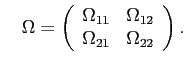
Because prices can be negative, the assets' excess returns are best expressed on a per share basis, and are denoted:

For simplicity
 is fixed, which implies
 i.i.d.
  . To solve
investors' portfolio problem, it is useful to decompose the segment
assets return into a component that is perfectly correlated with
the index and into a residual return
. To solve
investors' portfolio problem, it is useful to decompose the segment
assets return into a component that is perfectly correlated with
the index and into a residual return  :
:
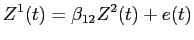
where
![\beta_{12} = \frac{\operatorname{Cov}[Z^{1}(t),Z^{2}(t)]}{\operatorname{Var}[Z^{2}(t)]} = \Omega_{21} \Omega_{22}^{-1}.](img22.gif) Investors' portfolio problem can be represented as choosing
their exposure to the index risk, and to the residual risk of the
segment assets. Because a limited number of investors hold the
residual risk, it is not diversifiable. Therefore, the expected
return for holding the residual risk will not necessarily be equal
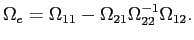
to 0. The variance of is denoted
Investors' portfolio problem can be represented as choosing
their exposure to the index risk, and to the residual risk of the
segment assets. Because a limited number of investors hold the
residual risk, it is not diversifiable. Therefore, the expected
return for holding the residual risk will not necessarily be equal
to 0. The variance of is denoted
 ; in
equilibrium it turns out to be constant through time and is given
by:
; in
equilibrium it turns out to be constant through time and is given
by:
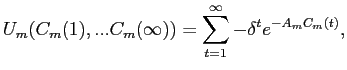
Investors
Each investor  chooses risky asset holdings
  and consumption
  to maximize his discounted
expected Constant Absolute Risk Aversion (CARA) utility of
consumption:
to maximize his discounted
expected Constant Absolute Risk Aversion (CARA) utility of
consumption:
|
(B4) |
with discount factor
 and absolute risk aversion
  , subject to the standard intertemporal budget
constraints:
, subject to the standard intertemporal budget
constraints:
![LaTex Encoded Math: \displaystyle W_{m}(t) = Q_{m}(t)'Z(t) + r[W_{m}(t-1) - C_{m}(t-1)] \quad t=1,\hdots T.](img31.gif)
|
(B5) |
An investor's liquid wealth,  , is that part of her wealth that can be
liquidated at current prices. Because large investors' trades have
price impact, their wealth and liquid wealth differ; and it is
their liquid wealth that appears as an argument in their value
functions. Therefore it is useful to express their budget
constraints in terms of their beginning of period liquid
wealth:
, is that part of her wealth that can be
liquidated at current prices. Because large investors' trades have
price impact, their wealth and liquid wealth differ; and it is
their liquid wealth that appears as an argument in their value
functions. Therefore it is useful to express their budget
constraints in terms of their beginning of period liquid
wealth:
![\begin{displaymath}\begin{split}W_{ml}(t) = Q_{m}^{1} & (t)'D^{1}(t) + Q_{m}^{2}(t)'Z^{2}(t) \\ & + r \left [ W_{ml}(t-1) - \Delta Q^{1}_{m}(t-1)'P^{1}(t-1) - C_{m}(t-1) \right ] \quad t=1,\hdots T. \end{split}\end{displaymath}](img33.gif)
|
(B6) |
Below, I show that investors who differ in their risk-aversion
have different trading styles; this affects other investors ability
to acquire illiquid assets. As a result, which investors hold the
segment assets is a critical argument of investors value functions.
It is summarized by  (
(
 vech
vech![[Q^{1}_{1}(t)',\hdots, Q^{1}_{M}(t)']'](img36.gif) ), the vector of
all investors segment-asset holdings.
), the vector of
all investors segment-asset holdings.
Trading Dynamics
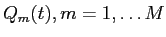
Segment assets are traded over a total of  time periods. The sequence of
actions is as follows: At the beginning of each period
time periods. The sequence of
actions is as follows: At the beginning of each period  , investors enter the period
with risky-asset holdings
, investors enter the period
with risky-asset holdings
 ;
they then receive dividends and choose their risky asset trades
;
they then receive dividends and choose their risky asset trades
 . These
trades determine risky asset prices . Investors then choose consumption ; the period ends; and the
same sequence is repeated through time . After period , investors continue to consume and
trade other assets, but trading of segment assets ends. The final
period of trade in the segment-assets facilitates solution of the
model via backwards induction.
. These
trades determine risky asset prices . Investors then choose consumption ; the period ends; and the
same sequence is repeated through time . After period , investors continue to consume and
trade other assets, but trading of segment assets ends. The final
period of trade in the segment-assets facilitates solution of the
model via backwards induction.
The process of trade for the segment-assets is modeled as a
dynamic Cournot-Stackelberg game of full information. In each
period , each
small investor optimally computes his demand for the segment assets
conditional on the state-variable
 . Inverting
the aggregated demands of the small investors defines a linear
schedule of prices at which they are willing to absorb all possible
quantities of the large investors trades for the segment
assets:
. Inverting
the aggregated demands of the small investors defines a linear
schedule of prices at which they are willing to absorb all possible
quantities of the large investors trades for the segment
assets:

The matrix
 measures
the impact of large investor 's segment asset trades on the price of the segment
assets.15 Large investors account for this price
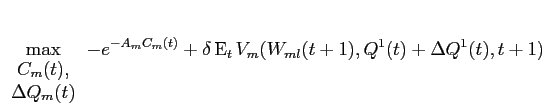
impact when choosing their trades. Given the price schedule in
equation (7), large investors choose
their time
measures
the impact of large investor 's segment asset trades on the price of the segment
assets.15 Large investors account for this price
impact when choosing their trades. Given the price schedule in
equation (7), large investors choose
their time  risky asset
trades and consumption choices to solve the maximization
problem:
risky asset
trades and consumption choices to solve the maximization
problem:
subject to the budget constraint:
![LaTex Encoded Math: \displaystyle W_{ml}(t+1) = Q_{m}^{1}(t+1)'D^{1}(t+1) + Q_{m}^{2}(t+1)'Z^{2}(t+1) + r \left [ W_{ml}(t) - \Delta Q^{1}_{m}(t)'P^{1}(.,t) - C_{m}(t) \right ].](img46.gif)
Large investors' equilibrium trades are found by solving for
trades that are best-responses to each other under the
Cournot-Stackelberg assumption that each large investor chooses his
own trades while taking the price schedule and the trades of the
other large investors as given. The resulting trades within a
period are a Cournot-Nash equilibrium. The model of trade is solved
by backwards induction from period , and the resulting equilibrium is subgame perfect.
Additional details on model solution and investors' value functions
are contained in the appendix.
Intuition for the main results on asset prices and trades comes
from examining the first order condition for large investor
's optimal trade
vector for the segment assets:
![LaTex Encoded Math: \displaystyle \frac{\partial \operatorname{E}V_{m}}{\partial \Delta Q^{1}_{m}} = \left [ \operatorname{E}V_{m,W}(.) ( D_{1}(t) - r P^{1}) + \operatorname{E}V_{m,Q^{1}_{m}}(.) \right ] - \left [\operatorname{E}V_{m,W}(.)r \Delta Q^{1}_{m}' P_{m}^1(.) \right ] = 0,](img47.gif)
where
 .
.
The first term in braces on the right hand side measures the expected net benefit from borrowing money to buy a bit more of a segment asset when trades have no price impact. This is the only term of the first order condition that should be present in a competitive setting. Therefore, in a competitive setting all investors would immediately trade to a point where the first term is equal to 0. When there is imperfect competition, it will never be optimal for a large investor to trade immediately to such a point because the second term in his first order condition would be non-zero, implying his trades had too much price impact. Instead, to reduce their price impact, large investors trade in a way that allows their positions to converge towards a point at which further trade is no longer optimal. Therefore, if a large investor believes an asset is overvalued, or provides too low a return, he will not liquidate its holdings immediately, but will instead sell the asset slowly over time. Because he sells slowly, prices will also adjust slowly, making it possible for low returns to persist in equilibrium, as will be discussed further below.
3.1 Asset
Pricing
The intuition in the previous section and the results below both
show that when markets are illiquid, asset returns will satisfy one
equilibrium relationship when asset holdings are at their long-run
equilibrium, and satisfy a different relationship during the
transition to the long run. To illustrate the exact pricing
relationship, additional notation is required. More specifically,
let
 represent
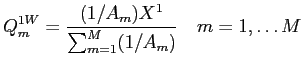
investor 's long-run
holdings of the segment-assets; these holdings are also the same as
if all investors were price-takers, and are also associated with
the efficient sharing of risks. When risk sharing is efficient,
each investor holds assets in proportion to his risk-tolerance as a
fraction of the sum total of all investors' risk tolerances:
represent
investor 's long-run
holdings of the segment-assets; these holdings are also the same as
if all investors were price-takers, and are also associated with
the efficient sharing of risks. When risk sharing is efficient,
each investor holds assets in proportion to his risk-tolerance as a
fraction of the sum total of all investors' risk tolerances:
The following proposition shows that when markets are illiquid, the deviation from investors' efficient asset holdings behaves like a priced factor when computing one-period returns:
![LaTex Encoded Math: \displaystyle \bar{Z}^{1}(t) = \beta_{12} \bar{Z}^{2}(t) + \lambda_{[X^{1}]} \Omega_{e} X^{1} + \sum_{m=2}^{M} \lambda(m,t) \Omega_{e} (Q^{1}_{m}(t) - Q^{1W}_{m})](img51.gif)
where
![LaTex Encoded Math: \displaystyle \lambda_{[X^{1}]} = \frac{1-(1/r)}{\sum_{m=1}^{M} 1/A_{m}}](img52.gif)
Proof: See section D of the appendix.
The proposition is intuitive. Because investors can perfectly
hedge the segment risk that is correlated with the index, the
reward for bearing that risk is exactly the same as is provided by
trading the index. Investors are left to share the segment assets
portfolio of residual risk,
 Segment-assets covariance with that residual risk is
 . I
refer to this covariance as segment risk; segment risk is rewarded
because the investors in the segment cannot diversify it
away.16 In section D.1
of the appendix I show that in a competitive setting, index-risk
and segment-risk are the only priced risks in the model.
. I
refer to this covariance as segment risk; segment risk is rewarded
because the investors in the segment cannot diversify it
away.16 In section D.1
of the appendix I show that in a competitive setting, index-risk
and segment-risk are the only priced risks in the model.
When some investors trades move prices, imperfect risk sharing
among investors introduces additional transient priced factors that
vanish only when investors asset holdings converge to those
associated with perfect risk sharing. Because of illiquidity, the
convergence process takes time; therefore, imperfect risk sharing
at period affects one
period risk-premia at period  , as shown in the following corollary:
 period ahead
1-period excess returns follow a factor model in which deviations
from perfect risksharing at period affect excess returns at period :
period ahead
1-period excess returns follow a factor model in which deviations
from perfect risksharing at period affect excess returns at period :
![LaTex Encoded Math: \displaystyle \operatorname{E}_{t} [Z^{1}(t+\tau + 1)] = \beta_{12} \bar{Z}^{2} + \lambda_{[X^{1}]} \Omega_{e} X^{1} + \sum_{m=2}^{M} \lambda_{m}(t,\tau) \Omega_{e} (Q^{1}_{m}(t) - Q_{m}^{1W})](img57.gif)
Proof: See section D of the appendix.
In both the corollary and the proposition, the prices of risk of
the transient factors (the
 's) are
negative because when large investors hold more than their
efficient share of risky assets, the marginal investors, in this
case the small investors, hold less and hence require a smaller
premium for holding the residual risk.
's) are
negative because when large investors hold more than their
efficient share of risky assets, the marginal investors, in this
case the small investors, hold less and hence require a smaller
premium for holding the residual risk.
Potential Explanations for Underperformance
There are two notions of return underperformance after an IPO. The first is that an asset's expected returns in the short-run are lower than its expected returns in the long-run. The second are that its expected returns underperform after adjusting for some benchmark measure of risk. This section deals with the first type of underperformance; the second type of underperformance is discussed in section 5.3.
Corollary 1 illustrates how
underperformance of the first type can occur. More specifically,
because investors trade to efficient asset holdings, the third term
in equation (14) is transient, while the
first two terms are not. Therefore, short-run underperformance will
occur whenever the third-term is negative. Because the market
prices of risk
 are
negative, the third term generates return underperformance when
each large investor's IPO share allocation is greater than is
consistent with optimal risk sharing; this is consistent with
allocations being tilted towards institutional investors and away
from retail investors at the IPO.
are
negative, the third term generates return underperformance when
each large investor's IPO share allocation is greater than is
consistent with optimal risk sharing; this is consistent with
allocations being tilted towards institutional investors and away
from retail investors at the IPO.
The magnitude of underperformance depends on whether allocations
are distorted towards large investors, and it depends on the risk
preferences of the large investors that receive the allocations. In
a model with illiquidity, differences in investors' risk tolerances
correspond to differences in investors' willingness to sell assets
quickly and pay a high liquidity cost in order to share risk. The
more risk tolerant large investors are less willing to pay a high a
liquidity cost to share risk; therefore, risk sharing progresses
more slowly when asset allocations are initially tilted towards
them. This reduces the amount of risk that must be borne by the
marginal (small) investors and reduces the assets required rate of
return. Consistent with this reasoning, in simulations the
functions (which measure the impact of allocation distortions
towards investor at
time on excess returns at
time ) show that when
allocations are distorted towards large investors with more risk
tolerance, the effect on excess returns is longer-lived and larger
in magnitude.
The amount and persistence of underperformance also depends on
the competitiveness of the aftermarket. When the aftermarket is
highly competitive, the
functions rapidly asymptote toward 0 as increases, generating little
underperformance. When the aftermarket is less competitive, the
functions asymptote slowly, generating longer-lived
underperformance.
Because IPO allocations affect post-IPO excess returns, they should also affect the initial trading price of the segment assets in the aftermarket. This is established in the appendix17, where I show that segment-asset prices at the beginning of each time period have the form:
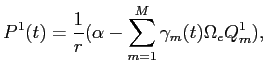
where the scalars
 are
positive numbers that are smaller for investors who are more risk
tolerant. It follows that aftermarket prices will initially be
higher than their long-run competitive values if the asset
allocations are distorted away from efficient asset holdings
towards relatively risk tolerant large investors. The initial
"overpricing" in the aftermarket due to allocation distortions may
help to explain part of the IPO underpricing puzzle. A full
explanation depends on how shares are allocated at the IPO, and on
how the IPO offer price is set. I turn to that topic below.
are
positive numbers that are smaller for investors who are more risk
tolerant. It follows that aftermarket prices will initially be
higher than their long-run competitive values if the asset
allocations are distorted away from efficient asset holdings
towards relatively risk tolerant large investors. The initial
"overpricing" in the aftermarket due to allocation distortions may
help to explain part of the IPO underpricing puzzle. A full
explanation depends on how shares are allocated at the IPO, and on
how the IPO offer price is set. I turn to that topic below.
4 IPO Share Allocation and Price
Setting
The motivation for the analysis in this section is based on Pritsker (2004). Pritsker studies a situation in which a distressed investor must rapidly sell a given number of shares into an imperfectly competitive aftermarket. Because the distressed investor is essentially selling to an oligopoly, the price he receives is discounted relative to the competitive price. The size of the discount is determined by the intensity of competition, which in turn depends on differences in large investors' risk tolerances. If one large investor is far more risk tolerant than the others, he has significant market power because by purchasing fewer shares, he can force the distressed sales to be absorbed by relatively risk averse investors who require a larger risk premium for taking the shares. Conversely, if investors risk tolerances are more similar, each investors market power is reduced, and the aftermarket becomes more competitive.18
The distressed investor analysis is applicable to the IPO
setting. The issuing firm is like a distressed investor that needs
to sell shares
in a segment that is imperfectly competitive. The IPO is a
mechanism that helps avoid selling shares into the imperfectly
competitive aftermarket by instead allocating them beforehand at a
fixed IPO price. I assume the underwriter acts on the issuer's
behalf by lining up investors to buy the issue in order to maximize
IPO proceeds. The IPO process resembles bookbuilding as practiced
in the United States. The underwriter gathers demand information on
the issue. In the model this information consists of knowledge
about the other risky assets in the new issue's market segment, as
well as knowledge about investors holdings of the segment-assets,
the investors risk preferences, and whether there are investors who
have market power in aftermarket trading. Based on this
information, the underwriter sets an IPO offer price  and makes take it or leave
offers of share allocations to the large and small investors. The
large investors allocations' are denoted by
and makes take it or leave
offers of share allocations to the large and small investors. The
large investors allocations' are denoted by
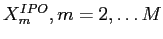 . The total number of
shares offered to small investors is denoted
. The total number of
shares offered to small investors is denoted
 . I assume
that the small investors that are offered share allocations are
offered identical amounts of shares. It will turn out that if
shares are offered to some small investors, it will be optimal to
offer them to all small investors. Therefore, I assume that when
small investors are offered shares, they are all offered the same
amount.
. I assume
that the small investors that are offered share allocations are
offered identical amounts of shares. It will turn out that if
shares are offered to some small investors, it will be optimal to
offer them to all small investors. Therefore, I assume that when
small investors are offered shares, they are all offered the same
amount.
If a large or small investor turns down the share allocation
that he is offered, then the underwriter is stuck with the shares.
I assume that the underwriter sells any unallocated shares
immediately in the aftermarket following the IPO. The possibility
that an investor can force distressed sales in the aftermarket
serves as a threat that constrains how the issuer allocates shares
and chooses the IPO offer price.19 In particular, if an investor receives
shares, the allocations and offer price must be set so that it
cannot be in the interest of the investor to refuse their
allocation and instead force the shares to be sold by the
underwriter in the aftermarket. Of course, it is possible in theory
that the underwriter might find it optimal to sell some shares in
the aftermarket; denote these shares as
 and the
aftermarket price on the first day of trading as
and the
aftermarket price on the first day of trading as
 .20 This suggests that the underwriter
chooses the vector of share allocations and aftermarket sales
.20 This suggests that the underwriter
chooses the vector of share allocations and aftermarket sales
 and IPO offer price
to maximize
and IPO offer price
to maximize

where
 represents the
underwriters profit, the first term on the right hand side measures
revenues raised at the IPO, and the second represents revenues
raised by distressed sales in the IPO aftermarket.
represents the
underwriters profit, the first term on the right hand side measures
revenues raised at the IPO, and the second represents revenues
raised by distressed sales in the IPO aftermarket.
The maximization takes place subject to the constraints that the total issue is allocated:
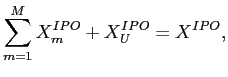
that there are no short-sales by investors
 through ,
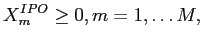
and subject to incentive compatibility (IC) constraints that those who receive allocations in the IPO will accept the allocations. The IPO allocations are evaluated based on investors ex-ante expected value of entering the first period of aftermarket trading when the asset allocation is
.21 Each small investor's  constraint is denoted
  , and takes the form:
![LaTex Encoded Math: \displaystyle \psi_{s} = V_{s}[Q_{s}^{IPO};Q^{IPO},t^{IPO}+1] - V_{s}[Q_{s}; Q^{IPO},t^{IPO} + 1] \ge 0](img76.gif)
The segment-asset holdings of each small investor that chooses to and chooses not to participate in the IPO are denoted
 and
and
 respectively; and
the vector of all investors post-IPO segment asset holdings is
denoted
respectively; and
the vector of all investors post-IPO segment asset holdings is
denoted  .
Because each small investor is infinitesimal, his individual
participation decision has no influence on the state vector
.
.
Because each small investor is infinitesimal, his individual
participation decision has no influence on the state vector
.
Large investors IC constraints are denoted  and take the form:
![LaTex Encoded Math: \displaystyle \psi_{m} = V_{m}[Q^{IPO},t^{IPO}+1] - V_{m}[Q_{-m}^{IPO},t^{IPO}+1] \ge 0](img81.gif)
where large investor
's
share allocation is
 if he
participates in the IPO, and
if he
participates in the IPO, and
 if he does
not.
if he does
not.
While other investors are not allowed to take a short position at the IPO, the underwriter can do so. If he does, then he is obligated to buy shares in the first period of aftermarket trade in order to cover his short position.22
The assumption that any shares not sold at the IPO are sold
immediately afterward by the underwriter in the form of distressed
sales is very strong. A more realistic assumption is that any
shares that the underwriter fails to sell at the IPO will instead
be sold over a longer amount of time,  trading periods, following
the IPO. This modeling assumption is consistent with empirical
evidence, reported in Ellis et. al. (2000), that IPO underwriters
engage in price support activities in the IPO aftermarket, and with
evidence reported by Ellis et. al. (2002) which shows that
underwriters are active participants in the IPO aftermarket for
long periods of time.23.
trading periods, following
the IPO. This modeling assumption is consistent with empirical
evidence, reported in Ellis et. al. (2000), that IPO underwriters
engage in price support activities in the IPO aftermarket, and with
evidence reported by Ellis et. al. (2002) which shows that
underwriters are active participants in the IPO aftermarket for
long periods of time.23.
I assume that when the underwriter sells shares over
 time periods
he will sell them optimally. By optimality I mean that the
underwriter buys shares at the IPO offer price, and then
participates in the IPO aftermarket, trading as a large investor
over the following
time periods in order to maximize his own utility subject to the
constraint that by time the underwriter holds no shares of the new
issue. It is assumed that the certainty equivalent value of the
underwriters utility from buying and trading the shares is turned
over to the issuing firm at the time of the IPO. For tractability I
assume that the underwriter has CARA utility like the other large
investors. Let
time periods
he will sell them optimally. By optimality I mean that the
underwriter buys shares at the IPO offer price, and then
participates in the IPO aftermarket, trading as a large investor
over the following
time periods in order to maximize his own utility subject to the
constraint that by time the underwriter holds no shares of the new
issue. It is assumed that the certainty equivalent value of the
underwriters utility from buying and trading the shares is turned
over to the issuing firm at the time of the IPO. For tractability I
assume that the underwriter has CARA utility like the other large
investors. Let
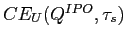 denote the underwriters
certainty equivalent. Then, under the less restrictive assumption,
the underwriter maximizes:
denote the underwriters
certainty equivalent. Then, under the less restrictive assumption,
the underwriter maximizes:
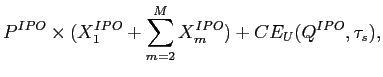
subject to the constraints that the total issue is allocated [equation (17)], that there are no short sales [equation (18)], and subject to a new set of participation constraints that account for the underwriter's trading activity in the aftermarket.24 My conjecture is that the underwriter's ability to spread out sales of unsold shares through time will reduce large investors bargaining power at the IPO and result in a higher IPO offer price, and higher profits for the issuer. That said, most of my recent simulations using the objective function in equation (21) show spreading out the underwriters sales has little effect on profit. Therefore, I do not report any results for this case in the current version; but hope to study it more in future work.
In closing this section I should emphasize that the optimal IPO allocation problem is difficult because it involves maximizing a nonlinear objective function subject to nonlinear inequality constraints. Details on how I solved the problem are provided in appendix E.
5 Simulation Analysis
The model's properties are studied for a single case in which an underwriter sells 40 shares to a continuum of small investors (investor 1) and five large investors (investors 2-6) under a variety of liquidity conditions. For simplicity, the only segment asset is the new issue, and investors risk tolerances are normalized so that they sum to 1.
Aftermarket liquidity depends on the concentration of risk bearing capacity among investors, and on the number of periods of aftermarket trade. An investors share of a segment's risk bearing capacity is his risk tolerance as a percentage of the sum total of all investors risk tolerances. Concentration of risk bearing capacity provides investors with market power in the aftermarket; and this makes the market more illiquid. Results on concentration of risk bearing capacity are reported using the Herfindahl index, which ranges from 10,000 when risk bearing capacity is concentrated with one investor, to 0 when all investors are small and there is no concentration.25
The number of post-IPO trading periods consider ranges from 200 trading days (a bit less than a year) up to 2000 trading days (8 years).26 To explain the relationship between the number of post-IPO trading periods and liquidity, note that the more shares an investor trades within a period, the more he moves the price. Therefore, he would prefer to break up his trades through time to minimize their price impact. When fewer periods of trade remain, opportunities to break up trades are limited; therefore risk sharing becomes more costly. Consequently, shares acquire a greater liquidity premium when fewer periods of trade remain. Conversely, as the number of tradings periods grow, the liquidity premium vanishes and the market becomes perfectly competitive.27 Because my focus is on imperfect competition, I assume the number of trading periods is finite.
To illustrate the role of imperfect competition, the main results focus on two benchmark cases that differ only in whether the investors behave competitively. In both cases, investor 2 has more than a fifty percent share of the segment's risk bearing capacity (Table 1, Panel A); and the other investors differ in their risk tolerances.
When investors behave competitively, and the underwriter must sell all 40 shares, the IPO is no different than if the underwriter sold the shares directly in the aftermarket. Therefore, he raises $420 at the competitive price of $10.50 per share; additionally investors share allocations are proportional to their share of risk bearing capacity, which implies investor 2 should receive 21.82 shares.
When the aftermarket is imperfectly competitive, investor 2's
large share of risk bearing capacity gives him enormous bargaining
power at the IPO, because if he turns down his share allocation
then the underwriter will have to sell shares into an aftermarket
where investor 2 has substantial influence over price.
Alternatively, if the underwriter instead chooses to allocate
shares to other more risk averse investors, then they will be
exploited by investor 2 in the aftermarket--and this will depress
the price that other investors are willing to pay for shares. To
illustrate these points, I studied a sequence of IPOs in which
investor 2 can trade in the aftermarket but is restricted in the
amounts that he can acquire at the IPO. More specifically investor
2's aquistion was progressively restricted to be no larger than
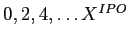 shares.28If the aftermarket is perfectly
competitive, the allocation restrictions are of little consequence
because other investors can aquire the shares at the IPO and then
quickly sell them to investor 2 in the aftermarket at the
competitive price; therefore the IPO offer price is barely
discounted from the competitive price. By contrast, if the
aftermarket is imperfectly competitive, then the IPO offer price is
severely discounted relative to the competitive price; moreover,
the feasible offer price (Figure 1) and
proceeds (not shown) are monotone increasing in the amount that can
be offered to investor 2 up to the total outstanding supply of the
issue. Investor 2's enormous bargaining power has implications for
allocations and trading volume, as well as for underpricing, and
return underperformance.
shares.28If the aftermarket is perfectly
competitive, the allocation restrictions are of little consequence
because other investors can aquire the shares at the IPO and then
quickly sell them to investor 2 in the aftermarket at the
competitive price; therefore the IPO offer price is barely
discounted from the competitive price. By contrast, if the
aftermarket is imperfectly competitive, then the IPO offer price is
severely discounted relative to the competitive price; moreover,
the feasible offer price (Figure 1) and
proceeds (not shown) are monotone increasing in the amount that can
be offered to investor 2 up to the total outstanding supply of the
issue. Investor 2's enormous bargaining power has implications for
allocations and trading volume, as well as for underpricing, and
return underperformance.
5.1 Allocation Distortions and Trading Volume
Because prices and proceeds are increasing in the amount that investor 2 can purchase, all of the shares are allocated to him at the IPO. This shows that allocations are distorted towards investors who have market power and away from retail investors (who each have none) (Table 1,Panel C). Additionally, among investors with market power, in the example the allocations are distorted towards the large investor with the most power. This illustrates that differences in investors market power provide a noninformation based explanation for why some large investors receive share allocations while others do not.
Because allocations at the IPO are not pareto optimal, the distortions create a basis for trade in the aftermarket. The resulting trading volume is heaviest on the first day of trading, constituting 1.2 percent of shares issued; daily volume drops off to about 0.1 percent of shares issued after the first week of trading (Figure 2). The example's pattern of heavy trading volume that rapidly drops off is qualitatively consistent with the empirical literature on post-IPO trading (Ellis et al. 2000), but the model fails to match the empirical magnitude of the first day's trading, which averaged 33.3 percent of shares issued in the 1980's, and 148.7 percent of shares issued in 1999-2000 (Ritter, 2005).
5.2 IPO Underpricing
The example shows the model is capable of generating substantial IPO underpricing. Underpricing ranges from a low of 40 percent when many trading periods remain to a high of 159 percent when relatively few periods remain (Table 1, Panel B). The underpricing has three pronounced features. First, the offer price is low relative to the asset's competitive price. Second, the aftermarket price is inflated relative to the asset's competitive price. If the competitive price is interpreted as the asset's "fundamental value" then it appears as if the IPO is associated with irrational price-overshooting even though the model is fully rational. The third feature is that the first two features are most pronounced when there are fewer periods of trade following the IPO.
Intuition for the first feature is related to investor 2's bargaining power; additional intuition for the underpricing comes from interpreting illiquidity as a tax on risk sharing. Because the tax makes risk sharing more costly, it pushes down the IPO offer price; in addition because of the tax less risk sharing takes place, which means investor 2 sells less in the aftermarket--and this constraint on supply pushes up the aftermarket price. When fewer trading periods remain, illiquidity is more severe, making the first two features more pronounced.
5.3
Underperformance
Recall that there are two types of return
underperformance--underperformance relative to an assets long-run
return--and underperformance relative to a risk adjusted benchmark.
Section 3.1 shows that the former is
associated with IPOs; to address the latter, post-IPO expected
excess returns were computed for up to 2000 business days and then
adjusted for market-risk by subtracting the asset's beta times the
expected excess return on the market portfolio. To compute the
excess return on the market portfolio, I aggregated up the excess
returns across all market segments. Recall from equation (12) (reproduced below) that in each segment
 , assets excess
expected returns can be decomposed into a component that is
correlated with the index, a second that is associated with market
segmentation (due to imperfect sharing of idiosyncratic risk), and
a third that is associated with allocation distortions and
illiquidity:
, assets excess
expected returns can be decomposed into a component that is
correlated with the index, a second that is associated with market
segmentation (due to imperfect sharing of idiosyncratic risk), and
a third that is associated with allocation distortions and
illiquidity:
![LaTex Encoded Math: \displaystyle \bar{Z}^{j}(t) = \beta_{j2} \bar{Z}^{2}(t) + \lambda_{[X^{j}]} \Omega_{e_{j}} X^{j} + \sum_{m=2}^{M_{j}} \lambda(m,t) \Omega_{e_{j}} (Q^{j}_{m}(t) - Q^{jW}_{m}).](img90.gif)
Under these circumstances, if investors trade the liquid index and specialize in trading the assets within different market-segments, then in the context of a one-period example (appendix F), the assets in each segment and the market portfolio earn a segmentation premium. Therefore, after adjustment for market-risk, the assets average segmentation premia are 0, and do not depend on whether the assets are new issues. Using similar reasoning, because relatively few firms are new issues, these firms will only have a minor effect on the market return. Therefore, after market adjustment, IPO firms will retain a large negative liquidity premium; that is they will underperform on a risk-adjusted basis.
Under simplifying circumstances (see appendix F), if  is the fraction of firms that are new issues,
then the average market adjusted underperformance at time
for segments with
IPO's should be approximately
is the fraction of firms that are new issues,
then the average market adjusted underperformance at time
for segments with
IPO's should be approximately  times the allocation distortion / liquidity
component of excess returns:
times the allocation distortion / liquidity
component of excess returns:
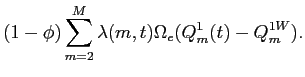 is
0, and the market adjusted segmentation premium is approximately 0
for simplicity, then the CAR grows to -32 percent over 2000
periods. In the simulations which corresponds to about 8 years of
underperformance (Figure 3, Panel A).
More realistically, if is about 10 percent, then the expected
market-adjusted CAR should be about -29 percent over 8 years. This
confirms that the model can in theory generate both IPO
underpricing and long-lived market adjusted return
underperformance.
is
0, and the market adjusted segmentation premium is approximately 0
for simplicity, then the CAR grows to -32 percent over 2000
periods. In the simulations which corresponds to about 8 years of
underperformance (Figure 3, Panel A).
More realistically, if is about 10 percent, then the expected
market-adjusted CAR should be about -29 percent over 8 years. This
confirms that the model can in theory generate both IPO
underpricing and long-lived market adjusted return
underperformance.5.3.1 Adjusting for Characteristics
A stylized fact of measured underformance is that it is strongest when returns are market-adjusted, and weaken after adjustment for additional characteristics such as market-to-book (Ritter and Welch, 2002). Under some interpretations, these stylized facts are consistent with the liquidity-based explanation in the model; in particular, if assets' long-run competitive prices are interpreted as book-value, then the model predicts that because of illiquidity and allocation distortions at the IPO, then just after the IPO, market to book is high and consistent with the market-to-book effect, IPO returns underperform. It is important to bear in mind that in the empirical asset pricing literatature, market-to-book's ability to explain asset returns is an empirical regularity, not a theory of asset pricing. The contribution of the present model is that it provides a theoretical reason why market-to-book appears to "explain" post IPO return underperformance. This result has empirical implications; in particular, it shows that controlling for market-to-book can be problematic when testing the present model because a finding of no underperformance after adjustment for market-to-book is consistent with the model, and not evidence against it. This topic is discussed further in footnote 33 of section 6.1.
5.4 Money Left on the Table
IPO underpricing makes it appears as if the IPO should have raised more revenue. The loss in revenue is referred to as "money left on the table", hereafter MLOTT, and is usually measured as the differential between the IPO-offer price and closing price on the first day of trade times the number of shares issued. MLOTT often has the interpretation of a measure of the issuer's losses due to imperfections in the IPO process.29 For the present model, the imperfection is illiquidity; and it should be clear that the usual MLOTT calculation overstates issuer losses because it incorrectly assumes that all of the shares could be sold at the artificially high price that prevails in an illiquid aftermarket. An alternative measure of MLOTT instead compares the revenues that were raised at the IPO against the revenues that could have been raised if the aftermarket was perfectly competitive, which in this model means perfectly liquid. Computing losses by this alternative metric shows that the usual calculation can very significantly overstate issuer losses; in the case of the example it overstates them by a factor of 5 to 10 (Table 1, Panel B).
5.5 Alternative market configurations
To study how differences in investors risk tolerances affect the
results, I solved the model under two alternative market
configurations. In the first, some of investor 2's risk tolerance
is spread evenly among the other large investors (Table 2). This change makes the aftermarket more competitive,
and has three further effects on the aftermarket. First, when the
number of aftermarket trading periods is  , or
, or  , the market is sufficiently
competitive that differences in who receives shares at the IPO have
a very small effect on prices (no more than 6 cents per share). In
this circumstance, the optimal allocation problem is ill-posed. I
simply assume that the competitive allocation results in these
cases. Second, the magnitude and persistence of underperformance
diminish somewhat, with the liquidity component of the CAR reduced
to -16 percent over 5 years. Third, the prices charged by the
underwriter at the IPO are actually above the competitive price.
This occurs because when the aftermarket is a little bit more
competitive, investor 2 has less market power in the aftermarket,
and hence has less bargaining power at the IPO. In this
circumstance, the underwriter can extract some of investor 2's
surplus from acquiring the new issue. Because the aftermarket is
still not perfectly liquid, the aftermarket price is inflated above
the IPO offer price, but now the underwriter is actually generating
more revenue for the issuer than if the aftermarket were
competitive. Compared with the earlier results, this shows that the
underwriter and issuer actually benefit if the aftermarket is a bit
less than perfectly competitive, but is hurt if the aftermarket
becomes too imperfectly competitive. Because a little bit of
imperfect competition can sometimes help the underwriter, this
result may help to explain underwriter practices that restrain
trade in the aftermarket, such as restrictions on investors ability
to flip shares.
, the market is sufficiently
competitive that differences in who receives shares at the IPO have
a very small effect on prices (no more than 6 cents per share). In
this circumstance, the optimal allocation problem is ill-posed. I
simply assume that the competitive allocation results in these
cases. Second, the magnitude and persistence of underperformance
diminish somewhat, with the liquidity component of the CAR reduced
to -16 percent over 5 years. Third, the prices charged by the
underwriter at the IPO are actually above the competitive price.
This occurs because when the aftermarket is a little bit more
competitive, investor 2 has less market power in the aftermarket,
and hence has less bargaining power at the IPO. In this
circumstance, the underwriter can extract some of investor 2's
surplus from acquiring the new issue. Because the aftermarket is
still not perfectly liquid, the aftermarket price is inflated above
the IPO offer price, but now the underwriter is actually generating
more revenue for the issuer than if the aftermarket were
competitive. Compared with the earlier results, this shows that the
underwriter and issuer actually benefit if the aftermarket is a bit
less than perfectly competitive, but is hurt if the aftermarket
becomes too imperfectly competitive. Because a little bit of
imperfect competition can sometimes help the underwriter, this
result may help to explain underwriter practices that restrain
trade in the aftermarket, such as restrictions on investors ability
to flip shares.
The second alternative market configuration contained two dominant large investors that each have 30% of the risk bearing capacity.30 Because this configuration was highly competitive, unless a small number of trading periods followed the IPO, results are only discussed for when there are 200 post-IPO trading periods. Unlike the previous examples in which the optimum involved allocating all of the shares to one investor, in this example the optimal share allocations involved splitting the shares evenly between investors 2 and 3 while distorting the share allocations away from all other investors. As in the previous example, the resulting IPO offer price was above the price that would prevail if the aftermarket was perfectly competitive. Nevertheless, the aftermarket price following the IPO was even higher, resulting in IPO underpricing of about 12%. Additionally, cumulative abnormal returns indicate short-lived underperformance; the liquidity component of the underperformance was 4.5% over 200 trading days.
6 Empirical Implications
The purpose of this section is to outline a rough strategy for testing the theory in this paper. The main implication of the theory is that IPO illiquidity and imperfect competition in the aftermarket following an IPO lead to allocation distortions towards large investors and IPO underpricing and underperformance. These implications lead to the following testable predictions:
- Allocation distortions are associated with underperformance in the aftermarket.
- Allocation distortions are associated with IPO underpricing.
- The above two effects are associated with illiquidity and imperfect competition in aftermarket trading.
Prediction 1 imposes restrictions on the coefficients of empirical versions of equation (14):
![LaTex Encoded Math: \displaystyle Z_{i}(t+\tau + 1) = \beta_{i,2} \pi_{IND} + [\lambda_{[X^{1}]} \Omega_{e} X^{1}] \pi_{SEG} + [\sum_{m=2}^{M} \lambda_{m}(t,\tau) \Omega_{e} (Q^{1}_{m}(t) - Q_{m}^{1W})] \pi_{LIQ} + \epsilon_{i}(t+\tau)](img96.gif)
The empirical version provided above differs from equation
(14) because it is parameterized with
additional  coefficients, and because expected excess returns have been
replaced by their realization on the left hand-side, which
introduces an expectational error
coefficients, and because expected excess returns have been
replaced by their realization on the left hand-side, which
introduces an expectational error
 on
the right-hand side. The main coefficient of interest is
on
the right-hand side. The main coefficient of interest is
 . Under the
null hypothesis that allocation distortions at the IPO are
unrelated to underperformance, should be equal to 0; while under the
alternative
should be positive and the coefficients
. Under the
null hypothesis that allocation distortions at the IPO are
unrelated to underperformance, should be equal to 0; while under the
alternative
should be positive and the coefficients
 should
be negative. Estimation of in cross-section requires information on
and
investors holdings of all assets within each segment. However, if
is nearly
diagonal, or if allocation distortions are only significantly
different from zero for new issues, then it is sufficient to create
an allocation distortion measure for each new issue that only
depends on its own idiosyncratic risk and own asset holdings. This
simplified approach is outlined below.
should
be negative. Estimation of in cross-section requires information on
and
investors holdings of all assets within each segment. However, if
is nearly
diagonal, or if allocation distortions are only significantly
different from zero for new issues, then it is sufficient to create
an allocation distortion measure for each new issue that only
depends on its own idiosyncratic risk and own asset holdings. This
simplified approach is outlined below.
The allocation distortion measure that I propose for firm
 has the form:
distort![LaTex Encoded Math: \displaystyle _{i} = \Omega_{ii} \sum_{m=2}^{M} g(RBC_{m}) \left [ \frac{x_{m}}{\sum_{m=1}^{M} x_{m}} - RBC_{m} \right ],](img102.gif)
|
(B23) |
where
 is the share
allocation of large investor at the IPO;
is the share
allocation of large investor at the IPO;
 is the
variance of the idiosyncratic component of firm 's return;
is the
variance of the idiosyncratic component of firm 's return;  is large investor
 risk bearing
capacity, which is his risk tolerance as a fraction of the sum
total of all investors
risk tolerances; and
risk bearing
capacity, which is his risk tolerance as a fraction of the sum
total of all investors
risk tolerances; and  is
a negative and monotone decreasing function, which serves as a
proxy for
is
a negative and monotone decreasing function, which serves as a
proxy for  in
equation (22). The distortion measure is 0
if allocations are efficient; positive if allocations are distorted
towards small investors, and negative if distorted towards large
investors. In addition, consistent with the results that show
underperformance and the aftermarket price are maximized when
allocations are distorted towards the most risk tolerant large
investor, the distortion measure is maximized when all assets are
allocated to the most risk tolerant large investor.
in
equation (22). The distortion measure is 0
if allocations are efficient; positive if allocations are distorted
towards small investors, and negative if distorted towards large
investors. In addition, consistent with the results that show
underperformance and the aftermarket price are maximized when
allocations are distorted towards the most risk tolerant large
investor, the distortion measure is maximized when all assets are
allocated to the most risk tolerant large investor.
Proxies for
are needed to operationalize the distortion measure. Because the
model assumes that investors have CARA utility primarily for
tractability, a sensible way to proceed is to use a more realistic
assumption about investors utility. For example, if all investors
have power utility with coefficient of relative risk aversion
 , then investors
absolute risk tolerance is
, then investors
absolute risk tolerance is
 , and each
investors risk bearing capacity is equal to their own wealth as a
fraction of the sum total of the wealth of other investors in the
segment (
, and each
investors risk bearing capacity is equal to their own wealth as a
fraction of the sum total of the wealth of other investors in the
segment (
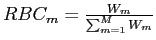 ).31 Since wealth is a measure of
investors's size, the allocation distortion measure them becomes a
measure of how assets are allocated relative to the size of the
investors involved. Armed with this measure of allocation
distortions it should be possible to test prediction 1 by
estimating variants of equation (22) in
cross-section and then test whether is positive.32. A full analysis of how to estimate
the equation is well beyond the scope of the present paper. To test
prediction 2, the same measures of allocation distortions that are
used to estimate equation (22) can be used
to attempt to explain the cross-section of IPO underpricing.
).31 Since wealth is a measure of
investors's size, the allocation distortion measure them becomes a
measure of how assets are allocated relative to the size of the
investors involved. Armed with this measure of allocation
distortions it should be possible to test prediction 1 by
estimating variants of equation (22) in
cross-section and then test whether is positive.32. A full analysis of how to estimate
the equation is well beyond the scope of the present paper. To test
prediction 2, the same measures of allocation distortions that are
used to estimate equation (22) can be used
to attempt to explain the cross-section of IPO underpricing.
To test the third prediction, measures of aftermarket illiquidity should be interacted with the allocation distortion variable. The theory predicts that the allocation distortions should only have an effect when there is illiquidity in the aftermarket. Hence, the interaction with the illiquidity variables should provide a sharper test of theory. The coefficients on the interaction terms are expected to have the same sign as the coefficients on the allocation distortions, and including these terms should cause the coefficients on the allocation distortions to weaken.
Allocation distortions are predicted by other theories, such as for example bookbuilding and adverse selection, in which the allocations are based on investors information. However, neither of those theories predicts a relationship between allocation distortions and IPO return underperformance. Therefore, if allocation distortions explain both underpricing and underperformance, it should be interpreted as evidence that an explanation based on illiquidity and imperfect competition in the aftermarket helps contribute to our understanding of IPOs.
To close this section, I briefly review the most closely related empirical literature on underpricing and underperformance.
6.1 Related
literature
The empirical literature that is most closely related to this paper studies the relationship between after-market liquidity and underpricing or underperformance. The relationship between IPO underpricing and illiquidity has been empirically studied by Booth and Chua (1996), Hahn and Ligon (2004), and Ellul and Pagano (2003). In closely related work, Butler et. al. (2005) study the relationship between a stock's liquidity, and the underwriting fees that are paid during a seasoned equity offering.
Although the Booth and Chua model makes predictions about the relationship between underpricing and aftermarket liquidity, they don't test this implication of their model; instead their tests focus on underpricing as compensation for costs of information gathering. Because such costs could generate underpricing irrespective of illiquidity, the implications of their tests for the relationship between underpricing and aftermarket liquidity are unclear. Hahn and Ligon attempt to directly test the Booth and Chua hypothesis that underpricing is used to increase liquidity by running OLS regressions of market microstructure measures of aftermarket liquidity on IPO underpricing. In regressions that account for other determinants of illiquidity, their results are mixed; with coefficients on underpricing sometimes statistically significant and positive, sometimes statistically significant and negative, and sometimes not statistically significant at all. A potential difficulty with the Hahn and Ligon methodology is that causality may run from underpricing to illiquidity (as in Booth and Chua) as well as from illiquidity to underpricing (as in Ellul and Pagano). The possibility that causality runs in both directions suggests that an instrumental variable approach is needed. In Ellul and Pagano, they regress underpricing on a set of determinants for underpricing, including measures of aftermarket liquidity. Additionally, they recognize the potential for simultaneity bias and instrument for it in some of their regressions.33 In all of Ellul and Pagano's regressions they find that more aftermarket illiquidity increases the amount of IPO underpricing. Butler et. al. find qualitatively similar relationship between illiquidity and underwriter fees in SEO's, but quantitatively the effects of illiquidity are much smaller than in Ellul and Pagano. This suggests the Ellul and Pagano results, while favorable for liquidity based theories, should be interpreted with caution. An additional reason for caution is if underpricing is a risk premium for aftermarket illiquidity, then the logical extension of Ellul and Pagano's theory would suggest that in the aftermarket, IPO's should earn a positive and significant risk premium for aftermarket illiquidity. If we believe the empirical evidence that IPO returns underperform in the aftermarket, this suggests that the mechanism driving aftermarket returns is more complicated than the theory of illiquidity considered by Ellul and Pagano. Eckbo and Norli (2002) take this argument one step further; they claim that newly issued stocks are more liquid than other stocks with similar risk characteristics; and thus their returns should underperform. To establish this point empirically, Eckbo and Norli compare the returns of a rolling portfolio of newly issued stocks that are held for up to five years against the returns a portfolio of more seasoned issues that are matched on size and book to market. They find that after adjusting for these factors, and controlling for differences in liquidity, new issues do not underperform.
The Eckbo and Norli and Ellul and Pagano findings, taken
together are puzzling because the latter suggests that IPOs are
very illiquid, while the former suggests the opposite. Both papers
can only be correct if liquidity conditions change rapidly after
the IPO, and if participants in IPOs are very concerned about a
short-term need to liquidate. This paper points towards a different
resolution in which illiquidity, when combined with imperfect
competition, generates both underpricing and underperformance. To
make a strong case that this is the correct resolution requires
careful future research on how to measure underperformance and
which measures of liquidity are relevant for large
investors.34 35
35
7 Conclusions
In this paper I have presented a fully-rational, symmetric-information model to simultaneously explain IPO underpricing, underperformance, and a tilt in IPO share allocations towards institutional investors, and away from retail investors. The key model features that generate these results are illiquidity and imperfect competition in aftermarket trading. The model also generates a new set of testable predictions that tie the market structure of aftermarket trading and allocation distortions at the IPO, to the cross-sectional pattern of return underperformance following an IPO. Hopefully the results in this paper will stimulate new empirical research that studies the relationship between the structure of the IPO aftermarket trading environment and IPO underpricing and underperformace.
8 Notation
There are investors and
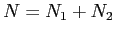 risky assets. The first
  assets are illiquid. The next
  assets are perfectly liquid.
The risky asset holdings of investor at time
are denoted by
assets are perfectly liquid.
The risky asset holdings of investor at time
are denoted by
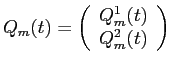
 and
and
 are
investor holdings
of illiquid and liquid risky assets respectively. denote the
are
investor holdings
of illiquid and liquid risky assets respectively. denote the
 vector of all investors illiquid asset holdings at time
where
vector of all investors illiquid asset holdings at time
where
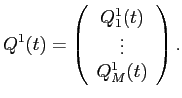
 represents the net asset holdings of a continuum of infinitesimal
small investors indexed by
represents the net asset holdings of a continuum of infinitesimal
small investors indexed by  :
:
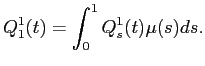
 through
 denotes
the net illiquid risky asset holdings of large investors, and is
denoted by the
denotes
the net illiquid risky asset holdings of large investors, and is
denoted by the
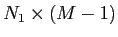 vector
 . The
change in investors illiquid risky asset holdings from the
beginning of time period
to the beginning of time period
. The
change in investors illiquid risky asset holdings from the
beginning of time period
to the beginning of time period  is denoted by the
vector
is denoted by the
vector
 .
Similarly,
.
Similarly,
 and
and
 denote the change in the competitive fringe's illiquid asset
holdings, and the change in the illiquid asset holdings of the
large investors.
denote the change in the competitive fringe's illiquid asset
holdings, and the change in the illiquid asset holdings of the
large investors.
The algebra which follows requires many matrix summations and
the use of selection matrices. Rather than write summations
explicitly, I use the matrix
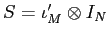 to perform summations
where
to perform summations
where  is an
by vector of ones, and
is an
by vector of ones, and  is the
 identity
matrix.36 In some cases, the matrix
identity
matrix.36 In some cases, the matrix  may have different dimensions to
conform to the vector whose elements are being added. In all such
cases, will always
have
may have different dimensions to
conform to the vector whose elements are being added. In all such
cases, will always
have  , or rows. The matrix
  is used for selecting
submatrices of a larger matrix. has form
is used for selecting
submatrices of a larger matrix. has form
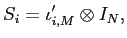
 is an
vector has a
in its 'th element, and has zeros
elsewhere.37 As above will sometimes have different
dimensions to conform with the matrices being summed, but it will
always have or
rows.
is an
vector has a
in its 'th element, and has zeros
elsewhere.37 As above will sometimes have different
dimensions to conform with the matrices being summed, but it will
always have or
rows.
In the rest of the exposition, I will occasionally suppress time subscripts to save space.
9 Proof of Proposition 2
with liquid wealth  , when investors' state vector of illiquid asset
holdings is given by
, when investors' state vector of illiquid asset
holdings is given by  is given by:
![\begin{displaymath}\begin{array}{rcl} V_{s}(W_{s},Q^{1},t) & = & -K_{1}(t) \ F(Q^{1},t) \ e^{-A_{s}(t)W_{s}}, \\ [0.06in] \mbox{where} \ F(Q^{1},t) & = & e^{-Q^{1}(t)'\bar{v}_{s}(t) - Q^{1}(t)'\theta_{s}(t) Q^{1}(t).} \end{array}\end{displaymath}](img146.gif)
Large investor
's
value function for entering period when the state vector of illiquid asset holdings is
 and his holdings of
liquid wealth is
and his holdings of
liquid wealth is  is given by:

and the price function for illiquid assets has the functional form:
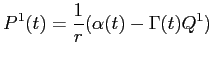
Proof: The proof is by induction. Part I of the proof
establishes that if the value function has this form at time
, then it has the same
form at time  . Part II of
the proof establishes the result for time , the first period in which trade
cannot occur.
. Part II of
the proof establishes the result for time , the first period in which trade
cannot occur.
9.1 Part I:
Suppose the form of the value function is correct for time
. Then, to establish
the form of the value function at time , I first solve for the competitive
fringe's demand curve for absorbing the net order flow of the large
investors. I then solve the large investors and competitive
fringe's equilibrium portfolio and consumption choices, and then
solve for the value function at time .
9.1.1 The competitive fringe's demand curve
The competitive fringe represents a continuum of infinitesimal
investors that are distributed uniformly on the unit interval with
total measure 1, i.e.
 for
for
![s \in [0,1]](img151.gif) . At time
, each participant
of the competitive
fringe solves:
. At time
, each participant
of the competitive
fringe solves:
![LaTex Encoded Math: \displaystyle \max_{\begin{array}{c}C_{s}(t-1),\\ Q_{s},\\ q_{s} \end{array}} -e^{-A_{s} C_{s}(t-1)} - \delta \operatorname{E}[ K_{s}(t) F(Q^{1},t) e^{-A_{s}(t) W_{s}(t)} ]](img152.gif)
where, is the
stacked vector of small investor 's holdings of illiquid ( ) and perfectly liquid
(
) and perfectly liquid
( ) risky
assets:
) risky
assets:
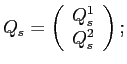
 is the stacked
vector of excess returns for the illiquid and liquid assets:
is the stacked
vector of excess returns for the illiquid and liquid assets:

and small investors liquid wealth is given by
![LaTex Encoded Math: \displaystyle W_{s}(t) = Q_{s}'Z(t) + r [W_{s}(t-1) - C_{s}(t-1)].](img158.gif)
In equation (B5),
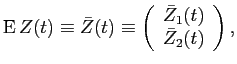
and
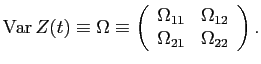
Substituting the expression for in (B4) and taking
expectations shows that small investors maximization becomes:
![LaTex Encoded Math: \displaystyle \max_{\begin{array}{c} C_{s}(t-1),\\ Q_{s} \end{array}} -e^{-A_{s} C_{s}(t-1)} - \delta F(Q^{1},t) e^{-A_{s}(t) r [W_{s}(t-1) - C_{s}(t-1)] -A_{s}(t) Q_{s}'\bar{Z}(t) + .5 A_{s}(t)^{2} Q_{s}' \Omega Q_{s} }](img161.gif)
In solving the model, it is useful to break small investors
maximization into pieces by first solving for optimal as a function of
, and then
solving for optimal . For given , the first order condition for optimal
shows that
optimal is
given by
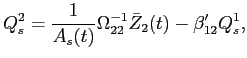
|
(B7) |
where
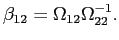
Plugging the solution for into the small investors value function and
simplifying then shows that the small investors maximization
problem reduces to:
![\begin{displaymath}\begin{split}\max_{\begin{array}{c} C_{s}(t-1),\\ Q^{1}_{s} \end{array}} -e^{-A_{s} C_{s}(t-1)} - & \delta F(Q^{1},t) K_{s}(t) \operatorname{Exp}\left \{ -.5 \bar{Z}_{2}'\Omega_{22}^{-1} \bar{Z}_{2} - A_{s}(t) r [W_{s}(t-1) - C_{s}(t-1)] \right \} \\ & \times \operatorname{Exp}\left \{ -A_{s}(t) Q^{1}_{s}'[\bar{Z}_{1}(t) - \beta_{12} \bar{Z}_{2}(t)] + .5 A_{s}(t)^{2} Q^{1}_{s}' \Omega_{e} Q^{1}_{s} \right \} \end{split}\end{displaymath}](img164.gif)
where
is given by
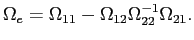
To gain intuition for the above expression, note that the excess return on each illiquid asset can be decomposed into a component that is correlated with the liquid assets and into a second idiosyncratic component.

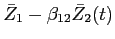 is the vector
of expected returns on the idiosyncratic components at time
and
is the
variance covariance matrix of the idiosyncratic returns. The
expression shows that small investors portfolio maximization
problem can equivalently be written in terms of choosing an
exposure to the returns of the liquid assets, and to the
idiosyncratic component of returns of the illiquid assets.
is the vector
of expected returns on the idiosyncratic components at time
and
is the
variance covariance matrix of the idiosyncratic returns. The
expression shows that small investors portfolio maximization
problem can equivalently be written in terms of choosing an
exposure to the returns of the liquid assets, and to the
idiosyncratic component of returns of the illiquid assets.
Solving for optimal
 then
shows
then
shows
![LaTex Encoded Math: \displaystyle Q^{1}_{s}(t) = \frac{1}{A_{s}(t)} \Omega_{e}^{-1} [\bar{Z}_{1}(t) - \beta_{12} \bar{Z}_{2}(t)]](img169.gif)
The aggregate demand for at time by all small investors can be found by integrating
both sides of equation (B9) with respect to
 , the density
of small investors, yielding:
, the density
of small investors, yielding:
![\begin{displaymath}\begin{array}{rcl} Q^{1}_{1}(t) & = & \int_{0}^{1} Q^{1}_{s}(t) \mu_{s} ds \\ [0.08in] & = & \left [\int_{0}^{1} \frac{1}{A_{s}(t)} \mu_{s} ds \right ] \Omega_{e}^{-1} [\bar{Z}_{1}(t) - \beta_{12} \bar{Z}_{2}(t)] \\ [0.08in] & = & \frac{1}{A_{1}(t)} \Omega_{e}^{-1} [\bar{Z}_{1}(t) - \beta_{12} \bar{Z}_{2}(t)] \end{array}\end{displaymath}](img171.gif)
9.1.2 The Price Schedule Faced by Large Investors
The price schedule faced by large investors at time maps large investors desired
orderflow of the illiquid assets into the time prices at which the competitive
fringe is willing to absorb the net orderflow. To solve for the
price schedule, I solve for prices  in equation (B10)
such that when the large investors choose trade
in equation (B10)
such that when the large investors choose trade
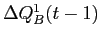 at time t-1, then the competitive fringe chooses trade
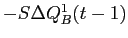 .
.
Rearranging, equation (B10) while
making the substitutions
 |
 |

|
|
 |
|
![LaTex Encoded Math: \displaystyle S_{1} [Q^{1}(t-1) + \Delta Q^{1}(t-1)],](img179.gif)
|
|
 |
|
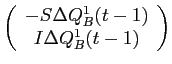
|
and
 |
|

|
|
 |
|
![LaTex Encoded Math: \displaystyle \frac{1}{r} \left ( \alpha(t) - \Gamma(t) [Q^{1}(t-1) + \Delta Q^{1}(t-1)] \right )](img185.gif)
|
then produces the price schedule faced by large investors at time
:

where,

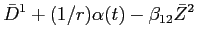



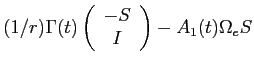
Given the price schedule in equation (B11), large investors at time solve the maximization problem:
9.1.3 Large Investors Maximization Problem

where, substituting in the budget constraint, liquid wealth at
the beginning of time
is given by

|
(B16) |
Note: Because dividends are paid in cash, the dividend payments received for holdings of illiquid asset are counted as part of liquid wealth even though the illiquid assets themselves are not counted.
Note that in equation (B15),
 and
and
 are
deterministic functions of time that are parameters of the value
function. Keeping this in mind, large investors holdings of the
liquid assets are solved in the same way as for small investors.
Taking expectations in equation (B15), solving
for optimal
are
deterministic functions of time that are parameters of the value
function. Keeping this in mind, large investors holdings of the
liquid assets are solved in the same way as for small investors.
Taking expectations in equation (B15), solving
for optimal  given , and
substituting the optimal choice back into the large investor's
value function, transforms the large investors maximization problem
so that it has the following form:
given , and
substituting the optimal choice back into the large investor's
value function, transforms the large investors maximization problem
so that it has the following form:
![\begin{displaymath}\begin{split}\max_{\begin{array}{c}C_{m}(t-1),\\ Q^{1}_{m} \end{array}} & -e^{-A_{m} C_{m}(t-1)} \\ & - \delta K_{m}(t) \left \{ \operatorname{Exp}( -.5 \bar{Z}^{2}'\Omega_{22}^{-1} \bar{Z}_{2} -A_{m}(t) r [W_{m}(t-1) - \Delta Q_{m}(t-1)'P^{1}(t-1,.) - C_{m}(t-1) ] \right. \\ & \left. \times \operatorname{Exp}(-A_{m}(t) Q^{1}'\bar{v}_{m}(t) + .5 A_{m}(t)^{2} Q^{1}'\theta_{m}(t) Q^{1} ) \right \} \end{split}\end{displaymath}](img198.gif)
where,



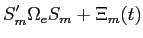
The large investors play a Cournot game in which each choose his
time trade
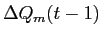 in
the illiquid assets to solve the maximization problem in (B17) while taking the trades of the other large
investors as given, but while taking into account the effect that
his own trades have on the prices of the illiquid assets. Recall
the price impact function for the illiquid assets at time
is given by equation
(B11).
in
the illiquid assets to solve the maximization problem in (B17) while taking the trades of the other large
investors as given, but while taking into account the effect that
his own trades have on the prices of the illiquid assets. Recall
the price impact function for the illiquid assets at time
is given by equation
(B11).
The first order condition for large investors illiquid asset choices is given by:
![\begin{displaymath}\begin{split}0 = -A_{m}(t) [(-S_{1} + & S_{m})\bar{v}_{m}(t)] + A_{m}(t)^2 (-S_{1} + S_{m})[(\theta_{m}(t) + \theta_{m}(t)')/2](Q^{1} + \Delta Q^{1}) \\ & + A_{m}(t) \left [r P^{1}(.,t-1) - S_{m} \beta_{Q^{1}_{B}}(t-1)' S_{m} \Delta Q^{1}_{B} \right ], \end{split}\end{displaymath}](img204.gif)
After substituting for
 from
equation (B11), writing
from
equation (B11), writing
 as
as
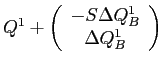 and simplifying, this produces the following reaction
function for large investor :
and simplifying, this produces the following reaction
function for large investor :

where,
![\begin{displaymath}\begin{split}\pi_{m}(t-1) = & A_{m}(t) (-S_{1} + S_{m})[(\theta_{m}(t) + \theta_{m}(t)')/2]\left( \begin{array}{c} -S \\ I \end{array} \right ) \\ & - \beta_{Q^{1}_{B}}(t-1) - S_{m} \beta_{Q^{1}_{B}}(t-1)' S_{m} \\ \end{split}\end{displaymath}](img209.gif)
|
(B22) |



![LaTex Encoded Math: \displaystyle \beta_{Q^{1}}(t-1) - A_{m}(t) (-S_{1} + S_{m}) [(\theta_{m}(t) + \theta_{m}(t)')/2]](img213.gif)
Stacking the (M-1) reaction functions produces a system of
 linear
equations in
unknowns:
linear
equations in
unknowns:

Assume that  is invertible. Then the solution for
is unique, and given by
is invertible. Then the solution for
is unique, and given by

9.1.4 Equilibrium Asset Holdings
The solution for
 is
. Therefore, the solution for
is
. Therefore, the solution for
 can be written as:

where,
 and
and
With the above notation, the equilibrium purchases by large
participant in period
are given by
![LaTex Encoded Math: \displaystyle \Delta Q^{1}_{m}(t-1) = S_m[ H_{0}(t-1) + H_{1}(t-1)Q^{1}(t-1) ]](img223.gif)
Additionally, the equilibrium transition dynamics for beginning of period illiquid risky asset holdings are given by:

where
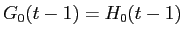 and
and
 .
.9.1.5 Equilibrium Price Function
Recall that the equilibrium price function in each time period
maps investors beginning of period holdings of risky assets to an
equilibrium price after trade. The equilibrium price function for
period is found by
plugging the solution for large investors equilibrium trades from
equation (B26) into the price schedule faced
by large investors (equation (B11)). The
resulting price function for illiquid asset in period has form:

where,




9.1.6 Large Investors Consumption
Large investors optimal time consumption depends on optimal time trades. After plugging the
expressions for equilibrium prices, and equilibrium trades
[equations (B30), (B31),
and (B27)] into equation (B17), large investors consumption choice problem has
form:

where
![\begin{displaymath}\begin{split}\psi_{m}(Q^{1}, W_{m}(t-1),t-1) = & e^{-.5 \bar{Z}^{2}'\Omega_{22}^{-1} \bar{Z}^{2} -A_{m}(t) r W_{m}(t-1)} \\ & \times e^{+A_{m}(t) r [S_{m}(H_{0}(t-1) + H_{1}(t-1)Q^{1}(t-1)]'(\alpha(t-1) - \Gamma(t-1) Q^{1}(t-1))/r } \\ & \times e^{-A_{m}(t) (G_{0}(t-1) + G_{1}(t-1) Q^{1}(t-1))'\bar{v}_{m}(t)} \\ & \times e^{ .5 A_{m}(t)^{2} [G_{0}(t-1) + G_{1}(t-1) Q^{1}(t-1)]'\theta_{m}(t) [G_{0}(t-1) + G_{1}(t-1) Q^{1}(t-1)]} \end{split}\end{displaymath}](img233.gif)
|
(B35) |
The first order condition for choice of consumption implies that optimal consumption is given by:
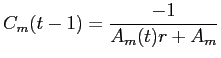 ln
ln
9.1.7 Large investors value function at time
Define
 as the value function to
large investor from
entering period when
the vector of illiquid risky asset holdings is , and his liquid asset holdings
are
as the value function to
large investor from
entering period when
the vector of illiquid risky asset holdings is , and his liquid asset holdings
are
 . After
substituting the optimal consumption choice in (B36) into equation (B34),
this value function is given by:
. After
substituting the optimal consumption choice in (B36) into equation (B34),
this value function is given by:
![LaTex Encoded Math: \displaystyle V_{m}(W_{m}(t-1),Q^{1},t-1) = -\left [\frac{1+r^{*}_{m}(t)}{r^{*}_{m}(t)} \right ] \left [\delta k_{m}(t) r^{*}_{m}(t) \psi_{m}(Q^{1}, W_{m}(t-1), t-1) \right ]^{\frac{1}{1+r^{*}_{m}(t)}}](img238.gif)
where,
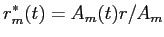
Tedious algebra then shows that large investor 's value function at time
has form:

where the parameters of the value function at time are given by the following Riccati
difference equations.

![\begin{displaymath}\begin{split}k_{m}(t-1) = & \left [ \frac{r^{*}_{m}(t) + 1}{r^{*}_{m}(t)} \right ] \left [\delta k_{m}(t) r^{*}_{m}(t) \right ]^{\frac{1}{1+r^{*}_{m}(t)}} \\ & \times e^{\frac{-.5 \bar{Z}^{2} ' \Omega_{22}^{-1} \bar{Z}^{2}}{1+r^{*}_{m}(t)}} \\ & \times e^{A_{m}(t-1) H_{0}(t-1)'S_{m}' \alpha(t-1)/r - A_{m}(t-1)G_{0}(t-1)'\bar{v}_{m}(t)/r + .5 A_{m}(t-1)^{2} ((1+r^{*}_{m}(t))/r^{2})(G_{0}(t-1)'\theta_{m}(t) G_{0}(t-1))} \end{split}\end{displaymath}](img242.gif)


9.1.8 Small investors optimal consumption
The solution for each small investors consumption depends on
small investors optimal trades. To solve for optimal consumptions,
I first use equation (B9) to substitute out
for in equation
(B8). I then substitute out for
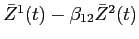 with the
expression:
with the
expression:

|
(B44) |
where,



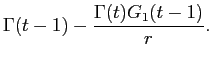
Finally I substitute out
with
![[G_{0}(t-1) + G_{1}(t-1)Q(t-1)]](img251.gif) . With these
substitutions, small investors choice of optimal consumptions
simplifies to:
. With these
substitutions, small investors choice of optimal consumptions
simplifies to:

where,
![\begin{displaymath}\begin{split}\psi_{s}(Q^{1}(t-1),W_{s}(t-1),& t-1) = e^{-A_{s}(t) r W_{s}(t-1) -.5 \bar{Z}_{2}'\Omega_{22}^{-1} \bar{Z}_{2}} \\ \times & e^{-.5 [a_{0}(t-1) + a_{1}(t-1) Q^{1}(t-1)]'\Omega_{e}^{-1}[a_{0}(t-1) + a_{1}(t-1) Q^{1}(t-1)]} \\ \times & e^{-[G_{0}(t-1) + G_{1}(t-1) Q^{1}(t-1)]'\bar{v}_{s}(t)}\\ \times & e^{ - [G_{0}(t-1) + G_{1}(t-1) Q^{1}(t-1)]' \theta_{s}(t) [G_{0}(t-1) + G_{1}(t-1) Q^{1}(t-1)]} \end{split}\end{displaymath}](img253.gif)
|
(B48) |
The first order condition for choice of optimal consumption implies that optimal consumption is given by:
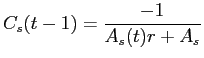 ln
ln
9.1.9 Small investors value function at time
Define
 as the value function
to small investor from
entering period when
the vector of illiquid risky asset holdings is
as the value function
to small investor from
entering period when
the vector of illiquid risky asset holdings is
 , and his
liquid wealth is
, and his
liquid wealth is
 . After
substituting the optimal consumption choice in (B49) into equation (B47), this value function is given by:
. After
substituting the optimal consumption choice in (B49) into equation (B47), this value function is given by:
![\begin{displaymath}\begin{split}V_{s}(W_{s}(t-1),Q^{1}(t-1),t-1) = \\ & -\left [\frac{1+r^{*}_{s}(t)}{r^{*}_{s}(t)} \right ] \left [\delta k_{s}(t) r^{*}_{s}(t)\psi_{s}(Q^{1}(t-1),W_{s}(t-1), t-1)\right ]^{\frac{1}{1+r^{*}_{s}(t)}} \end{split}\end{displaymath}](img259.gif)
where,
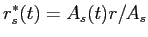
|
(B51) |
Simplification then shows that the value function has form:
![\begin{displaymath}\begin{array}{ccl} V_{s}(W_{s}(t-1),Q^{1}(t-1),t-1) & = & -K_{s}(t-1) \ F(Q^{1},t-1) \ e^{-A_{s}(t-1)W_{s}(t-1)} , \\ [0.06in] \mbox{where} \ F(Q^{1}(t-1),t-1) & = & e^{- Q^{1}(t-1)'\bar{v}_{s}(t-1) - Q^{1}(t-1)'\theta_{s}(t-1) Q^{1}(t-1)} \end{array}\end{displaymath}](img261.gif)
The parameters in the small investors value functions at time
are a function of
time parameters as
expressed in the following Riccati equations:
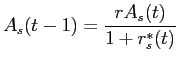
|
(B53) |
![\begin{displaymath}\begin{split}k_{s}(t-1) = & \left [ \frac{r^{*}_{s}(t) + 1}{r^{*}_{s}(t)} \right ] \left [\delta k_{s}(t-1) r^{*}_{s}(t) e^{-.5 \bar{Z}^{2}'\Omega_{22}^{-1} \bar{Z}^{2}} \right ]^{\frac{1}{1+r^{*}_{s}(t)}} \\ & \times \operatorname{Exp}\left \{\frac{ - a_{0}(t-1)'\Omega_{e}^{-1} a_{0}(t-1) - G_{0}(t-1)'\bar{v}_{s}(t) - G_{0}(t-1)'\theta_{s}(t) G_{0}(t-1)}{1+r^{*}_{s}(t)} \right \}, \end{split}\end{displaymath}](img263.gif)
|
(B54) |


This completes part I of the proof because equations (B39) and (B52) verify
that the value functions at time have the same form as at time .
9.2 Part II
To establish part II of the proof, I need to show that investors
value functions for entering entering period , the last period of trade, has the
same functional form as given in the proposition. To establish this
result, I first need to solve for investors value function at time
 , the first period
when investors cannot trade the illiquid assets (recall they can
continue to trade the riskless asset and the liquid assets
indefinitely). Then, given this value function, I use backwards
induction to solve for investors value function at time
.
, the first period
when investors cannot trade the illiquid assets (recall they can
continue to trade the riskless asset and the liquid assets
indefinitely). Then, given this value function, I use backwards
induction to solve for investors value function at time
.
9.2.1 Investors Value
Functions at Time T+1
Recall that investors are infinitely lived but that from time
onwards they cannot
alter their holdings of illiquid assets, but they can continue to
alter their consumption, and their holdings of liquid and riskless
assets. Because investors cannot trade in period and after, the distinction
between small and large investors after this period is irrelevant.
Hence, the index used
below could be for either a large or small investor. Using the
Bellman principle, the value function  of entering period
(
of entering period
( ) with illiquid asset holdings
 and liquid
wealth
satisfies the functional equation:
and liquid
wealth
satisfies the functional equation:

where,
![LaTex Encoded Math: \displaystyle W_{m}(t+2) = Q^{1}_{m}'D^{1}(t+2) + Q^{2}_{m}'Z^{2}(t+2) + r[W_{m}(t+1)- C_{m}(t+1)],](img271.gif)
and,

Inspection shows that the function
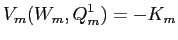 exp
exp![LaTex Encoded Math: \displaystyle ^{-A_{m}[1-(1/r)] W_{m} - A_{m}[1-(1/r)] Q^{1}_{m}'\frac{(1/r)[\bar{D}^{1} - \beta_{12} \bar{Z}^{2}]}{1-(1/r)} + \frac{1}{2} A_{m}^{2}[1-(1/r)]^{2} Q_{m}^{1}'\frac{(1/r)\Omega_{e}}{1-(1/r)} Q_{m}^{1} }](img274.gif)
with
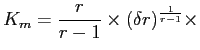 exp
exp
 .
.
Given the value function at time , to solve for investors value functions at time
, I follow the same
steps as in equations (B4) through equation
(B56). Therefore, substituting in from
equation (B59), small investors
maximization problem at time has form:

such that,
![LaTex Encoded Math: \displaystyle W_{s}(T+1) = Q^{1}_{s}'Z^{1}(T+1) + Q^{2}_{s}'Z^{2}(T+1) + r[W_{s}(T)- C_{s}(T)],](img279.gif)
|
(B61) |
where,
 |
|
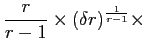 exp
exp
|
(B62) |
 |
|
![LaTex Encoded Math: \displaystyle A_{s}[1-(1/r)],](img283.gif) |
(B63) |
 |
|
![LaTex Encoded Math: \displaystyle \frac{(1/r)[\bar{D}^{1} - \beta_{12} \bar{Z}^{2}]}{1-(1/r)},](img285.gif)
|
(B64) |
 |
|

|
(B65) |
 |
|
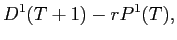 |
(B66) |
 |
|

|
(B67) |
Substituting the expression for
 into the
value function, taking expectations, and then solving for optimal
given
, and
substituting that into the value function shows that small
investors optimal choice of and
into the
value function, taking expectations, and then solving for optimal
given
, and
substituting that into the value function shows that small
investors optimal choice of and  problem has form:
![\begin{displaymath}\begin{split}\max_{\begin{array}{c} C_{s}(T),\\ Q^{1}_{s} \end{array}} -e^{-A_{s} C_{s}(T)} - & \delta K_{s}(T+1) \operatorname{Exp}\left \{ -.5 \bar{Z}_{2}'\Omega_{22}^{-1} \bar{Z}_{2} - A_{s}(T) r [W_{s}(T) - C_{s}(T)] \right \} \\ & \times \operatorname{Exp}\left \{ -A_{s}(T+1) Q^{1}_{s}' [\bar{v}_{s}(T+1) - r P^{1}(T)] + .5 A_{s}(T+1)^{2} Q^{1}_{s}' \Omega_{e}(T+1) Q^{1}_{s} \right \} \end{split}\end{displaymath}](img294.gif)
where

![LaTex Encoded Math: \displaystyle \left [\frac{\bar{D}^{1}(T+1) - \beta_{12} \bar{Z}_{2}(T+1)}{1-(1/r)}\right ]](img296.gif)

![LaTex Encoded Math: \displaystyle \left [\frac{\Omega_{e}}{1-(1/r)} \right ]](img298.gif)
Integrating the solution for optimal  over the set of small
investors then reveals that the net demand for the illiquid assets
by the competitive fringe is:
over the set of small
investors then reveals that the net demand for the illiquid assets
by the competitive fringe is:
![LaTex Encoded Math: \displaystyle Q^{1}_{1}(T+1) = \frac{1}{A_{1}(T+1)}[\Omega_{e}(t+1)]^{-1} [\bar{v}_{s}(T+1) - rP(t)]](img300.gif)
|
(B71) |
Following the approach that was used earlier to solve for the price schedule faced by large investors in equation (B11), inverting the small investors demand schedule for the illiquid assets reveals that the price schedule faced by large investors has the form:

|
(B72) |





Given the price schedule at time , and the value function in equation (B59), large investors maximization problem at time
can be written in the
form:

|
(B76) |
where,

![LaTex Encoded Math: \displaystyle A_{m}[1-(1/r)]](img309.gif)

![LaTex Encoded Math: \displaystyle S_{m}' \left [ \frac{(1/r)[\bar{D}^{1} - \beta_{12} \bar{Z}^{2}]}{1-(1/r)} \right ],](img311.gif)

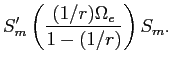


Substituting in the budget constraint, liquid wealth at the
beginning of time is
given by

|
(B81) |
Large investors maximization problem at time has exactly the same form as given
in equation (B15). Therefore, the optimal
trades and consumption of large investors follow precisely the same
equations as given in Part I of the proof. Large investors value
function at time also
has the same functional form as in part I. The equilibrium price
function at time also
has the same functional form as in part I. Therefore, to complete
the proof, it suffices to solve for small investors consumption and
then value function and verify that the value function has the
appropriate functional form.
To do so, note that from equation (B68), it is straightforward to show that the
optimal choice of
 is
is
![LaTex Encoded Math: \displaystyle Q^{1}_{s}(T+1) = \frac{1}{A_{s}(T+1)} [\Omega_{e}(T+1)]^{-1} \times [\bar{v}_{s}(T+1) - r P^{1}(T)],](img318.gif)
 ,
then the maximization in equation (B68)
simplifies to have the form:
,
then the maximization in equation (B68)
simplifies to have the form:

|
(B82) |
where,
![\begin{displaymath}\begin{split}\Psi_{s}(T,Q^{1}) = & \operatorname{Exp}\left \{ -.5 \bar{Z}_{2}'\Omega_{22}^{-1} \bar{Z}_{2} - A_{s}(T) r W_{s}(T) \right \} \\ & \times \operatorname{Exp}\left \{ -.5 [\bar{v}_{s}(T+1) - \alpha(T)]' [\Omega_{e}(T+1)]^{-1} [\bar{v}_{s}(T+1) - \alpha(T)] \right \} \\ & \times \operatorname{Exp}\left \{ -Q^{1}(T)'\Gamma(T)'[\Omega_{e}(T+1)]^{-1} [\bar{v}_{s}(T+1) - \alpha(T)] \right \} \\ & \times \operatorname{Exp}\left \{ -.5 Q^{1}(T)' \Gamma(T)'[\Omega_{e}(T+1)]^{-1} \Gamma(T) Q^{1}(T) \right \} \end{split}\end{displaymath}](img321.gif)
|
(B83) |
Using the same approach that was used to solve for large
investors optimal consumption and then value function in part I of
the proof, tedious algebra shows that small investors value
function at time has
form


 |
|
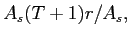 |
(B84) |
 |
|

|
(B85) |
![\begin{displaymath}\begin{split}K_{s}(T) = & \left [ \frac{r^{*}_{s}(T+1) + 1}{r^{*}_{s}(T+1)} \right ] \left [\delta K_{s}(T+1) r^{*}_{s}(T+1) \right ]^{\frac{1}{1+r^{*}_{s}(T+1)}} \\ & \times \operatorname{Exp}\left ( \frac{-.5 \bar{Z}^{2} ' \Omega_{22}^{-1} \bar{Z}^{2} -.5 [\bar{v}_{s}(T+1) - \alpha(T)]' [\Omega_{e}(T+1)]^{-1} [\bar{v}_{s}(T+1) - \alpha(T)]}{1+r^{*}_{s}(T+1)} \right ), \end{split}\end{displaymath}](img328.gif)
|
(B86) |
![LaTex Encoded Math: \displaystyle \bar{v}_{s}(T) = \frac{\Gamma(T)'[\Omega_{e}(T+1)]^{-1} [\bar{v}_{s}(T+1) - \alpha(T)]}{1+r^{*}_{s}(T+1)},](img329.gif)
![LaTex Encoded Math: \displaystyle \theta_{s}(T) = \frac{\Gamma(T)'[\Omega_{e}(T+1)]^{-1} \Gamma(T)}{1+r^{*}_{s}(T+1)}.](img330.gif)
|
(B88) |
This completes the proof by establishing that large and small
investors value functions take the hypothesized form in all periods
that involve trade. 
10 Solutions for Value Function Parameters
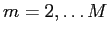
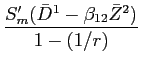

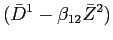


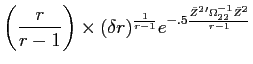
Proof:
For
 and
and
 :
:
The proof is by induction. First, suppose that the results for
and
are true at
time . Then, from equation
(B12),
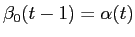 . This implies that from
equation (B23) that
. This implies that from
equation (B23) that
 .
As a result
.
As a result
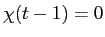 , which
implies from equation (B32) that
, which
implies from equation (B32) that
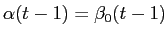 and from equations
(B28) and (B30) that
and from equations
(B28) and (B30) that
 Substituting for
 and
and
 in equation
(B42) and simplifying then shows:
in equation
(B42) and simplifying then shows:
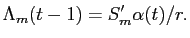
|
(C6) |
Finally, substituting this result in equation (B18) proves the result for
 . To
complete the induction, I use equations (B78) and (B18) to solve
for
. To
complete the induction, I use equations (B78) and (B18) to solve
for
 ; I
then substitute the resulting expression as well as the one for
; I
then substitute the resulting expression as well as the one for
 (equation
(B73)) in equation (B23) and use it to show that
(equation
(B73)) in equation (B23) and use it to show that
 , which
implies
, which
implies
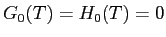 . Substituting into equation
(B32), then shows that
. Substituting into equation
(B32), then shows that
![\alpha(T) = \beta_{0}(T) = S_{m}'(\bar{D}^{1} - \beta_{12} \bar{Z}^{2})/[1-(1/r)]](img357.gif) , which confirms the result for
, which confirms the result for  . Finally, given the
solutions for and
,
substitution in equations (B78) and
(B18) confirms the result for
. Finally, given the
solutions for and
,
substitution in equations (B78) and
(B18) confirms the result for
 and
completes the induction.
and
completes the induction.
For  and
and
 :
:
The proof is by backwards induction. We know
![A_{m}(T+1) = A_{m}[1-(1/r)]](img362.gif) from equation (B77). Using this expression, and iterating on
equations (B40) and (B38)
proves the result for all times
from equation (B77). Using this expression, and iterating on
equations (B40) and (B38)
proves the result for all times

For  :
:
The proof is by backwards induction. Equation (B80) establishes that it is true at time . Plugging the solution for
 into
equation (B41) while using the solutions for
into
equation (B41) while using the solutions for
 and the
result
and the
result
 confirms the result for
periods
confirms the result for
periods
 .
.
The next proposition provides information on the value functions of the small investors:


![LaTex Encoded Math: \displaystyle A_{s}[1-(1/r)]](img372.gif)


Proof:
For  and
and
 :
Plugging the solutions for and
from
proposition 3 into equation (B45) shows that
:
Plugging the solutions for and
from
proposition 3 into equation (B45) shows that
 for all
times . Since
for all
times . Since
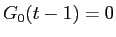 for all
times , it then follows from
equation (B55) that if
for all
times , it then follows from
equation (B55) that if
 ,
then so does
,
then so does
 . To
complete the induction, note that substituting the solutions for
. To
complete the induction, note that substituting the solutions for
 (equation (B69)) and (proposition 3) into equation (B87)
confirms the result.
(equation (B69)) and (proposition 3) into equation (B87)
confirms the result.
For  ,
,
 , and
, and
 :
:
The form of the proof is identical to that given in proposition
3.
, conditional on state variable
the Nash
Equilibrium trades of the large investors exists and is unique.
Then for all
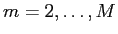 and
and
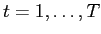 ,
,
 has
form:
has
form:

|
(C12) |
where,
 is
is
 ; and
; and
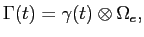
|
(C13) |
where,
 is
is
 .
.Proof: The proof is by induction. First, assume that the
theorem is true at time .
Then, from equations (B14) and (B13)
 ,
and
,
and
 , where
 is
is
 and
and
 is
. Applying
these substitutions in large investors reaction functions and then
stacking the results reveals that in equation (B25),
is
. Applying
these substitutions in large investors reaction functions and then
stacking the results reveals that in equation (B25),
 and
and
 . The assumption
that the Nash Equilibrium trades in each period are unique implies
that
. The assumption
that the Nash Equilibrium trades in each period are unique implies
that
 is
invertible. Solving for
and
is
invertible. Solving for
and
 then shows
that
then shows
that
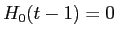 and
and
 |
|
![LaTex Encoded Math: \displaystyle \left ( \begin{array}{c}-S[P(t-1)^{-1} Z(t-1)] \otimes I_{N_{1}}\\ (P(t-1)^{-1} Z(t-1)) \otimes I_{N_{1}} \end{array} \right )](img404.gif)
|
(C14) |
|
![LaTex Encoded Math: \displaystyle \left ( \begin{array}{c} [-\iota_{M}' {\cal P}(t-1)^{-1}Z(t-1)] \otimes I_{N_{1}} \\ ({\cal P}(t-1)^{-1} Z(t-1)) \otimes I_{N_{1}} \end{array} \right )](img405.gif)
|
(C15) | |
|
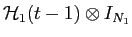
|
(C16) |
where
is a
vector of
ones, and
 is
. Since
is
. Since
 , it follows that
 for
for
 . From
here, substitution in equation (B33) shows
that
. From
here, substitution in equation (B33) shows
that
 and
substitution in equation (B43) and
(B19) shows that
and
substitution in equation (B43) and
(B19) shows that
 .
To complete the induction, I substitute the expression for
.
To complete the induction, I substitute the expression for
 (equation
(B79)) into equation (B19) and show that the result is true for
(equation
(B79)) into equation (B19) and show that the result is true for
 . Then,
following steps similar to those in the first part of the
induction, it is straightforward to show that the result holds for
. Then,
following steps similar to those in the first part of the
induction, it is straightforward to show that the result holds for
 and
and
 , which
completes the induction. .
, which
completes the induction. .
 ,
,
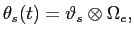
 is
.
is
.Proof: Straightforward induction involving application of the results from proposition 5.
11 Proofs of Asset Pricing
Propositions
 ,
then investors will hold forever, and asset prices and expected returns
will be the same as when there is perfect competition.
,
then investors will hold forever, and asset prices and expected returns
will be the same as when there is perfect competition.Proof: When investors risky asset holdings are
, then investors
asset holdings are identical to those associated with a competitive
equilibrium and complete markets in which trading is restricted to
the set of market participants that has been modeled. Hence, when
trade in the first set of assets is restricted to be among the
market participants, asset holdings are pareto optimal in all time
periods; and investors asset holdings will remain at because investors have no
basis to trade away from asset holdings that are associated with
perfect risk sharing. Because is the vector of asset holdings from a
competitive equilibrium, the resulting prices and expected returns
which support  are the
same as in the competitive equilibrium.
are the
same as in the competitive equilibrium.
![LaTex Encoded Math: \displaystyle [\Gamma(t) - \frac{1}{r}\Gamma(t+1)G_{1}(t) ] Q^{1W} = \lambda_{[X^{1}]} \Omega_{e} X^{1}.](img422.gif)
Proof: Algebra shows that when asset holdings of asset 1
at time are
, then excess
returns of asset 1 are equal to:
![LaTex Encoded Math: \displaystyle P^{1}(t+1) + \bar{D}^{1} - rP^{1}(t) = \beta_{12} \bar{Z}^{2} + [\Gamma(t) - \frac{1}{r}\Gamma(t+1)G_{1}(t) ]Q^{1W}.](img423.gif) then the excess
returns of asset 1 are
then the excess
returns of asset 1 are
![\beta_{12} \bar{Z}^{2} + \lambda_{[X^{1}]} \Omega_{e} X^{1}](img424.gif) .
Equating the two expressions confirms the claim in the corollary.
.
Equating the two expressions confirms the claim in the corollary.

Proposition 1: When investors
asset holdings of the first asset are not , then equilibrium expected
asset returns satisfy a linear factor model in which one factor is
the returns on asset 2, another factor corresponds to perfect
risk-sharing, but imperfect diversification of the idiosyncratic
risk of asset 1, and the remaining factors correspond to the
deviation of large investors asset holdings from those associated
with the large investors perfectly sharing the idiosyncratic risk
of asset 1.
Proof: Let
denote the vector of asset holdings of asset 1 that is associated
with perfect risk sharing among the investors that trade in asset
1. Manipulation of the equation for equilibrium prices given in
proposition 2, and substitution of
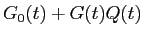 for
for  shows:
![LaTex Encoded Math: \displaystyle P^{1}(t+1) + \bar{D}^{1} - rP^{1}(t) = [\frac{1}{r} \alpha(t+1) + \bar{D^{1}} - \alpha(t)] -[\frac{1}{r}\Gamma(t+1)G_{0}(t)] + [\Gamma(t) - \frac{1}{r}\Gamma(t+1)G_{1}(t) ]Q^{1}(t)](img428.gif)
Plugging in the solution for
![\alpha(t) = \alpha(t-1) = [\bar{D}^{1} - \beta_{12} \bar{Z}^{2}]/[1-(1/r)]](img429.gif) shows the first term in braces on the right hand side of
the equation is equal to
shows the first term in braces on the right hand side of
the equation is equal to
 . The second term in braces is
zero since proposition 3 shows that
. The second term in braces is
zero since proposition 3 shows that
 Adding
and subtracting
to , the above
equation can be rewritten as:
Adding
and subtracting
to , the above
equation can be rewritten as:
 - Q^{W}) + [\Gamma(t) - \frac{1}{r}\Gamma(t+1)G_{1}(t) ]Q^{1W}](img432.gif)
Using the fact that
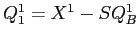 , the vector
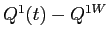 can
be expressed in terms of the deviations of large investors asset
holdings from pareto optimal asset holdings:
can
be expressed in terms of the deviations of large investors asset
holdings from pareto optimal asset holdings: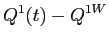 |
|
![LaTex Encoded Math: \displaystyle \left[ \begin{array}{c}(X^{1} - SQ^{1}_{B}) - (X^{1}-SQ^{1W}_{B}) \\ Q^{1}_{B} - Q^{1W}_{B} \end{array} \right ]](img436.gif)
|
|
|
![LaTex Encoded Math: \displaystyle \left [\begin{array}{c} -S \\ I \end{array} \right ] (Q^{1}_{B} - Q^{1W}_{B})](img437.gif)
|
Applying the substitution for
, and
the result of corollary 3 in equation
(D1) shows
![LaTex Encoded Math: \displaystyle P^{1}(t+1) + \bar{D}^{1} - rP^{1}(t) = \beta_{12} \bar{Z}^{2} + \lambda_{[X^{1}]} \Omega_{e} X^{1} + [\Gamma(t) - \frac{1}{r}\Gamma(t+1)G_{1}(t) ]\left ( \begin{array}{c} -S \\ I \end{array} \right ) (Q^{1}_{B}(t) - Q^{1W}_{B})](img438.gif)
Finally, applying the algebra used in the derivation of proposition 5 shows
![LaTex Encoded Math: \displaystyle [\Gamma(t) - \frac{1}{r}\Gamma(t+1)G_{1}(t) ]\left ( \begin{array}{c} -S \\ I \end{array} \right ) = \lambda(t) \otimes \Omega_{e}](img439.gif)
|
(D2) |
where
 is
. Making
this substitution then shows:
is
. Making
this substitution then shows:
![\begin{displaymath}\begin{array}{rcl} P^{1}(t+1) + \bar{D}^{1} - rP^{1}(t) & = & \beta_{12} \bar{Z}^{2} + \lambda_{[X^{1}]} \Omega_{e} X^{1} + [\lambda(t) \otimes \Omega_{e}] (Q^{1}_{B}(t) - Q^{1W}_{B}) \\ & = & \beta_{12} \bar{Z}^{2} + \lambda_{[X^{1}]} \Omega_{e} X^{1} + \sum_{m=2}^{M} \lambda(m,t) \Omega_{e} (Q^{1}_{m}(t) - Q^{1W}_{m}) \end{array}\end{displaymath}](img441.gif)
|
(D3) |
where
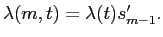 .
.
Corollary 1: When asset
holdings at time are
not efficient, then asset returns at time follow a factor model in which
the market portfolio, the portfolio of segment residual risk, and
the deviation of large investors time asset holdings from efficient asset
holdings are factors.
Proof: Iterating equation (D1),
by periods shows:
 - Q^{1W}) \\ &+ [\Gamma(t+\tau) - \frac{1}{r}\Gamma(t+\tau + 1)G_{1}(t+\tau) ]Q^{1W}. \end{split}\end{displaymath}](img443.gif)
Iterating the equation for equilibrium trades in each period shows
![LaTex Encoded Math: \displaystyle Q^{1}(t+\tau) = [\prod_{j=0}^{\tau-1} G_{1}(t+j)] Q^{1}(t).](img444.gif)
![LaTex Encoded Math: \displaystyle [\prod_{j=0}^{\tau-1} G_{1}(t+j)] Q^{1W} = Q^{1W}.](img445.gif)

|
|
![LaTex Encoded Math: \displaystyle \beta_{12} \bar{Z}^{2} + \lambda_{[X^{1}]} \Omega_{e} X^{1} + [\lambda(t,\tau) \otimes \Omega_{e}](Q^{1}(t)-Q^{1W})](img447.gif)
|
|
|
![LaTex Encoded Math: \displaystyle \beta_{12} \bar{Z}^{2} + \lambda_{[X^{1}]} \Omega_{e} X^{1} + \sum_{m=2}^{M} \lambda_{m}(t,\tau) \Omega_{e} (Q^{1}_{m}(t) - Q_{m}^{1W})](img448.gif)
|
where,
![LaTex Encoded Math: \displaystyle \lambda(t,\tau) \otimes \Omega_{e} = [\Gamma(t+\tau) - \frac{1}{r}\Gamma(t+1+\tau)G_{1}(t+\tau) ] \prod_{j=0}^{\tau-1} G_{1}(t+j),](img449.gif)
 .
.
11.1
Competitive Benchmark Model
It is useful to contrast the behavior in the multi-market model with large investors with the behavior of asset prices and trades in the same model when all investors are price takers and can trade forever.
In this infinite period set-up with competitive markets, the
equilibrium risk-premium should be time invariant. Denote this risk
premium by  ,
where,
,
where,

|
(D5) |
Note that
 is taken
as exogenous. The goal is to solve for
is taken
as exogenous. The goal is to solve for
 and
and
 that makes the
prices of the first group of assets (the ones that are illiquid in
the imperfect competition model) consistent with equilibrium in all
time periods.
that makes the
prices of the first group of assets (the ones that are illiquid in
the imperfect competition model) consistent with equilibrium in all
time periods.
Solving the equation for forward while imposing the transversality
condition
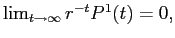 shows that
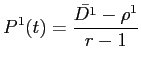 .
.
Given the hypothesized behavior of prices, it remains to solve
for  and then to
show that the hypothesized behavior of prices is consistent with
equilibrium.
and then to
show that the hypothesized behavior of prices is consistent with
equilibrium.
The function,

and the risk premium solution
![LaTex Encoded Math: \displaystyle \rho^{1} = \bar{Z}^{1} = \beta_{12} \bar{Z}^{2} + \lambda_{[X^{1}]} \Omega_{e} X^{1},](img460.gif)
where,
![LaTex Encoded Math: \displaystyle \lambda_{[X^{1}]} = \frac{(1-(1/r))}{\sum_{m=1}^{M}(1/A_{m})}](img461.gif)
|
(D7) |
satisfies the Bellman equation,
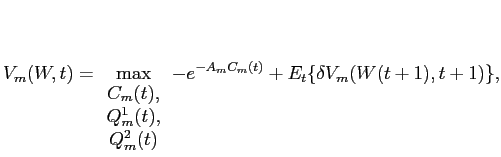
![LaTex Encoded Math: \displaystyle W(t+1) = Q_{m}^{1}(t)'Z^{1}(t) + Q_{m}^{2}(t)'Z^{2}(t) +r[W(t) - C_{m}(t)].](img463.gif)
In addition, in the competitive equilibrium, investors optimal
choices of are
constant through time, and are market clearing for the hypothesized
. Investor
competitive
equilibrium holdings of is denoted by
 and is
equal to
and is
equal to
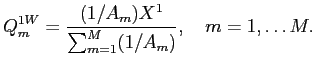
|
(D8) |
Substituting the hypothesized into the expression for equilibrium
, it follows that
in a competitive equilibrium, the equilibrium price is given by

|
(D9) |
12 Solving the IPO Allocation and
Price-Setting Problem
The underwriter's problem in equations (16) - (18) problem requires
that he maximize a nonlinear objective function subject to the
equality constraint that the total issue is allocated at the IPO or
sold in the aftermarket, and subject to a set of nonlinear
participation constraints. To solve the maximation, the
participation constraints were expressed in terms of investors
certainty equivalent wealth. The transformed participation
constraints are quadratic in the state variables. Additionally, the
equality constraint was used to express  in terms of the size of the
issue, and the allocations to other investors:
in terms of the size of the
issue, and the allocations to other investors:
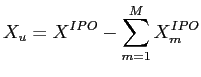
To economize on notation, I will drop the "IPO" superscript below in what follows. The Lagrangian for the transformed maximization problem is:
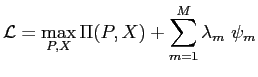
|
(E1) |
The necessary conditions for an optimum are given by the Kuhn-Tucker conditions:
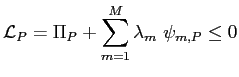 with c.s.
 |
(E2) |
and for
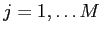 :
:
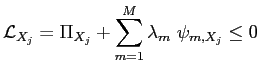 with c.s.
 |
(E3) |
If an investor purchases any shares at the IPO, then his utility is decreasing in the IPO offer price. Therefore, if shares are issued at the IPO, then the incentive constraints must be binding for some investors, because if they were not the underwriter could profit by raising the offer price until the incentive constraints do bind.
Although it is clear the incentive constraints must bind for at
least one investor, it is not clear for how many other investors
the constraints will bind. I solved the model in the special case
when there are 6 investors ( ) and the only asset in the segment is the new
issue. To solve the model, I assumed that the underwriters short
position is limited, i.e.
) and the only asset in the segment is the new
issue. To solve the model, I assumed that the underwriters short
position is limited, i.e.
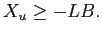 With
this added constraint, the feasible choices of
With
this added constraint, the feasible choices of  lie on a simplex. I discretized
the simplex so that each investor's post IPO asset holdings could
take one of 21 values. Given a vector of asset holdings, I then
solved for the highest IPO offer price that satisfies all investors
incentive compatibility constraints,38, and then evaluated the objective
function. The point on the discretized simplex for which the
objective function was highest was treated as being in a
neighborhood of the global optimum, and was used as a starting
point for a second stage optimization. Additionally, the investor
or investors for whom the incentive compatibility constraints were
binding, were deemed as the investors for whom the constraints will
be binding at the optimum.
lie on a simplex. I discretized
the simplex so that each investor's post IPO asset holdings could
take one of 21 values. Given a vector of asset holdings, I then
solved for the highest IPO offer price that satisfies all investors
incentive compatibility constraints,38, and then evaluated the objective
function. The point on the discretized simplex for which the
objective function was highest was treated as being in a
neighborhood of the global optimum, and was used as a starting
point for a second stage optimization. Additionally, the investor
or investors for whom the incentive compatibility constraints were
binding, were deemed as the investors for whom the constraints will
be binding at the optimum.
The second stage optimization minimized the squared norm of the
Kuhn-Tucker conditions while checking for changes in the set of
investors for whom the constraints are binding. A quadratic
hillclimbing algorithm with safeguards was used in the second stage
optimization. When the investors all differ in their risk aversion,
as they do in some of the examples in the paper, then the incentive
compatability constraints tended to bind for a single investor.
Under this circumstance, the Kuhn Tucker condition for price
produce an analytical expression for
, which
simplifies the second-stage optimization. A complicating factor in
the second stage is that the Hessians of the first and second stage
objective functions are singular. I believe (but cannot show), that
Gauss' nonlinear constrained optimization crashed because of this
property. To compensate for this problem in the second stage, at
each iteration I projected the direction vector onto the range and
null spaces of the hessian matrix, and then solved for the
projection coefficients that guarantee an increasing step in the
objective function. Finally, I found the book Practical Optimization, by Gill, Murray, and
Wright (1981) to be a very useful reference for solving nonlinear
optimization problems.
13 Market Segmentation and Market
Adjusted Abnormal Returns
The purpose of this section is to study the properties of market
adjusted abnormal returns when there is market segmentation. The
analysis and results are closely related to Merton (1987). The
model contains two time-periods and blocks of risky assets, and a riskfree asset that is
in perfectly elastic supply and has return . The supply of shares outstanding in
block is denoted by the
vector  . Note
that the number of assets can vary from block to block. Investors
trade the assets in period 1 and consume in period 2. The period 2
payoff vector per share in block is equal to
. Note
that the number of assets can vary from block to block. Investors
trade the assets in period 1 and consume in period 2. The period 2
payoff vector per share in block is equal to  . The payoff of is further decomposed into its mean
  , a component that is
sensitive to systematic risk factor
, a component that is
sensitive to systematic risk factor  , and an idiosyncratic component
 :
:
|
(F1) |
I assume that
 , and
, and
 . The
are
uncorrelated across blocks and are uncorrelated with .
. The
are
uncorrelated across blocks and are uncorrelated with .
In addition to the
blocks of assets, there is a single asset in zero net supply whose
payoff vector is:
 |
(F2) |
The N'th market can be viewed as a market for sharing systematic risk.
At time period 1, the price vector of the risky assets is
denoted by  ,
,
 .
.
I assume that for some reason that is not specified here, asset
markets are segmented. This means that each block of assets has its
own set of investors that only take positions in the segment assets
and in asset  . For
simplicity, the investors in each block are modelled as a single
representative price-taking investor with CARA utility of period 2
wealth and risk tolerance
. For
simplicity, the investors in each block are modelled as a single
representative price-taking investor with CARA utility of period 2
wealth and risk tolerance  .
.
The market portfolio has payoff
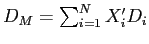 , and price
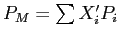 . Its excess return over the
risk free rate is denoted by
. Its excess return over the
risk free rate is denoted by
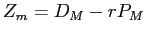 ; and the excess return of the
assets in block over
the risk free rate is denoted by
; and the excess return of the
assets in block over
the risk free rate is denoted by
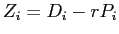 .
.
Armed with this notation,
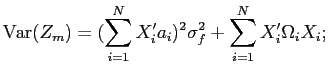
|
(F3) |
and,
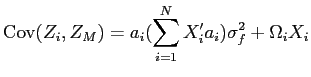
|
(F4) |
If I use the primitive assets to construct assets with payoffs
 , and a single asset with payoff
, then the new assets
will span the same space as the old, but they are easier to work
with. In particular, working from the new assets, it is
straightforward to show that for each block , under the assumption of market
segmentation,
, and a single asset with payoff
, then the new assets
will span the same space as the old, but they are easier to work
with. In particular, working from the new assets, it is
straightforward to show that for each block , under the assumption of market
segmentation,
 |
|
![LaTex Encoded Math: \displaystyle \tau_{i}^{-1} \Omega_{i} X_{i} + a_{i} [\sum X_{i}'a_{i}] [\sum \tau_{i}^{-1} ] \sigma^{2}_{f}](img497.gif)
|
(F5) |
|

|
(F6) |
where
![\lambda_{M} = [\sum \tau_{i}]^{-1}](img499.gif) , and
, and
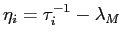 , and
, and
 .
.
Using the above expression to solve for the market's excess expected return then shows:
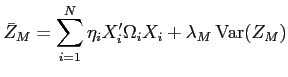
|
(F7) |
The expression for
 contains
two components. The second component is the standard risk premium
for an assets covariance with market risk when investors fully
diversify their asset holdings. The first component is an
additional premium for imperfect diversification. Examination will
show that each term of the imperfect diversification premium is
positive, which implies that imperfect diversification increases
the return on the market portfolio.
contains
two components. The second component is the standard risk premium
for an assets covariance with market risk when investors fully
diversify their asset holdings. The first component is an
additional premium for imperfect diversification. Examination will
show that each term of the imperfect diversification premium is
positive, which implies that imperfect diversification increases
the return on the market portfolio.
Below, I seek to examine how imperfect diversification affects
market adjusted abnormal returns. Letting
 ,
algebra then shows:
,
algebra then shows:

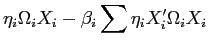

The term on the right hand of equation (F8) is the vector of Jensen's alphas for block
that is due to
market segmentation. These alphas capture the risk premium for
inefficiently sharing risk across market segments (or blocks). My
goal here is to characterize the average behavior of the
 . Simple
algebra shows
. Simple
algebra shows
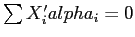 . Because
 , it
follows that some of the market corrected must be positive and some
must be negative. Additionally, if the number of shares outstanding
of each asset is the same, then the average value of
is equal to
0. This suggests that to a first approximation when the market is
perfectly competitive, and there is segmentation, then the average
market adjusted
, it
follows that some of the market corrected must be positive and some
must be negative. Additionally, if the number of shares outstanding
of each asset is the same, then the average value of
is equal to
0. This suggests that to a first approximation when the market is
perfectly competitive, and there is segmentation, then the average
market adjusted  is 0.
is 0.
When there is imperfect competition, I showed that asset returns
have two components.39 The first component is compensation
for imperfect risk sharing across blocks (or segments), and is
identical to the component above for the competitive case. The
second component is for inefficient risk sharing among the
investors who trade within a segment. Because investors within each
segment eventually share risks optimally, this second component is
transitory. For simplicity here, I will write it as  . should be close to 0 for
segments that have not experienced an IPO recently, but may be
nonzero if they did. Note: if the first asset in a segment is an
IPO, and the risks of the other assets are shared efficiently
within the segment, then the allocation distortions at the IPO will
cause to depart from
0 for all assets within the segment, but the size of the departure
for each asset is proportional to the first column of
. should be close to 0 for
segments that have not experienced an IPO recently, but may be
nonzero if they did. Note: if the first asset in a segment is an
IPO, and the risks of the other assets are shared efficiently
within the segment, then the allocation distortions at the IPO will
cause to depart from
0 for all assets within the segment, but the size of the departure
for each asset is proportional to the first column of
 . If
is
diagonal, then the other assets in the segment are not affected by
the IPO; but they will be otherwise. To examine the role that this
term plays in market adjusted excess returns, note that
should be
added to each segments excess returns, and
. If
is
diagonal, then the other assets in the segment are not affected by
the IPO; but they will be otherwise. To examine the role that this
term plays in market adjusted excess returns, note that
should be
added to each segments excess returns, and
 should be added to the excess return on the market. Arithmetic then
shows that:
should be added to the excess return on the market. Arithmetic then
shows that:
![LaTex Encoded Math: \displaystyle \bar{Z}_{i} - \beta_{i} \bar{Z}_{M} = \alpha_{i} + \left[ \pi_{i} - \beta_{i} \sum X_{i}'\pi_{i} \right ]](img515.gif)
The second term on the right hand side of the above equation
reflects how an IPO affects the returns within a particular market
segment. To get a feel for the magnitude of this term, with great
loss of generality suppose for a moment that an IPO occurs only in
segment 1, that there is only 1 risky asset per segment, and that
the characteristics of the assets in each segment are identical
(same number of shares, etc). Then is nonzero in segment , and 0 in the other  segments. Algebra shows that
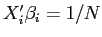 ;
solving for
;
solving for  and
substituting in the right hand side of (F10)
then shows that if segment 1 has an IPO then
and
substituting in the right hand side of (F10)
then shows that if segment 1 has an IPO then

|
|
![LaTex Encoded Math: \displaystyle \alpha_{1} + \left [\pi_{1} - \frac{1}{N X_{1}} \sum X_{i}'\pi_{i} \right ]](img520.gif)
|
|
|
![LaTex Encoded Math: \displaystyle \alpha_{i} + \pi_{1}[1-(1/N)],](img521.gif)
|
where the last line follows because by assumption in this specialized case,
 , and
, and
 for
all . Generalizing a bit,
since
is 0 on
average, this analysis suggests that averaging across IPOs through
time and across segments, the average market adjusted returns on
IPOs will be
for
all . Generalizing a bit,
since
is 0 on
average, this analysis suggests that averaging across IPOs through
time and across segments, the average market adjusted returns on
IPOs will be
![\pi_{1}[1-\phi]](img524.gif) where
is the fraction of
segments that have an IPO. This implies that IPO's should
underperform after adjusting for market risk.
where
is the fraction of
segments that have an IPO. This implies that IPO's should
underperform after adjusting for market risk.
- Aggarwal, R., 2003, "Allocation of initial public offerings and flipping activity," Journal of Financial Economics, 68, 111-135.
- Benveniste, L.M., and P.A. Spindt, 1989, "How Investment Bankers Determine the Offer Price and Allocation of New Issues," Journal of Financial Economics 24, 343-61.
- Biais, B., Bossaerts, P., and J.C. Rochet, 2002, "An Optimal IPO Mechanism," Review of Economic Studies 69, 117-46.
- Boehmer, E., and R.P.H. Fishe, 2000, "Do Underwriters Encourage Stock Flipping? A New Explanation for the Underpricing of IPOs," Mimeo.
- Booth, J.R., and L. Chua, 1996, "Ownership dispersion, costly information, and IPO underpricing," Journal of Financial Economics 41, 291-310.
- Brav, A., Geczy, C., and P.A. Gompers, 2000, "Is the abnormal return following equity issuance anomalous?", Journal of Financial Economics 56, 209-249.
- Butler, A., Grullon, G., and J. Weston, 2005 "Stock Market Liquidity and the Cost of Issuing Equity," Journal of Financial and Quantitative Analysis, 40, 331-348.
- Cornelli, F., and D. Goldreich, (2003): "Bookbuilding: How Informative is the Order Book?," Journal of Finance, 58, 1415-44.
- Corwin, S.A., Harris, J.H., and M.L. Lipson, 2004, "The Development of Secondary Market Liquidity for NYSE-Listed IPOs," Journal of Finance, 59, no. 5, 2339-2373.
- DeMarzo, P.M., and B. Urosevic, 2000 "Optimal Trading by a Large Shareholder," Working Paper, Haas School of Business, University of California at Berkeley.
- de Jong, F. and M. Dahlquist, 2003, "Pseudo-Market Timing, Fact or Fiction," Mimeo, the University of Amsterdam.
- Derrien, F., and K.L. Womack, 2003, "Auctions vs. Bookbuilding and the Control of Underpricing in Hot IPO Markets," Review of Financial Studies 16, no. 1, 31-61.
- Eckbo, B.E., and Ø. Norli, 2002, "Liquidity risk, leverage, and long-run IPO returns," Mimeo, Dartmouth Tuck School of Business.
- Ellis, K., Michaely, R., and M. O'Hara, 2000, "When the Underwriter is the Market Maker: An Examination of Trading in the IPO Aftermarket," Journal of Finance, 55, no. 3, 1039-1074.
- Ellis, K., Michaely, R., and M. O'Hara, 2002, "The Making of a Dealer Market: From Entry to Equilibrium in the Trading of NASDAQ Stocks," Journal of Finance 57, no. 5, 2289 - 2316.
- Ellul, A., and M. Pagano, 2003, "IPO Underpricing and After-Market Liquidity," CSEF Working Paper no. 99, University of Salerno Centre for Studies in Economics and Finance.
- Gill, P.E., Murray, W., and M.H. Wright, 1981, Practical Optimization, Academic Press, London.
- Hahn, T., and J.A. Ligon, 2004, "Liquidity and Initial Public Offering Underpricing," Mimeo, College of Business and Economics, The University of Idaho.
- Hoberg, G., 2004, "Strategic Underwriting in Initial Public Offers," Yale ICF Working Paper No. 04-07.
- Jenkinson, T., and H. Jones, 2004, "Bids and Allocations in European IPO Bookbuilding," Journal of Finance , 59, no. 5, 2309-2338.
- Ljungqvist, A.P., Nanda, V., and R. Singh, 2003, "Hot Markets, Investor Sentiment, and IPO Pricing," Mimeo, Stern School of Business, New York University.
- Ljungvist, A., 2004, "IPO Underpricing," Handbooks in Finance: Empirical Corporate Finance, Chapter III.4, edited by B. E. Eckbo, forthcoming.
- Kihlstrom, R., 2001, "Monopoly Power in Dynamic Securities Markets,"Working Paper, The Wharton School, University of Pennsylvania.
- Loughran, T., and J.R. Ritter, 2000, "Uniformly Least Powerful Tests of Market Efficiency," Journal of Financial Economics 55, 361-389.
- Loughran, T., and J.R. Ritter, 2004, "Why has IPO Underpricing Changed over time?", Financial Management, 33, no. 3, 5-37.
- Merton, R.C., 1987, "A Simple Model of Capital Market Equilibrium with Incomplete Information", The Journal of Finance, 42 no. 3, 483-510.
- Pritsker, M., 2004, "Large Investors: Implications for Equilibrium Asset Returns, Shock Absorption and Liquidity," Mimeo, The Federal Reserve Board.
- Reuter, J., 2005, "Are IPO Allocations for Sale? Evidence from Mutual Funds," The Journal of Finance, Forthcoming.
- Ritter, J.R., 2005, "Some Factoids About the 2004 IPO Market," mimeo, the University of Florida, http://bear.cba.ufl.edu/ritter.
- Ritter, J.R., and I. Welch, 2002, "A Review of IPO Activity, Pricing, and Allocations," Journal of Finance 57, no. 4, 1795 - 1828.
- Rock, K., 1986, "Why New Issues Are Underpriced," Journal of Financial Economics 15, 187-212.
- Schultz, P., 2003, "Pseudo Market Timing and the Long-Run Underperformance of IPOs," Journal of Finance 58, no. 2, 483-517.
- Stapleton, R.C., and M.G. Subrahmanyam, 1978, "A Multi-period Equilibrium Asset Pricing Model," Econometrica, 46, 1077-1096.
- Urosevic, B., 2002a, "Moral Hazard and Dynamics of Insider Ownership Stakes," Working Paper, Universitat Pompeu Fabra.
- Urosevic, B., 2002b, "Essays in Optimal Dynamic Risk Sharing in Equity and Debt Markets," Ph.D. Dissertation, University of California at Berkeley, May.
- Vayanos, D., 2001, "Strategic Trading in a Dynamic Noisy Market," Journal of Finance, 56, 131-171.
- Viswanathan, S, and B. Wei, 2004, "Endogenous Events and Long Run Returns," Mimeo, Duke University.
- Westerfield, M.M., 2003, "Market Composition and the Participation Externality in Equity Market Formation," Mimeo, MIT Sloan School of Business.
| Investor Number | Type | Risk Bearing Capacity |
|---|---|---|
| 1 | Retail | 10.00 |
| 2 | Institutional | 54.56 |
| 3 | Institutional | 21.82 |
| 4 | Institutional | 8.73 |
| 5 | Institutional | 3.49 |
| 6 | Institutional | 1.40 |
| Risk Bearing Concentration (Herfindahl Index) | 3543.26 | |
Table 1: IPO Under-Pricing and Money Left on the Table: I.
B. IPO Under-Pricing and
Money Left on the Table (MLOTT)
| Periods Liq | Prices P_Offer | Prices P_Open | Prices P_Comp | Prices % Und_Price | MLOTT Raw | MLOTT Liq. Adj. |
|---|---|---|---|---|---|---|
| 2000 | 10.13 | 14.25 | 10.50 | 40.66 | 164.75 | 14.90 |
| 1800 | 10.06 | 14.83 | 10.50 | 47.38 | 190.73 | 17.38 |
| 1600 | 10.00 | 15.43 | 10.50 | 54.26 | 217.12 | 19.79 |
| 1400 | 9.94 | 16.04 | 10.50 | 61.33 | 243.93 | 22.23 |
| 1200 | 9.88 | 16.66 | 10.50 | 68.61 | 271.18 | 24.72 |
| 1000 | 9.82 | 17.29 | 10.50 | 76.10 | 298.87 | 27.24 |
| 800 | 9.75 | 17.93 | 10.50 | 83.82 | 327.01 | 29.81 |
| 600 | 9.69 | 18.58 | 10.50 | 91.76 | 355.60 | 32.41 |
| 400 | 9.62 | 19.24 | 10.50 | 99.94 | 384.65 | 35.06 |
| 200 | 7.95 | 20.62 | 10.50 | 159.36 | 506.89 | 101.74 |
Table 1: IPO Under-Pricing and Money Left on the Table: I.
C. IPO Allocation
Distortions (Percent)
| Investor Number | ||||||
| Post-IPO Trading Periods | 1 | 2 | 3 | 4 | 5 | 6 |
|---|---|---|---|---|---|---|
| 2000 | -100.00 | 83.29 | -100.00 | -100.00 | -100.00 | -100.00 |
| 1800 | -100.00 | 83.29 | -100.00 | -100.00 | -100.00 | -100.00 |
| 1600 | -100.00 | 83.29 | -100.00 | -100.00 | -100.00 | -100.00 |
| 1400 | -100.00 | 83.29 | -100.00 | -100.00 | -100.00 | -100.00 |
| 1200 | -100.00 | 83.29 | -100.00 | -100.00 | -100.00 | -100.00 |
| 1000 | -100.00 | 83.29 | -100.00 | -100.00 | -100.00 | -100.00 |
| 800 | -100.00 | 83.29 | -100.00 | -100.00 | -100.00 | -100.00 |
| 600 | -100.00 | 83.29 | -100.00 | -100.00 | -100.00 | -100.00 |
| 400 | -100.00 | 83.29 | -100.00 | -100.00 | -100.00 | -100.00 |
| 200 | -100.00 | 83.29 | -100.00 | -100.00 | -100.00 | -100.00 |
Notes: When there is a continuum of small retail investors (investor 1), and 5 large investors (investors 2-6), the table reports expected IPO underpricing and money left on the table for 10 IPOs that vary by the number of days of trading that take place in the IPO aftermarket (Periods Liq). Fewer trading days correspond to less aftermarket liquidity. Each investors risk bearing capacity (panel A) is his own risk tolerance as a percent of the sum total of all investors risk tolerances. Percentage underpricing (panel B) is equal to the net expected one-day return associated with purchasing at the offer price (P_Offer) and then selling at the first days closing price (P_Open). Raw money left on the table is the difference in P_Offer and P_Open times the number of shares issued. Liquidity adjusted money left on the table is equal to the shares issued times the one day return associated with purchasing at P_Offer and then selling into a competitive (and perfectly liquid) aftermarket at price P_Comp. In a competive market, each investors allocation at the IPO should be equal to risk capacity times the number of shares issued. Allocation distortions (panel C) measure are the percentage difference in investors allocations at the IPO relative to the allocation he would have received in an efficient market.
| Investor Number | Type | Risk Bearing Capacity |
|---|---|---|
| 1 | Retail | 10.00 |
| 2 | Institutional | 40.00 |
| 3 | Institutional | 12.50 |
| 4 | Institutional | 12.50 |
| 5 | Institutional | 12.50 |
| 6 | Institutional | 12.50 |
| Risk Bearing Concentration (Herfindahl Index) | 2225 | |
Table 2: IPO Under-Pricing and Money Left on the Table: II.A.
B. IPO Under-Pricing and Money Left on the Table (MLOTT)
| Periods Liq | Prices P_Offer | Prices P_Open | Prices P_Comp | Prices % Und_Price | MLOTT Raw | MLOTT Liq. Adj. |
|---|---|---|---|---|---|---|
 |
10.50 | 10.50 | 10.50 | 0.00 | 0.00 | 0.00 |
 |
10.50 | 10.50 | 10.50 | 0.00 | 0.00 | 0.00 |
| 1600 | 10.53 | 10.71 | 10.50 | 1.70 | 7.14 | -1.38 |
| 1400 | 10.69 | 11.65 | 10.50 | 8.97 | 38.33 | -7.62 |
| 1200 | 10.85 | 12.61 | 10.50 | 16.27 | 70.59 | -14.07 |
| 1000 | 11.01 | 13.60 | 10.50 | 23.49 | 103.48 | -20.65 |
| 800 | 11.18 | 14.61 | 10.50 | 30.62 | 136.94 | -27.34 |
| 600 | 11.35 | 15.63 | 10.50 | 37.65 | 170.96 | -34.14 |
| 400 | 11.52 | 16.66 | 10.50 | 44.59 | 205.55 | -41.06 |
| 200 | 11.70 | 17.72 | 10.50 | 51.43 | 240.70 | -48.09 |
Table 2: IPO Under-Pricing and Money Left on the Table: II.A.
C. IPO Allocation Distortions (Percent)
| Investor Number | ||||||
| Post-IPO Trading Periods | 1 | 2 | 3 | 4 | 5 | 6 |
|---|---|---|---|---|---|---|
|
0.00 | 0.00 | 0.00 | 0.00 | 0.00 | 0.00 |
|
0.00 | 0.00 | 0.00 | 0.00 | 0.00 | 0.00 |
| 1600 | -100.00 | 147.50 | -100.00 | -100.00 | -100.00 | -100.00 |
| 1400 | -100.00 | 149.57 | -100.00 | -100.00 | -100.00 | -100.00 |
| 1200 | -100.00 | 149.77 | -100.00 | -100.00 | -100.00 | -100.00 |
| 1000 | -100.00 | 149.84 | -100.00 | -100.00 | -100.00 | -100.00 |
| 800 | -100.00 | 149.88 | -100.00 | -100.00 | -100.00 | -100.00 |
| 600 | -100.00 | 149.90 | -100.00 | -100.00 | -100.00 | -100.00 |
| 400 | -100.00 | 149.92 | -100.00 | -100.00 | -100.00 | -100.00 |
| 200 | -100.00 | 149.93 | -100.00 | -100.00 | -100.00 | -100.00 |
Notes: This table is similar to Table 1 except that investors risk bearing capacity is less concentrated. When there are 2000, and 1800 post-IPO trading perids (marked with an asterisk), the aftermarket is sufficiently competitive that investors and the underwriter are nearly indifferent over how shares are allocated. I have assigned efficient share holdings in this case at competitive prices. When the aftermarket is slightly more competitive than in Table 1, but not perfectly competitive, the underwriter can allocate shares at a price that is higher than the competitive price (which is also the price with perfect liquidity). In such circumstances, liquidity adjusted money left on the table is negative.
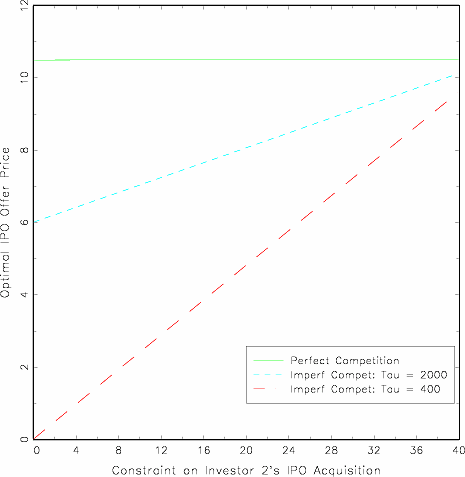
Notes: For the market structure in panel A of Table 1, the figure presents optimal IPO offer prices as a function of constraints on the amount of shares that investor 2 can acquire at the IPO. Results are presented for when the aftermarket is perfectly competitive (nearly flat solid line), and when it is imperfectly competitive and there are 2000 (short dashes) or 400 (long dashes) periods of aftermarket trading following the IPO. The figure shows that when there is imperfect competition, the underwriter should distort share holdings towards investor 2 in order to increase the revenue raised at the IPO.
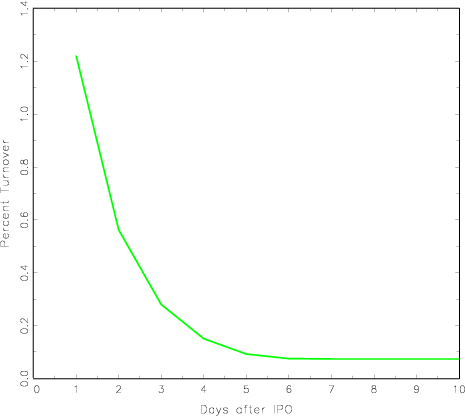
Notes: For the market structure in panel A of Table 1, when there are 2000 periods of trade remaining following the IPO, the figure presents share turnover [(buy volume + sell volume)/2] as a percent of shares outstanding.
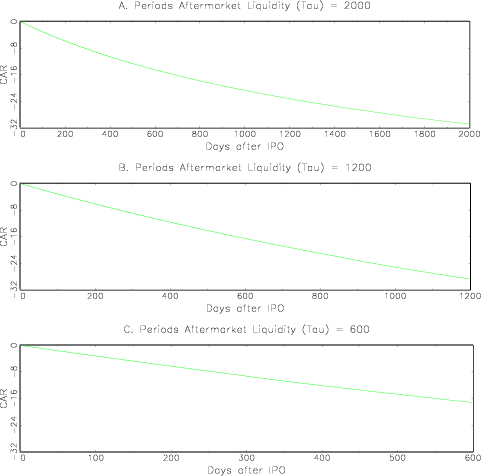
Notes: For the market structure in panel A of Table
1, the figure presents expected cumulative
abnormal returns (CARs) relative to the market portfolio for
differing numbers of periods of liquid trading in the aftermarket
following the IPO. The figure is constructed under the assumption
that IPO's are an infinitesimal fraction of the market portfolio.
If instead, new issues represent percent of the market, then the CAR should be
adjusted downward in magnitude by approximately percent. See appendix F for details.
Footnotes
 is not equal to
0, then is added
to the initial allocation of investor 1 in order to determine the
aftermarket price. Return to
Text. Return to
Text time periods is similar to
Pritsker (2004), and is not presented here in order to save space.
Return to Text represents wealth under management, and the
measure of risk bearing capacity implies that more wealthy
investors have a greater capacity to bear risk. Return to Text
is not equal to
0, then is added
to the initial allocation of investor 1 in order to determine the
aftermarket price. Return to
Text. Return to
Text time periods is similar to
Pritsker (2004), and is not presented here in order to save space.
Return to Text represents wealth under management, and the
measure of risk bearing capacity implies that more wealthy
investors have a greater capacity to bear risk. Return to Text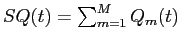 Return to Text
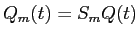 .
Return to Text
.
Return to Text