
Keywords: Cointegration, Stochastic Trends
Abstract:
1. Introduction
Since its introduction in Granger (1981, 1983) cointegration has become a widely investigated and extensively used tool in multivariate time series analysis. Cointegrated models combine short-run dynamics and long-run relationships in a framework that lends itself to investigating these features in economic data. The relationship between cointegrated systems, their vector autoregressive (VAR) and vector moving-average (VMA) representations, and vector error-correction models (VECM) were developed in Granger (1981, 1983) and in Engle and Granger (1987).
In a cointegrated system of time series, the cointegrating vectors can be interpreted as the long-run equilibrium relationships among the variables towards which the system will tend to be drawn. Economic theories and economic models may imply long-run relationships among variables. Certain ratios or spreads between nonstationary variables are expected to be stationary, that is, these variables are cointegrated with given cointegrating vectors. For example, neoclassical growth models imply "balanced growth" among income, consumption, and investment (for example, see Solow, 1970 and King, Plosser, Stock, and Watson, 1991), implying that their ratios are mean-reverting. Other theories, rather than implying given ratios or spreads are cointegrated, may imply that some linear combinations of the variables are stationary, that is, the variables are cointegrated without specifying the cointegrating relationships (for example, see Johansen and Juselius' (1990) investigation of money demand).
Johansen's (1988) maximum likelihood approach to cointegrated models provides an efficient procedure for the estimation of cointegrated systems and provides a useful framework in which to test restrictions of the sorts mentioned above. For example, Johansen (1988, 1991) and Johansen and Juselius (1990, 1992) derive likelihood ratio tests for various structural hypotheses concerning the cointegrating relationships and the speed of adjustment to the disequilibrium implied by the cointegrating relationships (or weights); Konishi and Granger (1992) use this approach to derive and test for separation cointegration, and Gonzalo and Granger (1995) use this framework for estimation of and testing for their multivariate version of Quah's (1992) permanent and transitory (P-T) decomposition.
Further, building on the univariate work of Beveridge and Nelson (1981) and the multivariate generalization by Stock and Watson (1988), cointegration analysis may be used to decompose a system of variables into permanent components (based on the variables' common stochastic trends) and temporary (or cyclical) components. Several methods have been proposed to separate cointegrated systems into their permanent and temporary components, for example, Johansen (1990), Kasa (1992), and Gonzalo and Granger (1995). In each case, the permanent component is based either on the orthogonal complements of the cointegrating relationships or on the orthogonal complements of the disequilibrium adjustments to the cointegrating relationships.
In this paper, new hypothesis tests are presented in Johansen's maximum likelihood framework that allow one to combine restrictions on the cointegrating relationships and on their disequilibrium adjustments. These tests possess closed-form solutions and do not require iterative methods to estimate the restricted parameters under the null hypothesis. Secondly, both for Johansen's likelihood ratio tests for coefficient restrictions and for the new tests presented below, the restrictions implicitly placed on the orthogonal complements of the cointegrating relationships and on the orthogonal complements of the adjustment speeds are presented. Johansen's tests and the tests developed in this paper can be interpreted as tests of restrictions on the various definitions of common stochastic trends, since these definitions depend on the orthogonal complements either of the cointegrating relationships or of the disequilibrium adjustments. Thus, one has great flexibility in formulating and testing hypotheses of economic interest simultaneously on the cointegrating relationships and on the common stochastic trends--the long-run relationships among the variables in the system and the variables driving the trending behavior the system, respectively.
The organization of this paper is as follows: In section 2, the basic model and notation are introduced, and maximum likelihood estimation of the unrestricted model is briefly described. In section 3, Johansen's (1988, 1989) and Johansen and Juselius' (1990) likelihood ratio tests for restrictions on cointegrating relationships and on their weights are briefly described, and three new tests in this framework are presented. In section 4, the implications for the orthogonal complements of the cointegrating vectors and of the adjustment vectors are developed for the tests described in section 3. It is shown how these tests can be used for testing restrictions on the orthogonal complements of cointegrating vectors and on the orthogonal complements of the disequilibrium adjustment vectors--thus allowing for combinations of tests on cointegrating relationships and on the different definitions of common stochastic trends. Section 5 concludes, and the appendix contains the mathematical proofs.
2. The Unrestricted Cointegrated Model
Let
 denote a time series that is integrated of order
  , that is,
applications of the differencing filter,
, that is,
applications of the differencing filter,  , yield a stationary process. Let
 be a
be a  vector of possibly
  (1) time series defined by the
  -order vector autoregression (VAR),

 , by
, by  -dimensional normally-distributed
zero-mean random variables
-dimensional normally-distributed
zero-mean random variables
 with variance matrix
 nd by a vector of deterministic components
 (possibly
constants, linear trends, and seasonal and other dummy variables). Using the lag polynomial expression for (2.1),
(possibly
constants, linear trends, and seasonal and other dummy variables). Using the lag polynomial expression for (2.1),where

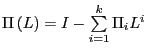 , the VAR in the levels in (2.1) can be rewritten in first differences as
where

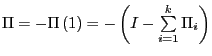 and
and
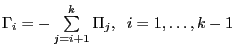 .
.
The long-run behavior of the system depends on the rank of the  matrix
 If the matrix has rank 0 (that is,
  = 0)
= 0) then there are unit roots in the system, and (2.3) is simply a traditional VAR in
differences. If has full rank , then is an I(0) process, that is, is stationary in its levels. If the rank of is
then there are unit roots in the system, and (2.3) is simply a traditional VAR in
differences. If has full rank , then is an I(0) process, that is, is stationary in its levels. If the rank of is  with
with then is said to be cointegrated of order . This
implies that there are
then is said to be cointegrated of order . This
implies that there are  linear combinations of that are stationary.
Granger's Representation Theorem from Engle and Granger (1987) shows that if is cointegrated of order (the matrix has rank
linear combinations of that are stationary.
Granger's Representation Theorem from Engle and Granger (1987) shows that if is cointegrated of order (the matrix has rank  , one can write
 , where both
  and
and  are
are  matrices of full column rank. This and some
fairly general assumptions about initial distributions allow one to write (2.1) as the vector error-correction model (VECM):
matrices of full column rank. This and some
fairly general assumptions about initial distributions allow one to write (2.1) as the vector error-correction model (VECM):
 contains the cointegrating vectors,
and
contains the cointegrating vectors,
and  are the stationary linear combinations of . The matrix can be interpreted as equilibrium relationships among the variables, and the difference between the current value of the cointegrating relationships, , and their expected values can be interpreted as measures of disequilibrium from the different long-run relationships. The matrix in (2.4) measures how quickly
  reacts to the deviation from equilibrium implied by .1
Given a matrix of full column rank,  , an orthogonal complement of
, denoted
, an orthogonal complement of
, denoted  , is a
  matrix of full column rank such that
  . It is often necessary to calculate the orthogonal complements of
and in order to
form the
. It is often necessary to calculate the orthogonal complements of
and in order to
form the  common I(1) stochastic trends of a cointegrated system; for example, Gonzalo and Granger (1995) propose
 as the common stochastic trends and
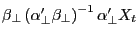 as the permanent components for a cointegrated system; Johansen (1991) proposes the random walks
 as a cointegrated system's common stochastic trends and
 as its permanent components.
Several methods have been proposed for identifying, estimating, and conducting inference in a cointegrated system (see Watson (1995) and Gonzalo (1994) for explanations of several methods and evaluations of their properties). This paper uses the efficient maximum likelihood framework of Johansen
(1988). The log-likelihood function for the parameters in (2.4) is
![\begin{displaymath} \begin{array}{l} \log L\left( {\alpha ,\beta ,\Omega ,\Gamm... ...a X_{t-i} -\Phi D_t } } \right)} \right] \ \end{array}_{.} \end{displaymath}](img48.gif) . To do
this one forms two sets of
. To do
this one forms two sets of  1 residual vectors,
  and
and  , by regressing, in turn, and on
  -1 lags of and the deterministic components.
The VECM in (2.4) can then be written as
 , on the disequilibrium adjustment parameters , and on their orthogonal complements,
  and
and
 . The equation (2.6) has two unknown parameter matrices, and . Maximizing the likelihood function is equivalent to estimating the parameters in (2.6) via reduced rank regression methods
(Anderson, 1951). Since this involves the product of two unknown full-column rank matrices in (2.6), estimating these parameters requires solving an eigenvalue problem.
. The equation (2.6) has two unknown parameter matrices, and . Maximizing the likelihood function is equivalent to estimating the parameters in (2.6) via reduced rank regression methods
(Anderson, 1951). Since this involves the product of two unknown full-column rank matrices in (2.6), estimating these parameters requires solving an eigenvalue problem.
Defining the moment matrices for the residual series,
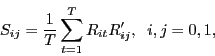 , one estimates the adjustment parameters, by regressing on
 to get
The maximum likelihood estimator for the residual variance-covariance matrix is

As shown in Johansen (1988), one may write the likelihood function, apart from a constant, as

which can be expressed as a function of
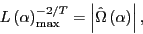
 ,
,As shown in Johansen (1988), maximizing the likelihood function with respect to
 is equivalent to minimizing (2.11), which is accomplished by solving the
eigenvalue problem
is equivalent to minimizing (2.11), which is accomplished by solving the
eigenvalue problemfor eigenvalues

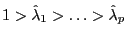 and corresponding eigenvectors
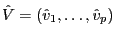 normalized by
 . Thus the maximum likelihood estimate for the cointegrating vectors is
and the normalization implies that the estimate of the weights in (2.8) is
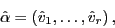
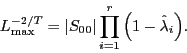
Then, apart from a constant, the maximized likelihood can be written as

Likelihood ratio tests of the hypothesis of
 unrestricted cointegrating relationships in the unrestricted VAR model and for unrestricted cointegrating relationships against the alternative of
  unrestricted cointegrating relationships--the trace and maximum
eigenvalue tests--are derived in Johansen (1988). The asymptotic distribution of the trace and maximum eigenvalue tests for different deterministic components may be found in Johansen (1988) and Johansen and Juselius (1990), and the tabulated critical values for various values of and for different deterministic components may be found in Johansen (1989, 1996) and Osterwald-Lenum (1992); small-sample adjustments to the critical values that are based on response surface
regressions may be found in Cheung and Lai (1993) and MacKinnon, Haug, and Michelis (1999).
unrestricted cointegrating relationships--the trace and maximum
eigenvalue tests--are derived in Johansen (1988). The asymptotic distribution of the trace and maximum eigenvalue tests for different deterministic components may be found in Johansen (1988) and Johansen and Juselius (1990), and the tabulated critical values for various values of and for different deterministic components may be found in Johansen (1989, 1996) and Osterwald-Lenum (1992); small-sample adjustments to the critical values that are based on response surface
regressions may be found in Cheung and Lai (1993) and MacKinnon, Haug, and Michelis (1999).
The unrestricted orthogonal complements of and , and , can be estimated
three ways: Gonzalo and Granger (1995) show that one may use the eigenvectors associated with the zero eigenvalues of
 and
and
 (given a p
 r matrix of full
column rank , one can quickly construct as the ordered eigenvectors
corresponding to the zero-eigenvalues of
r matrix of full
column rank , one can quickly construct as the ordered eigenvectors
corresponding to the zero-eigenvalues of  ; they also show that one may
estimate as the eigenvectors corresponding to the smallest
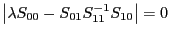
eigenvalues that solve the dual of the eigenvalue problem in (2.12),
; they also show that one may
estimate as the eigenvectors corresponding to the smallest
eigenvalues that solve the dual of the eigenvalue problem in (2.12),
 , normalized such that
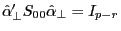 , and by setting
 . Johansen (1996) shows one may estimate them from (2.12) by
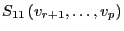 and
and
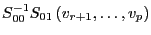 , respectively.
3. Testing Restrictions on and
Economic theory may suggest that certain ratios or spreads between variables will be cointegrating relationships. For example, some neoclassical growth models with a stochastic productivity shock imply "balanced growth" among income, consumption, and investment (that is, the ratios are
cointegrated), and certain one-factor models of the term structure of the interest rates imply that the spreads between the different interest rate maturities will be cointegrated. One might also be interested in testing for the absence of certain variables in the system from any of the
cointegrating relationships. Complicated restrictions on or may be formulated, for example, neutrality hypotheses in Mosconi and Giannini (1992) and separation cointegration in Konishi and Granger (1992). Based on their maximum likelihood framework, Johansen (1988, 1991) and Johansen and Juselius (1990, 1992)
formulate a series of likelihood ratio tests for linear restrictions on or  nd tests for a subset of known vectors in or . After briefly summarizing this set of five tests, three new tests for combining linear
restrictions and known vectors will be derived.
nd tests for a subset of known vectors in or . After briefly summarizing this set of five tests, three new tests for combining linear
restrictions and known vectors will be derived.
The tests for restrictions on the cointegrating relationships and disequilibrium adjustment vectors described below are asymptotically chi-squared distributed. The finite sample properties of some of the tests have been studied (see, for example Haug (2002)) and are shown to have significant
size distortions in small samples, though they generally perform well with larger samples. Johansen (2000) introduces a Bartlett-type correction for tests (1) and (2) below that depend on the size of the system, the number of cointegrating vectors, the lag length in the VECM, the number of
deterministic terms (restricted versus unrestricted), the parameter values, and the sample size under the null hypothesis. Haug (2002) demonstrates that the Bartlett correction is successful in moving the empirical size of the test close to the nominal size of the test. Haug (2002) also
demonstrates that the power of the tests for restrictions on depend on the speed of adjustment to the long-run equilibrium relationships in the system, with
slower adjustment speeds leading to tests with lower power.
The tests below are all based on the reduced rank regression representation of the VECM in (2.4),

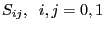 and by their eigenvalues. The parameter estimates under the restrictions and the maximized likelihood functions can be explicitly calculated; other tests not discussed
here may be solved using iterative methods (see Doornik (1995) and Johansen (1995)). Denote the unrestricted model of at most cointegrating relationships in the VECM (2.4) as
and by their eigenvalues. The parameter estimates under the restrictions and the maximized likelihood functions can be explicitly calculated; other tests not discussed
here may be solved using iterative methods (see Doornik (1995) and Johansen (1995)). Denote the unrestricted model of at most cointegrating relationships in the VECM (2.4) as
 . For any rectangular matrix with full column rank, , define the
notation
. For any rectangular matrix with full column rank, , define the
notation
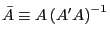 , which implies
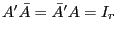 . Five tests for restrictions on nd from Johansen
(1988, 1989) and Johansen and Juselius (1990) are briefly described before turning to three new tests for restrictions on nd
. Five tests for restrictions on nd from Johansen
(1988, 1989) and Johansen and Juselius (1990) are briefly described before turning to three new tests for restrictions on nd

(1)
 (Johansen, 1988), (2)
where
 is known and
 is unknown,
  .
.
This test places the same  linear restrictions on all the vectors in . The likelihood ratio test of
  in
is asymptotically distributed as
in
is asymptotically distributed as  with
with  degrees of freedom. One can also use this test also to determine if a subset of thevariables do not enter the cointegrating relationships.
(2)
![H_0 :\beta =\left[ {H,\theta } \right]](img96.gif) (Johansen and Juselius, 1990), (3)
(Johansen and Juselius, 1990), (3)
where
is known, and
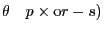 is unknown where
 with
with
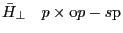 known and
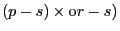 unknown.
This test assumes  known cointegrating vectors and restricts the remaining
  unknown cointegrating vectors to be orthogonal to them. The likelihood ratio test of in
is asymptotically distributed as with
unknown cointegrating vectors to be orthogonal to them. The likelihood ratio test of in
is asymptotically distributed as with  degrees of freedom.
(3)
 (Johansen and Juselius, 1990), (4)
where
 is known and
 is unknown,
  .
.
This test places the same  linear restrictions on all disequilibrium adjustment vectors in . This can be interpreted as a test of
  for
for  . The likelihood ratio test of in
is asymptotically distributed as with
. The likelihood ratio test of in
is asymptotically distributed as with  degrees of freedom. One may use (3) to test that some or all of the cointegrating relationships do not appear in the short run equation for a subset of the variables in the system, that is, that a
subset of the variables do not error correct to some or all of the stochastic trends in the system.
degrees of freedom. One may use (3) to test that some or all of the cointegrating relationships do not appear in the short run equation for a subset of the variables in the system, that is, that a
subset of the variables do not error correct to some or all of the stochastic trends in the system.
(4)
![H_0 :\alpha =\left[ {A,\tau } \right]](img113.gif) (Johansen, 1989), (5)
(Johansen, 1989), (5)
where
is known, and
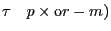 is unknown where
 with
with
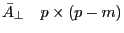 known and
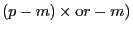 unknown.
This test allows for  known adjustment vectors and restricts the remaining
  adjustment vectors to be orthogonal to them. The likelihood ratio test of in
is asymptotically distributed as with
adjustment vectors to be orthogonal to them. The likelihood ratio test of in
is asymptotically distributed as with  degrees of freedom.
(5)
 (Johansen and Juselius, 1990), (6)
where
,
are known and , are unknown, . and  .
.
This test combines tests (1) and (3), testing for cointegrating vectors with common linear restrictions and adjustment vectors with common linear restrictions. The likelihood ratio test of in
is asymptotically distributed as with 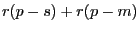 degrees of freedom.
In the same framework as the tests above, three new tests for simultaneous restrictions on nd
 re presented.
(6)
![H_0 :\beta =\left[ {H,\theta } \right],\;\;\alpha =A\psi](img125.gif) (7)
(7)
where
,  are known;
is unknown where
with
known and (
are known;
is unknown where
with
known and (
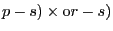 unknown; and
 is unknown,
 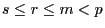 .
.
This test combines tests (2) and (3), that is, it tests the restriction that of the cointegrating vectors are known--restricting the remaining cointegrating vectors to be orthogonal to them--and that the adjustment vectors share linear restrictions. For
example, if a system of variables includes a short-term and a long-term interest rate, (6) could be used to test whether the spread between the long-term and short-term interest rates was a cointegrating relationship and to test simultaneously whether the short-term interest rate failed to react to
any of the cointegrating relationships in the system.
To calculate the test statistic and the estimated cointegrating relationships and adjustment vectors, the reduced rank regression (3.1) first is split into
 is partitioned conformably with as
![\left[ {\psi _1 ,\psi _2 } \right]](img131.gif) . In order to derive the test statistic and to estimate the restricted parameters under this hypothesis it is necessary to transform the product moment
matrices,
. In order to derive the test statistic and to estimate the restricted parameters under this hypothesis it is necessary to transform the product moment
matrices,  . Define two set of moment matrices:
and

The restricted estimators and the likelihood ratio test statistic and its asymptotic distribution are summarized in the following theorems.

THEOREM 3.1: Under the hypothesis
where H ps, A pm are known;  p
p
 r-s) is unknown where
with
r-s) is unknown where
with  p
p-s
p
p-s known and (p-s)(r-s) unknown; and mr is unknown, s
 rm
rm p; the maximum likelihood estimators are found by the following steps:
Solve the eigenvalue problem

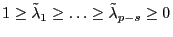 and corresponding eigenvectors
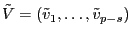 , normalized so that
 ; and solve the eigenvalue problem
for eigenvalues

 .
.
Then the restricted estimators are
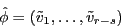
![\begin{displaymath} \hat {\beta }=\left[ {\hat {\beta }_1 ,\hat {\beta }_2 } \right]=\left[ {H,\hat {\theta }} \right]=\left[ {H,\bar {H}_\bot \hat {\phi }} \right] \end{displaymath}](img148.gif)


and the maximized likelihood function, apart from a constant, is
![\begin{displaymath} \begin{array}{l} \hat {\alpha }=\left[ {A\hat {\psi }_1 ,A\hat {\psi }_2 } \right]=\left[ {A\left( {{A}'A} \right)^{-1}{A}'\left( {S_{01.A_\bot } \hat {\beta }_1 -S_{01.A_\bot .H} \hat {\beta }_2 {\hat {\beta }}'_2 S_{11.A_\bot } \hat {\beta }_1 } \right)\left( {{\hat {\beta }}'_1 S_{11.A_\bot } \hat {\beta }_1 } \right)^{-1},} \right. \ \left. {\quad \,\quad \;\;\;\;\;\;\;\;\;\;\;\;\;\;\;\;\;\;\;\,A\left( {{A}'A} \right)^{-1}{A}'S_{01.A_\bot .H} \hat {\beta }_2 } \right] \ \end{array}\end{displaymath}](img151.gif)
The proof of Theorem 3.1 is in the Appendix.
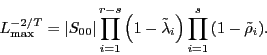
THEOREM 3.2: The likelihood ratio test statistic of the hypothesis
verses
is expressed as:

 are from the unrestricted maximized likelihood in (2.15), and is asymptotically distributed
as with r(p-m)+s(p-r) degrees of freedom.
are from the unrestricted maximized likelihood in (2.15), and is asymptotically distributed
as with r(p-m)+s(p-r) degrees of freedom.
The proof of Theorem 3.2 is in the Appendix.
(7)
![H_0 :\beta =H\phi ,\;\;\alpha =\left[ {A,\tau } \right]](img155.gif)
where
,
are known; is unknown; and 
 is unknown where
with
known and (
is unknown where
with
known and (
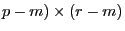 unknown,
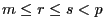 .
.
This test combines Johansen's tests (1) and (4), that is, it tests the restriction that the cointegrating vectors share linear restrictions and of the adjustment vectors are assumed known (with the remaining orthogonal to them). This test would be used,
for example, to determine if some variable in the system did not enter any of the cointegrating relationships or if two variables entered the cointegrating relationships as the spread between them, and to test simultaneously that some of the cointegrating vectors only appear in the equation for one
of the variables.
The first step in calculating the test statistic and restricted coefficient estimates is to split the reduced rank regression into variation independent parts
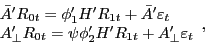 is partitioned conformably with as
![\left[ {\phi _1 ,\phi _2 } \right]](img161.gif) . In order to derive the test statistics and to estimate the restricted parameters under this hypothesis it is again necessary to define a new set of
residual vectors and transform the product moment matrices, . Fixing
. In order to derive the test statistics and to estimate the restricted parameters under this hypothesis it is again necessary to define a new set of
residual vectors and transform the product moment matrices, . Fixing  and , define the residual vector
One can then define the notation

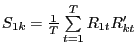 and so on, and define the set of product moment matrices:
The restricted estimators and the likelihood ratio test statistic and its asymptotic distribution are summarized in the following theorems.

THEOREM 3.3: Under the hypothesis
where H ps, A pm are known; sr is unknown; and p
r-m) is unknown where
with  p(p-m) known and (p-m)(r-m) unknown,
  p; the maximum likelihood
estimators are found by the following steps:
p; the maximum likelihood
estimators are found by the following steps:
Solve the eigenvalue problem

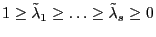 and corresponding eigenvectors
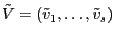 , normalized so that
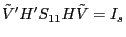 ; and solve the eigenvalue problem
for eigenvalues


Then the restricted estimators are
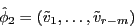

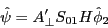

![\begin{displaymath} \hat {\beta }=\left[ {\hat {\beta }_1 ,\hat {\beta }_2 } \right]=\left[ {H\left( {{H}'S_{11.k} H} \right)^{-1}{H}'S_{10.k} \bar {A},H\hat {\phi }_2 } \right] \end{displaymath}](img178.gif)
where
![\begin{displaymath} \hat {\alpha }=\left[ {A,\hat {\tau }} \right]=\left[ {A,\bar {A}_\bot \hat {\psi }} \right]=\left[ {A,A_\bot \left( {{A}'_\bot A_\bot } \right)^{-1}{A}'_\bot S_{01} \hat {\beta }_2 } \right], \end{displaymath}](img179.gif)
 is calculated from (3.22) evaluated at

The maximized likelihood function, apart from a constant, is

THEOREM 3.4: The likelihood ratio test statistic of the hypothesis
verses
is expressed as:
![\begin{displaymath} \begin{array}{l} LR\left( {H_0 \vert H\left( r \right)} \right)= \ \;\;T\left\{ {\ln \left[ {\frac{\left\vert {{A}'S_{00.k} A} \right\vert\left\vert {{A}'_\bot S_{00} A_\bot } \right\vert}{\left\vert {{A}'A} \right\vert\left\vert {{A}'_\bot A_\bot } \right\vert}} \right]-\ln \left\vert {S_{00} } \right\vert+\sum\limits_{i=1}^{r-m} {\ln \left( {1-\tilde {\lambda }_i } \right)+\sum\limits_{i=1}^m {\ln \left( {1-\tilde {\rho }_i } \right)} -\sum\limits_{j=1}^r {\ln \left( {1-\hat {\lambda }_j } \right)} } } \right\} \ \end{array}_{,} \end{displaymath}](img183.gif) are from the unrestricted maximized likelihood in (2.15), and is asymptotically distributed
as with m(p-
are from the unrestricted maximized likelihood in (2.15), and is asymptotically distributed
as with m(p- -s)degrees of freedom.
The proof of Theorem 3.4 is in the Appendix.
Next, a hypothesis test on
of the form
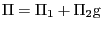 s presented in which
  is known. This test,
which combines tests (2) and (4), implies one is testing that both a subset of the cointegrating vectors and the associated adjustment vectors are known. It might seem too optimistic or restrictive to believe one might not only know certain cointegrating vectors but also know the adjustments to
them. A test of this sort, however, might be useful as the end of a general-to-simple strategy for testing structural hypotheses or for testing very specific theoretical implications. More usefully, one might estimate the cointegrating relationships and adjustment vectors from a subset of a system
of variables and then desire to test whether these estimated relationships hold in the full system of variables.
is known. This test,
which combines tests (2) and (4), implies one is testing that both a subset of the cointegrating vectors and the associated adjustment vectors are known. It might seem too optimistic or restrictive to believe one might not only know certain cointegrating vectors but also know the adjustments to
them. A test of this sort, however, might be useful as the end of a general-to-simple strategy for testing structural hypotheses or for testing very specific theoretical implications. More usefully, one might estimate the cointegrating relationships and adjustment vectors from a subset of a system
of variables and then desire to test whether these estimated relationships hold in the full system of variables.
(8)
![H_0 :\;\;\beta =\left[ {H,\theta } \right],\;\;\alpha =\left[ {A,\tau } \right]](img187.gif)
where both  are known
  matrices with
  , and the unknown parameter matrices are orthogonal to :
,
with ,
, and the unknown parameter matrices are orthogonal to :
,
with ,
 ps
ps
 nown and , (ps)(rs) unknown. This implies
 .
.
Define the vector of residuals

In order to derive the test statistics and to estimate the restricted parameters under this hypothesis it is again necessary to define a new set of residual vectors and transform the product moment matrices,
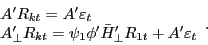
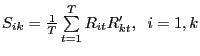 and so on, and also define the product moment matrices,
 .
.
The restricted estimators and the likelihood ratio test statistic and its asymptotic distribution are summarized in the following theorem.
THEOREM 3.5: Under the hypothesis
where are known ps matrices; and are unknown p(r-s) matrices such that
and
with
and p
p-s) known and , (p-s)(r-s) unknown; the maximum likelihood estimators are found by the following steps:
Solve the eigenvalue problem

 and corresponding eigenvectors
, normalized so that
and corresponding eigenvectors
, normalized so that
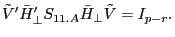
Then the restricted estimators are
![\begin{displaymath} \beta =\left[ {\hat {\beta }_1 ,\hat {\beta }_2 } \right]=\left[ {H,\hat {\theta }} \right]=\left[ {H,\bar {H}_\bot \hat {\phi }} \right] \end{displaymath}](img201.gif)
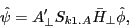
and the maximized likelihood function, apart from a constant, is
![\begin{displaymath} \alpha =\left[ {A,\tau } \right]=\left[ {A,\bar {A}_\bot \psi } \right]=\left[ {A,A_\bot \left( {{A}'_\bot A_\bot } \right)^{-1}{A}'_\bot S_{k1.A} \hat {\beta }_2 } \right] \end{displaymath}](img203.gif)
The proof of Theorem 3.5 is in the Appendix.
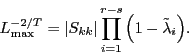
THEOREM 3.6: The likelihood ratio test statistic of the hypothesis
verses
is expressed as:
 are from the unrestricted maximized likelihood in (2.15), and is asymptotically distributed
as with 2ps-s
are from the unrestricted maximized likelihood in (2.15), and is asymptotically distributed
as with 2ps-s degrees of freedom.
The proof of Theorem 3.6 is in the Appendix.
4. Testing Restrictions on
 and
and

Separating an economic time series into permanent (long run) components and cyclical (short run, temporary, transitory) components has been used in many contexts in economics. Methods proposed include decomposing the series into a deterministic trend component and a stationary cyclical
component, as in Fellner (1956). Muth (1960) uses the long-run forecast of a geometric distributed lag, that is, the permanent component is the long-run forecast after the dynamics (modeled as a distributed lag) have run their course. Beveridge and Nelson (1981) uses the Wold (1938) decomposition
to generalize this to ARIMA models, defining the permanent component to be a multiple of the random walk component of the series. This method, too, implies that the permanent component of the series in period  is the long-run forecast of the time series made in period . Watson (1986) uses unobserved components ARIMA models based on Watson and Engle's (1983) methods. Quah (1992)
develops a permanent-transitory (P-T) decomposition to derive lower bounds for the relative size of the permanent component of a series and showed that restricting it to be a random walk maximizes the size of the lower bound.
is the long-run forecast of the time series made in period . Watson (1986) uses unobserved components ARIMA models based on Watson and Engle's (1983) methods. Quah (1992)
develops a permanent-transitory (P-T) decomposition to derive lower bounds for the relative size of the permanent component of a series and showed that restricting it to be a random walk maximizes the size of the lower bound.
Sims (1980) introduced vector autoregressions to empirical economics as a flexible multivariate dynamic framework to which the Beveridge-Nelson (1981) decomposition can be extended (see Stock and Watson, 1988). In cointegrated systems, several methods have been proposed to decompose the
individual time series into their permanent and cyclical components. The importance of multivariate information sets for this sort of analysis is argued in Cochrane (1994). Stock and Watson (1988), Johansen (1990), and Granger and Gonzalo (1995) split a system of cointegrated time series into common stochastic trends (where is the number of cointegrating relationships), linear combinations of which form the permanent components of the individual time series. The cyclical components are some combination of the cointegrating relationships, plus, if the common
stochastic trends are assumed to be random walks, other stationary components. See Proietti (1997) for a discussion of the relationship among these definitions and with the notion of common features by Vahid and Engle (1993) and Engle and Kozicki (1993).
The orthogonal complements of and are used to construct the common stochastic trends and the permanent components of a cointegrated model. Kasa (1992) proposes
 as the common stochastic trends and
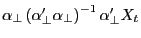 as the permanent components of the individual variables in the system. Gonzalo and Granger (1995) propose
as the common stochastic trends in the system and
as the permanent components; Johansen (1995) proposes the random walks
as the common stochastic trends and random walks
as the permanent components.
as the permanent components of the individual variables in the system. Gonzalo and Granger (1995) propose
as the common stochastic trends in the system and
as the permanent components; Johansen (1995) proposes the random walks
as the common stochastic trends and random walks
as the permanent components.
There is no econometric reason why one definition of a common stochastic trend and permanent component is necessarily any better than another; one needs economic justifications to choose among them. One interpretation of the cointegrating relationships, , derived from Johansen's methodology is that they are the maximally canonically
correlated linear combinations of and . So, Kasa's common
stochastic trends would be the minimally canonically correlated linear combinations; there, however, is no strong economic justification for choosing these linear combinations as the
common stochastic trends. The Gonzalo and Granger formulation has the advantage that the cointegrating relationships and transitory components have no long-run effect on the common stochastic trends and permanent components. In the Johansen version, the common stochastic trends and permanent
components are random walks (like the univariate Beveridge-Nelson decomposition), and the permanent components of the variables can be seen as the long-run forecasts of the variables once the dynamics have worked out themselves. In the Johansen definition, however, unlike the Gonzalo and Granger
method, the cointegrating relationships and transitory components can have a permanent effect on the common stochastic trends and the permanent components.
Recall that and are matrices of full column rank, that is, the columns of and lie in -dimensional subspaces of  . The likelihood ratio tests in section 3 for restrictions on the cointegrating vectors and on their disequilibrium adjustment vectors were
of two general types: The first imposes linear relationships on all the vectors, and the second assumes that a subset of the vectors are known. Johansen (1989) shows that since one actually estimates the space spanned by the cointegrating vectors,
. The likelihood ratio tests in section 3 for restrictions on the cointegrating vectors and on their disequilibrium adjustment vectors were
of two general types: The first imposes linear relationships on all the vectors, and the second assumes that a subset of the vectors are known. Johansen (1989) shows that since one actually estimates the space spanned by the cointegrating vectors,
 , restrictions on cointegrating vectors are restrictions on the space they span. The restriction that the vectors in share linear restrictions, that is,
  where
where  is a known
matrix of full column rank and
is a known
matrix of full column rank and  s
an unknown matrix, can be represented geometrically as
s
an unknown matrix, can be represented geometrically as
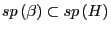 . This implies the columns of are restricted to lie in a given -dimensional subspace of (Johansen, 1988). The restriction that of the cointegrating relationships are known, that is,
![\alpha =\left[ {h,\varphi } \right]](img216.gif) where
where  contains the known
  relationships and
 is unknown, can be represented geometrically as
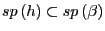 (Johansen, 1989). This implies that the known vectors lie in an -dimensional subspace of the space spanned by the vectors in . These two restrictions can be written
 .
.
Restrictions placed on cointegrating vectors or on their adjustment vectors imply that restrictions are imposed on the space spanned by their orthogonal complements as well (Johansen, 1989). The restriction that
implies
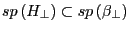 , where the orthogonal complements and
  are and
 matrices, respectively, of full column rank. This means that a subset of of the vectors in are known, namely those
contained in . Thus, the test implies a test on its orthogonal
complement of the form
matrices, respectively, of full column rank. This means that a subset of of the vectors in are known, namely those
contained in . Thus, the test implies a test on its orthogonal
complement of the form
![\beta _\bot =\left[ {H_\bot ,\theta } \right]](img225.gif) for which is an unknown
for which is an unknown  matrix of rank
  .
.
Similarly,
implies
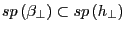 , where
  is a
is a  matrix of full column rank; that is, the vectors in
share the (
matrix of full column rank; that is, the vectors in
share the ( linear restrictions implied by . Thus, a test of the form
implies a test on its orthogonal complement of the form
linear restrictions implied by . Thus, a test of the form
implies a test on its orthogonal complement of the form
 for which is an
unknown (
for which is an
unknown (
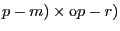 matrix of rank .
With minor modifications to the tests in section 3, we may more explicitly state the implications for the orthogonal complements and reformulate them as tests on the orthogonal complements, that is, use the tests in section 3 as tests on the orthogonal complements.
PROPOSITION 4.1: For (1)
where H ps is known and sr is unknown, rsp one may choose
![\begin{displaymath} \beta _\bot =\left[ {H_\bot ,\bar {H}\phi _\bot } \right] \end{displaymath}](img234.gif)
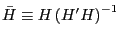 . Further, one can test the hypothesis
where G p
![\begin{displaymath} \beta _\bot =\left[ {G,\bar {G}_\bot \theta } \right] \end{displaymath}](img236.gif) q is known and (p-q)( p-q-r) is unknown by transforming this problem into above setting
q is known and (p-q)( p-q-r) is unknown by transforming this problem into above setting  and s=p-q. That is, one may test the hypothesis that certain are known and the remaining elements of are
orthogonal to the known vectors.
and s=p-q. That is, one may test the hypothesis that certain are known and the remaining elements of are
orthogonal to the known vectors.
To check that is indeed an orthogonal complement of , one must verify that
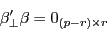
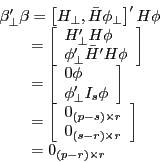
PROPOSITION 4.2: For (2)
![H_0 :\beta =\left[ {H,\bar {H}_\bot \phi } \right]](img240.gif) where H ps is known and (p-s) (r-s) is unknown, one may
choose
where H ps is known and (p-s) (r-s) is unknown, one may
chooseThus, we can test the hypothesis
![\begin{displaymath} \alpha _\bot =\left[ {A_\bot ,\bar {A}\psi _\bot } \right]. \end{displaymath}](img241.gif)
where G is a known p
 q matrix and is an unknown
q(p-r) matrix by transforming this problem into above setting and s=p-q. That is, one may test the hypothesis that the vectors in share the same p-s linear restrictions.
q matrix and is an unknown
q(p-r) matrix by transforming this problem into above setting and s=p-q. That is, one may test the hypothesis that the vectors in share the same p-s linear restrictions.
Again, to check that is indeed an orthogonal complement of , one must verify that  :
:
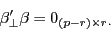
Proofs of the above and following propositions are in the Appendix.
One can apply the ideas from the two examples above to tests (3) through (8) in section 3. The results are summarized below.
PROPOSITION 4.3: For (3)
where A pm is known and mr is unknown, rmp, one may choose
![\begin{displaymath} \alpha _\bot =\left[ {A_\bot ,\bar {A}\psi _\bot } \right], \end{displaymath}](img245.gif) . Further, one can test the hypothesis
. Further, one can test the hypothesiswhere B p
![\begin{displaymath} \alpha _\bot =\left[ {B,\bar {B}_\bot \xi } \right] \end{displaymath}](img246.gif) n is known and
n is known and  (p-n)(p-n-r) is unknown by transforming this problem into above setting and m=p-n. That is, one may test the hypothesis that certain are known and the remaining vectors in are orthogonal to the known
vectors.
(p-n)(p-n-r) is unknown by transforming this problem into above setting and m=p-n. That is, one may test the hypothesis that certain are known and the remaining vectors in are orthogonal to the known
vectors.
PROPOSITION 4.4: For (4)
![H_0 :\alpha =\left[ {A,\bar {A}_\bot \psi } \right]](img248.gif) where A pm is known and (p-m)r is unknown, one may
choose
where A pm is known and (p-m)r is unknown, one may
choose

where B is a known p
 n matrix and is an unknown
n(p-r) matrix by transforming this problem into above setting and m=p-n. That is, one may test the hypothesis that the vectors in share the same p-m linear restrictions.
n matrix and is an unknown
n(p-r) matrix by transforming this problem into above setting and m=p-n. That is, one may test the hypothesis that the vectors in share the same p-m linear restrictions.
This test is equivalent to the hypothesis test  in Gonzalo and Granger (1995), which uses the dual of the eigenvalue problem for (4) used in Proposition 4.4.
The following four propositions allow one to combine restrictions on the orthogonal complements of the cointegrating vectors and of their disequilibrium adjustment vectors.
PROPOSITION 4.5: For (5)
where H ps, A
pm are known and sr, mr are
unknown, rsp and rmp, one may choose
![\begin{displaymath} \beta _\bot =\left[ {H_\bot ,\bar {H}\phi _\bot } \right],\;\;\alpha _\bot =\left[ {A_\bot ,\bar {A}\psi _\bot } \right]. \end{displaymath}](img252.gif)
where G p
![\begin{displaymath} \beta _\bot =\left[ {G,\bar {G}_\bot \theta } \right],\;\;\alpha _\bot =\left[ {B,\bar {B}_\bot \xi } \right] \end{displaymath}](img253.gif) q and B pn are known matrices and
q and B pn are known matrices and
 p-q)(p-q-r) and (p-n)(p-n-r) are unknown matrices by transforming this problem into above setting
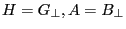 , s=p-q, and m=p-n. This test allows one simultaneously to test for known vectors and for known vectors.
PROPOSITION 4.6: For (6)
![H_0 :\;\beta =H\phi ,\;\;\alpha =\left[ {A,\bar {A}_\bot \psi } \right]](img256.gif) where H ps, A pm are known and sr, (p-m)
m
where H ps, A pm are known and sr, (p-m)
m r) are unknown, m rsp,
one may choose
r) are unknown, m rsp,
one may choose
![\begin{displaymath} \beta _\bot =\left[ {H_\bot ,\bar {H}\phi _\bot } \right], \quad \alpha _\bot =A_\bot \psi _\bot . \end{displaymath}](img258.gif)
where G p
![\begin{displaymath} \beta _\bot =\left[ {G,\bar {G}_\bot \theta } \right], \quad \alpha _\bot =B\xi \end{displaymath}](img259.gif) q and B pn are known matrices and
p-q)(p-q-r) and n(p-r) are unknown matrices by transforming this problem into above setting
, s=p-q, and m=pn. This test allows one simultaneously to test for known vectors and to place common linear restrictions on
q and B pn are known matrices and
p-q)(p-q-r) and n(p-r) are unknown matrices by transforming this problem into above setting
, s=p-q, and m=pn. This test allows one simultaneously to test for known vectors and to place common linear restrictions on

PROPOSITION 4.7: For (7)
![H_0 :\beta =\left[ {H,\bar {H}_\bot \phi } \right],\;\;\alpha =A\psi](img261.gif) where H ps, A pm are known and (p-s)(r-s), mr are unknown, srmp, one may choose
where H ps, A pm are known and (p-s)(r-s), mr are unknown, srmp, one may choose
![\begin{displaymath} \alpha _\bot =\left[ {A_\bot ,\bar {A}\psi _\bot } \right], \quad \alpha _\bot =\left[ {A_\bot ,\bar {A}\psi _\bot } \right] \end{displaymath}](img262.gif)
where G p
![\begin{displaymath} \beta _\bot =G\theta , \quad \alpha _\bot =\left[ {B,\bar {B}_\bot \xi } \right] \end{displaymath}](img263.gif) q and B pn are known matrices and
q and B pn are known matrices and
 (p-r) and (p-n)(p-n-r) are unknown matrices, by transforming this problem into above setting
, s=p-q, and m=p-n. This test allows one simultaneously to test for common linear restrictions on the vectors and for known vectors.
(p-r) and (p-n)(p-n-r) are unknown matrices, by transforming this problem into above setting
, s=p-q, and m=p-n. This test allows one simultaneously to test for common linear restrictions on the vectors and for known vectors.
PROPOSITION 4.8: For (8)
![H_0 :\beta =\left[ {H,\bar {H}_\bot \phi } \right],\;\;\alpha =\left[ {A,\bar {A}_\bot \psi } \right]](img265.gif) where H ps, A ps are known and
where H ps, A ps are known and
 (p-s)(r-s) are unknown, srp, one may choose
![\begin{displaymath} \alpha _\bot =\left[ {A_\bot ,\bar {A}\psi _\bot } \right], \quad \alpha _\bot =A_\bot \psi _\bot \end{displaymath}](img267.gif)
where G p
 q and B pn are known matrices and
 (p-r) are unknown matrices, by transforming this problem into above setting
, s=p-q. This test allows one simultaneously to test for common linear restrictions on the vectors and to place common linear restrictions on the vectors.
(p-r) are unknown matrices, by transforming this problem into above setting
, s=p-q. This test allows one simultaneously to test for common linear restrictions on the vectors and to place common linear restrictions on the vectors.
These propositions allow one, in addition, to combine the tests on the cointegrating vectors and adjustment vectors with those on the respective orthogonal complements. For example, one could use Proposition 4.7 to test that the cointegrating vectors share certain linear restrictions (say,
ratios or spreads, or that some subset of variables do not enter the cointegrating relationships) and that some subset of the common stochastic trends are known:
![H_0 :\beta =H\phi ,\;\;\alpha _\bot =\left[ {B,\bar {B}_\bot \xi } \right]](img270.gif) . The tests (1) through (8) can be recast as tests of the hypotheses that are displayed below:
. The tests (1) through (8) can be recast as tests of the hypotheses that are displayed below:
![\beta _\bot =\left[ {G,\bar {G}_\bot \theta } \right]](img271.gif)
![\beta =\left[ {H,\bar {H}_\bot \phi } \right]](img272.gif)

![\alpha _\bot =\left[ {B,\bar {B}_\bot \xi } \right]](img275.gif)
![\alpha =\left[ {A,\bar {A}_\bot \psi } \right]](img276.gif)


![\begin{array}{l} \beta =H\phi \ \alpha _\bot =\left[ {B,\bar {B}_\bot \xi } \right] \ \end{array}](img279.gif)
![\begin{array}{l} \beta _\bot =\left[ {G,\bar {G}_\bot \theta } \right] \ \alpha =A\psi \ \end{array}](img280.gif)
![\begin{array}{l} \beta _\bot =\left[ {G,\bar {G}_\bot \theta } \right] \ \alpha _\bot =\left[ {B,\bar {B}_\bot \xi } \right] \ \end{array}](img281.gif)
![\begin{array}{l} \beta =\left[ {H,\bar {H}_\bot \phi } \right] \ \alpha =A\psi \ \end{array}](img282.gif)
![\begin{array}{l} \beta =\left[ {H,\bar {H}_\bot \phi } \right] \ \alpha _\bot =\left[ {B,\bar {B}_\bot \xi } \right] \ \end{array}](img283.gif)

![\begin{array}{l} \beta _\bot =G\theta \ \alpha _\bot =\left[ {B,\bar {B}_\bot \xi } \right] \ \end{array}](img285.gif)
![\begin{array}{l} \beta =H\phi \ \alpha =\left[ {A,\bar {A}_\bot \psi } \right] \ \end{array}](img286.gif)

![\begin{array}{l} \beta _\bot =\left[ {G,\bar {G}_\bot \theta } \right] \ \alpha =\left[ {A,\bar {A}_\bot \psi } \right] \ \end{array}](img288.gif)
![\begin{array}{l} \beta _\bot =\left[ {G,\bar {G}_\bot \theta } \right] \ \alpha _\bot =B\xi \ \end{array}](img289.gif)
![\begin{array}{l} \beta =\left[ {H,\bar {H}_\bot \phi } \right] \ \alpha =\left[ {A,\bar {A}_\bot \psi } \right] \ \end{array}](img290.gif)
![\begin{array}{l} \beta =\left[ {H,\bar {H}_\bot \phi } \right] \ \alpha _\bot =B\xi \ \end{array}](img291.gif)
![\begin{array}{l} \beta _\bot =G\theta \ \alpha =\left[ {A,\bar {A}_\bot \psi } \right] \ \end{array}](img292.gif)

where
 ,
,
 ,
,
 and vice versa.
5. Conclusion
This paper has two aims. The first is to develop three new hypothesis tests for combining structural hypotheses on cointegrating relationships and on their disequilibrium adjustment vectors in Johansen's (1988) multivariate maximum likelihood cointegration framework. These tests possess closed-form solutions for parameter estimates under the null hypothesis. The second is to demonstrate the implications that the tests for restrictions on the cointegration vectors and disequilibrium adjustment vectors have for the orthogonal complements of these quantities, and how these tests can be formulated as tests on the orthogonal complements. This is useful since the various specifications of multivariate common stochastic trends and permanent components are derived from these orthogonal complements. Thus, one may combine tests for restrictions on the long-run relationships represented by cointegrating relationships, the adjustments to them, and the common stochastic trends of a system of variables.
References
Beveridge, S. and C.R. Nelson (1981), "A New Approach to Decomposition of Economic Time Series into Permanent and Transitory Components with Particular Attention to Measurement of the `Business Cycle'," Journal of Monetary Economics, 7, 151174.
Cheung, Y-W, and K.S. Lai (1993), "Finite-Sample Sizes of Johansen's Likelihood Ration Tests for Cointegration," Oxford Bulletin of Economics and Statistics, 55, 313-328.
Cochrane, J. (1994a), "Univariate vs. Multivariate Forecasts of GNP Growth and Stock Returns: Evidence and Implications for the Persistence of Shocks, Detrending Methods, and Tests of the Permanent Income Hypothesis," Working Paper 3427, National Bureau of Economic Research, Cambridge, MA.
Cochrane, J. (1994b), "Permanent and Transitory Components of GNP and Stock Prices," Quarterly Journal of Economics, 241-265.
Cochrane, J. (1994c), "Shocks," Carnegie-Rochester Conference Series on Public Policy, 41, 296-364.
Doornik, J.A., (1995) "Testing General Restrictions on the Cointegrating Space," Working Paper, Nuffield College.
Engle, R.F., and C.W.J. Granger (1987), "Cointegration and Error Correction: Representation, Estimation, and Testing," Econometrica, 55, 251-276.
Engle, R.F. and S. Kozicki (1993), "Testing for Common Features," Journal of Business and Economic Statistics, 11(4), 369-380.
Engle, R.F., and B.S. Yoo (1987), "Forecasting and Testing in Cointegrated Systems," Journal of Econometrics, 35, 143-159.
Engle, R.F., and B.S. Yoo (1987), "Cointegrated Economic Time Series: An Overview with New Results," in R.F. Engle and C.W.J. Granger (eds.) Long-Run Economic Relations, Readings in Cointegration, Oxford University Press, New York.
Gonzalo, J. (1994), "Five Alternative Methods of Estimating Long-Run Equilibrium Relationships," Journal of Econometrics, 60, 203-233.
Gonzalo, J., and C.W.J. Granger (1995), "Estimation of Common Long-Memory Components in Cointegrated Systems," Journal of Business and Economic Statistics, 13, 27-35.
Gonzalo, J., and T.-H. Lee (1998), "Pitfalls in Testing for Long Run Relationships," Journal of Econometrics, 86(1), 129-154.
Granger, C.W.J. (1981), "Some Properties of Time Series Data and Their Use in Econometric Model Specification," Journal of Econometrics, 16, 121-130.
Granger, C.W.J. (1983), "Cointegrated Variables and Error Correction Models," Discussion Paper 83:13a, University of California, San Diego.
Granger, C.W.J., and T.-H. Lee (1990), "Multicointegration," Advances in Econometrics, 8, 71-84.
Hamilton, J. (1994), Time Series Analysis, Princeton University Press, Princeton, NJ.
Haug, A (2002), "Testing Linear Restrictions on Cointegrating Vectors: Sizes and Powers of Wald tests in Finite Samples," Econometric Theory, 18, 505-524.
Johansen, S. (1988), "Statistical Analysis of Cointegration Vectors," Journal of Economic Dynamics and Control, 12, 231-254.
Johansen, S. (1989), "Likelihood Based Inference on Cointegration: Theory and Applications," unpublished lecture notes, University of Copenhagen, Institute of Mathematical Statistics.
Johansen, S. (1991), "Estimation and Hypothesis Testing of Cointegration Vectors n Gaussian Vector Autoregressive Models," Econometrica, 59, 1551-1580.
Johansen, S. (1995), "Identifying Restrictions of Linear Equations with Applications to Simultaneous Equations and Cointegration," Journal of Econometrics, 1995, 69, 111-132.
Johansen, S. (1996), Likelihood-Based Inference in Cointegrated Vector Autoregressive Models, Oxford University Press, Oxford.
Johansen, S (2000), "A Bartlett Correction Factor for Tests on the Cointegrating Relations," Econometric Theory, 16, 740-778.
Johansen, S., and K. Juselius (1990), "Maximum Likelihood Estimation and Inference on Cointegration: with Applications to the Demand for Money," Oxford Bulletin of Economics and Statistics, 52, 169-210.
Johansen, S., and K. Juselius (1992), "Testing Structural Hypotheses in a Multivariate Cointegration Analysis of the PPP and UIP for UK," Journal of Econometrics, 53, 211-244.
Kasa, K. (1992), "Common Stochastic Trends in International Stock Markets," Journal of Monetary Economics, 29, 95-124.
King, R., C. Plosser, and S. Robelo (1988), "Production, Growth, and Business Cycles: II. New Directions," Journal of Monetary Economics, 21, 309-341.
King, R., C. Plosser, J. Stock, and M.W. Watson (1991), "Stochastic Trends and Economic Fluctuations," The American Economic Review, 81, 819-840.
Konishi, T. and C.W.J. Granger (1992), "Separation in Cointegrated Systems," Discussion Paper 92-51, University of California, San Diego.
MacKinnon, J., A. Haug, and L. Michelis (1999), "Numerical Distribution Functions of Likelihood Ratio Tests for Cointegration," Journal of Applied Econometrics, 14 (5), 563-577.
Mosconi, R. and C. Giannini (1992), "Non-causality in Cointegrated Systems: Representation, Estimation, and Testing," Oxford Bulletin of Economics and Statistics, 54, 399-417.
Muth, J.F. (1960), "Optimal Properties of Exponentially Weighted Forecasts," Journal of the American Statistical Association, 55, 299-306.
Osterwald-Lenum, M. (1992), "A Note with Quantiles of the Asymptotic Distribution of the Maximum Likelihood Cointegration Rank Test Statistics," Oxford Bulletin of Economics and Statistics, 54, 461-472.
Phillips, P.C.B. (1991), "Optimal Inference in Cointegrated Systems," Econometrica, 56, 1021-1044.
Proietti, T. (1997), "Short Run Dynamics in Cointegrated Systems," Oxford Bulletin of Economics and Statistics, 59(3), 405-422.
Quah, D. (1992), "The Relative Importance of Permanent and Transitory Components: Identification and Some Theoretical Bounds," Econometrica, 60, 107-118.
Reimers, H.E. (1992), "Comparisons of Tests for Multivariate Cointegration," Statistical Papers, 33, 335-359.
Reinsel, G., and S. Ahn (1990), "Vector Autoregressive Models with Unit Roots and Reduced Rank Structure: Estimation, Likelihood Ratio Tests, and Forecasting," Journal of Time Series Analysis, 13, 353-375.
Sims, C.A. (1980), "Macroeconomics and Reality," Econometrica, 48, 1-48.
Solow, R. (1970), Growth Theory: An Exposition, Oxford, Clarendon Press.
Stock, J.H., and M.W. Watson (1988), "Testing for Common Trends," Journal of the American Statistical Association, 83, 1097-1107.
Vahid, F. and R.F. Engle (1993), "Common Trends and Common Cycles," Journal of Applied Econometrics, 8(4), 341-360.
Watson, M.W. (1986), "Univariate Detrending Methods with Stochastic Trends," Journal of Monetary Economics, 18, 49-75.
Watson, M.W. (1995), "Vector Autoregressions and Cointegration," in The Handbook of Econometrics, 4, ed. by R.F. Engle and D. McFadden, Elsevier, Amsterdam, The Netherlands.
Watson, M.W. and R.F. Engle (1983), "Alternative algorithms for the Estimation of Dynamic Factor, MIMIC, and Varying Coefficient Regression Models," Journal of Econometrics, 23, 485-500.
Wold, H. (1938), A Study in the Analysis of Stationary Time Series, Almqvist and Wiksell, Uppsala, Sweden.
Appendix
THEOREM 3.1:
where
, are known and  (r-s), are unknown, .
The reduced rank regression from (2.6) is
 is partitioned conformably with as
, and is split into
is partitioned conformably with as
, and is split intoand

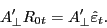
This allows one to factor the likelihood function into a marginal part based on (A.19) and a factor based on (A.18) conditional on (A.19):
where

The parameters in the two equations are variation independent with independent errors, and the maximized likelihood will be the product of the maxima of the two factors.
The maximum of the likelihood function for the factor corresponding to the marginal distribution of
 is, apart from a constant,
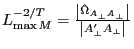 . The denominator is estimated by
 thus,
thus,
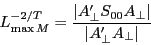
 conditional on
and is found by reduced rank regression. It is equivalent
to maximizing the concentrated conditional factor as function of the unknown parameter matrix First, one estimates
conditional on
and is found by reduced rank regression. It is equivalent
to maximizing the concentrated conditional factor as function of the unknown parameter matrix First, one estimates  by fixing
  ,
,  , and and regressing
 on
. This yields
on
. This yieldsThis allows one to correct for
 in (A.19) by forming new residual vectors
and product moment matrices

Thus we can write the conditional regression equation (A.20) as

To successively concentrate the conditional likelihood until it is solely a function of
 , one fixes and nd then estimates by regressing
 on
on
 to get
One then corrects

 for
by forming new residuals
for
by forming new residualsand product moment matrices

Thus one can rewrite (A.26) as

for which

Fixing
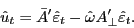 , one estimates by regressing
 on
on
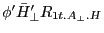 . This gives
and

The factor of the maximized likelihood corresponding to the conditional distribution is, apart from a constant,

where
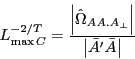
The maximum likelihood estimate of the conditional variance matrix is

which gives the maximized conditional likelihood

The maximized likelihood function is the product between the maximized conditional factor and maximized marginal factor, for which the only unknown parameters are contained in
 ; one then has (and noting that
implies
; one then has (and noting that
implies

From the matrix relationship for nonsingular
 and
and  ,
,it follows that

 , and thus one can rewrite (A.38) as
The variance-covariance matrix is then estimated by

![\hat {\Omega }=\left[ {{\begin{array}{*{20}c} A \hfill & {\bar {A}_\bot } \hfill \ \end{array} }} \right]\left[ {{\begin{array}{*{20}c} {\hat {\Omega }_{AA} } \hfill & {\hat {\Omega }_{AA_\bot } } \hfill \ {\hat {\Omega }_{A_\bot A} } \hfill & {\hat {\Omega }_{A_\bot A_\bot } } \hfill \ \end{array} }} \right]\left[ {{\begin{array}{*{20}c} A \hfill & {\bar {A}_\bot } \hfill \ \end{array} }} \right]^\prime](img338.gif) ,
,
where the estimators of
 ,
,
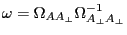 , and
, and
 are used to recover
 ,
,
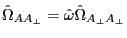 ,
,
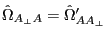 , and
, and
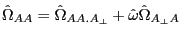 .
.
Maximizing the likelihood function is equivalent to minimizing the last factor of (A.40) with respect to . Following From Johansen and Juselius (1990),
here, one solves the eigenvalue problem
and eigenvectors
normalized so that
. Then
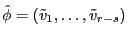 , from which one then can recover the parameters (3.14) to (3.17), and the maximized likelihood function, apart from a
constant, is
, from which one then can recover the parameters (3.14) to (3.17), and the maximized likelihood function, apart from a
constant, isRewriting
and noting

where
 solves the eigenvalue problem
yields

This gives the maximized likelihood function, apart from a constant,

If

 is a matrix of full rank and
![X=\left[ {A,A_\bot } \right]](img353.gif) , where and are full column rank and matrices respectively, one may use the properties of determinants to write
, where and are full column rank and matrices respectively, one may use the properties of determinants to write
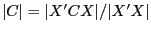 . And since
we have

Substituting

 and recalling
 we have
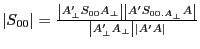 . (.51)
Therefore, apart from a constant, the maximized likelihood is
 in
in  is
isThe constant terms in both cancel, and one can write from (2.15) and (A.52),

which yields the likelihood ratio test statistic

The calculation for the limiting distribution and degrees of freedom for these tests are based on Johansen (1989, 1991) and Lemma 7.1 in Johansen (1996). The former set shows that the limiting distribution of the likelihood ratio tests for restrictions on
 and given cointegrating relationships is . The latter shows that for
  and
and  matrices of full column rank,
  and
and  , the tangent space of
  has
dimension (
has
dimension ( The number of parameters in the unrestricted
is (using,
The number of parameters in the unrestricted
is (using,  ,
,  , and
, and  , 2pr-
 . In the restricted model the number of free parameters in
 is ms+(+(
 -(
-( (
( =mr+pr-ps+sr-.
The difference between the unrestricted and restricted free parameters,
=mr+pr-ps+sr-.
The difference between the unrestricted and restricted free parameters, 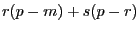 , are the degrees of freedom. So, the likelihood ratio test is asymptotically distributed as with degrees of freedom.
THEOREM 3.3:
![H_0 :\beta =H\phi ,\;\;\alpha =\left[ {A,\bar {A}_\bot \psi } \right]](img381.gif) where
where
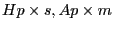 are known and
sr, (pm)
are known and
sr, (pm) are unknown, rsp.
The reduced rank regression is then
 s partitioned conformably with as
, and is split into
s partitioned conformably with as
, and is split intoand

This allows one to factor the likelihood function into a marginal part based on (A.58) and a factor based on the (A.57) conditional on (A.58):

where


The parameters in (A.59) are variation independent of (A.58) with independent errors.
To maximize the likelihood for the marginal distribution, first one fixes
 in (A.58) and estimates by regression, giving

which gives the maximum likelihood estimator for

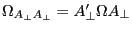 ,
,The contribution of the marginal distribution, apart from a constant, is


One maximizes the factor of the marginal contribution by minimizing the second factor in (A.64) with respect to the unknown parameter matrix
 . This is done by solving the eigenvalue problem
for eigenvalues
and corresponding eigenvectors
, normalized so that
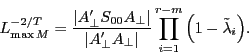
. This implies the maximand of the marginal distribution of the likelihood function is
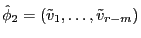 , from which one then can recover the parameters (3.25) to (3.27), and the maximized contribution is
To calculate the conditional distribution, given
 ,
,
 , and
, and  , one regresses
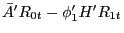 on
on
 to estimate
where
 and so on. This allows one to correct for in (A.59) by forming new residual vectors
and product moment matrices

One can then write (A.59) as
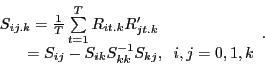
where

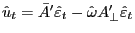 and, as suggested by Johansen (1989), estimate by regression which yields
The factor of the maximized likelihood corresponding to the conditional distribution is, apart from a constant,

where
The maximum likelihood estimate of the conditional variance matrix is
which gives, apart from a constant, the maximized likelihood for the conditional distribution as



where
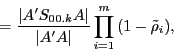
 solve the eigenvalue problem
The variance-covariance matrix is then estimated by

where the estimators of
![\begin{displaymath} \hat {\Omega }=\left[ {{\begin{array}{*{20}c} A \hfill & {\bar {A}_\bot } \hfill \ \end{array} }} \right]\left[ {{\begin{array}{*{20}c} {\hat {\Omega }_{AA} } \hfill & {\hat {\Omega }_{AA_\bot } } \hfill \ {\hat {\Omega }_{A_\bot A} } \hfill & {\hat {\Omega }_{A_\bot A_\bot } } \hfill \ \end{array} }} \right]\left[ {{\begin{array}{*{20}c} A \hfill & {\bar {A}_\bot } \hfill \ \end{array} }} \right]^\prime , \end{displaymath}](img414.gif) ,
, and
are used to recover
,
,
, and
.
,
, and
are used to recover
,
,
, and
.
Finally, the maximized likelihood is
 in is
in isThe constant terms in both cancel, and one can write the likelihood ratio test statistic from (2.15) and (A.80),

The number of free parameters in the unrestricted model for
![\begin{displaymath} \begin{array}{l} LR\left( {H_0 \vert H\left( r \right)} \right)= \ \;\;T\left\{ {\ln \left[ {\frac{\left\vert {{A}'S_{00.k} A} \right\vert\left\vert {{A}'_\bot S_{00} A_\bot } \right\vert}{\left\vert {{A}'A} \right\vert\left\vert {{A}'_\bot A_\bot } \right\vert}} \right]-\ln \left\vert {S_{00} } \right\vert+\sum\limits_{i=1}^{r-m} {\ln \left( {1-\tilde {\lambda }_i } \right)+\sum\limits_{i=1}^m {\ln \left( {1-\tilde {\rho }_i } \right)} -\sum\limits_{j=1}^r {\ln \left( {1-\hat {\lambda }_j } \right)} } } \right\} \ \end{array}_{.} \end{displaymath}](img417.gif) cointegrating relationships, from Theorem 3.2, is 2pr-. In the restricted model,
cointegrating relationships, from Theorem 3.2, is 2pr-. In the restricted model,
 (from Lemma 7.1 in Johansen (1996)) has ms+(
 -(
-( (
( free parameters.
The degrees of freedom for the likelihood ratio tests is the difference in free parameters between the unrestricted and restricted models,
free parameters.
The degrees of freedom for the likelihood ratio tests is the difference in free parameters between the unrestricted and restricted models, 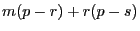 . So, the likelihood ratio test is
asymptotically distributed as with
. So, the likelihood ratio test is
asymptotically distributed as with 
 degrees of freedom.
THEOREM 3.5: Under the hypothesis
![H_0 :\;\;\beta =\left[ {H,\bar {H}_\bot \phi } \right],\;\;\alpha =\left[ {A,\bar {A}_\bot \psi } \right]](img425.gif) where are known matrices and and (
where are known matrices and and (
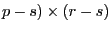 are unknown, srp.
The reduced rank regression given can be expressed as

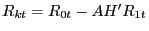 , for which there are no unknown parameters, one rewrites (A.83) as
and premultiplies (A.84), in turn, by

 and
and  to get
and

This allows one to factor the likelihood function into a marginal part based on (A.85) and a factor based on (A.86) conditional on (A.85):

where

 . The parameters in (A.87) are variation independent of (A.85) with independent
errors.
. The parameters in (A.87) are variation independent of (A.85) with independent
errors.
To calculate the conditional factor, one fixes and and regresses
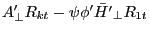 on
on
 to estimate
 in (A.87) by forming new residual vectors
and product moment matrices

This allows one to write (A.87) as

where

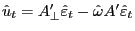 . Fixing , one estimates
  y regressing
 on
on
 , which yields
The factor of the maximized likelihood corresponding to the conditional distribution is, apart from a constant,

where
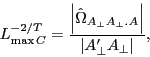
The maximum likelihood estimate of the conditional variance matrix is


which gives, apart from a constant, the maximized likelihood for the conditional factor as

The conditional likelihood is maximized by minimizing (A.96) with respect to
 , which is done by solving the eigenvalue problem
for
and for eigenvectors
, normalized so that
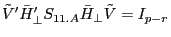 . The maximand of the likelihood function is
, from which one then can recover the parameters (3.37) to (3.39), and the maximized likelihood function for the
conditional piece, apart from a constant, is
. The maximand of the likelihood function is
, from which one then can recover the parameters (3.37) to (3.39), and the maximized likelihood function for the
conditional piece, apart from a constant, isThe maximum of the factor corresponding to the likelihood function for the marginal piece based on (A.85) is, apart from a constant,
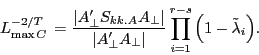
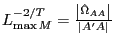 . The
denominator is estimated by
. The
denominator is estimated by
 and thus
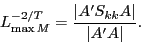
![\hat {\Omega }=\left[ {{\begin{array}{*{20}c} A \hfill & {A_\bot } \hfill \ \end{array} }} \right]\left[ {{\begin{array}{*{20}c} {\hat {\Omega }_{AA} } \hfill & {\hat {\Omega }_{AA_\bot } } \hfill \ {\hat {\Omega }_{A_\bot A} } \hfill & {\hat {\Omega }_{A_\bot A_\bot } } \hfill \ \end{array} }} \right]\left[ {{\begin{array}{*{20}c} A \hfill & {A_\bot } \hfill \ \end{array} }} \right]^\prime](img457.gif) ,
,
where the estimators of  ,
,
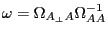 , and
, and
 are used to recover
 ,
,
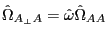 ,
,
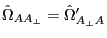 , and
, and
 .
.
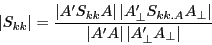
The product of (A.98) and (A.99) yield, apart from a constant, the maximized likelihood
so that the maximized likelihood function is
THEOREM 3.6: The likelihood ratio test for
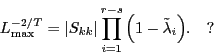 in is
in isThe constant terms in both cancel, and one can write the likelihood ratio test statistic from (2.15) and (A.102),
The number of free parameters in the unrestricted model for
 cointegrating relationships, from Theorem 3.2, is 2pr-. In the restricted model,
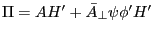 (from Lemma 7.1 in Johansen (1996)) has ((+(-(( free parameters. The degrees of freedom for the likelihood ratio tests is the difference in free parameters between the unrestricted and restricted models, (2. So, the likelihood ratio test is asymptotically distributed as with 2ps-s degrees of freedom.
PROPOSITION 4.1:
where  is known and s
 is unknown,
 That one may choose
![\beta _\bot =\left[ {H_\bot ,\bar {H}\phi _\bot } \right]](img472.gif) as the orthogonal complement of was shown is section 4.
as the orthogonal complement of was shown is section 4.
Consider
 is known and
(p-q)
is known and
(p-q) is unknown
![. \quad \beta _\bot =\left[ {G,\bar {G}_\bot \theta } \right]](img475.gif) implies
implies
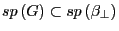 , which implies
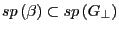 . Setting , a
 matrix, implies
, which shows this is a test of the form where is (
matrix, implies
, which shows this is a test of the form where is ( . Noting
![{\beta }'_\bot \beta =\left[ {G,\bar {G}_\bot \theta } \right]^\prime H\phi =\left[ {{\begin{array}{*{20}c} {{G}'H\phi } \hfill \ {{\theta }'{\bar {G}}'_\bot H\phi } \hfill \ \end{array} }} \right]=\left[ {{\begin{array}{*{20}c} {0\phi } \hfill \ {{\theta }'I_{p-q} \phi } \hfill \ \end{array} }} \right]](img480.gif) is zero when
(that is,
is zero when
(that is,
 and setting
  shows this is test (1) in section 3.
PROPOSITION 4.2:
where  s is known and (
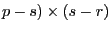 is unknown. That one may choose
 was shown in section 4. Consider

 is a known
  matrix and is an unknown
  matrix;
 implies
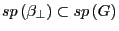 , which implies
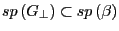 . Setting the , a
matrix, implies
. Setting the , a
matrix, implies
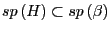 , which shows this is a test of the form
![\beta =\left[ {H,\zeta } \right]](img493.gif) where
where  is -(
is -( . Noting
![{\beta }'_\bot \beta ={\theta }'{G}'\left[ {H,\zeta } \right]=\left[ {{\theta }'{G}'_\bot H,{\theta }'{G}'\zeta } \right]=\left[ {{\phi }'_\bot 0,{\theta }'{G}'\zeta } \right]=\left[ {0_{\left( {p-r} \right)\times p-q} ,{\theta }'{G}'\zeta } \right]](img496.gif) is zero when
is zero when
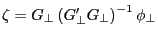 and setting
shows this is test (1) in section 3.
and setting
shows this is test (1) in section 3.
The other propositions in section 4 are combinations of the above propositions using and 
Footnotes
and are not uniquely determined (although is); that is, any
nonsingular  matrix implies
 . Return to Text