
Stability of Risk Preference
Keywords: Risk tolerance, risk aversion, correlated random effects, interval regression
Abstract:
1 INTRODUCTION
"One does not argue over tastes for the same reason that one does not argue over the Rocky Mountains -- both are there, will be there next year, too, and are the same to all men." Stigler and Becker (1977)
This paper approaches the fundamental debate on preference stability as an empirical question. Hypothetical gambles asked repeatedly to the same individuals over ten years provide a unique lever for this direct study of changes in risk tolerance. The gambles pose a well-defined risky choice that is comparable both across individuals and over time. The odds of the gambles are explicit, the stakes over lifetime income are large, albeit hypothetical, and most importantly for this study, the substance of the gambles does not change over time. As a result, the panel of gamble responses provides a clearer picture of long-term preference stability than standard behavioral data in surveys or experiments.
To quantify the stability of risk preference, I use gamble responses across the 1992 to 2002 waves of the Health and Retirement Study (HRS).1The placement of the gambles in the HRS with its rich individual and household information is also crucial for measuring the systematic changes in risk preference. To interpret the gamble responses, I adapt the framework from Barsky et al. (1997) and Kimball et al. (Forthcoming) that maps the gambles to the coefficient of relative risk tolerance. Yet my paper is distinct from other work with HRS gambles. I provide the first direct test of whether risk preferences are stable, and in particular whether individuals exhibit constant relative risk aversion.2 My analysis of the gamble responses also incorporates the detailed information on individuals over the panel period. This allows me to investigate the drivers of preference change and the degree of selection on preference type. I model risk tolerance with a time-varying component and a time-constant component and use the panel to separate within-person and across-person variation in preferences. Specifically, I estimate a correlated random effects model of risk tolerance with 18,625 gamble responses from 12,003 individuals between ages 45 and 70.
The results present a nuanced view of the stability in risk preference. There is a modest decline in risk tolerance with age, and an improvement in macroeconomic conditions is associated with an increase in risk tolerance. But changes in income and wealth do not measurably alter an individual's willingness to take risk. In addition, major life events of a job displacement and the diagnosis of a serious health condition that likely reduce expected lifetime income have little impact on measured risk tolerance. The invariance of risk tolerance to within-person changes in income -- the explicit stake of the gamble -- provides support for the specification of utility with constant relative risk aversion. While the gamble responses reveal few sources of systematic change in risk preference, there is substantial evidence of large persistent differences in preferences across individuals. Demographics, including gender, race, education, and marital status are all associated with significant differences in the time-constant component of risk tolerance. The panel also points to the past selection of risky careers and high debt levels based on the individual's risk tolerance type. Altogether, the time-varying attributes account for 27% of the systematic variation in risk tolerance. There are also large persistent differences across individuals in their willingness to take risk in the hypothetical gambles that are not explained by any of the observables. The time-constant variance of preferences from the gambles that is unrelated to observables is twice as large as the systematic variance of preferences.
One potential concern is the credibility of results from hypothetical gambles. There are three main justifications for using this data to study changes in preferences. First, I estimate the systematic changes with a risky choice that is consistently defined over time. Extraneous details in the gambles, such as the sequence of the risks, may affect the responses and bias the estimated level of risk tolerance. However, I focus on the changes in risk preferences which are unaffected by constant question effects. Unlike panels of actual risky behavior, such as Brunnermeier and Nagel's (Forthcoming) analysis of household asset allocation, I can cleanly identify preference changes, as opposed to a mix of preference, expectations, and institutional changes.3 Second, the stakes of the gambles over lifetime income are large, as Rabin (2000) argues is necessary for measuring risk preference. This limits the question to a hypothetical situation, but the most likely cost is an increase in the noise. In a review of several experiments, Camerer and Hogarth (1999) find that financial incentives generally reduce the unexplained variability in behavior but do not affect the average behavior. Accordingly, my statistical model of risk tolerance removes the random variation in the gamble responses and the results focus on systematic changes in preferences. Third, individuals' responses to hypothetical gambles are correlated with their actual, incentivized risky behavior. In the last section, I show that more risk tolerant individuals (according to the gambles) are more likely to own stocks and increases in an individual's risk tolerance raise the probability of stock ownership. This is consistent with Barsky et al. (1997) who find a positive correlation between the level of measured risk tolerance and numerous actual risky behaviors. In addition, the experimental validation by Dohmen et al. (2006) of a hypothetical lottery question supports the use of hypothetical choice data. Altogether the gamble responses in the HRS offer valuable information on the stability of risk preferences.
The plan of the paper is as follows. Section 2 discusses the hypothetical gambles in the HRS. Section 3 uses expected utility theory to map the gamble responses to the coefficient of relative risk tolerance. The section then develops a statistical model of risk tolerance based on the gamble responses. Section 4 presents the results from maximum-likelihood estimation of the model. Section 5 uses the estimates of risk tolerance to study the household's actual decision to own stocks. The final section offers conclusions.
2 GAMBLES OVER LIFETIME INCOME
The Health and Retirement Study uses hypothetical gambles over lifetime income to elicit risk attitudes. In a short series of questions, individuals choose between two jobs; one job guarantees current lifetime income and the other job offers an unpredictable, but on average higher lifetime income. In the 1992 HRS, individuals consider the following scenario:
Suppose that you are the only income earner in the family, and you have a good job guaranteed to give you your current (family) income every year for life.
You are given the opportunity to take a new and equally good job, with a 50-50 chance it will double your (family) income and a 50-50 chance that it will cut your (family) income by a third. Would you take the new job?
Individuals who accept the first risky job then consider a job with a larger downside risk of one-half. Those who reject the first risky job are asked about a job with a smaller downside risk of one-fifth. Starting with the 1994 HRS, individuals who reject their first two risky jobs consider a third job that could cut their lifetime income by one-tenth. Likewise individuals who accept their first two risky jobs consider a third job that could cut their lifetime income by three-quarters. I use these responses to order individuals in a small number of categories. Table 1 relates the gamble response category to the downside risks that the individual accepts and rejects. The category numbers are increasing in an individual's willingness to accept income risk, so the gamble responses provide a coarse ranking of individuals by their risk preference.
Barsky et al. (1997) designed the gambles and analyzed the responses on the first two waves of the HRS. They acknowledge the potential for a status qua bias in the gamble responses due to the question wording, since individuals may have an aversion to a new job unrelated to its income risk. The 1998 HRS revised the hypothetical scenario so that individuals now choose between two new jobs:
Suppose that you are the only income earner in the family. Your doctor recommends that you move because of allergies, and you have to choose between two possible jobs.
The first would guarantee your current total family income for life. The second is possibly better paying, but the income is also less certain. There is a 50-50 chance the second job would double your total lifetime income and a 50-50 chance that it would cut it by a third. Which job would you take -- the first job or the second job?
The objective attributes of the two jobs are identical in the original and revised versions of the question. Furthermore the 1998, 2000, and 2002 HRS use the same sequence of downside risks for the second job as the 1994 HRS uses for the new job. Over 30% of the individuals respond to both versions of the question which allows me to estimate the size of the status quo bias in the original question.
In this paper, I analyze 18,625 gamble responses on the 1992, 1994, 1998, 2000, and 2002 waves of the HRS from 12,003 individuals in the 1931 to 1947 birth cohorts.4 The panel is unbalanced due to survey attrition, expansion of the survey in 1998, and targeted delivery of the gamble questions in the survey. In particular, the survey usually asks the gambles to new respondents and a random sub-sample of returning respondents. Nonetheless 45% of the individuals answer the battery of income gambles in multiple waves and 8% answer the gambles in three or more waves.
The distribution of gamble responses in Table 2 shows that most individuals are unwilling to take income risks even when the expected value of the gamble is substantially larger than their current lifetime income. In 1992, more than two-thirds of individuals reject the risky job that offers a 50-50 chance to double lifetime income or cut it by one-fifth. The expected value of the income from this risky job is 140% of current lifetime income. And less than 13% of individuals accept the risky job with a downside risk of one-half which has an expected value of 125% of current lifetime income. The distribution of the gamble response categories is fairly stable across waves, though individuals in 1998 are willing to accept somewhat more income risk.
The placement of these gambles on a large panel study provides an ideal opportunity to study systematic changes in risk tolerance, and the decade in which the gambles are fielded coincides with many significant changes in individual circumstances and macroeconomic conditions. Table 3 summarizes the primary set of individual attributes and events that I use to quantify systematic changes in risk tolerance. First the considerable diversity in the sample of gamble respondents in the HRS is worth noting. Of the 18,625 gamble responses, 43% are from men, 15% are from blacks, and 8% are from Hispanics.5 About one-fifth of the responses are from individuals with less than twelve years of education versus one-fifth from individuals with sixteen or more years of education.
Over the panel, several individuals have experiences that plausibly alter their expected lifetime income. I focus particularly on job displacements and serious health conditions. While an individual's past behavior may influence the occurrence of these events, they are not perfectly predictable and should represent some shock to an individual. Prior to their gamble response, 25% of the respondents had experienced a job displacement, that is, a job ending with a firm closure or layoff, and 22% had received a diagnosis of heart disease, a stroke, cancer, or lung disease. Most importantly, 13% of the gamble responses were followed later in the survey by a first job displacement for the individual and 17% by a first diagnosis of a serious health condition. This within-person variation is what allows me to identify the direct effect of these events on an individual's risk tolerance. Table 3 also shows that there are meaningful changes in income and wealth during the panel period.6 On average, the household income and wealth of the respondents at the time of their gamble response is below the average levels of their total income and wealth across the 1992 to 2002 survey waves. But there is substantial variation across respondents in both the average level and changes in income and wealth.
The gamble responses also coincide with significant changes in the macroeconomy. Performance of the U.S. stock market particularly defined the survey period of April 1992 to February 2003. Figure 1 depicts the large increase and then sharp decline in the annual real returns on the S&P 500 Index. The shaded areas on the figure denote months in which the HRS asked the income gamble questions. The gambles appear on five waves of the HRS and each wave spans 8 to 15 months. This yields meaningful variation both across and within survey waves. Figure 1 also highlights positive association between consumer sentiment and stock market returns. I use the Index of Consumer Sentiment (ICS) in the month of an individual's interview to measure the general economic condition at the time of a gamble response.7 There is considerable variation in general economic outlook both across and within survey waves. From October 1992 to February 2000 the index rose sharply from 70.3 to 111.3 and over the course of the 2002 HRS the index dropped sharply from 96.9 in May 2002 to 79.9 in February 2003.
3 MODEL OF RISK TOLERANCE
In this section, I discuss how I use the gamble responses on the HRS to quantify changes in an individual's risk tolerance over time, as well as differences across individuals at a point in time. I adopt the expected utility interpretation of the gambles and the general estimation strategy developed by Barsky et al. (1997) and later used in Kimball et al. (Forthcoming). I use a rich set of covariates to investigate systematic changes in risk tolerance. My model incorporates the potential correlation between the time-constant component of risk tolerance and other time-varying attributes. The estimates from a panel of gamble responses and attributes allow me to determine whether a change in individual circumstances leads to a change in risk tolerance or simply signals an individual's risk tolerance type.
3.1 Mapping Gambles to Preferences
Expected utility theory offers a translation of an individual's gamble responses to a standard metric of risk preference -- the coefficient of relative risk tolerance. Specifically, choices in the gambles establish a range for an individual's risk tolerance. Consider a general utility function
 and a level of permanent consumption
  . Offered a 50-50 chance of doubling lifetime
income or cutting it by a fraction
. Offered a 50-50 chance of doubling lifetime
income or cutting it by a fraction  , an individual accepts a risky job when its expected utility exceeds the utility from the certain job, that is, if
 |
 . . |
(1) |
The greater the curvature of
, the smaller the downside risk an individual
accepts. This interpretation of the gamble responses links lifetime income to permanent consumption and ignores the potential effect of wealth.8 To quantify
risk preference, I assume that relative risk aversion (and its reciprocal relative risk tolerance) are constant in the range of the gambles, such that
 |
 |
(2) |
The coefficient of relative risk tolerance,
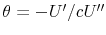 (Pratt, 1964), in this specification of utility may differ across individuals. It is assumed to be constant for all values of
permanent consumption for a given individual. The estimated model of risk tolerance in Section 4, which includes measures of income and wealth, is consistent with this assumption of constant relative risk aversion utility.
(Pratt, 1964), in this specification of utility may differ across individuals. It is assumed to be constant for all values of
permanent consumption for a given individual. The estimated model of risk tolerance in Section 4, which includes measures of income and wealth, is consistent with this assumption of constant relative risk aversion utility.
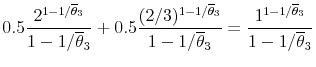
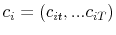
In this framework, the gamble responses define a range for an individual's risk tolerance  . Consider an individual, in gamble response category 3, who accepts the job with a
one-fifth downside risk and rejects the job with a one-third downside risk. These choices imply a coefficient of relative risk tolerance between 0.27 and 0.50, since
. Consider an individual, in gamble response category 3, who accepts the job with a
one-fifth downside risk and rejects the job with a one-third downside risk. These choices imply a coefficient of relative risk tolerance between 0.27 and 0.50, since
 |
 |
(3) |
 |
 . . |
(4) |
The highest downside risk accepted and the smallest risk rejected establish the upper and lower bounds on risk tolerance. The last two columns of Table 1 provides the range of risk tolerance for each of the gamble response categories.
3.2 Model of Measured Log Risk Tolerance
The statistical model of risk tolerance
 encompasses systematic changes in preferences and a persistent attitude toward risk, such that,
 |
 |
(5) |
where
 is the time-varying component and
  is the time-constant component
of the logarithm of risk tolerance. The logarithmic specification of risk tolerance captures the fact that most individuals exhibit a low tolerance of risks in the gambles, but some individuals are willing to take large income risks. The parameter
is the time-constant component
of the logarithm of risk tolerance. The logarithmic specification of risk tolerance captures the fact that most individuals exhibit a low tolerance of risks in the gambles, but some individuals are willing to take large income risks. The parameter  measures the percent change in risk tolerance associated with a change in the attributes
  .
.
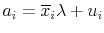
The time-constant component of risk tolerance may be correlated with the individual circumstances that can change risk tolerance. For example, the experience of a job displacement may reduce an individual's willingness to take further risks, that is,  . Or the event could primarily reveal an individual's risk tolerance type if more risk tolerant individuals tend to select career paths with a higher risk of displacement. To accommodate such selection effects, I model a relationship between the time-constant component
and observable attributes as
. Or the event could primarily reveal an individual's risk tolerance type if more risk tolerant individuals tend to select career paths with a higher risk of displacement. To accommodate such selection effects, I model a relationship between the time-constant component
and observable attributes as
where
 is the panel average of
 for individual
  and the type effect
  measures the persistent systematic differences across individuals in risk tolerance.9 The term
  captures the portion of constant risk tolerance that is unrelated to the attributes in
, a vector that includes a constant. This mean-zero residual is constant for a given individual over time and is independently distributed across individuals conditional on
observables, such that,
captures the portion of constant risk tolerance that is unrelated to the attributes in
, a vector that includes a constant. This mean-zero residual is constant for a given individual over time and is independently distributed across individuals conditional on
observables, such that,
 N
N . The model of the correlated random effects in equation
(6) follows from Mundlak (1978). Chamberlain (1984) summarizes this modeling strategy and presents a more general specification of the type effects.10
. The model of the correlated random effects in equation
(6) follows from Mundlak (1978). Chamberlain (1984) summarizes this modeling strategy and presents a more general specification of the type effects.10
The estimation strategy also recognizes the limitations of using a small set of hypothetical gamble responses to infer individual preferences. First, the gamble responses establish an interval, not a point estimate, for risk tolerance, so I do not have the data to simply estimate the linear model. Second, the income gamble questions likely generate substantial survey response error as is common with hypothetical and cognitively difficult questions. Nearly half of the individuals switch their gamble responses across waves -- one sign of random noise. Comments made by individuals during the survey also highlight difficulties respondents had in answering the hypothetical income gamble questions.11 Survey response errors can arise on the gambles when individuals misinterpret the hypothetical scenario or make computational mistakes in their comparison of the jobs.
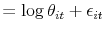
To incorporate these additional features of the data, I model the latent signal  from the individual's gamble responses as a combination of risk tolerance
and a survey response error
from the individual's gamble responses as a combination of risk tolerance
and a survey response error
 , such that
 |
 |
(7) |
 |
 , if , if |
(8) |
where
 is the gamble response category that is observed in the data. An individual in response category
  has a noisy signal of risk tolerance that lies in the interval
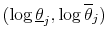 , where the cutoffs are the logarithm of the values in Table 1. The odds and outcomes are explicit in the gamble
questions, so with the assumption of constant relative risk aversion utility, the intervals of risk tolerance are known values and do not vary across individuals or across waves. The model of the latent signal incorporates two sources of variation in the gamble responses over time: systematic
changes in risk tolerance and survey response error. Earlier studies of the income gambles by Barsky et al. (1997) and Kimball et al. (Forthcoming) on the HRS also model the time variation in gamble responses due to response error. My analysis is the
first to investigate changes in risk tolerance that are both systematically associated with observed changes in circumstances and due to the random variation from response errors. For identification, I assign all the changes in the latent signal that are unrelated to these covariates to the survey
response error. This assumption likely understates any high frequency shifts in risk tolerance. My focus on the time-constant and systematic variation in preferences is consistent a well-defined measure of risk preference that would apply to other risky decisions made by the individual.
, where the cutoffs are the logarithm of the values in Table 1. The odds and outcomes are explicit in the gamble
questions, so with the assumption of constant relative risk aversion utility, the intervals of risk tolerance are known values and do not vary across individuals or across waves. The model of the latent signal incorporates two sources of variation in the gamble responses over time: systematic
changes in risk tolerance and survey response error. Earlier studies of the income gambles by Barsky et al. (1997) and Kimball et al. (Forthcoming) on the HRS also model the time variation in gamble responses due to response error. My analysis is the
first to investigate changes in risk tolerance that are both systematically associated with observed changes in circumstances and due to the random variation from response errors. For identification, I assign all the changes in the latent signal that are unrelated to these covariates to the survey
response error. This assumption likely understates any high frequency shifts in risk tolerance. My focus on the time-constant and systematic variation in preferences is consistent a well-defined measure of risk preference that would apply to other risky decisions made by the individual.
In modeling the survey response error, I also investigate the question framing effects and heteroscedasticity in the response error. The survey response error
has the form
 |
 |
(9) |
where
 is an indicator for a gamble response to the original ("new job") version of the question, so
  measures the degree of status quo bias in responses to the gamble question on the 1992 and 1994 HRS.12 The term
 is a survey response error that is unrelated to both the question type and other observables. It is independently distributed
N
is a survey response error that is unrelated to both the question type and other observables. It is independently distributed
N across individuals and over time. I allow the observed attributes in the model of risk tolerance and the question type to also affect the dispersion of the response
error. Specifically, the dispersion in response errors is
across individuals and over time. I allow the observed attributes in the model of risk tolerance and the question type to also affect the dispersion of the response
error. Specifically, the dispersion in response errors is
![\sigma_{eit}=\exp [(x_{it},\overline{x}_{i},q_{it})\sigma_{e}]](img56.gif) , where
, where
 is a parameter vector that relates individual attributes to the variation in response errors. Thus individuals with a particular attribute, such as less education, do not
systematically understate (or overstate) their risk tolerance in their gamble responses. The response errors in this group, however, may be larger in absolute value than the response errors from individuals with more education. The term soaks up changes in an individual's gamble responses that are not associated with the observed attributes, as well as the unsystematic transitory variation in the gamble responses across individuals. The heteroscedastic variance of permits the precision in the gamble responses -- or the degree of wave-to-wave switches -- to vary with individual attributes and question type. The gambles are complicated hypothetical questions
on a lengthy survey and answers to the gambles have no real consequences, so a careful treatment of the survey response error is essential to infer risk tolerance from the gamble responses.13
is a parameter vector that relates individual attributes to the variation in response errors. Thus individuals with a particular attribute, such as less education, do not
systematically understate (or overstate) their risk tolerance in their gamble responses. The response errors in this group, however, may be larger in absolute value than the response errors from individuals with more education. The term soaks up changes in an individual's gamble responses that are not associated with the observed attributes, as well as the unsystematic transitory variation in the gamble responses across individuals. The heteroscedastic variance of permits the precision in the gamble responses -- or the degree of wave-to-wave switches -- to vary with individual attributes and question type. The gambles are complicated hypothetical questions
on a lengthy survey and answers to the gambles have no real consequences, so a careful treatment of the survey response error is essential to infer risk tolerance from the gamble responses.13
Combining the models of risk tolerance and survey response error yields a reduced-form description of the latent signal in the gamble responses:
|
 |
(10) |
 |
(11) |
A restatement of the model draws particular attention to the variation in the preference signal within and between individuals. Specifically,
|
 |
(12) |
where the first term
 captures a change in risk tolerance for a given individual and the second term
 captures the differences in risk tolerance across individuals that are associated with observed attributes. The separate identification of the direct effect
and the type effect depends crucially on variation in over the panel period and variation in
across the individuals. For time-constant attributes, such as gender and race, or choices made before the survey period, such as years of education, I can only identify the
composite term of
captures the differences in risk tolerance across individuals that are associated with observed attributes. The separate identification of the direct effect
and the type effect depends crucially on variation in over the panel period and variation in
across the individuals. For time-constant attributes, such as gender and race, or choices made before the survey period, such as years of education, I can only identify the
composite term of
 , not the direct effect . In contrast, the type effect
of a covariate is not identified when its panel average
is the same for all individuals. For example, the gamble respondents all experienced the same macroeconomy of the 1990s, so any association between the average economic
outlook in the panel and the persistent component of risk tolerance is absorbed in the estimate of the constant.
, not the direct effect . In contrast, the type effect
of a covariate is not identified when its panel average
is the same for all individuals. For example, the gamble respondents all experienced the same macroeconomy of the 1990s, so any association between the average economic
outlook in the panel and the persistent component of risk tolerance is absorbed in the estimate of the constant.3.3 Log-Likelihood of Gamble Responses
I use maximum-likelihood methods to estimate the parameters
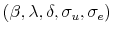 of the reduced-form model in equation (11) with the panel of income gamble responses and covariates. I compute the
probability of observing an individual's set of gamble responses over the survey period with a truncated normal distribution function, where the order of the function corresponds to the number of waves (up to five) in which an individual answers the income gambles. Consider, for example, an
individual who answers the gambles in only one wave of the HRS, but participates in multiple waves of the survey. The attributes that are observed with a response to version
of the income gambles and the average of these attributes across the entire panel
yield the following likelihood that the individual is in gamble response category at time
of the reduced-form model in equation (11) with the panel of income gamble responses and covariates. I compute the
probability of observing an individual's set of gamble responses over the survey period with a truncated normal distribution function, where the order of the function corresponds to the number of waves (up to five) in which an individual answers the income gambles. Consider, for example, an
individual who answers the gambles in only one wave of the HRS, but participates in multiple waves of the survey. The attributes that are observed with a response to version
of the income gambles and the average of these attributes across the entire panel
yield the following likelihood that the individual is in gamble response category at time  :
:
P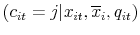 |
 P P |
|
 |
(13) |
where
 Var
Var and
and
 is the univariate normal cumulative distribution function. I adjust the likelihood function accordingly for the individuals who answer the gamble questions in multiple survey
waves.14 Since the lower bound
is the univariate normal cumulative distribution function. I adjust the likelihood function accordingly for the individuals who answer the gamble questions in multiple survey
waves.14 Since the lower bound
 and upper bound
 for the latent signal in each response category are known, the mean effects of , , and are identified separately from the
variance terms and are interpretable as if the latent signal were directly observed.15 Given the model of preferences, the estimate of is the percent change in risk tolerance for a given individual due
to a change in and is the percent difference in risk tolerance
across individuals due to a difference in
.
for the latent signal in each response category are known, the mean effects of , , and are identified separately from the
variance terms and are interpretable as if the latent signal were directly observed.15 Given the model of preferences, the estimate of is the percent change in risk tolerance for a given individual due
to a change in and is the percent difference in risk tolerance
across individuals due to a difference in
.
The maximum-likelihood estimator finds the values of the parameters that maximize the conditional log-likelihood
 of the sample:
 |
![\displaystyle = \sum_{i \in N} \sum_{j \in J} 1[c_{i}=j] \log](img79.gif) P P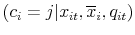 |
(14) |
where
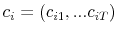 is the set of an individual's gamble responses on the HRS and
  contains all possible sets of response categories. For the estimator, I use the modified method of scoring, a Newton-Raphson algorithm in which the sample average of the outer product from the score function approximates the information matrix.16The estimates of the asymptotic standard errors are also derived from this estimator of the information matrix.
4 ESTIMATES OF RISK TOLERANCE
The results from the maximum-likelihood estimation reveal a low degree of risk tolerance on average, although there is considerable preference heterogeneity across individuals. The mean of relative risk aversion in the sample is 9.6 and its standard deviation is also 9.6.17 This implies that an average respondent would be willing to pay 28% of lifetime income to avoid a gamble with the 50-50 chance of doubling lifetime income or cutting it by one-third. It is possible that some feature in the framing, fielding, or modeling of the gambles may bias the estimated level of risk preference. Yet even with a persistent misstatement in the gamble responses, this panel of answers to the same question over a decade still provides valid information on the stability of individuals' preferences.
In this sample of older individuals, the gamble responses reveal few sources of systematic and long-lasting shifts in risk tolerance. I find a moderate decline in risk tolerance with age and a co-movement of individual risk tolerance and the macroeconomic conditions. But changes in the individual's total household income or wealth do not significantly alter an individual's willingness to take risk. In addition, a job displacement and diagnosis of a serious health condition, two personal events that plausibly reduce expected lifetime income, have little impact on risk tolerance. These results support the standard utility specification of constant relative risk aversion for within-person changes in consumption. I also find large stable differences across individuals in risk tolerance type that relate to commonly observed attributes. The estimated effects of time-constant observed attributes, such as gender and race, broadly conform to the results in earlier cross-sectional studies of risk attitudes. The panel structure of the HRS also reveals a relationship between individuals' earlier decisions, such as career choice, and their risk tolerance type. The rest of this section discusses the results from the maximum-likelihood estimation. The full model has 55 parameters, including direct effects, type effects, and error variance effects related to 20 observed attributes, so I have chosen to present the results in pieces. Appendix Table 9 contains the full set of covariates and estimates.
4.1 Household Income and Wealth
The outcomes in the hypothetical gambles are defined as fractions of "your current family income every year for life," so the changes in income that individuals experience over the panel of gamble responses provide the power to test the utility specification of constant relative risk aversion. The gamble responses reveal no discernible change in risk tolerance when an individual's current income or wealth deviates from its average level in the panel.18 The first column of Table 4 shows that a 10% increase in current income relative to the individual's average income is associated with only a 0.3% increase in risk tolerance. With a standard error of 0.3% the direct effect of a within-person change in income on risk tolerance is a precisely estimated zero effect. Likewise changes in an individual's current wealth have no discernible effect on risk tolerance. These results suggest that the assumption of constant relative risk aversion as consumption changes for a particular individual is justifiable.19
The gamble responses, however, do not imply that risk aversion is constant across individuals with different levels of consumption. There are modest and statistically significant differences in risk tolerance across individuals related to their level of average income and average wealth in the panel. A 10% higher level of average income is associated with a 0.9% higher relative risk tolerance - a pattern consistent with more risk tolerant individuals selecting higher risk, higher return sources of income. This effect is modest in size but is statistically different from zero at the 5% level. Similarly, individuals with greater indebtedness reveal a higher level of risk tolerance in their gamble responses, with a 10% more negative average wealth associated with a 0.5% higher relative risk tolerance. There is no discernible pattern in risk tolerance across individuals with different, positive levels of average wealth. This could result from a cancelling of two effects: less risk tolerant individuals accumulate precautionary saving and more risk tolerant individuals select riskier, higher return assets.
These results from the HRS are comparable to previous cross-sectional studies of hypothetical choice data that find an association between the willingness to take risk and the level of income and wealth, including Donkers et al. (2001) and Dohmen et al. (2006). With different survey questions and modelling approaches in their cross-section studies, their point estimates are not directly comparable to my results. In general, the association between risk preferences and income or wealth in all of these studies is consistently small relative to demographics, such as gender and age.20
The second column of Table 4 investigates the robustness of the baseline estimates of income and wealth effects. The question frame of a hypothetical job choice may impede non-workers from revealing their true preferences and obscure an effect of income or wealth on risk tolerance. This issue could be particularly severe in the HRS where one-third of the individuals are not working at the time of their gamble response and over 40% experience a change in their work status during the panel. The estimates in the second column of Table 4 demonstrate that the risk tolerance of working household heads is no more sensitive to changes in income or wealth than the risk tolerance of all respondents. The direct effects of income and wealth in this sub-sample are not substantially altered and remain statistically indistinguishable from zero at the 5% level. The positive association between the logarithm of average income and risk tolerance does increases to 0.14 from 0.09. The type effect of negative wealth decreases to 0.01 from 0.05 and is no longer distinguishable from zero.
4.2 Job Displacement and Health Condition
I also examine the association between risk tolerance and two major life events, a job displacement and a serious health condition, that likely affect an individual's expected lifetime income.21 The gambles on the HRS are defined over current lifetime income, so a shift in this reference point could alter an individual's attitude toward risk. For example, individuals may accept more income risk after a negative personal shock if that gamble could restore their original level of lifetime income. Or individuals who have received one draw of bad luck may simply be less willing to "spin the wheel" again.22 Rather than a change in risk tolerance, these events -- which do not occur purely at random -- could also signal an individual's risk tolerance type. For example, high risk tolerant types may have selected riskier career paths with a higher chance of displacement, so they comprise a large fraction of the workers who actually experience displacements. Or more risk tolerant individuals may have forgone preventative health care, and thus accepted a higher risk of a serious health condition. A panel of gamble responses and events is essential for separating these mechanisms.
In Table 5 both a job displacement and the onset of a health condition are associated with a decline in risk tolerance of 6% and 9% respectively. These direct effects are imprecisely estimated and not statistically different from zero at the 5% level.23 More striking is the evidence of selection into risky careers based on individual preferences. Among individuals with no prior job displacement at the time of their gamble response, those who will experience a displacement later in the panel are 19% more risk tolerant than those who will never experience a displacement. The estimate of the type effect is both economically and statistically significant, as it suggests that high risk tolerance types have systematically chosen riskier careers with a higher chance of displacement. The positive correlation between risk tolerance and income risk underscores the need for a direct measure of individual preferences. For example, studies of household wealth accumulation that do not address this systematic variation in preferences would underestimate the amount of precautionary savings.24 The estimated type effect of a serious health condition is only 2% and is not statistically different from zero at the 5% level.
I use the gamble responses that individuals provide before and after major life events to identify the impact of these events on risk tolerance. In an unbalanced panel, attrition could be systematically related to these events and thus to changes in risk tolerance. The second column of Table 5 presents the results from the model estimated with individuals who respond in all six waves of the HRS.25 The balanced panel produces similar estimates of the type effects, but different estimates of the direct effects. The estimated direct effects imply a larger declines in risk tolerance of 11% after a job displacement and of 15% after the onset of a health condition. The direct effect of a health condition is now statistically significant. The bottom panel of Table 5 shows that the estimated type effects in the unbalanced and balanced panels are similar. In the balanced panel, individuals who will experience a job displacement later in the panel are 20% more risk tolerant and those who will experience the onset of a health condition are 6% more risk tolerant than individuals who will not experience the event before the end of the panel. As in the unbalanced panel, the across-person difference in risk tolerance that is revealed by a job displacement is statistically significant.
4.3 Age, Cohort, and Time
The ten-year panel of gamble responses also provides a unique opportunity to examine systematic changes in risk tolerance with age and with changes in the macroeconomic conditions. Yet, even with multiple observations from the same individuals, I face the standard challenge of separating the effects of age, birth cohort and time.26 I model the time effects with a measure of macroeconomic conditions at the time of the gamble response. I use a linear specification for the age effects and indicator variables that span five to six birth years for the cohort effects. The first column of Table 6 presents the estimates of the model. I find that each year of age is associated with a 1.7% decline in an individual's risk tolerance. This implies almost a 20% decrease in risk tolerance over the survey period associated with aging.27 Individuals in the 1937-41 birth cohorts are also 16% more risk tolerant than individuals in the 1931-1936 cohorts. The effects of birth cohort are suggestive of individuals closer to the Great Depression being less willing to take risk. Finally there is a strong positive relationship between risk tolerance and macroeconomic conditions, as measured by the Index of Consumer Sentiment (ICS) in the month of the gamble response. A ten-point increase in the sentiment index is associated with a 9% increase in an risk tolerance. During the panel period, there are substantial movements in this measure of economic conditions which imply quantitatively important changes in average risk tolerance. For example, risk tolerance increased steadily by 36% from October 1992 to February 2000 and then decreased sharply by 15% from May 2002 to February 2003. The movements in risk tolerance over the business cycle are substantial in magnitude; however, they do not signal a permanent shift in an individual's risk tolerance. To explore the duration of the macroeconomic effects, the second column of Table 6 adds a measure of consumer sentiment at six months and one year prior to the gamble response. The strongest association of 0.006 (t-statistic of 2.2) is between current macroeconomic conditions and risk tolerance. The estimated effect declines to 0.004 (t-statistic of 1.6)and -0.001 (t-statistic of -0.4) for macroeconomic conditions at six months and one year prior to the gamble response respectively. These results suggest the effect of changes in the macroeconomic conditions on risk tolerance is short-lived.
The last two columns of Table 6 use an alternate specification of the year effects that includes indicator variables for the survey wave. In the third column, the model controls for the survey wave of a gamble response, but not for consumer sentiment.28 All of the year effects are economically and statistically significant. This alternate specification has only a modest impact on the point estimate for age and birth cohort. In the last column, the model includes both the indicators of the survey wave and the measure of consumer sentiment. Here the effect of macroeconomic conditions is identified entirely from within-wave variation. Nonetheless the estimate of 0.007 is only 17% lower than the estimate of 0.009 in the baseline model and is still statistically different from zero at the 5% level. In addition, the Index of Consumer Sentiment soaks up much the wave-to-wave differences in gamble responses. Only in the 1994 HRS do the gamble respondents remain significantly more risk tolerant than the gamble respondents in the 1992 HRS.29 Again the estimated effects of age and birth cohort are not altered by different specification of the time effects. The comparison of the results in Table 6 demonstrates that my parsimonious model of age, cohort, and time in the first column captures the systematic change in individuals' risk tolerance with age and macroeconomic conditions.
4.4 Individual Attributes
While there are modest changes in risk tolerance, 73% of the systematic variation in preferences is driven by the time-constant differences across individuals. The estimates in the first column of Table 7 reveal substantial differences in risk tolerance by gender, race, and years of education. The relative risk tolerance of men is 14% higher than of women -- a finding consistent with a vast literature on gender differences in risk taking; see Byrnes et al. (1999) for a meta-analysis of the studies in psychology. There is an even larger disparity in the willingness to take risk by race with blacks 28% less risk tolerant than whites. The income gambles on the HRS also reveal a strong positive association between education and risk tolerance, such that those with more than post-graduate education are 32% more risk tolerant than high school graduates. Other work that analyzes hypothetical risky choices and qualitative measures of risk taking on large-scale surveys, such as Dohmen et al. (2006) and Donkers et al. (2001), has found similar patterns for all three variables. My analysis is one of the few attempts to quantify these differences in terms of the coefficient of relative risk tolerance.30
Table 7 also provides the estimated effects of marital status on risk tolerance. Entering a marriage is associated with an 11% increase in risk tolerance, though the estimate is not statistically different from zero at the 5% level. Yet less risk tolerant individuals are more likely to be consistently married in the panel. All else equal, an individual who is married at each survey is 16% less risk tolerant than an individual who is never married and the selection effect is statistically significant.31 Again this pattern is consistent with a stable attitude toward risk that influences actual behavior.
Finally there is a strong relationship between the measures of risk tolerance and probabilistic thinking skills in the HRS. Individuals who provide more precise answers to the subjective probability questions in the survey are also willing to take more risk on the hypothetical income gambles and exhibit less random variation in their gamble responses across survey waves. In my model of risk tolerance, I use the measure of probability precision developed by Lillard and Willis (2001), that is, the fraction of the subjective probability questions to which the individual provides an exact answer (not 0, 50, 100). There are roughly 20 such questions in each survey wave that cover future personal and general events. On average respondents only give exact answers to about 40% of the probability questions. Lillard and Willis (2001) use a model of uncertainty aversion to argue that individuals with less precise probability beliefs should be less willing to take risk.32 The results in Table 7 are consistent with their hypothesis, such that a one-standard deviation higher average FEP is associated with a 20% higher level of risk tolerance.33 An increase in current FEP relative to the individual's panel average FEP is also associated with a substantial increase in risk tolerance.
This paper focuses on within-person changes and across-person differences in risk tolerance that are systematically related to other observed attributes. Yet, the gamble responses also imply a large amount of residual variation. The model of risk tolerance allows for an individual-specific, time-constant component of risk tolerance that is uncorrelated with the observables. In Table 7 the estimated standard deviation of this random individual effect is 0.72 which is large both in absolute terms and relative to the other estimated mean effects. As a comparison, the standard deviation of log risk tolerance that is systematically associated with the rich set of covariates is 0.41. There is even more transitory variation in the gamble responses that is unrelated to the observables. The estimated standard deviation of the response errors is 1.55 and is more than twice the standard deviation of the individual effect. The magnitude of these residuals highlights the scope for further investigation of time-constant survey response errors and transitory preference shocks.
As the first two columns of Table 7 reveal, the modelling of the response error variance affects the estimates of risk tolerance. The baseline model in the first column allows the estimated standard deviation of the transitory response errors to vary with the model covariates. The model in the second column instead imposes homoscedasticity. While the qualitative patterns in risk tolerance are largely the same, in many cases, the point estimates on the direct and type effects differ substantial across the two models of response error variance. For example, the standard deviation of men's response error is 12% larger than women's response error, so in the homoscedastic model, the estimated difference in risk tolerance by gender increases to 22% from 14% in the heteroscedastic model.34 These shifts in the point estimates also reflect the nonlinearity of the maximum-likelihood model.
4.5 Measure of Individual Risk Tolerance
The model estimates can also be used to form a proxy for an individual's risk tolerance at a particular point in time. Specifically, I calculate the expected value of log risk tolerance conditional on the individual's observed attributes and
and gamble responses  in the panel, such that,
E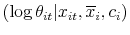 |
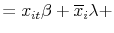 E E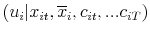 . . |
(15) |
The mean of the random effect
conditional on attributes
is zero, yet an individual's set of gamble responses
 does provide some information on the expected level of this component.35
The decomposition of the preference measure into permanent and transitory components is again useful with
| E |
 E E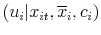 |
(16) |
where the first term on the right is a transitory component related to changes in the observed attributes of an individual, the second term is a permanent component related to differences across individuals in their observed attributes, and the third term is a permanent component related only to the difference across individuals in their gamble responses. The variance of the systematic within-person changes in risk tolerance (the first term) accounts for only 11% of the total variance in the individual measure of risk tolerance, whereas the variance of the systematic across-person differences (the second term) accounts for 45% of the total variance. Both changes in risk tolerance over time and differences in risk tolerance across individuals contribute to the systematic heterogeneity in measured preferences, though the stable differences across individuals are empirically more important. A substantial portion of the between-person variation in the risk tolerance proxy is not related to the observables in the model.
5 STOCK OWNERSHIP
The primary reason to study preferences is to better understand behavior, so in this section I use the individual measure of risk tolerance from the gamble responses to analyze the considerable differences in stock ownership across households over the 1990s. As economic theory predicts, there is a strong positive association between the measure of risk tolerance and the holding of risky financial assets. A transitory increase in risk tolerance, as well as a persistently higher level of risk tolerance both raise the marginal probability of actual stock ownership. The measure of risk tolerance also refines the common inference on other determinants of stock ownership, including the effects of gender, education, and wealth. Finally this analysis of stock ownership highlights the usefulness and validity of the risk tolerance proxy.
To study stock ownership, I follow the financial respondents from the original HRS households over the first six waves from 1992 to 2002. The financial respondent is the individual who is most knowledgeable about the finances of the household and who reports on the income and wealth in the survey. In my analysis of stock ownership, I exclude financial respondents who are in households with no financial assets, negative net worth, or no income at any of the six survey waves. This yields a balanced panel of 2,464 financial respondents with 14,784 household-wave observations.36 In the pooled sample, 46% of the financial respondents own stocks directly.37 The cross-sectional rate of stock ownership varies in the panel period. Stock ownership increases from 41% of households in the 1992 HRS to 47% of households in the 2000 HRS and then decreases slightly to 45% in the 2002 HRS. Following the same respondents over the panel, 28% never hold stocks, 20% always hold stocks, and 52% change ownership status at least once.
The first column of Table 8 presents the estimated marginal effects on the probability of owning stocks for a subset of the model covariates.38 The results in the first column are similar to the results in numerous studies of household portfolios, for examples, see Guiso et al. (2002). Men are 3 percentage points more likely to own stocks than women, though the effect is not precisely estimated. Higher levels of education and wealth are particularly strong predictors of stock ownership. College graduates are 19 percentage points more likely to own stocks than high school graduates. A 10% higher average wealth across individuals is associated with a 2.9 percentage point higher probability of stock ownership, and a 10% increase in wealth for a particular individual increases the probability of stock ownership by 1.4 percentage points.
The results in the second column of Table 8 show how a direct measure of risk tolerance refines the inferences on stock ownership. This model adds two measures of individual's risk tolerance: the average of log risk tolerance across the six survey waves and the deviation between current log risk tolerance and the panel average level. As economic theory predicts, both measures of risk tolerance are positively associated with stock ownership.39 A 10% higher level of average risk tolerance across individuals is associated with a 1.0 percentage point higher probability of stock ownership. And a 10% increase in an individual's risk tolerance raises the probability of stock ownership by 0.9 percentage points. Both of these effects are statistically and economically significant.40The model of risk tolerance estimated in Section 4 reveals considerable heterogeneity, so a one-standard difference in risk tolerance corresponds to a 8.2 percentage point difference in the predicted probability of stock ownership -- almost one-fifth of the actual ownership rate.
The measure of risk tolerance also refines the association between stock ownership and the other covariates. For example, the variation in risk tolerance absorbs much of the higher probability of stock ownership among men that is estimated in the first model. Likewise the effect of education on stock ownership is partially reduced when the model includes a measure of risk tolerance. Specifically, the estimated marginal effects of a college education and post-graduate education drop by 17% and 35% respectively. These results suggest that differences in risk preference can account for some of the commonly observed association between education and stock ownership. In contrast, Table 8 shows that the marginal effect of wealth on stock ownership is unrelated to differences in risk preference. Alternate explanations, such as transaction costs, are needed to explain the strong association between wealth and stock ownership, since there is no evidence of decreasing relative risk aversion. A direct measure of risk tolerance provides an opportunity to explore the mechanisms behind the large differences in stock ownership across households and over time. The strong association between the measure of risk tolerance and actual stock ownership also demonstrates that the hypothetical gambles capture meaningful differences in preferences.
6 CONCLUSION
Risk tolerance differs systematically both across individuals and over time. Most of these differences stem from characteristics, such as gender and ethnicity, that are constant over time for a particular individual; however, there are some sources of systematic change in an individual's risk tolerance, such as aging and changes in macroeconomic conditions. Other changes in individual circumstances, including the loss of a job or the end of a marriage, reveal information about individuals' risk tolerance type, not a change in their willingness to take risk.
The fact that risk tolerance differs greatly across individuals but is relatively stable for a particular individual has important consequences for studying risky behavior. The large differences in risk preference across individuals underscore the need for a direct measure of these differences. The relative stability of preferences and the correspondence between this survey measure of risk tolerance and actual risky behavior support our ability to measure risk preference at the individual level. Yet, the apparent noisiness of the hypothetical gamble responses needs to be further explored with higher frequency data and other survey questions, since the "survey response error" may be absorbing short-lived, but behaviorally important preference shocks. In addition, the gamble responses from individuals ages 45 to 70 in the HRS provide little insight on the formation of preferences, in particular on the direction of causality in the positive association between education and risk tolerance. The estimation techniques in this paper could be applied directly to this interesting question if the gambles were asked to the same individuals at different points in their education. Among individuals in their formative years, the systematic time-variation in risk preference is likely to be larger than among the older individuals in the HRS. Nonetheless, the results of this paper make clear that economic studies of behavior need to take into account the stable component of risk preference that differs systematically across individuals.
Bibliography
| Response Category | Downside Risk of Risky Job: Accepted | Downside Risk of Risky Job: Rejected | Bounds on Risk Tolerance: Lower | Bounds on Risk Tolerance: Upper |
|---|---|---|---|---|
| 1 | None | 1/10 | 0 | 0.13 |
| 2 | 1/10 | 1/5 | 0.13 | 0.27 |
| 3 | 1/5 | 1/3 | 0.27 | 0.50 |
| 4 | 1/3 | 1/2 | 0.50 | 1.00 |
| 5 | 1/2 | 3/4 | 1.00 | 3.27 |
| 6 | 3/4 | None | 3.27 |  |
| Response | 1992 | 1994 | 1998 | 2000 | 2002 |
|---|---|---|---|---|---|
| 1 | 64.7 | 44.4 | 39.5 | 45.0 | 43.2 |
| 2 | 64.7 | 17.2 | 18.7 | 19.4 | 18.8 |
| 3 | 11.9 | 13.8 | 16.2 | 14.6 | 15.6 |
| 4 | 10.9 | 15.0 | 9.4 | 8.6 | 9.9 |
| 5 | 12.5 | 5.9 | 9.1 | 6.8 | 6.5 |
| 6 | 12.5 | 3.7 | 7.1 | 5.6 | 6.0 |
| Responses | 9,647 | 594 | 2,502 | 943 | 4,939 |
| Percent | 1992-2002 |
|---|---|
| Male | 42.9 |
| Black | 14.7 |
| Hispanic | 7.5 |
| High School Drop Out | 22.0 |
| H.S. Grad / Some College | 57.2 |
| College / Post Graduate | 20.8 |
| Job Displacement: Prior to Response | 24.7 |
| Job Displacement: After Response | 12.9 |
| Health Condition: Prior to Response | 22.0 |
| Health Condition: After Response | 16.8 |
| Married: Current Status | 78.9 |
| Married: Change in Panel | 13.5 |
| Age (Mean) | 56.9 |
| Age (Std. Dev.) | (4.5) |
| Fraction Exact Probability: Individual Panel Average | 0.41 |
| Fraction Exact Probability: Individual Panel (Std. Dev.) | (0.18) |
| Fraction Exact Probability: Current - Panel Average | 0.04 |
| Fraction Exact Probability: Current - Panel (Std. Dev.) | (0.16) |
| Log of Income: Individual Panel Average | 10.9 |
| Log of Income: Individual Panel (Std. Dev.) | (0.8) |
| Log of Income: Current - Panel Average | -0.04 |
| Log of Income: Current - Panel (Std. Dev.) | (0.47) |
| Log of Wealth (Positive): Individual Panel Average | 11.5 |
| Log of Wealth (Positive): Individual Panel (Std. Dev.) | (2.5) |
| Log of Wealth (Positive): Current - Panel Average | -0.15 |
| Log of Wealth (Positive): Current - Panel (Std. Dev.) | (0.75) |
| Responses | 18,625 |
| Parameter | All Gamble Respondents | Working Household Heads |
|---|---|---|
| Direct Effect: , Log of Current Income |
0.03 | 0.03 |
| Direct Effect: , Log of Current Income (Std. Dev.) |
(0.03) | (0.06) |
| Direct Effect: , Log of Positive Current Wealth |
0.01 | -0.03 |
| Direct Effect: , Log of Positive Current Wealth (Std. Dev.) |
(0.02) | (0.03) |
Direct Effect: , Log of  Negative Current Wealth Negative Current Wealth
|
0.03 | 0.01 |
| Direct Effect: , Log of Negative Current Wealth
(Std. Dev.) |
(0.02) | (0.03) |
Direct and Type Effects:
 , Log of Average Income , Log of Average Income |
0.09 | 0.14 |
| Direct and Type Effects:
, Log of Average Income (Std. Dev.) |
(0.03) | (0.06) |
| Direct and Type Effects:
, Log of Positive Average Wealth |
0.003 | -0.02 |
| Direct and Type Effects:
, Log of Positive Average Wealth (Std. Dev.) |
(0.014) | (0.02) |
| Direct and Type Effects:
, Log of Negative Average Wealth |
0.05 | 0.01 |
| Direct and Type Effects:
, Log of Negative Average Wealth (Std. Dev.) |
(0.03) | (0.04) |
| Log-likelihood | -23573.5 | -10022.8 |
| Number of Respondents | 12,003 | 5,692 |
| Parameter | All Gamble Respondents | Balanced Panel of HRS |
|---|---|---|
| Direct Effect: , Previous Job Displacement |
-0.06 | -0.11 |
| Direct Effect: , Previous Job Displacement (Std. Dev.) |
(0.07) | (0.08) |
| Direct Effect: , Previous Health Condition |
-0.09 | -0.15 |
| Direct Effect: , Previous Health Condition (Std. Dev.) |
(0.06) | (0.07) |
| Type Effect: , Ever Job Displacement |
0.19 | 0.20 |
| Type Effect: , Ever Job Displacement (Std. Dev.) |
(0.06) | (0.07) |
| Type Effect: , Ever Health Condition |
0.02 | 0.06 |
| Type Effect: , Ever Health Condition (Std. Dev.) |
(0.06) | (0.07) |
| Log-likelihood | -23573.5 | -13426.4 |
| Number of Respondents | 12,003 | 6,591 |
| Parameter | Alternate Specification of Time Effect (1) | Alternate Specification of Time Effect (2) | Alternate Specification of Time Effect (3) | Alternate Specification of Time Effect (4) |
|---|---|---|---|---|
| Age | -0.017 | -0.16 | -0.021 | -0.021 |
| Age (standard error) | 0.008 | (0.09) | 0.010 | 0.010 |
| Age (standard error) continued | (0.00) | |||
| 1937-1941 Cohorts | 0.16 | 0.17 | 0.14 | 0.14 |
| 1937-1941 Cohorts (standard error) | (0.06) | (0.07) | (0.07) | (0.07) |
| 1942-1947 Cohorts (standard error) continued | 0.16 | 0.16 | 0.10 | 0.10 |
| 1942-1947 Cohort | (0.10) | (0.11) | (0.12) | (0.12) |
| 1942-1947 Cohort (standard error) | (0.00) | |||
| Consumer Sentiment | 0.009 | 0.006 | 0.007 | |
| Consumer Sentiment(standard error) | (0.002) | (0.003) | (0.004) | |
| ICS Six Months Ago | 0.004 | |||
| ICS Six Months Ago (standard error) | (0.003) | |||
| ICS One Year Ago | -0.001 | |||
| ICS One Year Ago (standard error) | (0.003) | |||
| 1994 HRS | 0.27 | 0.19 | ||
| 1994 HRS (standard error) | (0.08) | (0.09) | ||
| 1998 HRS | 0.37 | 0.19 | ||
| 1998 HRS (standard error) | (0.08) | (0.11) | ||
| 2000 HRS | 0.32 | 0.12 | ||
| 2000 HRS (standard error) | (0.11) | (0.14) | ||
| 2002 HRS | 0.24 | 0.17 | ||
| 2002 HRS (standard error) | (0.11) | (0.11) | ||
| 2002 HRS (standard error) continued | ||||
| 1992/1994 Version | -0.08 | -0.05 | ||
| 1992/1994 Version (standard error) | (0.09) | (0.12) | ||
| Log-likelihood | -23573.5 | -23571.5 | -23571.2 | -23569.0 |
| Parameters | 55 | 59 | 59 | 61 |
| Parameter | Model Allows for Heteroscedastic Errors: Yes | Model Allows for Heteroscedastic Errors: No |
|---|---|---|
| Direct and Type Effects:
, Male |
0.14 | 0.22 |
| Direct and Type Effects:
, Male (standard error) |
(0.04) | (0.03) |
| Direct and Type Effects:
, Black |
-0.28 | -0.12 |
| Direct and Type Effects:
, Black (standard error) |
(0.06) | (0.05) |
| Direct and Type Effects:
, Hispanic |
-0.03 | 0.05 |
| Direct and Type Effects:
, Hispanic (standard error) |
(0.08) | (0.06) |
| Direct and Type Effects:
, High School Drop Out |
0.02 | 0.09 |
| Direct and Type Effects:
, High School Drop Out (standard error) |
(0.06) | (0.04) |
| Direct and Type Effects:
, Some College |
0.17 | 0.19 |
| Direct and Type Effects:
, Some College (standard error) |
(0.05) | (0.04) |
| Direct and Type Effects:
, College Graduate |
0.22 | 0.25 |
| Direct and Type Effects:
, College Graduate (standard error) |
(0.06) | (0.06) |
| Direct and Type Effects:
, Post Graduate |
0.32 | 0.40 |
| Direct and Type Effects:
, Post Graduate (standard error) |
(0.06) | (0.06) |
| Direct Effect: , Currently Married |
0.11 | 0.10 |
| Direct Effect: , Currently Married (standard error) |
(0.09) | (0.08) |
| Direct Effect: , Fraction Exact Probability |
0.82 | 0.52 |
| Direct Effect: , Fraction Exact Probability (standard error) |
(0.10) | (0.09) |
| Type Effect: , Proportion of Years Married |
-0.27 | -0.23 |
| Type Effect: , Proportion of Years Married (standard error) |
(0.10) | (0.09) |
| Type Effect: , Average FEP Across Waves |
0.27 | -0.05 |
| Type Effect: , Average FEP Across Waves (standard error) |
(0.14) | (0.12) |
Std. Dev. of Individual Effect :
 , , |
0.72 | 0.77 |
| Std. Dev. of Individual Effect :
(standard error) |
(0.03) | (0.03) |
| Std. Dev. of Response Error:
, |
1.55 | 1.50 |
| Std. Dev. of Response Error:
(standard error) |
(0.01) | (0.02) |
| Log-likelihood | -23573.5 | -23801.3 |
| Parameters | 55 | 29 |
| Parameter | Marginal Effect on Probability (1) | Marginal Effect on Probability (2) |
|---|---|---|
| Log Risk Tolerance Individual Panel Average | 0.10 | |
| Log Risk Tolerance: Individual Panel Average (standard error) | (0.03) | |
| Log Risk Tolerance: Current - Panel Average | 0.09 | |
| Log Risk Tolerance: Current - Panel Averag (standard error) | (0.04) | |
| Male | 0.03 | 0.01 |
| Male (standard error) | (0.03) | (0.03) |
| High School Drop Out | -0.15 | -0.15 |
| High School Drop Out (standard error) | (0.03) | (0.03) |
| Some College | 0.06 | 0.04 |
| Some College (standard error) | (0.03) | (0.03) |
| College Graduate | 0.19 | 0.16 |
| College Graduate (standard error) | (0.04) | (0.04) |
| Post Graduate | 0.11 | 0.07 |
| Post Graduate (standard error) | (0.04) | (0.04) |
| Log of Current Wealth | 0.14 | 0.15 |
| Log of Current Wealth (standard error) | (0.01) | (0.01) |
| Log of Average Wealth | 0.15 | 0.16 |
| Log of Average Wealth (standard error) | (0.02) | (0.02) |
| Predicted Probability | 0.31 | 0.34 |
| Log-Likelihood | -6904.94 | -6897.3 |
| Variable | Mean Effect: Direct | Mean Effect: Type | Mean Effect: Composite | Std. Dev.: Effect |
|---|---|---|---|---|
| Constant | -3.30 | 1.46 | ||
| Constant (standard error) | (0.74) | (0.49) | ||
| Male | 0.14 | 0.12 | ||
| Male (standard error) | (0.04) | (0.02) | ||
| Black | -0.28 | 0.18 | ||
| Black (standard error) | (0.06) | (0.03) | ||
| Hispanic | -0.03 | 0.10 | ||
| Hispanic (standard error) | -(0.03) | (0.05) | ||
| 1937-1941 Cohorts | 0.16 | 0.003 | ||
| 1937-1941 Cohorts (standard error) | (0.06) | (0.04) | ||
| 1942-1947 Cohorts | 0.16 | 0.03 | ||
| 1942-1947 Cohorts (standard error) | (0.10) | (0.07) | ||
| High School Drop Out | 0.02 | 0.09 | ||
| High School Drop Out (standard error) | (0.06) | (0.03) | ||
| Some College | 0.17 | 0.03 | ||
| Some College (standard error) | (0.05) | (0.03) | ||
| College Graduate | 0.22 | -0.01 | ||
| College Graduate (standard error) | (0.06) | (0.04) | ||
| Post Graduate | 0.32 | 0.03 | ||
| Post Graduate (standard error) | (0.06) | (0.04) | ||
| Index Consumer Sentiment / 10 | 0.09 | -0.04 | ||
| Index Consumer Sentiment / 10 (standard error) | (0.02) | (0.02) | ||
| Current Age / 10 | -0.17 | 0.02 | ||
| Current Age / 10 (standard error) | (0.08) | (0.05) | ||
| Currently Married | 0.11 | -0.07 | ||
| Currently Married (standard error) | (0.09) | (0.06) | ||
| Fraction Exact Probability | 0.82 | -0.42 | ||
| Fraction Exact Probability (standard error) | (0.10) | (0.07) | ||
| Previous Job Displacement | -0.06 | 0.01 | ||
| Previous Job Displacement (standard error) | (0.07) | (0.05) | ||
| Previous Health Condition | -0.09 | -0.05 | ||
| Previous Health Condition (standard error) | (0.06) | (0.05) | ||
| Log (Current Income) / 10 | 0.29 | 0.14 | ||
| Log (Current Income) / 10 (standard error) | (0.34) | (0.25) | ||
Log (Current  Wealth) / 10 Wealth) / 10 |
0.10 | -0.22 | ||
| Log (Current Wealth) / 10 (standard error) |
(0.17) | (0.11) | ||
| Log ( Current - Wealth ) / 10 |
0.35 | -0.10 | ||
| Log ( Current - Wealth ) / 10 (standard error) |
(0.21) | (0.13) | ||
| Proportion of Years Married | -0.27 | -0.05 | ||
| Proportion of Years Married (standard error) | (0.10) | (0.07) | ||
| Panel Average FEP | 0.27 | -0.57 | ||
| Panel Average FEP (standard error) | (0.14) | (0.09) | ||
| Ever Job Displacement | 0.19 | 0.02 | ||
| Ever Job Displacement (standard error) | (0.06) | (0.05) | ||
| Ever Health Condition | 0.02 | 0.02 | ||
| Ever Health Condition (standard error) | (0.06) | (0.04) | ||
| Log (Average Income) / 10 | 0.60 | 0.68 | ||
| Log (Average Income) / 10 (standard error) | (0.45) | (0.30) | ||
| Log (Average Wealth) / 10 |
-0.07 | 0.31 | ||
| Log (Average Wealth) / 10 (standard error) |
(0.22) | (0.14) | ||
| Log ( Average - Wealth ) / 10 |
0.15 | 0.51 | ||
| Log ( Average - Wealth ) / 10 (standard error) |
(0.30) | (0.18) | ||
| "New Job" Version | -0.08 | -0.07 | ||
| "New Job" Version (standard error) | (0.09) | (0.06) | ||
![\sigma_{eit}=\exp[(x_{it}% ,\overline{x}_{i},q_{it})\sigma_{e}]](img98.gif) where
is the parameter vector of the standard deviation effects. The gambles in the 1992 and 1994 HRS ask about a new job, whereas the wording in the later waves removes the status quo
bias. See the notes on Table 4-7 and text for details on the variables.
where
is the parameter vector of the standard deviation effects. The gambles in the 1992 and 1994 HRS ask about a new job, whereas the wording in the later waves removes the status quo
bias. See the notes on Table 4-7 and text for details on the variables.
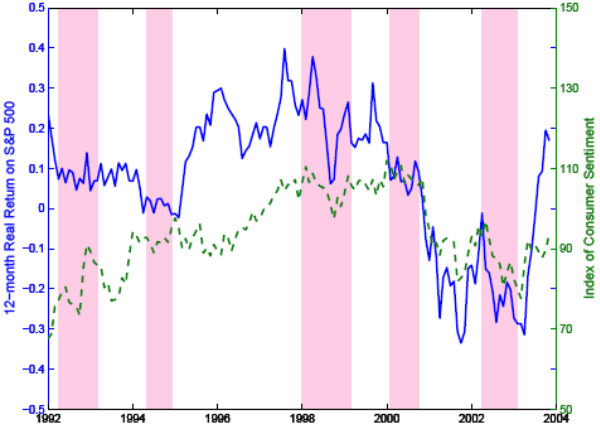
NOTE: The solid line is the total annual return from the S&P 500 Total Return Index (including dividends) over the previous 12 months. The monthly value of the S&P 500 Index is the closing value on the last business day of the month. The index from Global Financial Data is
adjusted for dividends and splits. The CPI-U removes general price inflation from the return. The dashed line is the current monthly value of the Index of Consumer Sentiment from the University of Michigan Survey of Consumers. The shaded areas denote months in which the HRS fielded the income
gambles. These interview months for the five waves are 4/1992 to 3/1993, 5/1994 to 12/1994, 1/1998 to 3/1999, 2/2000 to 11/2000, and 4/2002 to 2/2003.
|
Footnotes
 , where
  is the current total household income and
  is 5% of total household net worth (or an approximate annuity income value of wealth). The estimated weight on wealth
  is 0.019 and is not statistically different from zero at the 5% level. Annuitization based on a life table and the respondent's age has no qualitative effect on the estimated weight. Thus the simplifying assumption of approximating consumption with income is
appropriate when interpreting the gamble responses. Return to Text
is 0.019 and is not statistically different from zero at the 5% level. Annuitization based on a life table and the respondent's age has no qualitative effect on the estimated weight. Thus the simplifying assumption of approximating consumption with income is
appropriate when interpreting the gamble responses. Return to Text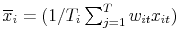 , where
  is the
number of survey waves for individual and
is the
number of survey waves for individual and  is an indicator for
participation in wave . I include information on an individual's circumstances from the first six waves of the HRS, not just the waves in which an individual answers the income gambles. To
make the estimated effects of an event easier to interpret, I define as an event prior to time and
as an event before the end of the panel. Return to Text, not just the panel average, which yields estimates of the type effects that can vary over time or
is an indicator for
participation in wave . I include information on an individual's circumstances from the first six waves of the HRS, not just the waves in which an individual answers the income gambles. To
make the estimated effects of an event easier to interpret, I define as an event prior to time and
as an event before the end of the panel. Return to Text, not just the panel average, which yields estimates of the type effects that can vary over time or
 . One limitation of the general specification is the need for a balanced panel of the observables . This restriction would have reduced my sample of gamble respondents by 46%, so I use the more parsimonious form of the correlated random effects with the panel average of observables. Return to Text. For covariates that systematically affect both preferences and response errors, it would not be possible to separately estimate and . Return to Text is constant over time, such that the
Cov
. One limitation of the general specification is the need for a balanced panel of the observables . This restriction would have reduced my sample of gamble respondents by 46%, so I use the more parsimonious form of the correlated random effects with the panel average of observables. Return to Text. For covariates that systematically affect both preferences and response errors, it would not be possible to separately estimate and . Return to Text is constant over time, such that the
Cov for
for  . To simplify the computation of the higher order probabilities, I integrate the product of the univariate densities conditional on over the distribution of
. See Cameron and Trivedi (2005) for a further discussion of this standard method. For the integration, I use Matlab codes for Gaussian quadrature from Miranda and
Fackler (2002). I use correlated random effects for the probit model of gamble responses, since there is no consistent fixed-effects estimator, see Chamberlain (1984) for a discussion. Return to Text and
requires that at least some individuals respond to the gambles in more than one wave. Return to Text
. To simplify the computation of the higher order probabilities, I integrate the product of the univariate densities conditional on over the distribution of
. See Cameron and Trivedi (2005) for a further discussion of this standard method. For the integration, I use Matlab codes for Gaussian quadrature from Miranda and
Fackler (2002). I use correlated random effects for the probit model of gamble responses, since there is no consistent fixed-effects estimator, see Chamberlain (1984) for a discussion. Return to Text and
requires that at least some individuals respond to the gambles in more than one wave. Return to Text year - birth year, so the separation of the effects requires further assumptions. See Hall et al. (2005) for a discussion of various identification strategies and other references. Sample attrition that is related to an individual's risk
tolerance, such as engaging in risky health behaviors that raise the chance of death, could also bias the estimates. Return to Text
year - birth year, so the separation of the effects requires further assumptions. See Hall et al. (2005) for a discussion of various identification strategies and other references. Sample attrition that is related to an individual's risk
tolerance, such as engaging in risky health behaviors that raise the chance of death, could also bias the estimates. Return to Text zdi and Willis (2006) also establish a positive association between actual stock ownership and more precise
probability beliefs. The statistical model of risk tolerance that I estimate is observationally equivalent to uncertainty aversion model of Lillard and Willis (2001), but I do not explicitly test their mechanism. Return to Text
zdi and Willis (2006) also establish a positive association between actual stock ownership and more precise
probability beliefs. The statistical model of risk tolerance that I estimate is observationally equivalent to uncertainty aversion model of Lillard and Willis (2001), but I do not explicitly test their mechanism. Return to Text is much smaller than its unconditional variance. See Kimball et al. (Forthcoming) for a further discussion of how this diminished variability impacts the
use of a proxy based on the conditional expectation. Return to Text
is much smaller than its unconditional variance. See Kimball et al. (Forthcoming) for a further discussion of how this diminished variability impacts the
use of a proxy based on the conditional expectation. Return to Text