
Firm Dynamics with Infrequent Adjustment and Learning
Keywords: Adjustment costs, learning, young firms
Abstract:
JEL Classification: E24, L11, L16
1 Introduction
In recent years there has been renewed interest in explaining patterns of firm dynamics, with new longitudinal datasets confirming heterogeneities between firms of different size and age. In particular, small and young (surviving) firms tend to grow faster and have higher failure rates than large and old firms, so that job destruction due to plant exit and job creation due to the scaling-up of firm size decrease with age.2 Moreover, entering plants tend to be small, but survivors grow rapidly after entry and are the main factor behind the shift to the right of a cohort's size distribution.3 These patterns differ significantly across countries and sectors, suggesting that technological differences are important, but that country specific factors also matter.4
This paper proposes an explanation for the leading role of survivors' growth in post-entry firm dynamics based on the interaction between adjustment costs and a learning-about-efficiency mechanism. Following a literature that uses adjustment costs to account for some dynamic properties of firms' labor demand, such as Campbell and Fisher (2000), we show that adjustment costs can impact the lifetime dynamics of firms' labor demand in a way consistent with the data. To implement our theory, we use a standard model of firm dynamics with passive learning. In order to check the empirical fit of our model, we also assume that inefficient firms are pruned from the market, although the predictions of our theory hold even in the absence of a selection mechanism (e.g. when exit is not allowed).
Our contribution is twofold. First, we contribute to the empirical literature by introducing a decomposition of the change in a cohort's average size into a survivor component and a non-survivor component. Given the emphasis on survivors' growth, our measure allows a quick assessment of how well a particular theory matches the data in that respect. We apply our decomposition to the 1988 cohort of entrants in the Portuguese economy, using the Quadros de Pessoal dataset. Similarly to Cabral and Mata (2003), we find that growth of survivors is the main force behind the change in the cohort's average firm size. However, we also find that growth of survivors is especially intense in the initial years after entry and that there are significant cross-sector differences in terms of our decomposition. In particular, initial exit rates are smaller and the survivors' contribution to changes in size is higher in manufacturing than in services.
Second, we contribute to the theoretical literature by introducing linear adjustment costs into a model of Bayesian learning about efficiency. Our assumption of linear or proportional costs is justified by the finding of high inaction rates in employment adjustment, in varying degrees across sectors. Our model builds on Jovanovic (1982) by adding proportional costs that apply not only to regular labor adjustment, but also to job creation at entry and job destruction at exit. We show that proportional adjustment costs create incentives for firms to start smaller and, if successful, grow faster after entry. We prove this analytically in a simplified model in which there is no exit of firms. This result shows that proportional costs can generate firm growth without selection. When firms are allowed to exit, selection intensifies the effects of adjustment costs on firm growth, while costs to adjustment reduce exit rates. Therefore, adjustment costs increase the contribution of surviving firms to growth in the cohort's average size.
All that is needed for firm growth under linear adjustment costs is the existence of a learning environment that generates a stochastic process for perceived efficiency with both persistence and decreasing uncertainty in age.5 The intuition for why firms grow faster and display smaller exit rates under proportional adjustment costs is that initial uncertainty about true profitability makes entering firms prudent; that is, they enter small and "wait and see" since they want to avoid incurring superfluous entering/hiring costs and firing/shutdown costs on jobs that prove to be excessive ex post. This implies that surviving firms will grow faster, even though adjustment costs imply that there are fewer firms exiting the market and therefore less pruning of inefficient firms.
The assumption that entering firms face a Bayesian learning problem concerning their efficiency is standard in selection theories and has been advanced as an explanation for the high rates of exit, job creation, and job destruction among young firms. The initial literature on adjustment costs used a (strictly) convex specification in an attempt to explain the sluggishness in input responses to aggregate shocks. However, the assumption that costs of adjustment are linear is now standard in dynamic labor demand models, following a number of studies since the late 1980s that have documented the importance of inaction in employment adjustment at the micro level.6 Since strictly convex costs imply smooth adjustments over time, whereas linear costs imply immediate adjustment when it occurs, allowing for strictly convex costs, instead of linear costs, in the context where they also apply at entry and exit, would bias our analysis and eventually make our argument stronger. In the case of hiring/entering costs, entering firms would prefer to start smaller and adjust gradually to their optimal size, even if their perceived productivity remained unchanged or learning was absent. For firing/exiting costs, firms experiencing large declines in perceived productivity would adjust downwards in several steps, a scenario that would make firms start smaller to attenuate its effects. Therefore, by avoiding a bias towards firm growth, our decision to assume linear costs is conservative and permits a simplification of the methods employed to measure the effects of adjustment costs.7
To assess our model quantitatively, we calibrate and estimate a version of the model with finite learning horizon and positive dispersion in entry size. We conclude that linear costs are the key element to account for the high empirical contribution of survivors to changes in a cohort's average size. A calibration/estimation for the manufacturing and services cohorts also suggests that firms in manufacturing learn relatively less initially about their efficiency and are subject to substantially larger adjustment costs than firms in services.
This paper is related to the literature on both adjustment costs and firm dynamics. Within the literature on adjustment costs, the paper is associated with theories that use linear adjustment costs to explain certain aspects of the dynamic behavior of labor demand and job flows. Well-known examples are Bentolila and Bertola (1990), Hopenhayn and Rogerson (1993), and Campbell and Fisher (2000). Bentolila and Bertola (1990) and Hopenhayn and Rogerson (1993) analyze the effects of proportional firing (and hiring) costs on the dynamics of hiring and firing decisions, and on average labor demand. Both papers conclude that high firing costs make hiring and firing adjustments more sluggish, but they disagree on the implications of that for long-run employment. Campbell and Fisher (2000) use proportional costs of job creation and job destruction to explain the higher aggregate volatility of job destruction found in the U.S. manufacturing sector. These costs imply that in reaction to aggregate wage shocks employment changes at contracting firms are larger than employment changes at expanding firms. What is new in our paper is the assumption that adjustment costs apply equally to the entry/exit decisions and the hiring/firing decisions.8
Within the literature on firm dynamics the paper is connected with theories that attempt to explain the stylized facts on the lifecycle dynamics outlined above. The two main explanations for these facts are theories based on selection of firms and theories based on financing constraints.9 Selection theories stress the tendency for firms that accumulate bad realizations of productivity to exit the market and for firms that accumulate good realizations to survive and expand. This implies a composition bias towards larger and more efficient firms as smaller, inefficient, and slow-growing firms gradually exit the industry. Representative papers of selection theories are Jovanovic (1982), Hopenhayn (1992), Ericson and Pakes (1995), and Luttmer (2007). In all cases productivity realizations are exogenous, except in Ericson and Pakes (1995) where they are to some extent endogenous.
Meanwhile, theories employing financing constraints argue that some imperfection in financial markets causes young firms to have limited access to credit, forcing them to enter at a suboptimally small scale. As firms get older and survive, they establish creditworthiness and build up internal resources that enable them to expand to their optimal size. Important contributions to this literature are those of Cooley and Quadrini (2001), Albuquerque and Hopenhayn (2004), and Clementi and Hopenhayn (2006). In Cooley and Quadrini (2001) a transaction cost on equity and a default cost on debt imply that equity and debt are not perfect substitutes, so that size depends positively on the amount of equity. In Albuquerque and Hopenhayn (2004) and Clementi and Hopenhayn (2006) lenders introduce credit constraints because of limited liability of borrowers and limited enforcement of debt contracts and because of asymmetric information on the use of funds or the return on investment, respectively.
Cabral and Mata (2003) analyze whether these two theories are consistent with the evolution of a cohort's size distribution in the Portuguese manufacturing sector. They find that, as the cohort ages, the firm size distribution shifts to the right largely due to growth of surviving firms rather than exit of small firms. In addition, they find that in the first year after entry younger business owners are associated with smaller firms but that is no longer the case once the cohort gets to age seven. Assuming that age is a proxy for the entrepreneur's initial wealth, the authors conclude that the age-size effect supports the idea of financially constrained firms starting at a suboptimal size and present a model with financing constraints capturing this effect.
More recently, Angelini and Generale (forthcoming) use survey and balance sheet information for Italian manufacturing firms to analyze the impact of financing constraints on the evolution of the firm size distribution. They find that financially constrained firms tend to be small and young, although this does not have a significant effect on the overall firm size distribution. Moreover, they find that financing constraints decrease firm growth, with this effect being entirely due to small firms. In particular, being young and financially constrained does not have any additional effect. Based on these results and the fact that young firms grow faster than old firms, the authors conclude that financing constraints are not the main factor behind the evolution of the firm size distribution. In line with their argument, this paper interprets the facts presented in Cabral and Mata (2003) and other cross-sector evidence as the result of the interaction between adjustment costs and learning about efficiency.10
To our knowledge, this work is the first to suggest adjustment costs as an explanation for differences in firm dynamics by age. The paper by Cabral (1995) is nearest to this paper. In his model, firms must pay a proportional sunk cost to increase their production capacity. He argues that, in a model with Bayesian learning, a proportional capacity cost would make small entering firms grow faster than large entering firms. The reason is that small entrants are those whose initial profitability signals were not good, so their exit probabilities are higher, and therefore they choose to invest more gradually. Unlike our model, Cabral's model depends on the existence of selection. Also, by analyzing a size-growth relationship, his model is not able to explain why some large entering firms also grow substantially.
The paper is organized as follows. In section 2, we present evidence of firm dynamics for a cohort of entering firms. In section 3, we build the general model, obtain optimality conditions, and provide heuristic arguments explaining the effects of adjustment costs. In section 4, using a simplified version of the model we analytically prove the effect of linear adjustment costs on survivors' growth. In section 5, we calibrate and estimate a finite learning horizon version of the model and quantify the contribution of adjustment costs to firm dynamics. Section 6 concludes. All proofs are left for an appendix.
2 Firm Dynamics in a Cohort of Entering Firms
There is a well established literature on the identification and explanation of differences in behavior between young and old firms. In this section, we analyze firm dynamics in a cohort of entering firms. We use Quadros de Pessoal, a database containing information on all Portuguese firms with paid employees. This dataset originates from a mandatory annual survey run by the Ministry of Employment, which collects information about the firm, its establishments, and its workers. All economic sectors except public administration are included. The panel we have access to covers the period 1985-2000. Information refers to March of each year from 1985 through 1993, and to October of each year since the reformulation of the survey in 1994. On average the dataset contains 250,000 firms, 300,000 establishments, and 2,500,000 workers in each year.
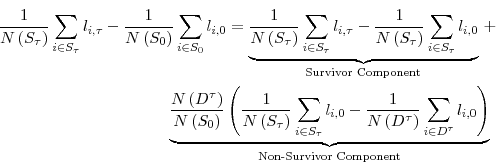
The literature on firm dynamics typically finds that young firms grow faster than old firms. Using kernel density estimates of the firm size distribution in a cohort of entrants, Cabral and Mata (2003) argue graphically that the cohort's evolution is mostly due to growth of survivors rather than exit of small firms. Their analysis points to the need for a measure of the contribution of survivors versus non-survivors to the growth in a given cohort's average size. To accomplish this, we propose a decomposition of the cohort's cumulative growth that will later allow an assessment of the empirical relevance of adjustment costs. We consider the following decomposition:
where
 is the firm's age,
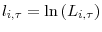 is log-employment at firm
  in period
,
in period
,  is the set of age- surviving firms,
  is the set of age- non-surviving firms, so that
 is a partition of
  , and
, and
 is the number of firms in set
  .11
.11
In general, the growth in a cohort's average size can originate from growth of survivors or from smaller initial size of non-survivors. Any theory of firm dynamics should consider both these sources of growth. Our measure allows a check on whether a particular theory can explain the key source
of growth in a cohort's average size. The survivor component compares the current average size of period survivors with their initial average size, so that it measures how much survivors
have grown. The non-survivor component compares the average initial size of period non-survivors with the average initial size of period survivors, so that it measures how relatively small non-survivors were initially.
We can obtain a similar decomposition for employment-weighted moments. The weighted decomposition contains information about the entire distribution of employment, not just its cross-sectional mean, and is affected both by within- and between-firm growth. Therefore, the weighted decomposition would be more relevant for assessing a richer model that considers the reallocation of employment shares between firms within the cohort. In the results that follow we focus on the unweighted decomposition because it analyzes within-firm growth, which in our model is the most relevant statistic to assess the effect of adjustment costs on the incentives for firms to grow.12
We can also produce a decomposition based on the cohort's annual growth instead of the cohort's cumulative growth. However, the annual version of the above decomposition is more sensitive to two aspects that would complicate the analysis in the paper. First, the annual survivor component is
significantly affected by the business cycle, especially after the first few years of life. To control for this, we would need to somehow remove the cyclical part of the survivor component. Second, as the age of the cohort increases, the annual survivor component becomes increasingly sensitive to
downsizing and exit by some survivors that become technologically outdated and consequently relatively less efficient. To fully consider this aspect of the data would force us to introduce additional parameters into the model that we present in section 3. Therefore, we believe
that by employing a decomposition based on the cohort's cumulative growth we avoid having to adjust the analysis for these two aspects, and instead focus on how intense is survivor's growth while learning-about-efficiency effects are significant.
| Year | CEx | AvEmp | CGrEmp | SComp |
|---|---|---|---|---|
| 1988 | 1.11 | |||
| 1989 | 15.6 | 1.27 | 15.2 | 69.5 |
| 1990 | 24.4 | 1.36 | 24.8 | 70.4 |
| 1991 | 30.8 | 1.43 | 31.2 | 69.7 |
| 1992 | 35.4 | 1.46 | 34.2 | 69.3 |
| 1993 | 40.0 | 1.46 | 34.6 | 68.9 |
| 1994 | 43.4 | 1.47 | 35.3 | 69.1 |
| 1995 | 46.7 | 1.48 | 36.1 | 68.7 |
| 1996 | 49.9 | 1.49 | 37.4 | 67.2 |
| 1997 | 52.7 | 1.51 | 39.6 | 68.5 |
| 1998 | 55.5 | 1.52 | 40.7 | 68.3 |
| 1999 | 58.5 | 1.54 | 43.0 | 68.9 |
Notes: CEx is the cumulative exit rate,
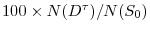 ; AvEmp is the mean of log-employment among survivors,
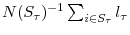 ; CGrEmp is the cumulative log-growth rate (in %) of employment among survivors,
![100\times[N(S_{\tau})^{-1}\sum_{i \in S_{\tau}}l_{\tau} - N(S_{0})^{-1}\sum_{i \in S_{0}}l_{0}]](img19.gif) ;
;  is the survivor component (in %),
![100\times[N(S_{\tau})^{-1}\sum_{i \in S_{\tau}}l_{\tau} - N(S_{\tau })^{-1}\sum_{i \in S_{\tau}}l_{0})] / [N(S_{\tau})^{-1}\sum_{i \in S_{\tau}% }l_{\tau} - N(S_{0})^{-1}\sum_{i \in S_{0}}l_{0}]](img21.gif) .
.
In table 1, we present the evolution of exit rates and the share of firm growth due to the survivor component in the 1988 cohort of entering firms for the overall economy.13 In 1988 there were  entering firms. The exit rate is very high initially but tends to decrease as firms get
older.14 However, ten years after entry only
entering firms. The exit rate is very high initially but tends to decrease as firms get
older.14 However, ten years after entry only  of the initial entrants remain active. There is significant growth in the cohort's average size, especially in the first few years, which is mostly due to the growth of survivors rather than to the exit of small inefficient firms: survivors' growth contributes around
 to the growth in the cohort's average size.15


Notes: ESh is the employment share of the sector in the overall economy cohort; CEx, CGrEmp, SComp are as defined in table 1.
Table 2 presents similar evidence on cohort dynamics for the manufacturing and services sectors.16 We include the employment shares
of each sector in the 1988 cohort of entering firms, which are close to shares in the overall economy. Although manufacturing has a much higher employment share than services, the number of entering firms in services surpasses that of manufacturing ( 6074 and 4834, respectively). Both sectors display a cumulative exit rate around  by 1999. However, initial differences in exit rates are more significant, with manufacturing displaying the smallest values, and services displaying the highest values. In terms of initial size, manufacturing has the largest
entrants, and services the smallest. Although manufacturing has the largest entrants, it exhibits more growth in average employment and a larger contribution of survivors to that growth than services.
by 1999. However, initial differences in exit rates are more significant, with manufacturing displaying the smallest values, and services displaying the highest values. In terms of initial size, manufacturing has the largest
entrants, and services the smallest. Although manufacturing has the largest entrants, it exhibits more growth in average employment and a larger contribution of survivors to that growth than services.
We perform two robustness checks on the previous findings. First, we redo our calculations using establishments rather than firms as the unit of analysis. For the 1988 establishment cohort, we obtain similar results, although exit rates and the survivor component are higher than in the case of
firms. Second, we examine an alternative cohort to make sure our results are not driven by business cycle conditions. The Portuguese economy experienced an expansion between 1986 and 1991, a period of slow growth with a recession between 1992 and 1994, and another weaker expansion between 1995 and
2000. The growth rates of real GDP were  in 1989,
  in 1992, and
 in 1995, so that the 1991 cohort did not face as favorable a macroeconomic environment as the 1988 cohort. However, the results for the 1991 cohort are, in all dimensions, very similar
to those presented above. The results for the 1994 cohort are also very similar, but with slightly smaller values for the survivor component in the first few years after entry.17
in 1995, so that the 1991 cohort did not face as favorable a macroeconomic environment as the 1988 cohort. However, the results for the 1991 cohort are, in all dimensions, very similar
to those presented above. The results for the 1994 cohort are also very similar, but with slightly smaller values for the survivor component in the first few years after entry.17


Notes: N30 is the fraction of firms with an adjusted growth rate of employment, conditional on survival, in the interval
 ; NA is the fraction of firms that do not adjust employment, conditional on survival; P30 is the fraction of firms with an
adjusted growth rate of employment, conditional on survival, in the interval
; NA is the fraction of firms that do not adjust employment, conditional on survival; P30 is the fraction of firms with an
adjusted growth rate of employment, conditional on survival, in the interval
 .
.
In table 3, we provide evidence on characteristics of labor adjustment in the 1988 cohort of entering firms. We use the distribution of the adjusted growth rate conditional on survival. Following Davis and Haltiwanger (1992), the
adjusted growth rate in period is defined as
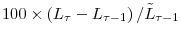 , where
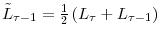 . The table shows that the incidence of inaction is very high, increases with age, and is higher in services than in
manufacturing. This may reflect technology-induced differences in adjustment costs, or job indivisibilities affecting to a larger extent the services sector for having a higher share of small firms. The table also shows that the large majority of firms have adjustment rates within the
. The table shows that the incidence of inaction is very high, increases with age, and is higher in services than in
manufacturing. This may reflect technology-induced differences in adjustment costs, or job indivisibilities affecting to a larger extent the services sector for having a higher share of small firms. The table also shows that the large majority of firms have adjustment rates within the
 interval. A high rate of inaction and small adjustment is usually considered consistent with the presence of linear or proportional adjustment costs. An additional fact is the
left skewness of the 1989 distributions, showing that survivors tend to grow initially, especially in manufacturing. This skewness is less evident in 1993, suggesting that adjustment patterns are different in initial years. The evidence on inaction justifies our assumption of linear adjustment
costs in the model that we present next.
interval. A high rate of inaction and small adjustment is usually considered consistent with the presence of linear or proportional adjustment costs. An additional fact is the
left skewness of the 1989 distributions, showing that survivors tend to grow initially, especially in manufacturing. This skewness is less evident in 1993, suggesting that adjustment patterns are different in initial years. The evidence on inaction justifies our assumption of linear adjustment
costs in the model that we present next.
3.1 Assumptions and Solution
In this section, we introduce linear adjustment costs into a model of Bayesian learning about efficiency. We derive conditions for optimal employment over time and present heuristic arguments about the effects of adjustment costs on the path of employment. Our model is based on Jovanovic (1982), adding adjustment costs and using a different specification for the idiosyncratic shock.
We assume an industry with competitive output and input markets. Current profits of a representative firm are defined by
 ,
,
 is the production function;
  is the amount of labor input;
 is a productivity shock; and
  is the wage rate. The output price is
normalized to unity, so that all monetary values are expressed in units of the output price. Given the competitive environment, the firm treats as a constant.
is the wage rate. The output price is
normalized to unity, so that all monetary values are expressed in units of the output price. Given the competitive environment, the firm treats as a constant.
Concerning technology we make the following assumption.
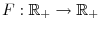 is
is  ,
,
 ,
,
 ,
,
 ,
,
 , and
, and
 . (b) Letting
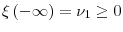
denote the firm's age and 0 the period in which the firm enters, the stochastic process of is defined by
. (b) Letting
denote the firm's age and 0 the period in which the firm enters, the stochastic process of is defined by

where
 ,
,  ,
,
 are mutually independent,
 is
is  ,
,
 and
and
 ,
,
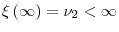 .
.Part (a) basically ensures a well defined interior optimum. In some of the analyses below, we will further specialize by assuming that  is Cobb-Douglas.
Meanwhile, part (b) establishes that in each period productivity is stochastic with a constant mean over the firm's lifetime. The productivity component,
is Cobb-Douglas.
Meanwhile, part (b) establishes that in each period productivity is stochastic with a constant mean over the firm's lifetime. The productivity component,  , is
made of two parts: , which is observed before entry, and , which is
never directly observed by the firm. Intuitively, can be thought of as indexing ex ante efficiency, measuring initial technology choice, while indexes ex post productivity, measuring how well a firm performs within its technology choice.
, is
made of two parts: , which is observed before entry, and , which is
never directly observed by the firm. Intuitively, can be thought of as indexing ex ante efficiency, measuring initial technology choice, while indexes ex post productivity, measuring how well a firm performs within its technology choice.
The introduction of is essential to obtain a non-degenerate distribution of firms' entry size, allowing an analysis of the contribution of survivors to growth in the cohort's
average size. In contrast, the absence of in Jovanovic's (1982) model generates a degenerate distribution of firms' entry size. Under this scenario, for
any period after entry, survivors and non-survivors have the same average initial size implying a value of  to our measure of the survivors' component. By assuming
 , we avoid this aspect of Jovanovic's model.
Before entry the firm knows the parameters governing the stochastic process of , i.e.,  ,
,
 ,
,
 and
and
 , and learns its ex ante productivity, , after paying a research cost,
  . After entry, the firm will learn about its specific ex post productivity, , over time as it observes the realizations of productivity, . In particular, the firm forecasts
period- productivity based on the ex ante efficiency parameter and on the past realizations of productivity,
. After entry, the firm will learn about its specific ex post productivity, , over time as it observes the realizations of productivity, . In particular, the firm forecasts
period- productivity based on the ex ante efficiency parameter and on the past realizations of productivity,
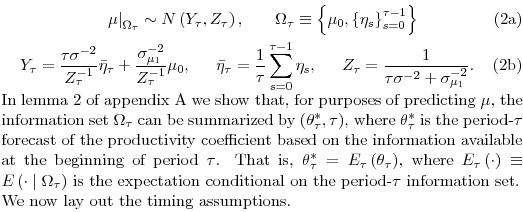
 . Similarly to Zellner (1971), a firm with age has the following Bayesian posterior distribution for at the beginning of period :
 , associated with the process of initial research, after which it observes a realization of ex ante productivity, . (i.b) Entry decision and entry cost: based on the idiosyncratic realization of , the
firm chooses whether to enter the industry or not. In case of entry, the firm pays
, associated with the process of initial research, after which it observes a realization of ex ante productivity, . (i.b) Entry decision and entry cost: based on the idiosyncratic realization of , the
firm chooses whether to enter the industry or not. In case of entry, the firm pays  for acquiring the (exogenously determined) capital stock. (i.c) Initial
employment and production decisions: conditional on entering the industry, the firm chooses how much labor to use and how much output to produce in period 0. A firm of age
for acquiring the (exogenously determined) capital stock. (i.c) Initial
employment and production decisions: conditional on entering the industry, the firm chooses how much labor to use and how much output to produce in period 0. A firm of age  takes the following actions: (ii.a) Update of posterior productivity: at the beginning of period , the firm updates its posterior
expectation of
takes the following actions: (ii.a) Update of posterior productivity: at the beginning of period , the firm updates its posterior
expectation of
 ,
,
 , based on the observation of
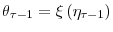 at the end of period
  .
(ii.b) Exit decision: given the new posterior productivity estimate,
, and employment from last period,
.
(ii.b) Exit decision: given the new posterior productivity estimate,
, and employment from last period,
 , the firm chooses whether to stay or exit the industry. In case of exit, the firm sells the capital stock for the value initially paid, (no depreciation). (ii.c) Employment and production decisions: conditional on staying, the firm chooses how much labor to use and how much output to produce in the current period. At the end of period
, the firm observes the productivity realization,
, and the process repeats itself again until the firm decides to leave the industry.18
, the firm chooses whether to stay or exit the industry. In case of exit, the firm sells the capital stock for the value initially paid, (no depreciation). (ii.c) Employment and production decisions: conditional on staying, the firm chooses how much labor to use and how much output to produce in the current period. At the end of period
, the firm observes the productivity realization,
, and the process repeats itself again until the firm decides to leave the industry.18In the absence of adjustment costs, while deciding whether to stay one more period or to exit, the firm compares the expected profit in case it stays,  , with the opportunity cost of
doing so, , the value it would recover by selling the (exogenously determined) capital initially acquired, i.e.,
, with the opportunity cost of
doing so, , the value it would recover by selling the (exogenously determined) capital initially acquired, i.e.,
![\displaystyle V\left( \theta_{\tau}^{\ast},\tau\right) =\max_{L_{\tau}}\left\{ \Pi\left( L_{\tau},\theta_{\tau}^{\ast}\right) +\beta E_{\tau}\left[ \max\left\{ W,V\left( \theta_{\tau+1}^{\ast},\tau+1\right) \right\} \right] \right\} %](img96.gif)
where
represents expected profits conditional on staying in period .
At entry, we have
 , and in equilibrium expected profits must compensate for the cost of acquiring capital, i.e.,
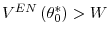 . Since markets are competitive and there is no friction in the entry and exit processes, in equilibrium the research cost equals expected gains at
the research phase, i.e.,
. Since markets are competitive and there is no friction in the entry and exit processes, in equilibrium the research cost equals expected gains at
the research phase, i.e.,
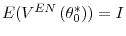 . If
. If
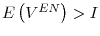 more firms will initiate research and later enter the industry, causing a decrease in output price until equality is restored. A strictly positive fixed
research cost,
more firms will initiate research and later enter the industry, causing a decrease in output price until equality is restored. A strictly positive fixed
research cost,  , is essential to avoid the extreme situation where trial research is so high that only the highest productivity firms enter and survive. Because there is no reliable
capital stock variable in Quadros de Pessoal, we do not make the capital decision endogenous to the model. Instead, we assume that firms are homogeneous along the capital dimension and face the same opportunity cost of remaining in activity, .
, is essential to avoid the extreme situation where trial research is so high that only the highest productivity firms enter and survive. Because there is no reliable
capital stock variable in Quadros de Pessoal, we do not make the capital decision endogenous to the model. Instead, we assume that firms are homogeneous along the capital dimension and face the same opportunity cost of remaining in activity, .
Up to this point, the only differences between our model and Jovanovic (1982) are that in the latter model the efficiency parameter implicitly affects the cost function and the cohort's entry size distribution is degenerate. Therefore, without adjustment costs there
would be no intertemporal linkages in our model aside from the exit decision. As in Jovanovic, because is strictly increasing in
 , the exit decision is characterized by an age-dependent exit threshold. For values of
above or equal to that threshold, the firm would stay and choose employment to maximize current period profits. For values of
below that threshold, the firm would leave the industry, since its expected profitability is below the opportunity cost. The increasing confidence the firm puts in
as it grows older implies that the exit threshold is increasing with age. This is the driving force underlying Jovanovic's result that the size distribution and the
survival probability increase with age.
, the exit decision is characterized by an age-dependent exit threshold. For values of
above or equal to that threshold, the firm would stay and choose employment to maximize current period profits. For values of
below that threshold, the firm would leave the industry, since its expected profitability is below the opportunity cost. The increasing confidence the firm puts in
as it grows older implies that the exit threshold is increasing with age. This is the driving force underlying Jovanovic's result that the size distribution and the
survival probability increase with age.
We now introduce linear adjustment costs into the model. The adjustment cost for continuing firms,  , is defined as

 is the cost per unit of adjustment. Since this is a model with endogenous entry and exit of firms, we consider that this cost also applies to the entry and exit decisions, so that
the costs for entering and exiting firms,
is the cost per unit of adjustment. Since this is a model with endogenous entry and exit of firms, we consider that this cost also applies to the entry and exit decisions, so that
the costs for entering and exiting firms,  and
and  respectively, are
given by
respectively, are
given by
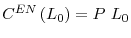 ,
, 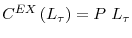 .
.With adjustment costs, the problem now becomes,
![\begin{multline} V^{S}\left( L_{\tau-1},\theta_{\tau}^{\ast},\tau\right) =\max_{L_{\tau}% }\left\{ \left[ \Pi\left( L_{\tau},\theta_{\tau}^{\ast}\right) -C^{S}\left( L_{\tau},L_{\tau-1}\right) \right] +\right. \ \left. \beta E_{\tau}\left[ \max\left\{ V^{EX}\left( L_{\tau}\right) ,V^{S}\left( L_{\tau},\theta_{\tau+1}^{\ast},\tau+1\right) \right\} \right] \right\} \text{,} % \end{multline}](img110.gif)
for all periods after entry (
 ) in which the firm remains in the industry, and
![\displaystyle V^{EN}\left( \theta_{0}^{\ast}\right) =\max_{L_{0}}\left\{ \left[ \Pi\left( L_{0},\theta_{0}^{\ast}\right) -C^{EN}\left( L_{0}\right) \right] +\beta E_{0}\left[ \max\left\{ V^{EX}\left( L_{0}\right) ,V^{S}\left( L_{0},\theta_{1}^{\ast},1\right) \right\} \right] \right\}](img112.gif) ,
,for the entry period, where
 , the value of exiting, is defined as
 .
. and in the costs of hiring at entry and firing at exit are taken into account.
In general, we could allow for asymmetry among the cost parameters in , , and . However, asymmetries between the cost of regular firing and the cost of firing at exit or between the cost of regular hiring and the cost of hiring at
entry lead to biases in entry and exit decisions. For example, if the per unit regular hiring cost is higher than the per unit entry hiring cost, then firms will hire more workers at entry in order to save on expected future higher hiring costs. Similarly, if the per unit regular firing cost is
smaller than the per unit exit firing cost, then firms facing the prospect of exit will fire workers before exiting the industry, saving on expected future higher exit firing costs. To avoid these biases, throughout the paper we assume symmetry between the parameters in , , and . A more interesting distinction is between firing and hiring costs. We will see below that the conclusion of the paper is immune to asymmetries between the costs of adding and subtracting workers.
In solving the firm's problem, we consider a two-step optimization procedure where the firm first chooses optimal employment in each of three possible scenarios, and then selects the scenario with the highest pay-off. More precisely,
 ,
, and
and  are obtained by maximizing the objective function in
(4) over
are obtained by maximizing the objective function in
(4) over
 and
and
 , respectively, and
  is obtained by choosing
 in (4). Although the adjustment cost function introduces a non-differentiability of the objective function at the frontiers between adjustment and
non-adjustment, the usual properties of the value function
in (4). Although the adjustment cost function introduces a non-differentiability of the objective function at the frontiers between adjustment and
non-adjustment, the usual properties of the value function  and its associated optimal exit policy function hold
be defined as in (4). Then: (a) There
exists a unique value function
and its associated optimal exit policy function hold
be defined as in (4). Then: (a) There
exists a unique value function
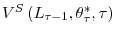 satisfying (4) that is bounded, continuous in
 , and strictly increasing in
. (b) There exists a unique optimal exit policy function
, and strictly increasing in
. (b) There exists a unique optimal exit policy function
 , where
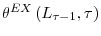 is a unique continuous function in
.
is a unique continuous function in
.In contrast, the non-differentiability of the objective function generates an inaction region in the employment policy, within which optimal employment does not vary with changes in productivity.
, if the firm adjusts upwards, optimal employment satisfies
![\displaystyle \left[ F^{\prime}\left( L_{\tau}^{\ast}\right) \theta_{\tau}^{\ast }-w\right] +\sum_{s=1}^{\infty}E_{\tau}\beta^{s}\left\{ \tilde{\chi}% _{\tau+s}^{\ast}\left( -P\right) +\hat{\chi}_{\tau+s}^{\ast}\left[ F^{\prime}\left( L_{\tau+s}^{\ast}\right) \theta_{\tau+s}^{\ast}-w\right] \right\} =P](img133.gif) ,
,whereas if the firm adjusts downwards optimal employment satisfies
![\displaystyle \left[ F^{\prime}\left( L_{\tau}^{\ast}\right) \theta_{\tau}^{\ast }-w\right] +\sum_{s=1}^{\infty}E_{\tau}\beta^{s}\left\{ \tilde{\chi}% _{\tau+s}^{\ast}\left( -P\right) +\hat{\chi}_{\tau+s}^{\ast}\left[ F^{\prime}\left( L_{\tau+s}^{\ast}\right) \theta_{\tau+s}^{\ast}-w\right] \right\} =-P](img134.gif) ,
,In period 0, the firm enters the industry if
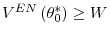 , in which case optimal employment satisfies
![\displaystyle \left[ F^{\prime}\left( L_{0}^{\ast}\right) \theta_{0}^{\ast}-w\right] +\sum_{s=1}^{\infty}E_{0}\beta^{s}\left\{ \tilde{\chi}_{s}^{\ast}\left( -P\right) +\hat{\chi}_{s}^{\ast}\left[ F^{\prime}\left( L_{s}^{\ast }\right) \theta_{s}^{\ast}-w\right] \right\} =P](img136.gif) .
. is the optimal employment in period
  , and
, and
 ,
,
 are functions of the optimal exit decision,
 , in periods
  to , such that
equals one when the firm has remained in the industry until period
to , such that
equals one when the firm has remained in the industry until period  , but decides to exit in period , and
equals one when the firm is still in the industry in period .
, but decides to exit in period , and
equals one when the firm is still in the industry in period .

Equations (6), (7) and (8) are marginal conditions, similar to the smooth pasting conditions in the (S, s) model literature, and they state that if the firm adjusts then the marginal adjustment cost must equal the expected present discounted value of the marginal revenue product for all future periods in which the firm is still in the industry, minus the increase in the exit cost when the firm decides to exit. This is the discrete-time analog of the continuous-time result present in Nickell (1986) and Bentolila and Bertola (1990), adjusted for the fact that now we also have an exit decision. Because the firm will not change employment if the marginal cost of adjustment exceeds its marginal benefit for the first unit of adjustment, proportional costs imply inaction in the employment decision of the firm.
Although the results in proposition 6 do not allow a formal proof of the effects on firm growth of adjustment costs in this general model, the following corollary of proposition 6 enables us to make qualitative heuristic statements about those effects.
Corollary #.:
 , the marginal benefit of one additional unit of labor, that is, the LHS of expressions (6),
(7), and (8), can be recursively represented as
, the marginal benefit of one additional unit of labor, that is, the LHS of expressions (6),
(7), and (8), can be recursively represented as
![\begin{multline} MB\left( L_{\tau-1},\theta_{\tau}^{\ast},\tau\right) =\left( F^{\prime }\left( L_{\tau}^{\ast}\right) \theta_{\tau}^{\ast}-w\right) +\beta E_{\tau}\left[ \chi_{\tau+1}^{\ast}\left( -P\right) +\right. \ \left. \left( 1-\chi_{\tau+1}^{\ast}\right) MB\left( L_{\tau}^{\ast },\theta_{\tau+1}^{\ast},\tau+1\right) \right] % \end{multline}](img145.gif)
where
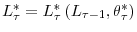 ,
,
 are the optimal employment and exit decisions.
3.2 Linear Adjustment Cost and Firm Growth
As we have seen above, in the absence of adjustment costs, optimal employment is determined solely to maximize current period profits, so that
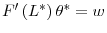 . Therefore, firms' growth is essentially a by-product of a selection mechanism: those firms that are inefficient, and therefore small, exit,
while those firms that are efficient survive and grow. There is an additional source of positive growth when the frictionless employment decision rule,
. Therefore, firms' growth is essentially a by-product of a selection mechanism: those firms that are inefficient, and therefore small, exit,
while those firms that are efficient survive and grow. There is an additional source of positive growth when the frictionless employment decision rule,
 , is convex in
. Because of Jensen's inequality and because
is a Martingale, surviving firms will grow over time:
, is convex in
. Because of Jensen's inequality and because
is a Martingale, surviving firms will grow over time:
![E_{\tau}\left[ L^{\ast}\left( \theta_{\tau+1}^{\ast}\right) \right] >L^{\ast}\left[ E_{\tau}\left( \theta_{\tau+1}^{\ast}\right) \right] =L^{\ast}\left( \theta_{\tau}^{\ast}\right)](img150.gif) .
However,
.
However,  will not be convex in
for general
will not be convex in
for general
 .20
.20
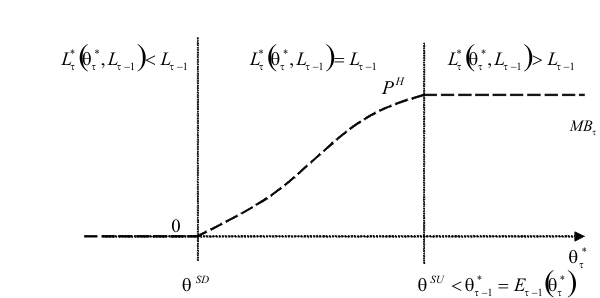
In arguing heuristically about the impact of the proportional cost on firm growth we use the property that  is weakly increasing in
, and that
is weakly increasing in
, and that
 is locally weakly increasing in
. Because it is not immediately obvious why firing and hiring costs should give similar incentives for firm growth, we analyze separately these two costs.21 We present in figure 1 the case where there is a hiring cost,
is locally weakly increasing in
. Because it is not immediately obvious why firing and hiring costs should give similar incentives for firm growth, we analyze separately these two costs.21 We present in figure 1 the case where there is a hiring cost,  , and no firing cost,
  . This figure assumes a given
. For that specific value of
. This figure assumes a given
. For that specific value of  ,
,
 and
and
 are the frontiers between non-adjustment and upward and downward adjustment, respectively. Therefore, if
![\theta_{\tau}^{\ast}\in\left[ \theta^{SD},\theta^{SU}\right]](img171.gif) there will be no adjustment and the marginal benefit of an additional unit of labor (represented by the dashed line) is
contained in the interval
there will be no adjustment and the marginal benefit of an additional unit of labor (represented by the dashed line) is
contained in the interval
![\left[ 0,P^{H}\right]](img172.gif) . To simplify the argument, we consider a firm whose sequence of productivity draws is such that in every period it has a perceived productivity equal to the
unconditional mean of
, even though the firm's uncertainty over next period
decreases with age.
. To simplify the argument, we consider a firm whose sequence of productivity draws is such that in every period it has a perceived productivity equal to the
unconditional mean of
, even though the firm's uncertainty over next period
decreases with age.
Case 1: Hiring Cost: ,
Because the firm starts at the hiring margin, we must have
 at entry, and
![MB_{\tau}\in\left[ 0,P^{H}\right]](img174.gif) , for all subsequent periods,
, for all subsequent periods,
 , with the two extremes of the interval representing firing and hiring of workers, respectively. Consider first a situation where exit is not allowed. Under this assumption,
(9) would become
, with the two extremes of the interval representing firing and hiring of workers, respectively. Consider first a situation where exit is not allowed. Under this assumption,
(9) would become

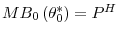 , which implies that the firm will start smaller when than when
  .22 Since
![MB_{1}\left( \theta_{1}^{\ast }\right) \in\left[ 0,P^{H}\right]](img181.gif) ,
,
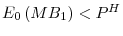 and thus we must have
 , for all
 , if . In the following period, firms will
adjust upwards as frequently with as when , because they start
at the hiring margin and
, if . In the following period, firms will
adjust upwards as frequently with as when , because they start
at the hiring margin and
 , even though they might have smaller magnitudes of adjustment due to the hiring cost. The proportional hiring cost implies that firms will adjust
downwards only if
, even though they might have smaller magnitudes of adjustment due to the hiring cost. The proportional hiring cost implies that firms will adjust
downwards only if
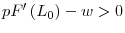
 , so that there is a region of inaction when that is not present when . That is, firms hire fewer workers initially because the resulting smaller probability of having to fire them, and therefore
wasting the initial hiring cost, compensates for the expected decrease in profits this period. Consequently, in period 1 more firms will hire than fire, and this tendency towards growth in young firms will persist for several periods.
, so that there is a region of inaction when that is not present when . That is, firms hire fewer workers initially because the resulting smaller probability of having to fire them, and therefore
wasting the initial hiring cost, compensates for the expected decrease in profits this period. Consequently, in period 1 more firms will hire than fire, and this tendency towards growth in young firms will persist for several periods.
The Bayesian learning mechanism implies both persistence and a reduction in variance with age in the Markov process associated with
. The effect of persistence, that is, the fact that
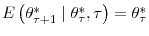 , was analyzed in the previous paragraph. The reduced uncertainty in the posterior estimate of
productivity will be reflected in a smaller inaction region as firms accumulate information on realized productivity; that is,
decreases with . This causes an increase in
, was analyzed in the previous paragraph. The reduced uncertainty in the posterior estimate of
productivity will be reflected in a smaller inaction region as firms accumulate information on realized productivity; that is,
decreases with . This causes an increase in
 for those firms already at the hiring margin, which must be balanced by an increase in
for the right hand side of (9) to remain equal to
for those firms already at the hiring margin, which must be balanced by an increase in
for the right hand side of (9) to remain equal to  . As firms become more certain about their true productivity they are more willing to adjust to their long run optimal size. Because most firms are at the hiring margin, this will cause a further increase in average size.
Consider now the possibility of exit. In this case, the uncertainty reduction as the firm ages implies a decrease in the exit probability, and a further increase in the future-periods component of  in (9). Consequently,
needs to increase further in order to offset that.23 On the other hand, the smaller exit probability implies less pruning of inefficient slow-growing firms as a cohort ages, which tends to make growth in average firm size smaller. Therefore, we will have less cohort growth due to non-survivors and more cohort growth due
to survivors, so that survivors' contribution to average firm growth in the cohort should increase when exit is allowed.
in (9). Consequently,
needs to increase further in order to offset that.23 On the other hand, the smaller exit probability implies less pruning of inefficient slow-growing firms as a cohort ages, which tends to make growth in average firm size smaller. Therefore, we will have less cohort growth due to non-survivors and more cohort growth due
to survivors, so that survivors' contribution to average firm growth in the cohort should increase when exit is allowed.
Case 2: Firing Cost:  ,
,
In this case we have  ,
,
![MB_{\tau}\in\left[ -P^{F},0\right]](img193.gif) ,
. Assume first that exit is not allowed. The intuition is the same as in case 1. In comparison with , when firms start smaller and subsequently hire more frequently than they fire. As firms age, the reduction in variance of
causes an increase in
, which must be compensated by an increase in
for firms at the hiring margin. When exit is possible, those effects become more intense, since the exit probability will decrease as firms age.
,
. Assume first that exit is not allowed. The intuition is the same as in case 1. In comparison with , when firms start smaller and subsequently hire more frequently than they fire. As firms age, the reduction in variance of
causes an increase in
, which must be compensated by an increase in
for firms at the hiring margin. When exit is possible, those effects become more intense, since the exit probability will decrease as firms age.
From the heuristic intuition we have just given it becomes clear that proportional hiring and proportional firing costs reinforce each other in creating incentives for firms to grow. In the end, our assessment of the relevance of linear adjustment costs for firm growth will depend on how well a pure selection model can fit the empirical evidence, and on how much adjustment costs improve the fit. Before we move into a quantitative assessment, we present analytical results for a simple version of the general model.
4 Model with One Period Learning Horizon and No Exit
In this section, we analyze a model where firms' efficiency is revealed after the first period of life and where firms' lifetime horizon is know with certainty at entry. We assume that firms live for  periods,
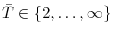 , and that no exit is allowed prior to age . These two simplifications allow us to determine the effect of linear adjustment costs on firm growth.
The introduction of adjustment costs implies an additional expected operating cost for entering firms. Therefore, the equilibrium price must increase to generate higher expected future profits that compensate for the costs incurred while adjusting to optimal size. As a consequence, pre-entry
pruning of inefficient firms should increase while post-entry pruning should decrease. This is optimal from a social point of view, since with higher adjustment costs there should be less experimentation in order to save in unrecoverable costs. Therefore, the assumption that exit is exogenous is
not critical for the results in this section. Since adjustment costs attenuate post-entry pruning, even if exit was endogenous to the model, the relative contribution of survivors to growth in the cohort's average size would increase through this channel. By eliminating any exit prior to
we focus only on the incentives for survivors to grow.
To formulate the problem, we use the fact that once the firm learns its true efficiency in period 2, it will adjust once and for all to its long run employment level, and it will not adjust in any of the following periods.24 Therefore, assuming that upon exit at age the firm recovers its initial investment net of exit costs, the
optimization problem in period 2 is

where
 , and and are defined as above. In period 1, we then have
![\displaystyle V^{EN}\left( \theta_{1}^{\ast}\right) =\max_{L_{1}}\left\{ \Pi\left( L_{1},\theta_{1}^{\ast}\right) -C^{EN}\left( L_{1}\right) +\beta E_{1} \left[ V^{S}\left( L_{1},\theta_{2}^{\ast}\right) \right] \right\} .](img199.gif)
![E_{0}\left[ V^{EN}\left( \theta_{1}^{\ast }\right) \right] =I](img200.gif) .
.
We examine the impact of adjustment costs on the log growth rate of employment, rather than the standard growth rate, in order to attenuate the effect of Jensen's inequality on firm growth.25 In this simple model, the inaction region of optimal employment can be expressed as an interval:
![\Theta ^{SN}=\left[ \theta^{SD},\theta^{SU}\right]](img203.gif) . Therefore, the average log growth rate between period 1 and period 2, conditional on
. Therefore, the average log growth rate between period 1 and period 2, conditional on
 , is defined as
![\begin{multline*} g\left( \theta_{1}^{\ast}\right) =E\left[ \ln\left( L_{2}^{\ast}\right) -\ln\left( L_{1}^{\ast}\right) \right] =\ \int_{\nu_{1}}^{\theta^{SD}}\left\{ \ln\left( L_{2}^{\ast SD}\right) -\ln\left( L_{1}^{\ast}\right) \right\} dF_{\theta_{1}^{\ast}}\left( \theta_{2}^{\ast}\right) +\int_{\theta^{SU}}^{\nu_{2}}\left\{ \ln\left( L_{2}^{\ast SU}\right) -\ln\left( L_{1}^{\ast}\right) \right\} dF_{\theta_{1}^{\ast}}\left( \theta_{2}^{\ast}\right) \end{multline*}](img205.gif)
where
![\Theta\equiv\left[ \nu_{1},\nu_{2}\right]](img206.gif) is the support of the distribution of
is the support of the distribution of
 , and
, and
 and
and
 are the frontiers between non-adjustment and downward and upward adjustment, respectively. Depending on the specific value of
and the magnitude of the adjustment cost parameters, we might have
are the frontiers between non-adjustment and downward and upward adjustment, respectively. Depending on the specific value of
and the magnitude of the adjustment cost parameters, we might have
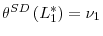 and/or
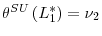 . However, in the results that follow, we assume that
and the adjustment cost parameters are such that both downward adjustment and upward adjustment occur with positive probability, i.e.,
. However, in the results that follow, we assume that
and the adjustment cost parameters are such that both downward adjustment and upward adjustment occur with positive probability, i.e.,
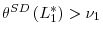 and
and
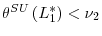 . Since we assume exogenous exit, we ignore the indirect effect of adjustment costs that works through changes in the equilibrium price, and
implicitly assume that the research cost, , adjusts to maintain an equilibrium. This indirect price effects influence average firm size in both periods, but are of second order importance
for the average log-growth rate.26
. Since we assume exogenous exit, we ignore the indirect effect of adjustment costs that works through changes in the equilibrium price, and
implicitly assume that the research cost, , adjusts to maintain an equilibrium. This indirect price effects influence average firm size in both periods, but are of second order importance
for the average log-growth rate.26
Optimal employment in period 2 is determined by
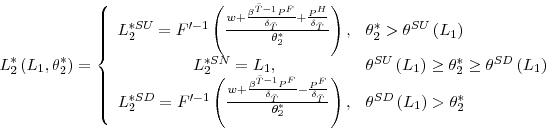
 equals the pro-rated per-period cost of adding another worker, including the wage, the marginal hiring cost, and the discounted cost of firing the worker after period
. The numerator of
has a similar interpretation, as the benefit of shedding a worker.
equals the pro-rated per-period cost of adding another worker, including the wage, the marginal hiring cost, and the discounted cost of firing the worker after period
. The numerator of
has a similar interpretation, as the benefit of shedding a worker.
We then have the following result concerning the effects of changes in and  on the cohort's average log growth rate of employment.
is Cobb-Douglas and that
and
:27(a) The marginal effect of on
 , assuming is zero, is positive for a high
enough value of . (b) The marginal effect of on
, assuming is zero, is positive for all
.
, assuming is zero, is positive for a high
enough value of . (b) The marginal effect of on
, assuming is zero, is positive for all
.
Consider first the hiring cost. In the proof, we show that an increase in decreases both
 and
and
 . The impact of on the growth rate depends on two opposing
effects. First, while in the case of
the cost of hiring can be equally spread out over
. The impact of on the growth rate depends on two opposing
effects. First, while in the case of
the cost of hiring can be equally spread out over  periods with certainty, in the case of
it will be spread out over either periods or one period,
depending on whether the firm learns in period 2 that it has overhired. Therefore, ex ante a proportionately greater part of is attached to period 1 in the case of
than in the case of
periods with certainty, in the case of
it will be spread out over either periods or one period,
depending on whether the firm learns in period 2 that it has overhired. Therefore, ex ante a proportionately greater part of is attached to period 1 in the case of
than in the case of
 , affecting more
than
. This explains the positive effect on growth of for
, affecting more
than
. This explains the positive effect on growth of for
 . Second, the hiring cost on
can possibly be spread out over periods, while the hiring
cost on
can only be spread out over periods. This affects more
than
, and explains why the effect of on growth is not necessarily
positive for finite . However, as increases the first effect
dominates so that decreases
more than
and growth increases.28
. Second, the hiring cost on
can possibly be spread out over periods, while the hiring
cost on
can only be spread out over periods. This affects more
than
, and explains why the effect of on growth is not necessarily
positive for finite . However, as increases the first effect
dominates so that decreases
more than
and growth increases.28
With respect to there is always a positive effect on growth, independently of the lifetime horizon. This occurs because an increase in decreases
and increases
 . This positive effect always dominates the uncertain effect due to the fact that
also decreases with .
. This positive effect always dominates the uncertain effect due to the fact that
also decreases with .
When there are both hiring and firing costs and these costs are identical (
 ), then an increase in has a positive effect on
, for sufficiently high , where the
required is lower than in item (a) of proposition 8.
), then an increase in has a positive effect on
, for sufficiently high , where the
required is lower than in item (a) of proposition 8.
5 Calibration/Estimation Under Finite Learning Horizon
In the previous two sections, we developed heuristic and some formal arguments about the effect of adjustment costs on the incentives for firms to start smaller and grow faster after entry. In this section, we assess the contribution of adjustment costs to explain some of the basic facts on firm dynamics found in section 2, both for the overall economy and for the manufacturing and services sectors. To accomplish this, we perform a calibration/estimation of the model using computational methods.
To simulate the infinite learning horizon model we follow the suggestion of Ljungqvist and Sargent (2004) and consider an approximation where firms live forever, but learn their ex post true productivity component,
, with certainty at some age  .29
.29
We assume that is Cobb-Douglas, i.e.,
 ,
,
 . Under this assumption, when adjustment is costless, optimal employment is given by

where
 is the productivity exit threshold. Therefore, with
, optimal employment conditional on survival is a convex function of
, so that Jensen's inequality implies growth of employment even if there is no selection. As in the previous section, in order to avoid any growth due to Jensen's
inequality, we take logs of all variables and analyze the effects of adjustment costs on the log-growth rate.
is the productivity exit threshold. Therefore, with
, optimal employment conditional on survival is a convex function of
, so that Jensen's inequality implies growth of employment even if there is no selection. As in the previous section, in order to avoid any growth due to Jensen's
inequality, we take logs of all variables and analyze the effects of adjustment costs on the log-growth rate.
Concerning the productivity distribution, we assume that
is lognormally distributed, i.e.,
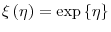 .30 This assumption is made for computational simplicity, and it seems reasonable on empirical grounds (see Aw et. al., 2004). In addition, this assumption is not critical as the results in section 4 suggest that the distribution of productivity mostly affects the intensity of the effect of adjustment costs on firm growth, but not the sign. In fact, proposition 8 is derived independently of the particular distribution of
. With the log-normal distribution assumption, the transition law for the
s is as follows.
.30 This assumption is made for computational simplicity, and it seems reasonable on empirical grounds (see Aw et. al., 2004). In addition, this assumption is not critical as the results in section 4 suggest that the distribution of productivity mostly affects the intensity of the effect of adjustment costs on firm growth, but not the sign. In fact, proposition 8 is derived independently of the particular distribution of
. With the log-normal distribution assumption, the transition law for the
s is as follows.
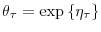 be generated as in assumption 1. Then, (a) The posterior distribution of
 (
( ), given the information set at time ,
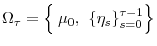 if
if  , and
, and
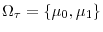 if
if
 , is
, is
 ,,
,,  and
and  are defined in (2), and, for
,
are defined in (2), and, for
,
 and
and
 . Let
. Let
 . Then the distribution of
 (
( ) given
 is
is
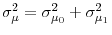
 . () is

 .
.
Since we assume that the firm enters the industry already knowing its ex ante productivity component (see assumption 1), we will
get a non-degenerate distribution of initial size. This occurs because
 , and
, and
 has positive variance in the cohort's initial distribution. The next proposition analyzes the properties of the optimization problem after is revealed to the firm in period .
is revealed to the firm at period , then all adjustments are made at period , and the firm will not change its exit and employment decisions after that period. This
means that
 , , |
(10) |
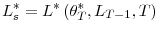 , ,  , , ![\displaystyle \chi_{T}^{\ast}=\mathbf{1}\left[ V^{S}\left( \theta _{T}^{\ast},L_{T-1},T\right) <V^{EX}\left( L_{T-1}\right) \right]](img260.gif) . . |
This result enables us to simplify the computational algorithm significantly, since it implies a finite horizon dynamic programming problem. In appendix B, we present some details concerning the computational algorithm used to simulate the model. In the next subsection, we partially calibrate and estimate the learning model with costly adjustment, and in the following subsection we do a sensitivity analysis.
5.1 Calibration and Estimation of Model with Costly Adjustment
We calibrate and estimate our model to match statistics from the 1988 cohort of entering firms, both for the overall economy and the manufacturing and service sectors. We first calibrate parameters related to inputs directly from the data. We then use a form of the method of moments to estimate
the parameters associated with the learning process and the adjustment cost. These estimates are obtained so that the model generated moments match the evolution of firm size, of exit rates, and of the survivor component observed in the data. As discussed in appendix B, we find
the set of parameter values that minimize the method of moments objective function by using a simulated annealing method. This optimization method is robust to local minima, to discontinuities, and to the discretization implemented in order to simulate the model.31 A central element to our estimation strategy is a decomposition of the change in the cohort's average size into a survivor component and a non-survivor component. This decomposition
forces the model to match not only the growth in the cohort's average size but also the contribution of surviving and non-surviving firms to that growth. Similarly to section 2, with
 , our decomposition is defined as
![\displaystyle E\left[ l_{\tau}\mid S_{\tau}\right] -E\left[ l_{0}\mid S_{0}\right] =\underset{\text{Survivor Component}}{\underbrace{E\left[ l_{\tau}-l_{0}\mid S_{\tau}\right] }}+\underset{\text{Non-Survivor Component}}{\underbrace {\Pr\left( D^{\tau}\mid S_{0}\right) \left\{ E\left[ l_{0}\mid S_{\tau }\right] -E\left[ l_{0}\mid D^{\tau}\right] \right\} }}%](img266.gif)
|
(11) |
Prior to estimation, we calibrate some parameters. The parameters  and
are calibrated with data from INE (1997) containing the Inquérito Annual às Empresas from 1990 to 1995. These data are considered reliable and cover all firms in the Portuguese economy, with sampling among firms with less than 20
workers. We measure as the 1990-1995 average of the cost share of labor in value added, and as the 1990-1995 average cost per worker. We can also obtain these values at the one-digit sectoral level. We deflate all nominal variables using the GDP sectoral price indices available in the updated version of Séries Longas para a Economia
Portuguesa in Banco de Portugal (1997). The real interest rate is calibrated as the 1990-1995 average of the implicit real interest rate on public debt transactions on the secondary market of the Lisbon Stock Exchange. The data was also taken from
Banco de Portugal (1997). We deflate the nominal interest rates using the December-to-December consumer price index from INE (1990-5). The discount rate is then obtained as
and
are calibrated with data from INE (1997) containing the Inquérito Annual às Empresas from 1990 to 1995. These data are considered reliable and cover all firms in the Portuguese economy, with sampling among firms with less than 20
workers. We measure as the 1990-1995 average of the cost share of labor in value added, and as the 1990-1995 average cost per worker. We can also obtain these values at the one-digit sectoral level. We deflate all nominal variables using the GDP sectoral price indices available in the updated version of Séries Longas para a Economia
Portuguesa in Banco de Portugal (1997). The real interest rate is calibrated as the 1990-1995 average of the implicit real interest rate on public debt transactions on the secondary market of the Lisbon Stock Exchange. The data was also taken from
Banco de Portugal (1997). We deflate the nominal interest rates using the December-to-December consumer price index from INE (1990-5). The discount rate is then obtained as
 , where
  is the average real interest rate.
The remaining parameters, ,
 ,
,
 ,
,  , , and are estimated using a method of moments estimator, which attempts to make the model match closely the evidence on cohort
dynamics presented in section 2. In particular, the estimates are selected to minimize a weighted sum of the distance between the following moments in the model and the data: (a) the time-series of the cross-sectional mean of log-employment conditional on survival,
, , and are estimated using a method of moments estimator, which attempts to make the model match closely the evidence on cohort
dynamics presented in section 2. In particular, the estimates are selected to minimize a weighted sum of the distance between the following moments in the model and the data: (a) the time-series of the cross-sectional mean of log-employment conditional on survival,
![E\left[ l_{\tau}\mid S_{\tau }\right]](img273.gif) ; (b) the time-series of annual changes in the cross-sectional standard deviation of log-employment conditional on survival,
; (b) the time-series of annual changes in the cross-sectional standard deviation of log-employment conditional on survival,
![SD\left[ l_{\tau}\mid S_{\tau}\right]](img274.gif) ; (c) the time-series of the cumulative exit rate,
; (c) the time-series of the cumulative exit rate,
 ; (d) and the time-series of the survivor component, as defined in (
![[*]](file:/usr/share/latex2html/icons/crossref.gif) ). In estimating the above parameters, the output price is normalized to 1, and the initial research cost, , is obtained by the equilibrium condition
). In estimating the above parameters, the output price is normalized to 1, and the initial research cost, , is obtained by the equilibrium condition
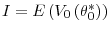 .32
.32
The decision to estimate , instead of calibrating it, deserves some discussion. First, the main purpose of this parameter is to induce endogenous exit as it represents the firm's
opportunity cost of remaining in activity. In Hopenhayn (1992), the same result is accomplished using a fixed per period operating cost. Since the per period operating cost can be seen as the periodic payment in an annuity with a present discounted value of
, the two mechanisms are equivalent. Second, because Quadros de Pessoal misses any reliable capital stock variable, we consider the capital decision to be
exogenous. A rough estimate of the magnitude of is the present discounted value of an annuity with annual payments equal to the 1990-1995 average of value added minus labor costs, using the
same deflators as for .33 Because the sample
is biased towards surviving firms, this measure overestimates the value of , and we cannot use it as a reference to calibrate . Consequently, we estimate jointly with the remaining parameters in the model.
| Parameter |  |
 |
 |
 |
 |
 |
|---|---|---|---|---|---|---|
|
0.56 | 0.56 | 0.57 | 0.57 | 0.73 | 0.73 |
 |
0.956 | 0.956 | 0.956 | 0.956 | 0.956 | 0.956 |
|
11.8 | 11.8 | 13.1 | 13.1 | 7.5 | 7.5 |
 |
3.227 | 3.180 | 3.435 | 3.607 | 2.408 | 2.455 |
 |
0.218 | 0.205 | 0.257 | 0.188 | 0.143 | 0.122 |
 |
0.259 | 0.255 | 0.261 | 0.253 | 0.153 | 0.137 |
|
0.571 | 0.656 | 0.558 | 0.526 | 0.359 | 0.314 |
|
668.4 | 775.3 | 1136.4 | 1291.1 | 179.8 | 189.0 |
|
0 | 0.70 | 0 | 1.13 | 0 | 0.11 |
|
122.5 | 76.5 | 180.7 | 224.1 | 22.2 | 18.6 |
 |
0.0861 | 0.0629 | 0.1727 | 0.1236 | 0.0480 | 0.0439 |
Notes: NAC refers to no-adjustment-costs case; AC refers to proportional-adjustment-costs case;
is the value of the objective
function.
We present in table 4 the calibrated and estimated parameters for the three cohorts and the model with (AC) and without (NAC) adjustment costs, and in figure 2 we plot the overall economy data
moments and the equivalent moments in the AC and NAC models. From table 4, we verify that more information is revealed ex post
 , and that there is significant noise in the learning process (
 ,
,
 ). For the overall economy cohort, the AC model implies an estimate for the proportional cost of about
  of the annual wage. As can be seen in figure 2, this proportional cost improves noticeably the fit of the survivor component.
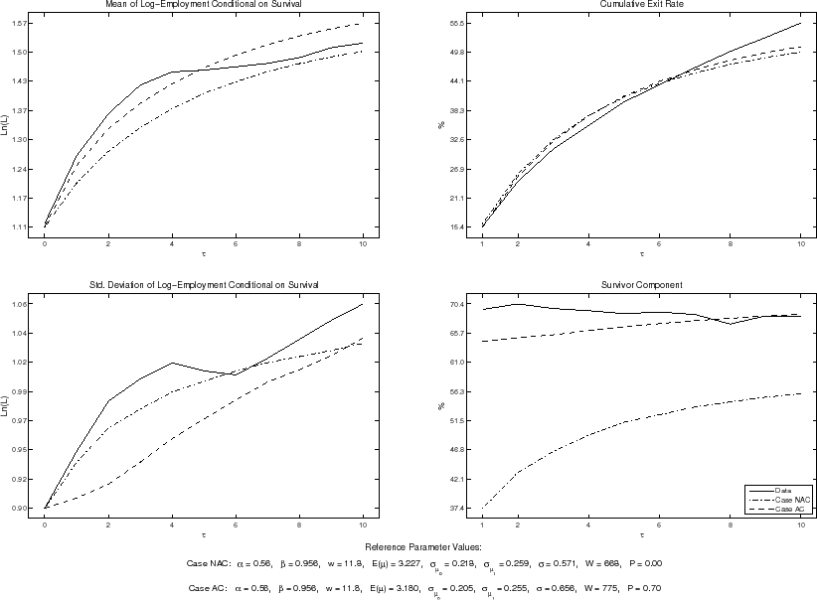
Figure 2 shows that although the NAC model can generate moments on firm size and exit rates that are close to equivalent empirical moments, it cannot satisfactorily match the empirical survivors' contribution. That is, the NAC model cannot explain the main source of growth in the cohort's average size, since survivors contribute much more to growth in the data than in the NAC model. This shortcoming occurs especially in the initial years after entry as the path of the survivor component is almost flat in the data, whereas it is increasing in the NAC model. The larger initial distance between the NAC model and the data in terms of the survivor component reflects the fact that, in the absence of adjustment costs, learning has a larger initial impact on the exit of small inefficient firms than on growth of survivors.

In table 4, we also calibrate/estimate the AC and NAC models for the manufacturing and services sectors, and in figure 3 we present a summary of the implied moments. In discussing the results for
the two sectors we consider the estimates for the AC model. Firms in manufacturing initially learn relatively less about their efficiency than firms in services (
 is smaller in manufacturing), and adjustment costs need to be relatively higher in manufacturing than in services to account for the much higher survivor
component in manufacturing (the proportional costs amount to
is smaller in manufacturing), and adjustment costs need to be relatively higher in manufacturing than in services to account for the much higher survivor
component in manufacturing (the proportional costs amount to  and
and  of
the annual wage, respectively). The higher adjustment costs and smaller knowledge about their efficiency at entry, implies higher incentives for manufacturing firms to start smaller and to gradually adjust to optimal size as they survive and their uncertainty is resolved. Firms in manufacturing
also pay a relatively higher initial research cost (
of
the annual wage, respectively). The higher adjustment costs and smaller knowledge about their efficiency at entry, implies higher incentives for manufacturing firms to start smaller and to gradually adjust to optimal size as they survive and their uncertainty is resolved. Firms in manufacturing
also pay a relatively higher initial research cost ( is higher). This, together with the smaller initial knowledge about their efficiency (
is smaller), implies that manufacturing firms are more likely to enter the industry at the research phase (
is higher). This, together with the smaller initial knowledge about their efficiency (
is smaller), implies that manufacturing firms are more likely to enter the industry at the research phase (
 equals
  in manufacturing and
  in services).
While the introduction of adjustment costs clearly improves the fit of the survivor component in the model, we cannot claim that the proportional cost explains completely the path of the survivor component in the data. In fact, in all three cohorts the initial growth of survivors seems larger
than the AC model can explain. Additionally, in the manufacturing sector, although the AC model raises noticeably the contribution of survivors relative to the NAC model, the survivor component generated by the
AC model is still somewhat below the survivor component in the data. Several factors could be behind these results. First, the introduction of a fixed entry or fixed exit cost would improve the fit of the AC model. By introducing a wedge
between the "cost" of entry and the "benefit" of exit, these fixed costs would help to control both the fraction of firms that never enter the industry,
 , and the amount of exit in the initial post-entry periods,
 . As these fixed costs increase, the first fraction increases and the second probability decreases due to a larger initial selection. Therefore, these fixed
costs would allow more freedom in adjusting
to account for the long-run survivor component, without distorting much the initial exit rates. The proportional adjustment cost would also increase,
raising the long-run value of the survivor component and making its path flatter. Second, other theories that emphasize firm growth in the first years after entry, namely those based on financing constraints, can certainly also account for the high value of the survivor component, especially in the
manufacturing sector.
. As these fixed costs increase, the first fraction increases and the second probability decreases due to a larger initial selection. Therefore, these fixed
costs would allow more freedom in adjusting
to account for the long-run survivor component, without distorting much the initial exit rates. The proportional adjustment cost would also increase,
raising the long-run value of the survivor component and making its path flatter. Second, other theories that emphasize firm growth in the first years after entry, namely those based on financing constraints, can certainly also account for the high value of the survivor component, especially in the
manufacturing sector.
5.2 Sensitivity Analysis
In this subsection we explain some aspects of the calibration/estimation exercise and provide a detailed sensitivity analysis to all parameters in the model. First, we do not attempt to match the level of the cross-sectional variance of log-employment, but only its change over time. This is
because to fit the dispersion in employment, the model would require substantially larger values for both
and
. This would allow the model to match
![Var\left[ l_{\tau}\mid S_{\tau }\right]](img307.gif) and
, but would imply an excessive rate of growth in
. However, this shortcoming is not a serious problem. It implies that only a fraction of the observed cohort's employment dispersion can be attributed
to a Bayesian learning process about efficiency. The remaining part could be attributed to heterogeneity in the initial choice of technology.
and
, but would imply an excessive rate of growth in
. However, this shortcoming is not a serious problem. It implies that only a fraction of the observed cohort's employment dispersion can be attributed
to a Bayesian learning process about efficiency. The remaining part could be attributed to heterogeneity in the initial choice of technology.
For instance, consider a model where capital is endogenous and suppose that a firm chooses its initial stock of capital,  , based on the realization of a random variable indexing
technology choice. Assume further that, after selecting , the firm keeps its capital stock unchanged for the remainder of its life. If the production function has constant returns to
scale, if the total opportunity cost is proportional to , i.e.,
, based on the realization of a random variable indexing
technology choice. Assume further that, after selecting , the firm keeps its capital stock unchanged for the remainder of its life. If the production function has constant returns to
scale, if the total opportunity cost is proportional to , i.e.,
 , then we can easily prove that
 , where
  is the value function conditional on the chosen . Therefore, in this alternative framework, dispersion in
would govern the initial dispersion in employment and only the subsequent evolution in employment dispersion would depend on the Bayesian learning process. This is the reason why we
attempt to match only the evolution of
, but not its level. In the estimated models presented in table 4 only little less than
is the value function conditional on the chosen . Therefore, in this alternative framework, dispersion in
would govern the initial dispersion in employment and only the subsequent evolution in employment dispersion would depend on the Bayesian learning process. This is the reason why we
attempt to match only the evolution of
, but not its level. In the estimated models presented in table 4 only little less than  of the observed dispersion in the cohort's log-employment can be attributed to the learning process.34
Second, the value of
affects the long-run contribution of survivors, since a relatively smaller initial dispersion would make the average size of exiting firms closer to the
average size of surviving firms in the entry period, and in this case most growth would be due to survivors. In the aforementioned extended model with an initial choice over , if we had
 we would have a non-degenerate initial distribution of size, entirely due to the heterogeneity in , but the survivors' component would be in each period. This would occur because the distribution of initial size among exiting firms would be
equal to the distribution of initial size among surviving firms. This also explains why even with heterogeneity over , we would still need to assume
in order to match the empirical facts on the importance of the survivor component.
we would have a non-degenerate initial distribution of size, entirely due to the heterogeneity in , but the survivors' component would be in each period. This would occur because the distribution of initial size among exiting firms would be
equal to the distribution of initial size among surviving firms. This also explains why even with heterogeneity over , we would still need to assume
in order to match the empirical facts on the importance of the survivor component.
While we could increase the long-run contribution of survivors by tinkering with the ratio
, without adjustment costs the model cannot match the observed flatness in the path of the survivor component. For any choice of
and
, it will always be the case that the survivor component will exhibit an increasing path in the absence of adjustment costs. Note also that the ratio
affects both the exit rate and the evolution of the cross-sectional firm size dispersion. If this ratio becomes too small, post-entry exit rates become
excessively high and the size dispersion increases too fast. This is the reason why in the NAC model we cannot find a value for this ratio that attains the long-run contribution of survivors found in the data, and simultaneously matches the behavior of the cumulative
exit rate and the evolution of the cross-sectional size dispersion. Therefore, the value we select for this ratio is disciplined by the exit rates and the evolution of firm size dispersion in the cohort.
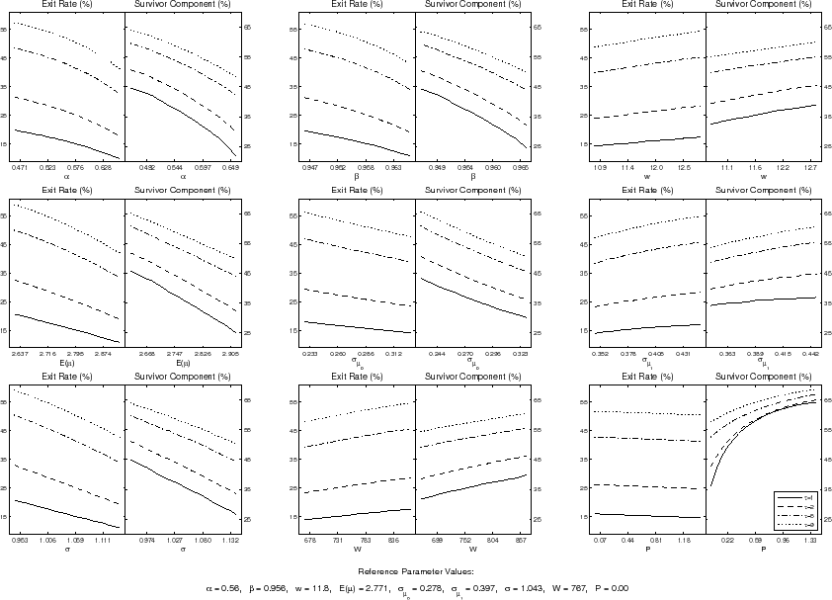
Third, to show that proportional adjustment costs are crucial for our model to fit the evidence on the survivors' contribution to growth in the cohort's average size, in figure 4 we perform a sensitivity analysis with respect to each parameter in the model. We take as benchmark the NAC model estimated for the overall economy cohort in which we do not attempt to match the evidence on the survivor component.35
From figure 4, we see that the model with costless adjustment cannot match satisfactorily the contribution of survivors to growth, even if we allow parameters (except for the proportional cost) to vary one by one from their benchmark values. In fact, no other parameter besides the proportional cost can shrink significantly the distance between the survivor component at different ages of the cohort without changing much the exit rates. The main effect of these costs is to put more emphasis on individual firm growth in the initial years of life, when exit of inefficient firms is very intense.36
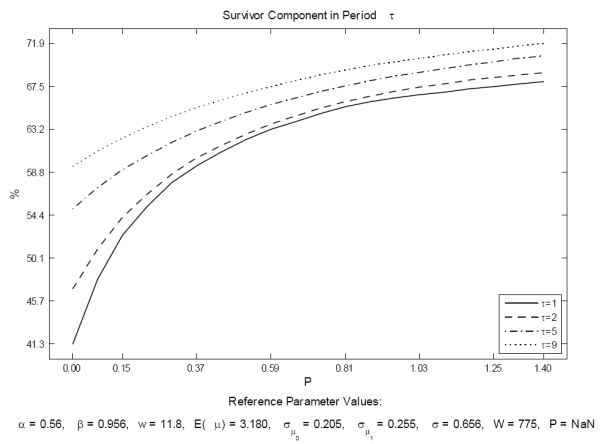
To emphasize the role of the proportional adjustment cost in replicating the evidence on the contribution of survivors, in figure 5 we present the impact of changes in on the survivor component, using as a benchmark the estimates for the AC model for the overall economy cohort in table 4. We conclude that allowing for even a small value of has a substantial impact on the survivors' contribution, with a larger effect in the initial years of life.
6 Conclusion
In this paper, we show that a model with learning about efficiency and linear adjustment costs generates incentives for entering firms to be smaller and for successful firms to expand faster after entry. We present evidence on firm dynamics for a cohort of entrant firms in the Portuguese economy. The evidence shows that growth in the cohorts' average size is driven largely by growth of survivors rather than by pruning of small inefficient firms, with rapid growth of survivors in the initial years after entry and with significant differences between manufacturing and services in the contribution of survivors. A calibration and estimation of the model reveals that the proportional adjustment cost is the key parameter to explain the high contribution of survivors to growth in the cohorts' average size. In order to explain the higher contribution of survivors in manufacturing than in services, adjustment costs need to be higher in manufacturing, both in absolute terms and in relation to the wage.
The paper proposes a channel through which linear adjustment costs to job creation and job destruction can affect firm size dynamics. Therefore, proportional costs not only make job creation and job destruction more sluggish, but also affect the lifetime dynamics of firm size. Although our theory does not provide a complete explanation for the evidence on the survivor component, the success of our model in better approximating the growth of survivors as the main source for growth suggests that adjustment costs do play a significant role in firm size adjustments after entry. From our results, we conclude that selection theories are more relevant to explain firm exit than to explain growth of survivors. Financing constraints theories should also play a role in explaining growth of survivors. Although there is not much evidence that financing constraints can explain cross-sector differences in growth of survivors, financing constraints should be especially relevant when technology requires a large startup cost, such as in manufacturing industries.
Angelini and Generale (forthcoming) argue that financing constraints are not the main determinant behind the evolution of the firm size distribution. Therefore, any government intervention to eliminate financing constraints might not change the lifetime dynamics of firm size we find in this paper. Furthermore, this paper suggests that, in sectors where adjustment costs are high and learning is important, government policies aimed at curbing financing constraints might not produce the intended results, as firms under those circumstances have incentives to start smaller and expand faster.
A. Appendix: Proofs
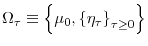 can be summarized by
 , and the distribution function
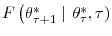 is a continuous and strictly decreasing function of
.
is a continuous and strictly decreasing function of
.![\displaystyle \theta_{\tau}^{\ast}=g\left( Y_{\tau},\tau\right) =E\left( \xi\left( \eta_{\tau}\right) \mid Y_{\tau},\tau\right) =\nu_{1}+\int_{-\infty}% ^{\infty}\left[ 1-F_{\eta}\left( \eta_{\tau}\mid Y_{\tau},\tau\right) \right] d\xi\left( \eta_{\tau}\right)](img319.gif) ,
, is the posterior distribution of
 . Because
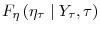 is continuous and strictly decreasing in , and
 is strictly increasing in
, we conclude that
is strictly increasing in
, we conclude that
 is continuous and strictly increasing in
(see theorem 3.4.1 in Swartz, 1994). Therefore, for the purpose of predicting
,
is continuous and strictly increasing in
(see theorem 3.4.1 in Swartz, 1994). Therefore, for the purpose of predicting
,
 , since
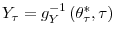 , where
 is the inverse function of
  with respect to . Using the recursion
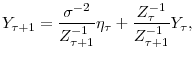
 can be represented as
![\displaystyle F\left( \theta_{\tau+1}^{\ast}\mid\theta_{\tau}^{\ast},\tau\right) =F_{\eta }\left[ \frac{Z_{\tau+1}^{-1}}{\sigma^{-2}}g_{Y}^{-1}\left( \theta_{\tau +1}^{\ast},\tau+1\right) -\frac{Z_{\tau}^{-1}}{\sigma^{-2}}g_{Y}^{-1}\left( \theta_{\tau}^{\ast},\tau\right) \mid g_{Y}^{-1}\left( \theta_{\tau}^{\ast },\tau\right) ,\tau\right] \text{,}%](img331.gif) over the domain where
over the domain where
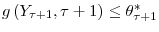 . From this, we conclude that
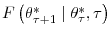 is a continuous and strictly decreasing function of
. Therefore, the transition function associated with
is a continuous and strictly decreasing function of
. Therefore, the transition function associated with
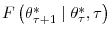 is monotone and satisfies the Feller property (see pp. 376-9 in Stokey et al., 1989).
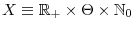 and
and
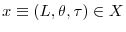 , where
![\Theta\equiv\left[ \nu_{1},\nu _{2}\right] \subset\mathbb{R}_{+}](img336.gif) ,
,
 ,
,
 ; (ii) is the operator associated
with (4); (iii)
; (ii) is the operator associated
with (4); (iii)  denotes the following operator
 ;
; ,
,
 , and
, and
 denote the objective functions associated with , , and
  that is, for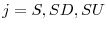

(a.i) Existence and Uniqueness: This follows from the Contraction Mapping Theorem and Blackwell's sufficient conditions (see theorems 3.2 and 3.3 in Stokey et al., 1989).
(a.ii) Continuity in
 : Let
: Let
 be the space of bounded functions on which are continuous
in
. This is clearly a closed subset of
be the space of bounded functions on which are continuous
in
. This is clearly a closed subset of
 , the space of bounded functions
 . Since
with the sup norm
. Since
with the sup norm
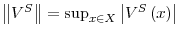 is a Banach space, then
is also a Banach space. Now consider
is a Banach space, then
is also a Banach space. Now consider
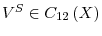 . Because
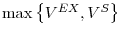 is also continuous and
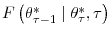 satisfies the Feller property (see lemma 2), then
  is continuous in
 (see lemma 9.5 in Stokey et al., 1989). Since
 is continuous, then
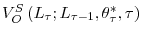 is continuous in
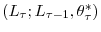 . Therefore, applying the maximum theorem, we conclude that
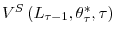 is continuous in
. Note that the set of admissible values for employment can be made compact. First, only non-negative values are acceptable for employment.
Second, we can choose a value for
is continuous in
. Note that the set of admissible values for employment can be made compact. First, only non-negative values are acceptable for employment.
Second, we can choose a value for  high enough, say
  , such that
 , for all
 , so that all values of interest are considered. is
finite since
, and is bounded. Therefore, as defined by (4) is continuous in
.
, so that all values of interest are considered. is
finite since
, and is bounded. Therefore, as defined by (4) is continuous in
.
(a.iii) Strict Monotonicity in
: From lemma 2 (the transition function associated with
is monotone) if
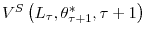 is weakly increasing in
, then
is weakly increasing in
, then
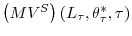 is also weakly increasing in
. Then, because
is also weakly increasing in
. Then, because
 is strictly increasing in
(and the constraint set is not affected by
),
is strictly increasing in
(see theorem 9.11 in Stokey et al., 1989).
is strictly increasing in
(and the constraint set is not affected by
),
is strictly increasing in
(see theorem 9.11 in Stokey et al., 1989).
(b) Exit Policy: The exit policy is determined by the condition
 , is constant and is strictly increasing in
, then it is obvious that
is a unique function defined by the value of
, is constant and is strictly increasing in
, then it is obvious that
is a unique function defined by the value of
![\theta^{\ast}\in\left[ \nu_{1},\nu_{2}\right]](img367.gif) that satisfies the above equation, if it exists, or by
that satisfies the above equation, if it exists, or by  , when
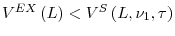 , or by
  ,
when
,
when
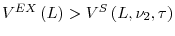 . Because both and are continuous functions, then
is also a continuous function in .
. Because both and are continuous functions, then
is also a continuous function in .
be the maximum allowed age, so that a firm entering in period 0 must exit the industry at the end of period . Then
 , for all
 ,
,
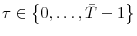 where
where

 and
and
 are continuously differentiable in , and all optima are interior
in the region of their definition.37, we have
are continuously differentiable in , and all optima are interior
in the region of their definition.37, we have

 ,
,
 and
and
 are continuously differentiable functions of
 ,
,
 , and
, respectively. Since
, and
, respectively. Since
 ,
,
 ,
,
, and is bounded above, then
and
have interior optima in the regions of definition of
and
. Therefore, those optima are independent of
,
,
, and is bounded above, then
and
have interior optima in the regions of definition of
and
. Therefore, those optima are independent of
 , and we must have
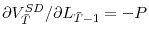 ,
,
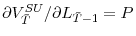 , in the regions of their definition, and
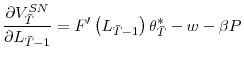 .
.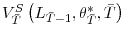 is continuously differentiable at
 , with probability one (given
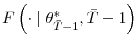 and for all
 ).
).
Now consider a generic period
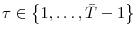 , and assume that
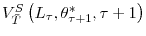 is continuously differentiable at
 with probability one. Because
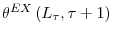 is a unique continuous function of ,
we can apply the dominated convergence theorem to conclude that
is a unique continuous function of ,
we can apply the dominated convergence theorem to conclude that
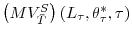 is continuously differentiable at , for all
 (see theorems 3.2.16 and 3.4.3 in Swartz, 1994). Consequently, the same argument used for period can be repeated here.
 we partition the state-space associated with
,
we partition the state-space associated with
,  , into regions of exit,
 , downward adjustment,
 , non-adjustment,
 , and upward adjustment,
 :38
:38
 ,
,


If it is optimal for the firm to adjust upwards, then we must solve
![\displaystyle A_{SU}=\left[ F^{\prime}\left( L_{\tau}^{\ast}\right) \theta_{\tau}^{\ast }-\left( w+P\right) \right] +\beta\frac{\partial\left( MV^{S}\right) \left( L_{\tau}^{\ast},\theta_{\tau}^{\ast},\tau\right) }{\partial L}=0\text{,}%](img412.gif)
![\displaystyle A_{SD}=\left[ F^{\prime}\left( L_{\tau}^{\ast}\right) \theta_{\tau}^{\ast }-\left( w-P\right) \right] +\beta\frac{\partial\left( MV^{S}\right) \left( L_{\tau}^{\ast},\theta_{\tau}^{\ast},\tau\right) }{\partial L}=0](img413.gif)
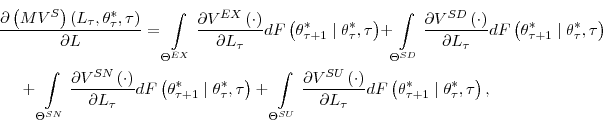
where some of the regions might be empty, and in separating the integrals we have taken into account the continuity of the integrand in
at the frontiers.
For each of the above derivatives we have
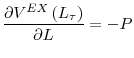 ,
,![\displaystyle \left. \frac{\partial V^{SD}\left( \cdot\right) }{\partial L}\right\vert _{\theta_{\tau+1}^{\ast}\in\Theta^{SD}\left( L_{\tau},\tau+1\right) }=-P=\left[ F^{\prime}\left( L_{\tau+1}^{\ast}\right) \theta_{\tau+1}% ^{\ast}-w\right] +\beta\frac{\partial\left( MV^{S}\right) \left( L_{\tau+1}^{\ast},\theta_{\tau+1}^{\ast},\tau+1\right) }{\partial L}\text{,}%](img416.gif)
![\displaystyle \frac{\partial V^{SN}\left( \cdot\right) }{\partial L_{\tau}}=\left[ F^{\prime}\left( L_{\tau}\right) \theta_{\tau+1}^{\ast}-w\right] +\beta\frac{\partial\left( MV^{S}\right) \left( L_{\tau},\theta_{\tau +1}^{\ast},\tau+1\right) }{\partial L}\text{,}%](img417.gif)
![\displaystyle \left. \frac{\partial V^{SU}\left( \cdot\right) }{\partial L}\right\vert _{\theta_{\tau+1}^{\ast}\in\Theta^{SU}\left( L_{\tau},\tau+1\right) }=P=\left[ F^{\prime}\left( L_{\tau+1}^{\ast}\right) \theta_{\tau+1}^{\ast }-w\right] +\beta\frac{\partial\left( MV^{S}\right) \left( L_{\tau +1}^{\ast},\theta_{\tau+1}^{\ast},\tau+1\right) }{\partial L}\text{,}%](img418.gif)
 , when it is optimal to adjust upwards, and
  , when it is optimal to adjust downwards. Therefore, we have
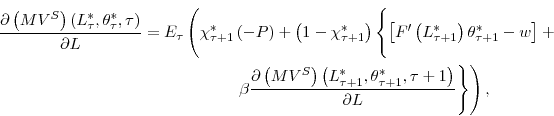
Using the law of iterated expectations, we can rewrite the above as
![\displaystyle \frac{\partial\left( MV^{S}\right) \left( L_{\tau}^{\ast},\theta_{\tau }^{\ast},\tau\right) }{\partial L}=\sum_{s=1}^{\infty}E_{\tau}\beta ^{s-1}\left\{ \tilde{\chi}_{\tau+s}^{\ast}\left( -P\right) +\hat{\chi }_{\tau+s}^{\ast}\left[ F^{\prime}\left( L_{\tau+s}^{\ast}\right) \theta_{\tau+s}^{\ast}-w\right] \right\} \text{,}%](img422.gif)
 , and
, and  .
.
![\begin{multline*} MB_{\tau}=\left( F^{\prime}\left( L_{\tau}^{\ast}\right) \thet... ...ast}\right) \theta_{\tau+1+s}^{\ast}-w\right) \right] \right\} . \end{multline*}](img425.gif)
Taking into account that
 ,
,
 ,
,
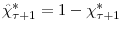 , and
, and
 , then we get the stated result.
![\begin{multline*} F^{\prime}\left( L_{1}\right) \theta_{1}^{\ast}-\left( w+P^{H}\right) +\beta\left( \int_{\nu_{1}}^{\theta^{SD}}-P^{F}dF_{\theta_{1}^{\ast}}\left( \theta_{2}^{\ast}\right) +\right. \ \left. \int_{\theta^{SD}}^{\theta^{SU}}\left\{ \delta_{\bar{T}}\left[ F^{\prime}\left( L_{1}\right) \theta_{2}^{\ast}-w\right] -\beta^{\bar{T}% -1}P^{F}\right\} dF_{\theta_{1}^{\ast}}\left( \theta_{2}^{\ast}\right) +\int_{\theta^{SU}}^{\nu_{2}}P^{H}dF_{\theta_{1}^{\ast}}\left( \theta _{2}^{\ast}\right) \right) =0 \end{multline*}](img430.gif)
(a) In the case of a proportional hiring cost, assuming
, we have
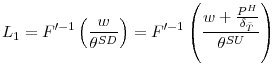 ,
, |
|
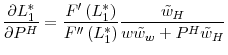 , , |
|
![\displaystyle \tilde{w}_{w}=1+\beta\delta_{\bar{T}}\left[ F_{\theta_{1}^{\ast}}\left( \theta^{SU}\right) -F_{\theta_{1}^{\ast}}\left( \theta^{SD}\right) \right]](img433.gif) , , ![\displaystyle \tilde{w}_{H}=1-\beta\left[ 1-F_{\theta_{1}^{\ast}}\left( \theta^{SU}\right) \right]](img434.gif) . . |
After some algebra we get
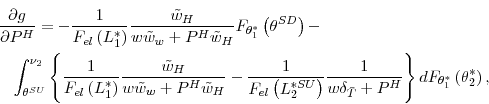
where
 stands for the elasticity of the marginal product of labor. If
 , we have
 , and the above expression simplifies to
![\displaystyle \frac{\partial g}{\partial P^{H}}=\left( 1-\alpha\right) ^{-1}\left( \frac{\tilde{w}_{H}}{w\tilde{w}_{w}+P^{H}\tilde{w}_{H}}\left\{ F_{\theta _{1}^{\ast}}\left( \theta^{SD}\right) +\left[ 1-F_{\theta_{1}^{\ast}% }\left( \theta^{SU}\right) \right] \right\} -\frac{1}{w\delta\left( \bar{T}\right) +P^{H}}\left[ 1-F_{\theta_{1}^{\ast}}\left( \theta ^{SU}\right) \right] \right) \text{,}%](img439.gif) is high enough so that
is high enough so that
![\displaystyle w\left\{ \delta_{\bar{T}}F_{\theta_{1}^{\ast}}\left( \theta^{SD}\right) -\beta^{\bar{T}-1}\left[ 1-F_{\theta_{1}^{\ast}}\left( \theta^{SU}\right) \right] \right\} +P^{H}\left\{ 1-\beta\left[ 1-F_{\theta_{1}^{\ast}% }\left( \theta^{SU}\right) \right] \right\} F_{\theta_{1}^{\ast}}\left( \theta^{SD}\right) >0](img440.gif) , we get similarly
, we get similarly

where
|
|
![\displaystyle \tilde{w}_{F}=F_{\theta_{1}^{\ast}}\left( \theta^{SD}\right) +\beta^{\bar {T}-1}\left[ F_{\theta_{1}^{\ast}}\left( \theta^{SU}\right) -F_{\theta _{1}^{\ast}}\left( \theta^{SD}\right) \right]](img442.gif) |
Under the assumption that marginal productivity is always positive, we need
 or otherwise the firm would prefer to pay the worker his lifetime salary, instead of firing him. If
, we have
or otherwise the firm would prefer to pay the worker his lifetime salary, instead of firing him. If
, we have
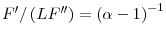 , and the above expression simplifies to
![\begin{multline*} \frac{\partial g}{\partial P^{H}}=\left( 1-\alpha\right) ^{-1}... ...1-F_{\theta_{1}^{\ast}}\left( \theta^{SU}\right) \right] \right) \end{multline*}](img445.gif)
which is positive for all
.
follows directly from
 conditional on
, we use the fact that
conditional on
, we use the fact that
 |
|
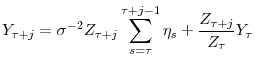 , , |
|
 , , |
|
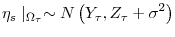 , ,  , ,  , ,  , ,  |
so that, in the end, we get
![\displaystyle E\left[ \ln\left( \theta_{\tau+j}^{\ast}\right) \mid\Omega_{\tau}\right] =Y_{\tau}+\frac{1}{2}\left( Z_{\tau+j}+\sigma^{2}\right)](img455.gif) ,
, |
|
![\displaystyle Var\left[ \ln\left( \theta_{\tau+j}^{\ast}\right) \mid\Omega_{\tau}\right] =Z_{\tau}-Z_{\tau+j}](img456.gif) . . |
From here the result follows by noting that
 .
.
For the unconditional distribution, just note that
 is a sum of normal random variables, and that
![\displaystyle E\left[ \ln\left( \theta_{\tau}^{\ast}\right) \right] =\bar{\mu}+\frac {1}{2}\left( Z_{\tau}+\sigma^{2}\right)](img459.gif) |
|
![\displaystyle Var\left[ \ln\left( \theta_{\tau}^{\ast}\right) \right] =\sigma_{\mu_{0}% }^{2}+\left( Z_{0}-Z_{\tau}\right)](img460.gif) |
 the optimization problem is time invariant, since there is no uncertainty concerning
 . Therefore, for periods
  ,
,  , we have
![\begin{multline*} V^{S}\left( \theta_{T}^{\ast},L_{s-1},T\right) =\max_{L_{s}\geq0,\chi_{s}% \in\left\{ 0,1\right\} }\left\{ \left[ \Pi\left( L_{s},\theta_{T}^{\ast }\right) -C^{S}\left( L_{s},L_{s-1}\right) \right] +\right. \ \left. \beta\left\{ \chi_{s}\left[ W-C^{EX}\left( L_{\tau+s}\right) \right] +\left( 1-\chi_{s}\right) V^{S}\left( \theta_{T}^{\ast}% ,L_{s},T\right) \right\} \right\} \text{.}% \end{multline*}](img465.gif)
Consider a firm that is in the industry at time
, . We now prove that
this firm will not change its employment level in period  . For this, we use the easily proven fact that it is less costly to adjust in one step than in two steps, i. e.,
 ,
,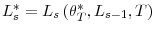 . We then have
 |
||
 |
||
 |
||
 |
||
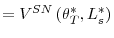 . . |
Therefore, at time
it is optimal to set
 .
.
We now prove that the firm does not exit at time after remaining in the industry at time , . Because the firm stays at time , then
 . Now assume that in period the firm exits, so that

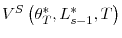 |
 |
|
 |
which is a contradiction.
B. Appendix: Computational Algorithm and Estimation Method
We describe the algorithm we use to numerically simulate and estimate the finite learning horizon model in several steps.
- (i)
- Discretization and transition probability matrices associated with
: We discretize
based on a uniform discrete approximation to the (cross-section) distribution of
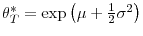 , which is
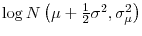 . We then employ the method of Tauchen (1986) in order to build the transition matrices associated
with this discrete approximation. We use a grid with 25 points.
. We then employ the method of Tauchen (1986) in order to build the transition matrices associated
with this discrete approximation. We use a grid with 25 points. - (ii)
- Discretization of We have used the decision rules for problem (12) in case of hiring and in case of firing, from which we consider
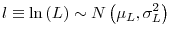 ,
,![\displaystyle \mu_{L}=\frac{1}{1-\alpha}\left\{ \bar{\mu}+\frac{1}{2}\sigma^{2}+\ln\left( \frac{\alpha p}{\sqrt{\left[ w+P^{SU}+\beta P^{EX}\right] \left[ w-\left( 1-\beta\right) P^{SD}\right] }}\right) \right\}](img484.gif) ,
,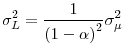 .
.
For the mean of we assume that if a firm is at the upper end of the grid for , then it should optimally decrease employment even at
 , and that if a firm is at the lower end of the grid for ,
then it should optimally increase employment and exit next period, even at
, and that if a firm is at the lower end of the grid for ,
then it should optimally increase employment and exit next period, even at
 . We then find the upper and lower end of the grid for such that those
decisions occur, and use the same procedure to discretize as the one used for , considering 800 gridpoints.
. We then find the upper and lower end of the grid for such that those
decisions occur, and use the same procedure to discretize as the one used for , considering 800 gridpoints. - (iii)
- Choice for We choose
 , and display results until period
  .
. - (iv)
- Model simulation For a given set of parameters we numerically compute the optimal entry, employment, and exit policy rules. In doing this, for each point in the grid for
we compute the optimal employment associated with




since these do not depend on. In doing this, we first find the optimizer on the grid for presented
in (ii). Then, we use this maximizer to implement a golden section method to find a more precise value for this maximizer.39 We
then convert these value functions into and , determine the inaction
regions, and compute . With the optimal policy functions in hand, we generate a random sample with  lifetime histories of
 , and compute all endogenous decisions associated with each realization of a firm's lifetime history. We then use this information to compute by
simulation the relevant moments in the model.
, and compute all endogenous decisions associated with each realization of a firm's lifetime history. We then use this information to compute by
simulation the relevant moments in the model. - (v)
- Moments used in estimation We consider four sets of moments, computed among firms that actually enter the industry: (a) Exit rate: For
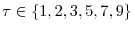 , we consider
(b) Average current size conditional on survival: For
, we consider
(b) Average current size conditional on survival: For
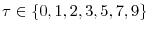 , we consider
(c) Relative change in variance of current size conditional on survival: For
, we consider
(c) Relative change in variance of current size conditional on survival: For![\displaystyle f_{b\tau i}=l_{\tau,i}\mathbf{1}\left( \chi_{\tau,i}=0\right) -E\left[ l_{\tau}\mid S_{\tau}\right] \Pr\left( S_{\tau}\mid S_{0}\right)](img499.gif)
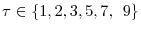 , we consider40
![\begin{multline*} f_{c\tau i}=\left\{ l_{\tau,i}-E\left[ l_{\tau}\mid S_{\tau}\right] \right\} ^{2}\mathbf{1}\left( \chi_{\tau,i}=0\right) -\left\{ l_{0,i}% ^{2}-E\left[ l_{0}\mid S_{0}\right] ^{2}\right\} \times\ \left\{ E[l_{\tau}^{2}\mid S_{\tau}]-E\left[ l_{\tau}\mid S_{\tau}\right] ^{2}\right\} \Pr\left( S_{t}\mid S_{0}\right) /\left\{ E[l_{0}^{2}\mid S_{0}]-E\left[ l_{0}\mid S_{0}\right] ^{2}\right\} \end{multline*}](img501.gif)
(d) Average entry size conditional on survival: For, we consider41
![\displaystyle f_{d\tau i}=l_{0,i}\mathbf{1}\left( \chi_{\tau,i}=0\right) -E\left[ l_{0}\mid S_{\tau}\right] \Pr\left( S_{\tau}\mid S_{0}\right)](img502.gif)
- (vi)
- Weighting matrix The weighting matrix is obtained as the inverse of the sample variance-covariance matrix of the moments in (v),
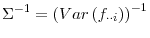 ,
, ![\displaystyle f_{\cdot\cdot i}=[f_{a\cdot i}^{\prime}~~f_{b\cdot i}^{\prime}~~f_{c\cdot i}^{\prime}~~f_{d\cdot i}^{\prime}]^{\prime}%](img504.gif)
- (vii)
- Estimation method We use a simulated annealing method to search for the set of parameter values
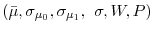 that minimizes the method of moments objective function,42

Bibliography
"Optimal Lending Contracts and Firm Dynamics," Review of Economic Studies, 71 (2), 285-315. "On The Evolution of Firm Size Distributions." American Economic Review. "Firm-Level Evidence on Productivity Differentials, Turnover, and Exports in Taiwanese Manufacturing," Journal of Development Economics, 66 (1), 51-86. Séries Longas para a Economia Portuguesa, Pós II Guerra Mundial, Vol. I and II Séries Estatísticas. Banco de PortugalFootnotes
 an Aruoba, and Rachel Kranton. All remaining errors are my own. I would also like to thank the Direcção-Geral de Estudos, Estatística e Planeamento -
Ministério da Segurança Social, da Família e da Criança, for kindly allowing me to access the Quadros de Pessoal database, the University of Minho for their hospitality, and João Cerejeira and Miguel Portela for their help in extracting results. Return to Text
will represent both the
firm's age and the period (after entry) we are analyzing. Return to Text
an Aruoba, and Rachel Kranton. All remaining errors are my own. I would also like to thank the Direcção-Geral de Estudos, Estatística e Planeamento -
Ministério da Segurança Social, da Família e da Criança, for kindly allowing me to access the Quadros de Pessoal database, the University of Minho for their hospitality, and João Cerejeira and Miguel Portela for their help in extracting results. Return to Text
will represent both the
firm's age and the period (after entry) we are analyzing. Return to Text , where
 is the weight of firm in period in set , with
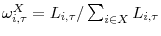 . The weighted survivor component can be further decomposed as

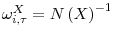 . Return to Text
 as those firms that have not been in the database before . Given the high incidence of temporarily missing firms, we select the 1988 entering cohort, using 1985 and 1986 to detect false entries. Similarly, we identify exiting firms in the -th period (after entry in 1988) as those firms that are present in the database in period , but do not reappear in any of the following
periods. Therefore, we display results only up to 1999, using 2000 to detect false exits. This procedure eliminates most false entries and false exits. Return to Text, we scale it with a factor that compares that mean in period 0 between all firms and those not temporarily missing in period . We also adjust the data in 1994, when the survey moved from March to October, to correct for a higher than normal exit rate and average growth in this year. Return to Text
as those firms that have not been in the database before . Given the high incidence of temporarily missing firms, we select the 1988 entering cohort, using 1985 and 1986 to detect false entries. Similarly, we identify exiting firms in the -th period (after entry in 1988) as those firms that are present in the database in period , but do not reappear in any of the following
periods. Therefore, we display results only up to 1999, using 2000 to detect false exits. This procedure eliminates most false entries and false exits. Return to Text, we scale it with a factor that compares that mean in period 0 between all firms and those not temporarily missing in period . We also adjust the data in 1994, when the survey moved from March to October, to correct for a higher than normal exit rate and average growth in this year. Return to Text of the change in
the cohort's unweighted average productivity. Return to Text
of the change in
the cohort's unweighted average productivity. Return to Text and services
 . Return to Text is not concave, we cannot prove the usual differentiability properties of the value function. Therefore, in what
follows, we implicitly assume that
is differentiable at with probability one, in terms of
for all
. Return to Text is not concave, we cannot prove the usual differentiability properties of the value function. Therefore, in what
follows, we implicitly assume that
is differentiable at with probability one, in terms of
for all
 . By part (b) of proposition 4 and the dominated convergence theorem, this implies that the objective functions
associated with , and are continuously differentiable in , so that marginal conditions can be applied to find interior optima. This assumption
also implies that
is differentiable at
with probability one. In proposition 5 of appendix A, we prove that this property holds both in a model with a finite lifetime horizon and
in a model with infinite-lived firms that face a finite learning horizon (as in sections 4 and 5). Return to Text
. By part (b) of proposition 4 and the dominated convergence theorem, this implies that the objective functions
associated with , and are continuously differentiable in , so that marginal conditions can be applied to find interior optima. This assumption
also implies that
is differentiable at
with probability one. In proposition 5 of appendix A, we prove that this property holds both in a model with a finite lifetime horizon and
in a model with infinite-lived firms that face a finite learning horizon (as in sections 4 and 5). Return to Text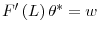 , we have

 . Therefore, if decreasing returns to labor do not decrease too fast, that is,
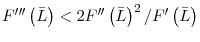 , then we will have
 . When
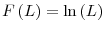 , then
 , and when
,
, then
, and when
,
, then
 . Return to Text is concave (and continuously differentiable) in , so that
  must decrease for
  to increase. Return to Text, Jensen's inequality implies positive expected growth, even in the absence of adjustment costs. Because the log transformation is concave, it will offset the convexity of the
optimal employment function. For example, for a Cobb-Douglas specification of
to increase. Return to Text, Jensen's inequality implies positive expected growth, even in the absence of adjustment costs. Because the log transformation is concave, it will offset the convexity of the
optimal employment function. For example, for a Cobb-Douglas specification of
 , the log growth rate eliminates the effect of Jensen's inequality, since
 becomes linear in
. Return to Text
becomes linear in
. Return to Text was enough to generate a positive effect on growth. Return to Text differs from the lifetime horizon used in section 4, with
 . In this section, we assume an infinite horizon, so that
. In our simulations below, we assume that (years), and
present results until year 10. Return to Text
. In this section, we assume an infinite horizon, so that
. In our simulations below, we assume that (years), and
present results until year 10. Return to Text and
and
 . Although this violates assumption 1, this is not a problem in this section, since we will be using a discrete approximation to the productivity
distribution. Return to Text
. Although this violates assumption 1, this is not a problem in this section, since we will be using a discrete approximation to the productivity
distribution. Return to Text , where
 is a vector of differences between the sample and model generated moments, and
  is the estimated variance-covariance matrix of
  . Return to Text
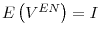 is satisfied. Return to Text to the level found in the data. Return to Text, and the firing/exit cost, , separately, because and produce almost identical results. This should be expected as the incentives created by proportional hiring/entry and firing/exit costs differ only in the displacement of time by one period. Return to Text
 and time-0 variances. Return to Text