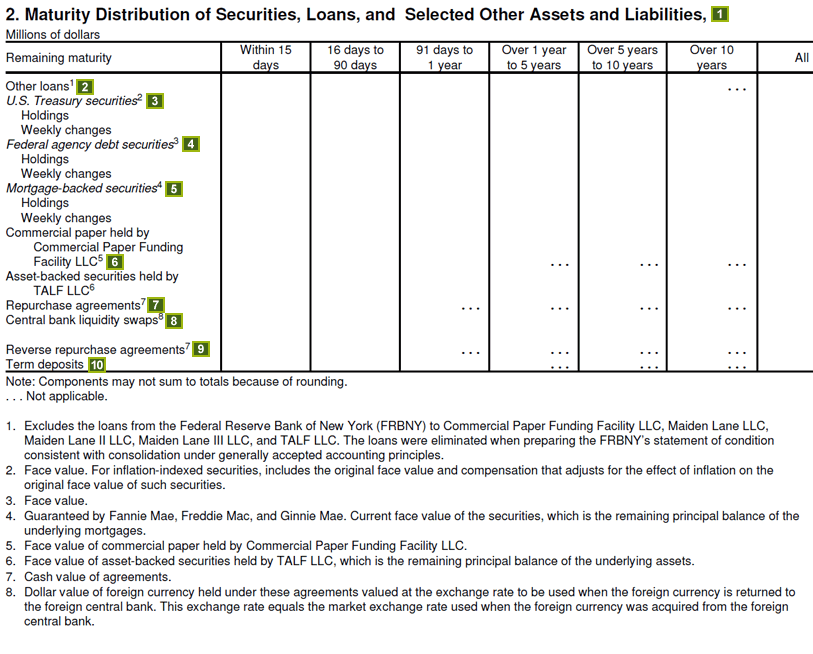
 Maturity distribution: Table 2 fulfills the Federal Reserve's statutory requirement to publish the maturity of the assets it holds. This table presents the maturity of securities holdings and loans extended. Moreover, where practicable, the table presents the maturity of the assets held by special purpose vehicles that have been consolidated onto the Federal Reserve's books. Return
 Other loans: Other loans is the sum of "Primary credit," "Secondary credit," "Seasonal credit," "Primary dealer and other broker-dealer credit," "Asset-Backed Commercial Paper Money Market Mutual Fund Liquidity Facility," "Credit extended to American International Group, Inc.," "Term Asset-Backed Securities Loan Facility," and "Other credit extensions." Return
 U.S. Treasury securities: The total face value of U.S. Treasury securities held by the Federal Reserve. This total is broken out in the lines below. Purchases or sales of U.S. Treasury securities by the Federal Reserve Bank of New York (FRBNY) are made in the secondary market, or with various foreign official and international organizations that maintain accounts at the Federal Reserve. FRBNY's purchases or sales in the secondary market are conducted only through primary dealers.
- Bills: The current face value of the Federal Reserve's outright holdings of Treasury bills.
- Notes and bonds, nominal: The current face value of the Federal Reserve's outright holdings of nominal Treasury notes and bonds.
- Notes and bonds, inflation-indexed: The current face value of the Federal Reserve's outright holdings of inflation-indexed Treasury notes and bonds.
-
Inflation compensation: Inflation compensation reflects adjustments for the effects of inflation to the principal of inflation-indexed securities.
Return
 Federal agency debt securities: The current face value of federal agency obligations held by Federal Reserve Banks. These securities are direct obligations of Fannie Mae, Freddie Mac, and the Federal Home Loan Banks. Return
 Mortgage-backed securities: The current face value of mortgage-backed obligations held by Federal Reserve Banks. These securities are guaranteed by Fannie Mae, Freddie Mac, or Ginnie Mae. Return
 Commercial paper held by Commercial Paper Funding Facility LLC: The Commercial Paper Funding Facility (CPFF) provides a liquidity backstop to U.S. issuers of commercial paper through a special purpose vehicle (SPV), the CPFF LLC. This LLC purchases three-month unsecured and asset-backed commercial paper directly from eligible issuers. The Federal Reserve provides financing to the LLC through the CPFF, and all lending is secured by all of the assets of the LLC and, in the case of commercial paper that is not asset-backed commercial paper, by the retention of upfront fees paid by the issuers or by other forms of security acceptable to the Federal Reserve in consultation with market participants. This line reports the face value of the commercial paper held by the LLC.
Because the FRBNY is the sole beneficiary of the CPFF LLC, the assets and liabilities of the LLC are consolidated onto the books of the FRBNY. Return
 Repurchase agreements: Repurchase agreements reflect some of the Federal Reserve's temporary open market operations. Repurchase agreements are transactions in which securities are purchased from a primary dealer under an agreement to sell them back to the dealer on a specified date in the future. The difference between the purchase price and the repurchase price reflects an interest payment. The Federal Reserve may enter into repurchase agreements for up to 65 business days, but the typical maturity is between one and 14 days. Federal Reserve repurchase agreements supply reserve balances to the banking system for the length of the agreement. The Federal Reserve employs a naming convention for these transactions based on the perspective of the primary dealers: the dealers receive cash while the Federal Reserve receives the collateral. Return
 Central bank liquidity swaps: The FOMC has authorized temporary reciprocal currency arrangements (central bank liquidity swaps) with certain foreign central banks to help provide liquidity in U.S. dollars to overseas markets.
These swaps involve two transactions. First, when the foreign central bank draws on the swap line, it sells a specified amount of its currency to the Federal Reserve in exchange for dollars at the prevailing market exchange rate. The foreign currency that the Federal Reserve acquires is placed in an account for the Federal Reserve at the foreign central bank. This line in the statistical release reports the dollar value of the foreign currency held under these swaps.
Second, the dollars that the Federal Reserve provides are deposited in an account for the foreign central bank at the Federal Reserve Bank of New York. At the same time as the draw on the swap line, the Federal Reserve and the foreign central bank enter into a binding agreement for a second transaction in which the foreign central bank is obligated to repurchase the foreign currency at a specified future date at the same exchange rate. At the conclusion of the second transaction, the foreign central bank pays a market-based rate of interest to the Federal Reserve. Central bank liquidity swaps are of various maturities, ranging from overnight to three months. Return
 Reverse repurchase agreements: Reverse repurchase agreements are transactions in which securities are sold to primary dealers or foreign central banks under an agreement to buy them back from the same party on a specified date at the same price plus interest. Reverse repurchase agreements absorb reserve balances from the banking system for the length of the agreement. They are typically collateralized using Treasury bills. As with repurchase agreements, the naming convention used here reflects the transaction from the dealers' perspective; the Federal Reserve receives cash in a reverse repurchase agreement and provides collateral to the dealers. Return
 Term deposits: Term deposits are deposits with specified maturity dates that are held by institutions that are eligible to receive interest on their balances at Reserve Banks. Term deposits are separate and distinct from balances maintained in an institution's master account at a Federal Reserve Bank as well as from those maintained in an excess balance account. Term deposits are intended to facilitate the conduct of monetary policy by providing a tool for managing the aggregate quantity of reserve balances.Return
