

|
|
|
The Department of the Treasury The Use and Counterfeiting of United States Currency Abroad, Part 3
Contents
PrefaceThe Department of the Treasury wishes to thank the Congress for its insight in the passage of PL104‑132, the Antiterrorism and Effective Death Penalty Act of 1996, which initiated this study. The Congressional mandate contained in PL 104‑132, Section 807 has enabled Treasury, the Federal Reserve, and the Department of Homeland Security to work more effectively in the international arena. In addition to the information gathered during the study, the program has helped establish contacts and networks for gathering information. Over the course of the last ten years, the direct knowledge of the use of U.S. currency abroad and the opportunity to assess the counterfeiting threat allowed the U.S. government to make informed decisions regarding the public education program for new currency designs, the distribution of U.S. currency abroad, and the most effective ways to thwart counterfeiting activity. As established in the act, this is the final report, which summarizes what was learned during trips to countries around the world that use U.S. currency. Residents of many countries outside the United States use U.S. banknotes as a store of value and as a medium of exchange. A substantial share of U.S. banknotes in circulation has been held abroad for several decades. Today, we estimate that nearly 60 percent of all U.S. banknotes in circulation, or about $450 billion of the $760 billion in circulation as of December 2005, is now held abroad. Because banknotes can move undetected across borders, data and methods to estimate such holdings are by necessity indirect and based on simplifying assumptions that must be updated periodically to keep these assessments as accurate as possible based on the information received. It is important that we keep these channels assessable to the U.S. Treasury, the Federal Reserve, and the U.S. Secret Service to augment the data gathering process, which is a vital part of keeping us abreast of demand trends and counterfeit activity. During the course of this ten-year study, the introduction of new design currency was an important issue. The knowledge obtained through this study was used by Treasury to develop international public education programs, which have facilitated smooth introductions of new currency designs. In addition, the Secret Service obtained valuable information through the study and will continue to draw upon information arising from the study to evaluate its internal strategy. U.S. dollars (USD) are often found in countries with volatile political and economic conditions. Accordingly, much of the growth in international U.S. currency usage during the past two decades has occurred in Latin America and in formerly socialist countries. In many of these economies, to the extent that citizens and small businesses continue to face unstable local currencies as well as underdeveloped banking and payment systems, accumulating savings and making transactions in local currencies is difficult. As a result, many residents of countries facing unstable or crisis conditions opt to conduct saving and transaction functions in other currencies, often USD. The external circulation of USD provides benefits and presents challenges to U.S. taxpayers as well as USD holders abroad. The billions of U.S. banknotes held outside the United States represent a windfall to U.S. taxpayers because of the seigniorage revenues generated by the added currency demand, and they serve as a useful asset for USD users outside the United States who have no other liquid and stable assets available.1 However, the presence of USD in areas outside the direct jurisdictional reach of the U.S. Secret Service makes them a potential target for counterfeiters, who range from organized professionals with sophisticated printing facilities and considerable skill to amateurs with access only to copying machines or inexpensive computer printers. Counterfeiting is primarily carried out for economic gain but may also be associated with other crimes, including drug trafficking and illicit arms dealing. USD users abroad also face challenges in obtaining USD and information about USD, and in dealing with suspected counterfeits that are typically more simply resolved with their locale's legal tender. This study reaches five major conclusions about the counterfeiting of U.S. currency. First, the average incidence of counterfeit U.S. currency passing is generally low both inside and outside the United States, notwithstanding occasional large seizures of uncirculated counterfeits.2 Second, foreign banks and law enforcement agencies are eager to develop expertise, technology, and communication links with the U.S. Secret Service to detect and suppress counterfeiting activity. Third, the International Currency Awareness Program (ICAP) has helped expand and strengthen working relationships between the U.S. Secret Service and foreign financial and law enforcement organizations, which has allowed for improved investigations and training. Fourth, ICAP teams have found that one factor that both increases concern about counterfeiting and hampers enforcement is a lack of legal authority for banks and cash handlers to confiscate suspected or actual counterfeit U.S. currency. Fifth, ICAP teams have consistently found that the U.S. Secret Service U.S. Dollars Counterfeit Note Search website (USDOLLARS) established in 1999 has been extremely effective in aiding banks and cash handlers, their customers, and law enforcement in tracking and identifying counterfeit notes. This study is the last in a series of three reports and provides updates to the first two reports, which were issued in 2000 and 2003. Much of the information presented in the earlier reports remains valid today. As in the previous reports, some figures and information were available only from discussions with various governmental and commercial-sector officials; data gathered in such a way are inherently fragmentary. However, the models used in the reports to estimate the share of currency held abroad and the quantity of counterfeits in circulation generate results that are consistent with the information provided by the teams' interlocutors. This report was prepared for the Secretary of the Treasury under the direction of the Advanced Counterfeit Deterrence Steering Committee by staff at the Federal Reserve, U.S. Treasury Departmental Offices, and the U.S. Secret Service. Contributing to this report were Jon Cameron, Project Director for the International Currency Awareness Program, U.S. Department of the Treasury; Jacqueline Marengo, Assistant to the Special Agent in Charge, Criminal Investigative Division, U.S. Secret Service; Ruth Judson, Economist, Division of Monetary Affairs, Board of Governors of the Federal Reserve System; and Jeffrey Pruiksma, Cash Officer, International Cash Department, Federal Reserve Bank of New York. Executive SummaryIntroduction
Findings Regarding the International Use of U.S. Currency
The Introduction of the Series 1996 New Currency Design (NCD) and the Series 2004 New Color of Money Design (NCM)
Findings Regarding the International Counterfeiting of U.S. Currency
|
||||
1 Introduction1.1 BackgroundThis report is the last of three on the results of a long-term study of the use and counterfeiting of U.S. currency abroad undertaken as required by Section 807 of PL 104‑132, the Antiterrorism and Effective Death Penalty Act of 1996. As defined in the act, the Secretary of the Treasury, in consultation with the Advanced Counterfeit Deterrence Steering Committee (ACD), provides program direction for the study. The study program, currently known as the International Currency Awareness Program (ICAP), is an extension of an earlier effort known as the Joint International Study Team (JIST). JIST preceded the introduction of the new currency design (NCD) $100 note in March 1996 and was an effort on the part of the ACD to address three issues: patterns of use and circulation of U.S. currency abroad, counterfeiting of U.S. currency abroad, and appropriate planning for the introduction of the new-design $100 note. The successful introduction of the NCD $100 note was viewed by the U.S. government as extremely important because it represented the first significant redesign of U.S. currency in nearly seventy years. The ACD recognized that a smooth introduction of the NCD note in 1996, particularly internationally, was important because the majority of $100s in circulation was estimated to be held abroad (table 1.1). Both ICAP and JIST activities consisted of teams study trips to areas of the world where U.S. dollars (USD) were known to circulate in significant quantities. Prior to the introduction of the NCD $100s, the teams also studied where to establish the extended custodial inventory (ECI) facilities to encourage both recirculation of fit currency and repatriation of old-series currency.5
Sources: Columns 1 and 2: Treasury Bulletin, various issues, Table USCC‑2. Figures include vault cash but exclude coin. Column 4: Federal Reserve Board Flow of Funds Accounts (Z.1. Statistical Release, Table L.204, line 22). In addition, the ICAP and JIST teams gathered information that assisted in the development of educational materials to inform USD users abroad about the characteristics of the new notes. The educational program for the NCD $100 was designed to avoid the kind of confusion and panic that occurred in Russia when the Series 1990 $100 note was introduced. During that period, the U.S. Ambassador to Russia had to appear on local television to address incorrect rumors that older-series notes were to be recalled. The public education program described the new design's security features as well as the U.S. government's no-recall policy. 1.2 Design of the StudyThe study takes account of available information and understanding accumulated by the U.S. Treasury, the Federal Reserve System, and the U.S. Secret Service about U.S. currency holdings and counterfeit activity abroad. In accordance with the congressional mandate, the study is based on three components: models of U.S. currency usage abroad, models of counterfeiting abroad, and information obtained from country surveys of cash handlers and others knowledgeable about the extent of currency usage and counterfeiting issues abroad.6 The U.S. Treasury, the Federal Reserve, and the U.S. Secret Service obtained information on currency usage and counterfeiting from a variety of sources, including U.S. Customs reports, shipment data from international banknote wholesalers and published proxies for those shipments, estimates based on in-country surveys from USD-using countries, national surveys of domestic currency holdings, and a variety of empirical models developed by the Federal Reserve that estimate international flows or holdings based on assumptions concerning international currency usage. On the counterfeiting side, the U.S. Secret Service collects information from around the world on counterfeits that have been passed or seized and related information from country surveys. In addition, the Federal Reserve collects data on counterfeits found in deposits at Federal Reserve Banks. Finally, using data collected when Federal Reserve Bank cash offices process bank deposits and data on counterfeit notes passed both domestically and internationally, the Federal Reserve has developed models to estimate the quantity of counterfeit U.S. currency in circulation. 1.3 International Demand for the U.S. DollarBecause of its relative stability and near-universal recognition and acceptance, USD function as both a store of value and a medium of exchange when other stable or convenient assets (for example, national currencies) are not available. Thus, during times of economic or political crisis, a stable and familiar currency, such as USD, often is sought as a portable and liquid hedge against possible devaluation. Similarly, USD are a popular medium of exchange in regional or cross-border trade when credit markets are undeveloped or banks are underdeveloped or unreliable. U.S. currency in the form of banknotes (paper currency) in circulation outside the U.S. Treasury and the Federal Reserve System was about $759 billion by the end of 2005.7 Current estimates indicate that the proportion of U.S. currency held abroad is as much as 60 percent of the amount in circulation, or roughly $450 billion. Table 1.1 shows the total amount of U.S. banknotes in circulation as well as the share attributed to the $100 denomination. In value terms, the share of USD held as $100s has increased from around 21 percent at the end of 1965 to nearly 72 percent at the end of 2005. In addition, the share of $100 notes estimated to be held outside the United States has also increased. As shown in the right-hand column of the table, the share of $100 notes held outside the United States rose sharply over the period from 1975 to 1995 and then remained relatively stable at around two-thirds of all $100 notes since 1999. The international circulation of U.S. currency in Europe expanded after World War I in the wake of the hyperinflation induced by the obligations arising from the Treaty of Versailles.8 At that time, U.S. currency was viewed favorably because the United States was still on the gold standard, while Great Britain, whose currency was the leading alternative to U.S. currency, remained off the gold standard until May 1925. Other countries, such as Panama, adopted U.S. currency as their official currency. In the past two decades, the international usage of U.S. banknotes expanded largely because of two events: the breakup of the Soviet Union and episodes of high and volatile inflation in Latin America. During a period of instability, the magnitude of the inflows of U.S. banknotes depends on a country's experience with U.S. currency in the past and its economic circumstances. In particular, demand for USD appears to depend on two factors. The first factor is the ability of people to purchase U.S. banknotes, and the second factor is their confidence in the domestic banking system. The less confidence people have that the value of their bank holdings will be protected, the more likely they are to want to hold U.S. banknotes. Similarly, the more developed the banking system, the more likely it is that people will have a wide variety of options for saving and for making transactions. Because many holders of U.S. currency view it as a form of insurance against future instability, they are reluctant to alter their usage patterns for USD during periods of economic stability by either shifting out of U.S. banknotes or by switching to another currency, such as the euro. Since the introduction of euro banknotes in the beginning of 2002, it appeared that demand for USD waned somewhat in countries in and near the euro zone. However, responses to ICAP team inquiries indicated that USD holders have moved to holding euros in addition to, rather than instead of, USD. It is likely that underlying patterns of U.S. currency usage will change slowly in countries that already use USD. In countries that do not now use USD to a significant degree, it is difficult to predict if and when a crisis prompting demand for a second currency might develop. 1.4 Measuring the Extent of International Counterfeiting of U.S. CurrencyU.S. currency's strong international presence and popularity make it an inviting target for counterfeiters: where genuine banknotes circulate and are accepted, counterfeits also have a chance of being accepted. Inside the United States, the U.S. Secret Service has jurisdiction over counterfeiting cases, and it routinely receives information about counterfeit activity from the Federal Reserve, commercial banks, and local law enforcement authorities. Outside of the United States, the U.S. Secret Service relies on its international law enforcement counterparts, contacts in the banking community, and U.S. diplomatic staff.9 Furthermore, legislation and banking regulations abroad vary widely regarding how to handle U.S. counterfeit notes when they are found. Thus, without ongoing, direct contact with its foreign law enforcement counterparts, the U.S. Secret Service cannot assess the true nature of the counterfeiting threat of U.S. currency it faces abroad. Preliminary results from our investigations indicate that U.S. Secret Service agents are notified more promptly today about suspected counterfeiting through the information channels and reporting mechanisms (for example, the US DOLLARS website) that have been developed. 1.5 Organization of the Remainder of the ReportThe remainder of the report is organized as follows. Chapter 2 reviews the U.S. currency public education program. Chapter 3 discusses the ICAP country visits and highlights the information on international U.S. currency usage obtained from these visits. Chapter 4 presents the estimates of the quantity and location of U.S. currency abroad. Chapter 5 discusses the international distribution of U.S. currency. Chapter 6 reviews global counterfeiting of U.S. currency and what is known about the geographic distribution of counterfeiting activity abroad. Chapter 7 presents a model and estimates of the overall potential size of international counterfeiting activity of U.S. currency. Chapter 8 provides a brief summary and conclusion. 2 The U.S. Currency Public Education ProgramThe three elements of the ACD's counterfeit deterrence program are an effective currency design, law enforcement, and the public education program. The ICAP teams had many opportunities to assess the effectiveness of the U.S. currency public education program during their visits abroad. The information gathered by ICAP teams since the introduction of the NCD $100 note in March 1996 helped define the content for the public education program.10 In particular, observations of ICAP teams indicated that educating the public both domestically and internationally is an important component of any design change. As a result, revisions to the U.S. currency public education program followed the release of the Series 1990 $100 design and the Series 1996 NCD. In October 2003, the public education program for the Series 2004 New Color of Money (NCM) $20 note included a comprehensive program for both the domestic and international users of U.S. currency. 2.1 Overview: Introduction of New Currency DesignsThe ACD's goals for the launches of the Series 1996 NCD and Series 2004 NCM were quite similar and included four broad areas. First, the currency design added easy-to-use public features to assure USD users of the authenticity of their currency. Second, because the NCD design was the first major change in U.S. currency design in nearly seventy years, raising public awareness of the new features was essential if the features were to be effective and useful. Third, in order to avoid disruption to markets and unnecessary worries to USD users, the information programs for both series (NCD and NCM) reminded the public of the U.S. government's no-recall policy. Finally, the addition of the new security features would increase the difficulty of passing counterfeit U.S. currency. In order to meet these goals, the ACD took two concrete steps. First, the U.S. government conducted an international education program, which facilitated the smooth introduction of the new design. Second, the Federal Reserve established a network of facilities to hold and redistribute USD to the international market (discussed in chapter 5). The ECI facilities have increased the ready availability of U.S. banknotes abroad, thus facilitating the penetration of new-design notes in the international marketplace. Moreover, their presence has enabled the Federal Reserve to remove many of the older-design notes from international circulation. The remainder of this chapter reviews the U.S. government's program to introduce the NCD notes and the lessons drawn from that experience for the introduction of the NCM notes. Additional details on the ECI program and its results are in chapter 5. Additional details about counterfeiting and the U.S. Secret Service's programs to reduce it are in chapter 6. 2.2 Introducing the New Currency Design (Series 1996 NCD)In the mid-1980s, the ACD became concerned that U.S. currency would become increasingly vulnerable to counterfeiting because of rapid advances in reprographic technology. As a result, the ACD recommended a redesign of U.S. currency to the Secretary of the Treasury to improve the security and integrity of U.S. currency. The new currency design included several new counterfeit-deterrent features to prevent the use of equipment, such as desktop computers, scanners, and printers to produce counterfeits. Moreover, the ACD recognized that the ongoing improvements in reprographic technology would make the counterfeiter's job increasingly easy. To combat that threat, U.S. currency would have to undergo a redesign every seven to ten years. Because new counterfeit-deterrent features would be effective only if consumers and cash handlers recognized and actively used them, the ACD approved an expanded education program to increase the public's awareness of the new security features. The educational effort drew on the combined resources of both public and private organizations to communicate key messages regarding the new design to USD users worldwide. The March 1996 introduction of the NCD $100 notes was free of major problems, and, in general, the currency itself and the informational materials were well received. The NCD $100 notes circulated without any significant disruptions both within the United States and abroad. Before the introduction of the NCD $100, the ACD had concerns about countries like Russia, where U.S. currency plays an important role in the population's savings and in the country's banking system. Because the Russian public might be suspicious about the change and the potential rejection of the old-design notes, coupled with uneasiness about how the NCD might cause disruptions in the marketplace, the successful introduction of the NCD $100 note was especially welcome. Hence, a smooth international introduction was a critical concern throughout the planning process and received significant attention as part of the overall strategic plan. Despite the general success of the NCD $100 introduction, the follow-up education programs for the $50, $20, $10, and $5 notes were somewhat less successful in the international markets because, at that time, we believed that these denominations primarily circulated within the United States. Throughout the ICAP visits since March 1996, international banking and law enforcement representatives suggested three types of changes for future introductions of new designs. First, banks indicated that the elapsed time between the unveiling of the new design of a note and its issue date was insufficient. Some banks and currency exchange houses, particularly in Latin America and the Caribbean, did not receive the relevant information until after the introduction of the lower-denomination NCD notes. Second, banks and other USD users had great difficulty obtaining additional educational materials about the new U.S. currency in appropriate languages after the immediate introduction period, and in some cases, supplies of the materials in certain languages were insufficient. Diplomatic contacts did not always know where to obtain more materials, and the materials themselves did not indicate where to obtain additional copies. The third suggested change heard during ICAP visits involved requests for specific training on handling and authenticating NCD notes. Both cash handlers and law enforcement officials in the countries visited expressed interest in training on the security features beyond that available in the public education materials. 2.3 International Education and Training (Series 2004 NCM)To address these concerns, the public education program for the introduction of the NCM notes included specific programs for international USD users, some made possible through the rapid development of the Internet in the late 1990s. Because nearly every bank and institution has Internet access, the public education program evolved to provide materials and ordering forms via the Internet (www.moneyfactory.gov/newmoney). In addition, adequate stocks of informational materials in multiple languages were readily available to meet ongoing needs, and the U.S. Secret Service arranged with the appropriate field offices to provide training to cash handlers and law enforcement officials who expressed interest in more-extensive training on the security features. In addition to training efforts by the U.S. Secret Service, the public education and awareness program sponsored a number of international seminars, roundtables, and training sessions. Since the introduction of the NCM $20 note, more than seventy-five education sessions were conducted in Argentina, Bolivia, Canada, the Dominican Republic, Ecuador, El Salvador, Greece, Mexico, Panama, Peru, the Philippines, and several cities in Russia. To support the introduction of all denominations, educational brochures and posters were produced in as many as two dozen languages, with additional training aids (such as videos, PowerPoint presentations, and CD‑ROMs) created in English and a limited number of other languages. To date, more than 5,800 orders for more than 9.4 million pieces of educational material have been placed and shipped to international addresses in more than 100 countries. In addition to the materials developed for use by the public, a reference resource for U.S. embassy and consulate personnel was developed to provide public information and economics officers with details about the redesigned currency. In addition, the U.S. Treasury sends cables regularly to U.S. Embassy contacts to provide updates regarding the currency redesign program. During several ICAP visits, team members received excellent reports regarding the efforts by local U.S. Embassy staff to prepare businesses, financial institutions, and the public for the pending change to U.S. currency. Likewise, the international news media proved to be an effective resource in communicating important information to businesses and citizens abroad regarding changes to U.S. currency. Press materials were developed for various NCM milestone events, such as identifying the next denomination for redesign, unveiling of new designs, and announcing issue dates for new-design U.S. banknotes. Materials developed were translated into two dozen languages and were distributed to media outlets worldwide. While the total impact of media outreach cannot be fully measured, targeted media monitoring identified significant news coverage about the redesigned currency in large and small media markets around the world. 3 Country Surveys of Currency Usage: The ICAP Trips3.1 Overview of the Currency SurveysThe NCD $100 note issued in 1996 represented a dramatic design change for U.S. currency. Some difficulties had followed the foreign introduction of its predecessor, the Series 1990 $100 note.11 Hence, the ACD sought a smoother introduction for the Series 1996 notes. During 1994 and 1995, Joint International Study Teams (JIST) conducted a series of trips abroad with the goal of addressing three sets of questions: First, where and how does U.S. currency circulate outside the United States? Second, where and how do U.S. counterfeits circulate, and how are they detected and handled outside the United States? Third, what should be done to make the introduction of the NCD $100 notes as smooth and trouble free as possible? The teams usually consisted of officials from the U.S. Treasury, the Board of Governors of the Federal Reserve System, the Federal Reserve Bank of New York, and the U.S. Secret Service. The teams met with officials from U.S. embassies, consulates, and related institutions; officials of the host-country finance ministries and central banks; counterfeiting enforcement officials; currency dealers and handlers at banks, currency exchanges, and valuables-handling services; and various trade associations representing these groups. In addition, other authorities, organizations, businesses, and individuals were visited, depending on the level of USD usage. In 1994, the JIST members first visited wholesale banknote distribution centers in Europe and Asia to assess the reception that a newly designed $100 note might meet by the banks and other institutions involved in distributing U.S. currency internationally. Next, the JIST representatives visited the two countries that were believed to have the largest holdings of U.S. currency, Argentina and Russia, as well as Belarus, a neighbor of Russia. Then, in September and October of 1995, JIST representatives visited the Middle East, a region that historically had been a significant importer of USD. The countries visited on this trip were Turkey, Egypt, Bahrain, Saudi Arabia, and United Arab Emirates. After the 1996 legislation, ICAP teams made three trips to Asia to study U.S. currency usage in eight countries: Cambodia, Hong Kong, Indonesia, Korea, the Philippines, Taiwan, Thailand, and Vietnam. In 1997, ICAP teams also conducted a trip to four countries in Eastern Europe that were using USD as they transitioned from centralized, Soviet-style economies to market economies: Bulgaria, Latvia, Lithuania, and Poland. In 1997 and 1998, two trips were made to six Latin American countries that have had varying degrees of USD usage: Brazil, Colombia, the Dominican Republic, Mexico, Panama, and Paraguay. In 1998, a trip was taken to South Africa, which had become an important source of U.S. currency counterfeits. In 1999, ICAP teams visited three other Latin American countries with varying degrees of U.S. currency usage: Chile, Argentina, and Peru. After the issuance of the first ICAP report in 2000, ICAP teams visited China, Ecuador, El Salvador, Russia, South Africa, Switzerland, and Turkey. After the issuance of the second report in 2003, ICAP teams revisited Bulgaria, Cambodia, Hong Kong, Peru, Romania, Russia, Singapore, Thailand, and Vietnam and made visits to Austria, Bolivia, Bulgaria, Greece, Ukraine, and Kazakhstan. The ICAP visits opened communication channels between U.S. government representatives, especially U.S. Secret Service field agents posted in other countries, and international commercial bankers, global and regional banknote wholesalers, and valuables handlers. These relationships support the exchange of information and can be instrumental in dealing with issues associated with U.S. currency and counterfeiting activity in international markets. 3.2 Criteria for Country SelectionThe ICAP teams selected the locations for visits and follow-up contacts based on business, economic, and security considerations. Specifically, the teams visited places that had large U.S. banknote inflows or outflows, and places where U.S. currency activity was otherwise indicated to be significant by Federal Reserve and U.S. Secret Service contacts and reports. One exception was Colombia, which was selected because it has consistently been a major source for U.S. currency counterfeits smuggled into the United States and successfully passed on to the public. Table 3.1 lists the ICAP visits by country and date.
3.3 Patterns of International U.S. Dollar UsageU.S. currency is widely used in many countries as a store of value, a transaction medium, or a unit of account, even when it is not the official currency.12 In countries with underdeveloped banking sectors, banknotes settle transactions of all magnitudes; in countries with the additional burden of unstable currencies, USD are held as a store of value, used for many transactions, and often are the unit of account, especially for larger transactions. Even in some countries with developed banking sectors and stable currencies, USD are the preferred currency for travelers, for cross-border trade, for settlement of large cash transactions, and for transactions in the informal sector. The countries visited by ICAP teams provided examples of the varying conditions in which people choose to use and hold U.S. banknotes. Although the relative importance of particular reasons varies with economic and political conditions, the ICAP teams found five basic motivations for holding and using U.S. banknotes. First, in times and places where the political or economic situation is uncertain, USD are held for security against inflation and general calamity. Second, expatriate workers throughout the world often carry or send portions of their earnings to their home countries in USD; between visits home, some of these workers hold U.S. banknotes outside banks. Third, travelers to other parts of the world carry USD because they are easier to exchange than local currencies. Fourth, cross-border trade in many areas is conducted largely in USD. Fifth, the informal sectors in many economies are highly dollarized. Although the circumstances in each country are unique and it is difficult to generalize, during a crisis, demand for USD (or indeed any other currency that circulates widely outside its home country) tends to follow certain patterns.13 A crisis, often with both political and economic overtones, arises that leads to increased U.S. currency usage. In many cases, growing fiscal deficits are eventually financed by rapid money creation, which leads to inflation. Surging prices sharply reduce the purchasing power of the domestic currency and the value of accumulated savings. Monetary and fiscal reforms are proposed or promised, but if they come at all, their arrival is usually slow and erratic. Inflation is correspondingly erratic, which in turn generates uncertainty about the future purchasing power of both banknotes and bank holdings denominated in domestic currency. Similarly, high and unstable inflation complicates the calculation and evaluation of any large or long-term financial transactions or investments, such as leases or time deposits. Residents of countries experiencing these crises naturally seek other, more-stable assets, and the U.S. currency is often the most convenient and familiar of the available assets. Similarly, they seek to set prices and conduct financial negotiations in terms that are less likely to be affected by domestic inflation. Thus, as inflation accelerates, the first use of the dollar is as the unit of account for large-scale and longer-term transactions in the economy. As dollarization spreads, more transactions for large items like cars and real estate are either priced in dollars or conducted in U.S. currency. As more and more residents realize that having USD will prevent further losses, U.S. banknote inflows accelerate. In a simple model of this process, the demand for the foreign currency -- in this example, U.S. banknotes -- depends on the variability of inflation rates and on the difference between the inflation rates of United States and the developing country. The larger the variability and the difference, the greater will be the demand for USD.14 The degree to which a country becomes dollarized and the degree to which residents prefer U.S. banknotes to dollar-denominated bank accounts both depend on confidence in the domestic banking system. Periodic bouts of inflation often wipe out the savings held in domestic currency and encourage flight to other assets. Interest rate premiums and indexation of accounts for domestic inflation are alternatives to dollarization, but they are only effective when people have confidence that they will actually provide full protection against inflation. Similarly, allowing dollar-denominated deposits is not always sufficient to eliminate a flight to U.S. banknotes: The bitter experience of having one's foreign currency account confiscated, devalued, or made inaccessible even once is enough to keep many people from trusting banks for a very long time. A country's demand for U.S. banknotes also depends on its economic circumstances: to purchase USD, countries must have something of value to exchange. Thus, richer countries or countries with well-developed export sectors are more likely to be able to afford to buy USD. Although U.S. banknotes flow into countries when the domestic currency weakens or political crisis looms, they often remain after the crisis passes. For example, an estimated 50 percent of the U.S. banknotes that flowed into Argentina in the late 1980s, into the Middle East before Operation Desert Storm, and into Taiwan after the 1996 crisis in the straits is still in those areas. Thus, it is reasonable to anticipate that USD will remain abroad even after local currencies stabilize in parts of Eastern Europe, Eurasia, and Latin America. 3.3.1 Dollarized Economies: Ecuador and El Salvador15Ecuador and El Salvador both dollarized in the past several years, and in both countries dollarization proceeded smoothly. However, their paths to dollarization were radically different. In January 2000, Ecuador found itself in political and economic crisis, with high inflation, a depreciating currency, and falling income. Under these circumstances, Ecuador announced that it would begin withdrawing its national currency, the sucre, and shift to U.S. currency over a short period beginning in March 2000. Despite the fact that Ecuador's dollarization occurred rapidly, it worked to stabilize the economy. In contrast to Ecuador, El Salvador dollarized in 2001 after having its national currency exchange rate pegged to the dollar for several years. Rather than recall its national currency, as Ecuador did, El Salvador simply did not re-issue colons when they were returned to the Central Bank in the normal course of business. The U.S. currency has replaced the colon relatively quickly in the cities, but the transition has been slower in the countryside. As with Ecuador, the initial experience with dollarization has been positive. Despite recently suffering two devastating earthquakes, a collapse of coffee prices, and a recession, El Salvador was able to benefit somewhat from lower interest rates and relative economic stability. Both countries are relatively small and poor, and thus the amount of U.S. currency in circulation in each country is estimated to be relatively small, no more than $1 billion in each. 3.3.2 RussiaRussia and some other former Soviet republics have suffered from high inflation, economic instability, an underdeveloped banking sector, a history of confiscation of bank deposits and of unwarranted and inequitable currency recalls, and, until recently, a lack of convertibility between local currencies and "hard" currencies such as USD. These conditions have contributed to a high level of U.S. currency use in transactions, accounting, and savings. Based on the study teams' observations in western Russia and Belarus, it is likely that the majority of households across Russia hold some USD, and many households use USD as their chief store of value. The prevalence of USD, the sophistication of USD users, and the degree to which news and rumors about USD spread is quite high in Moscow and a few other financial centers but not elsewhere in Russia. The official attitude toward the prevalence of USD in Russia is mixed. Although USD may be legally held in cash or in bank accounts, the Russian Central Bank supports "de-dollarization," or a return to the ruble. Interestingly, in the absence of a suitable alternative medium for transactions, USD were used as a settlement medium within Russia and among countries that were formerly part of the Soviet Union after the collapse of communism but before the massive inflation of the 1990s. Though USD had a substantial foothold in Russia, its usage grew further during the rapid inflation. On average, Russians imported about $2 billion per month in U.S. currency from about 1994 to 1996.16 Later, in 1998 and 1999, U.S. banknote exports to Russia slowed somewhat, reflecting increased financing difficulties within Russia after the unexpected default on debt obligations in August 1998. The event caused some banks in the wholesale international currency trade to tighten the terms on which they made short-term credit extensions to Russian banks. In addition, Russia raised the tax on imported foreign currency. An important factor restraining currency imports into Russia could well have been the softness in the world oil market over the early part of this period, which reduced the resources available for U.S. banknote purchases from abroad. The introduction of the euro banknotes in 2002 resulted in a decline in demand for USD, as the euro immediately became the currency of choice for Russians saving for travel to European destinations. In addition, Russians have become more attuned to the fluctuation of the value of the euro against the dollar and have shown some inclination to buy euros when they perceive the euro to be on the rise. The Russian banking system continues to develop in fits and starts, and, accordingly, saving in banknotes remains popular but is likely to be displaced by saving in banks in the long run. In the short run, however, increased uncertainty about Russia's political and business conditions will continue to be marked by inflows of USD. Indeed, commercial bank shipments to Russia in 2005 reached their highest level since 1998. 3.3.3 EurasiaCountries in Eurasia appear to follow Russian patterns of U.S. currency usage. ICAP teams found substantial U.S. currency usage for saving and private transactions in Kazakhstan as well as Ukraine in 2004, and it seems likely that USD are similarly used in the remaining countries as well. Countries in this region receive U.S. currency both through commercial currency shipments and through nonbank channels, with commercial shipments dominating when demand increases because of economic or political instability or the beginning of vacation seasons. In the countries and areas closer to the euro zone, the euro has become quite popular, especially for short- and medium-term saving (for example, for travel to the euro zone). As in Russia, in the longer term, USD are likely to be held for long-term savings until the banking and financial systems in these countries develop and the economic and political situation becomes more stable. 3.3.4 Argentina: A Long‑Term Dollar UserFor the past several decades, Argentina has experienced high and chronic inflation. In spite of eight major stabilization plans (an average of two per decade) and countless other attempts at reform, Argentina never managed to reduce its annual inflation to a double-digit rate for more than a year at a time until the 1990s. The surges of hyperinflation in 1975 and in the late 1980s resulted in a persistent dollarization of the economy. Beginning in the 1970s, USD were increasingly used for settling current transactions and as a unit of account. In April 1991, Argentina embarked on its most successful and ambitious stabilization attempt, pegging its local currency to the dollar at parity using a currency board structure, in which the supply of domestic currency was rigidly limited by the amount of foreign reserves held by the central bank.17 The new policy reversed Argentina's high inflation, which had averaged over 320 percent per year for the 16 years before the creation of their currency board. After the currency board came into existence, inflation was virtually nonexistent for over a decade. However, after a series of shocks and considerable difficulty in maintaining fiscal discipline, the dollar peg finally collapsed in late 2001, and Argentines saw their national currency rapidly depreciate from a 1‑to‑1 peg to about a 4‑to‑1 peg. Since the 2001 crisis, conditions in Argentina have stabilized somewhat and U.S. currency inflows have slowed. Clearly, while Argentina's currency board brought some economic tranquility, especially in terms of reduced inflation and interest rates, in the end, the recurring fiscal problems overwhelmed the economy and policymakers opted to devalue the national currency. The large group of U.S. banknote holders in the country has benefited greatly from their decision to hold cash. Well over $20 billion in U.S. banknotes may have been in Argentina in the early 1990s, and perhaps $50 billion or more may be there now. 3.3.5 Southeast AsiaBanks in Hong Kong and Singapore trade USD with clients for travel and for cash transactions, and they supply a large network of correspondent banks in countries where U.S. banknotes are used heavily, including Cambodia, China, India, Indonesia, Korea, the Philippines, Taiwan, Thailand, Vietnam, and several East African countries. The countries of Southeast Asia are at quite different degrees of development, and their U.S. currency usage patterns vary accordingly. In the more-developed economies, such as Hong Kong and Singapore, USD are held for travel and are used for cash payments in the ports.18 Heightened political tensions between Taiwan and China have led Taiwan residents to import substantial amounts of USD for use as precautionary savings, though anecdotal reports suggest that they might recently have begun to diversify into euros. In Thailand, USD are used heavily by visitors but less so by residents. In less-developed countries, such as Vietnam, USD are widely used for saving and large transactions despite regulations requiring all commercial transactions to be priced and conducted in the local currency, the Vietnamese dong. In Cambodia, the least-developed country in the region visited by ICAP teams, USD are used nearly universally, although the existing local currency is used for small transactions. In Cambodia, as in Vietnam and Thailand, USD largely flow into the country in the hands of tourists, travelers, and residents returning from abroad and leave the country through commercial banking channels. The condition of lower-denomination USD throughout the region, especially in Cambodia, is quite poor because the cost to return worn banknotes back to the United States through the international banknote dealers and replace them with new banknotes is prohibitive. While there is a low incidence of counterfeiting in the region, it is worth noting that circulating poor-quality banknotes can compromise the ability of USD users to settle transactions because of the difficulty associated with authenticating U.S. currency because of due to soil and wear of the security features. U.S. currency usage in these countries is likely to continue in its present patterns for some time to come. 3.3.6 Other AreasMuch of Eastern Europe was highly dollarized in the early years after the collapse of the Soviet Union, but the use of USD has waned to the extent that these countries have become more stable and have begun to develop a financial infrastructure. Nonetheless, USD and other banknotes are still heavily used for tourism, for cross-border trade, and in the informal sector, with the euro increasingly used in and near the euro zone. This transition is ongoing; during the mid-to-late 1990s, USD were estimated to represent about half of the currency stocks in the two Baltic countries visited by ICAP teams, Latvia and Lithuania. At present, however, U.S. currency usage in the Baltic countries appears to have dwindled in the face of rapid economic and financial development. In contrast to the Baltic countries, U.S. currency usage has persisted in other transition economies. When the currency of Bulgaria, the lev, collapsed in 1996, falling to less than one-seventh of its purchasing power in USD at the beginning of the year, the country imported as much as $50 per person. The arrival of the euro appears to have replaced the German mark as well as some of the U.S. banknotes as it became more convenient to use the currency of neighboring countries. In Western Europe, the banking sector is highly developed, and the domestic currencies are generally stable. Thus, USD are rarely used there as a store of value or means of transaction. However, several large wholesalers who do not receive U.S. banknotes from the Federal Reserve are based in Western Europe; they supply USD to, and buy USD from, correspondents in Eastern Europe, the Middle East, and Africa and sell USD to customers of their own branches for use in tourism and business in other parts of the world. All forms of U.S. currency usage are represented in the Middle East. Throughout the region, USD are the preferred currency for travelers. In the Gulf States, local currencies are stable, so USD are reserved for cross-border trade and travel. Traders from the rest of the Middle East and Eurasia use USD for their purchases. Residents carry USD when traveling outside the region, and expatriate workers are often paid in USD and remit USD to their home countries. In Turkey, USD are used for both trade and travel and for domestic transactions and saving because of persistent high inflation. In Egypt, USD are used very little except for travel. U.S. currency usage has had a long history in Latin America and the Caribbean. Many Latin American countries used USD exclusively or in large part at one time in their history: Argentina, the Dominican Republic, Mexico, Panama, Peru, and Uruguay fall under this heading. Residents of these countries began to use USD for the same reasons as in other countries, and U.S. currency is by far the most familiar of all foreign currencies in Latin America. It should be noted, however, that two countries in Latin America, Chile and Brazil, appear to have minimal U.S. currency usage despite histories of high inflation. As far as ICAP teams could determine, the low U.S. currency usage is due to successful indexation schemes that gave individuals confidence that the value of their savings would be preserved. 3.3.7 Inferences Regarding Countries Not Visited by ICAP TeamsAlthough the ICAP teams were not able to visit every country in each region, educated guesses were made about U.S. currency usage for several of the unvisited countries by drawing on a variety of economic intelligence and information from various businesses and U.S. Secret Service contacts. For example, information obtained by visits to South Africa indicates that U.S. banknotes are the dominant currency used for cross-border trade and tourism throughout Africa. Similarly, U.S. currency usage is likely widespread in countries in Latin America, Eastern Europe, and Eurasia not yet visited by ICAP teams. 3.4 Judging the Plausibility of Estimates of International Dollar Holdings from Country SurveysThe Federal Reserve estimates that as much as 60 percent of USD, or perhaps $450 billion, is held outside the United States.19 As shown in table 1.1 above, the quantity of USD in circulation has been increasing steadily since 1980, and a sizable share of this growth can be attributed to international demand. U.S. currency is thus a valuable export whose quality and integrity should be protected. As with many products, users have alternatives; in this case, alternatives include the British pound, euro, Swiss franc, Japanese yen, Hong Kong dollar, and Singapore dollar. How plausible are the estimates that $450 billion in U.S. banknotes are held abroad? The methodology underlying the aggregate estimate is the subject of chapter 4. The precise amounts that are held abroad have been the subject of a great deal of speculation for some time: As early as 1921, as the inflationary implications of the Treaty of Versailles were starting to leave an imprint, the Federal Reserve Bank of New York began publishing estimates of currency flows to Europe. Table 3.3 presents some preliminary results from the various U.S. Treasury and Federal Reserve surveys. As expected, the per capita estimates tend to be higher in countries that have experienced high rates of inflation, even when the peak inflation experience occurred much earlier. The estimates suggest that the 2.6 billion residents in the thirty-two countries visited held around $95 on average. Because these countries represent about 40 percent of the world's population and appear to hold around $250 billion in currency, the countries not yet visited might well hold enough USD to account for foreign holdings in the neighborhood of $450 billion.20 In particular, table 3.3 does not include estimates for several countries in Latin America, Eastern Europe, and Eurasia with high U.S. currency usage.
Notes: The source data for the average annual inflation rate is based on monthly Financial Statistics (IFS) data, and, when possible, ten-year averages of such data. The remaining data in the table were drawn from the CIA World Factbook website. For the currency holdings, estimates were provided during the teams' visits to each country and thus are estimates as of the most recent trip to each country. ICAP teams in the Middle East also found that about $15 billion was in the Persian Gulf in Saudi Arabia, Bahrain, the United Arab Emirates, Kuwait, Iran, and Iraq. A similar amount was thought to be in India and Pakistan. * Based on purchasing power parity GDP. Return to table … Not applicable Return to table Thus, the country trips tend to confirm the relatively large estimates of currency held abroad. One substantial area of uncertainty, however, remains. Domestic survey evidence on individual holdings of currency in the United States shows only about 10 percent of the total U.S. currency stock as being located inside the United States.21 If 60 percent or so were held abroad, 30 percent of the currency stock would remain unaccounted for. The true domestic figure is very likely larger than 10 percent, but the possibility that foreign holdings are substantially larger than 60 percent cannot be ruled out. 3.5 Changing Conditions in Countries SurveyedConditions in some countries have changed significantly over the course of the program. Argentina experienced a severe crisis from which it has yet to recover fully and that spread into neighboring Uruguay. Ecuador and El Salvador dollarized. The precise patterns of U.S. currency usage may have changed because of these events, but many of the general patterns almost surely remain, so the information from the trips is likely to remain generally valid. In addition, the ongoing relationships and visits from residents of these countries provide periodic updates. 3.5.1 Transaction TechnologiesAs countries develop and stabilize, noncash transactions and savings mechanisms such as checks, credit cards, debit cards, and bank accounts can displace banknotes. However, discussions during the ICAP teams' trips indicate that people who have been driven to U.S. currency usage by crisis are often extremely cautious about moving away from the familiar U.S. currency. At the wholesale level, payment systems that displace USD are embraced when credit systems and contract enforceability are established; these developments occur more readily within countries than across borders. Since the beginning of the program, several bold experiments in electronic cash were launched, and small-scale systems are beginning to develop, most often in smaller, advanced economies with concentrated banking sectors. 3.5.2 The EuroThe introduction of the euro banknotes in January 2002 generated a small short-run increase in demand for U.S. banknotes as a "bridge" currency, but over the longer run, the euro has apparently been displacing the U.S. currency in some instances. Three groups of people who used USD prior to 2002 might switch to euros at some point. First, residents of the euro area who formerly carried USD for travel outside their home countries began to find that, in many places, they could exchange euros just as easily and cheaply as USD.22 These USD users apparently shifted to euros quickly, within a year or two of the euro's introduction. Second, USD users in countries close to the euro area have found that euros are just as convenient, and in some cases more convenient, than USD. This transition also appears to have occurred relatively quickly, over the course of a couple of years. Third, although residents of countries experiencing political or economic crisis might in the long run prefer to hold euros, second-currency-holding habits change only very slowly. Thus, this group of USD users is also unlikely to switch away from USD very soon, if ever. Overall, those who use U.S. currency as a store of wealth seem to be cautious about switching to euros instead of USD, though many are apparently now holding both euros and USD. However, it should be noted that the euro zone is expected to expand over the next several years, which might further increase the scope of euro banknote usage by current holders of USD, as the euro becomes their national currency. 4 Models of International Demand for and Use of U.S. CurrencyThe Federal Reserve has developed several statistical models for estimating stocks and flows of USD abroad.23 The models indicate that between 50 percent and 70 percent of U.S. currency is now held outside the United States and that the growth in U.S. currency in circulation since the late 1980s has been driven mostly by foreign demand. These models use confidential data on currency shipments to and from the Federal Reserve Bank of New York, data collected by the U.S. Customs Service through its Currency and Monetary Instrument Report, data on cash processing at Federal Reserve Banks, and less formal information collected during the study trips. 4.1 Data Sources4.1.1 Major Wholesale Banknote DealersCurrently, monthly reports on the volumes, sources, and destinations of incoming and outgoing international currency shipments are provided to the Federal Reserve Bank of New York by large commercial banks and other banknote brokers. These reports have been provided since 1988 and were provided for a period between World War I and World War II. About $130 billion in U.S. banknotes, on net, moved abroad via wholesale banknote brokers in the eighteen years from 1988 through 2005. Before 1992, the bulk of the net value went to Latin America, primarily Argentina, which received a little more than one-third of total net shipments from the United States to the rest of the world from 1988 through 1991. Since then, turbulence in Eastern Europe and Eurasia has sharply boosted shipments, especially to Russia. Indeed, the shipments have been so large that, from 1988 to 2005, the broad region of Europe, Russia, and the other countries of Eurasia more than accounted for net U.S. currency shipments abroad. This growth was most spectacular from 1994 to 1996, when annual net flows to Russia averaged about $20 billion, or well over half of total net foreign shipments of U.S. currency in that period. 4.1.2 Federal Reserve Bank Cash Office Processing DataThe most complete source of indirect information on U.S. currency flows is data on currency processing at the Federal Reserve Bank's network of about three dozen cash offices. The cash offices record by denomination and, to a limited extent, by series, all currency received, processed, destroyed, and paid out or shipped to other cash offices. These data do not differentiate between foreign and domestic flows, but by comparing cash office reports on shipments of $100 notes and $50 notes with information from other sources, we can enhance our knowledge of stocks and flows abroad. These data are particularly useful in light of other data, which indicate that a noteworthy portion of U.S. banknote activity at certain cash offices arises from foreign demand for U.S. currency. 4.1.3 Currency and Monetary Instrument ReportsThe most obvious direct source of information on U.S. currency flows across U.S. borders is the Currency and Monetary Instrument Reports (CMIRs) required by the U.S. Customs Service. In principle, these reports are a rich source of information because individuals and firms making almost any shipment of more than $10,000 in cash across a U.S. border are required to file a CMIR. Nonetheless, the previous reports, issued in February 2000 and March 2003, indicated that CMIRs are neither accurate nor thorough measures of large cash shipments outside the banking sector due to a one-sided system for collecting data, the omission of some potentially large volumes of currency flows, and the inability to cope with intermediate ECI transactions.24 4.1.4 ICAP Trips and Other Institutional InformationThe Federal Reserve estimates also draw on institutional knowledge of several types, most having to do with patterns in the issuance and usage of the $100 note, the largest denomination now issued by the Federal Reserve. Two facts about the use of $100 notes suggest that the net new demand for them is coming primarily from abroad. First, although the use of $20 notes is more common in the United States than the use of $100 notes, $100 notes now make up nearly 72 percent of the dollar value of all U.S. currency outstanding. Second, the Federal Reserve Bank of New York, the primary supplier of U.S. currency to foreign markets, makes $100 note shipments that are unusually large relative to its region's share of nationwide population and income. The Federal Reserve Bank of New York accounted for 36 percent of the gross issuance of $100 notes in 2005, a figure two to three times larger than its share of population, income, or net issuance of $20 notes.25 At the same time, survey data on holdings of the $100 banknote indicate that each U.S. resident holds, on average, less than one third of one $100 banknote per person, while for every U.S. resident, about twenty $100 banknotes notes now circulate somewhere in the world. In sum, the basic information we have from surveys and the Federal Reserve Bank cash offices about the circulation of $100 banknotes is consistent with the assumption of relatively low $100 note use domestically and high $100 note use abroad. 4.2 Methods for Measuring Flows and Stocks of U.S. Currency AbroadIn terms of the geographic split in holdings, it is unwise to rely exclusively on official data sources because they often miss significant currency flows. For example, between two countries, currency often flows in one direction in the hands of travelers and in the other direction through recorded wholesale shipments between banks. 4.2.1 The Seasonal MethodThe seasonal method, as well as various other indirect methods discussed in Porter and Judson (April and October 1996) is based on the idea that the usage of U.S. currency abroad differs from its usage in the United States in some measurable respect. The method relies on three assumptions: (1) The seasonal pattern of currency demand in the United States is the same as the seasonal pattern observed for demand in Canada, (2) Foreign demand for USD has no seasonal pattern, and (3) International demand for Canada's currency is so small that the seasonal pattern of demand for Canadian currency is a domestic phenomenon. Appendix 1.1 in the previous report provides evidence of the veracity of these assumptions and details about the model. The seasonal method produces an estimate of the share of U.S. currency held abroad that rises steadily from about 35 percent in the early 1960s to around 68 percent in the mid-1990s and remains flat at this share before trailing off a bit and reaching around 67 percent in 2005.26 4.2.2 The Biometric MethodThe second estimation method is based on an approach used by biologists to estimate the size of an animal population. Biologists, like bankers, can often only see a small part of the "population" (animals or banknotes) at any one time. The approach used by biologists is to capture a sample of the animals, mark them, release them, and capture another sample later.27 If we assume that the marks do not affect the animals' ability to survive, the share of marked animals in the unknown general population will be the same as the share of marked animals in the recaptured sample. For example, suppose that a biologist wants to estimate the number of fish in a pond. The biologist catches 100 fish and marks them. Later, the biologist returns and catches another 100 fish, of which 20 fish have the biologist's mark on them. This catch would suggest that 20 out of 100 of the total fish population, or 20 percent, are marked. Because the biologist knows that 100 of the fish are marked, the biologist may conclude that the 100 marked fish represent 20 percent of the total population, or that the fish population is 500. This approach can be adapted to measuring U.S. currency abroad by combining two kinds of information: (1) data from Federal Reserve Bank cash offices on currency shipped to and from banks in their region, and (2) knowledge that most of the $100 note shipments handled by the Federal Reserve Bank of New York are to and from foreign markets. First, data on currency flows at Federal Reserve Bank cash offices provide virtually continuous samples of currency. Although currency is not literally marked when it is processed at Federal Reserve Banks, statistics for the pre Series 1990 $100 note are maintained separately from those for the 1990 and NCD series. The Series 1990 note contains an embedded security thread; the NCD note has additional security features, including an enlarged offset portrait, a portrait watermark, and color-shifting ink. The Series 1990 and NCD notes function as the marked animals. For example, when a pre NCD note is "sampled," or returned to a Federal Reserve Bank cash office, it is "marked" by being replaced with a NCD note. We know the number of NCD notes issued by each Federal Reserve Bank cash office, and we know how many return to the cash offices in later samples. Second, we make use of the institutional facts that the $100 note shipments moving through the Federal Reserve Bank of New York are mostly to and from foreign markets and that, the Federal Reserve Bank of New York handles most international shipments between commercial banks and the Federal Reserve. Thus, if we can estimate the population of USD in the area served by each Federal Reserve Bank, the currency abroad can be estimated as the population in the Federal Reserve Bank of New York area. Using the biometric method, we find that the December 2005 share of $100 notes held abroad is about 62 percent. The comparable estimate for $50 notes is about 55 percent. For $20 notes, the NCD circulation strategy, which did not destroy all old-design notes when they returned to the Federal Reserve, makes it difficult or impossible to apply the biometric method. 4.2.3 Wholesale Demand for CurrencyThe Flow of Funds Section of the Federal Reserve Board and the Commerce Department's Bureau of Economic Analysis (BEA) jointly publish quarterly estimates of international currency holdings that proxy for wholesale shipments of U.S. currency (table 1.1, column 4).28 The published series is an estimate of wholesale currency shipments that move through the international banking system. Research by Porter and Judson (April 1996) showed that such shipments constitute the vast majority of all international currency shipments, with a relatively minor amount likely being transmitted through the hands of individuals and firms and smaller financial institutions. The Federal Reserve-BEA estimate can be viewed in several different ways. First, as a benchmark for $100 notes held abroad in the last few years, this estimate closely matches the other estimates of the percentage of $100 notes held abroad. The Federal Reserve-BEA estimate of the share of $100 notes held outside the United States was 64.6 percent of total $100 notes in circulation at the end of 2005, about midway between the estimates for this period obtained from the two methods discussed above, the seasonal method (74 percent) and the biometric method (58 percent).29 Second, apart from these institutional considerations, the Federal Reserve-BEA estimates can be considered to represent international flows because they also coincide with the outliers from a simple domestic money demand specification. Judson and Porter (2001) show that, for the Federal Reserve Cash offices that are not believed to have significant U.S. banknote flows from other countries, regional demand for U.S. currency is closely linked to income and other economic factors. However, the alignment with local demand variables does not hold for the Federal Reserve Bank of New York cash office: During 2005, the Federal Reserve Bank of New York's share of Federal Reserve Banks' gross payments to circulation was 37 percent for $100 notes but only 15 percent of $20 notes. If the population served by each cash office is used as the benchmark for the normal level of demand in that region, the two significant outliers are the New York and Los Angeles cash offices.30 That finding was the deciding reason for selecting these two offices in constructing the Federal Reserve-BEA wholesale estimate. The assumption that all $100 notes issued by these two offices are sent abroad or received from abroad requires that the quantity of small-denomination notes sent abroad from these two offices as part of wholesale shipments about matches, on net, the $100 notes used domestically in the regions served by these offices. Unfortunately, this analysis cannot readily be applied to lower denominations. For denominations lower than $100, notably the $20, which is the next most widely used note, the estimates are far less clear-cut. In part, the variation in the quality of the results for these two denominations represents differences in the way these two notes are used. The $20 is a popular denomination in some developing countries, such as Mexico and other nearby Latin American countries, most likely because its purchasing power is convenient for a wide array of transactions. Various indirect methods for estimating foreign holdings suggest that the proportion of $20 notes held abroad is more than 50 percent. Because the $20 note, however, seems to be more likely to circulate outside of recorded commercial banking channels, the data on wholesale shipments that allow confirming estimates for the $100 note are much less informative for the $20 note, for two reasons. First, for a given value, $20 notes are more numerous and hence more expensive to ship than $100 notes. Indeed, data indicate that, unlike the $100 note, few $20 notes that are paid into circulation are shipped abroad. Second, anecdotal information indicates that departing international travelers are far more likely to carry $20 notes than $100 notes simply because the $20 is the primary denomination dispensed from ATMs within the United States. In sum, while various indirect methods for estimating foreign currency holdings suggest that more than half of $20 notes are abroad, the direct evidence is scanty but perhaps suggestive of a significantly lower figure. 4.2.4 Summary of EstimatesThese estimates generated by these disparate methods have diverged a bit compared with estimates for previous years, but they all indicate that between 58 percent and 74 percent of U.S. $100 notes are held abroad; $100 notes accounted for more than 70 percent of the total value of U.S. banknotes in circulation at the end of 2005.31 The biometric, wholesale demand, and seasonal methods all indicate that substantially more than one-half, and possibly as much as three-quarters, of U.S. $100 notes are in circulation abroad. For $50 notes, the seasonal method estimate (56 percent held abroad) and the biometric method estimate (52 percent held abroad) agree more closely and are both between one-half and two-thirds. It is difficult to comment on $20 notes, as their introduction has been handled differently and in a way that was not conducive to applying the biometric model to the available processing data, but the seasonal method indicates that a substantial share of $20 notes, 58 percent, circulated outside the United States as of 2005. If the average of each available estimate is applied to the quantity of U.S. currency in circulation by denomination at the end of 2005 and if it is assumed that no U.S. currency in the $10 denomination and smaller denominations was held abroad, the overall best estimate would be that 58 percent of U.S. currency, or about $450 billion, was held abroad in 2005. 5 The International Distribution of U.S. BanknotesThe International Currency Awareness Program (ICAP) and the earlier Joint International Study Team (JIST) efforts were partly motivated by a desire to improve understanding of U.S. banknote movements beyond the United States both within and outside commercial banking channels. Currency movements within banking channels -- that is, through banks that function as major wholesale banknote dealers and local retail banks, including sales and purchases of currency to and from other banks, corporations, and the public -- can be partially measured and observed because the Federal Reserve is the ultimate source or destination for many banknote shipments. However, significant volumes of banknotes also move across borders outside banking channels, and these movements are extremely difficult to measure, even in approximate terms. 5.1 International U.S. Banknote Market StructureU.S. banknotes are traded in international markets with small bid-ask spreads. While many financial institutions trade USD for other currencies in the international foreign exchange markets, approximately twenty institutions worldwide participate actively in the wholesale buying and selling (including transport and delivery) of U.S. banknotes. 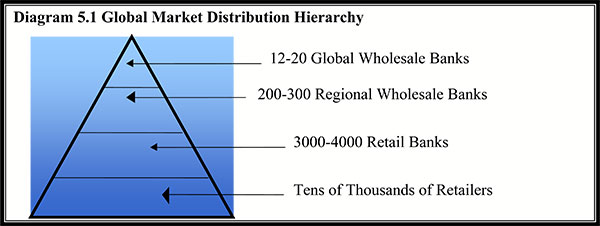 d d
As shown in diagram 5.1, the global wholesale banks service approximately 200 to 300 regional banks in the international markets; the regional banks in turn supply retail banks and retail distributors located in their own and nearby countries. Ultimately, U.S. banknotes make their way to and from end users of currency overseas, such as commercial establishments and individuals. Worldwide, five locations serve as the principal international distribution and consolidation hubs for U.S. banknotes: three in Europe (Frankfurt, London, and Zurich) and two in Asia (Hong Kong and Singapore). The preeminence of all these locations arises from accessible transportation networks as well as the locations' historical focus on international commerce. U.S. banknotes are distributed through international wholesale channels either as new (uncirculated) banknotes, still in the original Bureau of Engraving and Printing (BEP) packaging, or as fit notes (recirculated banknotes) in very good condition. The overwhelming preference for the majority of international market participants is for new U.S. banknotes still in the original BEP packaging because it assures the purchaser that the notes are free of counterfeits. In addition, many dollar users in international markets prefer new banknotes because new banknotes retain their condition longer than fit notes, which show signs of initial wear due to previous circulation. 5.2 The Federal Reserve's Currency Distribution MissionThe responsibility of Federal Reserve Banks for international currency distribution derives from the Federal Reserve's charge under the Federal Reserve Act (FRA) to provide an elastic supply of currency.32 The FRA does not distinguish between the domestic and international supply of currency. In practice, however, the provision of an elastic currency results in the Reserve Banks satisfying overall demand for U.S. currency both domestically and internationally. Historical records indicate that the Reserve Banks distributed currency for overseas demand as early as 1921. Although the FRA does not speak explicitly of an obligation to supply U.S. currency internationally, the Federal Reserve's responsibility is easily inferred for several reasons. The Reserve Banks have a fundamental interest in maintaining the integrity of the U.S. banknotes they issue into circulation because these notes are monetary obligations of the United States, represent legal tender within the United States, and the Reserve Banks are obligated to redeem them on demand. 5.3 Means of International Currency DistributionThe Reserve Banks facilitate the wholesale distribution U.S. currency to meet international demand through banking channels, primarily through depository institutions that are globally active in the wholesale banknote business. The Federal Reserve Bank of New York, on behalf of the Federal Reserve System, also operates a program to distribute U.S. banknotes through Extend Custodial Inventory (ECI) facilities in major international banking centers outside the United States. In addition, several central banks obtain U.S. banknotes directly from the Reserve Banks. Finally, a few globally active depository institutions in the banknote business do not obtain currency services from the Reserve Banks but instead rely on other market sources. Wholesale dealer banks purchase approximately 80 percent of the U.S. banknotes that are exported to international markets from the Federal Reserve Bank of New York. The remaining purchases are distributed from offices of the Federal Reserve Banks of San Francisco and Atlanta. Wholesalers purchase U.S. banknotes to fill customer orders, and the notes are shipped from Federal Reserve Bank cash offices directly to the customers, to the wholesalers' international distribution centers, or if, they are an ECI operator, to the ECI facility. In value terms, approximately 70 percent of U.S. banknotes that wholesale banks purchase in the markets and return to the United States are deposited for processing at the Federal Reserve Bank of New York; the remaining repatriated notes are deposited at the cash offices of the Federal Reserve Banks of San Francisco, Dallas, and Atlanta. 5.4 The Extended Custodial Inventory ProgramThe Federal Reserve System, in consultation with the U.S. Treasury, established the ECI program in March 1996 to facilitate the international distribution of the NCD banknotes, foster the repatriation of older-design U.S. banknotes, and promote the recirculation of fit U.S. banknotes. The NCD $100 note represented the first major design change to U.S. currency in nearly 70 years and, in recognition that an assured supply of U.S. currency abroad would help to maintain stability in international financial markets, the ECI program was developed. After successfully meeting its initial objectives, the ECI program was expanded and its objectives increased to include the collection of information to further the U.S. Treasury, Federal Reserve, and U.S. Secret Service's knowledge and understanding about the international use of USD, international U.S. banknote flows, and counterfeiting of U.S. currency in international markets. An ECI is an overseas cash depot maintained by a private-sector bank that holds U.S. banknotes on a custodial basis in a segregated area of its vaults. While at the ECI site, and during transit between a Reserve Bank and the ECI site, all U.S. banknotes remain on the books of the Federal Reserve Bank of New York. The Federal Reserve debits the reserve account of the bank operating the ECI when it withdraws U.S. banknotes from the ECI inventory to sell to its customers. Depository institutions that operate ECI sites bear all the costs of the insurance coverage that is required by the Federal Reserve, of the ECI site staffing, of maintaining processing operations, and of any necessary physical renovations to its facility to meet the ECI requirements. The Federal Reserve Bank of New York manages the ECI program, bears the costs associated with providing management oversight and monitoring of the program, and coordinates the shipment and receipt of currency between Federal Reserve facilities and the ECIs. Currently, five institutions operate eight ECI facilities in five major cities that serve as the principal international distribution centers for U.S. currency. Economists in the Division of Monetary Affairs at the Federal Reserve Board evaluated the implicit costs and benefits of the ECI program to the U.S. Treasury and concluded that the implicit cost of the program is small compared with the benefit of potential additional seigniorage that might occur because of increased overseas traffic in U.S. currency. The cost is even less significant when viewed in light of continued confidence in the large stock of U.S. currency held abroad. The ECIs provide several important benefits. First, the ECI program facilitates the ongoing international distribution of U.S. currency by enabling inventories of U.S. currency to be maintained in strategic international distribution centers. The ECI inventories allow banknote dealers to draw on an immediate supply of U.S. currency to meet local demand and to help mitigate potential financial crises. In addition, by having readily available supplies of U.S. currency at overseas ECI operations, market participants are not subject to the vagaries of transoceanic transportation schedules or adverse weather conditions for filling orders. The ECI inventories were one part of the Federal Reserve's preparations for the century-date change, which helped assuage currency-related Y2K concerns. Later, when air transportation in the United States was halted after the terrorist attacks on September 11, 2001, the ECI inventories provided immediately available supplies to meet international demands for U.S. currency in the major financial markets without any interruption of service. The ECI program continues to play a key role in the Federal Reserve's strategic plan for international business continuity. A second benefit of the ECI program is that it has provided an effective means of repatriating old-design banknotes. ECI operators are required to sort the U.S. banknotes purchased from market participants by design and into fit and unfit notes, ensuring that old-design and unfit notes are removed from international circulation in a timely fashion and then sent to a Federal Reserve cash processing center for authentication and destruction. A third benefit of the ECI program is its contribution to international public education efforts. The depository institutions that operate ECIs play a central role in educating the public about the authentication features in U.S. currency and informing the international public about design changes. These depository institutions distribute public education program materials and conduct authentication training for hundreds of foreign banks and other users of U.S. currency. Fourth, the ECI program has permitted the Federal Reserve Bank of New York to collect more finely detailed data on country-level U.S. banknote payments and receipts. This data set has been instrumental in the creation of several statistical models for estimating stocks and flows of U.S. currency abroad. These models have in turn been used to gain a better understanding of the benefits and challenges that result from having about $450 billion of U.S. currency held abroad. The ECI program has enabled the Federal Reserve Bank of New York to provide the U.S. Treasury and the Board of Governors of the Federal Reserve System with timelier and more-detailed reporting of country-specific information on overseas use of U.S. currency. Finally, the ECI program provides information on the international flows of counterfeit U.S. currency, which is critical to the U.S. Treasury, the Federal Reserve, and the U.S. Secret Service. The sorting and authentication operations conducted by the ECI operators and the information provided are important aspects of anti-counterfeiting efforts and provide two concrete improvements in reporting. First, the ECI program has become a direct source of information to the U.S. Secret Service on international counterfeiting. All ECI operators use the U.S. Secret Service's counterfeit note search website, USDOLLARS. ECIs detect counterfeit U.S. banknotes early in the distribution supply chain and information on the geographic sources of these counterfeit notes is quickly relayed to the U.S. Secret Service. The ECIs were among the pilot sites for the USDOLLARS website. Second, many U.S. banknote deposits forwarded to Federal Reserve Banks may also be identified by country of origin. Thus, for counterfeits detected at Federal Reserve Banks in ECI shipments, the country of origin where the counterfeits entered into the banking stream may also be reported. In summary, the introduction of the Federal Reserve Bank of New York's ECI program represented a successful approach in the Federal Reserve System's currency distribution and processing policies. The ECI program continues to demonstrate that partnership with the private sector can supplement Reserve Bank capabilities and be a cost-effective and market-sensitive approach. 6 International Counterfeiting of U.S. CurrencyBecause as much as 60 percent of genuine U.S. currency is likely held abroad, it is reasonable to wonder how much counterfeit U.S. currency might also be circulating abroad. When the ICAP teams were initially assembled in the mid-1990s, numerous reports suggested that vast quantities of counterfeit U.S. currency were circulating abroad. Some of these reports and anecdotes came from commercial establishments seeking to sell their anti-counterfeiting products as a method for businesses to protect themselves. Other, more-credible organizations stated that vast amounts of counterfeit notes went undetected and remained in the marketplace indefinitely. All such reports and anecdotes have been refuted by the findings of the ICAP trips as well as by data from official sources, an indication that the actual incidence of counterfeiting is relatively low. This chapter examines the economics of counterfeiting, the mechanics of counterfeiting enforcement, the amount of counterfeits passed and seized in various international markets, and the efforts by the U.S. Secret Service to respond to various counterfeiting threats. Chapter 6 uses data collected by the Federal Reserve and the U.S. Secret Service and an analysis of circulation patterns for genuine and counterfeit U.S. currency to place an upper bound on the estimated quantity of counterfeit currency in circulation. 6.1 General ConsiderationsCounterfeiting of U.S. currency can be a lucrative and relatively low-risk criminal enterprise in many parts of the world. Because USD are widely held and used in many countries, counterfeiters have many opportunities to pass counterfeit U.S. currency, even outside of the United States. Moreover, the punishment for production, distribution, and passing of counterfeit U.S. currency outside the United States varies considerably in severity by country. The level of concern about counterfeiting also varied across the countries visited by the ICAP teams: officials and business people in some countries viewed counterfeits as a considerable threat while some in other countries were more nonchalant, viewing counterfeits as an inescapable part of the banknote business. Regardless of the level of concern, the figures for the incidence of counterfeiting were remarkably consistent: most commercial banks report detecting no more than about one counterfeit note for every 10,000 notes they handle. Detection capabilities for counterfeit U.S. currency are relatively high abroad and, in line with the idea that counterfeit notes are part of the banknote business, the level of resources expended on their detection is determined in cost-benefit terms. Both central and commercial banks display varying detection practices depending on local labor costs, local counterfeit activity, and the relative cost of not detecting a counterfeit. Training tellers to detect counterfeit U.S. currency is not particularly difficult, and it is possible to train tellers in emerging-market countries. In many countries, tellers have an incentive to detect counterfeit U.S. currency because the value of undetected counterfeit notes is frequently deducted from their pay. The incentives for shopkeepers are similar: accepting a counterfeit is likely to result in a direct loss to the business. In countries where USD are a new asset, small commercial banks might suffer a loss from counterfeiting soon after entering the banknote or currency-exchange business and then arrange for training to avoid further losses. Similarly, banks often sort lower-denomination notes by hand or machine, reserving the costly but more-accurate method of hand counting and verification for the $50 and $100 denominations. On balance, counterfeit U.S. banknotes were typically viewed as an occasional but not serious problem within the foreign banking community. In the United States, U.S. currency received by Federal Reserve Banks is authenticated, and any suspect notes detected are forwarded to the U.S. Secret Service for further investigation. The counterfeits detected by the Federal Reserve constitute about 20 percent of all counterfeit notes passed to the public and received by the U.S. Secret Service. The remaining 80 percent of counterfeit U.S. banknotes detected are reported to the U.S. Secret Service directly by commercial establishments, financial institutions, and law enforcement authorities. The U.S. Secret Service maintains two systems to improve statistical reporting of counterfeit note seizures and passing activity: The Counterfeit Contraband System and the USDOLLARS note search website. The Counterfeit Contraband System facilitates the collection of statistical data on investigations regarding counterfeit currency. Information entered into the system is readily available for analysis and is reconciled fifteen days after the end of each month. The system allows each U.S. Secret Service office to monitor the data of all other offices and determine when counterfeiting activity moves from one investigative district to another. Monthly records are closed on the fifteenth of the following month, which allows for timely access to current statistics. In March 1999, the U.S. Secret Service established the USDOLLARS counterfeit note search site on the Internet (www.usdollars.usss.gov) that allows authorized users to access a database containing descriptions of counterfeit notes known to the U.S. Secret Service. This website, which is in continuous operation, allows vetted domestic and foreign financial institutions and law enforcement agencies to input the identifiers on a suspect note to determine if it is a known counterfeit. If the note is a known counterfeit, a U.S. Secret Service classification number is given, and further instructions are provided. If the note is not a known counterfeit, the user is instructed to examine the note carefully for defects and to call the U.S. Secret Service office listed on the screen for additional assistance. This site allows the U.S. Secret Service to obtain information on counterfeit distribution and passing activity more quickly than in the past. The U.S. Secret Service Criminal Investigation Division (CID) is the headquarters unit with oversight of all U.S. Secret Service criminal investigations, including investigations of U.S. currency counterfeiting throughout the world. CID also administers and controls the USDOLLARS website and maintains the counterfeit note database. CID has used the website on several occasions to post information on certain high-quality and large-quantity counterfeit notes to foreign law enforcement and financial institutions as well as the Federal Reserve System, thereby heightening awareness internationally of the appearance of these notes. The USDOLLARS site is currently available in four languages: English, Spanish, French, and Russian. The counterfeit note search site continues to grow in user registration and usage. In addition to providing for the routine processing of counterfeit U.S. banknotes, the website has been effectively used as a proactive enforcement tool. Certain high- priority notes, such as notes targeted in a specific investigation, can be carefully monitored by CID. When a user anywhere in the world enters the identifiers on these notes, this information can be rapidly disseminated to the responsible U.S. Secret Service field office and other authorities for immediate investigative action. Over time, the U.S. Secret Service expects additional foreign banks and law enforcement agencies to use the system, thus incorporating more timely and complete information from a wider array of countries. The website currently has more than 23,000 subscribers in 90 countries, including a variety of law enforcement agencies, financial institutions, and approved commercial entities.
6.2 Counterfeit Production MethodsVarious methods, which span a wide range of quality in output, are currently used for producing counterfeit U.S. banknotes. Once produced, the counterfeit U.S. currency must either be passed by the manufacturer or transferred to others for distribution; either method is a complicated undertaking when large volumes of notes are produced. A bank or an individual might be fooled into accepting a batch of counterfeit U.S. currency once, but seldom more than once. Thus, the counterfeiter must distribute the bogus notes ever more widely. In the past, producing highly deceptive or easily passed counterfeit U.S. currency required substantial technical ability and access to presses, inks, and, critically, high-grade paper. With advancements in personal computing and other digital technology, printing technology is improving at a dramatic rate, thus reducing the costs and printing skills or special training needed for counterfeiting. As a result, the quality of counterfeit U.S. currency that can be produced on color copiers or on inexpensive personal computer equipment is increasing. Counterfeit U.S. banknote manufacturing operations are of three basic types: traditional offset-printed counterfeit notes, digitally printed notes, and more highly deceptive notes produced by intaglio and typographic printing methods. Traditional offset lithography requires specialized printing equipment and materials as well as considerable skill. The counterfeit U.S. banknotes produced by offset lithography can be quite deceptive to the public but are generally easy to detect by trained cash handlers. The high volume of counterfeit U.S. currency that can be easily produced by offset lithography presents a significant threat. Digital printing techniques employ copying machines, scanners, and computers, which reproduce currency images using multicolor plastic toners or liquid inks. These counterfeit notes vary greatly in quality. A layperson with only rudimentary computer skills can use digital technology to produce a reasonably "passable" counterfeit note. Digital technology is also poised to revolutionize traditional printing operations. Fully automated and computer-controlled offset presses and other specialized printing equipment being introduced in today's market are allowing high-quality and high-volume printing with little training or expertise. The U.S. Secret Service suspects that the counterfeiting of U.S. currency will continue to be easier as the technology improves and the cost of computer equipment (including printers and scanners) decreases. Counterfeiting with laser color printers is likely to increase with the affordability of the printers. Similarly, the growing use of the Internet is expected to aid counterfeiting. Finally, certain highly deceptive notes, termed "supernotes" or "super dollars" by the media, have received worldwide attention. These notes are printed with intaglio and typographic methods similar to those used by the U.S. Bureau of Engraving and Printing (BEP) and use specially manufactured paper. Despite the high quality of this type of counterfeit, defects and other features allow it to be consistently detected in currency processing at Federal Reserve Bank cash offices and other financial institutions worldwide. In addition, in terms of volume, the current threat from this type of counterfeit is greatly overshadowed by the threat from offset and digital counterfeiting. Nonetheless, the U.S. Secret Service continues to investigate aggressively all cases of "highly deceptive" counterfeit U.S. currency to mitigate direct economic loss and a loss in confidence in U.S. currency worldwide. Of the 469 counterfeit-currency printing operations suppressed in the United States during fiscal year 2004, 453, or 96.6 percent, used digital processes, a phenomenal increase from the 29 digital operations (or 18.9 percent of the total) suppressed in FY 1995. Although the quality of digital counterfeits varies widely and although they are not at present being produced outside of the United States in nearly the same volume as they are domestically, the increasing use of computers in the production of counterfeit notes remains a key concern for the U.S. Secret Service. The rise in digital counterfeiting continued in FY 2005. That year, of 611 counterfeit currency printing operations suppressed, 598, or 98 percent, used digital processes. 6.3 Recent Experience with CounterfeitingOut of the approximately $760 billion in U.S. banknotes in circulation by the end of 2005, the U.S. Secret Service reported that about $61 million in counterfeit currency was passed on the public worldwide, or about $1 for every $12,400 in circulation.33 Of that $61 million, the vast majority ($55.2 million) was passed in the United States, with the remainder passed abroad. In terms of enforcement, the U.S. Secret Service counterfeit program in FY 2004 resulted in the arrest of 2,879 suspects and the suppression of 469 counterfeiting plants in the United States. In FY 2005, 3,717 suspects were arrested and, as mentioned above, 611 counterfeit printing plants were suppressed. 6.3.1 Overall Figures on Passing and Seizures of Counterfeit U.S. CurrencyWithin the United States, all detected counterfeit currency must be turned over to the U.S. Secret Service. As mentioned earlier, the laws of other countries vary considerably. Thus, the U.S. Secret Service's data for the United States are much more complete than the equivalent data for other countries. Table 6.2 displays figures on counterfeit currency passed or seized from 1999 to 2005.
Note. "Seized" refers to counterfeit currency that was detected before being circulated, while "passed" indicates currency that was determined to be counterfeit after entering circulation. Only passed currency represents a loss to the public; seized counterfeits represent an averted threat. 6.3.2 Rates of Counterfeiting in Federal Reserve StatisticsTables 6.3 and 6.4 provide some evidence on the frequency with which counterfeit notes are found in domestic and foreign deposits at Federal Reserve Bank cash offices. Table 6.3 shows the overall results by denomination for 2005; the denomination with the largest amount of counterfeits, both in dollar terms (about $10 million) and as a proportion of notes processed (about 44 per million notes), was the $100 note.
6.3.3 Counterfeiting Inside and Outside the United StatesTable 6.4 provides a rough breakdown of the data for $100 note counterfeits detected at Federal Reserve Bank cash offices by origin of deposit. The bulk of currency shipments into the United States arrive at the Federal Reserve Bank cash offices in New York, Miami, and Los Angeles, and so activity at those offices can be seen as an indication of how foreign currency inflows differ from domestic inflows. In this rough breakdown, a general downward trend in the incidence of counterfeiting is visible, from about 60 notes per million in 1996 to between 20 and 30 notes per million in 2003 and 2004. The increase in 2005 is a result of counterfeits detected in deposits from Peru, which is discussed in sections 6.4 and 6.5. With the exception of 2005, the incidence of counterfeit detection in foreign deposits appears to be similar to that at the "domestic" Reserve Bank cash offices.
The figures in table 6.4a apply only to the New York cash office, but they provide a precise breakdown of counterfeit detection by domestic and foreign origin. Notably, the incidence of detection for counterfeit U.S. currency received from international sources is considerably lower than that for domestic sources. In addition, the 2005 figures shown in table 6.4a are not affected by the receipt of a very large quantity of counterfeit $100 notes detected in deposits from Peru. We believe that the lower incidence of counterfeits indicated for international sources shown in table 6.4a is likely more indicative than the rougher breakdown shown in table 6.4. The lower figures for foreign deposits likely reflect two factors. First, foreign deposits are smaller because the cost of transporting U.S. currency is generally higher from a foreign location than from a domestic location, and thus USD held outside the United States tend to return to Federal Reserve Bank cash offices less frequently. Second, USD that are shipped back to Federal Reserve Bank cash offices have likely been scrutinized more because of both their longer lifespan away from the Federal Reserve and the generally lower labor costs of currency authentication outside the United States.
Table 6.5 provides data on the highly deceptive "supernotes." As noted above, supernotes are printed by the intaglio method, the same method used by the BEP to print genuine notes. Nearly all highly deceptive counterfeits are the $100 denomination, as the labor involved in producing and circulating them apparently does not make counterfeiting lower denominations worthwhile. The value of the passed supernotes is a small share of overall passing activity. In 2005, only $1.4 million of the $56.2 million, or about 2.5 percent, of counterfeit notes passed in the United States fell into the highly deceptive category.
6.3.4 International Law Enforcement Cooperation with the U.S. Secret ServiceThe statistics in the previous section make it clear that counterfeiting of U.S. currency is not just a domestic problem. In addition to the fact that counterfeit U.S. currency circulates abroad, evidence indicates that many of the counterfeit U.S. banknotes passed in the United States originate abroad.34 Before 1996, contact with the U.S. Secret Service by foreign law enforcement officials (including INTERPOL) and financial institutions can best be described as inconsistent. Counterfeiting of U.S. banknotes has not been and still is not considered a significant offense in most countries.35 In addition, there was neither a central repository for counterfeit notes nor a coherent policy for reporting counterfeit activity. Partly because of the contacts established during ICAP trips, many improvements have been achieved in the U.S. Secret Service's investigative techniques and data gathering and, above all, in its relationships with the law enforcement and financial institutions. Field presence has increased, and new offices have been established in key strategic locations. The U.S. Secret Service now has permanent offices in eighteen cities: Bangkok, Bogot�, Brasilia, Bucharest, Frankfurt, Hong Kong, London, Mexico City, Milan, Montreal, Moscow, Ottawa, Paris, Pretoria, Rome, Sofia, Toronto, and Vancouver. Through these offices, the U.S. Secret Service can more readily respond to counterfeit inquiries, establish contacts with local police agencies, offer expert testimony, conduct interviews, and assist in overall investigations. The new offices have already resulted in the seizing of substantial amounts of counterfeits and arrests that would not have been possible without an immediate presence in country. The U.S. Secret Service continues to develop important new relationships with key law enforcement agencies worldwide. In FY 2005, the U.S. Secret Service placed two key posts in Europe: a liaison officer at Europol in The Hague, Netherlands, and an attach� at Interpol in Lyon, France. The U.S. Secret Service post at Europol is primarily responsible for serving as a Europol liaison officer (ELO) from the U.S. Secret Service. This position also has collateral duty of being the U.S. Secret Service attach� to the region, providing investigative and technical assistance to the surrounding region. The Europol office was set up (operational July 1999) to help the law enforcement services of the European Union combat serious organized crime, which affects two or more member states. It does this by facilitating the exchange of criminal intelligence, primarily through the ELOs, and adding to the value of information, in order to produce new actionable knowledge. Unlike Interpol, Europol does not have any arrest capabilities. The U.S. Secret Service attach� position at Interpol allows the U.S. Secret Service to handle and facilitate requests for investigative and technical support regarding counterfeit U.S. currency and other obligations. The U.S. Secret Service continues to encourage, facilitate, and monitor public education in counterfeit detection. International initiatives include training and education for the banking and law enforcement community through its foreign offices, foreign task forces, ICAP, and the International Law Enforcement Academies (ILEAs). 6.3.5 International TrainingUnder the auspices of the Department of State's Anti-Crime Program, the U.S. Secret Service's Criminal Investigative Division (CID) receives funding to provide seminars on counterfeiting, financial crimes, and electronic crimes for the former eastern bloc countries, Russia, the Baltic region, and Asia. The seminars are conducted at the International Law Enforcement Academies (ILEA) in the following locations: Budapest, Hungary; Bangkok, Thailand; Gaborone, Botswana; and San Salvador, El Salvador. In addition, there is an ILEA in Roswell, New Mexico that offers a curriculum similar to that of a criminal justice university. The courses have been designed and are taught by academicians for graduates of the regional ILEAs. ILEA Budapest opened in 1995 to assist Eurasia and Eastern European countries and conducts five sessions a year. ILEA Bangkok opened in 1999. The curriculum and structure of this academy is similar to ILEA Budapest except for the shorter duration of the core course and added emphasis on narcotics matters; three sessions are held each year. ILEA Gaborone opened in 2001; its overall instructional format is similar to Budapest and Bangkok but is adapted to suit the needs of that region. ILEA Gaborone conducts four sessions a year. ILEA Latin America opened in 2005 and offers a core similar to Bangkok tailored to the regional needs of Latin and Central America. The International Counterfeit Detection Training Initiative began as a pilot program in 2004 in response to a demand for targeted counterfeit detection training that would meet the investigative needs of the U.S. Secret Service and the operational needs of international financial institutions. Sponsored by global banks, this initiative focuses on training bank and law enforcement officials on the detection of counterfeit U.S. currency. It also provides a forum within which to introduce and promote various counterfeit detection tools that the U.S. Secret Service offers, including the USDOLLARS website (www.usdollars.usss.gov). The website provides users with an immediate response to a counterfeit note query and helps the U.S. Secret Service determine the volume and type of notes in specific regions of the world. Each seminar is tailored to the training location and usually consists of sessions that cover detailed information on genuine U.S. currency and advanced counterfeit methods and defects and a session that involves microscope examination of sample notes. Table 6.6 displays a list of locations and dates where training had occurred as of March 2006.
6.4 Counterfeiting Activity by Country of OriginWith the introduction of the additional offices and the new data-collection systems described in section 6.1, information that is more comprehensive can be obtained on the true state of counterfeiting in terms of production, longevity, and movement within a given geographic region. The newer contacts, principally in Latin America and Eastern Europe, coupled with the establishment of the ECIs, provide information that is more definitive to the U.S. Secret Service related to criminal activity. As indicated in table 6.2, in fiscal 2005, the U.S. Secret Service reported foreign seizures totaling $37.9 million in counterfeit U.S. currency and foreign passing totaling $4.8 million in counterfeit U.S. currency. While the combined total of both seized and passed currency for foreign activity is comparable to that for the United States (see table 6.2), many more U.S. counterfeit notes are seized in foreign countries than are passed in foreign countries, according to statistics compiled from foreign sources. Thus, it appears that the amount of counterfeit U.S. currency passed abroad is less than that passed within the United States. The ICAP team, however, believes the statistics reflect how the U.S. Secret Service receives information regarding U.S. currency counterfeit activity abroad. In the United States, the U.S. Secret Service field offices report information on passing activity and counterfeit plant suppressions. In contrast, in foreign countries the U.S. Secret Service must rely on other international law enforcement representatives. Foreign law enforcement often requests the assistance of the U.S. Secret Service to suppress counterfeit plant operations, which allows the U.S. Secret Service to collect the information associated with seizures. In many countries, however, regulations regarding the detection of counterfeit U.S. currency require financial institutions and merchants to forward the passed counterfeits to the central bank. Because the U.S. Secret Service does not always work with foreign central banks, the counterfeit passing activity is not always reported to the U.S. Secret Service. The U.S. Secret Service believes that the true quantity of counterfeit U.S. currency passed abroad may be more comparable to that passed within the United States. Table 6.7 presents data on the ten most active countries over the past six fiscal years, ranked by the total value of counterfeit currency that was reported as seized or passed to the U.S. Secret Service. As can be seen, the very large seizures quite often occur in countries where USD circulation is limited. The most notable anomaly shown in table 6.7 is the sharp increase in counterfeit U.S. currency activity in Peru. For approximately three months in 2005, the highly deceptive supernote appeared in the Peruvian economy. The increase in passed counterfeit U.S. currency revealed a major vulnerability in the Peruvian banking system. The U.S. Secret Service responded to Peruvian law enforcement and financial system requests by traveling to Peru and presenting counterfeit detection and currency authentication seminars to the banking sector and the armored cash-in-transit industry. This incident demonstrated that the Peruvian government (including the central bank) did not have laws or regulations in place regarding the confiscation and surrender of counterfeit U.S. currency. Although the U.S. Secret Service continues to provide investigative and technical support to Peruvian law enforcement, the Peruvian banking system will likely remain vulnerable until the Peruvian government changes its laws and regulations regarding the production and passing of counterfeit U.S. currency.
6.5 Counterfeiting in Key Countries and RegionsThe U.S. Secret Service allocates its resources for combating counterfeiting abroad based on the overall incidence of counterfeit U.S. currency activity in a particular geographical area. The U.S. Secret Service has found that the strategic placement of its personnel abroad promotes successful foreign police anti-counterfeiting operations. U.S. Secret Service agents assigned abroad are able to respond more promptly and consistently in support of joint international counterfeit currency investigations. In time, the long-standing relationships that develop from day-to-day interactions, liaison activities, and training and the ability to focus consistently on ongoing problems encourage foreign law enforcement counterparts to increase the priority given to this type of investigation. In locations where a permanent presence is not feasible, the U.S. Secret Service employs task forces to target regions with large amounts of counterfeit currency (for example, Taipei, Taiwan). Two regions -- Latin America and countries on Russia's southern border -- and two countries -- Colombia and North Korea -- deserve special mention in any review of the responses developed by the U.S. Secret Service to deal with counterfeiting threats from abroad. Colombia registers first on the counterfeiting threat list because it has been the chief supplier of counterfeit notes to the U.S. market. Relatively high-quality Colombian counterfeit U.S. banknotes have been successfully imported into the United States for several decades. In the last ICAP report, Bulgaria was a country of concern because of the growth of organized crime in southeastern Europe. Since 2002, both production and trafficking of counterfeit U.S. banknotes have declined sharply, likely because of the opening of the U.S. Secret Service resident office in Sofia, Bulgaria. U.S. Secret Service-Sophia has been able to establish liaisons with local law enforcement and to provide investigative and technical assistance. 6.5.1 Latin AmericaFull or partial dollarization in Latin America, along with a relatively low threat of prosecution, has made this region an attractive target for counterfeit U.S. currency. Perhaps more significantly, the organizational structures developed to manufacture and distribute narcotics in and through this region are ideally suited to the manufacture and distribution of counterfeit U.S. currency. Moreover, given the respective penalties involved, these counterfeiting activities entail considerably less risk than the drug trade. In the past several years, the U.S. Secret Service has seen a significant increase in the number of packages of counterfeit U.S. currency seized in transit to or through Central and South American countries. Most of the intercepted packages of counterfeit U.S. currency, which were sent to the United States, Europe, or elsewhere outside of Latin America, originated in Colombia. The U.S. Secret Service has long recognized the need to expand its enforcement efforts and to foster greater cooperation with law enforcement authorities and financial institutions throughout Latin America. In August 2002, the U.S. Secret Service, in cooperation with the Colombian National Police, hosted the "International Seminar on Counterfeit Money: A Latin American Perspective on the U.S. Dollar" in Bogot�, Colombia. This conference brought together senior representatives of law enforcement agencies from eighteen countries to learn about the characteristics of genuine and counterfeit U.S. currency and to discuss investigative strategies for counterfeiting enforcement and prosecution. Law enforcement officials and prosecutors from Colombia, Argentina, Ecuador, Brazil, Chile, Peru, Uruguay, Paraguay, Panama, Costa Rica, El Salvador, Guatemala, Nicaragua, Mexico, Honduras, and the Dominican Republic, as well as representatives from Spain, EUROPOL, and the Southern European Cooperative Initiative (SECI), which represented Turkey and Romania, attended the conference. This conference was a major initiative on the part of the U.S. Secret Service and the authorities in each of these countries to address the current and potential threat of U.S. currency counterfeiting. In addition to a mutual pledge to take a proactive stance against counterfeiting in this region, essential relationships were established that should have a great impact on future enforcement efforts. 6.5.2 Colombia: Primary Foreign Producer of Counterfeit Dollars Passed in the United StatesColombia is consistently ranked in the top five of counterfeit source nations by value of seized counterfeit and has been a primary source of counterfeit U.S. currency flowing into the United States for more than two decades. During FY 2005, approximately 15 percent ($8 million out of a total of $56.2 million) of all counterfeit currency passed within the United States originated in Colombia. The percentage of counterfeit currency passed within the United States that was produced and trafficked by individuals and organized groups in Colombia has declined because of the continued partnership and success of Plan Colombia. Because large volumes of Colombian counterfeits have been entering the United States for many years, the U.S. Secret Service established the South American Task Force (SATF) in Bogot�, Colombia in 1997.36 The SATF and the U.S. Secret Service's Miami field office, Bogot� resident office, and Counterfeit Division have been instrumental in training South American law enforcement agencies in the detection, interdiction, and suppression of counterfeit U.S. currency. During the course of several investigations, the SATF has identified organized distribution networks, methods of concealment and trans-shipment, and contraband exchange and payment procedures, and has developed informants and identified U.S. cities targeted for the sale of counterfeit U.S. currency. In May 2001, the U.S. Department of State's Bureau of International Narcotics and Law Enforcement Affairs and the U.S. Department of the Treasury's Office of Enforcement signed an agreement to support a project to combat organized financial crime. These agencies agreed to work under the coordination of the Department of the Treasury's Office of Enforcement. Funding for this project came from the Colombian Justice Sector Reform Program within the "Assistance for Counter-Narcotics Activities" account of the Plan Colombia Supplemental Appropriation. Within this program, the U.S. Secret Service established its vetted anti-counterfeiting force in Colombia. The specific goal of this project is to assist specialized Colombian law enforcement units with training, strategy development, and infrastructure improvements. These efforts were all designed to reduce the production, sale, distribution, processing, transportation, and trafficking of counterfeit U.S. currency within Colombia. These vetted Colombian law enforcement units, working in conjunction with agents primarily from the U.S. Secret Service Miami field office and the Bogot� resident office, have been very successful. Counterfeiting in Colombia involves organized criminal groups that employ skilled individuals familiar with offset lithography and technical processes to modify various substrates (that is, papers) and inks to create high-quality counterfeit U.S. currency. These criminals frequently employ the same individuals involved in the trafficking of narcotics to the United States, and they use many of the same smuggling methods. Because of the relatively low penalties for counterfeiting U.S. currency in Latin American countries compared with those for narcotics trafficking, counterfeiting may be seen as an attractive alternate or parallel activity. Suppression of counterfeiting operations in Colombia is complicated by the same problems faced in the suppression of narcotics. Government resources are limited, and the country's sociopolitical issues are complex. Nevertheless, the U.S. Secret Service's Plan Colombia project can claim some major successes. U.S. Secret Service statistics, shown in table 6.8, reveal the cumulative impact of major seizures of counterfeit U.S. currency, plant (counterfeit manufacturing operation) suppressions, and dismantling of distribution networks. The increase in foreign arrests has been accompanied by a measurable decrease in Colombian counterfeit passing since the inception of Plan Colombia. The infrastructure established through Plan Colombia continues to grow and develop, with additional law enforcement training, special programs, and legislative efforts within Colombia to enhance penalties for counterfeiting.
The U.S. Secret Service assisted in implementing a counterfeit detection program in Colombia that employs specially trained canines to detect Colombian-produced counterfeit U.S. banknotes through the unique aroma present in these counterfeit notes. The program also includes the construction of kennels and canine training areas, canine procurement, the training of canines and handlers in counterfeit detection, equipment and supplies, veterinary care, operational procedures, and cost analysis. The success of this program will depend on the commitment to training and to the strategic use of these new canines as a deterrent to the smuggling of counterfeit U.S. banknotes out of Colombia. Historically, Colombian counterfeiters arrested in Colombia have been able to avoid significant jail time by having their sentences converted to an administrative fine. The fact that many of those arrested are repeat offenders indicates that arrests were not much of a deterrent in Colombia. This issue was addressed in various meetings with Colombian officials, and in 2003, the Colombian Congress enacted the penal code reforms that abolished administrative fines and imposed a mandatory term of imprisonment for any person convicted of importing, exporting, acquiring, receiving, or negotiating foreign or domestic counterfeit currency in Colombia. The Colombian Congress enhanced the counterfeit currency penal code in 2005. 6.5.3 PeruIn March 2005, the U.S. Secret Service learned that the Federal Reserve Bank cash office in Miami had received a large quantity of highly deceptive $100 supernotes in deposits from financial institutions in Peru. The high volume of supernotes detected in the deposits sparked alarm in the Peruvian banking system, and the Peruvian press subsequently reported the magnitude of counterfeit U.S. currency that had infiltrated their financial system. To combat the unease in the banking system, the U.S. Secret Service sent agents and counterfeit specialists to Peru to meet with and provide counterfeit detection training to representatives of foreign law enforcement, the Peruvian Central Bank, and other financial institutions within Peru. During the meetings in Peru, it was discovered that cash-in-transit companies in Peru, rather than the commercial banks or Central Bank, were responsible for authenticating currency. Furthermore, the meetings revealed that there were no laws established in Peru regarding counterfeiting of foreign currency, including U.S. currency. Agents from the U.S. Secret Service Miami field office continue to provide training and technical assistance to law enforcement and financial institutions in Peru. However, until Peru establishes policies, banking regulations, and laws regarding the handling of counterfeit U.S. currency, the commercial and financial sector remains a target for traffickers in counterfeit U.S. currency. 6.5.4 The Russian CaucasusThe U.S. Secret Service is currently investigating a scheme with ties to suspects in Israel, Russia, and the Republic of Georgia to produce counterfeit U.S. currency. The U.S. Secret Service has reason to believe that this family of counterfeit notes (C‑21558) is being produced in the Caucasus region. These good-quality counterfeit notes first appeared in Jerusalem in small numbers in March 1999. Domestic passing activity has increased dramatically in recent years, more than doubling from $1.5 million in 2003 to $4.1 million in 2004. In 2005, this activity increased even further, to $5.3 million. Since the C‑21558 family's first detection in March 1999, the total counterfeit activity (passed and seized notes) has exceeded $23 million. U.S. Secret Service agents have participated in numerous investigations linking this family of counterfeit notes to many other cases. To date, more than 130 suspects have been arrested in conjunction with this investigation. The majority of these counterfeit notes have been passed in the northeast corridor of the United States, including Buffalo, N.Y.; New York City; Newark, N.J.; and Baltimore. U.S. Secret Service agents are currently working closely with the Israeli National Police, Georgian Ministry of Internal Affairs, and Russian National Police/Ministry of Internal Affairs in an effort to identify investigative leads and to continue the progress in this case. 6.5.5 Bulgaria: UpdateIn March 2002, the U.S. Secret Service formally joined forces with the Bulgarian National Service for Combating Organized Crime to form the Bulgarian Counterfeit Task Force. From 1996 through fiscal year 2005, $18.1 million in counterfeit U.S. currency manufactured in Bulgaria has been passed or seized worldwide, and more than seventy-five related arrests have been made. In the previous ICAP report, Bulgaria was a country of concern because of the growth of organized crime in southeastern Europe. The U.S. Secret Service's Sofia office, which opened in 2002, has been able to establish liaisons with local law enforcement and to provide investigative and technical assistance to Bulgarian authorities. Since the U.S. Secret Service permanently established its Sofia resident office, passing of Bulgarian-produced counterfeit U.S. currency within the United States has declined markedly. In addition, after the introduction of the euro banknotes in 2002, Bulgarian counterfeiters began to focus on counterfeiting the euro. 6.5.6 China: UpdateAlthough China was mentioned in the previous report, it is not currently an area of major concern for counterfeiting of U.S. currency. However, because of China's emerging economy and its geographic location bordering North Korea, the country remains of interest for counterfeit passing and trafficking. The U.S. Secret Service has a resident office in Hong Kong whose are of responsibility includes mainland China. 6.5.7 North Korea and the SupernoteSince 1989, the U.S. Secret Service has led a counterfeit investigation involving the trafficking and production of highly deceptive counterfeit notes known as supernotes. The supernote investigation has been an ongoing strategic case with national security implications for the U.S. Secret Service since the note's first detection in 1989. The U.S. Secret Service has determined through investigative and forensic analysis that these highly deceptive counterfeit notes are linked to the Democratic People's Republic of Korea (DPRK) and are produced and distributed with the full consent and control of the North Korean government. In March 2005 and again in June 2006, Interpol issued an "Orange Alert" regarding the DPRK and its continued quest to obtain or purchase printing supplies that would facilitate the counterfeiting of U.S. currency. The U.S. Secret Service is working very closely with the intelligence community in analyzing supernote distribution activity and monitoring the broader illicit affairs of the DPRK. Over the course of this sixteen-year investigation, approximately $22 million in supernotes has been passed to the public (table 6.5), and approximately $50 million in supernotes has been seized by the U.S. Secret Service. 6.6 The Changing Nature of the Counterfeiting ThreatThe mission of the U.S. Secret Service has always been to suppress counterfeit production in the United States, but it now faces a constant battle of monitoring improvements in technology that make digital counterfeiting easier and cheaper. Less than ten years ago, computer-generated notes were generally of poor quality. The computer printers and the software available could not generate images of sufficiently high resolution to produce good-quality notes. It is estimated that the majority of the households in the United States now have computers with Internet access. The prospective digital counterfeiter can obtain the necessary equipment to produce a reasonably deceptive counterfeit note for less than $300. The value of counterfeit U.S. currency passed in the United States over the three fiscal years 1995-1997 was stable; however, there was a significant increase in FY 1998, to approximately $40 million. In fiscal years 1999-2004, the value of counterfeit U.S. currency passed in the United States remained in the $40 million range. In FY 2005, the value of counterfeit U.S. currency passed in the United States increased to $56.2 million, of which digital counterfeiting represented more than 50 percent. Since the emergence of newer methods of producing counterfeit banknotes, the percentage of inkjet counterfeit notes has dramatically increased (table 6.9). Many inkjet-produced counterfeit notes are of lesser quality than notes produced on offset presses, but their quality is high enough to deceive many commercial establishments. In addition, the dramatic increase in the supply of inkjet counterfeits has led to a concomitant sharp increase in plant suppressions and related arrests (middle columns of table 6.9). However, this phenomenon is not exclusively or even mainly a juvenile offender problem. While there were approximately 3,000 counterfeit plants in the last five years, nearly 600 of those cases (i.e. 1 in 5) involved juveniles manufacturing inkjet counterfeits.37
Thus far, the problem of digitally printed notes is largely a domestic one, mainly because the United States has a knowledgeable and widely dispersed group of personal computer users. However, as the technology spreads, it is reasonable to predict that digital counterfeit patterns will follow. In the wake of the terrorist attacks of September 11, 2001, the U.S. Congress, recognizing the threat to our nation's critical economic infrastructure posed by financial crimes, included the counterfeiting of U.S. currency in the Uniting and Strengthening America by Providing Appropriate Tools Required to Intercept and Obstruct Terrorism (USA PATRIOT) Act of 2001.38 On October 26, 2001, the President signed the act into law. This legislation, among other things, modified existing counterfeit statutes to accommodate emerging and future technologies, such as digital technology, and strengthened maximum statutory penalties for counterfeiting violations. This new law amends the U.S. criminal code to make counterfeiting statutes apply to all counterfeiting activity regardless of the technology employed.39 On November 1, 2001, the Federal Sentencing Commission issued amended sentencing guidelines that included penalty enhancements for counterfeit currency violations. The new guidelines provide enhanced minimum penalties regardless of the volume of counterfeits involved in the offense, enhancements for manufacturing, and enhancements for possessing or controlling "distinctive counterfeit deterrents." The latter enhancement applies when counterfeiters attempt to simulate security features found in genuine currency, particularly in NCD and NCM notes. Both the USA PATRIOT Act and recent federal sentencing enhancements demonstrate recognition on the part of lawmakers of the sharp growth in digital counterfeiting and related computer crimes. Recent events have heightened awareness of the threat posed by organized criminal groups, including those counterfeiting U.S. currency. Continued cooperation with worldwide enforcement, legislative, and educational efforts will enhance the security of our nation's financial infrastructure and will strengthen the security of U.S. currency. In sum, the fight against counterfeiting is dominated by three current factors. First, the security features of the NCD and NCM banknotes enhance the public's ability to authenticate U.S. currency, and future design changes to U.S. currency will make it even more resistant to counterfeiting. Second, digital technology used to produce counterfeit U.S. currency is becoming easier and cheaper to use and acquire, making the use and awareness of counterfeit-resistant features by the public, businesses, and financial institutions more important if we are to stop the passing of counterfeits at the first passing. Third, partly because of the communication channels established by the ICAP initiative, efforts should continue regarding the enforcement and suppression of U.S. currency counterfeiting, especially in dollarized and dollar-sensitive economies. 7 Estimates of CounterfeitingThis chapter presents the calculations that form the basis of a point estimate and estimated upper bound on the value and quantity of counterfeits in circulation. The estimates are based on counterfeit data collected by Federal Reserve and the U.S. Secret Service as well as current understanding of circulation patterns for genuine and counterfeit currency. The value of counterfeits in circulation is most likely around $70 million, or fewer than one in 10,000 notes, with about 60 percent of these held abroad. The upper bound is estimated to be about $200 million, or about 2.5 in 10,000 notes. Very good sample data on counterfeits are available from two sources that can be considered independent in various dimensions. Both sources suggest that the incidence of counterfeits in the population is quite small, on the order of one note in 10,000 for $100 notes.40 To develop appropriate confidence bounds for extrapolation, we compare the data from these two sources. In addition, using currency-processing data, we are able to estimate the degree to which the currency received by the Federal Reserve is likely to be representative of the total population of currency outstanding. We also consider the impact on the estimates of the currency that circulates only infrequently through Federal Reserve Bank cash offices. We conclude that it is unlikely that pockets containing large numbers of undetected counterfeits exist for very long outside the banking system. In sum, counterfeiting is not currently a serious problem for the U.S. economy as a whole. However, evidence indicates that the level of counterfeiting remains low precisely because counterfeiting is diligently investigated and prosecuted, as well as because of the effective design and comprehensive public education program.41 As mentioned previously, technological advances aid both the U.S. Secret Service, which is in charge of enforcing counterfeiting laws, and the counterfeiters, who use available tools to attempt to perpetrate a very lucrative type of crime. Thus, counterfeiting will remain low only as long as the U.S. Secret Service is able to act vigorously to prevent it. The first section describes a general economic model that explains the level of counterfeiting. The second section reviews the data sources available and presents comparisons of the two major datasets. The third section presents our estimates. The fourth section presents a model of currency circulation that demonstrates that it is quite unlikely that a large pool of counterfeits can circulate undetected. The fifth section is the conclusion. 7.1 Theoretical WorkThe few theoretical papers on the economics of currency counterfeiting conclude that there are only two possibilities for long-run equilibrium -- either very low or very high levels of counterfeiting. There is no middle level of counterfeiting. More specifically, given the actual level of enforcement against counterfeiting and the level of counterfeit-deterrent features in the genuine notes, the economy can reach two alternative equilibria: either counterfeit currency takes over, as in a situation in which Gresham's law holds (that is, bad money drives out good) or counterfeit notes hardly get any foothold whatsoever (Lengwiler, 1997). In Lengwiler's model, the equilibrium that actually occurs is a function of the note's production cost (that is, the difficulty of counterfeiting it) and its face value. The higher the cost of counterfeiting and the higher the value of the note, the more likely the monetary authority is to invest in higher-cost notes and thus ensure a near-zero-counterfeiting equilibrium. U.S. banknotes, especially the pre-NCD series, had significantly fewer counterfeit protection devices than the banknotes of many other industrialized countries and were low relative to those seen in other countries' currencies.42 However, as Green and Weber (1996) point out, the technology embedded in the NCD $100 approached that of other countries' currency. As new U.S. banknote designs incorporate new security features, the technological level of U.S. currency will increase the complexity of counterfeiting U.S. currency. Clearly, if the high-counterfeiting equilibrium had some real-world relevance, one would not observe the large demand for USD that exists in most parts of the world. Rather, the other low-counterfeiting equilibrium in Lengwiler's model appears to be consistent with the actual data on counterfeiting of U.S. currency in which the frequency of counterfeits is approximately one in 10,000. In terms of the economic model described above, these outcomes suggest that the effectiveness of counterfeiting deterrents embedded in U.S. banknotes, combined with the effectiveness of law enforcement provided by the U.S. Secret Service and its foreign counterparts, has been adequate to keep the economy operating at the low counterfeiting state, given the two possible equilibria that could occur. 7.2 Data SourcesThe two primary sources of data on counterfeiting are the U.S. Secret Service and the Federal Reserve. In addition, this project has obtained some institutional knowledge from foreign central banks, commercial banks, currency dealers, banknote shippers, and other officials responsible for currency distribution and counterfeit detection around the world. 7.2.1 U.S. Secret Service DataThe U.S. Secret Service collects data on all counterfeits found in the United States as well as all counterfeits it receives abroad. For every counterfeit obtained, the U.S. Secret Service records its characteristics and location of discovery. Statistics for notes that are seized before being put into circulation are kept separately from those for counterfeits detected while in circulation. This distinction is important for the estimates of counterfeits in circulation, in which we focus on the notes that were passed (actually used in at least one transaction). While the number of notes seized is important from a law enforcement perspective, only the notes that were actually placed into circulation generate an economic loss to the public.43 Although the U.S. Secret Service data are the most comprehensive available, the data on the passing of counterfeit U.S. currency outside the United States are incomplete for two major reasons. First, counterfeit U.S. banknotes found abroad may be retained by banks, returned to customers, or held by local law enforcement authorities without being reported to the U.S. Secret Service. Second, the capacity of the U.S. Secret Service itself to detect and seize counterfeit U.S. currency abroad is directly related to its ability to develop working relationships with the appropriate foreign and international agencies and officials: detection of counterfeits is highest where the U.S. Secret Service has the best ties with local law enforcement agencies. As shown in the top panel of table 7.1, the amount of counterfeit currency passed (and detected) in the United States in 2005, $56.2 million, was much greater than the amount the U.S. Secret Service seized (that is, intercepted before it was circulated) in the United States, $14.7 million. Outside the United States, however, the amount of counterfeit U.S. currency reported as seized is much higher than the amount reported as passed ($37.9 million and $4.8 million respectively). Because some counterfeits found outside the United States are not reported to U.S. authorities, the U.S. Secret Service believes that the actual amount of U.S. notes passed abroad is larger than the reported amount.
Note: "Seized" refers to counterfeit currency that was detected before being circulated, while "passed" denotes currency that was determined to be counterfeit after entering circulation. Only passed currency represents a loss to the public; seized counterfeits represent an averted threat. * Proxy measurement based on processing and counterfeit note detection at the Federal Reserve Bank cash offices in New York, Miami, and Los Angeles. Return to table n.a. Not available. Return to table 7.2.2 Federal Reserve DataEach Federal Reserve Bank cash office collects data on its cash processing activities, including counterfeit detection. These data are useful in three ways. First, the Federal Reserve cash office in New York, which is a major port of entry and exit for international shipments of USD, is able to identify the country of origin for many of the counterfeits it receives. These data, which cover counterfeit U.S. banknotes that by definition have been returned to the United States, complement the U.S. Secret Service data, which cover counterfeits detected abroad or, in the taxonomy mentioned in the introduction, are circulating but remain outside the Federal Reserve System. Thus, the correlation between these two sources can be used to calculate confidence bounds for the population of notes in circulation as a whole. Because these data have been developed only recently, however, we present only some preliminary results to demonstrate that the samples reveal broadly similar distributions of counterfeits by country. Overall, the Federal Reserve detects about 20 percent of all counterfeits reported to the U.S. Secret Service. The second use of processing data from a Federal Reserve Bank cash office comes from the fact that separate statistics are recorded for three classes of notes: the current design, the previous design, and all earlier designs. Until 2003, these categories corresponded to NCD notes, Series 1990 notes, and pre-Series 1990 notes respectively. After the issuance of the NCM notes began, these categories corresponded to NCM notes, NCD notes, and notes from the 1990 series and earlier.44 About 43 percent of all $100 notes outstanding passed through Federal Reserve Bank cash offices at least once in the twelve months after the introduction of the NCD $100 note, but the notes processed are almost surely not a random sample of all notes outstanding. Notes circulating within the United States are likely to return to Federal Reserve Bank cash offices more quickly than notes held abroad in remote areas and in areas where USD are often used more as a store of value than as a medium of exchange. The information on the series date of notes, however, can be used to obtain estimates of how much of the total currency population is in active circulation and how much might be hoarded or held abroad.45 The third use of processing data from a Federal Reserve Bank cash office is the most direct: From counterfeit detection rates and total processing figures, we can estimate the incidence of counterfeits among the stock of USD circulating actively. 7.3 Estimating the Total Quantity of Counterfeits in Circulation WorldwideThe worldwide estimates of counterfeiting rely on a variety of data sources with differing characteristics. Specifically, we have made three sets of calculations to estimate the total amount of counterfeit U.S. currency now in circulation. First, we generated a lower bound for the total number of $100 counterfeits based on Federal Reserve System cash processing data. Second, we generated an upper bound for $100 counterfeits by extrapolating from Federal Reserve data to cover counterfeits found outside the Federal Reserve. Third, we generated a range of plausible estimates for all denominations based on the relative incidence of $100 counterfeits and lower denomination counterfeits. We conclude that the total value of counterfeits in circulation at any moment is approximately $70 million or about one note in 10,000, and is highly unlikely to exceed $200 million, or about 2.5 in 10,000. Furthermore, we conclude that the incidence of counterfeits is roughly the same inside and outside the United States, and thus the distribution of counterfeits follows the estimated distribution of genuine currency, which is estimated to be about 55 percent to 60 percent abroad with the remainder located within the United States. 7.3.1 Estimating the Minimum Stock of $100 Counterfeits in CirculationThe Federal Reserve keeps records on the origin of counterfeit U.S. banknotes it detects. However, as a basis for comparison, the exact amount of U.S. currency held abroad is unknown. To take account of the range of possibilities, we use a broad range of assumptions on the share of total U.S. currency held abroad. Table 7.2 presents the counterfeit detection rate per million notes and the implied value of counterfeit notes for each year from 1996 to 2005 for shares of currency held abroad ranging from 40 percent to 80 percent.46
For every year except 2005, processing data from Federal Reserve Bank cash offices suggest that the total stock of $100 counterfeits outstanding is in the range of $10 million to $20 million, with a midpoint of $15 million, a figure we consider a lower bound for several reasons.47 First, the notes sent to Federal Reserve Cash offices are a relatively "clean" sample of the population of all notes in circulation in that the notes have already passed through several detection "screens" before reaching the Federal Reserve. If a counterfeit is deposited at a commercial bank, the probability that it will remain in the stock of notes sent on to the Federal Reserve is less than 100 percent, and most likely substantially less than 100 percent. Four possibilities for disposal await a counterfeit that arrives at a commercial bank. First, if undetected it could be recirculated or sent to the Federal Reserve. In the latter case, it would appear in the Federal Reserve processing data.48 Second, counterfeit could be detected and reported to the police and U.S. Secret Service. In this case, the note would appear in the U.S. Secret Service's statistics but not in the Federal Reserve's statistics. Third, a counterfeit could be detected and returned to the depositor (although virtually no U.S. banks return suspected counterfeits to depositors).49 Fourth, a counterfeit could be detected and confiscated but either not reported to the police and U.S. Secret Service or not released. Banks are often eager to retain a few counterfeits for training their own tellers. In some countries, banks are permitted to report counterfeits and then retain the notes. This set of notes thus does not appear in the Federal Reserve statistics but may or may not appear in the U.S. Secret Service statistics. Counterfeit detection at commercial banks is generally quite good, so we believe that the majority of counterfeits that arrive at banks are not deposited with the Federal Reserve. The fact that the U.S. Secret Service receives five times as many passed counterfeits as the Federal Reserve would seem to bear this out. We believe that a counterfeit arriving at a foreign bank is less likely than a counterfeit arriving at a U.S. bank to be delivered to the U.S. Secret Service or included in a deposit to the Federal Reserve for two reasons. First, U.S. banks are more likely than their foreign counterparts to contact the U.S. Secret Service directly. Second, on average, international banks appear to check their U.S. currency shipments more carefully for counterfeits than do U.S. banks, partly because labor costs are so much lower in many foreign countries with heavy U.S. currency traffic. Because of the higher level of screening abroad, the incidence of counterfeits from foreign deposits is just over half of that for domestic deposits in recent years (table 7.2). 7.3.2 Using Federal Reserve and U.S. Secret Service Data to Estimate the Total Stock of $100 Counterfeits in CirculationWe now return to the estimate of the total stock of counterfeits. As noted above, a lower bound for the estimate of $100 counterfeits in circulation is about $15 million. Within the United States, about four counterfeit $100 notes are found outside the Federal Reserve System for each note detected by the Federal Reserve. An estimate of counterfeit $100 notes in circulation based on this ratio would be about $75 million. This estimate, however, should be viewed as an upper bound, for reasons similar to those discussed above. The counterfeits found outside the Federal Reserve are, in general, of lower quality and more easily detected (hence their detection outside the Federal Reserve). Thus, they probably do not circulate for as long as the counterfeits that survive until reaching the Federal Reserve.50 A middle range value of about $50 million, or less than one counterfeit $100 note in every 11,000 $100 notes in circulation, is the best likely estimate. 7.3.3 Extrapolating from $100 Counterfeits to All CounterfeitsTable 7.1 indicates that $100 counterfeits constitute about 75 percent of all counterfeits (in dollar value terms) recorded by the U.S. Secret Service and found by the Federal Reserve. Extrapolation from the estimates for the $100 note suggest that the $50 million baseline should thus be inflated by a factor of 1.25 to 1.40, for a total of about $63 million to $70 million, or less than $1 in counterfeits for every $10,000 of currency of all denominations in circulation. If we extrapolate from the upper and lower bounds discussed above, the lower bound estimate for counterfeits of all denominations is about $20 million, or 25 to 30 cents per $10,000 in circulation, and the upper bound is about $100 million, or about $1.50 per $10,000 in circulation.51 7.4 The Next Step: How Unrepresentative Are Our Data?The estimates constructed above rely heavily on the assumption that the samples are representative. However, the samples could be unrepresentative along several dimensions. First and most crucially, suspected counterfeit notes could perhaps find their way into an isolated pool of currency that never reaches the banking system. Second, notes from some countries could be returned for processing more readily than others. Third, counterfeit detection capability could vary widely across countries. In appendix B of the first report, we developed two models that highlighted the reasons that notes are unlikely to remain outside the banking system indefinitely. Both of these models suggest that large quantities of counterfeits cannot hide anywhere for too long. With regard to the third concern, the varying counterfeit detection rates in different regions coupled with, the relatively close match between U.S. Secret Service data and Federal Reserve data suggests that the country distribution of counterfeits is unlikely to be radically different from what is observed in the available counterfeit data. 7.4.1 Hoarding: Some Empirical Evidence from ICAP Team TravelsOne cannot rule out the possibility that a large batch of counterfeits has been inadvertently hoarded along with genuine notes, but an episode in South Korea in 1998 suggests that fears about this problem may be overdrawn. After the sharp depreciation of the Korean won in the fall of 1997, a media-led program encouraged Koreans to deposit their U.S. currency holdings with the government to help resolve the financial crisis that had arisen. At the time of the call for USD, counterfeiting in Korea could have been a large problem. Korea was one of the very few countries in Asia that had traditionally been willing to accept fit (previously circulated) notes rather than new notes. Because of this program, the government collected $1.5 billion in U.S. currency from Korean residents during a grace period in January and February 1998. During the grace period, the government agreed not to question the source of any funds turned in. The U.S. currency was carefully inspected for counterfeits. In this repatriation of stockpiled currency, one of the largest ever conducted, Korean officials found only 0.018 percent to be counterfeit, or $264,000. That is, they found counterfeits at the rate of 1.8 counterfeits per 10,000 notes, a result in line with counterfeit incidence elsewhere in the world. Thus, this natural experiment reinforces the notion that significant stockpiles of currency do not necessarily entail significant quantities of counterfeits. More generally, because unexpected events continually lead individuals to draw upon their precautionary holdings of currency to meet unforeseen demands, there is a sense in which the stockpiled currency is always being sampled. 7.4.2 Scant Evidence for Pools of Undetected CounterfeitsPerhaps some counterfeits circulating abroad escape detection by circulating as part of a pool of U.S. currency that (1) never enters the banking system or enters banks that do not detect the counterfeits and (2) in any case never returns to the United States, where the counterfeits would almost certainly be discovered. Based on the teams' visits, these two possibilities seem highly unlikely. During their visits, the teams found that counterfeit detection capabilities are very good at central banks, commercial banks, and authorities charged with stopping counterfeiting and that the overall condition of the circulating currency is reasonably good in most places most of the time. These observations are consistent with the idea that counterfeits do not endlessly circulate outside the banking system. Currency is used for a wide range of transactions; but even in gray or black market economies, it will eventually find its way into a commercial banking institution, most likely after being used in relatively few transactions. Appendix B.2 of the first report puts these ideas together in an analytical model. 7.5 ConclusionWe estimate that about $70 million, or less than one counterfeit per 10,000 notes, might be in circulation at any one time. In addition, we consider a range of $20 million to $200 million, or between about 25 cents and $2.50 per $10,000 in circulation, to be an exhaustive confidence interval. It is indeed possible that a large number of counterfeits could be injected into the financial system, but they would likely be detected and removed quickly given what we know about cash transactions and the banking system. We believe that the close correlation between the country distribution of currency holdings and the counterfeits detected by the Federal Reserve and the U.S. Secret Service is strong evidence that both counterfeit detection and incidence fall within a small range throughout the world. 8 Summary and ConclusionsThis study reports the results of a joint U.S. Treasury, Federal Reserve System, and U.S. Secret Service investigation of U.S. currency usage and counterfeiting activities abroad; it updates the first report to the U.S. Congress in January 2000 and the second report to the U.S. Congress in March 2003. Activities consisted of study trips to areas of the world where USD circulate and, subsequently, the establishment of facilities to encourage both recirculation of fit currency and repatriation of old-series currency. The audit plan that we have used in this study takes account of all of the available information and understanding that the U.S. Treasury, Federal Reserve, and U.S. Secret Service possess concerning counterfeiting of U.S. currency as well as U.S. currency holdings abroad. Following the congressional mandate, it is based on three components: models of U.S. currency usage abroad, models of counterfeiting abroad, and information obtained from country surveys with cash handlers and others knowledgeable about the extent of currency usage and counterfeiting issues abroad. 8.1 International U.S. Dollar HoldingsFor some time, USD have been the currency of choice internationally. In countries with underdeveloped banking sectors and unstable currencies, USD are held in cash as a store of value, are used for transactions, and act as the unit of account, especially for larger transactions. Although USD flow into countries when the domestic currency becomes very unstable or political crisis looms, they do not necessarily flow out when the crisis passes. Even in some countries with developed banking sectors and stable currencies, USD are the preferred currency for travelers, for cross-border trade, for settlement of large cash transactions, and for transactions in the informal or gray sector. The Federal Reserve supplies currency on demand and implicitly accommodates new demands that originate anywhere in the world. Various models developed by Federal Reserve staff suggest that about $450 billion of the $760 billion in banknotes in circulation is held abroad. Although the circumstances in each country are unique, demand for USD (or indeed any other currency that circulates widely outside its home country) during a crisis does follow certain patterns. In a simple model of this process, the demand for the foreign currency (in this case U.S. currency), depends on the volatility of inflation and the differential between the inflation rate in the United States and the developing country. The degrees to which a country becomes dollarized and residents desire U.S. banknotes rather than USD-denominated bank accounts depend on confidence in the domestic banking system. The quantity of U.S. banknotes demanded also depends on a country's experience with USD in the past and its economic circumstances. Although estimates about foreign holdings of U.S. currency are necessarily imprecise, a confidence interval estimate in the neighborhood of $400 billion to $500 billion brackets most of the direct and indirect information we have on such holdings. To take the next step of making estimates for individual countries or regions is considerably more difficult. For one thing, most currency held outside the United States is used for transactions, so it is in constant circulation and therefore repeatedly moves across borders. While the Federal Reserve data and Currency and Monetary Instrument Reports provide information on shipments to and from various countries and the United States, there is no information about currency movements between other countries, and there is no reliable information about smaller quantities of currency leaving the United States or moving outside of wholesale channels. Our best estimate is that about 25 percent of foreign holdings are in the western Hemisphere, 15 percent are in the Far East, and 20 percent are in the Middle East and Africa. The remaining 40 percent is in Europe, Eurasia, and some of their trading partners, such as Turkey. 8.2 U.S. Dollar Counterfeiting AbroadGiven that so much genuine U.S. currency is held abroad, how much counterfeit U.S. currency is also located abroad? Before the rollout of the NCD $100 note in 1996, a number of news stories suggested that there might be significant international counterfeiting of U.S. banknotes. Since the release of the NCD $100 note in March 1996, however, the U.S. Secret Service has found no evidence to support the claims of large volumes of counterfeits in circulation. During the ICAP teams' visits abroad, the level of concern about counterfeiting varied among countries, but banks and other financial institutions detected one or at most only a few counterfeit notes for every 10,000 notes they processed. In FY 2005, the U.S. Secret Service reported the seizure of $37.9 million outside the United States and the passing of $4.8 million in counterfeit U.S. currency abroad. This discrepancy between the passed and seized figures abroad reflects in part the fact that data on counterfeit U.S. notes passed abroad are inherently partial: the U.S. Secret Service's knowledge about counterfeiting of U.S. currency is more complete in countries in which it has better ties with local law enforcement agencies. While counterfeiting rates are currently relatively low, it does not follow that one should necessarily be sanguine about the future. Only a decade ago or so, most counterfeits were produced by offset printing presses, which inherently limited the supply because of the limited number of presses and skilled printers. Now the nature of counterfeiting appears to be moving from offset printing technology to computer technology -- PCs, software, and relatively inexpensive printers -- for which prices are falling and accessibility is rising. For example, of counterfeit currency passed in the United States, the share produced using inkjet printers increased from less than 1 percent in FY 1995 to more than 50 percent in FY 2005. The counterfeit currency printing operations suppressed inside the United States during FY 2005 indicated a similar shift from traditional counterfeiting methods to digital counterfeiting; 98 percent used inkjet printers, a phenomenal increase from the FY 1995 figure of 19 percent. Given these technology changes, concomitant improvements in the design of U.S. banknotes, education of users of U.S. currency, and continued suppression of counterfeiting by the U.S. Secret Service are needed to stay ahead of the advancing counterfeiting threats. In addition, improvements in U.S. Secret Service capabilities are necessary, including more field offices and improvements in the traditional methods of recordkeeping. The U.S. Secret Service has increased foreign offices and task forces significantly since the ICAP trips began in 1994. Regarding recordkeeping, the U.S. Secret Service has recently developed two new systems to improve statistical reporting: the Counterfeit Contraband System and the USDOLLARS website on the Internet. 8.3 Currency Distribution and Education ProgramHistorically, new U.S. banknotes have been attractive to the international market because their newness guaranteed that they are free of counterfeits. The 1996 NCD Currency Introduction Plan provided for the establishment of an Extended Custodial Inventory (ECI) pilot program to facilitate the introduction of NCD notes, expedite the repatriation of the old-design banknotes, and promote the recirculation of fit NCD notes. Subsequent to the ECI pilot, an additional objective was set for the ECI program -- namely, to facilitate information flows about the circulation of both genuine and counterfeit currency. In addition to the original circulation objectives, the European and Asian ECIs have become important direct sources of information on external counterfeiting, as the U.S. Secret Service receives information directly from ECI operators regarding counterfeit notes detected during their verification process. In addition, the ECIs provide a natural safety valve for increases in currency demand related to events such as the century date change or the September 11 terrorist attacks. By stockpiling U.S. currency inventories in strategic international distribution centers, banks and currency dealers abroad have an assured, immediate supply of U.S. currency to meet unforeseen demand for banknotes resulting from financial or political disturbances and to mitigate financial panics. The U.S. government has a duty to inform and educate all users of U.S. currency about prospective changes to the currency and policies with regard to the treatment of older-series notes. The success of the U.S. government's worldwide education and training programs in disseminating information about U.S. currency must be continued to support the Advance Counterfeit Deterrence Committee's program. ReferencesAkerlof, George A., and Ross D. Milbourne (1978), "New Calculations of Income and Interest Elasticities in Tobin's Model of the Transactions Demand for Money," Review of Economics and Statistics, vol. 60 (November), pp. 541‑46. Allison, Theodore E., and Rosanna S. Pianalto (1997), "The Issuance of Series‑1996 $100 Federal Reserve Notes: Goals, Strategies, and Likely Results (49 KB PDF)," Federal Reserve Bulletin, vol. 83 (July), pp. 557‑64. Avery, Robert B., Gregory E. Elliehausen, Arthur B. Kennickell, and Paul A. Spindt (1987), "Changes in the Use of Transaction Accounts and Cash from 1984 to 1986," Federal Reserve Bulletin, vol. 73 (March), pp. 179‑96. Blinder, Alan S. (1996), "The Role of the Dollar as an International Currency," Eastern Economic Journal, vol.22 (Spring), pp. 127‑36. Board of Governors of the Federal Reserve System (1996), Report to Congress on Funds Availability Schedules and Check Fraud at Depository Institutions (543 KB PDF) (October). Boeschoten, Willem C., and Martin M. G. Fase (1992), "The Demand for Large Bank Notes," Journal of Money, Credit and Banking, vol. 24 (August), pp. 319‑37. Cohen, Benjamin J. (1997), "The Political Economy of Currency Regions," in Edward D. Mansfield and Helen V. Milner, eds., The Political Economy of Regionalism, New York: Columbia University Press. Della Paolera, Gerardo, and Alan M. Taylor (2001), Straining at the Anchor: The Argentine Currency Board and the Search for Macroeconomic Stability, Chicago: University of Chicago Press. Dotsey, Michael (1988), "The Demand for Currency in the United States," Journal of Money, Credit and Banking, vol. 20 (February), pp. 22‑40. Edwards, Sebastian and I. Igal Magendzo (2002), "Dollarization and Economic Performance: What Do We Really Know?" Austrian National Bank Working Paper 65 (July). Feige, Edgar L. (1996), "Overseas Holdings of U.S. Currency and the Underground Economy," in Susan Pozo, ed., Exploring the Underground Economy: Studies of Illegal and Unreported Activity, Kalamazoo, Mich.: W.E. Upjohn Institute for Employment Research, pp. 5‑62. Frankel, Jeffrey A. (1995), "Still the Lingua Franca," Foreign Affairs, vol. 74 (July/August), pp. 9‑16. Green, Edward J., and Warren E. Weber (1996), "Will the New $100 Bill Decrease Counterfeiting?" Federal Reserve Bank of Minneapolis, Quarterly Review (Summer), pp. 3‑10. Heymann, Daniel, and Axel Leijonhufvud (1995), High Inflation: The Arne Ryde Memorial Lectures (Clarendon Press). Judson, Ruth A., and Richard D. Porter (2001), "Overseas Dollar Holdings: What Do We Know?" Wirtschaftspolitische Blatter, vol. 4. Judson, Ruth A., and Richard D. Porter (2003), "Estimating the Worldwide Volume of Counterfeit U.S. Currency: Data and Extrapolation (429 KB PDF)," Federal Reserve Board Finance and Economics Discussion Series 2003‑52 (November). Kamin, Steven B., and Neil R. Ericsson (2003), "Dollarization in a Post-Hyperinflationary Economy," Journal of International Money and Finance, vol. 22 (April), pp. 185‑211 Laurent, Robert (1974), "Currency in Circulation and the Real Value of Notes," Journal of Money, Credit and Banking, vol. 16 (May), pp. 213‑26. Lengwiler, Yvan (1997), "A Model of Money Counterfeits," Journal of Economics, vol. 65:2, pp. 123‑32. Lindsey, Lawrence B. (1994‑95), "America's Most Ignored Export," Durell Journal of Money and Banking, vol. 6 (Winter), pp. 2‑5. Mueller, John (1994‑94), "Most of Our Money Is Missing--Again," Durell Journal of Money and Banking, vol. 6 (Winter), pp. 6‑13. Obstfeld, Maurice, and Kenneth Rogoff (1996), The Foundations of International Macroeconomics, Cambridge; MIT Press. Parke, Darrel W., and Laura Bauer Gillis (1991), "Deterioration Study--The Effect of Changes in Soil Setting on New Currency Orders from the Bureau of Engraving and Printing," in A Comprehensive Assessment of U. S. Currency: Quality, Age, and Cost Relationships (Federal Reserve System, September), pp. 47‑54. Porter, Richard D. (1993), "Estimates of Foreign Holdings of U.S. Currency--An Approach Based on Relative Cross-Country Seasonal Variations," in Nominal Income Targeting with the Monetary Base as Instrument: An Evaluation of McCallum's Rule, Finance and Economics Discussion Series Working Study 1 (Board of Governors of the Federal Reserve System, March). -------- (1993), "Foreign Holdings of U.S. Currency," International Economic Insights (November/December), p. 5. --------, and Ruth A. Judson (1996), "The Location of U.S. Currency: How Much is Abroad? (195 KB PDF)" Federal Reserve Bulletin, vol. 82 (October), pp. 883‑903. --------, and Ruth A. Judson (1996), "The Location of U.S. Currency: How Much Is Abroad?" (Board of Governors of the Federal Reserve System, April 15). Savastano, Miguel A. (1996), "Dollarization in Latin America: Recent Evidence and Some Policy Issues," in P. D. Mizen and E. J. Pentecost, eds., The Macroeconomics of International Currencies: Theory, Policy, and Evidence (Brookfield, Vt.: Elgar). Seitz, Franz (1995), The Circulation of Deutsche Mark Abroad, Discussion Paper 1/95, Economic Research Group of the Deutsche Bundesbank (May). Selden, G. C. (1902), "Trade Cycles and the Effort to Anticipate," Quarterly Journal of Economics, vol. 16 (February), pp. 293‑310. Sprenkle, Case M. (1993), "The Case of the Missing Currency," Journal of Economic Perspectives, vol. 7 (Fall), pp. 175‑84. Summer, Scott B. (1994), "The Case of the Missing Currency, Correspondence," Journal of Economic Perspectives, vol. 8 (Fall), pp. 201‑03. -------- (1990), "The Transactions and Hoarding Demand for Currency," Quarterly Review of Economics and Business, vol. 30 (Spring), pp. 75‑89. U.S. Department of the Treasury (1996), Audit Plan of the Secretary of the Treasury on Uses and Counterfeiting of U.S. Currency in Foreign Countries (October). -------- (1997), Addendum to the Audit Plan of the Secretary of the Treasury on Uses and Counterfeiting of U.S. Currency in Foreign Countries (April). U.S. Department of the Treasury (2000), The Use and Counterfeiting of U.S. Currency Abroad (February). Vegh, Carlos A. (1992), "Stopping High Inflation," International Monetary Fund, Staff Papers, vol. 39 (September), pp. 626‑95. Footnotes1. Seigniorage, or earnings from the assets that back the currency, totaled $29 billion in 2005, or nearly all of Federal Reserve net income. That year, $21 billion in earnings, about 1 percent of federal receipts, was remitted to the Treasury. Return to text 2. It is important to distinguish between the volumes of counterfeit currency passed and seized. Passed counterfeit currency entered circulation and resulted in a loss when someone unknowingly accepted the counterfeit note as real. Seized counterfeit currency was never circulated and never resulted in a loss to the public. Return to text 3. For more information on this mechanism, see Allison and Pianalto (1997). Return to text 4. The methods developed to produce this estimate are in Judson and Porter (2003), and are implemented for the most recent year's data in chapter 6 of this report. Return to text 5. "Fit" currency is currency that has already been in circulation but is still in sufficiently good condition, or "fit", for further use. Return to text 6. In the early phases of this project, ICAP teams also inspected or "audited" large samples of currency in commercial banks for the presence of counterfeits. However, these "audits" uncovered very few counterfeits and, as a result, large-scale currency inspections were discontinued. Return to text 7. Currency in circulation is measured several different ways, depending on whether currency held in the vaults of depository institutions ("vault cash") and coin are included. The Treasury figures in table 1.1 include vault cash but exclude coin. The Federal Reserve's data on money stock currency, reported in the H.3 Statistical Release, include coin and vault cash. On a monthly average basis, vault cash ranged from $45 billion to $51 billion during 2005. The value of coin in circulation at the end of 2005 was $35.2 billion. The Treasury figures on currency in circulation are used in this report. Return to text 8. It was around this time that the Federal Reserve began to collect information on overseas currency shipments to and from Europe (Porter and Judson, October 1996, note 9). Return to text 9. The Secret Service is unable to act outside U.S. borders without the consent of the host country. Return to text 10. The NCD denominations were issued at different times over the course of several years, beginning with the $100 notes in March 1996 and ending with the $5 notes and $10 notes in May 2000. As of the issuance of this report, the NCM notes were issued beginning with the $20 note in October 2003; the $50 note in October 2004; and the $10 note in March 2006. Return to text 11. These notes, issued beginning in August 1991, featured a security thread and microprinting. Return to text 12. For earlier estimates of the foreign component of currency stocks and flows and related issues, see, for example, Avery, Elliehausen, Kennickell, and Spindt (1987); Blinder (1996); Feige (1996); Frankel (1995); Lindsey (1994‑95); Mueller (1994‑95); Obstfeld and Rogoff (1996); Porter (1993); Porter and Judson (April and October 1996); Seitz (1995); Sprenkle (1993); and Summer (1990, 1994). Return to text 13. Heymann and Leijonhufvud (1995) discuss the forces affecting currency holdings in countries experiencing high inflation but not hyperinflation. See also Kamin and Ericsson (2003), Obstfeld and Rogoff (1996), Savastano (1996), and Vegh (1992). Return to text 14. See Obstfeld and Rogoff (1996), section 8.3. Return to text 15. The jury is still out on whether dollarization plays a role in improving the welfare of countries that adopt the USD as their currency. In a comparison of countries that dollarized and those that did not, Edwards and Magendzo (2002) find that in dollarized countries, inflation is lower but its volatility is about the same. However, they also find that real macroeconomic growth is lower, a result that they suspect may be due to greater difficulties in accommodating terms of trade or capital flow shocks. Return to text 16. Exports of USD to Russia were probably high before 1994, but during the early 1990s, banks reporting their shipments to the Federal Reserve Bank of New York were reporting intermediate destinations (for example, London or Zurich) rather than final destinations (for example, Russia). Return to text 17. This policy had many interesting historical precedents in Argentina. See, for example, Della Paolera and Taylor (2001). Return to text 18. ICAP teams had learned earlier that U.S. banknotes are used nearly universally to pay ships' crews and to cover other port expenses. Return to text 19. For the original analysis on which these estimates are based, see Porter and Judson (April and October 1996). Current estimates suggest that between one-half and two-thirds, or a midpoint estimate of around 60 percent of U.S. banknotes are held abroad. Return to text 20. Per capita holdings in the countries not yet visited would only need to be about $30 to be consistent with the overall estimate that nearly 60 percent of U.S. currency is held abroad. Return to text 21. Both the direct survey evidence on currency usage in the United States (Porter and Judson, April 1996) and Sprenkle (1993) argue for a smaller proportion, around 10 percent, of U.S. currency being held within the United States. Return to text 22. Among other factors, the cost of exchanging money is a function of the volume exchanged in a particular currency and location. USD are relatively cheap to exchange in many places because they are heavily used. Return to text 23. See Porter and Judson (April and October 1996) for a comprehensive treatment of the various indirect models that have been developed to estimate overseas holdings. Return to text 24. Most likely as a result of this one-sided recording capability, net shipments of U.S. currency in the CMIR statistics totaled only $340 million in the period from 1977 to 1996, a period over which all other estimates of such flows increased by several orders of magnitude. Return to text 25. The figures for the period since 1974 overall are similar. Return to text 26. These estimates are based on the banknote denominations common to the two countries, namely, the $5, $10, $20, $50, $100, and $1,000 notes. The results reported are a dollar share weighted average of those for the individual denominations, with the highest two denominations combined into one to take account of the continued issue and use of $1,000 notes in Canada until recently. In September 1998, $1,000 notes in Canada made up about 12 percent of the value of Canadian notes in circulation. The issuance of $1,000 notes in Canada has been discontinued, and they now constitute less than 4 percent of the value of notes in circulation. To replace many of the $1,000 notes that were removed from circulation, a disproportionately larger number of $100 notes was subsequently issued. To avoid the possible distortions in the seasonal estimates for $100 notes, a combined estimate of $100 notes and $1,000 notes was constructed. Return to text 27. This approach draws on studies in the 1890s by Danish biologist Carl Petersen. More detail about the model can be found in appendix A.1.2 of the previous report and in Porter and Judson (1996). Return to text 28. The Federal Reserve began publication in December 1996 and the BEA in July 1997, and in each case, both levels and net flows are published. Earlier, the BEA published a similar concept, but that series was discontinued in the mid-1950s. Return to text 29. This central tendency, 58 percent, for the biometric estimate combines estimates from four methods using different assumptions. Return to text 30. The Los Angeles cash office is a branch of the Federal Reserve Bank of San Francisco. The Los Angeles office shows atypically large inflows of $100 notes, which is largely currency returned to the United States from Pacific Rim countries. Return to text 31. Research into the question of why these estimates have diverged is ongoing, with a key question being whether the use of high-denomination notes within the United States has grown since the late 1990s. Return to text 32. Preamble to the Federal Reserve Act, ch. 6, 38 Stat. 251 (1913). Return to text 33. The Secret Service reported that additional quantities were "seized," or confiscated before they entered circulation. While seized notes pose some threat before they are seized, passed notes clearly cause losses to the public. Return to text 34. In FY 2005, 40.4 percent of the $56.2 million in counterfeit currency passed in the United States originated from foreign sources. Return to text 35. A significant exception is the European Union, which has reportedly become stricter about counterfeiting of all currencies since the introduction of the euro banknotes in 2002. Return to text 36. The SATF consists of representatives from five law enforcement organizations: Departamento de Investigaciones Judiciales de Inteligencia, the Colombian National Police, the Cuerpo T�cnico de Investigaciones, the Departamento Administrativo de Seguridad, and the Secret Service, in cooperation with the Colombian National Prosecutor's office. Authority and funding for Plan Colombia was provided under the Colombia Justice Sector Reform Program under the authority of Chapter 8 of Part I of the Foreign Assistance Act of 1961, as amended (22 U.S.C. � 2392 (b)). Return to text 37. The number of juvenile cases may reflect under reporting, but not enough to change the ratio significantly. Return to text 38. U.S. Congress, House (2001), "Uniting and Strengthening America by Providing Appropriate Tools Required to Intercept and Obstruct Terrorism (USA PATRIOT)" H.R. 3162. 107 Cong. Congressional Record (daily edition), October 23, 2001, pp H 7159‑7200. Return to text 39. 18 U.S.C. sections 470, 471, 472, 473, 474, 476, 477, 478, 479, 480, 481, 482, 483, 484, and 493. Before the enactment of the USA Patriot Act, U.S. Criminal Code penalties for counterfeiting distinguished between traditionally printed counterfeits and photocopier- or computer-produced notes. Return to text 40. We focus on $100 notes here because they account for between 70 percent and 80 percent of both the value of U.S. currency in circulation and the value of counterfeits passed. Return to text 41. This conclusion is also supported by the analytical model of counterfeiting that we consider in section 7.1. Return to text 42. The highest denomination now issued is $100. In contrast, many other countries issue denominations with values between $500 and $1,000. Return to text 43. We consider the U.S. Secret Service data on counterfeit passing within the United States to be complete or nearly so. Banks or individuals who detect counterfeit USD could in principle retain them, but the law requires suspected and actual counterfeits to be turned over to the Secret Service, and it would be highly unusual for banks to make a practice of retaining them. Return to text 44. The first Series 1990 notes were issued in 1991 and include a security thread and microprinting. The NCD notes were first issued in 1996, in the $100 denomination. Among the security features of the latest series are a larger portrait, a reflective security thread, a watermark, additional microprinting, and optically variable (color-shifting) ink. The NCM notes were first issued in late 2003 and incorporated color and additional microprinting. Return to text 45. The biometric model for estimating the share of currency abroad presented in chapter 4 uses these data. Return to text 46. Although the estimates in Porter and Judson (October 1996) and the three ICAP reports put the share of currency abroad between 50 percent and 70 percent, Feige (1996) presents estimates as low as 40 percent. Return to text 47. As mentioned earlier, the rates of counterfeit notes detected in processing at the Federal Reserve were elevated, largely because of the receipt of a large number of counterfeits from Peru. It is possible that the 2005 figures do not accurately reflect active circulation that year because the counterfeit notes from Peru may not have been in active circulation. Return to text 48. We assume that the Federal Reserve detects all counterfeits in shipments it receives. For a discussion of this assumption, see Allison and Pianalto (1997). Return to text 49. Nearly every central bank in the world, including the Federal Reserve, forbids this behavior on the part of local banks and currency exchanges, but some evidence and the ICAP teams' interviews suggest that it occurs with some regularity outside the United States. Return to text 50. Appendix B in the previous report takes up the issue of the lifespan of a counterfeit. Return to text 51. As mentioned above, we believe that it is not appropriate to base such calculations on the 2005 data. However, if these calculations were to be repeated using the 2005 data alone, the estimates above would increase by as much as a factor of two. Still, the upper-bound estimate of counterfeits in circulation would be quite low, at less than $3 per $10,000 in circulation. Return to text |
|||||||||||||||||||||||||||||||||||||||||||||||||||||||||||||||||||||||||||||||||||||||||||||||||||||||||||||||||||||||||||||||||||||||||||||||||||||||||||||||||||||||||||||||||||||||||||||||||||||||||||||||||||||||||||||||||||||||||||||||||||||||||||||||||||||||||||||||||||||||||||||||||||||||||||||||||||||||||||||||||||||||||||||||||||||||||||||||||||||||||||||||||||||||||||||||||||||||||||||||||||||||||||||||||||||||||||||||||||||||||||||||||||||||||||||||||||||||||||||||||||||||||||||||||||||||||||||||||||||||||||||||||||||||||||||||||||||||||||||||||||||||||||||||||||||||||||||||||||||||||||||||||||||||||||||||||||||||||||||||||||||||||||||||||||||||||||||||||||||||||||||||||||||||||||||||||||||||||||||||||||||||||||||||||||||||||||||||||||||||||||||||||||||||||||||||||||||||||||||||||||||||||||||||||||||||||||||||||||||||||||||||||||||||||||||||||||||||||||||||||||||||||||||||||||||||||||||||||||||||||||||||||||||||||||||||||||||||||||||||||||||||||||||||||||||||||||||||||||||||
 Print (4.74 MB PDF)