
Board of Governors of the Federal Reserve System
International Finance Discussion Papers
Number 795, April 2004 - Screen Reader Version*
Price-Level Determinacy, Lower Bounds on the Nominal Interest Rate, and Liquidity Traps
NOTE: International Finance Discussion Papers are preliminary materials circulated to stimulate discussion and critical comment. References in publications to International Finance Discussion Papers (other than an acknowledgment that the writer has had access to unpublished material) should be cleared with the author or authors. Recent IFDPs are available on the Web at http://www.federalreserve.gov/pubs/ifdp/. This paper can be downloaded without charge from the Social Science Research Network electronic library at http://www.ssrn.com/.
Abstract:
We consider monetary-policy rules with inflation-rate targets and interest-rate or money-growth instruments using a flexible-price, perfect-foresight model. There is always a locally-unique target equilibrium. There may also be below-target equilibria (BTE) with inflation always below target and constant, asymptotically approaching or eventually reaching a below-target value, or oscillating. Liquidity traps are neither necessary nor sufficient for BTE which can arise if monetary policy keeps the interest rate above a lower bound. We construct monetary rules that preclude BTE when fiscal policy does not. Plausible fiscal policies preclude BTE for any monetary policy; those policies exclude surpluses and, possibly, balanced budgets.
Keywords: price-level indeterminacy, multiple equilibria, zero bound, monetary policy, monetary rule, fiscal policy, money demand.
JEL Classification: E31, E50, E62, E41
1 Introduction and summary
In this paper we discuss price-level determinacy when there is a lower bound on the (nominal) interest rate. The lower bound may arise either because of the behavior of (private) agents or because of monetary policy. For generality and relevance, our analysis is conducted in terms of the inflation rate instead of the price level.1 In our terminology, a model exhibits (inflation-rate) indeterminacy if it has multiple equilibria.
Determinacy in flexible-price models is of both theoretical and practical interest. As regards theory, inflation-rate determinacy is a standard topic. Furthermore, in models with synchronized price contracts, agents must be able to determine what expected inflation would be under price flexibility in order to set their contract prices. As regards practice, the current situation in Japan, with deflation and zero short-term interest rates, makes it more urgent to ascertain whether the possible existence of multiple equilibria is more than a theoretical curiosum.
Recently, the possibility of indeterminacy has received much
attention. Models with standard interest-rate rules or money-growth
rules and a locally unique steady-state target equilibrium
( ) for the inflation
rate may have additional equilibria. To be more precise, there may
be multiple below-target equilibria (
) for the inflation
rate may have additional equilibria. To be more precise, there may
be multiple below-target equilibria ( ), paths along which the inflation rate is always
below target and is constant or either asymptotically approaches or
eventually reaches a below-target value.2 Fiscal policy may preclude ; in particular, a balanced-budget
fiscal policy precludes
in which the interest rate is always at a zero lower bound.3
), paths along which the inflation rate is always
below target and is constant or either asymptotically approaches or
eventually reaches a below-target value.2 Fiscal policy may preclude ; in particular, a balanced-budget
fiscal policy precludes
in which the interest rate is always at a zero lower bound.3
We illustrate, modify, and extend recent analysis using a perfect-foresight, superneutral model with flexible prices which may have a liquidity trap. We adopt what we regard as the conventional definition of a liquidity trap: a liquidity trap is a region of the money-demand function in which bonds and money are perfect substitutes so that open-market operations in bonds cannot lower the interest rate any further.4 In our model, a liquidity trap may arise at a zero or at a strictly positive interest rate.
It is useful to summarize what we do. We present accessible
derivations of the central results regarding indeterminacy given
the existence of a lower bound on the interest rate.5 We distinguish clearly between a lower
bound that arises because of monetary policy and one that arises
because agents are in a liquidity trap. It turns out that a
liquidity trap is neither necessary nor sufficient for .
We also consider monetary-policy rules that preclude
. The monetary policy
rules used in deriving indeterminacy results are monotonic in the
inflation rate. We present two kinds of monetary-policy rules that
may preclude . First,
elaborating on an observation in Benhabib, Schmitt-Grohe, and Uribe
(2001b), we demonstrate that monetary-policy rules that are not
monotonic in the inflation rate may preclude . Second, we present a rule under
which the interest rate responds to expected future inflation as
well as to current inflation. This rule is asymmetric: the interest
rate responds more strongly to expected future inflation if the
current inflation rate is below the target rate.
In addition, we show how conclusions about determinacy under
alternative monetary rules depend on fiscal policy. For simplicity,
we characterize fiscal policy by the growth rate of total nominal
government debt 6 There is always a growth rate of debt
high enough to preclude
no matter what the monetary policy because paths would violate the
transversality condition. A balanced-budget fiscal policy (a zero
growth rate of debt) is not expansionary enough if the interest
rate is positive at least part of the time either because of a
positive lower bound or, for example, because of foreseen variation
in productivity. Within a range, the combination of a small deficit
with a standard interest-rate or money-supply rule guarantees that
the is the unique
equilibrium because the deficit precludes .
6 There is always a growth rate of debt
high enough to preclude
no matter what the monetary policy because paths would violate the
transversality condition. A balanced-budget fiscal policy (a zero
growth rate of debt) is not expansionary enough if the interest
rate is positive at least part of the time either because of a
positive lower bound or, for example, because of foreseen variation
in productivity. Within a range, the combination of a small deficit
with a standard interest-rate or money-supply rule guarantees that
the is the unique
equilibrium because the deficit precludes .
In the next section we lay our model and discuss two specific
money-demand functions. Section 3 is a presentation of some
results regarding the existence of with interest-rate rules. We discuss indeterminacy
under money-growth rules in section 4. In section 5, we
present monetary-policy rules that assure determinacy.
Section 6 is a discussion of some implications of fiscal
policy for determinacy. Concluding remarks are provided in
section 7.
2 The model
2.1 Agents
Our model economy is populated by a continuum of agents each of which acts simultaneously as a consumer and a producer. For simplicity, we assume that the product market is perfectly competitive, that prices are flexible, and that agents have perfect foresight. The problem of each agent is to find the
![$\displaystyle \underset{C_{t},B_{t},M_{t},Y_{t}}{Max}\sum_{t=0}^{\infty}\beta^{... ...U(C_{t})+V(m_{t})-\left[ 1/\left( 2\rho_{t}\right) \right] Y_{t}{} ^{2}\right\}$](img6.gif)
|
||
| (1) | ||
 |

|
subject to the following period budget and positivity constraints:

|
(2) |

|
Period utility is increasing in consumption, weakly increasing in real (money) balances
 , and decreasing in output.7
  represents the level of productivity; as
increases the
production of a given level of output causes less
disutility.8 The agent
takes as given the money price of goods (
represents the level of productivity; as
increases the
production of a given level of output causes less
disutility.8 The agent
takes as given the money price of goods ( ) and the gross nominal interest
rate (
) and the gross nominal interest
rate ( ) earned on a bond
held from period
) earned on a bond
held from period  to
period
to
period  , and
chooses holdings of two nominal financial assets, money
(
, and
chooses holdings of two nominal financial assets, money
( ) and bonds
(
) and bonds
( ); consumption
(
); consumption
( ); and output
(
); and output
( ). According to
the period budget constraint, nominal income from production in
this period plus nominal money balances and bond holdings inclusive
of interest from last period must equal tax payments
). According to
the period budget constraint, nominal income from production in
this period plus nominal money balances and bond holdings inclusive
of interest from last period must equal tax payments  plus the sum of consumption and
money and bond holdings for this period. In addition, each agent
and, therefore, agents as a group are subject to a no-Ponzi-game
condition:
plus the sum of consumption and
money and bond holdings for this period. In addition, each agent
and, therefore, agents as a group are subject to a no-Ponzi-game
condition:

|
(3) |
where
 is their
net (nominal) financial assets in period .
is their
net (nominal) financial assets in period .
To simplify exposition, in sections 2-6 we express the nominal interest rate, the real interest rate and inflation rate in gross terms and refer to them as `the interest rate', `the real interest rate', and `the inflation rate' respectively. In the introductory and concluding sections, we refer to the net nominal interest rate as `the interest rate' in order to facilitate comparison of our results to those of others.
Three necessary conditions for an optimum are
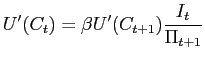 (bonds)
 |
(4) |
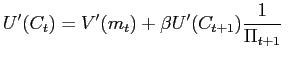 (money)
 |
(5) |
 (output)
 |
(6) |
where
 is the (backward
looking) gross inflation rate. A fourth necessary condition (the
transversality condition) is that (3) hold with equality
is the (backward
looking) gross inflation rate. A fourth necessary condition (the
transversality condition) is that (3) hold with equality

|
(7) |
Informally, since the marginal utility of consumption is always positive, it cannot be optimal for the present value of agents' `end of horizon' net financial assets to be strictly positive. The first order conditions have been written as equilibrium conditions:
has been set
equal to as it
must be in equilibrium since there is no government spending, and
desired asset stocks have been set equal to actual asset stocks.
We assume that productivity is constant
 except in section 6.3.
Under this assumption, the four equilibrium conditions (4), (5),
(6), and (7) reduce to the Fisher equation, the money market
equilibrium condition, the output determination equation, and the
transversality condition:
except in section 6.3.
Under this assumption, the four equilibrium conditions (4), (5),
(6), and (7) reduce to the Fisher equation, the money market
equilibrium condition, the output determination equation, and the
transversality condition:
 |
(8) |
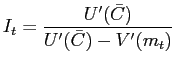
|
(9) |
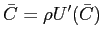 |
(10) |
|
|
(11) |
where
 is the constant gross real
interest rate and
is the constant gross real
interest rate and  is the constant flexible-price value of consumption.
 is ruled
out by (8), given
is ruled
out by (8), given
 . In turn,
(9) implies that
. In turn,
(9) implies that
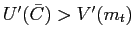 , so depending
on the functional form of
, so depending
on the functional form of
 there
may be a lower bound on that is greater than zero. Since
there
may be a lower bound on that is greater than zero. Since
 and
and
 , (9) implies
 where
where  is the lower
bound on implied
by
.
Since
is the lower
bound on implied
by
.
Since  and
and
 , (8)
also implies
, (8)
also implies
 .
.
2.2 Policy
We assume that fiscal policy determines the total amount of
nominal government bonds outstanding,  , through control of the budget
deficit inclusive of interest payments. Monetary policy determines
whether these bonds are held by the monetary authority as a match
for the money supply, , or directly by the public, , through control of open-market
operations. The consolidated government balance sheet implies that
, through control of the budget
deficit inclusive of interest payments. Monetary policy determines
whether these bonds are held by the monetary authority as a match
for the money supply, , or directly by the public, , through control of open-market
operations. The consolidated government balance sheet implies that
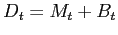 . Most
of this paper is devoted to the analysis of determinacy under
alternative monetary-policy rules which are specified below. Except
in section 6, we assume that fiscal policy is conducted so that
(11) holds for any path of the nominal interest rate.9Fiscal policy and equation (11),
therefore, may be disregarded until that section.
. Most
of this paper is devoted to the analysis of determinacy under
alternative monetary-policy rules which are specified below. Except
in section 6, we assume that fiscal policy is conducted so that
(11) holds for any path of the nominal interest rate.9Fiscal policy and equation (11),
therefore, may be disregarded until that section.
So that we can discuss indeterminacy in our stripped-down model,
we assume that there is a target equilibrium () with a target value for inflation (
 ) given by
 because of
considerations not included in the model. Since the target nominal
interest rate (
because of
considerations not included in the model. Since the target nominal
interest rate ( ) must satisfy
 ,
it is given by
,
it is given by
 .
Absent such considerations, the optimal values for
.
Absent such considerations, the optimal values for  and would be
 and
, respectively.
Our main focus is on the possible existence of below-target
equilibria
and
, respectively.
Our main focus is on the possible existence of below-target
equilibria  We
define as weakly
increasing or decreasing paths for inflation and the interest rate
along which they are always below
and
respectively,
and are either constant at, asymptotically approach, or eventually
reach values represented by
We
define as weakly
increasing or decreasing paths for inflation and the interest rate
along which they are always below
and
respectively,
and are either constant at, asymptotically approach, or eventually
reach values represented by  and
and  , respectively, where
 .
.
2.3 Money demand and lower bounds on the interest rate
We consider two particular specifications of money demand. Under both specifications the gross nominal interest rate has a lower bound (possibly one). Equation (9) implies

|
(12) |
Of course, a lower bound of one for
implies a lower bound of zero for the net
nominal interest rate.
The lower bound
may be unattainable or attainable. To model an attainable lower
bound ( ) for
, we assume that
the utility of real balances is given by
) for
, we assume that
the utility of real balances is given by
![$\displaystyle V(m_{t})=\left\{ \begin{array}[c]{cc} \underline{V}^{\prime}m_{t}... ...m_{t} & \text{for }m_{t}>\overline{m} \end{array} \right. ,\qquad\overline{m}>0$](img67.gif)
|
(13) |
As before,
 represents the minimum
marginal utility of real balances. Equation (12) implies
represents the minimum
marginal utility of real balances. Equation (12) implies
![$\displaystyle I_{t}=\left\{ \begin{array}[c]{cc} \frac{U^{\prime}(\bar{C})}{U^{... ...U^{\prime}(\bar{C})}{U^{\prime}(\bar{C})-\underline {V}^{\prime}}=\Omega^{ALB},$](img69.gif)
|
(14) |
To model an unattainable lower bound ( ), we assume that the utility of
real balances is given by
), we assume that the utility of
real balances is given by

|
(15) |
where
 represents the lower limit of the marginal utility of real
balances. With this functional form, equation (9) implies
represents the lower limit of the marginal utility of real
balances. With this functional form, equation (9) implies

|
(16) |
Money-demand functions with an and an
are represented in figure 1.10 In
both cases,  if
and only if
if
and only if
 . With an there is a liquidity trap, as
conventionally defined, at the lower bound. Purchases of bonds with
money can not lower the interest rate. With an there is never a liquidity trap.
Purchases of bonds with money can always lower the interest rate,
if only by an infinitessimal amount.
. With an there is a liquidity trap, as
conventionally defined, at the lower bound. Purchases of bonds with
money can not lower the interest rate. With an there is never a liquidity trap.
Purchases of bonds with money can always lower the interest rate,
if only by an infinitessimal amount.
From (16), (14), and  (from (4)) we know that there exists a minimum
level for real money balances denoted by
(from (4)) we know that there exists a minimum
level for real money balances denoted by
 :
:
 with an
model, and
with an
model, and
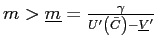 with an . In
order for
with an . In
order for
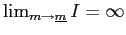 in the
model, we need
in the
model, we need
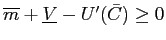 .
.
3 Interest-rate rules and BTE
We begin by assuming that monetary policy takes the form of interest-rate rules and consider two examples. The general form of the interest-rate rules is
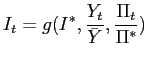
|
(17) |
where
is the
target-equilibrium ()
inflation rate and
 is the
flexible-price output level. With flexible prices, output is always
at its flexible-price level ,
is the
flexible-price output level. With flexible prices, output is always
at its flexible-price level ,
 , so from
now on we omit
, so from
now on we omit
 .
We assume that the elasticity of the interest rate with respect to
the inflation rate evaluated at the target inflation rate is
greater than one. If
.
We assume that the elasticity of the interest rate with respect to
the inflation rate evaluated at the target inflation rate is
greater than one. If
 ,
then
,
then
 In this
and the following section, we assume that the
interest-rate rule is at least weakly increasing in the inflation
rate and that the interest rate has a lower bound, either a
preference-determined lower bound or a policy-determined lower
bound. A preference-determined lower bound might exist because of a
liquidity trap. A policy-determined lower bound might exist, for
example, because the monetary authority wants to keep money market
funds economic.11 Under
these assumptions, interest-rate rules are associated with two
steady-state equilibria: a with
and
a , where
In this
and the following section, we assume that the
interest-rate rule is at least weakly increasing in the inflation
rate and that the interest rate has a lower bound, either a
preference-determined lower bound or a policy-determined lower
bound. A preference-determined lower bound might exist because of a
liquidity trap. A policy-determined lower bound might exist, for
example, because the monetary authority wants to keep money market
funds economic.11 Under
these assumptions, interest-rate rules are associated with two
steady-state equilibria: a with
and
a , where
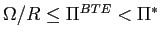 and
and
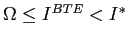 .
.
3.1 A preference-determined lower bound
First, consider the case of an interest-rate rule under which
the interest rate may go all the way to the preference-determined lower bound,
 ,
associated with an
money-demand function:12
,
associated with an
money-demand function:12
![$\displaystyle I_{t}=\max\left[ \Omega^{ALB},I^{\ast}\left( \frac{\Pi_{t}}{\Pi^{\ast} }\right) ^{\lambda}\right] ,\qquad\lambda>1$](img94.gif)
|
(18) |
The piecewise log-linear rule (18) is globally (weakly) increasing in the inflation rate, and the elasticity of the interest rate with respect to the inflation rate in the strictly increasing part is
 .13 We refer to this case as the
liquidity-trap case.
.13 We refer to this case as the
liquidity-trap case.
The Fisher equation (8), the interest-rate rule (18), and
imply a log-linear difference equation in when
 :
:
![$\displaystyle \begin{tabular}[c]{l} $\Pi_{t+1}=\frac{I^{\ast}}{R}\left( \frac{\... ...\Pi}_{t+1}=(1-\lambda)\hat{\Pi}^{\ast}+\lambda\hat{\Pi}_{t}$ \end{tabular} \ \ $](img97.gif)
|
(19) |
where variables with hats over them represent logarithms. The solution is
![$\displaystyle \hat{\Pi}_{t+k}=\hat{\Pi}^{\ast}+(\lambda)^{k}[\hat{\Pi}_{t}-\hat{\Pi}^{\ast}]$](img98.gif)
|
(20) |
One possible steady-state equilibrium is inflation equal to the
target rate. If one could disregard the lower bound on the interest
rate, this would be the only equilibrium. Deviations from the
inflation target would result in explosive or implosive paths of
inflation since .
However, equation (20) applies only when it calls for an
interest rate at or above
. The
inflation rate cannot decline forever. If the inflation rate given
by (20) calls for an interest rate below
 the
inflation rate is determined by the Fisher equation (8) together
with
the
inflation rate is determined by the Fisher equation (8) together
with
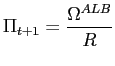
 instead of by (20). That is, the inflation rate will stop declining
when it is equal to its lower bound:
instead of by (20). That is, the inflation rate will stop declining
when it is equal to its lower bound:
 |
(21) |
The difference equation reflecting the lower bound has the form shown in figure 2:14
![$\displaystyle \Pi_{t+1}=\max\left[ \frac{\Omega^{ALB}}{R},(\Pi^{\ast})^{1-\lambda}(\Pi _{t})^{\lambda}\right]$](img106.gif)
|
(22) |
The list of equilibria as indexed by  is
is
- 1.
 Steady-state .
2.
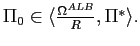 decreases to
 in finite time
3.
 Steady-state
equilibrium.
Steady-state
equilibrium.4.
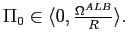 Equilibria with
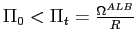 ,
,
 .15
.15
Along any path, the
inflation rate eventually reaches
so that reaches
its liquidity-trap value
at which
the levels of the nominal and real money supplies are
indeterminate.16 Hence,
the number of equilibria is even larger than indicated above. Let
the liquidity trap be reached in period  at price level
  , given a particular initial
 There is an
infinity of equilibria associated with each initial
There is an
infinity of equilibria associated with each initial
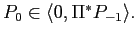 Once the
liquidity trap is reached, the set of possible paths for
Once the
liquidity trap is reached, the set of possible paths for

 includes all paths for which
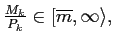 since agents
are indifferent between money and bonds.
since agents
are indifferent between money and bonds.
There may be more equilibria than those listed above. Beginning
on any initial inflation rate above
the
inflation rate follows follows a divergent path. Such divergent
paths have been referred to as speculative hyperinflations, for
example, by Obstfeld and Rogoff, who have discussed ways of
precluding them.17
Throughout this paper we assume that paths with ever increasing
inflation are precluded.
For the sake of comparison, we briefly consider the case of an
interest-rate peg in which  and the difference equation in figure 2 is a
horizontal line. Suppose it is announced that will equal in period and all future periods. The Fisher
equation (8), implies that would be associated with
from period
on. However, this
interest-rate rule would not pin down the initial inflation rate.
There would be a continuum of equilibria, indexed by the initial
inflation rate
and the difference equation in figure 2 is a
horizontal line. Suppose it is announced that will equal in period and all future periods. The Fisher
equation (8), implies that would be associated with
from period
on. However, this
interest-rate rule would not pin down the initial inflation rate.
There would be a continuum of equilibria, indexed by the initial
inflation rate
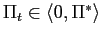 . However, if the
monetary authorities specify the initial level of the money supply
in addition to the interest-rate peg, the initial inflation rate is
determinate, since there is a unique level of real balances
associated with
. However, if the
monetary authorities specify the initial level of the money supply
in addition to the interest-rate peg, the initial inflation rate is
determinate, since there is a unique level of real balances
associated with
3.2 A policy-determined lower bound
Now consider interest-rate rules designed to keep the gross
nominal interest rate from falling below a policy-determined lower bound,  , that may be above
. The
policy-determined lower bound may be attainable,
, that may be above
. The
policy-determined lower bound may be attainable,
 , or
unattainable,
, or
unattainable,
 . For
example, with the interest-rate rule
. For
example, with the interest-rate rule
![$\displaystyle I_{t}=\max\left[ \Lambda^{ALB},I^{\ast}\left( \frac{\Pi_{t}}{\Pi^{\ast} }\right) ^{\lambda}\right] ,\qquad\Lambda^{ALB}\geq\Omega,\qquad\lambda>1$](img131.gif)
|
(23) |
the policy-determined lower bound is attainable. This rule and the difference equation in inflation that it implies are identical to the ones considered in the last subsection except that the lower bounds on the interest rate and inflation are determined by policy, not by preferences. The rule is implementable with both
money demand (
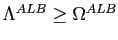 ) and with money demand (
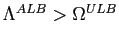 ). The entire list of
possible equilibria is given by items 1 through 4 in the last
subsection except that
replaces
everywhere. In contrast to the liquidity trap case, when
reaches
). The entire list of
possible equilibria is given by items 1 through 4 in the last
subsection except that
replaces
everywhere. In contrast to the liquidity trap case, when
reaches
 along a path, real balances and nominal
balances are uniquely determined.18
along a path, real balances and nominal
balances are uniquely determined.18
It is useful to consider a rule that is very similar to the
continuously differentiable rules used in the seminal papers on the
existence of :

|
(24) |
 and money-demand
functions. The interest rate rises with inflation, and the response
is greater the higher is inflation.20 As before, the elasticity of the
interest rate with respect to the inflation rate at
is
.
and money-demand
functions. The interest rate rises with inflation, and the response
is greater the higher is inflation.20 As before, the elasticity of the
interest rate with respect to the inflation rate at
is
.
With the rule (24), there must be two steady-state equilibrium
inflation rates: one is
and the
other is
which is below
and
above
 but
which may or may not involve deflation.
Combining the rule (24) with the Fisher equation (8) yields a
difference equation in inflation of the form plotted in figure
3:21
but
which may or may not involve deflation.
Combining the rule (24) with the Fisher equation (8) yields a
difference equation in inflation of the form plotted in figure
3:21
![$\displaystyle \Pi_{t+1}=\frac{1}{R}\left[ \left( I^{\ast}-\Lambda^{ULB}\right) ... ...\ast}}\right) ^{\frac{\lambda R}{I^{\ast}-\Lambda^{ULB}} }+\Lambda^{ULB}\right]$](img148.gif)
|
(25) |
This equation is a convex function that has a lower bound of
 and that
crosses the
and that
crosses the
 degree line
from below at
degree line
from below at
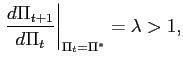
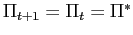 where its slope is
greater than one:
where its slope is
greater than one:
|
(26) |
that is,
is an
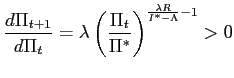
unstable steady state equilibrium. In addition its slope approaches
zero as
approaches 0 from above and rises continuously with :
|
(27) |
Therefore, it must intersect the
line a
second time at a point below
represented
by where its
slope is less than one.22That is,
is a stable
equilibrium with deflation (
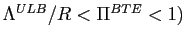 , stable prices (
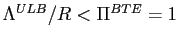 ), or inflation
 ).
).
There is a continuum of equilibria, indexed by . Each is associated with one of the
two possible steady-state inflation rates.
- 1.
 Steady-state .
2.
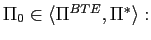 Non-steady-state ;
 from
above
from
above3.
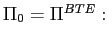 Steady-state .
4.
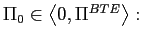 Non-steady-state ;
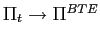 from below.23
4 Indeterminacy under money-growth rules
4.1 Indeterminacy with money demand
When the money-demand function has an , money-growth rules are consistent
with the existence of both a and in
which real money balances are forever increasing and the interest
rate is approaching its lower bound.24
Consider the money-growth rule:
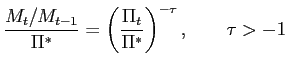
|
(28) |
If
 , money grows at
the constant target gross growth rate of money which is equal to
. In that
case, since
, money grows at
the constant target gross growth rate of money which is equal to
. In that
case, since  and
and
 are given,
 is determined by
. If
is determined by
. If
 , there is
one
, there is
one
 associated with each
  .25 In
either case, there will be a range of equilibria, each with its own
level of initial real balances.
.25 In
either case, there will be a range of equilibria, each with its own
level of initial real balances.
The Fisher equation (8) and the money market equilibrium
condition (9) with the functional form for  in equation (15) imply an
expression for the inflation rate in terms of real balances:
in equation (15) imply an
expression for the inflation rate in terms of real balances:
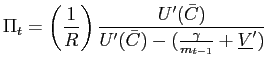
|
(29) |
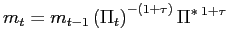
Furthermore, the money-growth rule can be rewritten as
|
(30) |
Combining (30) and (29), yields a difference equation in real balances,
![$\displaystyle m_{t}=m_{t-1}(\Pi^{\ast})^{1+\tau}\left[ \left( \frac{1}{R}\right... ...e}(\bar{C})-\frac{\gamma}{m_{t-1} }-\underline{V}^{\prime}}\right] ^{-(1+\tau)}$](img176.gif)
|
(31) |
with the form plotted in figure 4.26 Given the definition of
 in
equation (16), it follows that the term in square brackets
() approaches
in
equation (16), it follows that the term in square brackets
() approaches
 as
as
 . Therefore, the growth rate
of real balances (
. Therefore, the growth rate
of real balances (
 )
approaches
)
approaches
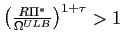 for
for  .27
.27
The unique steady-state solution for equation (31) is

|
(32) |
If the steady-state level of real balances is to be positive, it must be that
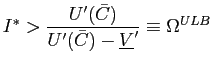
|
(33) |
The money-growth rule may be associated not only with the
, but also with a
range of in which
inflation declines forever and approaches the limit
. The
equilibria may be indexed by  :
:
- 1.
 Steady state with
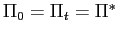 .
.
2.
 with positive growth
in ,
with positive growth
in ,
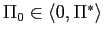 and
and
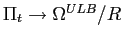 from
above
from
above .
.
The money-growth rule has a representation as an interest-rate rule that is related to but somewhat different from the one discussed in section 3.2.28
4.2 Indeterminacy with money demand
With money
demand money-growth rules are also consistent with the existence of
both a and
. In the  real money balances are forever
increasing money demand, as with money demand, but the interest rate reaches its
lower bound. The Fisher equation (8) and the
real money balances are forever
increasing money demand, as with money demand, but the interest rate reaches its
lower bound. The Fisher equation (8) and the
 -part of the money-demand
function (14) imply an expression for inflation in terms of real
balances:
-part of the money-demand
function (14) imply an expression for inflation in terms of real
balances:
![$\displaystyle \Pi_{t}=\left( \frac{1}{R}\right) \left[ \frac{U^{\prime}(\bar{C} )}{U^{\prime}(\bar{C})-\overline{m}+m_{t-1}-\underline{V}^{\prime}}\right]$](img204.gif)
|
(34) |
Combining the money-growth rule (30) with (34) we obtain a difference equation in real balances:
![$\displaystyle m_{t}=m_{t-1}\left[ \left( \frac{1}{R}\right) \frac{U^{\prime}(\b... ...^{\prime}}\right] ^{-(1+\tau)}\Pi^{\ast(1+\tau)},\qquad m_{t-1}\leq\overline{m}$](img205.gif)
|
(35) |
Given the definition of
in
equation (14) it follows that as  increases and reaches
 , the term
in square brackets () increases and reaches
, the term
in square brackets () increases and reaches
 .
Therefore, the growth rate of real balances (
)
increases and reaches
.
Therefore, the growth rate of real balances (
)
increases and reaches
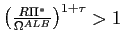 for .
for .
There exists a steady-state equilibrium with positive real balances equal to

|
(36) |
under weak conditions that we assume are met.29 This equilibrium is a
in which
 and
and
 30 Equation (35) applies only when
. In cases in which
30 Equation (35) applies only when
. In cases in which
 ,
the difference equation in real balances is given by (30) with the
inflation rate fixed at
,
the difference equation in real balances is given by (30) with the
inflation rate fixed at

Figure 5 is a diagram for the case where
 because
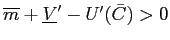 .31
.31
The list of equilibria indexed by is now
- 1.
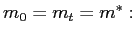 steady state with

2.
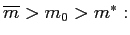 with
with
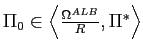 ,
reaches
from above, .
reaches
from
below,
,
reaches
from above, .
reaches
from
below,3.

 with
with
![$ \Pi_{0}\in\left\langle 0,\frac{\Omega^{ALB}}{R}\right] $](img232.gif) and
and
 . The growth rate is constant at
 .
.
There is a second steady-state equilibrium with zero real
balances when
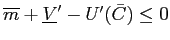 so that
 .32 This
case is not of particular interest to us because we want to focus
on equilibria in which inflation is below target (real balances are
above target). However, it is quite important for those considering
the existence of hyperinflation equilibria.
.32 This
case is not of particular interest to us because we want to focus
on equilibria in which inflation is below target (real balances are
above target). However, it is quite important for those considering
the existence of hyperinflation equilibria.
The money-growth rule in the model also has a representation as an
interest-rate rule as long as
.33 However,
 for all
 .
Hence, the interest-rate rule representation requires an additional
specification of policy when
in
order to uniquely pin down the path of real money balances for each
initial . For
example, Eggertson and Woodford (2003) add a rule for money growth
that applies whenever the interest rate reaches its lower
bound.
.
Hence, the interest-rate rule representation requires an additional
specification of policy when
in
order to uniquely pin down the path of real money balances for each
initial . For
example, Eggertson and Woodford (2003) add a rule for money growth
that applies whenever the interest rate reaches its lower
bound.
5 Monetary-policy rules that imply uniqueness
5.1 A nonmonotonic interest-rate rule
First, we show that making the interest-rate rule a nonmonotonic function of the inflation rate may insure a unique equilibrium, following up on an observation by Benhabib, Schmitt-Grohe, and Uribe (2001b). Consider the piecewise log-linear interest-rate rule
![$\displaystyle I_{t}=\left\{ \begin{array}[c]{cc} \begin{array}[c]{c} I_{t}^{\as... ...i_{t}}{\Pi^{\ast}}\right) ^{\lambda} \leq\Omega \end{array} \end{array} \right.$](img241.gif)
|
(37) |
This rule is similar to the one described in section 3.2, but the interest rate is pegged at
 instead of at the
policy-determined lower bound value
instead of at the
policy-determined lower bound value
 It is
feasible with both and
money demands, since
it never calls for
It is
feasible with both and
money demands, since
it never calls for
 .
.
The difference equation in the inflation rate that follows from
(37) and the Fisher equation (8) is illustrated in figure
6.34 Consider
a situation where the inflation rate is so low that if  were given by
 it would be less than or equal to the lower bound, . In such a situation,
jumps up to
it would be less than or equal to the lower bound, . In such a situation,
jumps up to
 . In the
next period, the inflation rate must be higher than the target
inflation rate given the Fisher equation and the fact that
. In the
next period, the inflation rate must be higher than the target
inflation rate given the Fisher equation and the fact that
 . But such a path is not
a possible solution, because it implies that the inflation rate
increases without limit. Hence, the economy cannot start out on a
path of declining inflation.
. But such a path is not
a possible solution, because it implies that the inflation rate
increases without limit. Hence, the economy cannot start out on a
path of declining inflation.
5.2 A monotonic but asymmetric interest-rate rule
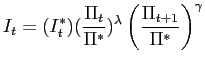
Next, we demonstrate that there is an asymmetric interest-rate rule that is associated with a unique steady-state inflation rate and a determinate price level. Consider the following rule35,
|
(38) |
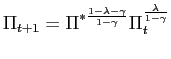
Combining equation (38) with the Fisher equation (8) and using
 , give a first-order
difference equation in the inflation rate,
, give a first-order
difference equation in the inflation rate,
|
(39) |
Taking logs, we have
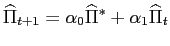
|
(40) |
where
 and
and
 With
With
 and
and
 chosen so that
 , the equation is unstable
and the unique solution for is
, the equation is unstable
and the unique solution for is

The rule (38) implies asymmetric responses under the following assumptions:
 If
If
 ,
,
 , and
, and
 , so that
 and
and
 .
.
If
 ,
,
 and
, so that
and
, so that
 and
and
 .
.
Under these assumptions, the rule calls for a stronger response to expected future inflation when current inflation is below target.
With the asymmetric rule the difference equation for inflation
(39) has the form shown in figure 7.36 In contrast with the symmetric rule
(19), the asymmetric rule (39) implies a difference equation for
inflation for which
 no matter how low the value of .
is a unique
steady-state equilibrium, and
is
the only equilibrium.37 If the
initial inflation rate is in the interval
no matter how low the value of .
is a unique
steady-state equilibrium, and
is
the only equilibrium.37 If the
initial inflation rate is in the interval
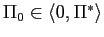 , the economy
embarks on a path with ever-increasing inflation. The part of the
difference equation that applies when
, the economy
embarks on a path with ever-increasing inflation. The part of the
difference equation that applies when
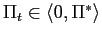 implies
 ,
and the inflation rate continues to increase because the part that
applies when
,
and the inflation rate continues to increase because the part that
applies when
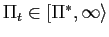 is
now relevant.
is
now relevant.
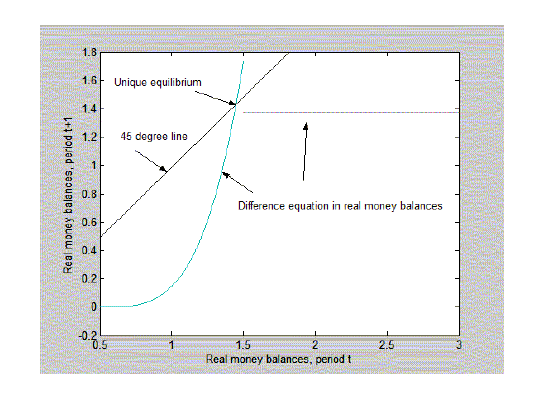
5.3 A nonmonotonic money-growth rule
Finally, we demonstrate that a nonmonotonic money-growth rule can work analogously to the nonmonotonic interest-rate rule in section 5.1. We assume a money-growth rule of the form
![$\displaystyle M_{t}=\left\{ \begin{array}[c]{ccc} \begin{array}[c]{c} \left( \f... ...rline{m}\\ \\ \text{if }m_{t-1}\geq\overline{m} \end{array} \end{array} \right.$](img279.gif)
|
(41) |
and an
money
demand. The nonmonotonic money-growth rule implies a discontinuous
difference equation in real money balances of the form shown in
figure 8.38
The top relationship in equation (41) is a rewrite of the
money-growth rule (28) and  is the steady-state level of real money
balances when following that relationship:
is the steady-state level of real money
balances when following that relationship:
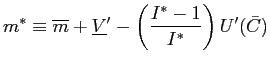
|
(42) |
The second part of (41) tells us that the level of real balances in period
will be
lower than the steady-state level if
 . To see this, note that the
lower bound on the inflation rate is
. Hence,
. To see this, note that the
lower bound on the inflation rate is
. Hence,
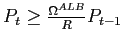 . With
 , real
balances must then be lower than in period
, real
balances must then be lower than in period  are
precluded because real balances jump below as soon as they would reach
or exceed the level that applies in a liquidity trap. And when the
real balances have reached such a low level, they continue to
decline according to the difference equation in real balances,
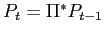
equation (35). Hence, the initial price level at will be uniquely pinned down at
are
precluded because real balances jump below as soon as they would reach
or exceed the level that applies in a liquidity trap. And when the
real balances have reached such a low level, they continue to
decline according to the difference equation in real balances,
equation (35). Hence, the initial price level at will be uniquely pinned down at
 .
.
6 Fiscal policy and BTE
6.1 Fiscal policy can always preclude BTE
There is always a fiscal policy that precludes no matter what the monetary policy
rule. Fiscal policy determines the path of total nominal government
debt measured as total nominal government bonds, . The consolidated government
balance sheet implies that must equal the money supply (which equals the
government bonds held by the monetary authority) plus government
bonds held by the public:
![$\displaystyle \begin{tabular}[c]{lllll} $D_{t}\equiv M_{t}+B_{t},$\ & & $D_{0}\neq0$\ & & $t\geq0$ \end{tabular}$](img291.gif)
|
(43) |
For simplicity, we devote most of our attention to fiscal policies under which there is a constant gross growth rate (
 ) for total government bonds:
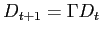 |
(44) |
where
 is the case
of a balanced-budget policy.
is the case
of a balanced-budget policy.
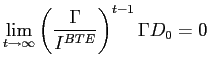
Fiscal policy and the transversality condition (11) taken
together have implications for the possibility of . First, consider a candidate
steady-state in which
the interest rate is constant at . The path

 can be a steady-state equilibrium
only if
can be a steady-state equilibrium
only if
|
(45) |
Therefore if
 fiscal policy precludes such a path. With our parameterization,
 is a
necessary condition for fiscal policy to be consistent with
steady-state .39
is a
necessary condition for fiscal policy to be consistent with
steady-state .39
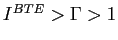
One important implication of the previous paragraph, is that if
 , the
Friedman rule (
, the
Friedman rule ( ) cannot be implemented exactly under
any type of monetary policy. This result for the case of
is obtained
by Schmitt-Grohe and Uribe (2000) in cases in which the
monetary-policy rule is either an interest-rate rule or a
money-growth rule. Another important implication is that if
) cannot be implemented exactly under
any type of monetary policy. This result for the case of
is obtained
by Schmitt-Grohe and Uribe (2000) in cases in which the
monetary-policy rule is either an interest-rate rule or a
money-growth rule. Another important implication is that if
 , there
may be with small
deficits (
, there
may be with small
deficits (
 ).
).
Next, consider a candidate path on which the interest-rate path is some
weakly decreasing sequence  with
with
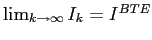 . Let
. Let
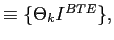 where
where
 is a
weakly decreasing sequence with
is a
weakly decreasing sequence with
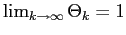 . Let the value
of
. Let the value
of
 at some
time
at some
time  given by
 be arbitrarily close to one. This sequence of interest rates can be
an equilibrium only if
be arbitrarily close to one. This sequence of interest rates can be
an equilibrium only if
![$\displaystyle \lim_{t\rightarrow\infty}D_{0}\Gamma^{t}\Pi_{k=\hat{t}}^{k=t-1}\left[ \Theta_{k}^{-1}(I^{BTE})^{-1}\right] =0$](img312.gif)
|
(46) |
The condition (46) cannot hold if
 and
and
 is
arbitrarily close to one. Therefore,
precludes in which
the interest rate asymptotically approaches or eventually reaches
.In addition,
is
arbitrarily close to one. Therefore,
precludes in which
the interest rate asymptotically approaches or eventually reaches
.In addition,
 precludes equilibria in which is approached asymptotically if
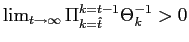 . This condition is satisfied if the nominal interest rate
approaches (and
hence
approaches
one) fast enough, for example if the nominal interest rate reaches
(
reaches
one) in finite time.
. This condition is satisfied if the nominal interest rate
approaches (and
hence
approaches
one) fast enough, for example if the nominal interest rate reaches
(
reaches
one) in finite time.
The class of fiscal policies for which
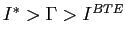 is especially
interesting. As just shown, this class precludes for any monetary policy. It follows
that a combination of a member of this class with a standard
interest-rate rule like equation (18) or money-supply rule like
equation (28) is sufficient to insure that
is the
unique equilibrium value for the inflation rate. These observations
suggest that may not be
a matter for concern in OECD countries. Most, if not all, of these
countries run positive but relatively small government deficits on
average so their fiscal policies may preclude . This possibility is yet another
reminder of the importance of analyzing monetary and fiscal policy
jointly.40
is especially
interesting. As just shown, this class precludes for any monetary policy. It follows
that a combination of a member of this class with a standard
interest-rate rule like equation (18) or money-supply rule like
equation (28) is sufficient to insure that
is the
unique equilibrium value for the inflation rate. These observations
suggest that may not be
a matter for concern in OECD countries. Most, if not all, of these
countries run positive but relatively small government deficits on
average so their fiscal policies may preclude . This possibility is yet another
reminder of the importance of analyzing monetary and fiscal policy
jointly.40
6.2 Uniqueness with money growth through transfers
In subsection 4.2 we show that with an ALB money-demand
function, the money-growth rule (28) is associated with multiple
equilibria. There, as well as in all of the paper before section 6,
we assume that
can take on any value implied by the open-market purchases used to
increase the money supply. In particular, can be as negative as necessary,
or, in other words, government interest-bearing claims on the
public can increase without limit.
In this subsection, we assume that there is a finite lower bound
on designated by
 where
where
 ; that is, government claims
on the public cannot exceed the finite amount
; that is, government claims
on the public cannot exceed the finite amount
 Once
this limit is reached, the money supply can be increased only by
money-financed transfers (`money rain'). The required policy is
best viewed as a combination of fiscal policy and monetary policy:
the fiscal authority makes a bond-financed transfer to the private
sector, and the monetary authority buys the bonds.
Once
this limit is reached, the money supply can be increased only by
money-financed transfers (`money rain'). The required policy is
best viewed as a combination of fiscal policy and monetary policy:
the fiscal authority makes a bond-financed transfer to the private
sector, and the monetary authority buys the bonds.
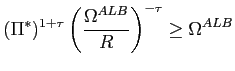
If are to be precluded,
the transversality condition (11) implies that
(the target
rate of inflation and money growth) must be chosen so that

|
(47) |
where
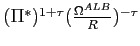 is the constant rate of growth of nominal balances implied by the
money-growth rule when the interest rate is at
so that
the inflation rate is
. The condition (47) can always
be met under the not very restrictive assumption that
is the constant rate of growth of nominal balances implied by the
money-growth rule when the interest rate is at
so that
the inflation rate is
. The condition (47) can always
be met under the not very restrictive assumption that
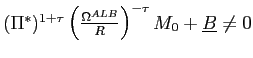 . Since
  , the first term is strictly positive and
either unbounded or bounded at
, the first term is strictly positive and
either unbounded or bounded at
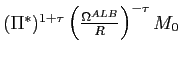 if
is chosen so
that41
if
is chosen so
that41
|
(48) |
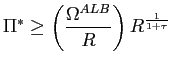
or, equivalently, so that
|
(49) |
The second term is either zero or bounded at
as
 .
Therefore, (47) is satisfied no matter whether the first term is
bounded or not.42 Note
that equation (49) implies uniqueness can be consistent with
.
Therefore, (47) is satisfied no matter whether the first term is
bounded or not.42 Note
that equation (49) implies uniqueness can be consistent with
 if
if  and, in particular, with
arbitrarily
close to its Friedman-rule value of
and, in particular, with
arbitrarily
close to its Friedman-rule value of
 if
if
 and
and
 is large
enough.43
is large
enough.43
6.3 An illustration of the insufficiency
of balanced-budget fiscal policy for precluding
In section 6.1, we show that a balanced-budget policy precludes
when the interest
rate is always at a lower bound of one. Here we show that a
balanced-budget policy may not preclude even if the interest rate is at a
lower bound of one infinitely often. We assume that there is
regular and perfectly foreseen variation in productivity, e.g.
seasonal variation. In our example, there is a in which the interest rate
fluctuates between one and a value greater than one.
Consider the following period utility function with time-varying
productivity, :
![$\displaystyle -\left( 1/2\right) (\psi-C_{t})^{2}-\left[ 1/\left( 2\rho_{t}\right) \right] Y_{t}^{2}+V(m_{t})$](img340.gif)
|
(50) |
Solutions for the model with this utility function can be obtained using the procedure for the constant-productivity case. We report only the results needed to make our point.
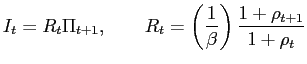
Equations (50), (4) and (6) imply that the nominal and real interest rates are given by
|
(51) |
Today's real interest rate,
 , is high if productivity increases between today
and tomorrow and vice versa. Therefore,
the `target' interest rate,
, is high if productivity increases between today
and tomorrow and vice versa. Therefore,
the `target' interest rate,
 , must
vary if the inflation rate is always to be at its fixed target,
:44
, must
vary if the inflation rate is always to be at its fixed target,
:44
 |
(52) |
We consider a simple example in which (a) the attainable lower
bound on the nominal interest rate is unity,
, (b)
alternates
between a high value (
 ) in even
periods and a low value (
) in even
periods and a low value (
 ) in odd
periods,
) in odd
periods,

|
(53) |
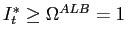
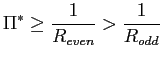
and (c)
is set high
enough that
 for all which according to equations
(52) and (53) implies that
must be
chosen so that45
for all which according to equations
(52) and (53) implies that
must be
chosen so that45
|
(54) |
If  is at the lower
bound of one, equations (51) and (54) imply that
is at the lower
bound of one, equations (51) and (54) imply that
 . From the
interest-rate rule (18) with a time varying
and
equation (52), it follows that
. From the
interest-rate rule (18) with a time varying
and
equation (52), it follows that  is above the lower bound if

|
(55) |
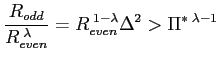
From equation (53) it follows that the condition (55) is satisfied if
|
(56) |
Given
, condition
(56) is met if  is high enough Both (54) and
(56) are met for some admissible parameter values, and we assume
that they are met in the rest of this subsection.46
is high enough Both (54) and
(56) are met for some admissible parameter values, and we assume
that they are met in the rest of this subsection.46
 is at the lower
bound again. Given
is at the lower
bound again. Given  and
and
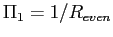 ,
,
 is given by
the difference equation (19) that applies when
is given by
the difference equation (19) that applies when  :
:

|
(57) |
Given the interest-rate rule (18) and inequality (54),
is
![$\displaystyle I_{2}=\max\left[ 1,\left( R_{even}\Pi^{\ast}\right) \left( \frac{... ...ght] =\max\left[ 1,\left( R_{even}\Pi^{\ast}\right) ^{1-\lambda^{2} }\right] =1$](img372.gif)
|
(58) |
By induction, interest rates, real interest rates, and inflation rates are
![$\displaystyle \begin{tabular}[c]{lll} $I_{even}=1$\ & & $I_{odd}=\left( R_{even... ..._{even}=(R_{even}\Pi^{\ast})^{1-\lambda }(1/R_{even})<1/R_{even}$ \end{tabular}$](img373.gif)
|
(59) |
since we are assuming that
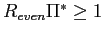 . The interest rate in odd
periods,
. The interest rate in odd
periods,
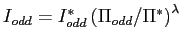 , is high because both the target interest rate and actual
inflation rate are high:
, is high because both the target interest rate and actual
inflation rate are high:
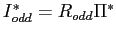 is high because
 is high, and
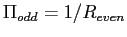 is high even though
  is at the lower bound because
  is low.
It follows that are
possible in our example with variable productivity and a balanced
budget. The transversality condition is met because the interest
rate alternates between one and a value greater than one. As
pointed out by Benhabib, Schmitt-Grohe, and Uribe (2001a), a
balanced-budget policy precludes only equilibria in which the
central bank commits to keep the interest rate equal to one no
matter what happens to inflation.
7 Concluding remarks
Under many specifications of monetary policy, standard models
may exhibit price-level indeterminacy. That is, they may have
multiple equilibria that include both a locally-unique steady-state
target (inflation-rate) equilibrium () and multiple below-target equilibria (), equilibria in which the inflation
rate is always below target and is constant or eventually reaches
or asymptotically approaches a below-target value.
Rules with either the (nominal) interest rate or money growth as instruments are consistent with price-level indeterminacy in the presence of a conventionally-defined liquidity trap, a situation in which bonds and money are perfect substitutes at either a positive or zero nominal interest rate. Interest-rate and money-growth rules may also be consistent with indeterminacy even if there is no liquidity trap for one of two reasons. First, an interest-rate rule may keep the interest rate above a policy-determined lower bound. Second, with either an interest-rate rule or a money-growth rule, money demand may imply a lower bound on the interest rate so that the interest rate cannot be lowered `enough' even though it can always be lowered somewhat.
We have found that implementing monetary policy by setting money
growth instead of the interest rate makes a difference only if the
economy is in a liquidity trap and money is injected without
open-market operations, e.g. by lump sum transfers. Under these
conditions, a money-growth rule, more accurately viewed as a
combination of a money-growth and fiscal-policy rules, may preclude
when an
interest-rate rule does not.
The above results all apply when the interest rate and money growth respond monotonically to eliminate deviations in the current inflation rate from its target value. We have expanded on the observation made in Benhabib, Schmitt-Grohe, and Uribe (2001b) that a unique steady-state inflation rate may be implied by interest-rate rules that are non-monotonic in the current inflation rate and have shown that an analogous result holds for non-monotonic money-growth rules. We also show that a unique steady state inflation rate is implied by an asymmetric interest-rate rule that calls for a response not only to current inflation but also to expected future inflation, with the response to expected future inflation being stronger when the current inflation rate is below target.
Conclusions about determinacy under alternative monetary rules
depend on fiscal policy as measured by the growth rate of total
nominal government debt. There is always a class of fiscal policies
that can preclude no
matter what the monetary policy because with those policies
paths violate the
transversality condition. Balanced budget fiscal policy can
preclude if the
interest rate is always at a zero lower bound. However, it cannot
do so if the lower bound on the interest rate is positive or if
productivity is variable even though the interest rate is at a
lower bound of zero infinitely often.
As stated in the introduction, it is not yet clear whether the
existence of is an
important problem or a curiosum. Some have argued that are of little interest for
theoretical reasons. McCallum (2001, 2003) uses his `minimum state
variable' criterion as one way of determining which equilibria are
of interest. In terms of our model, he shows that the
locally-unique meets
this criterion while the multiplicity of equilibria associated with the
below-target steady state, often referred to as `sun-spot'
equilibria, do not. Both McCallum (2001, 2003) and Evans and
Honkapohja (2002) use stability under a particular type of learning
as an alternative criterion. In terms of our model, they show that
the is stable under
learning while the are
not. Although these theoretical arguments are attractive, not all
analysts are completely convinced by them.
Our analysis suggests another more practical reason for focusing
on the  The
combination of any of a range of small deficits with a standard
interest-rate or money-supply rule guarantees that the is the unique equilibrium because
the deficit precludes .
This observation suggests that may not be a matter for concern in most OECD
countries. Most of these countries run positive but relatively
small government deficits on average so their fiscal policies may
preclude . This
possibility provides another illustration of the importance of
analyzing monetary and fiscal policy jointly.
The
combination of any of a range of small deficits with a standard
interest-rate or money-supply rule guarantees that the is the unique equilibrium because
the deficit precludes .
This observation suggests that may not be a matter for concern in most OECD
countries. Most of these countries run positive but relatively
small government deficits on average so their fiscal policies may
preclude . This
possibility provides another illustration of the importance of
analyzing monetary and fiscal policy jointly.
It might be argued that Japan has been in a for the last several years.
Although this argument cannot be rejected out of hand, there is a
good reason to question it. Japan has had near-zero interest rates
and deflation despite the fact that the growth rate of nominal
government debt has exceeded nominal interest rates on government
debt. That is, according to our analysis, fiscal policy was too
expansionary to be consistent with a .
Many analysts have concluded that the Japanese situation is
better described as a standard `liquidity-trap equilibrium'
( ). A could arise, for example, if
there were a large negative demand shock in the presence of wage
and price inertia. In order for output to be equal to potential it
would be necessary for the real interest rate to fall below zero.
However, the nominal interest rate could not be driven below zero
because of a liquidity trap as conventionally defined. Furthermore,
expected inflation might not move in the right direction or by the
right amount to reduce the real interest rate as much as is
required.
). A could arise, for example, if
there were a large negative demand shock in the presence of wage
and price inertia. In order for output to be equal to potential it
would be necessary for the real interest rate to fall below zero.
However, the nominal interest rate could not be driven below zero
because of a liquidity trap as conventionally defined. Furthermore,
expected inflation might not move in the right direction or by the
right amount to reduce the real interest rate as much as is
required.
For some policies, appropriateness depends crucially on whether
one is concerned about or , but,
for others, it does not. For example, it is often suggested that
Japan should announce a higher target inflation rate. Raising the
target inflation rate (or increasing the money supply even though
the interest rate is at the lower bound) can help an economy escape
from an by
raising expected future inflation thereby lowering the real
interest rate.47 However,
we have shown that this policy cannot help escape from a
because the target
inflation rate is irrelevant for this type of equilibrium. In
contrast, no matter which type of unintended equilibrium one is
trying to avoid, there is a strong case for a more aggressive
response to inflation when it is below target. It has been stressed
that more aggressive easing reduces the chances of falling into
in which
policymakers must rely on less familiar instruments with more
uncertain effects.48 We have
shown that responding more aggressively to expected inflation when
current inflation is below target makes it possible to avoid
.
References
Benhabib, J., S. Schmitt-Grohe, and M. Uribe (1998) ``Monetary Policy and Multiple Equilibria'', Finance and Economics Discussion Series 1998-29, Federal Reserve Board.
Benhabib, J., S. Schmitt-Grohe, and M. Uribe (2001a) ``Avoiding Liquidity Traps'', Journal of Political Economy, 110, 535--563.
Benhabib, J., S. Schmitt-Grohe, and M. Uribe (2001c) ``Monetary Policy and Multiple Equilibria'', American Economic Review, 91, 167--185.
Benhabib, J., S. Schmitt-Grohe, and M. Uribe (2001b) ``The Perils of Taylor Rules'', Journal of Economic Theory, 96, 40--69.
Bernanke, B. S., and V. Reinhart (2004) ``Monetary Policy at Very Low Nominal Interest Rates'', American Economic Review, 94, forthcoming.
Canzoneri, M. B., R. E. Cumby, and B. T. Diba (2001) ``Is the Price Level Determined by the Needs of Fiscal Solvency?'', American Economic Review, 91, 1221--1238.
Christiano, L. J., and M. Rostagno (2001) ``Money Growth Monitoring and the Taylor Rule'', NBER Working Paper 8539, National Bureau of Economic Research.
Eggertson, G., and M. Woodford (2003) ``The Zero Bound on Interest Rates and Optimal Monetary Policy'', Processed, IMF and Princeton University.
Evans, G. W., and S. Honkapohja (2002) ``Policy Interaction, Learning and the Fiscal Theory of Prices'', Processed, University of Helsinki, http://ideas.repec.org/e/pho12.html).
Evans, G. W., and S. Honkapohja (2003) ``Policy Interaction, Expectations and the Liquidity Trap'', Processed, University of Helsinki, (http://ideas.repec.org/e/pho12.html).
Krugman, P. (1998) ``It's Baack: Japan's Slump and Return of the Liquidity Trap'', Brookings Papers on Economic Activity, 2, 137--187.
Leeper, E. (1991) ``Equilibria under `Active' and `Passive'Monetary Policies'', Journal of Monetary Economics, 27, 129--147.
McCallum, B. T. (2001) ``Inflation Targeting and the Liquidity Trap'', in N. Loayza and R. Soto (eds.) Inflation Targeting: Design, Performance, Challenges, Central Bank of Chile, Santiago, 395-497 (NBER Working Paper 8225).
Loayza and R. Soto (eds.) Inflation Targeting: Design, Performance, Challenges, Central Bank of Chile, Santiago, 395--497 (NBER Working Paper 8225).
Obstfeld, M., and K. Rogoff (1983) ``Speculative hyperinflations in maximizing models: Can we rule them out?'', Journal of Political Economy, 91, 675--687.
Obstfeld, M., and K. Rogoff (1986) ``Ruling Out Divergent Speculative Bubbles'', Journal of Monetary Economics, 17, 349--362. 24
Obstfeld, M., and K. Rogoff (1996) Foundations of International Macroeconomics, MIT Press, Cambridge.
Orphanides, A., and V. Wieland (2000) ``Efficient Monetary Policy Design Near Price Stability'', Journal of the Japanese and International Economies, 14, 327--365.
Sargent, T. J. (1987) Macroeconomic Theory, Academic Press, New York, Second Edition.
Schmitt-Grohe, S., and M. Uribe (2000) ``Price Level Determinacy and Monetary Policy under a Balanced-Budget Requirement'', Journal of Monetary Economics, 45, 211--246.
Svensson, L. E. O. (2000) ``The Zero Bound in an Open Economy: A Foolproof Way of Escaping from a Liquidity Trap'', NBER Working Paper 7957, National Bureau of Econonmic Research.
Woodford, M. (1994) ``Monetary Policy and Price Level Determinacy in a Cash-in-Advance Economy'', Economic Theory, 4, 345--380.
Woodford, M. (2001a) ``Fiscal Requirements for Price Stability'', Journal of Money, Credit and Banking, 33, 669--728.
Woodford, M. (2001b) ``The Taylor Rule and Optimal Monetary Policy'', processed, Princeton University.
Woodford, M. (2003) Interest and Prices: Foundations of a Theory of Monetary Policy, Princeton University Press, Princeton.
Figure 1: ULB and ALB money demands
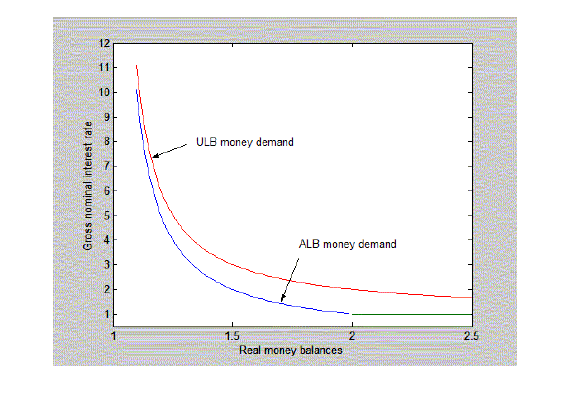
Figure 2: Interest-rate rule and preference-determined lower bound.
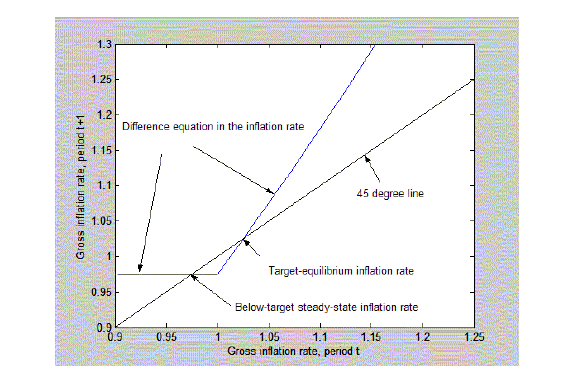
Figure 3: Interest-rate rule and policy-determined lower bound.
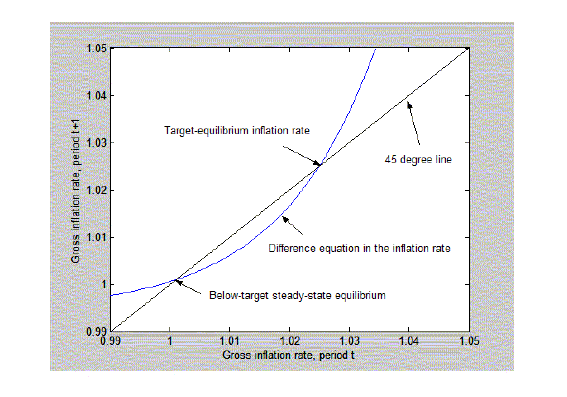
Figure 4: Money-growth rule with unattainable lower bound.
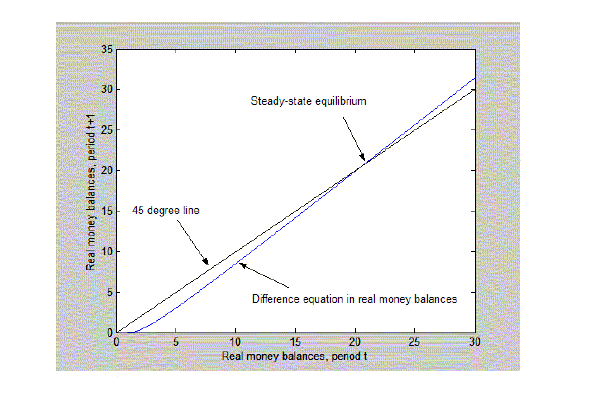
Figure 5: Money-growth rule with attainable lower bound.
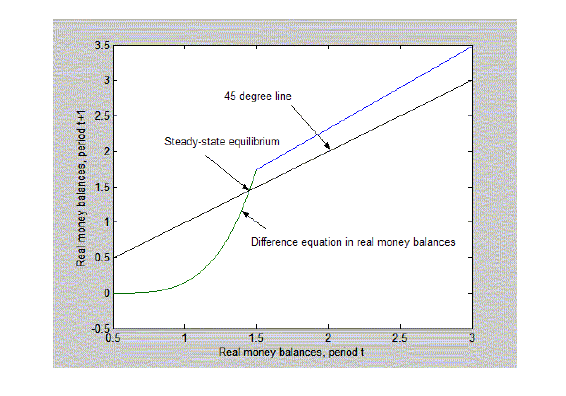
Figure 6: Non-monotonic interest-rate rule.
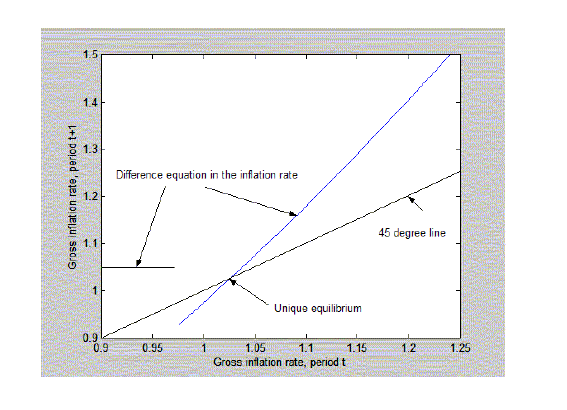
Figure 7: Asymmetric intrest-rate rule
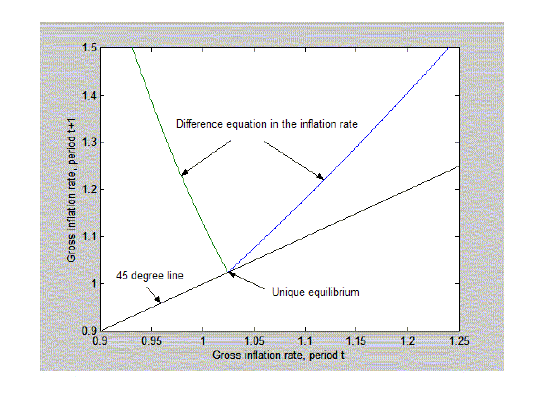
Figure 8: Non-monotonic money-growth rule
Footnotes
* Alstadheim is an Assistant Professor at Howard University, and Henderson is a Special Adviser in the Division of International Finance at the Federal Reserve Board. For helpful comments, we thank David Bowman, Matthew Canzoneri, Behzad Diba, Refet Gurkaynak, Berthold Herrendorf, Lars Svensson, and participants in a session at the 2001 meetings of the Southern Economics Association; in seminars at Georgetown University, the Federal Reserve Board, and the European Central Bank; and in the Konstanz Seminar on Monetary Theory and Monetary Policy. Remaining errors are our own. Alstadheim thanks the Center for Monetary and Financial Research in Norway and the Federal Reserve Board for financial support and hospitality. The views in this paper are solely the responsibility of the authors and should not be interpreted as reflecting those of the Board of Governors of the Federal Reserve System or any other person associated with the Federal Reserve System. The email addresses of the authors are, respectively, [email protected] and [email protected] . Return to text
1. Of course, inflation-rate determinacy and price-level determinacy are linked. If the inflation rate (defined as the percentage change in the price level between today and yesterday) is determined and yesterday's price level is known, then today's price level is determined. Return to text
2. A 1999 version of Woodford (2003) cited by Benhabib, Schmitt-Grohe, and Uribe (2001b) contains an explanation of the possible existence of BTE with both interest-rate rules and money-supply rules. In Woodford (2003) and Benhabib, Schmitt-Grohe, and Uribe (2001a) the inflation rate may asymptotically approach a below-target steady state; in Schmitt-Grohe and Uribe (2000), Benhabib, Schmitt-Grohe, and Uribe (2001b) and Eggertsson and Woodford (2003) it may eventually reach a below-target steady state. Return to text
3. Woodford (2001a) and Benhabib, Schmitt-Grohe, and Uribe (2001b) consider fiscal policy. Schmitt-Grohe and Uribe (2000) analyze balanced-budget fiscal policy. Return to text
4. McCallum (2001) refers to a `liquidity trap situation' as a situation in which `the (usual) interest rate instrument is immobilized'. Svensson (2000) refers to a liquidity trap as a situation with a binding zero lower bound on the nominal interest rate. Krugman (1998) refers to a liquidity trap as a situation where `monetary policy loses its grip because the nominal interest rate is essentially zero [and] the quantity of money becomes irrelevant because money and bonds are essentially perfect substitutes'. Our definition is the same as Krugman's except that, like Sargent (1987) among others, we explicitly allow for a liquidity trap at a positive interest rate. Return to text
5. Since our model has flexible prices and exhibits superneutrality, a lower bound can give rise to only nominal indeterminacy. However, using a model with sticky prices, Benhabib, Schmitt-Grohe, and Uribe (2001a) show that a lower bound can give rise not only to nominal indeterminacy but also to real indeterminacy. Return to text
6. The characterization of fiscal policy in Eggertsson and Woodford (2003) is more general and includes ours as a special case. Return to text
7. We consider specific functional
forms for in
section 2.3 and for
 in section 6.3. Return to text
8. Increases in can be interpreted either as
increases in productivity or decreases in the disutility of labor
if agents supply their desired amounts of labor either because they
are consumer-producers or because they participate in a labor
market that clears. Following Obstfeld and Rogoff (1996), let
 be the
disutility associated with labor (
be the
disutility associated with labor ( ) and let
 be the production function.
Inverting the production function yields
be the production function.
Inverting the production function yields
![$\displaystyle -\phi_{t}l_{t}=-\phi_{t}\left( y_{t}/A_{t}\right) ^{2}=-\left[ 1/... ..._{t}\right) \right] y_{t}^{2},\qquad\rho_{t}=A_{t}^{2}/\left( 2\phi_{t}\right) $](img19.gif)
9. This means that (except in section 6) fiscal policy is assumed to be Ricardian according to the definition of Benhabib, Schmitt-Grohe, and Uribe (1998). A sufficient condition for (11) to hold is that the gross growth rate of total government debt is low enough. Since the nominal interest rate enters equation (11), the maximum permissible growth rate depends on monetary policy and the rest of the model. Return to text
10. For figure 1,
 ,
,  ,
,
 , and
, and
 . Return to text
11. For these funds to survive, there must be some spread between the market rates they earn and the deposit rates they pay as noted by Bernanke and Reinhart (2004). Return to text
12. In this sense, the rule (18) is similar to the one used in Schmitt-Grohe and Uribe (2000) and in the appendix of Benhabib, Schmitt-Grohe, and Uribe (2001b). Return to text
13. We use an interest-rate rule of the form (18) so that the inflation-rate term in the strictly increasing range is directly comparable to the inflation-rate term in the money-supply rule (28). Return to text
14. For figure 2,
 ,
,
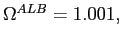
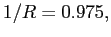 and
and
 . Return to text
15. The
initial inflation rate is not constrained by the lower bound
. The
reason is that the constraint on the inflation rate is implied by
the Fisher equation in combination with the interest rate given by
the interest-rate rule. The Fisher equation has no implications for
the initial price level or the inflation rate
 , but it has implications
for the inflation rate
, but it has implications
for the inflation rate
 .
Hence,
.
Hence,
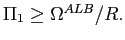 Return to text
16. Otherwise, the nominal money supply is determined by the nominal interest rate and the money-demand function, given the unique inflation rate associated with the TE. Return to text
17. See Obstfeld and Rogoff (1983) and Obstfeld and Rogoff (1986). Return to text
18. Consider the family of interest-rate rules given by
 begins at the point
 on the
 line in
 space. If
 , the
implied difference equation is qualitatively identical to the one
plotted in Figure 2.4 of Woodford (2003). Return to text
, the
implied difference equation is qualitatively identical to the one
plotted in Figure 2.4 of Woodford (2003). Return to text
19. The continuous-time policy rule used in Benhabib, Schmitt-Grohe, and Uribe (2001a) and the main text of Benhabib, Schmitt-Grohe, and Uribe (2001b) has a policy-determined unattainable lower bound. The discrete-time analogue of this rule is
![$\displaystyle I_{t}=\left( I^{\ast}-\Lambda^{ULB}\right) \exp\left[ \frac{RA}{I^{\ast }-\Lambda^{ULB}}(\Pi_{t}-\Pi^{\ast})\right] +\Lambda^{ULB},\qquad A>1 $](img142.gif)
We employ the rule (24) because it is
directly comparable to the other interest-rate rules and the
money-supply rules (28)
used in this paper. Rule (24) is also used by
Evans and Honkapohja (2003), who assume that
 . Return to
text
. Return to
text
20. That is

21. For figure 3,
,
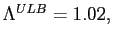 and
and
 Return to
text
Return to
text
22. If  there would be a unique
steady state at
, but
there would be multiple initial equilibrium inflation rates because
all paths that start below the target rate would approach
it. Return to text
there would be a unique
steady state at
, but
there would be multiple initial equilibrium inflation rates because
all paths that start below the target rate would approach
it. Return to text
23. can be lower than
 , see footnote 15. Return to text
24. This possibility is pointed out,
for example, in Woodford (1994), Woodford (2003),
Christiano (2001), and Benhabib, Schmitt-Grohe, and Uribe (2001b)). We
begin with the case of
money demand because it is somewhat simpler. Return to text
25. With
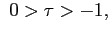 nominal balances increase when the inflation rate is above target.
For further discussion of this case, see footnote 27. Return to text
nominal balances increase when the inflation rate is above target.
For further discussion of this case, see footnote 27. Return to text
26. For figure 4, 


 and
and 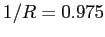 , so
, so
 Return to text
27. is
an unstable steady state since equation (31) and the
expression for
given by
(29) imply that for
all
![$\displaystyle \begin{tabular}[c]{l} $\left. \frac{dm_{t}}{dm_{t-1}}\right\vert ... ...R(1+\tau)\gamma\Pi^{\ast}}{m^{\ast}U^{\prime}(\bar{C})}>1$ \end{tabular}\ \ $](img191.gif)
28. Equation (16) can be used to
obtain an expression for in terms of . Using this expression and assuming
, it follows from equations
(30) and (8) that

29. The positive steady state exists
only if
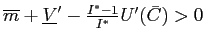 or equivalently
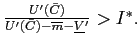 That is, the target interest rate must be smaller than the
maximum possible interest rate. For parameter values for which
That is, the target interest rate must be smaller than the
maximum possible interest rate. For parameter values for which
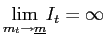 ,
,
 , so the condition is definitely met. In order to exist,
the strictly positive steady state equilibrium must also satisfy
, so the condition is definitely met. In order to exist,
the strictly positive steady state equilibrium must also satisfy
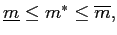 which
means that
which
means that
 . This condition is always satisfied as long as
is not too large. Return to text
. This condition is always satisfied as long as
is not too large. Return to text
30. is an unstable steady state since (36) and the
definition of
imply

31. For figure 5,
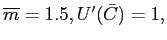 1/
1/ ,
, so
,
, so
 Return
to text
Return
to text
32. See section 2.3. In this case
(not shown), the line representing the difference equation would
start at the origin and have a slope that is below one at the
origin, increases until it exceeds one, and is constant for
 Return to text
33. Using (30),(8) and (14), we get
![$\displaystyle \frac{I_{t}-1}{I_{t}}U^{\prime}(\bar{C})=\left[ \frac{I_{t-1}-1}{... ...rac{I^{\ast}}{I_{t-1}}\right] ^{1+\tau}+(\underline{V}^{\prime} +\overline{m}) $](img238.gif)
34. For figure 6,
 ,
,

 and
and
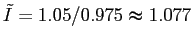 . Return to text
35. Benhabib, Schmitt-Grohe, and Uribe (2001c) also consider interest-rate rules where the interest rate responds to both current and future inflation, but in a different context. Return to text
36. For figure 7,
and
.
 when
when
 ,
and
,
and  otherwise. Return to text
37. All it takes for equation
(39) to be
associated with a unique steady-state is that
 when
and
when
and
 when
when
 .
One could, for example, let so that there was zero response to future
inflation, and vary
to meet these requirements. Return to
text
.
One could, for example, let so that there was zero response to future
inflation, and vary
to meet these requirements. Return to
text
38. For figure 8,
 ,
,
,
,  ,
,
 ,
,
 , , and
so
that
, , and
so
that
 . Return
to text
. Return
to text
39. Of course, there are many other
parameterizations of fiscal policy which are consistent with the
existence of . Return to text
40. An early joint analysis of monetary and fiscal policy is Leeper (1991); more recent analyses include Canzoneri, Cumby, and Diba (2001) and Evans and Honkapohja (2002). Return to text
41. Woodford (2003) and Woodford (1994) restrict attention to the case of (and
) and
argue that the restriction on the range of the target inflation
rate,
 necessary to preclude
is a limitation of money-supply rules relative to interest-rate
rules. However, the condition in equation (48) implies that if
, the
authorities can follow a money-supply rule that implies uniqueness
and still target a gross inflation rate below
. In
particular, with
one can
get arbitrarily close to the Friedman rule by choosing large enough. Return to text
necessary to preclude
is a limitation of money-supply rules relative to interest-rate
rules. However, the condition in equation (48) implies that if
, the
authorities can follow a money-supply rule that implies uniqueness
and still target a gross inflation rate below
. In
particular, with
one can
get arbitrarily close to the Friedman rule by choosing large enough. Return to text
42. In a model in which the lower
bound on the gross interest rate is one, Woodford (1994) shows
that a money-growth rule in combination with the condition that
 is associated with uniqueness as
long as gross money growth is equal to or larger than one (
is associated with uniqueness as
long as gross money growth is equal to or larger than one (
 in our
notation). When the public holds no government bonds, money must be
increased by money-transfers. A money-growth rule with
in our
notation). When the public holds no government bonds, money must be
increased by money-transfers. A money-growth rule with
 then corresponds to the
class of fiscal policies discussed in is subsection with
then corresponds to the
class of fiscal policies discussed in is subsection with
 , since the nominal growth rate of money is equal to the nominal
growth rate of government bonds.
Benhabib, Schmitt-Grohe, and Uribe (2001b) show that multiple equilibria
are precluded under money-growth rules when
, since the nominal growth rate of money is equal to the nominal
growth rate of government bonds.
Benhabib, Schmitt-Grohe, and Uribe (2001b) show that multiple equilibria
are precluded under money-growth rules when
 As we have
shown the lower bound on can be negative. What is needed is that money be
supplied with lump-sum transfers instead of open-market operations
after some point Return to text
As we have
shown the lower bound on can be negative. What is needed is that money be
supplied with lump-sum transfers instead of open-market operations
after some point Return to text
43. Woodford (1994) (2003) restricts
attention to the case of (and
) and
argues that the restriction on the range of the target inflation
rate,
necessary to preclude
is a limitation of money-supply rules relative to interest-rate
rules. Return to text
44. A similar relation is discussed in Woodford (2001b). Return to text
45. A

 cannot be
attained because
would be below a lower bound of one. As noted by Krugman (1998)
being in a liquidity trap in which is at its lower bound has only nominal
consequences in a flexible-price model but has real consequences in
a sticky-price model because output has to adjust. For example,
Svensson (2000) considers what happens when
is too low
and how it can credibly be raised. Return to text
cannot be
attained because
would be below a lower bound of one. As noted by Krugman (1998)
being in a liquidity trap in which is at its lower bound has only nominal
consequences in a flexible-price model but has real consequences in
a sticky-price model because output has to adjust. For example,
Svensson (2000) considers what happens when
is too low
and how it can credibly be raised. Return to text
46. For example, the combination
 ,
,
 ,
,
 , and
, and
 satisfy
both (54) and
(56), since
satisfy
both (54) and
(56), since
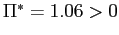 .
.
 and (
and (


47. See, for example, Krugman (1998). Return to text
48. See, for example, Orphanides and Wieland (2000). Return to text
This version is optimized for use by screen readers. A printable pdf version is available.