
Board of Governors of the Federal Reserve System
International Finance Discussion Papers
Number 872, September 2006 --- Screen Reader Version*
The Monetary Origins of Asymmetric Information in International Equity Markets
NOTE: International Finance Discussion Papers are preliminary materials circulated to stimulate discussion and critical comment. References in publications to International Finance Discussion Papers (other than an acknowledgment that the writer has had access to unpublished material) should be cleared with the author or authors. Recent IFDPs are available on the Web at http://www.federalreserve.gov/pubs/ifdp/. This paper can be downloaded without charge from the Social Science Research Network electronic library at http://www.ssrn.com/.
Abstract:
Existing studies using low-frequency data have found that macroeconomic shocks contribute little to international stock market covariation. However, these papers have not accounted for the presence of asymmetric information where sophisticated investors generate private information about the fundamentals that drive returns in many countries. In this paper, we use a new microstructure data set to better identify the effects of private and public information shocks about U.S. interest rates and equity returns. High-frequency private and public information shocks help forecast domestic money and equity returns over daily and weekly intervals. In addition, these shocks are components of factors that are priced in a model of the cross section of international returns. Linking private information to U.S. macroeconomic factors is useful for many domestic and international asset pricing tests.
Keywords: Private information, international equity returns, monetary policy, foreign exchange rates, exchange traded funds.
JEL classification: F3, G12, G14, G15
1 Introduction
The causes of international stock market covariation remain a puzzling issue in finance. Asset-pricing models dictate that expected stock returns vary in response to changes in risk-free interest rates, changes in expected future cash flows, and/or changes in the equity risk premium. In a rational asset-pricing framework, with international market integration, comovements in international stock returns would be driven by news about macroeconomic factors that affect cash flows, risk-free rates, or risk premiums in many countries.
Existing studies using low-frequency data, however, show that macroeconomic factors have a limited impact on international equity returns. For example, King, Sentana and Wadhwani (1994) construct a factor model of 16 national stock market monthly returns and examine the influence of 10 key macroeconomic variables. They conclude that the surprise components of these observable variables contribute little to world stock market variation. Rather, there is a dominant unobservable (i.e., non-public) factor driving international returns.1 Karolyi and Stulz (1996) show that neither macroeconomic news announcements nor interest rate shocks significantly affect comovements between U.S. and Japanese stock returns. Connolly and Wang (2003) examine the open-to-close equity market returns of the U.S., the U.K., and Japan and find that foreign returns cause movements in domestic markets even after accounting for macroeconomic news announcements.
If public news about macroeconomic variables is not responsible for the comovements, could some `` market friction'' be responsible? One potential friction is trading based on asymmetric information. In the literature that examines the limits to international risk-sharing, asymmetric information is used as a theoretical explanation of the `` home bias'' and `` familiarity'' puzzles in international portfolio selection.2 In contrast, the literature has been largely silent on the effects of trading based on private information on international asset-return covariability. When sophisticated agents trade, their private information is (partially) revealed to the market, causing revisions in asset prices. Trading based on private information could thus be a potential cause of the comovements in international stock returns if agents had superior knowledge about the common factors that price equities from many countries. However, the economic origins of such private information remain unexplored. Indeed, Goodhart and O'Hara (1997) wonder: `` in the international context, how could private information be expected to have a global impact?''
In this paper, we provide an answer to this question. We start by providing empirical estimates of trading based on private information in the U.S. money and equity markets. Using an analysis of microstructure data, we show that some agents have superior knowledge about both future U.S. interest rates and aggregate U.S. equity market returns. Trades based on private information have a significant impact on money and equity market returns over holding periods that range from one day to one week.
Our interpretation of these results is that sophisticated investors have good information about future macroeconomic factors that will affect both U.S. equity prices and interest rates. If international equity markets are integrated, then information about U.S. factors will give informed agents superior knowledge about the global factors that price stocks in many countries (Albuquerque, Bauer and Schneider 2003a). It is then likely that the private information of the sophisticated investors trading in these (liquid) U.S. markets will help explain the cross section of international equity returns.
We use a latent-factor model of international equity returns to evaluate the effects of private information originating in U.S. markets on foreign markets. The latent factor is composed of public and private information shocks from the U.S. money and equity markets. We examine how the factor is related to daily and weekly returns on foreign equity markets. We show that private and public information shocks arising in U.S. markets are components of the priced factor in a model of the cross section of international equity returns. Sophisticated investors have an impact on global markets when their superior information is incorporated into international equity returns. To the best of our knowledge, this is the first paper to show that private information is part of a priced factor in an international setting.
This paper extends the existing literature in three ways. The first extension is to adapt techniques from the microstructure literature (primarily Hasbrouck 1991) to identify information shocks in aggregate U.S. stock and money markets from quote revisions and order flows sampled at high frequencies. These shocks can be orthogonalized into those due to private and public information. Using order flow sampled at high frequencies provides a powerful method of obtaining private information shocks (e.g., Hasbrouck 1991, Brennan and Subrahmanyam 1996, Madhavan, Richardson and Roomans 1997, and Yu 2003). Similarly, the effect of public news on asset prices can be measured more accurately using high-frequency data (Andersen et al. 2003). We can use the high-frequency shocks obtained from our time-series regressions as elements of the latent factor in a conditional asset-pricing model of the cross section of international returns. The model reveals that the shocks are both statistically and economically important.
The second extension is to focus on shocks related to a specific macroeconomic fundamental: U.S. interest rates. Cochrane and Piazzesi (2002) and others have shown that unanticipated daily movements in short-term U.S. interest rates are good proxies for monetary policy innovations. Cochrane and Piazzesi (2002) also show that these public information shocks have a large impact on short and long-term U.S. bond yields. We extend their work in two ways. First, using time-series regressions on our microstructure data, we obtain both public and private information shocks about U.S. interest rates. We then show that these shocks affect prices in the U.S. equity market. Second, we show that the shocks have an affect on the cross section of international equity returns.
Our third extension is that, instead of focusing on the returns of foreign stocks traded in national markets, we use foreign stock indexes that trade in New York as exchange traded funds (ETFs). ETFs are bundles of foreign stocks that trade on the American Stock Exchange (AMEX) and are priced in U.S. dollars. They are designed to be a low-cost instrument that tracks a foreign stock index. Because the supply of an ETF can be altered at any time, arbitrage ensures that its price closely tracks the index. By using these contracts, we observe returns and order flows on foreign equities that trade contemporaneously with their U.S. counterparts. We can thus obtain high-frequency measures of public and private information shocks that affect the foreign indexes during U.S. trading times.
One potential problem in previous low-frequency studies of international equity market comovements is non-synchronous trading. Those studies examined the impact of information events that occurred during U.S. trading times on foreign (overnight) returns. The different time zones of the markets complicate the inference.3 In this paper, we avoid this problem by using foreign assets that trade contemporaneously with American stocks, and by focusing on public and private information shocks released during U.S. trading times only. The foreign assets, however, will respond to news released in the home markets as well. Thus, our approach does not measure the effects of all trading based on private information on the assets, but only a subset of the trades.4
A potential problem with our approach is that the foreign indexes (ETFs) trade less in the U.S. market than they do in their home market. The potential for stale prices will complicate any short-run analysis of the returns. In contrast, the focus in this paper is on changes in the foreign equity prices over holding periods ranging from one day to one week.5 At these intervals, stale prices will have much less of an influence. An additional benefit of examining daily and weekly intervals is that we obtain the aggregate U.S. and foreign market response to information released during U.S. trading times. This is important, because foreign market trading could negate the effects of information released during U.S. trading times, leaving no long-run impact on the price of the security. We find, however, that our high-frequency information shocks that occur during U.S. trading times continue to have an impact on foreign equity returns up to a week later.
Our focus on trading related to U.S. variables helps to fill in the gaps from previous studies. Albuquerque, Bauer and Schneider (2003a) identify a common global factor that accounts for approximately half of the variation in monthly trades by U.S. investors due to private information. Although they speculate on the origins of the private information, they do not test any particular factor. Other papers have hinted that private information in one market may spill over into a foreign equity market. For example, Werner and Kleidon (1996) examine the intra-day patterns in trading volume, return volatility, and bid-ask spreads of cross-listed stocks in the U.K. and U.S. equity markets. After testing several hypotheses that could cause the patterns, they conclude that the main cause is the private information revealed by U.S. order flow. Werner and Kleidon do not, however, indicate what the private information could be.
Our paper also contributes to areas other than international asset pricing. One contribution is to the growing literature that attempts to link microstructure concepts, such as private information and liquidity, to asset pricing.6 Easley, Hvidkjaer and O'Hara (2002) find that a measure of a stock's probability of private information based trading is priced in the cross section of U.S. stocks. In this paper, we provide additional support for their analysis by showing that part of the private information in the U.S. equity market is related to a specific macroeconomic fundamental.
We proceed as follows. In section 2, we describe the data and show how our Eurodollar interest rate series is related to U.S. monetary policy. In section 3, we describe our general microstructure model for extracting private and public information shocks from the U.S. money and equity markets. In section 4, we present our latent-factor model and show that private information is a priced factor in the cross section of international equity returns. We conclude in section 5.
2 Data Description and U.S. Monetary Policy Proxies
This section starts by explaining the sources of our data series. It also explains how to obtain signed trades (order flow) from the Eurodollar, U.S. equity, and foreign equity markets. We then show how shocks in the Eurodollar futures market are related to changes in U.S. monetary policy.
2.1 Data description
To capture public and private information shocks in the U.S. and foreign equity markets, we use high-frequency data on ETFs. ETFs are shares of a portfolio of stocks that trade continuously on an exchange and are designed to track closely the performance of a specific index.7 Managers of the ETFs may buy either all the stocks in the index or a sample of stocks, to track the index. It is important to emphasize that ETFs are not closed-end funds. Closed-end funds offer a fixed supply of shares, and as demand changes they frequently trade at appreciable discounts from (and sometimes premiums to) their net asset values (NAVs). In contrast, market participants are able to create and redeem shares in an ETF when its market price differs from the value of its underlying index. This ability to open the funds at any time ensures that ETFs trade near their NAVs.8
The U.S. ETF is the Standard and Poor's (S&P) 500 fund (SPDR, or `` Spider'') that began trading on the AMEX in 1993.9 Elton et al. (2002) discuss the investment and tracking performance of this fund. They conclude that the SPDR closely tracks the S&P 500 index, because the difference between the two is less than 1.8 basis points per annum. The SPDR is a very liquid security; in mid-2003, the fund had over U.S. $37 billion in assets under management, with average daily trading volume totalling U.S. $4 billion.
The foreign ETFs are shares of portfolios designed to track the performance of foreign market indexes compiled by Morgan Stanley Capital International (MSCI). They were launched under the World Equity Benchmark Shares (WEBS) brand and were renamed in 1998 as `` iShares,'' or index shares. They are managed by Barclays Global Fund Advisors and trade on the AMEX. We use bid quotes, ask quotes, and transactions prices for the ETFs of the U.S. and 10 foreign countries (Germany, Japan, the U.K., Switzerland, Canada, France, the Netherlands, Sweden, Australia, and Italy). We select these countries because they have developed equity markets and ETF data that are available over our sample period.
The U.S. and foreign ETF data are obtained from the Trades and Quotes (TAQ) database. The sample period consists of continuously recorded tick-by-tick data from April 1, 1996 to November 30, 2001 (1,206 days). To calculate ETF buyer-initiated orders and seller-initiated orders, we use the algorithm developed by Lee and Ready (1991).10 Order flow is the net amount of buyer-initiated less seller-initiated trades.
To estimate public and private information shocks in U.S.
interest rates, we use high-frequency data on the Eurodollar
futures contract that trades on the Chicago Mercantile Exchange
(CME).11 The
Eurodollar contract is considered to be the most liquid
exchange-traded money market instrument in the world. The contract
is valued at 100 less the London Inter-Bank Offered Rate (LIBOR) on
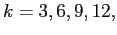
Eurodollars at maturity. We examine five different maturities: the
3-month, 6-month, 9-month, 1-year, and 5-year (
 and
and
 ) contracts. The
contracts maturing in less than one year are the most liquid.
) contracts. The
contracts maturing in less than one year are the most liquid.
The CME records `` time and sales data,'' which contain the time and price of a transaction only if the price is different from the previously recorded price. Bid (ask) quotes appear in this file only if the bid quote is above (the ask quote is below) the previously recorded transaction price. Because quotes are generally not recorded, we use the `` tick test'' to estimate buyer-initiated and seller-initiated orders.12 The order-flow series that we use is the net purchases (buyer-initiated less seller-initiated trades).
Using time and sales data produces two opposite effects on our measure of private information. The first effect is that we underestimate the number of `` liquidity trades'' as opposed to `` informed trades.'' Since we have time and sales data, we can measure trades only when the price of the asset changes, which is more likely to occur due to an informed trade rather than a liquidity-based trade. Thus, we systematically underestimate liquidity-based trades. This implies that our order-flow series is dominated by information-based trading.
The second effect results from not being able to observe quotes, which forces us to classify trades using the tick test. Our estimated order flows for the Eurodollar data using the tick test will be noisier than the order-flow measure for the other assets, which we obtain by using the Lee and Ready algorithm. However, Ellis, Michaely and O'Hara (2000) show that the tick test does not induce a systematic bias into the resulting order-flow data.
The foreign ETFs trade in U.S. dollars. As a robustness check to our results below, we wish to evaluate the effect of our public and private information shocks on foreign equity returns measured in foreign currencies. Unfortunately, we are unable to obtain high-frequency quote and transaction data on the spot market foreign exchange rates associated with our 12 foreign countries. We therefore use currency future contracts traded on the CME. We obtain time-and-sales data for the Euro, Japanese Yen, U.K. Pound, Swiss Franc, and Canadian Dollar futures contracts.13 The contracts are priced in U.S. dollars per unit of foreign currency. Again, we use the tick test to categorize the transactions data as purchases or sales. We use the 3-month futures contracts, because they are the most liquid.
One difficulty with combining our various data series is that the markets that we analyze have slightly different trading times. The Eurodollar and foreign currency futures contracts trade on the CME, where the trading hours are from 8:20 a.m. to 3.00 p.m. EST. The ETFs trade on the AMEX, where the trading hours are from 9:30 a.m. to 4.00 p.m. EST. In our analysis, we constrain the aggregate data set to a common period. We also divide the trading day into subperiods, to determine the influence of one market on the other. We therefore divide the day into eleven 30-minute intervals, with the first interval starting at 9:30 a.m. EST and the last interval ending at 3.00 p.m. EST. This results in a total of 15,598 half-hour observations for the entire data set. We use the last mid-quote recorded during each half-hour interval as our price.14Quote revisions are the log differences of these prices. Signed order flow is the total number of purchases less the total amount of sales during the interval.
Another difficulty with the data set is that the trades and quote revisions display an intra-day seasonality. We therefore perform an initial deseasonalization by projecting the order flows and quote revisions data on time-of-day dummy variables, and use the mean-centred residuals as our basic data series.
Table 1a shows sample statistics for the quote revisions on the
Eurodollar futures contracts, the U.S. and foreign ETFs, and the
foreign currency futures contracts. The Eurodollar futures
contracts have a very small average mean return and a low standard
deviation relative to the other series. The contracts with
maturities of less than one year are very liquid, with almost all
intervals recording a quote (transaction price). The ETFs are much
more volatile, with standard deviations above  per cent per half-hour of trading
for all countries. The U.S. ETF (Spider) is very liquid, with
observations recorded in
per cent per half-hour of trading
for all countries. The U.S. ETF (Spider) is very liquid, with
observations recorded in  per cent of all intervals. The foreign ETFs are naturally less
liquid, with some contracts having a quote observation in only
per cent of all intervals. The foreign ETFs are naturally less
liquid, with some contracts having a quote observation in only
 per cent of the
intervals. This may complicate the short-horizon analysis of
returns; however, our daily and weekly holding periods make this
issue much less important. The foreign currency contracts are all
liquid.
per cent of the
intervals. This may complicate the short-horizon analysis of
returns; however, our daily and weekly holding periods make this
issue much less important. The foreign currency contracts are all
liquid.
Table 1b shows the sample statistics of the order-flow data for
the assets. These data are displayed in numbers of net purchases
per half-hour period. For example, the 3-month Eurodollar futures
contract has an average of  contracts purchased net each half-hour during
the sample period. As can be seen, the net number of contracts
traded each interval ranges widely for the Eurodollar contracts,
the U.S. ETF, and the foreign currency futures contracts,
indicating a fair degree of trading activity.15 Some of the foreign ETFs trade much
less frequently, with trades recorded in approximately
contracts purchased net each half-hour during
the sample period. As can be seen, the net number of contracts
traded each interval ranges widely for the Eurodollar contracts,
the U.S. ETF, and the foreign currency futures contracts,
indicating a fair degree of trading activity.15 Some of the foreign ETFs trade much
less frequently, with trades recorded in approximately  per cent of all the intervals. We
obtain the global private information shocks from trading in the
Eurodollar and U.S. ETF markets, both of which are quite
liquid.
per cent of all the intervals. We
obtain the global private information shocks from trading in the
Eurodollar and U.S. ETF markets, both of which are quite
liquid.
Table 1c shows the correlation coefficients between the log
price changes of the ETF and their underlying MSCI indexes for
daily and weekly holding periods. The correlations range from
 to
to  at the daily interval, whereas
they rise to above
at the daily interval, whereas
they rise to above  at
the weekly interval. There are two reasons for the
less-than-perfect correlations. First, the ETF may not be able to
hold stocks in the same composition as that of the MSCI index. For
example, if a particular foreign stock is a large portion of the
foreign index, then the ETF fund manager may have trouble tracking
the index while keeping the ETF diversified enough for U.S. tax and
regulatory purposes. Second, investors are not able to arbitrage
all differences between the price of the ETF and the underlying
stocks, due to transactions costs and differences in trading
times.16 The
effect of timing differences will be particularly large at daily
intervals. Nevertheless, the correlations are high enough at the
weekly interval that we are confident that the ETFs represent the
U.S. prices of the foreign equities.
at
the weekly interval. There are two reasons for the
less-than-perfect correlations. First, the ETF may not be able to
hold stocks in the same composition as that of the MSCI index. For
example, if a particular foreign stock is a large portion of the
foreign index, then the ETF fund manager may have trouble tracking
the index while keeping the ETF diversified enough for U.S. tax and
regulatory purposes. Second, investors are not able to arbitrage
all differences between the price of the ETF and the underlying
stocks, due to transactions costs and differences in trading
times.16 The
effect of timing differences will be particularly large at daily
intervals. Nevertheless, the correlations are high enough at the
weekly interval that we are confident that the ETFs represent the
U.S. prices of the foreign equities.
Table 2a shows the contemporaneous correlations between the quote revisions on the assets. The top part of the table shows the correlations between the Eurodollar futures, the U.S. ETF, and the foreign currency futures contracts. There is a high degree of correlation between price movements on the short-dated Eurodollar futures contracts. The negative correlation between the U.S. ETF quote revision and those on the Eurodollar contracts implies that price gains in the U.S. ETF are associated with rising Eurodollar interest rates. In our sample, the U.S. Federal Reserve raised interest rates as the equity market was gaining, and then lowered rates as the market declined. The correlations with the foreign currency contracts indicate that an increase in the U.S. equity market is associated with a strengthening U.S. dollar against all of the foreign currencies except the Canadian dollar. The correlations among the U.S. and foreign equity quotes at the bottom part of Table 2a indicate that common factors are affecting the returns on these assets during U.S. trading times.
The net purchases data also display common variation, though the correlations are not as high (Table 2b). Again, the short-dated Eurodollar contracts display common variation. Investors purchase Eurodollar contracts when they are selling the U.S. equity market, as shown in the middle of the table. The bottom part of the table indicates some common variation to net purchases across the ETF markets.
In our analysis below, we study the effects of information
shocks that arise in the U.S. money and equity markets on foreign
equities. This implies a causal (time-series) relation that we
should establish first. We thus undertake a number of Granger
causality tests. In the first set of tests, we examine whether
foreign equity market order flows and quote revisions cause either
quote revisions or order flow in the Eurodollar market. In these
tests, we regress the quote revision or order flow in the U.S.
money market on 12 lagged values of order flow and quote revisions
in the market.17 We also
include 12 lagged values of the U.S. or foreign ETF order flows and
quote revisions, to determine whether the coefficients on the
latter variables are jointly significant, yielding a test statistic
that is distributed as
 .
.
Table 3a shows the asymptotic marginal significance levels
( -values) of the tests.
A small value would indicate predictability of the U.S. or foreign
equity market variable for the U.S. money market. None of the 44
statistics is significant at a
-values) of the tests.
A small value would indicate predictability of the U.S. or foreign
equity market variable for the U.S. money market. None of the 44
statistics is significant at a  per cent level, indicating that neither the order
flows nor the quote revisions from the U.S. or foreign ETF markets
Granger-cause the Eurodollar market.
per cent level, indicating that neither the order
flows nor the quote revisions from the U.S. or foreign ETF markets
Granger-cause the Eurodollar market.
We repeat the same test for the U.S. equity markets quote-revision and order-flow regressions. We also test (Table 3b) whether the Eurodollar variables help predict movements in the U.S. equity market. There is clear evidence that Eurodollar order flows and quote revisions cause movements in U.S. equity order flows and quote revisions. In contrast, only a few of the foreign ETF variables Granger-cause order flows or quote revisions in the U.S. ETF.
We also test (Table 3c) whether the U.S. money and equity markets Granger-cause the foreign equity markets. Lagged order flow in the Eurodollar and U.S. ETF markets is a significant predictor of future quotes and order flows in a number of countries. Lagged quote revisions in the Eurodollar and U.S. ETF markets yield a large amount of predictability in the foreign ETF order-flow processes. Investors who transact in U.S. trading times appear to base their foreign buying decisions on recent price movements in the U.S. markets. There is also a strong relationship in the foreign quote-revision regressions. ETF market makers respond to lagged order flows and quote revisions in the two U.S. markets when they set their quotes.
The tests indicate that price discovery occurs first in the U.S. money and then in the U.S. equity market. This information is subsequently impounded into foreign equity prices. This sequence is related to the relative liquidity of the markets. When investors receive private news about `` global'' factors (i.e., factors that affect many asset markets), they undertake transactions in those markets that are the most liquid. Thus, the initial price response in the Eurodollar and U.S. ETF markets may simply result from the relative liquidity of the markets. The market makers in the less-liquid market observe these prices and then adjust their quotes.
2.2 The Eurodollar futures contract and U.S. monetary policy
This paper uses the rate on Eurodollar futures contracts to estimate monetary policy shocks. Previous research has provided evidence on several components in the Eurodollar futures interest rate. Cochrane and Piazzesi (2002) show that the (spot) Eurodollar interest rate can successfully forecast moves in the Federal funds target rate, the rate which anchors moves in the spot Federal funds rate. Lee (2003) examines the close connection that exists between the overnight Federal funds market and its Eurodollar counterpart (the `` on-shore - off-shore interest differential''). He finds a small potential arbitrage between the two rates, but notes a number of frictions that may prevent arbitrage trades from happening. Stigum (1990, p. 911) also notes the close connection between the Eurodollar and domestic interest rate markets and quotes a Eurobanker as saying that `` Rarely does the tail wag the dog. The U.S. money market is the dog, the Euromarket the tail.'' She goes on to say that: `` The truth of this statement has created a foreign contingent of Fed watchers - in London, Paris, Singapore and other Eurocenters. ... Eurobankers must understand the workings of the U.S. money market and follow closely developments there.'' Piazzesi and Swanson (2004) show that Eurodollar futures rates predict future Federal funds rates. In addition, they find a significant time-varying risk premium in the futures rates, which can complicate the extraction of monetary policy forecasts from the futures' rates.
Thus, we can break the price of the Eurodollar futures contract into three components. The first is the forecast of the Federal funds rate (the `` monetary policy'' component). The second is the forecast of the difference between the Eurodollar interest rate (LIBOR) and the Federal funds rate (the `` on-shore - off-shore interest rate differential'' component). The third is the risk-premium component from holding the contract. Our assumption in this paper is that trades in the Eurodollar market reflect private information about the three components.
We use this framework to extract monetary policy innovations. Piazzesi and Swanson (2004) note that daily changes in the price of a Eurodollar futures contract can be used as a measure of a monetary policy shock, since the risk-premium component is relatively stable over their 2-day window. We use the change in the price of a short-term Eurodollar futures contract at the time of the target rate announcement as our measure of a monetary policy shock. Our assumption is that neither the risk-premium component nor the on-shore - off-shore interest differential component will change significantly during this half-hour period. Below, in our analysis of the microstructure data, we will show how to get a good measure of the unanticipated move in the rate at high frequencies. For now, we provide some simple forecasts using daily data. In Figure 1, we show how the price of the 6-month Eurodollar futures contract is related to future Federal funds target moves. From June 1999 to June 2000, the Eurodollar futures lead the Federal funds target rate increases. Likewise, from November 2000 to November 2001, the Eurodollar futures lead the target rate decreases. In the earlier part of the sample, from April 1996 to June 1999, there are two `` false'' predictions, but, for the most part, the Eurodollar futures correctly predicts no changes in the target and leads the increase and decrease in the target rate.
To formalize how well the Eurodollar futures contract can
forecast target rate changes, we estimate the forecasting model of
Cochrane and Piazzesi (2002). We estimate the model in price form;
i.e., we calculate a `` price'' for the Federal funds target rate
as
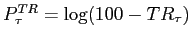 , where
  is the target rate at time
 . We make this
estimation to be consistent with our public and private information
system of equations used in section 3, which are in quote revision
form. The forecast regression is then
. We make this
estimation to be consistent with our public and private information
system of equations used in section 3, which are in quote revision
form. The forecast regression is then

where
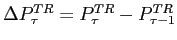 is
the `` return'' on the target rate at time , when a change to the target rate
is announced;
is
the `` return'' on the target rate at time , when a change to the target rate
is announced;
 is the
target rate 30 minutes before the announced change to the target
rate; and
is the
target rate 30 minutes before the announced change to the target
rate; and
 is
the spread between the log target rate price and the log Eurodollar
futures price on the
is
the spread between the log target rate price and the log Eurodollar
futures price on the  -month
contract, also recorded 30 minutes before the change to the target
rate. Note that the time index,
-month
contract, also recorded 30 minutes before the change to the target
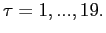
rate. Note that the time index,  is an event time index. In our sample period,
there are 19 changes to the target rate, so
is an event time index. In our sample period,
there are 19 changes to the target rate, so
 18
18
We run the Cochrane-Piazzesi regression separately using each of
the Eurodollar futures contracts. Table 4 shows the results. The
6-month contract has the highest predictive power, with an
 of
of  The negative coefficient on the
spread is to be expected; if the `` price'' of the target rate is
above that on the Eurodollar contract, the negative coefficient
indicates that a decrease in the Federal funds price is forecast,
so that it moves closer to that of the Eurodollar contract.
Overall, the regressions indicate that the spread between the
Eurodollar futures contracts and the current level of the target
contains significant information about future changes to the
Federal funds target.
The negative coefficient on the
spread is to be expected; if the `` price'' of the target rate is
above that on the Eurodollar contract, the negative coefficient
indicates that a decrease in the Federal funds price is forecast,
so that it moves closer to that of the Eurodollar contract.
Overall, the regressions indicate that the spread between the
Eurodollar futures contracts and the current level of the target
contains significant information about future changes to the
Federal funds target.
3 Private Information in U.S. Asset Markets
In this section, we use microstructure theory and a modification of a standard empirical model to obtain measures of private and public information shocks in the U.S. money and equity markets.19We start by outlining our general modelling approach and then apply it to the U.S. money and equity markets. The model yields public and private information shocks from the two markets that are used in the cross sectional analysis of international stock returns in section 4. However, they are also of interest in their own right for revealing the impact of trades based on private information in aggregate U.S. markets.
3.1 General modelling approach
Theoretical papers designed to explain price changes in a
microstructure setting have emphasized two factors: the optimal
inventory level of the specialist and the response of the quote to
information revelation. Our approach is to focus on the
information-revelation component while controlling for inventory
and liquidity effects. Figure 2 shows the stylized timing
convention that is present in the models. An investor observes the
original quotes (
 is the bid,
 is the ask)
set by the market maker at time
is the ask)
set by the market maker at time  . The investor then decides on their trade (i.e.,
net order flow),
. The investor then decides on their trade (i.e.,
net order flow),  which is driven partially by private information and by liquidity
needs. Public information news arrives after the trade is completed
and the market maker sets new quotes at time
which is driven partially by private information and by liquidity
needs. Public information news arrives after the trade is completed
and the market maker sets new quotes at time  , prior to any new trades being
completed.
, prior to any new trades being
completed.
To estimate the public and private information shocks in a particular asset market, we adopt the linear vector autoregression of Hasbrouck (1991). As he points out, many microstructure imperfections (e.g., inventory control effects, price discreteness, exchange mandated price smoothing) can cause lagged effects in order-flow and quote-revision dynamics. We therefore model investor order flow as a linear function of past flows and quote revisions:

where  is the (net)
order flow in the market;
is the (net)
order flow in the market;  is the quote revision on the asset; and
 and
and
 are
polynomials in the lag operator. The residual in this equation
(
are
polynomials in the lag operator. The residual in this equation
( ) includes two
components. The first is unanticipated trades due to liquidity
shocks: investors will undertake trades in an asset market in
response to random shocks to their wealth. The second component is
unanticipated trades due to new private information: investors will
undertake trades when their private assessment of the asset's value
differs from the prevailing market quote.20
) includes two
components. The first is unanticipated trades due to liquidity
shocks: investors will undertake trades in an asset market in
response to random shocks to their wealth. The second component is
unanticipated trades due to new private information: investors will
undertake trades when their private assessment of the asset's value
differs from the prevailing market quote.20
Quote revisions can be modelled using a similar autoregressive structure:

The lagged quote revision and order-flow variables are also present
to capture transient microstructure effects. Note that
contemporaneous unanticipated trades () are included in this
equation, given the above assumption about information revelation
in microstructure time. Because the explanatory variables account
for microstructure effects and private information, the disturbance
 reflects
public information news. The combined system of (2) and (3) thus provides
two (orthogonal) shocks that represent private and public news in
an asset market, respectively.
reflects
public information news. The combined system of (2) and (3) thus provides
two (orthogonal) shocks that represent private and public news in
an asset market, respectively.
In this system, a private information shock will cause a
sequence of quote revisions as the information becomes absorbed
into the market price. The key difficulty is in identifying the
private information component of the (unanticipated) trade
(). The
identifying assumption is that, in a market with informed and
uninformed traders, order flow conveys information and therefore
causes a persistent impact on the
security's price.21 Trades
based on liquidity or inventory have no information value and thus
have only a transitory impact on prices. Therefore, with the
passage of time, all rational agents expect quotes to revert (on
average) to the fair value of the security,
![$\displaystyle s\rightarrow T,E\left[ (q_{s}^{b}+q_{s}^{a})/2-p_{T}\vert\Phi _{t}\right] \rightarrow0,$](img41.gif)
where
 is some future time;
 is the terminal time
when the true value of the security,
is the terminal time
when the true value of the security,  , is revealed; and
  is the current (time ) information set. Private
information about an asset's value will cause a change in the fair
value of the security as the information is revealed through
trading and becomes incorporated in the market's expectation of the
price. To calculate the effect of a private information shock on an
asset's price, we calculate the long-run impact that unanticipated
trade orders have on the security's quotes.
is the current (time ) information set. Private
information about an asset's value will cause a change in the fair
value of the security as the information is revealed through
trading and becomes incorporated in the market's expectation of the
price. To calculate the effect of a private information shock on an
asset's price, we calculate the long-run impact that unanticipated
trade orders have on the security's quotes.
To measure the permanent effects of an unanticipated trade, we
construct the change in the (log) price of the asset over the
holding period,  :
:

We can then model the
-period return using the same structure as above:

In this equation, the holding-period return is driven in part by private information `` news'' that has been revealed to the market in the form of unanticipated trades (
 ). These unanticipated trades are noisy
measures of private information, because they include liquidity or
inventory effects. The key economic identification that we obtain
from the microstructure literature is that liquidity effects are
transient, whereas information effects are permanent. The trades
will represent private information if the
). These unanticipated trades are noisy
measures of private information, because they include liquidity or
inventory effects. The key economic identification that we obtain
from the microstructure literature is that liquidity effects are
transient, whereas information effects are permanent. The trades
will represent private information if the  coefficient is statistically
significant for longer holding periods.
coefficient is statistically
significant for longer holding periods.
Our econometric specification is similar to that by Hasbrouck
(1991), in that a reduced-form specification for trades is used to
obtain a residual that is a noisy measure of the private
information news. He uses impulse-response functions to obtain the
impact of an unanticipated net purchase on quote revisions. Our
method has direct tests of the private information effects on
returns via an examination of the significance of the coefficient. Our approach
provides robust standard errors on the impact of unanticipated
trades on returns, something that is not easily available in a
reduced-form VAR with simultaneous variables on the right-hand
side.22
3.2 Private and public information in U.S. money and equity markets
In this section, we describe our model of net purchases and quote revisions in the Eurodollar futures and U.S. ETF markets. While we base our model on the general approach of section 3.1, there are two additional issues that we must face. The first is that we are estimating the dynamics of quote revisions and order flows in the U.S. money and equity markets simultaneously. An assumption is therefore required about the information sets of the market makers in the two markets. We assume that the market makers in both markets can observe past order flows and prices from both markets.23 In this way, private information shocks in one market may be transmitted to the other market.
The second issue is the assumed variance-covariance stationarity of the data needed to estimate the VAR, which is clearly not the case with the Eurodollar futures contract.24 Figure 1 shows that the mean of the Eurodollar rate changes over time as it fluctuates around the Federal funds target rate. We therefore model the conditional mean of the Eurodollar rate as a function of the Federal funds target rate.
Following our general approach in section 3.1, the first
equation in the system models the time-series process of the order
flow in the Eurodollar futures market (
 ),
),



In this equation, net purchases in the Eurodollar futures market
are linear functions of past net purchases and quote revisions in
both the Eurodollar and U.S. ETF markets. Current trades are a
function of these public information variables, due to various
microstructure effects, which, in our setting, may have an
influence across several markets. We also include the two ``
monetary policy'' variables that were used in the Cochrane-Piazzesi
target rate regressions: the price of the lagged Federal funds
target rate (
 ) and the
spread between the log target-rate price and the log Eurodollar
futures price (
) and the
spread between the log target-rate price and the log Eurodollar
futures price (
 ). Recall
that both variables were shown to have good explanatory power for
forecasting future U.S. Federal Reserve policy moves in Table 4. If
agents trade in the Eurodollar market in anticipation of future Fed
moves, these variables should help capture those effects.
). Recall
that both variables were shown to have good explanatory power for
forecasting future U.S. Federal Reserve policy moves in Table 4. If
agents trade in the Eurodollar market in anticipation of future Fed
moves, these variables should help capture those effects.
The order-flow process for the U.S. ETF can be modelled similarly:



Equity market order flow is also a function of past order flow and quote revisions in the two markets.25 If sophisticated investors trade in the equity market in anticipation of interest rate changes by the Federal Reserve, then the monetary policy variables from the Cochrane-Piazessi regressions should help capture this flow. Following our Granger causality test results, we assume that the equity market maker sees the unanticipated order flow from the Eurodollar money market. The first two equations then provide (orthogonalized) residuals that contain the private information of sophisticated investors in the money and equity markets.
The third equation in the system models the quote revision process in the U.S. money market:



In this equation, the holding-period return on a Eurodollar futures contract is a function of past quote revisions and order flows in the two markets. These may have an influence over short holding periods, because microstructure effects are important. As the holding period lengthens, these variables are less likely to have an influence. We also include the monetary policy variables in this regression, for the reasons given above. The close relationship between the Eurodollar and target rates implies that the spread variable may help to capture the movement of the rates towards each other.
Quote revisions are also driven in part by private information
`` news'' that has been revealed to the market in the form of
unanticipated trades in both the money and equity markets (
 and
and
 ,
respectively). These unanticipated trades are noisy measures of
private information, because they include liquidity or inventory
shocks. As stated above, the key economic identification that we
obtain from the microstructure literature is that liquidity shocks
are transient, whereas information shocks have a permanent effect
on the price of the asset. To measure the permanent effects of
information shocks, we look at quote revisions in the Eurodollar
futures over the holding period, :
,
respectively). These unanticipated trades are noisy measures of
private information, because they include liquidity or inventory
shocks. As stated above, the key economic identification that we
obtain from the microstructure literature is that liquidity shocks
are transient, whereas information shocks have a permanent effect
on the price of the asset. To measure the permanent effects of
information shocks, we look at quote revisions in the Eurodollar
futures over the holding period, :

where
 is the price
of the Eurodollar futures contract.26 Thus, the trades will represent
private information if the
is the price
of the Eurodollar futures contract.26 Thus, the trades will represent
private information if the
 or
or
 coefficients are significant for longer holding periods.
We can gauge the effect of public and private information on U.S. equity returns similarly via:



In this regression, accumulated U.S. equity returns over the
holding period, (
 )
are a function of past public information originating in the U.S.
money and equity markets. Unanticipated money and equity market
order flows will forecast future equity returns if they contain
private information that is relevant to the equity market maker. As
in our money market analysis, the key test is that the
unanticipated money and equity market trades have an effect on
returns over longer holding periods (
)
are a function of past public information originating in the U.S.
money and equity markets. Unanticipated money and equity market
order flows will forecast future equity returns if they contain
private information that is relevant to the equity market maker. As
in our money market analysis, the key test is that the
unanticipated money and equity market trades have an effect on
returns over longer holding periods ( day or
days).
day or
days).
The half-hour ()
version of the money market quote-revision regression (9) provides an
estimate of the expected change in the price of the Eurodollar
contract. The residual from this regression (
 ) will be
the unexpected change in interest rates due to public news
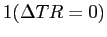
innovations. We can further decompose this residual using dummy
variables into those shocks that occur when there is a change to
the Federal funds target rate (
) will be
the unexpected change in interest rates due to public news
innovations. We can further decompose this residual using dummy
variables into those shocks that occur when there is a change to
the Federal funds target rate (
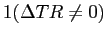 ) and when there is not (
 ). During the half-hour period
when the Federal Reserve changes interest rates, there is a clear
causal chain from the money market to the equity market. Thus, the
change in the price of the Eurodollar contract during these
particular half-hour periods (
) provides a high-frequency
counterpart to the monetary policy shocks constructed by Cochrane
and Piazzesi (2002). We therefore include these residuals in the
equity market order-flow regression.
). During the half-hour period
when the Federal Reserve changes interest rates, there is a clear
causal chain from the money market to the equity market. Thus, the
change in the price of the Eurodollar contract during these
particular half-hour periods (
) provides a high-frequency
counterpart to the monetary policy shocks constructed by Cochrane
and Piazzesi (2002). We therefore include these residuals in the
equity market order-flow regression.
3.3 Results
Table a shows
results of the first two equations from the model. The estimate of
the Eurodollar order-flow regression is at the top. Overall, the
instruments do a poor job in capturing expected Eurodollar order
flow: the
statistic is only  .27 The
monetary variables are not significant, which suggests that traders
do not position themselves around monetary policy changes. This
result may be misleading, however, because these trades could occur
at any time, and thus trying to capture them with one lagged value
may not be sufficient. The second regression is for U.S. equity
market order flow. This regression has an adjusted statistic of
.27 The
monetary variables are not significant, which suggests that traders
do not position themselves around monetary policy changes. This
result may be misleading, however, because these trades could occur
at any time, and thus trying to capture them with one lagged value
may not be sufficient. The second regression is for U.S. equity
market order flow. This regression has an adjusted statistic of  , which indicates that the
instruments have some ability to forecast the next period's order
flow. The sums of the U.S. ETF lagged order-flow and quote-revision
coefficients are significant, as are the lagged Eurodollar quote
revisions. The spread variable is also significant, with a positive
coefficient.
, which indicates that the
instruments have some ability to forecast the next period's order
flow. The sums of the U.S. ETF lagged order-flow and quote-revision
coefficients are significant, as are the lagged Eurodollar quote
revisions. The spread variable is also significant, with a positive
coefficient.
The poor ability of the selected instruments to capture order-flow variation raises concern about the use of the residuals from these regressions in the holding-period return regressions (9) and (10 ). The low degree of explanatory power indicates that the instruments are not able to capture much of the short-run inventory dynamics that are present in the markets. The residuals will therefore contain more of these short-run influences, making them noisier signals of the long-run information component. This, in turn, makes our subsequent findings of significant information effects more conservative.
Table b shows the
results of estimating the holding-period returns (9) on the
Eurodollar futures contract over periods ranging from one half-hour
to five trading days. The ability of the selected instruments to
model short-run movements in Eurodollar quote revisions is very
high, with the half-hour regression having an statistic of  As the holding period
lengthens, the statistics decrease rapidly, in line with similar
estimates of daily and weekly returns throughout the asset-pricing
literature. The spread variable is significant at conventional
levels for all of the holding periods. When the spread is higher,
the regressions in Table
As the holding period
lengthens, the statistics decrease rapidly, in line with similar
estimates of daily and weekly returns throughout the asset-pricing
literature. The spread variable is significant at conventional
levels for all of the holding periods. When the spread is higher,
the regressions in Table  show that the price of the target asset was expected to fall (an
increase in the target rate was likely). The spread shows that a
decrease in the Eurodollar price (an increase in the Eurodollar
rate) is also likely.
show that the price of the target asset was expected to fall (an
increase in the target rate was likely). The spread shows that a
decrease in the Eurodollar price (an increase in the Eurodollar
rate) is also likely.
The regressions also include the unanticipated order flows from
the money and equity markets (i.e., the residuals from the
order-flow regressions in Table a). The Eurodollar order-flow variable is significant
at all holding periods, which indicates that trades based on
private information are present in the Eurodollar futures market.
Sophisticated agents appear to have superior information about the
direction of future U.S. interest rates. When they trade, the
information becomes incorporated into market rates. The market
makers do not appear to use equity market order flow for longer-run
pricing decisions, providing further evidence that the direction of
causality is from the money market to the equity market.
Table c shows the
estimates of the holding-period returns on the U.S. ETF. As with
the quote-revision regressions, the half-hour holding period
returns display a large amount of predictability, with an
statistic of
 per cent. As the
holding period lengthens, the degree of linear predictability again
naturally falls. Neither of the two monetary policy variables from
the Cochrane-Piazzesi regressions is significant. Rather, the
influence of the money market is captured by the information shocks
from the Eurodollar market. Unanticipated money market order flow
is significant for the half-hour to day holding periods. Thus, private information
revealed in the U.S. money market helps predict subsequent U.S.
equity market movements. We note that the negative coefficients are
in line with the unconditional negative correlation coefficients
between the price of the ETF and U.S. equity market shown in Table
per cent. As the
holding period lengthens, the degree of linear predictability again
naturally falls. Neither of the two monetary policy variables from
the Cochrane-Piazzesi regressions is significant. Rather, the
influence of the money market is captured by the information shocks
from the Eurodollar market. Unanticipated money market order flow
is significant for the half-hour to day holding periods. Thus, private information
revealed in the U.S. money market helps predict subsequent U.S.
equity market movements. We note that the negative coefficients are
in line with the unconditional negative correlation coefficients
between the price of the ETF and U.S. equity market shown in Table
 ; traders are
adjusting their positions in line with the movements between
interest rates and equity returns during this period.
; traders are
adjusting their positions in line with the movements between
interest rates and equity returns during this period.
The effect of an unexpected change in the price of the
Eurodollar contract when there is a Federal Reserve policy change (
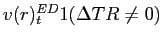 ) is shown in
the next column of Table 5c. The positive coefficients are in line
with other estimates in the literature: a policy-driven increase in
interest rates causes a decline in equity market prices. However,
the coefficients are significant at conventional levels for the
half-hour and
) is shown in
the next column of Table 5c. The positive coefficients are in line
with other estimates in the literature: a policy-driven increase in
interest rates causes a decline in equity market prices. However,
the coefficients are significant at conventional levels for the
half-hour and  day holding
periods only. At the day
horizon, the coefficient has a P-value
of
day holding
periods only. At the day
horizon, the coefficient has a P-value
of  .
.
There are two ways to interpret this finding. The first is that, although public news about U.S. monetary policy changes is quickly incorporated into U.S. equity market returns, the news has no long-run effect on prices. However, this interpretation would be at odds with a large and growing literature that finds that unexpected changes to the Federal funds target have an effect on longer-run asset market returns.28
The second interpretation of our results is that there are too
few ( ) changes to the
target rate during our sample period. Longer-run returns are
noisier and the power of the regressions to detect the effect of
the changes declines. In addition, other macroeconomic
announcements occur during the weekly holding periods. For example,
there are U.S. payroll announcements during the week following six
of the target rate changes in our sample. Five of these
announcements are negative and would have the effect of decreasing
U.S. equity returns, as Andersen et al. (2004) show. Thus, the
effects of monetary policy shocks are being negated by the effects
of the U.S. employment shocks. Under either interpretation of these
public news shocks, it is important to note that the private
information shocks have a long-run impact.
) changes to the
target rate during our sample period. Longer-run returns are
noisier and the power of the regressions to detect the effect of
the changes declines. In addition, other macroeconomic
announcements occur during the weekly holding periods. For example,
there are U.S. payroll announcements during the week following six
of the target rate changes in our sample. Five of these
announcements are negative and would have the effect of decreasing
U.S. equity returns, as Andersen et al. (2004) show. Thus, the
effects of monetary policy shocks are being negated by the effects
of the U.S. employment shocks. Under either interpretation of these
public news shocks, it is important to note that the private
information shocks have a long-run impact.
The last column in the table shows the effect of unanticipated equity market purchases over a half-hour period on future equity returns. The coefficients are positive and significant for all of the holding periods examined. While this variable may reflect both liquidity and information shocks at short horizons, only the information-based component will have an effect over longer holding periods. It is clear, then, that sophisticated investors have private information about the aggregate U.S. equity market. When they trade, this information is gradually incorporated into prices.
3.4 Interpretation
Our view of asymmetric information is different from the standard one, in which traders have good information about a specific firm. One way to view the equity market results in this section is that traders have correlated private information about many firms. Although the theoretical works of Subrahmanyam (1991) and Chan (1993) examine correlated private information, they are silent on the economic origins of the information.
Our contribution is to relate aggregate private information to
factors that influence the returns on many assets; in particular,
monetary policy. We have shown that unanticipated changes in the
Eurodollar rate when there is a Federal Reserve policy change, a
public news shock, affect U.S. stocks over a day interval.29 However, private information
originating in the U.S. money markets forecasts stock returns over
to days.30 This suggests that it may take longer
for investors to interpret the trades based on private information
about interest rates than the moves in the interest rate
itself.
Saar (2001) notes that the price impact of trades may not be the result of superior knowledge about the cash flows on the assets being released to the market. It may, instead, be the result of the market maker assessing the distribution of demand in a heterogeneous investor environment. The market maker uses trades to obtain more information about investor preferences and endowments. We note that this private information is not `` insider'' information; rather, it is the superior interpretation of public signals. The expense devoted to `` Fed watching'' by many financial institutions suggests that the forecasting of Federal Reserve actions is a profitable activity. Fed watchers (or the agents who use their analyses) can thus be viewed as informed traders whose orders convey information.
Given these findings, we are indifferent as to whether the private information we find is about either the cash flows on the assets or how these cash flows will be demanded by market participants. Sophisticated investors could obtain superior knowledge of factors that affect the cash flows that U.S. equities are claims to, or superior knowledge about future interest rate levels, from macroeconomic analysis. Alternatively, they could obtain knowledge of future investor order flow in the U.S. markets. In either case, the information asymmetry would likely impact foreign equity markets, as we show below.
One question about our results is the long-lived nature of the private information shock. Our daily and weekly results are bracketed by results in other studies that examine the effects of trading based on private information. For example, Hasbrouck (1991) examines the impact of private information on quote revisions that occur up to 20 transactions later. In contrast, Easley, Hvidkjaer and O'Hara (2002) find that a measure of a stock's probability of information-based trading is priced in the cross section of U.S. stocks using monthly data.
Our results have implications for studies that attempt to link private information and other market frictions to domestic asset prices. For example, other work has explored systematic factors in liquidity and their link to the cross section of U.S. stock returns (Chordia, Roll and Subrahmanyam 2000, Hasbrouck and Seppi 2001, and Pastor and Stambaugh 2003). We note that liquidity and trading based on private information are linked in many microstructure models. Our finding of a role of common private information may therefore provide some guidance for the economic origins of systematic liquidity.
4 The Cross Section of International Equity Returns
The previous sections have shown that trading based on private information predicts both U.S. money and equity market returns over daily and weekly holding periods. In addition, public information shocks in the Eurodollar market associated with policy changes affect U.S. equity prices. If international equity markets are integrated, then the factors that affect U.S. equity markets will also affect international markets. In this section, we explore whether these shocks are priced by estimating a latent-factor model of the cross section of international equity returns.
4.1 Latent-factor model
To test whether the U.S. information shocks are priced factors
in international markets, we use the latent-factor model of Hansen
and Hodrick (1983) and Gibbons and Ferson (1985). In this model,
the excess return on a foreign asset,  is a function of the realizations
of
is a function of the realizations
of  factors:
![$\displaystyle r_{i,t+1}=E_{t}[r_{i,t+1}]+\beta_{i}f_{t+1}+\varepsilon_{i,t+1} ,$](img91.gif)
where
 is a
is a  vector of factor realizations
with
vector of factor realizations
with
![$ E_{t} [f_{t+1}]=0$](img94.gif) ;
;
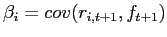 is a
is a  vector of constants; and
 is an
idiosyncratic error, uncorrelated with
is an
idiosyncratic error, uncorrelated with  Equilibrium requires that the
expected return on the asset be a function of the sources of risk:
Equilibrium requires that the
expected return on the asset be a function of the sources of risk:
![$\displaystyle E_{t}[r_{i,t+1}]=\beta_{i}\theta_{t},$](img99.gif)
where
 is a
vector that
contains the market price of risk of the factors.
is a
vector that
contains the market price of risk of the factors.
In the latent-factor approach, the factors are not specified
directly. Rather, there are a number of instruments that forecast
returns in the markets and are likely related to the true, but
unknown, factors. The price of risk of the  -th factor,
 , is
written as a linear combination of the set of
, is
written as a linear combination of the set of  instruments,
  :
:

where the
 are
coefficients.
are
coefficients.
Combining the assumption about the process driving returns
(11), the
equilibrium condition (12), and the
assumption on the market price of risk (13) yields a
non-linear pricing equation for asset  :
:
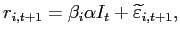
where the 
 matrix contains
the
coefficients on the instruments for the factors and
matrix contains
the
coefficients on the instruments for the factors and
 . This model is used to examine the cross section of
 assets via:
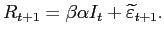
 is the
vector that contains
the quote revisions on the foreign countries. The by matrix,
is the
vector that contains
the quote revisions on the foreign countries. The by matrix,  is the loading of the returns on the
time-varying factor returns. The by
matrix,
is the loading of the returns on the
time-varying factor returns. The by
matrix,  are
the coefficients on the instruments; the linear combination,
are
the coefficients on the instruments; the linear combination,
 represents the time-varying return on the latent factors.
Because the factors are latent in this model, its ability to price the cross section of international equity returns will depend on the selection of the instruments. Campbell (1996) asserts that the factors that price the cross section of asset returns should be the innovations on those variables that can forecast the moments of the investment-opportunity set. In our model, with the assumption of international market integration, the innovations on those variables that forecast U.S. asset returns will be able to forecast the international investment-opportunity set.31 Thus, we use the public and private information variables from our time-series regressions for our instruments:
 |
 constant, constant, 
|
|
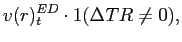   |
Our information set,  includes the monetary policy variables that were shown to have some
predictability for the Eurodollar and U.S. ETF markets. We include
the unanticipated order flow and quote revision from the Eurodollar
money market regressions, (7) and (9), respectively.
Note that we segregate the public information shocks into those
that have occurred as a function of changes to the target rate (
includes the monetary policy variables that were shown to have some
predictability for the Eurodollar and U.S. ETF markets. We include
the unanticipated order flow and quote revision from the Eurodollar
money market regressions, (7) and (9), respectively.
Note that we segregate the public information shocks into those
that have occurred as a function of changes to the target rate (
 ) and
those that have not (
) and
those that have not (
 ). We also
include the unanticipated order flow and quote revision from the
U.S. equity market regressions, (8) and (10), respectively.
). We also
include the unanticipated order flow and quote revision from the
U.S. equity market regressions, (8) and (10), respectively.
Our interest centres on the public and private information content of the shocks from the Eurodollar and U.S. equity markets. The unanticipated quote revisions represent public information news in the two markets. As stated earlier, the unanticipated order flows will contain elements related both to microstructure (e.g., liquidity or inventory) effects and to shocks to the private information sets of sophisticated investors. Over longer holding periods, the microstructure effects will disappear and the information effects of the trades may be obtained by estimating:

where  is the vector
of -period returns on the
foreign equity markets. If private information is part of a priced
factor, the
is the vector
of -period returns on the
foreign equity markets. If private information is part of a priced
factor, the
 coefficients associated with the unanticipated order flows will be
significant for longer holding periods (e.g., day or week).
coefficients associated with the unanticipated order flows will be
significant for longer holding periods (e.g., day or week).
The model is estimated by generalized method of moments (GMM).
We estimate the system (14) separately for
each holding period, . The
Newey-West (1987) form of the optimal weighting matrix is used to
capture any autocorrelation of heteroskedasticity in the residuals.
In its current form, the model is unidentified due to the
 combination. We thus impose the standard identification that the
first rows of the matrix
combination. We thus impose the standard identification that the
first rows of the matrix
 are equal to
an identity matrix. The cross-equation restrictions of the model
can be tested using the standard
are equal to
an identity matrix. The cross-equation restrictions of the model
can be tested using the standard  test statistic from a GMM system.
Using the latent-factor model to capture the cross section of returns has a number of advantages.32 In this study, as with other empirical studies of market frictions on asset prices (e.g., Pastor and Stambaugh 2002, Hou and Moskowitz 2003), we do not specify a model that directly ties asymmetric information to the cross section of expected international returns.33 Rather, the cross section of returns should be explained by those variables that can predict time variation in the investment-opportunity set. Given the time-series results above, the variables we have chosen should have some power to explain the cross section. The advantage of the latent-factor model is that it can capture the pricing ability of all of the variables in a parsimonious setting.
Another advantage of the latent-factor model is that it allows the data to reveal the structure of the cross section of expected returns. This can answer a number of questions. For example, are private and public information shocks separate factors, or part of the same factor? Do all of the countries examined load on the same shocks? Alternatively, as noted by Campbell and Hamao (1992), the latent-factor model can be evaluated simply by its ability to describe the cross section of returns.
4.2 Results
Table 6 shows the summary statistics of a one-latent-factor
model. The test
statistics of the cross-equation restrictions on the parameters are
shown at the top of the table, along with their asymptotic marginal
significance levels (-values). The statistics show that the one-factor
model is rejected for the one-half-hour () returns, whereas it is not
rejected for the daily and weekly returns ( and days). To judge whether the model does a good job in
capturing expected equity returns, we examine some variance ratios.
The numerator of the ratio is the variance of the expected return
on the foreign country ETF from the latent-factor model. The
denominator is the variance of the expected return from a
regression of the ETF return on the same instruments. If the model
does a good job in capturing expected return variation, then the
ratio should be near 1.00. As can be seen, the ratios are lower for
the half-hour holding period, whereas they rise for most countries
for the daily and weekly intervals.
The results of these tests contain a mixed message for the
model. Formally, our choice of instruments and the over-identifying
restrictions are rejected for the half-hour holding period, likely
due to short-run microstructure effects such as inventory
rebalancing or liquidity shocks. The microstructure effects will be
captured (in part) by our instruments and will affect half-hour
holding-period returns as the market maker adjusts their quotes to
the shocks. The quote adjustment process, however, appears to be
more complicated over half-hour intervals than the factor model
indicates. The large number of data points ( ,
, ) allows us to detect these small differences even
though the model captures a large portion of the predictable
returns based on these instruments.
) allows us to detect these small differences even
though the model captures a large portion of the predictable
returns based on these instruments.
At longer holding periods of a day to a week, the microstructure effects disappear and pricing decisions are driven by the assessment of information in the market. The combination of our instruments and the over-identifying restrictions of the model are not rejected, which indicates that the information effects driving longer horizon returns are less complicated than the shorter-run microstructure effects. In addition, the variance ratios indicate that the model captures a significant portion of expected return variation. Thus, given the formal model tests and the variance ratio results, we use the latent variable model as our starting point for analyzing the cross section of international returns.
Table  shows the
estimates of the coefficients for the
shows the
estimates of the coefficients for the  foreign countries and the three
holding periods. The coefficients on the German returns are
normalized to
foreign countries and the three
holding periods. The coefficients on the German returns are
normalized to  for
identification. For each holding period, all of the countries load
on the factor with a significant coefficient. This shows that the
instruments are doing a good job in capturing the common
information effects that are driving the cross section of
international returns.
for
identification. For each holding period, all of the countries load
on the factor with a significant coefficient. This shows that the
instruments are doing a good job in capturing the common
information effects that are driving the cross section of
international returns.
An examination of the
coefficients reveals which of the individual variables are priced
in the cross section. Table  shows these estimates over the three holding
periods. Each cell contains three numbers; the first two are the
estimated coefficient from the model and its -statistic. The third number
[
shows these estimates over the three holding
periods. Each cell contains three numbers; the first two are the
estimated coefficient from the model and its -statistic. The third number
[ -shock] is
designed to show the economic significance of the indicated
variable. It is calculated as the absolute value of the estimated
coefficient
times a one-standard-deviation shock to the variable, divided by
the standard deviation of the latent factor. It is thus similar to
a (normalized) one-standard-deviation shock analysis of an impulse
response function.
-shock] is
designed to show the economic significance of the indicated
variable. It is calculated as the absolute value of the estimated
coefficient
times a one-standard-deviation shock to the variable, divided by
the standard deviation of the latent factor. It is thus similar to
a (normalized) one-standard-deviation shock analysis of an impulse
response function.
The coefficients on the monetary policy variables are shown in
the first two columns of Table 8. As with the U.S. equity return
regressions, these instruments show little ability to price the
cross section of international returns. The next three columns
measure the effects of the Eurodollar market on the foreign equity
markets. At the longer holding periods, the unanticipated
Eurodollar purchases (
) are
noisy measures of private information released during U.S. trading
times. The coefficients on this variable are significant and
negative, again in line with the U.S. ETF results. Thus, private
information released in the U.S. money market is part of the priced
factor in the international cross section. The effects of the
private information shocks are also economically important. A
one-standard-deviation shock to the variable accounts for
approximately  per cent
( per cent) of the
volatility of the factor at a half-hour (weekly) horizon.
per cent
( per cent) of the
volatility of the factor at a half-hour (weekly) horizon.
Unanticipated Eurodollar quote revisions (
)
represent public news shocks. Shocks that are not associated with
monetary policy moves (
) have a
negative coefficient and are statistically significant at all
horizons. Shocks that are associated with monetary policy
innovations (
) have a
positive coefficient and are significant for the half-hour and
1-day horizons. The shocks account for approximately per cent of the factor's
variability at the same intervals. The shocks are not significant
for the weekly holding-period returns. The sign and significance of
the coefficients attached to monetary policy innovations over the
three horizons match those obtained for U.S. ETF returns.
Thus, during this period, the effect of interest rate changes on equity market returns depends on whether the change was driven by a policy move. However, both of the public information interest rate shocks (policy and non-policy driven) have smaller measures of economic significance than do the private information shocks.
The final two columns of Table 8 show the coefficients
associated with private and public information shocks that arise in
the U.S. equity market. Public information shocks in the U.S.
equity market (
 ) are a
part of the priced factor in foreign equity returns, in line with
previous low-frequency studies that use excess U.S. equity market
returns (e.g., Campbell and Hamao 1992, Bekaert and Hodrick 1992).
The new result is that private information shocks are also a priced
factor for the half-hour and daily intervals. The coefficients on
unanticipated net purchases are positive and significant for these
intervals. In addition, the private information shocks are large
economically, with a one-standard-deviation shock being equivalent
to
) are a
part of the priced factor in foreign equity returns, in line with
previous low-frequency studies that use excess U.S. equity market
returns (e.g., Campbell and Hamao 1992, Bekaert and Hodrick 1992).
The new result is that private information shocks are also a priced
factor for the half-hour and daily intervals. The coefficients on
unanticipated net purchases are positive and significant for these
intervals. In addition, the private information shocks are large
economically, with a one-standard-deviation shock being equivalent
to  per cent of the
variation in daily expected returns. The -shock measures are large for
the public information shocks even out to a weekly horizon, which
suggests that public information shocks take a long time to be
absorbed by the market. This may be misleading, however, since
there will be factors other than the money market shocks, which
will be analyzed by sophisticated investors. We conclude that
sophisticated U.S. investors obtain information that is related to
the common factors that influence asset prices around the world.
When they trade in the U.S. equity index market, market makers in
the ETFs can use this information to set foreign equity prices.
per cent of the
variation in daily expected returns. The -shock measures are large for
the public information shocks even out to a weekly horizon, which
suggests that public information shocks take a long time to be
absorbed by the market. This may be misleading, however, since
there will be factors other than the money market shocks, which
will be analyzed by sophisticated investors. We conclude that
sophisticated U.S. investors obtain information that is related to
the common factors that influence asset prices around the world.
When they trade in the U.S. equity index market, market makers in
the ETFs can use this information to set foreign equity prices.
4.3 Interpretation
In the international literature, private information is used as an explanation of the home bias phenomenon (French and Poterba 1991, Gehrig 1993, Brennan and Cao 1997, and Coval 1999). In this literature, sophisticated agents have superior information about returns on stocks in their own countries; e.g., German investors have superior knowledge about German firms, which U.S. investors could not obtain. This generates an additional source of risk to investing in international stocks, which leads agents to invest in domestic equities.
This view of the structure of private information has been challenged by Albuquerque, Bauer, and Schneider (2003a), who show that sophisticated U.S. investors have private information about global factors that affect returns in many countries. They use a factor analysis of monthly international transactions by U.S. residents to generate the global factor. We improve on their findings in two ways. First, we use high-frequency data to identify public and private information shocks based on well-established approaches from the microstructure literature. Second, we show that international trading based on private information is related (in part) to U.S. interest rates. As with our domestic market analysis above, we acknowledge that there may be other important economic sources of private information that we are not modelling.
The origins of the private information can be motivated in two ways. Sophisticated agents, such as hedge funds, can conduct `` top-down'' analyses in which they generate private information about macroeconomic fundamentals from a superior interpretation of public information. The fundamentals could be related to either the U.S. or foreign economies. In either case, with integrated international markets, such information would be useful for capturing return variation in many countries. The large number of PhDs employed by such funds to generate private trading opportunities is consistent with this story. We note that, as with our domestic results, this private information about monetary policy does not come from information leakages from the Fed.
Alternatively, order flow in the U.S. markets could be acting as a `` bottom-up'' aggregator of diffuse private information. Evans and Lyons (2004) construct a model of the foreign exchange market where order flow aggregates the dispersed private information about productivity shocks in the two countries. They note that, whereas productivity shocks would occur at the level of the firm, aggregate trades by agents in the country would give a more precise estimate of the country's productivity shock for that period. Evans and Lyons also note that agents' trades could be aggregating information about other variables that are realized at the micro level, such as money demand. Our U.S. shocks can therefore be interpreted as money-demand shocks and real shocks that arise from firm-level information. Financial firms in the U.S. that observe a large cross section of customer order flow could then extract such information and use it for proprietary trading. Again, with integrated markets, such U.S. information shocks would have an international effect.
We acknowledge that our results could be consistent with investors having country-specific private information. Kodres and Pritsker (2002) present a model of rational contagion across countries. In their model, asset prices contain both a country-specific private-information component and a global public-information component. As informed agents trade securities of a specific country due to new private information, their portfolios will require rebalancing to maintain the desired exposure to the global risk factors. This will, in turn, cause trading in assets from other countries. Thus, private information revelation in one market causes trading in many other markets due to portfolio rebalancing.
While our story may be consistent with country-specific private information, we believe that global private information factors offer a better interpretation. We are obtaining the private information signals from aggregate U.S. money and equity markets. These signals are more likely to have value for equities in many markets than the country-specific signals originating in developing markets as in Kodres and Pritsker. For example, short-term U.S. interest rates have been found to have forecasting ability for international equity returns by Campbell and Hamao (1992), Dumas and Solnik (1995), Harvey (1991) and Ferson and Harvey (1994). One of the contributions of this paper is to show that private information about U.S. interest rates is also a useful variable in these tests. However, even if our private information shocks are specific to the U.S., our two main points remain valid: (i) trading based on private information is at least partially responsible for the correlated moves in international equity markets; and, (ii) this private information is, in part, related to U.S. interest rates.
One question that we cannot answer from our data set is the identity of the agents who are generating the private information. We are able to identify all private information generated during U.S. trading hours in U.S. markets. The information could come from sophisticated investors from many countries who are trading in U.S. markets. For example, foreign sophisticated investors (e.g., hedge funds) could obtain superior information about U.S. based factors if they devote significant resources to that purpose and are able to profit from trading on the information. In this sense, what matters more for international markets is the degree of investor sophistication, not the country in which they reside (Albuquerque, Bauer and Schneider 2003b).
4.4 Home currency returns
A number of studies have shown that asymmetric information is a significant driver of exchange rates (Lyons 1995, 2001; Evans and Lyons 2002; Covrig and Melvin 2002). If sophisticated investors generate private information about foreign exchange rates, they will be able to trade assets denominated in the foreign currencies and make a profit. This may be driving our results, since the return on the foreign ETF that is traded in U.S. markets is composed of a home currency return on the index plus a change in the value of the foreign exchange rate. It follows that the results of our previous analysis could be due to sophisticated investors generating private information about the foreign exchange component, rather than the foreign equity component.
To show that the results for the equity markets were not solely due to exchange rate effects, we construct home currency equity returns by dividing the U.S. dollar price of the foreign country ETF by the foreign exchange rate from the futures market:

where
 is the
price of the foreign currency futures contract at time . We note that this return only
approximates the home currency return, because the spot exchange
rate price should have been used, but it is unavailable to us in
microstructure time. The approximation, however, should be good
because the variability of the futures price will be dominated by
movements in the spot exchange rate. We can project these home
currency equity returns on the estimated latent factor from our
model:
is the
price of the foreign currency futures contract at time . We note that this return only
approximates the home currency return, because the spot exchange
rate price should have been used, but it is unavailable to us in
microstructure time. The approximation, however, should be good
because the variability of the futures price will be dominated by
movements in the spot exchange rate. We can project these home
currency equity returns on the estimated latent factor from our
model:

where
 are the estimated coefficients from the GMM estimation of (14). If the
exchange rate effects do not matter, then the
are the estimated coefficients from the GMM estimation of (14). If the
exchange rate effects do not matter, then the
 coefficients in this regression should be close to the coefficients from the
original GMM estimation. The null hypothesis is then
coefficients in this regression should be close to the coefficients from the
original GMM estimation. The null hypothesis is then
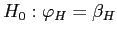 .
.Table  shows the
ordinary least squares (OLS) estimates of (15) and the
asymptotic -test
statistics associated with (16). The
P-values of the test statistics
associated with the test of (16) are also
included. The parameter estimates of the loadings of the home
currency returns are large for the half-hour holding period and
then decline with the forecast horizon. None of the coefficients is
statistically significant at the weekly horizon. The small
P-values on the half-hour test results
for all of the countries except Canada show that there is enough
power to reject the joint equivalence of both estimates. As before,
this is likely related to the poor ability of the model to capture
the microstructure effects. The two estimates, however, are not
statistically different in either the daily or weekly returns for
all of the countries, which suggests that the information
components of the returns are similar. We conclude that the changes
in the foreign exchange rates are somewhat related to the linear
combination of the selected instruments obtained from the equity
pricing model. The earlier results, however, were not driven solely
by this phenomenon.
shows the
ordinary least squares (OLS) estimates of (15) and the
asymptotic -test
statistics associated with (16). The
P-values of the test statistics
associated with the test of (16) are also
included. The parameter estimates of the loadings of the home
currency returns are large for the half-hour holding period and
then decline with the forecast horizon. None of the coefficients is
statistically significant at the weekly horizon. The small
P-values on the half-hour test results
for all of the countries except Canada show that there is enough
power to reject the joint equivalence of both estimates. As before,
this is likely related to the poor ability of the model to capture
the microstructure effects. The two estimates, however, are not
statistically different in either the daily or weekly returns for
all of the countries, which suggests that the information
components of the returns are similar. We conclude that the changes
in the foreign exchange rates are somewhat related to the linear
combination of the selected instruments obtained from the equity
pricing model. The earlier results, however, were not driven solely
by this phenomenon.
5 Conclusions
Our goal in this study was to deepen our understanding of the links between foreign asset movements and news (public and private) originating in U.S. money and equity markets. Recent studies using high-frequency data show that public news about U.S. money and equity markets affects equity markets abroad (Andersen et al. 2003). Our main contribution has been to show that some agents have superior knowledge about future U.S. interest rates and aggregate equity market returns. This superior knowledge is partially revealed through trades that affect daily and weekly returns on international stocks. This finding gets to the core of Goodhart and O'Hara's (1997) question as to how private information can have a global impact. Not only have we shown that public and private information about U.S. interest rates and aggregate equity markets predicts future foreign equity market movements, but we have also shown that these are components of the factor that is priced in the international cross section.
These findings suggest that further research should be conducted into the behavior of domestic and foreign markets. In recent work, Pastor and Stambaugh (2002) and others show that market-wide liquidity is a state variable that is important for domestic asset pricing. Liquidity is defined as temporary price fluctuations induced by order flow. In contrast, private information is defined as permanent price fluctuations induced by order flow. The literature has largely treated these as distinct concepts. As Kyle (1985) notes, however, the two quantities are correlated, since informed traders prefer to strategically place trades in liquid markets to hide their behavior and maximize their profits. Future research on asset returns should attempt to distinguish between the two effects and determine their economic origins.
Bibliography
- 1
- Albuquerque, Rui, Gregory H. Bauer, and Martin Schneider (2003a), `` Characterizing Asymmetric Information in International Equity Markets,'' mimeo, University of Rochester.
- 2
- Albuquerque, Rui, Gregory H. Bauer, and Martin Schneider (2003b), `` International Equity Flows and Returns: A Quantitative Equilibrium Approach,'' mimeo, University of Rochester.
- 3
- Andersen, T., T. Bollerslev, F.X. Diebold, and C. Vega (2003), `` Micro Effects of Macro Announcements: Real-Time Price Discovery in Foreign Exchange, '' American Economic Review, 93, 38-62.
- 4
- Andersen, T., T. Bollerslev, F.X. Diebold, and C. Vega (2004), `` Real-Time Price Discovery in Stock, Bond and Foreign Exchange Markets, '' mimeo, Northwestern University.
- 5
- Bekaert, Geert and Robert J. Hodrick (1992), `` Characterizing Predictable Components in Excess Returns on Equity and Foreign Exchange Markets'' Journal of Finance, 47(2) 467-509.
- 6
- Bernanke, Ben and Kenneth N. Kuttner (2005), `` What Explains the Stock Market's Reaction to Federal Reserve Policy,'' Journal of Finance, forthcoming.
- 7
- Brennan, Michael J., and H. Henry Cao (1997), `` International Portfolio Investment Flows,'' The Journal of Finance, 52, 1851-1880.
- 8
- Brennan, Michael J. and Subrahmanyam A. (1996), `` Market Microstructure and Asset Pricing: On the Compensation for Illiquidity in Stock Returns,'' Journal of Financial Economics, 41, 441-464.
- 9
- Brennan, Michael J., Narasimhan Jegadeesh, and Bhaskaran Swaminathan (1993), `` Investment Analysis and the Adjustment of Stock Prices to Common Information,'' The Review of Financial Studies, 6, 799-824.
- 10
- Campbell, John Y. (1996), `` Understanding Risk and Return,'' Journal of Political Economy, 104, 298-345.
- 11
- Campbell, John Y. and Yasushi Hamao (1992), `` Predictable Stock Returns in the United States and Japan: A Study of Long-Term Capital Market Integration'', The Journal of Finance, 47, 43-69.
- 12
- Carlson, John B., Jean M. McIntire and James B. Thomson (1995), `` Federal Funds Futures as an Indicator of Future Monetary Policy: A Primer,'' Economic Review, 20-30.
- 13
- Chan, Kalok (1993), `` Imperfect Information and Cross-Autocorrelation among Stock Prices,'' Journal of Finance 48:1211-1230.
- 14
- Chordia, Tarun, Richard Roll and Avavidhar Subrahmanyam (2000), `` Commonality in Liquidity,'' Journal of Financial Economics, 56, 3-28.
- 15
- Cochrane, John H. and Monika Piazzesi (2002), `` The Fed and Interest Rates: A High-Frequency Identification,'' American Economic Review Papers and Proceedings, 92, 90-95.
- 16
- Connolly, R. and A. F. Wang (2003), `` International Equity Market Comovements: Economic Fundamentals or Contagion?'' Pacific-Basin Finance Journal 11: 23-43.
- 17
- Coval, Joshua (1999), ``International Capital Flows when Investors have Local Information,'' University of Michigan, mimeo.
- 18
- Covrig, Vincentiu and Michael Melvin (2002), `` Asymmetric Information and Price Discovery in the FX Market: Does Tokyo Know More About the Yen?,'' Journal of Empirical Finance, .
- 19
- Craig, Alastair, Ajay Dravid and Matthew Richardson (1995), `` Market Efficiency Around the Clock Some Supporting Evidence in Using Foreign-Based Derivatives,'' Journal of Financial Economics, 39, 161-180.
- 20
- Dumas, Bernard and Bruno Solnik (1995), `` The World Price of Foreign Exchange Risk,'' Journal of Finance 50: 445-479.
- 21
- Easley, David, and Maureen O'Hara (1987), `` Prices, trade size and information in security markets,'' Journal of Financial Economics, 19, 69-90.
- 22
- Easley, David, and Maureen O'Hara (2002), `` Microstructure and Asset Pricing, '' in G.M. Constantinides, M. Harris and R. Stulz (eds.), Handbook of Economics of Finance. Elsevier-North Holland, forthcoming.
- 23
- Easley, David, Soeren Hvidkjaer and Maureen O'Hara (2002), `` Is Information Risk a Determinant of Asset Returns?'', The Journal of Finance, 57, 2185-2221.
- 24
- Ellis, Katrina, Roni Michaely and Maureen O'Hara (2000), `` The Accuracy of Trade Classification Rules: Evidence from Nasdaq,'' Journal of Financial and Quantitative Analysis, 35, 529-551.
- 25
- Elton, E. J., J. M. Gruber, G. Comer and K. Li (2002), `` Spiders: Where Are the Bugs?,'' Journal of Business, forthcoming.
- 26
- Engle, Robert F., Ito Takatoshi and Wen-Ling Lin (1990), `` Meteor Showers or Heat waves? Heteroskedastci Intra-Day Volatility in the Foreign Exchange Market,'' Econometrica, 58, 525-542.
- 27
- Evans, Martin D.D. and Richard K. Lyons (2002), `` Order Flow and Exchange Rates'', Journal of Political Economy, 110, 170-180.
- 28
- Evans, Martin D.D. and Richard K. Lyons (2004), `` A New Micro Model of Exchange Rate Dynamics'', mimeo, University of California Berkeley.
- 29
- Fair, C. Ray (2003), `` Shock Effects on Stocks, Bonds, and Exchange Rates,'' Journal of International Money and Finance, 22, 307-341.
- 30
- Ferson, Wayne E. (1995), `` Theory and Empirical Testing of Asset Pricing Models,'' in R.Jarrow et al. (eds.), Handbooks in OR & MS, vol. 9, 145-200.
- 31
- Ferson, Wayne E. and Campbell R. Harvey (1994), `` An Exploratory Investigation of the Fundamental Determinants of National Equity Market Returns,'' in The Internationalization of Equity Markets, Jeffrey A. Frankel (ed.). Chicago: The University of Chicago Press.
- 32
- French, Kenneth, and James Poterba (1991), `` Investor Diversification and International Equity Markets,'' American Economic Review Papers and Proceedings, 81,222-226.
- 33
- Gehrig, Thomas (1993), `` An Information Based Explanation of the Domestic Bias in International Equity Investment,'' Scandinavian Journal of Economics, 95, 97-109.
- 34
- Gibbons, Michael R. and Wayne Ferson (1985), `` Testing Asset Pricing Models with Changing Expectations and an Unobservable Market Portfolio'', Journal of Financial Economics, 14, 217-236.
- 35
- Glosten, Lawrence R., and Paul R. Milgrom (1985), `` Bid, Ask and Transaction Prices in a Specialist Market with Heterogeneously Informed Traders,'' Journal of Financial Economics, 14, 71-100.
- 36
- Goodhart, A.E. Charles and Maureen O'Hara (1997), `` High Frequency Data in Financial Markets: Issues and Applications,'' Journal of Empirical Finance, 4, 73-114.
- 37
- Hamao, Y., R.W. Masulis and V.K. Ng (1990), `` Correlations in Price Changes and Volatility across International Stock Markets,'' Review of Financial Studies, 3, 281-307.
- 38
- Hansen, Lars P. and Robert J. Hodrick (1983), `` Risk Averse Speculation in the Forward Foreign Exchange Market: An Econometric Analysis of Linear Models'', in Jacob A. Frenkel (ed.), Exchange Rates and International Macroeconomics. Chicago: The University of Chicago Press.
- 39
- Hardouvelis, Gikas A. (1987), `` Macroeconomic Information and Stock Prices,'' Journal of Economics and Business, 39, 131-140.
- 40
- Harvey, Campbell R. (1991), `` The World Price of Covariance Risk'', The Journal of Finance 46: 111-157.
- 41
- Hasbrouck, Joel (1991), `` Measuring The Information Content of Stock Trades,'' The Journal of Finance, 46, 179-207.
- 42
- Hasbrouck, Joel (1996), `` Modeling Market Microstructure Time Series,'' Handbook of Statistics, 14, 647-692.
- 43
- Hasbrouck, Joel and Duane J. Seppi (2001), `` Common Factors in Prices, Order Flows and Liquidity,'' Journal of Financial Economics, 59, 383-411.
- 44
- Hou, Kewei and Tobias J. Moskowitz (2003), `` Market Frictions, Price Delay and the Cross-Section of Expected Returns,'' working paper.
- 45
- Jensen, G. R., J.M. Mercer and R.R. Johnson (1996), `` Business Conditions, Monetary Policy, and Expected Security Returns,'' Journal of Financial Economics, 40, 213-237.
- 46
- Karolyi, G. Andrew, and Rene M. Stulz (1996), `` Why Do Markets Move Together? An Investigation of U.S.-Japan Stock Return Comovements,'' The Journal of Finance, 51, 951-985.
- 47
- Kim, Soyoung (2001), `` International Transmission of US Monetary Policy Shocks: Evidence from VAR's,'' Journal of Monetary Economics, 48, 339-372.
- 48
- King, Mervyn and Sushil Wadhwani (1990), `` Transmission of Volatility Between Stock Markets'', The Review of Financial Studies, 3, 5-33.
- 49
- King, Mervyn, Enrique Sentana and Sushil Wadhwani (1994), `` Volatility and the Link Between National Stock Markets'', Econometrica, 62, 901-33.
- 50
- Kodres, Laura E. and Matthew Pritsker (2002), `` A Rational Expectations Model of Financial Contagion'', Journal of Finance, 57, 769-799.
- 51
- Kuttner, Kenneth N. (2001), `` Monetary Policy Surprises and Interest Rates: Evidence from the Fed Funds Futures Market,'' Journal of Monetary Economics, 47, 523-544.
- 52
- Kyle, Albert S. (1985), `` Continuous Auctions and Insider Trading,'' Econometrica, 53, 1315-1335.
- 53
- Lee, Charles M. and Mark Ready (1991), `` Inferring Trade Direction from Intraday Data,'' The Journal of Finance, 46, 733-746.
- 54
- Lee, Young-Sook (2003), `` The Federal funds market and the overnight Eurodollar market'', Journal of Banking and Finance, 27, 749-771.
- 55
- Lin, W., Engle, R., and T. Ito (1994), `` Do Bulls and Bears Move accross Borders? International Transmission of Stock Returns and Volatility,'' Review of Financial Studies, 7, 507-538.
- 56
- Lyons, Richard K. (1995), `` Tests of Microstructural Hypothese in the Foreign Exchange Market'', Journal of Financial Economics, 321-351.
- 57
- Lyons, Richard K. (2001), The Microstructure Approach to Exchange Rates, MIT Press.
- 58
- Madhavan, A., M. Richardson and M. Roomans, (1997), `` Why Do Security Prices Change? A Transaction-Level Analysis of NYSE Stocks,'' Review of Financial Studies 10(4), 1035-1064.
- 59
- Melvin, Michael (2002), `` Exchange Rates and FOMC Days'', mimeo, Arizona State University.
- 60
- Newey, W. and K. West (1987), `` A Simple Positive-Definite Heteroskedasticity and Autocorrelation Consistent Covariance Matrix,'' Econometrica 55, 703-708.
- 61
- O'Hara, Maureen (1997), Market Microstructure Theory, Blackwell Publishers.
- 62
- Pastor, Lubos and Robert F. Stambaugh (2003), `` Asset Prices and Exchange Rates'', mimeo, MIT.
- 63
- Patelis, A. (1997), `` Stock Return Predictability and the Role of Monetary Policy,'' The Journal of Finance, 52, 1951-1972.
- 64
- Pearce, Douglas K. and V. Vance Roley (1985), `` Stock Prices and Economic News,'' Journal of Business, 58, 49-67.
- 65
- Piazzesi, Monika and Eric Swanson (2004), `` Futures Prices as Risk-Adjusted Forecasts of Monetary Policy'', NBER Working paper 10547.
- 66
- Rudebusch, Glenn D. (1998), `` Do Measures of Monetary Policy in a VAR Make Sense'', International Economic Review 39(4), 907-31.
- 67
- Saar, Gideon (2001), `` Investor Uncertainty and Order Flow Information'', working paper, New York University.
- 68
- Saar, Gideon and Lei Yu (2002), `` Information Asymmetry about the Firm and the Permanent Price Impact of Trades: Is there a Connection?'', working paper, New York University.
- 69
- Schwert G. William (1981), `` The Adjustment of Stock Prices to Information about Inflation,'' The Journal of Finance, 36, 15-29.
- 70
- Subrahmanyam, Avanidhar (1991), `` A Theory of Trading in Stock Index Futures,'' Review of Financial Studies 4:17-51.
- 71
- Stigum, Marcia (1990), The Money Market. Chicago: Richard D. Irwin, Inc.
- 72
- Susmel, R. and R. F. Engle (1994), `` Hourly Volatility Spillovers Between International Equity Markets,'' Journal of International Money and Finance, 13, 3-25.
- 73
- Thorbecke, W. (1997), `` On Stock Market Returns and Monetary Policy,'' The Journal of Finance, 52, 635-654.
- 74
- Werner, Ingrid M. and Allan W. Kleidon (1996), `` U.K. and U.S. Trading of British Cross-Listed Stocks: An Intraday Analysis of Market Integration'', The Review of Financial Studies, 9, 619-664.
- 75
- Yu, Lei (2003), `` Basket Securities, Price Formation and Informational Efficiency'', working paper, New York University.
Footnotes
*We thank Rui Albuquerque, Mike Barclay, Michael Fleming, Richard Lyons, Michael Melvin, Matthew Pritsker, Bill Schwert, JerryWarner as well as seminar participants at the Northern Finance Association meeting, Southern Finance Association meeting, Western Economics Association International meeting, Western Finance Association meeting, the Bank of Canada-Sauder School of Business Workshop on International Financial Markets, and the University of Rochester for their comments. Bauer is affiliated with the Financial Markets Department of the Bank of Canada. Address: 234 Wellington St., Ottawa, Ontario, Canada K1A 0G9. Vega is affiliated with the Board of Governors of the Federal Reserve System and William E. Simon Graduate School of Business Administration. Address: Carol Simon Hall, University of Rochester, Rochester, NY 14627. E-mail: [email protected] and [email protected]. The views in this paper are solely the responsibility of the authors and should not be interpreted as re.ecting the views of the Bank of Canada, the Board of Governors of the Federal Reserve System or of any other person associated with the Federal Reserve System. Return to text
1. King, Sentana and Wadhwani interpret the common factor that is unrelated to fundamentals as an index of `` investor sentiment.'' See also King and Wadhwani (1990) and Lin, Engle and Ito (1994). Return to text
2. Sophisticated agents are believed to have superior (`` private'') information about the returns on assets in their own country. A broader definition of private information is given below. Return to text
3. Low-frequency studies find conflicting results about causality. For example, Hammao, Masulis and Ng (1990), and King and Wadhwani (1990), find that correlations in volatility and prices appear to be causal from the United States to other countries. On the other hand, Lin, Engle and Ito (1994) find a bidirectional relationship between New York and Tokyo, and Susmel and Engle (1994) find a bidirectional relationship, albeit weak, between New York and London. Engle, Ito and Lin (1990) find a bidirectional relationship in the intraday yen/dollar exchange rate. Return to text
4. Craig, Dravid and Richardson (1995) find that trading in Nikkei futures in the United States provides information about next-day Japanese equity returns. However, they do not identify the sources of the information. Return to text
5. We construct the daily and weekly returns using overlapping samples of high-frequency data. This allows us to maintain the identification advantages of a microstructure analysis while focusing on the information content of longer holding-period returns. Return to text
6. This literature is surveyed in Easley and O'Hara (2002). Return to text
7. All the ETFs we use are listed on the AMEX; some of them are listed on other exchanges, including foreign exchanges. Nevertheless, the largest trading volume for these assets takes place on the AMEX during our sample period, and we confine ourselves to data from that exchange. Return to text
8. Another advantage of ETFs is their tax efficieny. See Elton et al. (2002). Return to text
9. The SPDR also traded on the NYSE and NASDAQ (as well as other exchanges) during our sample period. Howevere, trading on the AMEX remained quite liquid during this time. Return to text
10. This algorithm compares transaction prices with the mid-quote five seconds before the transaction took place. If the transaction price is above the mid-quote, then we classify the trade as a buy; if the transaction price is below the mid-quote, we classify the trade as a sell. If the transaction price is equal to the mid-quote, then we use the tick test. Ellis, Michaely and O�Hara (2000) evaluate how well the Lee and Ready algorithm performs, and find that it is 81.05 per cent accurate. Return to text
11. We could also have used federal funds futures contract data (e.g., Rudebusch 1998, Kuttner 2001, and Carlson, McIntire and Thomson 1995). We use the Eurodollar futures contract because it is more liquid than the Federal funds futures contract, implying that it may better reflect information about the state of the economy. We use futures market data because no high-frequency transactions data are available in the spot market. Return to text
12. The tick test is as follows: if the transaction price is higher than the previous price, we classify the trade as a buy, and if it is below the previous transaction price, we classify it as a sell. Ellis, Michaely and O�Hara (2000) find that the tick test correctly classifies 77.6 per cent of the trades. Return to text
13. As in Fair (2003), the euro futures contract series is the German Deutsche Mark futures contract prior to 1 June 1999, and the euro futures contract after that. Both contracts traded somewhat before and after this date, but this date is a reasonable splicing date, because at that time liquidity started to switch from the German Deutsche Mark market to the euro market. Return to text
14. For the Eurodollar and foreign currency futures contracts, we use the last transaction price recorded during the interval. Return to text
15. The frequency of observations recorded for the Eurodollar and foreign currency contract data are the same for both the quotes and order flows for the series, due to the use of time-and-sales data. Return to text
16. The prices of the ETFs are recorded at close of trade during U.S. trading hours, whereas the MSCI indexes are calculated at close of trade in the national markets. Return to text
17. We use 12 lagged values to capture the effects of a full day of trading. Our results are robust to this choice. Return to text
18. Following the literature, we exclude the change to the target rate following the terrorist attacks of September 11, 2001. Return to text
19. See O'Hara (1997) for a discussion and derivation of domestic microstructure models. For a discussion and derivation of international microstructure models, see Lyons (2001). For a survey of empirical time-series microstructure models, see Hasbrouck (1996). Return to text
20. We can
improve our measures of private information by having as much of
the effects of lagged public information removed from them as
possible. This means that, instead of using a statistical criterion
(such as AIC or SIC) to choose the optimal lag length,  , we choose large lag lengths that
are likely to be longer than those mandated by a statistical test
or casual economic reasoning. We thus choose a lag length equal to
just over one day of trading (
, we choose large lag lengths that
are likely to be longer than those mandated by a statistical test
or casual economic reasoning. We thus choose a lag length equal to
just over one day of trading ( half-hour intervals) for our base-case
analysis. Return to text
half-hour intervals) for our base-case
analysis. Return to text
21. Standard microstructure theory models with this set-up include: Kyle (1985), as an example of an auction or batch strategic trading model; and Glosten and Milgrom (1985) and Easley and O'Hara (1987), as examples of sequential trade models. Return to text
22.
Conventional measures of standard errors from this system are
likely to be understated, due to two problems. The first is that
extending the holding period of the asset out to periods will result in a
moving-average error process in (9) and (10). The second
problem is that the residuals in our intraday data are likely to be
heteroscedastic, in line with other microstructure studies. We
therefore report all results using Newey-West (1987) standard
errors with a lag length equal to the minimum of  or half-hour trading intervals. Return to text
23. We are assuming that sophisticated investors will trade on their superior knowledge of macroeconomic factors in several liquid markets simultaneously. Market makers would realize this and use as many sources of information as possible to reduce the information asymmetry. They can see aggregate trading activity in other asset markets and infer the signs of the recent trades from the cross-section of contemporaneous volume and price data. Return to text
24. In the steady state of this system, information shocks would be absent and inventories would be at desired levels. Expected returns are constant and prices are thus a martingale. Return to text
25. The coefficients in (8) are different from those in (7). The symbols are the same, because we do not wish to increase the notational burden. Return to text
26. Under
our assumption (4), this is
equivalent, as time progresses, to the return on a buy-and-hold
strategy over periods in a
Eurodollar futures contract. Note that a one-period return,
 represents the change in the price of the contract over a half-hour
interval. Return to text
represents the change in the price of the contract over a half-hour
interval. Return to text
27. Throughout
this paper, the
statistics are adjusted for degress of freedom. The low degree of
explanatory power is similar to estimates of order flow in other
asset markets. For example, Hasbrouck (1991) obtains an
of 0.086 when he
estimates the order flow of an individual stock. Return to text
28. Researchers who find a significant influence of monetary policy on U.S. stocks include Schwert (1981), Pearce and Roley (1985), Hardouvelis (1987), Jensen, Mercer and Johnson (1996), Patelis (1997), Thorbecke (1997), and Bernanke and Kuttner (2005). Changes in U.S. monetary policy also affect foreign equity markets (Kim 2001). Return to text
29. While monetary policy is one of the factors influencing prices, there are likely to be many others. See Andersen et al. (2004) for an analysis. Return to text
30. Melvin (2002) finds that the exchange rate market switches to a more informed state on Federal Open Market Committee days, which suggests greater private information revelation. Return to text
31. In
previous asset-pricing tests, the instruments were the `` usual suspects''
that were found to forecast returns at monthly horizons. Examples
include dividend yields, term structure slopes, short-term interest
rates, and credit spreads. We focus on variables that have
predictive ability over shorter horizons. Return to text
32. Latent-factor models have been used in a number of domestic and international asset-pricing tests. See Ferson (1995) for a survey. Return to text
33. See, however, Easley, Hvidkjaer and O'Hara (2002) for such a model on domestic stock returns. Albuquerque et al. (2003b) provide a model that relates returns and flows to private information in an international setting. However, they do not test the effects of private information on the cross section of asset prices. Return to text
Six-month Eurodollar Futures and Fed Funds Target Rate
The two solid lines are the daily 6-month Eurodollar futures rate and the actual target-rate. The sample period is from April 1, 1996 to November 30, 2001. There were 20 target-rate changes in this period. The Eurodollar futures data are from the Chicago Mercantile Exchange (CME). The target rate is from the Federal Reserve Bank of New York.
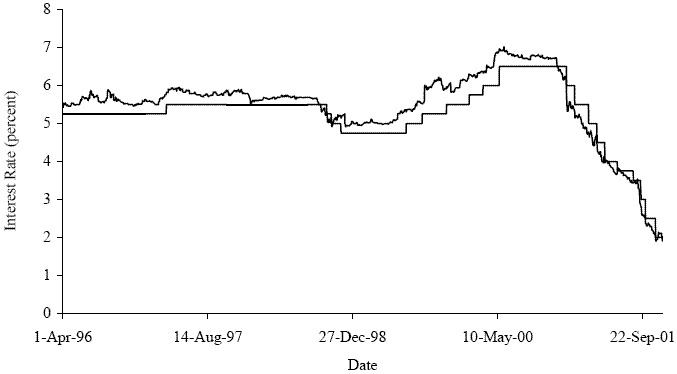
Timing of Quotes, Private Information, Trade Orders and Public Information
Private information is the persistent impact unanticipated trade
orders have on the security price. To measure private information
we estimate a system of equations similar to Hasbrouck (1991). The
two main identification assumptions are the following: trade orders
are in no part driven by public information and trade orders are
driven partially by private information and liquidity needs. These
two assumptions can be summarized as a timing convention. The
timing is shown bellow, where  is the bid quote,
  is the ask quote at time
 and
and  are the seller-initiated orders
and
are the seller-initiated orders
and  are the
buyer-initiated orders.
are the
buyer-initiated orders.

Summary Statistics of Quote Revisions on Eurodollar Futures Contracts, Exchange Traded Funds and Foreign Currency Futures Contracts
The table shows summary statistics of quote revisions on
Eurodollar futures contracts, Exchange Traded Funds (ETFs), and
foreign currency futures contracts. The Eurodollar futures
contracts are from the Chicago Mercantile Exchange (CME) and have a
maturity of  months. The
US ETF is the Standard and Poor's 500 Depository Receipt
(``Spider'') managed by State Street Global Advisors. The foreign
country exchange traded funds are the ``ishares'' ETFs managed by
Barclay's Global Advisors. The source of the ETF data is the TAQ
database. The foreign currency futures data are also from the CME
and are denominated in US dollars per unit of foreign exchange. All
of the series are aggregated to 11 one-half hour intervals during
the common trading times of the CME and the NYSE/AMEX exchanges.
The sample period is April 1, 1996 to November 30, 2001 resulting
in a total of 15,598 half-hour observations. The quote revisions
are the (log) change in the last quote recorded during each
one-half hour interval, multiplied by 100. The table shows the:
mean; standard deviation; first and 99
months. The
US ETF is the Standard and Poor's 500 Depository Receipt
(``Spider'') managed by State Street Global Advisors. The foreign
country exchange traded funds are the ``ishares'' ETFs managed by
Barclay's Global Advisors. The source of the ETF data is the TAQ
database. The foreign currency futures data are also from the CME
and are denominated in US dollars per unit of foreign exchange. All
of the series are aggregated to 11 one-half hour intervals during
the common trading times of the CME and the NYSE/AMEX exchanges.
The sample period is April 1, 1996 to November 30, 2001 resulting
in a total of 15,598 half-hour observations. The quote revisions
are the (log) change in the last quote recorded during each
one-half hour interval, multiplied by 100. The table shows the:
mean; standard deviation; first and 99 fractiles; the per cent of all
intervals which have an observation (``freq''); and asymptotic
marginal significance levels (
fractiles; the per cent of all
intervals which have an observation (``freq''); and asymptotic
marginal significance levels ( -values) of the Ljung-Box test statistics for
autocorrelation out to the indicated lags. The intra-day
seasonality has been removed from all of the quote revisions; the
final column shows the -value of a test of the null hypothesis of no
intra-day seasonality on the raw data.
-values) of the Ljung-Box test statistics for
autocorrelation out to the indicated lags. The intra-day
seasonality has been removed from all of the quote revisions; the
final column shows the -value of a test of the null hypothesis of no
intra-day seasonality on the raw data.
| mean (%) | std. dev. (%) | fractiles: 1 (%) (%) |
fractiles: 99 (%) |
freq. (%) | L.-B. Q-test: 1 lag (P - value) | L.-B. Q-test: 11 lags (P - value) | Intra-day seasonal (P - value) | |
|---|---|---|---|---|---|---|---|---|
| = 3 | 0.0002 | 0.010 | -0.021 | 0.021 | 91.197 |  |
|
0.007 |
| = 6 | 0.0003 | 0.013 | -0.031 | 0.031 | 94.961 | |
|
0.001 |
| = 9 | 0.0002 | 0.014 | -0.037 | 0.036 | 95.313 | 0.059 | |
0.063 |
| = 12 | 0.0001 | 0.015 | -0.038 | 0.038 | 94.031 | 0.617 | 0.001 | 0.070 |
| = 60 | -0.0003 | 0.016 | -0.053 | 0.044 | 42.797 | 0.028 | |
0.018 |
Panel B: Exchange Traded Funds
| mean (%) | std. dev. (%) | fractiles: 1 (%) | fractiles: 99 (%) | freq. (%) | L.-B. Q-test: 1 lag (P - value) | L.-B. Q-test: 11 lags (P - value) | Intra-day seasonal (P - value) | |
|---|---|---|---|---|---|---|---|---|
| US | -0.002 | 0.275 | -0.714 | 0.702 | 99.711 | 0.207 | 0.359 | 0.245 |
| Germany | -0.002 | 0.251 | -0.735 | 0.710 | 71.777 | 0.796 | 0.089 | 0.286 |
| Japan | -0.009 | 0.273 | -0.777 | 0.712 | 93.210 | |
|
|
| UK | 0.002 | 0.245 | -0.747 | 0.714 | 61.384 | 0.028 | |
0.060 |
| Switzerland | -0.002 | 0.226 | -0.776 | 0.714 | 49.580 | 0.004 | 0.027 | 0.054 |
| Canada | -0.004 | 0.273 | -0.977 | 0.856 | 41.444 | 0.234 | 0.049 | 0.214 |
| France | -0.002 | 0.217 | -0.672 | 0.643 | 57.947 | 0.889 | 0.030 | 0.017 |
| Netherlands | 0.001 | 0.213 | -0.598 | 0.632 | 46.624 | 0.048 | 0.301 | 0.052 |
| Sweden | 0.001 | 0.277 | -0.825 | 0.823 | 46.759 | 0.012 | 0.016 | 0.003 |
| Australia | -0.004 | 0.241 | -0.727 | 0.654 | 46.458 | |
|
0.090 |
| Italy | -0.004 | 0.236 | -0.714 | 0.687 | 54.754 | 0.538 | 0.036 | 0.011 |
Panel C: Foreign Currency Futures
| mean (%) | std. dev. (%) | fractiles: 1 (%) | fractiles: 99 (%) | freq. (%) | L.-B. Q-test: 1 lag (P - value) | L.-B. Q-test: 11 lags (P - value) | Intra-day seasonal (P - value) | ||
|---|---|---|---|---|---|---|---|---|---|
| Euro | 0.001 | 0.120 | -0.321 | 0.314 | 93.384 | 0.244 | 0.124 | 0.003 | |
| Yen | -0.002 | 0.122 | -0.326 | 0.340 | 98.442 | |
|
0.047 | |
| UK Pound | 0.002 | 0.093 | -0.249 | 0.259 | 98.211 | |
|
0.001 | |
| Swiss Franc | -0.0001 | 0.137 | -0.351 | 0.362 | 98.352 | 0.001 | 0.047 |
|
|
| Canadian $ | -0.002 | 0.071 | -0.198 | 0.201 | 98.282 | |
|
|
|
Summary Statistics of Signed Order Flows of Eurodollar Futures Contracts, Exchange Traded Funds and Foreign Currency Futures Contracts
The table shows summary statistics of signed order flows of
Eurodollar futures contracts, Exchange Traded Funds (ETFs), and
foreign currency futures contracts. The sources of the data are
given in Table 1a. Using all observations, the signs of the trades
in the Eurodollar and foreign currency futures contracts have been
estimated using the ``tick rule'' as detailed in the text. The ETF
trades from the TAQ database have been labeled as purchases or
sales according to the Lee and Ready (1991) algorithm. All of the
order flow series are aggregated to 11 one-half hour intervals
during the common trading times of the CME and the NYSE/AMEX
exchanges. The sample period is April 1, 1996 to November 30, 2001
resulting in a total of 15,598 half-hour observations. The table
shows the: mean; standard deviation; the 1 and 99 fractiles; the per cent of all
intervals which have an observation (``freq''); and asymptotic
marginal significance levels (-values) of the Ljung-Box test statistics for
autocorrelation out to the indicated lags. The intra-day
seasonality has been removed from all of the order flows; the final
column shows the -value
of a test of the null hypothesis of no intra-day seasonality on the
raw data.
| mean (#) | std. dev. (#) | fractiles: 1 (#) |
fractiles: 99 (#) | freq. (%) | L.-B. Q-test: 1 lag (P - value) | L.-B. Q-test: 11 lags (P - value) | Intra-day seasonal (P - value) | |
|---|---|---|---|---|---|---|---|---|
| = 3 | 0.029 | 1.521 | -4.052 | 4.041 | 91.197 | |
|
0.003 |
| = 6 | 0.028 | 1.990 | -5.907 | 5.093 | 94.961 | |
|
0.001 |
| = 9 | 0.029 | 2.257 | -6.109 | 6.000 | 95.313 | 0.013 | |
0.015 |
| = 12 | 0.011 | 2.359 | -6.915 | 6.085 | 94.031 | 0.164 | |
0.195 |
| = 60 | -0.013 | 0.802 | -2.024 | 2.020 | 42.797 | 0.131 | |
0.049 |
Panel B: Exchange Traded Funds
| mean (#) | std. dev. (#) | fractiles: 1 (#) |
fractiles: 99 (#) | freq. (%) | L.-B. Q-test: 1 lag (P - value) | L.-B. Q-test: 11 lags (P - value) | Intra-day seasonal (P - value) | |
|---|---|---|---|---|---|---|---|---|
| US | 0.886 | 14.471 | -41.506 | 40.329 | 99.679 | |
|
|
| Germany | 0.126 | 1.519 | -3.959 | 4.080 | 56.101 | |
|
|
| Japan | 0.298 | 3.022 | -7.156 | 9.183 | 88.145 | |
|
|
| UK | 0.067 | 1.103 | -3.021 | 2.998 | 43.848 | |
|
|
| Switzerland | 0.038 | 0.691 | -1.991 | 2.036 | 28.300 | |
|
|
| Canada | 0.039 | 0.661 | -1.989 | 2.016 | 21.568 | |
|
|
| France | 0.049 | 0.884 | -2.072 | 2.972 | 40.174 | |
|
|
| Netherlands | 0.032 | 0.580 | -1.961 | 1.987 | 22.684 | |
|
|
| Sweden | 0.028 | 0.540 | -1.030 | 1.990 | 19.818 | |
|
|
| Australia | 0.032 | 0.731 | -2.025 | 2.020 | 30.916 | |
|
|
| Italy | 0.018 | 0.905 | -2.042 | 2.968 | 36.404 | |
|
|
Panel C: Foreign Currency Futures
| mean (#) | std. dev. (#) | fractiles: 1 (#) | fractiles: 99 (#) | freq. (%) | L.-B. Q-test: 1 lag (P - value) | L.-B. Q-test: 11 lags (P - value) | Intra-day seasonal (P - value) | |
|---|---|---|---|---|---|---|---|---|
| Euro | 0.016 | 6.968 | -18.139 | 18.108 | 98.384 | |
0.027 | 0.143 |
| Yen | -0.020 | 7.255 | -18.938 | 18.569 | 98.442 | |
|
0.391 |
| UK Pound | 0.119 | 5.615 | -14.298 | 14.189 | 98.211 | |
|
|
| Swiss Franc | 0.094 | 6.881 | -17.845 | 17.964 | 98.352 | |
|
0.171 |
| Canadian $ | -0.159 | 4.289 | -11.116 | 11.198 | 98.282 | |
|
|
Correlation Coefficients of Foreign Exchange Traded Funds and M.S.C. I. Indexes
The tables shows correlation coefficients of the log price
change in the foreign Exchange Traded Funds (ETFs) and the log
change in the Morgan Stanley Capital Incorporated (MSCI) foreign
stock index over the indicated holding period  . The sources of the data are given in
Table 1a.
. The sources of the data are given in
Table 1a.
| = 1 day | = 5 days | |
|---|---|---|
| Germany | 0.767 | 0.934 |
| Japan | 0.674 | 0.909 |
| UK | 0.675 | 0.876 |
| Switzerland | 0.674 | 0.883 |
| Canada | 0.655 | 0.902 |
| France | 0.802 | 0.943 |
| Netherlands | 0.761 | 0.932 |
| Sweden | 0.725 | 0.896 |
| Australia | 0.603 | 0.856 |
| Italy | 0.801 | 0.932 |
Contemporaneous Correlations of Quote Revisions on Eurodollar Futures Contracts, Exchange Traded Funds and Foreign Currency Futures Contracts
The top part of the table shows contemporaneous correlation coefficients of quote revisions on the Eurodollar futures contracts, the US Exchange Traded Fund, and the foreign currency futures contracts. The bottom part of the table shows the contemporaneous correlation coefficients of quote revisions on the US and foreign Exchange Traded Funds. The sources of the data are given in Table 1a.
| Eurodollar futures: = 3 |
Eurodollar futures: = 6 |
Eurodollar futures: = 9 | Eurodollar futures: = 12 | Eurodollar futures: = 60 | US ETF | Foreign Currency Futures: Euro | Foreign Currency Futures: Yen | Foreign Currency Futures: UK Pd | Foreign Currency Futures: Sw. Fr. | |
|---|---|---|---|---|---|---|---|---|---|---|
| = 3 | 1 | |||||||||
| = 6 | 0.773 | 1 | ||||||||
| = 9 | 0.733 | 0.873 | 1 | |||||||
| = 12 | 0.696 | 0.835 | 0.901 | 1 | ||||||
| = 60 | 0.245 | 0.283 | 0.317 | 0.333 | 1 | |||||
| US ETF | -0.157 | -0.168 | -0.157 | -0.154 | -0.010 | 1 |
Panel B: Foreign Currency Futures
| Eurodollar futures: = 3 |
Eurodollar futures: = 6 |
Eurodollar futures: = 9 | Eurodollar futures: = 12 | Eurodollar futures: = 60 | US ETF | Foreign Currency Futures: Euro | Foreign Currency Futures: Yen | Foreign Currency Futures: UK Pd | Foreign Currency Futures: Sw. Fr. | |
|---|---|---|---|---|---|---|---|---|---|---|
| Euro | 0.177 | 0.167 | 0.161 | 0.152 | 0.044 | -0.309 | 1 | |||
| Yen | 0.102 | 0.086 | 0.068 | 0.054 | 0.008 | -0.186 | 0.379 | 1 | ||
| UK Pd | 0.087 | 0.082 | 0.081 | 0.076 | 0.023 | -0.174 | 0.540 | 0.229 | 1 | |
| Sw. Fr. | 0.221 | 0.204 | 0.184 | 0.172 | 0.058 | -0.325 | 0.883 | 0.396 | 0.496 | 1 |
| Cdn $ | 0.022 | 0.017 | 0.025 | 0.026 | 0.033 | 0.100 | -0.014 | -0.005 | -0.005 | -0.024 |
Panel C: Exchange Traded Funds
| US | Ger. | Jap. | UK | Swiss | Can. | Fra. | Neth | Swe. | Aus. | |
|---|---|---|---|---|---|---|---|---|---|---|
| US | 1 | |||||||||
| Germany | 0.196 | 1 | ||||||||
| Japan | 0.144 | 0.148 | 1 | |||||||
| UK | 0.176 | 0.209 | 0.110 | 1 | ||||||
| Switzerland | 0.168 | 0.173 | 0.082 | 0.195 | 1 | |||||
| Canada | 0.163 | 0.188 | 0.112 | 0.143 | 0.141 | 1 | ||||
| France | 0.215 | 0.404 | 0.156 | 0.226 | 0.200 | 0.233 | 1 | |||
| Netherlands | 0.228 | 0.224 | 0.099 | 0.244 | 0.300 | 0.138 | 0.241 | 1 | ||
| Sweden | 0.251 | 0.197 | 0.101 | 0.225 | 0.256 | 0.143 | 0.219 | 0.352 | 1 | |
| Australia | 0.113 | 0.168 | 0.101 | 0.145 | 0.108 | 0.147 | 0.171 | 0.144 | 0.073 | 1 |
| Italy | 0.166 | 0.331 | 0.142 | 0.193 | 0.192 | 0.209 | 0.402 | 0.226 | 0.167 | 0.183 |
Contemporaneous Correlations of Signed Order Flows of Eurodollar Futures Contracts, Exchange Traded Funds and Foreign Currency Futures Contracts
The top part of the table shows contemporaneous correlation coefficients of signed order flows of the Eurodollar futures contracts, the US Exchange Traded Fund, and the foreign currency futures contracts. The bottom part of the table shows the contemporaneous correlation coefficients of order flows of the US and foreign Exchange Traded Funds. The sources of the data are given in Table 1b.
| Eurodollar futures: = 3 |
Eurodollar futures: = 6 |
Eurodollar futures: = 9 | Eurodollar futures: = 12 | Eurodollar futures: = 60 | US ETF | Foreign Currency Futures: Euro | Foreign Currency Futures: Yen | Foreign Currency Futures: UK Pd | Foreign Currency Futures: Sw. Fr. | |
|---|---|---|---|---|---|---|---|---|---|---|
| = 3 | 1 | |||||||||
| = 6 | 0.672 | 1 | ||||||||
| = 9 | 0.647 | 0.814 | 1 | |||||||
| = 12 | 0.619 | 0.774 | 0.836 | 1 | ||||||
| = 60 | 0.185 | 0.239 | 0.267 | 0.285 | 1 | |||||
| US ETF | -0.121 | -0.122 | -0.114 | -0.113 | 0.006 | 1 |
Panel B: Foreign Currency Futures
| Eurodollar futures: = 3 |
Eurodollar futures: = 6 |
Eurodollar futures: = 9 | Eurodollar futures: = 12 | Eurodollar futures: = 60 | US ETF | Foreign Currency Futures: Euro | Foreign Currency Futures: Yen | Foreign Currency Futures: UK Pd | Foreign Currency Futures: Sw. Fr. | |
|---|---|---|---|---|---|---|---|---|---|---|
| Euro | 0.056 | 0.060 | 0.067 | 0.055 | 0.001 | -0.092 | 1 | |||
| Yen | 0.008 | 0.015 | 0.006 | 0.004 | -0.016 | -0.027 | 0.158 | 1 | ||
| UK Pd | 0.027 | 0.031 | 0.029 | 0.033 | 0.001 | -0.046 | 0.216 | 0.061 | 1 | |
| Sw. Fr. | 0.035 | 0.031 | 0.035 | 0.030 | -0.012 | -0.062 | 0.292 | 0.110 | 0.152 | 1 |
| Cdn $ | 0.014 | 0.008 | 0.007 | 0.010 | 0.020 | 0.024 | -0.014 | 0.003 | -0.018 | -0.020 |
Panel C: Exchange Traded Funds
| US | Ger. | Jap. | UK | Swiss | Can. | Fra. | Neth | Swe. | Aus. | |
|---|---|---|---|---|---|---|---|---|---|---|
| US | 1 | |||||||||
| Germany | 0.058 | 1 | ||||||||
| Japan | 0.044 | 0.094 | 1 | |||||||
| UK | 0.050 | 0.172 | 0.091 | 1 | ||||||
| Switzerland | 0.037 | 0.155 | 0.058 | 0.161 | 1 | |||||
| Canada | 0.033 | 0.066 | 0.054 | 0.040 | 0.051 | 1 | ||||
| France | 0.055 | 0.256 | 0.093 | 0.188 | 0.158 | 0.053 | 1 | |||
| Netherlands | 0.024 | 0.126 | 0.047 | 0.131 | 0.209 | 0.040 | 0.196 | 1 | ||
| Sweden | 0.010 | 0.098 | 0.043 | 0.085 | 0.125 | 0.042 | 0.135 | 0.148 | 1 | |
| Australia | 0.017 | 0.079 | 0.070 | 0.100 | 0.094 | 0.080 | 0.084 | 0.096 | 0.060 | 1 |
| Italy | 0.040 | 0.155 | 0.053 | 0.106 | 0.141 | 0.034 | 0.213 | 0.172 | 0.097 | 0.086 |
Granger Causality Tests of the Predictability of US and Foreign-Country ETF Variables in the Six-Month Eurodollar Order Flow and Quote Revision Regressions
The table presents asymptotic marginal significance levels
(-values) of the test
statistics associated with Granger causality tests of the
predictive ability of the indicated US and foreign country
variables in the six-month Eurodollar futures quote revision and
order flow regressions. The panel on the left shows the Granger
causality tests for the Eurodollar order flow regression while the
panel on the right shows the corresponding tests for the quote
revision regression. The tests are for the joint significance of 12
lagged values of the indicated US or foreign country ETF variable
in a regression that includes lagged Eurodollar quote revisions and
order flows. The test statistics, which are robust to general forms
of heteroskedasticity and autocorrelation (Newey and West (1987)),
are 
 distributed with 12 degree of freedom.
country  = = | Eurodollar Order Flow Regression: lagged order flow | Eurodollar Order Flow Regression: lagged quote revisions | Eurodollar Quote Revision Regression: lagged order flows | Eurodollar Quote Revision Regression: lagged quote revisions |
|---|---|---|---|---|
| US | 0.686 | 0.139 | 0.869 | 0.309 |
| Germany | 0.564 | 0.431 | 0.539 | 0.679 |
| Japan | 0.544 | 0.084 | 0.747 | 0.054 |
| UK | 0.787 | 0.771 | 0.703 | 0.726 |
| Switzerland | 0.745 | 0.864 | 0.920 | 0.927 |
| Canada | 0.051 | 0.188 | 0.128 | 0.314 |
| France | 0.817 | 0.418 | 0.474 | 0.277 |
| Netherlands | 0.098 | 0.922 | 0.174 | 0.857 |
| Sweden | 0.855 | 0.785 | 0.952 | 0.816 |
| Australia | 0.581 | 0.100 | 0.657 | 0.159 |
| Italy | 0.877 | 0.957 | 0.601 | 0.931 |
Granger Causality Tests of the Predictability of Eurodollar and Foreign-Country ETF Variables in the US ETF Order Flow and Quote Revision Regressions
The table presents asymptotic marginal significance levels
(-values) of the test
statistics associated with Granger causality tests of the
predictive ability of the indicated Eurodollar and foreign-country
ETF variables in the US ETF order flow and quote revision
regressions. The panel on the left shows the Granger causality
tests for the US ETF order flow regression while the panel on the
right shows the corresponding tests for the quote revision
regression. The tests are for the joint significance of 12 lagged
values of the indicated Eurodollar (with maturity of months) or foreign-country ETF
variable in a regression that includes lagged US ETF quote
revisions and order flows. The test statistics, which are robust to
general forms of heteroskedasticity and autocorrelation (Newey and
West (1987)), are distributed with 12 degree of
freedom.
| US ETF Order Flow Regression: lagged order flows | US ETF Order Flow Regression: lagged quote revisions | US ETF Quote Revision Regression: lagged order flows | US ETF Quote Revision Regression: lagged quote revisions | |
|---|---|---|---|---|
| = 3 | 0.013 | 0.021 | 0.042 | 0.036 |
| = 6 | |
|
|
|
| = 9 | 0.021 | |
0.212 | 0.010 |
| = 12 | 0.217 | 0.101 | 0.142 | 0.154 |
| = 60 | 0.117 | 0.207 | 0.425 | 0.856 |
Panel B: Exchange Traded Funds
| US ETF Order Flow Regression: lagged order flows | US ETF Order Flow Regression: lagged quote revisions | US ETF Quote Revision Regression: lagged order flows | US ETF Quote Revision Regression: lagged quote revisions | |
|---|---|---|---|---|
| Germany | 0.146 | 0.898 | 0.038 | 0.979 |
| Japan | 0.696 | 0.675 | 0.655 | 0.287 |
| UK | 0.882 | 0.177 | 0.939 | 0.769 |
| Switzerland | 0.007 | 0.567 | 0.681 | 0.509 |
| Canada | 0.269 | 0.092 | 0.101 | 0.219 |
| France | 0.221 | 0.400 | 0.933 | 0.911 |
| Netherlands | 0.672 | 0.010 | 0.862 | 0.023 |
| Sweden | 0.081 | 0.315 | 0.311 | 0.350 |
| Australia | 0.703 | 0.001 | 0.337 | 0.325 |
| Italy | 0.081 | 0.629 | 0.082 | 0.277 |
Granger Causality Tests of the Predictability of the Six-Month Eurodollar and US ETF Variables in the Foreign-Country ETF Order Flow and Quote Revision Regressions
The table presents asymptotic marginal significance levels
(-values) of the test
statistics associated with Granger causality tests of the
predictive ability of the indicated six-month Eurodollar and US ETF
variables in the foreign country ETF order flow and quote revision
regressions. The panel on the left shows the Granger causality
tests for the foreign-country order flow regressions while the
panel on the right shows the corresponding tests for the quote
revision regressions. The tests are for the joint significance of
12 lagged values of the indicated six-month Eurodollar or US ETF
variable in a regression that includes lagged Eurodollar, US ETF
and foreign-country ETF quote revisions and order flows. The test
statistics, which are robust to general forms of heteroskedasticity
and autocorrelation (Newey and West (1987)), are
distributed with 12 degree of freedom.
| country= | Country- ETF Order Flow Regressions: Eurodollar lagged order flows | Country- ETF Order Flow Regressions: Eurodollar lagged quote revisions | Country- ETF Order Flow Regressions: US ETF lagged order flows | Country- ETF Order Flow Regressions: US ETF lagged quote revisions | Country- ETF Quote Revision Regressions: Eurodollar lagged order flows | Country- ETF Quote Revision Regressions: Eurodollar lagged quote revisions | Country- ETF Quote Revision Regressions: US ETF lagged order flows | Country- ETF Quote Revision Regressions: US ETF lagged quote revisions |
|---|---|---|---|---|---|---|---|---|
| Germany | 0.078 | 0.007 | 0.046 | |
|
|
0.263 | |
| Japan | |
|
0.690 | |
|
|
0.078 | |
| UK | 0.113 | 0.001 | 0.274 | |
|
|
0.954 | |
| Switzerland | 0.081 | 0.066 | 0.060 | 0.297 | 0.085 | |
0.041 | |
| Canada | 0.350 | 0.096 | 0.435 | |
|
|
0.542 | |
| France | 0.504 | 0.332 | 0.188 | |
0.291 | 0.158 | 0.826 | |
| Netherlands | 0.004 | |
0.011 | 0.070 | 0.105 | 0.544 | 0.629 | |
| Sweden | 0.004 | |
0.355 | 0.472 | 0.369 | 0.089 | 0.017 | |
| Australia | 0.023 | |
0.741 | |
0.002 | 0.005 | 0.112 | |
| Italy | 0.114 | 0.135 | 0.811 | |
0.157 | 0.156 | 0.372 | |
Cochrane-Piazzesi (2002) Regressions using Eurodollar Futures Contracts
The table provides estimates of the Cochrane and Piazzesi (2002)
regressions to model the relationship between the Eurodollar
futures contract and future monetary policy changes. The dependent
variable in all of the regressions is the change in the ``price''
of the Federal funds target (
 ,
when a target change occurs
,
when a target change occurs Note that an increase in this variable implies a
decrease in the target rate. The independent variables are the
lagged level of the Federal funds target rate price (
Note that an increase in this variable implies a
decrease in the target rate. The independent variables are the
lagged level of the Federal funds target rate price (
 and
the spread between the log target-rate shadow price and the
-month log Eurodollar
futures price (SP
and
the spread between the log target-rate shadow price and the
-month log Eurodollar
futures price (SP
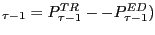 . These
latter two variables are recorded 30-minutes before the target-rate
change. The sample period is from April 1, 1996 to November 30,
2001. The time index is in event time:
. These
latter two variables are recorded 30-minutes before the target-rate
change. The sample period is from April 1, 1996 to November 30,
2001. The time index is in event time:  = 1,...19, as there were 19
target-rate changes in this period. (We exclude the target rate
change following September 11, 2001). The White
= 1,...19, as there were 19
target-rate changes in this period. (We exclude the target rate
change following September 11, 2001). The White  statistics (in parentheses) are
asymptotically robust to general forms of heteroskedasticity. The
statistics (in parentheses) are
asymptotically robust to general forms of heteroskedasticity. The
 statistics are
adjusted for degrees of freedom.
statistics are
adjusted for degrees of freedom.
| futures contract maturity |  ( | SP ( | |
|---|---|---|---|
| = 3 | 0.043
(2.918) |
-0.517
(-16.894) |
0.907 |
| = 6 | 0.079
(7.324) |
-0.383
(-17.255) |
0.918 |
| = 9 | 0.105
(8.112) |
-0.347
(-14.091) |
0.874 |
| = 12 | 0.137
(8.338) |
-0.336
(-11.159) |
0.851 |
| = 60 | 0.384
(8.568) |
-0.383
(-5.503) |
0.583 |
Estimates of the Modified Hasbrouck (1991) Model for the Eurodollar Futures and US Exchange Traded Fund Order Flow Regressions
The table presents the results from OLS regressions of the
six-month Eurodollar futures signed order flow (7) and the US ETF
signed order flow (8) on the selected public information variables.
The signed order flows on the two assets are accumulated over a
one-half-hour interval. They are projected on 12 lagged values each
of the Eurodollar and the US ETF order flows and quote revisions.
For these variables the sum of the 12 coefficients is given along
with a statistic of the
significance of the sum. The regressions also include: the lagged
Federal Funds target price (
 ; and the
lagged difference between the Fed Funds target price and the price
of the Eurodollar contract (SP
; and the
lagged difference between the Fed Funds target price and the price
of the Eurodollar contract (SP
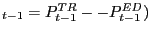 . The US ETF
order flow regression also includes the unanticipated net purchases
from the Eurodollar order flow regressions (
. The US ETF
order flow regression also includes the unanticipated net purchases
from the Eurodollar order flow regressions (
 . The
Newey-West statistics
(in parentheses) are asymptotically robust to general forms of
heteroskedasticity and autocorrelation. The statistics are adjusted for
degrees of freedom.
. The
Newey-West statistics
(in parentheses) are asymptotically robust to general forms of
heteroskedasticity and autocorrelation. The statistics are adjusted for
degrees of freedom.
| Eurodollar: lagged order flows (-stat.) | Eurodollar: lagged quote revisions (-stat.) | US ETF: lagged order flows (-stat.) | US ETF: lagged quote revisions (-stat.) | monetary policy: (-stat.) (-stat.) | monetary policy: SP (-stat.) (-stat.) |  (x) (x) (-stat.) (-stat.) |
|
|---|---|---|---|---|---|---|---|
| 0.029
(0.480) |
2.148
(0.224) |
0.001
(0.320) |
0.134
(0.561) |
-0.016
(-0.640) |
-0.022
(-0.501) |
0.006 |
Panel B: US ETF Order Flow Regression
| Eurodollar: lagged order flows (-stat.) | Eurodollar: lagged quote revisions (-stat.) | US ETF: lagged order flows (-stat.) | US ETF: lagged quote revisions (-stat.) | monetary policy: (-stat.) | monetary policy: SP (-stat.) | (x) (-stat.) |
|
|---|---|---|---|---|---|---|---|
| -0.041
(-0.094) |
216.576
(3.227) |
0.371
(12.282) |
-6.749
(-3.673) |
-0.953
(-5.387) |
1.080
(3.844) |
-0.894
(-9.687) |
0.083 |
Estimates of the Modified Hasbrouck (1991) Model for the Six-Month Eurodollar Futures Contract Holding Period Returns
The table presents the results from OLS regressions of the
six-month Eurodollar futures contract's holding period return on
the selected private and public information variables (9). The
holding period returns are the (log) difference in price of the
contract over the holding period . The returns are projected on 12 lagged values each
of the six-month Eurodollar and US ETF order flows and quote
revisions. For these variables the sum of the 12 coefficients is
given along with a
statistic of the significance of the sum. The regressions also
include: the lagged Federal Funds target price (
; the
lagged difference between the Fed Funds target price and the price
of the Eurodollar contract (SP
; the
unanticipated net purchases from the Eurodollar and US ETF order
flow regressions in Table 5a (
 and
and
 ,
respectively). The Newey-West statistics (in parentheses) are asymptotically robust
to general forms of heteroskedasticity and autocorrelation. The
statistics are
adjusted for degrees of freedom.
,
respectively). The Newey-West statistics (in parentheses) are asymptotically robust
to general forms of heteroskedasticity and autocorrelation. The
statistics are
adjusted for degrees of freedom.
| = |
Eurodollar: lagged order flows (-stat.) | Eurodollar: lagged quote revisions (-stat.) | US ETF: lagged order flows (-stat.) | US ETF: lagged quote revisions (-stat.) | monetary policy: (-stat.) | monetary policy: SP (-stat.) | Eurodollar: (x) (-stat.) | US ETF: (x) (-stat.) (-stat.) | |
|---|---|---|---|---|---|---|---|---|---|
 hour hour | -0.000
(-0.695) |
0.043
(2.329) |
-0.000
(-0.842) |
0.002
(1.091) |
-0.000
(-0.719) |
-0.000
(-2.821) |
0.0006
(77.794) |
0.00002
(1.886) |
0.752 |
| 1 day | -0.009
(-2.587) |
1.595
(3.012) |
-0.000
(-1.241) |
-0.015
(-0.685) |
-0.001
(-0.558) |
-0.010
(-2.728) |
0.006
(18.597) |
-0.00003
(-0.593) |
0.038 |
| 5 days | -0.024
(-2.222) |
2.287
(1.400) |
-0.000
(-0.068) |
-0.020
(-0.437) |
-0.006
(-0.523) |
-0.048
(-3.136) |
0.005
(6.919) |
0.00003
(0.311) |
0.030 |
Estimates of the Modified Hasbrouck (1991) Model for the US ETF Holding Period Returns
The table presents the results from OLS regressions of the US
ETF holding period return on the selected private and public
information variables (10). The holding period returns are the
(log) difference in price of the ETF over the holding period
. The returns are
projected on 12 lagged values each of the six-month Eurodollar and
US ETF order flows and quote revisions. For these variables the sum
of the 12 coefficients is given along with a statistic of the significance of the
sum. The regression also includes: the lagged Federal Funds target
price (
; the
lagged difference between the Fed Funds target price and the price
of the Eurodollar contract (SP
; the
unanticipated net purchases from the Eurodollar and US ETF order
flow regressions in Table 5a (
and
(x), respectively); and the
unanticipated quote revision on the Eurodollar contract from the
=
hour regression in Table 5b (
 when
there was a change in the Fed Funds target rate during the
half-hour period (1(
when
there was a change in the Fed Funds target rate during the
half-hour period (1( TR
TR 0)). The Newey-West statistics (in parentheses) are
asymptotically robust to general forms of heteroskedasticity and
autocorrelation. The
statistics are adjusted for degrees of freedom.
0)). The Newey-West statistics (in parentheses) are
asymptotically robust to general forms of heteroskedasticity and
autocorrelation. The
statistics are adjusted for degrees of freedom.
| = |
Eurodollar: lagged order flows (-stat.) | Eurodollar: lagged quote revisions (-stat.) | US ETF: lagged order flows (-stat.) | US ETF: lagged quote revisions (-stat.) | monetary policy: (-stat.) | monetary policy: SP (-stat.) | Eurodollar: (x) (-stat.) | Eurodollar: (r) 1( -stat.) | US ETF: (x) (-stat.) | |
|---|---|---|---|---|---|---|---|---|---|---|
| hour | 0.006
(1.022) |
0.574
(0.782) |
0.001
(1.552) |
-0.019
(-0.528) |
0.002
(0.623) |
0.004
(0.863) |
-0.027
(-9.275) |
16.858
(4.950) |
0.008
(33.275) |
0.203 |
| 1 day | 0.047
(0.675) |
-1.852
(-0.214) |
-0.005
(-0.890) |
0.767
(1.861) |
0.010
(0.260) |
0.035
(0.482) |
-0.025
(-3.750) |
18.423
(3.432) |
0.010
(10.365) |
0.015 |
| 5 days | 0.070
(0.268) |
-19.035
(-0.470) |
-0.036
(-2.320) |
-0.494
(-0.515) |
0.037
(0.227) |
0.170
(0.553) |
-0.027
(-2.123) |
17.203
(1.538) |
0.005
(3.171) |
0.007 |
Summary Statistics from and Tests of the Latent Factor Model of International Stock Returns
The top part of the table presents the value of the  -statistics associated with the Wald
tests of the over-identifying restrictions of the latent factor
model of international stock returns. The statistics are
distributed as (63) and are presented along with their asymptotic
marginal significance levels (-value). The model is estimated separately for each
holding period by
Generalized Method of Moments. The bottom part of the table
presents variance ratio measures of the statistical fit of the
model. The ratio shows how the latent factor model captures the
expected return variation in the data. The numerator is the
variance of the expected return on the foreign ETF from the latent
factor model while the denominator is the variance of the expected
return from an OLS regression of the foreign ETF return on the
global instruments.
-statistics associated with the Wald
tests of the over-identifying restrictions of the latent factor
model of international stock returns. The statistics are
distributed as (63) and are presented along with their asymptotic
marginal significance levels (-value). The model is estimated separately for each
holding period by
Generalized Method of Moments. The bottom part of the table
presents variance ratio measures of the statistical fit of the
model. The ratio shows how the latent factor model captures the
expected return variation in the data. The numerator is the
variance of the expected return on the foreign ETF from the latent
factor model while the denominator is the variance of the expected
return from an OLS regression of the foreign ETF return on the
global instruments.
-statistic model
test
 hour hour | = 1 day | = 5 days | |
|---|---|---|---|
 (63) statistic (63) statistic | 129.52 | 73.07 | 73.74 |
| -value | |
0.181 | 0.167 |
Panel B: Variance ratios
| hour | = 1 day | = 5 days | |
|---|---|---|---|
| Germany | 0.256 | 0.917 | 1.189 |
| Japan | 0.546 | 0.857 | 1.032 |
| UK | 0.503 | 0.927 | 1.575 |
| Switzerland | 0.690 | 0.928 | 1.388 |
| Canada | 0.375 | 0.883 | 0.572 |
| France | 0.291 | 0.927 | 1.386 |
| Netherlands | 0.440 | 0.925 | 1.329 |
| Sweden | 0.879 | 0.814 | 0.237 |
| Australia | 0.023 | 0.742 | 0.417 |
| Italy | 0.150 | 0.810 | 1.450 |
Beta Coefficients on the Implied Global Risk Premiums in the Latent Factor Model of International Stock Returns
The table shows the  coefficients on the
implied global risk premium from the latent factor model of
international stock returns. The implied global risk premium is the
linear combination of the global instruments given in Table 8. The
beta coefficient for Germany is normalized for identification. The
model is estimated separately for each holding period by Generalized Method of Moments. The
Newey-West statistics
(in parentheses) are asymptotically robust to general forms of
heteroskedasticity and autocorrelation.
coefficients on the
implied global risk premium from the latent factor model of
international stock returns. The implied global risk premium is the
linear combination of the global instruments given in Table 8. The
beta coefficient for Germany is normalized for identification. The
model is estimated separately for each holding period by Generalized Method of Moments. The
Newey-West statistics
(in parentheses) are asymptotically robust to general forms of
heteroskedasticity and autocorrelation.
| hour: (-stat.) | = 1 day: (-stat.) | = 5 days: (-stat.) | |
|---|---|---|---|
| Germany | 1.000 | 1.000 | 1.000 |
| Japan | 0.984
(11.675) |
0.529
(10.207) |
0.615
(5.439) |
| UK | 1.164
(14.845) |
0.753
(22.049) |
0.681
(11.467) |
| Switzerland | 0.988
(12.024) |
0.580
(17.342) |
0.698
(11.440) |
| Canada | 1.103
(12.121) |
1.149
(19.381) |
1.130
(10.504) |
| France | 1.012
(18.587) |
0.951
(32.196) |
0.881
(16.181) |
| Netherlands | 1.176
(13.764) |
0.8.14
(25.221) |
0.766
(13.957) |
| Sweden | 2.045
(14.690) |
1.301
(21.092) |
1.005
(11.438) |
| Australia | 0.367
(6.805) |
0.637
(11.550) |
0.637
(7.954) |
| Italy | 0.683
(12.215) |
0.857
(23.544) |
0.922
(11.838) |
Coefficients on the Global Instruments in the Latent Factor Model of International Stock Returns
The table shows the 
 coefficients on the global
instruments in the latent factor model of international stock
returns. The global instruments are: a constant; the lagged Federal
funds target price (; the lagged difference between the Fed
Funds target price and the price of the Eurodollar contract
(SP
; the
unanticipated net purchases on the six-month Eurodollar contract
from Table 5a (
; the
unanticipated quote revision on the Eurodollar contract from the
hour regression in Table 5b (
, which
are separated into whether there was a change in the Fed Funds
target rate during the half-hour period (1(TR0))
or not; and the unanticipated net purchases and quote revisions on
the US ETF from Tables 5a and 5c (
coefficients on the global
instruments in the latent factor model of international stock
returns. The global instruments are: a constant; the lagged Federal
funds target price (; the lagged difference between the Fed
Funds target price and the price of the Eurodollar contract
(SP
; the
unanticipated net purchases on the six-month Eurodollar contract
from Table 5a (
; the
unanticipated quote revision on the Eurodollar contract from the
hour regression in Table 5b (
, which
are separated into whether there was a change in the Fed Funds
target rate during the half-hour period (1(TR0))
or not; and the unanticipated net purchases and quote revisions on
the US ETF from Tables 5a and 5c (
 and
and
 . The
model is estimated separately by Generalized Method of Moments for
each holding period . The
Newey-West statistics
(in parentheses) are asymptotically robust to general forms of
heteroskedasticity and autocorrelation. The
. The
model is estimated separately by Generalized Method of Moments for
each holding period . The
Newey-West statistics
(in parentheses) are asymptotically robust to general forms of
heteroskedasticity and autocorrelation. The  -shocks [in brackets] represent
the effect of a one standard deviation shock to the indicated
variable, normalized by the standard deviation of the latent
factor.
-shocks [in brackets] represent
the effect of a one standard deviation shock to the indicated
variable, normalized by the standard deviation of the latent
factor.
hour
| constant (-stat.) | monetary policy: (-stat.) [-shock] | monetary policy: SP (-stat.) [-shock] | Eurodollar: (x) (-stat.) [-shock] | Eurodollar: (r) 1( | Eurodollar: (r) 1( | US ETF: (x) (-stat.) [-shock] | US ETF: (r) (-stat.) [-shock] |
|---|---|---|---|---|---|---|---|
| -0.641
(-1.246) |
0.001
(1.245) [0.036] |
0.0003
(0.169) [0.005] |
-0.005
(-8.327) [0.311] |
-0.797
(-6.462) [0.143] |
3.001
(13.383) [0.192] |
0.001
(10.664) [0.385] |
0.112
(14.427) [0.827] |
Panel B:
= 1 day
| constant (-stat.) | monetary policy: (-stat.) [-shock] | monetary policy: SP (-stat.) [-shock] | Eurodollar: (x) (-stat.) [-shock] | Eurodollar: (r) 1( | Eurodollar: (r) 1( | US ETF: (x) (-stat.) [-shock] | US ETF: (r) (-stat.) [-shock] |
|---|---|---|---|---|---|---|---|
| 2.204
(0.148) |
-0.005
(-0.146) [0.019] |
0.029
(0.507) [0.067] |
-0.027
(-5.096) [0.242] |
-2.330
(-2.797) [0.064] |
20.096
(13.353) [0.196] |
0.008
(8.971) [0.482] |
0.722
(13.089) [0.811] |
Panel C:
= 5 days
| constant (-stat.) | monetary policy: (-stat.) [-shock] | monetary policy: SP (-stat.) [-shock] | Eurodollar: (x) (-stat.) [-shock] | Eurodollar: (r) 1( | Eurodollar: (r) 1( | US ETF: (x) (-stat.) [-shock] | US ETF: (r) (-stat.) [-shock] |
|---|---|---|---|---|---|---|---|
| 118.18
(2.201) |
-0.259
(-2.199) [0.730] |
-0.123
(-0.579) [0.212] |
-0.031
(-2.981) [0.208] |
-7.940
(-4.984) [0.159] |
1.442
(0.770) [0.010] |
0.002
(1.377) [0.093] |
0.745
(7.737) [0.614] |
OLS Regressions of Home-Currency Returns on Foreign Exchange Traded Funds on the Latent Factor
The table shows the OLS regression coefficients ( of the
(log) change in the home-currency price of the foreign-country ETF
over holding period on the
latent factor from the international equity pricing model. The home
currency price of the ETF is calculated using the foreign currency
futures prices. The latent factor is the linear combinations of the
global instruments given in Table 8. The Newey-West statistics (in parentheses) are
asymptotically robust to general forms of heteroskedasticity and
autocorrelation. The
statistics are adjusted for degrees of freedom. The table also
shows the values of the asymptotic marginal significance levels
(-values) associated
with the
statistics which test whether the indicated coefficient is equal to
the value of the beta coefficient from the cross-sectional model
that is shown in Table 7.
of the
(log) change in the home-currency price of the foreign-country ETF
over holding period on the
latent factor from the international equity pricing model. The home
currency price of the ETF is calculated using the foreign currency
futures prices. The latent factor is the linear combinations of the
global instruments given in Table 8. The Newey-West statistics (in parentheses) are
asymptotically robust to general forms of heteroskedasticity and
autocorrelation. The
statistics are adjusted for degrees of freedom. The table also
shows the values of the asymptotic marginal significance levels
(-values) associated
with the
statistics which test whether the indicated coefficient is equal to
the value of the beta coefficient from the cross-sectional model
that is shown in Table 7.
= 1/2 hour:  (-stat.) (-stat.) | = 1/2 hour: -value ( | = 1 day: (-stat.) | = 1 day: -value ( | = 5 days: (-stat.) | = 5 days: -value ( | |
|---|---|---|---|---|---|---|
| Germany | 2.803
(5.761) |
0.111
|
1.177
(13.676) |
0.024
0.040 |
0.290
(0.607) |
-0.001
0.137 |
| Japan | 2.001
(6.835) |
0.049
0.001 |
0.602
(7.977) |
0.007
0.331 |
-0.229
(-0.648) |
-0.002
0.017 |
| UK | 1.923
(6.831) |
0.059
0.007 |
0.847
(12.821) |
0.019
0.156 |
0.378
(1.262) |
0.001
0.312 |
| Switzerland | 2.604
(7.725) |
0.107
|
0.801
(10.248) |
0.016
0.005 |
0.513
(1.401) |
0.001
0.614 |
| Canada | 1.310
(4.353) |
0.025
0.491 |
1.061
(13.507) |
0.022
0.265 |
-0.059
(-0.115) |
-0.000
0.020 |
This version is optimized for use by screen readers. Descriptions for all mathematical expressions are provided in LaTex format. A printable pdf version is available. Return to text