Board of Governors of the Federal Reserve System
International Finance Discussion Papers
Number 880, October 2006 --- Screen Reader
Version*
Optimal Fiscal and Monetary Policy When Money is Essential*
S. Borağan Aruoba†, University of Maryland
Sanjay K. Chugh‡, Federal Reserve Board
[The PDF document is dated "October 6, 2006."]
NOTE: International Finance Discussion Papers are
preliminary materials circulated to stimulate discussion and
critical comment. References in publications to International
Finance Discussion Papers (other than an acknowledgment that the
writer has had access to unpublished material) should be cleared
with the author or authors. Recent IFDPs are available on the Web
at http://www.federalreserve.gov/pubs/ifdp/. This
paper can be downloaded without charge from the Social Science
Research Network electronic library at http://www.ssrn.com/.
Abstract:
We study optimal fiscal and monetary policy in an environment where explicit frictions give
rise to valued money, making money essential in the sense that it expands the set of feasible
trades. Our main results are in stark contrast to the prescriptions of earlier flexible-price Ramsey models. Two especially important findings emerge from our work: the Friedman Rule is
typically not optimal and inflation is stable over time. Inflation is not a substitute instrument
for a missing tax, as is sometimes the case in standard Ramsey models. Rather, the inflation tax
is exactly the right tax to use because the use of money has a rent associated with it. Regarding
the optimal dynamic policy, realized (ex-post) inflation is quite stable over time, in contrast to
the very volatile ex-post inflation rates that arise in standard flexible-price Ramsey models. We
also find that because capital is underaccumulated, optimal policy includes a subsidy on capital income. Taken together, these findings turn conventional wisdom from traditional Ramsey
monetary models on its head.
Keywords: micro-founded models of money, Friedman Rule, inflation stability
JEL classification: E13, E52, E62, E63
* The views in this paper are solely the responsibility of the authors and should not be interpreted as reflecting the views of the Board of Governors of the Federal Reserve System or of any other person associated with the Federal Reserve System. Return to text
Monetary theory has made important advances of late, ones that
enable researchers interested in applied policy questions to
consider explicit frictions that give rise to valued money. In this
paper, we build on the works of Lagos and Wright (2005) and Aruoba,
Waller, and Wright (2006); in these new environments, we study
optimal fiscal and monetary policy, following the tradition of
Lucas and Stokey (1983) and Chari, Christiano, and Kehoe (1991).
Two important findings emerge from our work, both of which are
opposite those of earlier flexible-price Ramsey monetary models:
the Friedman Rule is typically not optimal and inflation is stable
over time. Our results thus turn conventional wisdom from
traditional Ramsey models on its head.
The contribution of Lagos and Wright (2005) and Aruoba, Waller,
and Wright (2006) -- hereafter, LW and AWW, respectively -- is to
integrate search-based monetary theory, in the spirit of Kiyotaki
and Wright (1989, 1993), with standard dynamic general equilibrium
macroeconomics. This integration makes the study of policy
questions much easier and potentially more relevant than in earlier
search-based models. However, these models have been criticized on
two grounds. First, they superficially resemble standard
cash-in-advance (CIA) or money-in-the-utility-function (MIU)
models, raising some question about whether they really are any
deeper than reduced-form models of money. This point has been
raised by, among others, Howitt (2003). Second, until now, the
policy questions addressed in these new models have been largely
confined to the deterministic welfare costs of inflation. When
parameterized to seem as close as possible to standard CIA and MIU
models, the quantitative answers they have yielded to this question
are similar to those obtained with CIA and MIU models, further
adding to the sense that these new models simply re-invent CIA or
MIU. In this paper, we ask a different policy-relevant question in
these new models, and even when we parameterize the model to look
very similar to standard applied models of money, we reach
conclusions very different from those reached by Chari, Christiano,
and Kehoe (1991) and others using typical CIA and MIU frameworks.
Our results thus show that the answers to policy questions may
indeed be very different once monetary frictions are treated
seriously.
We study the canonical Ramsey problem of optimal fiscal and
monetary policy using the LW and AWW models. Our first main finding
is that the optimal nominal interest rate is typically positive.
This optimal deviation from the Friedman Rule is not because the
inflation tax acts as a substitute instrument for a missing tax, as
is sometimes the case in Ramsey models. Rather, the inflation tax
is exactly the right tax for the government to use when money is
essential in Kocherlakota's (1998) sense that it expands the set of
feasible trades. Specifically, without money, trade can only occur
if there is a double coincidence of wants, whereas money allows
trade to occur with only a single coincidence of wants. Money is
thus a special object in this class of models and therefore has a
rent associated with it. Households in our economy require the
benefit of holding money to be strictly positive to be induced to
hold it. This benefit is realized only when the household is a
buyer in a bilateral match in the form of buyer's surplus, and it
is this surplus that we interpret as the rent associated with
holding money. It is well-known from Ramsey theory that it is
optimal to tax rents. The most direct way to tax rents accruing to
money is through inflation, hence the Friedman Rule is not optimal.
Interestingly, Kocherlakota (2005) conjectured that the Friedman
Rule may not be optimal in a Ramsey problem in search-based models.
Our results show his conjecture is correct.
Deviations from the Friedman Rule have also been obtained in
other modern Ramsey models. For example, Schmitt-Grohe and Uribe
(2004a) show that a positive nominal interest rate can tax
producers' monopoly profits, and Chugh (2006b) shows it can tax
monopolistic labor suppliers' rents.1 Both of these results, however, are
examples of the Ramsey planner using a positive nominal interest
rate to indirectly tax some rent. One
may wonder whether alternative tax instruments in our model could
tax the money rent. To investigate this, we introduce a sales tax
on goods whose purchase can only be achieved with money. It turns
out that adding this seemingly natural instrument does not admit a
Ramsey equilibrium in which the Friedman Rule is optimal. Thus, if
there does exist another tax instrument besides the inflation tax
that can seize the money rent, it is not an obvious one.
Our second main finding is that realized (ex-post) inflation is
quite stable over time in the face of shocks, which is in contrast
to the very volatile ex-post inflation rates that Chari,
Christiano, and Kehoe (1991) -- hereafter, CCK -- find. Inflation
volatility is high in CCK and the related literature because
surprise movements in the price level allow the government to
synthesize real state-contingent debt payments from nominally
risk-free government bonds, without distorting the relative prices
of consumption goods. The government then need not change other,
distortionary, tax rates much in response to shocks. In our model,
in contrast, real activity is distorted by ex-post inflation
because inflation affects relative prices of goods, in a way that a
flexible-price CIA or MIU model cannot articulate. The welfare cost
of this relative-price distortion dominates the insurance value of
generating state-contingent debt in our model, rendering inflation
very stable. The frictions underlying monetary trade thus provide
novel justification for the optimality of inflation stability, a
prescription that resonates with most central bankers. This result
also echos the long-standing idea in monetary economics that
inflation variability is undesirable because it induces relative
price shifts.
Finally, when we allow for capital accumulation, the optimal
policy includes a subsidy on capital income. Both the frictions
inherent in bilateral trade in our model as well as the deviation
from the Friedman Rule tend to depress capital accumulation
compared to its efficient level. A capital subsidy somewhat
alleviates this problem.
An important technical advantage of the LW and AWW frameworks is
that the distribution of money-holdings across agents is simple to
track: it simply collapses periodically to a point. At the expense
of a heavier computational burden, one may want to think about
optimal fiscal and monetary policy when this distribution is
non-trivial. Once one goes down that route, an interesting taxation
framework to apply may be the Mirrleesian one, in which
idiosyncratic shocks and private information become important
considerations in shaping optimal policy. However, because even the
simpler step of characterizing the Ramsey-optimal policy, which
assumes a representative agent, has not been studied in this class
of models, we think it makes sense to begin here.
The rest of the paper is organized as follows.
Section 2 lays out the baseline LW
model in which we first study optimal policy. Most of the important
results and intuition emerge in this basic model.
Section 3 presents the Ramsey
problem for the basic model. In Section 4, we characterize and discuss the optimal
policy in the basic model; we present in Section 4.1 a proof for a particularly important
version of the model that the Friedman Rule is not optimal and in
Section 4.2 the dynamic Ramsey
allocations and policy that demonstrate optimal inflation
stability. In Sections 5
and 6, we extend the Ramsey
problem to the AWW model, and Section 7 shows that the main results carry over
from the basic model virtually unchanged. Section 8 summarizes and offers ideas for future
work.
We begin by establishing our main results in a version of the LW
model. In this model, the agents in the economy participate in a
centralized market (CM) where they trade general consumption goods
and assets with the market and in a decentralized market (DM) where
they trade specialized consumption goods bilaterally. To enhance
comparability with the benchmark cash-credit environment used by
CCK, we alter slightly the timing of markets in the original LW
model. Specifically, in our version, the CM is the first market in
a given period, followed by the DM. We make this alteration because
we would like asset markets (which in the LW model meet in the CM)
to convene in any period before goods markets (in particular,
before goods markets in which money must be used for transactions),
which is the timing assumed by CCK. However, we do not see how any
of our results depend on the temporal ordering of markets within a
period. We proceed by describing the activities of the government,
households, and firms in our model.
Government consumption is assumed to be composed entirely of
goods produced in the CM. In nominal terms, the flow budget
constraint of the government is
(1)
which states that the government has three sources of revenues to
pay for its consumption: labor income tax revenues, nominal money
creation, and nominal debt issuance. The notation is standard:
denotes nominal
money outstanding at the end of period , is nominally risk-free government debt
outstanding at the end of period , is
the gross nominal interest rate on bonds,
is a
proportional labor income tax on aggregate hours worked
in the CM,
is the nominal
price level in the CM, and is the real wage in the CM. The nominal return
is known at the
time is issued and paid
in the CM of period . We
assume that bonds are simply book entries with no tangible proof
that one can carry around.
Households periodically transact in markets for general goods
and assets (the CM) and in markets for specialized goods (the DM).
In the DM, money is essential in the sense that transactions there
are infeasible without money.2 In the
CM, because markets are Walrasian trades can proceed with or
without money. We describe first the timing of events in a given
period and then present the household's CM and DM problems.
Events unfold for a household in a given period as follows:
The household begins the CM with portfolio and
The uncertainty for the current period is resolved, and the
household observes government consumption and the level of technology
. We denote the
aggregate state collectively by .
The household receives the receipts from bond holdings,
.
The household chooses its CM consumption , labor supply , portfolio
and pays
the labor income tax.
The household enters the DM with .
Depending on the household's trade in the DM, it exits the DM
with
, or
money holdings,
where is the buyer's
payment in bilateral trade.
For a household that enters the CM with money holdings
and bond
holdings , the
CM problem is
(2)
subject to
(3)
where denotes the
value of entering the CM and denotes the value of entering the DM that
convenes after the CM in period . Centralized market consumption is , and the household's hours
worked in the CM is .
Note that instantaneous utility in the CM is separable and linear
in labor; it is this quasi-linearity in preferences that allows the
LW model to be tractable, as it guarantees a degenerate
distribution of money holdings across households after every
meeting of the CM.
Eliminating in the
objective function using the budget constraint, the first-order
conditions with respect to , ,
and are
(4)
(5)
(6)
familiar from LW. These optimality conditions imply the usual LW
results about degeneracy of asset holdings
across
households because they are independent of
.3 All
households choose the same portfolio at the end of the CM
regardless of the portfolio they entered the market with. Thus, the
LW result of degeneracy of money holdings readily extends to bond
holdings as well. Moreover, we have standard envelope conditions
Now we turn to the household's DM problem. Knowing that the
distribution of money holdings is degenerate in equilibrium, we
will, for notational simplicity, write the household DM problem
assuming that when it meets a trading partner, the trading partner
has equilibrium money holdings ; this allows us to conserve on integrating over
all possible money holdings of trading partners that a given
household could meet. With probability , the household is a buyer in
the DM; with probability , the household is a seller in the DM; and with
probability , the
household does not participate in the DM and continues to the CM of
the next period without transacting.4Buyers consume in the DM, experiencing utility
; sellers produce
in the DM,
experiencing disutility, which can be interpreted as the cost of
production, , where
. We assume
throughout our basic model that
.5
We can write the problem of a household that enters the DM with
portfolio
as
(9)
(10)
(11)
The quantity
is the quantity produced and exchanged in a bilateral meeting in
the DM, where denotes
the money holdings of the buyer, denotes the money holdings of the seller, and
is the amount of money that changes hands. We refer to
as the
terms of trade in a single-coincidence meeting. Note that due to
the nature of the bonds, neither the buyer's nor the seller's bond
holdings will matter for
and .
In the DM, we must specify the protocol by which the price and
quantity in any bilateral trade are determined -- that is, we must
define the structure by which the terms of trade are determined.
The two main alternatives in the literature are Nash bargaining and
price-taking. We describe the bargaining version in detail. It
turns out -- see Rocheteau and Wright (2005) -- that price-taking
in the basic model amounts to a simple parameter restriction in the
bargaining version.
Denoting the portfolio of the buyer by
, that of
the seller by
, and the buyer's
bargaining power by ,
the generalized Nash bargaining problem is
(12)
(13)
subject to
(14)
where the constraint is simply a feasibility condition stating the
buyer cannot spend more than he has and the threat points are the
values of continuing on to the next CM in period . Using the envelope conditions
from above (in particular, the implied linearity of the function
), the
bargaining problem can be written more conveniently as
(15)
subject to
(16)
We define
which can be interpreted as the marginal utility of
consumption of CM
goods that are worth one unit of money using (4). Then, the Kuhn-Tucker conditions, which are
necessary and sufficient, for the bargaining problem are
(17)
(18)
(19)
where
is the
multiplier associated with the constraint. If
, the
first two conditions yield
, which defines
the efficient quantity
, and
, which
can be solved using the second equation.
If
, the
solution will have
, meaning
the buyer spends all his money in a bilateral meeting. Using the
first condition, the quantity produced and traded will solve
(20)
where
(21)
as in LW. In equilibrium,
, which
can be shown using a similar argument to the one in LW. Also, note
that because the expectation in is taken with respect to , we denote the bargaining
problem outcomes as
and
, where
the first argument is understood to be the money holdings of the
buyer.
Substituting this solution into the DM problem (9) and using the envelope conditions for
, we get
Although bargaining has been used almost exclusively as the
pricing scheme in bilateral meetings in this class of models, more
``competitive'' pricing schemes have been used recently, as well.
In addition to being closer to mainstream macroeconomics,
competitive pricing eliminates the holdup problems inherent in
bargaining. In the basic model, competitive pricing in the DM
amounts to sellers and buyers solving their respective supply and
demand problems taking the price as given; the market-clearing
price is determined in equilibrium. Based on the results of LW and
Rocheteau and Wright (2005), it follows that the price-taking
version of our model is the same as the bargaining version with
.
For the bargaining version we obtain the conditions that solve
the household's problem as follows. First, combining the
household's CM optimality conditions (4)-(6) with the envelope
conditions (23) and (24) gives us:
We will refer to these last two equations as the household's
first-order conditions with respect to money and bonds,
respectively, in analogy with a standard cash/credit CCK type of
model. Note that they imply a Fisher-like condition,
where the left hand side,
, is the
cost of holding money (the net nominal interest rate) and the right
hand side is the benefit of holding money. We note that the
right-hand-side of (34) will play an
important role in shaping the Ramsey allocations and hence the
optimal policy; we defer discussion and intuition regarding it
until we present the Ramsey problem in Section 3, in which we will see it in the context of
the complete Ramsey problem and will be able to easily compare it
to the benchmark Ramsey problems in Lucas and Stokey (1983) and
CCK.
To finally state the solution of the household problem: given
sequences
, initial
condition
, and
appropriate transversality conditions, the solution to the
household's problem is processes
satisfying conditions (3), (20
), (27), (31), and (33).
In the CM, a representative firm hires labor in a competitive
labor market and operates the linear production technology
.
Profit-maximization therefore implies the wage is
in
equilibrium.
Imposing equilibrium (
,
, etc.) and
combining the firms' and households' optimality conditions, we can
define the equilibrium as follows. Given policy variables
, the technology
realization
, the government spending
realization
, and initial condition
,
equilibrium is a set of processes
satisfying
(35)
(36)
(37)
(38)
(39)
(40)
For the Ramsey problem, it will be useful to combine (36) and (37) and rearrange for real money
balances,
(41)
Furthermore, in any monetary equilibrium,
because
otherwise households could earn unbounded profits by selling bonds
and buying money. We represent this restriction in terms of
allocations using (38) as
As is common in the Ramsey literature, we adopt the primal
approach and cast the Ramsey problem as that of a planner that
chooses allocations subject to feasibility and the need to raise
exogenous government revenue, making sure the resulting allocations
are implementable as a monetary equilibrium. We prove the following
in Appendix A.1:
Proposition 1The allocations in a
monetary equilibrium satisfy (39), (42),
and the present-value implementability constraint (PVIC),
(43)
In textbook Ramsey problems, implementability constraints
typically take the form , where
is the set of goods the
agent consumes at time .6 At first
glance, (43) does not seem to conform to
this general form because the term related to the DM,
does not look like marginal utility of a good times the
quantity of that good. However, this term does indeed have such an
interpretation; we can show that the term in the PVIC is simply the
product of money balances and its marginal utility.
To see this, note that from the bargaining problem and (20),
is the surplus of the buyer
and therefore
is
the marginal surplus of the buyer. Moreover, money has no use in
the DM unless the household is a buyer, which occurs with
probability . Thus,
the marginal utility of money can be expressed as
. From
(20) and (25), we
have
and
.
Combining these, we obtain the third term under the summation in
the PVIC. With this interpreration, one may argue that our model
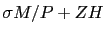
lolks like a MIU model, which would have a term in the PVIC. In our context,
though, the marginal utility of money is linked to the fundamentals
of the economy -- allocations and technology -- and it is not an
arbitrary function.
If , the DM shuts
down and our PVIC collapses to the usual CCK PVIC in a real model. That is, the model collapses not
to the CCK monetary (cash-credit) economy, but to a purely real
model. This is a manifestation of the ``dichotomy" result the LW
model displays that Aruoba and Wright (2003) pointed out. The
inflation rate in the LW model does not affect CM allocations at
all.7
Because we restrict attention to only monetary equilibria, we
require that the Ramsey allocations satisfy
restriction (42), which we refer to
as the zero-lower-bound (ZLB) constraint. CCK show that in their
model, the ZLB constraint always holds with equality under the
solution of the Ramsey problem obtained by dropping the ZLB constraint; in other words, in the
CCK model the Friedman Rule () can be shown analytically to always be the
optimal policy. Thus, in the CCK model it turns out the ZLB
constraint is redundant regardless of the parameterization of the
model. This is not the case in general in our model and thus we
need to impose it. As a technical point, note that the ZLB
constraint is an inequality constraint. Thus, when solving for the
dynamics of the model, we must employ a nonlinear global numerical
approximation to handle the occasionally binding constraint. In
practice, though, for a very important parameterization of interest
of the model, it turns out that the ZLB constraint can be shown to
be slack -- in fact, that it is always satisfied with strict
inequality. We discuss this further below, and it is one of our
main results.
We assume the Ramsey planner is able to commit at time zero to a
policy for . We
thus sidestep here the potentially interesting issue of
time-inconsistency in this model. The Ramsey problem is thus to
choose
to maximize
(44)
subject to the resource constraint
(45)
the PVIC (43), and the ZLB
constraint (42), taking as given
. In
Appendix A.2, we list the
conditions that characterize the solution to this problem, along
with the conditions that allow us to construct the policies and
prices that support the Ramsey allocation. Thus, as we already
noted, our approach is a straightforward application of Ramsey
theory.
One of our central results is that for a range of values for
, the optimal
nominal interest rate is positive. We can establish this
analytically for the case , which we do next. The case is an especially important
one because Rocheteau and Wright (2005) show that for this case,
bargaining yields the same outcomes as if there were competitive
forces in the DM, making DM trades look less non-standard from the
point of view of modern DGE theory. For , analytical solutions
are not as easy to obtain, and we resort to numerical
solutions.
The Friedman Rule is not optimal if , as we now show:
Proposition
2
(Optimal Deviation from the Friedman Rule in Basic
Model) If , the optimal policy features a strictly
positive net nominal interest rate in every period . Furthermore, if is CRRA (constant relative risk
aversion) then the optimal nominal interest rate is constant over
time.
Proof. Let be the multiplier on the PVIC (43) in the Ramsey problem, and consider the
Ramsey problem with the ZLB constraint dropped. The first-order
condition of this problem with respect to for is given in Appendix A.2. With , we have that
, so
this FOC simplifies considerably,
(46)
First, let us assume ,
which means the PVIC constraint is not binding. This implies
, or
. This also
means the ZLB constraint binds. Using (35) and the FOC of this problem with
respect to presented
in Appendix A.2, we also get
. All of
this implies that the real liabilities of the government grow
without bound and this cannot be sustained in equilibrium. As such,
the solution to this problem must have .
Because is strictly concave, the multiplier
under the
Ramsey allocation, and of course in a monetary equilibrium, the right hand
side of the first order condition above is strictly positive. This
implies
,
which in turn implies
(47)
imposing
because
. But this
implies, by the equilibrium condition (38), that , so we have established that the Friedman
Rule is not optimal.
Next, suppose
. Looking at (38), we see that for to be constant over time,
has to be constant. With , this requires that
is
constant. The CRRA utility function has the property
. Imposing this in
(46) and collecting the
terms, we
have
(48)
which shows that
is
constant.
Deviations from the Friedman Rule have been obtained in other
Ramsey models, as well. For example, Schmitt-Grohe and Uribe
(2004a) show that a positive nominal interest can tax producers'
monopoly profits, and Chugh (2006b) shows that it can tax
monopolistic labor suppliers' rents. We know from Ramsey theory
that taxing rents is optimal because it is non-distorting. However,
the deviations from the Friedman Rule in Schmitt-Grohe and Uribe
(2004a) and Chugh (2006b) are instances of the Ramsey planner using
a positive nominal interest rate to indirectly tax some rent -- in neither case is
money the ultimate object the Ramsey planner wants to tax.
In contrast, in our environment, inflation directly taxes the rent that the Ramsey planner
wants to seize, which is the rent associated with money. Money has
a rent in our model because without it, certain trades simply could
not occur, which would decrease welfare. A household chooses to
hold money with the anticipation of being a buyer in the next DM. A
household would never choose to hold money unless
, which can be interpreted
as the rent that money-holders enjoy. It is precisely this rent
that the Ramsey planner wants to tax, and the inflation tax is the
most obvious way of doing this.
Our conclusion that the Friedman Rule is not optimal of course
differs from that of CCK. However, it can be reconciled with their
result by considering basic principles of public finance. In CCK,
optimality of the Friedman Rule depends on a certain class of
utility functions. In particular, CCK require cash goods and credit
goods to enter the utility function homothetically and separably
from leisure. Similarly, in Chari and Kehoe's (1999) MIU model,
money and consumption must enter utility homothetically and
separably from leisure in order for the Friedman Rule to be
optimal. These results are essentially an application of the
uniform taxation result of Atkinson and Stiglitz (1980), requiring
cash-good consumption and credit-good consumption (or money and
consumption) to be taxed uniformly; a deviation from the Friedman
Rule would mean that cash goods are taxed more heavily than credit
goods, hence cannot be optimal.
The instantaneous social utility function in our model takes the
form
( denotes the
effort of sellers in the DM). If we interpret as the cash good and as the credit good, and must enter
homothetically to satisfy the CCK requirement. Our
Proposition 2 admits this case.
For example, we can set and Proposition 2 of course still holds. However, realize
that, given the structure of the LW model, . The reduced-form social utility function (the one that
the Ramsey planner maximizes) thus has the form
. Regardless of what we assume about and , and will
in general not enter the reduced-form utility function
homothetically. In other words, even though we might have
homothetic preferences in terms of the primitives, the reduced-form
representation, which is the one relevant for the Ramsey planner,
would have non-homothetic preferences. Our results thus reconcile
with those of CCK.
One may still wonder, though, if there is another instrument
that, if the Ramsey planner had it available and were to use it,
would reinstate the optimality of the Friedman Rule. Following the
logic of Schmitt-Grohe and Uribe (2004a) and Chugh (2006b), such an
instrument would seemingly need to be a direct means of taxing DM activity. A natural
candidate, then, is a sales tax in the DM. However, we show in
Appendix B that allowing for a
DM sales tax in what seems to be a straightforward way does not
admit a Ramsey equilibrium in which the Friedman Rule is
optimal.8 This
result implies that the sub-optimality of the Friedman Rule we have
documented is not sensitive to the inclusion of at least this tax
instrument. Admittedly, this is only one candidate alternative tax
to consider, although seemingly a very natural one -- but it does
not restore the Friedman Rule.
Left to still consider is the quantitative degree of the
departure from the Friedman Rule. The rent-seizing argument would
suggest that the optimal inflation rate should be one that
confiscates the entire rent, but this would imply . Thus, the optimal inflation rate
must balance the motive to seize the money rent versus pushing
too low. Our
numerical results, presented next, seem to confirm this
intuition.
As we explain in Appendix A.2, given
, the
first-order conditions of the Ramsey problem and the feasibility
condition for the CM characterize the allocations
and the multiplier on the ZLB constraint,
.9 Then we can use the equilibrium
conditions to back out
. Due to the nature of
our model, we can exactly solve for all of these variables, except
for , using a
nonlinear equation solver. However, to reduce computational time,
we nonetheless approximate the functions
and
, along
with
. Our
strategy is to construct global nonlinear approximations of these
functions because of the presence of the potentially
occasionally-binding ZLB constraint.10 Of interest to many practitioners,
however, should be our (unreported) findings that, for the versions
of the model in which we know for sure the ZLB constraint is always
slack, first-order and second-order local approximations yielded
results virtually identical to our global approximation.11To construct the approximations, we use
as the functional equations the first-order conditions of the
Ramsey problem with respect to and and the equilibrium condition (37). We use the remaining equations to
solve for the other variables of interest.
Before presenting numerical results, we briefly describe the
parameterization of the model. To the extent possible, we use the
parameters and functional forms that LW provide, whose model is
calibrated to match some long-run features of the US economy. The
DM utility function is
(49)
with , which is a
parameter that forces , which can occur in the DM if a household does
not meet another agent with whom to trade. In the CM, instantaneous
utility is
.
We consider two cases: buyer-take-all in the bargaining problem
, which is
equivalent to price-taking, and . For the former case we use
and for the latter
case we use
.
The exogenous government spending and TFP processes each evolve
as an AR(1) in logs,
(50)
(51)
with
and
. We
calibrate
, so that
government purchases constitute about 18 percent of total GDP in
steady-state.12 In line
with Schmitt-Grohe and Uribe (2004b) and the RBC literature, we set
the parameters of the stochastic processes
,
,
, and
. With
these volatility parameters, our model has a standard deviation of
government purchases of about 7 percent of the mean level of
government spending, and the volatility of total output is about
1.8 percent, both in line with data. The persistence parameters of
the exogenous processes are for an annual calibration, thus we set
the annual subjective discount factor
, which
delivers an annual real interest rate of about 4 percent. Finally,
we choose the level of steady-state government debt, an object not
pinned down by the model, so that it is 45 percent of steady-state
output, consistent with the parameterizations of CCK and
Schmitt-Grohe and Uribe (2004b).
In Section 4.1, we
established that the Friedman Rule is not optimal when . Obtaining analytic
solutions for
is not as easy, so we study the optimal steady-state policy for
this case numerically.
The solid line in Figure 1 shows the steady-state Ramsey policy
and key allocation variables as functions of . At , the optimal nominal
interest rate is about 2 percent at an annual rate; the associated
optimal inflation rate is thus -1.6 percent, higher than the
Friedman rate of deflation, which would be -3.4 percent in our
model.
As falls below
unity, the optimal nominal interest rate falls. This is due to the
holdup problem associated with holding money when discussed by LW.
Specifically, when , the buyer does not get the full benefit
from the match and this reduces his incentive to hold money,
causing the equilibrium
to fall. Realizing this, the Ramsey planner reduces the inflation
tax, balancing his desire to tax the buyer's surplus with the
desire to reduce the effects of the holdup problem. Because
seignorage revenue (not shown) falls along with the nominal
interest rate, the government's revenue shortfall must be made up
with the labor tax, causing the labor tax rate to rise, as the top
right panel of Figure 1 shows. The associated responses of the
allocation variables and
are easy to
understand as well. As the labor income tax rate rises with the
fall in , hours
worked and hence consumption in the CM decline.
If falls far
enough the ZLB constraint binds, making the Friedman Rule the
optimal policy. For our calibration, the ZLB constraint binds if
, as
can be seen by the fact that the net nominal interest rate is zero
over that interval. The kink when the ZLB constraint binds leads to
kinks in the labor tax rate and allocations as well.
The dotted line in Figure 1 shows the allocations and implied
and that emerge from the Ramsey
problem with the ZLB constraint (42)
dropped. The results for
are
of course identical because in that region the ZLB constraint did
not bind anyway. With the ZLB constraint dropped and
, we
see that the Ramsey planner would like to implement, if it were
consistent with monetary equilibrium, a negative net nominal
interest rate, apparently to boost . Of course, deflation faster than the Friedman Rule
is inconsistent with a monetary steady-state equilibrium. Hence,
the Friedman Rule becomes the constrained optimal policy.
We now turn to the dynamics of the Ramsey policy, which reveals
our second central result: optimal inflation is very stable. To
investigate the dynamic behavior of our model, we solve for the
dynamic Ramsey equilibrium and simulate the model. We conduct 1000
simulations of 500 periods each and discard the first 100 periods.
As in Khan, King, and Wolman (2003) and others, we assume that the
initial state of the economy is the asymptotic Ramsey steady-state.
For each simulation, we then compute first and second moments and
report the averages of these moments over the 1000 simulations.
Before turning to simulations, we make a few observations by
inspecting the first-order conditions of the Ramsey problem. First,
government spending affects only CM hours because none of the
first-order conditions for , ,
and (the
multiplier on the ZLB constraint) involve . Once is determined, adjusts according to the shocks
to . This result
follows from the quasi-linearity of preferences in the CM. Because
households essentially have risk-neutral preferences over hours,
fluctuations in
are fully reflected in .13 Simply
put, the dichotomy result is that CM and DM allocations have
nothing to do with each other unless production in each market
depends on a common capital stock (as we introduce in
Section 5). Second, and related,
the dynamics of
and follow the
dynamics of the technology shock as the latter is the only driving
force for the former. Third, for the particular utility function we
choose in the CM - in fact for any CRRA utility function -- the
labor income tax rate is constant over time.14 This can be viewed as the extreme case
of the usual consumption-smoothing motive as spelled out in, say,
Barro (1979).
Table 1 presents simulation-based moments for the key allocation
and policy variables for (which, again, is equivalent to
price-taking) and for . Let us first discuss the results for
. The first
three rows show the dynamics of realized inflation, the labor
income tax rate, and the net nominal interest rate under the Ramsey
policy. We hone in first on the result that the optimal inflation
rate is quite smooth over time, with a standard deviation of about
only about 24 basis points (at an annual rate) around a mean
deflation rate of 2 percent. The very stable inflation rate is in
sharp contrast to the extremely volatile optimal inflation rate
first found by CCK in a flexible-price Ramsey model and recently
verified in, among others, the flexible-price versions of
Schmitt-Grohe and Uribe (2004a, 2004b), Siu (2004), and Chugh
(2006a, 2006b).15
In these baseline Ramsey monetary models, inflation does not
distort the relative prices of goods. It is easiest to see this in
a cash-credit economy: the nominal price of both cash and credit
goods is , and the
relative price depends only on the nominal interest rate,
reflecting the opportunity cost of the money used to purchase the
cash good. In other words, given a nominal interest rate, dynamic
fluctuations in the price level do not alter the relative price
between cash and credit goods and therefore do not affect
equilibrium allocations. In these baseline models, then, the
driving force behind price-level dynamics is just the (desirable)
ability of price-level fluctuations to tailor the real returns on
nominal government debt, thus avoiding the need to change other
distortionary taxes in the face of shocks to the government budget.
Quantitatively, assuming business-cycle magnitude shocks, realized
inflation turns out to be very volatile.16
With money essential, this result is overturned because
inflation affects the relative price of DM and CM goods. To see
this, note that the nominal price of a DM good in period
can be expressed as
, which is
simply per-unit expenditure in the DM. This means the relative
price of DM goods in terms of CM goods is simply real money
balances divided by DM consumption. Both of these objects are
functions of inflation in equilibrium and therefore the relative
price is in principle a function of inflation in equilibrium. In
equilibrium, inflation thus affects the household's margin between
DM and CM goods in a way that simply cannot occur in a cash-credit
environment. Usual tax-smoothing reasons then suggest that it is
optimal to have smooth (low-volatility) inflation because otherwise
this margin would be disrupted. In Table 1 we also report the
dynamic properties of this relative price, and they are quite
similar to -- indeed, even smoother than -- the dynamic properties
of inflation. This demonstrates that even though the Ramsey planner
has available the option of moving this relative price around over
time, it is optimal to not do so.
Other Ramsey models make the prediction that inflation stability
is optimal, most notably Schmitt-Grohe and Uribe (2004b), Siu
(2004) and Chugh (2006b). The basic mechanism behind their
inflation stability results is also a relative-price distortion
caused by inflation; however, these models all rely on nominal
rigidities to generate the relative-price effect. We emphasize that
in our model, prices are fully flexible and yet inflation causes
relative price distortions. The real frictions underlying monetary
exchange are behind our result.
Another perhaps noteworthy feature of inflation dynamics is that
it displays high persistence. In the benchmark CCK model, which
assumed fixed capital, inflation persistence is virtually zero no
matter how persistent are the driving shocks. Chugh (2006a) shows
that allowing for capital accumulation or habit formation generates
optimal inflation persistence, but clearly here we have that result
with neither of these features. If one inspects the equilibrium
Euler equation for bonds, which is what we use to solve for the
dynamics of inflation, it is not surprising that the dynamics of
inflation would closely track the dynamics of and , which in turn closely track
the dynamics of the technology shock.
Finally, consider the results for , reported in the second panel of Table 1.
The means of the variables of interest are of course in line with
the steady state results. Compared to the price-taking case
(), the average
labor income tax rate is higher and average consumption (both CM
and DM) and GDP are lower. The Friedman rule is optimal with an
average deflation equal to the rate of time preference. In our
simulations, which are driven by business-cycle-magnitude shocks,
we find that the optimal nominal interest rate is once again
constant over time.17 Thus,
even though the ZLB constraint can be an occasionally-binding
constraint in principle, for our calibration it either always binds
() or never
binds (). We
also find that
is less volatile if , which in turn causes GDP to be less
volatile and the correlations of other variables with GDP to be
lower than what we find when . In short, we find that except for the
expected changes in the means, the dynamic behavior of the Ramsey
problem with
is qualitatively identical to the case with .
Ramsey models of optimal fiscal and monetary policy have only
recently begun considering how the presence of capital accumulation
affects optimal policy.18 Here, we
add capital to our baseline model following AWW: we assume that
capital is accumulated in the CM and used in production in both the
CM and the DM. As AWW show, with capital productive in both
markets, the LW and Aruoba and Wright (2003) ``dichotomy" result,
in which CM and DM allocations have nothing to do with each other,
disappears. We proceed by briefly describing how the model is
modified to accommodate capital and then present results.
The critical change from the basic model is that capital is
introduced as a factor of production in both the DM and CM. In the
CM, this is done in the obvious way: production takes place
according to a constant returns technology subject to TFP shocks,
.
Profit-maximization by firms in the CM leads to standard
factor-price conditions,
and
.
In the period- DM,
sellers use the capital they have, which is according to our timing
convention.19 As
explained in AWW, this amounts to modifying the cost function to
include capital as
, with , and .
The household CM budget constraint modifies in the obvious
way,
(52)
where is the
household's capital holdings at the start of period , is the rental rate on capital, is its deprecation rate, and
is the
tax rate on capital income.20 The
value functions in the CM and the DM now of course include the
household's capital holdings as a state variable. The household's
CM problem is
The first order conditions of this problem are exactly as they
were in the basic model, with a new condition for capital
accumulation given by
(54)
The results regarding the degenerate distribution of bonds and
money readily extend to capital. is still linear in all its arguments, with
given by
(55)
In the DM, we again consider two pricing schemes: bargaining and
price-taking. Unlike the basic model, price-taking cannot be
obtained by a simple parameter restriction of the bargaining model
and as such we briefly discuss it below. The DM problem for the
household is still given by (9)
after obvious changes in arguments and using
and
to represent the terms of trade from the viewpoint of the buyers
and the sellers, respectively. This simplifies to
(56)
using the linearity of
. All we
have to do to characterize the solution to the household's problem
is to compute the partial derivatives of , which we do for both pricing
schemes below. As in AWW, capital is only a productive input in
this market and cannot be used as a medium of exchange. Those
familiar with the AWW model may choose to skip the following
exposition and proceed directly to the Ramsey problem in
Section 6.
The bargaining problem is still given by (15) with the obvious modifications
regarding capital. The solution to the problem gives
,
where solves
, refers to the buyer's money
holdings and refers to
the seller's capital stock. The function
is a straightforward
modification of the one in the basic model.
The only new partial derivative we need is
which is
given by
(57)
Noting
, defining
(58)
and combining the optimality conditions (4)
and (54) with the envelope condition
(57), we get the household's Euler
equation for capital accumulation,
(59)
which shows that investment takes into account the fact that
capital affects productivity in the DM as well as in the CM. The
additional term related to the DM represents the seller's payoff
from carrying units
of capital into the DM and producing units, which occurs with probability
. As such, we can
think of it as the return of capital in the DM. Therefore when
making an investment decision in the CM of period , the households take the return of
extra capital in the CM of period , which is the usual term on the right hand side as
well as the return in the DM. It is also straightforward to show
that the analog of the Fisher-like condition (33) from our baseline model is
(60)
which we need in order to write the ZLB constraint on the Ramsey
problem.
An alternative to bargaining is price taking, in which buyers
and sellers each take the price of a unit of good in the DM,
, as given
and solve their respective demand and supply problems. The buyer's
problem is
(61)
subject to
.
In equilibrium this constraint binds, and we have
. The seller's problem is
(62)
with the first order condition
.
Using these two expressions, the two envelope conditions we need to
solve the problem of the household are given by
(63)
(64)
The analog of the Fisher-like condition (33) from our baseline model is
The government now collects revenue from capital income and
labor income taxation, along with money creation and debt issuance.
Its CM flow budget constraint is thus
Combining the relevant conditions derived in this section with
the ones that were unchanged from the basic model, we now list the
equilibrium conditions we use in writing the Ramsey problem.
Given policy variables
,
the technology realization
, the government spending
realization
, and initial condition
,
equilibrium is a set of processes satisfying
(67)
(68)
(69)
(70)
(71)
(72)
(73)
In the bargaining version, real money balances can be expressed as
Given policy variables
,
the technology realization
, the government spending
realization
, and initial condition
,
equilibrium is a set of processes satisfying (67), (71), (72), and
(73) along with
(76)
(77)
(78)
In the price-taking version, real money balances can be expressed
as
As we show in Appendix C.1, we can state the analog of
Proposition 1 for the model
with capital:
Proposition 3The allocations in a
monetary equilibrium in the model with capital satisfy the resource
constraint (72), the ZLB constraint
(75) for the bargaining model and
(80) for the price-taking model, and
the present-value implementability constraint (PVIC),
(81)
for the bargaining model and
(82)
for the price-taking model where the constant depends on
, and
,
(83)
With the introduction of capital, the term in the PVIC that is
related to the DM is similar to the one we derived in the basic
model, augmented by a new term
for the bargaining model and
for the price-taking model. As
we argued above, the expressions multiplying describe the DM return to
holding capital in each version of the model. In our basic model,
the surplus in a meeting between a buyer and seller was created due
to only the actions of the buyer, who had to choose money-holdings
prior to the meeting. Here, with capital, the seller also must make
a decision prior to the meeting in the form of investing in capital
in the previous CM. Because a household can be a buyer or a seller
with symmetric probabilities , the two terms in the PVIC related to the DM
represent the marginal surplus times the decision of the
household.
The Ramsey problem is to choose
to maximize
(84)
subject to the resource constraint (72), the PVIC ((81) for the bargaining model or (82) for the price-taking model), and the ZLB
constraint ((75) for the bargaining
model or (80) for the price-taking
model), taking as given
. In
Appendix C.2, we list the
conditions that characterize the solution to this problem, along
with the conditions that let us construct the policies and prices
that support the Ramsey allocation.
As was the case in the basic model, we are able to prove
analytically that the optimal nominal interest rate is positive for
the bargaining model with . For and for the price taking model, we must
resort to numerical methods.
Most of the discussion in this section will be very brief as
almost all the results from the basic model carry over to the model
with capital. We begin by proving that under bargaining we have an
optimal deviation from the Friedman Rule if .
Proposition 4
(Optimal Deviation from the Friedman Rule in the Model
with Capital under Bargaining) Under bargaining, if
, the optimal
policy features a strictly positive net nominal interest rate in
every period .
Proof. The proof follows very closely the one for the
basic model. With , we have that
and
, and
the first-order condition of the Ramsey problem with respect to
is given by
(85)
Because the multiplier under the Ramsey allocation as we prove in
the proof of Proposition 1, is strictly concave, , and
, the
right hand side is strictly positive. This in turn implies
, and
(86)
imposing
because
. But this
implies, by the equilibrium condition (75), that .
The intuition is as in the basic model: the essentiality of
money creates rents in the DM, which the Ramsey planner would like
to tax. In this version of the model, one can think of the rent in
the DM consisting of two parts, one due to holding money, realized
when the household is a buyer, and one due to holding capital,
realized when the household is a seller. The inflation tax is the
most direct way of taxing DM activity.
We follow the same solution strategy and adopt the same
functional forms as before with the following additions. The DM
cost function is
(87)
where
, and the
CM production function is standard Cobb-Douglas,
with
. We use
the parameter values provided in AWW.21 We keep the same stochastic processes
for and , but we alter and the level of steady-state
debt to match the same targets as in the basic model.
Figure 2 shows how the Ramsey steady-state varies with
with and
without the ZLB. As the upper left panel shows, the range of
over which the
ZLB constraint binds is clearly larger here than in Figure 1, but
this may be due to the somewhat different parametrizations across
models. It is important to note that due to Proposition 4, there will always be an interior
where the
Friedman rule will not be optimal for all
. Clearly, the same message as
in Section 4 comes through: when
is low enough,
the ZLB constraint binds and the Friedman Rule is optimal. But for
large enough -- in
particular for the interesting case -- the Friedman Rule is not optimal. Here,
not only is the Friedman Rule not optimal, but the optimal
inflation rate (not shown) is actually positive, around 7 percent,
in contrast to the small deflation that was optimal in the model
without capital.
The upper middle panel shows that the labor income tax rate is
roughly constant at about 35 percent over
,
then falls somewhat for higher values of . The intuition is just as
before: as the inflation tax begins generating revenue, the
distortionary labor income tax can be reduced.
The capital income tax rate is negative for all values of
, as the upper
right panel of Figure 2 shows. Indeed, for , it is relatively easy to
see that the steady-state capital tax rate in general is
non-positive. Dropping the ZLB constraint (because we know it does
not bind if ),
and using some simplifications that follow from our functional
forms, the steady-state version of the Ramsey first-order condition
with respect to capital is
(88)
where is the Ramsey
multiplier on the resource constraint and we have used the fact
that
and
. When
, the
steady-state household Euler equation for capital accumulation
reads
(89)
again using
. In a
standard Ramsey model, of course,
;
comparing the two conditions then readily shows that in steady
state, the optimal capital tax is zero. Here, however, using
(88) and (89)
and substituting in
,
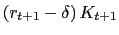
we can solve for the capital tax rate,
(90)
As long as
and
, which
holds as long as , the limiting capital income tax rate is
negative. The crucial difference between our model and a standard
Judd (1985) or Chamley (1986) argument is that the presence of the
terms in the
implementability constraint, arising from the trading arrangements
in the DM, drive another wedge between the Ramsey and household
FOCs on capital.
In terms of the economics, there are two reasons for the capital
subsidy. First, there is a holdup problem for investment in this
model as long as , which is analogous to (and in addition
to) the money holdup problem in the basic model; this holdup
problem causes capital to be underaccumulated relative to the
efficient capital stock. Specifically, DM sellers bear the entire
cost of investment in capital but, unless , must share part of the
surplus created from capital with DM buyers. Seller thus do not
have the socially-correct incentive to accumulate capital. Second,
the deviation from the Friedman Rule itself causes an inefficiency
in the capital stock, along with other allocation variables. The
Ramsey planner subsidizes capital income in an effort to reduce the
effects of both of these sources of inefficiency. In Figure 3, we
plot the steady-state value of the optimal capital income tax for
the case as we
vary and
.22 If , the DM shuts down and we recover the usual
result that capital income is not taxed (or subsidized) because
both of the channels just described are absent. If , capital is not a factor of
production in the DM and the holdup problem we mention above is not
present. As and
increase, the
optimal capital subsidy increases.
For our baseline parameter values, the capital income subsidies
in the range 60 to 80 percent that we find in Figure 2 are large,
but not out of line with capital subsidy rates found in other
Ramsey studies. For example, Schmitt-Grohe and Uribe (2005, Table
2) find an optimal capital subsidy rate of 44 percent in their
benchmark model featuring a host of real and nominal rigidities and
report that it can be as high as 85 percent.
Optimal policies and allocations in the price-taking version of
the model share the same characteristics as the bargaining version:
the optimal nominal interest rate is and the capital income subsidy is . The capital subsidy is lower
with price-taking because price-taking avoids the capital holdup
(as well as money holdup) problem inherent in Nash bargaining. If
somehow the Friedman rule had been part of the Ramsey policy, then
the optimal capital income tax with price-taking in fact would have
been zero.
In Table 2, we report simulation-based moments for the Ramsey
allocations and policy variables for the three versions of our
model with capital. While we track ex-post inflation as before, we
track the ex-ante capital income tax, following the convention in
much of the optimal capital taxation literature.23 Note that, unlike in the basic model,
both and shocks affect the Ramsey
solution in the models with capital. Also, while we do not
analytically prove they are constant, the simulated values for the
labor and capital income taxes and the nominal interest rate are
essentially constant.24 As such,
we do not report the second moments for these variables.
Turning to the results, in all three versions of the model, we
find that inflation is once again very stable, with a standard
deviation of about 20 basis points at an annual rate. This is in
line with the results of Chugh (2006a) and Schmitt-Grohe and Uribe
(2005) in that they both also find that, so long as prices are
flexible, capital accumulation does little to change the volatility
of Ramsey inflation relative to a flexible-price environment
without capital. That is, the volatility of Ramsey inflation has
nothing to do with whether or not there is capital accumulation. Of
course, in our basic model without capital, inflation was already
quite stable; this result carries over unchanged. The intuition for
the optimality of inflation stability is just as in the model
without capital: the relative price between CM and DM consumption
depends on the inflation rate, and distorting this relative price
imposes welfare costs so large that the Ramsey planner largely
refrains from varying inflation despite its ability to absorb
shocks to the government budget.
We view our work and results as a first step in taking more
seriously the new class of micro-founded models of money as a
laboratory for studying policy questions. Our central findings are
that the Friedman Rule is typically not the optimal policy and that
inflation fluctuates very little over time. These findings are
opposite those of the workhorse Chari, Christiano, and Kehoe (1991)
flexible-price Ramsey model. The presence of real frictions that
give rise to valued money also provide completely different
justification for a central bank's pursuit of inflation stability
than the typically-invoked ones of nominal rigidities.
There are of course a number of ways one might want to modify
our framework. Monopoly power in goods and labor markets are
thought by many to be important realistic features. It would be
straightforward to introduce monopoly power in the centralized
market. The results of Schmitt-Grohe and Uribe (2004a) and Chugh
(2006b) suggest that inflation in such an environment would be
partly a direct tax on the money rent we identify and partly an
indirect tax on producers' and labor suppliers' rents. It may be
interesting to know quantitatively how these direct and indirect
uses of the inflation tax interact.
Once one has monopoly power in the centralized market, one could
go further in adding elements monetary policy makers often think
are important, such as sticky prices and sticky wages. However,
given our finding of optimal inflation stability (albeit around a
non-zero average inflation rate), we do not see how the results
could be very different with such features.
Pushing our first step in different directions, another
interesting issue to study may be the nature of and solution to the
time-inconsistency problem of the Ramsey policy in this sort of
environment. It is not clear how the time-consistency results of,
say, Alvarez, Kehoe, and Neumeyer (2004) or Persson, Persson, and
Svensson (2006), would extend to our environment. Neither is it
clear how the emerging results in the new dynamic public finance
literature, which places at center stage distributional concerns,
might extend to a version of our environment in which money
holdings were allowed to differ across individuals.
Recent developments in understanding the micro-foundations of
monetary exchange are sometimes viewed as simply having provided
justification for the reduced-form models of money commonly used in
practice, not least of all because they superficially end up
resembling the reduced-form models. Our results throw into question
the conclusion that they must therefore yield the same answers to
interesting questions as existing models. We think it may be
worthwhile to re-examine a number of issues in monetary policy
using this now-tractable framework.
That allocations from a monetary equilibrium should satisfy the
CM feasibility condition (39)
and the zero-lower-bound constraint (42) is obvious.
Using the household optimality conditions (27 ), (31),
and (32) along with the equilibrium
conditions, we now derive the present-value implementability
constraint the Ramsey planner must respect. Begin as usual with the
CM household flow budget constraint,
(91)
To construct the present-value implementability constraint,
begin by multiplying the flow budget constraint by
and summing from
,
(92)
We point out that, as usual in a dynamic Ramsey problem assuming
commitment to the time-zero policy, any terms that appear in
intermediate expressions are eliminated by the law of iterated
expectations because the entire implementability constraint is
conditioned on the time-zero information set, hence the
. For ease of
exposition, we therefore proceed dropping operators that would appear in
intermediate expressions as well as the operator because it is
understood to be present in all subsequent expressions.
Substitute into the second term on the left-hand-side using
expression (32) to get
(93)
(94)
The second summation on the left-hand-side cancels with the the
last summation on the right-hand-side to leave only the initial
bond position,
(95)
(96)
Next, substitute into the second term on the left-hand-side
using (31) to get
(97)
(98)
Expand the second summation on the left-hand-side to get
(99)
(100)
Cancel the second summation on the left-hand-side with the second
summation on the right-hand-side to leave only the initial money
holdings,
(101)
(102)
Using (27), we can substitute
into the first term on the right-hand-side to get
Finally, from (31), we can make the
substitution
in the third summation on the left-hand-side. Cancelling
terms and reintroducing the operator leaves us with
(106)
which is the present-value implementability (PVIC) constraint for
the Ramsey problem in the LW model. Any allocation that satisfies
this restriction, the resource constraint, and the ZLB constraint
can be supported as a monetary equilibrium; furthermore, the
allocations from any monetary equilibrium can be described by these
three conditions.
The Kuhn-Tucker conditions for the problem in Section 3 are
(107)
(108)
(109)
(110)
and
(111)
We can represent the right-hand side of the PVIC in terms of
allocations as
(112)
where
is the
steady state real bond balances and variables without subscripts
are steady state values.
With these FOCs in hand, we proceed as follows. Imposing steady
state on these conditions, we solve for the steady state values of
allocations and the multiplier . Next, given and
, the
conditions above characterize
and (39) defines . Finally, we back out
policies
from (35) and (38) statically, and inflation can be
obtained from solving (37)
dynamically.
Here, we prove a claim we make in Section 4.1. To demonstrate that the deviation
from the Friedman Rule in our basic model is not proxying for a
sales tax in the DM, we modify our basic model. We introduce a
sales tax in the DM and show that the resulting Ramsey problem does
not have a solution in which the Friedman Rule holds. Our result
here is only for the case (which is equivalent to price-taking in the
DM), just as is our Proposition 2. It is somewhat easier to work with the
price-taking version to establish this result, which is why we use
this version here.
We introduce a DM sales tax in the following way: with
price-taking in the DM, buyers, taking
as
given, turn over
units of money in each transaction. The sellers must remit
to the government in
the next CM, which, given our timing assumptions, occurs in period
.25Equivalently, we can suppose that the
government receives the revenue in the DM but waits until the next
CM to spend it. Because the assets markets are not open in the DM,
the government cannot invest this extra revenue in an
interest-bearing asset.
The government's flow budget constraint in nominal terms is
thus
(113)
in which the appears
because it is only DM sellers in period (of which there is a measure
) that turn over
sales taxes to the government. Because in equilibrium,
(that is, any DM
meeting in which a transaction occurs leads to the buyer turning
over all his cash to the seller), we may write the
period- government
budget constraint as
(114)
If we sum the CM budget constraints of all households (a measure
of whom were
buyers in period and
thus enter period with no
money; a measure
of whom were sellers and thus enter period with
; and a measure
of whom did
not trade and thus have ), we have in equilibrium
(115)
Clearly, the government budget constraint and the summation of all
the households' budget constraints yields the CM resource
constraint. In the Ramsey problem, then, we can use the resource
constraint and the summation of all households' budget constraints,
which implies the government budget constraint is satisfied.
In order to solve the Ramsey problem, first let us derive the
equilibrium conditions with this new tax instrument in place. To
keep the discussion short, we simply point out the differences from
the conditions we derive above. The CM problem summarized in
(2)-(6) is
unchanged. In the DM, from the buyer's problem (derived as in, say,
Rocheteau and Wright (2005)), we get
(116)
The seller's problem can be written as
(117)
with the first order condition
, which leads to the following expression for :
(118)
This leads to the following equilibrium condition, which replaces
(37),
(119)
It is also straightforward to show that the analog of the
Fisher-like condition (33) from our
baseline model is
(120)
which we need in order to write the ZLB constraint on the Ramsey
problem. Note that in the main text we assumed
which is
simply a normalization because is in terms of utility. Using this, we have
. Also
note that by construction .
To construct the PVIC in this version of the model, we proceed
exactly as in Appendix A.1, using (115). The resulting PVIC is given by
(121)
As usual, the Ramsey problem is to maximize the consumer's lifetime
utility subject to the resource constraint, the PVIC, and the ZLB
constraint. In the timeless solution of the Ramsey problem, which
is what we restrict attention to, the initial tax rate
is
endogenous and equal to the steady-state implied by the Ramsey first-order conditions.
The sales tax has a natural upper bound, unity, but it does not
have a natural lower bound. Denote by the lower bound of
. We think
is the
most natural case to consider.
We proceed by stating and proving two lemmas. The first lemma
shows that the Ramsey planner always chooses
for all . The second lemma shows that if
, the
ZLB cannot be binding, meaning that the Friedman Rule cannot be a
part of the Ramsey policy. Thus, we establish through these two
lemmas that the Friedman Rule cannot be part of the Ramsey policy
even in the presence of a sales tax in the DM.
Lemma 1The solution to the Ramsey problem with a DM sales tax features
.
Proof. Associating the multiplier with the PVIC and the multiplier
with the ZLB
constraint
(122)
the Ramsey first-order-conditions with respect to is
if
(123)
In any monetary equilibrium, we have
.
This means
because solves
and
the utility function is strictly increasing. Examining this first
order condition and given that the utility function is strictly
increasing and strictly concave (and realizing the multipliers
and are non-negative), the
left-hand-side is strictly negative. This means the Ramsey planner
wants to choose the smallest possible ,
.
Lemma 2If
, the
solution to the Ramsey problem with a DM sales tax cannot feature a
binding ZLB constraint.
Proof. In Proposition 1, we implicitly had
and showed
the Friedman Rule was not optimal (meaning the ZLB constraint was
not binding). Now assume
. Given
that we focus on monetary equilibria (i.e.,
), we
have
. We know from the lemma above
that
. If
, then
, which means the
ZLB constraint is slack.
This completes our argument that if we introduce a sales tax in
the DM, the Ramsey problem has no solution that includes the
Friedman rule as part of the optimal policy.
The proof is similar to the proof of Proposition 1. Here we only show how to derive
the PVIC for the bargaining version of the model. The expression
for the price-taking version follows the same steps.
Having derived the implementability constraint for the LW model
in Appendix A.1, it is
straightforward to extend it for the AWW environment. Multiplying
the consumer's CM budget constraint by
and then summing
over dates and states beginning at as above, we have
(124)
where the ellipsis indicate that the other terms are the same as
those in (92). The
manipulations following (92) proceed just as before (with, of
course, now
included inside the function ), so we present here only the derivation of the
terms in the implementability constraint arising from the inclusion
of capital.
Use the household's Euler equation for capital,
(125)
to substitute for
on
the left-hand-side of the previous expression to get
(126)
(127)
Canceling like summations leaves
(128)
Re-inserting the terms from the LW PVIC, the PVIC for the AWW model
is
(129)
which is expression (81) in the
text. Any allocation that satisfies this restriction, the resource
constraint, and the ZLB constraint can be supported as a monetary
equilibrium; furthermore, any monetary equilibrium can be described
by these three conditions.
Here we only describe the solution for the bargaining version of
the model and the price-taking version is similar. The Kuhn-Tucker
conditions for the problem in Section 6 are
(130)
(131)
(132)
(133)
(134)
and
(135)
We can represent the right-hand side of the PVIC in terms of
allocations as
(136)
With these FOCs in hand, we proceed as follows. Imposing steady
state on these conditions, we solve for the steady state values of
allocations and the multiplier . Next, given and
, the
conditions above characterize
. We back out
policies
from (67) and (70) statically. Finally capital income tax and
inflation can be solved dynamically from (71) and (69).
Alvarez, Fernando, Patrick J. Kehoe, and Pablo Andres Neumeyer,
2004, The Time Consistency of Optimal Monetary and Fiscal Policies,
Econometrica, 72, 541-567.
Aruoba, S. Boragan, Jesus Fernandez-Villaverde, and Juan F.
Rubio-Ramirez, 2006, Comparing Solution Methods for Dynamic
Equilibrium Economies, Journal of Economic Dynamics and
Control.
Aruoba, S. Boragan, Christoper J. Waller, and Randall Wright, 2006, Money and Capital, University of Maryland.
Aruoba, S. Boragan and Randall Wright, 2003, Search, Money, and
Capital: A Neoclassical Dichotomy, Journal of Money, Credit, and
Banking, 35, 1086-1105.
Atkinson, Anthony B. and Joseph E. Stiglitz, 1980, Lectures on
Public Economics, New York: McGraw Hill.
Barro, Robert J, 1979, On the Determination of the Public Debt, Journal of Political Economy, 87, 940-971.
Chamley, Christophe, 1986, The Welfare Cost of Capital Income
Taxation in a Growing Economy, Econometrica, 54, 607-622.
Chari, V.V., Lawrence Christiano, and Patrick Kehoe, 1991, Optimal Fiscal and Monetary Policy: Some Recent Results, Journal of
Money, Credit, and Banking, 23, 519-539.
Chari V. V., and Patrick J. Kehoe, 1999, Optimal Fiscal and
Monetary Policy, Handbook of Macroeconomics, John B. Taylor and
Michael Woodford, Vol. 1C, Elsevier.
Chugh, Sanjay K, 2006a, Optimal Inflation Persistence: Ramsey
Taxation with Capital and Habits, Journal of Monetary
Economics.
Chugh, Sanjay K, 2006b, Optimal Fiscal and Monetary Policy with
Sticky Wages and Sticky Prices, Review of Economic Dynamics.
Howitt, Peter, 2003, Comment On: Search, Money, and Capital: A
Neoclassical Dichotomy, Journal of Money, Credit, and Banking, 35, 1107-1110
Judd, Kenneth L, 1985, Redistributive Taxation in a Simple
Perfect Foresight Model, Journal of Public Economics, 28, 59-83.
Judd, Kenneth L, 1992, Projection Methods for Solving Aggregate
Growth Models, Journal of Economic Theory, 58, 410-452
Khan, Aubhik, Robert G. King and Alexander L. Wolman, 2003, Optimal Monetary Policy, Review of Economic Studies, 70, 825-860.
Kiyotaki, Nobuhiro and Randall Wright, 1989, On Money As a
Medium of Exchange, Journal of Political Economy, 97, 927-954.
Kiyotaki, Nobuhiro and Randall Wright, 1993, A Search-Theoretic
Approach to Monetary Economics, American Economic Review, 83, 63-77.
Kocherlakota, Narayana R, 1998, Money is Memory, Journal of
Economic Theory, 81, 232-251.
Kocherlakota, Narayana R, 2005, Optimal Monetary Policy: What We
Know and What We Don't Know, Federal Reserve Bank of Minneapolis
Quarterly Review, 29, 10-19.
Lagos, Ricardo and Randall Wright, 2005, A Unified Framework for
Monetary Theory and Policy Analysis, Journal of Political Economy, 113, 463-484.
Lucas, Robert E. Jr. and Nancy L. Stokey, 1983, Optimal Fiscal
and Monetary Policy in an Economy Without Capital, Journal of
Monetary Economics, 12, 55-93.
Persson, Mats, Torsten Persson, and Lars E. O. Svensson, 2006, Time Consistency of Fiscal and Monetary Policy: A Solution, Econometrica, 74, 193-212.
Rocheteau, Guillaume and Randall Wright, 2005, Money in Search
equilibrium, in Competitive Equilibrium, and in Competitive Search
Equilibrium, Econometrica, 73, 175-202.
Schmitt-Grohe, Stephanie and Martin Uribe, 2004a, Optimal Fiscal
and Monetary Policy Under Imperfect Competition, Journal of
Macroeconomics, 26, 183-209.
Schmitt-Grohe, Stephanie and Martin Uribe, 2004b, Optimal Fiscal
and Monetary Policy Under Sticky Prices, Journal of Economic
Theory, 114, 198-230.
Schmitt-Grohe, Stephanie and Martin Uribe, 2005, Optimal Fiscal
and Monetary Policy in a Medium-Scale Macroeconomic Model, 2005.
Siu, Henry E, 2004, Optimal Fiscal and Monetary Policy with
Sticky Prices, Journal of Monetary Economics, 51, 576-607.
Figure 1 - Ramsey Steady-State in the Basic Model
Notes : Ramsey steady-state policy and allocation as a
function of with
the ZLB constraint (solid line) and without the ZLB constraint
(dotted line).
Figure 2 - Ramsey Steady-State in the Model with Capital
Notes : Ramsey steady-state policy and allocation as a function of with the ZLB constraint (solid
line) and without the ZLB constraint (dotted
line).
Figure 3 - Ramsey Steady-State Capital Income Tax
Notes : Optimal steady-state capital income tax rate as functions of and . Buyer bargaining power fixed
at .
Table 1 - Simulation Results for the Basic Model: (a) Price-Taking / Bargaining ()
Variable
Mean
Std. Dev.
Auto corr.
Corr
Corr
Corr
-1.987
0.240
0.805
0.722
0.999
0.005
0.220
0
-
-
-
-
1.931
0
-
-
-
-
0.798
0.036
0.806
0.723
1.000
0.005
1.664
0.020
0.806
0.723
1.000
0.005
2.065
0.028
0.874
0.554
-0.167
0.985
2.263
0.040
0.840
1
0.723
0.689
0.795
0.000
0.806
0.722
0.999
0.005
Table 1 - Simulation Results for the Basic Model: (b) Bargaining ()
Variable
Mean
Std. Dev.
Auto corr.
Corr
Corr
Corr
-3.844
0.236
0.805
0.681
0.999
0.005
0.277
0
-
-
-
-
0
0
-
-
-
-
0.573
0.017
0.806
0.683
1.000
0.005
1.287
0.015
0.806
0.683
1.000
0.005
1.688
0.028
0.874
0.600
-0.166
0.985
2.024
0.038
0.844
1
0.683
0.729
1.173
0.000
0.806
0.682
1.000
0.005
Notes: Simulation-based moments. Inflation and
nominal interest rate reported in percentage points.
Table 2 - Simulation Results for the Model with Capital: (a) Bargaining ()
Variable
Mean
Std. Dev.
Auto corr.
Corr
Corr
Corr
7.141
0.203
0.714
-0.567
-0.375
-0.383
0.317
0
-
-
-
-
-0.797
0
-
-
-
-
9.761
0
-
-
-
-
0.754
0.011
0.928
0.812
0.915
0.093
1.827
0.038
0.979
0.530
0.594
0.132
0.302
0.005
0.940
0.572
0.841
-0.247
0.322
0.007
0.783
0.762
0.389
0.802
0.550
0.013
0.805
1
0.865
0.496
0.124
0.001
0.854
-0.535
-0.055
-0.952
Table 2 - Simulation Results for the Model with Capital: (b) Bargaining ()
Variable
Mean
Std. Dev.
Auto corr.
Corr
Corr
Corr
-2.387
0.192
0.712
-0.554
-0.360
-0.402
0.312
0
-
-
-
-
-0.251
0
-
-
-
-
0
0
-
-
-
-
0.293
0.004
0.884
0.856
0.969
0.070
1.625
0.035
0.978
0.552
0.595
0.157
0.296
0.005
0.939
0.584
0.847
-0.237
0.315
0.006
0.784
0.747
0.367
0.816
0.533
0.013
0.809
1
0.862
0.503
0.418
0.003
0.874
-0.184
0.229
-0.692
Table 2 - Simulation Results for the Model with Capital: (c) Price-Taking
Variable
Mean
Std. Dev.
Auto corr.
Corr
Corr
Corr
5.139
0.209
0.710
-0.553
-0.358
-0.401
0.264
0
-
-
-
-
-0.116
0
-
-
-
-
7.710
0
-
-
-
-
0.723
0.009
0.853
0.865
0.989
0.045
1.623
0.035
0.978
0.555
0.596
0.163
0.310
0.005
0.939
0.591
0.851
-0.226
0.327
0.007
0.781
0.748
0.368
0.813
0.538
0.013
0.808
1
0.862
0.503
0.123
0.001
0.852
-0.211
0.143
-0.584
Simulation-based moments. Inflation and
nominal interest rate reported in percentage points.
Footnotes
1. In a different context, one that
abstracts from public finance considerations, Rocheteau and Wright
(2005) show that a positive nominal interest rate may be optimal
because it can correct inefficiencies along the extensive margin of
bilateral trading by influencing the relative number of traders on
each side of the market. Return to
text
2. In a more general model, one can
allow a double-coincidence meeting where barter takes place. Doing
so does not change any of the properties of the current model and
we abstract from it. Return to
text
3. This result requires a small
qualification for bond holdings. There are two parts of the
argument in LW. The first part relies on the observation that
does
not appear in (5) and (6). The second part relies on the strict concavity of
or, more
specifically, the strict monotonicity of and which means the choice of
and is unique. Both parts of the
argument go through for money in our environment but only the first
part goes through for bonds. This means that in principle there
could be multiple values of that households choose, which can create a
distribution of bond holdings. Fortunately, such a distribution of
bonds holdings is not important for any of our results because
bond-holdings will not affect the bargaining problem, as we show
below. Return to text
4. This setup can be justified by
either the search framework of the original LW model or the
preference shocks setup of AWW. Return to
text
5. This functional form can be
obtained by assuming a linear production function in effort,
, and a linear
disutility of effort, ,
which is just a normalization. Inverting the production function
and substituting into the disutility function gives the cost
function
. Return to
text
6. In the CCK model, for example,
instantaneous utility is defined over cash goods, credit goods, and
labor,
,
and the PVIC takes the form
, with a
function of initial money and bonds. See Chari and Kehoe (1999, p.
1676-1686) for more discussion of optimal taxation problems in
general. Return to text
7. When we proceed to study the AWW
model in Section 5, in which the
dichotomy is broken, inflation has effects on CM variables as
well. Return to text
8. When we work with the first-order
conditions of the new Ramsey problem, we find that the solution to
the problem is not interior, as can often occur in Ramsey problems
because there is no guarantee that the problem is concave. In
particular, we find that the Ramsey planner wants to set this new
tax rate as small as possible. To confirm this result we also use
numerical methods, for some reasonable parameters, without
resorting to using the first order conditions. Our analysis show
that the solution to the Ramsey planner does not have the Friedman
rule as the optimal policy. Return to
text
9. While our algorithm allows the
ZLB to be an occasionally binding constraint, which means the
multiplier
may
have one or more kinks in it, our quantitative results indicate
that for the parameterizations we use the ZLB either always binds
or never binds. Return to text
10. We approximate these functions
using linear combinations of Chebyshev polynomials, following Judd
(1992). Results from Aruoba, Fernandez-Villaverde and Rubio-Ramirez
(2006) and AWW indicate that this approximation method is very
accurate. Return to text
11. Of course, this statement only
holds for sufficiently-small driving shocks; the business-cycle
magnitude shocks that we assume are apparently small
enough. Return to text
12. Real GDP takes into account both
CM and DM output:
. Return to
text
13. To make this point more clear,
if we shut down the technology shock, then all variables except for
will remain at
their steady state values, and will fluctuate in line with . Return to text
14. This follows from the fact that
is constant. This can be seen
easily from the first-order condition of the Ramsey planner for
. Return to text
15. From their simulation
experiments, CCK report a mean inflation rate of -0.44 percent with
a standard deviation of 19.93; Schmitt-Grohe and Uribe (2004a)
report a mean inflation rate of -3.39 percent with a standard
deviation of 7.47 percent; Siu (2004) reports a mean inflation rate
of -2.59 percent with a standard deviation of 5.08 percent; and
Chugh (2006b) reports a mean inflation rate of -4.01 percent with a
standard deviation of 6.96 percent. Each of these models is
calibrated in a slightly different way from the others, but the
general result that comes through is clear: with flexible-prices,
the Ramsey inflation rate is quite volatile. Return to text
16. We also point out that with the
assumption of full commitment on the part of the Ramsey planner,
the use of state-contingent inflation is not a manifestation of
time-inconsistent policy. The ``surprise" in surprise inflation is
due solely to the unpredictable components of government spending
and technology, and not due to a retreat on past
promises. Return to text
17. However, this result is not
robust to large shocks. In simulations not reported here, we
considered very large negative technology shocks (a standard
deviation of more than 60 percent of the average). When hit by
these large shocks, the Ramsey solution includes small deviations
from the Friedman rule. Return to
text
18. As noted above, Chugh (2006a)
shows that the presence of capital accumulation in an
otherwise-standard flexible-price Ramsey model dramatically
increases the persistence of the optimal inflation rate compared to
the baseline CCK model. The results of Schmitt-Grohe and Uribe
(2005) show that when other frictions and rigidities are considered
along with capital accumulation, this result can be
mitigated. Return to text
19. Specifically, with the CM
convening before the DM, households exit the period- CM with units of capital, which is
used in both period- DM
production and period-
CM production. Return to text
20. Only capital income net of
depreciation is taxable. Return to
text
21. The following parameters are
fixed across different version of the model :
. For
the bargaining version with , we use
, for the
bargaining version with , we use
,
and for the price-taking version we use
.
Return to text
22. The capital tax rate surface for
lower values of
is very similar. Return to text
23. The ex-ante capital income tax
is computed by dividing the expected tax payments on
by the present
market value of future capital income, which takes into account
both period- DM returns
and period- CM
returns. Return to text
24. Chari and Kehoe (1999) also find
that the ex-ante capital income tax rate is constant around its
steady-state level, although in their model the steady-state level
is zero for the usual reasons in the capital tax
literature. Return to text
25. Thus, we assume that it is the
sellers that pass along the sales tax receipts to the government;
assuming that it is buyers that remit taxes would formally lead to
the same analysis. Return to
text








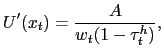
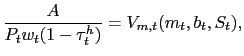
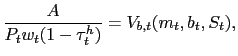


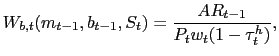


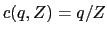
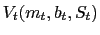
![$\displaystyle = \sigma\left\{ u\left[ q\left( m_{t}, M_{t}, S_{t}\right) \right] + \beta E_{t} W_{t+1}\left[ m_{t}- d(m_{t},M_{t},S_{t}), b_{t}, S_{t+1} \right] \right\}$](img51.gif)
![$\displaystyle + \sigma\left\{ -c\left[ q\left( M_{t},m_{t},S_{t}\right) , Z_{t}\right] + \beta E_{t} W_{t+1}\left[ m_{t} + d(M_{t},m_{t},S_{t}), b_{t}, S_{t+1} \right] \right\}$](img52.gif)

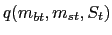


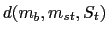
![$ [q(.), d(.)]$](img58.gif)


![$\displaystyle {\scriptsize\max_{q_{t},d_{t}}\left[ u(q_{t}) + \beta E_{t} W_{t+1}\left( m_{t}-d_{t}, b_{t},S_{t+1}\right) - \beta E_{t} W_{t+1}\left( m_{t} ,b_{t},S_{t+1}\right) \right] ^{\theta}}$](img62.gif)
![$\displaystyle \times\left[ -c(q_{t},Z_{t}) +\beta E_{t} W_{t+1}\left( \tilde{m}_{t} +d_{t},\tilde{b}_{t},S_{t+1}\right) - \beta E_{t} W_{t+1}\left( \tilde {m}_{t},\tilde{b}_{t},S_{t+1}\right) \right] ^{1-\theta}$](img63.gif)

![$\displaystyle \max_{q_{t},d_{t}} \left\{ u(q_{t}) - \beta d_{t} E_{t} \left[ \frac{A}{P_{t+1} w_{t+1} (1-\tau^{h}_{t+1})} \right] \right\} ^{\theta} \left\{ -c(q_{t}, Z_{t}) + \beta d_{t} E_{t} \left[ \frac {A}{P_{t+1} w_{t+1} (1-\tau^{h}_{t+1})}\right] \right\} ^{1-\theta}$](img65.gif)
![$ \chi_{t} \equiv E_{t} \left[ A/\{P_{t+1} w_{t+1} (1-\tau^{h} _{t+1})\} \right] $](img66.gif)


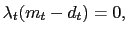


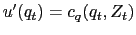


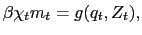



![$\displaystyle V_{t}(m_{t},b_{t},S_{t}) = \sigma\left\{ u\left[ q_{t}\left( m_{t} ,S_{t}\right) \right] -c\left[ q\left( M_{t},S_{t}\right) , Z_{t} \right] - \beta\chi_{t} m_{t} + \beta\chi_{t} M_{t} \right\} + \beta E_{t}W_{t+1}\left( m_{t},b_{t},S_{t+1}\right) .$](img82.gif)
![$\displaystyle V_{m,t}\left( m_{t},b_{t},S_{t}\right) = \sigma\left\{ u^{\prime}\left[ q_{t}\left( m_{t},S_{t}\right) \right] \frac{\partial q_{t}\left( m_{t},S_{t}\right) }{\partial m_{t}} - \beta\chi_{t} \right\} + \beta\chi_{t},$](img83.gif)

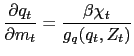
![$\displaystyle V_{m,t}\left( m_{t},b_{t},S_{t}\right) = \beta \chi_{t} \left[ \sigma\frac{u^{\prime}(q)}{g_{q}(q,Z)} + 1 - \sigma\right] .$](img86.gif)

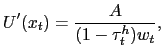
![$\displaystyle \frac{A}{P_{t}w_{t}(1-\tau_{t}^{h})} = \beta\chi_{t} \left[ \sigma\frac{u^{\prime}(q)}{g_{q}(q,Z)} + 1 - \sigma\right] ,$](img88.gif)
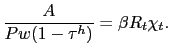
![$\displaystyle \chi_{t} = E_{t} \left[ \frac{U^{\prime}(x_{t+1})}{P_{t+1}} \right] ,$](img90.gif)
![$\displaystyle \frac{U^{\prime}(x_{t})}{P_{t}} = \beta\left[ \sigma \frac{u^{\prime}(q_{t})}{g_{q}(q_{t},Z_{t})} + 1 - \sigma\right] E_{t} \left[ \frac{U^{\prime}(x_{t+1})}{P_{t+1}}\right] ,$](img91.gif)
![$\displaystyle \frac{U^{\prime}(x_{t})}{P_{t}} = \beta R_{t} E_{t}\left[ \frac{U^{\prime}(x_{t+1})}{P_{t+1}}\right] .$](img92.gif)
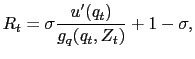
![$\displaystyle i_{t} = \sigma\left[ \frac{u^{\prime}(q_{t})}{g_{q}(q_{t} ,Z_{t})} - 1 \right] ,$](img94.gif)

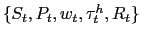

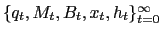



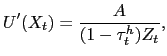
![$\displaystyle \beta M_{t} E_{t}\left[ \frac{U^{\prime}(X_{t+1} )}{P_{t+1}}\right] = g(q_{t},Z_{t}),$](img108.gif)
![$\displaystyle \frac{U^{\prime}(X_{t})}{P_{t}} = \beta\left[ \sigma\frac{u^{\prime}(q_{t})}{g_{q}(q_{t},Z_{t})} + 1 - \sigma\right] E_{t} \left[ \frac{U^{\prime}(X_{t+1})}{P_{t+1}}\right] ,$](img109.gif)
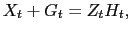

![$\displaystyle \frac{M_{t}}{P_{t}} = \frac{g(q_{t} ,Z_{t}) }{U^{\prime}(X_{t})} \left[ \sigma\frac{u^{\prime}(q_{t})} {g_{q}(q_{t},Z_{t})} + 1 - \sigma\right] .$](img112.gif)

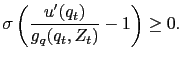
![$\displaystyle E_{0} \sum_{t=0}^{\infty} \beta^{t} \left[ U^{\prime} (X_{t}) X_{t} - A H_{t} + \sigma g(q_{t},Z_{t}) \left( \frac{u^{\prime} (q_{t})}{g_{q}(q_{t},Z_{t})} - 1\right) \right] = U^{\prime}(X_{0}) \left[ \frac{M_{-1} + R_{-1} B_{-1}}{P_{0}} \right] .$](img115.gif)




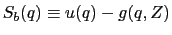

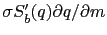
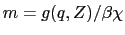
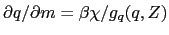


![$\displaystyle E_{0} \sum_{t=0}^{\infty} \beta^{t} \left\{ U(X_{t}) - A H_{t} + \sigma\left[ u(q_{t})-c(q_{t},Z_{t})\right] \right\}$](img133.gif)



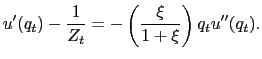

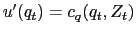


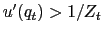
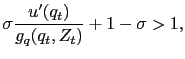


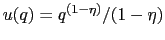

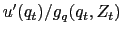

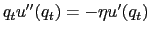
![$\displaystyle Z_t u'(q_t) = \left[ 1 - \eta \left(\dfrac{\xi}{1+\xi}\right)\right]^{-1},$](img160.gif)


![$ {\mathcal{U}}(q,X,e,h) = \sigma\left[ u(q) - e\right] + U(X) - AH$](img162.gif)


![$ {\mathcal{\tilde{U}}}(q,X,h) = \sigma\left[ u(q) - q/Z\right] + U(X) - AH$](img168.gif)


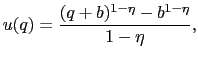


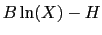




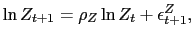
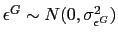
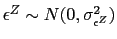


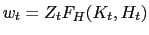
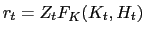

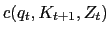


![$\displaystyle P_{t} x_{t} + P_{t} \left[ k_{t+1} - (1-\tau^{k} _{t})(r_{t} - \delta)k_{t}\right] + m_{t} + b_{t} = P_{t} w_{t} (1-\tau ^{h}_{t}) h_{t} + m_{t-1} + R_{t-1} b_{t-1},$](img216.gif)



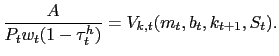

![$\displaystyle W_{k,t}(m_{t-1},b_{t-1},k_{t},S_{t})=\frac{A\left[ 1+\left( r_{t}-\delta\right) \left( 1-\tau_{t}^{k} \right) \right] }{w_{t}\left( 1-\tau_{t}^{h} \right) }.$](img224.gif)




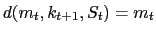
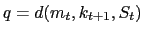
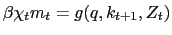


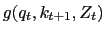

![$\displaystyle V_{k,t}\left( m_{t},b_{t},k_{t+1},S_{t}\right) =-\sigma\left[ c_{q}\left( q_{t},k_{t+1},Z_{t}\right) \frac{\partial q}{\partial k}+c_{k}\left( q_{t},k_{t+1},Z_{t}\right) \right] +\beta A E_{t}\left[ \frac{1+\left( r_{t+1}-\delta\right) \left( 1-\tau_{t+1}^{k} \right) }{w_{t+1}\left( 1-\tau_{t+1}^{h} \right) }\right]$](img236.gif)
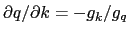

![$\displaystyle U^{\prime}(X_{t}) = \beta E_{t} \left\{ U^{\prime }(X_{t+1}) \left[ 1 + (1-\tau^{k}_{t+1})(r_{t+1} - \delta)\right] \right\} + \sigma\gamma(q_{t}, K_{t+1},Z_{t}),$](img239.gif)

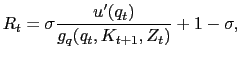





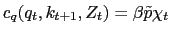

![$\displaystyle V_{k,t}(m_{t},b_{t},k_{t+1},S_{t})=\beta A E_{t}\left[ \frac{1+\left( r_{t+1}-\delta\right) \left( 1-\tau_{t+1}^{k} \right) }{w_{t+1}\left( 1-\tau_{t+1}^{h} \right) }\right] - \sigma c_{k}(q_{t},k_{t+1},Z_{t}).$](img249.gif)
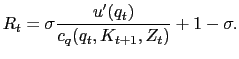

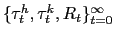
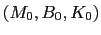

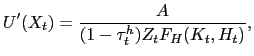
![$\displaystyle \beta M_{t} E_{t}\left[ \frac{U^{\prime}(X_{t+1} )}{P_{t+1}}\right] = g(q_{t},K_{t+1},Z_{t}),$](img256.gif)
![$\displaystyle U^{\prime}(X_{t}) = \beta E_{t} \left\{ U^{\prime }(X_{t+1})\left[ 1 + (1-\tau^{k}_{t+1})(Z_{t+1} F_{K}(K_{t+1},H_{t+1}) - \delta)\right] \right\} + \sigma\gamma(q_{t}, K_{t+1},Z_{t}),$](img257.gif)
![$\displaystyle \frac{U^{\prime}(X_{t})}{P_{t}} = \beta R_{t} E_{t} \left[ \frac{U^{\prime}(X_{t+1})}{P_{t+1}}\right]$](img258.gif)

![$\displaystyle M_{t} + B_{t} + P_{t} Z_{t} F_{H}(K_{t},H_{t}) \tau ^{h}_{t} H_{t} + P_{t} \tau^{k}_{t} [Z_{t} F_{K}(K_{t},H_{t}) - \delta]K_{t} = P_{t} G_{t} + M_{t-1} + R_{t-1}B_{t-1}$](img260.gif)
![$\displaystyle \frac{M_{t}}{P_{t}} = \frac{g(q_{t},K_{t+1},Z_{t}) }{U^{\prime}(x_{t})} \left[ \sigma\frac{u^{\prime}(q_{t})}{g_{q} (q_{t},K_{t+1},Z_{t})} + 1 - \sigma\right] ,$](img261.gif)
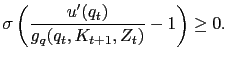
![$\displaystyle \beta M_{t} E_{t}\left[ \frac{U^{\prime}(X_{t+1} )}{P_{t+1}}\right] = q_{t} c_{q}(q_{t},K_{t+1},Z_{t}),$](img263.gif)
![$\displaystyle U^{\prime}(X_{t}) = \beta E_{t} \left\{ U^{\prime }(X_{t+1})\left[ 1 + (1-\tau^{k}_{t+1})(Z_{t+1} F_{K}(K_{t+1},H_{t+1}) - \delta)\right] \right\} - \sigma c_{k}(q_{t}, K_{t+1},Z_{t}),$](img264.gif)
![$\displaystyle \frac{M_{t}}{P_{t}} = \frac{q_{t} c_{q}(q_{t} ,K_{t+1},Z_{t}) }{U^{\prime}(X_{t})} \left[ \sigma\frac{u^{\prime}(q_{t} )}{c_{q}(q_{t},K_{t+1},Z_{t})} + 1 - \sigma\right] ,$](img265.gif)
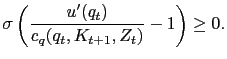
![$\displaystyle {\small E_{0} \sum_{t=0}^{\infty} \beta^{t} \left[ U^{\prime}(X_{t}) X_{t} - A H_{t} + \sigma g(q_{t}, K_{t+1},Z_{t}) \left( \frac{u^{\prime}(q_{t})}{g_{q}(q_{t}, K_{t+1},Z_{t})} - 1\right) + \sigma\gamma(q_{t}, K_{t+1},Z_{t}) K_{t+1} \right] = U^{\prime}(X_{0}) A_{0}.}$](img267.gif)
![$\displaystyle {\small E_{0} \sum_{t=0}^{\infty} \beta^{t} \left[ U^{\prime}(X_{t}) X_{t} - A H_{t} + \sigma q_{t} c_{q}(q_{t}, K_{t+1},Z_{t}) \left( \frac{u^{\prime}(q_{t})}{c_{q}(q_{t}, K_{t+1},Z_{t})} - 1\right) - \sigma c_{k}(q_{t}, K_{t+1},Z_{t}) K_{t+1} \right] = U^{\prime}(X_{0}) A_{0}.}$](img268.gif)


![$\displaystyle A_{0} = \frac{M_{-1} + R_{-1}B_{-1}}{P_{0}} + \left[ 1 + (1-\tau^{k} _{0})(Z_{0} F_{K}(K_{0},H_{0}) - \delta)\right] K_{0}.$](img271.gif)

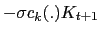
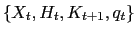
![$\displaystyle E_{0} \sum_{t=0}^{\infty} \beta^{t} \left\{ U(X_{t}) - A H_{t} + \sigma\left[ u(q_{t}) - c(q_{t}, K_{t+1},Z_{t})\right] \right\}$](img275.gif)
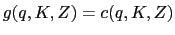
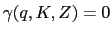
![$\displaystyle u' - c_q = -\left(\frac{\xi}{1+\xi}\right) c \left[\frac{u'' c_q - u'c_{qq}}{[c_q]^2}\right].$](img278.gif)


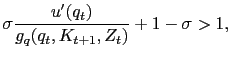

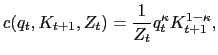

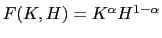


![$\displaystyle -\sigma c_{k} - \rho+ \beta\rho\left[ F_{k} + 1 - \delta\right] -\sigma\xi c_{k} = 0.$](img296.gif)


![$\displaystyle - 1 + \beta\left[ 1 + (1-\tau^{k})(F_{K} - \delta)\right] = 0$](img300.gif)
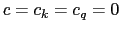
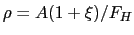
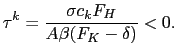










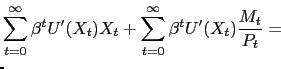

![$\displaystyle \lefteqn{\sum_{t=0}^{\infty} \beta^{t} U'(X_{t}) X_{t} + \sum_{t=0}^{\infty} \beta^{t+1} U'(x_{t+1}) \frac{M_{t}}{P_{t+1}} \left[ \sigma\frac{u'(q_{t} )}{g'(q_{t})} + 1 - \sigma\right] = }$](img325.gif)
![$\displaystyle \lefteqn{\sum_{t=0}^{\infty} \beta^{t} U'(X_{t}) X_{t} + \sum_{t=0}^{\infty} \beta^{t+1} U'(x_{t+1}) \frac{M_{t}}{P_{t+1}} + \sigma\sum_{t=0}^{\infty} \beta^{t+1} U'(x_{t+1}) \frac{M_{t}}{P_{t+1}} \left[ \frac{u'(q_{t} )}{g'(q_{t})} -1 \right] }$](img326.gif)

![$\displaystyle \lefteqn{\sum_{t=0}^{\infty} \beta^{t} U'(X_{t}) X_{t} + \sigma\sum _{t=0}^{\infty} \beta^{t+1} U'(x_{t+1}) \frac{M_{t}}{P_{t+1}} \left[ \frac{u'(q_{t})}{g'(q_{t})} -1 \right] }$](img328.gif)
![$\displaystyle = \sum_{t=0}^{\infty} \beta^{t} U^{\prime}(X_{t}) (1-\tau^{h}_{t})w_{t} H_{t} + U^{\prime}(x_{0}) \left[ \frac{M_{-1} + R_{-1}B_{-1}}{P_{0}}\right] .$](img329.gif)
![$\displaystyle \sum_{t=0}^{\infty} \beta^{t} U^{\prime}(X_{t}) X_{t} - \sum_{t=0}^{\infty} \beta^{t} A H_{t} + \sigma\sum_{t=0}^{\infty} \beta^{t+1} U^{\prime}(x_{t+1}) \frac{M_{t}}{P_{t+1}} \left[ \frac{u^{\prime}(q_{t})}{g_{q}(q_{t},Z_{t})} -1 \right] = U^{\prime}(x_{0}) \left[ \frac{M_{-1} + R_{-1}B_{-1}}{P_{0} }\right] .$](img330.gif)
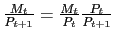

![$\displaystyle \sum_{t=0}^{\infty} \beta^{t} U^{\prime}(X_{t}) X_{t} - \sum_{t=0}^{\infty} \beta^{t} A H_{t} + \sigma\sum_{t=0}^{\infty} \beta^{t+1} \frac{U^{\prime }(x_{t+1})}{P_{t+1}} \frac{P_{t}}{U^{\prime}(X_{t})} g(q_{t},Z_{t}) \left[ \sigma\frac{u^{\prime}(q_{t})}{g_{q}(q_{t},Z_{t})} + 1 - \sigma\right] \left[ \frac{u^{\prime}(q_{t})}{g_{q}(q_{t},Z_{t})} -1 \right]$](img333.gif)
![$\displaystyle = U^{\prime}(x_{0}) \left[ \frac{M_{-1} + R_{-1}B_{-1}}{P_{0}}\right] . $](img334.gif)
![$ \beta E_{t} \left[ \frac{U^{\prime}(x_{t+1})}{P_{t+1}}\right] = \frac{U^{\prime}(X_{t} )}{P_{t}} \left[ \sigma\frac{u^{\prime}(q_{t})}{g_{q}(q_{t},Z_{t})} + 1 - \sigma\right] ^{-1}$](img335.gif)
![$\displaystyle E_{0} \sum_{t=0}^{\infty} \beta^{t} \left[ U^{\prime}(X_{t}) X_{t} - A H_{t} + \sigma g(q_{t},Z_{t}) \left( \frac{u^{\prime}(q_{t})}{g_{q}(q_{t},Z_{t})} - 1\right) \right] = U^{\prime}(x_{0}) \left[ \frac{M_{-1} + R_{-1} B_{-1} }{P_{0}} \right] ,$](img336.gif)
![$\displaystyle \left[ u^{\prime}(q_{t}) - c_{q}(q_{t},Z_{t})\right]$](img337.gif)
![$\displaystyle + \xi\left[ g_{q}(q_{t},Z_{t})\left( \dfrac{u^{\prime}(q_{t})} {g_{q}(q_{t},Z_{t})} - 1\right) + g(q_{t},Z_{t})\left( \dfrac{u^{\prime \prime}(q_{t})g_{q}(q_{t},Z_{t}) - u^{\prime}(q_{t}) g_{qq}(q_{t},Z_{t} )}{[g_{q}(q_{t},Z_{t})]^{2}} \right) \right]$](img338.gif)
![$\displaystyle +\iota_{t} \left[ \dfrac{u^{\prime\prime}(q_{t})g_{q}(q_{t},Z_{t} )-u^{\prime}(q_{t})g_{q}q(q_{t},Z_{t})}{g_{q}(q_{t},Z_{t})^{2}} \right] = 0,$](img339.gif)
![$\displaystyle U^{\prime}(X_{t})-\dfrac{A}{Z_{t}}+\xi\left[ U^{\prime\prime}(X_{t} )X_{t}+U^{\prime}(X_{t})-\dfrac{A}{Z_{t}} \right] = 0,$](img340.gif)
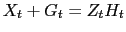
![$\displaystyle E_{0} \sum_{t=0}^{\infty} \beta^{t} \left[ U^{\prime}(X_{t}) X_{t} - A H_{t} + \sigma g(q_{t},Z_{t}) \left( \dfrac{u^{\prime}(q_{t})}{g_{q} (q_{t},Z_{t})} - 1\right) \right] = U^{\prime}(x_{0}) \left[ \dfrac{M_{-1} + R_{-1} B_{-1}}{P_{0}} \right]$](img342.gif)
![$\displaystyle \iota_{t} \left[ \dfrac{u^{\prime}(q_{t})}{g_{q}(q_{t},Z_{t})} - 1 \right] = 0,$](img343.gif) and
and 
![$\displaystyle U^{\prime}(X) \left[ \dfrac{g(q,1)}{\beta U^{\prime}(X)} + \dfrac {\mathcal{B}}{\beta} \right]$](img345.gif)




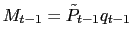

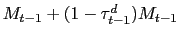







![$\displaystyle \frac{U^{\prime}(X_{t})}{P_{t}} = \beta\left[ \sigma\frac{(1-\tau^{d} _{t})u^{\prime}(q_{t})}{c_{q}(q_{t},Z_{t})} + 1 - \sigma\right] E_{t} \left[ \frac{U^{\prime}(X_{t+1})}{P_{t+1}}\right] .$](img365.gif)
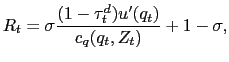

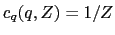

![$\displaystyle E_{0} \sum_{t=0}^{\infty} \beta^{t} \left[ U^{\prime}(X_{t}) X_{t} - A H_{t} + \sigma q_{t} \left[ Z_{t}(1-\tau^{d}_{t})u^{\prime}(q_{t}) - 1\right] + \sigma\tau_{t}^{d} q_{t} \right] = U^{\prime}(x_{0}) \left[ \frac{M_{-1} + R_{-1} B_{-1}}{P_{0}} \right] - \frac{\sigma\tau_{0}^{d} q_{0}}{\beta}.$](img370.gif)


![$\displaystyle \sigma \left [Z_t(1-\tau^d_t)u'(q_t) - 1\right] \geq 0,$](img379.gif)

![$\displaystyle \xi \sigma q_{t}\left[ - Z_t u^{\prime }\left( q_{t}\right) +1\right] -\sigma Z_t \iota _{t}u^{\prime }\left( q_{t}\right) \leq 0, = 0$](img381.gif) if
if 
![$ q_t \in (0,q^*_t]$](img383.gif)
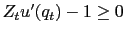

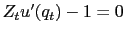


![$ [(1-\tau_L) Z_t u'(q_t) - 1] > 0$](img393.gif)

![$\displaystyle E_{0} ... + \sum_{t=0}^{\infty} \beta^{t} U^{\prime}(X_{t}) K_{t+1} = \sum_{t=0}^{\infty} \beta^{t} U^{\prime}(X_{t}) \left[ 1 + (1-\tau^{k} _{t})(F_{K}(K_{t},H_{t}) - \delta)\right] K_{t} + ...$](img395.gif)

![$\displaystyle U^{\prime}(X_{t}) = \beta U^{\prime}(X_{t+1}) \left[ 1 + (1-\tau^{k} _{t+1})(F_{K}(K_{t+1},H_{t+1}) - \delta)\right] + \sigma\gamma(q_{t}, K_{t+1}),$](img397.gif)

![$\displaystyle \lefteqn{... + \sum_{t=0}^{\infty} \beta^{t+1} U'(X_{t+1}) \left[ 1 + (1-\tau^{k}_{t+1})(F_{K}(K_{t+1},H_{t+1}) - \delta)\right] K_{t+1} }$](img399.gif)
![$\displaystyle +- \sum_{t=0}^{\infty} \beta^{t} \sigma\gamma(q_{t}, K_{t+1}) K_{t+1} = \sum_{t=0}^{\infty} \beta^{t} U^{\prime}(X_{t}) \left[ 1 + (1-\tau^{k} _{t})(F_{K}(K_{t},H_{t}) - \delta)\right] K_{t} + ...$](img400.gif)
![$\displaystyle ... + \sum_{t=0}^{\infty} \beta^{t} \sigma\gamma(q_{t}, K_{t+1}) K_{t+1} = U^{\prime}(X_{0}) \left[ 1 + (1-\tau^{k}_{0})(F_{K}(K_{0},H_{0}) - \delta)\right] K_{0} + ...$](img401.gif)
![$\displaystyle \lefteqn{E_{0} \sum_{t=0}^{\infty} \beta^{t} \left[ U^{\prime}(X_{t}) X_{t} - A H_{t} + \sigma g(q_{t},K_{t+1}) \left( \frac{u^{\prime}(q_{t})}{g_{q} (q_{t},K_{t+1})} - 1\right) + \sigma\gamma(q_{t},K_{t+1}) K_{t+1} \right] }$](img402.gif)
![$\displaystyle = U^{\prime}(x_{0}) \left[ \frac{M_{-1} + R_{-1} B_{-1}}{P_{0}} + \left[ 1 + (1-\tau^{k}_{0})(F_{K}(K_{0},H_{0}) - \delta)\right] K_{0} \right] ,$](img403.gif)
![$\displaystyle \left[ u^{\prime}(q_{t}) - c_{q}(q_{t},K_{t+1},Z_{t})\right] + \xi\left[ g_{q}(q_{t},K_{t+1},Z_{t})\left( \dfrac{u^{\prime}(q_{t})}{g_{q} (q_{t},K_{t+1},Z_{t})} - 1\right) \right]$](img404.gif)
![$\displaystyle + \xi\left[ g(q_{t},K_{t+1},Z_{t})\left( \dfrac{u^{\prime\prime} (q_{t})g_{q}(q_{t},K_{t+1},Z_{t}) - u^{\prime}(q_{t}) g_{qq}(q_{t} ,K_{t+1},Z_{t})}{[g_{q}(q_{t},K_{t+1},Z_{t})]^{2}} \right) + \gamma_{q} (q_{t},K_{t+1},Z_{t})K_{t+1}\right]$](img405.gif)
![$\displaystyle +\iota_{t} \left[ \dfrac{u^{\prime\prime}(q_{t})g_{q}(q_{t},K_{t+1} ,Z_{t})-u^{\prime}(q_{t})g_{qq}(q_{t},K_{t+1},Z_{t})}{g_{q}(q_{t} ,K_{t+1},Z_{t})^{2}} \right] = 0,$](img406.gif)
![$\displaystyle U^{\prime}(X_{t})-\dfrac{A(1+\xi)}{Z_{t} F_{H}(K_{t},H_{t})}+\xi\left[ U^{\prime\prime}(X_{t})X_{t}+U^{\prime}(X_{t})\right] = 0,$](img407.gif)
![$\displaystyle - \sigma c_{k}(q_{t},K_{t+1},Z_{t}) - \dfrac{A(1+\xi)}{Z_{t} F_{H} (K_{t},H_{t}} + \beta E_{t} \left\{ \dfrac{A(1+\xi)}{Z_{t+1} F_{H} (K_{t+1},H_{t+1})} \left[ Z_{t+1} F_{K}(K_{t+1},H_{t+1}) + 1 - \delta\right] \right\}$](img408.gif)



![$\displaystyle E_{0} \sum_{t=0}^{\infty} \beta^{t} \left[ U^{\prime}(X_{t}) X_{t} - A H_{t} + \sigma g(q_{t},K_{t+1}) \left( \dfrac{u^{\prime}(q_{t})}{g_{q} (q_{t},K_{t+1})} - 1\right) - \sigma\gamma(q_{t},K_{t+1}) K_{t+1} \right]$](img412.gif)
![$\displaystyle = U^{\prime}(x_{0}) \left[ \dfrac{M_{-1} + R_{-1} B_{-1}}{P_{0}} + \left[ 1 + (1-\tau^{k}_{0})(F_{K}(K_{0},H_{0}) - \delta)\right] K_{0} \right] ,$](img413.gif)
![$\displaystyle \iota_{t} \sigma\left[ \dfrac{u^{\prime}(q_{t})}{g_{q}(q_{t},K_{t+1} ,Z_{t})} - 1 \right] = 0,$](img414.gif) and
and ![$\displaystyle U^{\prime}(X) \left[ \dfrac{g(q,1}{\beta U^{\prime}(X)} + \dfrac{\mathcal{B} }{\beta} \right] + \dfrac{U(X)}{\beta} K \left[ 1 - \sigma\dfrac {\gamma(q,K,1)}{U^{\prime}(X)} \right]$](img415.gif)
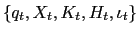
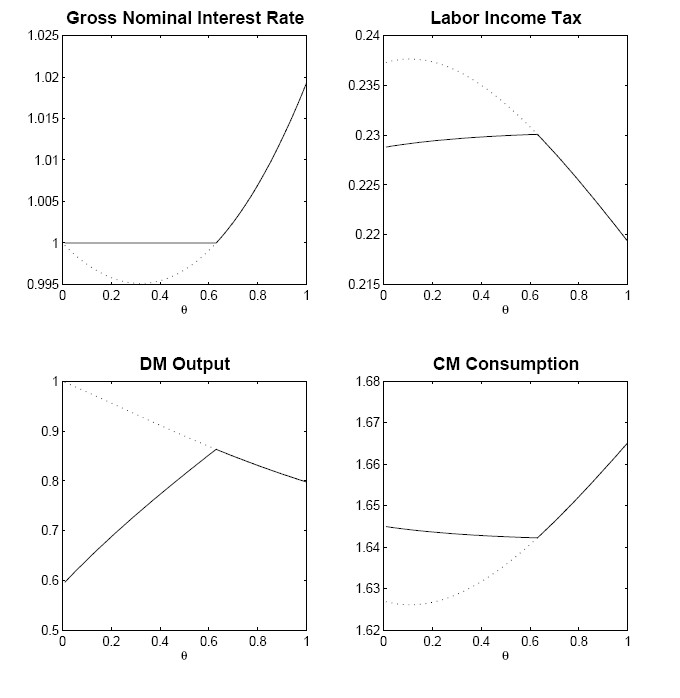
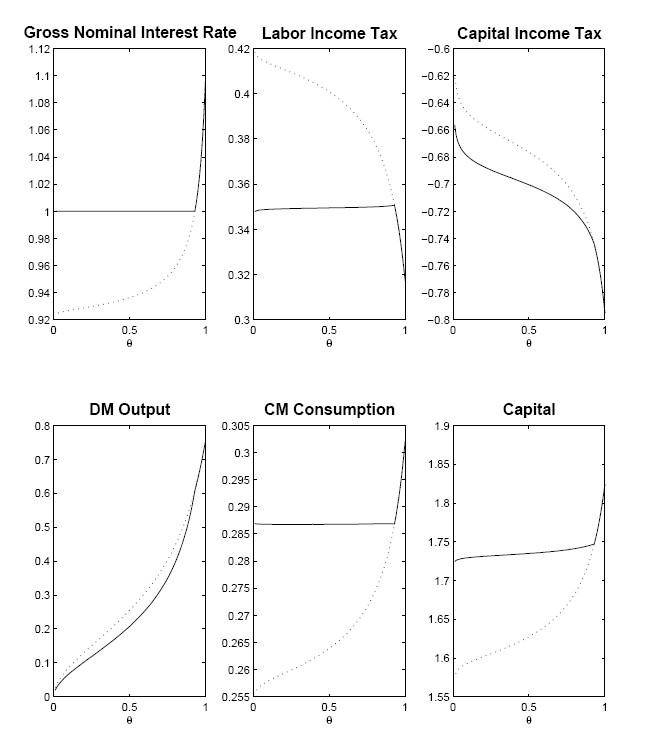
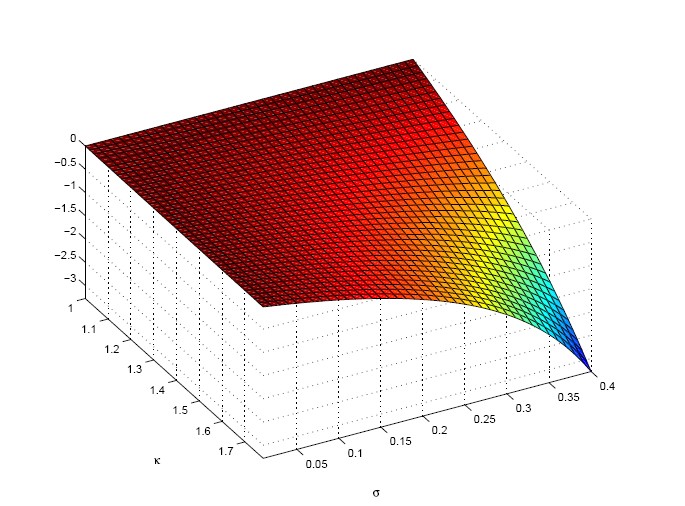


![$ \sum_{t=0}^{\infty} \beta^{t} \left[ u_{1t}c_{1t} + u_{2t} c_{2t} + u_{lt} l_{t}\right] = A_{0} $](img120.gif)