
Modeling Earnings Dynamics+
Keywords: Earnings dynamics, income shocks, wage growth, job mobility, indirect inference
Abstract:
1 Introduction
In this paper we build and estimate a simultaneous model of earnings. The model consists of equations for transitions into and out of employment, an equation for job to job mobility, a wage equation, an hours equation, and an earnings equation. The model features both observed and unobserved permanent heterogeneity, job specific wage and hours components, a persistent component that affects the wage of a worker in all jobs, state dependence in employment and job mobility, tenure and experience effects, and measurement error.
We have three main goals. The first is to advance the literature in labor economics on how employment, hours, wages, and earnings are determined over a career. We examine the effects of education, race, experience, job tenure and unobserved heterogeneity, employment shocks, shocks to general skills, and draws of new job opportunities offering different hours and wages. We trace out the response of wages, hours, and earnings to the various shocks and determine the channels through which they operate. Our analysis has implications for a number of long-standing questions in labor economics. For example, we provide estimates of the relative importance of general skill accumulation, job shopping, and job tenure for career wage growth and quantify the specific channels through which an exogenous employment shock affects the path of wage rates, hours, and earnings. We study the effects of shocks on the future variance of earnings changes as well as on the average path.
Our second goal is to provide a comprehensive account of what causes inequality in earnings at a point in time and over the lifetime. We measure the contribution of each of the various shocks, permanent unobserved heterogeneity, and education to the variance in earnings, wages, and hours over the course of a career.
Our third goal is to provide a richer model of earnings for use in studies of consumption and saving as well as in dynamic stochastic general-equilibrium models that are a cornerstone of modern macroeconomics and public finance. Such models have been used to study the distribution of wealth, the costs of business cycles, asset pricing, and other important questions.1 The quantitative implications of the calibrated theoretical models used in these lines of research depend on certain key features of the earnings process, such as the degree of earnings uncertainty and the persistence of earnings innovations.2
Almost all of the existing structural studies base their modeling and calibration choices for the earnings process on the large empirical literature on univariate statistical models.3 Much has been learned about the statistical properties of career earnings from this work. However, with only one indicator, univariate models, no matter how richly specified, cannot identify the various sources of earnings fluctuations, their relative importance, their dynamic behavior, or the economics underlying how labor market outcomes are determined. Without such information, it is difficult to think about the potential welfare consequences of specific sources of variation or of policies such as unemployment insurance, employment regulations, wage subsidies, or earned income tax credits that insure against particular types of shocks to income. Furthermore, the innovations in the univariate representation of a multivariate time series process may be aggregates of current and past shocks in the multivariate representation. This will lead to mistakes in characterizing what the surprises to the agent are even under the assumption that the agent's information set is the same as the econometrician's.
Only a few studies of earnings dynamics have considered multivariate models. These include Abowd and Card's (1987, 1989) analyses of hours and earnings, and Altonji, Martins, and Siow's (2002) second order vector moving average model of the first difference in family income, earnings, hours, wages, and unemployment. Altonji, Martins and Siow's use of their model to study consumption and labor supply behavior and decompose the variance of innovations in the marginal utility of income into various sources is not entirely successful, but it does illustrate the potential that a multivariate model of the income process provides. The models that we consider, in contrast to those mentioned above, incorporate discrete events such as job changes, employment loss, interactions between job changes and wages, and effects of these discrete events on the variance of wage and hours shocks.4
There are two distinct paths that one might take in formulating a multivariate model of earnings. The first approach is the development of a statistical model of the process with little attention to an underlying theory of household decisions and constraints. This approach is in the spirit of the literature on univariate earnings processes, but the absence of theory limits what one can learn about how earnings are determined. The second approach is to develop a model that is based on lifetime utility maximization. Grounding the model of the income process in a utility maximization framework provides a foundation for using the results to analyze policies when earnings are partially endogenous. The main disadvantage is the difficulty of specifying and estimating a model that incorporates labor supply choices, job search decisions, hours constraints, voluntary separations, and involuntary job changes. Indeed, we do not know of any papers that have studied work hours and employment using a lifecycle utility maximization model that incorporates job specific hours constraints, let alone job mobility decisions.5 Estimation of a structural model that is as rich as the one that we work with would require solving an intertemporal model of job search, labor supply (in the presence of hours constraints), and savings as part of the estimation strategy and is probably out of reach at the present time from a computational point of view. Low, Meghir, and Pistaferri (2008) take a major step in this direction by studying earnings risk and social insurance in the context of an intertemporal model of consumption, employment participation, wages, and mobility. They work with a simpler model of the earnings process than we do, but are able to measure welfare costs of the risk associated with innovations in the persistent wage component, an employer specific wage component, and job loss and unemployment. We view our study as complementary to theirs.
Although our model falls short of a fully specified behavior model, the equations can be viewed as approximations to the decision rules relating choices to state variables that would arise in a structural model based on lifetime utility maximization. The parameters of the rules depend on an underlying set of "deep" parameters that characterize consumption preferences, job search technology, etc. The class of models that we consider is rich enough to address a number of core behavior questions in labor economics, but tractable enough (at least the simpler versions) to be used in place of univariate income models that dominate the literature on savings, portfolio choice, etc. Furthermore, it provides a natural path along which to extend the analysis to include other important economic risks that individuals face, including changes in family structure through marriage, divorce, and the death of a spouse.
We estimate the model using data on male household heads from the Panel Study of Income Dynamics. Given the presence of interactions among discrete and continuous variables, unobserved heterogeneity and state dependence in multiple equations, measurement error, and a highly unbalanced sample, conventional maximum likelihood and method of moments approaches are not feasible. For this reason, we use indirect inference (I-I), which is one of a family of simulation based approaches to estimation that involve comparing the distribution of artificial data generated from the structural model at a given set of parameter values to features of the actual data.6 A complication arises in our case because our model includes discrete as well as continuous variables. With discrete variables, the simulated values of moments of the artificial data are not continuous in model parameters, which makes gradient based numerical optimization methods problematic. Given our model size, derivative-free methods are also unattractive. Consequently, we use a smoothed version of the procedure suggested by Keane and Smith (2003). Estimation of our model is not straightforward, and a secondary contribution of our research is to explore the feasibility and performance of I-I in large models with a mix of discrete and continuous variables.7
There are too many results to concisely summarize, but a few deserve emphasis. First, education, race, and the two forms of unobserved permanent heterogeneity play an important role in employment transitions and job changes. Second, in keeping with a large literature on the labor supply of male household heads, wages have only a small (negative) effect on employment and on annual work hours. Third, even after accounting for unobserved individual heterogeneity and job specific heterogeneity, we find a strong negative tenure effect on job mobility. Fourth, job changes are induced by high outside offers and deterred by the job specific wage component of the current job.
Fifth, unemployment at the survey date is associated with a large decline of .62 log points in annual earnings. About 60 percent of the reduction is due to work hours, which recover almost completely after one year. The other 40 percent is due to a decline of .25 in the log hourly wage rate. Lost tenure and a drop in the job-specific wage component contribute .064 and .027, respectively, to the wage reduction. The wage recovers by about .10 after 1 period and more slowly after that.
Sixth, wages do not contain a random walk component but are highly persistent. The persistence is the combined effect of permanent heterogeneity, the job specific wage component, and strong persistence in a stochastic component representing the value of the worker's general skills.
Seventh, shocks leading to unemployment or to job changes have large effects on the variance as well as the mean of earnings changes. Eighth, job shopping, the accumulation of tenure, and the growth in general skills account for log wage increases of .111, .122, and .580, respectively, over the first thirty years in the labor market.
Finally, job mobility and unemployment play a key role in the variance of career earnings. Job specific hours and wage components, unemployment shocks, and job shocks together account for 36.7%, 48.2%, and 46.8% of the variance in lifetime earnings, wages, and hours, respectively. Job specific wage shocks are more important than job specific hours shocks for earnings. Job specific wage shocks dominate for wages, with employment shocks also playing a substantial role. For hours, job specific hours shocks dominate. Education accounts for about 1/3 of the variance in lifetime earnings and wages but makes little difference for hours. In our full sample, unobserved permanent heterogeneity accounts for about 11% of the variance in earnings and about 46% of the variance of hours but matters little for wages, although this breakdown is somewhat sensitive to the model and sample used.
The paper continues in section 2, where we present the earnings model. In section 3 we discuss the data, which are drawn from the Panel Study of Income Dynamics (PSID) and in section 4 we discuss estimation. We present the results in Section 5, beginning with a discussion of the parameter estimates and then turning to an analysis of the fit of the model, impulse response functions to various shocks, and variance decompositions. In Section 6, we briefly discuss results for alternative samples, including whites by education level. In the final section we summarize our main findings and provide a research agenda.
2 Models of Earnings Dynamics
The main features of Model A, our main specification, are as follows. Labor market transitions, wages, and hours depend on three exogenous variables--race, education, and potential experience--as well as on two permanent unobserved heterogeneity components. The unobserved heterogeneity components can be labelled, loosely speaking, "innate ability" and "propensity to move". A typical worker enters the labor market after leaving school and receives initial draws of an employment status shock that determines whether the worker is employed or unemployed and an autoregressive wage component capturing part of "general productivity" that has the same value in all jobs. The worker also receives initial draws of a job-specific wage component and a job-specific hours component. There is state dependence in both employment and job-to-job transitions. In each period an unemployed worker receives an unemployment transition shock and an employed worker receives an employment transition shock. If the worker remains employed from one period to the next, then whether the worker changes jobs depends on the draw of the job-specific wage component for the new job, the current job-specific wage component, potential experience, job seniority, the two permanent heterogeneity terms and an i.i.d. shock. A typical worker's wage depends on one of the heterogeneity terms (ability), the autoregressive general-productivity component, the job-specific wage component, potential experience, and seniority. Unemployment spells have a negative effect on the autoregressive general-productivity component, and workers draw new job-specific wage and hours components when they leave unemployment. Annual hours depend on employment status, the heterogeneity terms, the wage, and a job-specific hours component that is identical across jobs. Finally, earnings are determined by wages and hours.
We work with several variants of Model A as well as with a second model, which we refer to as Model B. Model B does not include job-specific wage or hours components. However, it includes an autoregressive wage component which allows both the current wage to depend on the past wage and the variance of wage shocks to depend on whether the individual is continuing an existing job. In the next two subsections, we define notation and list the equations of Model A and then discuss the model. We then turn to Model B.
2.1 Model A.
A word about notation first. We control for economy wide effects using year dummies, but leave them implicit in most of the analysis. The subscript  which we sometimes suppress, refers to
the individual,
which we sometimes suppress, refers to
the individual,  is potential years of labor market experience of
  for a
particular observation. We sometimes refer to it as "time" and usually suppress the subscript. The subscript
for a
particular observation. We sometimes refer to it as "time" and usually suppress the subscript. The subscript  refers to the job that holds at
  The notation
 makes explicit the fact that individuals may change jobs. In particular,
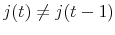 if experiences a job change without being unemployed at either
 or
or  or if is employed at but was unemployed at . The
  parameters refer to intercepts and to slope coefficients. For each intercept and slope parameter the superscripts identify the dependent variable. The
subscripts of slope parameters identify the explanatory variable. We use
parameters refer to intercepts and to slope coefficients. For each intercept and slope parameter the superscripts identify the dependent variable. The
subscripts of slope parameters identify the explanatory variable. We use  to denote coefficients on the fixed person specific unobserved heterogeneity components
  and
and
 the job match heterogeneity wage component
 and the job specific hours component
 . The superscripts for the parameters denote the dependent
variable and the subscripts
. The superscripts for the parameters denote the dependent
variable and the subscripts  and
and  identify the heterogeneity component. We
use
identify the heterogeneity component. We
use  with appropriate subscripts to denote autoregression coefficients. The
 are iid
 random variables where the superscripts
  correspond to the
dependent variables.
correspond to the
dependent variables.
The equations of Model A are as follows.
Employment to Employment Transition (EE)
| (1) |  |
![\displaystyle +\gamma _{ED}^{EE}\min (ED_{i,t-1},9)+\delta _{\mu }^{EE}\mu _{i}+\delta _{\eta }^{EE}\eta _{i}+\varepsilon _{it}^{EE}>0]](img28.gif) given given  |
where  is an employment dummy,
  is an indicator function,
 is lagged employment duration and is determined recursively by
 , and
, and
 is what the wage would be in if the individual were to
continue employment in the job held at .
is what the wage would be in if the individual were to
continue employment in the job held at .
Unemployment to Employment Transition (UE):
| (2) |  |
![\displaystyle +\delta _{\mu }^{UE}\mu _{i}+\delta _{\eta }^{UE}\eta _{i}+\varepsilon _{it}^{UE}>0]](img36.gif) given given  |
where
 is the number of years unemployed at the survey date and

Job Change While Employed (JC):

![\displaystyle +\delta _{\upsilon ^{\prime }j^{\prime }(t)}\upsilon _{i,j^{\prime }(t)}^{\prime }+\delta _{\upsilon j(t-1)}\upsilon _{i,j(t-1)}+\delta _{\mu }^{JC}\mu _{i}+\delta _{\eta }^{JC}\eta _{i}+\varepsilon _{it}^{JC}>0]\cdot E_{it}\cdot E_{i,t-1}](img41.gif)
where
 is a job specific error component,
 is a draw of the job specific component for an alternative job
 in , and
 is employer tenure at the previous survey date, which evolves according to
 |
Log Wages:



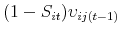






where
 is the " latent" wage, which we define below,
  is a vector
of exogenous variables including ,
is a vector
of exogenous variables including ,  and
and 
 is a fourth order polynomial in
  ,
,
 is the job match specific wage component,
 is an autoregressive component of the latent wage,
 is a job separation indicator that equals 1 if
  is 1 or if the individual was unemployed in and employed in The variable
  is the actual wage rate, which we define as 0 for persons who are unemployed.
Log Annual Work Hours of the Head of Household

where
is a job match specific hours component.
Log earnings
| (10) |  |
 |
 |
 |
|
 |
Error Components and Initial Conditions:
The fixed person specific error components and  are
are
 ,
,  across , independent of each other, and independent of all transitory shocks and measurement errors. We parameterize the errors of the various equations so that may be thought of as the fixed unobserved heterogeneity component of wages (or "innate ability"). We also allow to influence
 , , and
  . The factor is assumed to have no influence
on wages. One may think of it as a factor that is related to labor supply and to job and employment mobility preferences (or "propensity to move"). We impose the sign normalizations
. The factor is assumed to have no influence
on wages. One may think of it as a factor that is related to labor supply and to job and employment mobility preferences (or "propensity to move"). We impose the sign normalizations
 and
and
 .
.
The job match hours component
and the innovation
 in
are
in
are
 and
and
 , respectively. The shocks
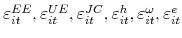 are
, where
are
, where
 and
and  They are iid across and and independent from one another and all measurement error components defined below.
The initial conditions are
 |
![\displaystyle E_{i1}=I[b_{0g}+\delta _{\mu }^{EE}\mu _{i}+\delta _{\eta }^{EE}\eta _{i}+\varepsilon _{i1}^{EE}>0]](img90.gif) |
||
 |
 |
||
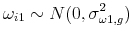 |
|||
   |
 |
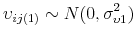 |
|
  |
|
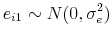 |
|
 |
 |
The intercept  of the initial employment condition and the variance of initial wages
 depend on the race-education group
  , where the groups
are defined by
, where the groups
are defined by  &
&
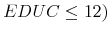 ,
,  &
& 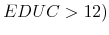 ,
, 
 &
, and & .
&
, and & .
Measurement Error and Observed Wages, Hours, and Earnings:
The observed (measured) variables are:

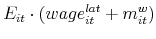

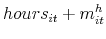


The measurement errors
 ,
,
 ,
,
 are
are
 ,
,
 , iid across and
  mutually independent, and independent from all other errors components in the model.
2.2 Discussion of Model A
The EE equation states that the latent variable that determines for previously employed workers depends on a quadratic in , a linear function of
with a ceiling at 9 years, ,  and the error
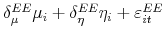 . Early on we experimented with including
 as well as
but in simulation experiments found that we had trouble distinguishing the effects of the two. Standard labor supply models imply that employment at should depend on the current wage opportunity, which we proxy with
as well as
but in simulation experiments found that we had trouble distinguishing the effects of the two. Standard labor supply models imply that employment at should depend on the current wage opportunity, which we proxy with
 . It also depends on the permanent wage heterogeneity component as well as the hours preference and mobility component .
The transition probability has the same form as  , with unemployment
duration
replacing
. Because there are relatively few multi-year unemployment spells, we exclude
, with unemployment
duration
replacing
. Because there are relatively few multi-year unemployment spells, we exclude
 restricting
 to 0 in most of the analysis. We experimented with specifications containing the lagged latent wage rate or the expected value of the period
wage but had difficulty identifying the effects of these variables, perhaps because we observe relatively few unemployment spells. We do include the wage heterogeneity component
as well as
to 0 in most of the analysis. We experimented with specifications containing the lagged latent wage rate or the expected value of the period
wage but had difficulty identifying the effects of these variables, perhaps because we observe relatively few unemployment spells. We do include the wage heterogeneity component
as well as

The equation refers to job to job changes for workers who are employed in both and . In our specification of the link between mobility and wages, the main distinction we draw is between job changes from employment and job changes that involve
unemployment. We believe that this is the most important distinction for the determination of wages and annual work hours, although it would be interesting in future work to distinguish between quits and layoffs on the basis of self reports
Standard job search and job matching models predict a negative coefficient on
 since higher values of the job match component of the current job should reduce search activity and raise the reservation wage. In the model each worker is assigned a
potential draw of
since higher values of the job match component of the current job should reduce search activity and raise the reservation wage. In the model each worker is assigned a
potential draw of
 based on (6), which we discuss momentarily. Search models predict a positive coefficient on
, but the magnitude should depend on the probability that the worker actually receives the offer. That is, the relative magnitudes of the two
coefficients should depend on offer arrival rates and need not be equal.8 We include
as well as
based on (6), which we discuss momentarily. Search models predict a positive coefficient on
, but the magnitude should depend on the probability that the worker actually receives the offer. That is, the relative magnitudes of the two
coefficients should depend on offer arrival rates and need not be equal.8 We include
as well as  because models of firm financed or jointly
financed specific capital investment suggest that it will play a role, and the decline in separation rates with
in cross section data is very strong. Little is known about how much of the association between
and
because models of firm financed or jointly
financed specific capital investment suggest that it will play a role, and the decline in separation rates with
in cross section data is very strong. Little is known about how much of the association between
and  is causal because of the difficulty of distinguishing
state dependence from the individual heterogeneity
is causal because of the difficulty of distinguishing
state dependence from the individual heterogeneity  and
and  and job match
heterogeneity
and job match
heterogeneity
 in dynamic discrete choice models, particularly when data are missing on early employment histories for most sample members. Indeed, Buchinsky et al (2008) is the only other
study that we know that accounts for both individual and job specific heterogeneity and deals with initial conditions problems when estimating the effects of
in dynamic discrete choice models, particularly when data are missing on early employment histories for most sample members. Indeed, Buchinsky et al (2008) is the only other
study that we know that accounts for both individual and job specific heterogeneity and deals with initial conditions problems when estimating the effects of  and on job changes.9
When interpreting results for and , one must keep in mind that our
employment indicator refers to the survey date. We undoubtedly miss short spells of unemployment that fall between surveys. Due to data limitations, we cannot tell whether a person has changed jobs between surveys only once or multiple times. Furthermore, if a person is employed at , unemployed for part of the year, and employed in a new job at , we would count this as a
job to job change even if, for example, the job change is due to a layoff into unemployment. A relatively simple alternative would be to make use of information on the number of weeks that the individual was unemployed during the year. However, one would want to distinguish between short spells of
unemployment that are associated with temporary layoffs with the strong expectation of recall and unemployment spells due to a permanent layoff. This is possible only at the survey date. Fortunately, earnings depend on employment through annual work hours and the transitory error component in the
hours equation should capture the effect on hours of unemployment spells of varying duration. The 25th, 50th, 75th, and 90th percentiles of hours of unemployment are 120, 680, 1200, and 1600 when
 and 0, 0, 0, and 64 when
 .10
.10
The wage model (4) is unusual in our use of the concept of a latent wage. For employed individuals
and the actual wage
 are the same. For an unemployed individual
captures the process for wage offers that exceed
are the same. For an unemployed individual
captures the process for wage offers that exceed
 reservation wage. At a given point in time the individual might not have such an offer. Our formulation allows us to capture in a parsimonious way the idea that worker skills
and worker specific demand factors evolve during an unemployment spell. From a practical point of view, the formulation also allows us to deal with the fact that wages are only observed for jobs that are held at the survey date.
reservation wage. At a given point in time the individual might not have such an offer. Our formulation allows us to capture in a parsimonious way the idea that worker skills
and worker specific demand factors evolve during an unemployment spell. From a practical point of view, the formulation also allows us to deal with the fact that wages are only observed for jobs that are held at the survey date.
The variable
depends on five components. The first is the regression index
 , which captures the effects of potential experience
  education, race, and economy wide variation (through year dummies). Since we control for both tenure effects and gains from job shopping, the effect of potential experience is a general human capital effect. The second of the five components is tenure. The third is the heterogeneity component
. The fourth is a stochastic component
education, race, and economy wide variation (through year dummies). Since we control for both tenure effects and gains from job shopping, the effect of potential experience is a general human capital effect. The second of the five components is tenure. The third is the heterogeneity component
. The fourth is a stochastic component
 which depends on
 , unemployment, and the error component
 . The dependence of
 on the past may reflect persistence in the market value of the general skills of and/or the fact that employers base wage offers on past wages. We will have more to say about the second mechanism when we turn to model B. The fifth is the job match specific term
. When persons leave unemployment or move from job to job without unemployment, they draw a new value of
on the past may reflect persistence in the market value of the general skills of and/or the fact that employers base wage offers on past wages. We will have more to say about the second mechanism when we turn to model B. The fifth is the job match specific term
. When persons leave unemployment or move from job to job without unemployment, they draw a new value of
 The new value depends on
 , a mean shift term
 in the case of a job change without unemployment, and the shock
 We set
 when
when
 and
are included in the
and
are included in the  model (models A.2 and A.3 below),
because in that case any shift in the mean of
is accounted for endogenously by the effects of
and
on mobility. In standard search models with exogenous offer arrivals, the job specific component of the offer,
does not depend on
although accepted offers
will. In such models the correlation between accepted offers
and
arises because the reservation wage is a positive function of
model (models A.2 and A.3 below),
because in that case any shift in the mean of
is accounted for endogenously by the effects of
and
on mobility. In standard search models with exogenous offer arrivals, the job specific component of the offer,
does not depend on
although accepted offers
will. In such models the correlation between accepted offers
and
arises because the reservation wage is a positive function of
 Nevertheless, we allow offers
to depend on
through the parameter
Nevertheless, we allow offers
to depend on
through the parameter
 for three main reasons. The first is that employers may base offers to prospective new hires in part on wages in the prior firm, including the firm specific component.
Bagger et al (2007), building on Postel-Vinay and Robin (2002) and Postel-Vinay and Turon (2005), is one of a few recent papers in which outside firms tailor offers to surplus in the current job. This surplus will be related to
to the extent that
is the worker's portion of a job specific productivity component. However, in contrast to those papers, we do not allow the current employers to change
in response to outside offers. (Wages do change through
for three main reasons. The first is that employers may base offers to prospective new hires in part on wages in the prior firm, including the firm specific component.
Bagger et al (2007), building on Postel-Vinay and Robin (2002) and Postel-Vinay and Turon (2005), is one of a few recent papers in which outside firms tailor offers to surplus in the current job. This surplus will be related to
to the extent that
is the worker's portion of a job specific productivity component. However, in contrast to those papers, we do not allow the current employers to change
in response to outside offers. (Wages do change through
 ) The second reason
will depend on
is that
is not likely to be entirely job specific in the presence of demand shocks affecting jobs in a narrowly defined industry, occupation, and region. The third is that the
network available to an individual may be related to the quality of the job that he is in. As it turns out, our estimates of
) The second reason
will depend on
is that
is not likely to be entirely job specific in the presence of demand shocks affecting jobs in a narrowly defined industry, occupation, and region. The third is that the
network available to an individual may be related to the quality of the job that he is in. As it turns out, our estimates of  are large--about .60.11 We were not successful in limited experimentation with estimating models in which the link between
 and
when
and
when  differs from the link following unemployment,
although standard job search models with exogenous layoffs imply that it should.
differs from the link following unemployment,
although standard job search models with exogenous layoffs imply that it should.
The equation for
 includes . It also includes , , and the product of the job specific hours component
and
includes . It also includes , , and the product of the job specific hours component
and  We include
because there is strong evidence that work hours are heavily influenced by a job specific component. This component presumably reflects work schedules imposed by
employers.12 A new value of
is drawn when individuals change jobs. The iid error component
We include
because there is strong evidence that work hours are heavily influenced by a job specific component. This component presumably reflects work schedules imposed by
employers.12 A new value of
is drawn when individuals change jobs. The iid error component
 picks up transitory variation in straight time hours worked, overtime, multiple job holding, and unemployment conditional on employment status at the survey. It may
reflect temporary shifts in worker preferences as well as hours constraints.
picks up transitory variation in straight time hours worked, overtime, multiple job holding, and unemployment conditional on employment status at the survey. It may
reflect temporary shifts in worker preferences as well as hours constraints.
Hours also depend on
and . For most observations,
is the actual wage. However, many individuals are unemployed at the survey date but work part of the year. We use
as the measure of the wage the individual would typically receive. Because wage shocks turn out to be highly persistent and because we strongly question the standard labor
supply assumption that individuals are free to adjust hours on their main job in response to short term variation in wage rates, we think of the coefficient on the latent wage as a response to a relatively permanent wage change rather than a Frish elasticity. We stick with this interpretation even
though we control for
 in both the wage and hours equations.
Log earnings  depends on (residual)
and
depends on (residual)
and
 . The coefficients
 and
and
 might differ from 1 for a number of reasons, including overtime,
multiple job holding, bonuses and commissions, job mobility, and the fact that for some salaried workers the wage reflects a set work schedule but annual hours worked may vary. We also include a first order autoregressive error component
might differ from 1 for a number of reasons, including overtime,
multiple job holding, bonuses and commissions, job mobility, and the fact that for some salaried workers the wage reflects a set work schedule but annual hours worked may vary. We also include a first order autoregressive error component  to capture some of these factors. In previous drafts of the paper we freely estimated
and
and obtained values close to 1 for most specifications. However,
for some versions of the model it is helpful to restrict the coefficients to be 1, which we do below.
to capture some of these factors. In previous drafts of the paper we freely estimated
and
and obtained values close to 1 for most specifications. However,
for some versions of the model it is helpful to restrict the coefficients to be 1, which we do below.
We have not considered models with an ARCH error structure. However, the model implies that the variance of wage, hours, and earnings changes are state dependent and also depend on This
is because the odds of a job change and an unemployment spell depend on 
 ,
potential experience, and
and because job changes and unemployment spells are associated with innovations in
and
,
potential experience, and
and because job changes and unemployment spells are associated with innovations in
and
 The variances also depend on the permanent components of
(education and race) and on the unobserved heterogeneity components and .
The variances also depend on the permanent components of
(education and race) and on the unobserved heterogeneity components and .
Many studies of the income process simply ignore the presence of measurement error even though surveys by Bound et al.(2001) and others indicate that it is substantial. Altonji et al.(2002) and some other studies have attempted to directly estimate the variances of measurement error in wages,
hours, and earnings under a classical measurement error assumption. Here, we draw loosely upon studies of measurement error in the PSID and other panel data sets to come up with a range of estimates of the measurement error parameters. For most of our models our choices imply that
accounts for 35% of
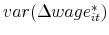 , 25% of
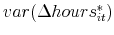 ,
,  and 25% of
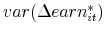 . We abstract from measurement error in employment, which we believe is relatively unimportant, as well as in the job change indicator, which we suspect is more
serious. (See Altonji and Williams (1998)). Our reported standard errors do not account for uncertainty about the measurement error parameters.13
. We abstract from measurement error in employment, which we believe is relatively unimportant, as well as in the job change indicator, which we suspect is more
serious. (See Altonji and Williams (1998)). Our reported standard errors do not account for uncertainty about the measurement error parameters.13
2.3 Model B
The main differences between Model A and Model B are in the wage and equations. The wage equation for Model B is

![\displaystyle \rho _{\omega }[1+\phi _{1}S_{it}]\omega _{_{i,t-1}}+\gamma _{JC}^{\omega }JC_{it}+\gamma _{1-E_{t}}^{\omega }(1-E_{it})+\gamma _{1-E_{t-1}}^{\omega }(1-E_{i,t-1}) \notag](img183.gif)
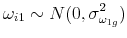 (initial condition).
The above wage model does not include the job specific wage component
 but introduces the coefficients
  and
and  .14 These allow the degree of persistence and the
variance in the wage innovation to shift with a job change or end of an unemployment spell. As noted above, our specification of state dependence in wages captures the fact that many employers use past wage rates, along with other information, in determining wage offers for new hires, as well as
the fact that previous wage rates are a reference point for incumbent workers when evaluating an offer. It may also reflect dependence between the productivity of a worker today and productivity last year. One might expect the degree of dependence to be weaker across jobs than within jobs
.14 These allow the degree of persistence and the
variance in the wage innovation to shift with a job change or end of an unemployment spell. As noted above, our specification of state dependence in wages captures the fact that many employers use past wage rates, along with other information, in determining wage offers for new hires, as well as
the fact that previous wage rates are a reference point for incumbent workers when evaluating an offer. It may also reflect dependence between the productivity of a worker today and productivity last year. One might expect the degree of dependence to be weaker across jobs than within jobs
 .
.
The equation is the same as (3) with the  terms
excluded. We have estimated versions of Model B with and without
terms
excluded. We have estimated versions of Model B with and without
 in the and equations but to save space report the version without the
 terms. The hours equation excludes the job specific hours component
We use Model B for three reasons. First, it is a smaller step from univariate models of the wage process than Model A. Second, it has proved to be easier to estimate. Finally, it is more tractable than Model A for use in dynamic programming models of consumer behavior.15
3 Data
We use the 1975-1997 waves of the PSID to assemble data that refers to the calendar years 1975-1996. Because some observations are lost due to the use of lags, the current values of the variables in our model range from 1978 to 1996. We include members of both the SRC stratified random sample and SEO sample. The latter consists primarily of households that were low income in 1968 and substantially overrepresents blacks. We also present results for the SRC sample only. We also include nonsample members who married PSID sample members. The sample is restricted to male household heads. We include both single and married individuals.
Observations for a given person-year are used if the person is between age 18 and 62, was working, temporarily laid off or unemployed in a given year, was not self employed, had valid data on education  and had no more than 40 years of potential experience. We treat persons on temporary layoff at the survey date as employed. We eliminate a small number of observations in which the individual reports being retired, disabled, a housewife, a student, other, or "don't know". (See
Appendix tables A1 and A2).16
and had no more than 40 years of potential experience. We treat persons on temporary layoff at the survey date as employed. We eliminate a small number of observations in which the individual reports being retired, disabled, a housewife, a student, other, or "don't know". (See
Appendix tables A1 and A2).16
Potential experience is
 is one if the individual is black and
0 otherwise.
is one if the individual is black and
0 otherwise.  is the number of years in a row that a person is employed at the survey date. In 1975 and for persons who join the sample after 1975, we set
to tenure with the current employer.17
is the number of years in a row that a person is employed at the survey date. In 1975 and for persons who join the sample after 1975, we set
to tenure with the current employer.17
The variable
is the number of consecutive years up to that the individual has not
been employed at the survey date. We set
 to 0 if the first time we observe is in
year Few unemployment spells exceed 1 year, so the error is probably small. The wage measure
to 0 if the first time we observe is in
year Few unemployment spells exceed 1 year, so the error is probably small. The wage measure
 is the reported hourly wage rate at the time of the survey. It is only available for persons who are employed or on temporary layoff.18
Finally, we censor reported hours at 4000, add 200 to reported hours before taking logs to reduce the impact of very low values of hours on the variation in the logarithm, and censor observed earnings and observed wage rates (in levels, not logs) to increase by no more than 500% and decrease to no less than 20% of their lagged values. We also censor wages to be no less than $3.50 in year 2000 dollars.
After observations are lost due to construction of lagged values, or missing data, we use information on 4,632 individuals. Each individual contributes between 1 and 19 observations. The 5th, 25th, median, 75th, and 95th percentile values of the number of observations a given individual contributes are 1, 3, 6, 11, and 18 respectively (see Appendix Table A3). Of course, persons who are present for many years contributed disproportionately to the total of 33,933 person-year observations. The number of observations per year varies from 1,200 in 1979 to 2,007 in 1991.
The sample is highly unbalanced. As we have already noted, an advantage of simulation based estimators such as I-I is that by incorporating the sample selection process into the simulation, one can handle unbalanced data. We assume that observations are missing at random, although there is reason to believe that the heterogeneity components and shocks influence attrition from the sample. In principle, one could augment the model with an attrition equation. Alternatively, it would be straightforward to simply use sample weights to reweight the PSID when evaluating the likelihood function of the auxiliary model if suitable weights were available. However, PSID sample weights are designed to keep the data representative of successive cross sections of the US population that originate in the families present in the base year.19 They do not adjust for factors that alter the US population, such as differences in birth rates by race or education. Furthermore, there are no sample weights for persons who move into PSID households through marriage. Consequently, we do not use weights. In essence, we are assuming both that observations are missing at random and that the model parameters do not vary across demographic groups or over time. The results are fairly robust to restricting the analysis to the SRC sample, as we discuss in Section 6. We also report separate results for SRC whites by education level.
In Table 1a we present the mean, standard deviation, minimum and maximum of the variables used in our structural model. The mean of is .97, so we observe relatively few unemployment
spells. Note also that the mean of  is .98. Given these magnitudes, even relatively large movements in the latent variable index determining have only a small effect on whether is 1 or 0. In Table 1b we provide additional information about our sample, including the mean and standard deviation for education, race,
potential experience, and the calendar year.
is .98. Given these magnitudes, even relatively large movements in the latent variable index determining have only a small effect on whether is 1 or 0. In Table 1b we provide additional information about our sample, including the mean and standard deviation for education, race,
potential experience, and the calendar year.
4 Estimation Methodology
We begin with a brief overview of our estimation procedure. We then define the auxiliary model used in the estimation procedure as well as additional moment conditions that we use. Note first that to reduce computational complexity, we estimate the coefficients on vector in equations with continuous dependent variables by first regressing
 ,
, and
,
, and
 on . The vector
  consists of a constant, years of education, , ,
 ,
,  , and a set of year dummies. We then work with the
residuals of these variables when estimating the remaining parameters by I-I.20
, and a set of year dummies. We then work with the
residuals of these variables when estimating the remaining parameters by I-I.20
4.1 Indirect inference
For clarity, we will refer to Model A (or B) above as the " structural" model, even though the models do not express the parameters of the decision rules for , , , etc., in terms of preference parameters and parameters governing job search, mobility,
and exogenous layoffs. We denote the " structural" parameters by  .
Indirect inference involves the use of an "auxiliary" statistical model that captures properties of the data. This auxiliary model has
.
Indirect inference involves the use of an "auxiliary" statistical model that captures properties of the data. This auxiliary model has  parameters
  . The method involves simulating data from the structural model (given a hypothesized value of ) and
choosing the estimator
. The method involves simulating data from the structural model (given a hypothesized value of ) and
choosing the estimator
 to make the simulated data match the actual data as closely as possible according to some criterion that involves .
Let the observed data consist of a set of observations on  individuals in each of
  time periods:
 ,
,
 ,
,
 , where
  is endogenous to the model and
  is exogenous. The auxiliary model parameters can be estimated using the
observed data as the solution to:
is exogenous. The auxiliary model parameters can be estimated using the
observed data as the solution to:
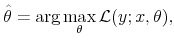 |
where
 is the likelihood function associated with the auxiliary model,
 and
and
 .
.
Given  and assumed values of the structural parameters , we use the
structural model to generate
and assumed values of the structural parameters , we use the
structural model to generate  statistically independent simulated data sets
 ,
,
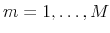 . Each of the
  simulated data sets has individuals and is constructed using the same observations on the exogenous variables, .
For each of the simulated data sets, we compute
simulated data sets has individuals and is constructed using the same observations on the exogenous variables, .
For each of the simulated data sets, we compute
 as
as
 |
where the likelihood function associated with the auxiliary model is evaluated using the
 th simulated data set
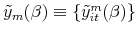 rather than the real data. Denote the average of the estimated parameter vectors by
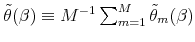 .
.
I-I generates an estimate
of the structural parameters by choosing to minimize the
distance between
 and
and
 according to some metric.21 As described in Keane and Smith (2003) and elsewhere, there are (at least) three possible ways to specify such a metric. Here we choose
to minimize the difference between the constrained and unconstrained values of the likelihood function of the auxiliary model evaluated using the observed data. In particular, we
calculate
according to some metric.21 As described in Keane and Smith (2003) and elsewhere, there are (at least) three possible ways to specify such a metric. Here we choose
to minimize the difference between the constrained and unconstrained values of the likelihood function of the auxiliary model evaluated using the observed data. In particular, we
calculate
![\displaystyle \hat{\beta}=\arg \min_{\beta }[\mathcal{L}(y;x,\hat{\theta})-\mathcal{L}(y;x,% \tilde{\theta}(\beta ))].](img238.gif) |
Gourieroux, Monfort, and Renault (1993) show that
is a consistent and asymptotically normal estimate of the true parameter vector
 . The reason is that as becomes large holding and fixed,
 and
both converge to the same "pseudo" true value
and
both converge to the same "pseudo" true value
 where
where  is a nonstochastic function.
Accommodating missing data in I-I is straightforward: after generating a complete set of simulated data, one simply omits observations in the same way in which they are omitted in the observed data. As we have already discussed, we assume that the pattern of missing data is exogenous. In the simulated data, we simply omit observations according to the same pattern. In some cases, it is convenient to estimate auxiliary models in which missing observations are replaced with some arbitrary value (such as 0). In such circumstances, the same principle applies: use the same arbitrary values in both the simulated and observed data sets.
In our structural model, the observed data  consists of both continuous and discrete random variables. Discrete random variables complicate the calculation of
because the objective function (i.e., the difference between the constrained and unconstrained values of the likelihood) is discontinuous in the structural parameters
. Discontinuities arise when applying I-I to discrete choice models because any simulated choice
consists of both continuous and discrete random variables. Discrete random variables complicate the calculation of
because the objective function (i.e., the difference between the constrained and unconstrained values of the likelihood) is discontinuous in the structural parameters
. Discontinuities arise when applying I-I to discrete choice models because any simulated choice
 is discontinuous in (holding fixed the set of
random draws used to generate simulated data from the structural model). Consequently, the estimated set of auxiliary parameters
is discontinuous in (holding fixed the set of
random draws used to generate simulated data from the structural model). Consequently, the estimated set of auxiliary parameters
 is discontinuous in . The non-differentiability of
the objective function in the presence of discrete variables prevents the use of gradient-based numerical optimization algorithms to maximize the objective function and requires instead the use of much slower algorithms such as simulated annealing or the simplex method.
is discontinuous in . The non-differentiability of
the objective function in the presence of discrete variables prevents the use of gradient-based numerical optimization algorithms to maximize the objective function and requires instead the use of much slower algorithms such as simulated annealing or the simplex method.
To circumvent these difficulties, we use Keane and Smith's (2003) modification to I-I, which they call generalized indirect inference. Suppose that the simulated value of a binary variable
 equals 1 if a simulated latent utility
 is positive and equals 0 otherwise. Rather than use
when computing
, we use a continuous function
is positive and equals 0 otherwise. Rather than use
when computing
, we use a continuous function
 of the latent utility. The function is
chosen so that as the smoothing parameter
of the latent utility. The function is
chosen so that as the smoothing parameter  goes to 0,
 converges to
. Letting go to 0 as the observed sample size
goes to infinity ensures that
converges to
. Letting go to 0 as the observed sample size
goes to infinity ensures that
 converges to
 , thereby delivering consistency of the I-I estimator of
 . Our choice of is
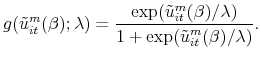 |
Because the latent utility is a continuous and smooth function of the structural parameters
, is a smooth function of . Moreover, as goes
to 0, goes to 1 if the latent utility is positive and to 0 otherwise.
When the structural model contains additional variables that depend on current and lagged values of indicator variables
, these additional variables will also be discontinuous in . In our structural model, for instance, variables such as employment duration and job tenure depend on the history of indicator variables such as employment status and job changes. Since employment duration and tenure are discontinuous in , they also contribute to creating a discontinuous objective function in the estimation process. Our smoothing strategy, however, ensures that all these variables will also be continuous in , provided that they depend continuously on
. In other words, replacing the indicator functions by their continuous approximations
 ensures that all other variables that depend on through
are continuous. Care must be taken in choosing , because approximation error in indicator functions for a particular year accumulate in the approximate functions for employment duration and tenure.
ensures that all other variables that depend on through
are continuous. Care must be taken in choosing , because approximation error in indicator functions for a particular year accumulate in the approximate functions for employment duration and tenure.
We searched for a combination of the smoothing parameter and the number of simulations that generates sufficient smoothness in the objective function, while keeping bias small and computation time manageable. The larger these parameters are, the smoother the objective function will be, but large values of introduce bias and large values of increase computation time. Based upon simulation experiments, we chose a small value of
, .05, which is large enough to smooth the objective surface sufficiently given our choice of 20 for . Our simulation experiments as well as the parametric bootstrap results reported below indicate that the associated bias in the estimates is small
for almost all of our parameters.
We use a parametric bootstrap procedure to conduct inference. Given consistent estimates of the structural parameters, we repeatedly generate "artificial" observed data sets from the structural model, estimate the parameters of the structural model for each such data set, and then calculate the standard deviations of the parameter estimates across the data sets. These standard deviations serve as our estimates of the standard errors of the structural parameter estimates associated with the actual observed data.22 Standard errors of functions of model parameters, such as the impulse response functions and variance decompositions are constructed as the standard deviation across parametric bootstrap replications.
4.2 The Auxiliary Model
Our auxiliary model consists of a system of seemingly unrelated regressions (SUR) with 7 equations and 25 covariates that are common to all 7 equations. We implement the model under the assumption that the errors follow a multivariate normal distribution with an unrestricted covariance matrix. One may write the system as
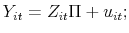
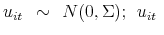 iid over
  and
and 
where

![\displaystyle Y_{it}=[E_{it}\cdot E_{i,t-1},E_{it}\cdot (1-E_{i,t-1}),JC_{it}\cdot E_{it}\cdot E_{i,t-1},wage_{it}^{\ast },hours_{it}^{\ast },earn_{it}^{\ast },\ln (1+wage_{it}^{\ast }{}^{2})]^{\prime };](img262.gif) |
and





![\displaystyle wage_{i,t-2}^{\ast }\cdot JC_{i,t-1},wage_{i,t-2}^{\ast }\cdot E_{i,t-1}]^{\prime }](img268.gif)
Since  has
has
 elements and
  is a
is a  covariance matrix with 28 unique elements, the auxiliary model has 203 parameters. In contrast, Model A.3 has only 46 parameters that we estimate by I-I (not counting the measurement error parameters, tenure coefficients,
and
covariance matrix with 28 unique elements, the auxiliary model has 203 parameters. In contrast, Model A.3 has only 46 parameters that we estimate by I-I (not counting the measurement error parameters, tenure coefficients,
and
 As we discuss momentarily, a few of the 46 parameters are estimated all or in part using additional moment conditions rather than exclusively by I-I. Consequently, the
number of features of the data used to fit the structural model greatly exceeds the number of parameters.
As we discuss momentarily, a few of the 46 parameters are estimated all or in part using additional moment conditions rather than exclusively by I-I. Consequently, the
number of features of the data used to fit the structural model greatly exceeds the number of parameters.
In estimating the model we use the likelihood function that corresponds to (15). Note that the assumption
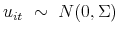 with
with  iid over and is false for several reasons, including the fact that
  contains binary variables and that both
and
contains binary variables and that both
and
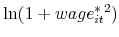 appear. However, the fact that we use a misspecified likelihood affects the efficiency of our procedure rather than consistency.
Our choice of what to include in the auxiliary model is as much a matter of art as science, but is motivated by the following principles. First, we use a common set of right-hand-side variables in the seven equations of the auxiliary model to avoid having to iterate between and to maximize the likelihood function. The disadvantage, however, is that we
do not tailor the right-hand-side variables to the particular dependent variable. As a result, the auxiliary model probably contains more parameters than are needed to describe the data. Furthermore, we are restricted in our ability to add additional right-hand-side variables to particular
equations, such as additional interactions between  and other lagged variables, because the total number of variables would get out of hand. Although it would be useful to explore
differentiating the equations of the auxiliary model in future work, our simulations indicate that most of our parameters are quite well determined by the auxiliary model that we have chosen.
and other lagged variables, because the total number of variables would get out of hand. Although it would be useful to explore
differentiating the equations of the auxiliary model in future work, our simulations indicate that most of our parameters are quite well determined by the auxiliary model that we have chosen.
The second principle is to include variables that appear as explanatory variables in the structural model. This accounts for the presence of
 ,
,
 ,
,
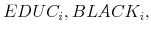
 and
. We also include
even though we constrain
and
. We also include
even though we constrain
 to equal 0. Since the model is dynamic and includes state
dependence terms in most equations, we include two lags of each dependent variable except
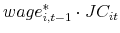
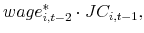
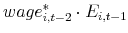
. The lags help distinguish between state dependence and heterogeneity. Finally, we include the interaction terms
to equal 0. Since the model is dynamic and includes state
dependence terms in most equations, we include two lags of each dependent variable except
. The lags help distinguish between state dependence and heterogeneity. Finally, we include the interaction terms
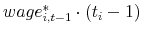 ,
,
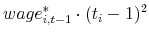 ,
,
 ,
,
 and
and
 to help capture any nonstationarity in wages.
One disadvantage of our choice for (16) is that the first three observations for each individual are lost due to lags. This makes it difficult to identify parameters of the models for the initial wage and employment status. It also makes it difficult to identify changes with
experience in the variance of shocks at the beginning of a career. In principle, one could add additional equations with 0, 1, or 2 lags to the auxiliary model to accommodate observations with missing data. The cost would be a more complex auxiliary model. (Alternatively, one can set values of
missing lags to 0 in both the simulated and actual data.) In simulation experiments we did not find that adding such equations helped a great deal with identification of model parameters. In the next section, we discuss use of the variance of wages when  for each race-education group to help identify parameters of the initial condition for wages. We also discuss the initial condition for employment.
4.3 Use of Additional Moments and Other Information Sources to Identify Parameters
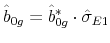
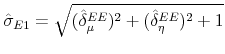
In the equation for initial employment we estimate the intercepts as
 where
where
 and
and
 is the coefficient estimate from a Probit regression of on a constant estimated on PSID data for
  for each of 4 groups defined by race and whether the person has more than a high school education. We use the first five years rather than simply the first because we have relatively few observations for each group when
  .23
.23
To identify
 , we use the fact that model A implies that the variance of the observed (residual) wage,
 of an employed individual from race-education group is
 |
Because of sample size considerations we estimate
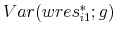 as the variance of (residual) wage observations in the PSID corresponding to .
 equals .109 for blacks with a high school degree or less, .124 for blacks with more than a high school degree, .109 for whites with high school or less, and
.141 for whites with more than high school. We then obtain
equals .109 for blacks with a high school degree or less, .124 for blacks with more than a high school degree, .109 for whites with high school or less, and
.141 for whites with more than high school. We then obtain
 setting it to

 at each iteration of the I-I procedure, where
is preset to
at each iteration of the I-I procedure, where
is preset to
 on the basis of measurement error studies for the PSID. In Model B,
 does not appear. Estimates of other parameters are not very sensitive to constraining
 to be the same for all groups and estimating
using
to be the same for all groups and estimating
using  rather than 5.
In the case of model A, we also use a large number of moment conditions spanning a much longer time span than the 3 lags in our auxiliary model to identify
 and help distinguish persistence due to
from persistence due to and
. For workers who are continuously employed between
and help distinguish persistence due to
from persistence due to and
. For workers who are continuously employed between  and
and
 and who do not change jobs between and

We approximate
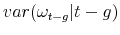 with a constant plus a third order polynomial in . We compute
 for each
  combination satisfying
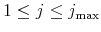 and
and
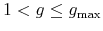 . We estimate
 and the parameters of the polynomial approximation by weighted minimum distance using the number of sample observations used to estimate
as the weights, eliminating moments estimated using fewer than 5 observations. The point estimates and approximate standard errors for
and the parameters of the polynomial approximation by weighted minimum distance using the number of sample observations used to estimate
as the weights, eliminating moments estimated using fewer than 5 observations. The point estimates and approximate standard errors for
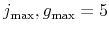 ,
,
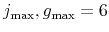 ,
,
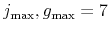 ,
,
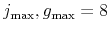 , and
, and
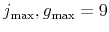 are .882 (.027), .919 (.020), .927 (.014), .94 (.011), and .94 (.009) respectively. We chose .92 as our point estimate.24 For Model A.1, we obtain .913 when we ignore (17) and freely estimate
by I-I.
are .882 (.027), .919 (.020), .927 (.014), .94 (.011), and .94 (.009) respectively. We chose .92 as our point estimate.24 For Model A.1, we obtain .913 when we ignore (17) and freely estimate
by I-I.
In model B we make use of an expression for the difference in the variance of wage growth conditional on
 and conditional on
 to express the wage innovation variance shift factor in terms of other parameters of the model. See Appendix 1.25 We do not use moment conditions analogous to (17) to estimate
, although the estimate we obtain by I-I, .95, is in the neighborhood of the above values.
to express the wage innovation variance shift factor in terms of other parameters of the model. See Appendix 1.25 We do not use moment conditions analogous to (17) to estimate
, although the estimate we obtain by I-I, .95, is in the neighborhood of the above values.
Finally, when we include tenure in the wage equation (model A.3 in Table 2), we impose Altonji and Williams' (2005) estimates of tenure polynomial
based on PSID data for the years 1975-2001 rather than attempting to estimate it by I-I, which would have required the addition of a number of additional variables to the
auxiliary model.26
The parametric bootstrap standard errors reported below do not account for sampling error in the above sample moments of the PSID or in the tenure parameters.
4.4 Mechanics of Estimation
Our chosen values of
 and
and  yield a smooth objective function that allows the use of
fast gradient-based optimization algorithms with little evidence of bias.27 Not surprisingly given the size and complexity of our models, the objective
function displays multiple local optima with respect to some of the parameters. We experimented extensively with different starting values to make sure that we are finding the global optimum. We began the process by obtaining estimates of a series of "reduced-form equations" that correspond to
the equations in the structural model. As part of the process, we have used grid evaluations for the set of parameters that appear most problematic, and we have used the smaller models to help us find good initial guesses and then build up to more complex ones. The problem is more serious in the
case of Model A.1-Model A.3 than for Model B. This is one of the reasons that we make use of the moments (17) to help distinguish
from
yield a smooth objective function that allows the use of
fast gradient-based optimization algorithms with little evidence of bias.27 Not surprisingly given the size and complexity of our models, the objective
function displays multiple local optima with respect to some of the parameters. We experimented extensively with different starting values to make sure that we are finding the global optimum. We began the process by obtaining estimates of a series of "reduced-form equations" that correspond to
the equations in the structural model. As part of the process, we have used grid evaluations for the set of parameters that appear most problematic, and we have used the smaller models to help us find good initial guesses and then build up to more complex ones. The problem is more serious in the
case of Model A.1-Model A.3 than for Model B. This is one of the reasons that we make use of the moments (17) to help distinguish
from

The fact that we have between 39 and 46 parameters estimated by indirect inference, the large size of the auxiliary model, and the number of simulations make computation very time-consuming even though we use a fast gradient based optimization algorithm. To reduce estimation time, we exploit the highly parallelizable structure of our estimation methodology.28
4.5 Local Identification and Analysis of Estimation Bias
We have chosen the auxiliary model with an eye toward distinguishing among state dependence, fixed heterogeneity, and transitory shocks and an eye toward establishing links across equations in the heterogeneity components. However, one cannot easily verify that the parameters of our model are identified by matching up the parameters against sample moments. In particular, the fact that the number of moments that play a role in the likelihood function of the auxiliary model is much larger than the number of structural model parameters does not establish identification of any particular parameter. Consequently, we use Monte Carlo experiments extensively to establish local identification and analyze the adequacy of our auxiliary model given the sample size and demographic structure of the available data and to check for bias. For a hypothesized vector of parameter values, we simulate data and then verify that the parameter values that maximize the likelihood function of the auxiliary model are close to the hypothesized values. Using a number of model specifications, including ones that differ somewhat from the ones presented in the paper, we informally experimented with varying parameter values to get a sense of how robust identification is to the particular values. We also used these experiments to investigate whether the objective function has flat regions near the solution, or multiple global optima.
In general we have found that identification of most of the parameters is quite robust. However, our Monte Carlo studies also indicate that a few of the parameters are poorly determined given the sample size. We also found local optima involving alternative combinations of subsets of the
parameters. Bringing in additional information through the moment conditions described above solved the most serious problems. However, some of the parameters remain sensitive to changes in the auxiliary model, and starting values must be chosen carefully. This is particularly true of the
coefficients of the experience profiles in the , and to a lesser extent, the
equations, for reasons that we not fully understand. In table 2 below there is also evidence of bias for some of the parameters in these equations. Overall, however, the relatively small
values of the bootstrap standard errors in the tables below indicates that for the sample size and demographic structure of the PSID sample, our auxiliary model is quite informative about most of the model parameters. Furthermore, in almost all cases the means of the bootstrap replications are
close to the point estimates, indicating that the degree of bias in the procedure is small for most of our parameters.
5 Empirical Results
First, we discuss the parameter estimates for Model A, with heavy emphasis on Model A.3. Model A.3 is basically the model presented above with the duration dependence term in the UE equation restricted to 0 and
 set to 0. We also present simpler versions of Model A.
Model A.2 is identical to Model A.3 except that we exclude tenure terms from the wage equation. Columns 1a-1c refer to Model A.1, which in addition excludes
set to 0. We also present simpler versions of Model A.
Model A.2 is identical to Model A.3 except that we exclude tenure terms from the wage equation. Columns 1a-1c refer to Model A.1, which in addition excludes
 from and
and
from and
and
 from , and allows
to be nonzero. We also briefly discuss results for Model B, with emphasis on the wage equation. Second, we evaluate the fit of the model by comparing means and
standard deviations of the PSID data to the corresponding values based on simulated data from the model and by comparing simple regression relationships in actual and simulated data. Third, we present impulse response functions. Finally, we decompose the variance of wages, hours, and earnings into
the contributions of the main types of shocks in our model. In the case of Model A.3, inference is based on 300 bootstrap replications. Because the bootstrap procedure is very computer intensive, we only use 100 replications for the other models.
from , and allows
to be nonzero. We also briefly discuss results for Model B, with emphasis on the wage equation. Second, we evaluate the fit of the model by comparing means and
standard deviations of the PSID data to the corresponding values based on simulated data from the model and by comparing simple regression relationships in actual and simulated data. Third, we present impulse response functions. Finally, we decompose the variance of wages, hours, and earnings into
the contributions of the main types of shocks in our model. In the case of Model A.3, inference is based on 300 bootstrap replications. Because the bootstrap procedure is very computer intensive, we only use 100 replications for the other models.
5.1 Parameter Estimates for Model A
Columns 3a, 3b, and 3c of Table 2 report parameter estimates, the means of the parametric bootstrap estimates, and standard error estimates for Model A.3. Columns 2a-2c refer to Model A.2 and Columns 1a-1c refer to Model A.1. The row headings indicate the variable or error component that the
parameter estimates correspond to and also list the parameter names. The estimates are grouped by equation, beginning with .
5.1.1 Employment Transitions and Job Changes
The coefficients on and  imply that the latent variable determining conditional on
 declines slowly with until is about 12 and then rises slowly. However, the difference between
  and
and  in the latent variable is only .21, and the effect on the odds of a transition is small because the
probability is very high. Since the value of
in the latent variable is only .21, and the effect on the odds of a transition is small because the
probability is very high. Since the value of
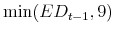 is rising rapidly over the first few years in the labor market, the overall relationship between and is weak. The point estimates should be taken with a grain of salt, because the relative values of the constant, the coefficients on and
  and the coefficient on
are sensitive to the exact specification. Furthermore, the bootstrap replications provide evidence of bias.
and the coefficient on
are sensitive to the exact specification. Furthermore, the bootstrap replications provide evidence of bias.
The coefficient on
is .044 (.018), indicating modest positive duration dependence in the odds of remaining employed. Below we show that a regression of on
conditional on
 gives similar results in data simulated from Model A.3 and in PSID data, which indicates that the combined effect of duration dependence and unobserved heterogeneity in the
model does a good job of matching the weak positive state dependence found in the data.
gives similar results in data simulated from Model A.3 and in PSID data, which indicates that the combined effect of duration dependence and unobserved heterogeneity in the
model does a good job of matching the weak positive state dependence found in the data.
The coefficient on
is -.058 (.076). At first glance the negative sign would seem to be opposite the expected sign because there is only a substitution effect at 0 work hours. However, it is probably better to think of employment at the survey date as a movement along the extensive margin when one views labor supply from the perspective of a year. In any event, the coefficient is not statistically significant and the implied effect on the
probability is small.
The equation is the least satisfactory equation in the model. The estimated
profile implies that the exit probability declines with experience and then increases, but the standard errors are very large. As we document below, the model does a poor job of tracking the relationship between and in the data. We experimented with models that included
but had difficulty estimating the duration coefficient, perhaps because the overall number of unemployment spells is small and relatively few individuals were unemployed for two or
more surveys in a row. (Most work on duration dependence in unemployment spells uses weekly, monthly or quarterly data). Simulations reported below show that the equation without state dependence is consistent with the negative link between and
found in the PSID, presumably because of the important role played by permanent heterogeneity. However it understates that relationship to some extent.
The latent variable for declines slightly with over the first 20 years, but
is strongly decreasing in job tenure. The coefficient on
is -.0673 (.0156), indicating that 10 years of seniority shift the index determining by .673 standard deviations of the job change shock
 . It is noteworthy that we obtain a large negative effect of tenure on even after accounting for unobserved person specific heterogeneity and and for job match heterogeneity.
The job match components
and
play an important role in job mobility without unemployment, and they have signs and relative magnitudes that are consistent with the theoretical
discussion above. The coefficient on
is -.923 (.127). To get a sense of the magnitude, note that the standard deviation of
is .273 for a person with 10 years of experience. Consequently, a one standard deviation increase in
lowers the index by -.252. Since the coefficient on
is -.067, this is roughly equivalent to the effect of 3.8 years of seniority. An increase from 0 to .273 in the value of
lowers the probability of a job change for a white individual with 12 years of education, 2 years of seniority, 10 years of experience,  and
and  from .130 to .084, keeping
constant. The current value
has a coefficient of .594.29 A one standard deviation shock to
raises the job change probability by 0.066.
from .130 to .084, keeping
constant. The current value
has a coefficient of .594.29 A one standard deviation shock to
raises the job change probability by 0.066.
Thus far, we have not discussed the role of race and education or the unobserved individual heterogeneity terms. has a substantial negative effect on the latent variable for
and a substantial negative effect on , while  has a substantial positive effect on both. In the equation is positive, with an effect that is equivalent to having about 2.5 fewer years of tenure. does not alter
. The coefficient on the "innate ability" factor is .443 (.094) in the
equation and .637 (.128) in the
has a substantial positive effect on both. In the equation is positive, with an effect that is equivalent to having about 2.5 fewer years of tenure. does not alter
. The coefficient on the "innate ability" factor is .443 (.094) in the
equation and .637 (.128) in the  equation. Since the standard deviations
of , ,
equation. Since the standard deviations
of , ,
 , and
, and
 are all 1, the factor loadings imply that accounts for
15.6% of the error variance in the
are all 1, the factor loadings imply that accounts for
15.6% of the error variance in the  equation and 27.9% in the equation. The
productivity factor has a coefficient of -.280 (.136) in the equation. All
three results are sensible in light of the fact that has a positive sign in both the wage and hours equations. In thinking about the magnitudes, keep in mind that the factor loadings
represent the partial effect of the heterogeneity components in a given period holding spell duration constant.
equation and 27.9% in the equation. The
productivity factor has a coefficient of -.280 (.136) in the equation. All
three results are sensible in light of the fact that has a positive sign in both the wage and hours equations. In thinking about the magnitudes, keep in mind that the factor loadings
represent the partial effect of the heterogeneity components in a given period holding spell duration constant.
The mobility/hours preference component is normalized to have a positive sign in the equation. It enters the , and indices with coefficients of -.237 (.107), .222 (.187), and .531 (.100), respectively, and accounts for 4.5%, 3.4%, and 19.7% of the error variances of these equations. The magnitude implies only a small effect on the transition probability and the sign in the equation is positive in the other models. The results suggest that raises the
probabilities of transiting out of unemployment and of moving from job to job without unemployment. It has a coefficient that is essentially zero in the hours equation in the case of Model A.3 but is larger in the other specifications. Across Models A.1, A.2, A.3 and B.1, the relative importance of
and varies somewhat.
5.1.2 The Wage Model
We begin with the parameters of the autoregressive component,
 |
The estimated standard deviation of the initial condition
 varies with race and education but is between .248 and .306 in Model A.3. The autoregressive coefficient
 is .92, which implies considerable persistence but is well below unity. The shocks
have a standard deviation of .095 (.003). This value strikes us as large given that we separately account for the effects of job specific error components. The
only other study we know that allows for a persistent general wage component, a job specific error term, and endogenous mobility is Low et al (2008). They obtain a value of .104 but set
is .92, which implies considerable persistence but is well below unity. The shocks
have a standard deviation of .095 (.003). This value strikes us as large given that we separately account for the effects of job specific error components. The
only other study we know that allows for a persistent general wage component, a job specific error term, and endogenous mobility is Low et al (2008). They obtain a value of .104 but set
 In the data, the standard deviation of wage changes for stayers is .136 after adjusting for
measurement error.
In the data, the standard deviation of wage changes for stayers is .136 after adjusting for
measurement error.
The coefficients of -.1895 (.010) on
 and .1041 (.013) on
 imply that being unemployed at the survey date has a large effect on the mean of the wage that persists for some time, even when the value of lost tenure is held constant. As
will become clear from the impulse response functions, unemployment also leads to a loss of tenure as well as to a reduction on average in the value of the job match component, which implies further reductions in wages.30
imply that being unemployed at the survey date has a large effect on the mean of the wage that persists for some time, even when the value of lost tenure is held constant. As
will become clear from the impulse response functions, unemployment also leads to a loss of tenure as well as to a reduction on average in the value of the job match component, which implies further reductions in wages.30
The coefficient
 on is only .049 (.028), so the direct contribution of
unobserved permanent heterogeneity to the variance of wages is small once we account separately for job match heterogeneity. Note, however, that also has an additional effect on wages
through its connection to employment transitions and job changes. One should also keep in mind that is net of the effect of , which contains the important permanent variables and
on is only .049 (.028), so the direct contribution of
unobserved permanent heterogeneity to the variance of wages is small once we account separately for job match heterogeneity. Note, however, that also has an additional effect on wages
through its connection to employment transitions and job changes. One should also keep in mind that is net of the effect of , which contains the important permanent variables and  and that the standard deviation of the initial condition
 is large. Almost 30 percent of the effect of
is still present at
is large. Almost 30 percent of the effect of
is still present at  Note that the component is much more important in Model A.1 and in Model B.1, perhaps because there is no selective quit behavior in A.1 and B.1 does not incorporate a job specific wage component at all. It is also about
twice as important in the SRC sample.
Note that the component is much more important in Model A.1 and in Model B.1, perhaps because there is no selective quit behavior in A.1 and B.1 does not incorporate a job specific wage component at all. It is also about
twice as important in the SRC sample.
The parameters of the job match component
are quite interesting. The initial condition
 has a standard deviation of .197 (.021) in A.3. The autoregression parameter
is .625 (.022) and the value of
has a standard deviation of .197 (.021) in A.3. The autoregression parameter
is .625 (.022) and the value of
 is large: .269 (.007). As we have already noted, the substantial persistence of
across jobs suggests that wage offers are based in part on salary history, that demand shocks may reflect narrow occupation, industry and region and thus may not be entirely
job specific, and/or that the search network available to workers depends on job quality. As we shall see below, the contribution of the job specific component to the variance of wages and earnings is substantial.
is large: .269 (.007). As we have already noted, the substantial persistence of
across jobs suggests that wage offers are based in part on salary history, that demand shocks may reflect narrow occupation, industry and region and thus may not be entirely
job specific, and/or that the search network available to workers depends on job quality. As we shall see below, the contribution of the job specific component to the variance of wages and earnings is substantial.
As we discuss in Appendix 2, one can use Model A.3 to decompose
 the experience profile of wages, into the contributions of general human capital
  , job mobility
 , and accumulated job seniority
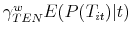 . Figure 1 graphs the components and thus addresses the fundamental question of what accounts for wage growth over a career. Most of the return to
potential experience is due to general skill accumulation. Job shopping and the accumulation of tenure account for 14.1 percent and 13.1 percent, respectively, of the overall growth of wages over the first ten years. They account for 13.7 percent and 15.0 percent of growth over the first 30
years.31 Using social security records for quarterly earnings (rather than hourly wage rates) Topel and Ward (1992) find larger gains from job mobility
early in careers than we find. We suspect their estimates are overstated by the school to work transition and growth across jobs in hours worked, while ours are understated because we miss some job changes and we do not use the first three years of wages.32
. Figure 1 graphs the components and thus addresses the fundamental question of what accounts for wage growth over a career. Most of the return to
potential experience is due to general skill accumulation. Job shopping and the accumulation of tenure account for 14.1 percent and 13.1 percent, respectively, of the overall growth of wages over the first ten years. They account for 13.7 percent and 15.0 percent of growth over the first 30
years.31 Using social security records for quarterly earnings (rather than hourly wage rates) Topel and Ward (1992) find larger gains from job mobility
early in careers than we find. We suspect their estimates are overstated by the school to work transition and growth across jobs in hours worked, while ours are understated because we miss some job changes and we do not use the first three years of wages.32
5.1.3 Hours and Earnings
In the
equation
 , the effect of
  is .413 (.008). This indicates that
unemployment at the survey date is associated with relatively long completed spells of nonemployment. Short spells will tend to be missed given our point in time measure at annual frequencies. They will show up in the hours component
. The wage elasticity is small and negative, which is consistent with a large literature on the behavior of male household heads. The coefficients on and are .125 and .0145 respectively, suggesting only a modest role for individual
heterogeneity (net of and
is .413 (.008). This indicates that
unemployment at the survey date is associated with relatively long completed spells of nonemployment. Short spells will tend to be missed given our point in time measure at annual frequencies. They will show up in the hours component
. The wage elasticity is small and negative, which is consistent with a large literature on the behavior of male household heads. The coefficients on and are .125 and .0145 respectively, suggesting only a modest role for individual
heterogeneity (net of and  in annual hours in a given year. However,
permanent heterogeneity turns out to be quite important over the lifetime. The importance of relative to varies across the specifications. The standard deviation of
in annual hours in a given year. However,
permanent heterogeneity turns out to be quite important over the lifetime. The importance of relative to varies across the specifications. The standard deviation of
 is .169, indicating substantial year to year variation in hours even when the job specific component
  does not change. The standard deviation of is large--.157 (.014).
Turning to earnings, recall that the coefficients
and
 are constrained to equal 1. The earnings component has
an autoregression coefficient of .553 (.007) and the standard deviation of the shock
are constrained to equal 1. The earnings component has
an autoregression coefficient of .553 (.007) and the standard deviation of the shock
 is .211 (.002).
5.2 Estimates of Model B
Columns 4a-4c of Table 2 report estimates for Model B.1. As we noted earlier, Model B does not contain job specific wage or hours components. However, it allows the autoregression coefficient and the standard deviation of wage shocks to shift when individuals change jobs or leave unemployment.
The specification is closest to that of Model A.1. We had relatively little difficulty estimating this model and estimate the autoregressive parameter
by indirect inference rather than by using the moment conditions (17), which do not apply to Model B.1 without modification.
The results for Model B.1, in keeping with those for Model A, provide clear evidence that job changes, whether with or without unemployment, involve substantial wage risk. The coefficient on lagged wages is .958 for job stayers but only .723 if the job changes. At the same time, wage innovations
have a standard deviation of .0934 (.002) for stayers but are about 3 times larger for persons who have changed jobs ((1+2.10)*0.0934). The estimate of
is .151 (.012), so permanent heterogeneity plays a more important role in Model B.1 than in A.3.33
5.3 Evaluating the fit of the Model:
We simulate careers for 138,960 individuals using the parameter estimates for Model A.1, A.2, A.3 and Model B.1--30 for each individual in the PSID sample. From each simulated career we select data so that the temporal pattern, education level, and race matches that of a corresponding PSID case. Note that in all cases the simulated variables incorporate measurement error. We examine the fit of the model in two ways. First, we compare the means and standard deviations of the key variables implied by the model with corresponding values from the PSID. We then turn to a comparison of the regression relationships among key variables that are implied by the model with those of the corresponding PSID estimates.
5.3.1 Predicted and Actual Mean and Standard Deviations of Key Variables, by Potential Experience
Figure 2 compares the actual standard deviations of
,
 and
in the PSID to the 95 percent confidence interval estimates of the standard deviations based on data simulated from Model A.3. The standard error bands in the figure
reflect both sampling error in
and sampling error due to randomness in the careers of the individuals in a particular sample.34 The bands are tight, which means that we sometimes conclude that the PSID values are statistically different from the model predictions even when the values are close in economic terms.
and
in the PSID to the 95 percent confidence interval estimates of the standard deviations based on data simulated from Model A.3. The standard error bands in the figure
reflect both sampling error in
and sampling error due to randomness in the careers of the individuals in a particular sample.34 The bands are tight, which means that we sometimes conclude that the PSID values are statistically different from the model predictions even when the values are close in economic terms.
Across experience levels, the model overpredicts
 by about 6% (not shown) and implies less of an increase with experience than we find in the actual data. We suspect that most of the discrepancy is due to the fact that
we have removed the effects of education and race from the PSID wage measure, but include them in the equations for ,
by about 6% (not shown) and implies less of an increase with experience than we find in the actual data. We suspect that most of the discrepancy is due to the fact that
we have removed the effects of education and race from the PSID wage measure, but include them in the equations for ,  and in the model. Consequently, the effects of race and education on wages, hours, and earnings that operate indirectly through , , and rather than directly through wages and hours influence the model predictions for
but not the PSID value.35 The values for Model A.2 (not reported) are reasonably similar to A.3, while the values for Model B.1 in Appendix Figure A1 shows a flatter profile for
.
and in the model. Consequently, the effects of race and education on wages, hours, and earnings that operate indirectly through , , and rather than directly through wages and hours influence the model predictions for
but not the PSID value.35 The values for Model A.2 (not reported) are reasonably similar to A.3, while the values for Model B.1 in Appendix Figure A1 shows a flatter profile for
.
The sample value for
 is .285, which lies a bit below the model value .293. The model implies that
varies little with and misses the increase when
is 40, which might reflect the effects of partial retirement not captured by the experience profiles in the model. The results for Model A2 and B.1 are similar. The actual and simulated
is .285, which lies a bit below the model value .293. The model implies that
varies little with and misses the increase when
is 40, which might reflect the effects of partial retirement not captured by the experience profiles in the model. The results for Model A2 and B.1 are similar. The actual and simulated
 for earnings are 0.567 and 0.585, respectively. However, there is an erratic pattern in the data that is not matched by the model predictions, which display a smooth hump-shape pattern
with a peak around
for earnings are 0.567 and 0.585, respectively. However, there is an erratic pattern in the data that is not matched by the model predictions, which display a smooth hump-shape pattern
with a peak around  . The error at
  for earnings mirrors the error for
hours and probably reflects partial retirement.
for earnings mirrors the error for
hours and probably reflects partial retirement.
The left panels of Figure 3 compare the PSID values and the model predictions for the mean of  and for the mean of conditional on
  and
and  . The PSID values lie close to the model estimates. The overall mean for is .967 in the data and .960 based on the model. Overall, the model overstates
by about .014 but tracks the experience profile fairly closely.
. The PSID values lie close to the model estimates. The overall mean for is .967 in the data and .960 based on the model. Overall, the model overstates
by about .014 but tracks the experience profile fairly closely.
The upper right panel of Figure 3 reports the sample means and simulated means of transitions, which match reasonably well. However, the lower right panel shows that A.3 does poorly in
explaining the experience profile of exits from unemployment  . The actual and simulated means of are .74 and .69, a substantial discrepancy. Furthermore, the model does not track the experience profile well.36 Model B.1 does
somewhat better than model A.3 despite the fact that the and equations of
A.3 and B.1 are the same (Appendix Figure A2).
. The actual and simulated means of are .74 and .69, a substantial discrepancy. Furthermore, the model does not track the experience profile well.36 Model B.1 does
somewhat better than model A.3 despite the fact that the and equations of
A.3 and B.1 are the same (Appendix Figure A2).
Figure 4 examines the behavior of the mean of , , and  . The fits for and are reasonably close, although the two models overpredict by an average of about 0.4 years. The models overpredict
  by a substantial amount. This is probably attributable to our use of
  as the
initial value for when an individual first enters the sample (see the Data Section). The results for the models A.2 and B.1 are similar.
as the
initial value for when an individual first enters the sample (see the Data Section). The results for the models A.2 and B.1 are similar.
5.3.2 Comparison of Regression Relationships Among Key Variables
Tables 3a-3d report a series of regressions. The " a" columns are based on the PSID sample, and the "b" and " c" columns are based on data simulated using the estimates of Model A.3 and Model B.1. We also report robust panel standard errors for the PSID estimates.37 Columns 1a and 1b of Table 3a report regressions of on

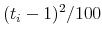 , and
, and  conditional on . This is a stripped down version of the equation in the structural model. There are some differences in the experience profiles. The coefficient on is .0025
in the PSID and .0031 in the simulation, a close correspondence.
conditional on . This is a stripped down version of the equation in the structural model. There are some differences in the experience profiles. The coefficient on is .0025
in the PSID and .0031 in the simulation, a close correspondence.
Columns 2a and 2b report results for a version of the equation. The differences in the coefficients on the experience profile are substantial, a fact that is reflected in the failure of
the model to fit the experience profile. The model understates the degree of persistence in unemployment spells to some extent. The equations for in columns 3a and 3b match fairly closely,
although the weights on the experience terms are somewhat different.
Table 3b examines the dynamics of wages. When only one lag is included, the coefficient on
 is .885 in the PSID and .905 in the simulation. When two lags are included, the sums of the coefficients are very close but there is a substantial difference in the
coefficient pattern. The coefficient on is small and negative in the PSID and in the simulated data for A.3. It is small and positive for B.1.
is .885 in the PSID and .905 in the simulation. When two lags are included, the sums of the coefficients are very close but there is a substantial difference in the
coefficient pattern. The coefficient on is small and negative in the PSID and in the simulated data for A.3. It is small and positive for B.1.
Table 3c examines hours. The results based on the simulated data and actual data match reasonably closely, although the sum of the coefficients on the lags of hours is about .6 in the simulated data and about .55 in the actual data (columns 1a and 1b). The wage coefficient is essentially 0 in the actual data and -.0191 in the simulated data--a close correspondence.
Finally, in Table 3d we report earnings regressions. Note that all of the dynamics in earnings stem from dynamics in the wage, hours, and the autoregressive earnings component  The
sum of the coefficients on
The
sum of the coefficients on
 and
and
 is .873 in the PSID data and .800 in simulated data, so that the model understates the persistence of earnings by a small amount. There is also some difference between
the data and the model in the coefficients on
is .873 in the PSID data and .800 in simulated data, so that the model understates the persistence of earnings by a small amount. There is also some difference between
the data and the model in the coefficients on
 and
and
 (Column 2a and 2b).
Overall, the match between the model and the data is good, although there is room for improvement, particularly in the case of 
5.4 Mean and Variance Impulse Response Functions
Figures 5a-c report impulse responses to shocks that occur when  . The point estimates are constructed as follows. First, using the parameter estimates for Model A.3, we simulate a
large number of cases through
. The point estimates are constructed as follows. First, using the parameter estimates for Model A.3, we simulate a
large number of cases through  . Then we impose the shock indicated in the figures in period 10. After that, we continue the simulation in accordance with the model parameters. The figures
show the mean paths of wages, hours and earnings relative to the base case. The base case represents the mean of the simulated paths in the absence of the specified intervention in period 10.38
. Then we impose the shock indicated in the figures in period 10. After that, we continue the simulation in accordance with the model parameters. The figures
show the mean paths of wages, hours and earnings relative to the base case. The base case represents the mean of the simulated paths in the absence of the specified intervention in period 10.38
Since wages and hours are reflected in earnings with coefficients of 1, we focus on earnings to save space. The diamond line in Figure 5a reports the response of the mean of to
a one standard deviation shock to
 , the error term in the autoregressive component of wages. Earnings rise by about .088, and the effect slowly decays, governed by the value .92 for
 . The pattern for earnings closely mirrors the response to wages because the coefficient on the wage is 1 and the response of hours to the wage is small.
The line with circles shows the effect of becoming unemployed when  The pattern is very interesting. The log of earnings drops by about -.62, recovers by more than two thirds after
one year, and then slowly returns to the base case. The initial drop is the combination of a drop of about -.38 in log hours and a drop of about -.25 in the wage. Hours recover almost completely after one period. The wage increases by about .08 in the first year and recovers slowly after that.
The pattern is very interesting. The log of earnings drops by about -.62, recovers by more than two thirds after
one year, and then slowly returns to the base case. The initial drop is the combination of a drop of about -.38 in log hours and a drop of about -.25 in the wage. Hours recover almost completely after one period. The wage increases by about .08 in the first year and recovers slowly after that.
The drop in wages is due to three main factors. First, the distributed lag coefficients on unemployment in the wage equation and
indicate that unemployment reduces
by -.190 (0.010) followed by an increase a year later of .104 (0.013) plus .190*(1-.92) if the person leaves unemployment. After that, the response of
to unemployment is governed by
. Second, the loss of tenure lowers the wage by an average of .064 relative to the baseline average for persons at Third, since there is no selectivity in the job change induced by the unemployment spell, on average workers suffer a decline in
equal to
 or .027. On average, endogenous mobility following the unemployment spell leads
to back up toward the base case mean for a given value of
or .027. On average, endogenous mobility following the unemployment spell leads
to back up toward the base case mean for a given value of
The pattern of a long-lasting impact of unemployment on earnings is broadly consistent with a number of previous studies, including Jacobson, Lalonde, and Sullivan (1993), who use establishment earnings records. Using the PSID and a fixed effects strategy, Stevens (1997) finds a 30% drop in earnings and a 14% drop in wages in the year of a layoff. Earnings recover substantially in the first year, but wages recover very slowly. Her estimate of the initial earnings loss is smaller than ours, perhaps because those who are laid off do not necessarily become unemployed, and those who are unemployed at the survey date tend to be in a long spell. Our model and the PSID data permit us to examine effects that operate through wages and hours separately, as well as to identify the specific channels of influence.39
Finally, the figures report the response of wages, hours, and earnings to an exogenous job change. In this case, is set equal to one in period 10 for individuals with
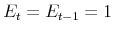 which one should think of as resulting from a large positive realization of the iid component
 that negatively affects the relative attractiveness of the current job rather than from a large draw of
. The line marked with "x" shows the average response. The negative effect on earnings reflects the value of lost tenure (.063). Since the job change is
not selective on
that negatively affects the relative attractiveness of the current job rather than from a large draw of
. The line marked with "x" shows the average response. The negative effect on earnings reflects the value of lost tenure (.063). Since the job change is
not selective on
 ,
declines by
,
declines by
 or .027. The line with triangles is the effect of an exogenous job change that is accompanied by a value of
 that is one standard deviation above its mean, or .269. The net positive effect is large and highly persistent. These results are mirrored in wages (Figure
5b). In addition, we show the effect of an exogenous job change that is accompanied by a 1 standard deviation increase of .157 in the job specific hours component
. This is associated with a positive increase in hours worked and in earnings that decays in half in the first few years but slowly thereafter. Since
is independent across jobs, the persistence stems from the fact that when is greater than 10, job changes with or without unemployment are infrequent.40
that is one standard deviation above its mean, or .269. The net positive effect is large and highly persistent. These results are mirrored in wages (Figure
5b). In addition, we show the effect of an exogenous job change that is accompanied by a 1 standard deviation increase of .157 in the job specific hours component
. This is associated with a positive increase in hours worked and in earnings that decays in half in the first few years but slowly thereafter. Since
is independent across jobs, the persistence stems from the fact that when is greater than 10, job changes with or without unemployment are infrequent.40
We also use the model to estimate the effects of an exogenous job loss and an exogenous job change on earnings risk using the methodology described above. The circle line in Figure 6a graphs the ratio of
 following an exogenous unemployment shock when
  to the baseline variance for the model. The variance ratio is slightly below 1 when , it is 1.46 when
  declines to 1.17 when
  and then slowly declines to 1 over the next ten years. The corresponding ratio for
 is about .83 when
  presumably because differences in wages
matter less when everyone is unemployed, 1.08 when
presumably because differences in wages
matter less when everyone is unemployed, 1.08 when  , and then slowly declines to about 1.03. The exogenous job change induces a big spike in the ratio
when . The corresponding ratio for
, and then slowly declines to about 1.03. The exogenous job change induces a big spike in the ratio
when . The corresponding ratio for
 rises slowly following the shock, presumably because in some cases the exogenous job change induces additional ones. We have produced corresponding figures for shocks at
 (not shown). The impact on the variance is somewhat smaller and less persistent.
5.5 Variance Decompositions
We have used our model to measure the relative importance of the initial condition and shocks to the autoregressive wage component, the iid hours shocks, the iid earnings shocks, job changes and employment spells and the associated shocks, the permanent heterogeneity components and , and the effects of education and race. However, because the sample
overrepresents blacks, we report variance decompositions using the white sample. To do this, we first compute the variance in the sum of the annual values of , , and
over a 40 year career. We then repeat the simulation after setting the
variance of the particular random component in the model to 0. We use the drop in the variance relative to the base case as the estimated contribution of the particular type of shock. Since the model is nonlinear, the contributions do not sum to 100% and may be negative.
We have normalized them to sum to 100. We report results for the levels of variables, accounting for the experience profile in all variables. The decompositions of the sums of the annual values of logs of earnings, hours, and wages are similar (not reported). We use the parametric bootstrap
distribution of the
to estimate the standard deviation of variance contributions, which are reported in parentheses. We continue to focus on Model A.3, but also briefly discuss results for Model A.2
and B.1.
The results for Model A.3 are in Table 4a. The first row refers to the sum of lifetime earnings. The earnings shocks
account for 6.6% of the variance in lifetime earnings even though they account for about 17% of
in a given year (Table 4b). The reason for the relatively small contribution is that the shocks are not very persistent. Similarly, the value in column II indicates that iid
hours shocks
contribute only 2.4% of the variance in lifetime earnings but account for between 7.7% and 9.3% in annual earnings (Table 4b). One can easily self-insure against these
shock categories. In contrast, in column III, the initial condition
 and the iid shocks to
are together responsible for 12.4% of the variance in lifetime earnings. The earnings results reflect the fact that these shocks account for 20.6% of the variance in lifetime
wages. They contribute little to the variance in hours because the response of hours to wages is small.
and the iid shocks to
are together responsible for 12.4% of the variance in lifetime earnings. The earnings results reflect the fact that these shocks account for 20.6% of the variance in lifetime
wages. They contribute little to the variance in hours because the response of hours to wages is small.
The most striking result is in Column IV, which shows the collective impact of job specific hours and wage components, unemployment spells, and job changes. Altogether, mobility and unemployment related shocks account for 36.7%, 48.2%, and 46.8% of the variance in lifetime earnings, wages, and
hours, respectively. Given the interactions among the job change and employment related factors, we break down their relative contributions by first turning off the job specific hours shocks, then turning off both hours and job specific wage shocks, then turning off hours, wage, and unemployment
shocks, and finally turning off hours, wage, and unemployment and the idiosyncratic job change shocks
 . The estimates are reported in columns VIII, IX, X, and XI. For earnings, job specific wage shocks are more important than hours shocks. Job specific wage shocks
dominate for wages, while job specific hours shocks dominate for hours.41
. The estimates are reported in columns VIII, IX, X, and XI. For earnings, job specific wage shocks are more important than hours shocks. Job specific wage shocks
dominate for wages, while job specific hours shocks dominate for hours.41
Finally, we turn to the three permanent heterogeneity components for whites: , , and . Surprisingly, the estimates in column V indicate that the mobility preference component does not play much of a role. The point estimate is actually negative. However, accounts for 11.4% of the variance in lifetime earnings and
46.2% of the variance in work hours but explains none of the variance in wages.42 The positive direct effect that has on the wage variance is offset by its role in reducing transitions into unemployment and job changes. Education is very important, contributing 31.4% of the variance in lifetime earnings and 34.6% of the variance in
lifetime wages but only 4.9% of the variance in lifetime hours.
The results for Model A2 (not reported) are basically similar to those for Model A3, except that plays a somewhat larger role in the variance of earnings and wages. The results for
Model B.1 are in Tables 5a and 5b. Model B.1 does not include job specific wage or hours components. Without these features, the interpretation of the results in terms of underlying economic factors is less transparent than those for A3. However, job changes with and without unemployment are
associated with reduced persistence and large innovations in
. This is reflected in the fact that the initial condition for
and the
shocks account for 24.6% of the variance in lifetime earnings and 45.59% of the variance in lifetime wages, respectively. The two unobserved heterogeneity
components and together account for about 30% of the earnings variance,
12% of the wage variance, and 85% of the hours variance. Education is also very important for both wages and earnings. Education, , and are much less important for variance in a given year. Note that one can use the model to examine the contributions of the shocks between, for instance, and  to the variance in earnings over the same period or subsequent periods, but we exclude such computations.
6 Results for Other Samples
In this section we briefly summarize results using the full SRC sample, the SRC sample of whites with some college or more, and the SRC sample of whites with a high school degree or less and no post secondary vocational education. We estimate wage, hours, and earnings residuals separately for
each sample, removing the race dummies from the models for whites. We use the tenure profile from Altonji and Williams (2005) for all subsamples. In the case of Model A.3 we continue to use
 for the full SRC sample and the SRC sample of whites. For
the SRC samples of whites by educational attainment we use
for the full SRC sample and the SRC sample of whites. For
the SRC samples of whites by educational attainment we use
 because the evidence based on (17) pointed to a slightly lower value. Columns 1b and 2b of Table 6 report estimates of Model A.3 and Model B.1 for
the full SRC sample. Because of the computational burden, we have only computed standard errors for the full SRC sample. For ease of comparison, we report estimates for the combined SRC-SEO sample in Columns 1a and 2a, which are the same as Columns 3a and 3c of Table 2 .
because the evidence based on (17) pointed to a slightly lower value. Columns 1b and 2b of Table 6 report estimates of Model A.3 and Model B.1 for
the full SRC sample. Because of the computational burden, we have only computed standard errors for the full SRC sample. For ease of comparison, we report estimates for the combined SRC-SEO sample in Columns 1a and 2a, which are the same as Columns 3a and 3c of Table 2 .
Overall, the point estimates for the SRC sample are very similar to those for the SRC-SEO sample. The coefficient on is smaller in the SRC sample, which may reflect the fact that
the SEO sample was drawn from households in low income areas. Individual heterogeneity plays a somewhat more important role in the wage equation.
Figure 7a reports the average response of earnings to shocks at t=10 and may be compared to Figure 5a for the SRC-SEO sample. The results are very similar to those for the full sample. Panel A of Table 7 reports variance decompositions of lifetime earnings, wages, and hours. The results are also quite similar to those for the SRC-SEO sample in Table 4a.
Columns 1d and 1e in Table 6 report model estimates for SRC subsamples of whites with a high school degree or less and whites with some college or more. (Individuals with a high school degree and some postsecondary vocational education are excluded from both samples.) For comparison, we also
report estimates for the full SRC sample of whites in column 1c. The point estimates are quite similar overall. However, a few differences are worth noting. First, mobility is less sensitive to seniority for the high education sample than for the low education sample. Second, is more responsive to outside offers in the case of the high education sample. Third, unemployment is less common for the high education sample. These facts are reflected in the decompositions of the
experience profile of wages in Appendix Figures B1 and B2, which show little growth in with  for the less educated sample. We also find that
 is considerably larger for the high education sample--.100 versus .075. The standard deviation of the iid component of hours is much larger for the less educated sample,
which probably reflects greater variation in overtime hours and in unemployment spells between surveys.
is considerably larger for the high education sample--.100 versus .075. The standard deviation of the iid component of hours is much larger for the less educated sample,
which probably reflects greater variation in overtime hours and in unemployment spells between surveys.
The variance decompositions in Panel B and Panel C of Table 7 indicate that the persistent productivity component
is more important for the high education sample than the low education sample for wages and earnings. Employment shocks, iid hours shocks, within group heterogeneity in
education, and are more important for the low education sample. The job specific hours component
 is more important for the high education sample.
7 Conclusion
In this paper, we study earnings across individuals and over careers. To this end, we construct a model of earnings dynamics from equations governing employment transitions, job changes without unemployment, wages, and work hours. Since both state dependence and heterogeneity are important and one cannot determine the role of one without accounting for the other, our models incorporate state dependence in employment, job changes, and wages, while also including multiple sources of unobserved heterogeneity as well as job-specific error components in both wages and hours. These turn out to play an important role in the variance of lifetime earnings. The equations of our model provide a rich statistical description of the earnings process but can also be viewed as first approximations to the decision rules suggested by structural models of employment transitions, job search, and labor supply. Our simulation based estimation strategy permits us to handle a highly unbalanced sample in the context of a model that mixes discrete and continuous variables and allows for both state dependence and multifactor heterogeneity and for measurement error. Vidangos (2008) shows the potential for using models of the type we develop by studying the implications of a related multi-equation model of family income for precautionary behavior and welfare within the context of a lifecycle consumption model.43
Our results address many important questions concerning wages, hours and earnings over a career. In keeping with many other studies, we find that education, race, and unobserved permanent heterogeneity all play an important role in employment transitions and job changes and that labor supply of male household heads is inelastic. By accounting for both unobserved individual heterogeneity and job specific heterogeneity, we are able to show that a substantial portion of the strong negative relationship between job seniority and job mobility found in many previous studies is causal. Job changes are induced by high outside offers and deterred by the job specific wage component of the current job. Job offers are strongly positively related to the job specific component on the current job, in contrast to the usual assumption in the search literature that offers are drawn at random. We discuss a number of possible explanations in the text.
Overall, wages are highly persistent but do not contain a random walk component. The persistence results from permanent heterogeneity, the job specific wage component, and strong persistence in the stochastic component that reflects the value of the worker's general skills.
We also contribute to the displaced workers literature by providing a full decomposition of earnings losses from unemployment. We find that short-term earnings losses from unemployment are dominated by hours and the long-term costs are dominated by wages, with lost tenure, movement to a lower paying job, and a drop in the autoregressive skill component all playing a role. We find general human capital accumulation is the dominant source of wage growth over a career, although job tenure and job mobility both play significant roles.
Finally, job mobility and unemployment play a key role in the variance of career earnings. They operate primarily by leading to large changes in job specific components of wages and hours rather than through their direct effects on wages and hours. For whites in our full sample, job specific hours and wage components, unemployment shocks, and job shocks together account for 36.7%, 48.2%, and 46.8% of the variance in lifetime earnings, wages, and hours, respectively. Job specific wage shocks are more important than job specific hours shocks for earnings. Job specific wage shocks dominate for wages, with employment shocks also playing a substantial role. For hours, job specific hours shocks dominate. Education accounts for about 1/3 of the variance in lifetime earnings and wages but makes little difference for hours. In our full sample, unobserved permanent heterogeneity accounts for about 11% of the variance in earnings and about 46% of the variance of hours but matters little for wages, although this breakdown is somewhat sensitive to the model and sample used.
There are number of extensions to the model that would be worth exploring. Thus far, we simply remove year effects from wages, hours, and earnings, but it would be natural to add aggregate shocks to the model. It would also be natural to extend the model to explore changes in the stability of earnings, building on work by Gottschalk and Moffitt (1994, 2008), Haider (2001), Shin and Solon (2008) and others. This would require a very different auxiliary model. With matched employer-employee data such as those used by Abowd et al (1999) and Bagger et al (2007), one could distinguish firm specific risk associated with observed as well as unobserved variables from job match specific risk. A much more ambitious extension would be to construct a model of the household income of an individual that incorporates marriage, divorce, and death of a spouse. This will be pursued in separate work.
Given the large number of issues that the paper already addresses, we do not attempt the formidable task of seeking to identify how much of the stochastic variation in earnings that we analyze is anticipated by agents, how far in advance they anticipate it, or how much is insured. Adding a family income model (with private and public transfers) as in Vidangos (2008) gets partially at the question of insurance. Dealing with expectations is more difficult. One needs either data on expectations or an expanded model that incorporates decisions that depend on and/or reveal the information set of the agent, such as consumption choices. Work by Blundell and Preston (1998), Blundell, Pistaferri, and Preston (2008), Cunha, Heckman, and Navarro (2005), Cunha and Heckman (2006), and Guvenen and Smith (2008) illustrate the latter approach.
References
Abowd, J.M. and Card, D.E. (1987)."Intertemporal labor supply and long-term employment contracts", American Economic Review, 77(1), 50-68.
Abowd, J.M. and Card, D.E. (1989). "On the covariance structure of hours and earnings changes", Econometrica, 57(2), 411-445.
Abowd, J.M., F. Kramarz, D.N. Margolis (1999). "High Wage Workers and High Wage Firms", Econometrica 67 (2) , 251-333.
Aiyagari, S.R. (1994). "Uninsured idiosyncratic risk and aggregate saving", Quarterly Journal of Economics 109, 659-684.
Altonji, J. G., A.P. Martins and A. Siow (2002). "Dynamic Factor Models of Wages, Hours, and Earnings", Research in Economics 56(1), 3-59.
Altonji, J. G., and C. H. Paxson (1986). "Job Characteristics and Hours of Work", in Research in Labor Economics, Vol. 8, Part A, ed. by R. G. Ehrenberg, Greenwich: Westview Press, 1-55.
Altonji, J. G. and C. R. Pierret (2001). "Employer Learning and Statistical Discrimination", Quarterly Journal of Economics, 116, 313-350.
Altonji, J. G. and R. A. Shakotko (1987): "Do Wages Rise with Job Seniority?" Review of Economic Studies, 54, 437-59.
Altonji, J. G. and N. Williams (1998). "The Effects of Labor Market Experience, Job Seniority, and Mobility on Wage Growth", Research in Labor Economics, 17, 233-276.
Altonji, J. G. and N. Williams (2005). "Do Wages Rise With Job Seniority? A Reassessment", Industrial and Labor Relations Review, 58(3), 370-397.
Bagger, J., F. Fontaine, F. Postel-Vinay, and J.M. Robin (2007). "A Tractable Equilibrium Search Model of Individual Wage Dynamics with Experience Accumulation", unpublished paper.
Baker, M. (1997). "Growth-rate heterogeneity and the covariance structure of life cycle earnings", Journal of Labour Economics, 15(2), 338-375.
Baker, Michael and Gary Solon (2003)"Earnings Dynamics and Inequality Among Canadian Men, 1976-1992: Evidence from Longitudinal Income Tax Records", Journal of Labor Economics 21 (2003), 289-321.
Barlevy, Gadi, (2008) "Identification of Search Models Using Record Statistics". Review of Economic Studies, 75(1):29-64.
Blundell, R. and I. Preston (1998), "Consumption inequality and income uncertainty", Quarterly Journal of Economics 113, 603-640.
Blundell, R., L. Pistaferri, and I. Preston (2008). " Consumption Inequality and Partial Insurance", American Economic Review 98(5), 1887-1921.
Blundell, R. and T. MaCurdy (1999). "Labor Supply: A Review of Alternative Approaches", in Handbook of Labor Economics, Vol. 3A.
Blundell, R. and I. Preston (1998). "Consumption Inequality and Income Uncertainty". Quarterly Journal of Economics 113(2), 603-640.
Bound, J., Brown, C., and Mathiowetz, N. (2001). " Measurement Error in Survey Data." in Handbook of Econometrics, V. 5, eds. E. E. Leamer and J. J. Heckman, pp 3705-3843.
Buchinsky,M. , Fougère, D., Kramarz, F. and Tchernis, R. (2008). "Interfirm Mobility, Wages, and the Returns to Seniority and Experience in the U.S." (March). IZA Discussion Paper No. 1521.
Carrington, W. J. (1993). "Wage Losses for Displaced Workers." Journal of Human Resources, 28 (3) (Summer), pp. 435-62.
Castañeda, A., Díaz-Giménez, J., and Ríos-Rull V. (2003). "Accounting for the U.S. Earnings and Wealth Inequality", Journal of Political Economy, 111(4), 818-857.
Cunha, F., J. J. Heckman, and S. Navarro (2005). " Separating Uncertainty from Heterogeneity in Life Cycle Earnings, The 2004 Hicks Lecture". Oxford Economic Papers 57(2), 191--261.
Cunha, F., J. J. Heckman (2006). "Identifying and Estimating the Distributions of Ex Post and Ex Ante Returns to Schooling: A Survey of Recent Developments", unpublished paper, University of Chicago.
Deaton, A. (1991). "Saving and liquidity constraints", Econometrica, 59(5), 1221-1248.
Farber, H. (1999), "Mobility and stability: The dynamics of job change in labor markets", in O. Ashenfelter and D. Card Editors, Handbook of Labor Economics Volume 3, Part 2, 2439-2483.
Fitzgerald, Gottschalk, and Moffitt (1998). "An Analysis of Sample Attrition in Panel Data: The Michigan Panel Study of Income Dynamics", Journal of Human Resources 33(2):251-299.
Geweke, J. and Keane, M. (2000). "An empirical analysis of earnings dynamics among men in the PSID: 1968-1989", Journal of Econometrics, 96, 293-356.
Gibbons, R., and L. Katz (1991). "Layoffs and Lemons", Journal of Labor Economics, IX, 351-80.
Gottschalk, P. and R. Moffitt (1994), "The Growth of Earnings Instability in the U.S. Labor Market.", Brookings Papers on Economic Activity, Issue 2, p217-272.
Gottschalk, P., and R. Moffitt (2008). "Trends in the Transitory Variance of Male Earnings in the U.S.: 1970-2004", draft.
Gourieroux, C., Monfort, A., and Renault, E. (1993). " Indirect Inference", Journal of Applied Econometrics 8, S85-S118.
Gourinchas, P.O., and Parker, J. (2002). "Consumption over the Life Cycle", Econometrica 70(1) 47-89.
Guvenen, F. (2007). "Learning Your Earning: Are Labor Income Shocks Really Very Persistent?", American Economic Review, 97(3), 687-712.
Guvenen, F and A. Smith. (2008). "Inferring Labor Income Risk From Economic Choices: An Indirect Inference Approach" , preliminary draft.
Haider, S.J. (2001). "Earnings Instability and Earnings Inequality of Males in the United States: 1967-1991", Journal of Labor Economics, 19(4), 799-836.
Ham, J. and Reilly, K. (2002). "Testing Intertemporal Substitution, Implicit Contract, and Hours Restriction Models of the Labor Market Using Micro Data", American Economic Review 92(4), 905-927.
Hause, J.C. (1980). "The fine structure of earnings and the on-the-job training hypothesis", Econometrica, 48(4), 1013-1029.
Heaton, J. and Lucas, D.J. (1996). "Evaluating the effects of incomplete markets on risk sharing and asset pricing", Journal of Political Economy, 104(3), 443-487.
Hubbard, G., Skinner, J., and Zeldes, S. (1994). "Expanding the Life-Cycle Model: Precautionary Saving and Public Policy", American Economic Review (Papers and Proceedings), 84(2), 174-179.
Huggett, M. (1996). "Wealth Distribution in Life-Cycle Economies", Journal of Monetary Economics, 38(3), 469-494.
Imrohoroglu, A. (1989). "Cost of Business Cycles with Indivisibilities and Liquidity Constraints", Journal of Political Economy, 97(6), 1364-1383.
Jacobson, L., LaLonde, R., and Sullivan, D. (1993). " Earnings Losses of Displaced Workers", American Economic Review, 83(4), 685-709.
Kambourov, G. and Manovskii, I. (2009). "Occupation Specificity of Human Capital", International Economic Review, 50(1), 63-115.
Keane, M. and Smith Jr., A . A. (2003). "Generalized Indirect Inference for Discrete Choice Models", unpublished manuscript, Yale University.
Kletzer, L. G. (1998), "Job Displacement" , The Journal of Economic Perspectives, Vol. 12, No. 1 (Winter), pp. 115-136.
Krusell, P. and Smith Jr., A . A. (1997). "Income and Wealth Heterogeneity, Portfolio Selection, and Equilibrium Asset Returns", Macroeconomic Dynamics, 1, 387-422.
Krusell, P. and Smith Jr., A . A. (1998). "Income and Wealth Heterogeneity in the Macroeconomy", Journal of Political Economy, 106(5), 867-896.
Krusell, P. and Smith Jr., A . A. (1999). "On the welfare effects of eliminating business cycles", Review of Economic Dynamics 2, 254-272.
Lillard, L. and Weiss, Y. (1979). "Components of variation in panel earnings data: American scientists 1960-1970", Econometrica 47(2), 437-454.
Lillard, L. and Willis, R. (1978). "Dynamic aspects of earning mobility", Econometrica 46(5), 985-1012.
Low, H., Meghir, C., and Pistaferri, L. (2008). "Wage Risk and Employment Risk over the Life Cycle", IZA Discussion Paper No. 3700.
MaCurdy, T.E. (1982). "The use of time series processes to model the error structure of earnings in a longitudinal data analysis", Journal of Econometrics, 18, 83-114.
Meghir, C. and Pistaferri, L. (2004). "Income variance dynamics and heterogeneity", Econometrica, 72(1), 1-32.
Nagypal, E. (2007)."Learning-by-Doing versus Learning About Match Quality: Can We Tell Them Apart?", Review of Economic Studies, 74 (2), 537-566.
Neal, D. (1995). "Industry-Specific Human Capital: Evidence from Displaced Workers,"Journal of Labor Economics, 13(4), 653-677.
Neal, D. (1999). "The Complexity of Job Mobility Among Young Men," Journal of Labor Economics, 17(2), 237-261.
Parent, D. (2000): "Industry-Specific Capital and the Wage Profile: Evidence from the National Longitudinal Survey of Youth and the Panel Study of Income Dynamics," Journal of Labor Economics, 18(2), 306-323.
Postel-Vinay, F. and Robin, J.-M. (2002). "Equilibrium Wage Dispersion with Worker and Employer Heterogeneity", Econometrica 70(6), 2295-2350.
Postel-Vinay, F. and Turon, H. (2005). "On-the-job Search, Productivity Shocks, and the Individual Earnings Process", unpublished manuscript, University of Bristol.
Schoenberg, U. (2005). "Testing for Asymmetric Employer Learning", unpublished paper, University of Rochester.
Senesky, S. (2005). "Testing the Intertemporal Labor Supply Model: Are Jobs Important?", Labour Economics, 12, 749-772.
Shin, D. and G. Solon (2008). "Trends in Men's Earnings Volatility: What Does the Panel Study of Income Dynamics Show?", NBER Working Paper W14075.
Smith, A.A., Jr. (1990). "Three Essays on the Solution and Estimation of Dynamic Macroeconomic Models", Ph.D. thesis (Duke University).
Smith, A.A., Jr. (1993). "Estimating Nonlinear Time-Series Models using Simulated Vector Autoregressions", Journal of Applied Econometrics 8, S63-S84.
Stevens, A.H. (1997) "Persistent Effects of Job Displacement: The Importance of Multiple Job Losses" Journal of Labor Economics, 15(1) Part 1, 165-188.
Storesletten, K., Telmer, C., and Yaron, A. (2001a). "The Welfare Costs of Business Cycles Revisited: Finite Lives and Cyclical Variation in Idiosyncratic Risk", European Economic Review, 45, 1311-1339.
Storesletten, K., Telmer, C., and Yaron, A. (2001b). "How Important are Idiosyncratic Shocks? Evidence from Labor Supply", American Economic Review (Papers and Proceedings), 91, 413-417.
Storesletten, K., Telmer, C., and Yaron, A. (2004a). " Consumption and Risk Sharing Over the Life Cycle", Journal of Monetary Economics, 51(3), 609-633.
Storesletten, K., Telmer, C., and Yaron, A. (2004b). " Cyclical Dynamics in Idiosyncratic Labor Market Risk", Journal of Political Economy, 112(3), 695-717.
Storesletten, K., Telmer, C., and Yaron, A. (2007). "Asset Pricing with Idiosyncratic Risk and Overlapping Generations", Review of Economic Dynamics, forthcoming.
Tartari, M. (2006). "Divorce and the Cognitive Achievement of Children", unpublished paper, Department of Economics, University of Pennsylvania.
Telmer, C. (1993). "Asset-Pricing Puzzles and Incomplete Markets", Journal of Finance, 48(5), 1803-1832.
Topel, R. (1991). "Specific Capital, Mobility, and Wages: Wages Rise with Job Seniority", Journal of Political Economy, 99(1), 145-176.
Topel, R. and Ward, M. (1992). "Job Mobility and the Careers of Young Men", Quarterly Journal of Economics, 107(2), 439-479.
Vidangos, I. (2008). "Fluctuations in Individual Labor Income: A Panel VAR Analysis", unpublished manuscript, Federal Reserve Board.
Vidangos, I. (2008). "Household Welfare, Precautionary Saving, and Social Insurance under Multiple Sources of Risk", unpublished manuscript, Federal Reserve Board.
Wolpin, K. (1992). "The Determinants of Black-White Differences in Early Employment Careers: Search, Layoffs, Quits, and Endogenous Wage Growth", Journal of Political Economy, 100(3), 535-560.
Appendix 1: A Moment Condition for
and
in Model B
Recall that the autoregressive wage component in equation (14) is:
 |
|
![\displaystyle \rho _{\omega }[1+\phi _{1}S_{it}]\omega _{_{i,t-1}}+\gamma _{JC}^{\omega }JC_{it}+\gamma _{1-E_{t}}^{\omega }(1-E_{it})+\gamma _{1-E_{t-1}}^{\omega }(1-E_{it-1}) \notag](img474.gif) |
|
![\displaystyle +[1+\phi _{2}S_{it}]\varepsilon _{it}^{\omega } \notag](img184.gif) |
Using the equation for the observed wage
, define
 |
 |
![\displaystyle [wage_{it}^{\ast }-\gamma _{0}^{w}-\gamma _{X}^{w}X_{it}-[\gamma _{JC}^{\omega }JC_{it}+\gamma _{1-E_{t}}^{\omega }(1-E_{it})+\gamma _{1-E_{t-1}}^{\omega }(1-E_{it-1}))]](img477.gif) |
|
|
![\displaystyle wres_{it}^{\ast }-[\gamma _{JC}^{\omega }JC_{it}+\gamma _{1-E_{t}}^{\omega }(1-E_{it})+\gamma _{1-E_{t-1}}^{\omega }(1-E_{it-1}))]](img478.gif) |
||
|
 |
Using the above equations, :
 |
|
| (19) |  |
Let 
![\lbrack wres_{it}^{\ast },JC_{it},(1-E_{it}),(1-E_{it-1}))]](img483.gif) and
and
![\Psi =[1,-\gamma _{JC}^{\omega },-\gamma _{1-E_{t}}^{\omega },-\gamma _{1-E_{t-1}}^{\omega }]](img484.gif) . One may rewrite the above equation as
. One may rewrite the above equation as
![\displaystyle \lbrack \Psi ^{\prime },-\rho _{\omega }\Psi ^{\prime },-\rho _{\omega }\phi _{1}\Psi ^{\prime }][Z_{it}^{\prime },Z_{it-1}^{\prime },S_{it}Z_{it-1}^{\prime }]^{\prime }](img485.gif)

Denote the left-hand side of (20) by
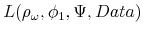 , and the right-hand side by
 .
.
Now, consider the following variances of
conditional on  :
:
![\displaystyle V_{1}^{R}\equiv Var[R(.)\vert S_{it}=1]=[\delta _{\mu }^{\omega }(1-\rho _{\omega }(1+\phi _{1}))]^{2}var(\mu _{i}\vert S_{it}=1)+(1+\phi _{2})^{2}\sigma _{\omega }^{2}+\sigma _{mw}^{2}+\rho _{\omega }^{2}(1+\phi _{1})^{2}\sigma _{mw}^{2}](img490.gif) |
and
![\displaystyle V_{0}^{R}\equiv Var[R(.)\vert S_{it}=0]=(\delta _{\mu }^{\omega }(1-\rho _{\omega }))^{2}var(\mu _{i}\vert S_{it}=0)+\sigma _{\omega }^{2}+\sigma _{mw}^{2}+\rho _{\omega }^{2}\sigma _{mw}^{2}](img491.gif) . . |
Assuming that
![[var(\mu _{i}\vert S_{it}=1)-var(\mu _{i}\vert S_{it}=0)]](img492.gif) is small, the difference is:
is small, the difference is:
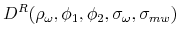
^{2}\sigma _{\mu }^{2}](img494.gif)
![\displaystyle +[(1+\phi _{2})^{2}-1]\sigma _{\omega }^{2}+\rho _{\omega }^{2}[(1+\phi _{1})^{2}-1]\sigma _{mw}^{2}. \notag](img495.gif)
The corresponding conditional variances of
are
![\displaystyle V_{1}^{L}\equiv \lbrack \Psi ^{\prime },-\rho _{\omega }\Psi ^{\prime },-\rho _{\omega }\phi _{1}\Psi ^{\prime }]Var([[Z_{it}^{\prime },Z_{it-1}^{\prime },S_{it}Z_{it-1}^{\prime }]^{\prime }\vert S_{it}=1][\Psi ^{\prime },-\rho _{\omega }\Psi ^{\prime },-\rho _{\omega }\phi _{1}\Psi ^{\prime }]^{\prime }](img496.gif)
|
and
![\displaystyle V_{0}^{L}\equiv \lbrack \Psi ^{\prime },-\rho _{\omega }\Psi ^{\prime },-\rho _{\omega }\phi _{1}\Psi ^{\prime }]Var([[Z_{it}^{\prime },Z_{it-1}^{\prime },S_{it}Z_{it-1}^{\prime }]^{\prime }\vert S_{it}=0][\Psi ^{\prime },-\rho _{\omega }\Psi ^{\prime },-\rho _{\omega }\phi _{1}\Psi ^{\prime }]^{\prime }](img497.gif)
|
Note that
 is not observed when
  and
and
 is not observed when
 Consequently, the elements of
![Var([[Z_{it}^{\prime },Z_{it-1}^{\prime },S_{it}Z_{it-1}^{\prime }]^{\prime }\vert S_{it}=1])](img502.gif) and
and
![Var([[Z_{it}^{\prime },Z_{it-1}^{\prime },S_{it}Z_{it-1}^{\prime }]^{\prime }\vert S_{it}=0])](img503.gif) that involve and
that involve and  are 0. We are assuming that selection on and does not affect the variance of very much.
Let
 At each stage of iteration, given estimates
 , and the moments from the PSID data, we compute
 . We set
 equal to the expression for
 in (21), evaluated at
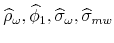 , and solve for
 .
.
This yields:
^{2}\hat{\sigma}_{\mu }^{2}}{\widehat{\sigma }_{\omega }^{2}}}](img512.gif)
One can see that
 is increasing in

Appendix 2: Decomposing Career Wage Growth into the Effects of General Human Capital, Tenure, and Job Shopping
The experience profile of wages
 is the sum of the effect of general human capital accumulation, the accumulation of job tenure and the gains from job shopping. That is,
 |
where ,
 is the value of general human capital,
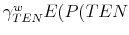
 is the expected value of the terms of
the tenure polynomial, and
is the expected value of the terms of
the tenure polynomial, and
 is the expected value of the job match component. We approximate
using a cubic polynomial in and obtain estimates from the
regression of
on a cubic in , education, race, and a set of year dummies. The
coefficients of the experience polynomial are reported in Table 2. Note that in the estimation of Model A.3 but not the other models, we account for the fact that
is the expected value of the job match component. We approximate
using a cubic polynomial in and obtain estimates from the
regression of
on a cubic in , education, race, and a set of year dummies. The
coefficients of the experience polynomial are reported in Table 2. Note that in the estimation of Model A.3 but not the other models, we account for the fact that
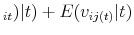 is removed from the PSID wage residuals that are used with our I-I estimator by adding a quadratic in to the wage equation. This polynomial is a quadratic approximation to
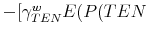
![_{it})\vert t)+E(v_{ij(t)}\vert t)].](img523.gif) Failure to include and when estimating the other model parameters is likely to bias the parameters involving the job match coefficient.
Failure to include and when estimating the other model parameters is likely to bias the parameters involving the job match coefficient.
We simulate data from the model to compute the values of
 and
and
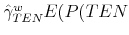 , where
 is taken from Altonji and Williams (2005). In figure 1 we graph
 and and  |
As one can see, most of the return to potential experience is due to general skill accumulation or the effect of age. Job shopping and the accumulation of tenure account for 14.6 percent and 13.5 percent, respectively, of the overall growth of wages over the first ten years. They account for
12.1 percent and 15.8 percent of growth over the first 35 years. In thinking about this, one should keep in mind that job losses counter the effects of selective mobility on growth in
. The fact that we exclude the first three years of labor market experience in the I-I estimator and miss job changes probably leads to an understatement of the
return to job shopping.
| Obs. | Mean | StDev | Min | Max | |
|---|---|---|---|---|---|
| Et | 33,933 | 0.97 | 0.18 | 0 | 1 |
| Et | Et-1 = 1 | 32,868 | 0.98 | 0.15 | 0 | 1 |
| Et | Et-1 = 0 | 1,065 | 0.71 | 0.45 | 0 | 1 |
| JCt | 33,933 | 0.08 | 0.28 | 0 | 1 |
| EDt | 33,933 | 11.58 | 7.45 | 0 | 42.25 |
| UDt | 33,933 | 0.05 | 0.31 | 0 | 8 |
| TENt | 33,933 | 9.34 | 7.81 | 0 | 42.25 |
| wage*t | 32,889 | 2.73 | 0.49 | 1.25 | 4.98 |
| hours*t | 33,933 | 7.73 | 0.29 | 5.30 | 8.34 |
| earn*t | 33,933 | 3.53 | 0.67 | -5.19 | 6.49 |
| wt(a) | 32,828 | 0.03 | 0.39 | -2.00 | 2.22 |
| ht(a) | 33,933 | 0.04 | 0.28 | -2.51 | 0.87 |
| et(a) | 33,933 | 0.06 | 0.57 | -8.91 | 2.44 |
(a)Variable is the residual from a 1-st stage least-squares regression against race, years of education, a cubic in potential experience, and year indicators.
| Obs. | Mean | StDev | Min | Max | |
|---|---|---|---|---|---|
| Potential Experience | 33,933 | 19.34 | 8.80 | 4 | 40 |
| Education (years) | 33,933 | 12.94 | 2.38 | 6 | 17 |
| Black | 33,933 | 0.29 | 0.45 | 0 | 1 |
| Calendar Year | 33,933 | 1987.5 | 5.25 | 1978 | 1996 |
| Parameter | Model A.1 1a Point Est. | Model A.1 1b MC Mean | Model A.1 1c S.E. | Model A.2 2a Point Est. | Model A.2 2b MC Mean | Model A.2 2c S.E. | Model B.1 3a Point Est. | Model B.1 3b MC Mean | Model B.1 3c S.E. | Model B.1 4a Point Est. | Model B.1 4b MC Mean | Model B.1 4c S.E. | |
|---|---|---|---|---|---|---|---|---|---|---|---|---|---|
| E-E Equation (cons) | γEE0 | 0.9360 | 0.6855 | (-0.1878) | 0.9366 | 0.6624 | (-0.2186) | 1.0141 | 0.7833 | (-0.1853) | 1.0309 | 0.8374 | (-0.1359) |
| E-E Equation (ti-1)/10 | γEEt | -0.6208 | -0.3675 | (-0.1453) | -0.8330 | -0.5520 | (-0.1639) | -0.3707 | -0.1664 | (-0.0976) | -0.5654 | -0.3432 | (-0.1225) |
| E-E Equation (ti-1)2/100 | γEEt2 | 0.2242 | 0.1590 | (-0.0408) | 0.2714 | 0.1963 | (-0.0414) | 0.1465 | 0.0927 | (-0.0231) | 0.1908 | 0.1289 | (-0.0342) |
| E-E Equation (EDt-1) | γEEED | 0.0211 | 0.0186 | (-0.0217) | 0.0298 | 0.0310 | (-0.0246) | 0.0440 | 0.0439 | (-0.0176) | 0.0711 | 0.0740 | (-0.0086) |
| E-E Equation BLACK | γEEBLACK | -0.2910 | -0.2670 | (-0.0529) | -0.3047 | -0.2671 | (-0.0646) | -0.3608 | -0.3261 | (-0.0571) | -0.3117 | -0.2724 | (-0.0429) |
| E-E Equation EDUC | γEEEDUC | 0.1096 | 0.1063 | (-0.0190) | 0.1264 | 0.1186 | (-0.0246) | 0.0801 | 0.0758 | (-0.0159) | 0.0694 | 0.0621 | (-0.0102) |
| E-E Equation (wage't) | γEEw' | -0.2169 | -0.1877 | (-0.0941) | -0.0582 | -0.0217 | (-0.0763) | ||||||
| E-E Equation (μ) | δEEμ | 0.4574 | 0.4275 | (-0.0678) | 0.5833 | 0.5117 | (-0.1049) | 0.4426 | 0.3921 | (-0.0936) | 0.3427 | 0.3076 | (-0.0333) |
| E-E Equation (η) | δEEη | 0.1949 | 0.1809 | (-0.0930) | 0.1102 | 0.1140 | (-0.1062) | -0.2370 | -0.1868 | (-0.1070) | 0.1005 | 0.0750 | (-0.0366) |
| U-E Equation (cons) | γUE0 | -0.0264 | -1.0104 | (-0.8326) | -0.6039 | -1.4430 | (-0.7368) | 0.0771 | -0.9389 | (-0.8416) | -0.1514 | -0.9070 | (-0.7311) |
| U-E Equation (ti-1)/10 | γUEt | -0.8677 | -0.5467 | (-0.4987) | -0.0218 | 0.0824 | (-0.4277) | -1.0505 | -0.5641 | (-0.4892) | -0.5021 | -0.2730 | (-0.3896) |
| U-E Equation (ti-1)2/100 | γUEt2 | 0.2608 | 0.2115 | (-0.1350) | 0.0699 | 0.0702 | (-0.1195) | 0.3330 | 0.2339 | (-0.1358) | 0.1696 | 0.1322 | (-0.1040) |
| U-E Equation BLACK | γUEBLACK | -0.5375 | -0.4685 | (-0.1212) | -0.6158 | -0.5488 | (-0.1493) | -0.4860 | -0.4123 | (-0.1325) | -0.4810 | -0.4424 | (-0.1253) |
| U-E Equation EDUC | γUEEDUC | 0.1798 | 0.2132 | (-0.0503) | 0.1600 | 0.1985 | (-0.0619) | 0.1742 | 0.2009 | (-0.0537) | 0.1510 | 0.1746 | (-0.0490) |
| U-E Equation (μ) | δUEμ | 0.2570 | 0.2548 | (-0.1696) | 0.2118 | 0.1879 | (-0.1546) | 0.6372 | 0.5434 | (-0.1281) | 0.2276 | 0.2053 | (-0.1591) |
| U-E Equation (η) | δUEη | 0.5789 | 0.4650 | (-0.1233) | 0.6204 | 0.4967 | (-0.1140) | 0.2218 | 0.1257 | (-0.1873) | 0.5889 | 0.4830 | (-0.0943) |
| JC Equation (cons) | γJC0 | -0.3114 | -0.2486 | (-0.1523) | -0.3781 | -0.3414 | (-0.1429) | -0.6264 | -0.5177 | (-0.1628) | -0.5048 | -0.4706 | (-0.1725) |
| JC Equation (ti-1)/10 | γJCt | -0.2132 | -0.2615 | (-0.1116) | 0.0018 | -0.0775 | (-0.1261) | -0.0983 | -0.2112 | (-0.1062) | -0.2125 | -0.3026 | (-0.1579) |
| JC Equation (ti-1)2/100 | γJCt2 | -0.0134 | 0.0049 | (-0.0271) | -0.0637 | -0.0368 | (-0.0316) | -0.0455 | -0.0113 | (-0.0247) | -0.0137 | 0.0144 | (-0.0388) |
| JC Equation (TENt-1) | γJCTEN | -0.0786 | -0.0705 | (-0.0149) | -0.1138 | -0.1065 | (-0.0159) | -0.0673 | -0.0544 | (-0.0156) | -0.0767 | -0.0612 | (-0.0166) |
| JC Equation BLACK | γJCBLACK | 0.0885 | 0.0924 | (-0.0390) | 0.0538 | 0.0629 | (-0.0333) | 0.1658 | 0.1839 | (-0.0554) | 0.1033 | 0.1165 | (-0.0407) |
| JC Equation EDUC | γJCEDUC | -0.0325 | -0.0328 | (-0.0104) | -0.0222 | -0.0206 | (-0.0087) | -0.0184 | -0.0205 | (-0.0108) | -0.0189 | -0.0174 | (-0.0102) |
| JC Equation (υt-1) | δJCυ-1 | -0.5082 | -0.4801 | (-0.0697) | -0.9230 | -0.9187 | (-0.1274) | ||||||
| JC Equation (υt) | δJCυ | 0.2101 | 0.2333 | (-0.0659) | 0.5936 | 0.6155 | (-0.1410) | ||||||
| JC Equation (μ) | δJCμ | -0.5491 | -0.5357 | (-0.0651) | -0.3522 | -0.3503 | (-0.0681) | -0.2796 | -0.2935 | (-0.1362) | -0.5449 | -0.5587 | (-0.0707) |
| JC Equation (η) | δJCη | 0.0650 | 0.0827 | (-0.0890) | 0.1446 | 0.1414 | (-0.0845) | 0.5308 | 0.5209 | (-0.0995) | 0.1270 | 0.1409 | (-0.0692) |
| Wage Equation BLACK | γwBLACK(i) | -0.2048 | (-0.0038) | -0.2048 | (-0.0038) | -0.2048 | (-0.0038) | -0.2048 | (-0.0038) | ||||
| Wage Equation EDUC | γwEDUC(i) | 0.1049 | (-0.0008) | 0.1049 | (-0.0008) | 0.1049 | (-0.0008) | 0.1049 | (-0.0008) | ||||
| Wage Equation Tenure polynomial | no | no | yes | no | |||||||||
| Wage Equation (ti-1)/10(*) | γwt(i) | 0.7514 | (-0.0211) | 0.7514 | (-0.0211) | 0.7514 | (-0.0211) | 0.7514 | (-0.0211) | ||||
| Wage Equation (ti-1)2/100 | γwt2(i) | -0.2430 | (-0.0118) | -0.2430 | (-0.0118) | -0.2430 | (-0.0118) | -0.2430 | (-0.0118) | ||||
| Wage Equation (ti-1)3/1000 | γwt3(i) | 0.0278 | (-0.0019) | 0.0278 | (-0.0019) | 0.0278 | (-0.0019) | 0.0278 | (-0.0019) | ||||
| Wage Equation (μ) | δwμ | 0.1264 | 0.1297 | (-0.0124) | 0.0633 | 0.0653 | (-0.0218) | 0.0490 | 0.0477 | (-0.0278) | 0.1505 | 0.1512 | (-0.0118) |
| Wage Equation (JCt) | γυ0 | 0.0420 | 0.0442 | (-0.0074) | 0.0355 | 0.0359 | (-0.0068) | ||||||
| Wage Equation (υt-1) | ρυ | 0.5651 | 0.5867 | (-0.0215) | 0.5962 | 0.6142 | (-0.0227) | 0.6252 | 0.6399 | (-0.0224) | |||
| Wage Equation (ευ) | συ | 0.2656 | 0.2765 | (-0.0064) | 0.2710 | 0.2820 | (-0.0063) | 0.2686 | 0.2775 | (-0.0070) | |||
| Wage Equation (ευ1) | συ1 | 0.1443 | 0.1528 | (-0.0315) | 0.1833 | 0.1943 | (-0.0162) | 0.1967 | 0.2103 | (-0.0205) | |||
| Wage Equation (ωt-1) | ρω | 0.9200 (ii) | 0.9200 (ii) | 0.9200 (ii) | 0.9577 | 0.9603 | (-0.0027) | ||||||
| Wage Equation (ωt-1) | φ1 | -0.2379 | -0.2339 | (-0.0115) | |||||||||
| Wage Equation (1-Et) | γω1-Et | -0.2016 | -0.2016 | (-0.0100) | -0.2317 | -0.2298 | (-0.0104) | -0.1895 | -0.1877 | (-0.0102) | -0.1858 | -0.1866 | (-0.0099) |
| Wage Equation (1-Et-1) | γω1-Et-1 | 0.0978 | 0.0997 | (-0.0121) | 0.1010 | 0.1017 | (-0.0121) | 0.1041 | 0.1052 | (-0.0132) | 0.0626 | 0.0630 | (-0.0110) |
| Wage Equation (εω) | σω | 0.0954 | 0.0916 | (-0.0026) | 0.0929 | 0.0891 | (-0.0025) | 0.0950 | 0.0922 | (-0.0029) | 0.0934 | 0.0904 | (-0.0017) |
| Wage Equation (εω) | φ2 | 2.1000 | 2.1969 | (-0.0553) | |||||||||
| Wage Equation (εω1) (Black, Low Educ) | σω1 (ii) | 0.2572 | 0.2477 | (-0.0177) | 0.2557 | 0.2450 | (-0.0142) | 0.2488 | 0.2343 | (-0.0195) | 0.2834 | 0.2827 | (-0.0063) |
| Wage Equation (εω1) (Black, High Educ) | σω1 (ii) | 0.2836 | 0.2751 | (-0.0159) | 0.2822 | 0.2727 | (-0.0127) | 0.2760 | 0.2632 | (-0.0171) | 0.3076 | 0.3070 | (-0.0058) |
| Wage Equation (εω1) (White, Low Educ) | σω1 (ii) | 0.2563 | 0.2467 | (-0.0178) | 0.2547 | 0.2440 | (-0.0142) | 0.2478 | 0.2333 | (-0.0196) | 0.2826 | 0.2819 | (-0.0063) |
| Wage Equation (εω1) (White, High Educ) | σω1 (ii) | 0.3133 | 0.3057 | (-0.0142) | 0.3120 | 0.3034 | (-0.0114) | 0.3064 | 0.2950 | (-0.0152) | 0.3351 | 0.3345 | (-0.0053) |
| Hours Equation (cons) | γh0 | -0.3630 | -0.3737 | (-0.0084) | -0.3609 | -0.3710 | (-0.0081) | -0.3632 | -0.3747 | (-0.0076) | -0.3633 | -0.3745 | (-0.0081) |
| Hours Equation BLACK | γhBLACK (i) | -0.1055 | (-0.0043) | -0.1055 | (-0.0043) | -0.1055 | (-0.0043) | -0.1055 | (-0.0043) | ||||
| Hours Equation EDUC | γhEDUC (i) | 0.0178 | (-0.0007) | 0.0178 | (-0.0007) | 0.0178 | (-0.0007) | 0.0178 | (-0.0007) | ||||
| Hours Equation (Et) | γhE | 0.4104 | 0.4114 | (-0.0082) | 0.4110 | 0.4122 | (-0.0070) | 0.4129 | 0.4142 | (-0.0075) | 0.4157 | 0.4168 | (-0.0074) |
| Hours Equation | σξ | 0.1631 | 0.1802 | (-0.0143) | 0.1611 | 0.1762 | (-0.0131) | 0.1574 | 0.1726 | (-0.0136) | |||
| Hours Equation (wt) | γhw | -0.0680 | -0.0681 | (-0.0128) | -0.0698 | -0.0682 | (-0.0139) | -0.0692 | -0.0670 | (-0.0148) | -0.0929 | -0.0921 | (-0.0148) |
| Hours Equation (μ) | δhμ | 0.0707 | 0.0714 | (-0.0170) | 0.0894 | 0.0846 | (-0.0188) | 0.1248 | 0.1204 | (-0.0135) | 0.0929 | 0.0935 | (-0.0188) |
| Hours Equation (η) | δhη | 0.0991 | 0.0953 | (-0.0198) | 0.0848 | 0.0888 | (-0.0224) | 0.0145 | 0.0200 | (-0.0304) | 0.1545 | 0.1539 | (-0.0102) |
| Hours Equation (εh) | σh | 0.1676 | 0.1654 | (-0.0026) | 0.1679 | 0.1659 | (-0.0024) | 0.1686 | 0.1667 | (-0.0023) | 0.1800 | 0.1802 | (-0.0009) |
| Earnings Equation (cons) | γe0 | -0.0043 | -0.0059 | (-0.0026) | -0.0047 | -0.0061 | (-0.0026) | -0.0061 | -0.0071 | (-0.0024) | -0.0044 | -0.0060 | (-0.0022) |
| Earnings Equation (wt) | γew(iii) | 1.0000 | 1.0000 | 1.0000 | 1.0000 | ||||||||
| Earnings Equation (ht) | γeh(iii) | 1.0000 | 1.0000 | 1.0000 | 1.0000 | ||||||||
| Earnings Equation | ρe | 0.5510 | 0.5508 | (-0.0084) | 0.5498 | 0.5506 | (-0.0073) | 0.5527 | 0.5528 | (-0.0068) | 0.5481 | 0.5476 | (-0.0072) |
| Earnings Equation (εe) | σe | 0.2110 | 0.2108 | (-0.0015) | 0.2105 | 0.2103 | (-0.0015) | 0.2109 | 0.2107 | (-0.0016) | 0.2109 | 0.2106 | (-0.0014) |
(i) Estimate obtained in first-stage least-squares regression.
(ii) Estimate obtained using additional moment conditions. See discussion in Section 4.
(iii) Imposed.
| PSID 1a(1) Et | PSID 2a(2) Et | PSID 3a(3) JCt | Model A.3 1b(1) Et | Model A.3 2b(2) Et | Model A.3 3b(3) JCt | Model B.1 1c(1) Et | Model B.1 2c(2) Et | Model B.1 3c(3) JCt | |
|---|---|---|---|---|---|---|---|---|---|
| PEt-1 /10 | -0.0069 | 0.1446 | -0.0702 | -0.0348 | -0.2304 | -0.0420 | -0.0415 | -0.1189 | -0.0541 |
| PEt-1 /10 | (-0.0050) | (-0.0901) | (-0.0090) | (-0.0010) | (-0.0154) | (-0.0018) | (-0.0010) | (-0.0156) | (-0.0018) |
| PE2t-1 /100 | -0.0003 | -0.0319 | 0.0169 | 0.0052 | 0.0632 | 0.0107 | 0.0070 | 0.0296 | 0.0135 |
| PE2t-1 /100 | (-0.0011) | (-0.0217) | (-0.0020) | (-0.0002) | (-0.0038) | (-0.0004) | (-0.0002) | (-0.0039) | (-0.0004) |
| EDt-1 | 0.0025 | 0.0031 | 0.0030 | ||||||
| EDt-1 | (-0.0002) | (-0.0000) | (-0.0000) | ||||||
| UDt-1 | -0.1071 | -0.0559 | -0.0498 | ||||||
| UDt-1 | (-0.0181) | (-0.0011) | (-0.0011) | ||||||
| TENt-1 /10 | -0.0803 | -0.0912 | -0.0922 | ||||||
| TENt-1 /10 | (-0.0026) | (-0.0004) | (-0.0004) | ||||||
| Constant | 0.9638 | 0.7453 | 0.2173 | 0.9691 | 0.9647 | 0.2159 | 0.9759 | 0.8808 | 0.2266 |
| Constant | (-0.0047) | (-0.0866) | (-0.0086) | (-0.0010) | (-0.0142) | (-0.0017) | (-0.0010) | (-0.0145) | (-0.0017) |
| Observations | 27651 | 708 | 27055 | 816079 | 34691 | 793445 | 816281 | 34489 | 793549 |
| R-squared | 0.01 | 0.05 | 0.05 | 0.02 | 0.08 | 0.07 | 0.02 | 0.06 | 0.07 |
| RMSE | 0.14 | 0.44 | 0.26 | 0.16 | 0.45 | 0.28 | 0.16 | 0.45 | 0.28 |
(1) Sample restricted to observations where Et-1=1.
(2) Sample restricted to observations where Et-1=0.
(3) Sample restricted to observations where Et=1 and Et-1=1.
| PSID 1a Wt | PSID 2a Wt | PSID 3a Wt | PSID 4a Wt | Model A.3 1b Wt | Model A.3 2b Wt | Model A.3 3b Wt | Model A.3 4b Wt | Model B.1 1c Wt | Model B.1 2c Wt | Model B.1 3c Wt | Model B.1 4c Wt | |
|---|---|---|---|---|---|---|---|---|---|---|---|---|
| Wt-1 | 0.8850 | 0.6173 | 0.6142 | 0.9051 | 0.7261 | 0.7256 | 0.9010 | 0.7240 | 0.7244 | |||
| Wt-1(Standard Error) | (-0.0029) | (-0.0063) | (-0.0063) | (-0.0005) | (-0.0012) | (-0.0012) | (-0.0005) | (-0.0012) | (-0.0012) | |||
| Wt-2 | 0.3164 | 0.3172 | 0.1984 | 0.1979 | 0.1964 | 0.1973 | ||||||
| Wt-2(Standard Error) | (-0.0063) | (-0.0063) | (-0.0012) | (-0.0012) | (-0.0012) | (-0.0012) | ||||||
| JCt | -0.0389 | -0.0129 | 0.0185 | |||||||||
| JCt(Standard Error) | (-0.0044) | (-0.0007) | (-0.0007) | |||||||||
| PEt-1 /10 | (-0.2209) | (-0.1395) | (-0.1002) | |||||||||
| PEt-1 /10 (Standard Error) | (-0.0378) | (-0.0074) | (-0.0072) | |||||||||
| PE2t-1 /100 | 0.0615 | 0.0456 | 0.0179 | |||||||||
| PE2t-1 /100 (Standard Error) | (-0.0188) | (-0.0037) | (-0.0036) | |||||||||
| PE3t-1 /1000 | (-0.0074) | (-0.0061) | (-0.0028) | |||||||||
| PE3t-1 /1000 (Standard Error) | (-0.0028) | (-0.0006) | (-0.0005) | |||||||||
| TENt-1 /10 | 0.3944 | 0.4107 | 0.2519 | |||||||||
| TENt-1 /10 (Standard Error) | (-0.0175) | (-0.0029) | (-0.0028) | |||||||||
| TEN2t-1 /100 (Standard Error) | (-0.1600) | (-0.2207) | (-0.0882) | |||||||||
| TEN2t-1 /100 (Standard Error) | (-0.0138) | (-0.0023) | (-0.0022) | |||||||||
| TEN3t-1 /100 | 0.0249 | 0.0342 | 0.0136 | |||||||||
| TEN3t-1 /100 (Standard Error) | (-0.0029) | (-0.0005) | (-0.0005) | |||||||||
| Constant | 0.0132 | 0.0147 | 0.0175 | 0.0591 | 0.0058 | 0.0059 | 0.0070 | -0.0010 | 0.0043 | 0.0041 | 0.0025 | 0.0200 |
| Constant (Standard Error) | (-0.0011) | (-0.0011) | (-0.0012) | (-0.0223) | (-0.0002) | (-0.0002) | (-0.0002) | (-0.0044) | (-0.0002) | (-0.0002) | (-0.0002) | (-0.0043) |
| Observations | 27055 | 22587 | 22587 | 32828 | 793445 | 652618 | 652618 | 976539 | 793549 | 652765 | 652765 | 976949 |
| R-squared | 0.77 | 0.8 | 0.8 | 0.07 | 0.83 | 0.84 | 0.84 | 0.04 | 0.82 | 0.83 | 0.83 | 0.05 |
| RMSE | 0.18 | 0.17 | 0.17 | 0.37 | 0.17 | 0.16 | 0.16 | 0.4 | 0.17 | 0.16 | 0.16 | 0.39 |
from Models A.3 and B.1 - Hours Regressions
| PSID 1a ht | Model A.3 1b ht | Model B.1 1c ht | |
|---|---|---|---|
| PEt-1 /10 | -0.0081 | 0.0084 | 0.0069 |
| PEt-1 /10 (Standard Error) | (-0.0086) | (-0.0018) | (-0.0018) |
| PE2t-1 /100 | 0.0006 | -0.0021 | -0.0019 |
| PE2t-1 /100 (Standard Error) | (-0.0018) | (-0.0004) | (-0.0004) |
| ht-1 | 0.3697 | 0.3236 | 0.2758 |
| ht-1 (Standard Error) | (-0.0067) | (-0.0011) | (-0.0011) |
| ht-2 | 0.1826 | 0.2741 | 0.2748 |
| ht-2 (Standard Error) | (-0.0065) | (-0.0011) | (-0.0011) |
| wt | -0.0005 | -0.0191 | -0.0113 |
| wt (Standard Error) | (-0.0036) | (-0.0007) | (-0.0007) |
| Constant | 0.0368 | 0.0219 | 0.0276 |
| Constant (Standard Error) | (-0.0091) | (-0.0019) | (-0.0019) |
| Observations | 23322 | 689672 | 689749 |
| R-squared | 0.23 | 0.28 | 0.24 |
| RMSE | 0.21 | 0.24 | 0.23 |
| PSID 1a et | PSID 2a et | Model A.3 1b et | Model A.3 2b et | Model B.1 1c et | Model B.1 2c et | |
|---|---|---|---|---|---|---|
| PEt-1 /10 | 0.0304 | -0.0105 | -0.0113 | |||
| PEt-1 /10 (Standard Error) | (-0.0130) | (-0.0029) | (-0.0029) | |||
| PE2t-1 /100 | -0.0078 | 0.0023 | 0.0025 | |||
| PE2t-1 /100 (Standard Error) | (-0.0028) | (-0.0006) | (-0.0006) | |||
| et-1 | 0.6873 | 0.5488 | 0.5330 | |||
| et-1 (Standard Error) | (-0.0069) | (-0.0011) | (-0.0011) | |||
| et-2 | 0.1859 | 0.2513 | 0.2684 | |||
| et-2 (Standard Error) | (-0.0070) | (-0.0011) | (-0.0011) | |||
| wt | 0.9232 | 0.9601 | 0.9624 | |||
| wt (Standard Error) | (-0.0043) | (-0.0008) | (-0.0008) | |||
| ht | 0.7701 | 0.8757 | 0.8703 | |||
| ht (Standard Error) | (-0.0068) | (-0.0011) | (-0.0012) | |||
| Constant | -0.0214 | 0.0214 | 0.0137 | 0.0007 | 0.0169 | 0.0039 |
| Constant (Standard Error) | (-0.0137) | (-0.0017) | (-0.0030) | (-0.0003) | (-0.0030) | (-0.0003) |
| Observations | 23915 | 32828 | 717450 | 976539 | 717450 | 976949 |
| R-squared | 0.65 | 0.65 | 0.57 | 0.69 | 0.57 | 0.69 |
| RMSE | 0.32 | 0.3 | 0.39 | 0.31 | 0.38 | 0.3 |
| I Shock: εe | II Shock: εh | III Shock:εw | IV Shock: Composite | V Shock: η | VI Shock: μ | VII Shock: Educ | VIII Breakdown of Composite 'Shock': ξ | IX Breakdown of Composite 'Shock': υ | X Breakdown of Composite 'Shock': E | XI Breakdown of Composite 'Shock': JC | |
|---|---|---|---|---|---|---|---|---|---|---|---|
| Lifetime Earnings | 6.56 | 2.35 | 12.41 | 36.65 | -0.78 | 11.42 | 31.38 | 7.80 | 27.58 | 1.71 | -0.44 |
| (SE) | (-0.18) | (-0.07) | (-0.93) | (-2.42) | (-2.18) | (-4.04) | (-0.91) | (-1.36) | (-2.29) | (-0.28) | (-0.17) |
| Lifetime Wage | 0 | 0 | 20.61 | 48.18 | -3.06 | -0.29 | 34.56 | 0 | 47.14 | 1.69 | -0.64 |
| (SE) | (-0.00) | (-0.00) | (-1.29) | (-2.28) | (-1.32) | (-2.77) | (-1.01) | (-0.00) | (-2.43) | (-0.37) | (-0.28) |
| Lifetime Hours | 0 | 4.49 | 0.45 | 46.81 | -2.78 | 46.17 | 4.86 | 42.65 | 0.61 | 3.73 | -0.18 |
| (SE) | (-0.00) | (-0.13) | (-0.17) | (-7.48) | (-4.22) | (-7.73) | (-0.42) | (-7.27) | (-0.29) | (-0.46) | (-0.06) |
| I Shock: εe | II Shock: εh | III Shock: εw | IV Shock: Composite | V Shock: η | VI Shock: μ | VII Shock: Educ | VIII Breakdown of Composite 'Shock': ξ | IX Breakdown of Composite 'Shock': υ | X Breakdown of Composite 'Shock': E | XI Breakdown of Composite 'Shock': JC | |
|---|---|---|---|---|---|---|---|---|---|---|---|
| Earnings t = 1 | 14.0 | 9.3 | 23.4 | 19.0 | 0.1 | 10.0 | 24.2 | 8.4 | 10.5 | 0.2 | 0 |
| Earnings t = 1 (Standard Error) | (-0.28) | (-0.28) | (-2.44) | (-2.59) | (-0.57) | (-2.64) | (-0.37) | (-1.50) | (-2.32) | (-0.07) | (-0.00) |
| Earnings t = 5 | 17.7 | 7.7 | 17.9 | 26.1 | 0.3 | 8.5 | 21.9 | 7.8 | 18.8 | 0.9 | -1.5 |
| Earnings t = 5 (Standard Error) | (-0.38) | (-0.27) | (-1.54) | (-2.07) | (-1.05) | (-2.59) | (-0.37) | (-1.35) | (-1.95) | (-0.22) | (-0.19) |
| Earnings t = 10 | 17.9 | 8.5 | 15.8 | 28.6 | 0.4 | 8.0 | 20.8 | 7.6 | 21.9 | 0.9 | -1.8 |
| Earnings t = 10 (Standard Error) | (-0.37) | (-0.27) | (-1.15) | (-1.98) | (-1.33) | (-2.89) | (-0.50) | (-1.28) | (-1.89) | (-0.22) | (-0.20) |
| Earnings t = 20 | 17.0 | 8.3 | 14.7 | 32.2 | -0.1 | 7.2 | 20.7 | 6.5 | 25.6 | 1.1 | -0.9 |
| Earnings t = 20 (Standard Error) | (-0.45) | (-0.26) | (-0.98) | (-2.03) | (-1.39) | (-3.03) | (-0.56) | (-1.26) | (-1.96) | (-0.19) | (-0.15) |
| Earnings t = 30 | 16.8 | 8.7 | 13.1 | 32.6 | 2.5 | 6.6 | 19.7 | 6.9 | 25.4 | 0.7 | -0.4 |
| Earnings t = 30 (Standard Error) | (-0.42) | (-0.34) | (-0.91) | (-1.99) | (-1.74) | (-3.19) | (-0.59) | (-1.22) | (-1.91) | (-0.14) | (-0.12) |
| Earnings t = 40 | 17.5 | 7.9 | 14.5 | 34.0 | 1.5 | 5.6 | 19.0 | 7.0 | 26.9 | 0.3 | -0.2 |
| Earnings t = 40 (Standard Error) | (-0.46) | (-0.32) | (-0.89) | (-1.84) | (-2.02) | (-2.70) | (-0.54) | (-1.19) | (-1.88) | (-0.08) | (-0.09) |
| Wage t = 1 | 0 | 0 | 45.1 | 22.7 | 0 | 1.7 | 30.4 | 0 | 22.7 | 0 | 0 |
| Wage t = 1 (Standard Error) | (-0.00) | (-0.00) | (-4.50) | (-4.60) | (-0.00) | (-1.77) | (-0.11) | (-0.00) | (-4.60) | (-0.00) | (-0.00) |
| Wage t = 5 | 0 | 0 | 35.7 | 36.5 | -0.1 | 1.0 | 27.0 | 0 | 37.4 | 0.7 | -1.5 |
| Wage t = 5 (Standard Error) | (-0.00) | (-0.00) | (-2.52) | (-2.77) | (-0.50) | (-1.55) | (-0.47) | (-0.00) | (-2.72) | (-0.24) | (-0.26) |
| Wage t = 10 | 0 | 0 | 31.4 | 42.5 | -0.8 | 0.7 | 26.2 | 0 | 43.2 | 1.0 | -1.7 |
| Wage t = 10 (Standard Error) | (-0.00) | (-0.00) | (-1.84) | (-2.29) | (-0.80) | (-1.77) | (-0.61) | (-0.00) | (-2.31) | (-0.31) | (-0.31) |
| Wage t = 20 | 0 | 0 | 27.8 | 48.1 | -1.6 | 0.0 | 25.8 | 0 | 47.3 | 1.6 | -0.8 |
| Wage t = 20 (Standard Error) | (-0.00) | (-0.00) | (-1.55) | (-2.14) | (-1.05) | (-2.09) | (-0.73) | (-0.00) | (-2.22) | (-0.32) | (-0.24) |
| Wage t = 30 | 0 | 0 | 26.8 | 49.7 | -0.7 | -0.9 | 25.1 | 0 | 48.8 | 1.2 | -0.3 |
| Wage t = 30 (Standard Error) | (-0.00) | (-0.00) | (-1.56) | (-2.02) | (-1.08) | (-1.90) | (-0.74) | (-0.00) | (-2.08) | (-0.26) | (-0.19) |
| Wage t = 40 | 0 | 0 | 27.8 | 49.8 | 0.2 | -1.5 | 23.8 | 0 | 49.4 | 0.6 | -0.1 |
| Wage t = 40 (Standard Error) | (-0.00) | (-0.00) | (-1.58) | (-1.94) | (-1.04) | (-1.84) | (-0.87) | (-0.00) | (-1.96) | (-0.16) | (-0.12) |
| Hours t = 1 | 0 | 39.5 | 0.5 | 35.8 | 0.3 | 21.8 | 2.0 | 33.9 | 0.3 | 1.7 | 0 |
| Hours t = 1 (Standard Error) | (-0.00) | (-1.31) | (-0.19) | (-5.27) | (-1.97) | (-4.33) | (-0.07) | (-5.54) | (-0.12) | (-0.64) | (-0.00) |
| Hours t = 5 | 0 | 36.5 | 0.5 | 37.4 | 0.3 | 23.1 | 2.3 | 32.3 | 0.1 | 4.9 | 0.1 |
| Hours t = 5 (Standard Error) | (-0.00) | (-1.31) | (-0.19) | (-4.93) | (-1.97) | (-3.94) | (-0.38) | (-5.07) | (-0.14) | (-0.83) | (-0.03) |
| Hours t = 10 | 0 | 37.1 | 0.4 | 36.9 | 0.5 | 22.5 | 2.6 | 32.3 | 0.0 | 4.5 | 0.1 |
| Hours t = 10 (Standard Error) | (-0.00) | (-1.42) | (-0.16) | (-4.88) | (-2.03) | (-3.86) | (-0.35) | (-4.84) | (-0.17) | (-0.52) | (-0.04) |
| Hours t = 20 | 0 | 37.1 | 0.4 | 36.7 | 0.6 | 22.5 | 2.7 | 31.9 | 0.0 | 4.8 | 0.0 |
| Hours t = 20 (Standard Error) | (-0.00) | (-1.31) | (-0.16) | (-5.10) | (-1.98) | (-4.00) | (-0.38) | (-5.11) | (-0.21) | (-0.49) | (-0.03) |
| Hours t = 30 | 0 | 39.5 | 0.5 | 36.0 | -0.5 | 22.4 | 2.1 | 34.1 | -0.1 | 2.1 | -0.0 |
| Hours t = 30 (Standard Error) | (-0.00) | (-1.44) | (-0.18) | (-5.46) | (-2.23) | (-4.24) | (-0.30) | (-5.47) | (-0.20) | (-0.32) | (-0.02) |
| Hours t = 40 | 0 | 40.3 | 0.3 | 35.1 | -0.6 | 23.0 | 1.8 | 35.0 | -0.1 | 0.2 | -0.0 |
| Hours t = 40 (Standard Error) | (-0.00) | (-1.50) | (-0.17) | (-5.59) | (-2.37) | (-4.40) | (-0.37) | (-5.55) | (-0.19) | (-0.22) | (-0.02) |
| I Shock: εe | II Shock: εh | III Shock: εw | IV Shock: J | V Shock: E | VI Shock: η | VII Shock: μ | VIII Shock: Educ | |
|---|---|---|---|---|---|---|---|---|
| Lifetime Earnings | 6.85 | 2.66 | 24.62 | 2.35 | 1.88 | 11.53 | 18.76 | 31.35 |
| (SE) | (-0.13) | (-0.03) | (-1.61) | (-0.56) | (-0.29) | (-1.36) | (-3.13) | (-0.76) |
| Lifetime Wage | 0 | 0 | 45.59 | 3.46 | 1.83 | 0.75 | 11.46 | 36.90 |
| (SE) | (-0.00) | (-0.00) | (-2.09) | (-0.88) | (-0.50) | (-0.25) | (-1.89) | (-0.83) |
| Lifetime Hours | 0 | 4.98 | 1.87 | 0.23 | 3.03 | 64.61 | 20.39 | 4.91 |
| (SE) | (-0.00) | (-0.09) | (-0.52) | (-0.09) | (-0.40) | (-8.28) | (-7.96) | (-0.29) |
| Variable/Horizon | I Shock: εe | II Shock: εh | III Shock: εw | IV Shock: J | V Shock: E | VI Shock: η | VII Shock: μ | VIII Shock: Educ |
|---|---|---|---|---|---|---|---|---|
| Earnings t = 1 | 14.8 | 10.9 | 25.4 | 0.0 | 0.2 | 8.3 | 17.3 | 23.1 |
| Earnings t = 1 (Standard Error) | (-0.23) | (-0.15) | (-1.40) | 0.00 | (-0.06) | (-1.07) | (-2.52) | (-0.30) |
| Earnings t = 5 | 17.6 | 9.9 | 26.3 | 6.2 | 1.0 | 8.1 | 11.8 | 19.1 |
| Earnings t = 5 (Standard Error) | (-0.31) | (-0.20) | (-1.13) | (-0.69) | (-0.22) | (-0.71) | (-2.09) | (-0.30) |
| Earnings t = 10 | 17.1 | 8.7 | 26.7 | 7.6 | 1.4 | 7.1 | 12.0 | 19.3 |
| Earnings t = 10 (Standard Error) | (-0.27) | (-0.16) | (-1.12) | (-0.81) | (-0.20) | (-0.69) | (-2.01) | (-0.30) |
| Earnings t = 20 | 17.0 | 9.8 | 25.9 | 6.1 | 1.2 | 7.6 | 11.7 | 20.6 |
| Earnings t = 20 (Standard Error) | (-0.31) | (-0.15) | (-1.19) | (-0.68) | (-0.24) | (-0.72) | (-2.04) | (-0.35) |
| Earnings t = 30 | 17.3 | 9.4 | 25.3 | 4.4 | 1.1 | 8.2 | 13.9 | 20.4 |
| Earnings t = 30 (Standard Error) | (-0.33) | (-0.15) | (-1.31) | (-0.53) | (-0.21) | (-0.77) | (-2.04) | (-0.36) |
| Earnings t = 40 | 18.1 | 10.3 | 25.2 | 2.3 | 0.5 | 7.8 | 14.0 | 21.9 |
| Earnings t = 40 (Standard Error) | (-0.36) | (-0.17) | (-1.35) | (-0.45) | (-0.15) | (-0.76) | (-2.01) | (-0.35) |
| Wage t = 1 | 0 | 0 | 56.0 | 0 | 0 | 0 | 13.5 | 30.6 |
| Wage t = 1 (Standard Error) | (-0.00) | (-0.00) | (-1.99) | (-0.00) | (-0.00) | (-0.00) | (-2.11) | (-0.12) |
| Wage t = 5 | 0 | 0 | 54.5 | 11.6 | 0.8 | 0.5 | 8.1 | 24.5 |
| Wage t = 5 (Standard Error) | (-0.00) | (-0.00) | (-1.48) | (-1.01) | (-0.29) | (-0.27) | (-1.35) | (-0.42) |
| Wage t = 10 | 0 | 0 | 53.2 | 13.6 | 1.5 | 0.6 | 7.5 | 23.5 |
| Wage t = 10 (Standard Error) | (-0.00) | (-0.00) | (-1.45) | (-1.04) | (-0.38) | (-0.25) | (-1.14) | (-0.41) |
| Wage t = 20 | 0 | 0 | 52.5 | 11.3 | 2.2 | 0.6 | 8.2 | 25.2 |
| Wage t = 20 (Standard Error) | (-0.00) | (-0.00) | (-1.46) | (-0.84) | (-0.41) | (-0.27) | (-1.02) | (-0.48) |
| Wage t = 30 | 0 | 0 | 51.3 | 7.6 | 2.6 | 1.7 | 11.0 | 25.8 |
| Wage t = 30 (Standard Error) | (-0.00) | (-0.00) | (-1.51) | (-0.70) | (-0.42) | (-0.35) | (-1.17) | (-0.54) |
| Wage t = 40 | 0 | 0 | 53.9 | 4.0 | 1.6 | 0.6 | 11.8 | 28.2 |
| Wage t = 40 (Standard Error) | (-0.00) | (-0.00) | (-1.67) | (-0.77) | (-0.35) | (-0.23) | (-1.40) | (-0.65) |
| Hours t = 1 | 0 | 47.8 | 1.5 | 0 | 2.0 | 35.6 | 11.1 | 2.1 |
| Hours t = 1 (Standard Error) | (-0.00) | (-0.92) | (-0.44) | (-0.00) | (-0.69) | (-4.68) | (-4.42) | (-0.08) |
| Hours t = 5 | 0 | 44.7 | 1.6 | -0.0 | 5.1 | 34.5 | 11.3 | 2.6 |
| Hours t = 5 (Standard Error) | (-0.00) | (-1.05) | (-0.48) | (-0.08) | (-0.90) | (-4.39) | (-4.24) | (-0.35) |
| Hours t = 10 | 0 | 44.3 | 1.8 | -0.0 | 5.1 | 34.4 | 11.6 | 2.8 |
| Hours t = 10 (Standard Error) | (-0.00) | (-0.81) | (-0.53) | (-0.11) | (-0.45) | (-4.51) | (-4.26) | (-0.31) |
| Hours t = 20 | 0 | 44.1 | 1.7 | -0.0 | 5.1 | 34.1 | 12.0 | 3.0 |
| Hours t = 20 (Standard Error) | (-0.00) | (-0.86) | (-0.53) | (-0.12) | (-0.53) | (-4.63) | (-4.39) | (-0.28) |
| Hours t = 30 | 0 | 47.2 | 1.7 | -0.0 | 2.1 | 35.9 | 10.7 | 2.5 |
| Hours t = 30 (Standard Error) | (-0.00) | (-0.91) | (-0.50) | (-0.09) | (-0.40) | (-4.57) | (-4.27) | (-0.14) |
| Hours t = 40 | 0 | 49.0 | 1.8 | 0.1 | -0.0 | 36.0 | 10.7 | 2.4 |
| Hours t = 40 (Standard Error) | (-0.00) | (-0.89) | (-0.52) | (-0.09) | (-0.29) | (-4.65) | (-4.36) | (-0.11) |
| Equation / Variable | Parameter | Model A.3 : 1a SRC+SEO | Model A.3 : 1a SRC+SEO | Model A.3 : 1b All SRC | Model A.3 : 1b All SRC | Model A.3 : 1c White | Model A.3 : 1d Low Educ | Model A.3 : 1e High Educ | Model A.3 : 2a SRC+SEO | Model A.3 : 2b All SRC |
|---|---|---|---|---|---|---|---|---|---|---|
| E-E Equation (cons) | γEE0 | 1.0141 | (-0.1853) | 0.8305 | (-0.1683) | 0.6175 | 0.5553 | 0.7246 | 1.0309 | 0.8617 |
| E-E Equation (ti-1)/10 | γEEt | -0.3707 | (-0.0976) | -0.5002 | (-0.1393) | -0.5523 | -0.4733 | -0.8043 | -0.5654 | -0.5832 |
| E-E Equation (ti-1)2/100 | γEEt2 | 0.1465 | (-0.0231) | 0.1953 | (-0.0385) | 0.2080 | 0.1633 | 0.2691 | 0.1908 | 0.1893 |
| E-E Equation (EDt-1) | γEEED | 0.0440 | (-0.0176) | 0.0746 | (-0.0186) | 0.0893 | 0.0758 | 0.0966 | 0.0711 | 0.0795 |
| E-E Equation BLACK | γEEBLACK | -0.3608 | (-0.0571) | -0.1691 | (-0.0914) | -0.3117 | -0.3176 | |||
| E-E Equation EDUC | γEEEDUC | 0.0801 | (-0.0159) | 0.0742 | (-0.0155) | 0.0856 | 0.1065 | 0.0809 | 0.0694 | 0.0777 |
| E-E Equation (wage't) | γEEw' | -0.0582 | (-0.0763) | -0.0796 | (-0.1070) | -0.1007 | -0.2954 | -0.2639 | ||
| E-E Equation (μ) | δEEμ | 0.4426 | (-0.0936) | 0.3816 | (-0.0820) | 0.3582 | 0.4245 | 0.3805 | 0.3427 | 0.3537 |
| E-E Equation (η) | δEEη | -0.2370 | (-0.1070) | -0.2110 | (-0.0719) | -0.1944 | -0.2066 | -0.1539 | 0.1005 | 0.0693 |
| U-E Equation (cons) | γUE0 | 0.0771 | (-0.8416) | 0.9653 | (-0.5116) | 1.8163 | 2.8077 | 0.5927 | -0.1514 | 0.7095 |
| U-E Equation (ti-1)/10 | γUEt | -1.0505 | (-0.4892) | -1.3641 | (-0.5706) | -0.7142 | -1.7540 | -0.5310 | -0.5021 | -0.9452 |
| U-E Equation (ti-1)2/100 | γUEt2 | 0.3330 | (-0.1358) | 0.3695 | (-0.1685) | 0.2603 | 0.6474 | 0.1059 | 0.1696 | 0.2968 |
| U-E Equation BLACK | γUEBLACK | -0.4860 | (-0.1325) | -0.1473 | (-0.2112) | -0.4810 | -0.1374 | |||
| U-E Equation EDUC | γUEEDUC | 0.1742 | (-0.0537) | 0.0946 | (-0.0336) | -0.0239 | -0.0809 | 0.1000 | 0.1510 | 0.0805 |
| U-E Equation (μ) | δUEμ | 0.6372 | (-0.1281) | 0.2948 | (-0.1530) | 0.3484 | 0.3444 | 0.4068 | 0.2276 | 0.1685 |
| U-E Equation (η) | δUEη | 0.2218 | (-0.1873) | 0.1227 | (-0.1537) | 0.2701 | 0.0448 | -0.0836 | 0.5889 | 0.3212 |
| JC Equation (cons) | γJC0 | -0.6264 | (-0.1628) | -0.3423 | (-0.1876) | -0.6065 | -0.2481 | -1.8496 | -0.5048 | -0.3078 |
| JC Equation (ti-1)/10 | γJCt | -0.0983 | (-0.1062) | -0.1509 | (-0.1432) | 0.2697 | -0.1849 | 0.7347 | -0.2125 | -0.1783 |
| JC Equation (ti-1)2/100 | γJCt2 | -0.0455 | (-0.0247) | -0.0445 | (-0.0332) | -0.1415 | -0.0028 | -0.2748 | -0.0137 | -0.0178 |
| JC Equation (TENt-1) | γJCTEN | -0.0673 | (-0.0156) | -0.0528 | (-0.0194) | -0.0863 | -0.1237 | -0.0570 | -0.0767 | -0.0605 |
| JC Equation BLACK | γJCBLACK | 0.1658 | (-0.0554) | -0.0665 | (-0.1307) | 0.1033 | -0.0796 | |||
| JC Equation EDUC | γJCEDUC | -0.0184 | (-0.0108) | -0.0368 | (-0.0133) | -0.0262 | -0.0201 | 0.0204 | -0.0189 | -0.0383 |
| JC Equation (υt-1) | δJCυ-1 | -0.9230 | (-0.1274) | -0.8088 | (-0.1402) | -0.5495 | -0.3932 | -0.4633 | ||
| JC Equation (υt) | δJCυ | 0.5936 | (-0.1410) | 0.7846 | (-0.1545) | 0.5035 | 0.1717 | 0.8330 | ||
| JC Equation (μ) | δJCμ | -0.2796 | (-0.1362) | -0.3175 | (-0.1012) | -0.1943 | -0.2007 | -0.2534 | -0.5449 | -0.5133 |
| JC Equation (η) | δJCη | 0.5308 | (-0.0995) | 0.5071 | (-0.1012) | 0.3593 | 0.3599 | 0.3607 | 0.1270 | 0.1834 |
| Wage Equation BLACK | γwBLACK(i) | -0.2048 | (-0.0038) | -0.2350 | (-0.0085) | -0.2048 | -0.2350 | |||
| Wage Equation EDUC | γwEDUC(i) | 0.1049 | (-0.0008) | 0.1083 | (-0.0011) | 0.1069 | 0.0948 | 0.1271 | 0.1049 | 0.1083 |
| Wage Equation Tenure polynomial | yes | yes | yes | yes | yes | yes | yes | no | no | |
| Wage Equation (ti-1)/10 | γwt(i) | 0.7514 | (-0.0211) | 0.8028 | (-0.0270) | 0.8182 | 0.8038 | 0.8027 | 0.7514 | 0.8028 |
| Wage Equation (ti-1)2/100 | γwt2(i) | -0.2430 | (-0.0118) | -0.2644 | (-0.0151) | -0.2714 | -0.2768 | -0.2478 | -0.2430 | -0.2644 |
| Wage Equation (ti-1)3/1000 | γwt3(i) | 0.0278 | (-0.0019) | 0.0305 | (-0.0025) | 0.0312 | 0.0334 | 0.0248 | 0.0278 | 0.0305 |
| Wage Equation cons.(*) | a0 | -0.0343 | (-0.0340) | -0.0542 | (-0.0447) | -0.0514 | -0.1077 | 0.0486 | ||
| Wage Equation (ti-1)/10(*) | a1 | -0.0753 | (-0.0344) | -0.0816 | (-0.0462) | -0.0505 | 0.0671 | -0.1910 | ||
| Wage Equation (ti-1)2/100(*) | a2 | 0.0072 | (-0.0075) | 0.0092 | (-0.0103) | 0.0052 | -0.0194 | 0.0334 | ||
| Wage Equation (μ) | δwμ | 0.0490 | (-0.0278) | 0.1015 | (-0.0269) | 0.0796 | 0.1006 | 0.1827 | 0.1505 | 0.1420 |
| Wage Equation (JCt) | γυ0 | 0.0355 | 0.0327 | |||||||
| Wage Equation (υt-1) | ρυ | 0.6252 | (-0.0224) | 0.6041 | (-0.0366) | 0.6136 | 0.5902 | 0.6513 | ||
| Wage Equation (ευ) | συ | 0.2686 | (-0.0070) | 0.2739 | (-0.0089) | 0.2776 | 0.2690 | 0.2942 | ||
| Wage Equation (ευ1) | συ1 | 0.1967 | (-0.0205) | 0.1048 | (-0.0206) | 0.1318 | 0.1696 | 0.0947 | ||
| Wage Equation (ωt-1) | ρω | 0.9200 (ii) | 0.9200 (ii) | 0.9200 (ii) | 0.9000 (ii) | 0.9000 (ii) | 0.9577 | 0.9567 | ||
| Wage Equation (ωt-1) | φ1 | -0.2379 | -0.2015 | |||||||
| Wage Equation (1-Et) | γω1-Et | -0.1895 | (-0.0102) | -0.1485 | (-0.0122) | -0.1370 | -0.1866 | -0.1740 | -0.1858 | -0.1561 |
| Wage Equation (1-Et-1) | γω1-Et-1 | 0.1041 | (-0.0132) | 0.0744 | (-0.0153) | 0.0372 | 0.0737 | 0.0548 | 0.0626 | 0.0246 |
| Wage Equation (εω) | σω | 0.0950 | (-0.0029) | 0.0937 | (-0.0032) | 0.0937 | 0.0753 | 0.1004 | 0.0934 | 0.0929 |
| Wage Equation (εω) | φ2 | 2.1000 | 2.1303 | |||||||
| Wage Equation (εω1) (Black, Low Educ) | σω1 (ii) | 0.2488 | (-0.0195) | 0.2858 | (-0.0126) | 0.2816 | 0.2532 | 0.2462 | 0.2834 | 0.2878 |
| Wage Equation (εω1) (Black, High Educ) | σω1 (ii) | 0.2760 | (-0.0171) | 0.3098 | (-0.0116) | 0.3059 | 0.2800 | 0.2737 | 0.3076 | 0.3116 |
| Wage Equation (εω1) (White, Low Educ) | σω1 (ii) | 0.2478 | (-0.0196) | 0.2850 | (-0.0127) | 0.2807 | 0.2522 | 0.2452 | 0.2826 | 0.2869 |
| Wage Equation (εω1) (White, High Educ) | σω1(ii) | 0.3064 | (-0.0152) | 0.3371 | (-0.0106) | 0.3335 | 0.3100 | 0.3043 | 0.3351 | 0.3388 |
| Hours Equation (cons) | γh0 | -0.3632 | (-0.0076) | -0.4116 | (-0.0095) | -0.4112 | -0.3902 | -0.4627 | -0.3633 | -0.4022 |
| Hours Equation BLACK | γhBLACK(i) | -0.1055 | (-0.0043) | -0.0636 | (-0.0096) | -0.1055 | -0.0636 | |||
| Hours Equation EDUC | γhEDUC(i) | 0.0178 | (-0.0007) | 0.0136 | (-0.0009) | 0.0139 | 0.0226 | 0.0197 | 0.0178 | 0.0136 |
| Hours Equation (Et) | γhE | 0.4129 | (-0.0075) | 0.4384 | (-0.0096) | 0.4417 | 0.4305 | 0.4698 | 0.4157 | 0.4362 |
| Hours Equation | σξ | 0.1574 | (-0.0136) | 0.1632 | (-0.0140) | 0.1628 | 0.1426 | 0.1873 | ||
| Hours Equation (Wt) | γhw | -0.0692 | (-0.0148) | -0.1024 | (-0.0151) | -0.0943 | -0.1672 | -0.1224 | -0.0929 | -0.1032 |
| Hours Equation (μ) | δhμ | 0.1248 | (-0.0135) | 0.0947 | (-0.0152) | 0.0892 | 0.1195 | 0.0873 | 0.0929 | 0.0812 |
| Hours Equation (η) | δhη | 0.0145 | (-0.0304) | 0.0290 | (-0.0220) | 0.0306 | 0.0251 | 0.0238 | 0.1545 | 0.1403 |
| Hours Equation (εh) | σh | 0.1686 | (-0.0023) | 0.1402 | (-0.0027) | 0.1360 | 0.1664 | 0.0926 | 0.1800 | 0.1545 |
| Earnings Equation (cons) | γe0 | -0.0061 | (-0.0024) | -0.0005 | (-0.0032) | -0.0053 | 0.0038 | -0.0083 | -0.0044 | -0.0005 |
| Earnings Equation (wt) | γew (iii) | 1.0000 | 1.0000 | 1.0000 | 1.0000 | 1.0000 | 1.0000 | 1.0000 | ||
| Earnings Equation (ht) | γeh (iii) | 1.0000 | 1.0000 | 1.0000 | 1.0000 | 1.0000 | 1.0000 | 1.0000 | ||
| Earnings Equation | ρe | 0.5527 | (-0.0068) | 0.6178 | (-0.0095) | 0.6251 | 0.5793 | 0.6849 | 0.5481 | 0.6132 |
| Earnings Equation (εe) | σe | 0.2109 | (-0.0016) | 0.1715 | (-0.0018) | 0.1662 | 0.1785 | 0.1419 | 0.2109 | 0.1720 |
| Number of individuals | 4,632 | 2,651 | 2,455 | 1,143 | 1,027 | 4,632 | 2,651 | |||
| Number of observations | 33,933 | 20,502 | 19,131 | 8,446 | 8,305 | 33,933 | 20,502 |
(i) Estimate obtained in first-stage least-squares regression.
(ii) Estimate obtained using additional moment conditions. See discussion in Section 4.
(iii) Imposed.
| I Shock: εe | II Shock: εh | III Shock: εw | IV Shock: Composite | V Shock: η | VI Shock: μ | VII Shock: Educ | VIII Breakdown of Composite 'Shock': ξ | IX Breakdown of Composite 'Shock': υ | X Breakdown of Composite 'Shock': E | XI Breakdown of Composite 'Shock': JC | |
|---|---|---|---|---|---|---|---|---|---|---|---|
| Lifetime Earnings | 5.3 | 1.6 | 11.7 | 35.4 | -0.3 | 12.8 | 33.4 | 7.4 | 26.9 | 1.5 | -0.4 |
| (SE) | (-0.2) | (-0.1) | (-1.0) | (-2.7) | (-1.9) | (-4.1) | (-1.1) | (-1.4) | (-3.0) | (-0.3) | (-0.2) |
| Lifetime Wage | 0 | 0 | 20.3 | 45.0 | -2.8 | 3.5 | 34.0 | 0 | 43.5 | 1.6 | -0.2 |
| (SE) | (-0.0) | (-0.0) | (-1.5) | (-3.6) | (-1.6) | (-4.4) | (-1.4) | (-0.0) | (-3.7) | (-0.3) | (-0.4) |
| Lifetime Hours | 0 | 3.5 | 1.2 | 57.8 | -0.0 | 31.1 | 6.4 | 53.2 | 1.2 | 3.5 | -0.1 |
| (SE) | (-0.0) | (-0.2) | (-0.3) | (-9.5) | (-3.9) | (-8.4) | (-0.6) | (-9.3) | (-0.5) | (-0.5) | (-0.1) |
| I Shock: εe | II Shock: εh | III Shock: εw | IV Shock: Composite | V Shock: η | VI Shock: μ | VII Shock: Educ | VIII Breakdown of Composite 'Shock': ξ | IX Breakdown of Composite 'Shock': υ | X Breakdown of Composite 'Shock': E | XI Breakdown of Composite 'Shock': JC | |
|---|---|---|---|---|---|---|---|---|---|---|---|
| Lifetime Earnings | 5.9 | 2.5 | 5.1 | 41.3 | -1.6 | 33.1 | 13.7 | 9.7 | 26.9 | 4.8 | -0.0 |
| Lifetime Wage | 0 | 0 | 12.2 | 63.7 | -4.6 | 13.7 | 14.9 | 0 | 57.5 | 5.7 | 0.5 |
| Lifetime Hours | 0 | 5.0 | 1.4 | 47.5 | 2.2 | 41.1 | 2.8 | 40.5 | 4.3 | 2.9 | -0.2 |
| I Shock: εe | II Shock: εh | III Shock: εw | IV Shock: Composite | V Shock: η | VI Shock: μ | VII Shock: Educ | VIII Breakdown of Composite 'Shock': ξ | IX Breakdown of Composite 'Shock': υ | X Breakdown of Composite 'Shock': E | XI Breakdown of Composite 'Shock': JC | |
|---|---|---|---|---|---|---|---|---|---|---|---|
| Lifetime Earnings | 5.7 | 0.8 | 10.1 | 44.4 | 2.0 | 29.3 | 7.6 | 13.4 | 29.3 | 1.6 | 0.1 |
| Lifetime Wage | 0 | 0 | 18.3 | 55.8 | -0.1 | 18.3 | 7.7 | 0 | 53.4 | 1.9 | 0.4 |
| Lifetime Hours | 0 | 1.7 | 0.8 | 77.2 | -0.7 | 20.2 | 0.8 | 73.5 | 2.4 | 1.3 | -0.1 |
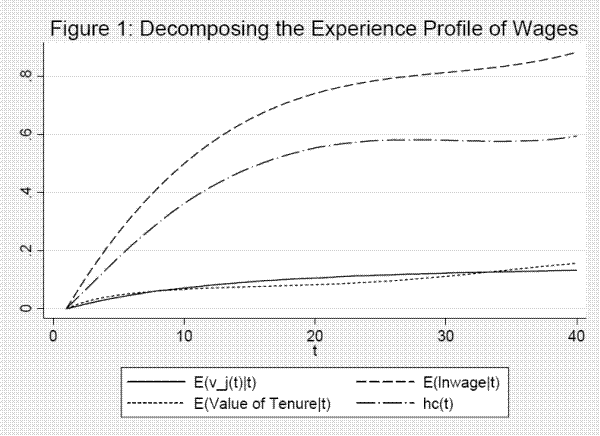
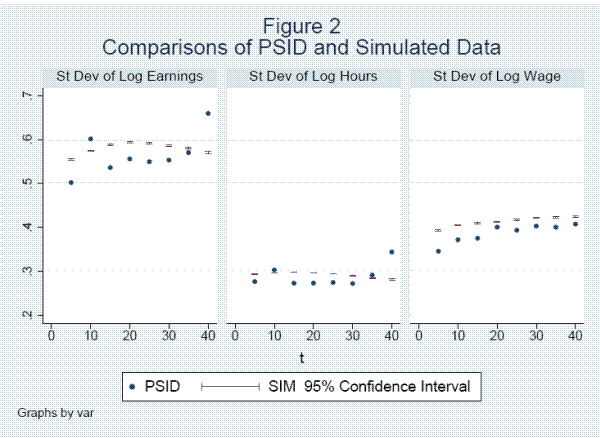
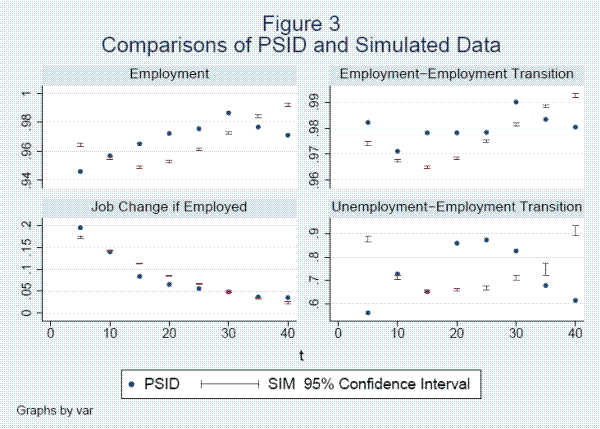
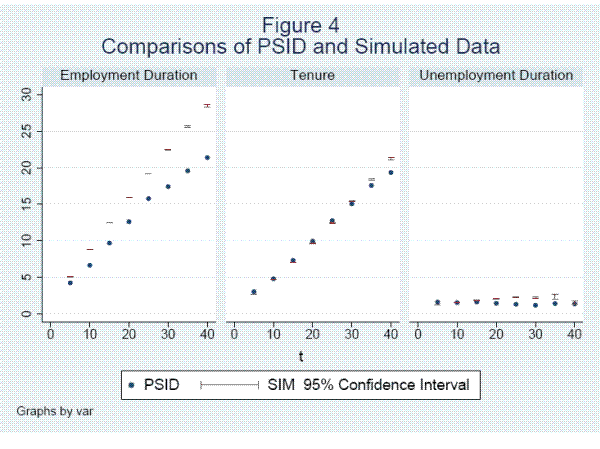
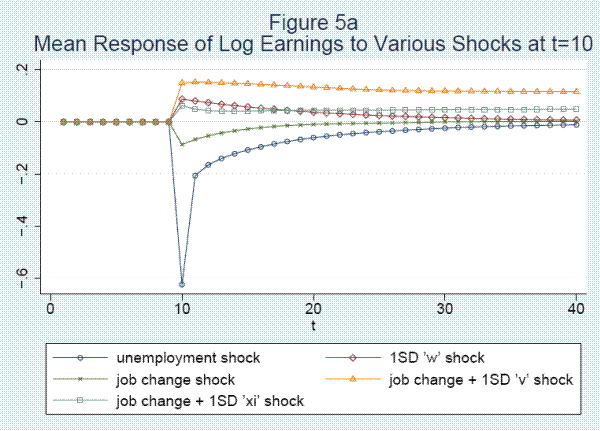
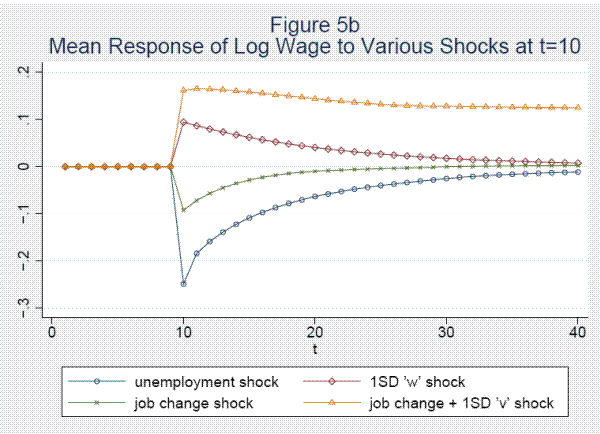
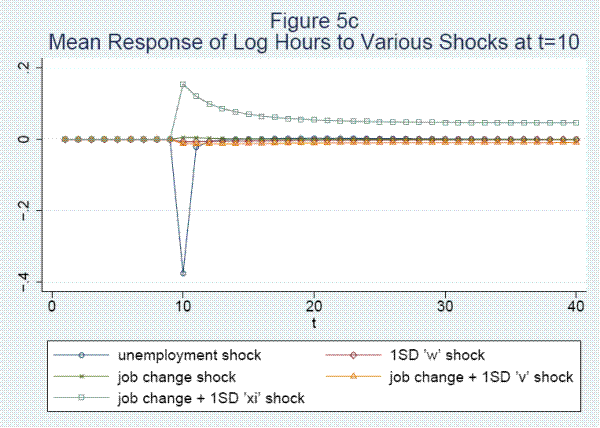
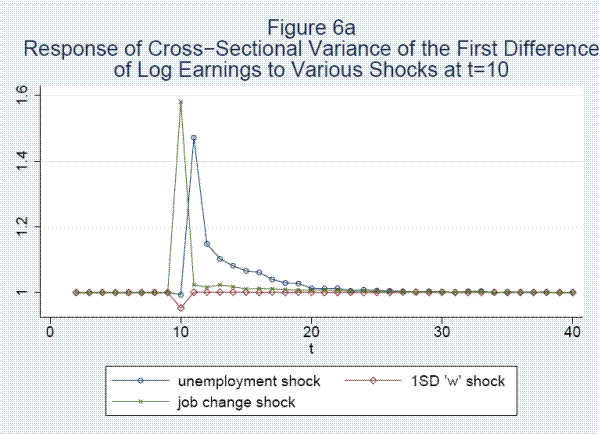
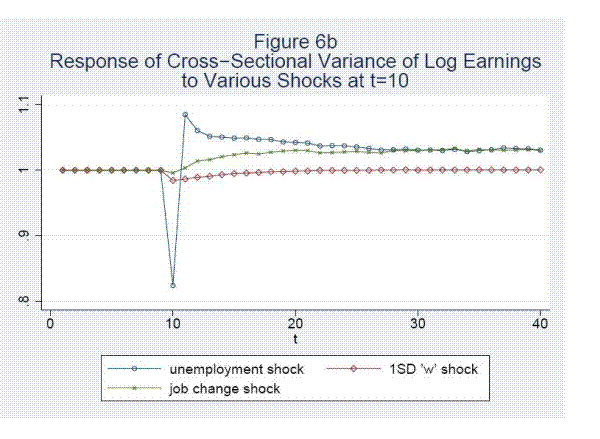
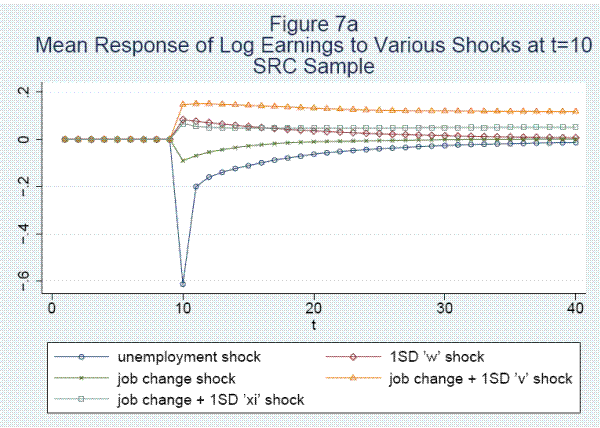
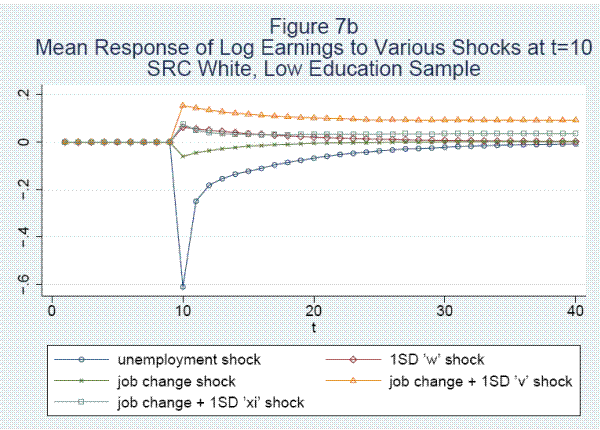
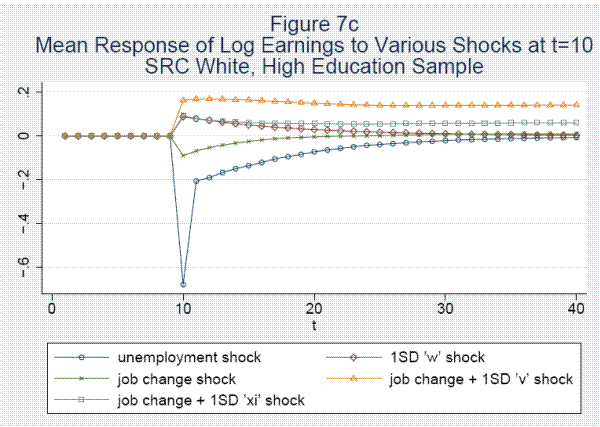
| Percentage | |
|---|---|
| Emp. Status: Working | 87.98 |
| Emp. Status: Temp. Laidoff | 1.48 |
| Emp. Status: Unemployed | 5.9 |
| Emp. Status: Retired | 0.87 |
| Emp. Status: Disabled | 1.85 |
| Emp. Status: Housewife | 0.19 |
| Emp. Status: Student | 1.17 |
| Emp. Status: Other | 0.56 |
| Percentage | |
|---|---|
| PE: 1 | 16.6 (a) |
| PE: 2 | 9.5 |
| PE: 3 | 6.3 |
| PE: 4 | 4.8 |
| PE: 5 | 4.4 |
| PE: 6 | 3.4 |
| PE: 7 | 2.8 |
| PE: 8 | 2.8 |
| PE: 9 | 2.5 |
| PE: 10 | 2.3 |
| PE: 11 | 2.5 |
| PE: 12 | 2.8 |
| PE: 13 | 2.9 |
| PE: 14 | 3.5 |
| PE: 15 | 2.5 |
| PE: 16 | 2.7 |
| PE: 17 | 3.2 |
| PE: 18 | 2.9 |
| PE: 19 | 3.1 |
| PE: 20 | 3.6 |
| PE: 21 | 3.2 |
| PE: 22 | 3.4 |
| PE: 23 | 4.5 |
| PE: 24 | 5.1 |
| PE: 25 | 5.4 |
| PE: 26 | 5.4 |
| PE: 27 | 5.6 |
| PE: 28 | 5.1 |
| PE: 29 | 5.6 |
| PE: 30 | 6.3 |
| PE: 31 | 6.6 |
| PE: 32 | 7.2 |
| PE: 33 | 8.2 |
| PE: 34 | 9.0 |
| PE: 35 | 9.4 |
| PE: 36 | 11.7 |
| PE: 37 | 13.4 |
| PE: 38 | 14.4 |
| PE: 39 | 18.4 |
| PE: 40 | 21.97(b) |
(a) All students at PE=1.
(b) Of these, 13.5 are retired, 7.5 disabled.
Per Individual in PSID Sample.
| Percentile: Min | Percentile: 5% | Percentile: 25% | Percentile: 50% | Percentile: 75% | Percentile: 95% | Percentile: Max | |
|---|---|---|---|---|---|---|---|
| Number of observations per individual | 1 | 1 | 3 | 6 | 11 | 18 | 19 |
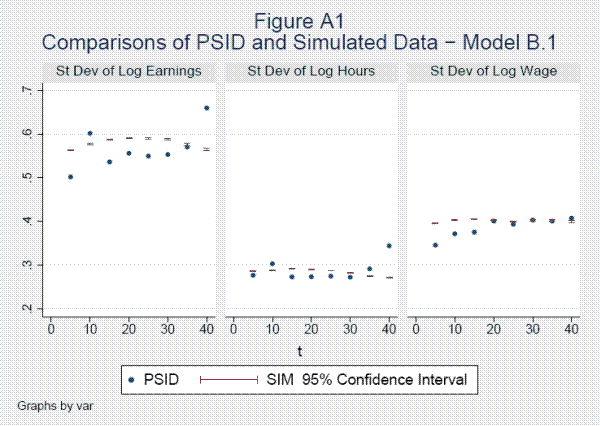
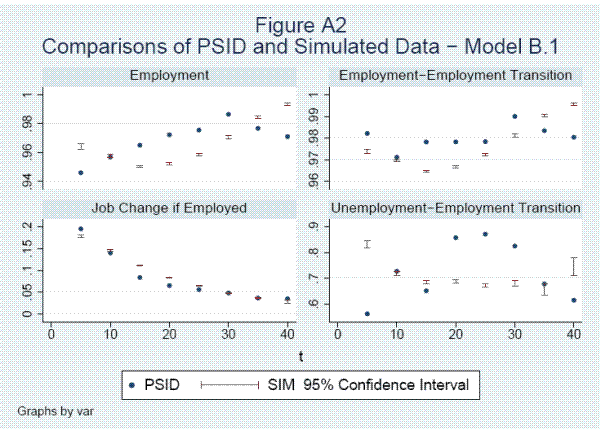
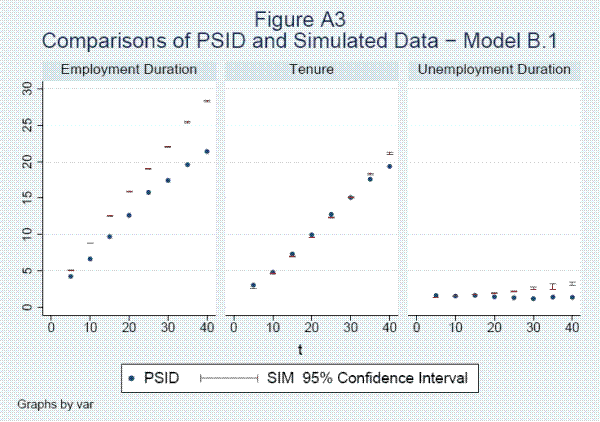
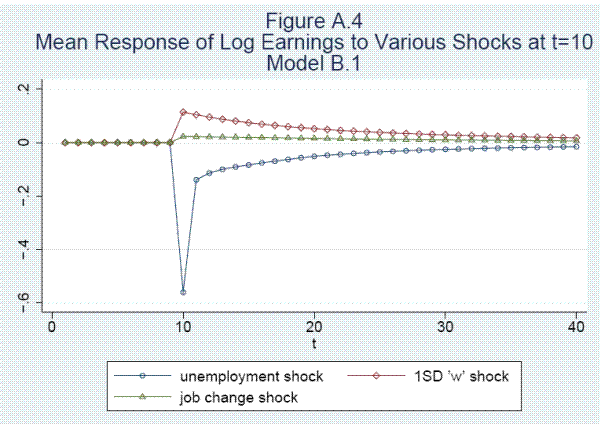
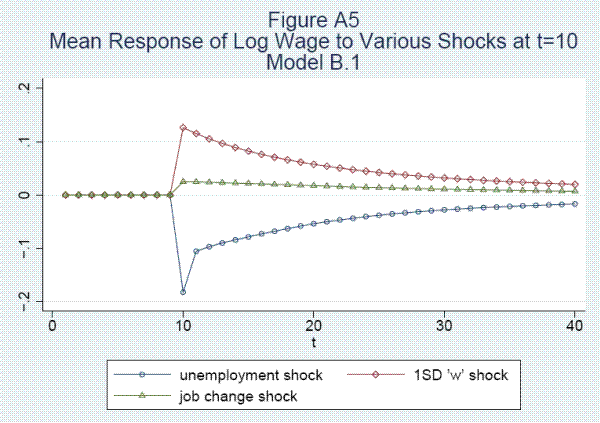
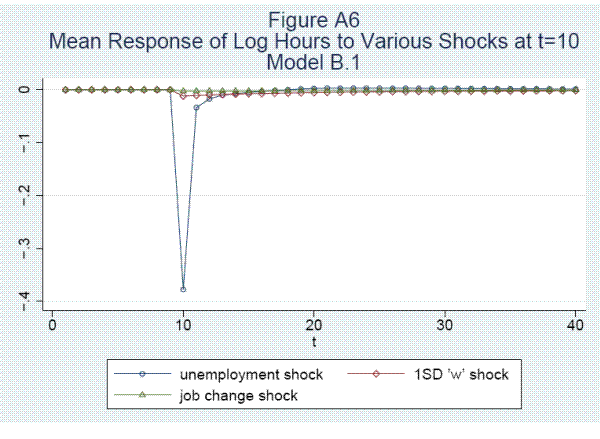
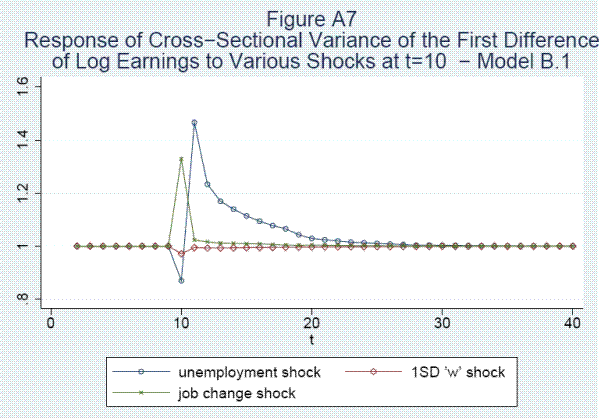
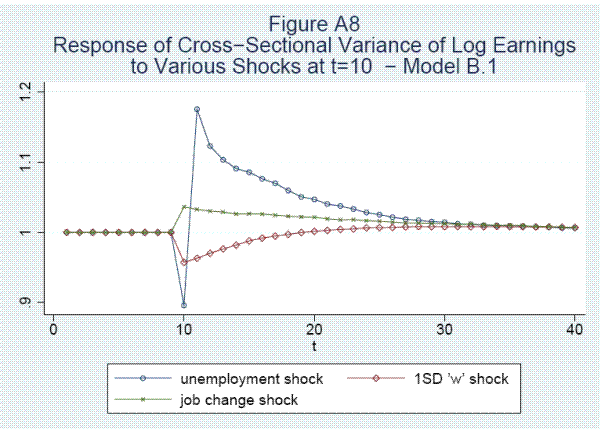
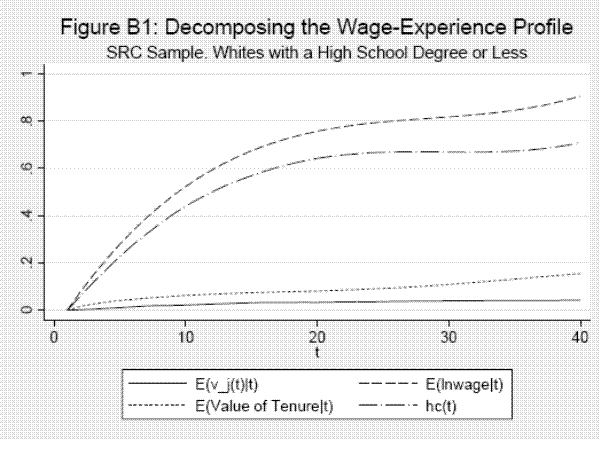
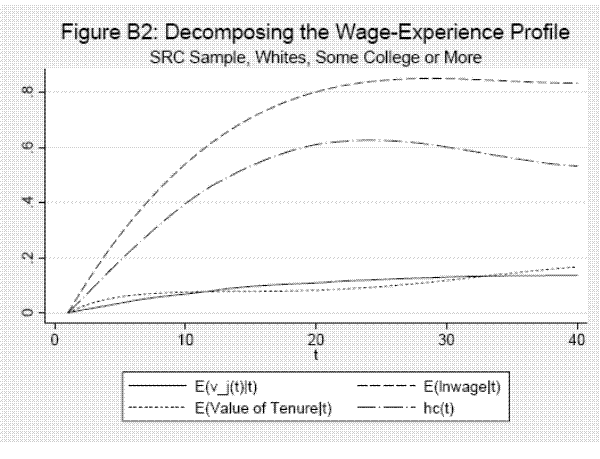
Footnotes
into the unemployment equation. Low et al (2008) work with such a specification. In our job change equation,
may reduce mobility both because it raises the reservation wage and because it lowers search intensity. Return to Text more than
given that industry and occupation changes tend to occur across employers. They would also affect the estimates of the return to seniority that we import from Altonji and
Williams (2005). See Neal (1995), Parent (2000), and Kambourov and Manovskii (2009) for somewhat conflicting evidence on the importance of occupation specific, industry specific, and firm specific human capital. Extending the model to distinguish occupation and/or industry is conceptually
straightforward but would require models of occupation and industry transitions and attention to measurement error. We leave this to future work. Return to Text to grow linearly with experience, but did not obtain sensible results. Return to Text would be
set to tenure when in the simulated case is equal to for the first value we see
in the corresponding PSID case. Return to Text
 and
and
 in the wage, hours and earnings models even though we also include a constant when construct hours, wage, and earnings residuals. Our reported standard errors do not account
for first stage estimation of the
in the wage, hours and earnings models even though we also include a constant when construct hours, wage, and earnings residuals. Our reported standard errors do not account
for first stage estimation of the
 parameters. We doubt that adjustment would make much difference because the estimated standard errors for the elements of
 are small. Also, note that the coefficients on the experience profile of wages capture not only the effects of general human capital and age but also average growth in
 and tenure with . When we estimate Model A.3 by indirect
inference, we include a quadratic in experience in the equation for the wage to account for this. We did not include these terms in models A.1, A.2 and B.1, which exclude tenure from the wage equation. Return to Text. Return to Text is 0.918 for blacks with a high school degree or less, 1.427 for blacks with more than high school, 1.391 for whites with high school or less, and 1.671 for whites with
more than high school. We obtained similar results for other model parameters when we constrain
to be the same for all groups and use
and tenure with . When we estimate Model A.3 by indirect
inference, we include a quadratic in experience in the equation for the wage to account for this. We did not include these terms in models A.1, A.2 and B.1, which exclude tenure from the wage equation. Return to Text. Return to Text is 0.918 for blacks with a high school degree or less, 1.427 for blacks with more than high school, 1.391 for whites with high school or less, and 1.671 for whites with
more than high school. We obtained similar results for other model parameters when we constrain
to be the same for all groups and use  to estimate
it. Return to Text
to estimate
it. Return to Text and
and  are 5 to 7,906 when and
are 9. The standard errors account for heteroskedasticity but not for
correlation among the moments, which use overlapping data. They are probably understated. In the case of Model A.3, equation (17) is an approximation because Model A.3 states that employment transition probabilities depend on
are 5 to 7,906 when and
are 9. The standard errors account for heteroskedasticity but not for
correlation among the moments, which use overlapping data. They are probably understated. In the case of Model A.3, equation (17) is an approximation because Model A.3 states that employment transition probabilities depend on
 . This means that the evolution of
depends on the number of periods of continous employment:
. This means that the evolution of
depends on the number of periods of continous employment:  We
doubt that this is an important problem. Setting
to .90 instead of .92 has little effect on the variance decompositions. Return to Text
We
doubt that this is an important problem. Setting
to .90 instead of .92 has little effect on the variance decompositions. Return to Text . The implied return to 2, 5, 10 and 20 years of tenure are .046 (.0064), .008 (.0011), .112 (.016), and .119
(.029). It is obtained using Altonji and Shakotko's (1987) instrumental variables approach, which treats as exogenous and uses the within job
. The implied return to 2, 5, 10 and 20 years of tenure are .046 (.0064), .008 (.0011), .112 (.016), and .119
(.029). It is obtained using Altonji and Shakotko's (1987) instrumental variables approach, which treats as exogenous and uses the within job  variation in


 , and
, and
 to identify the effects of tenure. Our finding of a modest link between and
implies that Altonji and Williams' estimates are biased downward by a small amount. Return to Text simulations required to evaluate the objective function are essentially
independent and can be conducted simultaneously by different processors. Using our parallelized computer algorithm on
to identify the effects of tenure. Our finding of a modest link between and
implies that Altonji and Williams' estimates are biased downward by a small amount. Return to Text simulations required to evaluate the objective function are essentially
independent and can be conducted simultaneously by different processors. Using our parallelized computer algorithm on  (balanced) processors reduces computation time by a factor of about
 , where
 is the ceiling function. All programs are written in FORTAN 90. The parallelization is implemented using the Message Passing Interface (MPI). We estimate the model using 21 CPUs supplied by 11
Intel Xeon 5150 dual core processors, which reduces estimation time by a factor of 20, to between 2 to 7 hours.
on the probability is .029. It is smaller than the partial
effect because a unit shift in
shifts the distribution of
by .625. Return to Text
is the ceiling function. All programs are written in FORTAN 90. The parallelization is implemented using the Message Passing Interface (MPI). We estimate the model using 21 CPUs supplied by 11
Intel Xeon 5150 dual core processors, which reduces estimation time by a factor of 20, to between 2 to 7 hours.
on the probability is .029. It is smaller than the partial
effect because a unit shift in
shifts the distribution of
by .625. Return to Text is about -.22 and
 is about .10. Return to TextBagger et al (2007) do not allow for a direct effect of seniority on wages such as would arise from shared investment in firm specific capital but obtain an indirect effect that arises through the response of firms to outside offers. They attribute average growth of wages within
the firm and growth of wages across firms to job search. Using Danish matched employer/employee data they find that human capital accounts for about half of all wage growth for workers with more than 12 years of education that occurs after the first five years in the labor market. Human capital
accumulation is neglibible for less educated groups. Return to Text
is about .10. Return to TextBagger et al (2007) do not allow for a direct effect of seniority on wages such as would arise from shared investment in firm specific capital but obtain an indirect effect that arises through the response of firms to outside offers. They attribute average growth of wages within
the firm and growth of wages across firms to job search. Using Danish matched employer/employee data they find that human capital accounts for about half of all wage growth for workers with more than 12 years of education that occurs after the first five years in the labor market. Human capital
accumulation is neglibible for less educated groups. Return to Text . The coefficient
 is .042, which indicates that on average
increases
is .042, which indicates that on average
increases
 by .042. Models A.1 and A.2 exclude tenure effects on wages. Return to Text
![\displaystyle H_{it}=I[\gamma _{0}^{H}+\gamma _{t}^{H}(t-1)+\rho _{H}H_{i,t-1}+\delta _{\varsigma }^{H}\varsigma _{i}+\varepsilon _{it}^{H}>0]](img395.gif)
to models that are very similar to A.1 and to model B, where
 is an indicator for poor health, and is 1 for those who answer yes to the question, "Do you have any physical or nervous
condition that limits the type of work or the amount of work you can do?",
is an indicator for poor health, and is 1 for those who answer yes to the question, "Do you have any physical or nervous
condition that limits the type of work or the amount of work you can do?",
 captures fixed heterogeneity in health, and
 is an iid health shock. We added the indicator to
the , ,
is an iid health shock. We added the indicator to
the , ,  , and equations. We also added an equation for to the auxiliary model and added two lags of
  to all equations of the auxiliary model. The heterogeneity term
 accounts for 67% of the variance of the composite error term for the health latent variable. We also find strong state dependence in health and (not surprisingly) that health
status worsens with age. The effects of health are small for , , and for
wages. Work hours are about 6% lower for people in poor health, everything else equal. The relatively small effects of health, at least as we have measured it, on employment, wages, and hours imply that health shocks account for little of the variance in career earnings. We focus on models without
the health equation for this reason. See Vidangos (2008) for models with health and permanent disability. Return to Text implied by the model as follows. First,we obtain the point estimate
accounts for 67% of the variance of the composite error term for the health latent variable. We also find strong state dependence in health and (not surprisingly) that health
status worsens with age. The effects of health are small for , , and for
wages. Work hours are about 6% lower for people in poor health, everything else equal. The relatively small effects of health, at least as we have measured it, on employment, wages, and hours imply that health shocks account for little of the variance in career earnings. We focus on models without
the health equation for this reason. See Vidangos (2008) for models with health and permanent disability. Return to Text implied by the model as follows. First,we obtain the point estimate
 by using the point estimates of for
Model A.3 to simulate 30 careers for each member of the PSID. (That is, we preserve the race, education and experience mix of the available data.) To obtain the standard deviation of
by using the point estimates of for
Model A.3 to simulate 30 careers for each member of the PSID. (That is, we preserve the race, education and experience mix of the available data.) To obtain the standard deviation of
 given the PSID sample size and demographic properties, we repeat the simulation for each of the 300 parametric boostrap estimates of using only 1 career for each member of the PSID and then compute the standard deviation of the 300 values of
 The bands we report are the point estimate
plus or minus 1.984
The bands we report are the point estimate
plus or minus 1.984
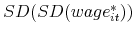 . Other variables are handled in similar fashion. For each value of in the table the results are the average over , and
 with the exception of
  which is the average for
  and . Return to Text. There were still some minor discrepancies in the experience profiles. Return to Text in the equation, by I-I, whether or not we allow for state dependence. We also had difficulty with the equation. We are puzzled as to
why. It may be that longer lags than we use would be helpful in pinning down the parameters. For the specification reported in the paper we also estimated the equation by maximum likelihood, treating
and . Return to Text. There were still some minor discrepancies in the experience profiles. Return to Text in the equation, by I-I, whether or not we allow for state dependence. We also had difficulty with the equation. We are puzzled as to
why. It may be that longer lags than we use would be helpful in pinning down the parameters. For the specification reported in the paper we also estimated the equation by maximum likelihood, treating
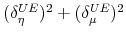 as a single parameter. Even though does not depend on duration, this is only an approximation. The problem stems from the fact that and appear in both the and
equations. Consequently, the distributions of and conditional on
as a single parameter. Even though does not depend on duration, this is only an approximation. The problem stems from the fact that and appear in both the and
equations. Consequently, the distributions of and conditional on
 depend on
  , and
, and  and the stochastic components that influence the wage. They will not have a normal distribution. In any event, the
MLE estimates (standard errors) are
and the stochastic components that influence the wage. They will not have a normal distribution. In any event, the
MLE estimates (standard errors) are
 |
= | -.838 | .121EDUC | -.439BLACK | +.33 |
-.048
 |
; |
![\widehat{[(\delta _{\eta }^{UE})^{2}+(\delta _{\eta }^{EE})^{2}]^{.5}}=.630](img427.gif) |
|---|---|---|---|---|---|---|---|---|
| (.439) | (.029) | (.109) | (.273) | (.066) | (.119) |
(N=1065, number of individuals contributing spells=748.) The I-I estimates of the cofficients on BLACK and EDUC are somewhat larger. The experience profiles are also quite different. The I-I estimate of
![\widehat{[(\delta _{\eta }^{UE})^{2}+(\delta _{\eta }^{EE})^{2}]^{.5}}](img429.gif) is .675, which is close to the MLE estimate. We cannot take the same approach with the EE equation due to state
dependence in that equation.
is .675, which is close to the MLE estimate. We cannot take the same approach with the EE equation due to state
dependence in that equation.
 . The immediate effect of unemployment on earnings and wages is
somewhat smaller than when because the decline in tenure and in
is smaller. The effects are also less persistent. Job changes accompanied by shocks to and to also have less persistent effects. Return to Text on work hours
translates into only an 11.4% impact on the variance in lifetime earnings. Return to Text
. The immediate effect of unemployment on earnings and wages is
somewhat smaller than when because the decline in tenure and in
is smaller. The effects are also less persistent. Job changes accompanied by shocks to and to also have less persistent effects. Return to Text on work hours
translates into only an 11.4% impact on the variance in lifetime earnings. Return to Text