


Regulation II (Debit Card Interchange Fees and Routing)
2023 Interchange Fee Revenue, Covered Issuer Costs, and Covered Issuer and Merchant Fraud Losses Related to Debit Card Transactions
Preface
The Dodd-Frank Act requires the Board to prescribe rules related to debit card interchange fees and routing. The Board's Regulation II implements this provision of the Dodd-Frank Act.1
The Dodd-Frank Act also requires the Board to disclose aggregate or summary information concerning the costs incurred, and interchange fees charged or received, by issuers and payment card networks as the Board considers appropriate and in the public interest on at least a biennial basis. Pursuant to these statutory instructions, every two years beginning in 2011, the Board has released a report and accompanying data based on data collections from debit card issuers and payment card networks.
Highlights
Card Use
- In 2023, payment card networks in the United States processed 100.7 billion debit and general-use prepaid card transactions valued at $4.7 trillion. Total debit card transaction volume and value both grew at an average rate of 4.6 percent per year from 2021 to 2023, significantly slower than the average annual growth rates from 2009 to 2021 (7.8 percent by volume and 9.5 percent by value).
- Dual-message networks, which traditionally processed mainly signature-authenticated transactions, accounted for 71.4 and 72.9 percent of the total by volume and value, respectively, in 2023. Single-message networks, which traditionally processed PIN-authenticated transactions, accounted for the rest. Since 2009, the dual-message share of total transactions has progressively increased 9.0 percentage points.
- From 2021 to 2023, annual growth for dual-message transactions (7.0 percent by volume and 6.4 by value) was greater than for single-message transactions, as it had been from 2009 to 2021. In fact, from 2021 to 2023, single-message transaction value barely increased, while single-message transaction volume actually declined over the two years, driven by the first-ever annual decline in volume of 2.2 percent from 2021 to 2022.
- Card-not-present (CNP) transactions reached 34.4 percent of total volume and almost one-half of total value in 2023, having grown consistently faster than card-present (CP) transactions since 2009. From 2021 to 2023, CNP transaction volume grew 8.2 percent per year, faster than the 2.8 percent per year growth recorded by CP transactions, but considerably slower than the 26.5 percent per year CNP growth observed from 2019 to 2021 during the COVID-19 pandemic, or the 17.8 percent per year growth observed from 2009 to 2019.
- In 2023, the average transaction value of CNP transactions was once again higher than that of CP transactions, at $63.96 and $36.99, respectively. However, as e-commerce has grown in popularity over the years and expanded to include smaller value purchases, the average transaction value of CNP transactions has decreased. In 2023, the average transaction value of CNP transactions was 1.7 times the average transaction value of CP transactions, down from 2.3 in 2009.
- From 2021 to 2023, annual volume growth for transactions subject to Regulation II's interchange fee standards ("covered transactions") was slightly higher than for transactions not subject to the interchange fee standards ("exempt transactions"), at 4.8 and 4.2 percent, respectively.
- From 2021 to 2023, annual growth for prepaid card transactions (11.5 percent by volume and 7.0 by value) was once again faster than for non-prepaid card transactions (2.7 percent by volume and 3.3 percent by value). In fact, prepaid card transactions surpassed CNP transactions as the fastest growing category for the first time since 2015, having grown 19.7 percent from 2022 to 2023.
Interchange Fees, Network Fees, and Incentives
- In 2023, interchange fees across all debit and general-use prepaid card transactions totaled $34.12 billion, an average increase of 3.9 percent per year since 2021.
- For transactions covered by Regulation II, the average level of interchange fees has not changed materially since the regulation took effect in the fourth quarter of 2011. In 2023, the average interchange fee for covered transactions processed over single-message networks was $0.24, while that for covered transactions processed over dual-message networks was $0.22.
- The average interchange fee for transactions exempt from Regulation II was $0.52 in 2023. Across data collections, the average interchange fee for exempt transactions gradually increased from $0.43 since the regulation took effect to $0.52 in 2021, and remained steady through 2023. For exempt transactions processed over dual-message networks, the average interchange fee fell from $0.64 in 2021 to $0.62 in 2023, marking a reversal of the upward trend that saw this value gradually increase from $0.51 in the fourth quarter of 2011 to $0.64 in 2021. By contrast, for exempt transactions processed over single-message networks, the average interchange fee gradually fell after Regulation II took effect, from $0.31 in the fourth quarter of 2011 to $0.25 in 2017, and has since gradually increased to $0.27 in 2023.
- Network fees to all parties increased to $12.95 billion in 2023 from $11.49 billion in 2021. The average network fee per transaction increased to $0.129 in 2023, up from $0.125 in 2021 and $0.098 in 2011. By contrast, the average network fee per transaction expressed as a percentage of average transaction value, 0.28 percent in 2023, has not changed materially since Regulation II took effect.
- In 2023, acquirers and merchants paid 64.9 percent of network fees, up from 63.9 percent in 2021; issuers paid the rest. This increase is a continuation of a long-term trend, which has seen the proportion of network fees paid by acquirers and merchants increase gradually from 44.3 percent in 2009.
Fraud Losses
- In 2023, across all transactions for covered issuers, fraud losses to all parties as a share of the transaction value were 17.6 basis points, or $17.63 per $10,000 in transaction value. This value reflects a steady increase in fraud losses from 7.8 basis points in 2011.
- In 2023, merchants absorbed 49.9 percent of losses from fraudulent transactions reported by covered issuers, up from 46.9 percent in 2021 and 38.3 percent in 2011. By contrast, issuers absorbed 28.3 percent of losses in 2023, down from 33.4 percent in 2021 and 59.8 percent in 2011. Cardholders, who absorb the remaining fraud losses, saw their share of fraud losses rise from less than 1.8 percent in 2011 to 21.8 percent in 2023.
- In 2023, across all transaction categories, prepaid transactions experienced the highest level of fraud losses as a share of transaction value, as well as the highest incidence of fraudulent transactions as a percentage of total transactions (312.6 basis points and 1.12 percent, respectively). Fraud levels were second highest for dual-message transactions (17.9 basis points and 0.12 percent, respectively) and were once again the lowest for single-message transactions (6.7 basis points and 0.03 percent, respectively), as they have been since 2011.
Issuer Costs
- Across all covered issuers, average per-transaction authorization, clearing, and settlement (ACS) costs, excluding issuer fraud losses, were $0.041 in 2023, approximately one-half of the 2009 value, and a slight increase from $0.039 in 2021.
- In 2023, the base interchange fee cap in Regulation II excluding the fraud-prevention adjustment—$0.21 plus 5 basis points multiplied by the value of a transaction—exceeded the average per-transaction ACS costs, including issuer fraud losses, for 80.1 percent of covered issuers and for 99.2 percent of covered transactions.
Data Collections
Payment Card Network Survey
The Board collected data for 2022 and 2023 through the two most recent Payment Card Network (PCN) Surveys, conducted in 2023 and 2024, respectively. All 13 card networks that processed debit card transactions in 2022 and 2023 completed the survey for each of those years.2 In addition to using data from these latest PCN Surveys for this report, the Board used the data to calculate the annual information it published on the average interchange fees received by issuers across different networks.3
As in previous years, the most recent PCN Surveys asked respondents to report information separately for issuers covered by the interchange fee standards (covered issuers) and issuers exempt from the interchange fee standards (exempt issuers). The surveys further asked respondents to distinguish between prepaid card transactions that were covered by or exempt from the interchange fee standards. Starting with the 2013 data collection, the PCN Surveys asked respondents to distinguish exempt prepaid transactions performed with cards issued by exempt issuers from those performed with cards issued by covered issuers. This distinction allows transactions reported in the PCN Surveys to be categorized as either exempt or covered.4
As figure 1 illustrates, the difference between the transaction volume of covered issuers, which includes transactions performed with exempt prepaid cards issued by covered issuers, and the volume of covered transactions, which excludes those transactions, was equal to 3.0 percent of total transaction volume of covered issuers or 1.9 percent of total transaction volume of all issuers in 2023, in line with previous years. Depending on the context, this report decomposes the data either by transaction status under Regulation II (that is, exempt versus covered transactions) or by issuer status (that is, exempt versus covered issuers).
Figure 1. Composition of transaction volume in 2023
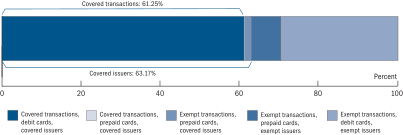
Note: Key describes bars in order from left to right. Covered transactions, prepaid cards, covered issuers accounted for 0.06 percent of total transaction volume.
Debit Card Issuer Survey
The Board collected data from covered issuers for 2023 through the latest Debit Card Issuer (DCI) Survey, conducted in 2024. As in previous data collections, respondents ranged from the largest debit card issuers in the United States to issuers with small debit card programs and consolidated assets greater than $10 billion.5 The DCI Survey asked for information related to the volume and value of debit and prepaid card transactions; authorization, clearing, and settlement costs as well as other costs associated with particular debit card transactions, including the incidence of and losses related to debit and prepaid card fraud; fraud-prevention and data-security costs; and interchange fee revenue. The DCI Survey instructed respondents to provide the requested information separately for debit card transactions processed over dual-message networks, debit card transactions processed over single-message networks, and prepaid card transactions for issuers with prepaid card programs.6
A total of 166 covered issuers responded to the 2023 DCI Survey, compared with 162 respondents for 2021.7 Figure 2 shows the percentage that high-, mid-, and low-volume issuers represented out of total covered issuers and the total number and value of covered issuers' transactions in 2023. In particular, 34.1 percent of the respondents processed more than 100 million debit card transactions (high-volume issuers), 53.9 percent processed between 1 million and 100 million transactions (mid-volume issuers), and the remaining 12.0 percent of respondents processed fewer than 1 million debit card transactions (low-volume issuers). As in previous data collections, high-volume issuers accounted for the vast majority of transaction volume and value. In 2023, high-volume issuers accounted for 94.0 percent of transaction volume and 93.9 percent of transaction value, mid-volume issuers accounted for 5.9 percent of transaction volume and 6.1 percent of transaction value, and low-volume issuers accounted for 0.01 percent of transaction volume and value.
Figure 2. Composition of covered issuers and transaction volume/value of covered issuers in 2023, by issuer size
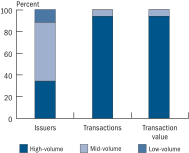
Note: Key describes bars in order from bottom to top. Low-volume issuers accounted for 0.01 percent of transaction volume and 0.01 percent of transaction value.
Detailed Discussion
Card Use
The PCN Surveys have provided information about total card usage on a yearly basis since 2009.8 Over this period, the volume of total card usage progressively grew from 37.6 billion transactions in 2009 to 100.7 billion transactions in 2023, corresponding to an average growth rate of 7.3 percent per year (see figure 3). Total debit card transaction volume and value both grew at an average rate of 4.6 percent per year from 2021 to 2023, significantly slower than the average annual growth rates from 2009 to 2021 (7.8 percent by volume and 9.5 percent by value). The total value of purchase transactions also increased, growing consistently from $1.43 trillion in 2009 to $4.66 trillion in 2023, corresponding to an average growth rate of 8.8 percent per year.9
Figure 3. Number and growth rate of volume of purchase transactions over time
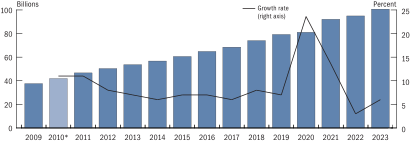
Note: The left vertical axis is associated with the bars representing the volume of transactions in each year. The right vertical axis is associated with the line that represents the growth in volume of transactions since the previous year. The number of transactions in 2010 is an interpolation from 2009 and 2011 statistics based on an assumption of a constant growth rate from 2009 to 2011 because survey data were not collected for 2010.
* Estimated.
Figure 4 examines transaction volume growth rates across different transaction categories from 2022 to 2023 compared with average annual growth rates from the first year the data were collected to 2022. The growth rate for transactions processed over dual-message networks from 2022 to 2023, at 8.4 percent, was in line with the average annual growth rate of 8.3 percent per year observed from 2009 to 2022. By comparison, the growth rate from 2022 to 2023 for transactions processed over single-message networks was 0.7 percent, once again lower than the corresponding value for dual-message networks, and significantly lower than the average annual growth rate of 5.6 percent per year from 2009 to 2022 for single-message transactions.10 Moreover, single-message transaction volume decreased 2.2 percent from 2021 to 2022, the first time when an absolute decrease in the number of single-message transactions was observed. This decline led to a decrease in the average annual growth rate since 2009, lowering it from an average of 6.3 percent per year from 2009 to 2021, to 5.6 percent per year from 2009 to 2022.
Figure 4. Average annual growth rate in transaction volume, by transaction category
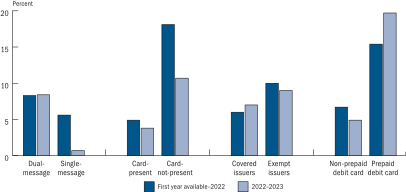
Note: Key describes bars in order from left to right. For all categories except the "Exempt/Covered issuer" breakdown, the first year of availability for the data is 2009. For the "Exempt/Covered issuer" category, 2011 statistics are reported instead.
As shown in the second set of bars in figure 4, growth in the volume of CNP transactions slowed significantly from an average annual growth rate of 18.1 percent per year from 2009 to 2022 to 10.7 percent from 2022 to 2023. From 2022 to 2023, CNP transactions was the second-fastest growing transaction category—the first time since 2015 that CNP transaction volume did not grow faster on an annual basis than all other transaction categories.11 CNP transaction volume grew at an average annual rate of 19.2 percent per year from 2009 to 2021, with a substantially higher growth rate experienced from 2019 to 2020, at 33.8 percent. Since 2021, the CNP growth rate slowed, dropping to 5.8 percent from 2021 to 2022 and reverting slightly upward, to 10.7 percent, from 2022 to 2023. This slower growth following 2021 reverted the average annual growth rate of CNP transaction volume to its pre-COVID rate. From 2009 to 2023, the average annual growth of CNP transaction volume was 17.5 percent, which is essentially identical to the average annual growth rate observed from 2009 to 2019 (17.8 percent). By contrast, card-present (CP) transaction volume increased at a rate of 4.9 percent per year from 2009 to 2022 and at a slower rate of 3.8 percent from 2022 to 2023.
As shown by the third set of bars in figure 4, the growth rate in the volume of transactions processed by covered issuers increased slightly, from an average annual growth rate of 6.0 percent per year from 2011 to 2022 to 7.1 percent from 2022 to 2023. Growth in the volume of transactions processed by exempt issuers was slightly lower than for their covered counterparts, slowing down from an average annual growth rate of 9.6 percent from 2011 to 2022 to 9.1 percent from 2022 to 2023.
Finally, as shown by the final set of bars in figure 4, prepaid card transactions recorded the highest growth rate by volume from 2022 to 2023 among all transaction categories. Growth in prepaid card volume accelerated from an average annual growth rate of 15.4 percent per year from 2009 to 2022 to 19.7 percent from 2022 to 2023. By contrast, growth in non-prepaid transaction volume slowed from an average annual growth rate of 6.7 percent per year from 2009 to 2022 to 4.9 percent from 2022 to 2023.
While figure 4 examines the growth rates in transaction volume across different transaction categories, figure 5 focuses on the composition of total transactions within each of these categories in 2023. To better understand how the composition itself evolved, figure 5 also illustrates the corresponding breakdown at the beginning of the data collection, and the associated change in composition relative to that initial breakdown.
Figure 5. Composition of total transaction volume, by transaction category
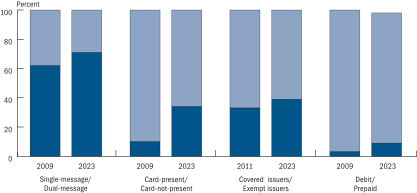
Note: Axis labels identify bars from top to bottom.
In 2023, transactions processed over dual-message networks accounted for 71.4 percent of debit card transaction volume, with transactions processed over single-message networks accounting for the remaining 28.6 percent. The proportion of transactions processed over dual-message networks increased 9.0 percentage points from 2009 to 2023. The share of CNP transactions out of total transaction volume reached 34.4 percent in 2023, up from 9.6 percent in 2009. This increase reflects the continuing increase in popularity of online retail, as well as the significant increase in CNP transaction volume of 33.8 percentage points from 2019 to 2020 alone. The share of transactions processed by exempt issuers reached 38.8 percent in 2023, an increase of 6.0 percentage points from the corresponding share in 2011. Finally, the share of prepaid transactions has been growing steadily and reached 9.2 percent in 2023, almost three times higher than the share in 2009.
As shown in figure 6, average transaction values in 2023 did not differ substantially across most transaction categories, which has been the case across data collections. In 2023, average values for most transaction categories were higher than they were in the first year the data were collected. Unlike the steady patterns observed in other data series, this increase was primarily the result of larger increases observed from 2019 to 2021.
Figure 6. Average transaction value, by transaction category
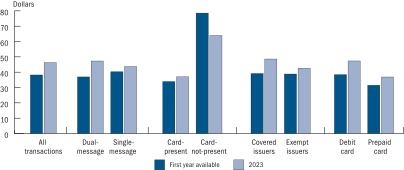
Note: Key describes bars in order from left to right. For all categories except the "Exempt/Covered issuer" breakdown, the first year of availability for the data is 2009. For the "Exempt/Covered issuer" category, 2011 statistics are reported instead.
CNP transactions were a notable exception in both cases. In 2023, the average value of CNP transactions ($63.96) was nearly three-quarters greater than the corresponding value for CP transactions ($36.99). While the average value of CNP transactions was still considerably higher than the average value for all other transaction categories in 2023, it fell by over $14 from 2009 to 2023. However, after a steady decline from 2009 to 2019, reaching the lowest observed average value of $61.56 in 2019, the average value of CNP transactions has progressively increased since then, reversing the declining trend.
Interchange Fees, Network Fees, and Incentives
The PCN Survey requests information about interchange fees; certain network fees; and payments and incentives (P&I) that are set, charged, or paid by payment card networks.12 These fees and transfers vary from network to network; thus, the totals and averages reported in this section serve only as a general characterization of network practices. Moreover, P&I are usually bilateral arrangements between a network on one side and a merchant, acquirer, or issuer on the other. The statistics reported in this section, calculated from network-reported totals, do not reflect the heterogeneity of these bilateral arrangements.
Figure 7 shows the main fees, as well as P&I, exchanged among networks, issuers, and acquirers/merchants in 2023. The total value of interchange fees transferred from acquirers to issuers was by far the largest: $34.12 billion. Network fees paid by issuers and acquirers/merchants were $4.54 billion and $8.40 billion, respectively. In each case, these network fees were considerably higher than the P&I issuers and acquirers/merchants received from networks: $1.98 billion and $3.71 billion, respectively.
Figure 7. Fees and payments and incentives among networks, issuers, and acquirers in 2023
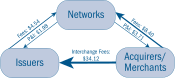
Note: Values are in billions of dollars. "P&I" stands for payments and incentives. The arrows represent the source and recipient of fees, payments, and incentives, rather than the actual path the money takes.
Figure 8 illustrates the evolution of average interchange fees over time, by network type and transaction status (whether transactions were covered by or exempt from the interchange fee standards). Average interchange fees for covered transactions, both those processed over single-message and those processed over dual-message networks, did not change materially after Regulation II took effect in the fourth quarter of 2011. In 2023, these fees stood at $0.24 and $0.22, respectively. In both cases, the fees were slightly less than the maximum that an issuer could receive on an average covered transaction under the regulation.13 While average interchange fees on covered transactions were higher for dual-message networks immediately after the regulation took effect, their subsequent slow-but-steady decline means that, since 2013, average interchange fees for covered transactions have been higher for transactions processed over single-message networks.
Figure 8. Average interchange fees over time, by network type and transaction status
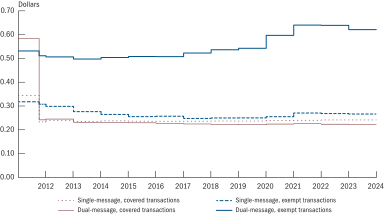
Note: Values for each period are represented by a data point at the end of the period: end of quarter for 2011:Q1-Q3, end of year for 2011:Q4, 2012, 2013, 2014, 2015, 2016, 2017, 2018, 2019, 2020, 2021, and 2023 data. Figures for 2013–23 represent a covered/exempt transaction breakout; for previous years, they represent a covered/exempt issuer breakout.
Average interchange fees for exempt transactions also declined in the years after Regulation II took effect, albeit at a much slower rate than interchange fees for covered transactions—by 2016, fees for exempt transactions processed over dual-message networks were $0.51, down from $0.53 before the regulation took effect, while fees for exempt transactions processed over single-message networks were $0.26, down from $0.32. After 2016, the paths of the two average fees diverged. In particular, while average interchange fees for exempt transactions processed over single-message networks have changed little since 2016 (and equaled $0.27 in 2023), average interchange fees for exempt transactions processed over dual-message networks rose from $0.51 in 2016 to $0.64 in 2021, before declining slightly to $0.62 in 2023.
Figure 9 illustrates, for 2023, network fees paid by acquirers and issuers as well as P&I received by acquirers/merchants and issuers from networks. Overall, for both single-message and dual-message networks, acquirers/merchants and issuers paid more in network fees than they received from the networks in P&I. Across network types, dual-message networks consistently charged higher network fees and disbursed higher P&I than single-message networks.
Figure 9. Per-transaction network fees and payments and incentives in 2023, by network type and payer/recipient
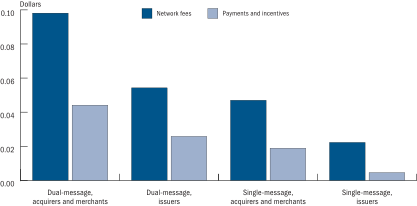
Note: Key describes bars in order from left to right. Although payments and incentives are received by both acquirers and merchants, network fees are paid by acquirers and are not directly paid by merchants.
Looking across different parties and types of networks, per-transaction network fees paid by acquirers were considerably higher than those paid by issuers for both dual-message and single-message networks. Network fees charged by dual-message networks were considerably higher than the fees charged by single-message networks for both acquirers and issuers.
For single-message networks, the amount of P&I that acquirers/merchants received corresponded to around 39.7 percent of the network fees that they paid, over twice as much as the corresponding value for issuers, 18.9 percent. For dual-message networks, by contrast, the amount of P&I that acquirers/merchants and issuers received was similar and higher than for single-message networks, at 45.0 percent and 47.6 percent, respectively. Notably, the amount that acquirers/merchants received in P&I relative to the network fees paid increased substantially from 2021 to 2023 for both network types, reaching its highest value since the promulgation of Regulation II.
Figure 10 shows trends over time in network fees, as well as in P&I. Focusing on network fees first, single-message network fees have changed little since 2009, rising a bit for acquirers/merchants and falling a bit for issuers. By contrast, dual-message network fees have changed more over time, almost doubling from 2009 to 2023 for acquirers/merchants, and substantially decreasing for issuers. Turning to P&I, payments and incentives received by issuers from either network type has not changed materially since 2009. By contrast, P&I received by acquirers/merchants have increased substantially since 2009, especially payments and incentives from dual-message networks.
Figure 10. Per-transaction network fees and payments and incentives for issuers and acquirers/merchants over time, by network type and payer/recipient
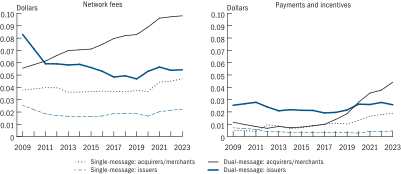
Note: Fees are shown on the same scale, for purposes of comparison.
Figure 11 examines how network fees and P&I differed between covered and exempt issuers in 2023. Exempt issuers paid higher per-transaction network fees and received higher per-transaction P&I than covered issuers, with these differences occurring for both dual-message and single-message networks.14 Moreover, P&I paid to exempt issuers by dual-message networks remained substantially higher than those paid by single-message networks in 2023. P&I paid to covered issuers by dual-message networks were more than 12 times higher than those paid by single-message networks in 2023. While covered issuers received P&I equal to 74.7 and 13.6 percent of the network fees that they paid to dual-message and single-message networks, respectively, P&I for exempt issuers were 40.0 percent of network fees paid to dual-message and 20.4 percent of fees paid to single-message networks.
Figure 11. Per-transaction network fees and payments and incentives for issuers in 2023, by network type and issuer status
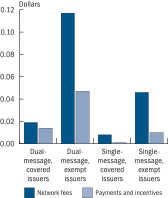
Note: Key describes bars in order from left to right.
Figure 12 examines how network fees, as well as P&I, for covered and exempt issuers changed after 2011. As previously noted, network fees paid by issuers to single-message networks as well as P&I received by issuers from both types of networks have remained relatively stable over time. By contrast, network fees paid by issuers to dual-message networks gradually declined since the beginning of the data collection. That overall decline was driven by a substantial decline in dual-message network fees paid by covered issuers, which outweighed the gradual increase in dual-message network fees paid by exempt issuers over the same period.
Figure 12. Per-transaction network fees and payments and incentives for issuers over time, by network type and issuer status
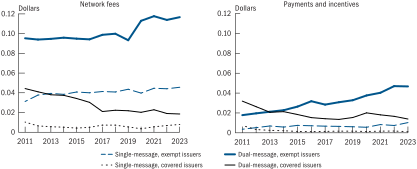
Note: Fees are shown on the same scale, for purposes of comparison.
Fraud
Fraud is ever-evolving and shifts toward new areas of vulnerability as new methods to prevent fraud are developed and deployed. For example, with the introduction of increased security for in-person card payments through the issuance of chip-based EMV cards, card fraud shifted from in-person fraud toward CNP, or remote, fraud.15
The fraud data presented in this section are from the DCI Survey and, therefore, only apply to covered issuers.16 Because these issuers constitute a particular segment of the total population of debit card issuers, their fraud experience may not be representative of all debit card issuers. As a result, estimates of aggregate fraud that might be derived from these data could differ from those based on information that reflects a broader set of issuers.
Figure 13 shows that overall fraud losses as a share of transaction value rose from 17.5 basis points in 2021 to 17.6 basis points in 2023, a substantially smaller increase than in previous years. However, this small increase masks substantial differences across different transaction categories and is driven primarily by a small increase in fraud losses for dual-message transactions, the most common transaction type. By contrast, fraud losses as a share of transaction value increased substantially for single-message transactions, from 4.2 basis points in 2021 to 6.7 basis points in 2023, while those for prepaid transactions rose from 222.1 basis points in 2021 to 312.6 basis points in 2023.
Figure 13. Fraud losses as a share of transaction value over time, by transaction category
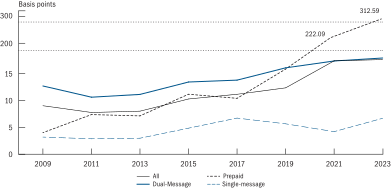
Figure 14 shows total fraud losses in 2023 to all parties expressed as a share of transaction value, broken down into four types of fraud: (1) lost and stolen fraud, (2) counterfeit fraud, (3) CNP fraud, and (4) other fraud.17 As figure 14 illustrates, CNP fraud accounted for more than one-half of overall fraud in 2023, at 54.3 percent. The second-largest fraud source, lost and stolen fraud, resulted in less than one-half as much fraud, at 22.2 percent. The third-largest fraud source, counterfeit fraud, accounted for a similar share of fraud, at 17.5 percent. Other fraud accounted for the remaining 5.9 percent.
Figure 14. Composition of fraud losses in 2023, by transaction category
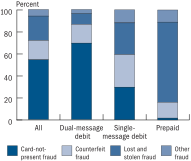
Note: Key describes bars in order from bottom to top. Percentages for each category are calculated based on issuers reporting the breakdowns of fraud losses for that transaction category.
The main fraud type driving observed fraud losses depends on the transaction category. CNP fraud was the main driver for dual-message transactions, making up over two-thirds of total fraud losses. Lost and stolen fraud made up the majority of prepaid fraud losses, at 72.9 percent. By contrast, the fraud experienced by single-message transactions can be accounted for by CNP, lost and stolen, and counterfeit fraud in almost equal shares. Additionally, other fraud constituted a small share of fraud losses for each transaction category; however, in absolute terms, the value for other fraud experienced by prepaid transactions was more than an order of magnitude higher than for the other two transaction categories.
On July 1, 2023, the final revision to Regulation II specifying that the regulation's routing provisions apply to CNP transactions went into effect.18 While single-message networks were still used relatively rarely for CNP transactions in 2023, a modest but clear increase in usage was observed. In particular, the share of volume and value of single-message CNP transactions out of all CNP transactions increased from 6.1 and 4.5 percent, respectively, in 2021, to 6.6 and 5.0 percent in 2023. With increased routing of CNP transactions over single-message networks, the share of total single-message fraud attributable to CNP transactions in 2023 increased to 29.7 percent but remains less than one-half of the equivalent share for dual-message networks (69.4 percent).
Figures 13 and 14 focus on fraud losses as a share of transaction value and the fraud loss per fraudulent transaction (figure 16). The product of these two factors yields the average fraud loss per transaction.19
Figure 15 shows that overall fraud incidence displayed a similar directional trend from 2009 to 2023 to that of fraud losses as a share of transaction value (figure 13) but with a greater magnitude. Overall fraud incidence flattened from 2021 to 2023, putting an end to the upward trend observed from 2011 to 2021. Fraud incidence more than tripled from 2011 to 2021, an even sharper increase than the one observed in fraud losses as a share of transaction value over the same period (figure 13). As had been the case since 2009, prepaid and dual-message transactions exhibited a considerably higher fraud incidence than single-message transactions in 2023.
Figure 15. Incidence of fraudulent transactions as a percentage of total transactions over time, by transaction category
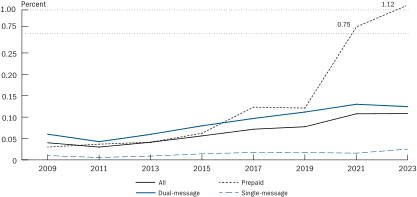
Figure 16 shows that the average loss per fraudulent transaction across all transactions remained relatively stable from 2021 to 2023. This was driven by two opposing forces: (1) an increase in the average loss per fraudulent transaction for both single- and dual-message transactions and (2) a decrease in the average loss per fraudulent transactions for prepaid transactions. Unlike fraud losses as a share of transaction value (figure 13) and fraud incidence (figure 15), the average loss per fraudulent prepaid transaction is not an outlier relative to the other transaction categories. In particular, the average loss per fraudulent prepaid transaction decreased slightly from 2021 to 2023 and remained above the equivalent value for dual-message transactions but below that for single-message transaction. As had been the case since 2009, in 2023 the average loss per fraudulent dual-message transaction was fairly similar to the average loss across all transactions. Finally, the average loss for single-message transactions increased slightly from $122.89 in 2021 to $128.42 in 2023, remaining nearly double the corresponding value for dual-message transactions and higher than the corresponding value for prepaid transactions.
Figure 16. Average loss per fraudulent transaction over time, by transaction category
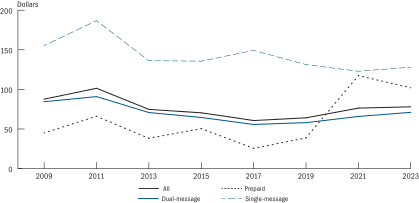
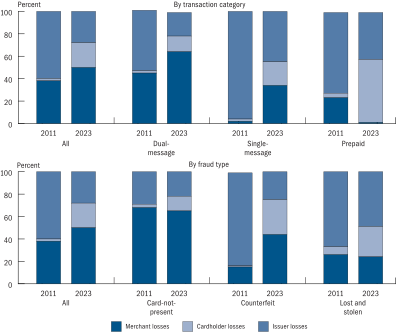
Figure 17 breaks down fraud losses that were absorbed by merchants, cardholders, and issuers in 2011 and 2023.20 In both years, the majority of fraud losses for all transactions were absorbed by issuers and merchants. However, the composition of fraud losses for all transactions, as well as for particular transaction categories and fraud types, evolved significantly over this period.
Figure 17. Composition of fraud losses in 2023, by transaction category and fraud type
Note: Key describes bars in order from bottom to top. Percentages for each category and fraud type, respectively, are calculated based on issuers reporting the breakdowns of fraud losses for that transaction category or fraud type.
From 2011 to 2023, for all transactions, the share of fraud losses absorbed by issuers fell from 59.8 percent in 2011 to 28.3 percent in 2023, while the equivalent shares rose for merchants (from 38.3 percent in 2011 to 49.9 percent in 2023) and for cardholders in (from less than 1.8 percent in 2011 to 21.8 percent in 2023).
These changes reflect both shifts in the composition of fraud losses by fraud type and transaction category and varying growth rates across different transaction categories. In particular, the rise in cardholders' share of fraud losses is driven mostly by the former, with shares rising across all fraud types and fraud categories, and especially for prepaid transactions and counterfeit fraud. By contrast, the rise in merchants' share of fraud losses is driven in large part by the rise in popularity of CNP transactions (as illustrated in figure 5) for which merchants' share of fraud has been much higher than for other categories, despite that share falling slightly from 2011 to 2023.
Focusing on the composition of fraud losses in 2023, the share of losses absorbed by merchants, cardholders, and issuers varied significantly across transaction categories and fraud types. Merchants absorbed the majority of fraud losses for transactions dual-message transactions (64.4 percent) and CNP fraud (65.1 percent). Issuers absorbed the largest share of fraud losses for single-message transactions (45.3 percent) and lost and stolen fraud (49.3 percent). Cardholders absorbed the largest share of fraud losses for prepaid transactions (56.3 percent) and counterfeit fraud (30.7 percent).
Issuer Costs
Like the fraud data presented in the previous section, issuer cost data presented in this section come from the DCI Survey and, therefore, apply only to covered issuers. Figure 18 presents average per-transaction authorization, clearing, and settlement (ACS) costs over time for different transaction categories.21 After declining consistently from 2009 to 2017, average ACS costs for all transactions stabilized in recent data collections, reaching $0.041 in 2023, a slight increase from 2021 ($0.039). Looking across transaction categories, in 2023, the average ACS cost of a prepaid card transaction ($0.129) was more than three times the cost of a dual-message debit transaction ($0.039) and more than four times the cost of a single-message debit transaction ($0.030). This pattern, in which prepaid card transactions are the most costly and single-message transactions are the least costly, has not changed since 2009. The average ACS costs for all three transaction categories converged from 2009 to 2019, although the average ACS cost of a prepaid card transaction has since diverged, rising from $0.076 in 2019 to $0.129 in 2023. Despite this increase, from 2009 to 2023 the highest-cost transaction category (prepaid) has exhibited the largest overall decline (50.2 percent), while the lowest-cost transaction category (single-message) saw the smallest decline (35.7 percent).
Figure 18. Average ACS costs per transaction (excluding issuer fraud losses) over time, by transaction category
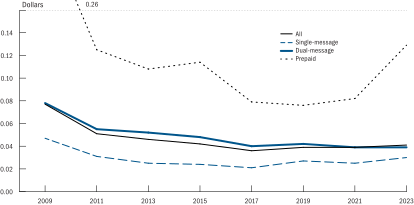
Figure 19 presents the average ACS costs over time by issuer size. Overall, for all years, issuers who processed more transactions consistently had lower per-transaction ACS costs on average.22 In 2023, the average per-transaction ACS cost for mid-volume issuers ($0.121) was over three times higher than the cost for high-volume issuers ($0.036), whereas the cost for low-volume issuers ($1.088) was 30 times higher than the cost for high-volume issuers. From 2021 to 2023, the average per-transaction ACS cost increased for issuers of all sizes.
Figure 19. Average ACS costs per transaction, excluding issuer fraud losses over time, by issuer size
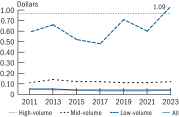
The overall decline in the average per-transaction ACS cost over the period from 2011 to 2023 has been driven primarily by the decline in the average pre-transaction ACS cost among high-volume issuers, which fell from $0.047 in 2011 to $0.036 in 2023. Over the same period, the average per-transaction ACS cost for mid-volume issuers increased slightly above its 2011 level. Lastly, the average per-transaction ACS cost for low-volume issuers oscillated around $0.60 from 2011 to 2021, but its value in 2023 ($1.09) was almost double the corresponding 2021 value.
Figure 20 breaks down ACS costs in 2023 across three categories: (1) in-house costs, (2) third-party processing fees, and (3) network fees.23 Overall, in-house costs constituted almost one-half of total ACS costs, at 45.2 percent, third-party processing fees constituted 29.6 percent, and network fees made up the rest. This split varied substantially across transaction categories and issuer size. For example, in-house costs constituted 53.9 percent of total ACS costs for dual-message transactions but only 32.9 percent for prepaid card transactions, while third-party processing fees constituted 60.8 percent of costs for prepaid cards, almost three times the share for dual-message transactions. Similarly, the share of in-house and third-party processing costs for high-volume issuers was 52.5 and 27.3 percent, respectively, while the corresponding shares for low-volume issuers were 5.6 and 75.6 percent.
Figure 20. Composition of average ACS costs, excluding issuer fraud losses in 2023, by transaction category and issuer size
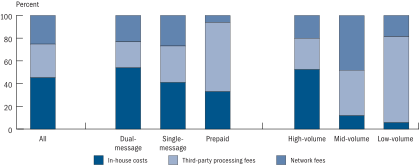
Note: Key describes bars in order from bottom to top. Breakdown excludes costs of transaction monitoring, which were not allocated to in-house costs and third-party processing fees.
Figure 21 illustrates how in 2023 the average per-transaction ACS costs borne by issuers compared with other costs borne by issuers in connection with their debit card programs. Overall, per-transaction ACS costs excluding issuer fraud losses constituted around one-third of average costs borne by issuers as reported in this data collection. Across transaction and issuer categories, three types of costs varied more than others: ACS costs excluding issuer fraud losses, cardholder inquiry costs, and issuer fraud losses.24 Unlike the pattern with ACS costs, there is no clear negative relationship between fraud-prevention costs and issuer volume, but high-volume issuers tend to incur a higher share of fraud-prevention costs. In particular, while mid-volume issuers had fraud-prevention costs that were 9.7 percent of total costs, those costs were more than twice as high, at 20.6 percent, for high-volume issuers, and slightly higher, at 10.3 percent, for low-volume issuers.
Figure 21. Composition of average issuer costs per transaction in 2023, by transaction category and issuer size
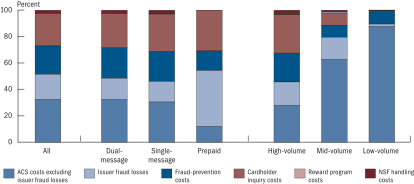
Note: Key describes bars in order from bottom to top. A substantial portion of low-volume issuers did not submit data on non-ACS costs. Thus, statistics for this group of issuers should be analyzed with caution. Reward program costs accounted for a negligible share of costs across most transaction categories and issuer sizes.
Issuer fraud losses as a share of total costs were higher for prepaid transactions and lower for low-volume issuers relative to other transaction and issuer categories. Cardholder inquiry costs were comparable across transaction categories; across issuer categories, cardholder inquiry costs were 31.3 percent of total costs for high-volume issuers but constituted a much smaller share of total costs for mid- and low-volume issuers: 6.3 percent and 0.6 percent, respectively. Reward program costs constituted just 0.2 percent of overall debit card costs and were equal to or below 1 percent for all transaction categories and issuer volume tiers.25
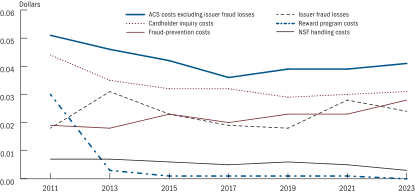
Figure 22 illustrates how average per-transaction ACS costs and other costs borne by issuers changed over time. Overall, total issuer per-transaction costs gradually decreased from $0.169 in 2011 to $0.127 in 2023.26 After Regulation II took effect, reward program costs substantially declined, with the largest drop observed from 2011 to 2013. ACS costs excluding issuer fraud losses, cardholder inquiry costs, and nonsufficient funds handling costs all progressively fell from 2011 to 2023. By contrast, fraud-prevention costs and issuer fraud losses were both higher in 2023 than in 2011.
Figure 22. Issuer costs per transaction, by type of cost
The first two columns in figure 23 show the percentage of covered issuers and transaction volume of covered issuers for which the sum of ACS costs and issuer fraud losses was less than or equal to the interchange fee permitted by the interchange fee standards. In 2023, the percentage of issuers with per-transaction ACS costs, including issuer fraud losses, less than or equal to the permissible amount was 80.1 percent, a small increase from 78.0 percent in 2021. Meanwhile, transactions reported by these issuers represented 99.2 percent of all transactions in 2023, down slightly from 99.6 percent in 2021.27 The difference between the percentage of issuers under the maximum and percentage of transactions under the maximum reflecting the fact that issuers under the maximum processed, on average, more transactions than issuers above the maximum.
Figure 23. Percentage of covered issuers and transactions with ACS costs, including fraud issuer losses, and fraud prevention costs in 2023 below the maximums permitted by Regulation II
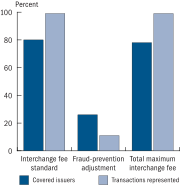
Note: Key describes bars in order from left to right.
As figure 23 further shows in the middle two columns, the percentages of both covered issuers and covered transactions with per-transaction fraud-prevention costs below the $0.01 permitted by the fraud-prevention adjustment were substantially lower than those for which per-transaction ACS costs, including issuer fraud losses, were lower than the interchange fee standards. In 2023, 26.3 percent of covered issuers had fraud-prevention costs less than or equal to $0.01, down from 42.0 percent in 2021. Similarly, 10.6 percent of covered transactions had fraud-prevention costs less than or equal to $0.01, down from 34.5 percent in 2021.28
Finally, as shown in the last two columns in figure 23, in 2023, the percentage of issuers with combined costs lower than or equal to the total amount allowed by the interchange fee standards and the fraud-prevention adjustment was 78.1 percent, a small increase from 76.5 percent in 2021. Meanwhile, transactions reported by these issuers represented 99.2 percent of all transactions in 2023, down slightly from 99.6 percent in 2021.29
Background
The Electronic Fund Transfer Act (EFTA) requires the Federal Reserve Board to biennially publish data on the costs incurred, and interchange fees charged or received, by debit card issuers and payment card networks.30 The Board conducted its first data collection in 2010 on a voluntary basis, collecting data from payment card networks and issuers from 2009. The information from the first voluntary data collection assisted the Board in developing Regulation II and was included in a report published in 2011. Six subsequent reports summarized data collected on a mandatory basis since the initial voluntary data collection. The most recent report, released in 2023, contained information through 2021.31 The present report is the eighth in the series and contains data through 2023.
Regulation II establishes interchange fee standards under which, for a debit card transaction subject to the standards, an issuer may not receive or charge an interchange fee greater than $0.21 plus 5 basis points times the value of that transaction.32 For a transaction subject to the standards, an issuer may be eligible to receive an additional $0.01 adjustment to the interchange fee amount permitted under the standards if the issuer meets fraud-prevention standards specified in the regulation. Certain transactions—namely those performed using certain debit cards issued pursuant to government-administered payment programs, and those performed using certain reloadable general-use prepaid cards—are exempt from the interchange fee standards.33 Additionally, an issuer with consolidated assets below $10 billion is not subject to the interchange fee standards, provided the issuer holds the account that is debited.
Data Collections
The Board conducts two surveys to collect information about the debit card industry, both of which are mandatory under Regulation II. The Payment Card Network (PCN) Survey is conducted every year and surveys payment card networks that process debit card transactions. The Debit Card Issuer (DCI) Survey is conducted every two years and surveys issuers that are subject to the interchange fee standards in Regulation II.
The surveys ask respondents to report information on all debit card transactions issued by that issuer or processed by that network in a given calendar year.34 The surveys distinguish between general-use prepaid cards and other debit cards.35 Although Regulation II defines prepaid cards to be a subset of debit cards, for ease of exposition, this report uses terminology that distinguishes between prepaid cards and non-prepaid debit cards. In particular, the report uses the term "debit cards" to mean non-prepaid debit cards. It further uses the term "prepaid cards" to mean general-use prepaid cards that are covered by the definition of debit card in Regulation II.
The surveys also distinguish between dual-message and single-message networks. A dual-message network typically uses separate messages to authorize and clear a transaction. Traditionally, these networks processed signature-authenticated transactions.36 Increasingly, however, transactions processed over these networks may not require signature authentication or may involve other methods of cardholder authentication, such as entry of a personal identification number (PIN) or biometric authentication. By contrast, a single-message network typically uses a single message to authorize and clear a transaction. Traditionally, these networks processed PIN-authenticated transactions.37 Increasingly, however, transactions processed over single-message networks, such as low-value purchases and CNP transactions, may not require PIN authentication. Over time, the distinction between single-message and dual-message networks has become less clear from a functional perspective, as methods of cardholder authentication change and both types of networks develop new functionalities.38 This report continues to categorize networks as single-message or dual-message because this categorization serves to distinguish networks into groupings that are widely used by the industry.
Appendix: Tables
Table 1. Purchase transactions, 2023
| Transactions | Number (billions) | Value ($ billions) | Average ($) |
|---|---|---|---|
| All transactions | 100.70 | 4,658.42 | 46.26 |
| Non-prepaid debit card | 89.14 | 4,217.61 | 47.32 |
| Prepaid card | 9.24 | 340.49 | 36.86 |
| Dual-message networks | 71.86 | 3,398.00 | 47.29 |
| Non-prepaid debit card | 65.41 | 3,148.32 | 48.13 |
| Prepaid card | 6.45 | 249.68 | 38.72 |
| Single-message networks | 28.84 | 1,260.42 | 43.71 |
| Non-prepaid debit card | 23.73 | 1,069.30 | 45.06 |
| Prepaid card | 2.79 | 90.81 | 32.56 |
Table 2. Card-present and card-not-present transactions, 2023
| Transactions | Number (billions) | Value ($ billions) | Average ($) |
|---|---|---|---|
| All transactions1 | 100.70 | 4,658.42 | 46.26 |
| Card-present | 66.08 | 2,444.63 | 36.99 |
| Card-not-present | 34.61 | 2,213.79 | 63.96 |
| Dual-message networks2 | 71.86 | 3,398.00 | 47.29 |
| Card-present | 39.54 | 1,294.33 | 32.73 |
| Card-not-present | 32.32 | 2,103.67 | 65.09 |
| Single-message networks2 | 28.84 | 1,260.42 | 43.71 |
| Card-present | 26.54 | 1,150.31 | 43.34 |
| Card-not-present | 2.29 | 110.12 | 48.01 |
1. Prepaid card transactions are included under all transactions and under both dual-message and single-message networks. Return to table
Table 3. Covered and exempt debit card transactions, 2023
| Transactions | Number (billions) | Value ($ billions) | Average ($) |
|---|---|---|---|
| All transactions | 100.70 | 4,658.42 | 46.26 |
| Covered transactions | 61.67 | 2,996.73 | 48.59 |
| Non-prepaid | 61.61 | 2,994.63 | 48.60 |
| Prepaid | 0.06 | 2.10 | 36.17 |
| Exempt transactions | 39.02 | 1,661.69 | 42.58 |
| Non-prepaid | 29.84 | 1,323.29 | 44.34 |
| Prepaid | 9.18 | 338.39 | 36.86 |
| Covered issuer | 1.94 | 82.21 | 42.41 |
| Exempt issuer | 7.24 | 256.28 | 35.38 |
| Dual-message networks | 71.86 | 3,398.00 | 47.29 |
| Covered transactions | 44.50 | 2,193.09 | 49.28 |
| Non-prepaid | 44.45 | 2,191.46 | 49.30 |
| Prepaid | 0.05 | 1.63 | 35.81 |
| Exempt transactions | 27.36 | 1,204.90 | 44.04 |
| Non-prepaid | 20.96 | 956.85 | 45.66 |
| Prepaid | 6.40 | 248.05 | 38.74 |
| Covered issuer | 1.21 | 54.95 | 45.24 |
| Exempt issuer | 5.19 | 193.10 | 37.22 |
| Single-message networks | 28.84 | 1,260.42 | 43.71 |
| Covered transactions | 17.17 | 803.64 | 46.80 |
| Non-prepaid | 17.16 | 803.17 | 46.81 |
| Prepaid | 0.01 | 0.47 | 37.48 |
| Exempt transactions | 11.66 | 456.78 | 39.16 |
| Non-prepaid | 8.89 | 366.44 | 41.23 |
| Prepaid | 2.78 | 90.35 | 32.54 |
| Covered issuer | 0.72 | 27.26 | 37.66 |
| Exempt issuer | 2.05 | 63.18 | 30.74 |
Table 4. Interchange fee revenue, 2023
| Transactions | Interchange fee revenue ($ billions) | Fee per transaction($)1 | Fee as percent of transaction value1 |
|---|---|---|---|
| All transactions | 34.12 | 0.34 | 0.73 |
| Non-prepaid debit card | 28.23 | 0.32 | 0.67 |
| Prepaid card | 5.24 | 0.57 | 1.54 |
| Dual-message networks | 26.87 | 0.37 | 0.79 |
| Non-prepaid debit card | 22.40 | 0.34 | 0.71 |
| Prepaid card | 4.47 | 0.69 | 1.79 |
| Single-message networks | 7.25 | 0.25 | 0.57 |
| Non-prepaid debit card | 5.82 | 0.25 | 0.54 |
| Prepaid card | 0.77 | 0.28 | 0.85 |
1. Interchange fee revenue is divided by the number or value of purchase transactions. Return to table
Table 5. Interchange fee revenue from covered and exempt debit card transactions, 2023
| Transactions | Interchange fee revenue ($ billions) | Fee per transaction ($)1 | Fee as percent of transaction value1 |
|---|---|---|---|
| All transactions | 34.12 | 0.34 | 0.73 |
| Covered transactions | 14.02 | 0.23 | 0.47 |
| Non-prepaid | 14.01 | 0.23 | 0.47 |
| Prepaid | 0.01 | 0.23 | 0.63 |
| Exempt transactions | 20.10 | 0.52 | 1.21 |
| Non-prepaid | 14.87 | 0.50 | 1.12 |
| Prepaid | 5.22 | 0.57 | 1.54 |
| Covered issuer | 1.03 | 0.53 | 1.26 |
| Exempt issuer | 4.19 | 0.58 | 1.64 |
| Dual-message networks | 26.87 | 0.37 | 0.79 |
| Covered transactions | 9.88 | 0.22 | 0.45 |
| Non-prepaid | 9.87 | 0.22 | 0.45 |
| Prepaid | 0.01 | 0.23 | 0.63 |
| Exempt transactions | 16.99 | 0.62 | 1.41 |
| Non-prepaid | 12.53 | 0.60 | 1.31 |
| Prepaid | 4.46 | 0.70 | 1.80 |
| Covered issuer | 0.86 | 0.71 | 1.56 |
| Exempt issuer | 3.60 | 0.69 | 1.87 |
| Single-message networks | 7.25 | 0.25 | 0.57 |
| Covered transactions | 4.14 | 0.24 | 0.52 |
| Non-prepaid | 4.13 | 0.24 | 0.51 |
| Prepaid | 0.00 | 0.23 | 0.62 |
| Exempt transactions | 3.10 | 0.27 | 0.68 |
| Non-prepaid | 2.34 | 0.26 | 0.64 |
| Prepaid | 0.77 | 0.28 | 0.85 |
| Covered issuer | 0.18 | 0.25 | 0.65 |
| Exempt issuer | 0.59 | 0.29 | 0.93 |
1. Interchange fee revenue is divided by the number or value of purchase transactions. Return to table
Table 6. Payments and incentives paid by networks, 2023
| Recipients | Payments and incentives ($ billions) | Payment per transaction ($)1 | Payment as percent of transaction value1 |
|---|---|---|---|
| All recipients | 5.68 | 0.056 | 0.12 |
| Paid to A/M | 3.71 | 0.037 | 0.08 |
| Paid to issuers | 1.98 | 0.020 | 0.04 |
| Dual-message networks | 5.02 | 0.070 | 0.15 |
| Paid to A/M | 3.17 | 0.044 | 0.09 |
| Paid to issuers | 1.85 | 0.026 | 0.05 |
| Single-message networks | 0.66 | 0.023 | 0.05 |
| Paid to A/M | 0.54 | 0.019 | 0.04 |
| Paid to issuers | 0.12 | 0.004 | 0.01 |
1. Payments and incentives are divided by the number or value of purchase transactions. Return to table
A/M is acquirers/merchants.
Table 7. Payments and incentives paid to issuers by networks, 2023
| Issuers | Payments and incentives ($ billions) | Payment per transaction ($)1 | Payment as percent of transaction value1 |
|---|---|---|---|
| All issuers | 1.98 | 0.020 | 0.042 |
| Covered issuers | 0.65 | 0.010 | 0.021 |
| Exempt issuers | 1.32 | 0.036 | 0.084 |
| Dual-message networks | 1.85 | 0.026 | 0.055 |
| Covered issuers | 0.63 | 0.014 | 0.028 |
| Exempt issuers | 1.22 | 0.047 | 0.106 |
| Single-message networks | 0.12 | 0.004 | 0.010 |
| Covered issuers | 0.02 | 0.001 | 0.002 |
| Exempt issuers | 0.10 | 0.009 | 0.024 |
1. Payments and incentives are divided by the number or value of purchase transactions. Return to table
Table 8. Network fees, 2023
| Recipients | Network feepayments ($ billions) | Fee pertransaction ($)1 | Fee as percent of transaction value1 |
|---|---|---|---|
| All recipients | 12.95 | 0.129 | 0.28 |
| Paid by acquirers | 8.40 | 0.083 | 0.18 |
| Paid by issuers | 4.54 | 0.045 | 0.10 |
| Dual-message networks | 10.95 | 0.152 | 0.32 |
| Paid by acquirers | 7.05 | 0.098 | 0.21 |
| Paid by issuers | 3.90 | 0.054 | 0.11 |
| Single-message networks | 2.00 | 0.069 | 0.16 |
| Paid by acquirers | 1.36 | 0.047 | 0.11 |
| Paid by issuers | 0.64 | 0.022 | 0.05 |
1. Network fees are divided by the number or value of purchase transactions. Return to table
Table 9. Network fees paid by issuers, 2023
| Issuers | Network fee payments ($ billions) | Fee per transaction ($)1 | Fee as percent of transaction value1 |
|---|---|---|---|
| All issuers | 4.54 | 0.045 | 0.10 |
| Covered issuers | 0.99 | 0.016 | 0.03 |
| Exempt issuers | 3.55 | 0.096 | 0.22 |
| Dual-message networks | 3.90 | 0.054 | 0.11 |
| Covered issuers | 0.85 | 0.019 | 0.04 |
| Exempt issuers | 3.05 | 0.117 | 0.27 |
| Single-message networks | 0.64 | 0.022 | 0.05 |
| Covered issuers | 0.14 | 0.008 | 0.02 |
| Exempt issuers | 0.50 | 0.046 | 0.12 |
1. Network fees are divided by the number or value of purchase transactions. Return to table
Table 10. Covered issuer fraudulent debit card activity, 2023
| Transactions | Fraud as percent of purchase transactions1 | Average loss per fraudulent transaction ($)2 |
|---|---|---|
| All transactions | 0.108 | 78 |
| Card-not-present fraud | 0.061 | 73 |
| Counterfeit fraud | 0.021 | 69 |
| Lost and stolen fraud | 0.018 | 102 |
| Other fraud | 0.006 | 85 |
| Dual-message debit transactions3 | 0.124 | 71 |
| Card-not-present fraud | 0.084 | 72 |
| Counterfeit fraud | 0.023 | 63 |
| Lost and stolen fraud | 0.011 | 77 |
| Other fraud | 0.005 | 66 |
| Single-message debit transactions4 | 0.025 | 128 |
| Card-not-present fraud | 0.009 | 106 |
| Counterfeit fraud | 0.008 | 119 |
| Lost and stolen fraud | 0.006 | 146 |
| Other fraud | 0.002 | 221 |
| Prepaid transactions | 1.116 | 102 |
| Card-not-present fraud | 0.050 | 38 |
| Counterfeit fraud | 0.241 | 65 |
| Lost and stolen fraud | 0.660 | 122 |
| Other fraud | 0.164 | 95 |
1. Number of fraudulent transactions divided by the total number of purchase transactions. Return to table
2. Total fraud losses to all parties (merchants, cardholders, and issuers) divided by the number of fraudulent transactions. Return to table
3. Dual-message debit transactions are transactions initiated with non-prepaid debit cards processed over dual-message networks. Return to table
4. Single-message debit transactions are transactions initiated with non-prepaid debit cards processed over single-message networks. Return to table
Table 11. Covered issuer fraud losses, 2023
| Transactions | All fraud1 | Card-not-present fraud2 | Counterfeit fraud | Lost and stolen fraud | ||||
|---|---|---|---|---|---|---|---|---|
| Loss per transaction ($)3 | Loss as share of transaction value (bp)4 | Loss per transaction ($)3 | Loss as share of transaction value (bp)4 | Loss per transaction ($)3 | Loss as share of transaction value (bp)4 | Loss per transaction ($)3 | Loss as share of transaction value (bp)4 | |
| All transactions | 0.086 | 17.63 | 0.046 | 9.50 | 0.015 | 3.07 | 0.019 | 3.87 |
| Merchant losses | 0.043 | 8.75 | 0.022 | 4.47 | 0.005 | 0.93 | 0.002 | 0.33 |
| Cardholder losses | 0.019 | 3.83 | 0.004 | 0.91 | 0.003 | 0.65 | 0.002 | 0.38 |
| Issuer losses | 0.024 | 4.96 | 0.007 | 1.49 | 0.003 | 0.54 | 0.003 | 0.70 |
| Dual-message debit transactions5 | 0.088 | 17.92 | 0.062 | 12.52 | 0.015 | 3.05 | 0.009 | 1.81 |
| Merchant losses | 0.056 | 11.30 | 0.044 | 8.86 | 0.008 | 1.73 | 0.003 | 0.58 |
| Cardholder losses | 0.012 | 2.52 | 0.006 | 1.24 | 0.003 | 0.71 | 0.002 | 0.40 |
| Issuer losses | 0.018 | 3.73 | 0.011 | 2.17 | 0.003 | 0.59 | 0.004 | 0.79 |
| Single-message debit transactions6 | 0.032 | 6.69 | 0.010 | 2.01 | 0.010 | 1.99 | 0.010 | 1.98 |
| Merchant losses | 0.011 | 2.22 | 0.005 | 1.12 | 0.003 | 0.53 | 0.002 | 0.50 |
| Cardholder losses | 0.007 | 1.39 | 0.001 | 0.29 | 0.003 | 0.60 | 0.002 | 0.42 |
| Issuer losses | 0.014 | 2.99 | 0.003 | 0.59 | 0.004 | 0.81 | 0.005 | 1.03 |
| Prepaid transactions | 1.116 | 312.59 | 0.024 | 6.43 | 0.198 | 53.59 | 1.007 | 272.70 |
| Merchant losses | 0.016 | 4.62 | 0.002 | 0.61 | 0.000 | 0.08 | 0.000 | 0.11 |
| Cardholder losses | 0.628 | 175.85 | 0.000 | 0.09 | 0.010 | 2.84 | 0.010 | 2.64 |
| Issuer losses | 0.472 | 132.08 | 0.004 | 1.19 | 0.003 | 0.83 | 0.004 | 1.02 |
Note: Statistics exclude responses in which the issuer reported issuer fraud losses but was unable to report gross fraud losses. Therefore, statistics may differ from those in table 14, which include responses in which the issuer was able to report only issuer fraud losses.
1. Card-not-present, counterfeit, and lost and stolen fraud losses do not necessarily sum to all fraud losses. Some fraud losses could not be categorized by issuers into the categories above but are still included under all fraud losses. Return to table
2. Card-not-present fraud losses may also be reported in another second category. Return to table
3. Fraud losses divided by the number of purchase transactions (both fraudulent and non-fraudulent). Return to table
4. Fraud losses divided by the value of purchase transactions (both fraudulent and non-fraudulent). Return to table
5. Dual-message transactions are transactions initiated by non-prepaid debit cards over dual-message networks. Return to table
6. Single-message transactions are transactions initiated by non-prepaid debit cards over single-message networks. Return to table
Table 12. Covered issuers by 2023 volume
| Issuers 1 | Number of covered issuers | Percent of transaction value | Average transaction value ($)2 |
|---|---|---|---|
| All covered issuers | 166 | 48.86 | |
| High-volume issuers | 57 | 93.87 | 48.75 |
| Mid-volume issuers | 89 | 6.11 | 50.62 |
| Low-volume issuers | 20 | 0.01 | 83.22 |
1. High-volume issuers are issuers that report more than 100 million transactions. Mid-volume issuers are issuers that report between 1 and 100 million transactions. Low-volume issuers are issuers that report fewer than 1 million transactions. Return to table
2. Average transaction values in this table are calculated from the Debit Card Issuer survey. Average transaction values reported in tables 1–3 are calculated from the Payment Card Network survey. Return to table
Table 13. Covered issuer average authorization, clearing, and settlement (ACS) costs, excluding issuer fraud losses, per transaction (dollars), 2023
| Transactions | All covered issuers | High-volume issuers | Mid-volume issuers | Low-volume issuers |
|---|---|---|---|---|
| All transactions1, 2 | 0.041 | 0.036 | 0.121 | 1.088 |
| Dual-message debit transactions2 | 0.039 | 0.036 | 0.119 | 1.105 |
| Single-message debit transactions2 | 0.030 | 0.026 | 0.128 | 1.204 |
| Prepaid transactions2, 3 | 0.129 | 0.129 | 1.685 | 0.044 |
| Transactions reported with cost breakdown1, 2 | 0.038 | 0.034 | 0.100 | 1.000 |
| In-house costs | 0.016 | 0.017 | 0.013 | 0.022 |
| Third-party processing fees | 0.011 | 0.009 | 0.044 | 0.301 |
| Network fees | 0.009 | 0.006 | 0.053 | 0.075 |
| Dual-message debit transactions2, 3 | 0.037 | 0.036 | 0.083 | 1.030 |
| In-house costs | 0.019 | 0.019 | 0.011 | 0.010 |
| Third-party processing fees | 0.008 | 0.007 | 0.037 | 0.144 |
| Network fees | 0.008 | 0.006 | 0.059 | 0.016 |
| Single-message debit transactions2, 3 | 0.026 | 0.023 | 0.101 | 1.106 |
| In-house costs | 0.011 | 0.010 | 0.027 | 0.013 |
| Third-party processing fees | 0.009 | 0.007 | 0.033 | 0.865 |
| Network fees | 0.007 | 0.005 | 0.059 | 0.265 |
| Prepaid transactions2, 3 | 0.124 | 0.124 | 1.685 | — |
| In-house costs | 0.040 | 0.040 | 0.175 | — |
| Third-party processing fees | 0.073 | 0.073 | 1.072 | — |
| Network fees | 0.008 | 0.008 | 0.278 | — |
1. Rows 1–4 in table 13 report statistics from transactions processed by all covered issuers, regardless of the level of detail in their cost reporting. Rows 5–20 report statistics from transactions including only those issuers that provided a breakdown of their costs by category. Return to table
2. ACS costs include transactions monitoring costs. However, transactions monitoring costs are not included in the breakout into in-house costs and third-party processing fees. Return to table
3. Prepaid figures for low-volume issuers, as well as the breakdown by cost category among low-volume issuers for dual-message, single-message and prepaid transactions, are not reported because of the small number of respondents. Return to table
Table 14A. Covered issuer costs per transaction (dollars) and fraud losses as share of transaction value, 2023
(basis points)
| Transactions | All covered issuers | High-volume issuers | ||||||||
|---|---|---|---|---|---|---|---|---|---|---|
| Transaction-weighted average | Issuer-weighted average | Issuer percentiles | Transaction-weighted average | Issuer-weighted average | Issuer percentiles | |||||
| 25th | 50th | 75th | 25th | 50th | 75th | |||||
| All transactions | ||||||||||
| ACS costs, excluding fraud losses 1 | 0.041 | 1.363 | 0.055 | 0.108 | 0.176 | 0.036 | 0.064 | 0.035 | 0.059 | 0.083 |
| Fraud-prevention costs2 | 0.028 | 0.152 | 0.010 | 0.018 | 0.043 | 0.028 | 0.023 | 0.010 | 0.014 | 0.029 |
| Cardholder inquiry costs 3 | 0.031 | 0.030 | 0.001 | 0.007 | 0.021 | 0.043 | 0.018 | 0.002 | 0.013 | 0.027 |
| Reward program costs | <0.001 | 0.001 | — | — | — | <0.001 | <0.001 | — | — | — |
| NSF handling costs 4 | 0.003 | 0.004 | — | — | 0.002 | 0.007 | 0.004 | <0.001 | 0.001 | 0.004 |
| Issuer fraud losses | 0.024 | 0.033 | 0.015 | 0.023 | 0.034 | 0.023 | 0.024 | 0.015 | 0.020 | 0.027 |
| Dual-message debit transactions 5 | ||||||||||
| ACS costs, excluding fraud losses 1 | 0.039 | 0.173 | 0.041 | 0.090 | 0.166 | 0.029 | 0.062 | 0.030 | 0.055 | 0.083 |
| Fraud-prevention costs 2 | 0.028 | 0.033 | 0.011 | 0.019 | 0.046 | 0.028 | 0.027 | 0.011 | 0.031 | 0.040 |
| Cardholder inquiry costs 3 | 0.031 | 0.018 | 0.001 | 0.008 | 0.025 | 0.075 | 0.020 | 0.007 | 0.015 | 0.027 |
| Reward program costs | <0.001 | <0.001 | — | — | — | <0.001 | <0.001 | — | — | — |
| NSF handling costs 4 | 0.003 | 0.005 | — | <0.001 | 0.002 | 0.005 | 0.004 | <0.001 | 0.001 | 0.004 |
| Issuer fraud losses | 0.020 | 0.038 | 0.014 | 0.024 | 0.038 | 0.026 | 0.029 | 0.014 | 0.024 | 0.035 |
| Single-message debit transactions 6 | ||||||||||
| ACS costs, excluding fraud losses 1 | 0.030 | 0.576 | 0.031 | 0.075 | 0.153 | 0.022 | 0.053 | 0.022 | 0.038 | 0.071 |
| Fraud-prevention costs 2 | 0.023 | 0.194 | 0.009 | 0.019 | 0.050 | 0.023 | 0.022 | 0.009 | 0.013 | 0.027 |
| Cardholder inquiry costs 3 | 0.027 | 0.018 | 0.001 | 0.008 | 0.023 | 0.059 | 0.018 | 0.005 | 0.014 | 0.027 |
| Reward program costs | <0.001 | <0.001 | — | — | — | <0.001 | <0.001 | — | — | — |
| NSF handling costs 4 | 0.003 | 0.002 | — | — | 0.002 | 0.003 | 0.004 | <0.001 | 0.001 | 0.003 |
| Issuer fraud losses | 0.015 | 0.041 | 0.006 | 0.014 | 0.033 | 0.020 | 0.018 | 0.007 | 0.013 | 0.021 |
| Prepaid transactions7 | ||||||||||
| ACS costs, excluding fraud losses 1 | 0.129 | 0.411 | 0.057 | 0.136 | 0.285 | 0.129 | 0.237 | 0.057 | 0.136 | 0.162 |
| Fraud-prevention costs 2 | 0.166 | 0.075 | 0.007 | 0.017 | 0.060 | 0.166 | 0.090 | 0.009 | 0.020 | 0.062 |
| Cardholder inquiry costs 3 | 0.345 | 0.274 | 0.011 | 0.052 | 0.257 | 0.173 | 0.251 | 0.028 | 0.065 | 0.250 |
| Reward program costs | <0.001 | <0.001 | —- | — | — | <0.001 | <0.001 | — | — | — |
| NSF handling costs 4 | <0.001 | 0.002 | — | — | 0.000 | <0.001 | 0.001 | — | — | 0.001 |
| Issuer fraud losses | 0.476 | 0.183 | 0.006 | 0.014 | 0.101 | 0.468 | 0.240 | 0.013 | 0.028 | 0.128 |
| Covered issuer fraud losses (bp) 8 | 4.96 | 5.71 | 2.81 | 4.15 | 6.67 | 4.66 | 4.78 | 3.10 | 4.14 | 5.26 |
| Dual-message debit transactions 5 | 3.99 | 6.32 | 2.79 | 4.24 | 7.27 | 5.27 | 5.85 | 3.08 | 4.34 | 6.78 |
| Single-message debit transactions 6 | 3.11 | 7.06 | 1.24 | 3.06 | 5.66 | 4.21 | 3.88 | 1.41 | 2.83 | 4.50 |
| Prepaid transactions 7 | 132.99 | 34.68 | 1.13 | 4.37 | 23.41 | 130.80 | 43.82 | 3.09 | 6.40 | 27.82 |
1. Authorization, clearing, and settlement costs include transactions monitoring costs and exclude issuer fraud losses, which are reported separately. Return to table
2. Fraud-prevention costs include fraud-related cardholder inquiry costs and exclude transactions monitoring costs, which are counted as part of ACS costs. Return to table
3. Cardholder inquiry costs exclude fraud-related cardholder inquiry costs, which are counted as part of fraud-prevention costs. Return to table
4. Non-sufficient funds (NSF) handling costs. Return to table
5. Dual-message debit transactions are transactions initiated with non-prepaid debit cards processed over dual-message networks. Return to table
6. Single-message debit transactions are transactions initiated with non-prepaid debit cards processed over single-message networks. Return to table
7. Prepaid figures for low-volume issuers are not reported because of the small number of respondents in this category. Return to table
8. Covered issuer fraud losses for all transactions include covered issuers that could not allocate fraud losses among dual-message debit, single-message debit, and prepaid transactions. Return to table
Table 14B. Covered issuer costs per transaction (dollars) and fraud losses as share of transaction value, 2023
(basis points)
| Transactions | Mid-volume issuers | Low-volume issuers | ||||||||
|---|---|---|---|---|---|---|---|---|---|---|
| Transaction-weighted average | Issuer-weighted average | Issuer percentiles | Transaction-weighted average | Issuer-weighted average | Issuer percentiles | |||||
| 25th | 50th | 75th | 25th | 50th | 75th | |||||
| All transactions | ||||||||||
| ACS costs, excluding fraud losses1 | 0.121 | 0.161 | 0.089 | 0.132 | 0.180 | 1.088 | 10.300 | 0.243 | 1.164 | 2.841 |
| Fraud-prevention costs2 | 0.018 | 0.030 | 0.010 | 0.018 | 0.035 | 0.129 | 1.086 | 0.018 | 0.114 | 0.272 |
| Cardholder inquiry costs 3 | 0.012 | 0.019 | 0.001 | 0.005 | 0.018 | 0.007 | 0.113 | — | — | 0.001 |
| Reward program costs | 0.002 | 0.002 | — | — | — | — | — | — | — | — |
| NSF handling costs4 | 0.003 | 0.005 | — | — | 0.001 | — | — | — | — | — |
| Issuer fraud losses | 0.032 | 0.042 | 0.018 | 0.028 | 0.040 | 0.023 | 0.021 | — | 0.002 | 0.024 |
| Dual-message debit transactions 5 | ||||||||||
| ACS costs, excluding fraud losses 1 | 0.101 | 0.170 | 0.071 | 0.137 | 0.188 | 0.143 | 0.725 | 0.112 | 0.281 | 1.059 |
| Fraud-prevention costs 2 | 0.022 | 0.035 | 0.011 | 0.020 | 0.044 | 0.051 | 0.065 | — | 0.051 | 0.126 |
| Cardholder inquiry costs 3 | 0.009 | 0.019 | <0.001 | 0.004 | 0.019 | 0.004 | 0.004 | — | — | — |
| Reward program costs | <0.001 | <0.001 | — | — | — | — | — | — | — | — |
| NSF handling costs 4 | 0.004 | 0.006 | — | — | 0.001 | — | — | — | — | — |
| Issuer fraud losses | 0.032 | 0.051 | 0.016 | 0.031 | 0.044 | 0.018 | 0.020 | — | 0.005 | 0.017 |
| Single-message debit transactions6 | ||||||||||
| ACS costs, excluding fraud losses 1 | 0.128 | 0.237 | 0.064 | 0.128 | 0.179 | <0.001 | 4.868 | 0.379 | 0.659 | 1.496 |
| Fraud-prevention costs 2 | 0.019 | 0.052 | 0.007 | 0.021 | 0.060 | 0.493 | 2.036 | 0.103 | 0.393 | 1.590 |
| Cardholder inquiry costs 3 | 0.008 | 0.021 | 0.001 | 0.005 | 0.017 | 0.013 | 0.009 | — | — | — |
| Reward program costs | — | — | — | — | — | — | — | — | — | — |
| NSF handling costs 4 | 0.001 | 0.001 | — | — | <0.001 | — | — | — | — | — |
| Issuer fraud losses | 0.030 | 0.057 | 0.009 | 0.018 | 0.050 | 0.041 | 0.058 | — | — | 0.052 |
| Prepaid transactions 7 | ||||||||||
| ACS costs, excluding fraud losses 1 | 1.685 | 1.217 | 0.146 | 1.118 | 2.390 | — | — | — | — | — |
| Fraud-prevention costs 2 | 0.065 | 0.044 | — | 0.006 | 0.024 | — | — | — | — | — |
| Cardholder inquiry costs 3 | 0.836 | 0.432 | — | 0.134 | 0.566 | — | — | — | — | — |
| Reward program costs | — | — | — | — | — | — | — | — | — | — |
| NSF handling costs 4 | 0.016 | 0.008 | — | — | 0.008 | — | — | — | — | — |
| Issuer fraud losses | 0.051 | 0.060 | 0.001 | 0.009 | 0.044 | — | — | — | — | — |
| Covered issuer fraud losses (bp) 8 | 6.25 | 7.13 | 3.38 | 4.65 | 7.91 | 2.82 | 2.26 | — | 0.37 | 2.07 |
| Dual-message debit transactions 5 | 6.08 | 7.88 | 3.11 | 5.03 | 8.02 | 2.26 | 2.06 | — | 0.60 | 2.36 |
| Single-message debit transactions 6 | 6.04 | 9.80 | 2.05 | 3.54 | 9.11 | 4.95 | 8.32 | — | — | 3.82 |
| Prepaid transactions 7 | 14.38 | 16.08 | 0.35 | 2.66 | 12.90 | — | — | — | — | — |
1. Authorization, clearing, and settlement costs include transactions monitoring costs and exclude issuer fraud losses, which are reported separately. Return to table
2. Fraud-prevention costs include fraud-related cardholder inquiry costs and exclude transactions monitoring costs, which are counted as part of ACS costs. Return to table
3. Cardholder inquiry costs exclude fraud-related cardholder inquiry costs, which are counted as part of fraud-prevention costs. Return to table
4. Non-sufficient funds (NSF) handling costs. Return to table
5. Dual-message debit transactions are transactions initiated with non-prepaid debit cards processed over dual-message networks. Return to table
6. Single-message debit transactions are transactions initiated with non-prepaid debit cards processed over single-message networks. Return to table
7. Prepaid figures for low-volume issuers are not reported because of the small number of respondents in this category. Return to table
8. Covered issuer fraud losses for all transactions include covered issuers that could not allocate fraud losses among dual-message debit, single-message debit, and prepaid transactions. Return to table
Table 15. Covered issuers with costs/losses below the levels permitted by the interchange fee standard and fraud-prevention adjustment, 2023
| Issuers | Percent of covered issuers1 | Percent of transactions represented2 |
|---|---|---|
| All covered issuers | ||
| Total maximum interchange fee3 | 78.1 | 99.2 |
| Interchange fee standard4 | 80.1 | 99.2 |
| Fraud-prevention adjustment5 | 26.3 | 10.6 |
| High-volume issuers | ||
| Total maximum interchange fee3 | 98.0 | 99.8 |
| Interchange fee standard4 | 98.0 | 99.8 |
| Fraud-prevention adjustment5 | 26.9 | 9.2 |
| Mid-volume issuers | ||
| Total maximum interchange fee3 | 79.5 | 89.9 |
| Interchange fee standard4 | 80.8 | 90.0 |
| Fraud-prevention adjustment5 | 25.6 | 33.4 |
| Low-volume issuers | ||
| Total maximum interchange fee3 | 16.7 | 35.6 |
| Interchange fee standard4 | 27.8 | 65.1 |
| Fraud-prevention adjustment5 | 27.8 | 26.4 |
1. Percentage of covered issuers in the relevant category with average ACS costs, including issuer fraud losses, and fraud-prevention costs below the level permitted by the interchange fee standard and the fraud-prevention adjustment. All covered issuers are included, but some of these issuers may not have been eligible for the fraud-prevention adjustment. Return to table
2. Percentage of purchase transactions represented by covered issuers in the relevant category with average ACS costs, including fraud losses, and fraud-prevention costs below the level permitted by the interchange fee standard and the fraud-prevention adjustment. All covered issuer transactions are included although certain prepaid transactions were exempt from the interchange fee standard. Return to table
3. Average ACS costs, including issuer fraud losses, plus fraud-prevention costs per transaction of 22 cents plus 5 basis points of the issuer's average transaction value or less. Return to table
4. Average ACS costs, including issuer fraud losses, per transaction of 21 cents plus 5 basis points of the issuer's average transaction value or less. Return to table
5. Average fraud-prevention costs per transaction of 1 cent or less. Return to table
Table 16. Covered issuers average authorization, clearing, and settlement (ACS) costs, excluding issuer fraud losses, per transaction (dollars), by transaction percentile range, 2023
| All covered issuers | |
|---|---|
| All transactions | 0.041 |
| 0–40 | 0.021 |
| 40–70 | 0.035 |
| 70–90 | 0.049 |
| 90–95 | 0.086 |
| 95–99 | 0.130 |
| 99–100 | 0.274 |
Note: An alternative term for the average ACS costs, excluding issuer fraud losses, per transaction is the transaction-weighted average of per-transaction base component costs across covered issuers. See https://www.federalreserve.gov/paymentsystems/RegII_Additional_information_proposed_methodology.htm.
Footnotes
1. 12 C.F.R. part 235. Return to text
2. The survey instructed network companies that operate both dual-message and single-message networks to provide separate responses for each network. Similarly, if a network company processed both single-message and dual-message transactions over a single network, the survey instructed the network company to provide separate responses for each type of transaction performed over the network. Based on these reporting conventions, there were 20 total responses to the PCN Survey for both 2022 and 2023. Return to text
3. Information on average interchange fees is available on the Board's website at https://www.federalreserve.gov/paymentsystems/regii-average-interchange-fee.htm. Return to text
4. In data collections before 2013, it was only possible to distinguish between covered and exempt issuers; that is, transactions performed with cards issued by issuers who were covered by the interchange fee standards versus transactions performed with cards issued by issuers who were exempt from the standard. However, some transactions performed with cards issued by issuers who are covered by the standards may actually be exempt if the card is an exempt prepaid card. Return to text
5. The Board distributed surveys to holding companies of covered financial institutions. These financial institutions included bank and thrift holding companies with consolidated assets of at least $10 billion; independent commercial banks, thrifts, and credit unions with assets of at least $10 billion; and U.S. branches and agencies of foreign banking organizations with worldwide assets of at least $10 billion. Assets were computed using the Consolidated Financial Statements for Bank Holding Companies (FR Y-9C; OMB No. 7100-0128), the Consolidated Reports of Condition and Income (Call Reports) for independent commercial banks (FFIEC 031 & 041; OMB No. 7100-0036) and for U.S. branches and agencies of foreign banks (FFIEC 002; OMB No. 7100-0032), the Thrift Financial Reports (OTS 1313; OMB No. 1550-0023) for thrift holding companies and thrift institutions, and the Credit Union Reports of Condition and Income (NCUA 5300/5300S; OMB No. 3133-0004) for credit unions. The ownership structure of banking organizations was established using the Federal Financial Institutions Examination Council's National Information Center structure database. Participation was mandatory for institutions that were covered by the interchange fee standards in 2024, based on their consolidated assets as of December 31, 2023, and that were also covered in 2023. Institutions that indicated that they did not have a debit card program in 2023 were not required to complete a survey. These institutions were typically either foreign banking organizations or other financial institutions with large nonbank affiliates that do not provide retail banking services. Return to text
6. Unlike the PCN Survey, the DCI Survey does not generally distinguish between general-use prepaid cards that were covered by the interchange fee standards and those that were exempt. Return to text
7. The count of issuers subject to Regulation II change annually because of several factors, including newly covered issuers that pass the $10 billion asset threshold as of December 31 of the previous year because of either organic asset growth or mergers and acquisitions, institutions that have assets higher than $10 billion that switch their debit card issuing status, and changes in reporting practices of some covered issuers. Return to text
8. Both the PCN Survey and the DCI Survey ask respondents for data pertaining to the number and value of settled purchase transactions on debit cards. Settled purchase transactions include transactions that are later charged back or returned and exclude ATM transactions, funds loaded to card accounts for prepaid cards, and any card activity in which value was not transferred between a cardholder and a merchant, such as denials, errors, or authorizations that did not clear or were not presented for settlement. A comparison of data from the two surveys suggests a high level of consistency across network and issuer responses. Because the DCI Survey only includes covered issuers, the information in this section come from the PCN Survey data. Return to text
9. Value of purchase transactions is documented in table 1 of historical data, available at https://www.federalreserve.gov/paymentsystems/files/regiireportsdata.xls. Return to text
10. As applicable, statistics based on the total transaction volume for single-message networks include information on any dual-message transactions performed on those networks. Return to text
11. The statistics discussed in these paragraphs on the number and value of covered and exempt debit card transactions across transaction categories and network types are documented in table 3 of historical data, available at https://www.federalreserve.gov/paymentsystems/files/regiireportsdata.xls. CNP transactions include internet, telephone, and mail-order transactions. Return to text
12. Interchange fees are those fees set by the network, charged to acquirers, and received by issuers as part of a debit card transaction. The acquirer typically passes these fees on to the merchant, allowing interchange fees to be thought of as a cost to merchants. Network processing fees are total fees charged by payment card networks for services that are required for the processing of transactions by networks and do not include any fees for optional services related to transaction processing that may be provided by a payment card network or an affiliate of a payment card network, or any network fees that are not directly linked to the processing of transactions, such as membership or license fees. Return to text
13. The interchange fee permitted under Regulation II's interchange fee standards, plus the $0.01 fraud-prevention adjustment, was $0.245 for an average covered dual-message transaction ($49.28) and $0.243 for an average covered single-message transaction ($46.80) in 2023. The actual average interchange fee for covered transactions in 2023 was $0.222 for dual-message networks and $0.241 for single-message networks. Return to text
14. P&I paid to issuers by networks and network fees paid by issuers are documented in tables 7 and 9 of historical data, available at https://www.federalreserve.gov/paymentsystems/files/regiireportsdata.xls. Return to text
15. EMV, or Europay Mastercard Visa, is a technical standard for microchip-based payment cards. Return to text
16. Respondents were instructed to exclude the incidence of and losses from fraudulent ATM withdrawals. Return to text
17. Lost and stolen fraud is fraud identified as having occurred through the use of a lost or stolen debit card. Counterfeit fraud is fraud identified as having occurred through the use of a counterfeit reproduction of a debit card. CNP fraud is fraud related to CNP transactions. Other fraud includes any fraud that cannot be categorized in the first three categories. For more information, refer to the 2023 Debit Card Issuer Survey instrument, available at https://www.federalreserve.gov/paymentsystems/files/2023DebitCardIssuersurvey.pdf. Return to text
18. 87 Fed. Reg. 61,217 (October 11, 2022). Return to text
19. The average fraud loss per transaction divided by the average transaction value yields fraud losses as a share of transaction value. Return to text
20. The vast majority of fraud losses were absorbed by issuers, merchants, and cardholders. The data presented on merchant fraud losses assume that acquirers pass on to merchants all of the fraud losses that issuers charge back to acquirers. Data were not collected on fraud losses absorbed by networks, which are assumed to be negligible.
21. Unless otherwise noted, the average of ACS costs in this section is calculated on a transaction-weighted basis and excludes issuer fraud losses. The average cost per transaction reflects data from all covered issuers who reported their total ACS costs in the DCI Survey and whose cost data submission was finalized by the Survey team. Only a subset of those issuers reported a breakdown of their ACS costs across cost categories (both sets of averages are available in table 13 of historical data). These cost categories include transaction-monitoring costs, in-house costs, third-party processing fees, network processing fees, and fraud losses. Fraud losses, which generally result from an issuer's authorization, clearance, or settlement of a particular transaction that later turns out to be fraudulent, are addressed in the previous section of this report and are not included in the issuer ACS costs reported here unless noted otherwise. Issuers were instructed not to include costs related to corporate overhead, account relationships, rewards programs, nonsufficient funds handling, nonsufficient funds losses, cardholder inquiries, card production and delivery, fraud-prevention costs that are not incurred as part of authorization, costs associated with funds loads (or deposits), or costs of account set-up and maintenance. Issuers were instructed to include costs for purchase transactions, chargebacks, and other non-routine transactions. Return to text
22. Breakdown by issuer volume is not available for 2009 data. As in the earlier discussion of the composition of covered issuers by transaction volume, high-volume issuers are defined as those that process more than 100 million debit card transactions annually, mid-volume issuers as those that process between 1 million and 100 million debit card transactions, and low-volume issuers as those that process fewer than 1 million debit card transactions. Return to text
23. In-house costs are ACS costs that are not outsourced to third parties and include costs incurred by the card issuer or its affiliated processor (that is, a processor in the same holding company). Third-party processing fees are fees paid to external service providers for services related to the authorization, clearance, and settlement of debit card transactions that are performed by those service providers on behalf of the debit card issuer. Service providers may include payment card networks or affiliates of payment card networks to the extent that such parties provide optional services related to transaction processing. They do not include other fees charged by a payment card network or an affiliated processor for services that are required for the network processing of transactions. The 2023 DCI Survey did not request that transaction-monitoring costs be broken out into in-house costs and third-party processing fees. As a result, the breakdown of costs into in-house costs, third-party processing fees, and network fees does not include transaction-monitoring costs. Return to text
24. Fraud-prevention and data security costs are costs related to activities aimed at identifying and preventing debit card fraud; costs related to the monitoring of the incidence of, reimbursements received for, and losses incurred from debit card fraud; costs related to responding to suspected and realized debit card fraud in order to prevent or limit losses; costs incurred in securing the data processing and communications infrastructure of debit card operations; and costs incurred in the development or improvement of fraud-prevention technologies. Return to text
25. Costs associated with cardholder inquiries include costs associated with cardholder communication with a debit card issuer related to specific debit card transactions, such as inquiries about transactions details, errors, and potential fraudulent activity. These communications do not include inquiries that are not related to specific debit card transactions, such as inquiries related to account balances, rewards programs, credit card transactions, and ATM transactions. Rewards and other incentives costs are incentive payments given to cardholders as a result of particular debit card transactions. Costs associated with nonsufficient funds handling are the costs of handling events in which an account does not have enough funds to settle an authorized debit card transaction between the time of authorization of that transaction and the settlement of that transaction. Return to text
26. The per-transaction cost for each year can also be calculated from table 14 of historical data, available at https://www.federalreserve.gov/paymentsystems/files/regiireportsdata.xls. Return to text
27. The shares reported in this paragraph are available in table 15 of historical data, available at https://www.federalreserve.gov/paymentsystems/files/regiireportsdata.xls. Return to text
28. This analysis assumes all covered issuers are eligible for the fraud-prevention adjustment. Return to text
29. Average ACS costs by transaction percentile range is available in table 16 of historical data, available at https://www.federalreserve.gov/paymentsystems/files/regiireportsdata.xls. Return to text
30. 15 U.S.C. 1693 o-2(a)(3)(B). Return to text
31. The reports, survey instruments, and historical data are available on the Federal Reserve Board's public website at
www.federalreserve.gov/paymentsystems/regii-data-collections.htm. Return to text
32. Most of EFTA section 920's requirements relate to debit card transactions—referred to in the statute and in Regulation II as "electronic debit transactions"—which are defined in EFTA section 920(c)(5) as transactions in which a person uses a debit card. The terms "debit card transaction" and "electronic debit transaction" are used interchangeably in this report series. One basis point is equal to 1/100 of 1 percent. Return to text
33. A reloadable general-use prepaid card must meet certain conditions to be exempt from the interchange fee standards, such as not being marketed or labeled as a gift card or gift certificate. Return to text
34. Issuers report on all of their debit card transactions, whether or not each transaction is subject to the interchange fee standards. Under Regulation II, debit cards are cards, or other payment codes or devices, that are issued or approved for use through a payment card network to debit a transaction, savings, or other asset account and that can be used at multiple unaffiliated merchants. The surveys exclude cards that can access only automated teller machine (ATM) networks and cannot be used as a form of payment. Return to text
35. Prepaid cards are cards, other payment codes, or devices that are issued on a prepaid basis for a specified amount, whether or not that amount may be increased or reloaded, in exchange for payment. General-use prepaid cards, covered by the PCN and DCI Surveys, can be redeemed upon presentation at multiple unaffiliated merchants. General-use prepaid cards contrast with private-label prepaid cards, which can be used only at an individual merchant or a group of affiliated merchants. Because Regulation II does not cover cards, including prepaid cards, that can only be used at an individual merchant or a group of affiliated merchants, the surveys do not collect information on such cards. Return to text
36. Because dual-message networks traditionally processed signature-authenticated transactions, they are sometimes referred to as "signature networks," which is a term that was used in previous reports in this series. Return to text
37. Because single-message networks traditionally processed PIN-authenticated transactions, they are sometimes referred to as "PIN networks," which is a term that was used in previous reports in this series. Return to text
38. For example, in some instances, a dual-message network may use a single message to authorize and clear a given transaction. Similarly, in some instances, a network that typically uses single messages to authorize and clear transactions may use separate messages to authorize and clear a given transaction. This report categorizes each network based on the primary type of messaging that is used for the transactions that it processes. Return to text