


FEDS Notes
November 09, 2026
Gold Reserve Relocations: Are They Always Bad News for U.S. Dollar Reserves?
This note reviews several publicized gold reserve relocations by central banks in the Netherlands, France, and Germany since 2013 and any concurrent changes in their U.S. dollar reserve allocations. Generally, the choice of where to custody gold reserves may in part reflect the perceived risk of sanctions or expropriation in the jurisdiction of custody alongside other considerations like the proximity to international gold markets.2 The U.S. dollar share of foreign exchange (FX) reserves may also depend on sanctions risk in addition to other factors like the size and strength of the U.S. economy and the unmatched depth and liquidity of U.S. financial markets. While some countries have accumulated gold reserves stored outside the U.S. as they have reduced the U.S. dollar share of their FX reserves due to sanctions risk, the euro area central banks mentioned above have not followed this pattern. Instead, they continue to hold most of their FX reserves in U.S. dollar assets without substantial declines in the U.S. dollar share following the shift of their gold reserves out of the U.S. For these euro area central banks, the economic benefits of allocating reserves to U.S. dollar assets appear to outweigh any potential costs.
Why custodial location may matter for gold reserves
Before discussing the cases of the euro area central banks that are the focus of this note, I first review why the storage location of a country's gold reserves may have implications for its U.S. dollar reserves. One of gold's potential appeals as a reserve asset is that it can be used to evade financial sanctions and asset seizures imposed by foreign governments, in contrast to foreign currency assets. For these facts to be true, however, the gold cannot be custodied in the country of the sanctioning government.3 In practice, this has meant that central banks concerned about sanctions custody their gold reserves in domestic vaults. Two prominent examples demonstrate this practice.4 First, Russia holds its gold reserves domestically, having stockpiled gold and reduced its dollar holdings during the 2010s amid concerns about U.S. financial sanctions. Second, Turkey repatriated gold held in the U.S. and U.K. in 2018 and also dramatically cut the dollar share of its reserves, actions taken during a period of geopolitical tensions with the U.S. that included President Erdoğan's criticism of the dollar's international role (Arslanalp, Eichengreen, Simpson-Bell, 2025; McDowell, 2023).
Turning to the euro area, Germany, the Netherlands and France, unlike Russia and Turkey, maintained U.S. dollar reserve allocations even after relocating gold reserves out of U.S. 5
2010s relocations: Germany shifted about one-fifth of its U.S.-held gold to domestic vaults between 2013 and 2017. (Bundesbank, 2017). Its dollar share of foreign exchange reserves remained around 90 percent during this period and currently exceeds 80 percent—well above the U.S. dollar's overall share in global FX reserves based on the IMF's COFER data (Figure 1(a)). Similarly, the Netherlands repatriated about two-fifths of its U.S.-custodied gold reserves in 2014 (Carlyle, 2014), with little change to the 83 percent U.S. dollar share of its FX reserves at (Figure (1(b)). While the dollar share did dip to nearly 50 percent in 2018, this large decline proved short-lived.6
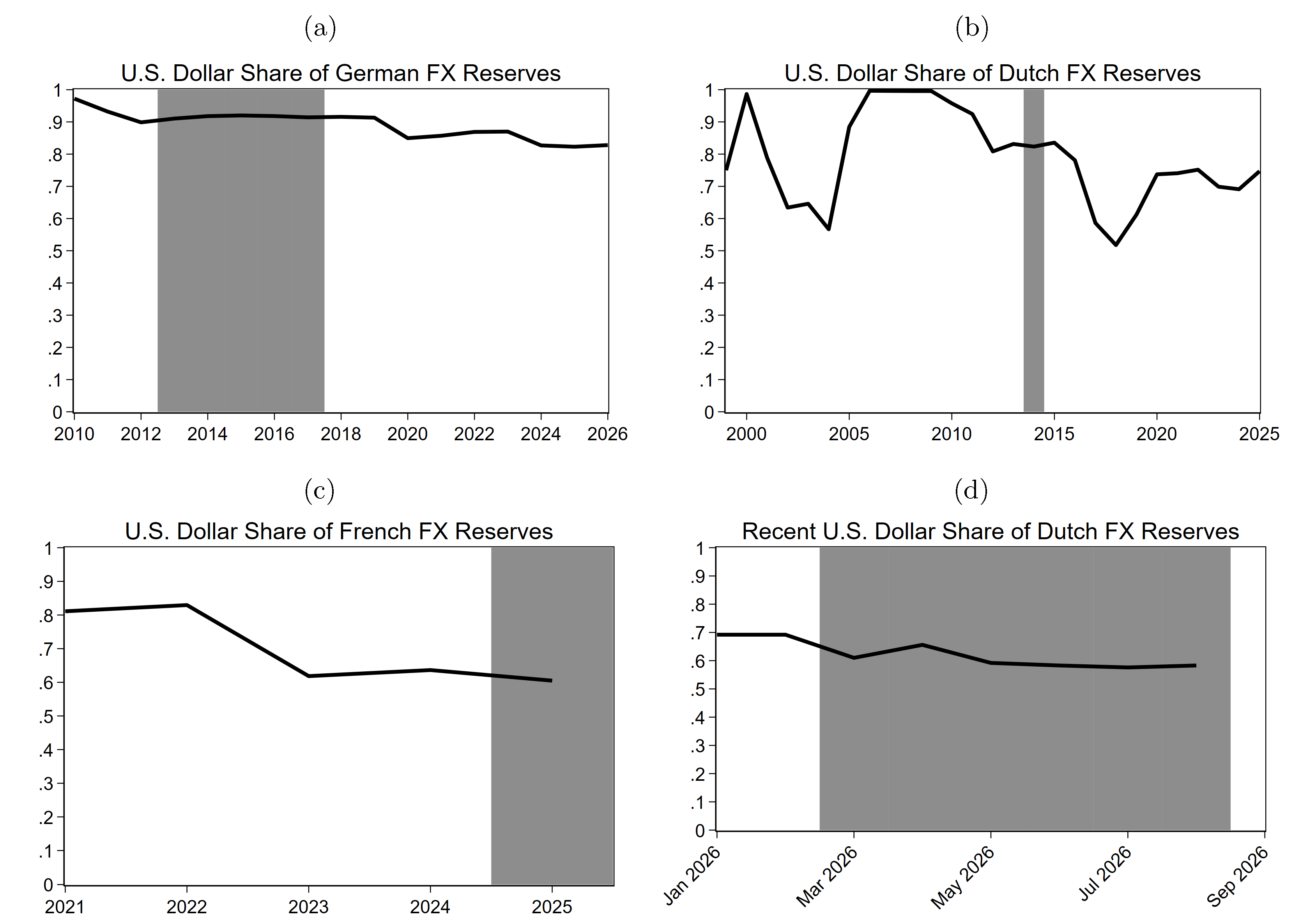
Figure 1a
Note: Shaded region marks years of gold custody transfer.
Sources: Ito and McCauley (2020) and IMF IRFCL.
Figure 1b
Note: Shaded region marks years of gold custody transfer.
Sources: Ito and McCauley (2020) and IMF IRFCL.
Figure 1c
Note: Shaded region marks year of gold custody transfer.
Sources: Ito and McCauley (2020) and DNB Annual Reports.
Figure 1d
Note: Shaded region marks months of gold custody transfer.
Source: IMF IRFCL.
2020s relocations: France repatriated all its U.S.-held gold reserves in 2025 and early 2026 (Banque de France, 2026), yet its U.S. dollar share of FX reserves remained steady at 60 percent (Figure 1(c)), even as the overall U.S. dollar share of global FX reserves in the IMF COFER data declined.7 The Netherlands moved two-fifths of its U.S.-stored gold to London in 2026 (De Nederlansche Bank, 2026). While the U.S. dollar share of its FX reserves did undergo a concurrent 10-percentage-point decline (Figure 1(d)), this share remains above 2018 lows and still dominates Dutch FX reserves.8
In all cases, these central banks continue holding most reserves in U.S. dollar assets, indicating no substantial diversification away from the U.S. dollar.
References
Arslanalp, Serkan, Barry Eichengreen, and Chima Simpson-Bell. (2025). "Our Underappreciated International Reserve System," NBER Working Paper No. 34478.
Banque de France. (2026). "Net profit of EUR 8.1 billion, enabling the clearing of losses carried forward," Press Release (March 25). https://www.banque-france.fr/en/press-release/net-profit-eur-81-billion-enabling-clearing-losses-carried-forward.
Carlyle, Tristan. (2014). "Netherlands Bank Moves 122.5 Tonnes of Gold from New York to Amsterdam," Central Banking (November 21).
De Nederlansche Bank. (2017). 2016 Annual Report. Amsterdam: De Nederlansche Bank, March.
De Nederlansche Bank. (2026). "DNB improves tradability of gold reserves," Press Release (September 2). https://www.dnb.nl/en/general-news/press-release-2026/dnb-improves-tradability-of-gold-reserves.
Deutsch Bundesbank. (2017). "Bundesbank completes gold transfer ahead of schedule," Press Release (August 23). https://www.bundesbank.de/en/tasks/topics/bundesbank-completes-gold-transfer-ahead-of-schedule-646102.
Ito, Hiro and Robert N. McCauley. (2020). "Currency Composition of Foreign Exchange Reserves," Journal of International Money and Finance 102 (102104).
McDowell, Daniel. (2023). Bucking the Buck: U.S. Financial Sanctions and the International Backlash against the Dollar. New York: Oxford University Press.
U.S. Department of the Treasury. (2026). "Treasury Launches Unprecedented Campaign Against Iranian Regime on Economic D-Day," Press Release (August 24). https://home.treasury.gov/news/press-releases/sb0613.
World Gold Council. (2026). "Central Bank Gold Reserves Survey 2026," World Gold Council, June.
1. I thank Shaghil Ahmed and Daniel Beltran for helpful feedback. The views expressed here are solely my own and do not reflect the views of the Board of Governors of the Federal Reserve or anyone else associated with the Federal Reserve System. Return to text
2. Note that the official statements provided by these euro area central banks about these gold reserve relocations do not suggest concerns about sanctions or expropriation as a key motivation for the shifts. Return to text
3. For example, Venezuela has not been able to access its gold reserves custodied at the Bank of England since 2019 because the British government does not recognize the legitimacy of Nicolás Maduro and his government. Recently, the U.S. Treasury announced sanctions targeting "anyone, regardless of where they are located," operating in the gold sector of Iran's economy (U.S. Treasury, 2026.) Return to text
4. Aside from these examples, recent survey results from the World Gold Council (2026) show a growing number of central banks report a preference for holding their gold reserves in domestic vaults. Return to text
5. Data on currency composition of FX reserves through 2020 are based on Ito and McCauley (2020), who compiled currency shares based on reports from central banks and FX reserve managers. After 2021, I use data from central bank annual reports and the IMF's international reserves foreign currency liquidity (IRFCL) database. Data are as-of year-end except for the 2026 observation for Germany, which is as-of March. Return to text
6. De Nederlansche Bank (DNB) actively manages the currency risk around its foreign currency investments including by hedging currency risk through forward exchange contracts. The U.S. dollar share of its FX reserves reached a local peak in 2015, and the DNB's 2016 annual report notes it reduced its U.S. dollar exposure in that year due to "the high costs of hedging the currency risk" (DNB, 2017). While subsequent annual reports do not explain changes in U.S. dollar exposure, it can plausibly be assumed that some of the movements in the U.S. dollar share of FX reserves reflect changing returns (inclusive of hedging costs) on holding U.S. dollar assets. Return to text
7. The large decline in the U.S. dollar share that occurred in 2023 appears to reflect the sales of U.S. dollar assets by the Banque de France to generate net income at a time when net interest expenses increased rapidly rather than any major preference change around U.S. dollar reserves. Return to text
8. The monthly data in shown in Figure 1(d) come from a different data source than the annual data shown for the Netherlands in Figure 1(b). In principle, these two series should be identical, but, in practice, they are not—especially after 2022. The U.S. dollar share based on the monthly IRFCL data is persistently below that based on the Netherlands' central bank annual report. Return to text
Weiss, Colin (2026). "Gold Reserve Relocations: Are They Always Bad News for U.S. Dollar Reserves?," FEDS Notes. Washington: Board of Governors of the Federal Reserve System, November 09, 2026, https://doi.org/10.17016/2380-7172.4200.
Disclaimer: FEDS Notes are articles in which Board staff offer their own views and present analysis on a range of topics in economics and finance. These articles are shorter and less technically oriented than FEDS Working Papers and IFDP papers.