


FEDS Notes
November 20, 2026
When productivity booms, do interest rates rise?
Antoine Lepetit, and David Miller1
1. Introduction
Long-term interest rates have risen sharply since the COVID period. Concurrently, advances in artificial intelligence (AI) have raised the prospect of a sustained increase in productivity growth. As many observers have noted, standard macroeconomic theory predicts that expectations of faster productivity growth should push interest rates higher. Expecting higher future incomes, households may boost current spending and reduce their saving rate. Simultaneously, firms anticipating higher returns on capital may front-load investment. Together, the combination of lower saving supply and higher investment demand should exert upward pressure on interest rates.
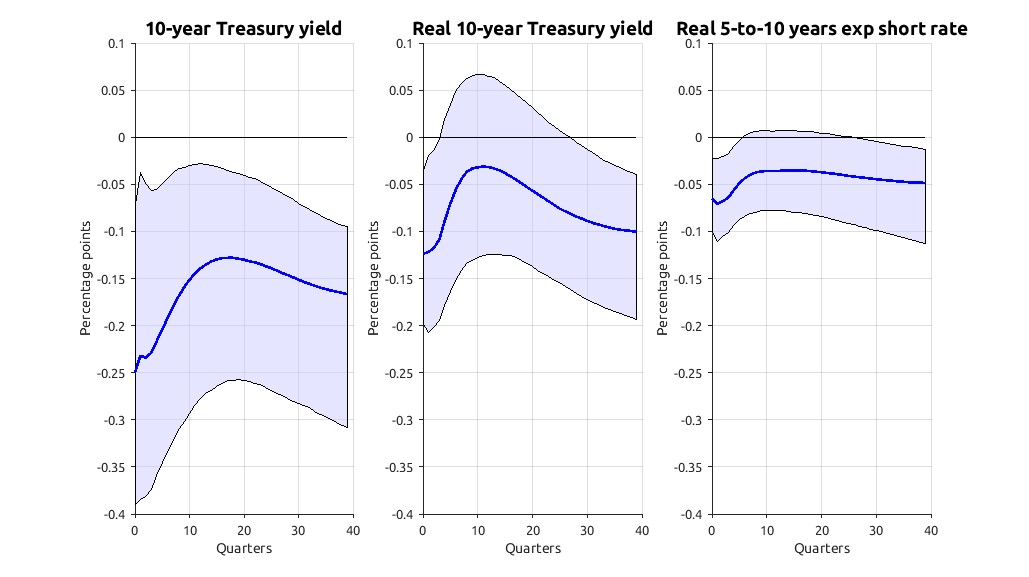
In this Note, we estimate a vector autoregressive (VAR) model to empirically examine the link between productivity growth and interest rates. Contrary to standard theory, we find that shocks that lead to a persistent increase in total factor productivity (TFP) growth, and that are foreseen by the public, result in declines in both the 10-year Treasury yield and the expected real short rate 5-to-10 years ahead—a common measure of r*, the long-run equilibrium level of the real federal funds rate (see Figure 1). The decline in the 10-year Treasury yield reflects two offsetting forces: a modest temporary rise in short-run interest rates and a larger fall in the term premium. It follows that, from the model's point of view, the recent rise in interest rates cannot be explained by anticipated higher productivity growth.
Previous empirical work generally finds little correlation between productivity (or output) growth and interest rates (Lunsford and West, 2019; Hamilton et al, 2016). Correlational studies cannot isolate the underlying causal mechanisms. To uncover the causal relationship between productivity growth and interest rates, we employ a structural VAR model and identify a shock containing advance information about the future path of TFP—that is, a TFP news shock—using the approach of Barsky and Sims (2011) and Francis et al. (2014). In part, our results are informed by the only episode of a large, sustained change in productivity growth in recent history: the tech boom of the late 1990s. Although our methodological approach differs, our findings align closely with recent studies that achieve causal identification using high-frequency data and show that news surrounding the release of major AI models is associated with declines in r* (Christensen and Rudebusch, 2026; Willens, Cavallo, and Beaudry, 2026).
2. TFP booms and long-term interest rates
We estimate several Bayesian VARs over the 1990-2019 sample period.2 All models include five core quarterly series, each expressed in logarithms: (1) utilization-adjusted TFP (Fernald, 2012); (2) real per capita GDP; (3) real per capital business fixed investment; (4) real per capita consumption; and (5) the S&P 500 deflated by the consumer price index (CPI). To this core specification, we add the following auxiliary variables one at a time: (1) the nominal 10-year Treasury yield; (2) the real 10-year Treasury yield from the term structure model of D'Amico, Kim, and Wei (2018), as updated in Kim, Walsh, and Wei (2019);3 (3) the real federal funds rate, measured as the effective federal funds rate minus CPI inflation; and (4) the expectations and term premium components of the D'Amico, Kim, and Wei (2018) real 10-year yield. We identify a TFP news shock using the max-share approach, which isolates the structural shock that best explains future movements in TFP at a 10-year horizon.4
Figure 2 plots the impulse responses of the core VAR variables to an identified TFP news shock. The largest effects on the level of TFP materialize several years after the initial shock. This trajectory is consistent with the gradual diffusion of productivity-enhancing technologies and suggests that the productivity gains may have been anticipated by economic agents well in advance. Consistent with this view, and the theory laid out at the beginning of this Note, investment and the stock market rise immediately, long before the bulk of the TFP increase occurs.
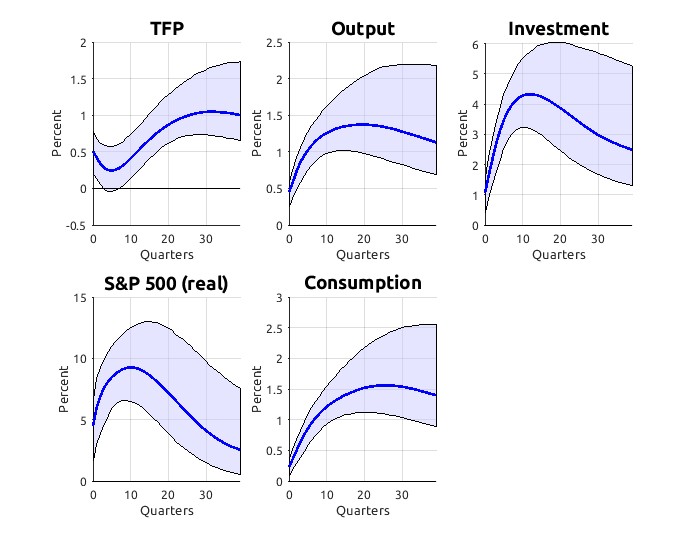
Figure 3 shows the impulse responses of the auxiliary variables.5 Our main finding is that the nominal 10-year Treasury yield falls in response to a positive TFP news shock that generates persistently higher TFP growth over the subsequent decade. The second panel demonstrates that this result is not driven by a fall in inflation expectations as the real 10-year Treasury yield exhibits a similar behavior. The final two panels decompose the real 10-year yield into its expectations and term premium components. Following the shock, the expectations component rises briefly—mirroring the path of the real federal funds rate in the third panel—but this temporary increase is more than offset by a large, persistent decline in the real term premium.
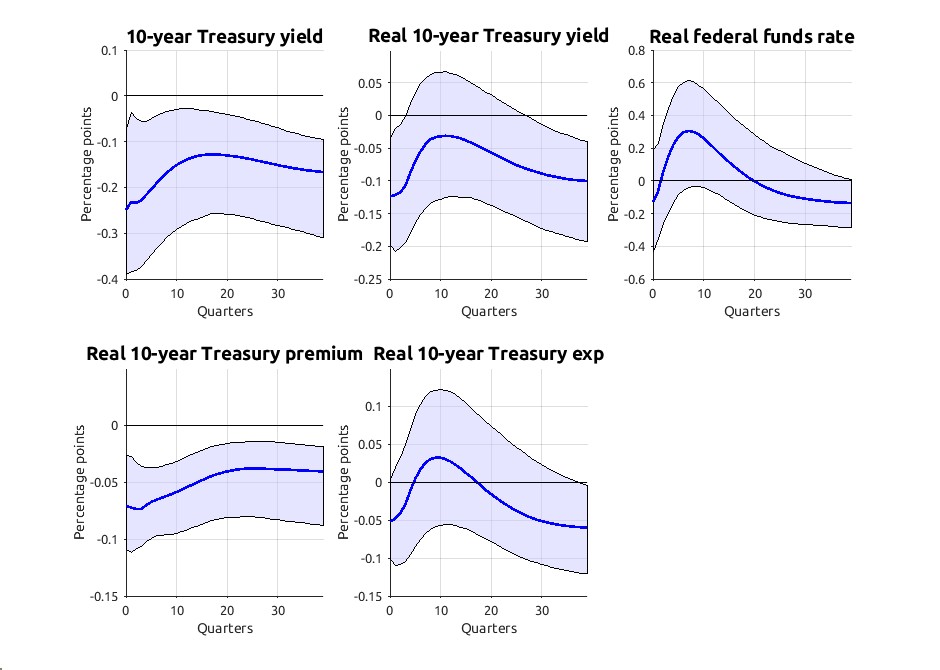
Several channels could account for this statistically significant decline in the term premium. Most directly, the term premium reflects a countercyclical market price of risk, which falls as the productivity shock boosts output and consumption (Figure 2). When the economy does well, investors demand less extra compensation for tying up their money in long-term Treasuries. In addition, because output expands without a corresponding rise in inflation, uncertainty surrounding the future path of monetary policy diminishes, increasing demand for longer-term bonds. Finally, the positive economic effects extend to the fiscal outlook. By raising real output and the tax base, the productivity shock expands fiscal space, which is associated with lower long-term yields and term premia (Plante et al., 2025).
3. The recent rise in long-term yields through the lens of the model
Next, we evaluate whether news about future TFP can explain the recent path of long-term Treasury yields. Because our focus is on productivity expectations fueled by advances in AI and public awareness of generative AI was limited prior to the release of ChatGPT on November 30, 2022 (Christensen and Rudebusch, 2026), we begin our evaluation period in 2022Q4.
Figure 4 plots an eight-quarter moving average of the model's estimated TFP news shocks over the 2022Q4-2026Q2 period. Reflecting the 2022 equity market downturn, the shock realizations are initially negative. Over the subsequent three years, however, the model estimates that we have repeatedly received good news about future TFP. This shift is consistent with the view that rapid developments in AI technology have brightened prospects for future productivity growth.
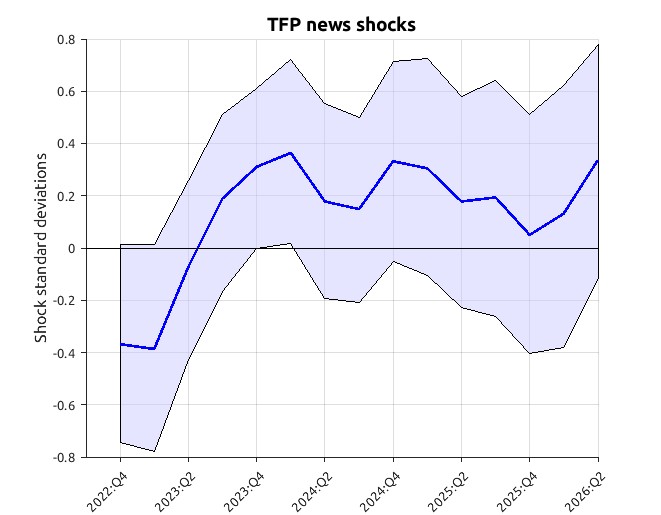
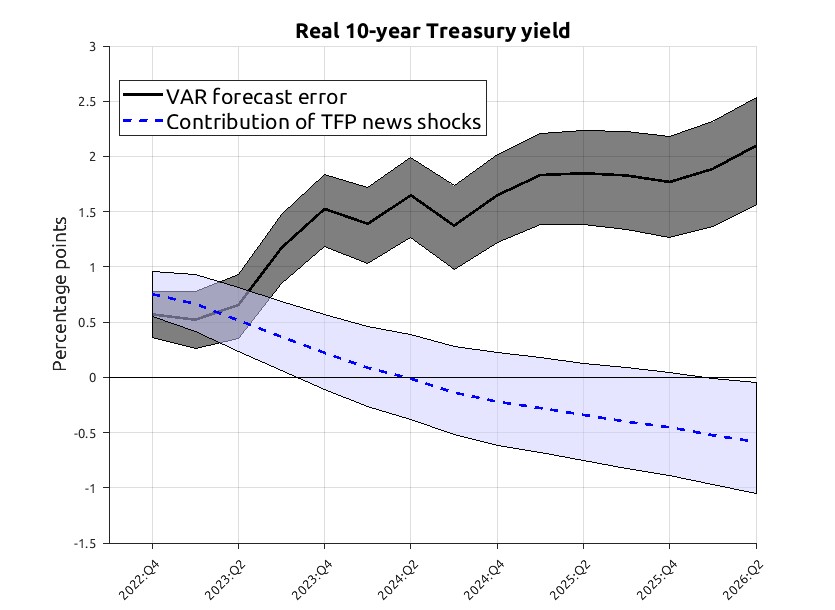
Figure 5 shows a historical decomposition of the real 10-year Treasury yield, tracing the contribution of these TFP news shocks since 2022Q4. The black line represents the VAR forecast error. In the absence of shocks, the model projected that long-term rates would revert toward their low pre-pandemic baseline; consequently, the forecast error widens to 200 basis points by early 2026, even though the actual yield increased by only 90 basis points between 2022Q3 and 2026Q2. The blue line depicts the contribution of TFP news shocks to this forecast error. While this contribution is initially positive—as negative news in 2022 pushed yields higher—it steadily declines thereafter as the positive shocks of 2023-2025 exert downward pressure on rates. By 2026Q2, the net contribution is near zero or slightly negative, suggesting that news about future TFP arriving since the launch of ChatGPT has had virtually no cumulative impact on current 10-year Treasury yields.
4. TFP booms and r*
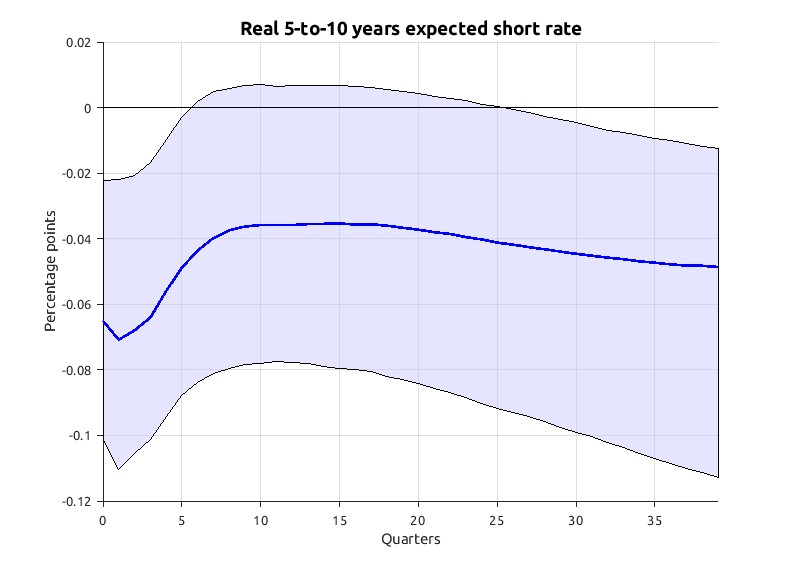
We also examine the behavior of the longer-run equilibrium real interest rate, r*, defined here as the real federal funds consistent with the economy operating at potential once the transitory effects of shocks have abated. Because r* is unobserved, researchers often proxy for it using the expected real short rate 5-to-10 years ahead (e.g., Christensen and Rudebusch, 2019; Cho and Williams, 2025). Stripped of the term premium, this measure captures market expectations of where the real policy rate will settle once cyclical fluctuations have dissipated. Although standard macroeconomic theory predicts that r* should rise in response to an anticipated, persistent increase in TFP growth, Figure 6 shows that the expected real short rate 5-to-10 years ahead actually declines following a positive TFP news shocks. As the shock also leads to higher growth (Figure 2), this result calls into question approaches that estimate r* by enforcing a tight relationship between r* and the medium-run growth rate of the economy, such as Laubach and Williams (2003).
5. Conclusion
In this Note, we show that positive shocks to expectations of future productivity growth lower both long-term Treasury yields and a common measure of r*. These findings present a challenge to textbook macroeconomic theory and suggest that modelling the term premium's reaction to shocks is of first-order importance. Applying our framework to the post-2022 period, we find that AI-related optimism about future productivity cannot explain the recent surge in long-term Treasury yields, pointing instead to other macroeconomic factors.
References
Barsky, Robert B. and Eric R. Sims. 2011. "News Shocks and Business Cycles," Journal of Monetary Economics, 58(3): 273-289.
Beaudry, Paul, Paolo Cavallino, and Tim Willems. 2026. "Anatomy of a rise: Monetary policy and the post-Covid surge in long-term interest rates." Voxeu Column, 21 Sep 2026.
Christensen, J. H. E., & Rudebusch, G. D. 2019. A New Normal for Interest Rates? Evidence from Inflation-Indexed Debt. The Review of Economics and Statistics, 101(5), 933–949.
Christensen, Jens H. E. and Glenn D. Rudebusch. 2026. "Can Fiscal, AI, or Monetary News Explain the Rise in r*?" Federal Reserve Bank of San Francisco Working Paper 2026-19.
Cho, Sophia and John C. Williams. 2025. "Are Financial Markets Good Predictors of R-Star?" Liberty Street Economics, August 25.
D'Amico, Stefania, Don H. Kim, and Min Wei. 2018. "Tips from TIPS: The Informational Content of Treasury Inflation-Protected Security Prices." Journal of Financial and Quantitative Analysis, 53(2): 395-436.
Fernald, John. 2012. "A Quarterly, Utilization-Adjusted Series on Total Factor Productivity," Federal Reserve Bank of San Francisco Working Paper Series 2012-19.
Giannone, Domenico, Michele Lenza and Giorgio E Primiceri. 2015. "Prior Selection for Vector Autoregressions." Review of Economics and Statistics, 97(2): 436-451.
Hamilton, James D., Ethan S. Harris, Jan Hatzius, and Kenneth D. West. 2015. "The Equilibrium Real Funds Rate: Past, Present and Future." NBER Working Paper 21476.
Kim, Don, Cait Walsh, and Min Wei. 2019. "Tips from TIPS: Update and Discussions," FEDS Notes. Washington: Board of Governors of the Federal Reserve System, May 21, 2019.
Laubach, Thomas and John C. Williams. 2003. "Measuring the Natural Rate of Interest." The Review of Economics and Statistics, 85(4): 1063-1070.
Lunsford, Kurt G. and Kenneth D. West. 2019. "Some Evidence on Secular Drivers of US Safe Real Rates." American Economic Journal: Macroeconomics, 11(4): 113-139.
Neville, Francis, Michael T. Owyang, Jennifer E. Roush and Riccardo DiCecio. 2014. "A Flexible Finite-Horizon Alternative to Long-Run Restrictions with an Application to Technology Shocks," The Review of Economics and Statistics, 96(4): 638-647.
Plante, Michael, Alexander W. Richter and Sarah Zubairy. 2025. "Revisiting the Interest Rate Effects of Federal Debt," NBER Working Paper 34018.
1. The views expressed here are solely those of the authors and should not be interpreted as reflecting the views of the Board of Governors, its staff, or any other person associated with the Federal Reserve System. We thank Raven Molloy and Matthias Paustian for useful comments. Return to text
2. We use a standard Minnesota prior. The tightness of the prior is chosen according to the data-driven approach of Giannone, Lenza, and Primiceri (2015). Return to text
3. The real 10-year yield is derived from the yield on Treasury inflation-protected securities (TIPS) of comparable maturities using a term structure model which adjusts for the TIPS liquidity premium. In this framework, the difference between the nominal and risk-adjusted real 10-year-yields reflects expected inflation as well as an inflation risk premium—the extra compensation investors demand for bearing inflation risks. Return to text
4. Including forward-looking variables such as consumption, investment, and the stock market in the VAR is crucial for the identification of TFP news shocks. Those variables capture the advance information that agents possess and react to before future technological improvements actually materialize. Return to text
5. In each of the VARs that we estimate, the impulse responses of TFP, output, investment, the stock market, and consumption are very similar than those shown in Figure 1. Return to text
Lepetit, Antoine, and David S. Miller (2026). "When productivity booms, do interest rates rise?," FEDS Notes. Washington: Board of Governors of the Federal Reserve System, November 20, 2026, https://doi.org/10.17016/2380-7172.4213.
Disclaimer: FEDS Notes are articles in which Board staff offer their own views and present analysis on a range of topics in economics and finance. These articles are shorter and less technically oriented than FEDS Working Papers and IFDP papers.