


Monetary Policy
Monetary Policy Report submitted to the Congress on June 20, 2025, pursuant to section 2B of the Federal Reserve Act
The Federal Open Market Committee held the federal funds rate steady
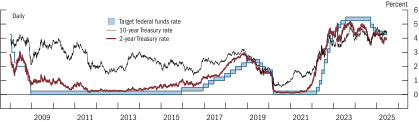
With the labor market at or near maximum employment, and inflation continuing to moderate toward 2 percent, the Federal Open Market Committee (FOMC) has maintained the target range for the federal funds rate at 4-1/4 to 4-1/2 percent since the beginning of the year figure 47. The FOMC's current stance of monetary policy leaves it well positioned to wait for more clarity on the outlook for inflation and economic activity and respond in a timely way to potential economic developments. In considering the extent and timing of additional adjustments to the target range for the federal funds rate, the Committee will carefully assess incoming data, the evolving outlook, and the balance of risks.
Figure 47. Selected interest rates
Accessible Version | Return to text
Note: The 2-year and 10-year Treasury rates are the constant-maturity yields based on the most actively traded securities.
Source: Department of the Treasury; Federal Reserve Board.
The Federal Open Market Committee slowed the pace of decline of its holdings of Treasury securities
The FOMC began reducing its securities holdings in June 2022 and, since then, has continued to implement its plan for significantly reducing the size of the Federal Reserve's balance sheet in a predictable manner. Following its March 2025 meeting, the FOMC announced that the Committee would further slow the pace of decline of its Treasury securities holdings, effective April 1, by reducing the redemption cap on Treasury securities from $25 billion to $5 billion per month and maintaining the redemption cap on agency debt and agency mortgage-backed securities (MBS) at $35 billion per month. Any principal payments in excess of the agency debt and agency MBS cap are to be reinvested into Treasury securities, consistent with the FOMC's intention to hold primarily Treasury securities in the longer run. A slower pace of balance sheet runoff helps facilitate a smooth transition to ample reserve balances and gives the Committee more time to assess market conditions as the balance sheet continues to shrink. It will also allow banks, and short-term funding markets more generally, additional time to adjust to the lower level of reserves, thus reducing the probability that money markets experience undue stress that could require an early end to runoff. The decision to slow the pace of balance sheet runoff does not have implications for the stance of monetary policy and does not mean that the balance sheet will ultimately shrink by less than it would otherwise.
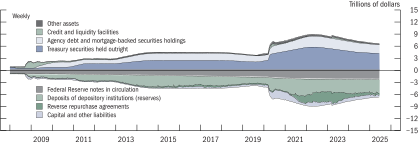
The System Open Market Account holdings of Treasury and agency securities have declined $176 billion since the beginning of the year to $6.7 trillion, a level equivalent to 22 percent of U.S. nominal gross domestic product (figure 48). Reserve balances—the largest liability item on the Federal Reserve's balance sheet—have increased $97 billion since the beginning of the year to a level of about $3.4 trillion. (See the box "Developments in the Federal Reserve's Balance Sheet and Money Markets.")
Figure 48. Federal Reserve assets and liabilities
Accessible Version | Return to text
Note: "Other assets" includes repurchase agreements, FIMA (Foreign and International Monetary Authorities) repurchase agreements, and unamortized premiums and discounts on securities held outright. "Credit and liquidity facilities" consists of primary, secondary, and seasonal credit; term auction credit; central bank liquidity swaps; support for Maiden Lane, Bear Stearns Companies, Inc., and AIG; and other credit and liquidity facilities, including the Primary Dealer Credit Facility, the Asset-Backed Commercial Paper Money Market Mutual Fund Liquidity Facility, the Commercial Paper Funding Facility, the Term Asset-Backed Securities Loan Facility, the Primary and Secondary Market Corporate Credit Facilities, the Paycheck Protection Program Liquidity Facility, the Municipal Liquidity Facility, and the Main Street Lending Program. "Agency debt and mortgage-backed securities holdings" includes agency residential mortgage-backed securities and agency commercial mortgage-backed securities. "Capital and other liabilities" includes the U.S. Treasury General Account and the U.S. Treasury Supplementary Financing Account. The key identifies shaded areas in order from top to bottom. The data extend through June 11, 2025.
Source: Federal Reserve Board, Statistical Release H.4.1, "Factors Affecting Reserve Balances."
The FOMC has stated that it intends to maintain securities holdings at amounts consistent with implementing monetary policy efficiently and effectively in its ample-reserves regime. To ensure a smooth transition to ample reserve balances, the FOMC slowed the pace of decline of its securities holdings in June 2024 and in April 2025, and it intends to stop reductions in its securities holdings when reserve balances are somewhat above the level that it judges to be consistent with ample reserves. Once balance sheet runoff has ceased, reserve balances will likely continue to decline at a slower pace—reflecting growth in other Federal Reserve liabilities—until the FOMC judges that reserve balances are at an ample level. Thereafter, the FOMC will manage securities holdings as needed to maintain ample reserves over time.
Box 3. Developments in the Federal Reserve's Balance Sheet and Money Markets
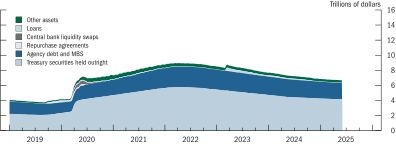
The Federal Open Market Committee (FOMC) continued to reduce the size of the Federal Reserve's System Open Market Account (SOMA) portfolio. Since early January 2025, total Federal Reserve assets have decreased $176 billion, leaving the total size of the balance sheet at $6.7 trillion, $2.2 trillion smaller since the reduction in the size of the SOMA portfolio began in June 2022 (table A and figure A).1 On March 19, the FOMC announced that the Committee would further slow the pace of decline in its securities holdings beginning in April, consistent with the Committee's Plans for Reducing the Size of the Federal Reserve's Balance Sheet.2
Table A. Balance sheet comparison
Billions of dollars
| June 11, 2025 | January 8, 2025 | Change (since January 2025) | Change (since Fed's balance sheet reduction began on June 1, 2022) | |
|---|---|---|---|---|
| Assets | ||||
| Total securities | ||||
| Treasury securities | 4,212 | 4,291 | −79 | −1,558 |
| Agency debt and MBS | 2,159 | 2,236 | −77 | −551 |
| Unamortized premiums | 238 | 249 | −11 | −99 |
| Repurchase agreements | 0 | 0 | 0 | 0 |
| Loans and lending facilities | ||||
| PPPLF | 2 | 2 | 0 | −18 |
| Discount window | 4 | 2 | 2 | 3 |
| BTFP | 0 | 3 | −3 | 0 |
| Other loans and lending facilities | 5 | 8 | −3 | −29 |
| Central bank liquidity swaps | 0 | 1 | −1 | 0 |
| Other assets | 57 | 61 | −4 | 15 |
| Total assets | 6,677 | 6,854 | −176 | −2,238 |
| Liabilities | ||||
| Federal Reserve notes | 2,339 | 2,315 | 24 | 108 |
| Reserves held by depository institutions | 3,430 | 3,332 | 97 | 72 |
| Reverse repurchase agreements | ||||
| Foreign official and international accounts | 371 | 386 | −15 | 106 |
| Others | 205 | 185 | 19 | −1,760 |
| U.S. Treasury General Account | 277 | 621 | −344 | −504 |
| Other deposits | 229 | 174 | 55 | −19 |
| Other liabilities and capital | −173 | −160 | −14 | −241 |
| Total liabilities and capital | 6,677 | 6,854 | −176 | −2,238 |
Note: January 8, 2025, is the date of the first Federal Reserve Statistical Release H.4.1, "Factors Affecting Reserve Balances," of 2025 that is not affected by year-end distortions. MBS is mortgage-backed securities. PPPLF is Paycheck Protection Program Liquidity Facility. BTFP is Bank Term Funding Program. Components may not sum to totals because of rounding.
Source: Federal Reserve Board, Statistical Release H.4.1, "Factors Affecting Reserve Balances."
Figure A. Federal Reserve assets
Accessible Version | Return to text
Note: The data are weekly and extend through June 11, 2025. MBS is mortgage-backed securities. The key identifies shaded areas in order from top to bottom.
Source: Federal Reserve Board, Statistical Release H.4.1, "Factors Affecting Reserve Balances."
Loans extended under the Bank Term Funding Program (BTFP)—which made term funding available to eligible depository institutions amid the banking-sector stress of spring 2023 to help ensure the stability of the banking system and the ongoing provision of credit to the economy—were all repaid as of early March.3
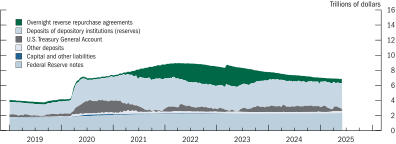
Reserves, the largest liability item on the Federal Reserve's balance sheet, have increased $97 billion since early January 2025 to a level of about $3.4 trillion.4 The increase in reserves was due to a $344 billion decline in the Treasury General Account (TGA). Since the beginning of balance sheet runoff, reserves have increased by $72 billion, on net, as the reserve-draining effect of balance sheet runoff was offset by the decline in the TGA and a $1.8 trillion decline in balances at the overnight reverse repurchase agreement (ON RRP) facility. Reduced usage of the ON RRP facility largely reflects money market mutual funds shifting their portfolios toward higher-yielding investments, including Treasury bills and private-market repurchase agreements, although the decline has slowed in recent months amid reduced Treasury bill supply. Since early January 2025, usage of the ON RRP facility was little changed, on net, and currently stands at around $200 billion (figure B).
Figure B. Federal Reserve liabilities
Accessible Version | Return to text
Note: The data are weekly and extend through June 11, 2025. "Capital and other liabilities" includes the liability for earnings remittances due to the U.S. Treasury and contributions from the U.S. Treasury; the sum is negative from June 2023 onward because of the deferred asset that the Federal Reserve reports. The key identifies shaded areas in order from top to bottom.
Source: Federal Reserve Board, Statistical Release H.4.1, "Factors Affecting Reserve Balances."
Conditions in overnight money markets remained stable. The ON RRP facility continued to serve its intended purpose of supporting the control of the effective federal funds rate (EFFR), and the Federal Reserve's administered rates—the interest rate on reserve balances and the ON RRP offering rate—remained highly effective at maintaining the EFFR within the target range.
The Federal Reserve's expenses have continued to exceed its income in recent months, causing its deferred asset to increase $15 billion since early January to a level of around $232 billion.5 Negative net income and the associated deferred asset do not affect the Federal Reserve's conduct of monetary policy or its ability to meet its financial obligations.6
1. The first Federal Reserve Board statistical release H.4.1 ("Factors Affecting Reserve Balances") of 2025 that was not affected by year-end distortions was dated January 8, 2025. As a result, this discussion refers to changes in the Federal Reserve's balance sheet since early January. Return to text
2. See the May 4, 2022, press release regarding the Plans for Reducing the Size of the Federal Reserve's Balance Sheet, available on the Board's website at https://www.federalreserve.gov/newsevents/pressreleases/monetary20220504b.htm. Return to text
3. The BTFP was established under section 13(3) of the Federal Reserve Act with the approval of the Secretary of the Treasury. The BTFP offered loans of up to one year to banks, savings associations, credit unions, and other eligible depository institutions against collateral such as U.S. Treasury securities, U.S. agency securities, and U.S. agency mortgage-backed securities. For more details, see "Bank Term Funding Program" on the Board‘s website at https://www.federalreserve.gov/financial-stability/bank-term-funding-program.htm. Return to text
4. Reserve balances consist of deposits held at the Federal Reserve Banks by depository institutions, such as commercial banks, savings banks, credit unions, thrift institutions, and U.S. branches and agencies of foreign banks. Return to text
5. The deferred asset is equal to the cumulative shortfall of net income and represents the amount of future net income that will need to be realized before remittances to the Treasury resume. Although remittances are suspended at the time of this report, over the past decade and a half, the Federal Reserve has remitted over $1 trillion to the Treasury. Return to text
6. Net income is expected to turn positive again as interest expenses fall, and remittances will resume once the temporary deferred asset falls to zero. As a result of the ongoing reduction in the size of the Federal Reserve's balance sheet, interest expenses will fall over time in line with the decline in the Federal Reserve's liabilities. Return to text
The Federal Open Market Committee will continue to monitor the implications of incoming information for the economic outlook
The FOMC is strongly committed to supporting maximum employment and returning inflation to its 2 percent objective. In considering the extent and timing of additional adjustments to the target range for the federal funds rate, the FOMC will carefully assess incoming data, the evolving outlook, and the balance of risks. Its assessments will take into account a wide range of information, including readings on labor market conditions, inflation pressures and inflation expectations, and financial and international developments.
In addition to considering a wide range of economic and financial data, the FOMC gathers information from business contacts and other informed parties around the country, as summarized, for instance, in the Beige Book. The Federal Reserve also regularly hears from a broad range of participants in the U.S. economy about how monetary policy affects people's daily lives and livelihoods. In particular, the Federal Reserve has continued to gather insights into these matters through the Fed Listens initiative and the Federal Reserve System's community development outreach.13
The FOMC continued its discussions related to the review of the Federal Reserve's monetary policy framework at each of its meetings this year. These discussions covered topics related to the labor market, inflation dynamics, and uncertainty. The review featured public events involving a wide range of parties around the country, including through the Fed Listens initiative and a research conference in Washington, D.C., that was held in May.14 The Committee intends to conclude its review by late summer and to report the outcomes of the review at that time.
Policymakers routinely consult prescriptions for the policy interest rate provided by various monetary policy rules. These rule prescriptions can provide useful benchmarks for the consideration of monetary policy. However, simple rules cannot capture all of the complex considerations that go into the formation of appropriate monetary policy, and many practical considerations make it undesirable for the FOMC to adhere strictly to the prescriptions of any specific rule. Nevertheless, some principles of good monetary policy can be brought out by examining these simple rules. (See the box "Monetary Policy Rules in the Current Environment.")
Box 4. Monetary Policy Rules in the Current Environment
Simple interest rate rules relate a policy interest rate, such as the federal funds rate, to a small number of other economic variables—typically including the current deviation of inflation from its target value and a measure of resource slack in the economy. As part of their monetary policy deliberations, policymakers regularly consult the prescriptions of a variety of simple interest rate rules without mechanically following the prescriptions of any particular rule.
Available data on employment and inflation have indicated that the labor market remained solid and that inflation continued to ease in the first part of the year. However, the four-quarter change in core personal consumption expenditures (PCE) prices in the first quarter of this year was little different from the fourth quarter of last year, and most simple policy rules considered here called for levels of the policy rate in the first quarter of this year that were little changed from the end of last year. In support of its goals of maximum employment and inflation at the rate of 2 percent over the longer run, the Federal Open Market Committee (FOMC) has maintained the target range for the federal funds rate at 4-1/4 to 4-1/2 percent while continuing to reduce its holdings of Treasury securities and agency debt and agency mortgage-backed securities.
Selected Policy Rules: Descriptions
In many economic models, desirable economic outcomes can be achieved over time if monetary policy responds to changes in economic conditions in a manner that is predictable and adheres to some key design principles. In recognition of this idea, economists have analyzed many monetary policy rules, including the well-known Taylor (1993) rule, the "balanced approach" rule, the "adjusted Taylor (1993)" rule, and the "first difference" rule.1 Table A shows these rules, along with a "balanced approach (shortfalls)" rule, which responds to the unemployment rate only when it is higher than its estimated longer-run level. All of the simple rules shown embody key design principles of good monetary policy, including the requirement that the policy rate should be adjusted by enough over time to ensure a return of inflation to the central bank's longer-run objective and to anchor longer-term inflation expectations at levels consistent with that objective.
Table A. Monetary policy rules
| Taylor (1993) rule | $$ R_t^{T93} = r_t^{LR} + \pi_t + 0.5 (\pi_t - \pi^{LR}) + (u_t^{LR} – u_t) $$ |
|---|---|
| Balanced-approach rule | $$ R_t^{BA} = r_t^{LR} + \pi_t + 0.5(\pi_t - \pi^{LR}) + 2(u_t^{LR} – u_t) $$ |
| Balanced-approach (shortfalls) rule | $$ R_t^{BAS} = r_t^{LR} + \pi_t + 0.5 (\pi_t - \pi^{LR}) + 2min \{ (u_t^{LR} – u_t), 0\} $$ |
| Adjusted Taylor (1993) rule | $$ R_t^{T93adj} = max \{ R_t^{T93} – Z_t , ELB \} $$ |
| First-difference rule | $$ R_t^{FD} = R_{t-1} + 0.5(\pi_t - \pi^{LR}) + (u_t^{LR} – u_t) – (u_{t-4}^{LR} – u_{t-4}) $$ |
Note: $$ R_t^{T93}$$, $$ R_t^{BA}$$, $$ R_t^{BAS}$$, $$ R_t^{T93adj}$$, and $$ R_t^{FD}$$ represent the values of the nominal federal funds rate prescribed by the Taylor (1993), balanced-approach, balanced-approach (shortfalls), adjusted Taylor (1993), and first-difference rule, respectively.
$$ R_{t-1}$$ denotes the average midpoint of the target range for the federal funds rate in quarter $$ t−1$$, $$ u_t$$ is the average unemployment rate in quarter $$ t$$, and $$ \pi_t$$ denotes the 4-quarter core personal consumption expenditures price inflation for quarter $$ t$$. In addition, $$ u_t^{LR}$$ is the rate of unemployment expected in the longer run, and $$ r_t^{LR}$$ is the level of the neutral real federal funds rate in the longer run that is expected to be consistent with sustaining maximum employment and keeping inflation at the Federal Open Market Committee’s 2 percent longer-run objective, represented by $$ \pi^{LR}$$. $$ Z_t$$ is the cumulative sum of past deviations of the federal funds rate from the prescriptions of the Taylor (1993) rule when that rule prescribes setting the federal funds rate below an effective lower bound (ELB) of 12.5 basis points. Box note 1 provides references for the policy rules.
All five rules feature the difference between inflation and the FOMC's longer-run objective of 2 percent.2 The five rules use the unemployment rate gap, measured as the difference between an estimate of the rate of unemployment in the longer run ($$ u_t^{LR}$$) and the current unemployment rate; the first-difference rule includes the change in the unemployment rate gap rather than its level.3 All but the first-difference rule include an estimate of the neutral real interest rate in the longer run ($$ r_t^{LR}$$).4
Unlike the other simple rules featured here, the adjusted Taylor (1993) rule recognizes that the federal funds rate cannot be reduced materially below the effective lower bound (ELB). By contrast, the standard Taylor (1993) rule prescribed policy rates that, during the pandemic-induced recession, were far below zero. To make up for the cumulative shortfall in policy accommodation following a recession during which the federal funds rate is constrained by its ELB, the adjusted Taylor (1993) rule prescribes delaying the return of the policy rate to the (positive) levels prescribed by the standard Taylor (1993) rule.
Policy Rules: Limitations
As benchmarks for monetary policy, simple policy rules have important limitations. One of these limitations is that the simple policy rules mechanically respond to only a small set of economic variables and thus necessarily abstract from many of the factors that the FOMC considers when it assesses the appropriate setting of the policy rate. In addition, the structure of the economy and current economic conditions differ in important respects from those prevailing when the simple policy rules were originally devised and proposed. Relatedly, the prescriptions of the rules incorporate values of the unemployment rate in the longer run and the neutral real interest rate in the longer run, which are economic concepts that are not only difficult to measure, but can also change over time as the economy evolves. Finally, simple policy rules are not forward-looking and do not allow for important risk-management considerations, associated with uncertainty about economic relationships and the evolution of the economy, that factor into FOMC decisions. In particular, the responses of the rules to the unemployment rate gap and the deviation of inflation from 2 percent do not take into account the potentially different time horizons over which these two gaps are anticipated to close.
Selected Policy Rules: Prescriptions
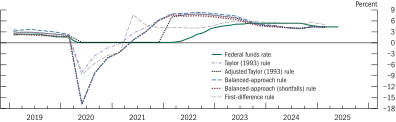
Figure A shows historical prescriptions for the federal funds rate under the five simple rules considered together with the target federal funds rate. For each quarterly period, the figure reports the policy rates prescribed by the rules, taking as given the prevailing economic conditions and survey-based estimates of $$ u_t^{LR}$$ and $$ r_t^{LR}$$ at the time. All of the rules considered called for highly accommodative monetary policy in response to the pandemic-driven recession, followed by tighter policy as inflation picked up and labor market conditions strengthened. Starting around 2023, the policy rates prescribed by the rules declined as inflation eased and the unemployment rate increased somewhat. The prescriptions of most of the rules were somewhat below the target range for the federal funds rate for some time. Now, however, the latest prescriptions from these rules are within the current target range for the federal funds rate of 4-1/4 to 4-1/2 percent except for the first-difference rule, which prescribes a somewhat higher policy rate.
Figure A. Historical federal funds rate prescriptions from simple policy rules
Accessible Version | Return to text
Note: The rules use historical values of core personal consumption expenditures (PCE) inflation, the unemployment rate, and, where applicable, the midpoint of the target range for the federal funds rate constructed as the average of the lower and upper limits of the target range. Quarterly projections of longer-run values for the federal funds rate, the unemployment rate, and inflation used in the computation of the rules' prescriptions are interpolations to quarterly values of projections from the Survey of Market Expectations. The rules' prescriptions are quarterly, and the federal funds rate data are the monthly average of the daily midpoint of the target range for the federal funds rate.
Source: For core PCE inflation, PCEPILFE; for the unemployment rate, UNRATE; for the lower and upper limits of the federal funds target range, DFEDTARL and DFEDTARU, respectively; all from Federal Reserve Bank of St. Louis, Federal Reserve Economic Data; Federal Reserve Bank of New York, Survey of Market Expectations; Federal Reserve Board staff estimates.
1. The Taylor (1993) rule was introduced in John B. Taylor (1993), "Discretion versus Policy Rules in Practice," Carnegie-Rochester Conference Series on Public Policy, vol. 39 (December), pp. 195–214. The balanced-approach rule was analyzed in John B. Taylor (1999), "A Historical Analysis of Monetary Policy Rules," in John B. Taylor, ed., Monetary Policy Rules (Chicago: University of Chicago Press), pp. 319–41. The adjusted Taylor (1993) rule was studied in David Reifschneider and John C. Williams (2000), "Three Lessons for Monetary Policy in a Low-Inflation Era," Journal of Money, Credit and Banking, vol. 32 (November), pp. 936–66. The first-difference rule is based on a rule suggested by Athanasios Orphanides (2003), "Historical Monetary Policy Analysis and the Taylor Rule," Journal of Monetary Economics, vol. 50 (July), pp. 983–1022. A review of policy rules is provided in John B. Taylor and John C. Williams (2011), "Simple and Robust Rules for Monetary Policy," in Benjamin M. Friedman and Michael Woodford, eds., Handbook of Monetary Economics, vol. 3B (Amsterdam: North-Holland), pp. 829–59. The same volume of the Handbook of Monetary Economics also discusses approaches to deriving policy rate prescriptions other than through the use of simple rules. Return to text
2. The rules are implemented as responding to core PCE price inflation rather than to headline PCE price inflation because current and near-term core inflation rates tend to outperform headline inflation rates as predictors of the medium-term behavior of headline inflation. Return to text
3. Implementations of simple rules often use the output gap as a measure of resource slack in the economy. In the rules described in table A, the output gap has been replaced with the unemployment rate gap (using a relationship known as Okun's law) because that gap better captures the FOMC's statutory goal to promote maximum employment. Movements in these alternative measures of resource utilization tend to be highly correlated. Return to text
4. The neutral real interest rate in the longer run ($$ r_t^{LR}$$) is the level of the real federal funds rate that is expected to be consistent, in the longer run, with maximum employment and stable inflation. Like $$ u_t^{LR}$$, $$ r_t^{LR}$$ is determined largely by nonmonetary factors. The first-difference rule shown in table A does not require an estimate of $$ r_t^{LR}$$, a feature that is touted by proponents of such rules as providing an element of robustness. However, this rule has its own shortcomings. For example, research suggests that this sort of rule often results in greater volatility in employment and inflation than what would be obtained under the Taylor (1993) and balanced-approach rules. Return to text
Footnotes
13. See the list of Fed Listens events in 2025 on the Board's website at https://www.federalreserve.gov/monetarypolicy/review-of-monetary-policy-strategy-tools-and-communications-fed-listens-events-2025.htm. Return to text
14. See the Second Thomas Laubach Research Conference agenda, available on the Board's website at https://www.federalreserve.gov/conferences/second-thomas-laubach-research-conference.htm. Return to text