


Consumer & Community Context - October 2025
Alternative Data: Expanding Access to Credit
This article explores the types and usage of alternative data in financial services and the recent technological developments and innovative practices that make alternative data more accessible. It then discusses two customer categories who could benefit most from these advances: "credit invisibles" (adults who lack an existing credit score or have a very limited credit history) and "invisible primes" (borrowers with low credit scores and short credit histories, but with a low propensity to default). It concludes by highlighting the uses of one type of alternative data, cash-flow data, in underwriting small-dollar credit as a promising area for innovation, recognizing that using any alternative data comes with measured risk but also opportunities to expand access to credit safely and fairly.1
What is alternative data, and how can it be used?
For decades, traditional data—basic information on an individual's current and historical credit accounts—has served as the basis for consumers' credit scores.2 However, alternative data—information from non-traditional sources—could bolster or sometimes substitute for that traditional data, with subsequent benefits for and risks to consumers. There are two primary categories of alternative data: financial data and non-financial data (see table 1). Financial alternative data generally involves some measures related to deposit-account information or household income and expenses. Non-financial alternative data may incorporate a range of consumer characteristics (e.g., educational and professional information) or information related to a consumer's "digital footprint." Both types of alternative data have merits and challenges, but financial alternative data has shown the most promise for responsible use in consumer finance.
As practical applications for alternative data expanded and evolved, federal prudential regulators responded with guidance for financial institutions. The 2019 Interagency Statement on the Use of Alternative Data in Credit Underwriting (the 2019 Use of Alternative Data statement) was issued to provide risk mitigation strategies to financial institutions that were interested in utilizing alternative data.3 This statement describes alternative data as "information not typically found in the consumer's credit files of the nationwide consumer reporting agencies or customarily provided by consumers as part of applications for credit."
Table 1. Categories of alternative data
| Financial data: summary cash-flow data | Financial data: transaction-level cash-flow data | Non-financial data | |
|---|---|---|---|
| Description | Summary account inflow and outflow data (i.e., not individual transactions). | Detailed, transaction-level account data categorized and used to assess applicants' financial position. | Information that is not directly related to an applicant's finances. |
| Examples | • Average monthly deposit/spot balance • Age of account • Average size of direct deposits • Overdraft history • Monthly net cash flow for small business • Monthly net cash flow for small business |
• Monthly rent and utility payments • Small business sales and expenditures • Discretionary expenditures |
• Education/professional information (e.g., school, field of study, certifications) • Digital footprints such as social media posts, the type of smartphone used, geographic location, and online behavioral patterns • Business licenses as a measure of stability |
| Potential sources | • Monthly bank account statements • Digital payment processors |
• Bank accounts • Utility companies • Landlord-reported rent payments |
• Data brokers • Mobile phone permissions • Social media accounts |
Banking regulators have encouraged the responsible use of alternative data.4 Among the types of alternative data, financial data (see the first two columns of table 1) are generally directly related to consumers' finances and how consumers manage their financial commitments. The 2019 Use of Alternative Data statement notes that use of such data may present lower risks than use of other types of alternative data.5 In favor of financial alternative data, regulators noted the following:
The evaluation of a borrower's income and expenses to help determine repayment capacity is a well-established part of the underwriting process. Improving the measurement of income and expenses through cash flow evaluation may be particularly beneficial for consumers.6
In 2020, regulators also singled out the use of cash-flow financial alternative data as a reliable source for small-dollar loan underwriting.7 Cash-flow alternative data, as reflected in the consumer's deposit account in particular, enables financial institutions to underwrite customers while remaining consistent with safe, sound, fair, and transparent practices, as the data is generally accurate and its use can be explained and disclosed to consumers as may be required by law.
In contrast to financial alternative data sources, traditional credit files include information on the number and age of existing credit accounts, the use of these accounts, and their repayment history. These credit files also contain information on derogatory marks, particularly negative information such as collections, charge-offs, repossessions, foreclosures, and bankruptcies. All this information, both positive and negative, goes into the calculation of a credit score: a single number meant to provide lenders with a measure of a consumer's creditworthiness. This approach to analyzing a consumer's creditworthiness has been in place for decades and is considered effective for predicting both the absolute and relative risk of a consumer becoming delinquent or going into default.
There are some limitations with traditional credit scores, especially in the context of underwriting credit. First, a meaningful share of the population has limited experience with debt, and some have no credit lines with traditional lenders, making them ineligible for a credit score.8 Second, low credit scores may automatically preclude some consumers from accessing credit from traditional lenders, even though they may be more creditworthy than their score suggests. The use of financial alternative data can provide additional insights into the creditworthiness of consumers with no credit score or a low credit score.
Improvements in data availability and computing power have expanded the potential uses for alternative data over the past decade. Complex models can leverage thousands of data points to assess a consumer's likelihood of repayment. However, simpler models based on a smaller set of financial alternative data, sourced from deposit account information, can be used to model a consumer's ability to repay while also having a clear, logical connection to creditworthiness. These variables tend to have analogues to components used to develop a traditional credit score as illustrated in table 2. By contrast, complex models that leverage non-financial alternative data may contain variables with a mathematical relationship to a consumer's likelihood to repay but no obvious nexus to creditworthiness.
Table 2. Comparing traditional credit scoring components with comparable cash-flow financial alternative data
| Traditional credit scoring components (weight) 1 | Comparable cash-flow financial alternative data |
|---|---|
| Payment History (delinquencies) (35%) | Overdraft history |
| Amounts Owed (utilization rate) (30%) | Size of regular deposits and average balance |
| Length of Credit History (15%) | Tenure of account |
| New credit (10%) | Change in average balance |
| Credit Mix (10%) | — |
1. Credit Score weights from MyFICO.com; see https://www.myfico.com/credit-education/whats-in-your-credit-score. Return to table
Who can benefit from the use of alternative data?
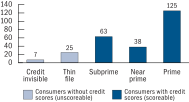
Most creditors require a sufficient credit history and score as a condition for lending, so people without a credit score generally lack access to credit. Roughly 32 million American adults are estimated to be "unscoreable" in regards to a credit score, including "credit invisible" that have no credit history (7 million, or 2.7 percent of all adults) or adults with a "thin file" (25 million, or 9.8 percent) (see figure 1).9 This classification prevents credit reporting agencies from generating a traditional credit score for these consumers and can effectively preclude these individuals from accessing credit from traditional banks.10 Financial alternative data can expand credit access for "credit invisible" populations, and it may also improve the precision and accuracy of credit scores for borrowers with thin credit files and certain borrowers with low credit scores. Specifically, financial alternative data can identify consumers within these populations that have a low propensity to default, what some researchers now refer to as "invisible primes." Importantly, this has the potential to improve credit access and affordability for borrowers who otherwise might not have access to traditional financial products.11
Figure 1. Current state of access to credit (Number of people in millions)
Accessible Version | Return to text
Note: Credit invisible, thin file, subprime, and near prime are most likely to benefit from alternative data. Current U.S. adult population is 258.3 million.
Source: Staff calculations.
Why has financial alternative data only recently begun to benefit these populations? Lenders have long used financial forms of alternative data when evaluating requests for commercial loans and mortgages. However, when performed manually, incorporating this information can be labor-intensive and expensive. This burden may be offset by the return on large-scale loans, but until recently, it was considered too costly for small-dollar consumer loans of $1,000 or less, in which the maximum revenue potential could be under $30.12 The economics against such small-dollar lending become even more unbalanced when adding costs related to loan origination and loan processing without even considering nonpayment and collections. However, since the release of the 2019 Use of Alternative Data statement, banks have begun utilizing automated underwriting models, especially for small-dollar loans, to more efficiently review a consumer's financial data and make an immediate lending decision. That speed, accuracy, and reduced cost can be crucial for consumers.
Why is there a need for small-dollar lending?
Small-dollar loans can provide needed liquidity (funds) to consumers facing income shocks or unanticipated expenses. Results from the Federal Reserve's annual Survey of Household Economics and Decisionmaking (SHED) consistently demonstrate the consumer need for small-dollar credit. Nineteen percent of the respondents to the 2024 SHED survey reported that their spending exceeded their income in the month they answered the survey.13 Eleven percent reported struggling to pay their bills because of varying income, including nearly 20 percent of those with income under $50,000. From 2022 to 2024, the SHED reported that 37 percent of adults would not cover a small emergency expense using cash, savings, or a credit card paid off at the next statement.14
Small-dollar loans could also improve the financial health of consumers that utilize costly alternative financial products. According to a 2022 survey from the Financial Health Network, while only 4 percent of financially healthy households reported paying an overdraft or nonsufficient funds fee in 2022, nearly half (46 percent) of financially vulnerable households with a checking account reported paying these fees in 2022, and nearly two-thirds (65 percent) did so at least three times during the year. Forty-five percent of study respondents who overdrafted reported that the most recent instance was on a transaction of $50 or less.15 Rapid access to low-cost, small-dollar loans could benefit this population, as well as the 6 percent of adults who reported using a payday, pawn, auto title, or tax refund anticipation loan—all costly alternative liquidity products identified in the 2024 SHED survey. The Consumer Financial Protection Bureau (CFPB) has noted that the finance charge for a payday loan, for example, works out to an annual percentage rate (APR) of nearly 400 percent for a two-week loan.16
Across the board, these indicators paint a picture of a large number of American consumers that need and seek out small-dollar funds on a regular basis, particularly in financially vulnerable households. Further, their needs are relatively small but may persist for more than a few days, and the current usage of overdraft and other alternative liquidity products is relatively expensive in comparison to a small-dollar installment loan offered by a depository institution and enabled by alternative data.17 Alternative data can be particularly beneficial in underwriting safe and affordable loans for consumers who have an ability to repay but otherwise would not qualify based on credit score alone.
What are some of the long-term benefits of innovations in alternative data?
Cash-flow data can enhance access to financial services for underserved borrowers while remaining consistent with safe and sound risk management and consumer protection requirements in two complementary ways. First, the use of alternative data, particularly cash-flow data, increases the scoreable population.18 Second, cash-flow data can uncover so-called "invisible prime" borrowers, increasing the credit access of customers that would otherwise be categorized as subprime with only traditional credit reporting agency.19 Moreover, the use of alternative data can also increase the convenience, speed, accuracy, and efficiency of credit underwriting for borrowers and lenders.
Finally, while this article highlights the benefits of cash-flow data to expand small-dollar credit access, alternative data offers many additional benefits. Alternative data can assist in fraud detection when the fraud detection model involves direct access to an employee's payroll system or bank account. Moreover, cash-flow data may also provide reliable measures of financial health that can support tailored financial products and services (beyond credit).
What are potential concerns and risks?
Despite the benefits of alternative data usage, potential concerns and risks remain. Many alternative data models have not been tested through an entire business cycle, raising questions as to how models using alternative data might perform during economic downturns. Over time, the expanding use of alternative data in underwriting will increase the representativeness of cash-flow data across credit cycles.
Data challenges, including unreliable access to transaction data, inconsistent data quality, and improperly structured data, could reduce the effectiveness of new technologies and practices. These issues may limit the ability of alternative data to expand credit access. Additionally, relevant data may be expensive to acquire from third parties, and even data held at the lending bank may require vendor support to organize. Further, current practices may face challenges in terms of economies of scale and profitability, particularly regarding small-dollar credit.
While many cash-flow metrics are straightforward for consumers used to managing their income and expenses, some consumers may not fully understand how their income and spending behavior affects credit models and decisions to offer a loan or other services.20 The extent to which the data permissioning process and use of alternative data is transparent to consumers is ripe for further research as innovation in this space continues.
Conclusion
Innovative uses of alternative data to promote financial inclusion have evolved significantly since the issuance of the 2019 Use of Alternative Data statement. Emerging uses of cash-flow data in small-dollar lending by financial institutions of all sizes show promise in safely and fairly expanding access to credit. This is especially relevant for consumers with a thin credit file or no credit history and a willingness to permission the use of their transaction data. These innovations could scale to other financial products over time. As the use of alternative data develops, it will be vital for consumers, regulators, and market participants to monitor how this data is being used and how it affects both access to credit and consumer financial health and ensures that the resulting products are viable, fair, and safe.
Footnotes
1. The staff contacts for this issue are Sean Creehan, Dan Gorin, and Kirsten Noland, and the contact for the Consumer & Community Context series is John Rodier. Evan LeFlore and Kim Wilson provided research and analysis on this topic. Lincy Chacko and David Coffey provided editorial support. Return to text
2. Consumers with credit scores fall into three general categories: subprime (credit scores below 620), near prime (credit scores of 620 to 659), and prime (credit scores above 660). Return to text
3. See Board of Governors of the Federal Reserve System, "Interagency Statement on the Use of Alternative Data in Credit Underwriting," CA letter 19-11 (December 12, 2019), https://www.federalreserve.gov/supervisionreg/caletters/caltr1911.htm. Return to text
4. See Board of Governors, "Use of Alternative Data." Return to text
5. As noted in the alternative data statement, firms may choose to consult with appropriate regulators when planning for the use of alternative data. Return to text
6. See Board of Governors, "Use of Alternative Data." Return to text
7. See joint statement by Board of Governors of the Federal Reserve System, Federal Deposit Insurance Corporation, National Credit Union Administration, and Office of the Comptroller of the Currency, "Interagency Lending Principles for Offering Responsible Small-Dollar Loans," May 20, 2020, https://www.federalreserve.gov/newsevents/pressreleases/files/bcreg20200520a1.pdf. Return to text
8. According to Oliver Wyman, nearly one in five adults in the U.S. fall into one of these two categories. See Mike Hepinstall, Chaitra Chandrasekhar, Peter Carroll, Nick Dykstra, and Yigit Ulucay, Financial Inclusion and Access to Credit (Oliver Wyman, 2022), https://images.go.experian.com/Web/ExperianInformationSolutionsInc/%7B63ec9888-37ea-405c-b39d-7492de9143ce%7D_FINALExperian_report_14_01.pdf. Return to text
9. Consumer Financial Protection Bureau, Technical Correction and Update to the CFPB's Credit Invisibles Estimate (CFPB, June 2025), https://files.consumerfinance.gov/f/documents/cfpb_update-credit-invisibles-estimate_2025-06.pdf. Return to text
10. Hepinstall, et al., Financial Inclusion and Access to Credit. The minimum scoring criteria for a credit score from FICO, the pioneer of scoring to measure credit risk, includes one trade line (a line of credit) reported within the past six months and one trade line that is at least six months old. As a counterpoint, the FDIC estimates that "only" 15.7 percent of adults had no access to mainstream credit in 2023, down from 20 percent in 2017. See Federal Deposit Insurance Corporation, "2023 FDIC National Survey of Unbanked and Underbanked Households" (FDIC, November 2024), https://www.fdic.gov/household-survey. Return to text
11. See, for example, Marco Di Maggio and Di Muthu Ratnadiwakara, "Invisible Primes: Fintech Lending with Alternative Data" (SSRN, May 2022), https://papers.ssrn.com/sol3/papers.cfm?abstract_id=3937438. Return to text
12. The revenue on a $500 small-dollar installment loan payable in three periods with a 36 percent APR is $30.30 and $20.13 with an APR of 24 percent. Return to text
13. Board of Governors of the Federal Reserve System, Economic Well-Being of U.S. Households in 2024 (Board of Governors, May 2025), https://www.federalreserve.gov/publications/files/2024-report-economic-well-being-us-households-202505.pdf. Return to text
14. Board of Governors, Economic Well-Being of U.S. Households in 2024. Return to text
15. Meghan Greene, MK Falgout, and Necati Celik, "Overdraft Trends Amid Historic Policy Shifts" (Financial Health Network, June 1, 2023), https://finhealthnetwork.org/research/overdraft-trends-amid-historic-policy-shifts/. Return to text
16. See "What Are the Costs and Fees for a Payday Loan?," Consumer Financial Protection Bureau, last reviewed November 25, 2024, https://www.consumerfinance.gov/ask-cfpb/what-are-the-costs-and-fees-for-a-payday-loan-en-1589/. Return to text
17. See Board of Governors of the Federal Reserve System, "Meeting Small-Dollar Consumer Credit Needs: Old and New Choices," Consumer & Community Context, July 2023, https://www.federalreserve.gov/publications/files/consumer-community-context-20230728.pdf. Return to text
18. Finnegan, The Use of Cash-Flow Data in Underwriting Credit: Empirical Research Findings (FinRegLab.org), https://finreglab.org/research/the-use-of-cash-flow-data-in-underwriting-credit-empirical-research-findings/. Hepinstall, et al., Financial Inclusion and Access to Credit. Return to text
19. Marco Di Maggio and Dimuthu Ratnadiwakara, "Invisible Primes." Return to text
20. See Board of Governors, "Use of Alternative Data" for a discussion of consumer protection implications of the use of alternative data in underwriting, including with respect to benefits and potential risks. The statement notes that the ability for consumers to expressly permission access to their cash flow data enhances transparency and control over the data. Return to text