

Consumer & Community Context - August 2026
What is Buy Now, Pay Later?
This issue of Consumer & Community Context examines the use of Buy Now, Pay Later (BNPL).1 BNPL is a deferred payment product that has experienced strong growth—both in the number of loans and dollar volume—since 2019.2 Unlike layaway or rental arrangements, BNPL allows consumers to immediately own or access a good or service while spreading out its cost without incurring the additional interest or fees if the terms are met. The definition of BNPL has spread in recent years to encompass multiple point-of-sale installment products. This article focuses exclusively on the original pay-in-four product, which allows consumers to split purchases into four equal payments over six weeks. For example, a $100 purchase can be made by paying $25 at checkout and then making three biweekly installment payments of $25. Given the increasing popularity of the pay-in-four product category, its unique features and position in the consumer lending landscape, and the possible misconceptions consumers may have about these loans, it is important to better understand BNPL and the potential benefits and risks it poses for borrowers.
Pay-in-four BNPL is predominantly offered by fintech companies, such as Affirm, Klarna, or Afterpay, among others. Consumers can use BNPL for online shopping or in-store purchases. Retailers that have partnered with a BNPL firm typically offer consumers the BNPL payment option during checkout. Consumers may also access BNPL directly from a BNPL firm's app.3 A recent BNPL market report found that among five large BNPL firms, U.S. monthly app usage increased through the end of 2024.4
BNPL firms employ a "low and slow" approach to lending—that is, they commonly offer small initial loans and, upon successful repayment, make the consumer eligible for a larger pay-in-four BNPL loan. With respect to underwriting, BNPL lenders rely heavily on their own proprietary models. Generally, they utilize consumers' credit bureau history via a soft credit pull when underwriting their initial BNPL loan. Subsequent loans are commonly underwritten using individual borrowers' repayment data.
The vast majority of BNPL loans are repaid.5 BNPL firms assert this repayment success is a result of their own companies' screening and underwriting models.6 The mechanics of the pay-in-four model may also play a role: borrowers must provide a down payment and set up an automatic payment account at the time of purchase. In addition to the down payment, BNPL providers confirm through the debit/credit card networks that sufficient funds to pay off the loan are available in the linked account at the time of purchase. While not guaranteeing a BNPL loan will be repaid, this practice provides the lender with information demonstrating that the borrower has the means to repay the loan at the point of origination.
Currently, most BNPL lenders do not report these loans to the credit reporting agencies (CRAs).7 Given the unique structure of these pay-in-four products, they do not fit well with existing reporting infrastructure. As a result, borrowers are not credited for timely payments or penalized for late payments, and lenders do not have full visibility into borrowers' outstanding debt obligations. Unlike other traditional credit products, there is no way to holistically view consumers' BNPL use in credit data.
Who uses BNPL?
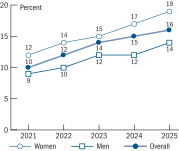
This article primarily uses data from the 2025 Survey of Household Economics and Decisionmaking (SHED), a nationally representative survey of nearly 13,000 respondents.8 Overall, 16 percent of all adults used BNPL in 2025. BNPL use has increased steadily each year since 2021, when the SHED first asked about BNPL. Over this time, women have consistently been more likely than men to use BNPL. In 2025, nearly one in five women used BNPL in the prior year (figure 1). Even after accounting for differences in income, educational attainment, and age, women are more likely than men to use BNPL. Usage is also higher among younger adults, adults without a bachelor's degree, and Black and Hispanic adults.
Figure 1. Used Buy Now, Pay Later in past year, by year and gender
Accessible Version | Return to text
Note: Among all adults.
Source: Author's calculations using the 2025 Survey of Household Economics and Decisionmaking.
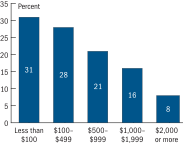
Individuals with fewer financial resources are also more likely to use BNPL. Previous research using the SHED found that individuals with lower incomes, lower credit scores, debt repayment struggles, and revolving credit card balances used BNPL at higher rates.9 These patterns persisted in the 2025 SHED. For example, individuals who were unable to cover modest emergency expenses using only their savings were more likely to use BNPL than those with greater amounts of savings. BNPL usage was 31 percent among adults whose largest emergency expense they could cover using only their savings was less than $100, and it steadily decreased to 8 percent among adults able to cover an emergency expense of $2,000 or more (figure 2). Over time, the growth in BNPL has been concentrated among those experiencing credit and liquidity constraints.
Figure 2. Buy Now, Pay Later use, by largest emergency expense individuals could handle right now using only savings
Accessible Version | Return to text
Note: Among all adults.
Source: Author's calculations using the 2025 Survey of Household Economics and Decisionmaking.
What do consumers use BNPL for?
Consumers used BNPL to purchase a variety of goods and services. Clothing or accessories was the most common type of purchase, with nearly half (49 percent) of users reporting they used BNPL to cover these items in the prior year (table 1). One in five BNPL users said they used the product to pay for groceries or food delivery services in the prior year. Electronics as well as furniture or appliances were also commonly purchased using BNPL.
Table 1. Types of purchases made using Buy Now, Pay Later (BNPL)
Percent
| Income | Male/Female | Overall | ||||
|---|---|---|---|---|---|---|
| Purchase Type | Less than $50,000 | $50,000-$99,999 | $100,000 or more | Men | Women | |
| Clothing or accessories | 51 | 50 | 44 | 38 | 56 | 49 |
| Electronics | 33 | 32 | 32 | 42 | 25 | 32 |
| Furniture or appliances | 25 | 28 | 27 | 27 | 26 | 26 |
| Groceries or food delivery | 29 | 19 | 9 | 18 | 22 | 20 |
| Travel expenses | 13 | 23 | 24 | 18 | 19 | 19 |
| Medical or veterinary procedures | 9 | 8 | 7 | 8 | 8 | 8 |
| Other | 15 | 17 | 18 | 18 | 15 | 16 |
Note: Among BNPL users.
Source: Author's calculations using the 2025 Survey of Household Economics and Decisionmaking.
Different patterns of use emerge when considering BNPL users' income. Individuals with the highest income were more likely to use BNPL to cover travel expenses than those adults making less than $50,000. Conversely, high-income BNPL users were less likely to use BNPL for groceries or food delivery services and clothing or accessories. BNPL users with an income less than $50,000 were more likely to use BNPL to pay for groceries or food delivery services and for clothing or accessories.
For other categories, there is no relationship between BNPL users' income level and the types of goods and services they purchased. For example, consumers were equally likely to use BNPL to buy electronics, furniture, and medical or veterinary services after accounting for income level.
According to the survey, women and men also used BNPL for different types of purchases. Men were significantly more likely to use BNPL for electronics, while women were more likely to use BNPL for clothing or accessories and groceries or food delivery.
The benefits and risks of BNPL
As BNPL has experienced strong growth, attention has been given to why consumers select this product. Contrary to the assumption that the product is used as a last resort, BNPL users routinely cite reasons related to convenience. This finding suggests that the majority of BNPL users like specific product features or find this payment tool useful for some purchases.
Individuals often give multiple reasons for using BNPL to pay for purchases. The top two reasons for using BNPL in 2025 were wanting to spread out payments (87 percent) and convenience (82 percent). Importantly, BNPL users cited "only accepted payment method [they] had" as the least common reason among the choices given.10 The order in which BNPL users rank these reasons for use has been consistent since the SHED began asking respondents about their BNPL use. These findings match what other researchers have previously found about why consumers choose to use BNPL.11 While some users choose BNPL out of necessity, the vast majority cite reasons related to preference or convenience.
While BNPL may offer newfound convenience, its use may also impose new and potentially unforeseen risks for consumers as well. For example, consumers can be charged late fees for missing payments or can incur an overdraft or non-sufficient funds (NSF) fee if their bank account does not have adequate funds.12 Although it is possible for individuals to cancel or change the automatic installment payments that BNPL lenders establish at checkout, most BNPL payments are automated debit payments from a checking account.13 This product feature could increase BNPL repayment success, including for the liquidity-constrained individuals who are more likely to use pay-in-four products. However, this feature also increases the risk of consumers incurring an overdraft or NSF fee on their bank accounts.
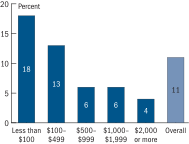
Eleven percent of BNPL users had a BNPL payment trigger an overdraft or NSF fee in the prior year (figure 3).14 Consumers with fewer financial resources were the most likely to have a BNPL payment trigger an overdraft fee from their bank. Eighteen percent of BNPL users whose largest expense they could cover using their savings was less than $100 experienced an overdraft fee triggered by a BNPL payment. Conversely, 4 percent of BNPL users who could cover an expense of $2,000 or more incurred an overdraft fee because of a BNPL payment.
Figure 3. Buy Now, Pay Later (BNPL) payment triggered an overdraft or non-sufficient funds fee, by largest emergency expense individuals could handle right now using only savings
Accessible Version | Return to text
Note: Among BNPL users.
Source: Author's calculations using the 2025 Survey of Household Economics and Decisionmaking.
Note: On September 3, 2026, the HTML version was updated to correct the placement of charts for Figures 3 and 4. The figures now appear in the correct order.
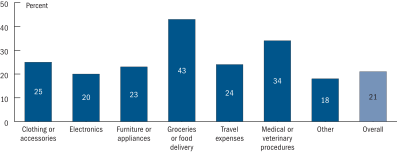
The types of purchases for which individuals use BNPL may also be related to their repayment behavior. Overall, slightly more than one-fourth (26 percent) of BNPL users said they paid late at least once in the prior year, and 17 percent were charged extra for paying late in the prior year.15 Those that used the product for groceries or food delivery were more prone to facing late payment charges or incurring an overdraft or NSF fee (figure 4). This is true even when looking at people with similar incomes. Thirty-four percent of BNPL users who purchased medical or veterinary procedures with BNPL also were charged extra for paying late or incurred an overdraft or NSF fee in the prior year.
Figure 4. Share of Buy Now, Pay Later (BNPL) users who were charged extra for paying late or incurred an overdraft or non-sufficient funds fee, by BNPL purchase type
Accessible Version | Return to text
Note: Among BNPL users.
Source: Author's calculations using the 2025 Survey of Household Economics and Decisionmaking.
Note: On September 3, 2026, the HTML version was updated to correct the placement of charts for Figures 3 and 4. The figures now appear in the correct order.
BNPL provides consumers with an interest-free deferred payment method, provided they make payments on time. When BNPL users pay late and are charged a fee, there is a cost to financing their purchase with BNPL. Consumers who use BNPL to cover essentials—such as groceries—were more likely to struggle with repayment in 2025 and incurred extra fees. BNPL can offer flexibility and short-term credit to consumers who may have trouble accessing traditional sources of credit. However, BNPL may not be an improvement over other alternative financial services if the total costs are higher. It remains an open question whether consumers with severe financial constraints actually pay lower costs overall by using BNPL.
Conclusion
As more consumers utilize BNPL, key trends have emerged. Women continue to use the product more than men. Additionally, consumers who appear liquidity constrained, as measured by the largest emergency expense they could cover using only their savings, were more likely to use the product.
Consumers used BNPL to purchase a variety of goods and services. While clothing or accessories was the most common type of purchase, those who used BNPL to cover groceries or food delivery services were more likely to have had lower income.
With respect to repayment and how BNPL use can affect users' bank accounts, more than 1 in 10 BNPL users had an installment payment trigger an overdraft or NSF fee. Consumers with the least amount in savings were the most likely to incur an overdraft or NSF fee due to a BNPL payment.
Taken together, these results suggest that some adults struggle to cover essentials, and BNPL is not filling the gap. The flexibility offered via three installment payments over six weeks is not enough to prevent consumers with fewer financial resources from missing payments and incurring additional fees. While many BNPL users selected and continue to use the product because of its unique features and other preferences, more attention should be paid to those BNPL users who use the product for daily necessities and are experiencing repayment difficulties.
Footnotes
1. The staff contact for this issue is Anna Tranfaglia, and the contact for the Consumer & Community Context series is John Rodier. Lincy Chacko and David Jenkins provided editorial support. Return to text
2. The Consumer Financial Protection Bureau (CFPB) estimates that the number of BNPL loans increased from 19.8 million in 2019 to 335.8 million in 2023. Dollar volume grew from $2.7 billion to $45.2 billion during the same period. For more information, see Consumer Financial Protection Bureau, The Buy Now, Pay Later Market (CFPB, December 2025), https://files.consumerfinance.gov/f/documents/cfpb_bnpl-market-report_2025-12.pdf. Return to text
3. Consumers can download an app from a BNPL lender and complete the credit application process at their convenience. Once approved, they gain access to a set of partner merchants to shop at via the app. Return to text
4. Approximately 45 million monthly BNPL users utilized a BNPL app at the end of 2024, compared to approximately 10 million monthly users in early 2021. For more information, see CFPB, Buy Now, Pay Later Market. Return to text
5. In 2023, 1.8 percent of loans were charged off. For more information, see CFPB, Buy Now, Pay Later Market. Return to text
6. For example, Affirm has argued that its underwriting strategy is a main driver of the low default rates it experiences. For more information, see Katherine Adkins, "A Deeper Look at Buy Now, Pay Later Users, Benefits and Common Criticisms," Affirm, February 5, 2025, https://investors.affirm.com/news-releases/news-release-details/deeper-look-buy-now-pay-later-users-benefits-and-common. Return to text
7. One exception is that BNPL loans sent to collections are visible in consumer credit reporting data, just like most other third-party collections reported to the CRAs. Return to text
8. More information on the SHED, including the questionnaire, anonymized data, and survey methodology, is available on the Federal Reserve Board's website at https://www.federalreserve.gov/consumerscommunities/shed.htm. Return to text
9. See Jeff Larrimore, Alicia Lloro, Zofsha Merchant, and Anna Tranfaglia, "Payment Preference or Necessity: Who Uses BNPL and Why," Journal of Consumer Affairs 59, no. 3 (2025), e70024, https://doi.org/10.1111/joca.70024. For the earlier working paper version, see Jeff Larrimore, Alicia Lloro, Zofsha Merchant, and Anna Tranfaglia, "‘The Only Way I Could Afford It': Who Uses BNPL and Why," FEDS Notes (Washington: Board of Governors of the Federal Reserve System, December 20, 2024), https://doi.org/10.17016/2380-7172.3675. Return to text
10. For more information on consumers' main reasons for using BNPL and a discussion of all the reasons survey respondents could choose from, see Board of Governors of the Federal Reserve System, Economic Well-Being of U.S. Households in 2025 (Board of Governors, May 2026), https://www.federalreserve.gov/publications/files/2025-report-economic-well-being-us-households-202605.pdf. Return to text
11. Akana and Doubinko (2024) found that the most common reason for using BNPL was convenience among their sample of survey respondents; see Tom Akana and Valeria Zeballos Doubinko, 4-in-6 Payment Products—Buy Now, Pay Later: Insights from New Survey Data (Federal Reserve Bank of Philadelphia, February 2024), https://www.philadelphiafed.org/-/media/frbp/assets/consumer-finance/reports/bnpl-survey-insights.pdf. Return to text
12. Most BNPL lenders charge late fees for missed payments. For more information, see Tom Akana, "Buy Now, Pay Later: Survey Evidence of Consumer Adoption and Attitudes," Discussion Paper 22-02 (Federal Reserve Bank of Philadelphia, June 2022), https://www.philadelphiafed.org/-/media/FRBP/Assets/Consumer-Finance/Discussion-Papers/dp22-02.pdf. Return to text
13. This is a result of specific BNPL lenders updating their terms to require establishing autopayments from a checking account at origination as well as some large credit card lenders barring cardholders from using their credit cards to pay for pay-in-four BNPL loans; see "My Payment Method Isn't Supported," Sezzle, https://shopper-help.sezzle.com/hc/en-us/articles/360052486252-My-payment-method-isn-t-supported; Imani Moise, "Banks Hate ‘Buy Now, Pay Later'—and May Penalize Its Users," Wall Street Journal, July 22, 2025, https://www.wsj.com/personal-finance/credit/fico-credit-score-buy-now-pay-later-44424ae0. Return to text
14. BNPL users are more prone to experience an overdraft fee. Overall, 12 percent of adults with a bank account experienced an overdraft or NSF fee in 2025. Thirty percent of bank account owners who used BNPL incurred an overdraft fee (on any transaction—not restricted to only BNPL payments) in 2025 compared to 8 percent of bank account owners who did not use BNPL; see Board of Governors of the Federal Reserve System, Survey of Household Economics and Decisionmaking [dataset] (Washington: Board of Governors, 2026), https://doi.org/10.17016/datasets.002. Return to text
15. Fees that result from paying late can include fees imposed by the BNPL lender or fees from a user's bank due to overdrawing their account. The SHED question does not ask respondents for more detail on type of fee. Return to text