


No FEAR Act Annual Report - 2025
Overview
The Notification and Federal Employee Antidiscrimination and Retaliation Act of 2002 (No FEAR Act) requires that federal agencies be publicly accountable for violations of antidiscrimination laws and policies.1 Federal agencies must post quarterly and annual statistical data relating to federal-sector Equal Employment Opportunity (EEO) complaints on their public websites, reimburse the Judgment Fund for payments made, and notify employees and applicants for employment about their rights under the federal antidiscrimination and whistleblower laws.
The No FEAR Act, as amended, also requires each federal agency to submit an annual report to Congress no later than 180 days after the end of each fiscal year (FY). The FY for the federal government begins on October 1 and ends on September 30. Based on this requirement, the Federal Reserve Board (Board) hereby submits this 22nd annual report, pursuant to the requirements of section 203 of the No FEAR Act.
In accordance with section 203(a) of the No FEAR Act and its regulations thereunder (5 CFR § 724.302), this 22nd annual report is being forwarded to the Speaker of the House of Representatives; the president pro tempore of the Senate; the Committee on Homeland Security and Governmental Affairs, U.S. Senate; the Committee on Oversight and Government Reform, U.S. House of Representatives; each committee of Congress with jurisdiction relating to the Board; the Chair of the Equal Employment Opportunity Commission (EEOC); the Attorney General of the United States; and the Director of the Office of Personnel Management (OPM).
Office of EEO Programs
The Office of EEO Programs, within the Office of EEO Programs and OMWI (OEO), administers and directs the Board's EEO compliance policies, practices, and programs. In addition to implementing the No FEAR Act requirements, the EEO Office is responsible for implementing the following Board and EEOC program directives summarized below:
- Management Directive 715 (MD-715) contains policy guidance and standards for establishing and maintaining an effective program for EEO.2
- Management Directive 110 (MD-110) contains procedures to be followed when processing complaints of discrimination filed by federal employees and by applicants for federal employment alleging employment discrimination.3
- The Board's Rules Regarding Equal Opportunity set forth the requirements and procedures relating to the Board's policies to promote equal opportunity.4
About This Report
This report summarizes the accomplishments within the Board's EEO program in implementing the No FEAR Act, focusing principally on EEO complaint processing.
As required by section 203(a) of the No FEAR Act, this annual report addresses
- the number of federal court cases, pending or resolved, arising under the antidiscrimination laws and authorities included in the No FEAR Act, and the status and disposition of the cases;
- Judgment Fund reimbursements, adjustments to agency budgets to meet reimbursement requirements, and the amount of reimbursement required for attorneys' fees where such fees have been separately designated;
- the number and type of disciplinary actions related to discrimination, retaliation, or harassment and the agency's policy relating to appropriate disciplinary action;
- year-end summary data related to federal-sector EEO complaint activity;
- a detailed description of the agency's policy for taking disciplinary actions against employees for conduct inconsistent with the antidiscrimination laws referenced by the No FEAR Act;
- an analysis of the information provided in this report, including an examination of trends, causal analysis, practical knowledge gained, and actions planned or taken to improve compliance; and
- the agency's plan to train employees on their rights under the No FEAR Act.
Further guidance on each agency's reporting obligations is provided in 5 CFR § 724.302, which also requires the submission of the annual report to the Director of OPM, for the implementation of a best practices study and the issuance of advisory guidelines.
This report provides EEO data and analysis for the No FEAR Act for FY 2025 (October 1, 2024, through September 30, 2025).
Results and Data
The No FEAR Act requires that federal agencies report on the number of cases in federal court pending or resolved in each fiscal year and arising under each of the respective provisions of the federal antidiscrimination and whistleblower protection laws applicable to the agency as defined in 5 CFR § 724.102. The laws covered in the No FEAR Act include
- title VII of the Civil Rights Act of 1964, as amended, 42 U.S.C. § 2000e-16 (race, color, religion, sex, and national origin) (title VII);
- the Age Discrimination in Employment Act of 1967, as amended, 29 U.S.C. § 633a (age);
- the Equal Pay Act of 1963, 29 U.S.C. § 206(d) (gender-based wage differentials);
- section 501 of the Rehabilitation Act of 1973, as amended, 29 U.S.C. § 791 (disability);
- the Genetic Information Nondiscrimination Act of 2008, 42 U.S.C. § 2000ff-1 (genetic information); and
- the Civil Service Reform Act of 1978, 5 U.S.C. § 2302(b) (race, color, religion, sex, national origin, age, disability, marital status, political affiliation, and whistleblowing).
EEO Complaint Activity in Federal Court Disposition
As shown in table 1, there were two new Federal District Court cases filed in FY 2025. In addition, the Board had one case pending in federal court in FY 2025.
In the aggregate and separated by provision(s) of the law involved, the status or disposition of the cases (including settlement) are identified in table 1.
Table 1. Federal court cases, fiscal year 2025
| Status or disposition | Total cases pending or resolved |
|---|---|
| Basis of actions | Pending |
| Age (29 U.S.C. § 633a) | 1 |
| Race, color, religion, sex, or national origin (42 U.S.C. § 2000 e-16 ) | 1 |
| Equal Pay Act (29 U.S.C. § 206) | 0 |
| Disability (29 U.S.C. § 71) | 1 |
| Basis of actions | Resolved |
| Age (29 U.S.C. § 633a) | 0 |
| Race, color, religion, sex, or national origin (42 U.S.C. § 2000 e-16) | 0 |
| Equal Pay Act (29 U.S.C. § 206) | 0 |
| Disability (29 U.S.C. § 71) | 1 |
Judgment Fund Reimbursements and Budget Adjustments
The Board does not use the Judgment Fund.5 Accordingly, the Board made no reimbursements to the Judgment Fund during the reporting period.
-
The amount of money required to be reimbursed to the Judgment Fund by the agency for payments as defined in 5 CFR § 724.102:
None. -
The amount of reimbursement to the fund for attorney's fees where such fees have been separately designated:
None. -
For each FY, any adjustment needed or made to the budget of the agency to comply with its Judgment Fund reimbursement obligation(s) incurred under 5 CFR § 724.103:
None.
Disciplinary Policy and Actions
For federal court cases that involve allegations of a violation of federal antidiscrimination or whistleblower protection laws, federal agencies are required to report the number of employees disciplined. "Discipline" is defined as any one or a combination of the following actions: reprimand, suspension without pay, reduction in grade or pay, or removal. Whether or not in connection with discrimination cases in federal court, federal agencies are to report the total number of employees disciplined and the specific nature of the disciplinary action taken in accordance with agency policy that prescribes disciplinary action for discrimination, retaliation, or harassment conduct, and whistleblower protection law violations.
-
In connection with cases identified in table 1, the total number of employees in each FY disciplined as defined in 5 CFR § 724.102 and the specific nature, e.g., reprimand, etc., of the disciplinary actions taken, separated by the provision(s) of law involved:
Zero. -
A detailed description of the agency's policy for taking disciplinary action against federal employees for conduct that is inconsistent with federal antidiscrimination and whistleblower protection laws or for conduct that constitutes another prohibited personnel practice revealed in connection with agency investigations of alleged violations of these laws:
See the discussion that follows on related Board policies.
The Board considers violations of antidiscrimination laws to be misconduct. The Board's Disciplinary Actions Policy, Provisional and Nonregular Employment Policy, and Adverse Action Policy (see appendix A) are used to discipline employees who have violated antidiscrimination laws. Depending on the seriousness of the offense, one instance of misconduct may be sufficient to separate an employee from Board service.
The objective of the Disciplinary Actions Policy is to correct and deter employee misconduct to aid in the maintenance of an efficient and orderly work environment. The Board may take a variety of disciplinary actions against employees, including but not limited to, reprimanding or warning an employee in writing, last chance agreements, or suspensions without pay of up to 14 calendar days. When the Board disciplines an employee, the employee will be informed of the action resulting in discipline and be warned of the consequences of the same problem recurring. The Board may take into account past misconduct of the employee when determining the appropriate discipline to apply.
Under the Provisional and Nonregular Employment policy, all newly hired employees are provisional employees for a two-year period starting from their entrance-on-duty date. Both provisional and nonregular employees may be separated from employment at the will of the Board for any reason that is not unlawful. Some reasons the Board may separate provisional and nonregular employees from Board employment include misconduct, when there are suitability concerns, or if an employee is deemed to be a direct threat. Provisional and nonregular employees have no right to continued employment. A provisional employee who is separated from employment during the provisional period shall be given written notification of such action and of any specific reasons for the action. However, nonregular employees have no such appeal rights under Board policy.
Adverse actions are taken to promote the integrity and efficiency of the Board. Under the Adverse Action Policy, which applies to employees who have completed their two-year provisional employment period, the Board issues a stronger discipline, such as suspensions of more than 14 calendar days, a reduction in grade or pay, or separation.
The Board administers two policy statements that reinforce the Board's commitment to establishing a workplace free from discrimination, harassment, and/or retaliation and that inform employees of their rights and responsibilities: the Equal Employment Opportunity Policy and the Discriminatory Workplace Harassment Policy. These policies are available to all employees on the Board's intranet.
The Equal Employment Opportunity Policy explains the Board's firm commitment to EEO. The EEO policy also explains the administrative EEO complaint process, including how to initiate the process, pertinent regulatory timeframes, and the roles and responsibilities for implementing the policy. It also distinguishes the difference between the administrative EEO complaint process and the administrative harassment process. The Board disseminates information regarding the Board's EEO policy and the EEO complaint process to all new employees during onboarding. Information pertaining to the EEO complaint process and EEO counselor contacts are posted on the Office of EEO Programs' internal website and throughout the Board.
The Discriminatory Workplace Harassment Policy clearly defines discriminatory harassment and inappropriate conduct, and makes clear that harassment, inappropriate conduct, and retaliation will not be tolerated at the Board. This policy identifies multiple avenues of redress for claims of harassment and does not limit employees to the EEO process. The Board's policy on Discriminatory Workplace Harassment is readily and continuously available to all employees on several Board communication platforms.
Final Year-End No FEAR Act Summary Data
See appendix B for a detailed look at the formal complaints filed against the agency during the reporting period, including the number of complaints and complainants and the bases and issues alleged for each of the five immediately preceding fiscal years.
Analysis of Complaints
The No FEAR Act requires regular examination of trends and a causal analysis. Observations related to these areas follow.
Complaint Processing Data (an Overview)
When individuals believe that they have experienced discrimination, they first must contact an EEO counselor prior to filing a formal complaint. An aggrieved person has 45 days after the alleged incident occurs to establish contact with a Board EEO counselor (see 29 CFR § 1614.105 (a) and 12 CFR § 268.104(a)).
Contacting an EEO counselor initiates the EEO complaint process. The EEO complaint process has two stages: informal and formal.
The objective of the initial informal (or "pre-complaint") stage of EEO complaint processing is to reach a resolution in the dispute, freely arrived at by all parties involved, at the earliest possible stage in the process. An informal complaint "resolution" occurs when a pre-complaint is withdrawn, a settlement is reached, or a formal complaint is not filed.
If an informal resolution is not reached, the aggrieved person will then have the option of filing a formal complaint. The formal EEO complaint process focuses on the merits of an EEO complaint.
The formal complaint process proceeds through multiple stages, for example, acceptance and/or procedural dismissal, investigation, hearing(s), appeal, and reconsideration. Not all formal complaints complete all formal complaint processing stages.
Trends and Causal Analysis
EEO Complaint Activity
Four (4) formal complaints were filed at the Board in FY 2025. This marked a 63.64 percent decrease from FY 2024's eleven (11) formal complaints, and a departure from the annual average of 7.2 complaints for the five-year period spanning FYs 2021 to 2025 (figure 1).
Figure 1. Number of Board EEO complaints filed by fiscal year (FY 2021–25)
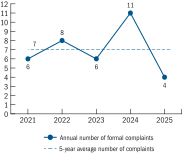
Therefore, the overall percentage of the Board's 3,108 full-time employees who filed an EEO formal complaint remained less than half of one percent (0.13 percent) in 2025, consistent with previous years.
Bases of Discrimination in EEO Complaints
The basis of the complaint is the protected characteristic that the complainant asserts motivated the alleged discriminatory conduct. The bases protected by EEO statutes include race, color, religion, national origin, sex, pregnancy, disability, age, genetic information, and retaliation (also called reprisal) for participating in the EEO complaint process or for opposing practices made illegal under the EEO laws. Complaints can be filed on multiple bases. Accordingly, the sum of the bases may exceed the total number of complaints filed in the fiscal year.
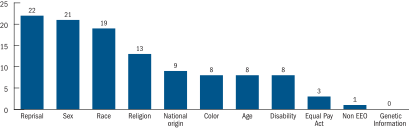
Overall, the frequency of most protected bases alleged in Board formal complaints remained consistent with prior years. Reprisal, race, and sex are perennially prevalent bases. Together, these three bases accounted for 55 percent of all bases alleged in Board formal complaints over the last five years (figure 2).
Figure 2. Total number of Board EEO complaints by basis (FY 2021–25)
Accessible Version | Return to text
Note: Complaints can be filed alleging multiple issues, so the sum of the issues may exceed the total complaints filed.
Despite the decrease in the number of formal complaints filed at the Board during FY 2025, the statistical frequency for protected bases remained consistent with five-year trends at the Board. However, each of these bases has seen a marked decrease in complaints from the previous year. Comparing 2025 to 2024, claims of reprisal decreased by five (5), claims of race discrimination also decreased by five (5), and claims of sex discrimination decreased by four (4). Additionally, while claims of discrimination based on color, religion, Equal Pay Act, disability, and non-EEO did not occur in 2025, claims of national origin did occur, but decreased 25 percent from 2024.
Consistent with 2024, female employees filed the majority of discrimination complaints in 2025, with three of the four complaints being filed by female employees. For 2025, while three (3) of the four (4) total complaints in 2025 alleged sex discrimination, one (1) of the complainants was male, while two (2) were female.
For 2025, there was a higher number of national origin-based discrimination complaints (3) than race-based complaints (2). This is a notable shift from a trend that consistently saw race-based complaints outpace national origin complaints in the preceding five years by nineteen (19) to six (6).
Regarding race, two (2) race-based complaints of discrimination were filed at the Board in FY 2025, one of which was filed by a Black employee and one of which was filed by an Asian employee (unchanged from race-based complaints filed by Asians in 2024). As a result, there was a 66 percent decrease in cases filed by Black employees in 2025 compared to 2024 (3), and a 71 percent decrease in total race-based complaints in 2025 (7 were filed in 2024).
Similar to the increase in national origin complaints the Board experienced in 2024 (4), the Board again saw an elevated number of national origin complaints in 2025, with three (3) such complaints filed. Prior to 2024, the Board typically averaged fewer than one (1) national origin complaint each year and had zero (0) national origin complaints in 2020, 2022, and 2023, with only one (1) in 2021. Analysis showed no clear nexus between the national origin complaints.
FY 2024 ended a declining trend for Age Discrimination in Employment Act (ADEA) complaints at the Board with the filing of four (4) ADEA complaints. FY 2025 experienced a return to that declining trend which originated in 2021, with the filing of one (1) formal ADEA complaint.
This year, there were zero (0) complaints of color discrimination. This is a change to a trend of increasing of color-based complaints filed between 2022 and 2024, where one (1) complaint was filed in FY 2022, followed by two (2) complaints in FY 2023, and five (5) complaints in 2024. The decline in total discrimination cases filed likely contributed to the observed change in this metric.
Zero (0) religious discrimination complaints were filed in 2025, another observed change in complaint types filed compared to previous years, where religious discrimination complaints were filed at an average of 3.25 cases per year between 2021 and 2024.
Multiple bases were frequently alleged together in a single complaint. For example, of the four (4) reprisal complaints, the three (3) that complained of reprisal at inception of the complaint also included national origin as a basis in their complaint. Additionally, two (2) of those three (3) cases which alleged reprisal at inception also included sex and/or race. One complaint listed a total of five (5) bases, i.e., reprisal, national origin, race, pregnancy, and sex. Additionally, all complainants listed retaliation/reprisal as a basis. In 2024, the results were similar, where ten (10) of the eleven (11) complainants listed retaliation as a basis.
Issues in EEO Complaints
The issue of a complaint is the specific subject matter for which the complainant seeks redress, for example, an alleged discriminatory policy or practice the complaint challenges, an alleged discriminatory incident or personnel action taken against the complainant, and/or a pattern of alleged discriminatory behaviors. The range of issues covered by the EEO laws is broad and can cover many aspects of an individual's employment.
In FY 2025, "non-sexual harassment" (2), "evaluation appraisal" (3), and "promotion/non-selection" (3), and "assignment of duties" (2) accounted for 83 percent (10 of 12) of all issues alleged in Board EEO complaints. One notable change from 2024 to 2025, was the absence of "appointment/hire" issues, which returned to its rate of zero (0) allegations between 2021 and 2023. Another notable change was the absence of "terms/conditions of employment" issues, where zero (0) were alleged in 2025, preceded by seven (7) total between 2021 and 2024.
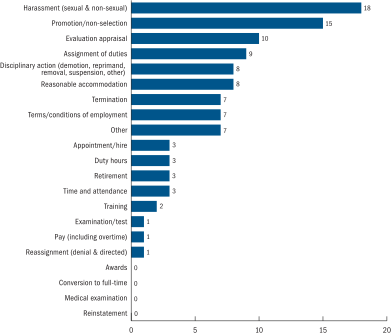
Looking longer term, of the 35 complaints filed between FYs 2021 and 2024, the most frequently alleged issues were "non-sexual harassment" (17) or 48.6 percent, "promotion/non-selection" (15) or 42.9 percent, "evaluation appraisal" (10) or 28.6 percent, and "assignment of duties" (9) or 25.7 percent. These four (4) issues accounted for roughly half (51 of 106) or 48.1 percent of all issues alleged during the five-year period.
"Assignment of duties" was the only issue to experience a year over year increase from 2024 (1), with two (2) such issues alleged in 2025.
Three other issues saw a marked decrease between 2024 and 2025, which may have been influenced by the marked decrease in total number of complaints filed. "Removal" decreased from two (2) to zero (0), "evaluation appraisal" decreased from five (5) to three (3), and "harassment/non-sexual" decreased from five (5) to two (2).
For other issues, FY 2025 largely followed the general issue trends established since 2021 or yielded zero (0) allegations (figure 3).
Figure 3. Total number of Board EEO complaints by issue (FY 2021–25)
Accessible Version | Return to text
Note: Complaints can be filed alleging multiple issues, so the sum of the issues may exceed the total complaints filed.
Informal Complaint Processing
All aggrieved persons are offered the option of electing between EEO counseling or Alternative Dispute Resolution (ADR) to attempt resolution of their informal EEO complaint. Both the EEO counseling and ADR processes are facilitated by a neutral third party.
For aggrieved persons who choose EEO counseling, a Board EEO counselor closely interacts with both sides. The counselor plays a pivotal role in promoting the early and informal resolution of issues that can be settled through the informal EEO pre-complaint process.
Aggrieved persons who opt for ADR, and who raise claims eligible for ADR resolution, participate in a forum designed to resolve the issue(s) quickly, effectively, and to the satisfaction of both parties. When ADR is appropriate in the pre-complaint process, the Board prefers mediation as the ADR method. Mediation allows both sides to engage with a neutral, professional mediator. In compliance with the EEOC's Management Directive 110, the Board requires all management officials to participate in the ADR process whenever ADR is approved.
The Board processed five (5) pre-complaints in FY 2025. Only one (1) of the aggrieved persons requested ADR, but Board policy precluded participation in ADR for that matter. Board policy l precludes pre-complaint ADR for certain issues, such as pay and compensation matters, termination of former employees, and non-selection claims raised by outside applicants.
The Board is committed to conducting timely EEO counseling sessions in accordance with EEOC regulation 29 CFR § 1614.105(d) and Board EEO rule 12 CFR § 268.104(d). The EEO counselor has 30 days to complete a timely counseling, unless the aggrieved person agrees to an extension of no more than 60 days. Both EEO counseling completed within 30 days and those completed within 90 days with a written extension are considered timely. If the aggrieved person's concerns are not resolved by the close of the pre-complaint period, the counselor must issue a "Notice of Final Interview," which includes information about the aggrieved person's right to file a formal complaint at the conclusion of counseling.
All Board counseling sessions achieved timely conclusion within the regulatory 30-calendar-day time period in FY 2025, unless the aggrieved employee agreed to an extension. In all extended pre-complaints, Board EEO counselors completed the informal process within 90 days.
Employees may also seek resolution of non-EEO issues through the Board's Addressing Work-Related Problems Policy administered by People, Strategy & Operations (PSO), the Board's Human Resources (HR) department. The Office of EEO Programs collaborates with the Employee Relations function within PSO to reach resolutions of non-EEO complaints through ADR, including mediation and/or facilitated discussions between the parties involved.
EEO Investigation
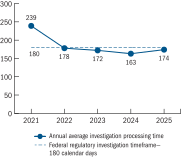
In accordance with 29 CFR § 1614.108(e) and 12 CFR § 268.107(e)(1), an EEO investigation for formal complaints must be completed within 180 calendar days, unless the complainant agrees to extend the deadline, or the complaint is amended.
Thus, the Board's average investigation times for formal complaints in FY 2025 was 174 calendar days. However, EEOC's most recently published governmentwide numbers from 2021 show that the average time for federal agencies to complete an investigation in FY 2021 was 185 calendar days (figure 4).6
Figure 4. EEO investigation processing time of pending complaints in calendar days by fiscal year (FY 2021–25)
Accessible Version | Return to text
Note: Horizontal dashed line marked at 180 calendar days represents the (Benchmark) statutory timeframe.
Actions to Improve the Program
The No FEAR Act requires federal agencies to describe any actions planned or taken to improve agency complaints or EEO programs. In addition, agencies are to discuss practical knowledge gained through the experience of administering the programs. Over the past years, OEO has gained invaluable insights that have helped improve the Board's EEO program.
Actions Planned to Improve the EEO Program in 2026
- Continue to collaborate with People, Strategy, and Operations (PSO), the Board's human resources function, to ensure OEO awareness of potential discriminatory harassment and EEO issues that may surface in the course of human resources activities or in its data.
- Update the No FEAR Act training modules to stay current with applicable federal EEO regulations and in preparation for the 2026 No FEAR Act training delivery.
- Continue to conduct trends and causal analyses on workplace practices to ensure that the Board's workplace practices are aligned with EEO best practices.
- Assess its EEO Counseling Program to ensure a proactive approach to facilitating resolution and settlement of concerns in the pre-complaint process.
- Leverage technology to improve the efficiency of EEO complaint processing and reporting.
Actions Taken to Improve the EEO Program in 2025
In 2025, OEO undertook many activities to promote EEO in the Board workforce, including but not limited to
- Collaborated with PSO to ensure OEO awareness of potential discriminatory harassment and EEO issues that may surface in the course of human resources activities or in its data.
- Reviewed trends and causal analyses on workplace practices to ensure that the Board's workplace practices are aligned with EEO best practices.
Practical Knowledge Gained
The Board continues to benefit from practical knowledge gained through quantitative and qualitative analysis of our complaint data. In particular, manager and employee trainings have supported the Board's efforts to promote the environment and working culture that the Board endeavors to shape and protect through its EEO-related policies.
No FEAR Act Written Training Plan
Instructional Materials and Training Methods
Section 202 of the No FEAR Act requires federal agencies to provide training for their employees on the rights and remedies under federal antidiscrimination, retaliation, and whistleblower protection laws. Title 5 of CFR § 724.203 requires federal agencies to develop a written training plan and to have trained their employees by December 17, 2006, and every two years thereafter. Under these regulations, new employees are to receive No FEAR Act training within 90 days of appointment.
The web-based training course provides instruction on the Board's EEO complaint process, discriminatory harassment policy and procedures, reasonable accommodation policy and procedures, and instruction on employee and manager rights and responsibilities. As required by the No FEAR Act and OPM regulations, the Board's online course teaches employees about their rights and remedies available under the antidiscrimination and retaliation laws. The training is included in the Board's learning management system (FedLearn).
Training Schedule
New Board employees receive information about their rights and responsibilities under the No FEAR Act during onboarding orientation, including a copy of the Board's EEO Policy Statement, Reasonable Accommodation Policy, and Discriminatory Workplace Harassment Policy. In addition, new employees are instructed to take an online No FEAR Act training course within 90 days of joining the Board. The training is formally assigned and tracked through FedLearn.
In compliance with the requirement to provide No FEAR Act training every two years, the Board will provide mandatory No FEAR Act training to all Board employees again in 2026. In preparation for the 2026 delivery, the Board is updating its No FEAR Act training to reinforce the important aspects of federal EEO rules.
In 2026, the Board will continue to supplement No FEAR Act training for employees and leaders with additional educational resources focusing on major topics of equal employment opportunity and civil treatment in the workplace.
Means of Documenting Completion of Training
The Board tracks No FEAR Act training through FedLearn. This learning management system provides an employee's training status (that is, training completion date and training modules completed) and produces a report to track employee training status by division. Upon completion of the training, employees print a certificate of completion, and the results are recorded in FedLearn. An employee survey is included in the No FEAR Act training, which provides an opportunity for feedback on the training. The feedback enables the EEO Office to review subject areas for updates, legal revisions, and enhancements based on best practices.
Appendix A: Board Policies
Disciplinary Actions Policy
Policy Statement
The objective of this policy is to correct and deter employee misconduct to aid in the maintenance of an efficient and orderly work environment. This policy explains the types of discipline and the procedures that the Board will follow when disciplining an employee covered under this policy.7
Definitions
Disciplinary action means an action intended to address an employee's misconduct that does not constitute an adverse action under the Board's Adverse Action policy.
Employee is an individual who works full-time or part-time and is appointed into Board service for a period of more than 90 calendar days. The term employee does not include members of the Board or those serving a provisional employment period under the Board's Provisional Employment Period policy, student aides, office assistants, student interns, co-op employees, or those serving in a term-limited position. The term employee also does not include an at-will employee—that is, an individual serving at the pleasure of the Board who may be discharged from Board service for any reason that is not unlawful.
Misconduct means any words or actions of an employee that evidence unacceptable or improper behavior. Examples of misconduct include, but are not limited to, workplace violence, violations of the Board's Leave policy, unprofessional communications, failure to follow a manager's directions, and prohibited use of Board IT resources.
Suspension, under this policy, is a disciplinary action whereby management places an employee in a temporary nonduty and nonpay status for up to 14 calendar days.
Guidelines for Disciplinary Actions
The Board may take a variety of disciplinary actions against employees. For example, the Board may orally counsel employees, require employees to attend training classes, reprimand or warn an employee in writing, require the employee to enter into a last chance agreement, or suspend the employee. When the Board disciplines an employee, the employee will be informed of the action resulting in discipline and be warned of the consequences of the same problem reoccurring.
If a manager determines that it is necessary to suspend an employee as a disciplinary action, the manager must consult the Employee Relations (ER) section of People, Strategy & Operations, Division of Management, before issuing the suspension.8 The manager should provide ER with a description of the circumstances that gave rise to the need for discipline and any relevant documentation. The employee's manager, after consultation with ER, will determine whether to discipline and, if so, the appropriate discipline.9 If an employee engages in misconduct, this may also impact their annual performance rating. The employee's manager may take into account past misconduct of the employee when making their decision.
The Board's Employee Assistance Program (EAP) is available for disciplined employees as needed.
Appealing a Suspension Without Pay
If a manager suspends an employee without pay, the employee may appeal the suspension without pay to their division or office director, who will designate a division or office officer who did not make the original decision to hear the appeal (the appeal official). If the division or office director made the initial decision to discipline the employee, the chief human capital officer or designee will designate another division or office director to serve as the appeal official.
The employee's appeal must be in writing and must be submitted within 10 working days of the date of the notice of the disciplinary action that reduces the employee's pay.10 The employee may submit additional material on appeal, but any such material must be submitted by the date the appeal is due. Any material the employee submits will be shared with the employee's management unless the appeal official does not rely on the information in reaching a decision or they determine that disclosing the information would create or exacerbate an employee relations issue.
Any appeal will not delay the effective date of the suspension. The appeal official will issue a written decision within 15 working days of receipt of the employee's appeal. The appeal official's decision is final and binding.11 Employees cannot substitute their paid leave, including annual leave, sick leave, or floating holidays for any day that they are suspended.
Review of Documentation by Appeal Official
In reviewing the appeal, the appeal official has the discretion to conduct whatever investigation they deem appropriate, including relying solely on the appeal and any documentation that may have been presented with the appeal, or requesting supplementary information from the employee or from management.
Remedies
As a result of an appeal of a suspension without pay, the appeal official may uphold, overturn, or reduce the action but may not modify the suspension in a way that is adverse to the employee, such as by increasing the suspension.
Responsibility
The Board's People, Strategy & Operations function has discretionary authority to administer and interpret this policy. The Board may review, update, and amend this policy at any time.
Related Resources
- Academic Assistance Policy
- Adverse Action Policy
- Alternative Work Arrangements Policy
- Leave Policy
- Provisional Employment Period Policy
Provisional and Nonregular Employment Policy
Policy Statement
This policy explains the rules applicable to employees during their two-year provisional employment period and to nonregular employees.
Definitions
Employee means an individual who works full-time or part-time and is appointed into Board service for a period of more than 90 days. The term employee does not include members of the Board, the Inspector General, or nonregular employees.
Direct threat means a significant risk of substantial harm to the health or safety of an individual or others that cannot be eliminated or reduced by reasonable accommodation. The determination that an employee poses a direct threat is based on an individualized assessment of their present ability to safely perform the essential functions of their job.
Misconduct means any words or actions of an employee that evidence unacceptable or improper behavior. Examples of misconduct include, but are not limited to, workplace violence, violations of the Board's Leave policy, unprofessional communications, failure to follow a manager's directions, and prohibited use of Board IT resources.
Nonregular employees means student aides, office assistants, student interns, co-op employees, and individuals who are serving in term-limited positions (such as research assistants).
Officer means an employee who has been appointed by the Board to serve as a member of its official staff.
Performance deficiency exists anytime an employee's work or competency demonstration does not meet expectations of the employee's position and when improvement is needed for an employee's performance to meet expectations.
Suitability means fitness or eligibility to perform services for the Board, as evidenced by an individual's past and present conduct.
Provisional Employment Period
All newly hired employees are provisional employees for a two-year period starting from their entrance-on-duty date. To satisfy the provisional period, employees must complete two years of current continuous service at the Board. Prior federal government, Federal Reserve Bank, or Board service, including temporary Board employment (such as, but not necessarily limited to, serving as a student intern, office assistant, or student assistant), may not be used to fulfill the provisional employment period. A provisional employee may be separated from employment at the will of the Board for any reason that is not unlawful. For example, the Board may separate a provisional employee from Board employment for misconduct, suitability, failure to meet employment requirements, if an employee's performance deficiencies result in their not meeting the Board's expectations, or if an employee is deemed to be a direct threat.12 A provisional employee has no right to continued employment.
Extension of an employee's provisional period:
- Transferring to a different position. An employee's provisional period can be extended if (1) the employee transfers to a different position during the provisional period, (2) the extension is approved by the chief human capital officer (CHCO) or their designee, and (3) the employee is notified of such extension prior to transferring positions. If the hiring manager wishes to request an extension of an employee's provisional period, they must make the request in advance of the employee transferring positions.
- Issuance of performance warning. If the Board determines, in its sole discretion, to issue a performance warning to a provisional employee, the employee's provisional employment period will be extended for an additional year (that is, the employee's provisional period will end three years after their entrance-on-duty date, instead of the standard two-year period).
- Nonpay status and short-term disability leave. If an employee is in a nonpay status or on short-term disability for a total of 22 working days or more during the provisional period, the provisional period will be extended, before the termination of the provisional period, by the number of days the employee was in a nonpay status or on short-term disability.
Procedure for Separating Provisional Employees
The employee's division or office, after consultation with the Employee Relations (ER) section of the Division of Management and Financial Services, may separate an employee from service. An employee who is separated from employment during the provisional period shall be given written notification (by a supervisor who is a Board officer) of such action and of any specific reasons for the action. Such notice shall be given on or before the effective date of separation and shall state the effective date of the action. In the event an officer (except for a division or office director) is being separated, the oversight governor must act to separate them, with notice to the officer of the reason or reasons for the separation. In the event a division or office director is being separated, the full Board must act (by majority vote) to separate them, with notice to the division or office director of the reason or reasons for the separation.
Appeal Process for Provisional Employees
Directors and other officers have no right to appeal their separation. All other employees who are notified during the provisional employment period that they are being separated from employment under this policy may appeal in writing to their division or office director, or to the division or office director's designee, within 15 calendar days from the date of notice of separation. If the division or office director made the initial decision to separate the employee, the employee may appeal the separation decision to the division's oversight governor. An employee may submit documentation as part of their appeal, but such documentation must be submitted by the date the appeal is due.
Any appeal will not delay the effective date of the separation. The division or office director, or their designee, will issue a written decision within 30 calendar days of receipt of the employee's appeal. The decision of the division or office director, or their designee, is final and binding.
This appeal process is the exclusive remedy for the appeal of a notice of separation pursuant to this policy. ER may extend the time limit for making an appeal or for issuing a written decision.
Nonregular Employees
Nonregular Employees can be separated from employment at the will of the Board for any reason that is not unlawful, and they have no procedural or appeal rights under this or any other Board policy.13
Responsibility
The People, Strategy & Operations function has authority to administer and interpret this policy. This policy may be reviewed, updated, or amended at any time.
Related Resources
- Leave Policy
Adverse Action Policy
Policy Statement
This policy outlines the general circumstances under which the Board may take an adverse action against an employee and describes the procedures that will be followed when such an action is proposed and taken. Unless an action falls within the definition of an adverse action, the action is not covered by this policy. Actions not covered by this policy may be covered by other Board policies—for example, the Disciplinary Actions policy or the Provisional and Nonregular Employment policy.
Definitions
Adverse action means a discharge, removal, or suspension without pay for a period of more than 14 calendar days, or a reduction in grade or base pay against an employee. All other actions do not constitute adverse actions. In addition, adverse actions do not include
- actions the employee voluntarily agrees to or takes on their own behalf;
- actions that reduce an employee's variable pay, bonuses, cash awards, or any other type of pay that does not constitute base pay;
- any action taken under the Board's Workforce Reductions policy (including separation or reduction in grade or pay); or
- actions taken to carry out a transfer of function(s) required by law or other actions required by applicable law.
Base pay means the employee's annual rate of basic pay. Base pay does not include variable pay, cash awards, lump-sum merit increases, sign-on bonuses, retention bonuses, shift differential, overtime pay, holiday pay, availability pay, unscheduled-duty pay, premium pay, closure pay, or any other type of pay that the Board does not treat as base pay.
Days refers to calendar, not working, days unless otherwise noted.
Direct threat means a significant risk of substantial harm to the health or safety of an individual or others that cannot be eliminated or reduced by reasonable accommodation. The determination that an employee poses a direct threat is based on an individualized assessment of their present ability to safely perform the essential functions of their job.
Employee means an individual who works full-time or part-time and is appointed into Board service for a period of more than 90 calendar days. The term employee does not include members of the Board, the inspector general,14 those serving a provisional employment period, or nonregular employees.15 The term employee also does not include an at-will employee—that is, an individual serving at the pleasure of the Board, who may be discharged from Board service for any reason that is not unlawful. An individual who provides services to the Board, but who is not an employee as defined herein has no rights under this policy.
Misconduct means any words or actions of an employee that evidence unacceptable or improper behavior. Examples of misconduct include, but are not limited to, workplace violence, violations of the Board's Leave policy, unprofessional communications, failure to follow a manager's directions, and prohibited use of Board IT resources.
Nonregular employees means student aides, office assistants, student interns, co-op employees, and individuals who are serving in term-limited positions (such as research assistants).
Officer means an employee who has been appointed by the Board to serve as a member of its official staff.
Performance deficiencies exist anytime an employee's work or competency demonstration is not meeting expectations of the employee's position and when improvement is needed for an employee's performance to meet expectations.
Grounds for Adverse Actions
Adverse actions are taken to promote the integrity and efficiency of the Board. For example, an adverse action may be initiated against an employee on the basis of an employee's performance deficiencies that result in the employee receiving a performance warning under the Board's Performance Warnings policy. An adverse action may also be initiated against an employee on the basis of, for example, misconduct or a failure to meet job requirements (such as failing to maintain a required license or based on national security or employment-suitability considerations).
Performance
The Board may take an adverse action against an employee if the employee fails to improve their performance to a level that meets expectations after receiving a performance warning under the Board's Performance Warnings policy. Divisions are responsible for notifying Employee Relations (ER) when the division first believes that an employee's behavior or performance is not meeting expectations. If an employee's performance deficiencies cause them not to meet the Board's performance expectations, the employee's manager, after consulting with ER, will issue the employee a written performance warning, as explained in the Performance Warnings policy. If, after a reasonable opportunity to improve, the employee fails to improve their performance to a level that meets the Board's expectations, the Board may initiate an adverse action against the employee.16
If the employee improves their performance after the delivery of a performance warning, the employee is required to sustain this improvement. If an employee does not sustain their improved performance in the areas previously identified for improvement, the Board may initiate an adverse action against the employee as a result of their failure to sustain improved performance.16
Misconduct
In addition, the Board may take an adverse action against an employee as a result of their misconduct. A manager should consult with ER immediately if they believe an employee has committed misconduct. Whether a matter constitutes misconduct (as opposed to, for example, a performance concern) is determined by the Board in its sole discretion. In addition, whether the Board takes an adverse action and the type of adverse action the Board takes against an employee for misconduct depend on the facts of the particular case, including whether the misconduct has caused the Board to lose trust or confidence in the employee's ability to carry out their job responsibilities and any other factors, which may be relevant to the Board's ability to carry out efficiently its business functions. Depending on the seriousness of the offense, one instance of misconduct may be sufficient to separate an employee from Board service. A performance warning will not be issued prior to separating or disciplining an employee for misconduct.
Failure to Meet Employment Requirements
The Board may also take an adverse action against an employee due to an employee's failure to meet certain employment requirements, such as national security considerations; not being legally authorized to work in the United States; being determined a direct threat to himself, herself, or others by the chief human capital officer (CHCO); not meeting an essential job requirement, such as an employee not being fit for duty; not passing a background investigation; or because of suitability concerns as explained in the Board's Suitability policy. In cases where the employee fails to meet an employment requirement or there are suitability concerns, an adverse action will be initiated against the employee and the employee will be provided with the procedural protections outlined in this policy.
Adverse Action Procedures
Proposing an Adverse Action
An officer (the proposing official) in the employee's division must consult with ER prior to proposing an action. A division may not inform an employee of a proposed adverse action before consulting ER. After ER has reviewed and commented on the proposal, the proposing official will deliver the proposal to the employee (and such notice will be considered delivered on the date that it was delivered to the employee either in person, by certified mail or Federal Express, or similar method). At the same time, the proposing official will deliver the proposal to the head of the employing division or office (the deciding official). Appendix A outlines the individuals who serve as the proposing and deciding officials if an officer is the subject of the adverse action. The employee shall be given an opportunity to respond to the proposal, as further described below.
Content of the proposal and notice to employee. The proposal must state the proposed action, and the reason(s) for the proposed action.17 A copy of this policy must be attached to the proposal and the proposal must inform the employee
- of the time period to respond to the proposal and that, if the employee chooses to respond, the response must be in writing;
- that an employee relations specialist is available to assist them; and
- that they are entitled to consult with, and be represented by, a personal representative of the employee's choice and at the employee's expense, at any stage in the adverse action process.
Procedures governing the employee's response to the proposal. An employee will be given 21 calendar days from the date of the proposal to respond to the proposal unless there is reasonable cause to believe that the employee may be guilty of a crime. In that case, the officer responsible for Employee Relations (ER Officer), or their designee, may reduce the response period to seven calendar days. The proposal will also set a meeting date and time between the employee and the deciding official when the employee may respond to the proposal. The meeting may be held in person at the Board's offices, or the deciding official may choose to conduct the meeting over the telephone or via video conference, at the deciding official's discretion. If the employee does not attend the meeting at the date and time established by the Board or declines the invitation, this policy does not provide a right to a meeting at a different date or time.
At any time, the proposing official may amend a proposed action that has been issued to an employee to include additional information in support of the proposed action, to reference subsequently occurring or discovered supporting evidence, to add additional bases for the proposed action, or to increase the penalty of the proposed action for any of these reasons. The employee may be given additional time to respond to the proposed action, as amended.18 An employee's response to the proposed action must be made in writing. The employee's response must specifically state the reasons they believe the proposed action is incorrect and may include affidavits or any other relevant documentation. All documentation must be submitted with the employee's response.
Employee's status pending a decision. The proposing official, in consultation with the ER Officer, or their designee, may place the employee on administrative leave (with pay) from the date the employee is provided with the proposal, or at any time after that date, until the deciding official issues a decision on the proposal. An employee on administrative leave may have their access to things, such as the Board's buildings and electronic systems, restricted, but the employee will continue to receive the regular health and retirement benefits and pay (excluding overtime) they would have been paid if the employee had worked during the administrative-leave period.
An employee who is absent from work without pay at the time the adverse action is proposed will not be placed in a pay status while the deciding official's decision is pending unless the employee requests and qualifies for paid leave or returns to duty. If the employee requests and qualifies for paid leave or returns to duty, the employee will be placed in a pay status from the date the leave request was made or the date the employee returned to duty. In addition, if an employee is absent from work and has applied for, or is receiving, short-term disability (STD) benefits at the time the adverse action is proposed, the employee will be paid in accordance with the Board's normal rules for administering STD claims or benefits while the deciding official's decision is pending. However, if the employee states that they are able to return to work, the employee will be placed on administrative leave with pay or returned to work while the deciding official's decision is pending.
Deciding Official's Decision on the Proposal
Within 30 calendar days after the employee responds to the proposed action, or not more than 30 calendar days after the time period for the employee's response expires, the deciding official shall notify the employee, the employee's representative (if any), and the proposing official in writing of their decision. The deciding official may, in reaching a decision, conduct whatever investigation they deem appropriate, including requesting supplementary information from the employee or the proposing official (or both).
The decision may sustain, reverse, or modify the proposing official's recommendation either in whole or in part. However, in no case may the deciding official increase the proposing official's recommended penalty. If the deciding official uncovers new and material information to support the proposal, and they intend to rely on that information in reaching a decision, the deciding official must describe the new information to the employee and the employee will be provided with an opportunity to respond.19 Information that refutes factual claims made by the employee in their response to the proposal is not necessarily considered new and material information to support the proposal. In addition, the deciding official may rely on information provided by the employee without providing the employee a new opportunity to respond.
If the decision is adverse to the employee, the deciding official shall notify the employee of the decision at or before the time the action will be made effective. The deciding official's decision shall be dated and shall inform the employee of the reason(s) for the decision, the effective date of the decision, and their right to appeal the decision. Any appeal will not delay the effective date of the adverse action.
Appeal
An employee may appeal the deciding official's decision to the chief operating officer (COO)20 or, if the COO made the initial adverse action determination or otherwise must abstain from making the decision, to an official designated by the chairman, Committee on Board Affairs (appeal official).21 Appendix A outlines who serves as the appeal official in the case of an officer. As part of an employee's appeal, they may request a hearing. The employee must file an appeal with the appeal official no later than 21 calendar days after the date of the deciding official's decision. A written performance warning is not separately appealable.
Content of the appeal. The appeal must (1) be in writing, (2) state the specific reasons the adverse action is incorrect, and (3) state whether the employee is requesting a hearing. If the employee requests a hearing, the employee's appeal must state the names of any witnesses the employee wishes to call to testify at the hearing and why each witnesses' in-person testimony is relevant to the issues raised on appeal. If the employee does not name and specifically request the in-person testimony of any witnesses in their appeal, only the appealing employee will be allowed to testify at the hearing.
Hearing. If the employee requests a hearing, the COO will designate a hearing official who may be different than the appeal official.22 If the hearing official is a different person than the appeal official, the hearing official will present their findings and recommendations from the hearing to the appeal official. The hearing official will also determine the type of hearing and the scope of the hearing that will be provided.23 In all cases, the employee appealing the deciding official's decision will bear the burden of proving, by a preponderance of the evidence, that the deciding official's decision was erroneous.
Decision on appeal. Within 30 calendar days after the date of a timely appeal—or if a hearing is granted, within 30 calendar days after the hearing concludes—the appeal official shall notify the employee, the employee's representative (if any), the proposing official, and the deciding official of their decision in writing. The decision may sustain, reverse, or modify the deciding official's recommendation either in whole or in part. However, in no case may the appeal official increase the penalty imposed by the deciding official. In reaching a decision on appeal, the appeal official may only consider the written record before them as well as information that arises at or results from any statements made orally at the hearing. The decision must explain the basis for the decision. The decision on appeal shall be final and binding upon the employee and the Board.
Substitution of Proposing, Deciding, Appeal, or Hearing Official
If any proposing, deciding, appeal, or hearing official is unavailable to take action or decides to abstain from taking action under this policy due to, for example, a conflict of interest or any other reason, the Administrative Governor may designate an official to act in their place.24
Extension of Time Limits
At any stage of the process, the deciding official, appeal official, or hearing official, as appropriate, may extend the time limits indicated in the adverse action procedures by up to 30 calendar days. Extensions beyond 30 calendar days must be approved by the CHCO, in consultation with the deciding official, appeal official, or hearing official. In situations that require an extension of time, ER will inform the employee of such an extension.
Disclosure of Information
Ordinarily, any information the employee submits to the Board or that the Board provides to an employee during this process is not required to be kept confidential. However, the proposing, deciding, or appeal official may require an employee to agree to maintain the confidentiality of information provided at any stage during this process as a pre-condition to receiving such information if disclosure of such information would impinge on the privacy rights of other employees or would otherwise be impermissible under law or Board policy.
Interplay with Other Policies
An employee may not simultaneously challenge an action under this policy and under other applicable Board policies, except for the Board's Equal Employment Opportunity (EEO) policy. Accordingly, subject to that exception, if an adverse action is proposed, all actions under other Board policies that are based on the same set of facts as the proposed adverse action will be terminated. An employee may continue to pursue both an appeal under this Adverse Action policy and an action under the Board's EEO policy. If an employee wishes to challenge an adverse action under the Board's EEO policy, they must initiate contact with an EEO counselor within 45 calendar days of the date of the deciding official's decision on the adverse action. The filing of an EEO complaint does not delay the effective date of the adverse action.
Implications of Adverse Actions on Benefits and Discretionary Offerings
Employees who receive adverse actions may be deemed ineligible to receive certain benefits and discretionary offerings that other employees who are otherwise in good standing may receive, such as a merit increase, variable pay, academic assistance, or the ability to apply for internal job openings. An employee who receives an adverse action is encouraged to review applicable Board policies and consult with an ER specialist to discuss how the adverse action may affect any benefits or discretionary offerings.25
Actions Taken Pursuant to National Security
Notwithstanding any other provisions of this policy, to the extent a proposed adverse action is based on information that is classified for national security reasons, the Board will provide an employee with as comprehensive and detailed a written explanation of the basis for the adverse action as the national security interests of the United States and other applicable law permit. In addition, the Board will provide an employee with the information an adverse action is based on only as permitted by national security interests and other applicable law.
Responsibility
The Board's People, Strategy and Operations function has the authority to administer and interpret this policy. This policy may be reviewed, updated, or amended at any time.
Related Resources
- Disciplinary Actions Policy
- Equal Employment Opportunity Policy
- Leave Policy
- Performance Warnings Policy
- Provisional and Nonregular Employment Policy
- Suitability Policy
- Workforce Reductions Policy
Appendix A—Proposing and Deciding Officials for Adverse Actions Involving Officers
The following list names who the proposing, deciding, and appeal officials are in the event of an adverse action against
-
The chief operating officer (COO) and division or office directors, except those listed under 2, below
Proposing official: Oversight Governor
Deciding official: Administrative Governor (or if the Administrative Governor was the proposing official, the Vice Chair)26
Appeal official: Full Board (excluding the proposing and deciding officials) -
The director of the Division of Management and Financial Services, program director of the Office of EEO Programs and OMWI, director of the Division of Informational Technology, and any other division or office director that the Board states, in writing, reports to the COO
Proposing official: COO
Deciding official: Administrative Governor
Appeal official: Full Board (excluding the deciding official) -
All other officers (other than the inspector general)
Proposing official: Division or office director
Deciding official: Oversight Governor
Appeal official: Administrative Governor (or if the Administrative Governor was the deciding official, the Board's Vice Chair)27
The COO, division directors, and Governors who are required to act as the proposing official, deciding official, or appeal official may consult with the CHCO and the assistant general counsel, as needed. In addition, if an officer requests a hearing, the COO will designate a hearing official who may be different than the appeal official. The hearing rules for officers will be the same as the hearing rules that apply to all other employees.
Appendix B: Year-end No FEAR Summary Data
Table A.1. Complaint activity
| Complaint activity | Comparative data | Fiscal year 2025 (thru 09/30/2025) |
||||
|---|---|---|---|---|---|---|
| Previous fiscal year data | ||||||
| 2020 | 2021 | 2022 | 2023 | 2024 | ||
| Number of complaints filed | 5 | 6 | 8 | 6 | 11 | 4 |
| Number of complainants | 5 | 6 | 8 | 6 | 11 | 4 |
| Repeat filers | 0 | 0 | 1 | 0 | 0 | 0 |
Table A.2. Complaints by basis
| Complaints by basis* | Comparative data | Fiscal year 2025 (thru 09/30/2025) |
||||
|---|---|---|---|---|---|---|
| Previous fiscal year data | ||||||
| 2020 | 2021 | 2022 | 2023 | 2024 | ||
| Race | 2 | 4 | 3 | 3 | 7 | 2 |
| Color | 0 | 0 | 1 | 2 | 5 | 0 |
| Religion | 0 | 2 | 5 | 2 | 4 | 0 |
| Reprisal | 3 | 2 | 5 | 2 | 9 | 4 |
| Sex | 2 | 5 | 3 | 3 | 7 | 3 |
| National origin | 0 | 2 | 0 | 0 | 4 | 3 |
| Equal Pay Act | 0 | 0 | 2 | 0 | 1 | 0 |
| Age | 3 | 1 | 0 | 2 | 4 | 1 |
| Disability | 0 | 1 | 2 | 2 | 3 | 0 |
| Non EEO | 0 | 0 | 0 | 0 | 1 | 0 |
* Complaints can be filed alleging multiple bases, so the sum of the bases may exceed the total complaints filed. Return to table
Table A.3. Complaints by issue
| Complaints by issue* | Comparative data | Fiscal year 2025 (thru 09/30/2025) |
||||
|---|---|---|---|---|---|---|
| Previous fiscal year data | ||||||
| 2020 | 2021 | 2022 | 2023 | 2024 | ||
| Appointment/hire | 0 | 0 | 0 | 0 | 3 | |
| Assignment of duties | 0 | 1 | 1 | 4 | 1 | 2 |
| Awards | 0 | 0 | 0 | 0 | 0 | 0 |
| Conversion to full-time | 0 | 0 | 0 | 0 | 0 | 0 |
| Disciplinary action | ||||||
| Demotion | 0 | 0 | 0 | 0 | 0 | 0 |
| Reprimand | 1 | 0 | 0 | 0 | 0 | 0 |
| Removal | 0 | 0 | 1 | 2 | 2 | 0 |
| Suspension | 0 | 0 | 0 | 0 | 0 | 0 |
| Other | 0 | 1 | 0 | 0 | 1 | 1 |
| Duty hours | 0 | 1 | 1 | 1 | 0 | 0 |
| Evaluation appraisal | 1 | 0 | 0 | 2 | 5 | 3 |
| Examination/test | 0 | 0 | 1 | 0 | 0 | 0 |
| Harassment | ||||||
| Nonsexual | 2 | 5 | 1 | 4 | 5 | 2 |
| Sexual | 0 | 0 | 0 | 0 | 1 | 0 |
| Medical examination | 0 | 0 | 0 | 0 | 0 | 0 |
| Pay (including overtime) | 0 | 0 | 1 | 0 | 0 | 0 |
| Promotion/non-selection | 3 | 4 | 1 | 3 | 4 | 3 |
| Reassignment | ||||||
| Denied | 0 | 0 | 1 | 0 | 0 | 0 |
| Directed | 0 | 0 | 0 | 0 | 0 | 0 |
| Reasonable accommodation | 0 | 1 | 5 | 2 | 0 | 0 |
| Reinstatement | 0 | 0 | 0 | 0 | 0 | 0 |
| Retirement | 0 | 0 | 1 | 1 | 1 | 0 |
| Termination | 0 | 1 | 2 | 2 | 1 | 1 |
| Terms/conditions of employment | 1 | 2 | 1 | 3 | 1 | 0 |
| Time and attendance | 0 | 1 | 1 | 1 | 0 | 0 |
| Training | 1 | 2 | 0 | 0 | 0 | 0 |
| Other | 0 | 0 | 4 | 0 | 3 | 0 |
* Complaints can be filed alleging multiple issues, so the sum of the issues may exceed the total complaints filed. Return to table
Table A.4. Processing time
| Processing time | Comparative data | Fiscal year 2025 (thru 09/30/2025) |
||||
|---|---|---|---|---|---|---|
| Previous fiscal year data | ||||||
| 2020 | 2021 | 2022 | 2023 | 2024 | ||
| Complaints pending during fiscal year | ||||||
| Average number of days in investigation stage | 219 | 239 | 178 | 172 | 163 | 175 |
| Average number of days in final action stage | 18 | 62 | 28 | 78 | 28 | 24 |
| Complaints pending during fiscal year where hearing was requested | ||||||
| Average number of days in investigation stage | 234 | 239 | 178 | 206 | 189 | 193 |
| Average number of days in final action stage | 30 | 62 | 0 | 0 | 0 | 0 |
| Complaints pending during fiscal year where hearing was not requested | ||||||
| Average number of days in investigation stage | 203 | 0 | 179 | 245 | 205 | 239 |
| Average number of days in final action stage | 56 | 0 | 28 | 78 | 29 | 24 |
Table A.5. Complaints dismissed by agency
| Complaints dismissed by agency | Comparative data | Fiscal year 2025 (thru 09/30/2025) |
||||
|---|---|---|---|---|---|---|
| Previous fiscal year data | ||||||
| 2020 | 2021 | 2022 | 2023 | 2024 | ||
| Total complaints dismissed by agency | 0 | 0 | 0 | 0 | 1 | 0 |
| Average days pending prior to dismissal | 0 | 0 | 0 | 0 | 122 | 0 |
| Complaints withdrawn by complainants | ||||||
| Total complaints withdrawn by complainants | 8 | 2 | 8 | 0 | 3 | 5 |
Table A.6. Total final actions finding discrimination
| Total final actions finding discrimination | Comparative data | Fiscal year 2025 (thru 09/30/2025) |
||||||||||
|---|---|---|---|---|---|---|---|---|---|---|---|---|
| Previous fiscal year data | ||||||||||||
| 2020 | 2021 | 2022 | 2023 | 2024 | ||||||||
| Number | Percent | Number | Percent | Number | Percent | Number | Percent | Number | Percent | Number | Percent | |
| Total number findings | 0 | 0 | 0 | 0 | 0 | 0 | ||||||
| Without hearing | 0 | 0 | 0 | 0 | 0 | 0 | 0 | 0 | 0 | 0 | 0 | 0 |
| With hearing | 0 | 0 | 0 | 0 | 0 | 0 | 0 | 0 | 0 | 0 | 0 | 0 |
Table A.7. Findings of discrimination rendered by basis
| Findings of discrimination rendered by basis | Comparative data | Fiscal year 2025 (thru 09/30/2025) |
||||||||||
|---|---|---|---|---|---|---|---|---|---|---|---|---|
| Previous fiscal year data | ||||||||||||
| 2020 | 2021 | 2022 | 2023 | 2024 | ||||||||
| Number | Percent | Number | Percent | Number | Percent | Number | Percent | Number | Percent | Number | Percent | |
| Total number findings | 0 | 0 | 0 | 0 | 0 | 0 | ||||||
| Race | 0 | 0 | 0 | 0 | 0 | 0 | 0 | 0 | 0 | 0 | 0 | 0 |
| Color | 0 | 0 | 0 | 0 | 0 | 0 | 0 | 0 | 0 | 0 | 0 | 0 |
| Religion | 0 | 0 | 0 | 0 | 0 | 0 | 0 | 0 | 0 | 0 | 0 | 0 |
| Reprisal | 0 | 0 | 0 | 0 | 0 | 0 | 0 | 0 | 0 | 0 | 0 | 0 |
| Sex | 0 | 0 | 0 | 0 | 0 | 0 | 0 | 0 | 0 | 0 | 0 | 0 |
| National origin | 0 | 0 | 0 | 0 | 0 | 0 | 0 | 0 | 0 | 0 | 0 | 0 |
| Equal Pay Act | 0 | 0 | 0 | 0 | 0 | 0 | 0 | 0 | 0 | 0 | 0 | 0 |
| Age | 0 | 0 | 0 | 0 | 0 | 0 | 0 | 0 | 0 | 0 | 0 | 0 |
| Disability | 0 | 0 | 0 | 0 | 0 | 0 | 0 | 0 | 0 | 0 | 0 | 0 |
| Non EEO | 0 | 0 | 0 | 0 | 0 | 0 | 0 | 0 | 0 | 0 | 0 | 0 |
| Findings after hearing | 0 | 0 | 0 | 0 | 0 | 0 | 0 | 0 | 0 | 0 | 0 | 0 |
| Race | 0 | 0 | 0 | 0 | 0 | 0 | 0 | 0 | 0 | 0 | 0 | 0 |
| Color | 0 | 0 | 0 | 0 | 0 | 0 | 0 | 0 | 0 | 0 | 0 | 0 |
| Religion | 0 | 0 | 0 | 0 | 0 | 0 | 0 | 0 | 0 | 0 | 0 | 0 |
| Reprisal | 0 | 0 | 0 | 0 | 0 | 0 | 0 | 0 | 0 | 0 | 0 | 0 |
| Sex | 0 | 0 | 0 | 0 | 0 | 0 | 0 | 0 | 0 | 0 | 0 | 0 |
| National origin | 0 | 0 | 0 | 0 | 0 | 0 | 0 | 0 | 0 | 0 | 0 | 0 |
| Equal Pay Act | 0 | 0 | 0 | 0 | 0 | 0 | 0 | 0 | 0 | 0 | 0 | 0 |
| Age | 0 | 0 | 0 | 0 | 0 | 0 | 0 | 0 | 0 | 0 | 0 | 0 |
| Disability | 0 | 0 | 0 | 0 | 0 | 0 | 0 | 0 | 0 | 0 | 0 | 0 |
| Non EEO | 0 | 0 | 0 | 0 | 0 | 0 | 0 | 0 | 0 | 0 | 0 | 0 |
| Findings without hearing | 0 | 0 | 0 | 0 | 0 | 0 | 0 | 0 | 0 | 0 | 0 | 0 |
| Race | 0 | 0 | 0 | 0 | 0 | 0 | 0 | 0 | 0 | 0 | 0 | 0 |
| Color | 0 | 0 | 0 | 0 | 0 | 0 | 0 | 0 | 0 | 0 | 0 | 0 |
| Religion | 0 | 0 | 0 | 0 | 0 | 0 | 0 | 0 | 0 | 0 | 0 | 0 |
| Reprisal | 0 | 0 | 0 | 0 | 0 | 0 | 0 | 0 | 0 | 0 | 0 | 0 |
| Sex | 0 | 0 | 0 | 0 | 0 | 0 | 0 | 0 | 0 | 0 | 0 | 0 |
| National origin | 0 | 0 | 0 | 0 | 0 | 0 | 0 | 0 | 0 | 0 | 0 | 0 |
| Equal Pay Act | 0 | 0 | 0 | 0 | 0 | 0 | 0 | 0 | 0 | 0 | 0 | 0 |
| Age | 0 | 0 | 0 | 0 | 0 | 0 | 0 | 0 | 0 | 0 | 0 | 0 |
| Disability | 0 | 0 | 0 | 0 | 0 | 0 | 0 | 0 | 0 | 0 | 0 | 0 |
| Non EEO | 0 | 0 | 0 | 0 | 0 | 0 | 0 | 0 | 0 | 0 | 0 | 0 |
Note: Complaints can be filed alleging multiple bases. The sum of the bases may not equal total complaints and findings.
Table A.8. Findings of discrimination rendered by issue
| Findings of discrimination rendered by issue | Comparative data | Fiscal year 2025 (thru 09/30/2025) |
||||||||||
|---|---|---|---|---|---|---|---|---|---|---|---|---|
| Previous fiscal year data | ||||||||||||
| 2020 | 2021 | 2022 | 2023 | 2024 | ||||||||
| Number | Percent | Number | Percent | Number | Percent | Number | Percent | Number | Percent | Number | Percent | |
| Total number findings | 0 | 0 | 0 | 0 | 0 | 0 | ||||||
| Appointment/hire | 0 | 0 | 0 | 0 | 0 | 0 | 0 | 0 | 0 | 0 | 0 | 0 |
| Assignment of duties | 0 | 0 | 0 | 0 | 0 | 0 | 0 | 0 | 0 | 0 | 0 | 0 |
| Awards | 0 | 0 | 0 | 0 | 0 | 0 | 0 | 0 | 0 | 0 | 0 | 0 |
| Conversion to full-time | 0 | 0 | 0 | 0 | 0 | 0 | 0 | 0 | 0 | 0 | 0 | 0 |
| Disciplinary action | 0 | 0 | 0 | 0 | 0 | 0 | 0 | 0 | 0 | 0 | 0 | 0 |
| Demotion | 0 | 0 | 0 | 0 | 0 | 0 | 0 | 0 | 0 | 0 | 0 | 0 |
| Reprimand | 0 | 0 | 0 | 0 | 0 | 0 | 0 | 0 | 0 | 0 | 0 | 0 |
| Suspension | 0 | 0 | 0 | 0 | 0 | 0 | 0 | 0 | 0 | 0 | 0 | 0 |
| Removal | 0 | 0 | 0 | 0 | 0 | 0 | 0 | 0 | 0 | 0 | 0 | 0 |
| Other | 0 | 0 | 0 | 0 | 0 | 0 | 0 | 0 | 0 | 0 | 0 | 0 |
| Duty hours | 0 | 0 | 0 | 0 | 0 | 0 | 0 | 0 | 0 | 0 | 0 | 0 |
| Evaluation appraisal | 0 | 0 | 0 | 0 | 0 | 0 | 0 | 0 | 0 | 0 | 0 | 0 |
| Examination/test | 0 | 0 | 0 | 0 | 0 | 0 | 0 | 0 | 0 | 0 | 0 | 0 |
| Harassment | 0 | 0 | 0 | 0 | 0 | 0 | 0 | 0 | 0 | 0 | 0 | 0 |
| Nonsexual | 0 | 0 | 0 | 0 | 0 | 0 | 0 | 0 | 0 | 0 | 0 | 0 |
| Sexual | 0 | 0 | 0 | 0 | 0 | 0 | 0 | 0 | 0 | 0 | 0 | 0 |
| Medical examination | 0 | 0 | 0 | 0 | 0 | 0 | 0 | 0 | 0 | 0 | 0 | 0 |
| Pay (including overtime) | 0 | 0 | 0 | 0 | 0 | 0 | 0 | 0 | 0 | 0 | 0 | 0 |
| Promotion/nonselection | 0 | 0 | 0 | 0 | 0 | 0 | 0 | 0 | 0 | 0 | 0 | 0 |
| Reassignment | 0 | 0 | 0 | 0 | 0 | 0 | 0 | 0 | 0 | 0 | 0 | 0 |
| Denied | 0 | 0 | 0 | 0 | 0 | 0 | 0 | 0 | 0 | 0 | 0 | 0 |
| Directed | 0 | 0 | 0 | 0 | 0 | 0 | 0 | 0 | 0 | 0 | 0 | 0 |
| Reasonable accommodation | 0 | 0 | 0 | 0 | 0 | 0 | 0 | 0 | 0 | 0 | 0 | 0 |
| Reinstatement | 0 | 0 | 0 | 0 | 0 | 0 | 0 | 0 | 0 | 0 | 0 | 0 |
| Retirement | 0 | 0 | 0 | 0 | 0 | 0 | 0 | 0 | 0 | 0 | 0 | 0 |
| Termination | 0 | 0 | 0 | 0 | 0 | 0 | 0 | 0 | 0 | 0 | 0 | 0 |
| Terms/conditions of employment | 0 | 0 | 0 | 0 | 0 | 0 | 0 | 0 | 0 | 0 | 0 | 0 |
| Time and attendance | 0 | 0 | 0 | 0 | 0 | 0 | 0 | 0 | 0 | 0 | 0 | 0 |
| Training | 0 | 0 | 0 | 0 | 0 | 0 | 0 | 0 | 0 | 0 | 0 | 0 |
| Other | 0 | 0 | 0 | 0 | 0 | 0 | 0 | 0 | 0 | 0 | 0 | 0 |
| Findings after hearing | 0 | 0 | 0 | 0 | 0 | 0 | 0 | 0 | 0 | 0 | 0 | 0 |
| Appointment/hire | 0 | 0 | 0 | 0 | 0 | 0 | 0 | 0 | 0 | 0 | 0 | 0 |
| Assignment of duties | 0 | 0 | 0 | 0 | 0 | 0 | 0 | 0 | 0 | 0 | 0 | 0 |
| Awards | 0 | 0 | 0 | 0 | 0 | 0 | 0 | 0 | 0 | 0 | 0 | 0 |
| Conversion to full-time | 0 | 0 | 0 | 0 | 0 | 0 | 0 | 0 | 0 | 0 | 0 | 0 |
| Disciplinary action | 0 | 0 | 0 | 0 | 0 | 0 | 0 | 0 | 0 | 0 | 0 | 0 |
| Demotion | 0 | 0 | 0 | 0 | 0 | 0 | 0 | 0 | 0 | 0 | 0 | 0 |
| Reprimand | 0 | 0 | 0 | 0 | 0 | 0 | 0 | 0 | 0 | 0 | 0 | 0 |
| Suspension | 0 | 0 | 0 | 0 | 0 | 0 | 0 | 0 | 0 | 0 | 0 | 0 |
| Removal | 0 | 0 | 0 | 0 | 0 | 0 | 0 | 0 | 0 | 0 | 0 | 0 |
| Other | 0 | 0 | 0 | 0 | 0 | 0 | 0 | 0 | 0 | 0 | 0 | 0 |
| Duty hours | 0 | 0 | 0 | 0 | 0 | 0 | 0 | 0 | 0 | 0 | 0 | 0 |
| Evaluation appraisal | 0 | 0 | 0 | 0 | 0 | 0 | 0 | 0 | 0 | 0 | 0 | 0 |
| Examination/test | 0 | 0 | 0 | 0 | 0 | 0 | 0 | 0 | 0 | 0 | 0 | 0 |
| Harassment | 0 | 0 | 0 | 0 | 0 | 0 | 0 | 0 | 0 | 0 | 0 | 0 |
| Nonsexual | 0 | 0 | 0 | 0 | 0 | 0 | 0 | 0 | 0 | 0 | 0 | 0 |
| Sexual | 0 | 0 | 0 | 0 | 0 | 0 | 0 | 0 | 0 | 0 | 0 | 0 |
| Medical examination | 0 | 0 | 0 | 0 | 0 | 0 | 0 | 0 | 0 | 0 | 0 | 0 |
| Pay (including overtime) | 0 | 0 | 0 | 0 | 0 | 0 | 0 | 0 | 0 | 0 | 0 | 0 |
| Promotion/nonselection | 0 | 0 | 0 | 0 | 0 | 0 | 0 | 0 | 0 | 0 | 0 | 0 |
| Reassignment | 0 | 0 | 0 | 0 | 0 | 0 | 0 | 0 | 0 | 0 | 0 | 0 |
| Denied | 0 | 0 | 0 | 0 | 0 | 0 | 0 | 0 | 0 | 0 | 0 | 0 |
| Directed | 0 | 0 | 0 | 0 | 0 | 0 | 0 | 0 | 0 | 0 | 0 | 0 |
| Reasonable accommodation | 0 | 0 | 0 | 0 | 0 | 0 | 0 | 0 | 0 | 0 | 0 | 0 |
| Reinstatement | 0 | 0 | 0 | 0 | 0 | 0 | 0 | 0 | 0 | 0 | 0 | 0 |
| Retirement | 0 | 0 | 0 | 0 | 0 | 0 | 0 | 0 | 0 | 0 | 0 | 0 |
| Termination | 0 | 0 | 0 | 0 | 0 | 0 | 0 | 0 | 0 | 0 | 0 | 0 |
| Terms/conditions of employment | 0 | 0 | 0 | 0 | 0 | 0 | 0 | 0 | 0 | 0 | 0 | 0 |
| Time and attendance | 0 | 0 | 0 | 0 | 0 | 0 | 0 | 0 | 0 | 0 | 0 | 0 |
| Training | 0 | 0 | 0 | 0 | 0 | 0 | 0 | 0 | 0 | 0 | 0 | 0 |
| Other | 0 | 0 | 0 | 0 | 0 | 0 | 0 | 0 | 0 | 0 | 0 | 0 |
| Findings without hearing | 0 | 0 | 0 | 0 | 0 | 0 | 0 | 0 | 0 | 0 | 0 | 0 |
| Appointment/hire | 0 | 0 | 0 | 0 | 0 | 0 | 0 | 0 | 0 | 0 | 0 | 0 |
| Assignment of duties | 0 | 0 | 0 | 0 | 0 | 0 | 0 | 0 | 0 | 0 | 0 | 0 |
| Awards | 0 | 0 | 0 | 0 | 0 | 0 | 0 | 0 | 0 | 0 | 0 | 0 |
| Conversion to full-time | 0 | 0 | 0 | 0 | 0 | 0 | 0 | 0 | 0 | 0 | 0 | 0 |
| Disciplinary action | 0 | 0 | 0 | 0 | 0 | 0 | 0 | 0 | 0 | 0 | 0 | 0 |
| Demotion | 0 | 0 | 0 | 0 | 0 | 0 | 0 | 0 | 0 | 0 | 0 | 0 |
| Reprimand | 0 | 0 | 0 | 0 | 0 | 0 | 0 | 0 | 0 | 0 | 0 | 0 |
| Suspension | 0 | 0 | 0 | 0 | 0 | 0 | 0 | 0 | 0 | 0 | 0 | 0 |
| Removal | 0 | 0 | 0 | 0 | 0 | 0 | 0 | 0 | 0 | 0 | 0 | 0 |
| Other | 0 | 0 | 0 | 0 | 0 | 0 | 0 | 0 | 0 | 0 | 0 | 0 |
| Duty hours | 0 | 0 | 0 | 0 | 0 | 0 | 0 | 0 | 0 | 0 | 0 | 0 |
| Evaluation appraisal | 0 | 0 | 0 | 0 | 0 | 0 | 0 | 0 | 0 | 0 | 0 | 0 |
| Examination/test | 0 | 0 | 0 | 0 | 0 | 0 | 0 | 0 | 0 | 0 | 0 | 0 |
| Harassment | 0 | 0 | 0 | 0 | 0 | 0 | 0 | 0 | 0 | 0 | 0 | 0 |
| Nonsexual | 0 | 0 | 0 | 0 | 0 | 0 | 0 | 0 | 0 | 0 | 0 | 0 |
| Sexual | 0 | 0 | 0 | 0 | 0 | 0 | 0 | 0 | 0 | 0 | 0 | 0 |
| Medical examination | 0 | 0 | 0 | 0 | 0 | 0 | 0 | 0 | 0 | 0 | 0 | 0 |
| Pay (including overtime) | 0 | 0 | 0 | 0 | 0 | 0 | 0 | 0 | 0 | 0 | 0 | 0 |
| Promotion/nonselection | 0 | 0 | 0 | 0 | 0 | 0 | 0 | 0 | 0 | 0 | 0 | 0 |
| Reassignment | 0 | 0 | 0 | 0 | 0 | 0 | 0 | 0 | 0 | 0 | 0 | 0 |
| Denied | 0 | 0 | 0 | 0 | 0 | 0 | 0 | 0 | 0 | 0 | 0 | 0 |
| Directed | 0 | 0 | 0 | 0 | 0 | 0 | 0 | 0 | 0 | 0 | 0 | 0 |
| Reasonable accommodation | 0 | 0 | 0 | 0 | 0 | 0 | 0 | 0 | 0 | 0 | 0 | 0 |
| Reinstatement | 0 | 0 | 0 | 0 | 0 | 0 | 0 | 0 | 0 | 0 | 0 | 0 |
| Retirement | 0 | 0 | 0 | 0 | 0 | 0 | 0 | 0 | 0 | 0 | 0 | 0 |
| Termination | 0 | 0 | 0 | 0 | 0 | 0 | 0 | 0 | 0 | 0 | 0 | 0 |
| Terms/conditions of employment | 0 | 0 | 0 | 0 | 0 | 0 | 0 | 0 | 0 | 0 | 0 | 0 |
| Time and attendance | 0 | 0 | 0 | 0 | 0 | 0 | 0 | 0 | 0 | 0 | 0 | 0 |
| Training | 0 | 0 | 0 | 0 | 0 | 0 | 0 | 0 | 0 | 0 | 0 | 0 |
| Other | 0 | 0 | 0 | 0 | 0 | 0 | 0 | 0 | 0 | 0 | 0 | 0 |
Table A.9. Pending complaints filed in previous fiscal years by status
| Pending complaints filed in previous fiscal years by status | Comparative data | Fiscal year 2025 (thru 09/30/2025) |
||||
|---|---|---|---|---|---|---|
| Previous fiscal year data | ||||||
| 2020 | 2021 | 2022 | 2023 | 2024 | ||
| Total complaints from previous fiscal years | 7 | 7 | 9 | 5 | 7 | 11 |
| Number complaints pending | ||||||
| Investigation | 0 | 0 | 1 | 2 | 1 | 1 |
| ROI issued, pending Complainant's action | 0 | 0 | 1 | 0 | 0 | 0 |
| Hearing | 5 | 4 | 2 | 3 | 2 | 5 |
| Final action | 0 | 1 | 1 | 1 | 0 | 1 |
| Appeal with EEOC Office of Federal Operations | 1 | 1 | 0 | 2 | 3 | 2 |
| Class Certification with EEOC Office of Federal Operations | 1 | 1 | 1 | 1 | 1 | 1 |
| District Court | 2 | 0 | 0 | 0 | 0 | 1 |
Table A.10. Complaint investigations
| Complaint investigations | Comparative data | Fiscal year 2025 (thru 09/30/2025) |
||||
|---|---|---|---|---|---|---|
| Previous fiscal year data | ||||||
| 2020 | 2021 | 2022 | 2023 | 2024 | ||
| Pending complaints where investigations exceed required time frames | 1 | 0 | 2 | 2 | 1 | 4 |
Footnotes
1. No FEAR Act of 2002, Pub. L. 107-174, 5 U.S.C. § 2301, et seq. Return to text
2. See https://www.eeoc.gov/federal/directives/md715.cfm. Return to text
3. See https://www.eeoc.gov/federal/directives/md110.cfm. Return to text
4. See https://www.gpo.gov/fdsys/pkg/CFR-2013-title12-vol4/xml/CFR-2013-title12-vol4-part268.xml and https://www.federalregister.gov/documents/2019/06/11/2019-11569/rules-regarding-equal-opportunity. Return to text
5. The Judgment Fund is a permanent, indefinite appropriation used to pay court judgments and U.S. Department of Justice settlements of actual or imminent lawsuits against the U.S. government. It is a permanent appropriation and is administered by the Judgment Fund Branch, which is part of the U.S. Department of Treasury, Financial Management Service. The No FEAR Act requires federal agencies to reimburse the Judgment Fund for personnel discrimination payments made in accordance with 28 U.S.C. §§ 2414, 2517, 2672, or 2677. Return to text
6. See Equal Employment Opportunity Commission, Enforcement Guidance on Retaliation and Related Issues, No. 915.005 (August 25, 2016), accessible at https://www.eeoc.gov/no-fear/equal-employment-opportunity-data-posted-pursuant-no-fear-act-0, figure 6, Average Processing Days for All Completed Investigation, FY 2015-21. Return to text
7. The Adverse Action policy explains the procedures the Board will follow when issuing a stronger discipline, such as a suspension of more than 14 calendar days, a reduction in grade or base pay, or a separation, to an employee covered under the Adverse Action policy. Employees who are not covered by this policy or the Adverse Action policy may be disciplined or separated but the Board is not required to provide the employee the procedural protections set out in this policy or the Adverse Action policy. If an employee is covered by the Provisional Employment Period (PEP) policy and is disciplined by being separated, the Board must comply with the protections provided under the PEP policy. The nature and seriousness of the employee's behavior and the employee's employment status will determine which policy the Board will use to discipline an employee. Return to text
8. Employees who are subject to a disciplinary action may be deemed ineligible to receive certain benefits and discretionary offerings that other employees who are otherwise in good standing may receive, such as academic assistance, or the ability to apply for internal job openings. Applicable policies include, but are not limited to, Academic Assistance and the Alternative Work Arrangements. Affected employees are encouraged to review applicable Board policies and consult with an employee relations specialist for more information. Return to text
9. If an employee engages in misconduct, this may also impact their annual performance rating. Return to text
10. Employees have no right to appeal any disciplinary action other than a suspension without pay. Return to text
11. The appeal official, in consultation with ER, may extend the time limit for making an appeal or for issuing a written decision. Nothing in this policy provides for the right to a trial-type hearing that includes, for example, the examination of witnesses. The appeal process described above is the exclusive remedy for the appeal of disciplinary actions.] Return to text
12. The CHCO has the sole authority to determine whether an employee is a direct threat, and the employee's division or office may separate the provisional employee based on the CHCO's determination. Return to text
13. In addition, a person serving in a term-limited position may automatically be separated at the end of their term, unless a decision is made to extend the employee's term. If the term is extended, the employee may also be separated at the end of their extended term. Return to text
14. The inspector general may only be removed under the terms and conditions specified under the Inspector General Act. Return to text
15. Those serving a provisional employment period can be separated from employment at the will of the Board for any reason that is not unlawful, in accordance with the Board's Provisional and Nonregular Employment policy. Nonregular employees serve at the will of the Board and may be disciplined or separated for any reason that is not unlawful and such employees have no procedural or appeal rights related to any decision to discipline or separate them. Furthermore, a person serving in a term-limited position may automatically be separated at the end of their term, unless a decision is made to extend the employee's term. If the term is extended, the employee may also be separated at the end of their extended term. Return to text
16. In determining what constitutes a reasonable opportunity to improve, divisions must consult with Employee Relations staff. Return to text
17. The notice will include at least the information necessary to satisfy due process. If an adverse action is based on performance, the proposing official need only attach the employee's prior performance warnings on which the action is based as well as an explanation of why performance did not meet expectations after delivery of the performance warning. Return to text
18. An employee will be given additional time to respond to an amended adverse action if the Board determines that additional time is required to satisfy due process. If the Board determines to provide an employee with additional time to respond, the Board will inform the employee of the response period when the employee is provided with the amended action. Return to text
19. The amount of time that an employee will be given to respond to any new and material information will be the amount of time necessary to satisfy due process. The employee will be informed of their response period at the same time that the employee is provided with the new and material information. Return to text
20. The COO may designate the chief human capital officer (CHCO) to decide the appeal instead of the COO. However, if the COO made the initial determination to separate the employee or otherwise must abstain from deciding the appeal, the COO may not designate the CHCO to hear the appeal. Return to text
21. The COO must consult with the Legal Division regarding when such an official must be designated. The Administrative Governor may designate any Board officer who was not involved in the initial decision. Return to text
22. The hearing official will review the information the employee provides and determine what witnesses, if any, to allow to testify at the hearing. Return to text
23. The hearing will provide sufficient process to satisfy due-process requirements, as determined by the hearing official in consultation with the Legal Division. Return to text
24. The proposing, deciding, and appeal officials should consult with the Legal Division regarding when abstention is required. Return to text
25. Applicable policies include, but are not limited to, Academic Assistance, Alternative Work Arrangements, Cash Compensation Program, Teleworking, and Vacant-Position Posting. Return to text
26. If the position of Vice Chair is vacant, the Administrative Governor shall appoint a Governor to act in place of the Vice Chair. Return to text
27. As noted above, if the position of Vice Chair is vacant, the Administrative Governor shall appoint a Governor to act in place of the Vice Chair. Return to text