

FEDS Notes
September 03, 2026
Why Gold Didn't Actually Overtake Treasury Securities as the World's "Favorite" Reserve Asset1
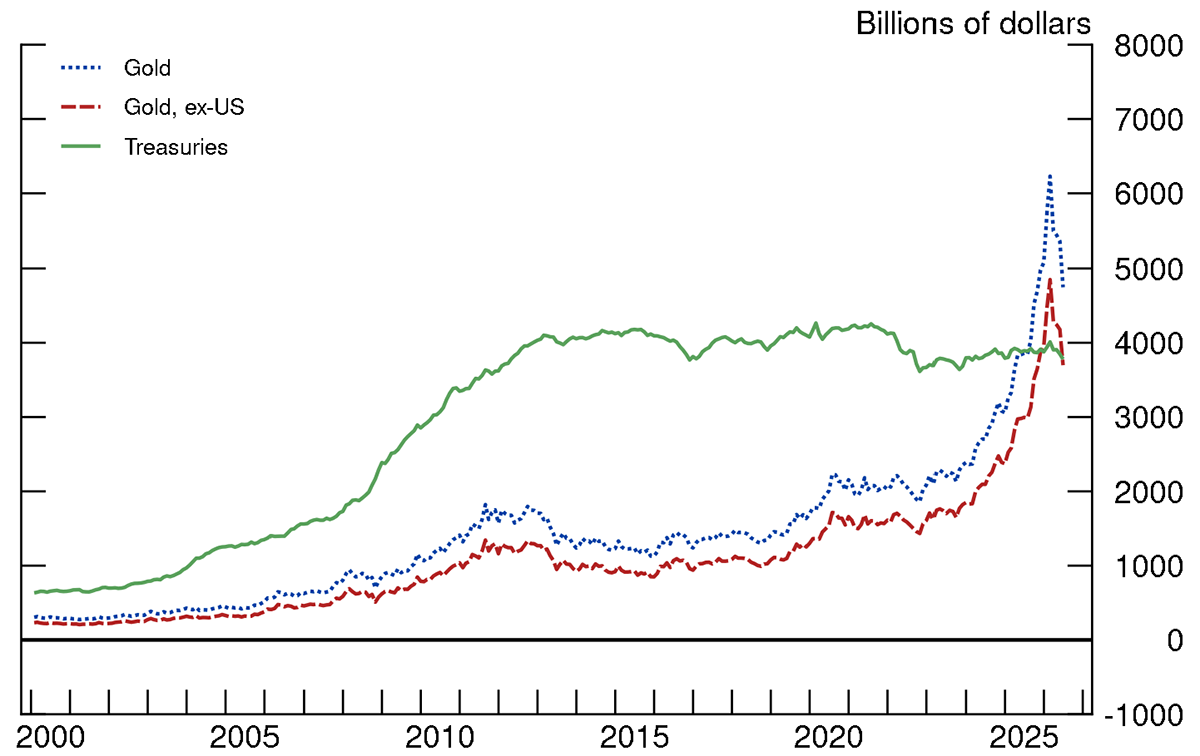
In 2025, world international reserves held in gold surpassed foreign official holdings of U.S. Treasury securities (figure 1), a fact drawing attention from media and policymakers (Nangle, 2025; European Central Bank, 2026; Storbeck and Hook, 2026, for example). Should this be interpreted as gold overtaking U.S. Treasury securities in its appeal as a reserve asset? I argue that the answer is no, as a comparison of world gold reserves and aggregate foreign official holdings of U.S. Treasury securities is problematic for a couple reasons.2 First, the rise in the market value of gold reserves since 2024 was primarily driven by a surge in gold prices from a jump in private sector demand.3 Second, the rise in the share of gold in global reserves is mostly accounted for by a handful of countries with large legacy holdings from the Bretton Woods era that have not accumulated gold in any meaningful amount since the 1970s—including the U.S., which cannot hold Treasury securities as international reserves.4
Note: Data through June 2026.
Source: IMF International Financial Statistics, Bloomberg, Treasury International Capital.
Valuation gains and the rise in gold reserves
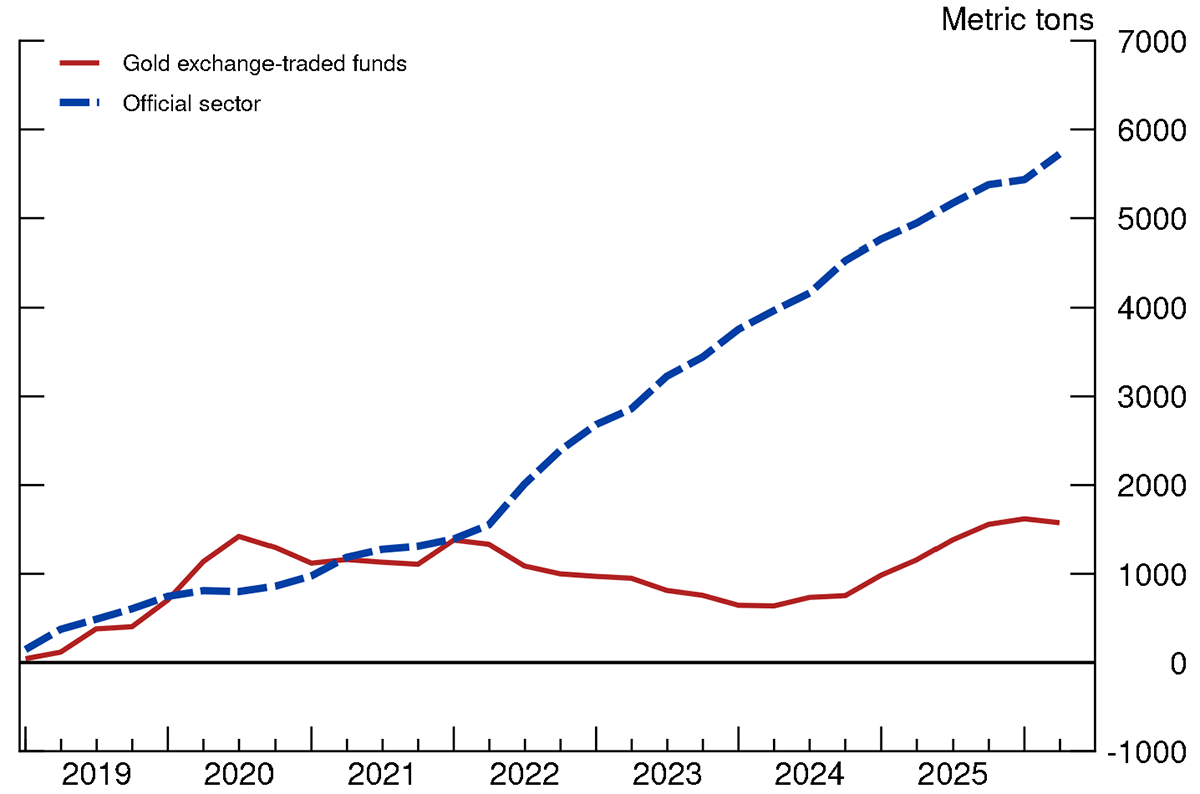
The sharp increase in the market value of world gold reserves since 2024 was fueled by a jump in private sector demand that boosted gold prices.5 This surge in gold prices does not reflect a concurrent spike in central bank purchases. While central bank purchases of gold likely increased substantially in 2022, these banks have only maintained that elevated pace since then (blue line, figure 2). Rather, demand from private sector investors jumped in late 2024, manifesting in inflows to physical gold-backed exchange traded funds (ETFs, red line, figure 2).6 Thus, while the spectacular rise in gold prices witnessed in 2025 likely required strong demand from both private and official investors, the demand from official investors in isolation would not have been sufficient to cause a surge in prices.
Note: Data through 2026:Q2.
Source: World Gold Council; Board staff calculations.
The role of U.S. gold reserves
Foreign official holdings of U.S. Treasury securities by definition exclude the Federal Reserve as a holder, but the series for world gold reserves includes those held by the U.S. government. The U.S. is the largest holder of gold reserves, accounting for 22 percent of the world total, leading to world gold reserves substantially overstating gold's importance relative to U.S. Treasury securities in foreign governments' reserve portfolios. Excluding U.S. gold reserve holdings, world gold reserves were $0.8-$1.1 trillion below the headline gold reserve number throughout much of 2025 (red line in figure 1).7
Nevertheless, at end-2025, world gold reserves, at $5.1 trillion, and world gold reserves excluding the U.S., at $4 trillion, both exceed foreign official holdings of U.S. Treasury securities of $3.9 trillion. Again, though, this largely reflects large valuation changes rather than any sharp uptick in central bank accumulation over the past 18 months. By June 2026, foreign official holdings of Treasuries again surpassed world gold reserves excluding the U.S. in dollar terms despite further increases in gold reserves as measured in fine troy ounces.
The Bretton Woods relic
Despite accumulation by many emerging market central banks beginning in 2008, most world gold reserves were still acquired prior to 1971, which was the de facto end of the Bretton Woods system.8 By contrast, most foreign official holdings of Treasuries were accumulated after 2000. Moreover, the set of countries holding large gold reserves is often distinct from the set of countries holding large foreign exchange reserves.
Today, the countries more actively choosing between holding reserves in gold or U.S. Treasury securities still only account for a minority of world gold reserves. The five largest holders of gold reserves—the U.S., Germany, Italy, France, and the IMF—account for about 52 percent of current world gold reserves but have not accumulated gold in any meaningful amount since the 1970s. Moreover, the U.S., Germany, France, and Italy have not accumulated substantial foreign exchange reserves either, so gold now, at its current market price, accounts for more than 80 percent of international reserves in each country.
Looking outside the five largest holders of gold reserves, Treasury securities are still a larger part of international reserve portfolios, as shown in figure 3.9 Foreign official holdings of Treasury securities were around $1 trillion larger than gold reserves in June 2026, despite the valuation-driven narrowing of the gap over the past year. This comparison could overstate or understate the gap, however. On the one hand, there may be substantial official sector purchases of gold after 2021 not reported in the official statistics published by the IMF.10 On the other hand, true foreign official holdings of U.S. Treasury securities are likely larger than what is reported in the TIC data as well, due to some official investors' use of non-U.S. custodians for part of their holdings of Treasury securities. Even accounting for just the additional official sector purchases estimated by the World Gold Council beginning in 2022, foreign official sector holdings of U.S. Treasury securities outside the U.S., Germany, France, Italy, and the IMF, exceeded official sector gold holdings by about $0.6 trillion.
Figure 3. Modified World Gold Reserves and Foreign Holdings of Treasuries (Excludes U.S., Germany, France, Italy, IMF)
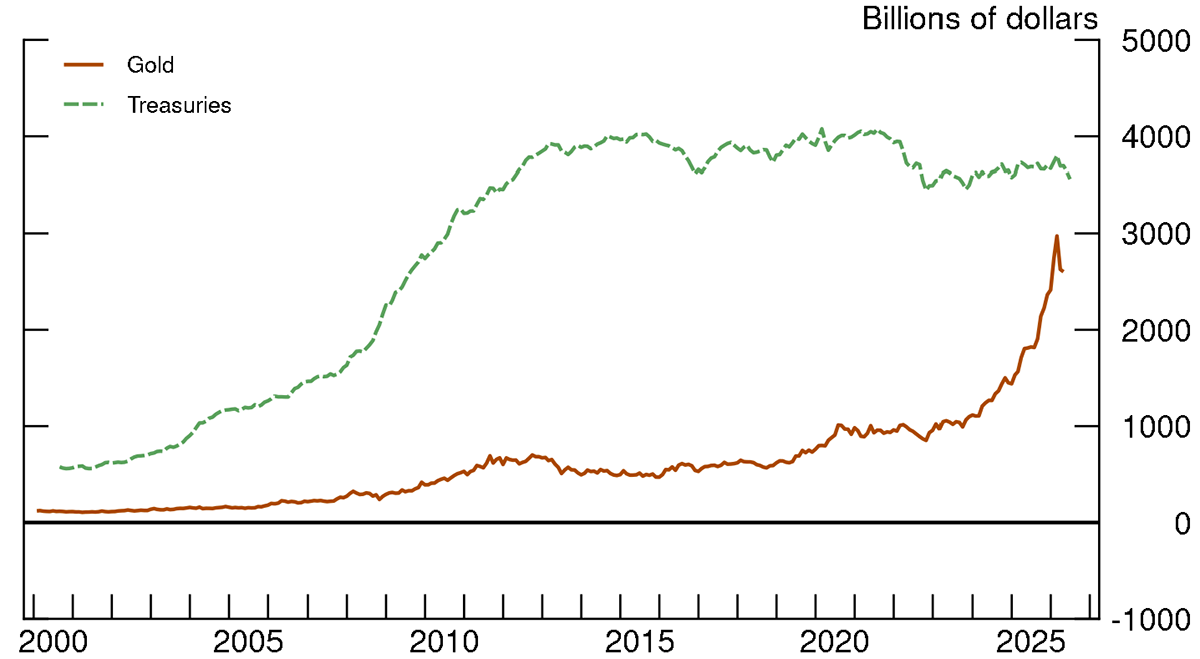
Note: Data through June 2026. Modified FOI Treasury holdings subtract FX reserves held in securities by France, Germany, and Italy, and all official and private Treasury holdings by international and regional organizations from aggregate FOI Treasury holdings.
Source: IMF International Financial Statistics, Bloomberg, Treasury International Capital.
Summing up
The value of aggregate foreign official holdings of U.S. Treasury securities relative to world gold reserves is a misleading comparison of the importance of gold and Treasury securities in international reserve portfolios.11 This owes to valuation effects that largely reflect private sector demand for gold and large legacy gold holdings in a few countries. Nevertheless, official sector investors have been accumulating gold on net since 2008, and the pace of this accumulation likely increased significantly beginning in 2022. These purchases could partly reflect geopolitical considerations, such as ideological proximity to the U.S. or financial sanctions.12 Still, despite several major holders of foreign exchange reserves selling hundreds of billions of dollars of reserves to support their currencies after 2021, foreign official investors have purchased nearly $200 billion of U.S. Treasury securities on net from 2022 through April 2026.13 Treasury securities thus remain an important part of reserve portfolios.
Appendix: Data series and estimate construction
World gold reserves are taken from the IMF's international financial statistics, while foreign official holdings of U.S. Treasury securities are reported in the Treasury International Capital (TIC) data published by the U.S. Treasury.
Estimated foreign official holdings of U.S. Treasury securities excluding the five largest holders of gold reserves are constructed by first subtracting off France, Germany, and Italy's foreign exchange reserves held in securities as reported in the IMF's international reserves and foreign currency liquidity (IRFCL) dataset from aggregate foreign official holdings of U.S. Treasury securities. I then also subtract all Treasury securities held by international and regional organizations (IROs) reported in the TIC data. This estimate should be thought of as a lower bound on foreign official holdings of U.S. Treasury securities excluding France, Germany, Italy, and the IMF.
Other official sector investors such as sovereign wealth funds that do not need to report their gold holdings as part of a country's official reserves in the IMF's international financial statistics may also invest in gold. After 2021, the World Gold Council's estimated official sector gold purchases are substantially larger than the changes in the volume of world gold reserves reported in the international financial statistics. Circumstantial evidence lends credence to there being purchases of gold that are unreported in the international financial statistics. See, for example, Hook (2025).
References
Arslanalp, Serkan, Barry Eichengreen, and Chima Simpson-Bell (2023). "Gold as International Reserves: A Barbarous Relic No More?" Journal of International Economics 145(2023): 103822.
Arslanalp, Serkan, Barry Eichengreen, and Chima Simpson-Bell (2025). "Our Underappreciated International Reserve System," NBER Working Paper 34478.
Arvai, Kai, Nuno Coimbra, and Marco Pinchetti (2026). "Fool's Gold? How the U.S. Dollar Lost Its Shine," CEPR Discussion Paper No. 21575.
Bertaut, Carol, Bastian von Beschwitz, and Stephanie Curcuru (2025). "The International Role of the Dollar—2025 Edition," FEDS Notes. Washington: Board of Governors of the Federal Reserve System, July 18, 2025.
Brüggen, Anja, Maurizio Michael Habib, Roger Gomis, and Alessandro Vallin (2025). "Gold Demand: The Role of the Official Sector and Geopolitics," in The International Role of the Euro. European Central Bank, Frankfurt am Main, June 2025.
Chinn, Menzie D., Jeffrey A. Frankel, and Hiro Ito (2025). "Reserves, Sanctions, and Tariffs in a Time of Uncertainty," NBER Working Paper 34177.
Chinn, Menzie D., Jeffrey A. Frankel, and Robert N. McCauley (2022). "Do Central Banks Rebalance Their Currency Shares?" Journal of International Money and Finance 122(2022): 102557.
Douglass, Patrick, Linda S. Goldberg, and Oliver Z. Hannaoui (2024). "Taking Stock: Dollar Assets, Gold, and Official Foreign Exchange Reserves," Federal Reserve Bank of New York Liberty Street Economics, May 29, 2024.
European Central Bank (2026). The International Role of the Euro, June 2026. Frankfurt am Main, June 2026.
Hook, Leslie (2025). "China's Secretive Gold Purchases Help Fuel Record Rally," Financial Times, November 14.
McDowell, Daniel (2023). Bucking the Buck: U.S. Financial Sanctions and the International Backlash against the Dollar. New York: Oxford University Press.
Nangle, Toby (2025). "Do Central Banks Really Have More Gold than U.S. Treasury Bonds?" Financial Times, September 9.
Storbeck, Olaf and Leslie Hook (2026). "Gold Replaces U.S. Treasuries as World's Top Reserve Asset, ECB Says," Financial Times, June 2.
Weiss, Colin (2025). "De-Dollarization? Diversification? Exploring Central Bank Gold Purchases and the Dollar's Role in International Reserves," International Finance Discussion Papers 1420. Washington: Board of Governors of the Federal Reserve System.
1. I thank Shaghil Ahmed, Daniel Beltran, and Alexandra Tabova for helpful suggestions. Angela Garcia and Alanna Baker provided excellent research assistance. The views expressed here are solely my own and do not reflect the views of the Board of Governors of the Federal Reserves or anyone else associated with the Federal Reserve System. Return to text
2. This is not to deny that many central banks have increased gold reserve accumulation over the past 15 years, although purchases are quite concentrated within a few countries (Arslanalp, Eichengreen, and Simpson-Bell, 2023, 2025; Weiss, 2025). Return to text
3. The importance of valuation effects has been previously noted by Bertaut, von Beschwitz, and Curcuru (2025) and ECB (2026). The ECB report also outlines several limitations to gold as a reserve asset that may prevent it from fully replacing U.S. Treasury securities in reserve portfolios. Return to text
4. An important issue beyond the scope of this note is whether central banks with large "legacy" gold holdings should rebalance their reserve portfolios by selling gold due to these valuation gains, as central banks sometimes do with their foreign exchange reserves (Chinn, Ito, and McCauley, 2022). Return to text
5. The importance of this surge in gold price in driving gold reserve levels substantially higher has been noted in existing work (Bertaut, von Beschwitz, Curcuru, 2025; ECB, 2026). Return to text
6. These ETFs track the price of gold by investing solely in gold bars. Several analysts have also noted increased demand for gold bars coming from stablecoin issuer Tether. Return to text
7. Although U.S. gold reserves are often reported using the statutory price of $42.22 per troy ounce, here I exclude them valued at market prices. Return to text
8. This was a system where the U.S. dollar price of gold was fixed and leading currencies pegged to the U.S. dollar. Return to text
9. The series for foreign official holdings of U.S. Treasury securities excluding the five largest holders of gold is an estimate because using actual holdings would reveal confidential data, see Appendix for description. Return to text
10. See Appendix for a discussion of possible differences between gold reserve accumulation shown in the IMF's international financial statistics and the estimates of official sector gold purchases published by the World Gold Council. Return to text
11. For more analysis of individual countries' gold and U.S. dollar reserves, interested readers are directed to Weiss (2025). Return to text
12. The literature arguing this includes Arslanalp, Eichengreen, and Simpson-Bell (2023, 2025); Arvai, Coimbra, and Pinchetti (2026); Brüggen, Habib, Gomis, and Vallin (2025); Chinn, Ito, and Frankel (2025); Douglass, Goldberg, and Hannaoui (2024), McDowell (2023). Return to text
13. On net, from 2022:Q1-2026:Q1, four of the ten largest holders of foreign exchange reserves (Japan, Switzerland, India, and Korea) sold over $600 billion in FX reserves through disclosed FX interventions. Return to text
Weiss, Colin (2026). "Why Gold Didn't Actually Overtake Treasury Securities as the World's "Favorite" Reserve Asset," FEDS Notes. Washington: Board of Governors of the Federal Reserve System, September 03, 2026, https://doi.org/10.17016/2380-7172.4147.
Disclaimer: FEDS Notes are articles in which Board staff offer their own views and present analysis on a range of topics in economics and finance. These articles are shorter and less technically oriented than FEDS Working Papers and IFDP papers.