


FEDS Notes
July 18, 2025
The International Role of the U.S. Dollar – 2025 Edition
Carol Bertaut, Bastian von Beschwitz, and Stephanie Curcuru1
This FEDS Note is an updated version of The International Role of the U.S. Dollar and "The International Role of the U.S. Dollar" Post-COVID Edition.
For most of the last century, the preeminent role of the U.S. dollar in the global economy has been supported by the size and strength of the U.S. economy, its stability and openness to trade and capital flows, and strong property rights and the rule of law. As a result, the depth and liquidity of U.S. financial markets is unmatched, and there is a large supply of extremely safe dollar-denominated assets.
The role of the U.S. dollar has received renewed attention this year. A sharp rise in policy uncertainty has led some to question the strength and stability of the U.S. economy.2 In particular, increased attention has been paid to the U.S. fiscal outlook, as noted in the recent downgrade by Moody's of the credit rating on U.S. government debt.3 And the U.S. has increased its level of tariffs and thereby somewhat reduced its openness to trade flows. Given that most data on international dollar usage is available with a lag, this note is not yet able to show any potential results of the change in the U.S. credit rating or changes to tariff rates in 2025. Rather, it provides a baseline for where the international role of the dollar stood before these announcements. In particular, we can examine the longer-run effects of U.S. sanctions on Russia that were imposed following its invasion of Ukraine in 2022.
As in our earlier notes, we review the use of the U.S. dollar in international reserves, as a currency anchor, and in transactions.4 According to our index combining various factors, the dollar's international usage is little changed over the past 5 years and far exceeds the U.S. share of global GDP and trade (see Figure 1). It also plays an outsized role in areas of financial innovation, such as being the dominant anchor for stablecoins. That said, several possible challenges to dollar dominance are discussed at the end of the note.
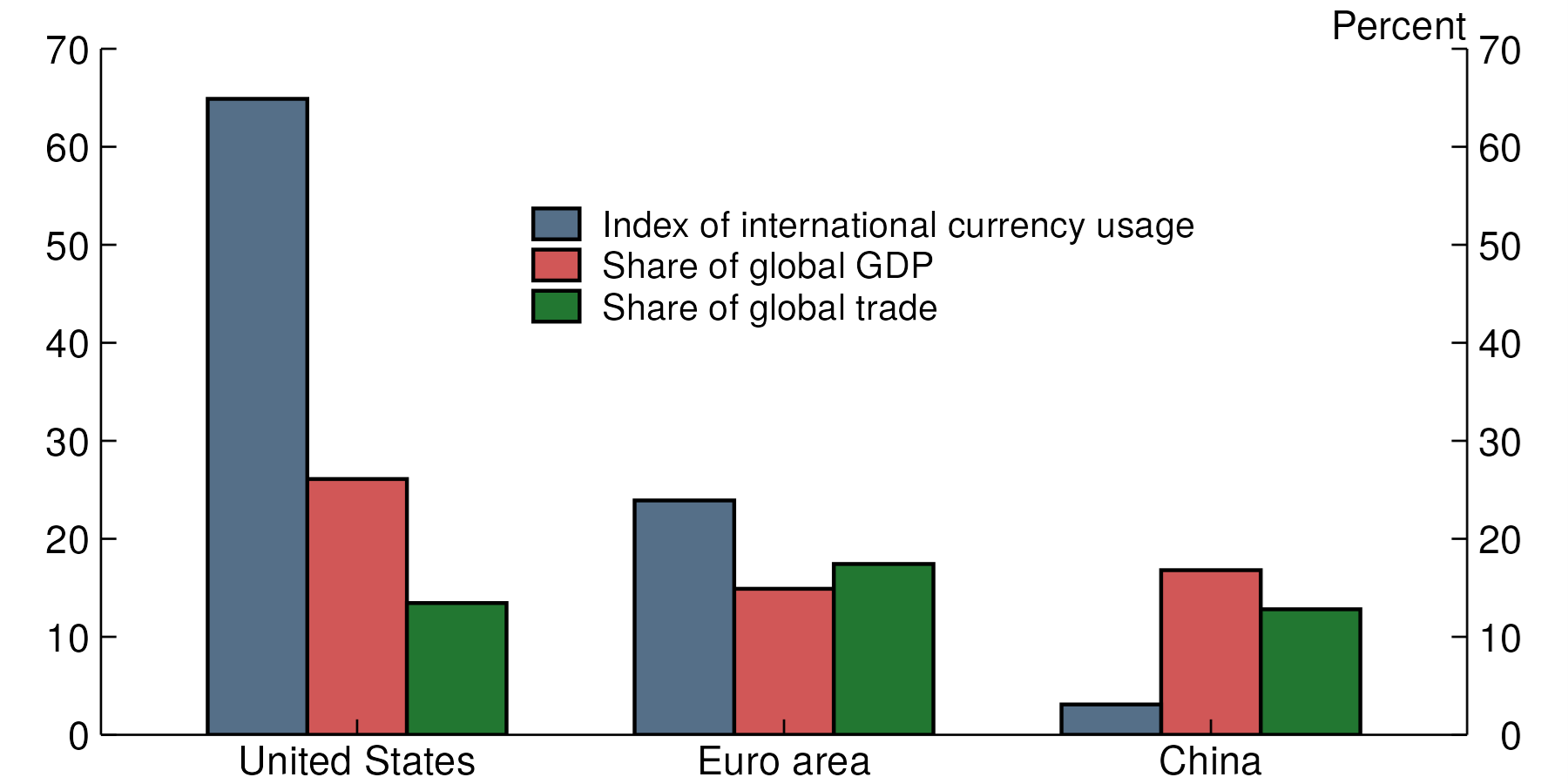
Note: Share of global GDP is measured in nominal terms. Share of global trade is the share of global trade in goods and services in nominal terms and excludes intra euro-area trade. Index of international currency usage is a weighted average of each currency's share of globally disclosed FX reserves (25 percent weight), FX transaction volume (25 percent), foreign currency debt issuance (25 percent), foreign currency and international banking claims (12.5 percent), and foreign currency and international banking liabilities (12.5 percent). Key identifies in order from left to right.
Source: IMF World Economic Outlook database, Haver, Eurostat, Comtrade, IMF COFER; BIS Triennial Central Bank Survey of FX and OTC Derivatives Market; LSEG Data & Analytics; BIS locational banking statistics; Board staff calculations.
There is widespread confidence in the U.S. dollar as a store of value
A key function of a currency is as a store of value which can be saved and retrieved in the future without a significant loss of purchasing power. One measure of confidence in a currency as a store of value is its usage in official foreign exchange reserves. As shown in Figure 2, the U.S. dollar comprised 58 percent of disclosed global official foreign reserves in 2024 and far surpassed all other currencies including the euro (20 percent), Japanese yen (6 percent), British pound (5 percent), and the Chinese renminbi (2 percent). The dollar share has declined from its peak of 72 percent of reserves in 2001, as foreign reserve managers have added to their portfolios a wide range of smaller currencies, including the Australian and Canadian dollars (IMF COFER). Even with this decline, the dollar remains by far the dominant reserve currency and only returned to about the share it had in 1995. Notably, it is basically unchanged since 2022, when it accounted for 58 percent of reserves, suggesting that U.S. sanctions on Russia following the invasion of Ukraine have not led to fears of dollar "weaponization" causing a notable reallocation of reserves out of dollars.
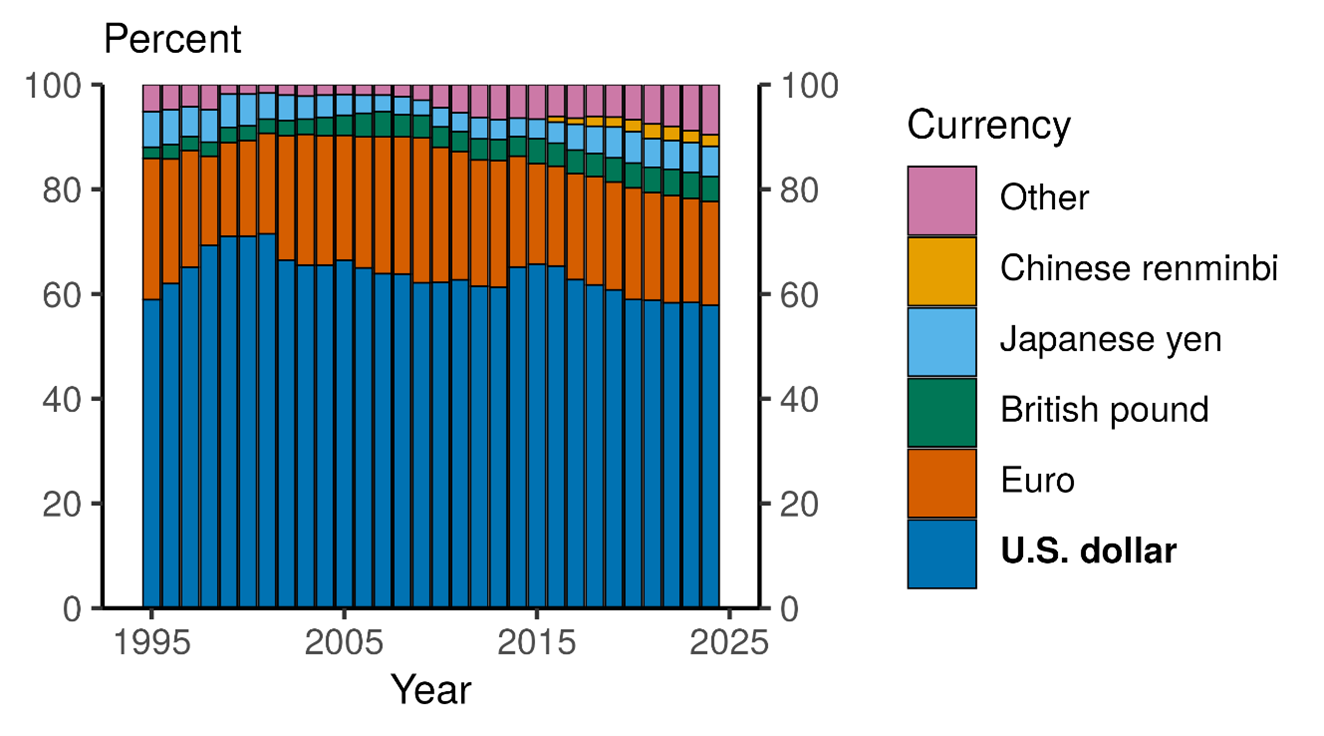
Note: Share of globally disclosed foreign exchange reserves. Data are annual and extend from 1995 through 2024. Legend entries appear in graph order from top to bottom. Chinese renminbi is 0 until 2015-Q2.
Source: IMF COFER.
Central banks can hold gold as an alternative to foreign exchange reserves. As shown in blue in Figure 3, the share of gold in official reserve assets has more than doubled from below 10 percent in 2015 to over 23 percent now. However, this increase mostly reflects the over 200 percent increase in the gold price over that period. In contrast, the physical quantity of gold holdings (shown in red) has only increased by less than 10 percent over this period. Furthermore, Weiss (2025) shows that increases in gold holdings are generally not associated with a decline in U.S. dollar reserves except for China, Russia, and Turkey. So even though gold has become more popular as a reserve asset, the increase in gold holdings is not necessarily linked to the decline in dollar holdings.
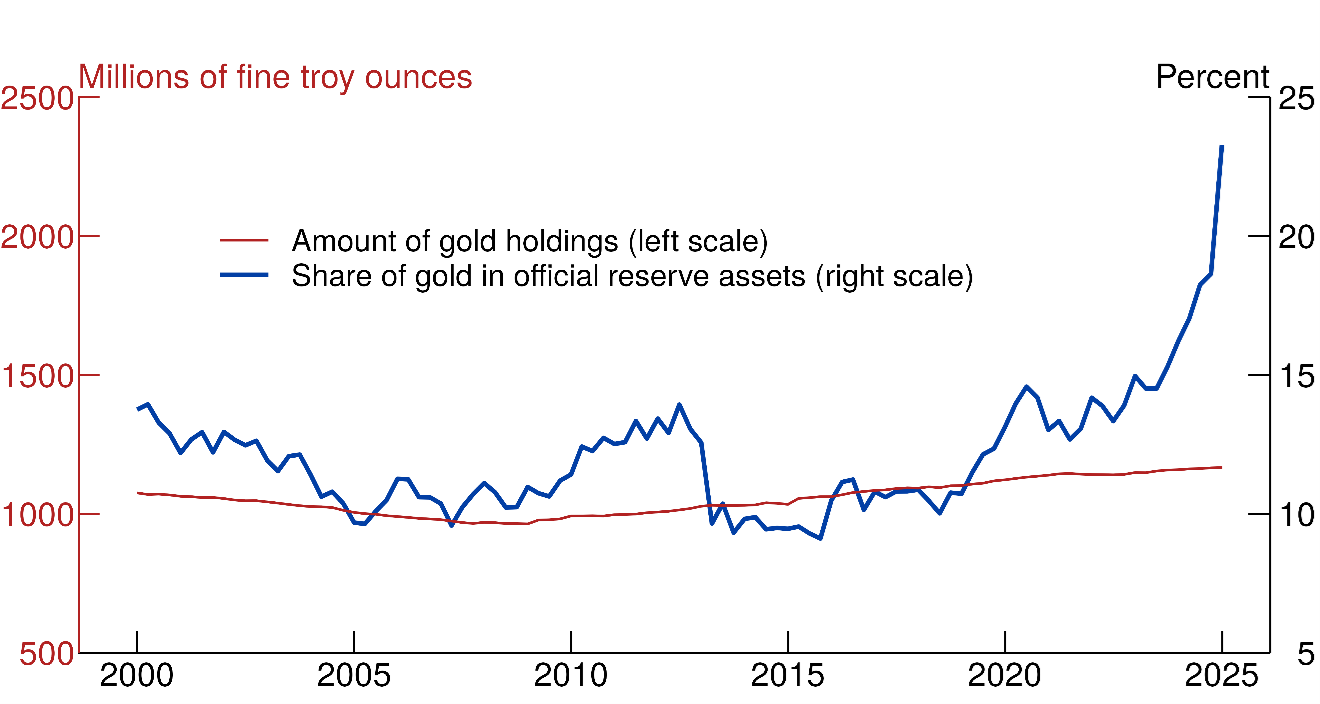
Note: The share of gold in official reserves is the gold reserves at market value as a percent of total reserves.
Source: IMF International Financial Statistics.
The bulk of official U.S. dollar reserves are held in the form of U.S. Treasury securities, which are in high demand by both official and private foreign investors. As of the first quarter of 2025, $9 trillion or 32 percent of marketable Treasury securities outstanding were held by foreign investors, both official and private (see Figure 4a), while 55 percent were held by private domestic investors, and 13 percent by the Federal Reserve System. Although the share of Treasuries held by foreign investors has declined from almost 50 percent in 2014, the current foreign share of Treasury holdings is little changed since 2022 and is broadly comparable to the foreign-held shares of government debt securities of the euro area, Japan, and the United Kingdom (shown in Figure 4b).
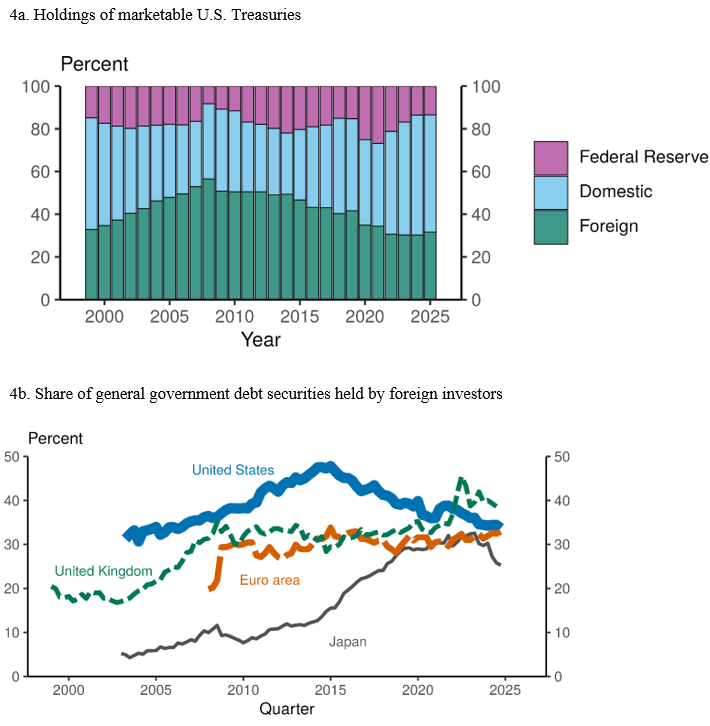
Note: Figure 4a legend entries appear in graph order from top to bottom. Figure 4b excludes domestic central bank holdings. It is based on market value, which for the euro area is estimated before 2020-Q4 using data on the nominal value. Intra-euro area holdings of euro area debt securities are considered domestic holdings. General government debt securities includes local, state, and national debt securities. Figure 4a. data are annual and extend from 1999 through 2025. 2025 is 2025-Q1. Figure 4b. data are quarterly and extend from 1999-Q1 through 2025-Q1.
Source: Financial Accounts of the United States, Table L.210. BIS debt securities statistics; World Bank/IMF Quarterly External Debt Statistics (QEDS), accessed through Haver Analytics; Bank of England; Bank of Japan; European Central Bank; Federal Reserve Board; Board staff calculations.
Foreign investors also hold substantial amounts of paper banknotes. As shown in Figure 5, the value of U.S. dollar banknotes held abroad has increased over the past two decades, both on an absolute basis and as a fraction of banknotes outstanding. Federal Reserve Board staff estimate that over $1 trillion in dollar banknotes were held by foreigners in the first quarter of 2025, roughly half of total dollar banknotes outstanding. The increase in foreign holdings of dollar banknotes has slowed down in the last 2 years, likely reflecting higher U.S. interest rates, which increase the opportunity cost of owning banknotes that do not pay interest. In addition, there has been an increase in the use of stablecoins anchored to the dollar, and which seem to be used as an alternative to U.S. banknotes in some developing countries.5 By April 2025, the total market capitalization of dollar stablecoins had reached about $220 billion (see Figure 6).
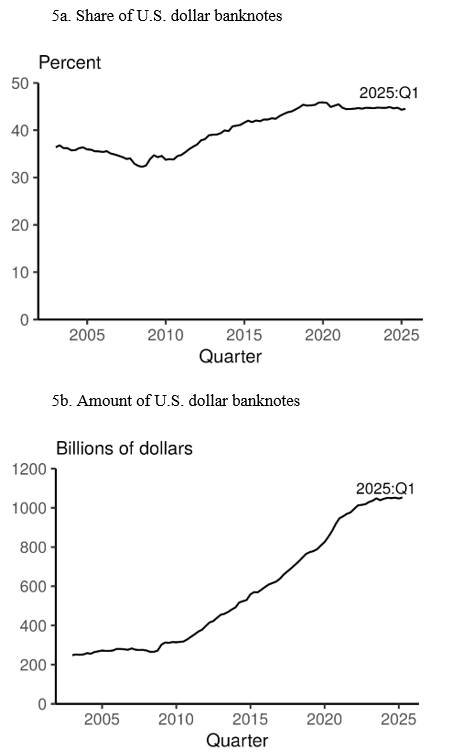
Note: The exact amount of U.S. dollar banknotes held by foreigners is not known and this is most likely a conservative estimate; see Judson (2017). Data are quarterly and extend from 2002-Q4 through 2025-Q1.
Source: Financial Accounts of the United States, Table L.204; Factors Affecting Reserve Balances (H.4.1), Table 1; Board staff calculations.
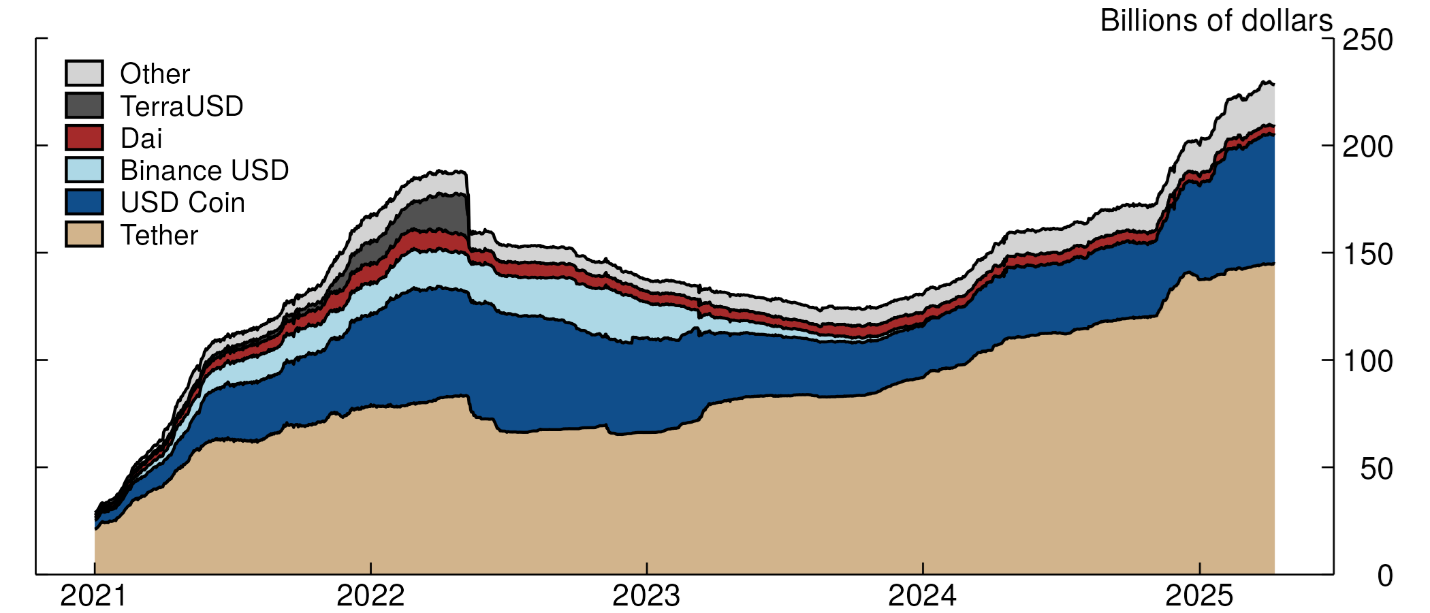
Note: Legend entries appear in graph order from top to bottom. Data are daily and extend from January 1, 2021 to April 10, 2025.
Source: Llama Corp, DeFiLlama.
Additionally, many foreign countries leverage the effectiveness of the U.S. dollar as a store of value by limiting the movements of their currencies with respect to the dollar – in other words, using it as an anchor currency. Ilzetzki, Reinhart, and Rogoff (2021) estimate that over half of countries in 2019 had their currency anchored to the dollar.6 Given how rarely countries change their exchange rate arrangements, it is unlikely that this fraction has meaningfully changed since then.
The U.S. dollar remains dominant in international transactions and financial markets
The international role of a currency can also be measured by its usage as a medium of exchange. The dominance of the U.S. dollar internationally has been highlighted in several recent studies on the currency composition of global trade and international financial transactions. The dollar is overwhelmingly the world's most frequently used currency in global trade. An estimate of the dollar share of global trade invoices is shown in Figure 7. Over the period 1999-2019, the dollar accounted for 96 percent of trade invoicing in the Americas, 74 percent in the Asia-Pacific region, and 79 percent in the rest of the world. The only exception is Europe, where the euro is dominant with 66 percent.7
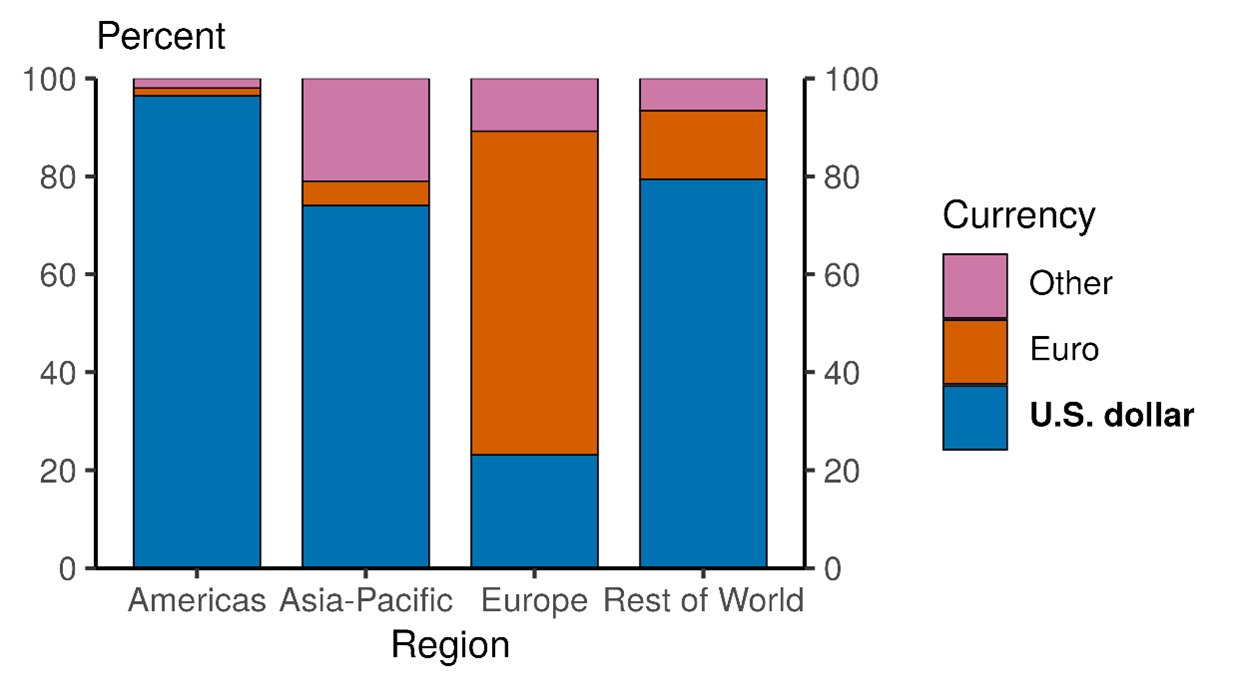
Note: Average annual currency composition of export invoicing, where data are available. Data extend from 1999 through 2019. Regions are those defined by the IMF. Legend entries appear in graph order from top to bottom. The value for Europe includes within-euro area trade.
Source: IMF Direction of Trade; Central Bank of the Republic of China; Boz et al. (2020); Board staff calculations.
While there is no comprehensive time-series data for trade invoicing, we have time-series data on international payments on SWIFT, which we show in Figure 8. These payments can be related to trade as well as other activities such as sending remittances. The U.S. dollar share of international payments is about 50 percent and has even slightly increased in recent years. If intra-euro area payments are included, the dollar share is even higher at about 60 percent.
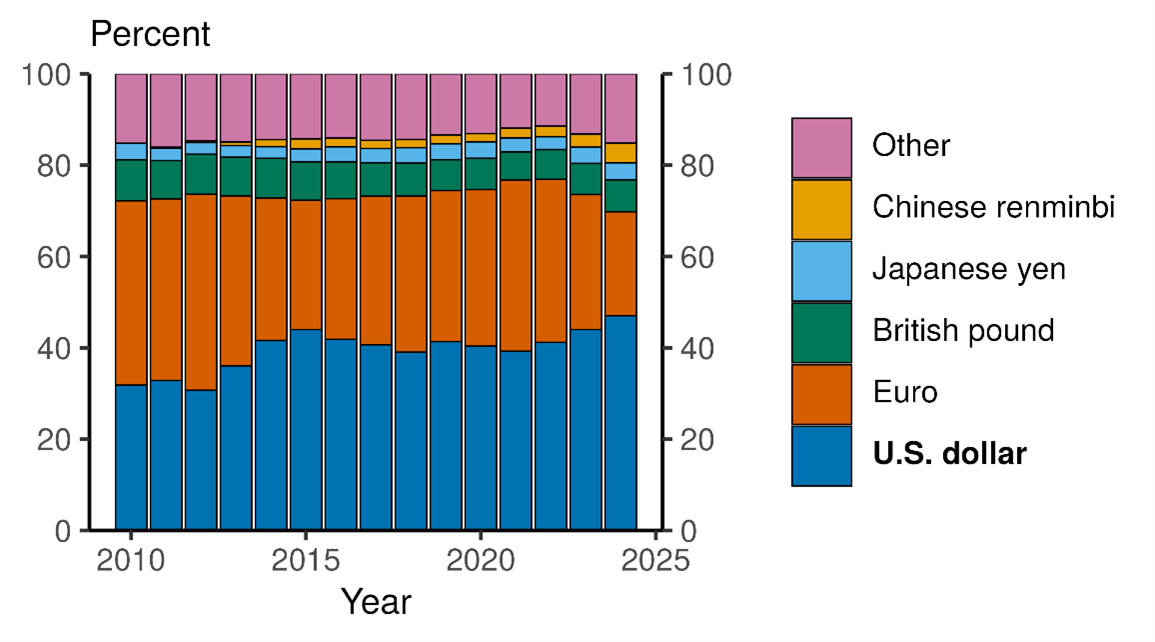
Note: Share of international payments on SWIFT (based on MT 103 and MT 202, customer initiated and institutional payments). Does include intra-euro area payments. Data are annual and extend from 2010 through 2024. Legend entries appear in graph order from top to bottom.
Source: SWIFT, Bloomberg Finance LP.
In part because of its dominant role as a medium of exchange, the U.S. dollar is also the dominant currency in international banking. As shown in Figure 9, about 55 percent of international and foreign currency claims (primarily loans) and 60 percent of liabilities (primarily deposits) are denominated in dollars. This share has remained relatively stable since 2000 and is well above that of the euro (about 20 percent).
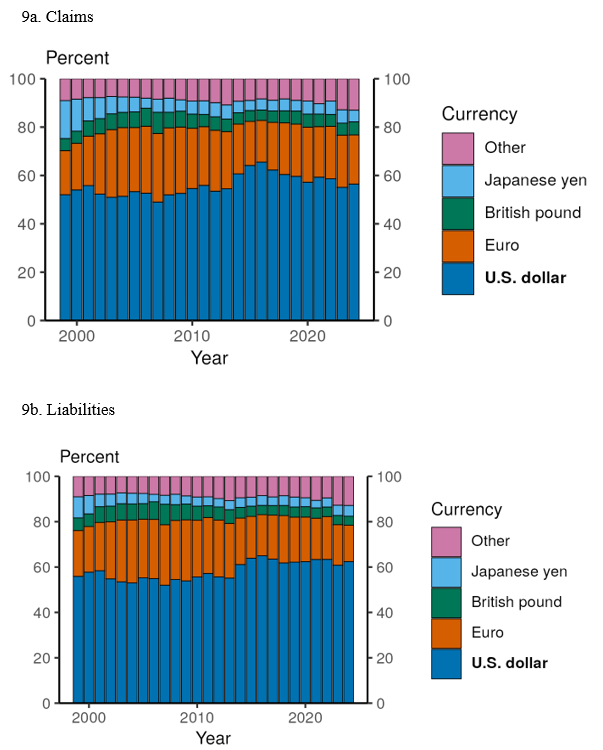
Note: Share of banking claims and liabilities across national borders or denominated in a foreign currency. Banking claims and liabilities are defined as loans and deposits only, including repurchase agreements. Excludes claims on and liabilities to related banking offices and central banks. Also excludes intra-euro area cross-border claims and liabilities. Data are annual and extend from 1999 through 2024. Legend entries appear in graph order from top to bottom.
Source: BIS locational banking statistics; Board staff calculations.
Issuance of foreign currency debt—debt issued by firms in a currency other than that of their home country — is also dominated by the U.S. dollar. The share of foreign currency debt denominated in dollars has remained around 60 percent since 2010, as seen in Figure 10. This puts the dollar well ahead of the euro, whose share is 26 percent.
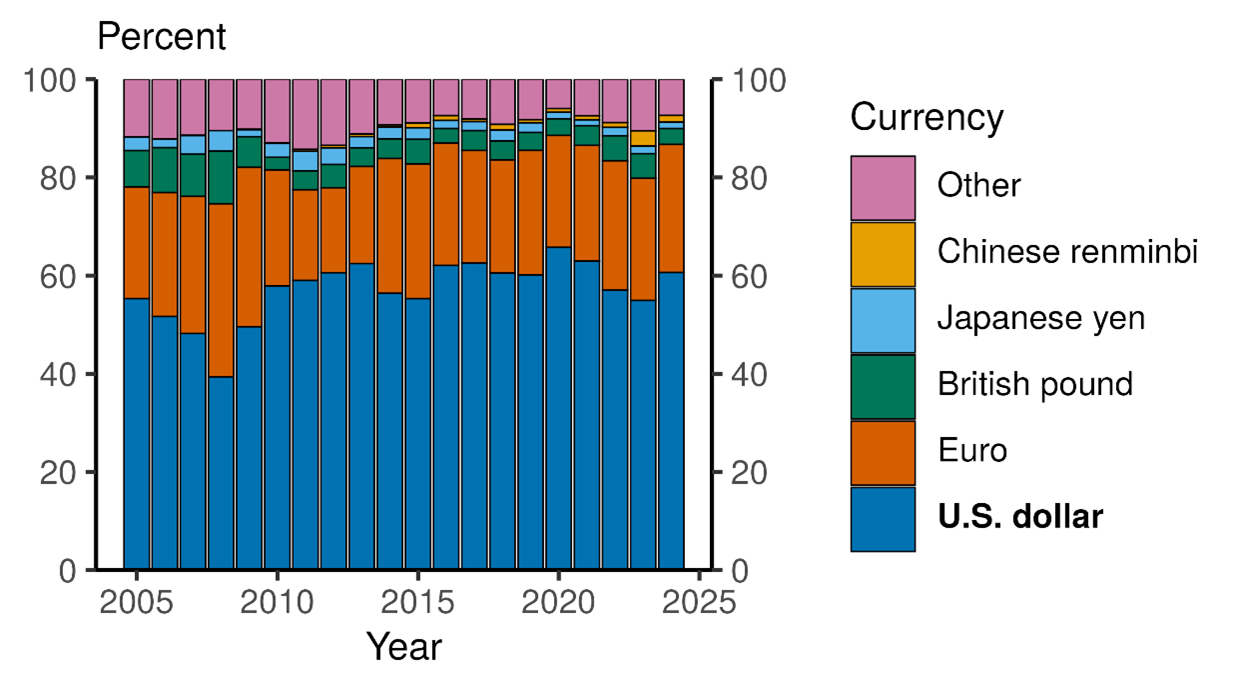
Note: Foreign currency debt is denominated in a foreign currency relative to the country of the issuing firm (not the location of issuance). Data are annual and extend from 2005 through 2024. Legend entries appear in graph order from top to bottom. Chinese renminbi is 0 in 2005.
Source: LSEG Data & Analytics; Board staff calculations.
The many sources of demand for U.S. dollars are also reflected in the high dollar share of foreign exchange (FX) transactions. The 2022 Triennial Central Bank Survey from the Bank for International Settlements indicated that the U.S. dollar was bought or sold in about 88 percent of global FX transactions in April 2022. This share has remained stable over the past 20 years (Figure 11). In contrast, the euro was bought or sold in 31 percent of FX transactions, a decline from its peak of 39 percent in 2010.8
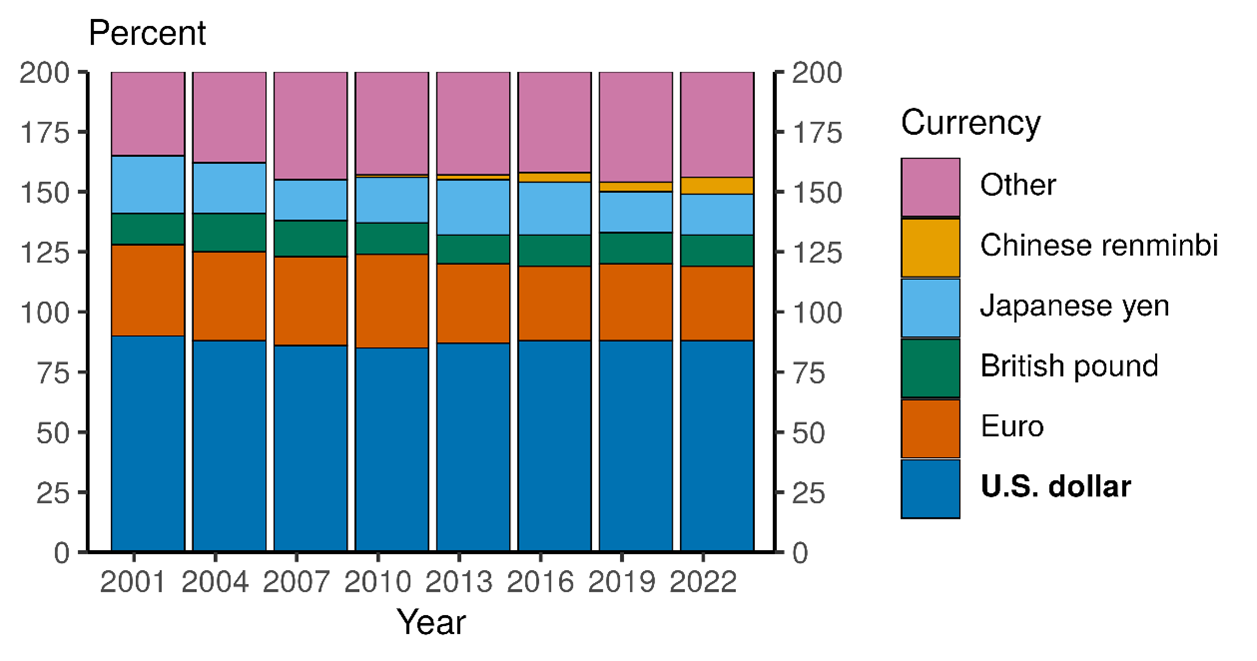
Note: On a net-net basis. Percentages sum to 200 percent because every FX transaction includes two currencies. Legend entries appear in graph order from top to bottom. Chinese renminbi is 0 until 2007.
Source: BIS Triennial Central Bank Survey of FX and OTC Derivatives Markets.
Overall, U.S. dollar dominance has remained stable over the past 20 years
A review of the use of the dollar globally over the last two decades suggests a dominant and relatively stable role. To illustrate this stability, we construct an aggregate index of international currency usage. This index is computed as the weighted average of five measures of currency usage for which long time-series data are available: official currency reserves, FX transaction volume, foreign currency debt instruments outstanding, cross-border deposits, and cross-border loans. We display this index of international currency usage in Figure 12. The dollar index level has remained in a narrow range between 65 to 70 since 2010, well ahead of all other currencies. The euro has the next-highest value at about 24, and its value has remained fairly stable as well. While international usage of the Chinese renminbi has trended higher, it has only reached an index level of about 3, remaining behind the Japanese yen and British pound, which are at about 7 and 6, respectively.
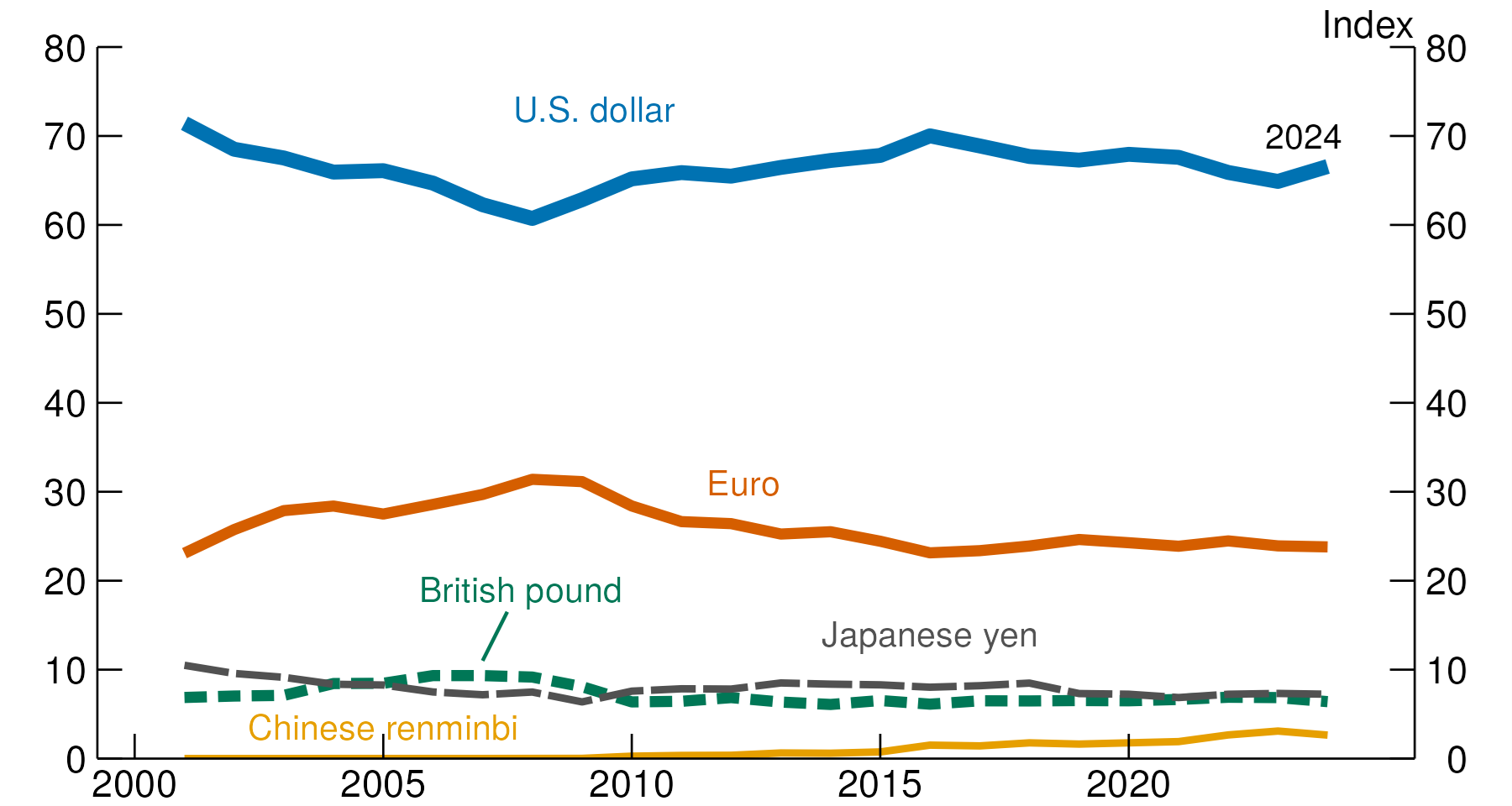
Note: Index is a weighted average of each currency's share of globally disclosed FX reserves (25 percent weight), FX transaction volume (25 percent), foreign currency debt issuance (25 percent), foreign currency and international banking claims (12.5 percent), and foreign currency and international banking liabilities (12.5 percent). Because our data on foreign currency debt issuance only becomes available in 2005, we fill back the 2005 value to previous years.
Source: IMF COFER; BIS Triennial Central Bank Survey of FX and OTC Derivatives Market; LSEG Data & Analytics; BIS locational banking statistics; Board staff calculations.
Central bank facilities support the global role of the U.S. dollar
With U.S. dollar financing in particularly high demand during times of crisis, foreign financial institutions may face difficulties in obtaining dollar funding. In response, the Federal Reserve has introduced two programs to ease crisis-induced strains in international dollar funding markets, thus mitigating the effects of strains on the supply of credit to domestic and foreign firms and households. To ensure that dollar financing remained available during the 2008-2009 financial crisis, the Federal Reserve introduced temporary swap lines with several foreign central banks, a subset of which were made permanent in 2013.9 During the COVID-19 crisis in March 2020, the Federal Reserve increased the frequency of operations for the standing swap lines and reintroduced temporary swap lines with the same additional counterparties as in the 2008-2009 financial crisis.10 On March 31, 2020, the Federal Reserve also introduced a repo facility available to Foreign and International Monetary Authorities (FIMA) with accounts at the Federal Reserve Bank of New York, which was made permanent in 2021.11 The frequency of swap line operations was temporarily increased again in March and April 2023 to relieve market stresses associated with the intervention in the operations of Credit Suisse by Swiss authorities.12
Both the swap lines and the FIMA repo facility have enhanced the standing of the U.S. dollar as the dominant global currency, as approved users know that in a crisis they have access to a stable source of dollar funding. During the 2008-2009 financial crisis and the 2020 COVID-19 crisis, the swap lines were extensively used, reaching outstanding totals of $585 billion and $450 billion, respectively (see Figure 13a). Although other central banks have also established swap lines, non-dollar-denominated swap lines offered by the European Central Bank and other central banks saw little usage (see Figure 13b). This fact highlights how crucial dollar funding is in the operations of many internationally active banks.
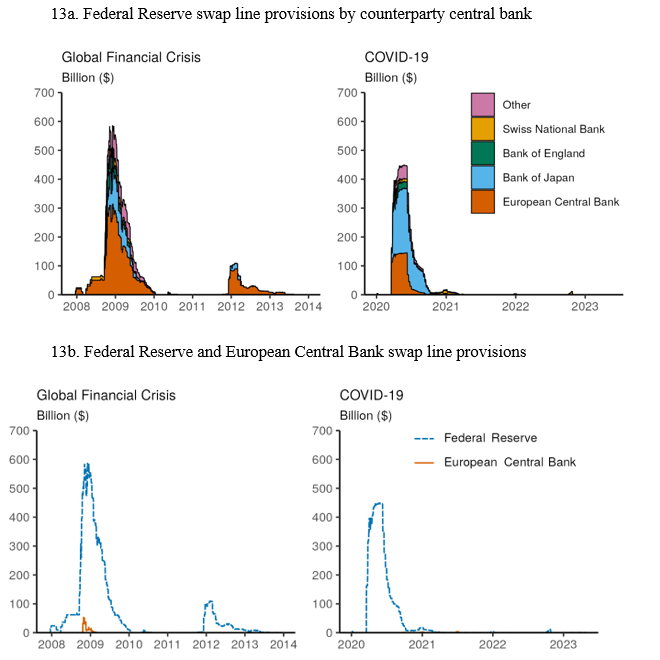
Note: In Figure 13a legend entries appear in graph order from top to bottom. Federal Reserve swap line provisions to the Bank of England, Bank of Japan, and other central banks are at or near 0 prior to September 2008. Provisions to the Swiss National Bank are at or near 0 prior to March 2008. Provisions for the Swiss National Bank and Bank of England are at or near zero after June 2009. Figure 13b includes both swap line and repo provisions by the European Central Bank for the COVID-19 period. Data are daily and extend from December 1, 2007 through December 31, 2013 for the Global Financial Crisis, and January 1, 2020 through April 30, 2023 for the COVID-19 period. Swap line provisions for the European Central Bank are 0 (or near 0 when shown in billions) before October 2008 and after February 2009.
Source: Federal Reserve Bank of New York; European Central Bank.
Possible challenges to the U.S. dollar's status
Near-term challenges to the U.S. dollar's dominance appear limited. In modern history there has been only one instance of a predominant currency switching—the replacement of the British pound by the dollar. The dollar rose to prominence after the financial crisis associated with World War I, then solidified its international role after the Bretton Woods Agreement in 1944 (Tooze 2021, Eichengreen and Flandreau 2008, Carter 2020).13
However, over a longer horizon there is more risk of a challenge to the U.S. dollar's international status, and some recent developments have the potential to boost the international usage of other currencies.
Several commentators argued that sanctions imposed by the United States and its allies on Russia following the invasion of Ukraine would make the U.S. dollar less attractive as a reserve currency as geopolitical adversaries fear exposure to U.S. sanctions. However, so far, we have not seen a notable decline in the dollar share of foreign reserves. Indeed, Weiss (2022) documents that about three-quarters of foreign government holdings of safe U.S. assets are held by countries with some military ties to the United States. Furthermore, other prominent reserve currencies such as the euro, Japanese yen, and British pound, are all issued by close U.S. allies, who also participated in sanctions on Russia. Thus, geopolitical adversaries do not have many attractive alternatives to the dollar or the currencies of U.S. allies.14
Increased European integration is another possible source of challenge, as the European Union (EU) is a large economy with fairly deep financial markets, generally free trade, and robust and stable institutions. During the COVID-19 crisis, the EU started to issue an unprecedented amount of jointly-backed debt, which reached about $700 billion by May 2025. While this is a large amount for the EU, it is small compared to the over $28 trillion of U.S. Treasuries outstanding. But if fiscal integration progresses and a large, liquid market for EU bonds develops, the euro could become more attractive as a reserve currency. This integration could potentially be accelerated by increased German debt issuance to finance defense spending, enhancements to the EU's sovereign debt market infrastructure, and introduction of a digital euro. However, even with more fiscal integration, political uncertainty arising from the diverse set of countries who have adopted the euro will likely continue to be a force holding back more widespread adoption of the euro as a reserve currency.
Another source of challenges to the U.S. dollar's dominance could be the continued rapid growth of China, which is by far the world's largest exporter, though it lags the United States by value of imports (IMF Direction of Trade Statistics, 2024). Chinese GDP already exceeds U.S. GDP on a purchasing power parity basis (IMF World Economic Outlook, 2025), but given China's steep population decline, it is unclear when and whether Chinese GDP will exceed U.S. GDP in nominal terms.15 Even if Chinese GDP eventually exceeds U.S. GDP, the difference may not be enough to overcome the significant roadblocks to more widespread use of the Chinese renminbi. Importantly, the renminbi is not freely exchangeable, the Chinese capital account is not open, and investor confidence in Chinese institutions is relatively low (Wincuinas, 2019). These factors all make the Chinese renminbi relatively unattractive for international investors. To overcome these shortcomings, China has recently increased various efforts to promote international use of the renminbi, but their effect has been rather limited thus far (see von Beschwitz (2024) for a more detailed discussion).
A shifting payments landscape could also result in a challenge to the U.S. dollar's dominance. For example, the rapid growth of digital currencies, both private sector and official, could reduce reliance on the dollar. Alternatively, it is possible that technological progress may solidify the dominant role of the dollar. For example, about 99 percent of stable coin market capitalization is linked to the dollar, implying that crypto assets are de facto traded in dollars.16 Indeed, increased stablecoin usage may cause more emerging market economies to become effectively dollarized (Cowen, 2025).
In sum, absent any large-scale, lasting disruptions which damage the value of the U.S. dollar as a store of value or medium of exchange and simultaneously bolster the attractiveness of dollar alternatives, the dollar will likely remain the world's dominant international currency for the foreseeable future.
References
Bank for International Settlements. BIS Data Bank.
von Beschwitz, B. (2024). "Internationalization of the Chinese renminbi: progress so far and outlook," FEDS Notes. Washington: Board of Governors of the Federal Reserve System, August 30, 2024.
Bloomberg Finance LP. Bloomberg Terminals (Open, Anywhere, and Disaster Recovery Licenses).
Boz, E., C. Casas, G. Georgiadis, G. Gopinath, H. Le Mezo, A. Mehl, and T. Nguyen (2020). "Patterns in Invoicing Currency in Global Trade." IMF Working Paper No. 20-126.
Carter, Z. (2020). The Price of Peace: Money, Democracy, and the Life of John Maynard Keynes. Random House.
Committee on the Global Financial System (CGFS) (2020). "U.S. dollar funding: an international perspective." BIS CGFS Papers No 65.
Cowen, T. (2025). "Stablecoins Will Both Replace and Entrench the Dollar." https://www.bloomberg.com/opinion/articles/2025-02-12/stablecoins-will-entrench-dollar-dominance-for-another-century. Accessed May 12, 2025.
Dealogic, DCM Manager, http://www.dealogic.com/en/fixedincome.htm.
The Economist (2020). "Dollar dominance is as secure as American leadership." https://www.economist.com/finance-and-economics/2020/08/06/dollar-dominance-is-as-secure-as-american-global-leadership. Accessed August 18, 2021.
Eurostat, Extra-EU trade by invoicing currency.
Eichengreen, B. and M. Flandreau (2008). "The Rise and Fall of the Dollar, or When Did the Dollar Replace Sterling as the Leading International Currency?" NBER Working Papers No. 14154.
Ilzetzki, E., C. Reinhart and K. Rogoff (2021), "Rethinking Exchange Rate Regimes". Handbook of International Economics, vol 5, G. Gopinath, E. Helpman and K. Rogoff, eds; www.ilzetzki.com/_files/ugd/b3763a_2bd7c9c69abd4d0085fbddd55dedc8aa.pdf.
Judson, R. (2017). "The Death of Cash? Not So Fast: Demand for U.S. Currency at Home and Abroad, 1990-2016." International Cash Conference 2017.
LSEG Data & Analytics. SDC Platinum SFTP Feed and Workspace for Investment Banking with Deals Module, http://www.thomsonone.com/.
Tooze, A. (2021). "The Rise and Fall and Rise (and Fall) of the U.S. Financial Empire." Foreign Policy https://foreignpolicy.com/2021/01/15/rise-fall-united-states-financial-empire-dollar-global-currency Accessed August 13, 2021.
Weiss, C. (2022). "Geopolitics and the U.S. Dollar's Future as a Reserve Currency", International Financial Discussion Paper.
Weiss, C. (2025). "Central Bank Gold Purchases and the Dollar's Role inInternational Reserves", Working Paper.
Wincuinas, J. (2019). "The China position: Gauging institutional investor confidence." Economist Intelligence Unit. https://eiuperspectives.economist.com/financial-services/china-position-gauging-institutional-investor-confidence Accessed August 18, 2021.
1. We thank Shaily Acharya for excellent research assistance. Return to text
2. For example, in the April 2025 survey of salient risks to financial stability, market contacts highlighted risks to global trade, policy uncertainty, and U.S. fiscal debt sustainability (Financial Stability Report, April 2025). Return to text
3. https://ratings.moodys.com/ratings-news/443154 Return to text
4. For a detailed discussion of the dollar's use in international financial markets see Committee on the Global Financial System (2020). Return to text
5. Stablecoin transactions below $1 million have increased the most in Latin America and Sub-Saharan Africa (https://www.chainalysis.com/blog/stablecoins-most-popular-asset/). Return to text
6. Their definition of anchored currencies includes currencies explicitly pegged to the dollar as well as currencies that move less than 2 percent against the dollar in over 80 percent of months. Return to text
7. This percentage includes trade within the euro area. Only 52 percent of extra-EU exports were invoiced in euro in 2024 (Eurostat). Return to text
8. Because one currency is purchased and another currency is sold in FX transactions, each trade is counted twice, so the sum of the FX transactions measure is 200 percent. Return to text
9. Since 2013, the following six central banks have had permanent bilateral swap arrangements with each other: the Bank of Canada, the Bank of England, the Bank of Japan, the European Central Bank, the Federal Reserve, and the Swiss National Bank. Return to text
10. Additional information about the Federal Reserve's central bank swap lines can be found at https://www.federalreserve.gov/monetarypolicy/central-bank-liquidity-swaps.htm. Return to text
11. The FIMA repo facility allows approved foreign central banks and other foreign monetary authorities to temporarily raise dollars by selling U.S. Treasuries to the Federal Reserve's System Open Market Account and agreeing to buy them back at the maturity of the repurchase agreement. Thus, it provides an alternative temporary source of U.S. dollars for FIMA account holders of Treasury securities other than sales of the securities in the open market. Additional information about the facility can be found at https://www.federalreserve.gov/monetarypolicy/fima-repo-facility.htm. Return to text
12. To improve the swap lines' effectiveness in providing U.S. dollar funding, the frequency of swap line operations was increased from weekly to daily between March 20 and April 30, 2023. https://www.federalreserve.gov/newsevents/pressreleases/monetary20230319a.htm. Return to text
13. U.S. GDP may have eclipsed British GDP as early as the late 1800s, but the dollar did not completely solidify its dominance until after the Bretton Woods Agreement in 1944 (Eichengreen and Flandreau (2008)). Return to text
14. This is especially true for China, which holds a lot of U.S. dollar reserves and cannot use the Chinese renminbi as a reserve currency. Return to text
15. For example, the Centre for Economics and Business Research, which in 2020 predicted that China would overtake the U.S. by 2028 now forecasts for Chinese GDP to remain below U.S. GDP until at least 2040. Return to text
16. See Box 5 Euro-based stablecoins in The International Role of the Euro June 2022 (PDF) published by the European Central Bank. Return to text
Bertaut, Carol, Bastian von Beschwitz, and Stephanie Curcuru (2025). "The International Role of the U.S. Dollar – 2025 Edition," FEDS Notes. Washington: Board of Governors of the Federal Reserve System, July 18, 2025, https://doi.org/10.17016/2380-7172.3856.
Disclaimer: FEDS Notes are articles in which Board staff offer their own views and present analysis on a range of topics in economics and finance. These articles are shorter and less technically oriented than FEDS Working Papers and IFDP papers.