


Banking System Conditions
Banks Maintain Strong Capital Levels
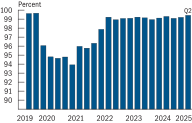
In the first half of 2025, the vast majority of banking organizations continued to report capital levels well above applicable regulatory requirements. As of the second quarter, over 99 percent of all banks were well capitalized (figure 1). Aggregate CET1 risk-based capital ratios were about 13 percent for both large and small banks, which is roughly the same level from a year earlier. Furthermore, 2025 stress test results showed that large banks are well positioned to weather a severe recession while maintaining minimum capital requirements and the ability to lend to households and businesses.
Figure 1. Share of well capitalized banks
Accessible Version | Return to text
Note: Banks that met the capital ratio requirements for the "well capitalized" designation according to the Prompt Corrective Action guidelines. See Notes on Data Sources and Terms for further information.
Source: Call Report and FR Y-9C.
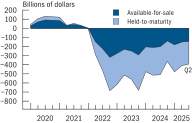
Tangible common equity (TCE) ratios, an alternate measure of bank capital, were also solid in the first half of 2025, but below pre-pandemic levels. Aggregate TCE grew to $2.2 trillion in the second quarter compared with $2.0 trillion one year earlier. The TCE ratio incorporates changes in the fair value of available-for-sale securities for all banks.1 Banks reported $143 billion in unrealized losses at fair value on available-for-sale securities as of the second quarter of 2025, lower than in the previous two quarters. They also reported $250 billion in unrealized losses at fair value on held-to-maturity securities (figure 2).2
Figure 2. Net fair value gains (losses) on investment securities
Accessible Version | Return to text
Note: Net fair value gains (losses) are computed as fair value less amortized cost.
Source: Call Report and FR Y-9C.
Liquidity and Funding Conditions Are Stable
Aggregate liquidity levels remained solid in the first half of 2025. Banking organizations subject to the liquidity coverage ratio (LCR) requirement maintained liquid asset levels well above regulatory requirements. At smaller banks, liquid asset levels were stable.
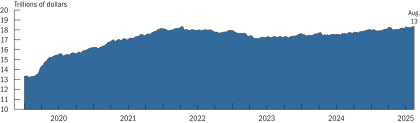
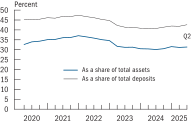
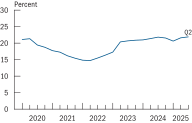
Funding risk for banks was in-line with historical norms in the first half of 2025. Aggregate deposit and liquid asset levels were stable over this period. Deposit growth at commercial banks continued as aggregate deposits reached a historical high of $18.3 trillion in August 2025 (figure 3). Uninsured deposits as a percentage of total assets and as a percentage of total deposits each remained below the level observed at the end of 2022 (figure 4). Lower levels of uninsured deposits help reduce funding vulnerabilities for banks. Over the first half of the year, aggregate wholesale funding as a share of total assets was roughly unchanged (figure 5), though G-SIB banks increased short-term wholesale funding, which can be more costly and less stable than insured deposits.
Figure 3. Deposits
Accessible Version | Return to text
Note: Data are seasonally adjusted and for all commercial banks.
Source: H.8, "Assets and Liabilities of Commercial Banks in the United States."
Figure 4. Uninsured deposits as a share of total assets and deposits
Accessible Version | Return to text
Note: Uninsured deposits are as reported or calculated using schedule RC-O Memoranda items of the Call Report.
Source: Call Report.
Figure 5. Wholesale funding as a share of total assets
Accessible Version | Return to text
Note: Wholesale funding is defined as the sum of brokered deposits under $250,000, federal funds purchased, securities sold under agreement to repurchase, subordinated notes and debentures, and other borrowed money.
Source: Call Report and FR Y-9C.
Loan Growth Was Strong as Most Major Loan Categories Experience Declines in Delinquency Rates
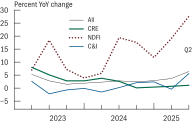
Aggregate loan growth across commercial banks was strong in the first half of 2025 reaching over 5 percent on an annual basis in the second quarter (figure 6). Most major loan categories experienced growth over this time horizon. After a slow first quarter, C&I loan growth exceeded 5 percent on an annualized basis in the second quarter. CRE loans grew modestly but at a higher rate relative to the latter half of 2024. Loans to nondepository financial institutions continue to expand as banks continue to partner with nonbank financial entities. Nonbank financial entities, such as private credit funds, are subject to less regulation and oversight than regulated banks and are gaining market share from banks by lending directly to companies. As a result, their risk appetite and risk management may be different than that of regulated banks. Recent defaults have further heightened regulators' attention to banks' exposures to nonbank financial entities. Thus far, realized losses on these exposures appear contained, and current supervisory monitoring reveals that banks are revisiting their underwriting policies and processes. Supervisors continue to monitor these events and conduct targeted supervisory work.
Figure 6. Loan growth by loan type
Accessible Version | Return to text
Source: H.8, "Assets and Liabilities of Commercial Banks in the United States."
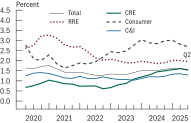
Loan delinquency rates decreased across most loan categories (figure 7). The total loan delinquency rate was about 1.5 percent in the first half of 2025, which is below the 10-year average of about 1.7 percent. In the last 10 years, the total quarterly peak delinquency rate is 2.5 percent. As of the second quarter of 2025, the available data showed limited delinquencies for loans to nondepository financial institutions.
Figure 7. Loan delinquency rates
Accessible Version | Return to text
Note: Delinquent loans are those 30+ days past due or in nonaccrual status.
Source: Call Report and FR Y-9C.
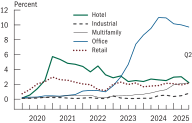
Despite declining somewhat, delinquency rates for CRE loans and consumer loans were above the average and median levels observed over the previous decade. The delinquency rate for CRE loans declined to about 1.5 percent, just below the highest quarterly rate observed over the past decade, which occurred in the first quarter of 2025. It remains roughly double the average over that period. At large banks, the delinquency rate for office loans also declined somewhat but remained near 10 percent in the second quarter of 2025 (figure 8). The aggregate delinquency rate for multifamily loans also declined somewhat from a 10-year high except at large banks where the rate was roughly constant.
Figure 8. Income-producing CRE loan delinquency rates by property type
Accessible Version | Return to text
Note: Delinquent loans are those 30+ days past due or in nonaccrual status.
Source: FR Y-14Q.
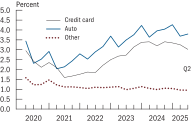
The delinquency rate for consumer loans leveled off over the first half of 2025. The credit card loan and auto loan delinquency rates shrank from a year earlier but remain above their 10-year quarterly average values (figure 9).
Figure 9. Consumer loan delinquency rates
Accessible Version | Return to text
Note: Delinquent loans are those 30+ days past due or in nonaccrual status.
Source: Call Report and FR Y-9C.
Banks Saw Solid Profitability in the First Half of 2025
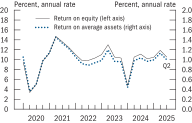
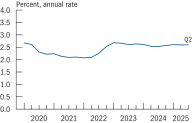
Return on average assets and return on equity were about 1 percent and 10.5 percent, respectively, in the first half of 2025. Both measures remained above their average levels over the past decade of 0.98 percent and 9.6 percent, respectively (figure 10). Aggregate net interest margins were flat but remained at a healthy level (figure 11).3 This reflected, in part, a decline in the cost of funding.
Figure 10. Bank return on average assets (ROAA) and return on equity (ROE)
Accessible Version | Return to text
Note: ROE is net income divided by average equity capital, and ROAA is net income divided by average assets.
Source: Call Report and FR Y-9C.
Figure 11. Aggregate net interest margin
Accessible Version | Return to text
Note: Net interest margin is net interest income divided by average earning assets.
Source: Call Report and FR Y-9C.
Market Indicators of Large Banks Implied Positive Risk Sentiment at the End of the Second Quarter
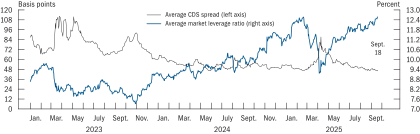
Market assessments of bank risk, including the market leverage ratio and credit default swap (CDS) spreads, provide a forward-looking assessment of a bank's financial strength. The market leverage ratio measures a bank's financial position based on the ratio of its market capitalization to the sum of market capitalization and the book value of liabilities. A lower price for the bank's stock reduces the market leverage ratio, while a higher price for the bank's stock increases the ratio. A higher market leverage ratio generally indicates a higher degree of market confidence in a bank's financial strength. As a complement to the market leverage ratio, CDS spreads track the price of insurance against a default by a given bank. If a bank's CDS spread increases, it means the market has lower confidence in the bank's creditworthiness. Conversely, lower CDS spreads indicate higher market confidence in a bank's creditworthiness.4
Average CDS spreads for the largest banks hovered towards the bottom of the range observed since 2015. The average market leverage ratio ended the second quarter close to a multiyear high (figure 12).
Figure 12. Average market leverage ratio and average credit default swap (CDS) spread (daily)
Accessible Version | Return to text
Note: The average market leverage ratio and the average CDS spread are calculated as simple averages from available observations for the eight LISCC firms (Bank of America Corporation; The Bank of New York Mellon Corporation; Citigroup Inc.; The Goldman Sachs Group; JPMorgan Chase & Co.; Morgan Stanley; State Street Corporation; and Wells Fargo & Company). See Notes on Data Sources and Terms for further information on the market leverage ratio and CDS spreads.
Source: Federal Reserve staff calculations using Bloomberg data.
Third Quarter 2025 Financial Results at Large Banks
Third-quarter earnings were solid at large banks.5 In the third quarter of 2025, median return on equity for large banks was 13 percent, compared with 12 percent in the second quarter of 2025. The quarter-over-quarter increase in large banks' median return on equity was driven by growth in net revenue and lower credit loss provisions, which outweighed higher operating expenses. Net revenue growth was driven by increased net interest income, as well as higher investment banking and wealth management fees.
Nonperforming loan-, loan loss-, and credit loss reserve-ratios slightly declined quarter-over-quarter in the third quarter of 2025 at most large banks despite a few large banks being exposed to a small number of bankruptcies by firms in the subprime auto sector.
Loan growth was solid at most banks in the third quarter of 2025, driven by most categories except residential and commercial real estate. While deposits increased quarter-over-quarter at most banks in the third quarter of 2025, deposit growth was outpaced by loan growth.
The median common equity tier 1 (CET1) capital ratio for large banks at the end of third quarter of 2025 was 11.0 percent. Most banks reported quarter-over-quarter increases in CET1 capital ratios, as incremental earnings offset increased shareholder distributions and risk-weighted asset growth.
References
1. In contrast to TCE, only the largest banks are required to include changes in the fair value of available-for-sale securities in CET1 capital. Return to text
2. Accounting standards do not require banks to reflect unrealized losses at fair value on held-to-maturity securities within equity capital. However, for held-to-maturity securities that were transferred from the available-for-sale category, unrealized losses at fair value that existed at the date of the transfer are reported within equity capital. Return to text
3. Net interest margin measures the difference between interest income and interest expense, relative to interest-earning assets. Return to text
4. See Notes on Data Sources and Terms for additional information on the market indicators. Return to text
5. This section is based on a sample of 22 large banks that includes Ally Financial Inc.; American Express Company; Bank of America Corporation; The Bank of New York Mellon Corporation; Capital One Financial Corporation; The Charles Schwab Corporation; Citigroup Inc.; Citizens Financial Group, Inc.; Fifth Third Bancorp; The Goldman Sachs Group, Inc.; Huntington Bancshares Incorporated; JPMorgan Chase & Co.; KeyCorp; M&T Bank Corporation; Morgan Stanley; Northern Trust Corporation; The PNC Financial Services Group, Inc.; Regions Financial Corporation; State Street Corporation; Truist Financial Corporation; U.S. Bancorp; and Wells Fargo & Company. Data are unadjusted for mergers and acquisitions. Return to text