


Background
The results of the 2025 stress test include information for each bank, such as capital ratios, pre-tax net income, losses, revenues, and expenses, projected under severely adverse economic and financial conditions.
Stress Test Process
The Federal Reserve projects these stress test results using a set of supervisory models that take as inputs bank-provided data on their financial conditions and risk characteristics, as well as the Federal Reserve's scenarios. The stress test uses models developed or selected by the Federal Reserve, which may be refined each year in advance of the stress test, and these models use bank-provided data collected primarily through regulatory reporting.6 This year, the supervisory severely adverse scenario is characterized by a severe global recession accompanied by a period of heightened stress in commercial and residential real estate markets, as well as in corporate debt markets.7
Participating Banks
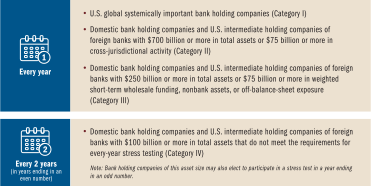
A total of 22 banks are participating in this year's stress test.8 Figure 5 shows when different types of banks are required to participate in the supervisory stress test, and table 3 lists participating banks for this year. In 2024, 31 banks participated in the stress test because Category IV banks are generally required to participate in the test every other year.9 Therefore, the aggregate results reported for the 2025 stress test are not fully comparable with the 2024 stress test results. This year, 20 banks were required to participate in the stress test, and two Category IV banks elected to participate.
Figure 5. When BHCs, covered SLHCs, and IHCs are required to participate in the supervisory stress test
The Board conducts stress tests of banks it supervises on an annual or two-year cycle. Based on a bank's financial condition, size, complexity, risk profile, risks to the U.S. economy, or scope of operations or activities, the Board may conduct a stress test of a bank more or less frequently than required.
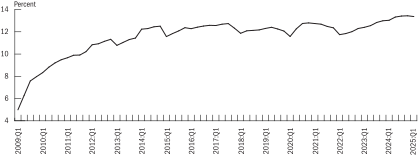
In the immediate years after the 2007–09 Global Financial Crisis, banks subject to the stress test substantially increased their capital, which has remained level for the past few years (see figure 6).
Table 3. Banks participating in the 2025 stress test
| Legal Name | Short Name | Risk Based Category |
|---|---|---|
| American Express Company | American Express | Category III |
| Bank of America Corporation | Bank of America | Category I |
| The Bank of New York Mellon Corporation | Bank of NY-Mellon | Category I |
| Barclays US LLC | Barclays US | Category III |
| BMO Financial Group | BMO | Category III |
| Capital One Financial Corporation | Capital One | Category III |
| The Charles Schwab Corporation | Charles Schwab Corp | Category III |
| Citigroup Inc. | Citigroup | Category I |
| DB USA Corporation | DB USA | Category III |
| The Goldman Sachs Group, Inc. | Goldman Sachs | Category I |
| JPMorgan Chase & Co. | JPMorgan Chase | Category I |
| M&T Bank Corporation | M&T | Category IV |
| Morgan Stanley | Morgan Stanley | Category I |
| Northern Trust Corporation | Northern Trust | Category II |
| The PNC Financial Services Group, Inc. | PNC | Category III |
| RBC US Group Holdings LLC | RBC USA | Category IV |
| State Street Corporation | State Street | Category I |
| TD Group US Holdings LLC | TD Group | Category III |
| Truist Financial Corporation | Truist | Category III |
| UBS Americas Holding LLC | UBS Americas | Category III |
| U.S. Bancorp | US Bancorp | Category III |
| Wells Fargo & Company | Wells Fargo | Category I |
Figure 6. Aggregate common equity capital ratio for 22 banks in the 2025 stress test
Accessible Version | Return to text
Note: The Federal Reserve's evaluation of a bank's common equity capital was initially measured using a tier 1 common capital ratio but now is evaluated using a common equity tier 1 capital ratio. Not all of the banks included in the 2025 stress test reported data for all periods since 2009.
Source: FR Y-9C.
Box 1. Model Adjustments in the 2025 Stress Test
The Federal Reserve regularly monitors model performance and evaluates whether any adjustments to models are warranted. The Board has opted to use largely identical models to those used during the 2024 stress test for the 2025 stress test. The only material changes to the models in the 2025 stress test are those that the Board began to phase in during the 2024 cycle, and the change in the treatment of private equity that was described in the December 30, 2024, Questions and Answers.1 Following the Federal Reserve's policies related to model risk management, these adjustments are reviewed by an independent validation group. Additionally, when producing stress test projections, the Federal Reserve considers issues specific to individual banks, such as the impact of recent mergers, acquisitions, or divestitures.
For the 2025 stress test, the Federal Reserve clarified how certain data should be reported by banks and made several model adjustments beyond those described in the stress test methodology document.2
- To improve the Federal Reserve's projection of expenses, the Federal Reserve adjusted the historical data for noninterest expense models to exclude certain "non-recurring" expenses. To make this adjustment, the Federal Reserve excluded expenses reported by the banks that were: (1) not likely to recur in the next two years or did not occur in the prior two years, or (2) those related to business changes (such as mergers, acquisitions, or divestitures).3
- Portfolio layer method (PLM) hedges can offset gains or losses associated with other comprehensive income from securities. The Federal Reserve adjusted securities models to include additional information on PLM hedges to more accurately project securities gains and losses in the stress test.
- When a bank sells assets or businesses, it may use divestiture accounting in its financial statements until the sale is consummated. Under divestiture accounting, a bank may list divested assets as discontinued operations, classify them as held for sale or available for sale instead of held for investment or held to maturity, and report revenues as income from discontinued operations. For the 2025 stress test, to ensure consistent treatment across assets with similar risks, the Federal Reserve adjusted certain input data that had been reclassified due to divestiture accounting to improve projections of loan losses and related income.
- Synthetic securitizations are a form of loss mitigation in which a bank partially transfers credit risk on specific portfolios to outside investors through credit derivatives or guarantees. The Federal Reserve incorporated a richer dataset and considered this type of credit protection in modeling fair-value-option/held-for sale loan losses.
1. See "Comprehensive Capital and Analysis Review and Dodd-Frank Act Stress Tests: Questions and Answers," SHK0502, December 30, 2024, Board of Governors of the Federal Reserve, https://www.federalreserve.gov/publications/ccar-qas/comprehensive-capital-analysis-and-review-questions-and-answers.htm. Return to text
2. See Board of Governors of the Federal Reserve System, 2025 Supervisory Stress Test Methodology (Washington: Board of Governors, June 2025), https://www.federalreserve.gov/publications/files/2025-june-supervisory-stress-test-methodology.pdf. Return to text
3. This recommended approach is consistent with the Board's letter to Goldman Sachs determining to recalculate its stress capital buffer requirement, as well as Securities and Exchange Commission guidance. See Board of Governors of the Federal Reserve System, "Response to request for reconsideration of The Goldman Sachs Group, Inc.'s preliminary stress capital buffer requirement, pursuant to the Board's capital plan rules," letter to David M. Solomon (Goldman Sachs), August 23, 2024, https://www.federalreserve.gov/newsevents/pressreleases/files/bcreg20240828a1.pdf; 17 C.F.R. § 229.10(e)(1)(ii)(B). Return to text
References
7. For more information on the models and bank-provided data, see Board of Governors of the Federal Reserve System, 2025 Supervisory Stress Test Methodology (Washington: Board of Governors, June 2025), https://www.federalreserve.gov/publications/files/2025-june-supervisory-stress-test-methodology.pdf. Return to text
8. For more information on the scenarios, see Board of Governors of the Federal Reserve System, 2025 Stress Test Scenarios (Washington: Board of Governors, February 2025), https://www.federalreserve.gov/publications/files/2025-stress-test-scenarios-20250205.pdf. Return to text
9. The Federal Reserve expects banks to wait until after 4:30 p.m. EDT on July 1, 2025, to publicly disclose any information about their planned capital actions and preliminary stress capital buffer requirements. This will give all banks sufficient time to examine and understand their individual results. Return to text
10. For more information on which banks participated in the 2024 stress test, see Board of Governors of the Federal Reserve System, 2024 Federal Reserve Stress Test Results (Washington: Board of Governors, June 2024), https://www.federalreserve.gov/publications/files/2024-dfast-results-20240626.pdf. Return to text