


Introduction
The 2025 stress test occurs in a year in which the Board has not yet completed changes to the stress test framework. Those changes are designed to increase transparency and reduce the year-over-year volatility of stress test results.
Summary of Results
The 2025 stress test results show that the 22 large banks subject to the test this year have sufficient capital to absorb nearly $550 billion in losses and continue lending to households and businesses under hypothetical stressful conditions.
Under the severely adverse scenario, the aggregate common equity tier 1 (CET1) capital ratio of the 22 banks subject to the stress test this year falls from an actual 13.4 percent in the fourth quarter of 2024 to its projected minimum of 11.6 percent, before rising to 12.8 percent at the end of the projection horizon (see table 1). The aggregate and individual bank post-stress CET1 capital ratios remain above the required minimum regulatory levels throughout the projection horizon.
Table 1. Aggregate capital ratios, actual, projected 2025:Q1–2027:Q1, and regulatory minimums
Percent
| Regulatory ratio | Actual 2024:Q4 | Stressed minimum capital ratios, severely adverse | Minimum regulatory capital ratios |
|---|---|---|---|
| Common equity tier 1 capital ratio | 13.4 | 11.6 | 4.5 |
| Tier 1 capital ratio | 14.9 | 13.2 | 6.0 |
| Total capital ratio | 16.9 | 15.3 | 8.0 |
| Tier 1 leverage ratio | 7.7 | 6.7 | 4.0 |
| Supplementary leverage ratio | 6.5 | 5.6 | 3.0 |
Note: The capital ratios are calculated using the capital action assumptions provided within the supervisory stress testing rules. See 12 C.F.R. §§ 238.132(d); 252.44(c). These projections represent hypothetical estimates that involve an economic outcome that is more adverse than expected. The minimum capital ratios are for the period 2025:Q1 to 2027:Q1. Supplementary leverage ratio projections only include estimates for banks subject to Category I, II, or III standards.
**Note: The Federal Reserve revised this report on September 30, 2025, the data in the "Stressed minimum capital ratios, severely adverse" column, "Tier 1 capital ratio" row, was revised.
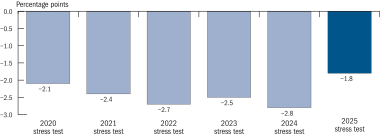
As shown in figure 2, the 1.8 percentage point aggregate decline this year is smaller than the aggregate decline in recent years.
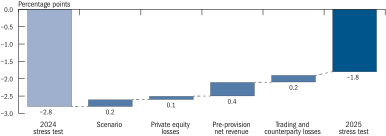
As highlighted in figure 3, several factors drive the smaller aggregate decline in CET1 capital ratios compared to the prior year:
Figure 2. Aggregate maximum decline in stressed common equity tier 1 capital ratio, severely adverse scenario
Accessible Version | Return to text
Note: Each bar represents the aggregate maximum common equity tier 1 (CET1) capital ratio decline of the banks in each exercise.
Figure 3. Decomposition of year-over-year changes in aggregate maximum decline in stressed common equity tier 1 capital ratio, severely adverse scenario
Accessible Version | Return to text
Note: The 2024 stress test bar shows the aggregate common equity tier 1 (CET1) capital decline resulting from the 2024 stress test. The scenario, private equity losses, pre-provision net revenue, and trading and counterparty losses bars show the impact that changes in each of these elements had on the difference between 2024 and 2025 stress test results. As a percent of starting risk-weighted assets, other changes accounting for less than 0.1 percent of the difference between 2025 stress test and 2024 stress test CET1 capital decline are not included in this chart. The 2025 stress test bar shows the aggregate CET1 capital decline resulting from the 2025 stress test. The sample includes the 22 banks subject to the supervisory stress test in 2025 compared with those 22 banks in the 2024 supervisory stress test. The figure is based on numbers at the minimum aggregate capital ratio quarter (fourth quarter) of the 2025 stress test. Values may not sum precisely due to rounding.
- Lower loan losses as a result of a less severe scenario: The 2025 severely adverse scenario is less severe than the 2024 severely adverse scenario. This is due to the mild slowing in the U.S. economy over 2024 and the countercyclical design of the Board's annual hypothetical scenario. For example, the 2025 severely adverse scenario features a smaller increase in the unemployment rate (+5.9 percentage points) compared with the 2024 scenario (+6.3 percentage points). Table 2 compares several scenario variables across the 2025 and 2024 severely adverse scenarios.
- Lower private equity losses due to change in treatment: As part of the 2025 stress test, private equity exposures are removed from the global market shock component of the stress test. Instead, losses on these exposures are projected under the severely adverse macroeconomic scenario. This change better aligns with the characteristics of private equity exposures, which are principally long-term investments that are managed as banking book positions.2
- Significantly higher projected pre-provision net revenue (PPNR) under stress, primarily as a result of strong recent profitability and models that are sensitive to recent data: Over the past year, bank profitability has improved due largely to robust capital markets activity and sustained strength in net interest margins. Through the lens of the Federal Reserve's models, stronger recent profitability leads to higher projections of PPNR under stress relative to recent years when bank profitability was not as strong.3
- Atypical trading positions: The stress test results also reflect trading positions driven by atypical client behavior at certain banks in early October 2024, when positions were measured for the 2025 stress test. These positions lead to a large improvement in trading losses for those banks in this year's test.
Table 2. Key variables in 2024 and 2025 supervisory severely adverse scenarios
| 2024 severely adverse | 2025 severely adverse | |
|---|---|---|
| Unemployment rate | ↑ 6.3 p.p. to 10% | ↑ 5.9 p.p. to 10% |
| Real GDP (peak-to-trough change) | ↓ 8.50% | ↓ 7.80% |
| House prices | ↓ 36% | ↓ 33% |
| CRE prices | ↓ 40% | ↓ 30% |
| 3-month Treasury | ↓ 5.3 p.p. to 0% | ↓ 4.4 p.p. to 0% |
| BBB-bond rate spread | ↑ 4.1 p.p. to 5.8% | ↑ 3.9 p.p. to 5.0% |
| Equity prices | ↓ 55% | ↓ 50% |
Note: p.p. is percentage point.
Further details on this year's results are provided in the "Results for Banks under the Severely Adverse Scenario" section of this report, which includes results presented both in the aggregate and for individual banks.
Implications of Changes to the Stress Test Framework
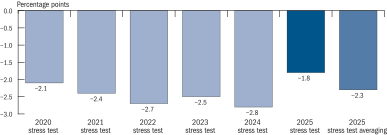
In April of this year, the Board proposed a rule to average the stress test results over two consecutive years to reduce the volatility in capital requirements.4 The Board is currently reviewing and considering the comments received on the proposal. If the Board finalizes the rule as proposed, it would require averaging this year's results with those of the 2024 stress test to calculate each bank's stress capital buffer requirement. Figure 4 shows the implications of this hypothetical averaging for the results that would inform banks' stress capital buffer requirements. Averaging the 2024 and 2025 results would lead to an aggregate post-stress capital decline of 2.3 percentage points.5
Figure 4. Aggregate maximum decline in stressed common equity tier 1 capital ratio, with averaging for 2025 stress test
Accessible Version | Return to text
Note: Each bar represents the aggregate maximum CET1 capital ratio decline of the banks in each exercise. The averaged aggregate decline is the result of averaging the 2024 and 2025 results for the 22 banks in this year's stress test, rounded to one decimal point.
In addition, in the coming months, the Board intends to improve the transparency of the stress test process by disclosing and seeking public comment on the models and scenario design framework that determine banks' hypothetical losses and revenues under stress. Through this new approach, the Board expects to obtain valuable feedback that could improve risk capture and model performance within the framework.
This report includes
- background information regarding the 2025 stress test,
- description of stress test model adjustments,
- stress test results,
- results of the 2025 exploratory analysis, and
- bank-specific stress test results (appendix A).
References
3. For more information on the models and bank-provided data, see Board of Governors of the Federal Reserve System, 2025 Supervisory Stress Test Methodology(Washington: Board of Governors, June 2025), https://www.federalreserve.gov/publications/files/2025-june-supervisory-stress-test-methodology.pdf. To improve the transparency of the stress test, the Board intends to disclose and seek public comment on the models and scenario design framework that determine the hypothetical losses and revenue of banks under stress. In light of this upcoming process, for the 2025 stress test, the Board opted to use largely identical models to those used during the 2024 stress test. Return to text
4. The Board's stress test models are sensitive to changes in recent data and the models tend to amplify the effect of recent changes in bank data. In particular, in the 2025 stress test, the pre-provision net revenue (PPNR) models respond strongly to an improvement in recent performance. This sensitivity to recent data leads to additional volatility in this year's results. Return to text
5. See Modifications to the Capital Plan Rule and Stress Capital Buffer Requirement, 90 Fed. Reg. 16,843 (April 22, 2025), https://www.federalregister.gov/documents/2025/04/22/2025-06863/modifications-to-the-capital-plan-rule-and-stress-capital-buffer-requirement. Return to text
6. The averaged aggregate decline is the result of averaging the 2024 and 2025 results for the 22 banks in this year's stress test, rounded to one decimal point. Return to text