


Results for Banks under the Severely Adverse Scenario
This section details the Federal Reserve's results for the 2025 supervisory stress test under the severely adverse scenario. The results are presented both in the aggregate and for individual banks.
The aggregate results incorporate the combined sensitivities of capital, losses, revenues, and expenses across all banks to the stressed economic and financial market conditions included in the severely adverse scenario. The range of results across individual banks indicates differences in business focus, asset composition, revenue and expense sources, and portfolio risk characteristics. Box 2 describes the results of the 2025 exploratory analysis. The comprehensive 2025 stress test results for individual banks are in appendix A.
Capital
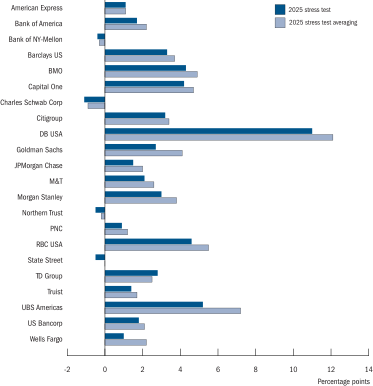
Under the severely adverse scenario, the aggregate CET1 capital ratio is projected to decline from an actual 13.4 percent at the start of the projection horizon to a minimum of 11.6 percent before rising to 12.8 percent at the end of nine quarters (see table 4). Tables 5 and 6 present post-stress minimum capital ratios for each bank and the change from the start of the projection horizon, which varies considerably across banks (see figure 7). This variation is due to differences in banks' business lines, portfolio composition, and securities and loan risk characteristics, which drive changes in the magnitude and timing of loss, revenue, and expense projections.
Table 4. Capital ratios and risk-weighted assets, actual 2024:Q4 and projected 2025:Q1–2027:Q1
Percent except as noted
| Regulatory ratio | Actual 2024:Q4 |
Projected 2027:Q1 |
Projected minimum |
|---|---|---|---|
| Common equity tier 1 capital ratio | 13.4 | 12.8 | 11.6 |
| Tier 1 capital ratio | 14.9 | 14.3 | 13.2 |
| Total capital ratio | 16.9 | 16.3 | 15.3 |
| Tier 1 leverage ratio | 7.7 | 7.3 | 6.7 |
| Supplementary leverage ratio | 6.5 | 6.2 | 5.6 |
| Risk-weighted assets1 (billions of dollars) | 10,364.9 | 10,288.0 |
Note: The capital ratios are calculated using the capital action assumptions provided within the supervisory stress testing rules. See 12 C.F.R. §§ 238.132(d); 252.44(c). These projections represent hypothetical estimates that involve an economic outcome that is more adverse than expected. The minimum capital ratios are for the period 2025:Q1 to 2027:Q1. Supplementary leverage ratio projections only include estimates for banks subject to Category I, II, or III standards.
**Note: The Federal Reserve revised this report on September 30, 2025, the data in the "Projected 2027:Q1" column for the "Common equity tier 1 capital ratio," "Tier 1 capital ratio," "Supplementary leverage ratio," and "Risk-weighted assets (billions of dollars)" rows were revised. The data in the "Projected minimum" column, "Tier 1
capital ratio" row, was revised.
1. For each quarter, risk-weighted assets are calculated under the Board's standardized approach to risk-based capital in 12 C.F.R. pt. 217, subpt. D. Return to table
Table 5. Projected minimum common equity tier 1 capital ratio under the severely adverse scenario, 2025:Q1–2027:Q1 22 banks
Percent
| Bank | Stressed ratios with supervisory stress testing capital action assumptions |
|---|---|
| American Express | 9.4 |
| Bank of America | 10.2 |
| Bank of NY-Mellon | 11.6 |
| Barclays US | 10.8 |
| BMO | 7.8 |
| Capital One | 9.2 |
| Charles Schwab Corp | 32.7 |
| Citigroup | 10.4 |
| DB USA | 12.7 |
| Goldman Sachs | 12.3 |
| JPMorgan Chase | 14.2 |
| M&T | 9.6 |
| Morgan Stanley | 12.9 |
| Northern Trust | 12.9 |
| PNC | 9.7 |
| RBC USA | 12.7 |
| State Street | 11.4 |
| TD Group | 13.8 |
| Truist | 10.2 |
| UBS Americas | 15.3 |
| US Bancorp | 8.8 |
| Wells Fargo | 10.1 |
Note: The capital ratios are calculated using the capital action assumptions provided within the supervisory stress testing rules. See 12 C.F.R. §§ 238.132(d); 252.44(c). These projections represent hypothetical estimates that involve an economic outcome that is more adverse than expected. The minimum capital ratio presented is for the period 2025:Q1 to 2027:Q1.
**Note: The Federal Reserve revised this report on September 30, 2025, the data point for Morgan Stanley was revised.
Source: Federal Reserve estimates in the severely adverse scenario.
Table 6. Capital ratios, actual 2024:Q4 and projected 2025:Q1–2027:Q1 under the severely adverse scenario: 22 banks
Percent
| Bank | Common equity tier 1 capital ratio |
Tier 1 capital ratio | Total capital ratio | Tier 1 leverage ratio | Supplementary leverage ratio1 |
||||||||||
|---|---|---|---|---|---|---|---|---|---|---|---|---|---|---|---|
| Actual 2024:Q4 |
Ending | Mini- mum |
Actual 2024:Q4 |
Ending | Mini- mum |
Actual 2024:Q4 |
Ending | Mini- mum |
Actual 2024:Q4 |
Ending | Mini- mum |
Actual 2024:Q4 |
Ending | Mini- mum |
|
| American Express | 10.5 | 12.7 | 9.4 | 11.2 | 13.3 | 10.1 | 13.2 | 15.4 | 12.1 | 9.8 | 11.6 | 8.7 | 8.3 | 9.8 | 7.4 |
| Bank of America | 11.9 | 10.7 | 10.2 | 13.2 | 12.1 | 11.5 | 15.1 | 14.1 | 13.8 | 6.9 | 6.3 | 6.0 | 5.9 | 5.3 | 5.1 |
| Bank of NY-Mellon | 11.2 | 14.8 | 11.6 | 13.7 | 17.4 | 14.1 | 14.8 | 18.4 | 15.2 | 5.7 | 7.2 | 5.9 | 6.5 | 8.2 | 6.7 |
| Barclays US | 14.1 | 13.0 | 10.8 | 15.5 | 14.4 | 12.3 | 17.3 | 16.4 | 14.3 | 8.3 | 7.8 | 6.5 | 5.8 | 5.4 | 4.5 |
| BMO | 12.1 | 7.8 | 7.8 | 12.8 | 8.5 | 8.5 | 14.6 | 10.4 | 10.4 | 9.2 | 6.0 | 6.0 | 8.0 | 5.2 | 5.2 |
| Capital One | 13.5 | 9.3 | 9.2 | 14.8 | 10.6 | 10.5 | 16.4 | 12.3 | 12.2 | 11.6 | 8.2 | 8.2 | 9.9 | 7.1 | 7.0 |
| Charles Schwab Corp | 31.7 | 37.0 | 32.7 | 39.8 | 45.0 | 40.8 | 39.8 | 45.4 | 40.9 | 9.9 | 11.3 | 10.2 | 9.8 | 11.2 | 10.1 |
| Citigroup | 13.6 | 12.5 | 10.4 | 15.3 | 14.2 | 12.2 | 18.1 | 17.0 | 15.0 | 7.2 | 6.6 | 5.6 | 5.8 | 5.3 | 4.5 |
| DB USA | 23.7 | 12.9 | 12.7 | 29.9 | 19.8 | 19.5 | 29.9 | 20.1 | 19.9 | 9.9 | 6.0 | 5.9 | 9.0 | 5.4 | 5.4 |
| Goldman Sachs | 15.0 | 16.3 | 12.3 | 16.8 | 18.2 | 14.1 | 18.8 | 20.2 | 16.5 | 6.8 | 7.4 | 5.7 | 5.5 | 5.9 | 4.6 |
| JPMorgan Chase | 15.7 | 15.8 | 14.2 | 16.8 | 16.9 | 15.3 | 18.5 | 18.7 | 17.2 | 7.2 | 7.3 | 6.5 | 6.1 | 6.1 | 5.5 |
| M&T | 11.7 | 9.6 | 9.6 | 13.2 | 11.1 | 11.1 | 14.7 | 12.7 | 12.7 | 10.2 | 8.6 | 8.6 | |||
| Morgan Stanley | 15.9 | 16.6 | 12.9 | 18.0 | 18.7 | 15.0 | 20.3 | 21.0 | 17.4 | 6.9 | 7.2 | 5.8 | 5.6 | 5.8 | 4.7 |
| Northern Trust | 12.4 | 13.5 | 12.9 | 13.3 | 14.4 | 13.8 | 15.1 | 16.9 | 16.3 | 8.1 | 8.8 | 8.4 | 8.9 | 9.6 | 9.2 |
| PNC | 10.5 | 9.8 | 9.7 | 11.9 | 11.2 | 11.0 | 13.6 | 12.7 | 12.7 | 9.0 | 8.5 | 8.3 | 7.5 | 7.0 | 6.9 |
| RBC USA | 17.3 | 12.7 | 12.7 | 17.3 | 12.7 | 12.7 | 18.0 | 13.8 | 13.8 | 12.0 | 8.5 | 8.5 | |||
| State Street | 10.9 | 14.4 | 11.4 | 13.2 | 16.6 | 13.7 | 14.8 | 18.5 | 15.4 | 5.2 | 6.6 | 5.4 | 6.2 | 7.8 | 6.4 |
| TD Group | 16.7 | 13.8 | 13.8 | 16.7 | 13.8 | 13.8 | 17.9 | 14.9 | 14.9 | 8.6 | 7.1 | 7.1 | 7.7 | 6.3 | 6.3 |
| Truist | 11.5 | 10.2 | 10.2 | 12.9 | 11.6 | 11.6 | 15.0 | 13.8 | 13.8 | 10.5 | 9.4 | 9.4 | 8.8 | 7.9 | 7.9 |
| UBS Americas | 20.5 | 15.5 | 15.3 | 24.1 | 19.6 | 19.5 | 24.4 | 20.8 | 20.7 | 9.6 | 6.9 | 6.9 | 8.3 | 6.0 | 5.9 |
| US Bancorp | 10.6 | 9.0 | 8.8 | 12.2 | 10.6 | 10.4 | 14.3 | 12.7 | 12.5 | 8.3 | 7.2 | 7.0 | 6.8 | 5.9 | 5.7 |
| Wells Fargo | 11.1 | 10.4 | 10.1 | 12.6 | 11.9 | 11.6 | 15.2 | 14.5 | 14.3 | 8.1 | 7.6 | 7.4 | 6.7 | 6.3 | 6.1 |
| 22 banks | 13.4 | 12.8 | 11.6 | 14.9 | 14.3 | 13.2 | 16.9 | 16.3 | 15.3 | 7.7 | 7.3 | 6.7 | 6.5 | 6.2 | 5.6 |
Note: The capital ratios are calculated using the capital action assumptions provided within the supervisory stress testing rules. See 12 C.F.R. §§ 238.132(d); 252.44(c). These projections represent hypothetical estimates that involve an economic outcome that is more adverse than expected. The minimum capital ratios are for the period 2025:Q1 to 2027:Q1.
**Note: The Federal Reserve revised this report on September 30, 2025, data in the Morgan Stanley row were revised. As a result, in the "22 banks" row, data were also revised in the "Common equity tier 1 capital ratio, ending;" "Tier 1 capital ratio, ending;" "Tier 1 capital ratio, minimum;" and "Supplementary leverage ratio, ending" columns.
1. Supplementary leverage ratio projections only include estimates for banks subject to Category I, II, or III standards. Return to table
Source: Federal Reserve estimates in the severely adverse scenario.
Figure 7. Change from start to minimum common equity tier 1 capital ratio in the severely adverse scenario for 2025 stress test and average common equity tier 1 capital decline of 2024 and 2025 stress test
Accessible Version | Return to text
Note: The top bars show the decline from the start of the 2025 stress test in 2024:Q4 to the minimum CET1 capital ratio in the 2025 stress test. The bottom bars show the average of the start-to-minimum capital decline in the 2025 stress test and the 2024 stress test. Estimates of minimum CET1 capital as a percent of risk-weighted assets are for the nine-quarter period from 2025:Q1 to 2027:Q1 for the 2025 stress test and the nine-quarter period from 2024:Q1 to 2026:Q1 for the 2024 stress test. Negative values indicate CET1 ratio increases. The averaged CET1 capital decline for State Street Corporation is 0.0.
**Note: The Federal Reserve revised this report on September 30, 2025, the data points for Morgan Stanley were revised.
Pre-tax Net Income
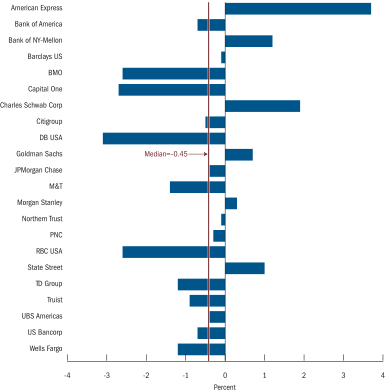
Projections of pre-tax net income are the largest component of post-stress changes in capital.10 Over the nine quarters of the projection horizon, aggregate cumulative pre-tax net income is projected to be negative $80 billion, which equals negative 0.4 percent of average total assets (see table 7). As a percent of average assets, projected cumulative pre-tax net income is negative for 16 of the 22 banks and varies considerably across banks, from negative 3.1 percent to positive 3.7 percent (see figure 8 and table 8). This range illustrates differences in the sensitivity of the various components of pre-tax net income to the economic and financial market conditions in the severely adverse scenario. These components include cumulative projections of losses and PPNR, which are discussed in further detail below.
Table 7. Projected aggregate losses, revenue, and net income before taxes through 2027:Q1 under the severely adverse scenario
| Item | Billions of dollars | Percent of average assets1 |
|---|---|---|
| Pre-provision net revenue | 469.3 | 2.3 |
| equals | ||
| Net interest income | 932.1 | 4.6 |
| Noninterest income | 860.4 | 4.3 |
| less | ||
| Noninterest expense2 | 1,323.2 | 6.6 |
| Other revenue3 | 0.0 | |
| less | ||
| Provisions for loan and lease losses | 472.6 | |
| Credit losses on investment securities (AFS/HTM)4 | 4.5 | |
| Trading and counterparty losses 5 | 42.4 | |
| Other losses/gains6 | 30.2 | |
| equals | ||
| Net income before taxes | -80.4 | -0.4 |
| Memo items | ||
| Other comprehensive income7 | 58.0 | |
| Other effects on capital | Actual 2024:Q4 | 2027:Q1 |
| AOCI included in capital (billions of dollars) | -96.7 | -38.7 |
**Note: The Federal Reserve revised this report on September 30, 2025, the data in the "Billions of dollars" column, "Trading and counterparty losses," "Other losses/gains," and "Net income before taxes" rows were revised.
1. Average assets is the nine-quarter average of total assets. Return to table
2. Noninterest expense includes losses from operational-risk events and other real estate owned (OREO) costs. Return to table
3. Other revenue includes one-time income and (expense) items not included in pre-provision net revenue. Return to table
4. The Federal Reserve incorporates its projection of expected credit losses on securities in the allowance for credit losses, in accordance with ASU 2016-13. Return to table
5. Trading and counterparty losses include mark-to-market and credit valuation adjustment (CVA) losses and losses arising from the counterparty default scenario component applied to derivatives, securities lending, and repurchase agreement activities. Return to table
6. Other losses/gains include projected change in fair value of loans held for sale or held for investment and measured under the fair-value option, losses/gains on hedges on loans measured at fair value or amortized cost, and losses on private equity investments. Return to table
7. Other comprehensive income is only calculated for banks subject to Category I or II standards or banks that opt in to including accumulated other comprehensive income (AOCI) in their calculation of capital. Return to table
Table 8. Projected losses, revenue, and net income before taxes through 2027:Q1 under the severely adverse scenario: 22 banks
Billions of dollars
| Bank | Sum of revenues | Minus sum of provisions and losses | Equals | Memo items |
Other effects on capital | ||||
|---|---|---|---|---|---|---|---|---|---|
| Pre-provision net revenue 1 | Other revenue 2 |
Provisions for loan and lease losses | Credit losses on investment securities (AFS/HTM) 3 | Trading and counterparty losses4 | Other losses/ gains 5 |
Net income before taxes |
Other compre- hensive income 6 |
AOCI included in capital (2027:Q1) |
|
| American Express | 37.4 | 0.0 | 27.2 | 0.0 | 0.0 | 0.2 | 10.0 | 0.0 | -3.4 |
| Bank of America | 49.6 | 0.0 | 61.3 | 0.4 | 7.4 | 3.6 | -23.0 | 5.0 | -4.7 |
| Bank of NY-Mellon | 8.4 | 0.0 | 1.4 | 0.2 | 1.8 | 0.0 | 5.0 | 2.6 | -2.1 |
| Barclays US | 5.9 | 0.0 | 4.5 | 0.0 | 1.2 | 0.3 | -0.1 | 0.0 | 0.0 |
| BMO | 4.3 | 0.0 | 12.0 | 0.0 | 0.0 | 0.0 | -7.7 | 0.0 | 0.0 |
| Capital One | 39.1 | 0.0 | 52.1 | 0.3 | 0.0 | 0.0 | -13.3 | 0.0 | 0.0 |
| Charles Schwab Corp | 11.1 | 0.0 | 2.1 | -0.2 | 0.0 | 0.0 | 9.2 | 0.0 | 0.0 |
| Citigroup | 48.1 | 0.0 | 47.4 | 0.5 | 8.4 | 3.1 | -11.3 | 6.6 | -41.0 |
| DB USA | -1.0 | 0.0 | 0.8 | 0.0 | 1.5 | 0.2 | -3.5 | 0.0 | -0.2 |
| Goldman Sachs | 39.7 | 0.0 | 20.3 | 0.0 | 0.3 | 7.5 | 11.7 | 2.8 | 0.1 |
| JPMorgan Chase | 92.7 | 0.0 | 89.0 | 1.3 | 10.2 | 6.4 | -14.2 | 19.2 | 11.6 |
| M&T | 6.2 | 0.0 | 9.0 | 0.0 | 0.0 | 0.1 | -2.9 | 0.0 | 0.0 |
| Morgan Stanley | 27.0 | 0.0 | 12.7 | 0.1 | 5.4 | 5.6 | 3.3 | 3.0 | -3.7 |
| Northern Trust | 4.0 | 0.0 | 4.0 | 0.2 | 0.0 | 0.0 | -0.1 | 1.1 | 0.3 |
| PNC | 14.9 | 0.0 | 16.6 | 0.1 | 0.0 | 0.1 | -2.0 | 0.0 | 0.0 |
| RBC USA | 1.9 | 0.0 | 5.7 | 0.6 | 0.0 | 0.0 | -4.4 | 0.0 | 0.0 |
| State Street | 6.1 | 0.0 | 1.7 | 0.1 | 1.0 | 0.0 | 3.4 | 1.6 | -0.3 |
| TD Group | 4.3 | 0.0 | 10.7 | 0.2 | 0.0 | 0.0 | -6.6 | 0.0 | 0.0 |
| Truist | 14.3 | 0.0 | 19.1 | 0.1 | 0.0 | 0.1 | -4.9 | 0.0 | 0.0 |
| UBS Americas | 2.2 | 0.0 | 3.1 | 0.0 | 0.0 | 0.0 | -0.9 | 0.0 | -0.1 |
| US Bancorp | 17.6 | 0.0 | 22.5 | 0.1 | 0.0 | 0.0 | -5.0 | 0.0 | 0.0 |
| Wells Fargo | 35.3 | 0.0 | 49.7 | 0.5 | 5.2 | 2.9 | -23.0 | 15.9 | 4.8 |
| 22 banks | 469.3 | 0.0 | 472.6 | 4.5 | 42.4 | 30.2 | -80.4 | 58.0 | -38.7 |
Note: These projections represent hypothetical estimates that involve an economic outcome that is more adverse than expected. Values may not sum precisely due to rounding.
**Note: The Federal Reserve revised this report on September 30, 2025, the data in the "Trading and counterparty losses," "Other losses/gains," and "Net income before taxes" columns were revised for Morgan Stanley and the "22 banks" row.
1. Pre-provision net revenue includes losses from operational-risk events and other real estate owned (OREO) costs. Return to table
2. Other revenue includes one-time income and (expense) items not included in pre-provision net revenue. Return to table
3. The Federal Reserve incorporates its projection of expected credit losses on securities in the allowance for credit losses, in accordance with ASU 2016-13. Return to table
4. Trading and counterparty losses include mark-to-market and credit valuation adjustment (CVA) losses and losses arising from the counterparty default scenario component applied to derivatives, securities lending, and repurchase agreement activities. Return to table
5. Other losses/gains include projected change in fair value of loans held for sale or held for investment and measured under the fair-value option, losses/gains on hedges on loans measured at fair value or amortized cost, and losses on private equity investments. Return to table
6. Other comprehensive income is only calculated for banks subject to Category I or II standards or banks that opt in to including accumulated other comprehensive income (AOCI) in their calculation of capital. Return to table
Source: Federal Reserve estimates in the severely adverse scenario.
Figure 8. Pre-tax net income rates in the severely adverse scenario
Accessible Version | Return to text
Note: Estimates are for the nine-quarter period from 2025:Q1 to 2027:Q1 as a percent of average assets.
**Note: The Federal Reserve revised this report on September 30, 2025, the data point for Morgan Stanley was revised.
Losses
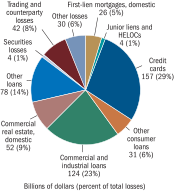
Over the projection horizon, aggregate losses on loans and other positions are projected to be $549 billion. These losses comprise
- $472 billion in loan losses, accounting for 86 percent of total losses;
- $30 billion in additional losses from items such as loans booked under the fair-value option (see table 7), accounting for 6 percent of total losses;
- $42 billion in trading and counterparty losses at the 10 banks with substantial trading, processing, or custodial operations, accounting for 8 percent of total losses; and11
- $4 billion in securities losses, accounting for 1 percent of total losses (see figure 9).12
Figure 9. Projected losses in the severely adverse scenario
Accessible Version | Return to text
Note: Percent of total losses may not sum to 100 because of rounding. Total losses in billions may not sum to the reported total losses because of rounding.
**Note: The Federal Reserve revised this report on September 30, 2025, the percentages for "Credit cards" and "Commercial and industrial loans" and the dollar amounts for "Trading and counterparty losses" and "Other losses" were revised.
For loans measured at amortized cost, projected aggregate losses are $472 billion, with the loan loss rate at 6.6 percent (see table 9).13 These loan losses flow into pre-tax net income through the projection of provisions for loan and lease losses, which is $473 billion in aggregate and takes into account banks' established allowances for credit losses at the start of the projection horizon.14
Table 9. Projected aggregate loan losses, by type of loan, under the severely adverse scenario, 2025:Q1–2027:Q1
| Loan type | Billions of dollars | Portfolio loss rates (percent)1 |
|---|---|---|
| Loan losses | 471.9 | 6.6 |
| First-lien mortgages, domestic | 25.7 | 1.9 |
| Junior liens and HELOCs,2 domestic | 4.3 | 3.4 |
| Commercial and industrial3 | 123.9 | 8.4 |
| Commercial real estate, domestic | 51.6 | 7.2 |
| Credit cards | 157.5 | 16.9 |
| Other consumer 4 | 31.3 | 5.3 |
| Other loans 5 | 77.5 | 3.9 |
1. Average loan balances used to calculate portfolio loss rates exclude loans held for sale, loans held for investment under the fair-value option, and Paycheck Protection Program loans and are calculated over nine quarters. Return to table
2. HELOCs (home equity lines of credit). Return to table
3. Commercial and industrial loans include small- and medium-enterprise loans and corporate cards. Return to table
4. Other consumer loans include student loans and automobile loans. Return to table
5. Other loans include international real estate loans. Return to table
Projected consumer loan losses represent a smaller share (40 percent) of total losses than commercial loan losses (46 percent). The loan portfolio that constitutes the largest amount of losses is credit cards, representing 29 percent of total losses.
Total loan loss rates vary significantly across banks, ranging between 1.2 percent and 16.4 percent (see table 10). This range results from differences in loan portfolio composition, which materially affects losses because projected loss rates vary significantly for different types of loans. For example, aggregate loan loss rates range from 1.9 percent on domestic first-lien mortgages to 16.9 percent on credit cards because of the sensitivity and historical performance of these loans. Some loan portfolios are sensitive to home prices or unemployment rates and may experience high stressed loss rates due to the considerable stress on these factors in the severely adverse scenario.15
Table 10. Projected loan losses by type of loan for 2025:Q1–2027:Q1 under the severely adverse scenario: 22 banks
Percent of average loan balances
| Bank | Loan losses1 |
First-lien mortgages, domestic |
Junior liens and HELOCs, 2 domestic |
Commercial and industrial3 |
Commercial real estate, domestic |
Credit cards | Other consumer4 |
Other loans5 |
|---|---|---|---|---|---|---|---|---|
| American Express | 11.8 | 0.0 | 5.1 | 15.5 | 0.0 | 9.7 | 16.9 | 3.2 |
| Bank of America | 5.2 | 1.8 | 2.8 | 5.9 | 9.1 | 16.5 | 2.2 | 3.2 |
| Bank of NY-Mellon | 1.8 | 2.0 | 7.3 | 4.5 | 5.7 | 0.0 | 0.6 | 1.4 |
| Barclays US | 12.5 | 0.0 | 0.0 | 17.5 | 4.0 | 16.5 | 16.7 | 0.9 |
| BMO | 7.4 | 3.1 | 5.0 | 8.3 | 8.8 | 17.0 | 9.6 | 7.2 |
| Capital One | 16.4 | 2.3 | 7.0 | 12.8 | 13.1 | 23.4 | 10.0 | 5.8 |
| Charles Schwab Corp | 1.2 | 1.5 | 5.2 | 9.9 | 0.0 | 0.0 | 0.6 | 0.9 |
| Citigroup | 7.5 | 2.7 | 4.3 | 5.2 | 8.3 | 16.6 | 18.8 | 3.1 |
| DB USA | 4.2 | 2.7 | 11.1 | 2.3 | 7.2 | 0.0 | 7.3 | 2.9 |
| Goldman Sachs | 8.0 | 2.7 | 5.1 | 16.3 | 17.0 | 23.4 | 3.5 | 4.6 |
| JPMorgan Chase | 6.6 | 1.6 | 2.1 | 12.6 | 2.9 | 16.0 | 2.9 | 4.9 |
| M&T | 6.3 | 2.5 | 4.5 | 7.5 | 5.8 | 17.8 | 9.2 | 7.0 |
| Morgan Stanley | 3.9 | 2.1 | 5.7 | 15.3 | 9.3 | 0.0 | 1.0 | 3.9 |
| Northern Trust | 7.4 | 2.5 | 5.1 | 7.5 | 13.1 | 0.0 | 16.6 | 6.9 |
| PNC | 5.4 | 1.8 | 3.3 | 6.8 | 7.5 | 18.2 | 3.5 | 3.2 |
| RBC USA | 6.5 | 3.1 | 5.9 | 10.0 | 11.1 | 17.8 | 15.4 | 3.2 |
| State Street | 3.3 | 0.0 | 0.0 | 7.1 | 4.4 | 0.0 | 0.0 | 2.8 |
| TD Group | 5.7 | 2.5 | 5.6 | 8.5 | 6.6 | 20.7 | 2.9 | 2.9 |
| Truist | 5.9 | 1.8 | 3.5 | 7.2 | 7.1 | 16.4 | 9.5 | 3.9 |
| UBS Americas | 2.8 | 2.8 | 0.0 | 3.2 | 9.8 | 17.8 | 0.6 | 7.5 |
| US Bancorp | 6.3 | 2.0 | 5.4 | 8.2 | 8.0 | 16.3 | 7.2 | 4.5 |
| Wells Fargo | 5.5 | 1.3 | 1.2 | 7.2 | 8.3 | 17.8 | 4.5 | 4.3 |
| 22 banks | 6.6 | 1.9 | 3.4 | 8.4 | 7.2 | 16.9 | 5.3 | 3.9 |
Note: These projections represent hypothetical estimates that involve an economic outcome that is more adverse than expected. Values may not sum precisely due to rounding.
1. Average loan balances used to calculate portfolio loss rates exclude loans held for sale, loans held for investment under the fair-value option, and Paycheck Protection Program loans and are calculated over nine quarters. Return to table
2. HELOCs (home equity lines of credit). Return to table
3. Commercial and industrial loans include small- and medium-enterprise loans and corporate cards. Return to table
4. Other consumer loans include student loans and automobile loans. Return to table
5. Other loans include international real estate loans. Return to table
Source: Federal Reserve estimates in the severely adverse scenario.
Loan loss rates also reflect differences in the characteristics of loans within each portfolio. For example, the median projected loss rate on commercial and industrial (C&I) loans across all banks is 7.8 percent. The loss rate on C&I loans among individual banks ranges from 2.3 percent to 17.5 percent. For credit cards, the range of projected loss rates among banks is 9.7 percent to 23.4 percent, and the median is 17.4 percent.
For loans measured at fair value, losses enter pre-tax net income through the other loans loss category (see table 8). Loans measured at amortized cost and those measured at fair value generally have similar risk factors, but the latter are exposed to risk from the effects of market fluctuations, which can lead to more severe market value losses in periods of high market volatility or asset illiquidity.
Aggregate trading and counterparty losses, which also flow into pre-tax net income, are $42 billion for the 10 banks subject to the global market shock component and/or the largest counterparty default component of the severely adverse scenario. Individual bank losses range from less than $1 billion to more than $10 billion, resulting from the specific risk characteristics of each bank's trading positions and counterparty exposures, inclusive of hedges (see table 8). Importantly, these projected losses are based on the trading positions and counterparty exposures held by banks on the same as-of date (October 11, 2024) and could have varied if they had been based on a different date.
Aggregate credit losses on investment securities are $4 billion (see table 7). In addition, unrealized gains and losses on AFS debt securities are reflected in accumulated other comprehensive income (AOCI).16 Other comprehensive income (OCI) is projected to be $58 billion in aggregate.
Pre-provision Net Revenue
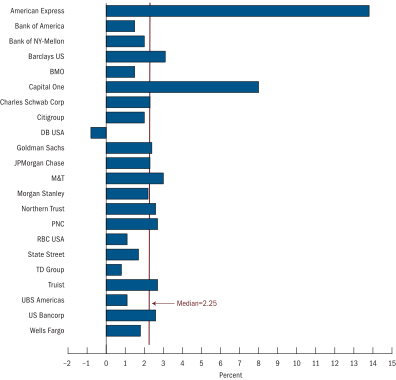
Pre-tax net income also includes projections of post-stress income and expenses captured in pre-provision net revenue (PPNR). Over the projection horizon, banks are projected to generate an aggregate of $469 billion in PPNR, which is equal to 2.3 percent of their combined average assets (see table 7).
PPNR projections are generally driven by the shape of the yield curve, the path of asset prices, equity market volatility, and measures of economic activity in the severely adverse scenario. In addition, PPNR incorporates expenses stemming from operational-risk events, such as fraud, employee lawsuits, litigation-related expenses, or computer system or other operating disruptions.17 In the aggregate, operational-risk losses are $179 billion for the 22 banks in the 2025 stress test. This amount is slightly lower than the $182 billion projected for the same set of banks in the 2024 stress test.
The ratio of PPNR to average assets varies across banks (see figure 10), primarily because of differences in business focus. For instance, the ratio of PPNR to assets tends to be higher at banks focusing on credit card lending, since credit cards generally produce higher net interest income relative to other forms of lending.18 Additionally, lower ratios of PPNR to assets do not necessarily imply lower pre-tax net income, because the same business focus and risk characteristics determining differences in PPNR across banks could also result in offsetting projected losses.
Figure 10. Pre-provision net revenue rates in the severely adverse scenario
Accessible Version | Return to text
Note: Estimates are for the nine-quarter period from 2025:Q1 to 2027:Q1 as a percent of average assets.
Box 2. Summary of Results of Exploratory Analysis of Risks to Banking System
As a companion to the 2025 supervisory stress test, the Federal Reserve conducted an exploratory analysis. This analysis complements the stress test by providing aggregate banking system results against different economic and financial conditions. The exploratory analysis is distinct from the stress test and does not affect large bank capital requirements.
This year's exploratory analysis consists of two elements.1 The first element examines credit and liquidity shocks in the nonbank financial institution (NBFI) sector during a severe global recession.2 The second element is an exploratory market shock featuring a sudden dislocation to financial markets stemming from expectations of reduced global economic activity and higher inflation expectations.3
Results of Nonbank Financial Institution Stress Analysis
The NBFI stress is motivated by rapid growth in large bank credit commitments to NBFIs over the past five years, which reached about $2.3 trillion in the fourth quarter of 2024 at large banks.4 While total loans at large banks increased by 21 percent over this period, lending to NBFIs at large banks has grown by 56 percent. This rapid growth poses risks to banks, as certain NBFIs operate with high leverage and are dependent on funding from the banking sector.
The NBFI stress analysis features a credit component and a liquidity component:
- The credit component assumes rapid deterioration in the credit quality of assets held by highly leveraged NBFIs, leading to downgrades in their own credit ratings.5 The analysis assumes that each borrower in these sub-sectors is downgraded by one credit rating grade (for example, from A to BBB) at the beginning of the stress horizon.
- The liquidity component assumes certain NBFIs draw more heavily on their lines of credit with banks.6 These sub-sectors have historically relied more heavily on the banks' lines of credit in times of stress. This component assumes that borrowers in these two sub-sectors would draw 100 percent of their available undrawn line of credit.
(continued)
1. For more information on the parameters for the exploratory analysis, see Board of Governors of the Federal Reserve System, Exploratory Analysis of Risks to the Banking System (Washington: Board of Governors, February 2025), https://www.federalreserve.gov/publications/files/exploratory-analysis-of-risks-to-the-banking-system-20250205.pdf. Return to text
2. This element applies to all 22 banks subject to the supervisory stress test. Return to text
3. This element applies only to the eight U.S. globally systemically important banks (G-SIBs). The Bank of New York Mellon Corporation and State Street Corporation were only subject to the hedge fund counterparty default components of the exploratory market shocks; the results do not include mark-to-market losses on their trading or credit valuation adjustments exposures. The exploratory market shocks are applied to positions held by the banks on October 11, 2024. Return to text
4. See figure 3.15 in Board of Governors of the Federal Reserve System, Financial Stability Report (Washington: Board of Governors, April 2025), https://www.federalreserve.gov/publications/files/financial-stability-report-20250425.pdf. Return to text
5. The sub-sectors are: (1) private equity, business development companies, and credit funds; (2) broker-dealers; and (3) special purpose entities, collateralized loan obligations, and asset-backed securities. Return to text
6. The sub-sectors are real estate investment trusts (REITs) and other financial vehicles. Other financial vehicles includes hedge funds; closed-end funds; and firms engaged in financial planning, investment management, and pension management activities, among others. Return to text
Box 2—continued
The results of the NBFI stress analysis suggest that the banking system is able to withstand the additional credit and liquidity stress to selected NBFI sub-sectors included in the exploratory analysis. Under NBFI stress, the aggregate CET1 capital ratio is projected to fall by 1.6 percentage points to a minimum of 11.9 percent.1 Through the nine-quarter projection, total loan losses are estimated around $490 billion.
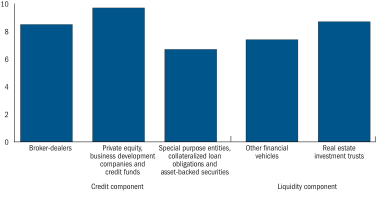
Both the credit and liquidity components of the NBFI stress increase loan loss projections. Over the projection horizon, the credit component increases the loss rate on the loans subject to the credit component by about 3 percentage points on average, while the liquidity component increases the loss rate on the set of loans subject to the liquidity component by about 1.5 percentage points on average. The projected loss rates vary across sub-sectors depending on the risk characteristics of the underlying loans (see figure A). The overall loss rate on loans to financial institutions under the NBFI stress is around 7 percent.
This exploratory analysis shows that large banks are generally well-positioned to withstand significant additional credit and liquidity stresses to major categories of NBFI lending exposures. The resilience of individual banks to these additional stresses depends on their exposures to the sub-sectors subjected to the credit and liquidity components and, for those subject to the credit component, the starting distribution of credit ratings of those borrowers.
(continued)
1. The NBFI element does not include trading or counterparty losses from the global market shock or exploratory market shock. Values may not sum precisely due to rounding. Return to text
Box 2—continued
Results of Exploratory Market Shock Analysis
The exploratory market shock is characterized by a sudden dislocation to financial markets stemming from expectations of reduced global economic activity and higher inflation expectations.1 A separate add-on component tests the results of equity market dislocations on large banks' counterparty exposures to hedge funds. This component applies stresses to valuations of single-name U.S. equity exposures held by hedge fund counterparties.2 Hedge funds unable to meet margin calls are assumed to be forced to liquidate equity positions at a loss; the five hedge funds with the largest counterparty exposures for each bank are assumed to fail.
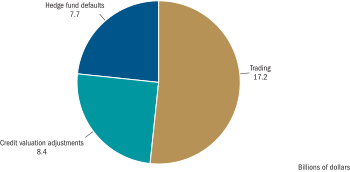
The results of the exploratory market shock element suggest that the largest and most complex banks can withstand a market shock stemming from higher inflation expectations. Under the exploratory market shock scenario, trading losses at U.S. global systemically important banks (G-SIBs) are expected to be about $17 billion. Aggregate losses from the assumed default of the hedge funds are moderate, amounting to roughly $8 billion.
The purpose of the market shock element is to assess the resilience of the largest and most complex banks to a wider variety of shocks. Despite significant variation in the performance of certain asset classes, results show that banks are well positioned against various potential outcomes, particularly in their trading books. Additionally, the largest and most complex banks demonstrated manageable exposure to single-name equity risk at hedge fund counterparties.
1. A shock of -20 percent is applied to U.S. equities. Return to text
2. To represent the potential for further stress in concentrated positions that large banks finance at their hedge fund clients, long single-name equity positions receive a shock of -35 percent, while short single-name equity positions receive a shock of -10 percent. Return to text
References
11. For risk-based capital ratios, the numerator is capital, which is primarily impacted from pre-tax net income and gains/losses on available-for-sale (AFS) debt securities. The denominator for risk-based capital ratios is risk-weighted assets. Risk-weighted assets change minimally throughout the projection horizon as the result of an assumption that a bank's assets generally remain unchanged. Return to text
12. The banks subject to the global market shock component and/or the largest counterparty default component are Bank of America Corporation; The Bank of New York Mellon Corporation; Barclays US LLC; Citigroup, Inc.; DB USA Corporation; The Goldman Sachs Group, Inc.; JPMorgan Chase & Co.; Morgan Stanley; State Street Corporation; and Wells Fargo & Company. Return to text
13. For banks that have adopted ASU 2016-13, the Federal Reserve incorporated its projection of expected credit losses on securities in the allowance for credit losses, in accordance with Financial Accounting Standards Board (FASB), "Financial Instruments–Credit Losses (Topic 326)," FASB ASU 2016-13 (Norwalk, CT: FASB, June 2016). Prior to the adoption of ASU 2016-13, securities credit losses were realized through other-than-temporary impairment. Return to text
14. The loss rate is calculated as total projected loan losses over the nine quarters of the projection horizon divided by average loan balances over the horizon. Return to text
15. Provisions for loan and lease losses equal projected loan losses plus the amount needed for the allowance to be at an appropriate level at the end of each quarter. Return to text
16. In addition, losses are calculated based on the exposure at default, which includes both outstanding balances and any additional drawdown of the credit line that occurs prior to default, while loss rates are calculated as a percentage of average outstanding balances over the projection horizon. Return to text
17. Only banks subject to Category I or II standards or banks that opt in are required to include unrealized gains and losses on AFS debt securities in the calculation of capital. Category III and IV banks are not required to include unrealized gains and losses on AFS debt securities in the calculation of capital. Return to text
18. These operational-risk expenses are not a supervisory estimate of banks' current or expected legal liability, as they are conditional on the severely adverse scenario and conservative assumptions, and they also incorporate the potential for substantial losses that do not involve litigation or legal exposure. Return to text
19. Credit card lending also tends to generate relatively high loss rates, suggesting that the higher PPNR rates at these banks do not necessarily indicate higher profitability. Return to text