


Background
The results of the 2026 stress test include information for each bank, such as capital ratios, pre-tax net income, losses, revenues, and expenses, projected under severely adverse economic and financial conditions.
Stress Test Process
The Federal Reserve projects stress test results using a set of supervisory models that take as inputs bank-provided data on their financial conditions and risk characteristics, as well as the Federal Reserve's scenarios. The stress test uses models developed or selected by the Federal Reserve, which may be refined each year in advance of the stress test, and these models use bank-provided data collected primarily through regulatory reporting.10 As noted in the introduction, the Federal Reserve is currently reviewing comments on proposed changes to its stress test process.
This year, the supervisory severely adverse scenario is characterized by a severe global recession accompanied by a period of heightened stress in commercial and residential real estate markets, as well as in corporate debt markets.11 The scenario was designed based on the Federal Reserve's scenario design framework and reflected input from the public.12
Participating Banks
A total of 32 banks are participating in this year's stress test. Figure 3 shows when different types of banks are required to participate in the supervisory stress test and table 3 lists participating banks for this year. In 2025, 22 banks participated in the stress test because banks subject to Category IV standards are generally required to participate in the test every other year.13 Therefore, the aggregate results reported for the 2026 stress test are not fully comparable with the 2025 stress test results.
Figure 3. When BHCs, covered SLHCs, and IHCs are required to participate in the supervisory stress test
The Board conducts stress tests of banks it supervises on an annual or two-year cycle. Based on a bank's financial condition, size, complexity, risk profile, risks to the U.S. economy, or scope of operations or activities, the Board may conduct a stress test of a bank more or less frequently than required.
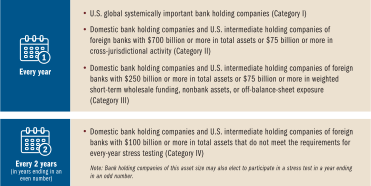
Table 3. Banks Participating in the 2026 Stress Test
| Legal Name | Short Name | Risk Based Category |
|---|---|---|
| Ally Financial Inc. | Ally | Category IV |
| American Express Company | American Express | Category III |
| Bank of America Corporation | Bank of America | Category I |
| The Bank of New York Mellon Corporation | Bank of NY-Mellon | Category I |
| Barclays US LLC | Barclays US | Category III |
| BMO Financial Corp. | BMO | Category III |
| Capital One Financial Corporation | Capital One | Category III |
| The Charles Schwab Corporation | Charles Schwab Corp | Category III |
| Citigroup Inc. | Citigroup | Category I |
| Citizens Financial Group, Inc. | Citizens | Category IV |
| DB USA Corporation | DB USA | Category III |
| Fifth Third Bancorp | Fifth Third | Category IV |
| First Citizens Bancshares, Inc. | First Citizens | Category IV |
| The Goldman Sachs Group, Inc. | Goldman Sachs | Category I |
| HSBC North America Holdings Inc. | HSBC | Category IV |
| Huntington Bancshares Incorporated | Huntington | Category IV |
| JPMorgan Chase & Co. | JPMorgan Chase | Category I |
| KeyCorp | KeyCorp | Category IV |
| M&T Bank Corporation | M&T | Category IV |
| Morgan Stanley | Morgan Stanley | Category I |
| Northern Trust Corporation | Northern Trust | Category II |
| The PNC Financial Services Group, Inc. | PNC | Category III |
| RBC US Group Holdings LLC | RBC USA | Category III |
| Regions Financial Corporation | Regions | Category IV |
| Santander Holdings USA, Inc. | Santander | Category IV |
| State Street Corporation | State Street | Category I |
| Synchrony Financial | Synchrony Fncl | Category IV |
| TD Group US Holdings LLC | TD Group | Category III |
| Truist Financial Corporation | Truist | Category III |
| UBS Americas Holding LLC | UBS Americas | Category III |
| U.S. Bancorp | US Bancorp | Category III |
| Wells Fargo & Company | Wells Fargo | Category I |
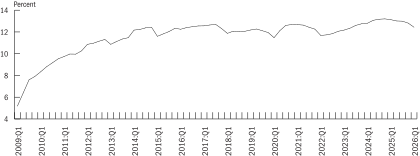
In the immediate years after the 2007–09 Global Financial Crisis, banks subject to the stress test substantially increased their capital. The aggregate common equity tier 1 capital ratio declined from 13.2 percent to 12.8 percent in 2025 but was generally in line with levels seen over the past decade (see figure 4). The capital ratio at the end of 2025 served as the starting point for the 2026 stress test.
Figure 4. Aggregate common equity capital ratio for 32 banks in the 2026 stress test
Accessible Version | Return to text
Note: The Federal Reserve's evaluation of a bank's common equity capital was initially measured using a tier 1 common capital ratio but now is evaluated using a common equity tier 1 capital ratio. Not all of the banks included in the 2026 stress test reported data for all periods since 2009.
Source: FR Y-9C.
References
10. For more information, see Board of Governors of the Federal Reserve System, 2026 Supervisory Stress Test Methodology (Board of Governors, February 2026), https://www.federalreserve.gov/publications/files/2026-february-supervisory-stress-test-methodology.pdf. Return to text
11. For more information on the scenarios, see Board of Governors of the Federal Reserve System, 2026 Stress Test Scenarios (Board of Governors, February 2026), https://www.federalreserve.gov/publications/files/2026-final-supervisory-stress-test-scenarios-20260204.pdf. Return to text
12. See Board of Governors of the Federal Reserve System, "Federal Reserve Board Finalizes Hypothetical Scenarios for Its Annual Stress Test and Votes to Maintain the Current Stress Test-related Capital Requirements until Public Feedback Can Be Considered," press release, February 4, 2026, https://www.federalreserve.gov/newsevents/pressreleases/bcreg20260204a.htm. Return to text
13. For more information on which banks participated in the 2025 stress test, see Board of Governors of the Federal Reserve System, 2025 Federal Reserve Stress Test Results (Board of Governors, June 2025), https://www.federalreserve.gov/publications/files/2025-dfast-results-20250627.pdf. Return to text