


Banking System Conditions
Capital Levels Remain Strong
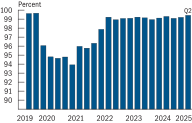
The vast majority of banking organizations continue to report capital levels well above applicable regulatory requirements through year-end 2025. As of the fourth quarter, over 99 percent of all banks were well capitalized. Aggregate common equity tier 1 (CET1) risk-based capital ratios were about 13 percent for both large and small banks, which is roughly the same level from a year earlier. The aggregate tier 1 leverage ratio also held steady through 2025 (figure 1).
Figure 1. Capital ratios
Accessible Version | Return to text
Note: The TCE ratio is TCE divided by tangible assets. TCE is total equity, less perpetual preferred stock and intangible assets.
Source: Call Report and FR Y-9C.
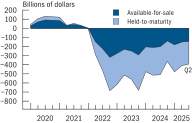
The tangible common equity (TCE) ratio, which measures bank capital after adjusting for the market value of available-for-sale (AFS) securities, increased slightly in the second half of 2025.5 Aggregate TCE ended the year at a high of $2.23 trillion. The increase in TCE partially resulted from a recovery in bank unrealized losses on AFS securities. As of the fourth quarter of 2025, unrealized losses on AFS securities trended downwards to $98 billion, ending the year at less than one-third of peak levels observed in 2022 (figure 2).
Figure 2. Net fair value gains (losses) on investment securities
Accessible Version | Return to text
Note: Net fair value gains (losses) are computed as fair value less amortized cost.
Source: Call Report and FR Y-9C.
Liquidity and Funding Conditions Shifted Slightly but Remain Solid
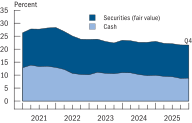
Aggregate liquidity levels were solid as of year-end 2025. Banking organizations subject to the liquidity coverage ratio (LCR) requirement maintained liquidity levels well above regulatory requirements. Liquid asset levels declined modestly, driven by lower holdings of reserve balances, yet remained robust across the industry (figure 3).
Figure 3. Liquid assets as a share of total assets
Accessible Version | Return to text
Source: Call Report and FR Y-9C.
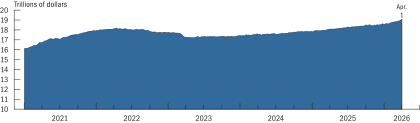
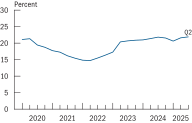
Deposits at commercial banks continued to grow, with aggregate deposits reaching a historical high of $19.5 trillion by February 2026 (figure 4). Meanwhile, uninsured deposits, both as a percentage of total assets and as a percentage of total deposits, increased slightly from their recent lows in 2023 and 2024 but remained below 2022 levels (figure 5). Reliance on wholesale funding, which can be more costly and less stable than core deposits, fell slightly in the second half of 2025, but remained above 2022 levels (figure 6).
Figure 4. Deposits
Accessible Version | Return to text
Note: Data are seasonally adjusted and for all commercial banks.
Source: H.8, "Assets and Liabilities of Commercial Banks in the United States."
Figure 5. Uninsured deposits as a share of total assets and deposits
Accessible Version | Return to text
Note: Uninsured deposits are as reported or calculated using schedule RC-O Memoranda items of the Call Report.
Source: Call Report.
Figure 6. Wholesale funding as a share of total assets
Accessible Version | Return to text
Note: Wholesale funding is defined as the sum of brokered deposits under $250,000, federal funds purchased, securities sold under agreement to repurchase, subordinated notes and debentures, and other borrowed money.
Source: Call Report and FR Y-9C.
Loan Growth Was Strong. Delinquencies Increased Slightly Across Several Loan Categories in 2025.
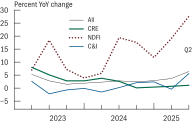
Loan balances continued to grow steadily throughout 2025, ending the year 5.6 percent higher than a year earlier. All major loan categories expanded over this period (figure 7). Commercial and industrial (C&I) loan growth accelerated in the second half of 2025 while commercial real estate (CRE) loans grew modestly. Loans to non-depository financial institutions (NDFI) continued to expand as banks partnered with nonbank financial entities, including private equity funds and mortgage, commercial, and consumer credit intermediaries, and warehouse lending facilities and lines of credit.
Figure 7. Loan growth by type
Accessible Version | Return to text
Source: H.8, "Assets and Liabilities of Commercial Banks in the United States."
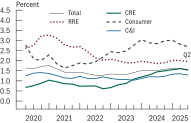
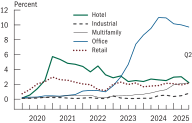
While loan growth remained steady, loan delinquency rates increased slightly across several loan categories in 2025. Consumer, CRE, C&I, and residential real estate (RRE) loans all showed slightly higher delinquency rates by the end of 2025, generally consistent with year-earlier levels (figure 8). Increases in these categories brought the total loan delinquency rate slightly upward, to 1.6 percent, which is below the long-run historical average delinquency rate of about 3 percent.
Figure 8. Loan delinquency rates
Accessible Version | Return to text
Note: Delinquent loans are those 30+ days past due or in nonaccrual status.
Source: Call Report and FR Y-9C.
The Federal Reserve closely monitors bank exposures to NDFIs. Though regulatory data shows limited delinquencies in this category, several high-profile NDFI defaults have led to concern about the private credit sector. Supervisory work shows that some banks are revisiting collateral management practices for these exposures.
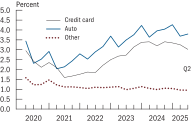
Consumer loan delinquencies declined throughout most of 2025 but increased moderately in the last two quarters. While delinquencies for auto and credit card loans rose over the last half of 2025, both categories ended the year at lower levels than the previous year, reflecting overall improvement (figure 9).
Figure 9. Consumer loan delinquency rates
Accessible Version | Return to text
Note: Delinquent loans are those 30+ days past due or in nonaccrual status.
Source: Call Report and FR Y-9C.
Banks Saw Healthy Profitability in the Second Half of 2025
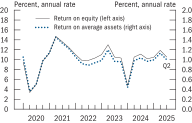
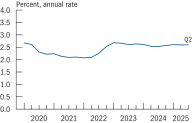
Return on average assets and return on equity were about 1.1 percent and 11.2 percent, respectively, at the end of 2025 (figure 10), similar to recent historical experience. Aggregate net interest margins increased slightly, partly due to the decline in the cost of funding (figure 11).6
Figure 10. Return on average assets (ROAA) and return on equity (ROE)
Accessible Version | Return to text
Note: ROE is net income divided by average equity capital, and ROAA is net income divided by average assets.
Source: Call Report and FR Y-9C.
Figure 11. Aggregate net interest margin
Accessible Version | Return to text
Note: Net interest margin is net interest income divided by average earning assets.
Source: Call Report and FR Y-9C.
Market Indicators of Large Banks Showed Market Confidence
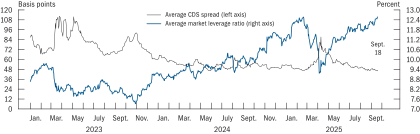
Market assessments of bank risk, including the market leverage ratio and credit default swap (CDS) spreads, provide a forward-looking assessment of a bank's financial strength. The market leverage ratio measures a bank's financial position based on the ratio of its market capitalization to the sum of market capitalization and the book value of liabilities. A lower price for the bank's stock reduces the market leverage ratio, while a higher price for the bank's stock increases the ratio. A higher market leverage ratio generally indicates a higher degree of market confidence in a bank's financial strength. As a complement to the market leverage ratio, CDS spreads track the price of insurance against a default by a given bank. If a bank's CDS spread increases, it means the market has lower confidence in the bank's creditworthiness. Conversely, lower CDS spreads indicate higher market confidence in a bank's creditworthiness.7
Average CDS spreads for the largest banks ended 2025 near their lowest levels since 2015 but rose in March and April 2026 (figure 12). The market leverage ratio increased steadily through year-end 2025. The market leverage ratio currently sits near its 10-year high despite some movement in early 2026. The improvement in the market leverage ratio is partially attributable to strong stock market performance.
Figure 12. Average market leverage ratio and average credit default swap (CDS) spread (daily)
Accessible Version | Return to text
Note: The average market leverage ratio and the average CDS spread are calculated as simple averages from available observations for the eight GSIB firms (Bank of America Corporation; The Bank of New York Mellon Corporation; Citigroup Inc.; The Goldman Sachs Group; JPMorgan Chase & Co.; Morgan Stanley; State Street Corporation; and Wells Fargo & Company). See the Data Sources and Terms page on the Board's public website for further information on the market leverage ratio and CDS spreads.
Source: Federal Reserve staff calculations using Bloomberg data.
First Quarter 2026 Financial Results at Large Banks
Large banks reported strong first quarter 2026 earnings.8 Aggregate return on equity rose to 14 percent from 12 percent in the fourth quarter of 2025. The quarter-over-quarter increase was driven by growth in noninterest income, reflecting record capital markets revenues and higher wealth management and payments fees. This growth more than offset higher operating expenses and credit loss provisions, while net interest income remained flat quarter-over-quarter.
Nonperforming loan, loan loss, and credit loss reserve ratios declined slightly in the first quarter of 2026 at most large banks, citing U.S. economic resiliency and enhanced oversight of private credit exposures.
Balance sheets expanded in the first quarter of 2026 at most large banks, reflecting growth in cash, reverse repos, trading assets, and loans. Loan growth was driven by commercial and industrial lending and funded by deposit growth.
The aggregate CET1 capital ratio for large banks at the end of the first quarter of 2026 was 12 percent. Most banks reported quarter-over-quarter declines in CET1 capital ratios, as shareholder distributions and growth in risk-weighted assets outweighed incremental earnings, though all large banks remained well capitalized.
References
5. In contrast to TCE, only the largest banks are required to include changes in the fair value of available-for-sale securities in CET1 capital. Return to text
6. Net interest margin measures the difference between interest income and interest expense, relative to interest-earning assets. Return to text
7. For additional information on the market indicators, see the Data Sources and Terms page on the Board's public website at https://www.federalreserve.gov/publications/2025-december-supervision-and-regulation-report-data-sources-terms.htm. Return to text
8. This section is based on a sample of 24 large banks that includes Ally Financial Inc.; American Express Company; Bank of America Corporation; The Bank of New York Mellon Corporation; Capital One Financial Corporation; The Charles Schwab Corporation; Citigroup Inc.; Citizens Financial Group, Inc.; Fifth Third Bancorp; First Citizens BancShares, Inc.; The Goldman Sachs Group, Inc.; Huntington Bancshares Incorporated; JPMorgan Chase & Co.; KeyCorp; M&T Bank Corporation; Morgan Stanley; Northern Trust Corporation; The PNC Financial Services Group, Inc.; Regions Financial Corporation; State Street Corporation; Synchrony Financial; Truist Financial Corporation; U.S. Bancorp; and Wells Fargo & Company. Data are unadjusted for mergers and acquisitions. Return to text