


Supervisory Developments
This section provides an overview of recent supervisory efforts to assess institutions' safety and soundness and compliance with laws and regulations. Supervisory approaches and priorities differ among financial institutions based on the size, complexity, business model, and risk profile. The subsections below discuss developments within specific portfolios, including community banking organizations, regional and foreign banking organizations with assets of less than $100 billion, and large financial institutions with assets of $100 billion or more.
Under the Dodd-Frank Wall Street Reform and Consumer Protection Act of 2010, the Board is also responsible for overseeing compliance with certain consumer financial protection laws and regulations. More information about the Federal Reserve's consumer-focused supervisory program can be found in the Federal Reserve's 111th Annual Report 2024.10
Federal Reserve Supervision
The Federal Reserve conducts examinations to evaluate a banking organization's activities, risk management, and financial condition.11 Examinations cover several key banking risk areas to support the assignment of supervisory ratings. The Federal Reserve may also decide to conduct targeted examinations for a bank's known and potential risks.
Supervisory ratings are confidential and provide an assessment of bank risk management and financial condition based on examination results, matters requiring (immediate) attention (MR(I)As), and other information gathered between examinations. These ratings reflect overall supervisory judgment of safety and soundness and compliance with laws, regulations, and final agency orders. Supervisory ratings are generally issued once every 12 to 18 months for banks that remain in satisfactory condition.12
If supervisors identify a deficiency that would threaten a firm's safety and soundness, U.S. financial stability, or that is, has been, or about to be a violation of a law, regulation, or final agency order, they provide direction and require the bank to eliminate or mitigate that deficiency.13 Typically this direction is first communicated in the form of an MRA and, for more significant deficiencies that must be corrected on a priority basis, an MRIA. These are confidentially communicated to bank management and board of directors in a written report that clearly describes the deficiency requiring remediation and what a non-deficient state would be. If the deficiencies are sufficiently significant, supervisors may take further action, including lowering the bank's supervisory rating or pursuing an enforcement action. For shortcomings that do not meet the standard for an MR(I)A, examiners should note a supervisory observation.
Supervised Institutions
The Federal Reserve supervises bank holding companies (BHCs), savings and loan holding companies (SLHCs), state member banks (SMBs), and foreign banking organizations (FBOs) operating in the United States and their covered affiliates. The Federal Reserve follows a risk-focused and tailored approach that considers factors including the asset size and institution complexity:
- The Community Banking Organization (CBO) program supervises U.S. firms with less than $10 billion in total assets.
- The Regional and Foreign Banking Organization (RFBO) program supervises (1) domestic banking organizations with total consolidated assets between $10 billion and $100 billion and (2) foreign banking organizations with total combined U.S. assets less than $100 billion.
- The Large and Foreign Banking Organization (LFBO) program supervises (1) U.S. banking organizations with total consolidated assets of $100 billion or more but are not global systemically important banking organizations and (2) foreign banking organizations with total combined U.S. assets of $100 billion or more.
- The Global Systemically Important Banking Organization (GSIB) program supervises the largest and most complex banking organizations headquartered in the United States. Because these organizations pose the greatest risk to the domestic economic and financial system, they are subject to the highest requirements set forth in the Federal Reserve Board's regulations, such as Regulations YY and QQ, covering capital, liquidity, resolution planning, risk management and internal controls, and stress testing requirements.14
Table 2 provides an overview of Federal Reserve supervised organizations by portfolio, including the number of institutions and total assets in each portfolio.
Table 2. Summary of organizations supervised by the Federal Reserve (as of 12/31/2025)
| Portfolio | Definition | Number of institutions | Total assets ($ trillions) |
|---|---|---|---|
| Community banking organizations (CBOs) | Total assets less than $10 billion | 3,316* | 3.1 |
| State member banks (SMBs) | SMBs within CBO organizations | 647 | 0.7 |
| Regional and foreign banking organizations (RFBOs) | U.S. firms with total assets between $10 billion and $100 billion and FBOs with less than $100 billion combined U.S. assets | 238 | 4.4 |
| Regional banking organizations (RBOs) | U.S. firms with total assets between $10 billion and $100 billion | 98** | 3.1 |
| Small FBOs (excluding rep offices) | FBOs with combined U.S. assets less than $100 billion | 105 | 1.3 |
| Small FBOs (rep offices) | FBO U.S. representative offices | 35 | 0.0 |
| SMBs | SMBs within RFBO organizations | 43 | 1.3 |
| Large and foreign banking organizations (LFBOs) | Non-GSIB U.S. firms with total assets $100 billion and greater and FBOs with combined U.S. assets $100 billion and greater | 33 | 9.7 |
| Large banking organizations (LBOs) | Non-GSIB U.S. firms with total assets $100 billion and greater | 16 | 5.2 |
| Large FBOs (with IHC) | FBOs with combined U.S. assets $100 billion and greater | 11 | 3.4 |
| Large FBOs (without IHC) | FBOs with combined U.S. assets $100 billion and greater | 6 | 1.1 |
| SMBs | SMBs within LFBO organizations | 10 | 1.1 |
| Global Systemically Important Banks (GSIBs) | Eight U.S. global systemically important banks (GSIBs) | 8 | 16.7 |
| SMBs | SMBs within GSIB organizations | 4 | 1.4 |
| Insurance and commercial savings and loan holding companies (SLHCs) | SLHCs primarily engaged in insurance or commercial activities | 3 insurance 2 commercial |
0.5 |
* Includes 3,270 holding companies and 46 state member banks that do not have holding companies.
** Includes 96 holding companies and 2 state member banks that do not have holding companies.
Supervisory Priorities
Since issuing the SSOP in October 2025, the Federal Reserve has enhanced its supervisory programs. These enhancements enable early identification of threats to bank safety and soundness and U.S. financial stability and require timely, proportionate action to eliminate or mitigate deficiencies. In May 2026, the Federal Reserve published an updated SSOP to provide greater clarity, including on the standards for issuing MR(I)As and enforcement actions. To ensure consistency with the updated SSOP, the Federal Reserve began reviewing existing MR(I)As in February 2026 (box 1). This review analyzes whether MR(I)As are appropriately based on threats to safety and soundness. MR(I)As that are not consistent with the SSOP will be downgraded to an observation or closed.
Box 1. MR(I)A Review
In February 2026, the Federal Reserve initiated a comprehensive review of all outstanding safety-and-soundness-related MR(I)As to identify misalignment with the SSOP—including issues that have already been remediated or pose no significant probability of significant harm to a banking organization's financial condition. This comprehensive review ensures consistent treatment across banking organizations regardless of asset size, complexity, business model, or risk profile. The review framework provides supervisory teams with clear guidelines for evaluating outstanding MR(I)As in a timely and transparent manner. The Federal Reserve is coordinating this effort with state banking agencies.
This is a two-phase review with completion targeted by mid-2026. The first phase was completed in March, with results communicated to supervised firms by March 31. Supervisors closed a number of outstanding supervisory matters that had been fully remediated. Some MR(I)As were closed or downgraded to observations if they did not align with the SSOP. In phase two, supervisory staff are working with other regulatory agencies and supervised firms to evaluate remaining outstanding issues. The Federal Reserve will conclude its review after ensuring SSOP alignment of the remaining MR(I)As.
This review strengthens the Federal Reserve's overall supervisory process by
- helping banks and examiners prioritize their focus on the Federal Reserve's efforts and attention on material financial risks that can threaten the safety and soundness or viability of supervised firms or U.S. financial stability;
- improving the clarity of supervisory communications, including on identified deficiencies; and
- increasing supervisory process effectiveness and efficiency by leveraging work performed by the firm's primary state or federal banking supervisor to the fullest extent possible, and the firm's internal audit function where this function is determined to be effective and has validated the remediation of a deficiency.
Community Banking Organizations and Regional and Foreign Banking Organizations
This section of the report discusses supervisory conditions and approaches for banking organizations with assets of less than $100 billion. This includes CBOs, which have less than $10 billion in total assets, and RBOs, which have total assets of $10 billion or more but less than $100 billion. This group also includes FBOs that have less than $100 billion in combined U.S. assets.
Trends in Supervisory Ratings and Findings
Federal Reserve supervisors use the RFI rating system to summarize their assessments of U.S. holding companies with consolidated assets of less than $100 billion.15 Additionally, the Federal Reserve and the other federal and state bank regulatory agencies use the Uniform Financial Institution Rating system, also known as the CAMELS rating system, to summarize bank supervisory assessments.16 Branches and agencies of FBOs are assessed using the ROCA rating system, which evaluates the components of risk management, operational controls, compliance, and asset quality.17
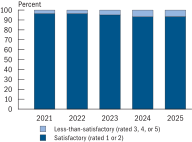
Most CBOs and RBOs under $100 billion remain in satisfactory condition with effective risk-management practices and adequate financial performance (figure 13). Composite ratings upgrades exceeded downgrades in the second half of 2025, and the proportion of less-than-satisfactory firms continues to decline. Most FBOs with U.S. assets under $100 billion are assessed to be in satisfactory condition.
Figure 13. Top-tier ratings for CBO and RBO firms
Accessible Version | Return to text
Note: Includes composite ratings for consolidated top-tier holding companies and SMBs without holding companies for CBO and RBO firms. Values are as of year-end. Key identifies bars in order from top to bottom.
Source: Internal Federal Reserve supervisory databases.
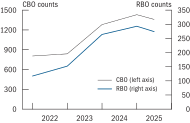
In 2025, the number of outstanding MR(I)As at CBOs and RBOs fell notably to levels roughly in line with levels prior to the 2023 bank failures (figure 14). This trend has continued in 2026, including due to the review of MR(I)As discussed above. Examiners have also begun utilizing supervisory observations to identify shortcomings that do not rise to the level of MR(I)As based on the SSOP.
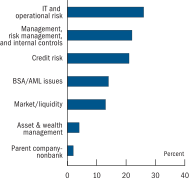
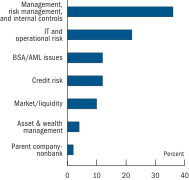
As of year-end 2025, IT and operational risk MR(I)As, which include cyber risk, represented the largest category of outstanding MR(I)As for CBOs and RBOs, followed by risk management and internal controls (figures 15 and 16). For FBOs with U.S. assets under $100 billion, the largest share of outstanding MR(I)As relate to Bank Secrecy Act (BSA)/anti-money laundering (AML) and Office of Foreign Assets Control compliance.
Figure 14. Outstanding number of MR(I)As, CBO and RBO firms
Accessible Version | Return to text
Note: Values are as of year-end. The MR(I)As count data are subject to revisions as MR(I)As are reviewed, updated, and finalized; this could result in minor historical count fluctuations.
Source: Internal Federal Reserve supervisory databases.
Figure 15. Outstanding MR(I)As by category, CBO firms
Accessible Version | Return to text
Note: As of 2025:Q4, there were 1,007 total MR(I)As for CBO firms.
Source: Internal Federal Reserve supervisory databases.
Figure 16. Outstanding MR(I)As by category, RBO firms
Accessible Version | Return to text
Note: As of 2025:Q4, there were 154 total MR(I)As for RBO firms.
Source: Internal Federal Reserve supervisory databases.
Supervisory Focus
Federal Reserve supervisors continue to focus on monitoring and assessing the financial condition of CBOs and RBOs and any material risks to safety and soundness. In addition, supervisors continue to ensure that supervision is appropriately tailored to bank size, risk, and business model.
Financial conditions are broadly stable at CBOs and RBOs, though some banks have observed increased delinquencies from very low levels relative to their historical averages in certain loan categories and have recalibrated or increased their allowances for credit losses. As of 2025 Q4, most CBO and RBO banks have lower levels of past due and classified loans than their average over the previous 10 years. However, delinquencies on CRE loans and consumer loans remain above the averages from the past decade, indicating, in part, that demand for office space has so far not returned to pre-pandemic levels.
Supervisors continue to monitor CBOs and RBOs that are concentrated in CRE lending, particularly the office and multifamily sectors. Elevated interest rates, lower commercial property values, and other factors may affect CRE borrowers' ability to refinance or pay off loans. Supervisors are monitoring CRE loan trends and delinquencies, including modification trends. They are also reviewing CBO and RBO underwriting practices, classifications, and credit loss reserve methodologies and levels.
Federal Reserve supervisors remain focused on agriculture concentrations at CBOs. In line with production expenses, agricultural lending volume and loan sizes have increased. As a result, profit margins in agriculture-related businesses continue to be tight.
CBO and RBO portfolio supervisors prioritized oversight of the following activities in 2025.
CBO and RBO Supervisory Priorities
Credit Risk
- high-risk credit concentrations and credit risk management
- adequacy of allowances for credit losses
- loan underwriting and collateral management practices
Liquidity Risk
- firms with higher reliance on noncore or volatile funding sources
- liquidity funding planning
Other Risks
- IT and cyber risk
Large Financial Institutions
This section of the report discusses the supervisory approach and outcomes for large financial institutions—U.S. firms with total assets of $100 billion or more, including GSIBs, and FBOs with combined U.S. assets of or in excess of $100 billion. These firms are in the GSIB portfolio or LFBO portfolios. LFIs are subject to regulatory requirements that are tiered to the risk profiles of these firms.
Supervisory efforts for large financial institutions focus on four components:
- Capital planning and positions,
- Liquidity risk management and positions,
- Governance and controls, and
- Recovery and resolution planning.18
Trends in Supervisory Ratings and Findings
Federal Reserve supervisors summarize their assessments of large financial institutions using the LFI rating system. The LFI rating system evaluates whether a firm possesses sufficient financial and operational strength and resilience to maintain safe and sound operations and comply with laws and regulations, including those related to consumer protection, through a range of economic conditions. It includes three components: (1) capital planning and positions; (2) liquidity risk management and positions; and (3) governance and controls.19
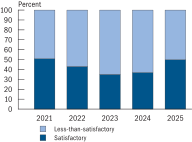
As of December 31, 2025, most large financial institutions were deemed to be satisfactory across all three LFI rating components (figure 17) and were considered "well-managed." The remaining large financial institutions were rated less-than-satisfactory in at least one component and were not considered "well-managed." Following the implementation of the revised LFI rating system, which became effective on January 16, 2026, the proportion of large financial institutions considered "well-managed" increased based on the revised definition of "well-managed." This impact is reflected in figure 17, which includes LFI ratings data as of January 31, 2026. Supervisors identified weaknesses in financial risk-management practices including capital planning and liquidity, operational resilience, and BSA/AML compliance.
Figure 17. Ratings for large financial institutions
Accessible Version | Return to text
Note: Large financial institutions are rated according to three components in the LFI Ratings Framework: Capital Planning and Positions; Liquidity Risk Management and Positions; and Governance and Controls. Bars show the percentage of well-managed and not well-managed ratings across all components. The 2026 value is as of 1/31/2026. Key identifies bars in order from top to bottom.
Source: Internal Federal Reserve supervisory databases.
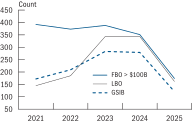
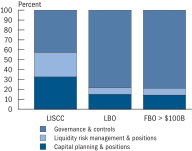
In the second half of 2025, the total number and average number per firm of outstanding MR(I)As at large financial institutions decreased (figure 18). The distribution of MR(I)As by category also remained largely unchanged over the second half of 2025, although the proportion of MR(I)As related to capital planning and positions increased slightly (figure 19).
Figure 18. Outstanding number of MR(I)As, large financial institutions
Accessible Version | Return to text
Note: Values are as of year-end. The MR(I)As count data are subject to revisions as MR(I)As are reviewed, updated, and finalized; this could result in minor historical count fluctuations.
Source: Internal Federal Reserve supervisory databases.
Figure 19. Outstanding MR(I)As by category, large financial institutions
Accessible Version | Return to text
Note: As of 2025:Q4, total MR(I)As by portfolio were: GSIB–121; LBO–162; and FBO > $100B–174. Key identifies bars in order from top to bottom.
Source: Internal Federal Reserve supervisory databases.
Supervisory Focus
Supervisors examine and monitor large financial institutions on a continuous basis, focusing on material financial risks. These risks are constantly evolving with firms' business practices, financial and market environments, legal requirements, and their own risk-management capacities. Large financial institutions typically undergo multiple exams each year. These are a primary input into supervisory ratings in accordance with the LFI ratings framework.
From mid-2025 through 2026, the Federal Reserve has prioritized reviews of liquidity, capital, and operational and cyber resilience. To eliminate duplicative examinations, Federal Reserve examiners have increased reliance on supervisory work by the FDIC or OCC for the depository institution subsidiaries of large financial institutions. In addition, supervisors have avoided duplicating validation work when a firm's internal audit function has been assessed to be effective and has validated remediation efforts. The Federal Reserve has also revised its horizontal review approach for large financial institutions, transitioning from large annual horizontal examinations to smaller, more targeted reviews with scope tailored to the complexity and risk of the smaller group of firms (box 2). Consistent with the SSOP, Federal Reserve examination assessments are based on safety and soundness expectations and regulations, not based largely on best practices.
Liquidity risk-management examinations in the second half of 2025 focused on reviewing firm internal liquidity stress testing deposit assumptions and derivatives methodologies, risk-management practices, including limits, compliance with applicable regulations, and monitoring of firm's liquidity positions. Capital planning examinations and monitoring focused on risks associated with retail and wholesale credit (including lending to NDFIs), counterparty credit, markets (including international trading risks), and interest rates. Exams also reviewed firm compliance with capital rules. Governance and controls examinations focused on operational resilience issues that have the potential to impact financial positions, including cybersecurity and change management reviews.
In the second half of 2025 and in early 2026, supervisors continued reviewing 2025 Title I targeted resolution plans. The review focused on firm strategies to maintain funding for material entities and critical operations in a variety of circumstances, including through a range of resolution scenarios, actions of foreign authorities that may be necessary for the firm to carry out their preferred resolution strategies, firm frameworks to provide assurance that their resolution capabilities will function if and when needed, and firm efforts to remediate shortcomings identified in 2023 resolution plans.
Box 2. LFBO Horizontal Reviews
Horizontal reviews are examinations on the same operational area or issue across multiple firms. Previously, the Federal Reserve included all, or nearly all, LFBOs in horizontal reviews with uniform scope, covering capital, liquidity, and other risk areas. Beginning in 2026, the Federal Reserve has enhanced its approach to conducting LFBO horizontal reviews:
- Targeted, tailored reviews. Reviews will be smaller and better tailored to targeted firms, grouping firms by size, complexity, business model, and risk profile.
- Risk-based supervisory intensity. Larger, more complex and higher-risk firms will receive greater supervisory attention. Not all LFBOs will automatically be included in a horizontal review, and review scope may differ by firm.
- Appropriate assessment criteria. Firms will be evaluated relative to supervisory expectations and safety and soundness. While horizontal reviews may identify best practices, firms will not be criticized if they do not adopt best practices.
- Elimination of duplicative work. Reviews will not duplicate other regulators' examinations. When overlap exists, the Federal Reserve will rely on the other regulator's supervisory work to the maximum extent possible. This may result in certain LFBOs no longer being included in some or all LFBO horizontal reviews, or the Federal Reserve will integrate the other regulator's supervisory work into the horizontal review process.
- Confidential disclosure of results. Results of horizontal reviews, including comparisons across in-scope firms, will be confidentially disclosed to participating firms.
These changes will enhance supervision effectiveness by better targeting firm-specific risks and focusing on the most material financial risks. The changes will also reduce the time required to communicate results to supervised firms and address identified deficiencies, creating significant efficiencies for both the Federal Reserve and supervised firms.
The Federal Reserve will conduct horizontal reviews only when the benefits to firm safety and soundness or U.S. financial system stability outweigh the associated costs. This determination will be made annually during supervisory planning.
Return to textLarge Financial Institution Supervisory Priorities
The Federal Reserve also conducts supervisory work on emerging risks across all portfolios, and for LFIs, as discussed below. Consistent with the SSOP, Federal Reserve LFI supervisory priorities are focused on firm financial positions, compliance with laws, and risks that could result in material financial risks. Federal Reserve LFI supervisory priorities are executed principally through firm-specific exams based on individual firm risk and activities, and in limited instances, through smaller, more tailored, and targeted coordinated reviews, as described in box 2.
Capital Planning and Positions
- consumer and commercial credit, including lending to nonbank financial institutions
- interest-rate risk
- market and counterparty credit risk
- monitoring of financial positions
Liquidity Risk Management and Positions
- internal liquidity stress testing, including prime services and intraday reserve methodologies
- inter-affiliate funding flows
- monitoring of liquidity positions
Governance and Controls
- operational resilience, including cybersecurity
- technology change risk management and controls
Recovery and Resolution Planning
- recovery planning for U.S. GSIBs, continued 2025 Title I targeted resolution plan review, and resolution planning for large financial institutions
References
10. See Board of Governors of the Federal Reserve System, 111th Annual Report of the Board of Governors of the Federal Reserve System (Board of Governors, November 2025), 77, https://www.federalreserve.gov/publications/files/2024annual-report.pdf. Return to text
11. See "Understanding Federal Reserve Supervision," https://www.federalreserve.gov/supervisionreg/how-federal-reserve-supervisors-do-their-jobs.htm. Return to text
12. See Board of Governors of the Federal Reserve System, "Supervisory Ratings for State Member Banks, Bank Holding Companies and Foreign Banking Organizations, and Related Requirements for the National Examination Data System," SR letter 99-17 (June 24, 1999), https://www.federalreserve.gov/boarddocs/srletters/1999/SR9917.htm. Return to text
13. More information about standard for issuing matters requiring attention can be found in the Federal Reserve's Updated Statement of Supervisory Operating Principles, available at https://www.federalreserve.gov/supervisionreg/files/statement-of-supervisory-operating-principles-20260430.pdf. Supervisors include both commissioned examiners (Federal Reserve staff who have been commissioned as an examiner) and subject matter experts that provide support during examinations and off-site monitoring. Return to text
14. The eight U.S. GSIBs are Bank of America, Bank of New York Mellon, Citigroup, Goldman Sachs, JP Morgan Chase, Morgan Stanley, State Street, and Wells Fargo. Return to text
15. See Board of Governors of the Federal Reserve System, "Supervisory Rating System for Holding Companies with Total Consolidated Assets Less Than $100 Billion," SR letter 19-4/CA letter 19-3 (February 26, 2019), https://www.federalreserve.gov/supervisionreg/srletters/sr1904.htm. Return to text
16. See the online appendix for additional information on the RFI and CAMELS rating systems. See above for information about proposed changes to the CAMELS ratings. Return to text
17. See Board of Governors of the Federal Reserve System, "Enhancements to the Interagency Program for Supervising the U.S. Operations of Foreign Banking Organizations," SR letter 00-14 (October 23, 2000), https://www.federalreserve.gov/supervisionreg/srletters/SR0014.htm. Return to text
18. For more information regarding the framework for supervision of large financial institutions, see Board of Governors of the Federal Reserve System, "Consolidated Supervision Framework for Large Financial Institutions," SR letter 12-17/CA letter 12-14 (December 17, 2012), https://www.federalreserve.gov/supervisionreg/srletters/sr1217.htm; and box 4 in the Board of Governors of the Federal Reserve System, Supervision and Regulation Report 2018 (Board of Governors, November 2018), https://www.federalreserve.gov/publications/files/201811-supervision-and-regulation-report.pdf. Return to text
19. In addition, the Federal Reserve and the other federal and state bank regulatory agencies use the Uniform Financial Institution Rating system, also known as the CAMELS rating system, to summarize supervisors' assessments of the capital, assets, management, earnings, liquidity, and sensitivity to interest-rate risk of banks. For more details, see the Data Sources and Terms page on the Board's public website. Return to text