


3. Leverage in the Financial Sector
Vulnerabilities associated with financial leverage remained notable
Leverage for hedge funds remained stable at record-high levels over the period for which comprehensive data have been collected, as a decrease in the cash-futures basis trade was largely offset by other relative value trades, such as swap spread trades. Leverage at the largest life insurance companies remained well into the upper quartile of its historical distribution.
The banking system remained sound and resilient as banks have reduced exposure to interest rate risk by shortening asset duration. Leverage at broker-dealers stayed near historically low levels. Dealers' ability and willingness to intermediate remained robust, as they maintained adequate levels of market making capacity.
Table 3.1 shows the size and growth rates of assets held by selected financial institutions discussed in this section as of the fourth quarter of 2025.
Table 3.1. Size of selected sectors of the financial system, by types of institutions and vehicles
| Item | Total assets (billions of dollars) |
Growth, 2024:Q4–2025:Q4 (percent) |
Average annual growth, 1997–2025:Q4 (percent) |
|---|---|---|---|
| Banks and credit unions | 29,153 | 5.3 | 5.6 |
| Mutual funds | 23,635 | 9.0 | 9.1 |
| Insurance companies | 15,070 | 8.9 | 5.7 |
| Life | 11,172 | 8.2 | 5.7 |
| Property and casualty | 3,899 | 10.8 | 5.9 |
| Hedge funds1 | 13,712 | 14.8 | 9.0 |
| Broker-dealers2 | 7,142 | 19.8 | 5.7 |
| Outstanding (billions of dollars) |
|||
| Securitization | 14,324 | 3.2 | 5.3 |
| Agency | 12,511 | 2.1 | 5.7 |
| Non-agency3 | 1,813 | 11.3 | 4.0 |
Note: The data extend through 2025:Q4 unless otherwise noted. Outstanding amounts are in nominal terms. Growth rates are nominal and are measured from Q4 of the year immediately preceding the period through Q4 of the final year of the period. Life insurance companies' assets include both general and separate account assets.
1. Hedge fund data start in 2012:Q4 and are updated through 2025:Q3. Growth rates for the hedge fund data are measured from Q3 of the year immediately preceding the period through Q3 of the final year of the period. Return to table
2. Broker-dealer assets are calculated as unnetted values. Return to table
3. Non-agency securitization excludes securitized credit held on balance sheets of banks and finance companies. Return to table
Source: Federal Reserve Board, Statistical Release Z.1, "Financial Accounts of the United States"; Federal Reserve Board, "Enhanced Financial Accounts of the United States."
Banks maintained historically high levels of regulatory capital, with declining fair value losses and exposure to interest rate risk
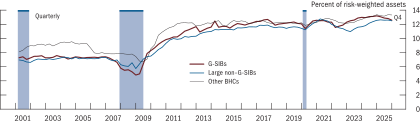
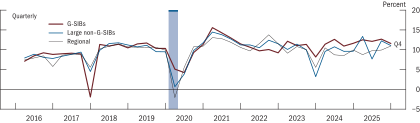
Robust capital positions allow banks to pursue growth opportunities while providing a cushion against unexpected losses. The common equity Tier 1 (CET1) ratio, a regulatory risk-based measure of bank capital adequacy, remained at historically high levels (figure 3.1). Banks' return on equity—a measure of profitability—remained within recent historical ranges through the fourth quarter of 2025 (figure 3.2). Continued strong income-generating capacity is an additional potential source of resiliency for banks, as they can more easily accrete capital by retaining a portion of their current earnings than by raising external funds.
Figure 3.1. Banks' risk-based capital ratios remained near historically high levels
Accessible Version | Return to text
Note: The data are seasonally adjusted by Federal Reserve Board staff. The sample consists of domestic bank holding companies (BHCs) and intermediate holding companies (IHCs) with a substantial U.S. commercial banking presence. G-SIBs are global systemically important banks. Large non–G-SIBs are BHCs and IHCs with greater than $100 billion in total assets that are not G-SIBs. Before 2014:Q1 (advanced-approaches BHCs) or before 2015:Q1 (non-advanced-approaches BHCs), the numerator of the common equity Tier 1 (CET1) ratio is Tier 1 common capital. Afterward, the numerator is CET1 capital. The denominator is risk-weighted assets. The shaded bars with top caps indicate periods of business recession as defined by the National Bureau of Economic Research: March 2001–November 2001, December 2007–June 2009, and February 2020–April 2020.
Source: Federal Reserve Board, Form FR Y-9C, Consolidated Financial Statements for Holding Companies.
Figure 3.2. Return on equity for banks stayed consistent with norms from the past 10 years
Accessible Version | Return to text
Note: Return on equity is equal to net income divided by average equity. The net income of banks that acquired failed banks was adjusted for the one-off gains from the acquisitions. Calculations for 2023:Q4 exclude Federal Deposit Insurance Corporation special assessment costs. G-SIBs are global systemically important banks. Large non–G-SIBs are bank holding companies and intermediate holding companies with greater than $100 billion in total assets that are not G-SIBs. The shaded bar with top cap indicates a period of business recession as defined by the National Bureau of Economic Research: February 2020–April 2020.
Source: Federal Financial Institutions Examination Council, Consolidated Reports of Condition and Income (Call Report) Form FFIEC 031; Federal Reserve Board, Form FR Y-9C, Consolidated Financial Statements for Holding Companies.
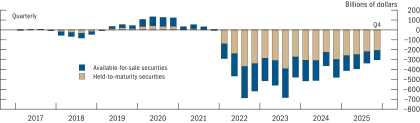
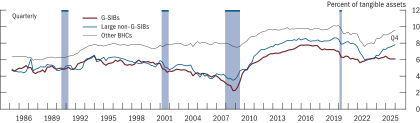
Banks have continued to reduce exposure to a potential rise in interest rates by shortening duration as their balance sheets moved toward less interest rate sensitive short-duration securities. These actions, combined with some decreases in interest rates, helped reduce fair value losses on banks' fixed-rate assets relative to peaks in 2022, but these losses remain sizable. The fair values of banks' available-for-sale (AFS) and held-to-maturity (HTM) portfolios were below their book values by a combined $300 billion at the end of 2025 (figure 3.3). An alternative measure of bank capital—the ratio of tangible common equity to total tangible assets, which, unlike the CET1 ratio, does not factor in the riskiness of assets but does include fair value declines on AFS securities—remained stable for global systemically important banks (G-SIBs) and close to its median level over the past decade, and it increased for large non–G-SIBs and other regional banks (figure 3.4).
Figure 3.3. Banks' securities portfolios experienced declining fair value losses
Accessible Version | Return to text
Note: The figure plots the difference between the fair and amortized cost values of the securities. The sample consists of all bank holding companies and commercial banks.
Source: Federal Financial Institutions Examination Council, Consolidated Reports of Condition and Income (Call Report) Form FFIEC 031; Federal Reserve Board, Form FR Y-9C, Consolidated Financial Statements for Holding Companies.
Figure 3.4. The ratio of tangible common equity to tangible assets rose
Accessible Version | Return to text
Note: The data are seasonally adjusted by Federal Reserve Board staff. The sample consists of domestic bank holding companies (BHCs), intermediate holding companies (IHCs) with a substantial U.S. commercial banking presence, and commercial banks. G-SIBs are global systemically important banks. Large non–G-SIBs are BHCs and IHCs with greater than $100 billion in total assets that are not G-SIBs. Bank equity is total equity capital net of preferred equity and intangible assets. Bank assets are total assets net of intangible assets. The shaded bars with top caps indicate periods of business recession as defined by the National Bureau of Economic Research: July 1990–March 1991, March 2001–November 2001, December 2007–June 2009, and February 2020–April 2020.
Source: For data through 1996, Federal Financial Institutions Examination Council, Consolidated Reports of Condition and Income (Call Report) Form FFIEC 031. For data from 1997 onward, Federal Reserve Board, Form FR Y-9C, Consolidated Financial Statements for Holding Companies; Federal Financial Institutions Examination Council, Consolidated Reports of Condition and Income (Call Report) Form FFIEC 031.
Banks maintained strong credit quality
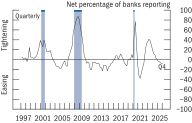
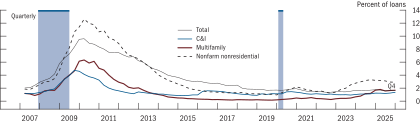
Recent responses from the SLOOS indicated that overall bank lending standards eased again in the fourth quarter of 2025 (figure 3.5). At the same time, delinquency rates on bank loans declined across key categories (figure 3.6).
Figure 3.5. A growing share of banks eased their lending standards
Accessible Version | Return to text
Note: Banks' responses are weighted by each bank's outstanding loans in the respective loan category. Survey respondents to the Senior Loan Officer Opinion Survey on Bank Lending Practices are asked about the changes over the quarter. The shaded bars with top caps indicate periods of business recession as defined by the National Bureau of Economic Research: March 2001–November 2001, December 2007–June 2009, and February 2020–April 2020.
Source: Federal Reserve Board, Senior Loan Officer Opinion Survey on Bank Lending Practices; Federal Reserve Board staff calculations.
Figure 3.6. Bank loan delinquency rates remained at low levels by historical standards
Accessible Version | Return to text
Note: The figure shows banks with total assets greater than or equal to $10 billion. C&I is commercial and industrial. The shaded bars with top caps indicate periods of business recession as defined by the National Bureau of Economic Research: December 2007–June 2009 and February 2020–April 2020.
Source: Federal Reserve Board, Form FR Y-9C, Consolidated Financial Statements for Holding Companies; Federal Financial Institutions Examination Council, Consolidated Reports of Condition and Income (Call Report) Form FFIEC 031.
Delinquencies of loans backed by commercial properties were largely stable at the end of 2025. Banks modified their CRE loan terms to manage exposure, including by requiring additional collateral from some borrowers.
Broker-dealers' leverage remained low
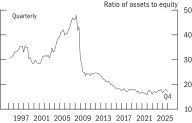
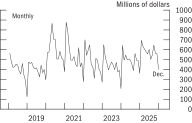
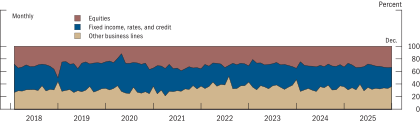
Broker-dealer leverage remained roughly unchanged, with asset-to-equity ratios at a level slightly below its median over the past decade (figure 3.7). Trading profits declined at the end of the year, in line with seasonal trends (figure 3.8). In addition, the distribution of trading profits remained balanced across equities; fixed income, rates, and credit; and other business lines (figure 3.9).
Figure 3.7. Leverage levels at broker-dealers continued to be low
Accessible Version | Return to text
Note: Leverage is calculated by dividing total assets by equity.
Source: Federal Reserve Board, Statistical Release Z.1, "Financial Accounts of the United States."
Figure 3.8. Broker-dealer profits moderated at the end of 2025, mirroring previous year-end performance
Accessible Version | Return to text
Note: The sample includes all trading desks of bank holding companies subject to the Volcker rule reporting requirement.
Source: Federal Reserve Board, Reporting, Recordkeeping, and Disclosure Requirements Associated with Regulation VV (Proprietary Trading and Certain Interests in and Relationships with Covered Funds, 12 C.F.R. pt. 248).
Figure 3.9. Broker-dealer profits maintained a stable distribution across business lines
Accessible Version | Return to text
Note: The sample includes all trading desks of bank holding companies subject to the Volcker rule reporting requirement. The "other business lines" category comprises desks trading in municipal securities, foreign exchange, and commodities, as well as any unclassified desks. The key identifies series in order from top to bottom.
Source: Federal Reserve Board, Reporting, Recordkeeping, and Disclosure Requirements Associated with Regulation VV (Proprietary Trading and Certain Interests in and Relationships with Covered Funds, 12 C.F.R. pt. 248).
Dealers are important intermediaries in Treasury markets, serving in key roles that support orderly market functioning. Measures of dealer intermediation activity in Treasury markets increased further due to growth in secured lending, particularly repurchase agreement (repo) lending to hedge fund clients. Dealers' value-at-risk (VaR) remained below internal risk limits, suggesting dealers' intermediation capacity remains adequate for market functioning in normal times.8 That said, VaR can rise rapidly when volatility increases, so dealers' willingness and ability to intermediate can be tested if VaR approaches those limits during periods of market stress.
According to the March 2026 Senior Credit Officer Opinion Survey on Dealer Financing Terms (SCOOS), dealers report that overall use of financial leverage and financing terms remained mostly unchanged.9 In response to a special question on funding in securities financing transactions, dealers indicated that they expect demand for securities financing across different asset classes to increase over the coming year, while also reporting that they expect to increase their capacity to supply such funding.
Leverage at large life insurance companies remained elevated
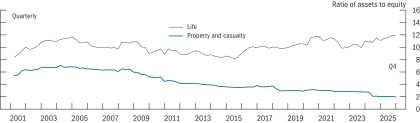
Leverage at the largest life insurers remained well into the upper quartile of its historical distribution over the second half of 2025, while leverage at property and casualty insurers remained at historically low levels (figure 3.10). Life insurers have also steadily increased their investments in risky and illiquid assets over the past decade, and their activity has contributed to the expansion of private credit.
Figure 3.10. Life insurance company leverage remained at the upper quartile of its distribution
Accessible Version | Return to text
Note: Ratio is calculated as (total assets – separate account assets)/(total capital – accumulated other comprehensive income) using generally accepted accounting principles. The largest 10 publicly traded life and property and casualty insurers are represented.
Source: Generally accepted accounting principles data from 10-Q and 10-K filings accessed via S&P Global, Capital IQ Pro.
Hedge funds' leverage was elevated
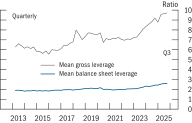
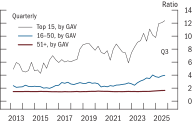
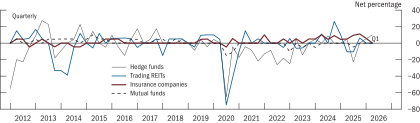
In the third quarter of 2025, the most recent quarter for which comprehensive data from the Securities and Exchange Commission's Form PF are available, gross notional leverage, measured as gross notional exposure divided by net asset value (NAV), was about unchanged at near all-time high levels (figure 3.11). Leverage in the sector also remained skewed to larger funds (figure 3.12). The use of leverage over the past couple of years has increased across a range of strategies and supported significant positions in key markets, such as Treasury securities, interest rate derivatives, and equities. According to data from the March 2026 SCOOS, dealers reported that hedge funds' use of financial leverage remained unchanged since the end of 2025 (figure 3.13). High leverage can lead to spillovers if the fund suddenly loses access to funding.
Figure 3.11. Hedge fund gross leverage reached record highs
Accessible Version | Return to text
Note: Means are weighted by net asset value (NAV). On-balance-sheet leverage is the ratio of gross asset value to NAV. Gross leverage is the ratio of gross notional exposure to NAV. Gross notional exposure includes both on-balance-sheet exposures and off-balance-sheet derivative notional exposures. Options are delta adjusted, and interest rate derivatives are reported at 10-year bond equivalent values. The data are reported on a 2-quarter lag beginning in 2013:Q1.
Source: Securities and Exchange Commission, Form PF, Reporting Form for Investment Advisers to Private Funds and Certain Commodity Pool Operators and Commodity Trading Advisors.
Figure 3.12. Balance sheet leverage at the 15 largest hedge funds increased a bit in the third quarter of 2025
Accessible Version | Return to text
Note: Leverage is measured by gross asset value (GAV) divided by net asset value (NAV). Funds are sorted into cohorts based on GAV. Average leverage is computed as the NAV-weighted mean. The data are reported on a 2-quarter lag beginning in 2013:Q1.
Source: Securities and Exchange Commission, Form PF, Reporting Form for Investment Advisers to Private Funds and Certain Commodity Pool Operators and Commodity Trading Advisors.
Figure 3.13. Most dealers reported no change in hedge fund leverage use by their clients
Accessible Version | Return to text
Note: Net percentage equals the percentage of institutions that reported increased use of financial leverage over the past 3 months minus the percentage of institutions that reported decreased use of financial leverage over the past 3 months. REIT is real estate investment trust.
Source: Federal Reserve Board, Senior Credit Officer Opinion Survey on Dealer Financing Terms.
Issuance of non-agency securitized products remained strong
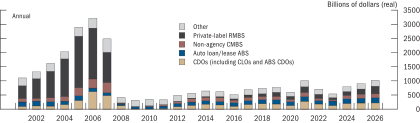
Issuance of non-agency securities remained robust through March 2026 (figure 3.14).10 Credit performance was mixed, with delinquencies increasing for CMBS deals and auto asset-backed securities but decreasing for securitized credit card products.
Figure 3.14. The pace of non-agency securitization issuance in early 2026 exceeded the strong pace seen in 2025
Accessible Version | Return to text
Note: The data from the first quarter of 2026 are annualized to create the 2026 bar. RMBS is residential mortgage-backed securities; CMBS is commercial mortgage-backed securities; CDO is collateralized debt obligation; CLO is collateralized loan obligation. The "other" category consists of other asset-backed securities (ABS) backed by credit card debt, student loans, equipment, floor plans, and miscellaneous receivables; resecuritized real estate mortgage investment conduit (Re-REMIC) RMBS; and Re-REMIC CMBS. The data are converted to constant 2026 dollars using the consumer price index. The key identifies bars in order from top to bottom.
Source: Green Street, Commercial Mortgage Alert's CMBS Database and Asset-Backed Alert's ABS Database; consumer price index, Bureau of Labor Statistics via Haver Analytics.
Bank lending to other financial entities continued to grow at a robust pace
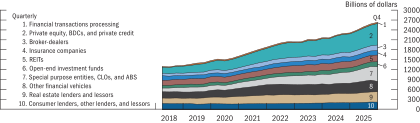
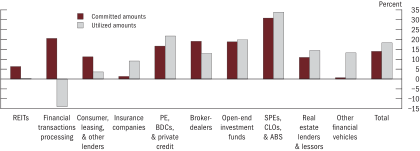
Bank credit commitments to other financial entities grew appreciably in the fourth quarter of 2025 to $2.6 trillion, reflecting the growth in market-based finance and other forms of private nonbank lending (figure 3.15). Private equity, BDCs, and other private credit vehicles constituted the largest portion of bank lending to other financial entities; see the box "Updates in the Classification of Nonbank Financial Institutions" for clarification on methodological changes. Yearly growth of commitments has been notably robust for the special purpose entities, collateralized loan obligations (CLOs), and asset-backed securities category, followed by the other financial vehicles category and the private equity, BDCs, and private credit category (figure 3.16).
Figure 3.15. Bank credit commitments to nonbank financial institutions continued to grow, with private equity, BDCs, and private credit being the largest exposure category
Accessible Version | Return to text
Note: The figure shows committed amounts on credit lines and term loans extended to nonbank financial institutions (NBFIs). NBFIs are identified based on reported North American Industry Classification System (NAICS) codes. In addition to NAICS codes, a name-matching algorithm is applied to identify specific entities such as real estate investment trusts (REITs), special purpose entities, collateralized loan obligations (CLOs), asset-backed securities (ABS), private equity, business development companies (BDCs), and private credit. REITs incorporate both mortgage (trading) REITs and equity REITs. Broker-dealers also include commodity contracts dealers and brokerages and other securities and commodity exchanges. Other financial vehicles include closed-end investment and mutual funds.
Source: Federal Reserve Board, Form FR Y-14Q (Schedule H.1), Capital Assessments and Stress Testing.
Figure 3.16. Bank credit sectoral growth rates in 2025:Q4 were broadly similar to 2024:Q4
Accessible Version | Return to text
Note: The figure shows 2025:Q4-over-2024:Q4 growth rates as of the end of the fourth quarter of 2025. REIT is real estate investment trust; PE is private equity; BDC is business development company; SPE is special purpose entity; CLO is collateralized loan obligation; ABS is asset-backed securities. The key identifies bars in order from left to right.
Source: Federal Reserve Board, Form FR Y-14Q (Schedule H.1), Capital Assessments and Stress Testing.
Box 3.1. Updates in the Classification of Nonbank Financial Institutions
Since the November report, the methodology for identifying bank credit commitments to nonbank financial institutions (NBFIs) has been further updated. The classification in figure 3.15 now incorporates new information from several data vendors, which allows for a reclassification of certain funds from categories such as "other financial vehicles," "special purpose entities, CLOs, and asset-backed securities," and "open-end investment funds" into the "private equity, BDCs, and private credit" category.
As in the previously updated classification, reflected in the April 2025 report, total commitment amounts to private equity, BDCs, and private credit were revised up by $261 billion in the fourth quarter of 2025.1 The estimated level of loan commitments to this sector now represents about 25 percent of total bank loan commitments to NBFIs. With the revised data, the year-over-year growth rate in loan commitments to this sector in 2025 was 17 percent, relative to the year-over-year growth in commitments to all types of NBFIs of 14 percent.
1. See the box "Changes in the Classification of Nonbank Financial Institutions" in Board of Governors of the Federal Reserve System (2025), Financial Stability Report (Washington: Board of Governors, April), p. 36, https://www.federalreserve.gov/publications/files/financial-stability-report-20250425.pdf. Return to text
References
8. VaR is a statistical measure that estimates the maximum potential loss in the value of a trading portfolio over a specified time horizon at a given confidence level. Dealers set internal risk limits based on their risk appetite, capital adequacy, and regulatory requirements. Return to text
9. The SCOOS is available on the Federal Reserve Board's website at https://www.federalreserve.gov/data/scoos.htm. Return to text
10. Securitization allows financial institutions to bundle loans or other financial assets and sell claims on the cash flows generated by these assets as tradable securities, much like bonds. By funding assets with debt issued by investment funds known as special purpose entities (SPEs), securitization can add leverage to the financial system, in part because SPEs are generally subject to regulatory regimes, such as risk retention rules, that are less stringent than banks' regulatory capital requirements. Examples of the resulting securities include collateralized loan obligations (predominantly backed by leveraged loans), asset-backed securities (often backed by credit card and auto debt), commercial mortgage-backed securities, and residential mortgage-backed securities. Return to text