

5. Near-Term Risks to the Financial System
The Federal Reserve routinely engages in discussions with domestic and international policymakers, community groups, and market participants to gauge the set of risk events that, should they occur, would be of greatest concern to these groups. As captured in the box "Survey of Salient Risks to Financial Stability," more respondents in recent outreach noted risks associated with geopolitical tensions, private credit, and AI than had done so in last fall's survey, while fewer participants cited risks related to policy uncertainty. As in previous surveys, a number of respondents continued to note that a successful cyberattack could have particularly severe consequences.
The following discussion considers possible interactions of existing domestic vulnerabilities with three potential near-term risks.
Cyberattacks and other cyber events could disrupt market functioning and the provision of financial services
In addition to survey respondents' recurring concerns about cyber events, commentators have suggested that an increased intensity of malicious cyberattacks could accompany the conflict in the Middle East. Furthermore, recent advances in the ability of large language models and agentic AI systems to detect and exploit vulnerabilities have introduced new challenges in safeguarding system security for financial institutions, infrastructures, and third-party service providers. Non-malicious cyber events, such as software malfunctions, have also caused disruptions to the provision of financial services. Shocks caused by cyber events may propagate through complex interdependencies among financial institutions and market infrastructures as well as service providers and can be further amplified by existing financial vulnerabilities. For example, a cyber event at a financial institution that disrupts its ability to provide services could have wide-ranging effects, including degraded market liquidity, erosion of investor and depositor confidence, and forced sales of assets. Attacks on critical third-party providers could affect multiple institutions, with the effects of such disruptions likely to be further amplified when there is limited substitutability for the affected services. Through continued interagency coordination and information sharing, U.S. government agencies and financial regulators are advancing efforts to further protect the financial system and financial infrastructure from cyber risks.
A protracted conflict in the Middle East could affect U.S. financial stability through multiple channels
As discussed in previous reports, a worsening of geopolitical tensions can lead to broad adverse spillovers.13 A prolonged conflict, particularly if accompanied by persistent commodity shortages and impaired supply chains, could lead to upward pressure on global inflation and an economic slowdown in the U.S. and abroad, including some foreign economies where elevated public debt levels may limit governments' ability to respond to weaker growth. In addition, a downturn in sentiment for investors, businesses, and consumers could prompt a broader pullback from riskier assets or those with elevated valuations, increasing volatility in financial markets. Sharp movements in the prices of commodities and related derivative instruments also could strain market participants. Tighter financing conditions could also result from weaker investor sentiment, leading to reduced dollar credit from non-U.S. banks and sales of dollar debt securities by international investors that rely on less stable wholesale sources for dollar funding or for hedging exchange rate risk.14 Weaker-than-expected economic activity could also erode the fundamentals of some businesses and households.
A further increase in term premiums leading to higher-than-anticipated long-term interest rates, particularly if accompanied by persistent inflation, could pose risks for both borrowers and lenders
Nominal term premiums have increased since the previous report, and the conflict in the Middle East has put upward pressure on near-term inflation. Higher interest rates and inflation could have significant financial and economic effects, including declines in asset prices. In the near term, higher interest rates, as well as weaker balance sheets resulting from asset price declines, could raise consumer borrowing costs and, along with inflation, strain household budgets. Debt-servicing costs for governments and businesses would similarly increase, which, for some businesses, could amplify existing vulnerabilities linked to high leverage and upcoming refinancing needs. Higher interest rates could lead to declines in the fair values of fixed-rate assets held by financial intermediaries, which, in turn, could reduce the supply of credit to the economy.
Box 5.1. Survey of Salient Risks to Financial Stability
As part of its market intelligence gathering, staff from the Federal Reserve Bank of New York solicited views from a wide range of contacts on risks to U.S. financial stability. During March and April, the staff surveyed 20 contacts, including professionals at broker-dealers, banks, investment funds, and advisory firms. This section is a summary of the views provided by survey respondents and should not be interpreted as representing the views of the Federal Reserve Board or the Federal Reserve Bank of New York.
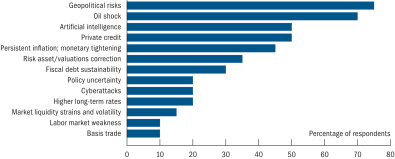
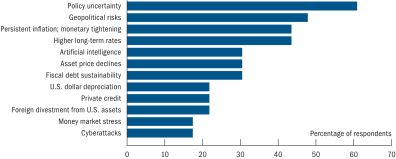
Geopolitical risks and an oil shock were the top-cited risks in this survey, with respondents focused on the inflationary implications of energy supply disruptions following the outbreak of the Iran conflict (figure A). AI-related risks were in focus as well, particularly concerns around equity valuations, debt-financed capital spending, and risks to the labor market. Private credit was also widely cited, receiving greater focus than in the previous survey (figure B). Respondents also remained concerned about the potential for a correction in risk assets, with several noting that triggers could come from AI valuation concerns or an escalation in the Iran conflict. While not cited as a top risk, the prospect of a successful cyberattack continued to be flagged as having the most severe potential consequences.
Figure A. Spring 2026: Most cited potential shocks over the next 12 to 18 months
Accessible Version | Return to text
Note: Responses are to the following question: "Over the next 12–18 months, which shocks, if realized, do you think would have the greatest negative impact on the functioning of the U.S. financial system?"
Source: Federal Reserve Bank of New York survey of 20 market contacts from March through April.
Figure B. Fall 2025: Most cited potential shocks over the next 12 to 18 months
Accessible Version | Return to text
Note: Responses are to the following question: "Over the next 12–18 months, which shocks, if realized, do you think would have the greatest negative impact on the functioning of the U.S. financial system?"
Source: Federal Reserve Bank of New York survey of 23 market contacts from September through October.
Geopolitical risks and oil shock
Respondents widely noted the Iran conflict's potential to cause prolonged supply disruptions in energy markets as well as the possibility of a prolonged period of higher inflation. Several noted that inflationary pressure from an energy shock could force central banks to tighten monetary policy even if economic growth were to weaken, potentially triggering risk aversion and amplifying vulnerabilities elsewhere.
Artificial intelligence
Respondents raised several risks related to AI, including equity valuations; that capital expenditures are increasingly funded by debt, creating leverage in the system; and that widespread adoption of AI may contribute to labor market weakness.
Private credit
Private credit was viewed as facing increasing pressure from investor redemptions, worsening sentiment, and AI-driven disruption affecting the credit quality of some borrowers, which could result in a tightening of credit conditions that could spill over into broader credit markets.
Persistent inflation; monetary tightening
More persistent inflation was widely cited as a risk, with many respondents expressing concerns that prolonged energy supply disruptions from the Iran conflict may necessitate tighter monetary policy.
Risk asset correction
A potential correction in risk assets was widely cited, with many respondents noting that such an event could be triggered by concerns around AI-related valuations or supply chain shortages from the Iran conflict.
References
13. See, for example, Board of Governors of the Federal Reserve System (2024), Financial Stability Report (Washington: Board of Governors, November), p. 45, https://www.federalreserve.gov/publications/files/financial-stability-report-20241122.pdf. Return to text
14. Non-U.S. banks' large role in dollar-denominated financial intermediation and their dollar funding vulnerabilities are documented in the box "Vulnerabilities in Global U.S. Dollar Funding Markets" in Board of Governors of the Federal Reserve System (2021), Financial Stability Report (Washington: Board of Governors, May), pp. 55–58, https://www.federalreserve.gov/publications/files/financial-stability-report-20210506.pdf. The sale of dollar securities by international investors during a period of strained liquidity is documented in the box "The Role of Foreign Investors in the March 2020 Turmoil in the U.S. Treasury Market" in Board of Governors of the Federal Reserve System (2021), Financial Stability Report (Washington: Board of Governors, November), pp. 22–25, https://www.federalreserve.gov/publications/files/financial-stability-report-20211108.pdf. Return to text