Overview
This report reviews vulnerabilities affecting the stability of the U.S. financial system related to valuation pressures, borrowing by businesses and households, financial-sector leverage, and funding risks. It also highlights several near-term risks that, if realized, could interact with these vulnerabilities. This report reflects market conditions and data as of April 23, 2026.
Overview of financial system vulnerabilities
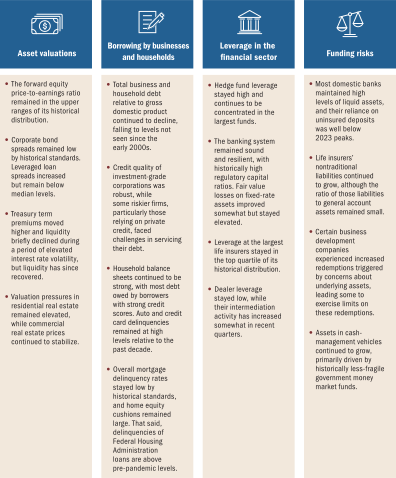
A summary of the developments in the four broad categories of vulnerabilities since the November 2025 Financial Stability Report is as follows:
- Asset valuations. Asset valuation pressures were elevated. Measures of equity valuations have remained high. The ratio of equity prices to earnings for S&P 500 companies stayed in the upper range of its historical distribution, and an estimate of the equity premium—the compensation for risk in equity markets—remained well below its historical average. Treasury term premiums moved higher amid volatility owing, in part, to geopolitical tensions. Corporate bond spreads over comparable-maturity Treasury securities were roughly unchanged and remained low by longer-run standards. In U.S. property markets, home price increases have continued to slow. Nevertheless, the ratio of house prices to rents remained in the upper ranges of its historical distribution. Transaction-based price indexes (adjusted for inflation) for commercial real estate (CRE) properties have further stabilized following significant declines, though vulnerabilities due to upcoming refinancing needs remained (see Section 1, Asset Valuations).
- Borrowing by businesses and households. Vulnerabilities from business and household debt remained moderate. Total debt of businesses and households as a fraction of gross domestic product (GDP) continued to trend down, falling to levels not seen since the early 2000s. Some measures of the leverage of publicly traded firms stayed high relative to their historical distributions, but solid interest coverage ratios (ICRs) suggest these firms remained well positioned to continue servicing their debt. Debt-servicing capacity was lower among some publicly traded non-investment-grade firms and riskier private firms, especially those that rely on floating-rate debt such as leveraged loans and private credit. In the household sector, balance sheets remained strong overall, with most debt being owed by borrowers with strong credit histories. Mortgage delinquency rates remained low due to large home equity cushions and strong underwriting standards, although some distress is evident among Federal Housing Administration (FHA) and Department of Veterans Affairs (VA) loans as well as borrowers who purchased homes with low down payments in recent years. Delinquencies on credit cards and auto loans remained above levels that have prevailed over the past decade (see Section 2, Borrowing by Businesses and Households).
- Leverage in the financial sector. Vulnerabilities associated with financial leverage remained notable. Leverage at hedge funds remained near all-time highs and was concentrated in a small number of large funds. This leverage supports a broad range of strategies, including those involving Treasury securities, interest rate derivatives, and equities. Leverage at the largest life insurers stayed well into the upper quartile of its historical distribution. The banking sector remained sound and resilient overall. Banks continued to report regulatory capital levels near historically high levels. Fair value losses on fixed-rate assets continued to decline but were still sizable and sensitive to changes in long-term interest rates. Leverage at broker-dealers remained subdued, with asset-to-equity ratios at a level slightly below its median over the past decade, and their intermediation activity supported a range of markets, including those for Treasury securities (see Section 3, Leverage in the Financial Sector).
- Funding risks. Funding risks have remained moderate. Banks' reliance on uninsured deposits—an important component of their funding risk—was well below the peaks in 2022 and early 2023. Assets in cash-management vehicles continued to grow, largely driven by government money market funds (MMFs), which historically have been the least susceptible to large-scale investor redemptions. Life insurers' nontraditional liabilities grew further, although they represent only a small share of general account assets. Finally, driven by concerns about the quality of underlying assets, certain nontraded business development companies (BDCs) faced notable increases in redemption requests, and some exercised limits on the size of these redemptions (see Section 4, Funding Risks).
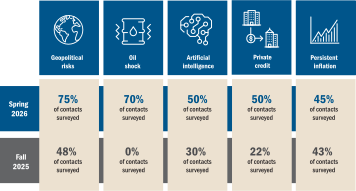
This report also discusses potential near-term risks, based in part on topics cited in market outreach (reported in the box "Survey of Salient Risks to Financial Stability"). Box 5.1 shows that when asked about risks to U.S. financial stability, a wide range of market contacts who participated in the Survey of Salient Risks in March and April most frequently cited geopolitical risks, an oil shock, risks from artificial intelligence (AI), private credit, and persistent inflation.
Finally, the report contains additional boxes that analyze topics salient to financial stability: "Updates in the Classification of Nonbank Financial Institutions" and "Developments in Private Credit."
Survey of salient risks to the financial system
Survey respondents cited several emerging and existing events or conditions as presenting risks to the U.S. financial system and the broader global economy. For more information, see the box "Survey of Salient Risks to Financial Stability."