

5. Near-Term Risks to the Financial System
The Federal Reserve routinely engages in discussions with domestic and international policymakers, academics, community groups, and others to gauge the set of risks of greatest concern to these groups. As captured in the box "Survey of Salient Risks to Financial Stability," significantly fewer respondents in recent outreach noted risks associated with the continued geopolitical conflict in the Middle East and Russia's war against Ukraine than had done so in the fall survey. Instead, the most cited risks were focused on global trade, policy uncertainty, and U.S. debt sustainability.
The following discussion considers possible interactions of existing domestic vulnerabilities with three potential near-term risks.
A U.S. slowdown, particularly if accompanied by higher interest rates, could pose risks for the wider economy as well as financial institutions
A slowdown in economic activity in the United States could have wide-ranging financial and economic effects and prompt further declines in asset prices. Adverse dynamics could be amplified if interest rates rose at the same time. In the near term, higher interest rates could raise consumer borrowing costs and strain household budgets, increasing the potential for delinquencies. Debt-servicing costs for governments and corporations would similarly increase, which could amplify existing vulnerabilities linked to high leverage and upcoming refinancing needs. Collectively, these factors could lead to fair value losses on fixed-rate securities among financial intermediaries, which, in turn, could reduce the supply of credit to the economy, further weighing on economic activity.
A marked slowdown in global economic growth could expose existing financial vulnerabilities
A pronounced economic slowdown in major advanced and emerging economies could weigh on investor, business, and consumer sentiment and prompt a broader pullback from riskier assets or those with elevated valuations, increasing volatility in financial markets and raising the potential for market dislocations. Weaker-than-expected economic activity could also erode the fundamentals of some businesses and households by broadly reducing the outlook for revenue and income growth, impairing their ability to service debt and raising the potential for defaults and delinquencies. These increased credit risks could strain the balance sheets of financial intermediaries, which may restrict the supply of credit as a result. In addition, concerns about elevated public debt levels and fiscal deterioration in many advanced economies may limit governments' ability to respond to weaker growth.
Cyberattacks and other cyber events could disrupt market functioning and the provision of financial services
Over recent years, cyber events, and the risks they pose to the financial system, have been a recurring concern for participants in the Federal Reserve's market outreach surveys. In addition to malicious cyberattacks and costly heists, non-malicious cyber events, such as software malfunctions, have caused disruptions to the provision of financial services. Shocks caused by cyber events may propagate through complex interdependencies among financial institutions and market infrastructures as well as service providers, and can be further amplified by existing financial vulnerabilities. For example, a cyber event at a financial market utility may disrupt core infrastructure that supports clearing and settlement, degrading market liquidity. An attack on a large financial institution could impair its ability to access or verify data, complete transactions, or meet obligations, posing risks for funding and depositor runs as well as fire sales. Attacks on critical third-party providers could affect multiple institutions, with the effects of such disruptions likely to be further amplified when there is limited substitutability for the affected services. Through continued interagency coordination and information sharing, U.S. government agencies and financial regulators are advancing efforts to further protect the financial system and financial infrastructure from cyber risks.
Box 5.1. Survey of Salient Risks to Financial Stability
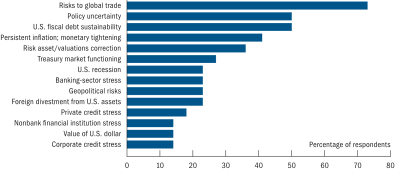
As part of its market intelligence gathering, staff from the Federal Reserve Bank of New York solicited views from a wide range of contacts on risks to U.S. financial stability. From February to early April, the staff surveyed 22 contacts, including professionals at broker-dealers, investment funds, and research and advisory firms, as well as academics (figure A). This section is a summary of the views provided by survey respondents and should not be interpreted as representing the views of the Federal Reserve Board or the Federal Reserve Bank of New York.
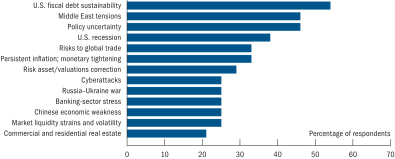
Risks emanating from changes to global trade policy were the most cited risk. U.S. fiscal debt sustainability, which was the top-cited risk last fall, was slightly less noted this round. Broader policy uncertainty, which was often cited in the survey last fall, remained frequently cited this cycle (figure B). A correction in risk assets as well as persistent inflation were also frequently cited in this round. Respondents also expressed concern that Treasury market functioning could become impaired due to a confluence of factors.
Figure A. Spring 2025: Most cited potential shocks over the next 12 to 18 months
Accessible Version | Return to text
Note: Responses are to the following question: "Over the next 12–18 months, which shocks, if realized, do you think would have the greatest negative impact on the functioning of the U.S. financial system?"
Source: Federal Reserve Bank of New York survey of 22 market contacts from February through early April.
Figure B. Fall 2024: Most cited potential shocks over the next 12 to 18 months
Accessible Version | Return to text
Note: Responses are to the following question: "Over the next 12–18 months, which shocks, if realized, do you think would have the greatest negative impact on the functioning of the U.S. financial system?"
Source: Federal Reserve Bank of New York survey of 24 market contacts from August to October.
Risks to global trade
Concern over changes to trade policy was the top-cited risk this cycle. While many respondents viewed tariffs as the key risk, some noted that the domestic economy could weather incremental tariffs on imported goods with only modest disruption. Respondents considered that the potential for an escalatory trade war could have more severe consequences.
Policy uncertainty
Respondents also highlighted policy uncertainty outside of trade, including changes in government spending priorities and the extent of U.S. international engagement. As in the fall, the need to raise the debt limit was also cited.
U.S. fiscal debt sustainability
Contacts noted concerns that elevated Treasury supply could crowd out private investment, raise term premia, and further challenge Treasury market liquidity.
Risk asset/valuation correction
Contacts cited a correction in the price of risk assets, with elevated valuations as a notable risk.
Persistent inflation
Respondents continued to note the risk of persistent inflation, though not as frequently as in surveys over the past several years. Participants highlighted that inflation could rise from tariffs and disruptions to global supply chains. Several contacts specifically mentioned the risk that longer-term inflation expectations could become unanchored.
Treasury market functioning
Respondents noted that the intermediation capacity in the Treasury market could become challenged. In addition, some expressed concerns about the demand for Treasury securities from foreign investors and how shifts in investor behavior could impact the Treasury market.