


4. Funding Risks
Over the past year, vulnerabilities from funding risks have declined to a level in line with historical norms
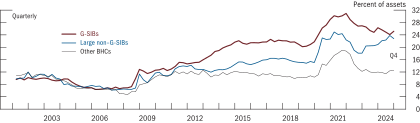
Funding risks for most banks remained near historical norms. Uninsured deposits as a share of bank funding have declined significantly from their 2022 peak, though some banks' reliance on potentially less-stable forms of funding remained high. On the asset side, large banks subject to the liquidity coverage ratio (LCR) maintained sound levels of high-quality liquid assets (HQLA).
MMFs and other cash-management vehicles continued to be vulnerable to runs, as they allow daily investor redemptions while investing in assets with a degree of credit risk and limited secondary-market trading, which can lead to strains in stress episodes. Vulnerabilities in prime and tax-exempt MMFs have diminished as reforms went into effect and assets under management (AUM) in institutional prime funds, the most run-prone segment, declined. However, other cash-management vehicles continued to grow.
Some open-end bond mutual funds remained susceptible to large outflows, as they allow daily redemptions while holding assets that might become illiquid in times of stress. Meanwhile, life insurers continued to face funding risk owing to their reliance on nontraditional liabilities in combination with an increasing share of investments in less-liquid assets.
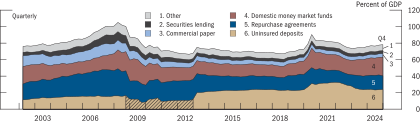
Overall, estimated runnable money-like financial liabilities grew 8.2 percent over the past year, exceeding $23 trillion, driven by growth in MMFs and repos. As a share of GDP, runnable liabilities remained near their historical median of around 78 percent (table 4.1 and figure 4.1). The box "Runnables: An Indicator of Aggregate Run-Related Vulnerabilities in the Economy" provides an overview of their composition, historical trends, and recent developments.
Table 4.1. Size of selected instruments and institutions
| Item | Outstanding/total assets (billions of dollars) |
Growth, 2023:Q4–2024:Q4 (percent) |
Average annual growth, 1997–2024:Q4 (percent) |
|---|---|---|---|
| Total runnable money-like liabilities 1 | 23,388 | 8.5 | 5.0 |
| Uninsured deposits | 7,067 | 5.0 | 10.7 |
| Domestic money market funds2 | 6,852 | 15.8 | 6.4 |
| Government | 5,638 | 16.4 | 15.2 |
| Prime | 1,079 | 13.3 | 3.3 |
| Tax exempt | 136 | 9.9 | −.8 |
| Repurchase agreements | 4,920 | 3.1 | 5.8 |
| Commercial paper | 1,323 | 8.0 | 2.7 |
| Securities lending3 | 1,045 | 8.6 | 7.3 |
| Bond mutual funds | 4,867 | 7.6 | 8.0 |
Note: The data extend through 2024:Q4 unless otherwise noted. Outstanding amounts are in nominal terms. Growth rates are nominal and are measured from Q4 of the year immediately preceding the period through Q4 of the final year of the period. Total runnable money-like liabilities exceed the sum of listed components. Unlisted components of runnable money-like liabilities include variable-rate demand obligations, federal funds, funding-agreement-backed securities, private liquidity funds, offshore money market funds, short-term investment funds, local government investment pools, and stablecoins. Bond mutual funds are not part of the total runnable money-like liabilities.
1. Average annual growth is from 2003:Q1 to 2024:Q4. Return to table
2. Average annual growth is from 2001:Q1 to 2024:Q3. Return to table
3. Average annual growth is from 2000:Q1 to 2024:Q3. Securities lending includes only lending collateralized by cash. Return to table
Source: Securities and Exchange Commission, Private Funds Statistics; iMoneyNet, Inc., Offshore Money Fund Analyzer; Bloomberg Finance L.P.; Securities Industry and Financial Markets Association: U.S. Municipal Variable-Rate Demand Obligation Update; DTCC Solutions LLC, an affiliate of the Depository Trust & Clearing Corporation: commercial paper data; Federal Reserve Board staff calculations based on Risk Management Association, Securities Lending Report; S&P Securities Finance; Investment Company Institute; Federal Reserve Board, Statistical Release Z.1, "Financial Accounts of the United States"; Federal Financial Institutions Examination Council, Consolidated Reports of Condition and Income (Call Report); Morningstar, Inc., Morningstar Direct; Llama Corp, DeFiLlama.
Figure 4.1. The ratio of runnable money-like liabilities to GDP remained near its median
Accessible Version | Return to text
Note: The black striped area denotes the period from 2008:Q4 to 2012:Q4, when insured deposits increased because of the Transaction Account Guarantee program. The "other" category consists of variable-rate demand obligations (VRDOs), federal funds, funding-agreement-backed securities, private liquidity funds, offshore money market funds, short-term investment funds, local government investment pools, and stablecoins. Securities lending includes only lending collateralized by cash. GDP is gross domestic product. Values for VRDOs come from Bloomberg beginning in 2019:Q1. See Jack Bao, Josh David, and Song Han (2015), "The Runnables," FEDS Notes (Washington: Board of Governors of the Federal Reserve System, September 3), https://www.federalreserve.gov/econresdata/notes/feds-notes/2015/the-runnables-20150903.html.
Source: Securities and Exchange Commission, Private Funds Statistics; iMoneyNet, Inc., Offshore Money Fund Analyzer; Bloomberg Finance L.P.; Securities Industry and Financial Markets Association: U.S. Municipal Variable-Rate Demand Obligation Update; DTCC Solutions LLC, an affiliate of the Depository Trust & Clearing Corporation: commercial paper data; Federal Reserve Board staff calculations based on Risk Management Association, Securities Lending Report; S&P Securities Finance; Investment Company Institute; Federal Reserve Board, Statistical Release Z.1, "Financial Accounts of the United States"; Federal Financial Institutions Examination Council, Consolidated Reports of Condition and Income (Call Report); gross domestic product, Bureau of Economic Analysis via Haver Analytics; Llama Corp, DeFiLlama.
Box 4.1. Runnables: An Indicator of Aggregate Run-Related Vulnerabilities in the Economy
Runs can precipitate severe strains in short-term funding markets1. As such, short-term uninsured liabilities that are susceptible to runs, or "runnables," serve as a key metric for assessing aggregate run-related vulnerabilities in the economy.2 This box provides an overview of runnables, including their composition, historical trends, and recent developments.
Concept of runnables
Runnables play a vital role in the economy by offering investors cash-management options and providing short-term funding to businesses, governments, and financial institutions. Their total outstanding volume amounts to roughly 80 percent of U.S. GDP, highlighting their significant presence in the financial system.
However, these liabilities also pose significant systemic risk due to their susceptibility to runs, in which investors stop providing funding by redeeming shares, withdrawing deposits, or refusing to roll over short-term debts. Such runs have contributed to several episodes of financial stress over the past two decades. Hence, monitoring the aggregate size and composition of runnables is critical for assessing vulnerabilities stemming from funding risk.
Estimation approach for runnables
Short-term funding markets include both funding instruments—such as repos and commercial paper (CP)—and investment vehicles like MMFs that invest in those instruments. Instruments and vehicles may overlap in providing funding. For example, an investor purchasing $10,000 in MMF shares may indirectly provide that funding to a bank if the MMF uses the proceeds to purchase CP issued by the bank. Runs can occur in either segment of this funding chain: The MMF can suffer a run if investors rapidly redeem shares, and a CP issuer can experience a run if MMFs suddenly stop rolling over its maturing CP. Furthermore, such events are often linked, as redemptions from an MMF may compel it to curtail the financing provided to its borrowers, amplifying systemic stress.
Thus, to quantify the aggregate size of runnables, the sum of the outstanding amounts of all runnable components is used, rather than a net amount.3 Conceptually, this aggregate measure is designed to capture all types of short-term liabilities that could be subject to runs. To account for inflation and economic growth over time, runnable liabilities are scaled by nominal U.S. GDP.
Components of runnables and their vulnerabilities
While runnables play a vital role in the financial system, in the past two decades most have experienced runs or run-like events—some of which stabilized only after government intervention.
Domestic MMF shares are used for cash management by both institutional and retail investors, while MMFs provide short-term funding to financial and nonfinancial firms as well as governments. Prime MMFs, which bear credit risk, suffered industry-wide runs in September 2008 and again in March 2020. CP is a key source of short-term funding for large corporations and financial institutions. However, during crises, issuers have struggled to roll over maturing CP, leading to sharp spikes infunding costs and market freezes. Repos are short-term, secured loans that serve as a key funding source for broker-dealers and leveraged investors, who often depend on continuous rollovers. Repo markets experienced major disruptions in 2008, with funding volumes contracting abruptly. Securities lending is economically similar to repo, with securities lenders typically reinvesting cash collateral in short-term instruments. Some of these reinvestments came under stress in 2008, which strained securities lenders' ability to return cash collateral on demand. Uninsured bank deposits—those exceeding the Federal Deposit Insurance Corporation insurance limit—are an important funding source for some banks but have been vulnerable to rapid withdrawals during multiple periods of stress.
The coverage of runnables has expanded notably since 2015, partly due to improved data availability.4 The measure now also includes dollar-denominated offshore MMFs, bank-sponsored short-term investment funds, local government investment pools, private liquidity funds, and ultrashort bond funds—many of which invest in similar markets as domestic MMFs. Most of these runnable vehicles have grown steadily over the past decade, and many experienced notable stresses during crises. More recently, innovation in short-term funding markets has given rise to new forms of runnables, particularly stablecoins. As financial innovations continue, the list of runnables will likely expand further.
Evolution of runnables
The usefulness of runnables as an indicator of aggregate financial vulnerability was evident in the years leading up to 2007, when their share of GDP reached record highs—driven largely by the expansion of nonbank financial intermediaries and their heavy use of short-term funding markets. These elevated levels signaled heightened run risks.
That fragility materialized during the 2007–09 financial crisis, as several key components of runnables experienced damaging runs. The most prominent include the run on asset-backed commercial paper (ABCP), the run on prime MMFs, and the freeze in the triparty repo market. Following the crisis, total runnables declined sharply relative to GDP, as market participants pulled back from certain funding markets—such as repos, securities lending, and ABCP—while uninsured deposits temporarily shrank due to expanded deposit insurance coverage.
Uninsured deposits returned to elevated levels in 2013 after the expiration of temporary deposit insurance expansions and saw another boost in 2020 amid the pandemic. These increases not only markedly contributed to the growth of aggregate runnables but also were a factor in the 2023 regional bank crisis, during which runs on uninsured deposits led to the failure of several banks.
Although uninsured deposits have declined in the aftermath of the 2023 turmoil, the overall volume of runnables remains substantial. Runnables are a key asset for investors and funding source for borrowers, and the liquidity mismatch associated with runnables contributes to inherent vulnerabilities in the financial system.
1. This box provides explanations and analyses for figure 4.1, which shows runnable money-like liabilities as a share of GDP. Return to text
2. The concept of "runnables" was introduced in Jack Bao, Josh David, and Song Han (2015), "The Runnables," FEDS Notes (Washington: Board of Governors of the Federal Reserve System, September 3), https://www.federalreserve.gov/econresdata/notes/feds-notes/2015/the-runnables-20150903.html. Return to text
3. In the example above, this approach results in total runnables of $20,000, reflecting both the MMF shares and the CP funding. Return to text
4. The new data series discussed in this paragraph, including stablecoins, are incorporated in the "Other" category of figure 4.1. This "Other" category also includes federal funds, variable-rate demand obligations, and funding-agreement-backed securities. Due to data limitations, the size of some of these runnables may be underestimated. Return to text
Most banks maintained high levels of liquidity, and their funding sources have stabilized over the past year
Aggregate liquidity in the banking system remained sound, as HQLA relative to total assets remained above pre-pandemic levels (figure 4.2). Many U.S. G-SIBs held a significant portion of their HQLA in HTM securities, primarily long-duration agency mortgage-backed securities, whose market values continued to be well below their book values. Securities held in HTM accounts are accounted at book value when used in the calculation of regulatory capital and book equity, but they are valued at fair value for LCR purposes; therefore, fluctuations in the value of these securities can affect banks' LCR levels. HTM securities can be pledged at the Federal Reserve's discount window or in repos at their market value.
Figure 4.2. The share of high-quality liquid assets to total assets remained above pre-pandemic levels
Accessible Version | Return to text
Note: The sample consists of domestic BHCs, intermediate holding companies (IHCs) with a substantial U.S. commercial banking presence, and commercial banks. G-SIBs are global systemically important banks. Large non–G-SIBs are BHCs and IHCs with greater than $100 billion in total assets that are not G-SIBs. Liquid assets are cash plus estimates of securities that qualify as high-quality liquid assets as defined by the Liquidity Coverage Ratio requirement. Accordingly, Level 1 assets as well as discounts and restrictions on Level 2 assets are incorporated into the estimate.
Source: Federal Reserve Board, Form FR Y-9C, Consolidated Financial Statements for Holding Companies.
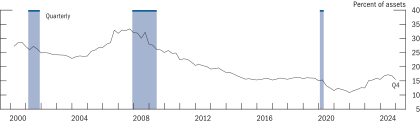
Banks' funding structure was little changed at the end of 2024 relative to the end of 2023. The share of uninsured deposits relative to total bank funding remained well below the elevated levels seen in 2022 and early 2023. Large banks adjusted to lower uninsured deposits by increasing their reliance on short-term non-deposit wholesale funding sources, such as repos, and regional and community banks generally became more reliant on brokered and reciprocal deposits (figure 4.3). While reciprocal deposits are fully insured, they are more expensive than traditional core insured deposits and may not be as stable during times of stress.
Figure 4.3. Banks' reliance on short-term wholesale funding has returned to pre-pandemic levels
Accessible Version | Return to text
Note: Short-term wholesale funding is defined as the sum of large time deposits with maturity less than 1 year, federal funds purchased and securities sold under agreements to repurchase, deposits in foreign offices with maturity less than 1 year, trading liabilities (excluding revaluation losses on derivatives), and other borrowed money with maturity less than 1 year. The shaded bars with top caps indicate periods of business recession as defined by the National Bureau of Economic Research: March 2001–November 2001, December 2007–June 2009, and February 2020–April 2020.
Source: Federal Reserve Board, Form FR Y-9C, Consolidated Financial Statements for Holding Companies.
Money market funds and other cash-management vehicles remained susceptible to runs
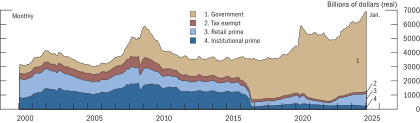
Vulnerabilities in prime MMFs have declined somewhat in the past year and AUM in institutional prime MMFs—historically, the most vulnerable segment—shrank substantially. Total prime assets declined only slightly over the past year, as retail prime MMFs attracted sizable inflows.
As of January 2025, total MMF assets had risen to $6.9 trillion from $6.0 trillion in January 2024, likely because MMFs continued to provide more attractive yields relative to most bank deposits (figure 4.4). More than 80 percent of MMF assets are in funds that hold only U.S. government securities and repo backed by them.
Figure 4.4. Assets under management at money market funds increased to an all-time high in January
Accessible Version | Return to text
Note: The data are converted to constant 2025 dollars using the consumer price index.
Source: Federal Reserve Board staff calculations based on Investment Company Institute data; consumer price index, Bureau of Labor Statistics via Haver Analytics.
Other cash-management vehicles, such as dollar-denominated offshore MMFs and short-term investment funds, also invest in money market instruments and engage in liquidity transformation. Estimated aggregate AUM of these vehicles remained at $2.1 trillion, unchanged from the November report, with roughly $1 trillion to $2 trillion of that amount in vehicles with portfolios similar to those of prime MMFs.10
Many cash-management vehicles—including retail and government MMFs, offshore MMFs, and short-term investment funds—seek to maintain stable net asset values that are typically rounded to $1.00. If short-term interest rates rise sharply or portfolio assets lose value for other reasons, the market values of these funds may fall below their rounded share prices, potentially triggering large redemptions and destabilizing short-term funding markets.
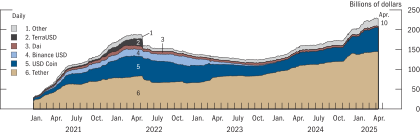
Stablecoins continued to grow and remained vulnerable to runs
Stablecoin assets—digital assets designed to maintain a stable value relative to a national currency or another reference asset—continued to grow.11 By early April, the total market capitalization of stablecoins reached approximately $235 billion, above the previous high observed in April 2022 before Terra's collapse (figure 4.5).
Figure 4.5. Market capitalization of major stablecoins has grown significantly
Accessible Version | Return to text
Note: The key identifies series in order from top to bottom.
Source: Llama Corp, DeFiLlama.
Bond mutual funds remained exposed to liquidity risks
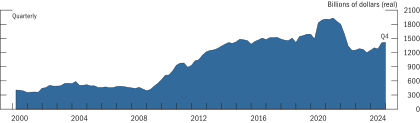
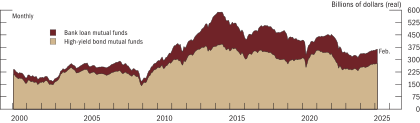
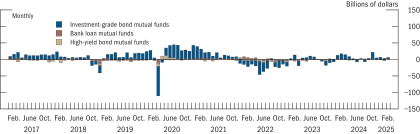
Mutual funds that invest substantially in corporate bonds, municipal bonds, and bank loans may be particularly exposed to liquidity transformation risks, given that these funds are required to offer daily redemptions and hold assets that can become illiquid in times of stress. As of the fourth quarter of 2024, mutual funds held approximately $1.4 trillion in corporate bonds—accounting for nearly 14 percent of corporate bonds outstanding (figure 4.6). In early 2025, total AUM of the subcategories of mutual funds holding high-yield bonds and bank loans—both of which tend to hold riskier and less liquid securities—increased modestly, while net inflows into these funds remained relatively subdued (figure 4.7 and figure 4.8).12 In early April, amid heightened market volatility, outflows from bank loan and high-yield bond mutual funds were somewhat elevated.
Figure 4.6. Corporate bonds held by bond mutual funds increased in the second half of 2024
Accessible Version | Return to text
Note: The data show holdings of all U.S. corporate bonds by all U.S.-domiciled mutual funds (holdings of foreign bonds are excluded). The data are converted to constant 2024 dollars using the consumer price index.
Source: Federal Reserve Board staff estimates based on Federal Reserve Board, Statistical Release Z.1, "Financial Accounts of the United States"; consumer price index, Bureau of Labor Statistics via Haver Analytics.
Figure 4.7. Assets held by bank loan and high-yield mutual funds have been trending up since late 2023
Accessible Version | Return to text
Note: The data are converted to constant 2025 dollars using the consumer price index. The key identifies series in order from top to bottom.
Source: Investment Company Institute; consumer price index, Bureau of Labor Statistics via Haver Analytics.
Figure 4.8. Mutual fund flows remained subdued through February
Accessible Version | Return to text
Note: Mutual fund assets under management as of February 2025 included $2,428 billion in investment-grade bond mutual funds, $276 billion in high-yield bond mutual funds, and $86 billion in bank loan mutual funds. Bank loan mutual funds, also known as floating-rate bond funds, are excluded from high-yield bond mutual funds.
Source: Investment Company Institute.
Central counterparties' initial margin levels and prefunded resources remained high
Central counterparties' (CCPs) initial margin levels remained high and stable during the second half of 2024. CCPs also maintained high levels of prefunded mutualized resources.13 Elevated initial margins and ample overall prefunded resources lower the risk faced by CCPs to the potential default by a clearing member or market participant. This, in turn, reduces the possibility of large liquidity demands from a CCP to its credit providers (usually banks). More recently, CCPs operated normally as transaction volumes across cleared products grew in early April. However, the concentration of clients' collateral at the largest clearing members remains a vulnerability, as such concentration could make transferring client positions to other clearing members challenging if it were ever necessary.14
Life insurers' reliance on nontraditional liabilities for funding continued to increase
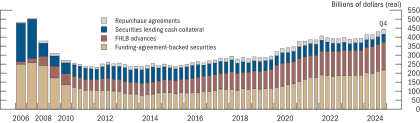
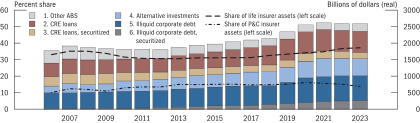
Life insurers continued to increase their reliance on nontraditional liabilities for funding, including funding-agreement-backed securities, Federal Home Loan Bank advances, and cash received through repos and securities lending transactions (figure 4.9). These liabilities can create liquidity risk through the inability to roll over funding if the proceeds from such funding are not invested in assets with similar maturity profiles (figure 4.10). The combination of a growing reliance on nontraditional liabilities and a steady decline in the liquidity of life insurers' assets could make it challenging for life insurers to meet a sudden rise in withdrawals or other claims.
Figure 4.9. Life insurers' reliance on nontraditional liabilities for funding increased further in the second half of 2024
Accessible Version | Return to text
Note: The data are converted to constant 2024 dollars using the consumer price index. FHLB is Federal Home Loan Bank. The data are annual from 2006 to 2010 and quarterly thereafter. The key identifies bars in order from top to bottom.
Source: Consumer price index, Bureau of Labor Statistics via Haver Analytics; Moody's Analytics, Inc., CreditView, Asset-Backed Commercial Paper Program Index; Securities and Exchange Commission, Forms 10-Q and 10-K; National Association of Insurance Commissioners, quarterly and annual statutory filings accessed via S&P Global, Capital IQ Pro; Bloomberg Finance L.P.
Figure 4.10. Life insurers continued to hold a significant share of risky and illiquid assets on their balance sheets
Accessible Version | Return to text
Note: The data are converted to constant 2023 dollars using the consumer price index. Securitized products include collateralized loan obligations for corporate debt, private-label commercial mortgage-backed securities for commercial real estate (CRE), and private-label residential mortgage-backed securities and asset-backed securities (ABS) backed by autos, credit cards, consumer loans, and student loans for other ABS. Illiquid corporate debt includes private placements, bank and syndicated loans, and high-yield bonds. Alternative investments include assets filed under Schedule BA. P&C is property and casualty. The key identifies bars in order from top to bottom.
Source: Consumer price index, Bureau of Labor Statistics via Haver Analytics; Federal Reserve Board staff estimates based on data from Bloomberg Finance L.P. and National Association of Insurance Commissioners Annual Statutory Filings.
References
10. Cash-management vehicles included in this total are dollar-denominated offshore MMFs, short-term investment funds, private liquidity funds, ultrashort bond mutual funds, and local government investment pools. Return to text
11. Stablecoins are typically backed by a pool of "reserve" assets that include Treasury bills and other short-term instruments, but some stablecoin reserve assets also include loans and other digital assets. Return to text
12. As of the fourth quarter of 2024, mutual funds held approximately 10 percent and 18 percent of high-yield and bank loans outstanding, respectively. Return to text
13. Prefunded resources represent financial assets, including cash and securities, transferred by the clearing members to the CCP to cover that CCP's potential credit exposure in case of default by one or more clearing members. These prefunded resources are held as initial margin and prefunded mutualized resources, which builds the resilience of CCPs to the possible default of a clearing member or market participant. Return to text
14. If a clearing member were to default, its client positions would need to be transferred. However, transferring these positions could be difficult if they are large. Given that a significant portion of client positions is currently concentrated with a few clearing members, such a transfer would likely be challenging if one of these members were to default. Return to text