

Overview
This report reviews vulnerabilities affecting the stability of the U.S. financial system related to valuation pressures, borrowing by businesses and households, financial-sector leverage, and funding risks. It also highlights several near-term risks that, if realized, could interact with these vulnerabilities. This report reflects market conditions and data as of April 11, 2025.
Overview of financial system vulnerabilities
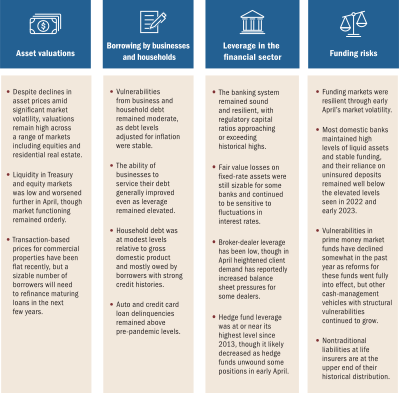
A summary of the developments in the four broad categories of vulnerabilities since the November 2024 Financial Stability Report (FSR) is as follows:
- Asset valuations. Asset valuations are notable. Prior to early April's market volatility, the ratio of equity prices to earnings had remained near the high end of its historical range and an estimate of the equity premium—the compensation for risk in equity markets—remained well below average. Even after recent declines in equity prices, prices remained high relative to analysts' earnings forecasts, which adjust more slowly than market prices. Treasury yields across maturities remained at the higher end of their levels since 2008. Spreads between yields on corporate bonds and those on comparable-maturity Treasury securities were at moderate levels compared to their history, despite recent increases. Liquidity across many financial markets remained low through the end of March and deteriorated further in April, but market functioning was generally orderly. In U.S. property markets, home prices remained elevated, and the ratio of house prices to rents continued to be near the highest levels on record. Transaction-based price indexes (adjusted for inflation) for commercial real estate (CRE) properties showed some signs of stabilization, though vulnerabilities due to upcoming refinancing needs remain (see Section 1, Asset Valuations).
- Borrowing by businesses and households. Vulnerabilities from business and household debt remained moderate. Total debt of businesses and households as a fraction of gross domestic product (GDP) continued to trend down to its lowest level in the past two decades. Indicators of business leverage remained elevated relative to historical levels, and private credit arrangements continued to grow. Nonetheless, measures of the ability of businesses to service their debt have been stable and within typical ranges, though a sustained decline in earnings could put some vulnerable business borrowers at risk. Household debt relative to GDP is subdued relative to recent history. Most household debt is owed by borrowers with strong credit histories who are well positioned to meet their payment obligations given fixed-rate mortgage debt carrying low interest rates and debt service ratios slightly below pre-pandemic levels. That said, delinquencies on credit cards and auto loans are above pre-pandemic levels, particularly for borrowers with non-prime credit scores, a large share of whom have low to moderate incomes (see Section 2, Borrowing by Businesses and Households).
- Leverage in the financial sector. Vulnerabilities associated with financial leverage remained notable. The banking sector remained sound and resilient overall, and most banks continued to report capital levels well above regulatory requirements. Fair value losses on fixed-rate assets were still sizable for some banks and continued to be sensitive to changes in interest rates. Further, some banks, insurers, and securitization vehicles continued to have concentrated exposures to CRE. Bank credit commitments to nonbank financial institutions (NBFIs) continued to increase. (Improvements to the methodology for measuring these commitments are discussed in the box "Changes in the Classification of Nonbank Financial Institutions.") Indicators suggested that hedge fund leverage was at or near the highest level in the past decade and concentrated in larger hedge funds. More recently, a number of leveraged investors have unwound positions amid heightened volatility or in the course of meeting margin calls, including hedge funds that participate in relative value trades. Broker-dealer leverage has been near historical lows. Dealer intermediation in Treasury markets hit record highs in the first quarter of 2025, and heightened client demand in early April reportedly increased balance sheet pressures for some dealers (see Section 3, Leverage in the Financial Sector).
- Funding risks. Funding risks have declined over the course of the past year to a moderate level—broadly in line with historical norms. Aggregate runnable money-like liabilities remained near their historical median and represent a persistent vulnerability (discussed in the box "Runnables: An Indicator of Aggregate Run-Related Vulnerabilities in the Economy"). Banks have significantly reduced their reliance on uninsured deposits from peaks in 2022 and early 2023. Vulnerabilities in prime money market funds (MMFs) have declined over the past year. However, other cash-management vehicles with similar vulnerabilities continued to grow. Additionally, bond and loan funds that hold assets that can become illiquid in times of stress and are therefore susceptible to large redemptions experienced somewhat elevated outflows in early April (see Section 4, Funding Risks).
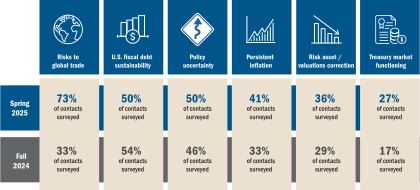
This report also discusses potential near-term risks, based in part on the most frequently cited risks to U.S. financial stability as gathered from outreach to a wide range of researchers, academics, and market contacts conducted from February to early April (discussed in the box "Survey of Salient Risks to Financial Stability"). The most frequently cited topics in the responses, the vast majority of which were received before April 2, were risks to global trade, policy uncertainty, and U.S. fiscal debt sustainability. A number of respondents also cited persistent inflation and corrections in asset markets as salient risks.
Survey of salient risks to the financial system
Survey respondents cited several risks to the U.S. financial system and the broader global economy. For more information, see the box "Survey of Salient Risks to Financial Stability."