


Housing
Housing represents the largest expense for most families, and consequently, housing decisions have the potential to substantially affect economic outcomes. The majority of adults owned their homes in 2024, though homeownership was less common among lower-income adults. Those who rent their homes, rather than own, most often said they did so because of financial constraints. That said, many renters noted that renting was more convenient than owning.
Some homeowners did not have homeowners insurance, and those with few financial resources were among the most likely to go without it. Consistent with this finding, a majority of those who went without homeowners insurance did so because of cost.
Homeownership
Sixty-three percent of adults owned their home, while 28 percent rented.65 Homeownership rates varied substantially by income. Thirty-five percent of adults with less than $50,000 of income owned their home, compared with 85 percent of adults with a family income of $100,000 or more.
The income gap in homeownership was even greater among adults under age 60, where the homeownership rate among those with income over $100,000 was more than three times that of those with income less than $50,000. One reason for this pattern may be that older adults, having already purchased their home during their working years, are now less reliant on income for homeownership.66 Another factor could be that increases in home prices have outpaced increases in income, making it more difficult for lower-income younger adults to afford homes than was the case for older generations.67
Gaps in homeownership rates were also apparent by other demographic characteristics. Black and Hispanic households were less likely to own, and more likely to rent, than White and Asian households. Adults with a disability were also less likely to own and more likely to rent their home (table 37).
Table 37. Homeownership and rental rates (by demographic characteristics)
Percent
| Characteristic | Homeownership rate | Rental rate |
|---|---|---|
| Family income | ||
| Less than $25,000 | 25 | 45 |
| $25,000–$49,999 | 47 | 43 |
| $50,000–$99,999 | 68 | 28 |
| $100,000 or more | 85 | 13 |
| Age | ||
| 18–29 | 25 | 45 |
| 30–44 | 58 | 36 |
| 45–59 | 75 | 23 |
| 60+ | 84 | 14 |
| Race/ethnicity | ||
| White | 71 | 21 |
| Black | 47 | 43 |
| Hispanic | 50 | 38 |
| Asian | 66 | 26 |
| Disability status | ||
| Disability | 52 | 35 |
| No disability | 66 | 26 |
| Overall | 63 | 28 |
Note: Among all adults. The share who own plus the share who rent does not sum to 100 percent because some people live rent free in a house that neither they nor their spouse or partner own.
Cost of Housing
About two-thirds of adults who owned their home had a mortgage in 2024. The median monthly mortgage payment was $1,500.68 Likely reflecting differences in home prices across the country, mortgage payments were higher in the Northeast and West, compared with the Midwest and South (table 38). Consistent with increases in home prices and mortgage rates in recent years, mortgage payments were also larger among those who moved in 2023 or 2024 relative to those who moved into their homes in earlier years.69
Table 38. Median monthly mortgage payment (by census region and most recent move)
Dollars
| Census region | Moved in 2023 or 2024 | Overall |
|---|---|---|
| Northeast | 2,200 | 1,600 |
| Midwest | 1,743 | 1,300 |
| South | 1,900 | 1,500 |
| West | 3,220 | 1,811 |
| Overall | 2,020 | 1,500 |
Note: Among homeowners who reported a positive monthly mortgage payment. Owners with a mortgage were asked for the total mortgage payment that they send to their mortgage servicer.
Among renters, the median reported rent was $1,200 in 2024, up about 10 percent each year since 2022. The median reported rent was $1,100 in 2023 and $1,000 in 2022.
Like homeowners with a mortgage, renters in the Northeast and West had higher monthly rent payments compared with the those in the Midwest and South, as measured by the median rental payment in the region (table 39). However, the median monthly rental payments were smaller than monthly mortgage payments made by homeowners. Renters who moved in 2024 or 2023 also had higher rent payments compared with those who did not move in the prior two years.70
Table 39. Median monthly rent payment (by census region and most recent move)
Dollars
| Census region | Moved in 2023 or 2024 | Overall |
|---|---|---|
| Northeast | 1,500 | 1,300 |
| Midwest | 1,050 | 900 |
| South | 1,200 | 1,080 |
| West | 1,600 | 1,400 |
| Overall | 1,300 | 1,200 |
Note: Among renters who reported a positive monthly rental payment.
Renter Experiences
Renters frequently cited multiple reasons for renting their homes. Similar to reasons reported in recent years, financial constraints led many adults to rent their home instead of owning in 2024. The most cited reason for renting was an inability to afford a down payment—just over two-thirds of renters cited this as a reason. Forty-two percent of renters said they rent because they cannot qualify for a home mortgage, and 49 percent said they rent because they cannot afford the monthly mortgage payment (table 40).
Table 40. Reasons for renting (by year)
Percent
| Reason | 2022 | 2023 | 2024 |
|---|---|---|---|
| Can't afford down payment | 65 | 65 | 68 |
| More convenient or flexible to rent | 56 | 57 | 58 |
| Can't afford mortgage monthly payment | 44 | 48 | 49 |
| Renting is less financially risky | 42 | 44 | 47 |
| Cheaper to rent | 42 | 42 | 46 |
| Can't qualify for home mortgage | 40 | 40 | 42 |
| Prefer to rent | 36 | 36 | 39 |
| Trying to buy | 32 | 30 | 30 |
Note: Among renters. Respondents could select multiple answers.
Although many renters noted financial constraints, these were not the only reasons for renting. More than one-third of renters preferred to rent than to own. The majority of renters (58 percent) said that renting is more convenient, and 47 percent rent their homes because they perceive owning as a larger financial risk. Forty-six percent of renters found it cheaper to rent than own.
Challenges paying rent continued at a similar rate to the prior year. Twenty-one percent of renters reported that they had been behind on their rent at some point in the past year, ticking up 1 percentage point from 2023.
Lower-income renters were more likely to fall behind on rent than higher-income renters. Nearly one-fourth of renters with less than $100,000 in income reported being behind on rent at some point in the prior year, compared with 6 percent among renters with income of at least $100,000. That said, the share of higher-income renters who were behind on rent in 2024 more than doubled over the prior year, while renters with income less than $100,000 saw no change.
Some renters face eviction for a variety of reasons, including nonpayment of rent, and ultimately move from their home. In 2024, 2 percent of renters moved in the prior year because of eviction or threat of eviction. This represents 14 percent of renters who moved during 2024.
Neighborhood Satisfaction
The quality of people's neighborhoods, in addition to their housing, can affect well-being and opportunities for the future. Neighborhood quality and characteristics also influence the decision of where to live.
Overall, 77 percent of adults were either somewhat or very satisfied with the overall quality of their neighborhood, similar to the prior year (table 41). Most adults were also satisfied with the level of crime risk, quality of local schools, and the risk from natural disasters. However, a lower 38 percent were satisfied with the cost of housing in their neighborhood.
Table 41. Satisfied with local neighborhood characteristics (by year)
Percent
| Characteristic | 2023 | 2024 |
|---|---|---|
| Overall quality | 76 | 77 |
| Quality of your local schools (among parents of children under age 18) | 66 | 64 |
| Crime risk | 61 | 64 |
| Natural disaster and severe weather risk | 65 | 67 |
| Cost of housing | 37 | 38 |
Note: Among all adults. Share satisfied includes those who were somewhat or very satisfied with the characteristic.
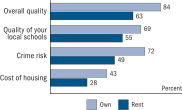
People's satisfaction with their neighborhoods differed by homeownership status. Renters were less likely to be satisfied with their neighborhood overall, as well as less likely to be satisfied with the neighborhood characteristics (figure 31). For example, less than one in three renters were satisfied with the cost of housing in their neighborhood, compared with 43 percent of homeowners.
Figure 31. Satisfied with local neighborhood characteristics (by homeownership status)
Accessible Version | Return to text
Note: Among adults who rent or own their homes. Quality of local schools is among parents living with their own children under age 18. Key identifies bars in order from top to bottom.
Natural Disaster Risks
People may face a variety of financial challenges in the event of natural disasters or severe weather events. Property damage or loss is one of the largest financial risks, particularly for homeowners without homeowners insurance.
Natural disasters and extreme weather can cause other disruptions, such as missing work or higher bills for heating or cooling homes.
Twenty-one percent of adults reported being financially affected by natural disasters or severe weather events (such as flooding, hurricanes, wildfires, or extreme temperatures), up from 19 percent in 2023. Most of these effects were modest, as 13 percent of adults said that they were slightly affected by natural disasters. Yet 6 percent of adults said that they were moderately affected, and 2 percent said that they were substantially affected financially by natural disasters.
When asked about how they were affected, the most common way was property damage, with 1 in 10 adults affected. Smaller shares reported work disruptions (6 percent) or needing to evacuate (3 percent).
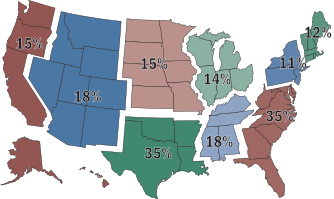
The effects of natural disasters were not experienced uniformly across geography. People living in the South Atlantic and the West South Central Census divisions were most likely to be financially affected by a natural disaster at 35 percent (figure 32).71
Figure 32. Financially affected by natural disaster or severe weather event (by census division)
Accessible Version | Return to text
Note: Among all adults.
Some adults undertook mitigation activities, such as improving their property or purchasing additional insurance, to reduce their financial risks from natural disasters. Making improvements to one's property was the most common mitigation activity, with 18 percent of adults doing so, followed by investigating other places to live (14 percent) and purchasing additional insurance (5 percent). Those who had been financially affected by a natural disaster were more likely to undertake each of these mitigation activities: 35 percent made improvements to their property to reduce risk, and 26 percent investigated other places to live.
While some people purchased additional insurance to help mitigate financial risk from natural disasters, others had no homeowners insurance. Overall, 7 percent of all homeowners went without homeowners insurance.72
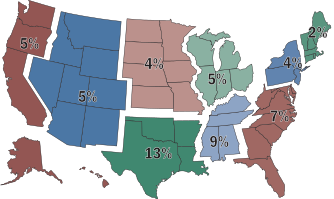
Rates of homeowners insurance varied substantially by geography. The share of homeowners going without homeowners insurance ranged from 2 percent in New England to 13 percent in the West-South Central division (figure 33). Additionally, homeowners living in non-metro areas and those living in low- to moderate-income census tracts were less likely to have homeowners insurance.73
Figure 33. Share with no homeowners insurance on primary residence (by census division)
Accessible Version | Return to text
Note: Among all homeowners.
Homeowners with fewer financial resources were among the most likely to go without homeowners insurance. For example, about 3 in 10 homeowners with income less than $25,000 or whose only asset was their home, went without homeowners insurance.
The majority who went without homeowners insurance did so because of cost. When asked the main reason they didn't have homeowners insurance, 43 percent said they "couldn't afford it", while another 19 percent said "it is not worth the cost." Fifteen percent said "I self-insure or prefer not to buy insurance" and 7 percent said that "no insurance company will insure my home."
Table 42. Share with no homeowners insurance on primary residence (by financial characteristics) **
| Characteristic | Percent |
|---|---|
| Family income | |
| Less than $25,000 | 29 |
| $25,000–$49,999 | 14 |
| $50,000–$99,999 | 5 |
| $100,000 or more | 2 |
| Emergency savings | |
| Under $500 | 18 |
| $500 to $999 | 9 |
| $1,000 to $1,999 | 6 |
| $2,000 or more | 3 |
| Assets | |
| Has no assets other than primary residence | 28 |
| Has other assets | 4 |
| Metropolitan status | |
| Metro area | 6 |
| Non-metro area | 10 |
| Neighborhood income | |
| Low or moderate income | 14 |
| Middle or upper income | 5 |
Note: Among homeowners.
**Note: The Federal Reserve revised this report on June 24, 2025, to reflect corrected data. In the Housing section, table 42, "Share with no homeowners insurance on primary residence (by financial characteristics)," data were corrected for the entry "Low or moderate income" neighborhood from 5 percent to 14 percent and for the entry "Middle or upper income" neighborhood from 14 percent to 5 percent.
References
65. Nine percent of adults reported neither owning nor renting. Return to text
66. Further, older adults, even those with lower income, are much more likely to own their homes free and clear. For example, among adults with income less than $50,000, nearly 41 percent of those age 60 or older own their home free and clear, compared with 10 percent of those under age 60. Return to text
67. Alexander Hermann and Peyton Whitney, "Home Price-to-Income Ratio Reaches Record High," Joint Center for Housing Studies (Cambridge: Harvard University, January 22, 2024), https://www.jchs.harvard.edu/blog/home-price-income-ratio-reaches-record-high-0. Return to text
68. Owners with a mortgage were asked for the total mortgage payment that they send to their bank, which will typically include escrow payments for taxes and homeowners insurance but will not include utilities. Return to text
69. For details on average mortgage rates over time, see Freddie Mac, "Current Mortgage Rate Data Since 1971," https://www.freddiemac.com/pmms. Return to text
70. In addition to reflecting changes in rent prices over time for new leases, the differences in rent prices for those who moved recently may reflect differences in who decides to move each year. Return to text
71. Census divisions are used because the sample contains too few observations to provide estimates for each state. Census divisions are groupings of states that subdivide the United States. See the U.S. Census Bureau at https://www.census.gov/programs-surveys/economic-census/guidance-geographies/levels.html. Return to text
72. Homeowners with a mortgage generally are required to have homeowners insurance, and only 3 percent reported not having it. Thirteen percent of owners who own their home free and clear went without homeowners insurance, unchanged from 2023. This question was not previously asked of those with a mortgage. Return to text
73. Geographic differences remain when looking only among homeowners who own their homes free and clear. Return to text