


Overall Financial Well-Being
The share of adults doing okay financially or living comfortably was similar to 2023 yet remained below the recent high in 2021.2 Inflation continued to be a top financial concern, particularly the price of food and groceries. People's perceptions of their local economy and the national economy improved, yet remained much less favorable than in 2019, before the pandemic.
Current Financial Situation
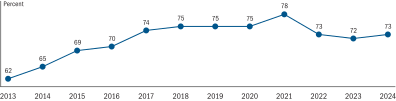
Near the end of 2024, 73 percent of adults reported "doing okay" financially (39 percent) or "living comfortably" (34 percent). The rest reported either "just getting by" (19 percent) or "finding it difficult to get by" (8 percent). The 73 percent of adults doing okay financially or living comfortably was similar to 2023 yet was down 5 percentage points from the recent high of 78 percent in 2021 (figure 1).
Figure 1. Doing okay or living comfortably financially (by year)
Accessible Version | Return to text
Note: Among all adults.
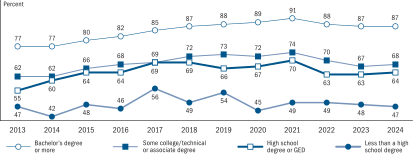
As in previous years, adults with at least a bachelor's degree continued to report higher financial well-being than did adults with lower levels of education. Eighty-seven percent of adults with at least a bachelor's degree reported doing okay or living comfortably, compared with 47 percent of those with less than a high school degree (figure 2).
The current gap in well-being by education was similar to that in recent years. That said, taking a longer view reveals a widened gap in financial well-being by education. Since 2013, the share doing okay or living comfortably has increased by 10 percentage points among adults with at least a bachelor's degree. In contrast, those with less than a high school degree have not experienced any lasting gains (figure 2).
Figure 2. Doing okay or living comfortably financially (by year and education)
Accessible Version | Return to text
Note: Among all adults. Results differ slightly from reports prior to 2021 because of adjustments in the education coding for consistency.
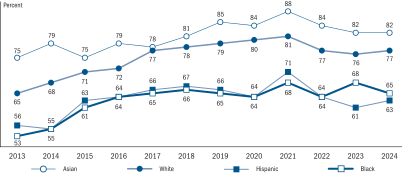
Differences in financial well-being across racial and ethnic groups also persisted in 2024. Eighty-two percent of Asian adults were doing okay or living comfortably, followed by 77 percent of White adults, 65 percent of Black adults, and 63 percent of Hispanic adults (figure 3).3
Figure 3. Doing okay or living comfortably financially (by year and race/ethnicity)
Accessible Version | Return to text
Note: Among all adults.
As with the overall population, financial well-being among Asian, Hispanic, and White adults was similar to the prior year, yet was below its peak in 2021. In contrast, the share doing okay or living comfortably among Black adults has fluctuated in recent years, settling at a level in 2024 that was statistically indistinguishable from 2021.
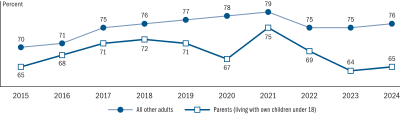
Parents living with their children under age 18 ("parents") are one group that has seen large changes in well-being since the onset of the pandemic. After rising sharply in 2021, the share of parents doing okay financially or living comfortably has fallen 10 percentage points since that time and the gap in financial well-being between parents and all other adults has notably widened. That said, in 2024 financial wellbeing among parents was essentially unchanged from the prior year (figure 4).
Figure 4. Doing okay or living comfortably financially (by year and parental status)
Accessible Version | Return to text
Note: Among all adults.
Financial well-being continued to differ by a range of other dimensions, including age, disability status, metropolitan status, and neighborhood income designation (table 1).4 For instance, 66 percent of adults age 18 to 29 reported doing okay or living comfortably, markedly lower than the 84 percent of adults age 60 or over who did so.
Financial well-being also varied according to where people lived. People living in non-metro areas had lower levels of financial well-being than those living in metro areas.5 Additionally, those living in low- or moderate-income communities continued to fare worse than those in middle- or upper-income communities.
Table 1. Doing okay or living comfortably financially (by demographic characteristics)
Percent
| Characteristic | 2024 n/a | 1-year change (since 2023) | Change since pre-pandemic (2019) |
|---|---|---|---|
| Age | |||
| 18-29 | 66 | 1 | −1 |
| 30-44 | 67 | 1 | −5 |
| 45-59 | 70 | −1 | −4 |
| 60+ | 84 | 2 | 0 |
| Disability status | |||
| Disability | 58 | 3 | n/a |
| No disability | 77 | 1 | n/a |
| Metropolitan status | |||
| Metro area | 74 | 1 | −2 |
| Non-metro area | 66 | −2 | −6 |
| Neighborhood income | |||
| Low or moderate income | 61 | 1 | −2 |
| Middle or upper income | 77 | 1 | −2 |
| Overall | 73 | 1 | −3 |
Note: Among all adults. Low- or moderate-income neighborhoods are defined here using the definition from the Community Reinvestment Act. Disability status was first identifiable in the 2021 survey. Here and in subsequent tables and figures, percentages may not sum to 100 because of rounding.
n/a Not applicable.
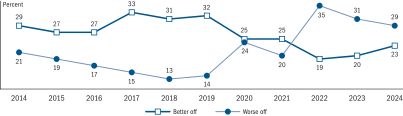
As a complement to the question asking how people are managing financially these days, the survey also asks respondents whether they are better or worse off financially than they were 12 months earlier. This question provides more insight into whether people's financial situation improved or worsened over the prior year, as some individuals may have felt worse off financially than they were a year earlier, for instance, even if they felt they were still doing okay overall (or that their financial well-being was improving even if they were still struggling overall).
Twenty-nine percent of adults said they were worse off financially than a year earlier, continuing to fall from the series high of 35 percent in 2022, yet still well above the levels seen in prior years (figure 5). The share doing about the same as a year earlier remained at 48 percent, while the share who said they were better off rose 3 percentage points to 23 percent.
Figure 5. Financial situation compared with 12 months prior (by year)
Accessible Version | Return to text
Note: Among all adults.
Financial Challenges
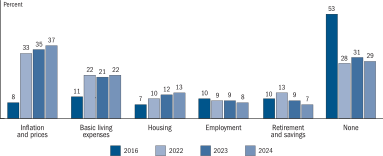
The survey further explored financial well-being by posing an open-ended question asking people about their financial challenges or concerns.6 The responses were classified into broad categories based on keywords or phrases.7 Challenges related to inflation and prices remained the most common, with 37 percent classified into that category, followed by basic living expenses (22 percent) and housing (13 percent). Twenty-nine percent said they did not have any financial challenges or concerns (figure 6).
People's main financial challenges and concerns were similar to those in recent years, though the share of people citing inflation and prices and the share citing housing as their main financial challenge have ticked up.8 Retirement continued to trend down as a main concern, consistent with the increase in the share of people who thought their retirement savings were on track (see the "Savings and Investments" section of this report).
Figure 6. Categories of self-reported main financial challenges in 2016, 2022, 2023, and 2024
Accessible Version | Return to text
Note: Among respondents who provided a text response or selected the none box. In 2024, this question was only asked of a randomized half of the sample. Response categories for medical expenses, debt, and education not shown. Key identifies bars in order from left to right.
When describing challenges related to inflation, people continued to mention the cost of food and groceries and did so at higher rates than in prior years. For example, one respondent stated that the "cost of basic goods especially groceries is way too high." Those with income under $100,000 were more likely to specifically mention the cost of food and groceries as a concern.
People also expressed concerns about housing affordability, particularly renters. For example, one respondent's main financial challenge was "having enough money to pay increasing rent." Other renters mentioned difficulty buying, such as the respondent who said "I am living comfortably, but still concerned I can't afford to buy a house." Indeed, when renters were later asked why they rent instead of own, most said they did so because of financial constraints (see the "Housing" section of this report).
Local and National Economic Conditions
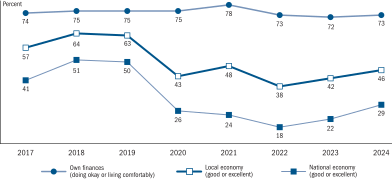
Along with questions about their own financial circumstances, people were asked to rate their local economy and the national economy as "excellent," "good," "only fair," or "poor." Forty-six percent of adults rated their local economy "good" or "excellent" in 2024, up 4 percentage points over the prior year and up 8 percentage points from the series low in 2022. Despite the increase in favorable ratings in recent years, the share rating their local economy as "good" or "excellent" in 2024 remained well below the 63 percent seen in 2019, before the pandemic.
Looking across census region and metropolitan status shows that the improvement in people's perception of their local economy was widespread. That said, those living in a non-metro area continued to rate their local economy much less favorably than those living in a metro area. Thirty-one percent of adults living in a non-metro area rated their local economy as "good" or "excellent," compared with 48 percent among those living in a metro area.
People's perception of the national economy has also improved in recent years. The share rating the national economy as "good" or "excellent" rose to 29 percent in 2024, up 7 percentage points over the prior year and up 11 percentage points from the series low in 2022. That said, perceptions of the national economy remained far more pessimistic than before the pandemic in 2019, when one-half of adults rated the national economy as "good" or "excellent" (figure 7).
Figure 7. Assessment of own financial well-being, local economy, and national economy (by year)
Accessible Version | Return to text
Note: Among all adults. For each series, the responses presented represent the most favorable two outcomes on a four-point scale.
References
2. Unless otherwise specified, results in this report are from the Federal Reserve's Survey of Household Economics and Decisionmaking. The survey was fielded in October 2024, and results reflect financial situations at that time. Results typically capture financial experiences at the time of the survey or in the 12-month period before the survey rather than the precise calendar year. Return to text
3. The reported categorizations reflect the largest statistical groupings but are neither exhaustive nor the only distinctions important to understand. Sample sizes for other racial and ethnic groups and subpopulations are not large enough to produce reliable estimates. Additionally, results for Asian adults are sometimes excluded when the sample size is insufficient to provide a reliable estimate. Return to text
4. Disability status is defined based on a five-question functional limitation sequence that asks about hearing, vision, ambulatory, self-care, and independent living difficulties. This approach for determining disability status is similar to the six-question sequence used for the American Community Survey (see U.S. Census Bureau, "How Disability Data Are Collected from the American Community Survey," https://www.census.gov/topics/health/disability/guidance/data-collection-acs.html). Neighborhood income is defined using the Community Reinvestment Act definition. Under this definition, low- and moderate-income refers to communities that have a median family income of less than 80 percent of the area median income. For details on the definition, see Board of Governors of the Federal Reserve System, "Community Reinvestment Act (CRA) Resources," https://www.federalreserve.gov/consumerscommunities/cra_resources.htm. Return to text
5. According to the U.S. Census Bureau, "The general concept of a metropolitan statistical area is that of a core area containing a substantial population nucleus, together with adjacent communities having a high degree of economic and social integration with that core." See U.S. Census Bureau website at https://www.census.gov/programs-surveys/metro-micro/about.html. Return to text
6. The question text is as follows: "In a couple of words, please describe the main financial challenges or concerns facing you or your family. If none please click the "None" box." Two percent of respondents did not provide a text response and did not check the "None" box. These respondents were excluded from the analysis. Return to text
7. Text entries were categorized based on words or word stems included in the response. "Inflation and prices" includes responses with inflat, cost, pay more, paying more, increas, expensive, price, pricing, higher, rising, skyrocket, sky rocket, going up, gone up. Those with bill, util, electric, heat, everything, necessities, basic needs, essential, can't afford, not enough, get by, getting by, surviv, struggl, no money, challenge, living expense, or food were categorized as "basic living expenses;" those with retire, 401k, stock, market, portfolio, pension, old age, Medicare, SSI, IRA, 401(k), Social Security, save, saving, or fund were categorized as "retirement and savings;" those with house, rent, home, or mortgage were categorized as "housing;" those that mentioned work, job, wage, employ, raise, paycheck, pay check, salary, laid off, part time, hours, full time, overtime, skills, or unemp were categorized as "employment;" those with medical, medicine, health, Medicaid, Medicare, dental, dentist, cancer, sick, ill, doctor, hospital, or prescription were categorized as "medical;" those with credit, loan, debt, or owe were categorized as "debt;" those that mentioned college, school, education, tuition, degree, university, or student were categorized as "education." Responses may be included in multiple categories or no categories, as the categories are neither exhaustive nor mutually exclusive. Nine percent provided a write-in response but were not classified into any of the above categories. Return to text
8. For reference, the inflation rate was 2.6 percent in October 2024 (when the 2024 SHED was conducted), down from 3.2 percent in October 2023, and 7.8 percent in October 2022. These inflation rates are based on the non-seasonally adjusted Consumer Price Index for All Urban Consumers (CPI-U). Return to text