


Job Quality
Jobs can differ in terms of demands and corresponding rewards, beyond just a paycheck. This includes qualities such as workplace autonomy, interest in the job, opportunities for advancement, when and where people work, and work-life balance. Workers with more education continued to have more autonomy in their work and to be much more likely to work from home at least some of the time.
Job changes often lead to better pay and greater job satisfaction. Fourteen percent of adults started a new job in 2024, and 9 percent voluntarily left a job. However, fewer job-changers said that their new job was an improvement over their previous one in 2024 as compared with 2023 and 2022.
Working from Home
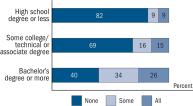
Working from home (or teleworking) continued to be common in 2024. In the week before the survey, 41 percent of workers said they worked from home at least some of the time.16 Eighteen percent of workers did so entirely from home and 22 percent did so some of the time. Levels of fully remote and hybrid work were both similar to levels in 2023, though the share working entirely from home was down 5 percentage points from 23 percent in 2021.
People who completed more education continued to be more likely to work from home. Twenty-six percent of workers with at least a bachelor's degree worked entirely from home compared with 9 percent of those with a high school degree or less (figure 8). Rates of hybrid work also varied markedly by how much education workers had completed.
Figure 8. Amount of work done from home (by education)
Accessible Version | Return to text
Note: Among all workers. Key identifies bars in order from left to right.
Self-employed workers were another group more likely to work from home. Thirty-five percent of people who were self-employed worked entirely from home, including 28 percent of self-employed business owners with paid employees. By comparison, a smaller 16 percent of people who worked for someone else ("employees") work entirely from home.
Employees saw bigger declines in remote work in recent years than people who were self-employed. In 2020, during the pandemic, 29 percent of people working for someone else did so entirely from home, but a smaller 16 percent did so in 2024. This 13 percentage point decrease in the share working from home among people who worked for someone else contrasts with a 1 percentage point increase over the same period among people who were self-employed.17
Irregular Schedules and Worker Decisionmaking
Many workers value scheduling that aligns with their lives outside of work and some control over how best to do their jobs.18 Although many people have regular work schedules, this is not the case for all workers. Twenty-seven percent of employees had irregular work schedules in 2024. Seventeen percent had a work schedule that varied based on their employer's needs, and 10 percent had a variable schedule at their own request.
To better understand workplace autonomy, we asked employees how much choice they had to decide what tasks to work on and how to do those tasks. Fifty-five percent of employees said they often or always chose how to complete tasks, and 33 percent said they often or always chose which tasks to work on. Employees with a bachelor's degree or more were more likely to choose what tasks they work on as well as how to complete those tasks than were workers with less education (table 8).
Table 8. Share of workers who often or always choose what tasks to work on and how to complete tasks (by education)
Percent
| Education | What tasks to work on | How to complete tasks |
|---|---|---|
| High school degree or less | 26 | 46 |
| Some college or technical degree | 29 | 49 |
| Associate degree | 34 | 52 |
| Bachelor's degree or more | 38 | 63 |
| Overall | 33 | 55 |
Note: Among adults who worked for someone else.
Promotions and Moving to New Jobs
Overall 31 percent of adults (58 percent of employees) said that they received a raise or a promotion, which is similar to 2023. A smaller 12 percent of adults (21 percent of employees) said that they asked for a raise or a promotion.
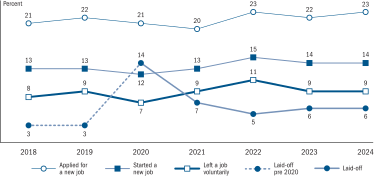
Among all adults, including those not working, 23 percent applied for at least one new job in the past 12 months. A smaller 14 percent said that they started a new job and 9 percent said that they voluntarily left a job, either for a new job or not. Six percent said they were laid off.
Figure 9. New jobs and separations (by year)
Accessible Version | Return to text
Note: Among all adults. Layoffs from 2019 and earlier are not directly comparable with those from 2020 and after due to a change in the question format in 2020.
Looking at trends over time in these measures of job mobility (figure 9) generally shows that hiring peaked in 2022, but remained solid in 2024. One example of this is the share of people who started a new job, which peaked at 15 percent in 2022. Another measure is the share of people who voluntarily quit their jobs, which can signal workers' ability to find new jobs. The share of people who left a job voluntarily peaked at 11 percent in 2022. These declines, however, are less apparent in terms of people looking for a job. Similar shares of adults applied for jobs in 2022, 2023, and 2024.
Most people who start a new job are moving on from another one. Of people who started a new job in 2024 and were still working at the time of the survey, 54 percent were starting a main job at a new employer, and 15 percent had a new job with the same employer. Another 12 percent said that they started a second job. Only 15 percent of people who started a new job said that they were not working a year earlier.19
Job Quality when People Change Jobs
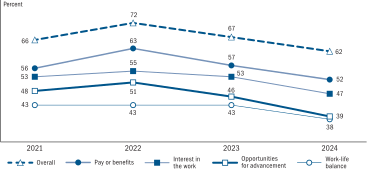
A related way of understanding how well the labor market is working for people is to measure how many people move into a job that they say is better than the last one they had. Among those who changed main jobs, fewer said that their new job was better than was the case in recent years. Overall, 62 percent of people who changed jobs said that their new job was better in 2024 (figure 10).20 This is down from its peak of 72 percent in 2022.
Figure 10. Share of job changes with improved characteristics (by year)
Accessible Version | Return to text
Note: Among adults who started a new job and had a different main job than a year ago.
The pattern of increases from 2021 to 2022 and declines afterwards is reflected across many different measures of job quality (figure 10). For example, 52 percent of people who changed jobs said that the pay and benefits were better in their new job in 2024, down from a peak of 63 percent in 2022. Similarly, fewer job changers said that their opportunities for advancement, interest in the job, and work-life balance improved with their new job in 2024 relative to that seen two years earlier.
References
16. Statistics on work from home in this year's report differ from those in earlier years. This year's report includes all people who had a job (workers) where previous reports included only people who worked for someone else (employees). Return to text
17. Rates during and after the pandemic are much higher than in 2019 when 7 percent of adults worked mostly from home. However, the question asked in 2019 was different in that it asked where people worked in their main jobs most of the time. Return to text
18. Surveys and experiments in some workplaces have shown that workers value schedule flexibility and autonomy, among other job characteristics. These include Alexandre Mas and Amanda Pallais, "Valuing Alternative Work Arrangements," American Economic Review, 107 (12): 3722–59, https://doi.org/10.1257/aer.20161500; Matthew Wiswall and Basit Zafar, "Preference for the Workplace, Investment in Human Capital, and Gender," The Quarterly Journal of Economics, 133(1): 457–507, https://doi.org/10.1093/qje/qjx035; and Nicole Maestas, Kathleen J. Mullen, David Powell, Till von Wachter, and Jeffrey B. Wenger, "The Value of Working Conditions in the United States and the Implications for the Structure of Wages," American Economic Review, 113(7): 2007–47, https://doi.org/10.1257/aer.20190846. Return to text
19. The remaining 4 percent said that something else had happened. Note that some people who started a new job in 2024 were not working at the time of the survey. The 15 percent of people starting a new job who were not working a year ago was similar to the 13 percent seen in 2023. Return to text
20. Twenty-nine percent said that their new job was about the same overall, while a lower 9 percent said that the new job was worse. Both the share who say their jobs is the same and who say their job is worse have grown since 2022. Return to text