


Savings and Investments
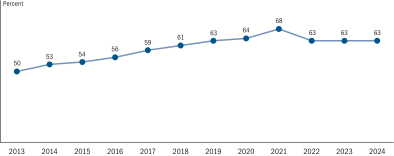
Having a buffer of savings for emergencies can help families cope with fluctuations in income and with unexpected expenses. The share of adults who would pay for an unexpected $400 expense with cash or the equivalent was unchanged from 2023, while the share who said they had rainy day funds to cover three months of expenses edged up from 2023.
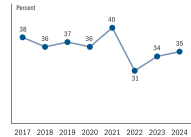
Saving and investing are also important for longer-run financial security, including in retirement. Among adults who were not retired, the share who felt that their retirement savings plan was on track also rose slightly from 2023. That said, each of these three measures of preparedness was down from 2021.
Emergency Savings and Unexpected Expenses
Relatively small, unexpected expenses, such as a car repair or a modest medical bill, can be a hardship for many families, especially those without a financial cushion. When faced with a hypothetical expense of $400, 63 percent of all adults said they would have covered it exclusively using cash, savings, or a credit card paid off at the next statement (referred to, altogether, as "cash or its equivalent").36 The remainder said they would have paid by borrowing or selling something or said they would not have been able to cover the expense. The share who would pay using cash or its equivalent was unchanged from 2022 and 2023 (figure 20).37
Figure 20. Would cover a $400 emergency expense completely using cash or its equivalent (by year)
Accessible Version | Return to text
Note: Among all adults.
Among the 37 percent of adults who would not have covered a $400 expense completely with cash or its equivalent, most would pay some other way, although some said that they would be unable to pay the expense at all. For those who could cover the expenses another way, the most common approach was to use a credit card and then carry a balance, and many indicated they would use multiple approaches. However, 13 percent of all adults said they would be unable to pay the expense by any means (table 21), unchanged from 2022 and 2023 but up from 11 percent in 2021.
Table 21. Other ways individuals would cover a $400 emergency expense
| Approach | Percent |
|---|---|
| Put it on a credit card and pay it off over time | 15 |
| Borrow from a friend or family member | 10 |
| Sell something | 7 |
| Use money from a bank loan or line of credit | 3 |
| Use a payday loan, deposit advance, or overdraft | 2 |
| Would not be able to pay for the expense right now | 13 |
Note: Among all adults. Respondents could select multiple answers.
Some of those who would not have paid an unexpected $400 expense completely with cash or its equivalent likely still had access to $400 in cash. Instead of using that cash to pay for the expense, they may have chosen to preserve their cash as a buffer for other expenses.
To explore this potential difference between how people would pay for a small, unexpected expense and whether they could pay for it with cash or the equivalent, the survey included a question asking people what the largest emergency expense was that they could handle using only savings. Eighteen percent of adults said the largest emergency expense they could handle right now using only savings was under $100, and 13 percent said they could handle an expense of $100 to $499 (table 22).
Table 22. Largest emergency expense individuals could handle right now using only savings
| Amount | Percent |
|---|---|
| Less then $100 | 18 |
| $100–$499 | 13 |
| $500–$999 | 10 |
| $1,000–$1,999 | 10 |
| $2,000 or more | 48 |
Note: Among all adults.
Sixty-nine percent of adults said they could pay an expense of at least $500 using only their current savings (table 22), similar to 2023. This is a somewhat larger share than the 63 percent of adults who said they would pay an unexpected $400 expense with cash or the equivalent, suggesting that some people choose to pay with other methods, even if they have cash savings available to them.38
Some financial challenges, such as a job loss, require more financial resources than would an unexpected $400 expense. One common measure of financial resiliency is whether people have savings sufficient to cover three months of expenses if they lost their primary source of income. In 2024, 55 percent of adults said they had set aside money for three months of expenses in an emergency savings or "rainy day" fund—up slightly from 54 percent in 2023 but down from a high of 59 percent in 2021.39
For those who did not set aside money for this purpose, some would have dealt with a loss of their main source of income by borrowing, selling assets, or drawing on other savings. Fifteen percent of all adults said that they could have covered three months of expenses in this way. Thirty percent of adults indicated they could not cover three months of expenses by any means.
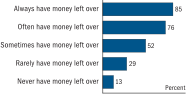
Spending less than income on a regular basis is one way to build an emergency fund, and people who did so more frequently were more likely to report they had a rainy-day fund. Eighty-five percent of adults who said they always had money left over at the end of the month said they had savings to cover three months of expenses, while 13 percent of those who never had money left over at the end of the month had such savings (figure 21).40
Figure 21. Have savings to cover three months of expenses (by how often have money left over at end of the month)
Accessible Version | Return to text
Note: Among all adults.
The share of adults who had emergency savings to cover three months of expenses varied across demographic groups. Older adults and those with a higher family income were more likely to say they had this level of emergency savings (table 23). Asian adults were more likely to have emergency savings, compared with adults from other racial or ethnic groups. Men were more likely than women to report having set aside this amount of savings.
Table 23. Have savings to cover three months of expenses (by demographic characteristics)
| Characteristic | Percent |
|---|---|
| Family income | |
| Less than $25,000 | 24 |
| $25,000–$49,999 | 40 |
| $50,000–$99,999 | 56 |
| $100,000 or more | 75 |
| Age | |
| 18–29 | 36 |
| 30–44 | 50 |
| 45–59 | 54 |
| 60+ | 72 |
| Race/ethnicity | |
| White | 60 |
| Black | 41 |
| Hispanic | 44 |
| Asian | 69 |
| Disability status | |
| Disability | 41 |
| No disability | 59 |
| Male/female | |
| Male | 57 |
| Female | 53 |
| Overall | 55 |
Note: Among all adults.
Retirement Savings and Investments
Saving for retirement is important in preparing for expenses later in life when many people are no longer working. Most adults had at least some savings in a tax-preferred retirement account, defined benefit pension, or other asset that they may be able to tap to meet expenses in retirement.41 Sixty-seven percent of adults had assets that are specifically designated for producing income in retirement. This included the 61 percent of adults who had a tax-preferred retirement account, including employer-sponsored defined contribution plans such as 401(k)s, individual retirement accounts (IRA), or Roth IRAs. It also included 29 percent who had a defined benefit pension through an employer (table 24).42
Table 24. Types of assets (by age)
Percent
| Assets | 18–24 | 25–54 | 55–64 | 65+ | Overall |
|---|---|---|---|---|---|
| Tax-preferred retirement accounts and pensions | |||||
| Tax-preferred retirement account, such as a 401(k) or IRA | 25 | 63 | 70 | 63 | 61 |
| Defined benefit pension through an employer | 4 | 20 | 36 | 54 | 29 |
| Have tax-preferred retirement account or pension | 26 | 66 | 77 | 80 | 67 |
| Other assets | |||||
| Own home | 20 | 57 | 79 | 84 | 63 |
| Savings or money market account, or certificate of deposit (CD) | 42 | 53 | 65 | 75 | 59 |
| Stocks, bonds, ETFs, or mutual funds held outside a retirement account | 17 | 31 | 41 | 48 | 35 |
| Cash value in a life insurance policy | 7 | 23 | 30 | 32 | 25 |
| Business or real estate | 2 | 9 | 17 | 16 | 11 |
| Have tax-preferred retirement account, pension, or other assets listed above | 63 | 83 | 92 | 95 | 85 |
Note: Among all adults. Respondent could select multiple answers. ETFs are exchange-traded funds.
Consistent with the declining prevalence of employer-sponsored defined benefit plans in recent decades, younger adults were much less likely to have defined benefit pensions.43 Among prime-age adults (ages 25 to 54), 20 percent had a defined benefit pension, compared with 36 percent of those ages 55 to 64 and 54 percent of those age 65 and over (table 24).
On the other hand, the growing prevalence of employer-sponsored defined contribution plans such as 401(k)s in recent decades is also reflected in the substantial share of adults who had tax-preferred retirement accounts. Among those ages 55 to 64 who were nearing common retirement ages, 70 percent had tax-preferred retirement savings accounts—higher than shares of prime-age adults and those age 65 and over who had these accounts (63 percent for both).
While most non-retired adults had some type of tax-preferred retirement account (such as a 401(k), IRA, or Roth IRA) or a defined benefit pension, a lower 35 percent of non-retirees thought their retirement saving was on track.44 The share of non-retirees who thought their retirement saving was on track was up relative to 2022 and 2023 but below the shares who thought their saving was on track in 2021 (figure 22).
Figure 22. View retirement savings plan as on track (by year)
Accessible Version | Return to text
Note: Among non-retirees.
Retirement savings and perceived preparedness differed across demographic groups. Younger adults, as well as Black and Hispanic adults, were less likely than others to have tax-preferred retirement accounts or defined benefit pensions (table 25). They also were less likely to view their retirement savings plan as on track. Men and women were similarly likely to have designated retirement assets, but men were more likely to say their retirement savings plan was on track.
Table 25. Retirement preparedness among non-retirees (by demographic characteristics)
Percent
| Characteristic | Tax-preferred retirement account | Defined benefit pension | Retirement savings on track |
|---|---|---|---|
| Age | |||
| 18–29 | 38 | 8 | 23 |
| 30–44 | 65 | 18 | 35 |
| 45–59 | 73 | 31 | 42 |
| 60+ | 74 | 35 | 50 |
| Race/ethnicity | |||
| White | 68 | 22 | 41 |
| Black | 52 | 22 | 26 |
| Hispanic | 46 | 16 | 23 |
| Asian | 75 | 20 | 45 |
| Disability status | |||
| Disability | 31 | 12 | 14 |
| No disability | 66 | 22 | 39 |
| Male/female | |||
| Male | 62 | 21 | 39 |
| Female | 60 | 20 | 32 |
| Overall | 61 | 21 | 35 |
Note: Among non-retirees.
Non-retirees with a disability were also less likely to have designated retirement assets and to view their savings as on track (table 25). Adults with a disability were less likely to be employed, and some means tested benefits received by those with disabilities have asset limits that deter the accumulation of savings.45 These factors may contribute to the lower share of adults with a disability who have designated retirement assets.
Although money in retirement accounts is intended to be preserved for retirement, occasionally these savings can also act as a source of emergency funds for non-retirees who face economic hardships. Overall, 8 percent of non-retired adults tapped their retirement savings by borrowing from or cashing out funds from their retirement accounts in the prior 12 months.46
Reducing regular contributions to retirement accounts is another way that non-retirees can increase their disposable income when facing economic challenges. Eight percent of non-retirees said that they reduced their regular contributions to their retirement accounts in the prior 12 months.47 Overall, 14 percent of non-retirees borrowed from, cashed out, or reduced contributions to their retirement accounts in the prior 12 months.
Non-retirees who had a major unexpected medical expense or who experienced a layoff were more likely to have tapped the funds in their retirement accounts, compared with other adults (table 26). They also were more likely to have reduced their regular contributions to retirement accounts.48
Table 26. Non-retirees who borrowed or cashed out money from a retirement account or reduced regular retirement account contributions in the prior 12 months (by economic hardship)
Percent
| Hardship | Borrowed or cashed out money | Reduced regular contributions |
|---|---|---|
| Had unexpected, out-of-pocket major medical expenses | ||
| Yes | 12 | 13 |
| No | 7 | 6 |
| Laid off from a job | ||
| Yes | 15 | 17 |
| No | 8 | 7 |
| Overall | 8 | 8 |
Note: Among non-retirees.
Tapping retirement accounts and reducing regular contributions can help people handle economic hardships or other changes to income or expenses, but this may come at a cost to their longer-term financial security. While 35 percent of non-retirees overall said their retirement savings plan was on track, 33 percent of non-retirees who had reduced their regular contributions to retirement accounts in the prior 12 months thought their retirement savings plan was on track. Among non-retirees who had borrowed from or cashed out funds from their retirement accounts in the prior year, the share who said they were on track was lower, at 28 percent.
Given the importance of retirement savings accounts and other self-directed investments, individuals ideally need to have the skills and knowledge required to manage their own investments or to select a paid professional to do so. People varied in their comfort with choosing and managing their investments.49 Forty-six percent of adults said they were mostly or very comfortable choosing and managing their investments, while 54 percent of adults said they were not comfortable or only slightly comfortable.
A higher share of men expressed comfort about managing their investments than women. Fifty-five percent of men said they were mostly or very comfortable choosing and managing their investments, while 38 percent of women gave these responses. Confidence also is related to having experience with investments. Among people with tax-preferred retirement accounts, 54 percent expressed confidence, compared with 35 percent of those who did not have these accounts.
Retiree Income Sources and Well-being
Retirement savings and pension rights acquired during working years have implications for income sources and financial well-being later in life when most people reduce their work hours or stop working entirely.50 Savings and investments can play an important role in bridging the gap between living expenses and public sources of income, such as Social Security.
In 2024, Social Security remained the most common source of retirement income, but 81 percent of retirees had one or more sources of private income. This included 56 percent of retirees with income from a pension; 50 percent with interest, dividends, or rental income; and 32 percent with labor income (table 27).51 Seventy-eight percent of retirees received income from Social Security in the prior 12 months, including 91 percent of retirees age 65 or older.
Table 27. Sources of income among retirees (by age)
Percent
| Source | Age 65+ | All retirees |
|---|---|---|
| Social Security | 91 | 78 |
| Pension | 64 | 56 |
| Interest, dividends, or rental income | 54 | 50 |
| Wages, salaries, or self-employment | 25 | 32 |
| Cash transfers, other than Social Security | 5 | 8 |
Note: Among retirees. Respondents could select multiple answers. Sources of income include the income of a spouse or partner. Social Security includes old age and disability insurance. Cash transfers other than Social Security include SSI, TANF, cash assistance from a welfare program, and unemployment income.
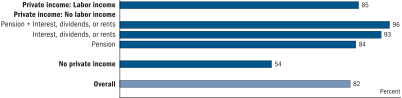
While retirees as a group had generally high levels of financial well-being, this varied depending on the individual's sources of income. In 2024, 82 percent of all retirees said they were doing okay or living comfortably financially. Among retirees whose family income included wages or other sources of labor income, a higher share (85 percent) reported they were doing okay or living comfortably (figure 23).
Figure 23. Retirees doing okay or living comfortably financially (by sources of private income in the prior 12 months)
Accessible Version | Return to text
Note: Among retirees. Sources of income include the income of a spouse or partner. Recipients of labor income may have income from other private sources, but other categories are mutually exclusive. So ‘Pension,' for example, indicates the retiree had income from a pension but not interest, dividends, or rents. Retirees may have received income from public sources as well.
Among retirees who did not have labor income, those who had a source of private income, such as a pension or interest income, fared better financially than those lacking any private income.52 Fifty-four percent of retirees who did not have private income said they were doing okay or living comfortably (figure 23). This was far below the share of retirees who had income from private sources, such as pensions and investments, who were doing okay or living comfortably.
References
36. Since 2013, when this question was first asked, median household income increased as did consumer prices. To check how changes in price levels affect responses to this question, the 2022 survey asked one-fifth of respondents how they would handle a $500 expense instead. Changing the threshold only altered the share who would pay in cash by 0.5 percentage points, suggesting that shifts in the price level have not materially affected the trend in this series. Return to text
37. The higher shares who said they would pay with cash or its equivalent in 2021 is consistent with other research showing that fiscal relief measures and a pullback in consumer spending boosted saving in the early part of the COVID-19 pandemic. For details on the increase in savings during the pandemic, see Aditya Alandangady, David Cho, Laura Feiveson, and Eugenio Pinto, "Excess Savings during the COVID-19 Pandemic," Finance and Economics Discussion Series Notes (Washington: Board of Governors of the Federal Reserve System, October 21, 2022), https://doi.org/10.17016/2380-7172.3223; and for details on the effects of relief measures on incomes through the pandemic, see Jeff Larrimore, Jacob Mortenson, and David Splinter, "Earnings Business Cycles: The Covid Recession, Recovery, and Policy Response," Journal of Public Economics 225 (2023): 104983. Return to text
38. The distinction between how people would or could pay small emergency expenses is discussed further in box 3 from Board of Governors of the Federal Reserve System, Report on the Economic Well-Being of U.S. Households in 2019, Featuring Supplemental Data from April 2020(Washington: Board of Governors, May 2020), https://www.federalreserve.gov/publications/files/2019-report-economic-well-being-us-households-202005.pdf. Return to text
39. Only 48 percent of adults said they could cover an expense of $2,000 using savings. A higher 55 percent said they had rainy-day savings to cover three months of expenses, which likely would require more than $2,000 for many families. One possible explanation for this difference in the responses is that the framing of the question about the largest emergency expense people could handle with savings was "right now." There may be assets, such as retirement funds, that some people would consider tapping in the event they went three months without a job that they would not consider tapping right now for an emergency. Return to text
40. A separate question on the SHED discussed in the "Income and Expenses" section of this report asks about whether respondents spent more or less than their income in the past month. A similar relationship between emergency savings and spending relative to income is seen using that measure rather than the frequency of having money left over at the end of the month. Return to text
41. While the assets listed here include many sources that people could tap to generate income for retirement, they do not reflect all types of assets people may hold. In particular, many adults have an automobile, and as discussed in the "Banking and Credit" section of this report, most adults have a checking or other transaction account. The Survey of Consumer Finances (SCF) provides detailed estimates of the types of assets and liabilities held by U.S. households and the value of their holdings. For the most recent estimates from the SCF, see Aditya Aladangady, Jesse Bricker, Andrew C. Chang, Sarena Goodman, Jacob Krimmel, Kevin B. Moore, Sarah Reber, Alice Henriques Volz, and Richard A. Windle, Changes in U.S. Family Finances from 2019 to 2022: Evidence from the Survey of Consumer Finances (Washington: Board of Governors of the Federal Reserve System, October 2023), https://doi.org/10.17016/8799. Return to text
42. Accounts such as 401(k) plans, IRAs, and Roth accounts are tax preferred in that they receive favorable tax treatment to incentivize retirement savings. Return to text
43. For history on IRAs, see Congressional Research Service (CRA), Individual Retirement Account (IRA) Ownership: Data and Policy Issues (Washington: CRA, December 9, 2020), https://crsreports.congress.gov/product/pdf/R/R46635/3. For recent context on employer-sponsored retirement plans, see Congressional Research Service, A Visual Depiction of the Shift from Defined Benefit (DB) to Defined Contribution (DC) Pension Plans in the Private Sector, (Washington: CRA, December 27, 2021), https://crsreports.congress.gov/product/pdf/IF/IF12007. Return to text
44. As noted in the "Employment" chapter, retirement status is based on a question asking all respondents whether they are retired or not, regardless of their employment status. The question asking non-retirees about whether their retirement savings plans was on track did not prompt respondents to consider any particular type of assets or level of income in their answer, and so survey respondents could determine for themselves what they considered on track. Return to text
45. Among prime age adults, 46 percent of adults with a disability worked for pay in the prior month, compared with 78 percent of adults without a disability. As an example of means testing, SSI recipients must have limited income and resources to qualify for benefits. See Social Security Administration, Red Book: A Guide to Work Incentives and Employment Supports for Persons Who Have a Disability under the Social Security Disability Insurance (SSDI) and Supplemental Security Income (SSI) Programs, SSA Publication No. 64-030, August 2023, https://www.ssa.gov/redbook/. Return to text
46. The question on borrowing from or cashing out retirement savings was changed on the 2024 survey, so is not directly comparable with earlier years. Return to text
47. In some cases, these reductions in contributions may be due to job changes or job loss that prevent the individual from continuing to contribute at the same amount. Return to text
48. For more on early withdrawals and the relationship with economic shocks and income, see Robert Argento, Victoria L. Bryant, and John Sabelhaus, "Early Withdrawals from Retirement Accounts during the Great Recession," Contemporary Economic Policy 33, (1) (2015), 1–16. Return to text
49. The question asked about choosing and managing investments but did not specify a type of investment, so people could answer according to the assets they considered to be investments. This question wording was changed in the 2023 survey and asked of all respondents rather than just non-retirees with self-directed accounts. Return to text
50. Participants in employer-sponsored pension plans must be vested in order to have a right to benefits. To be fully vested and have the right to receive benefits from employer contributions typically requires that the employee have a minimum number of years of service. For a summary of legal requirements around vesting for pension plans covered by the Employee Retirement Income Security Act of 1974 (ERISA), see Department of Labor, Employee Benefits Security Administration, FAQs about Retirement Plans and ERISA, https://www.dol.gov/sites/dolgov/files/ebsa/about-ebsa/our-activities/resource-center/faqs/retirement-plans-and-erisa-compliance.pdf. Return to text
51. The type of pension was not specified, so pension income may include income from defined benefit plans, which pay a fixed monthly amount, and defined contribution plans, such as 401(k) and 403(b) plans. While 38 percent of retirees whose family income included labor income said they worked for pay or profit in the month prior to the survey despite being retired, a larger 61 percent reported they had a spouse who worked for pay or profit in the prior month. Return to text
52. Those lacking any private income included those who were reliant solely on Social Security and cash transfers from other government programs or reported no income sources in 2024. For context on the income sources highlighted here, a "three-legged stool" has been used as a metaphor for a retirement savings strategy that includes Social Security, private pensions, and other savings and investments. For a history of this metaphor, see Larry DeWitt, Origins of the Three-Legged Stool Metaphor for Social Security, Research Notes & Special Studies by the Historian's Office (Washington: Social Security Administration, May 1996), https://www.ssa.gov/history/stool.html. Return to text