


1. Asset Valuations
Asset valuations were elevated, with some markets setting new highs after recovering from April's declines
Since April, price declines across multiple markets have largely reversed and volatility has receded. Prices remained high relative to their historical relationship with fundamentals across a range of markets.
Treasury market liquidity recovered to levels well above the lows seen in April. During that episode, yields on Treasury securities exhibited considerable volatility, which, in turn, contributed to April's deterioration in market liquidity.
Equity markets rebounded from April's volatility and declines. Corporate bond spreads have narrowed over that same period and stayed well below their historical medians.
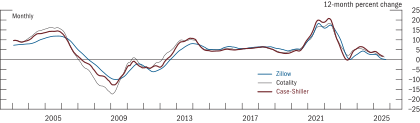
Prices and fundamentals in CRE markets showed continued signs of stabilizing, although the potential for distressed commercial property sales remains if CRE borrowers who need to refinance their mortgages are unable to do so. In residential real estate markets, prices continued to rise well above their historical relationship with fundamentals but at a lower rate. In the year ending July 2025, nominal house prices grew between 0.3 and 1.7 percent depending on the index used.
Table 1.1 shows the sizes of the asset markets discussed in this section. The two largest asset markets are those for public equities and residential real estate, which are substantially larger than the next two markets, Treasury securities and CRE. The table also shows recent and historical growth rates for each asset class. The remainder of this section presents the status of vulnerabilities across these markets.
Table 1.1. Size of selected asset markets
| Item | Outstanding (billions of dollars) |
Growth, 2024:Q2–2025:Q2 (percent) |
Average annual growth, 1997–2025:Q2 (percent) |
|---|---|---|---|
| Public equities | 74,410 | 15.6 | 8.9 |
| Residential real estate | 61,101 | 1.4 | 6.2 |
| Treasury securities | 28,518 | 6.0 | 8.3 |
| Commercial real estate | 20,524 | −5.6 | 5.4 |
| Investment-grade corporate bonds | 8,156 | 4.3 | 7.8 |
| Farmland | 3,558 | 4.2 | 5.6 |
| High-yield and unrated corporate bonds | 1,724 | 5.2 | 6.1 |
| Leveraged loans1 | 1,494 | 7.3 | 12.2 |
| Price growth (real) | |||
| Commercial real estate2 | −2.2 | 2.8 | |
| Residential real estate3 | −1.0 | 2.6 |
Note: The data extend through 2025:Q2. Outstanding amounts are in nominal terms. Growth rates are nominal and are measured from Q2 of the year immediately preceding the period through Q2 of the final year of the period. Equities, real estate, and farmland are at nominal market value; bonds and loans are at nominal book value.
1. The amount outstanding shows institutional leveraged loans and generally excludes loan commitments held by banks. For example, lines of credit are generally excluded from this measure. Average annual growth of leveraged loans is from 2001 to 2025:Q2, as this market was fairly small before then. Return to table
2. One-year growth of commercial real estate prices is from June 2024 to June 2025, and average annual growth is from June 1999 to June 2025. Both growth rates are calculated from equal-weighted nominal prices deflated using the consumer price index (CPI). Return to table
3. One-year growth of residential real estate prices is from June 2024 to June 2025, and average annual growth is from June 1998 to June 2025. Nominal prices are deflated using the CPI. Return to table
Source: For leveraged loans, PitchBook Data, Leveraged Commentary & Data; for corporate bonds, Mergent, Inc.,Fixed Income Securities Database; for farmland, Department of Agriculture; for residential real estate price growth, Cotality; for commercial real estate price growth, CoStar Group, Inc., CoStar Commercial Repeat Sale Indices; for all other items, Federal Reserve Board, Statistical Release Z.1, "Financial Accounts of the United States."
Treasury yields declined amid normalizing volatility
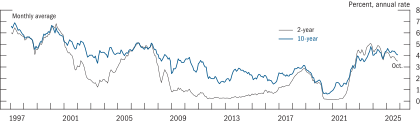
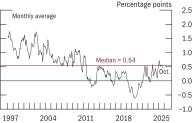
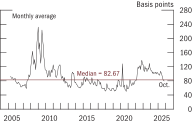
Treasury yields across 2- and 10-year maturities declined since the April report and continued to be well above their average levels over the past 15 years (figure 1.1). Over the same period, the longer end of the Treasury yield curve has steepened. A model-based estimate of the nominal Treasury term premium—a measure of the compensation that investors require to hold longer-term Treasury securities rather than shorter-term ones—fell a bit to its historical median, albeit near the top of its range since 2010 (figure 1.2). Moves in Treasury yields were sizable in early April. Since the April episode, interest rate volatility implied by interest rate swaps decreased to just below its long-term median (figure 1.3).
Figure 1.1. Nominal Treasury yields declined and remained above their average levels over the past 15 years
Accessible Version | Return to text
Note: Treasury rates are the 2-year and 10-year constant-maturity yields based on the most actively traded securities. Values are averaged within a calendar month, except for the value of the last month of the series, which is averaged through the data close date.
Source: Federal Reserve Board, Statistical Release H.15, "Selected Interest Rates."
Figure 1.2. An estimate of the nominal Treasury term premium remained near its historical median
Accessible Version | Return to text
Note: Term premiums are estimated from a 3-factor term structure model using Treasury yields and Blue Chip interest rate forecasts. Values are averaged within a calendar month, except for the value of the last month of the series, which is averaged through the data close date.
Source: Department of the Treasury; Wolters Kluwer, Blue Chip Financial Forecasts; Federal Reserve Bank of New York; Federal Reserve Board staff estimates.
Figure 1.3. Interest rate volatility returned to its median since 2005
Accessible Version | Return to text
Note: The data begin in April 2005. Implied volatility on the 10-year swap rate, 1 month ahead, is derived from swaptions. Values are averaged within a calendar month, except for the value of the last month of the series, which is averaged through the data close date.
Source: For data through July 13, 2022, Barclays and S&P Global; for data from July 14, 2022, onward, ICAP, Swaptions and Interest Rate Caps and Floors Data.
Equity valuations continued to increase, while volatility declined
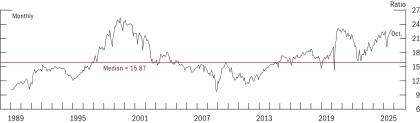
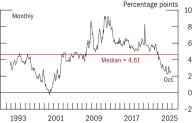
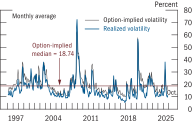
Measures of equity valuations rebounded after April's market episode. The forward price-to-earnings ratio, defined as the ratio of equity prices to expected 12-month earnings, remained well above its historical median (figure 1.4). The difference between the forward earnings-to-price ratio* and the real 10-year Treasury yield—a crude measure of the additional return that investors require for holding stocks relative to risk-free bonds (the equity premium)—remained well below its historical median (figure 1.5).2 Two measures of equity market volatility—option-implied and realized—rose dramatically in April but have since declined to below their historical medians (figure 1.6).
Figure 1.4. The price-to-earnings ratio of S&P 500 firms was once again close to the upper end of its historical range
Accessible Version | Return to text
Note: The figure shows the aggregate forward price-to-earnings ratio of Standard & Poor's (S&P) 500 firms, based on expected earnings for 12 months ahead. Values are reported as of month-end, except for the value of the last month of the series, which is reported as of the data close date.
Source: LSEG, Institutional Brokers' Estimate System, North American Summary & Detail Estimates, Level 2, Current & History Data, Adjusted and Unadjusted, https://www.lseg.com/en/data-analytics/financial-data/company-data/ibes-estimates.
Figure 1.5. As of October, an estimate of the equity premium was near a 20-year low
Accessible Version | Return to text
Note: The data begin in October 1991. The figure shows the difference between the aggregate forward earnings-to-price ratio of Standard & Poor's 500 firms and the expected real Treasury yields, based on expected earnings for 12 months ahead. Expected real Treasury yields are calculated from the 10-year consumer price index inflation forecast, and the smoothed nominal yield curve is estimated from off-the-run securities. Values are reported as of month-end, except for the value of the last month of the series, which is reported as of the data close date.
Source: LSEG, Institutional Brokers' Estimate System, North American Summary & Detail Estimates, Level 2, Current & History Data, Adjusted and Unadjusted, https://www.lseg.com/en/data-analytics/financial-data/company-data/ibes-estimates.
Figure 1.6. Volatility in equity markets declined to below the historical median
Accessible Version | Return to text
Note: Realized volatility is computed from an exponentially weighted moving average of 5-minute daily realized variances with 75 percent of the weight distributed over the past 20 business days. Values are averaged within a calendar month, except for the value of the last month of the series, which is averaged through the data close date.
Source: Cboe Volatility Index® (VIX®) accessed via Bloomberg Finance L.P.; Federal Reserve Board staff estimates.
Corporate bond markets have been resilient; spreads in corporate debt markets narrowed and remained tight
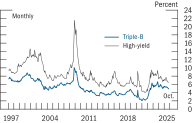
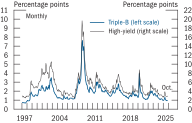
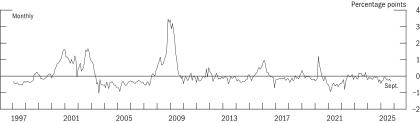
Yields on triple-B-rated and high-yield corporate bonds were lower than the levels observed in the April report and below the long-term median (figure 1.7). Spreads relative to comparable- maturity Treasury securities settled at historically tight levels below those observed before the April market events—about 0.7 percentage points below the historical median for triple-B rated and about 1.6 percentage points below the median for high-yield (figure 1.8). The excess bond premium for all nonfinancial corporate bonds—a measure of the risk premium required by bond investors after controlling for bond characteristics and credit quality—was below the median of its historical distribution (figure 1.9).
Figure 1.7. Corporate bond yields fell slightly but remained near their median for the past 30 years
Accessible Version | Return to text
Note: The triple-B series reflects the effective yield of the ICE Bank of America Merrill Lynch (BofAML) triple-B U.S. Corporate Index (C0A4), and the high-yield series reflects the effective yield of the ICE BofAML U.S. High Yield Index (H0A0). Values are reported as of month-end, except for the value of the last month of the series, which is reported as of the data close date.
Source: ICE Data Indices, LLC, used with permission.
Figure 1.8. Corporate bond spreads fell and remained at tight levels
Accessible Version | Return to text
Note: The triple-B series reflects the option-adjusted spread of the ICE Bank of America Merrill Lynch (BofAML) triple-B U.S. Corporate Index (C0A4), and the high-yield series reflects the option-adjusted spread of the ICE BofAML U.S. High Yield Index (H0A0). Values are reported as of month-end, except for the value of the last month of the series, which is reported as of the data close date.
Source: ICE Data Indices, LLC, used with permission.
Figure 1.9. The excess bond premium was below its long-run average
Accessible Version | Return to text
Note: The excess bond premium (EBP) is a measure of bond market investors' risk sentiment. It is derived as the residual of a regression that models corporate bond spreads after controlling for expected default losses. By construction, its historical mean is 0. Positive (negative) EBP values indicate that investors' risk appetite is below (above) its historical mean.
Source: Federal Reserve Board staff calculations based on Lehman Brothers Fixed Income Database (Warga); Intercontinental Exchange, Inc., ICE Data Services; Center for Research in Security Prices, CRSP/Compustat Merged Database, Wharton Research Data Services; S&P Global, Compustat.
Issuance in the corporate bond market picked up to a solid pace in August and September, on par with the average over the past 10 years. Market-based forecasts of one-year-ahead default probabilities of nonfinancial firms (a forward-looking indicator of credit quality) settled to levels last seen before April's market events.
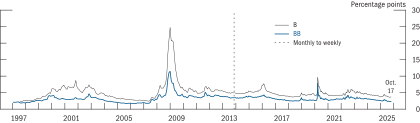
Since the previous report, the average spread on leveraged loans in the secondary market decreased moderately and remained at the low end of its historical distribution since 2009 (figure 1.10).
Figure 1.10. Spreads on leveraged loans decreased moderately to the low end of their distribution since 2009
Accessible Version | Return to text
Note: The data show secondary-market discounted spreads to maturity. Spreads are the constant spread used to equate discounted loan cash flows to the current market price. B-rated spreads begin in July 1997. The black dashed line represents the data transitioning from monthly to weekly in November 2013.
Source: PitchBook Data, Leveraged Commentary & Data.
Treasury and equity market liquidity was strained in April and has since recovered
Market liquidity refers to the ease of buying and selling an asset. Low liquidity can amplify the volatility of asset prices and result in larger price moves in response to shocks. Similarly, increased volatility can reduce market liquidity because liquidity providers may become more cautious in providing quotes. In extreme cases, low liquidity can threaten continued market functioning, leading to a situation in which participants are unable to trade without incurring a significant cost.
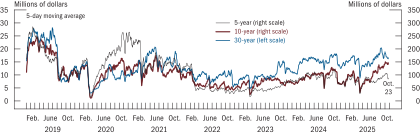
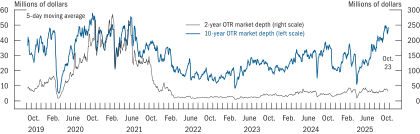
Treasury market liquidity is particularly important because of the key role these securities play in the financial system. Amid the April volatility, Treasury market liquidity hit historically low levels. Since then, various measures of Treasury market liquidity, including two different measures of market depth in the most liquid on-the-run segment, indicated that liquidity increased back to or above previous levels across all maturities (figures 1.11 and 1.12).
Figure 1.11. Treasury market depth recovered from April's low levels
Accessible Version | Return to text
Note: Market depth is defined as the average top 3 bid and ask quote sizes for on-the-run Treasury securities.
Source: Inter Dealer Broker Community.
Figure 1.12. While 2-year on-the-run Treasury market depth remained close to historical lows, 10-year market depth rose to levels last seen in 2021
Accessible Version | Return to text
Note: The data show the time-weighted average market depth at the best quoted prices to buy and sell, for 2-year and 10-year Treasury notes. OTR is on-the-run.
Source: BrokerTec; Federal Reserve Board staff calculations.
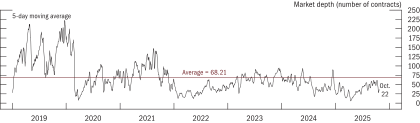
A measure of market liquidity in equity markets stayed below the historical average since 2019 but improved on net compared to April as volatility subsided (figure 1.13). Through September, liquidity in corporate bond markets remained robust and in line with the average level observed in recent years. The box "Artificial Intelligence and Algorithmic Trading" explores how the adoption of AI in algorithmic trading could bring new opportunities and challenges to financial markets.
Figure 1.13. A measure of liquidity in equity markets stayed below average
Accessible Version | Return to text
Note: The data show the depth at the best quoted prices to buy and sell, defined as the ask size plus the bid size divided by 2, for E-mini Standard & Poor's 500 futures.
Source: LSEG, Tick History; Federal Reserve Board staff calculations.
Commercial real estate prices showed signs of further stabilization
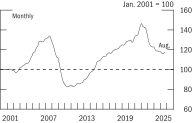
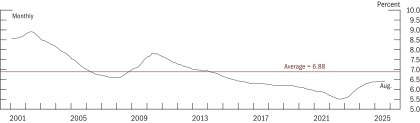
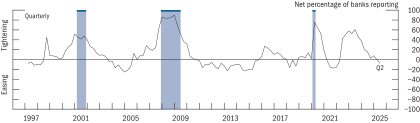
Aggregate CRE prices measured in inflation- adjusted terms showed signs of further stabilization, following significant declines between mid-2022 and early 2024 (figure 1.14). Vacancy rates and rent growth—fundamental determinants of prices—also appeared to be stabilizing for office properties. Capitalization rates at the time of property purchase, which measure the annual income of commercial properties relative to their prices, were unchanged in aggregate since the April report but remained below the average of the historical distribution (figure 1.15). After a period of tightening from 2022 to 2024, most banks have left standards on CRE loans unchanged over the past two quarters (figure 1.16).3 In the July survey, banks reported, on net, that the level of credit standards for several types of CRE loans was still somewhat or significantly tighter than longer-run norms.
Figure 1.14. Inflation-adjusted commercial real estate prices were little changed
Accessible Version | Return to text
Note: The data are deflated using the consumer price index. The dashed line at 100 indicates the index to January 2001 values.
Source: MSCI—Real Capital Analytics; consumer price index, Bureau of Labor Statistics via Haver Analytics.
Figure 1.15. Income of commercial properties relative to prices leveled off but remained below the historical average
Accessible Version | Return to text
Note: The data are a 12-month moving average of weighted capitalization rates in the industrial, retail, office, and multifamily sectors, based on national square footage in 2009.
Source: MSCI—Real Capital Analytics; Andrew C. Florance, Norm G. Miller, Ruijue Peng, and Jay Spivey (2010), "Slicing, Dicing, and Scoping the Size of the U.S. Commercial Real Estate Market," Journal of Real Estate Portfolio Management, vol. 16 (May–August), pp. 101–18.
Figure 1.16. Banks reported that lending standards for commercial real estate loans were little changed in the first half of 2025
Accessible Version | Return to text
Note: Banks' responses are weighted by their commercial real estate loan market shares. Survey respondents to the Senior Loan Officer Opinion Survey on Bank Lending Practices are asked about the changes over the quarter. The shaded bars with top caps indicate periods of business recession as defined by the National Bureau of Economic Research: March 2001– November 2001, December 2007–June 2009, and February 2020–April 2020.
Source: Federal Reserve Board, Senior Loan Officer Opinion Survey on Bank Lending Practices; Federal Reserve Board staff calculations.
A large volume of CRE debt is scheduled to mature over the coming year, and forced sales, were they to occur, would put downward pressure on CRE prices. However, continued willingness by lenders to mitigate losses via loan modification would alleviate some of that downside risk.
Residential real estate prices remained high relative to their historical relationship with fundamentals
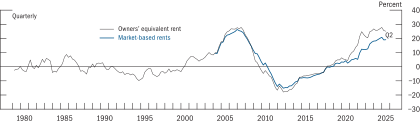
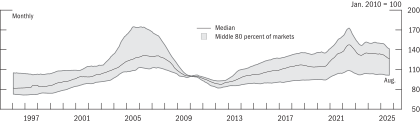
After posting double-digit gains in 2021 and 2022, house price increases have slowed (figure 1.17). Model-based measures of housing valuations, which assess their historical relationships with fundamentals, remained high (figure 1.18). Price-to-rent ratios fell in the geographic areas where they had been the highest, suggesting some cooling in those markets (figure 1.19). Credit standards for borrowers remained tight relative to the early 2000s, suggesting that weak credit standards are not driving house price growth.
Figure 1.17. House prices continued to increase in recent months but at a lower rate
Accessible Version | Return to text
Note: The data extend through September 2025 for Zillow, August 2025 for Cotality, and July 2025 for Case-Shiller.
Source: Zillow, Inc., Real Estate Data; Cotality Real Estate Data; S&P Cotality Case-Shiller Home Price Indices.
Figure 1.18. Model-based measures of house price valuations cooled from near historically high levels
Accessible Version | Return to text
Note: The owners' equivalent rent value for 2025:Q2 is based on monthly data through August 2025. The data for the market-based rents model begin in 2004:Q1. Valuation is measured as the deviation from the long-run relationship between the price-to-rent ratio and the real 10-year Treasury yield.
Source: For house prices, Zillow, Inc., Real Estate Data; for rent data, Bureau of Labor Statistics.
Figure 1.19. House price-to-rent ratios dropped slightly yet remained elevated across geographic areas
Accessible Version | Return to text
Note: The data are seasonally adjusted. Percentiles are based on 19 large metropolitan statistical areas.
Source: For house prices, Zillow, Inc., Real Estate Data; for rent data, Bureau of Labor Statistics.
Farmland valuations remained high relative to farm income
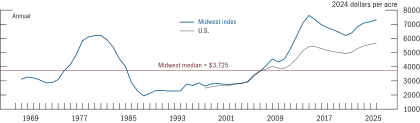
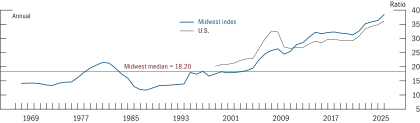
U.S. farmland values remained elevated based on annual data as of August 2025, continuing to rise from historically high levels (figure 1.20), as did price-to-rent ratios (figure 1.21). Prices continued to be sustained by limited farmland inventory, despite elevated interest rates and higher operating costs.
Figure 1.20. Inflation-adjusted farmland prices rose further in 2025 from already elevated levels
Accessible Version | Return to text
Note: The data for the U.S. begin in 1997. Midwest index is a weighted average of Corn Belt and Great Plains states derived from staff calculations. Values are given in real terms. The value for 2025 is based on monthly data through July 2025.
Source: Department of Agriculture; Federal Reserve Bank of Minneapolis staff calculations.
Figure 1.21. Farmland prices relative to rents increased to historical highs in 2025
Accessible Version | Return to text
Note: The data for the U.S. begin in 1998. Midwest index is a weighted average of Corn Belt and Great Plains states derived from staff calculations. The value for 2025 is based on monthly data through July 2025.
Source: Department of Agriculture; Federal Reserve Bank of Minneapolis staff calculations.
Box 1.1. Artificial Intelligence and Algorithmic Trading
Algorithmic trading refers to automated, computer-driven trading based on predefined trading strategies. Algorithms have long been used by various market participants for market making, optimal execution, statistical arbitrage, and speculative trading.1 Traditional algorithms are fast, simple rules operating at nanosecond frequencies, but they are relatively rigid and hard-coded. Generative AI and machine learning add self-learning based on historical experience, adaptation based on current market conditions, and analysis of unstructured data, such as text. The greater model complexity and the use of additional information by AI currently come at the cost of reduced speed, and thus the suitability of the latest AI models for trading decisions depends on the application. This box examines the adoption of AI in algorithmic trading and discusses its financial stability implications. The box leans on academic research, institutional market outreach, and conversations with key market participants.
The majority of AI applications in trading today seem to be building upon established practices in machine learning and sophisticated data analysis techniques, rather than representing a significant departure from existing methods.2 Therefore, AI is reportedly viewed as providing efficiency gains, without a fundamental change in the trading process itself, at least for now. Nonetheless, some policymakers and academics have noted that AI-driven algorithmic trading may generate financial stability risks such as correlated trading, collusion, market manipulation, and market concentration. As we discuss in this box, while the adoption of AI could potentially increase these risks, other factors often mitigate the potential impact of its use by market participants.
A long-standing concern is that widespread use of trading algorithms with common reaction to market events has the potential to exacerbate market volatility and lead to rapid price swings, flash crashes, and market dislocations. That said, the use of AI may also help reduce the likelihood of correlated trade execution, as it facilitates the use of richer information and more complex logic, potentially leading to a less uniform response to news and to a greater diversity of trading signals among market participants.3 This could, in turn, improve price discovery and market efficiency, leading to more accurate and timely reflection of information in market prices.
The self-learning nature of generative AI-driven trading algorithms also raises concerns about the potential for these algorithms to engage in sophisticated market manipulation.4 Manipulative uses of AI may be inherently harder to detect than currently known methods such as spoofing and quote stuffing—submitting a large number of orders to create a false impression of supply or demand—due to greater design complexity and increased ability to obfuscate manipulative intent. At the same time, however, AI has the potential to significantly enhance market surveillance techniques for investigators and supervisors. Major electronic market operators are already utilizing advanced machine learning techniques to detect market manipulation and collusive behaviors.5 Generative AI could further improve this process by identifying suspicious behavior and providing rapid textual descriptions and interpretations of the detected issues. Improved market surveillance capabilities could then strengthen market integrity and enhance market liquidity.
Academic literature has also identified the potential for self-learning AI-powered trading algorithms to autonomously develop collusive behavior, potentially impairing competition and market efficiency, leading to reduced market liquidity and less informative pricing.6 However, others observe that the likelihood of collusion is small if traders' learning processes differ. Furthermore, algorithmic traders have strong incentives to differentiate their strategies, as non-collusion can be highly profitable when others collude, suggesting that algorithmic heterogeneity is a more likely equilibrium outcome.7
Finally, some observers have expressed concerns about barriers to entry and increasing concentration associated with the adoption of AI. The costs of developing and running generative AI models can be large, discouraging companies from developing proprietary models, potentially leading them to rely on third-party solutions and thus increasing dependence on common AI models. Common AI models could also lead to more similar processes through which traders learn, which, as noted previously, could increase the likelihood of collusion. At the same time, however, market participants observe that access to technology is being democratized with the development of AI, and wider access to sophisticated AI-driven trading technology could lower barriers to entry for smaller firms and individual investors. Increased access and competition could then also contribute to a more diverse range of market participants and strategies, fostering greater market heterogeneity and, hence, more resilient market functioning.
In summary, as with many new technologies, AI seems to bring both new dangers and new opportunities for improvements to financial markets. While the potential for AI to increase correlated trading and impact market competition cannot be dismissed, historical evidence from algorithmic trading suggests that correlated trading has not necessarily been detrimental to market quality. Moreover, strong incentives for algorithmic traders to have differentiated strategies may mitigate the risk of autonomous collusion, reduce correlated trading, and improve competition. Many exchanges have also implemented safeguards, such as circuit breakers, which, if deployed simultaneously across related markets, can help prevent excessive price fluctuations. The ability of AI to assist enforcement of securities laws could also strengthen market integrity. That said, continued monitoring of developments and further empirical research are warranted to ensure a comprehensive understanding of the fast-evolving landscape of AI in financial markets.
1. See Andrei Kirilenko and Andrew W. Lo (2013), "Moore's Law versus Murphy's Law: Algorithmic Trading and Its Discontents," Journal of Economic Perspectives, vol. 27 (Spring), pp. 51–72. Return to text
2. See International Monetary Fund (2024), "Advances in Artificial Intelligence: Implications for Capital Market Activities," chapter 3 in Financial Stability Report (Washington: IMF, October), pp. 77–105, https://www.imf.org/en/Publications/GFSR/Issues/2024/10/22/global-financial-stability-report-october-2024; International Organization of Securities Commissions (2025), Artificial Intelligence in Capital Markets: Use Cases, Risks, and Challenges (Madrid: IOSCO, March), https://www.iosco.org/library/pubdocs/pdf/IOSCOPD788.pdf. Return to text
3. See Anne Lundgaard Hansen and Seung Jung Lee (2025), "Financial Stability Implications of Generative AI: Taming the Animal Spirits," Finance and Economics Discussion Series 2025-090 (Washington: Board of Governors of the Federal Reserve System, September), https://doi.org/10.17016/FEDS.2025.090. Return to text
4. See Álvaro Cartea, Patrick Chang, and Gabriel García-Arenas (2025), "Spoofing and Manipulating Order Books with Learning Algorithms," available at SSRN: https://ssrn.com/abstract=4639959 or http://dx.doi.org/10.2139/ssrn.4639959. Return to text
5. See Pedro Gurrola-Perez and Kaitao Lin (2024), "An Analysis of Market Manipulation Definitions around the World," working paper (London: World Federation of Exchanges, June). Return to text
6. See Winston Wei Dou, Itay Goldstein, and Yan Ji (2025), "AI-Powered Trading, Algorithmic Collusion, and Price Efficiency," NBER Working Paper Series 34054 (Cambridge, Mass.: National Bureau of Economic Research, July), https://www.nber.org/papers/w34054. Return to text
7. See Laura Veldkamp (2024), Discussion of "AI-Powered Trading, Algorithmic Collusion, and Price Efficiency" by Winston Wei Dou, Itay Goldstein, Jan Ji, NBER Summer Institute, July. Return to text
References
* On March 2, 2026, the term “forward P/E” was corrected to “forward earnings-to-price” ratio. Return to text
2. This estimate is constructed based on expected corporate earnings for 12 months ahead. Return to text
3. The Senior Loan Officer Opinion Survey on Bank Lending Practices (SLOOS) results reported are based on banks' responses weighted by each bank's outstanding loans in the respective loan category and might therefore differ from the results reported in the published SLOOS, which are based on banks' unweighted responses; SLOOS results are available on the Board's website at https://www.federalreserve.gov/data/sloos.htm. Return to text