Overview
This report reviews vulnerabilities affecting the stability of the U.S. financial system related to valuation pressures, borrowing by businesses and households, financial-sector leverage, and funding risks. It also highlights several near-term risks that, if realized, could interact with these vulnerabilities. This report reflects market conditions and data as of October 23, 2025.
Overview of financial system vulnerabilities
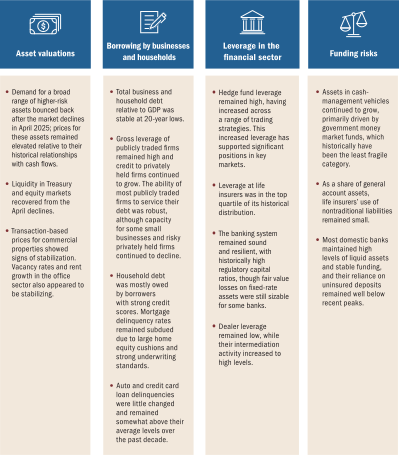
A summary of the developments in the four broad categories of vulnerabilities since the April 2025 Financial Stability Report is as follows:
- Asset valuations. Asset valuations were elevated. Since the market volatility of early April subsided, the ratio of equity prices to earnings has returned to near the high end of its historical range. An estimate of the equity premium—the compensation for risk in equity markets—remained well below average. Spreads between yields on corporate bonds and those on comparable-maturity Treasury securities also settled to pre-April levels, which were low compared to their longer-term history. Liquidity in Treasury markets recovered from April's trough. In U.S. property markets, home price increases slowed, but the ratio of house prices to rents continued to be near the highest levels on record. Transaction-based price indexes (adjusted for inflation) for commercial real estate (CRE) properties showed some signs of stabilization following significant declines, though vulnerabilities due to upcoming refinancing needs remained (see Section 1, Asset Valuations).
- Borrowing by businesses and households. Vulnerabilities from business and household debt remained moderate. Total debt of businesses and households as a fraction of gross domestic product (GDP) continued to trend slightly down to its lowest level in the past two decades. Measures of the leverage of publicly traded firms remained somewhat above the medians of their historical distributions, and debt owed by privately held firms continued to grow. While publicly traded firms' ability to service their debt remained solid in aggregate, the debt-servicing capacity of small businesses and risky privately held firms declined in recent years. Household debt relative to GDP has been subdued in recent history. Most household debt was owed by borrowers with strong credit histories. Mortgage delinquency rates remained low due to large home equity cushions and strong underwriting standards. Delinquencies on credit cards and auto loans remained above pre-pandemic levels (see Section 2, Borrowing by Businesses and Households).
- Leverage in the financial sector. Vulnerabilities associated with financial leverage remained notable. Over the past few years, hedge funds' leverage has steadily increased across a broad range of strategies, including those involving Treasury securities, interest rate derivatives, and equities. Leverage at life insurers was in the top quartile of its historical distribution. The banking sector remained sound and resilient overall, and most banks continued to report capital levels well above regulatory requirements. Fair value losses on fixed-rate assets declined but were still sizable and continued to be sensitive to changes in long-term interest rates. Bank credit to other financial entities continued to increase, and growth was most notable in the category of special purpose entities, collateralized loan obligations (CLOs), and asset-backed securities. Broker-dealer leverage remained near historical lows, and intermediation activity was historically high across a range of markets, including Treasury markets (see Section 3, Leverage in the Financial Sector).
- Funding risks. Funding risks have remained moderate. Assets in cash-management vehicles continued to grow; the main contributor to this growth was government money market funds (MMFs), which historically have been the least susceptible to large-scale investor redemptions. Assets in more fragile investment vehicles, expressed as a share of GDP, remained near the median of the historical distribution (discussed in the box "A More Targeted Assessment of Short-Term Funding Risk"). Banks' reliance on uninsured deposits, an important component of their funding risk, was well below the peaks in 2022 and early 2023. Life insurers' nontraditional liabilities grew further, although they represent only a small share of general account assets (see Section 4, Funding Risks).
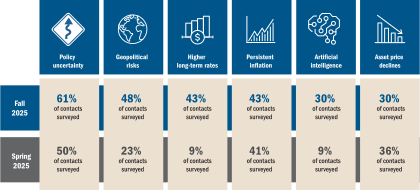
This report also discusses potential near-term risks, based in part on topics cited in market outreach (reported in the box "Survey of Salient Risks to Financial Stability"). Box 5.1 shows the most frequently cited risks to U.S. financial stability by a wide range of market contacts who participated in the Survey of Salient Risks during September and October.The most frequently cited topics from survey respondents were policy uncertainty, geopolitical risks, higher long-term rates, persistent inflation, and a sharp decline in asset prices, potentially connected to a turn in artificial intelligence (AI) sentiment.
Survey of salient risks to the financial system
Survey respondents cited several risks to the U.S. financial system and the broader global economy. For more information, see the box "Survey of Salient Risks to Financial Stability."