


4. Funding Risks
Vulnerabilities from funding risks were at levels roughly in line with historical norms
Funding risks for most banks remained near historical norms. As a share of assets, uninsured deposits, an important component of most banks' funding risk, stabilized at levels significantly below their 2022 peaks. Large banks also maintained sound levels of high quality liquid assets (HQLA).
Assets in cash-management vehicles continued to grow, primarily driven by government MMFs, which have historically proved the least susceptible to large-scale investor redemptions among cash-management vehicles.
Some open-end bond and loan mutual funds remained exposed to liquidity transformation risks that could cause asset fire sales in market downturns, as they allow daily redemptions while holding assets that might become illiquid in times of stress. Meanwhile, life insurers' use of nontraditional liabilities increased at a greater rate than their assets.
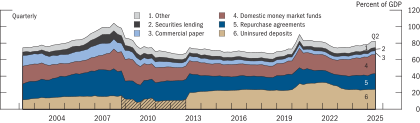
Table 4.1 gives the outstanding amounts of runnable money-like liabilities, and figure 4.1 shows the total relative to GDP. The box "A More Targeted Assessment of Short-Term Funding Risk" shows how accounting for the varying degrees of susceptibility of money-like liabilities, such as government MMFs, uninsured deposits, and repo, can provide additional insights regarding aggregate funding risk.
Table 4.1. Size of selected instruments and institutions
| Item | Outstanding/total assets (billions of dollars) |
Growth, 2024:Q2–2025:Q2 (percent) |
Average annual growth, 1997–2025:Q2 (percent) |
|---|---|---|---|
| Total runnable money-like liabilities1 | 25,049 | 12.6 | 5.2 |
| Uninsured deposits | 7,314 | 8.8 | 10.7 |
| Domestic money market funds2 | 7,024 | 15.3 | 6.6 |
| Government | 5,723 | 16.4 | 15.2 |
| Prime | 1,163 | 11.3 | 3.5 |
| Tax exempt | 138 | 6.9 | −.6 |
| Repurchase agreements | 5,813 | 12.6 | 6.0 |
| Commercial paper | 1,390 | 14.1 | 2.7 |
| Securities lending3 | 1,164 | 13.5 | 7.4 |
| Bond mutual funds | 5,032 | 7.7 | 8.0 |
Note: The data extend through 2025:Q2 unless otherwise noted. Outstanding amounts are in nominal terms. Growth rates are nominal and are measured from Q2 of the year immediately preceding the period through Q2 of the final year of the period. Total runnable money-like liabilities exceed the sum of listed components. Unlisted components of runnable money-like liabilities include variable-rate demand obligations, federal funds, funding-agreement-backed securities, private liquidity funds, offshore money market funds, short-term investment funds, local government investment pools, and stablecoins. Bond mutual funds are not part of the total runnable money-like liabilities.
1. Average annual growth is from 2003:Q1 to 2025:Q2. Return to table
2. Average annual growth is from 2001:Q1 to 2025:Q2. Return to table
3. Average annual growth is from 2000:Q1 to 2025:Q1. Securities lending includes only lending collateralized by cash. Return to table
Source: Securities and Exchange Commission, Private Fund Statistics; iMoneyNet, Inc., Offshore Money Fund Analyzer; Bloomberg Finance L.P.; Securities Industry and Financial Markets Association: U.S. Municipal Variable-Rate Demand Obligation Update; DTCC Solutions LLC, an affiliate of the Depository Trust & Clearing Corporation: commercial paper and negotiable certificates of deposit data; Federal Reserve Board staff calculations based on Risk Management Association, Securities Lending Report; S&P Securities Finance; Investment Company Institute; Federal Reserve Board, Statistical Release Z.1, "Financial Accounts of the United States"; Federal Financial Institutions Examination Council, Consolidated Reports of Condition and Income (Call Report) Form FFIEC 031; Morningstar, Inc., Morningstar Direct; Llama Corp, DeFiLlama.
Figure 4.1. The ratio of runnable money-like liabilities to GDP was around 80 percent
Accessible Version | Return to text
Note: The black striped area denotes the period from 2008:Q4 to 2012:Q4, when insured deposits increased because of the Transaction Account Guarantee program. The "other" category consists of variable-rate demand obligations (VRDOs), federal funds, funding-agreement-backed securities, private liquidity funds, offshore money market funds, short-term investment funds, local government investment pools, and stablecoins. Securities lending includes only lending collateralized by cash. GDP is gross domestic product. Values for VRDOs come from Bloomberg beginning in 2019:Q1. See Jack Bao, Josh David, and Song Han (2015), "The Runnables," FEDS Notes (Washington: Board of Governors of the Federal Reserve System, September 3), https://www.federalreserve.gov/econresdata/notes/feds-notes/2015/the-runnables-20150903.html.
Source: Securities and Exchange Commission, Private Fund Statistics; iMoneyNet, Inc., Offshore Money Fund Analyzer; Bloomberg Finance L.P.; Securities Industry and Financial Markets Association: U.S. Municipal Variable-Rate Demand Obligation Update; DTCC Solutions LLC, an affiliate of the Depository Trust & Clearing Corporation: commercial paper and negotiable certificates of deposit data; Federal Reserve Board staff calculations based on Risk Management Association, Securities Lending Report; S&P Securities Finance; Investment Company Institute; Federal Reserve Board, Statistical Release Z.1, "Financial Accounts of the United States"; Federal Financial Institutions Examination Council, Consolidated Reports of Condition and Income (Call Report) Form FFIEC 031; gross domestic product, Bureau of Economic Analysis via Haver Analytics; Llama Corp, DeFiLlama.
Box 4.1. A More Targeted Assessment of Short-Term Funding Risk
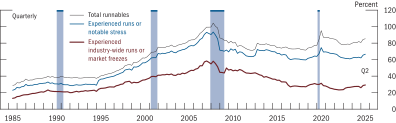
The volume and composition of short-term uninsured financial liabilities that are potentially susceptible to disruptive withdrawals or redemptions, referred to as "runnables" for short, are key indicators of the aggregate level of funding risk in the financial system.1 Runnables can be either short-term investment vehicles, like MMFs, or short-term funding instruments, like repos. The total outstanding volume of runnables is now equivalent in size to 85 percent of GDP, which exceeds the pre-pandemic level of this ratio and is approaching levels reached just before the 2007–09 financial crisis (figure 4.1 and figure A). Yet not all components of the aggregate are equally susceptible, and since 2007 some of the riskiest components have shrunk substantially. This box provides more targeted assessments of run-related funding risk in the financial system by sorting runnables according to their historical run propensity.
Figure A. Runnable vehicles and instruments, by historical run propensity
Accessible Version | Return to text
Note: The "experienced industry-wide runs or market freezes" category includes domestic prime institutional money market funds (MMFs), offshore prime MMFs, commercial paper, negotiable certificates of deposit, variable-rate demand obligations, and repurchase agreements. The "experienced runs or notable stress" category includes all components in "experienced industry-wide runs or market freezes" plus domestic prime retail MMFs, local government investment pools, short-term investment funds, ultrashort bond funds, private liquidity funds, stablecoins, uninsured deposits, securities lending, federal funds, and funding-agreement-backed securities. The "total runnables" category includes all components in "experienced runs or notable stress" plus domestic and offshore government MMFs. GDP is gross domestic product. The shaded bars with top caps indicate periods of business recession as defined by the National Bureau of Economic Research: July 1990–March 1991, March 2001–November 2001, December 2007–June 2009, and February 2020–April 2020.
Source: Securities and Exchange Commission, Private Fund Statistics; iMoneyNet, Inc., Offshore Money Fund Analyzer; Bloomberg Finance L.P.; Investment Company Institute; DTCC Solutions LLC, an affiliate of the Depository Trust & Clearing Corporation: commercial paper and negotiable certificates of deposit data; Federal Reserve Bank of New York; Securities Industry and Financial Markets Association; J.P. Morgan Chase & Co.; Llama Corp, DeFiLlama; Federal Financial Institutions Examination Council, Consolidated Reports of Condition and Income (Call Report) Form FFIEC 031; Securities and Exchange Commission, Form N-PORT, Monthly Portfolio Investments Report; Morningstar, Inc., Morningstar Direct; Risk Management Association, Securities Lending Report; Federal Reserve Board, Statistical Release Z.1, "Financial Accounts of the United States"; Federal Reserve Board staff calculations.
With this approach, the riskiest group of runnables, defined as short-term investment vehicles and funding instruments that have experienced either industry-wide runs or market freezes, have trended down since 2007. Figure A shows that the GDP-scaled volume of this group stands at about half its level just before the 2007–09 financial crisis and slightly below its pre-pandemic level. A broader set of runnables, which also includes vehicles and instruments that have experienced notable stress events—such as sizable redemptions or more acute but isolated strains—is also well below its level before the financial crisis. The widening gaps over the past decade between aggregate runnables and these two categories of risky runnables highlight that components that historically have been more stable account for much of the recent growth in the aggregate measure. Hence, a simple sorting of the runnables sharpens the assessment of funding risk and suggests lower vulnerabilities than the aggregate indicator on its own.
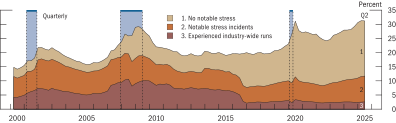
Figure B focuses on short-term investment vehicles and sorts them by their historical fragility. The riskiest category, those that have experienced industry-wide runs (dark red area, currently equivalent to 2.6 percent of GDP), consists of domestic institutional prime MMFs and dollar-denominated offshore prime MMFs. These vehicles' susceptibility to runs arises from a confluence of structural vulnerabilities—such as substantial liquidity transformation—and highly risk-averse institutional investors. Both types of MMFs experienced severe and widespread runs during the 2007–09 financial crisis and the pandemic.
Figure B. Runnable vehicles, by risk category, as a percentage of nominal GDP
Accessible Version | Return to text
Note: The "no notable stress" category includes domestic government money market funds (MMFs) and offshore government MMFs. The "notable stress incidents" category includes domestic prime retail MMFs, local government investment pools, short-term investment funds, ultrashort bond funds, private liquidity funds, and stablecoins. The "experienced industry-wide runs" category includes domestic prime institutional MMFs and offshore prime MMFs. GDP is gross domestic product. The shaded bars with top caps indicate periods of business recession as defined by the National Bureau of Economic Research: March 2001–November 2001, December 2007–June 2009, and February 2020–April 2020.
Source: iMoneyNet, Inc., Offshore Money Fund Analyzer; Investment Company Institute; Bloomberg Finance L.P.; Federal Financial Institutions Examination Council, Consolidated Reports of Condition and Income (Call Report) Form FFIEC 031; Securities and Exchange Commission, Private Fund Statistics; Securities and Exchange Commission, Form N-PORT, Monthly Portfolio Investments Report; Morningstar, Inc., Morningstar Direct; Llama Corp, DeFiLlama; Federal Reserve Board staff calculations.
A broader category of vehicles have experienced notable stress incidents (orange area, equivalent to 9 percent of GDP). For instance, retail prime MMFs faced notable redemptions during the 2007–09 financial crisis and the pandemic, but those redemptions were less severe than the runs on their institutional counterparts. Ultrashort bond funds with significant exposures to credit risk experienced heavy redemptions during both the 2007–09 financial crisis and the pandemic. Some local government investment pools, including those used by Orange County, California, in 1994 and by the state of Florida in 2007, have encountered notable but localized stress. A few private liquidity funds suffered losses and serious stress during the 2007–09 financial crisis that led some to freeze redemptions. Some bank-sponsored short-term investment funds (STIFs) came under stress during the 2007–09 financial crisis, with one bank abruptly liquidating a STIF in September 2008 and several other banks providing support for their funds. Some stablecoins have also experienced notable stress in the past.
The final category, investment vehicles that have not experienced notable stress (beige area, equivalent to about 20 percent of GDP), includes domestic and offshore government MMFs. They account for about 60 percent of the total assets of runnable vehicles and for much of their growth over the past decade.
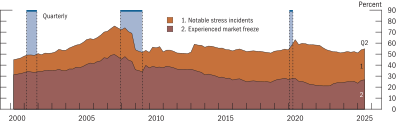
Figure C focuses on short-term funding instruments and sorts them by historical fragility. The instruments that have experienced market-wide freezes (dark red area, equivalent to 27 percent of GDP) include commercial paper (CP), negotiable certificates of deposit (NCDs), variable-rate demand obligations (VRDOs), and repo. During both the 2007–09 financial crisis and the pandemic, issuance of CP almost froze, particularly at maturities beyond overnight, and NCD issuance also plummeted in March 2020. Amid the 2007–09 financial crisis, the market for VRDOs, variable-rate municipal bonds that typically can be sold to a bank at par on short notice, effectively froze as investors rushed to sell, and the VRDO market has never fully recovered.2 The repo market also came under severe stress during the 2007–09 financial crisis, as concerns over counterparty and collateral risks prompted lenders to suddenly curtail funding and caused freezes in certain market segments.
Figure C. Runnable instruments, by risk category, as a percentage of nominal GDP
Accessible Version | Return to text
Note: The "notable stress incidents" category includes uninsured deposits, securities lending, federal funds, and funding-agreement-backed securities. The "experienced market freeze" category includes commercial paper, negotiable certificates of deposit, variable-rate demand obligations, and repurchase agreements. None of the runnable instruments are classified as having experienced "no notable stress." GDP is gross domestic product. The shaded bars with top caps indicate periods of business recession as defined by the National Bureau of Economic Research: March 2001–November 2001, December 2007–June 2009, and February 2020–April 2020.
Source: Federal Financial Institutions Examination Council, Consolidated Reports of Condition and Income (Call Report) Form FFIEC 031; DTCC Solutions LLC, an affiliate of the Depository Trust & Clearing Corporation: commercial paper and negotiable certificates of deposit data; Risk Management Association, Securities Lending Report; Federal Reserve Bank of New York; Bloomberg Finance L.P.; Securities Industry and Financial Markets Association; J.P. Morgan Chase & Co.; Federal Reserve Board, Statistical Release Z.1, "Financial Accounts of the United States"; Federal Reserve Board staff calculations.
The instruments that have experienced notable stress incidents (orange area, equivalent to 28 percent of GDP) include uninsured deposits, federal funds, securities lending, and funding-agreement-backed securities (FABS). Uninsured deposits, the largest of these components, have been susceptible to rapid withdrawals during multiple periods of stress. The federal funds market, an overnight unsecured interbank lending market, came under notable stress during the 2007–09 financial crisis as liquidity dried up in the banking system. Firms that engage in securities lending typically reinvest the cash collateral they receive, and some of these reinvestments soured during the 2007–09 financial crisis and left lenders unable to return collateral promptly. FABS, which are wholesale funding instruments issued by insurance companies, experienced severe stress during the 2007–09 financial crisis as investors pulled back from opaque credit exposures.
To be sure, sorting runnables based on historical stress events may not fully capture current resilience. For example, Securities and Exchange Commission reforms for MMFs implemented in 2023 likely reduced the run susceptibility of institutional prime MMFs relative to their past, and a requirement for expanded central clearing of Treasury repo could also mitigate vulnerabilities. On the other hand, some emerging vehicles may have no record of stress events or serious runs simply because they are new. The methodology also does not fully account for heterogeneity within components. For instance, vulnerabilities of stablecoins likely depend substantially on their pegging mechanisms and reserve compositions, and the GENIUS Act's requirements will mitigate vulnerabilities in payment stablecoins. Nonetheless, historical experience provides a systematic means of sorting runnables that offers new insights into the fragilities of funding markets and enhances assessments of funding risk.
1. For a broader introduction to runnables, see the box "Runnables: An Indicator of Aggregate Run-Related Vulnerabilities in the Economy" in Board of Governors of the Federal Reserve System (2025), Financial Stability Report (Washington: Board of Governors, April), pp. 39–40, https://www.federalreserve.gov/publications/files/financial-stability-report-20250425.pdf. Return to text
2. VRDOs are long-term municipal bonds with short-term interest rate resets. Investors typically can "put" (sell the bonds at par) on short notice, such as weekly, to a bank. In early 2008, investors began exercising their put options en masse. Banks were forced to repurchase VRDOs they could not resell, and rates on VRDOs rose significantly. Return to text
Most banks maintained high levels of liquidity, and their funding sources stabilized further over the past year
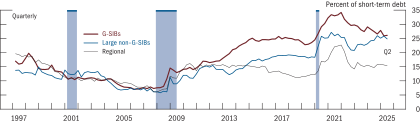
Aggregate liquidity in the banking system measured by the ratio of HQLA to total assets ticked down somewhat since the last report but has remained at the higher end of the historical distribution for all bank groups (figure 4.2). Many U.S. G-SIBs continued to hold a significant portion of their HQLA in HTM securities, primarily long-duration agency mortgage-backed securities, whose market values continued to be well below their book values. Any need to monetize these assets would likely rely on repo market access rather than asset sales.11
Figure 4.2. The share of high-quality liquid assets to short-term debt ticked down in the first half of 2025 but remained at the higher end of the historical distribution
Accessible Version | Return to text
Note: The figure shows banks with total assets greater than or equal to $10 billion. The sample consists of domestic bank holding companies (BHCs), intermediate holding companies (IHCs) with a substantial U.S. commercial banking presence, and commercial banks. G-SIBs are global systemically important banks. Large non–G-SIBs are BHCs and IHCs with greater than $100 billion in total assets that are not G-SIBs. Short-term debt is total liabilities minus long-term debt. The shaded bars with top caps indicate periods of business recession as defined by the National Bureau of Economic Research: March 2001–November 2001, December 2007–June 2009, and February 2020–April 2020.
Source: Federal Reserve Board, Form FR Y-9C, Consolidated Financial Statements for Holding Companies; Federal Financial Institutions Examination Council, Consolidated Reports of Condition and Income (Call Report) Form FFIEC 031.
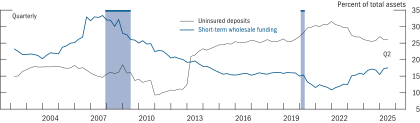
Banks' funding structures were little changed in the aggregate through the first half of 2025 (figure 4.3). The share of uninsured deposits relative to total bank assets remained well below the elevated levels seen in 2022 and early 2023 and near the levels seen in the latter half of the 2010s. Large banks, in lowering their uninsured deposits, increased their reliance on short-term nondeposit wholesale funding sources, such as repos. Regional and community banks, by contrast, generally relied more on brokered and reciprocal deposits. While a majority of brokered deposits and all reciprocal deposits are fully insured, they are more expensive than traditional core insured deposits and may not be as stable during times of stress.
Figure 4.3. Banks' reliance on uninsured deposits and short-term wholesale funding stabilized to levels more typical of the longer history
Accessible Version | Return to text
Note: Short-term wholesale funding is defined as the sum of large time deposits with maturity less than 1 year, federal funds purchased and securities sold under agreements to repurchase, deposits in foreign offices with maturity less than 1 year, trading liabilities (excluding revaluation losses on derivatives), and other borrowed money with maturity less than 1 year. The shaded bars with top caps indicate periods of business recession as defined by the National Bureau of Economic Research: December 2007–June 2009 and February 2020–April 2020.
Source: Federal Reserve Board, Form FR Y-9C, Consolidated Financial Statements for Holding Companies; Federal Financial Institutions Examination Council, Consolidated Reports of Condition and Income (Call Report) Form FFIEC 031.
Assets in cash-management vehicles continued to grow, primarily driven by government MMFs
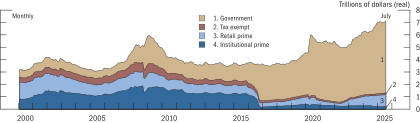
As of July 2025, total MMF assets had risen to $7.1 trillion from $6.3 trillion in July 2024, likely because MMFs continued to provide more attractive yields relative to most bank deposits (figure 4.4). The main contributor to this growth was government funds, which account for more than 80 percent of MMF assets and are less susceptible to runs because they only hold U.S. government and agency securities as well as repos backed by them. Assets under management (AUM) in institutional prime MMFs—historically, the most vulnerable segment—shrank by almost 18 percent over that period.
Figure 4.4. Assets under management at money market funds remained high
Accessible Version | Return to text
Note: The data are converted to constant 2025 dollars using the consumer price index.
Source: Federal Reserve Board staff calculations based on Investment Company Institute data; consumer price index, Bureau of Labor Statistics via Haver Analytics.
Other cash-management vehicles, such as dollar-denominated offshore MMFs and STIFs, also invest in money market instruments and engage in liquidity transformation. Estimated aggregate AUM of these vehicles has remained around $2.2 trillion for the past year. Many of these vehicles have portfolios similar to prime MMFs. Estimates of the size of these vehicles that are most like prime MMFs are limited by information gaps and range from $1 trillion to $2 trillion.12
The GENIUS Act provided a regulatory framework for payment stablecoins
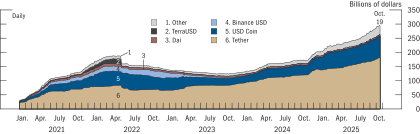
Stablecoin assets—digital assets designed to maintain a stable value relative to a national currency or another reference asset—have grown more than 70 percent in the past 12 months.13 In mid-October, the total market capitalization of stablecoins reached an all-time high around $300 billion (figure 4.5). On July 18, 2025, the Guiding and Establishing National Innovation for U.S. Stablecoins Act (GENIUS Act) was signed into law. The GENIUS Act established a new regulatory framework for the issuance and transaction of "payment stablecoins." Among its provisions are requirements that federal regulators issue rules regarding reserve requirements and redemptions, which will help mitigate run risks and likely encourage further growth of this asset class.14
Figure 4.5. Market capitalization of major stablecoins experienced accelerated growth
Accessible Version | Return to text
Note: The key identifies series in order from top to bottom. USD is U.S. dollar.
Source: Llama Corp, DeFiLlama.
Bond and loan mutual funds weathered short-lived outflows in April without amplifying market disruptions
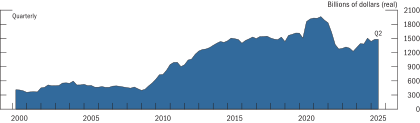
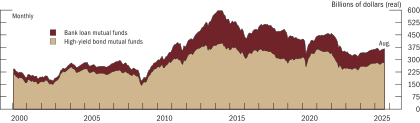
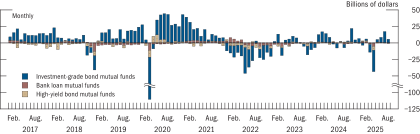
As of the second quarter of 2025, mutual funds held approximately $1.5 trillion in U.S. corporate bonds—accounting for around 13 percent of U.S. corporate bonds outstanding (figure 4.6). AUM in mutual funds with holdings that are concentrated in high-yield bonds and bank loans—which are riskier and less liquid forms of debt—were around $366 billion in August 2025, about 20 percent below levels in 2021 (figure 4.7). During the period of volatility in April, corporate bond and bank loan mutual funds all experienced appreciable outflows, but the outflows were short lived and orderly (figure 4.8).
Figure 4.6. Corporate bond holdings of mutual funds were stable in the first half of 2025
Accessible Version | Return to text
Note: The data show holdings of all U.S. corporate bonds by all U.S.-domiciled mutual funds (holdings of foreign bonds are excluded). The data are converted to constant 2025 dollars using the consumer price index.
Source: Federal Reserve Board staff estimates based on Federal Reserve Board, Statistical Release Z.1, "Financial Accounts of the United States"; consumer price index, Bureau of Labor Statistics via Haver Analytics.
Figure 4.7. Bank loan and high-yield mutual fund assets remained steady at levels far below their 2021 peaks
Accessible Version | Return to text
Note: The data are converted to constant 2025 dollars using the consumer price index. The key identifies series in order from top to bottom.
Source: Investment Company Institute; consumer price index, Bureau of Labor Statistics via Haver Analytics.
Figure 4.8. April's outflows stabilized
Accessible Version | Return to text
Note: Mutual fund assets under management as of August 2025 included $2,450 billion in investment-grade bond mutual funds, $280 billion in high-yield bond mutual funds, and $82 billion in bank loan mutual funds. Bank loan mutual funds, also known as floating-rate bond funds, are excluded from high-yield bond mutual funds. Curved line segments on the y-axis and bar indicate a scale break to accommodate high values observed in March 2020.
Source: Investment Company Institute.
Central counterparties' initial margin levels and other prefunded resources remained high
Central counterparties' (CCPs) initial margin levels remained high through the first half of 2025. Initial margin requirements for some products were increased further due to the April volatility, during which CCPs operated normally as transaction volumes increased. CCPs as a group also continued to increase prefunded mutualized resources from already high levels.15 Elevated initial margins and ample overall prefunded resources lower the risk faced by CCPs to the potential default by a clearing member or market participant. This, in turn, reduces the possibility of large liquidity demands from a CCP to its clearing members (usually banks). However, client collateral is heavily concentrated at the largest clearing members, presenting challenges in transferring client positions to other clearing members if it were ever necessary.
Life insurers' nontraditional liabilities increased further
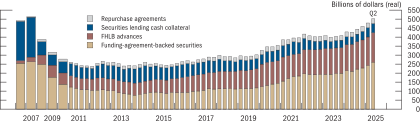
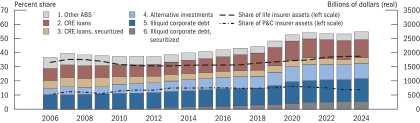
Life insurers continued to increase their reliance on nontraditional liabilities, including FABS,Federal Home Loan Bank advances, and cash received through securities lending and repo transactions (figure 4.9). The total amount of these liabilities grew by around 20 percent from 2024:Q2 to 2025:Q2, although they remain small relative to general account assets. Measures of the share of illiquid assets to total assets for life insurers and for property and casualty insurers were around 37 percent and 14 percent, respectively, in 2024 (figure 4.10).
Figure 4.9. Life insurers' use of nontraditional liabilities increased further
Accessible Version | Return to text
Note: The data are converted to constant 2025 dollars using the consumer price index. FHLB is Federal Home Loan Bank. The data are annual from 2006 to 2010 and quarterly thereafter. The key identifies bars in order from top to bottom.
Source: Consumer price index, Bureau of Labor Statistics via Haver Analytics; Moody's Analytics, Inc., CreditView, Asset-Backed Commercial Paper Program Index; Securities and Exchange Commission, Forms 10-Q and 10-K; National Association of Insurance Commissioners, quarterly and annual statutory filings accessed via S&P Global, Capital IQ Pro; Bloomberg Finance L.P.
Figure 4.10. Life insurers continued to hold a significant share of illiquid assets on their balance sheets
Accessible Version | Return to text
Note: The data are converted to constant 2024 dollars using the consumer price index. Securitized products include collateralized loan obligations for corporate debt, private-label commercial mortgage-backed securities for commercial real estate (CRE), and private-label residential mortgage-backed securities and asset-backed securities (ABS) backed by autos, credit cards, consumer loans, and student loans for other ABS. Illiquid corporate debt includes private placements, bank and syndicated loans, and high-yield bonds. Alternative investments include assets filed under Schedule BA. P&C is property and casualty. The key identifies bars in order from top to bottom.
Source: Consumer price index, Bureau of Labor Statistics via Haver Analytics; Federal Reserve Board staff estimates based on data from Bloomberg Finance L.P. and National Association of Insurance Commissioners Annual Statutory Filings.
References
11. Securities held in HTM accounts are accounted at fair value for liquidity coverage ratio (LCR) purposes but at book value for regulatory capital purposes. Selling HTM securities (rather than holding them to maturity) could "taint" the entire HTM investment portfolio, requiring it to be marked to market. This could result in the selling bank recognizing a significant mark-to-market loss and reduction in regulatory capital. Banks with access to repo markets can raise cash by pledging securities in a repo transaction without tainting their HTM portfolio. Return to text
12. Cash-management vehicles included in this total are dollar-denominated offshore MMFs, STIFs, private liquidity funds, ultrashort bond mutual funds, and local government investment pools. Return to text
13. Stablecoins are typically backed by a pool of "reserve" assets that include Treasury bills and other short-term instruments, but some stablecoin reserve assets also include loans and other digital assets. Return to text
14. The regulatory framework specified in the GENIUS Act also includes provisions regarding capital and risk management as well as illicit finance, among other areas. The act takes effect on the earlier of 18 months following enactment or 120 days after federal regulators issue final regulations implementing the act. Return to text
15. Prefunded resources represent financial assets, including cash and securities, transferred by the clearing members to the CCP to cover that CCP's potential credit exposure in case of default by one or more clearing members. These prefunded resources are held as initial margin and prefunded mutualized resources, which builds the resilience of CCPs to the possible default of a clearing member or market participant. Return to text