


2. Borrowing by Businesses and Households
Vulnerabilities from business and household debt remained moderate
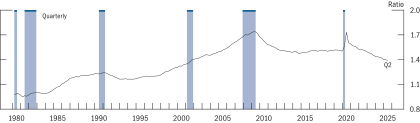
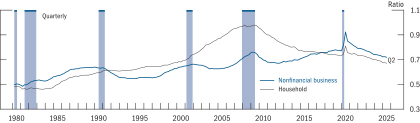
The balance sheet conditions of businesses and households remained stable in aggregate sincethe previous report. The level of total private nonfinancial-sector debt continued its moderate decline relative to GDP, with the debt-to-GDP ratio at its lowest level in two decades (figure 2.1). Trends in both the business and household sectors contributed to the decline in that overall ratio (figure 2.2). Business debt-to-GDP (blue line) edged down but remained near the 75th percentile of its historical range. The household debt-to-GDP ratio (black line) continued to tick downward and remained at more than 20-year lows.
Figure 2.1. The total debt of businesses and households relative to GDP remained at its lowest level in over 20 years
Accessible Version | Return to text
Note: The shaded bars with top caps indicate periods of business recession as defined by the National Bureau of Economic Research: January 1980–July 1980, July 1981–November 1982, July 1990–March 1991, March 2001–November 2001, December 2007–June 2009, and February 2020–April 2020. GDP is gross domestic product.
Source: Federal Reserve Board staff calculations based on Bureau of Economic Analysis, national income and product accounts, and Federal Reserve Board, Statistical Release Z.1, "Financial Accounts of the United States."
Figure 2.2. Both business and household debt-to-GDP ratios continued to fall
Accessible Version | Return to text
Note: The shaded bars with top caps indicate periods of business recession as defined by the National Bureau of Economic Research: January 1980–July 1980, July 1981–November 1982, July 1990–March 1991, March 2001–November 2001, December 2007–June 2009, and February 2020–April 2020. GDP is gross domestic product.
Source: Federal Reserve Board staff calculations based on Bureau of Economic Analysis, national income and product accounts, and Federal Reserve Board, Statistical Release Z.1, "Financial Accounts of the United States."
For additional context, table 2.1 shows the amounts outstanding and recent historical growth rates of different forms of debt owed by nonfinancial businesses and households as of the second quarter of 2025.
Table 2.1. Outstanding amounts of nonfinancial business and household credit
| Item | Outstanding (billions of dollars) |
Growth, 2024:Q2–2025:Q2 (percent) |
Average annual growth, 1997–2025:Q2 (percent) |
|---|---|---|---|
| Total private nonfinancial credit | 42,235 | 1.8 | 5.3 |
| Total nonfinancial business credit | 21,863 | 2.1 | 5.7 |
| Corporate business credit | 13,965 | 1.7 | 5.2 |
| Bonds and commercial paper | 8,654 | 2.7 | 5.5 |
| Bank lending | 1,875 | −7.8 | 3.4 |
| Leveraged loans1 | 1,441 | 6.4 | 12.3 |
| Noncorporate business credit | 7,897 | 2.8 | 6.7 |
| Commercial real estate credit | 3,396 | 2.0 | 6.0 |
| Total household credit | 20,372 | 1.4 | 4.9 |
| Mortgages | 13,533 | 2.8 | 5.0 |
| Consumer credit | 4,998 | .3 | 5.0 |
| Student loans | 1,814 | 4.2 | 7.3 |
| Auto loans | 1,563 | .3 | 5.1 |
| Credit cards | 1,257 | −2.3 | 3.4 |
| Nominal GDP | 30,354 | 4.6 | 4.7 |
Note: The data extend through 2025:Q2. Outstanding amounts are in nominal terms. Growth rates are nominal and are measured from Q2 of the year immediately preceding the period through Q2 of the final year of the period. The table reports the main components of corporate business credit, total household credit, and consumer credit. Other, smaller components are not reported. The commercial real estate (CRE) row shows CRE debt owed by both nonfinancial corporate and noncorporate businesses as defined in Table L.220: Commercial Mortgages in the "Financial Accounts of the United States." Total household-sector credit includes debt owed by other entities, such as nonprofit organizations. GDP is gross domestic product.
1. Leveraged loans included in this table are an estimate of the leveraged loans that are made to nonfinancial businesses only and do not include the small amount of leveraged loans outstanding for financial businesses. The amount outstanding shows institutional leveraged loans and generally excludes loan commitments held by banks. For example, lines of credit are generally excluded from this measure. Average annual growth of leveraged loans is from 2001 to 2025:Q2, as this market was fairly small before then. Return to table
Source: For leveraged loans, PitchBook Data, Leveraged Commentary & Data; for GDP, Bureau of Economic Analysis, national income and product accounts; for all other items, Federal Reserve Board, Statistical Release Z.1, "Financial Accounts of the United States."
Business debt increased slightly; the debt-servicing capacity of publicly traded firms was generally solid
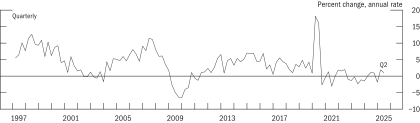
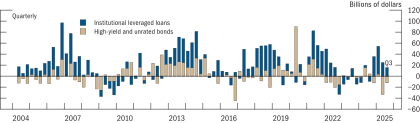
The growth rate of nonfinancial business debt adjusted for inflation turned slightly positive to around 1 percent in the first half of 2025 (figure 2.3). Net issuance of risky debt—defined as issuance of high-yield bonds, unrated bonds, and leveraged loans minus retirements and repayments—was negative in the second and third quarters of 2025, driven by increased retirements of high-yield and unrated bonds (figure 2.4). Privately held firms account for roughly 60 percent of the total outstanding debt of U.S. nonfinancial firms. These firms tend to have less access to capital markets and primarily borrow from banks, private credit funds, and other institutional investors.
Figure 2.3. Business debt adjusted for inflation turned slightly positive
Accessible Version | Return to text
Note: Nominal debt growth is seasonally adjusted and is translated into real terms after subtracting the growth rate of the price deflator for the core personal consumption expenditures price index.
Source: Federal Reserve Board, Statistical Release Z.1, "Financial Accounts of the United States."
Figure 2.4. Net issuance of risky debt fell in the middle of 2025
Accessible Version | Return to text
Note: The data begin in 2004:Q2. Institutional leveraged loans generally exclude loan commitments held by banks. The key identifies bars in order from top to bottom (except for some bars with at least one negative value). For 2025:Q3, the value corresponds to preliminary data.
Source: Mergent, Inc., Fixed Income Securities Database; PitchBook Data, Leveraged Commentary & Data.
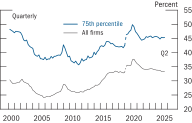
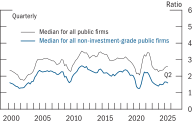
Gross leverage—the ratio of debt to assets—of all publicly traded nonfinancial firms was flat through the second quarter of 2025 (figure 2.5). Net leverage—the ratio of debt less cash to total assets—increased slightly in recent quarters. While both gross and net leverage remained high relative to history, so did the debt-servicing capacity of publicly traded firms. For publicly traded firms, where credit quality has been generally sound, interest coverage ratios (ICRs) were little changed since the April report (figure 2.6).
Figure 2.5. Gross leverage of publicly traded nonfinancial firms leveled off but was still high by historical standards
Accessible Version | Return to text
Note: Gross leverage is an asset-weighted average of the ratio of firms' book value of total debt to book value of total assets. The 75th percentile is calculated from a sample of the 2,500 largest firms by assets. The dashed sections of the lines in 2019:Q1 reflect the structural break in the series due to the 2019 compliance deadline for Financial Accounting Standards Board rule Accounting Standards Update 2016-02. The accounting standard requires operating leases, previously considered off-balance-sheet activities, to be included in measures of debt and assets.
Source: Federal Reserve Board staff calculations based on S&P Global, Compustat.
Figure 2.6. Interest coverage ratios, which indicate firms' ability to service their debt, were largely unchanged
Accessible Version | Return to text
Note: The interest coverage ratio is earnings before interest and taxes divided by interest payments. Firms with leverage less than 5 percent and interest payments less than $500,000 are excluded.
Source: Federal Reserve Board staff calculations based on S&P Global, Compustat.
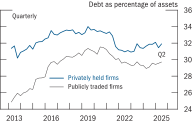
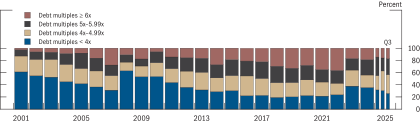
Debt-to-asset ratios increased on bank commercial and industrial loans but remained below pre-pandemic levels. This was true for both privately held and publicly traded firms (figure 2.7). In leveraged loans, the share of newly issued loans to large corporations with debt multiples—defined as the ratio of debt to earnings before interest, taxes, depreciation, and amortization—greater than 4 increased moderately to above the historical median (figure 2.8).
Figure 2.7. Firms with commercial and industrial bank loans increased their leverage slightly
Accessible Version | Return to text
Note: The figure shows the weighted median leverage of nonfinancial firms that borrow using commercial and industrial loans from the 23 banks that have filed in every quarter since 2013:Q1. Lever-age is measured as the ratio of the book value of total debt to the book value of total assets of the borrower, as reported by the lender, and the median is weighted by committed amounts.
Source: Federal Reserve Board, Form FR Y-14Q (Schedule H.1), Capital Assessments and Stress Testing.
Figure 2.8. Newly issued leveraged loans with debt multiples greater than 4 increased moderately to above the historical median
Accessible Version | Return to text
Note: Volumes are for large corporations with earnings before interest, taxes, depreciation, and amortization greater than $50 million and exclude existing tranches of add-ons and amendments as well as restatements with no new money. The key identifies bars in order from top to bottom.
Source: Mergent, Inc., Fixed Income Securities Database; PitchBook Data, Leveraged Commentary & Data.
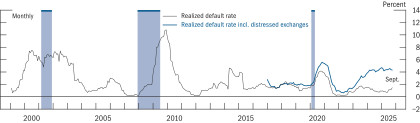
For leveraged loan borrowers, which are mostly, but not exclusively, privately held firms, gross and net leverage ratios declined modestly but remained above their historical medians since 2016. The median ICR for leveraged loan borrowers stayed near its historical lows. ICRs of smaller and riskier firms, including leveraged loan borrowers, are sensitive to interest rate changes due to their high leverage, high use of floating-rate loans, and short-term debt maturity structure. The volume-weighted default rate on leveraged loans stayed well below its historical median (figure 2.9, black line). However, defaults including distressed exchanges, which reflect the number of defaults and distressed loans that have been renegotiated between the borrower and the lender, continued to be elevated relative to history (figure 2.9, blue line).
Figure 2.9. The realized default rate on leveraged loans remained well below its previous peaks
Accessible Version | Return to text
Note: The data begin in December 1998 for the realized default rate and in December 2016 for the default rate including distressed exchanges. The default rate is calculated as the amount in default over the past 12 months divided by the total outstanding volume of loans that are not in default at the beginning of the 12-month period. The default rate including distressed exchanges is calculated as the number of issuers in default or distressed exchange over the past 12 months divided by the total number of issuers that are not in default at the beginning of the 12-month period. The shaded bars with top caps indicate periods of business recession as defined by the National Bureau of Economic Research: March 2001–November 2001, December 2007–June 2009, and February 2020–April 2020.
Source: PitchBook Data, Leveraged Commentary & Data.
Private credit remains a small fraction of outstanding nonfinancial business debt, and growth seemed to have slowed somewhat this year. Based on available data for privately held firms that have borrowing activities from large banks, the ICR for the median firm continued its downward trend over the previous few years, as higher interest rates have contributed to reduced earnings and increased the cost of debt servicing. The average ICR at issuance for private credit borrowers increased but remained low at a value of around 2. Aggregate leverage of privately held firms was similar to the previous report and remained near its historical median. The recent bankruptcies of two privately held firms, an auto parts supplier and a subprime auto lender, so far appear to be isolated events. However, these examples highlight that unexpected losses could arise from opaque off-balance-sheet funding arrangements that may be used by certain privately held firms.
Credit availability to small businesses tightened, and delinquencies remained above pre-pandemic levels
According to the August 2025 National Federation of Independent Business's Small Business Economic Trends Survey, the share of firms that borrow regularly has trended down since November 2021.4 Measures of small business loan originations were level through the first half of 2025. Data from the Small Business Lending Survey showed that banks continued to tighten credit standards.5 Interest rates on small business loans have been largely stable in recent months and remained near the top of the range observed since 2008. Short-term (up to 90 days) delinquency rates ticked up but were still substantially lower than during the pandemic or the Great Recession. Long-term (more than 90 days) delinquency rates have levelled off recently but remained above their pre-pandemic levels.
Outstanding household debt adjusted for inflation was little changed
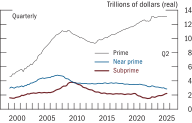
Outstanding household debt adjusted for inflation has been little changed over the past two years. The share of that debt that is currently owed by households with a subprime credit rating has risen somewhat, reflecting in part the rise in consumer delinquencies and a related deterioration of those borrowers' credit scores (figure 2.10). The ratio of total required household debt payments to total disposable income (the household debt service ratio) was little changed since the last report. Most household debt has fixed interest rates, and the higher interest rate environment of the past few years has only partially passed through to household interest expenses.
Figure 2.10. Inflation-adjusted household debt was largely unchanged
Accessible Version | Return to text
Note: Subprime are borrowers with an Equifax Risk Score less than 620; near prime are from 620 to 719; prime are greater than 719. Scores are measured contemporaneously. Student loan balances before 2004 are estimated using average growth from 2004 to 2007, by risk score. The data are converted to constant 2025 dollars using the consumer price index.
Source: Federal Reserve Bank of New York Consumer Credit Panel/Equifax; consumer price index, Bureau of Labor Statistics via Haver Analytics.
Mortgage credit risk remained low
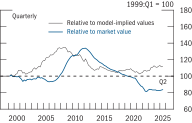
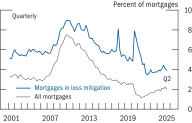
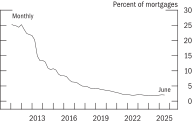
Mortgage debt accounted for roughly three-fourths of total household debt. Housing leverage—measured as outstanding mortgage loan balances relative to home values—remained subdued (figure 2.11). When measured relative to market prices (blue line), outstanding mortgage balances continued to sit well below previous peaks. Outstanding mortgage loan balances relative to an estimate of home values from a model using rents and other market fundamentals were somewhat higher but remained far below earlier peaks (black line). The overall mortgage delinquency rate remained at the lower end of its historical distribution in the first half of 2025 (figure 2.12). Delinquency rates remained subdued due to large home equity cushions (figure 2.13) and strong underwriting standards.
Figure 2.11. Measures of housing leverage stayed significantly below their peak levels
Accessible Version | Return to text
Note: Housing leverage is estimated as the ratio of the average outstanding mortgage loan balance for owner-occupied homes with a mortgage to (1) current home values using the Zillow national house price index and (2) model-implied house prices estimated by a staff model based on rents, interest rates, and a time trend.
Source: Federal Reserve Bank of New York Consumer Credit Panel/Equifax; Zillow, Inc., Real Estate Data; Bureau of Labor Statistics via Haver Analytics.
Figure 2.12. Mortgage delinquency rates edged down and remained close to the low end of their historical distribution
Accessible Version | Return to text
Note: Loss mitigation includes tradelines that have a narrative code of forbearance, natural disaster, payment deferral (including partial), loan modification (including federal government plans), or loans with no scheduled payment and a nonzero balance. Delinquent loans in both series are loans reported to the credit bureau as at least 30 days past due.
Source: Federal Reserve Bank of New York Consumer Credit Panel/Equifax.
Figure 2.13. Very few homeowners had negative equity in their homes
Accessible Version | Return to text
Source: Cotality Real Estate Data.
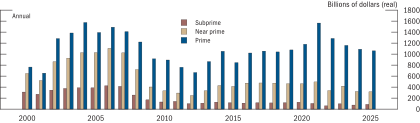
New mortgage extensions declined slightly for borrowers with a prime credit score (the group with the largest share) and for borrowers with near-prime credit scores but increased slightly for borrowers with subprime credit scores over the past year (figure 2.14). As of the fourth quarter of 2024, the early payment delinquency rate—the share of balances becoming delinquent within one year of mortgage origination—remained somewhat above the median of its historical distribution.
Figure 2.14. New mortgage extensions increased for subprime borrowers
Accessible Version | Return to text
Note: The figure plots the year-over-year change in balances for the second quarter of each year among those households whose balance increased over this window. Subprime are those with an Equifax Risk Score less than 620; near prime are from 620 to 719; prime are greater than 719. Scores were measured 1 year ago. The data are converted to constant 2025 dollars using the consumer price index. The key identifies bars in order from left to right.
Source: Federal Reserve Bank of New York Consumer Credit Panel/Equifax; consumer price index, Bureau of Labor Statistics via Haver Analytics.
Consumer delinquencies remained high by historical standards
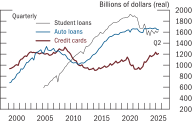
Consumer debt accounted for the remaining one-fourth of household debt and consisted primarily of student, auto, and credit card loans. Balances were broadly unchanged in inflation-adjusted terms relative to the previous report (figure 2.15).
Figure 2.15. Consumer debt balances were largely unchanged for student and auto loans and for credit cards
Accessible Version | Return to text
Note: The data are converted to constant 2025 dollars using the consumer price index. Student loan data begin in 2005:Q1.
Source: Federal Reserve Bank of New York Consumer Credit Panel/Equifax; consumer price index, Bureau of Labor Statistics via Haver Analytics.
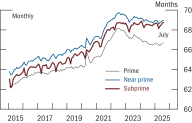
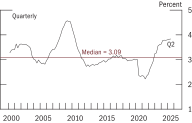
The average maturity of auto loans at origination for used cars was near historical highs for borrowers with a nonprime credit score (figure 2.16). On balance, longer-maturity loans tend to have higher default risks, partly because such loans have a higher risk of falling deep into a negative equity position, which can lead to consumer defaults. The share of auto loans in delinquent status was largely unchanged from the previous report and stood at a level somewhat above its historical median (figure 2.17).
Figure 2.16. The average maturity of loans at origination for used cars remained elevated for nonprime borrowers
Accessible Version | Return to text
Note: The data are seasonally adjusted. Loans are for used auto vehicles only. Subprime are those with a VantageScore less than 601; near prime are from 601 to 660; prime are greater than 660.
Source: Experian Velocity.
Figure 2.17. Auto loan delinquencies remained above the historical median
Accessible Version | Return to text
Note: Delinquent includes loans reported to the credit bureau as at least 30 days past due. The data for auto loans are reported semiannually by the Risk Assessment, Data Analysis, and Research Data Warehouse until 2017, after which they are reported quarterly. The data are seasonally adjusted.
Source: Federal Reserve Bank of New York Consumer Credit Panel/Equifax.
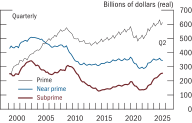
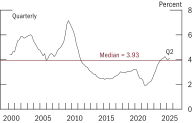
The stock of outstanding credit card debt shifted slightly to subprime borrowers over the first half of 2025 (figure 2.18). Credit card delinquency rates remained flat in the first half of 2025 after reaching their highest level since 2010 in the previous year (figure 2.19). The stabilization of credit performance has been broad based, with delinquency rates leveling off across credit score and income groups.6 The overall increase in credit card delinquencies since early 2022 was attributable primarily to elevated delinquencies among borrowers with a nonprime credit score and reflected in large part looser underwriting standards and large growth in inflation-adjusted revolving credit over the pandemic period.
Figure 2.18. Inflation-adjusted credit card balances for subprime borrowers were up slightly
Accessible Version | Return to text
Note: Subprime are borrowers with an Equifax Risk Score less than 620; near prime are from 620 to 719; prime are greater than 719. Scores are measured contemporaneously. The data are converted to constant 2025 dollars using the consumer price index.
Source: Federal Reserve Bank of New York Consumer Credit Panel/Equifax; consumer price index, Bureau of Labor Statistics via Haver Analytics.
Figure 2.19. Credit card delinquencies remained slightly above their long-term median
Accessible Version | Return to text
Note: Delinquency measures the fraction of balances that are at least 30 days past due, excluding severe derogatory loans, which are delinquent and have been charged off, foreclosed, or repossessed by the lender. The data are seasonally adjusted.
Source: Federal Reserve Bank of New York Consumer Credit Panel/Equifax.
Delinquencies on student loan debt increased significantly in the first half of 2025, reflecting the resumption of student loan repayments and reporting of delinquent loans to credit bureaus. However, student loan borrowers have not yet shown much greater difficulty in meeting their non-student loan debt payments relative to the overall population.
References
4. This survey's data are available on the National Federation of Independent Business's website at https://www.nfib.com/surveys/small-business-economic-trends. Return to text
5. This survey's data are available on the Federal Reserve Bank of Kansas City's website at https://www.kansascityfed.org/surveys/small-business-lending-survey/. Return to text
6. Income and credit score are not strongly correlated; see Rachael Beer, Felicia Ionescu, and Geng Li (2018), "Are Income and Credit Scores Highly Correlated?" FEDS Notes (Washington: Board of Governors of the Federal Reserve System, August 13), https://doi.org/10.17016/2380-7172.2235. Return to text