


Financial Stability
The Federal Reserve monitors financial system risks and engages at home and abroad to help ensure that the system supports a healthy economy for U.S. households, communities, and businesses.
In order to maintain a resilient financial system, the Federal Reserve monitors the potential buildup of risks to financial stability; uses such analyses to inform Federal Reserve responses, including the design of stress-test scenaraios and decisions regarding other policies; works with other domestic agencies directly and through the Financial Stability Oversight Council (FSOC); and engages with the global community in monitoring, supervision, and regulation efforts that mitigate the risks and consequences of financial instability domestically and abroad.1
This section discusses key financial stability activities undertaken by the Federal Reserve over 2024, which include the following:
- monitoring vulnerabilities that affect financial stability (see figure 3.1 for a summary of key vulnerabilities);
- promoting a perspective on the supervision and regulation of large, complex financial institutions that accounts for the potential spillovers from distress at such institutions to the financial system and broader economy; and
- engaging in domestic and international cooperation and coordination.
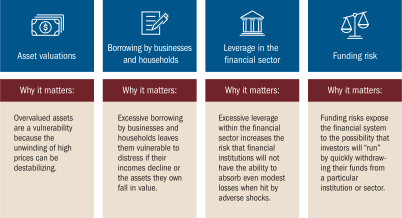
Figure 3.1. The Federal Reserve assesses four key vulnerabilities in monitoring financial stability
Accessible Version | Return to text
Each quarter, Federal Reserve Board staff assess a set of four vulnerabilities relevant for financial system stability. These monitoring efforts promote financial stability by informing broader policy discussions and stimulating additional research.
Periodically, Federal Reserve Board staff comprehensively assess potential vulnerabilities relevant for financial system stability. The results of these comprehensive assessments are communicated to the Board, the Federal Open Market Committee (FOMC), and the public through the Financial Stability Report (FSR), the Monetary Policy Report, and the FOMC minutes. These monitoring efforts promote financial stability by informing broader policy discussions and stimulating additional research.
Some of these activities are also discussed elsewhere in this annual report. A broader set of economic and financial developments are discussed in section 2, "Monetary Policy and Economic Developments," with the discussion that follows concerning surveillance of economic and financial developments focused on financial stability. The full range of activities associated with supervision of systemically important financial institutions and designated financial market utilities is discussed in section 4, "Supervision and Regulation."
Monitoring Financial Vulnerabilities
This section describes the Federal Reserve's monitoring of vulnerabilities in the financial system during 2024.
Financial institutions are linked together through a complex set of relationships, and their resilience depends on the economic condition of households and businesses. In turn, the condition of households and businesses hinges on the strength of financial institutions' balance sheets, as the nonfinancial sector obtains funding through the financial sector. The Federal Reserve's efforts to measure and monitor risks to financial stability are designed to better understand these complex linkages and are an important part of the Federal Reserve's efforts to achieve overall economic stability.
A stable financial system, when hit by adverse events, or "shocks," is able to continue meeting demands for financial services from households and businesses, such as credit provision and payment services. By contrast, in an unstable system, these same shocks are likely to have much larger effects, disrupting the flow of credit and leading to declines in employment and economic activity.
Consistent with this view of financial stability, the Federal Reserve Board's monitoring framework distinguishes between shocks to and vulnerabilities of the financial system. Shocks, such as sudden changes to financial or economic conditions, are inherently hard to predict. Vulnerabilities tend to build up over time and are the aspects of the financial system that are most expected to cause widespread problems in times of stress. Accordingly, the Federal Reserve maintains a flexible, forward-looking financial stability monitoring program focused on assessing how the level and configuration of those vulnerabilities affect the financial system's resilience to a wide range of potential adverse shocks.
Each quarter, Federal Reserve Board staff assess a set of vulnerabilities relevant for financial stability, including, but not limited to, asset valuation pressures, borrowing by households and businesses, leverage in the financial sector, and funding risk. These monitoring efforts inform discussions concerning policies to promote financial stability, such as monetary policy, payment systems, and supervision and regulation. They also inform Federal Reserve interactions with broader monitoring efforts, such as those by the FSOC and the Financial Stability Board (FSB).
Since 2018, the Federal Reserve Board has also published its FSR, which summarizes the Board's framework for assessing the resilience of the U.S. financial system and presents the Board's current assessment of financial system vulnerabilities.2 It aims to promote public understanding about Federal Reserve views on this topic and thereby increase transparency and accountability. The Federal Reserve Board provides a shorter summary and update on how conditions related to financial stability have evolved since publication of the previous FSR in the Monetary Policy Report. The FSR also complements the annual report of the FSOC, which is chaired by the Secretary of the Treasury and includes the Federal Reserve Chair and other financial regulators.
Asset Valuation Pressures
When asset prices are high relative to their historical relationship with fundamentals, vulnerabilities related to a rapid decline in price increase. A rapid unwinding of prices can be destabilizing, especially if the assets are widely held and the values are supported by excessive leverage, maturity transformation, or risk opacity. Moreover, stretched asset valuations may be an indicator of a broader buildup in risk-taking.
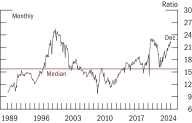
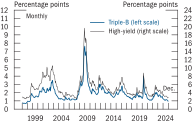
The economy remained strong over 2024, and the economic outlook centered on continued growth. Against this backdrop, valuation pressures remained elevated in a range of markets. Equity prices relative to earnings continued to rise toward the high end of their historical range (figure 3.2). Spreads on corporate bonds and loans remained low relative to their historical distributions (figure 3.3).
Figure 3.2. Forward price-to-earnings ratio of S&P 500 firms
Accessible Version | Return to text
Note: The figure shows the aggregate forward price-to-earnings ratio of S&P 500 firms based on expected earnings for 12 months ahead. The median value is 15.7.
Source: Federal Reserve Board staff calculations using Refinitiv, Institutional Brokers' Estimate System estimates.
Figure 3.3. Corporate bond spreads to similar-maturity Treasury securities
Accessible Version | Return to text
Note: The triple-B series reflects the option-adjusted spread of the ICE Bank of America Merrill Lynch (BofAML) triple-B U.S. Corporate Index (C0A4), and the high-yield series reflects the option-adjusted spread of the ICE BofAML U.S. High Yield Index (H0A0).
Source: ICE Data Indices, LLC, used with permission.
Valuation pressures in the residential real estate sector remained elevated. Despite high borrowing costs and tightened lending standards, various house price indexes continued to increase over the year. The price-to-rent ratio remained at the upper end of its historical distribution.
Commercial real estate (CRE) market conditions remain challenging despite some signs of improvement. The pace of declines in CRE prices slowed in 2024, but a substantial volume of office loans and multifamily property loans are set to reprice or mature through 2026.
Borrowing by Households and Businesses
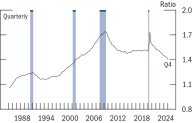
Excessive borrowing by households and businesses has been an important contributor to past financial crises. A commonly used measure of the financial position of households and businesses is the ratio of the combined total debt of nonfinancial businesses and households relative to gross domestic product (GDP). Growth in nominal GDP outpaced the modest growth in total debt in 2024, leaving the credit-to-GDP ratio close to its lowest level in 20 years (figure 3.4). This development suggests that, in the aggregate, households and businesses do not appear to have borrowed excessively.
Figure 3.4. Private nonfinancial-sector credit-to-GDP ratio
Accessible Version | Return to text
Note: The shaded bars indicate periods of business recession as defined by the National Bureau of Economic Research: July 1990 to March 1991, March 2001 to November 2001, December 2007 to June 2009, and February 2020 to April 2020. GDP is gross domestic product.
Source: Federal Reserve Board staff calculations based on Bureau of Economic Analysis, national income and product accounts, and Federal Reserve Board, Statistical Release Z.1, "Financial Accounts of the United States."
In the business sector, gross leverage—the ratio of debt to assets for all publicly traded nonfinancial firms—remained elevated by historical standards. Net leverage—the ratio of debt less cash to assets—showed a similar trend. The ability of public firms to service their debt, as measured by the interest coverage ratio, remained flat at moderate levels, in part reflecting resilient earnings. The cumulative pass-through of increases in interest rates during 2022 and 2023 remained moderate, reflecting record issuance of fixed-rate corporate bonds—which account for the majority of the debt of public firms—during the pandemic, when interest rates were low. However, businesses with floating-rate obligations have experienced significant increases in interest expenses since 2022.
In the household sector, household debt relative to GDP continued to edge down to a 20-year low. Mortgage debt accounts for roughly three-fourths of total household debt, with new mortgage extensions skewed toward prime borrowers in recent years. Most of the remaining one-fourth of household debt is consumer credit, which consists primarily of student loans, auto loans, and credit card debt. Although the strength of households' balance sheets held up through 2024, credit card and auto delinquency rates remained above historical averages. Meanwhile, lenders have tightened credit standards on those types of loans.
Leverage in the Financial System
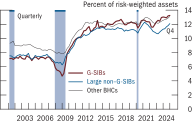
The banking system remained sound and resilient overall in 2024. Common equity tier 1 ratios—regulatory risk-based measures of bank capital adequacy—at the largest banks were near or above the top quartile of their range throughout the past decade (figure 3.5). Nonetheless, fair value losses on fixed-income assets remained sizable at some banks, and delinquency rates on credit cards, auto loans, and some CRE categories remained elevated relative to the pre-pandemic level.
Figure 3.5. Common equity tier 1 ratio of banks
Accessible Version | Return to text
Note: The data are seasonally adjusted by Federal Reserve Board staff. Before 2014:Q1, the numerator of the common equity tier 1 ratio is tier 1 common capital for advanced-approaches bank holding companies (BHCs) and intermediate holding companies (IHCs) (before 2015:Q1, for non-advanced-approaches BHCs). Afterward, the numerator is common equity tier 1 capital. G-SIBs are global systemically important U.S. banks. Large non-G-SIBs are other BHCs and IHCs with greater than $100 billion in total assets that are not G-SIBs. The denominator is risk-weighted assets. The shaded bars indicate periods of business recession as defined by the National Bureau of Economic Research: March 2001 to November 2001, December 2007 to June 2009, and February 2020 to April 2020.
Source: Federal Reserve Board, Form FR Y-9C, Consolidated Financial Statements for Holding Companies.
Outside the banking sector, leverage at large life insurance companies in 2024 remained above its historical average, and those insurers continued to allocate a substantial share of assets to less liquid instruments. Based on a number of measures, leverage at hedge funds during 2024 was near the top of its historical range, as the Treasury cash-futures basis trade continued to be near historical highs. The volatility spike in August 2024 appeared to be related to some hedge funds having to deleverage their positions to meet internal volatility targets. The event led to a deterioration in liquidity across a broad range of markets, but market conditions quickly recovered. Nevertheless, this event showed how high leverage can amplify adverse shocks.
Funding Risk
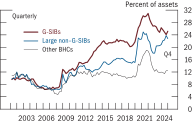
Overall, banks' liquidity positions remained ample compared with the risk of their funding structures. High-quality liquid assets measured relative to total assets were still at or above pre-pandemic levels at most banks during 2024 (figure 3.6). During the March 2023 banking-sector stresses, high reliance on funding from uninsured deposits was a key vulnerability among some of the most affected banks. Since then, the share of uninsured deposits relative to total bank funding has decreased for most banks, especially at those that previously relied heavily on uninsured deposits.
Figure 3.6. Liquid assets held by banks
Accessible Version | Return to text
Note: Liquid assets are cash plus estimates of securities that qualify as high-quality liquid assets as defined by the liquidity coverage ratio requirement. Some discounts and restrictions on Level 2 assets are incorporated into the estimate. G-SIBs are global systemically important U.S. banks. Large non-G-SIBs are other bank holding companies (BHCs) and intermediate holding companies with greater than $100 billion in total assets.
Source: Federal Reserve Board, Form FR Y-9C, Consolidated Financial Statements for Holding Companies.
Outside the banking sector, assets under management (AUM) of money market funds (MMFs) continued to increase in 2024, as MMFs continued to provide more attractive yields relative to most bank deposits. However, the level of institutional prime MMFs remained below levels 10 years ago. Combined AUM in other cash-management vehicles—such as offshore prime MMFs, short-term investment funds, private liquidity funds, and ultrashort bond funds—continued to increase and remained at a historically high level.
Financial Stability Cooperation and Coordination
The Federal Reserve continued its engagement with both domestic and international institutions in 2024 to promote U.S. financial stability.
Financial Stability Oversight Council Activities
As mandated by the Dodd-Frank Wall Street Reform and Consumer Protection Act, the FSOC was created in 2010. The FSOC is chaired by the Secretary of the Treasury and includes the Chair of the Board of Governors of the Federal Reserve System as one of its 10 voting members. The FSOC established an institutional framework for identifying and responding to sources of systemic risk. Through collaborative participation in the FSOC, U.S. financial regulators monitor not only institutions, but also the financial system as a whole. The Federal Reserve, in conjunction with other participants, assists in monitoring financial risks, analyzing the implications of those risks for financial stability, and identifying steps that can be taken to mitigate those risks. In addition, if the FSOC designates an institution as systemically important, the Federal Reserve assumes responsibility for supervising that institution. Federal Reserve staff regularly contribute to FSOC committees, working groups, and initiatives and brief principals on the Federal Reserve's key conclusions.
The FSOC's 2024 annual report reviewed significant financial market developments, described potential emerging threats to U.S. financial stability, identified vulnerabilities in the financial system, and made recommendations to mitigate them.3
Financial Stability Board Activities
In light of the interconnected global financial system and the global activities of large U.S. financial institutions, the Federal Reserve participates in international bodies, such as the FSB. The FSB monitors the global financial system and promotes international financial stability by coordinating with national financial authorities and international standard-setting bodies on information exchanges and work focused on developing strong global financial-sector policies.
Footnotes
1. For more information on how the Federal Reserve promotes a stable financial system, see the section "Promoting Financial System Stability" in The Fed Explained: What the Central Bank Does, available on the Board's website at https://www.federalreserve.gov/aboutthefed/files/the-fed-explained.pdf. Return to text
2. See Board of Governors of the Federal Reserve System, Financial Stability Report (Washington: Board of Governors, April 2024), https://www.federalreserve.gov/publications/files/financial-stability-report-20240419.pdf; and Board of Governors of the Federal Reserve System, Financial Stability Report (Washington: Board of Governors, November 2024), https://www.federalreserve.gov/publications/files/financial-stability-report-20241122.pdf. Return to text
3. See Financial Stability Oversight Council, Annual Report (Washington: FSOC, 2024), https://home.treasury.gov/system/files/261/FSOC2024AnnualReport.pdf. Return to text