


Federal Reserve System Budgets
The Federal Reserve Board of Governors and the Federal Reserve Banks prepare annual budgets as part of their efforts to demonstrate strong stewardship and provide appropriate transparency.1 This section presents information on the 2024 budget performance of the Board and Reserve Banks and on their 2025 budgets (box 1), budgeting processes, and trends in expenses and employment. This section also presents information on the costs of new currency.
Box 1. Implementation of the System's 2025 Budget
The Federal Reserve System's budget represents the maximum amount that is authorized for particular purposes. It does not constitute an obligation to spend funds, and actual spending on budget items may be reduced or eliminated without formal amendment to the budget. Since the Board adopted its 2025 budget, a number of budget items have been reduced or eliminated, including not proceeding with certain information technology modernization initiatives at their originally budgeted levels. Similarly, since the adoption of the 2025 Reserve Bank budgets, the Reserve Banks initiated a reduction to the 2025 full-time equivalents (FTE) forecast to align with the underrun in actual 2024 year-end performance.
As it has done historically, the Federal Reserve System has sought to align itself where appropriate and within the law with executive orders, including with the federal government hiring freeze. The Federal Reserve System also announced that it initiated a plan to reduce its overall headcount by 10 percent over the next few years. Initial Board efforts to this objective include offering a voluntary deferred resignation program and reevaluating its staffing needs related to the United States hosting the G-20 in 2026 and G-7 in 2027. Additionally, the Board and Reserve Banks are conducting a strategic evaluation to standardize operations and align operations to most strategic priorities to achieve staffing reductions.
System Budgets Overview
Tables D.1 and D.2 summarize the Federal Reserve Board of Governors' and Federal Reserve Banks' 2024 budgeted, 2024 actual, and 2025 budgeted operating expenses and employment.2
Table D.1. Total operating expenses of the Federal Reserve System, net of receipts and claims for reimbursement, 2024–25
Millions of dollars, except as noted
| Item | 2024 budget | 2024 actual | Variance 2024 actual to 2024 budget | 2025 budget | Variance 2025 budget to 2024 actual | ||
|---|---|---|---|---|---|---|---|
| Amount | Percent | Amount | Percent | ||||
| Board1 | 1,070.2 | 1,049.9 | −20.3 | −1.9 | 1,168.6 | 118.6 | 11.3 |
| Office of Inspector General2 | 39.6 | 40.1 | 0.5 | 1.4 | 41.3 | 1.2 | 3.0 |
| Reserve Banks3 | 6,053.2 | 5,865.4 | −187.7 | −3.1 | 6,382.5 | 517.1 | 8.8 |
| Currency4 | 1,368.6 | 1,242.3 | −126.3 | −9.2 | 1,263.6 | 21.3 | 1.7 |
| Total System operating expenses | 8,531.6 | 8,197.7 | −333.8 | −3.9 | 8,856.0 | 658.2 | 8.0 |
| Revenue from priced services | 501.4 | 524.4 | 23.0 | 4.6 | 531.7 | 7.3 | 1.4 |
| Claims for reimbursement5 | 879.8 | 835.8 | −43.9 | −5.0 | 915.0 | 79.2 | 9.5 |
| Revenue and claims for reimbursement6 | 1,381.2 | 1,360.2 | −20.9 | −1.5 | 1,446.7 | 86.5 | 6.4 |
| Total System operating expenses, net of revenue and claims for reimbursement | 7,150.4 | 6,837.5 | −312.9 | −4.4 | 7,409.3 | 571.7 | 8.4 |
Note: Here and in subsequent tables, components may not sum to totals and may not yield percentages shown because of rounding.
1. In December 2024, the Board approved an amended 2024 budget authority of $1,070.2 million. Return to table
2. In 2024, the Board approved a budget authority of $59.8 million. Total expenses, excluding operating income, were $58.7 million, which was $1.1 million, or 1.9 percent, lower than the budget authority. Operating income from the CFPB was $18.6 million, which was $1.6 million, or 8.1 percent, lower than the forecasted amount of $20.2 million. The OIG conducted more work related to the Board than planned, resulting in less operating income from the CFPB. This resulted in the net operating budget of $39.6 million and actual net expenses of $40.1 million. Return to table
3. Excludes Reserve Bank assessments by the Board of Governors for costs related to currency and the operations of the Board of Governors, OIG, and CFPB. Return to table
4. The 2024 and 2025 currency values reflect the sum of single-cycle and multicycle project costs. However, the Bureau of Engraving and Printing's single-cycle and multicycle project budgets are tracked separately, as shown in tables D.13 and D.14, respectively. Return to table
5. Reimbursable claims include the expenses of fiscal agency. In 2024 actual, the fiscal agency allocated portion of the pension is also included but is not included for the budget. The fiscal agency budgeted pension expense is $47.4 million in 2024 and $51.9 million in 2025. Return to table
6. Excludes annual assessment fees for the supervision of large financial companies pursuant to Regulation TT. These fees are not recognized as revenue or used to fund Board expenses. In 2024, the Board collected and transferred $777.7 million to the U.S. Treasury. Return to table
Table D.2. Employment in the Federal Reserve System, 2024–25
| Item | 2024 budget | 2024 actual | Variance 2024 actual to 2024 budget | 2025 budget | Variance 2025 budget to 2024 actual | ||
|---|---|---|---|---|---|---|---|
| Amount | Percent | Amount | Percent | ||||
| Board1 | 3,198 | 3,176 | −22 | −0.7 | 3,291 | 115 | 3.6 |
| Office of Inspector General2 | 141 | 140 | −1 | −1.0 | 146 | 7 | 4.7 |
| Reserve Banks | 21,238 | 20,840 | −398 | −1.9 | 21,411 | 571 | 2.7 |
| Currency | 24 | 23 | −1 | −4.2 | 27 | 4 | 17.4 |
| Total System employment | 24,602 | 24,179 | −423 | −1.7 | 24,875 | 696 | 2.9 |
Note: Employment numbers are represented in full-time equivalents (FTE) to better align with Reserve Banks and industry. FTE represent an employee's scheduled hours divided by the employer's hours for a full-time workweek. Part-time workers' hours can be fractional, which means the variance may be off slightly.
1. In December 2024, the Board approved an amended 2024 budget authority. The 2024 budget amount is updated to reflect the Board's forecasted 2024 FTE amount. Return to table
2. In December 2024, the Board approved an amended 2024 budget authority. The 2024 budget amount is updated to reflect the OIG's forecasted 2024 FTE amount. Return to table
2024 Budget Performance
In carrying out its responsibilities in 2024, the Federal Reserve System incurred $6,837.5 million in net expenses. Total System operating expenses of $8,197.7 million were offset by $1,360.2 million in revenue from priced services and claims for reimbursement. Total 2024 System operating expenses, net of revenue and reimbursements, were $312.9 million, or 4.4 percent, less than the amount budgeted for 2024.
2025 Operating Expense Budget
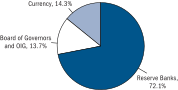
Budgeted 2025 System operating expenses of $7,409.3 million, net of revenue and reimbursements, are $571.7 million, or 8.4 percent, higher than 2024 actual expenses. The Reserve Bank budgets comprise almost three-quarters of the System budget (figure D.1).
Figure D.1. Distribution of budgeted expenses of the Federal Reserve System, 2025
Accessible Version | Return to text
OIG: Office of Inspector General.
Trends in Expenses and Employment
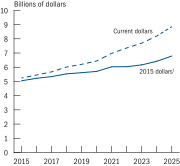
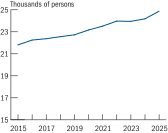
From the actual 2015 amount to the budgeted 2025 amount, the total operating expenses of the Federal Reserve System have increased an average of 5.4 percent annually (figure D.2), which is slightly higher than the 10-year growth rate between 2014 and 2024. The total rate of growth in Federal Reserve System expenses reflects investments in technology initiatives, payment infrastructure modernization efforts, the next-generation currency-processing program NextGen, and resources to support the supervision portfolio and other national strategic initiatives (figure D.3).3
Figure D.2. Total expenses of the Federal Reserve System, 2015–25
Accessible Version | Return to text
Note: For 2024–25, budgeted. Includes expenses of the OIG.
1. Calculated with the GDP price deflator.
Figure D.3. Employment in the Federal Reserve System, 2015–25
Accessible Version | Return to text
Note: For 2025, budgeted. From 2015 to 2018, employment numbers presented include position counts for the Board and the OIG and average number of personnel (ANP) for the Reserve Banks. From 2019 to 2020, employment numbers for all entities are represented in ANP. For 2021 to 2022, employment numbers presented include ANP for the Board and OIG and headcount for the Reserve Banks. For 2023 through 2025, employment numbers for all entities are represented by FTE.
Expense growth in the monetary policy area represents continued investment in regional economic research and resources to support effective market operations and monitoring activities.
Treasury services expenses have increased in response to Treasury's request that Reserve Banks, as fiscal agents, modernize legacy applications and align with the federal government's cloud computing strategy.
Expenses for services to financial institutions have increased as a result of the System's initiative to replace the existing, decades-old high-speed currency processing equipment with new equipment and technology. Growth in services to financial institutions and the public is also attributable to the addition of resources in support of the credit and liquidity facilities created in response to the COVID-19 pandemic.
Supervision has experienced moderate growth over the past 10 years. Growth driven by changes in the state member bank portfolio, the buildout of the cybersecurity supervision program, and support for other national strategic initiatives was partially offset by adjustments to supervisory mandates from the Economic Growth, Regulatory Reform, and Consumer Protection Act, the identification and realization of operational efficiencies, and the prioritization of resources toward higher-risk activities and emerging risks. In particular, resources were temporarily shifted from supervision in 2020 and 2021 to support the credit and liquidity facilities responding to the COVID-19 pandemic. Most recently, resources have been added to align with supervisory portfolio growth, increased complexity of institutions, and other strategic initiatives impacting the banking industry.
Growth in fee-based services is primarily for investments in payment infrastructure modernization efforts, including the FedNow SM Service initiative, and investments associated with multiyear technology initiatives to modernize processing platforms for Fedwire and automated clearinghouse (ACH).4
2025 Capital Budgets
The capital budgets for the Board and Reserve Banks total $531.8 million and $942.7 million, respectively.5 As in previous years, the 2025 capital budgets include funding for projects that support the strategic direction outlined by the Board, System leadership, and each Reserve Bank. These strategic goals emphasize investments that continue to improve operational efficiencies, enhance services to Bank customers, and ensure a safe and productive work environment.
Board of Governors Budgets
Board of Governors
The Board's budget is based on the principles established by the Strategic Plan 2024–27 and provides funding to advance the plan's goals and objectives.6 This functional alignment helps ensure organizational resources are used to advance the Board's mission and provides a structure to fund strategic priorities over the four-year time horizon.
The Board's budget process is as follows:
- At the start of the budget process, the chief operating officer and chief financial officer meet with the Committee on Board Affairs (CBA) to discuss budget recommendations for the Board's operating budget. After engagement with the CBA, Division of Financial Management (DFM) staff communicate the budget recommendations to the Executive Committee, which comprises the directors of each division.
- Divisions develop budget proposals and allocate resources to highest priority areas and seek tradeoffs and efficiencies. In some instances, new initiatives are proposed, reviewed, and prioritized against existing operations and budgets.
- DFM staff review initial budget requests submitted by divisions and collaborate with all divisions across all functional areas to develop budget recommendations.7
- The chief operating officer and chief financial officer subsequently brief the CBA on the budget submissions and recommendations. Once a final budget proposal is finalized, the Administrative Governor submits the budget to the full Board for review and final approval.
- Throughout the year, DFM staff monitor expenses through financial forecasts that provide insight into budgetary trends. Staff analyze budgetary variances and trends and communicate the results to senior management.
Tables D.3, D.4, and D.5 summarize the Board's 2024 budgeted and actual expenses and its 2025 budgeted expenses by operating area; division, office, or special account; and account classification, respectively. Table D.6 summarizes the Board's 2024 budgeted and actual authorized positions and its budgeted positions for 2025. Each table includes a line item for the Office of Inspector General (OIG), which is discussed later in this section.
Table D.3. Operating expenses of the Board of Governors, by operating area, 2024–25
Millions of dollars, except as noted
| Item | 2024 budget1 | 2024 actual | Variance 2024 actual to 2024 budget | 2025 budget | Variance 2025 budget to 2024 actual | ||
|---|---|---|---|---|---|---|---|
| Amount | Percent | Amount | Percent | ||||
| Monetary policy and financial stability2 | 457.4 | 449.4 | −8.0 | −1.7 | 518.5 | 69.1 | 15.4 |
| Supervision and regulation | 447.0 | 438.0 | −9.1 | −2.0 | 465.7 | 27.7 | 6.3 |
| Payment system and Reserve Bank oversight | 89.0 | 87.2 | −1.9 | −2.1 | 89.8 | 2.6 | 3.0 |
| Consumer protection and community development3 | 76.7 | 75.4 | −1.3 | −1.7 | 94.6 | 19.2 | 25.5 |
| Total, Board operations | 1,070.2 | 1,049.9 | −20.3 | −1.9 | 1,168.6 | 118.6 | 11.3 |
| Office of Inspector General | 39.6 | 40.1 | 0.5 | 1.4 | 41.3 | 1.2 | 3.0 |
Note: This table presents financial performance for the Board's operating areas, which align with the Reserve Banks. Payment system and Reserve Bank oversight is an operating area unique to the Board.
1. In December 2024, the Board approved an amended 2024 budget authority for the Board and OIG. OIG totals reflect the total operating budget net of expected earned income from the CFPB. Return to table
2. Includes the Survey of Consumer Finances. Return to table
3. 2025 growth within Consumer Protection and Community Development is affected by shifting of IT resources to the statistics function. Return to table
Table D.4. Operating expenses of the Board of Governors, by division, office, or special account, 2024–25
Millions of dollars, except as noted
| Division, office, or special account | 2024 budget1 | 2024 actual | Variance 2024 actual to 2024 budget | 2025 budget | Variance 2025 budget to 2024 actual | ||
|---|---|---|---|---|---|---|---|
| Amount | Percent | Amount | Percent | ||||
| Research and Statistics | 116.9 | 117.3 | 0.4 | 0.3 | 125.3 | 8.0 | 6.8 |
| International Finance | 47.9 | 47.7 | −0.2 | −0.4 | 55.9 | 8.2 | 17.1 |
| Monetary Affairs | 55.7 | 55.2 | −0.5 | −0.9 | 58.9 | 3.7 | 6.7 |
| Financial Stability | 23.7 | 23.5 | −0.1 | −0.6 | 26.9 | 3.3 | 14.1 |
| Supervision and Regulation | 141.9 | 139.8 | −2.0 | −1.4 | 152.3 | 12.4 | 8.9 |
| Consumer and Community Affairs | 43.3 | 43.4 | 0.1 | 0.2 | 47.6 | 4.2 | 9.7 |
| Reserve Bank Operations andPayment Systems | 55.8 | 55.6 | −0.2 | −0.3 | 59.7 | 4.0 | 7.2 |
| Board Members | 33.6 | 33.2 | −0.4 | −1.1 | 35.2 | 2.0 | 6.1 |
| Secretary | 13.7 | 13.5 | −0.2 | −1.5 | 15.5 | 2.0 | 14.8 |
| Legal | 41.5 | 40.9 | −0.6 | −1.3 | 44.3 | 3.4 | 8.3 |
| Chief Operating Officer | 20.0 | 19.9 | −0.1 | −0.5 | 23.1 | 3.2 | 15.9 |
| Financial Management | 17.6 | 17.4 | −0.2 | −1.1 | 18.7 | 1.3 | 7.7 |
| Information Technology | 187.0 | 187.5 | 0.5 | 0.3 | 209.9 | 22.4 | 12.0 |
| Management | 200.4 | 200.9 | 0.5 | 0.3 | 218.8 | 17.9 | 8.9 |
| Centrally managed benefits2 | 38.6 | 35.7 | −2.9 | −7.4 | 42.4 | 6.7 | 18.8 |
| Extraordinary items3 | 43.7 | 40.6 | −3.0 | −7.0 | 39.8 | −0.8 | −2.1 |
| Savings and reallocations4 | −12.3 | −23.8 | −11.5 | 93.4 | −25.4 | −1.6 | 6.7 |
| Survey of Consumer Finances5 | 1.4 | 1.5 | 0.1 | 6.4 | 19.8 | 18.3 | 1,217.4 |
| Total, Board operations | 1,070.2 | 1,049.9 | −20.3 | −1.9 | 1,168.6 | 118.6 | 11.3 |
| Office of Inspector General | 39.6 | 40.1 | 0.5 | 1.4 | 41.3 | 1.2 | 3.0 |
1. In December 2024, the Board approved an amended 2024 budget authority for the Board and OIG. OIG totals reflect the total operating budget net of expected earned income from the CFPB. Return to table
2. Includes retirement and post-retirement benefits, accrued annual leave, and Office of Employee Benefits administrative assessment. Return to table
3. Includes the NextGen transformation project, centralized position pool, centralized data accounts, and other programs. Return to table
4. Includes Board support and overhead allocations to the OIG and Currency. Includes the amended budget authority. Return to table
5. The survey collects information about family incomes, net worth, balance sheet components, credit use, and other financial outcomes, and is conducted every three years. Return to table
Table D.5. Operating expenses of the Board of Governors, by account classification, 2024–25
Millions of dollars, except as noted
| Account classification | 2024 budget1 | 2024 actual | Variance 2024 actual to 2024 budget | 2025 budget | Variance 2025 budget to 2024 actual | ||
|---|---|---|---|---|---|---|---|
| Amount | Percent | Amount | Percent | ||||
| Personnel services | |||||||
| Salaries | 617.4 | 616.2 | −1.2 | −0.2 | 659.2 | 43.0 | 7.0 |
| Outside agency help | 53.1 | 51.5 | −1.6 | −3.0 | 51.1 | −0.4 | −0.8 |
| Retirement, insurance, and benefits | 118.9 | 120.6 | 1.7 | 1.4 | 128.3 | 7.8 | 6.4 |
| Pension and post-retirement benefits | 22.2 | 21.5 | −0.8 | −3.5 | 25.8 | 4.3 | 20.1 |
| Subtotal, personnel services | 811.6 | 809.7 | −1.8 | −0.2 | 864.4 | 54.7 | 6.7 |
| Goods and services | |||||||
| Contractual services and professional fees | 47.4 | 44.2 | −3.2 | −6.8 | 66.6 | 22.4 | 50.8 |
| Rentals | 44.6 | 44.1 | −0.5 | −1.1 | 39.3 | −4.9 | −11.0 |
| Data, news, and research | 26.3 | 25.3 | −0.9 | −3.6 | 48.9 | 23.6 | 93.2 |
| Software | 43.3 | 43.6 | 0.3 | 0.6 | 58.0 | 14.4 | 33.1 |
| Furniture, equipment, postage, and supplies | 6.4 | 6.4 | 0.0 | −0.1 | 7.6 | 1.2 | 19.0 |
| Repairs and maintenance | 15.2 | 15.0 | −0.2 | −1.1 | 16.1 | 1.0 | 7.0 |
| Utilities | 9.2 | 9.2 | 0.0 | −0.3 | 8.1 | −1.1 | −11.5 |
| Travel | 8.8 | 8.1 | −0.7 | −7.9 | 10.7 | 2.6 | 32.1 |
| Other expenses | 18.7 | 15.8 | −2.9 | −15.8 | 23.8 | 8.0 | 51.1 |
| Depreciation/amortization | 57.1 | 57.5 | 0.3 | 0.6 | 55.4 | −2.1 | −3.6 |
| Support and overhead allocations2 | −12.5 | −23.8 | −11.3 | 90.7 | −25.4 | −1.6 | 6.7 |
| Earned revenue | −5.9 | −5.1 | 0.8 | −13.5 | −4.9 | 0.2 | −3.6 |
| Subtotal, goods and services | 258.6 | 240.2 | −18.4 | −7.1 | 304.2 | 64.0 | 26.6 |
| Total, Board operations | 1,070.2 | 1,049.9 | −20.3 | −1.9 | 1,168.6 | 118.6 | 11.3 |
| Office of Inspector General (OIG) | |||||||
| Personnel services | 37.4 | 36.7 | −0.7 | −1.9 | 39.4 | 2.7 | 7.4 |
| Goods and services3 | 22.4 | 22.0 | −0.4 | −1.8 | 23.1 | 1.1 | 5.2 |
| Subtotal, excluding operating income | 59.8 | 58.7 | −1.1 | −1.9 | 62.5 | 3.8 | 6.6 |
| Operating income4 | −20.2 | −18.6 | 1.6 | −8.1 | −21.2 | −2.6 | 14.2 |
| Total, OIG operations | 39.6 | 40.1 | 0.5 | 1.4 | 41.3 | 1.2 | 3.0 |
1. In December 2024, the Board approved an amended 2024 budget authority for the Board and OIG. Return to table
2. Includes a net zero transfer of costs from the Board operating budget to the OIG and Currency operating budgets for Board support and overhead expenses attributable to the OIG and Currency. Includes the amended budget authority. Return to table
3. Includes Board support and overhead allocations to the OIG. Return to table
4. Represents earned income from the CFPB. Return to table
Table D.6. Positions authorized by the Board of Governors, by division, office, or special account, 2024–25
| Division, office, or special account | 2024 budget | 2024 actual | Variance 2024 actual to 2024 budget | 2025 budget | Variance 2025 budget to 2024 actual | ||
|---|---|---|---|---|---|---|---|
| Amount | Percent | Amount | Percent | ||||
| Research and Statistics | 368 | 368 | 0 | 0.0 | 370 | 2 | 0.5 |
| International Finance | 170 | 171 | 1 | 0.6 | 172 | 1 | 0.6 |
| Monetary Affairs | 190 | 191 | 1 | 0.5 | 192 | 1 | 0.5 |
| Financial Stability | 83 | 83 | 0 | 0.0 | 84 | 1 | 1.2 |
| Supervision and Regulation | 499 | 499 | 0 | 0.0 | 499 | 0 | 0.0 |
| Consumer and Community Affairs | 139 | 139 | 0 | 0.0 | 139 | 0 | 0.0 |
| Reserve Bank Operations andPayment Systems | 191 | 191 | 0 | 0.0 | 191 | 0 | 0.0 |
| Board Members | 127 | 127 | 0 | 0.0 | 127 | 0 | 0.0 |
| Secretary | 55 | 55 | 0 | 0.0 | 55 | 0 | 0.0 |
| Legal | 139 | 139 | 0 | 0.0 | 139 | 0 | 0.0 |
| Chief Operating Officer | 64 | 66 | 2 | 3.1 | 71 | 5 | 7.6 |
| Financial Management | 72 | 72 | 0 | 0.0 | 74 | 2 | 2.8 |
| Information Technology | 420 | 420 | 0 | 0.0 | 438 | 18 | 4.3 |
| Management | 485 | 485 | 0 | 0.0 | 487 | 2 | 0.4 |
| Extraordinary items1 | 5 | 4 | −1 | −20.0 | 19 | 15 | 375.0 |
| Total, Board operations | 3,007 | 3,010 | 3 | 0.1 | 3,057 | 47 | 1.6 |
| Office of Inspector General | 152 | 152 | 0 | 0.0 | 152 | 0 | 0.0 |
| Currency | 24 | 24 | 0 | 0.0 | 27 | 3 | 12.5 |
Note: Budget represents authorized position count at the beginning of the year, and actual represents authorized position count at year-end.
1. Centralized position pool used for strategic areas of growth. Return to table
2024 Budget Performance
During 2024, uncontrollable factors within centrally managed benefits drove upward pressure to the 2024 budget. While staff use the latest and best estimates available when the budget is finalized, actuarial and demographic assumptions, economic conditions, and other factors contribute to variations in these benefits. In December 2024, the Board approved a 2024 budget authority of $1,070.2 million. Total expenses for Board operations were $1,049.9 million, which were $20.3 million, or 1.9 percent, lower than the budget authority.
The Board's 2024 single-year capital spending was $16.8 million, $8.2 million or nearly 32.9 percent less than budgeted. This variance was driven primarily by lower spending on equipment purchases, life-cycle replacements, and deferred automation projects. Multiyear capital projects spending in 2024 was higher than budgeted by $27.4 million, or 7.5 percent, driven by long-lead items received earlier than expected within building improvement projects. Although 2024 expenditures for multiyear capital projects were higher than budgeted, multiyear projects are still projected to be within their total project budgets. Table D.7 summarizes the Board's budgeted and actual capital expenditures for 2024 and 2025.
Table D.7. Capital expenditures of the Board of Governors, by capital type, 2024–25
| Item | 2024 budget | 2024 actual | Variance 2024 actual to 2024 budget | 2025 budget | Variance 2025 budget to 2024 actual | ||
|---|---|---|---|---|---|---|---|
| Amount | Percent | Amount | Percent | ||||
| Board | |||||||
| Single-year capital expenditures | 25.1 | 16.8 | −8.2 | −32.9 | 20.9 | 4.0 | 24.0 |
| Multiyear capital expenditures | 364.3 | 391.7 | 27.4 | 7.5 | 510.7 | 119.0 | 30.4 |
| Total capital expenditures | 389.4 | 408.5 | 19.2 | 4.9 | 531.6 | 123.1 | 30.1 |
| Office of Inspector General (OIG) | |||||||
| Single-year capital expenditures | 0.5 | 0.2 | −0.3 | −63.4 | 0.2 | 0.0 | 3.1 |
| Multiyear capital expenditures | 0.0 | 0.0 | 0.0 | n/a | 0.0 | 0.0 | n/a |
| Total capital expenditures | 0.5 | 0.2 | −0.3 | −63.4 | 0.2 | 0.0 | 3.1 |
| Board and OIG total capital expenditures | 389.9 | 408.7 | 18.8 | 4.8 | 531.8 | 123.1 | 30.1 |
Note: The amount reported for the multiyear capital budget represents the expected expenditure for the budget year.
n/a Not applicable.
2025 Operating Expense Budget
The 2025 budget for Board operations is $1,168.6 million, which is $118.6 million, or 11.3 percent, higher than 2024 actual expenses. The operating budget reflects investments to advance the Board's priorities across five goal areas to maintain the stability, integrity, and efficiency of the nation's monetary, financial, and payment systems.
The 2025 budget includes strategic investments in the Board's data and technology environment and the processes used for forecasting and modeling, short-term (non-permanent) support for upcoming G–20 and G–7 meetings, and funding to support the Board's triennial Survey of Consumer Finances.
Authorized positions for 2025 are 3,057, an increase of 47 positions from the 2024 authorized number.
2025 Capital Budgets
The Board's 2025 single-year capital budget is $20.9 million, which is $4.0 million, or 24 percent, higher than 2024 actual capital expenditures. The growth is driven by routine building life-cycle replacements and an accounting threshold change for bulk purchases.
The Board's multiyear capital budget is driven by building improvements and funding for information technology investments. Expected capital expenditures in 2025 total $510.7 million and reflect the Board's commitment to provide a secure, modern environment that meets the needs of the Board's workforce and leverages opportunities to increase collaboration, efficiency, and productivity. Table D.7 summarizes the Board's budgeted and actual capital expenditures for 2024 and 2025.
Office of Inspector General
The budget for the Board's OIG is grounded in the goals established in its strategic plan. In keeping with its statutory independence, the OIG prepares its proposed budget separate and apart from the Board's budget. The OIG presents its budget directly to the Board for approval.
2024 Budget Performance
In December 2024, the Board approved a budget authority of $59.8 million. Total expenses for OIG operations, excluding operating income, were $58.7 million, which was $1.1 million, or 1.9 percent, lower than the budget authority.
The OIG provides independent oversight of the Board and the Consumer Financial Protection Bureau (CFPB). Both agencies contribute to the OIG's budget based on the allocation of work attributed to each. Operating income from the CFPB was $18.6 million, which was $1.6 million, or 8.1 percent, lower than the forecasted amount of $20.2 million. The OIG conducted more work related to the Board than planned, resulting in less operating income from the CFPB. Including operating income from the CFPB, total expenses for OIG operations were $40.1 million in 2024.
The OIG's single-year capital spending was $0.2 million, which was $0.3 million, or 63.4 percent, less than the budgeted amount. Table D.5 summarizes the OIG's 2024 budgeted and actual expenses and table D.7 summarizes the OIG's 2024 budgeted and actual capital expenditures.
2025 Operating Expense Budget
The 2025 budget for OIG operations, excluding operating income, is $62.5 million, which is $3.8 ;million, or 6.6 percent, higher than 2024 actual expenses. Including operating income from the CFPB, the 2025 budget for OIG operations is $41.3 million.
The OIG has 152 authorized positions for 2025, which is no change from the 2024 authorized number.
2025 Capital Budget
The OIG's single-year capital budget is $0.2 million, which is consistent with 2024 actual capital expenditures. The budget includes funding for equipment purchases and life-cycle replacements. Table D.5 summarizes the OIG's 2025 budgeted expenses, and table D.7 summarizes the OIG's budgeted capital expenditures for 2025.
Federal Reserve Banks Budgets
Each Reserve Bank establishes operating goals for the coming year that reflect the System's key strategic objectives as endorsed by the Board of Governors, to devise strategies for attaining those goals, to estimate required resources, and to monitor results. The Reserve Banks structure their budgets around specific functional areas reflecting the core responsibilities of the Federal Reserve:
- contributing to the formulation of monetary policy and enhancing monetary policy implementation to become more effective, flexible, and resilient
- promoting financial stability through effective monitoring, analysis, and policy development
- promoting safety and soundness of financial institutions through effective supervision
- leading efforts to enhance the security, resiliency, functionality, and efficiency of services provided to financial institutions, to the U.S. Treasury as its fiscal agent, and to the public
The Reserve Bank budget process is as follows:
- The Conference of Presidents, working closely with the Conference of First Vice Presidents (CFVP), structured itself such that five umbrella committees would be responsible for major operational and functional areas.8 The umbrella committees are chaired by Reserve Bank Presidents and comprise Presidents and First Vice Presidents. These committees matured their roles in the budgeting process by setting budget priorities that aligned with the System's long-term strategies.
- The chair of each umbrella committee sits on the Committee on Spend Stewardship (CSS). The CSS defines, in close consultation with the Board's Committee on Federal Reserve Bank Affairs (BAC), key strategic objectives for the System. Considering long-term environmental trends and historical growth rates of expense, these governance bodies articulate an aggregate System-level growth expectation for the budget year.
- With guidance from the CSS, the 12 Reserve Banks develop budgets that reflect the System's strategic priorities, relying heavily on framing and making appropriate tradeoffs. These budgets are reviewed by each Reserve Bank's senior leadership and respective board of directors.
- The Reserve Banks submit for Board review preliminary budget information, including documentation to support the budget request.
-
Board staff analyzes these budgets, both individually and in the aggregate, with a focus on the overall System strategy and its articulation through resource decisions before providing its recommendations to the BAC.
-
Expenses associated with services provided to the Treasury require authorization from the Bureau of the Fiscal Service.
-
The BAC reviews the Banks' budgets.
-
The Reserve Banks make any needed changes and the BAC chair submits the revised budgets to Board members for review and final approval.
-
Throughout the year, Reserve Bank and Board staffs monitor actual performance and compare it with approved budgets and forecasts.
In addition to the budget approval process, the Reserve Banks must submit proposals for certain capital expenditures to the Board for further review and approval.
Tables D.8, D.9, and D.10 summarize the Reserve Banks' 2024 budgeted and actual expenses and 2025 budgeted expenses by Reserve Bank, functional area, and account classification.9 Table D.11 shows the Reserve Banks' budgeted and actual employment for 2024 and budgeted employment for 2025. In addition, table D.12 shows the Reserve Banks' budgeted and actual capital expenditures for 2024 and budgeted capital for 2025.
Table D.8. Operating expenses of the Federal Reserve Banks, by District, 2024–25
Millions of dollars, except as noted
| District | 2024 budget | 2024 actual | Variance 2024 actual to 2024 budget | 2025 budget | Variance 2025 budget to 2024 actual | ||
|---|---|---|---|---|---|---|---|
| Amount | Percent | Amount | Percent | ||||
| Boston | 438.2 | 431.0 | −7.2 | −1.7 | 460.0 | 29.0 | 6.7 |
| New York | 1,364.1 | 1,315.6 | −48.5 | −3.6 | 1,428.1 | 112.5 | 8.6 |
| Philadelphia | 243.9 | 242.9 | −1.0 | −0.4 | 257.9 | 15.0 | 6.2 |
| Cleveland | 330.0 | 310.6 | −19.4 | −5.9 | 345.9 | 35.3 | 11.4 |
| Richmond | 418.4 | 394.7 | −23.7 | −5.7 | 429.9 | 35.2 | 8.9 |
| Atlanta | 530.4 | 516.2 | −14.2 | −2.7 | 552.2 | 36.0 | 7.0 |
| Chicago | 557.6 | 541.4 | −16.2 | −2.9 | 578.9 | 37.5 | 6.9 |
| St. Louis | 491.6 | 476.8 | −14.9 | −3.0 | 518.7 | 41.9 | 8.8 |
| Minneapolis | 302.2 | 307.2 | 5.0 | 1.7 | 331.5 | 24.3 | 7.9 |
| Kansas City | 484.9 | 460.5 | −24.5 | −5.0 | 503.7 | 43.2 | 9.4 |
| Dallas | 334.5 | 330.6 | −3.9 | −1.2 | 376.2 | 45.6 | 13.8 |
| San Francisco | 557.2 | 538.1 | −19.2 | −3.4 | 599.6 | 61.5 | 11.4 |
| Total Reserve Bank operating expenses | 6,053.2 | 5,865.4 | −187.7 | −3.1 | 6,382.5 | 517.1 | 8.8 |
Note: Includes expenses of the National IT (NIT) support function and reflects allocations for all indirect services. Excludes Reserve Bank capital expenditures as well as assessments by the Board of Governors for costs related to currency and the operations of the Board of Governors and the Consumer Financial Protection Bureau.
Table D.9. Operating expenses of the Federal Reserve Banks, by operating area, 2024–25
Millions of dollars, except as noted
| Operating area | 2024 budget | 2024 actual | Variance 2024 actual to 2024 budget | 2025 budget | Variance 2025 budget to 2024 actual | ||
|---|---|---|---|---|---|---|---|
| Amount | Percent | Amount | Percent | ||||
| Monetary and economic policy | 928.8 | 902.9 | −25.9 | −2.8 | 961.1 | 58.2 | 6.4 |
| Services to the U.S. Treasury and other government agencies | 819.8 | 774.6 | −45.2 | −5.5 | 852.0 | 77.3 | 10.0 |
| Services to financial institutions and the public1 | 1,744.7 | 1,712.5 | −32.3 | −1.8 | 1,870.1 | 157.6 | 9.2 |
| Supervision and regulation | 1,784.5 | 1,732.5 | −52.1 | −2.9 | 1,902.0 | 169.5 | 9.8 |
| Fee-based services to financial institutions2 | 775.2 | 742.7 | −32.6 | −4.2 | 797.4 | 54.7 | 7.4 |
| Total Reserve Bank operating expenses3 | 6,053.2 | 5,865.4 | −187.7 | −3.1 | 6,382.5 | 517.4 | 8.8 |
1. Includes cash services. Return to table
2. Includes expenses associated with the priced services, including Check, FedACH, Fedwire Funds and National Settlement, Fedwire Securities, and FedNow. Return to table
3. Excludes the pension costs, reimbursements, and operating expense of the Board of Governors (see table D.4). Return to table
Table D.10. Operating expenses of the Federal Reserve Banks, by account classification, 2024–25
Millions of dollars, except as noted
| Account classification | 2024 budget | 2024 actual | Variance 2024 actual to 2024 budget | 2025 budget | Variance 2025 budget to 2024 actual | ||
|---|---|---|---|---|---|---|---|
| Amount | Percent | Amount | Percent | ||||
| Salaries and other benefits1 | 4,436.6 | 4,321.2 | −115.4 | −2.6 | 4,670.8 | 349.6 | 8.1 |
| Building | 313.4 | 314.3 | 0.9 | 0.3 | 318.6 | 4.3 | 1.4 |
| Software costs | 579.6 | 548.8 | −30.8 | −5.3 | 662.2 | 113.4 | 20.7 |
| Equipment | 267.3 | 264.0 | −3.3 | −1.2 | 278.8 | 14.8 | 5.6 |
| Recoveries | −241.9 | −242.0 | −0.1 | 0.1 | −245.7 | −3.6 | 1.5 |
| Expenses capitalized | −202.0 | −160.8 | 41.1 | −20.4 | −206.6 | −45.7 | 28.4 |
| All other2 | 900.1 | 820.0 | −80.1 | −8.9 | 904.4 | 84.4 | 10.3 |
| Total Reserve Bank operating expenses | 6,053.2 | 5,865.4 | −187.7 | −3.1 | 6,382.5 | 517.1 | 8.8 |
1. Includes salaries, other personnel expense, and retirement and other employment benefit expenses. It does not include pension expenses related to all the participants in the Retirement Plan for Employees of the Federal Reserve System and the Reserve Bank participants in the Benefit Equalization Plan and the Supplemental Retirement Plan for Select Officers of the Federal Reserve Banks. These expenses are recorded as a separate line item in the financial statements; see "Table G.9. Income and expenses of the Federal Reserve Banks, by Bank" in Appendix G, "Statistical Tables." Return to table
2. Includes fees, materials and supplies, travel, communications, and shipping. Return to table
Table D.11. Employment at the Federal Reserve Banks, by District, and of FRIT, 2024–25
| District | 2024 budget | 2024 actual | Variance 2024 actual to 2024 budget | 2025 budget | Variance 2025 budget to 2024 actual | ||
|---|---|---|---|---|---|---|---|
| Amount | Percent | Amount | Percent | ||||
| Boston | 1,296 | 1,276 | −19 | −1.5 | 1,321 | 45 | 3.5 |
| New York | 3,073 | 2,997 | −76 | −2.5 | 3,095 | 98 | 3.3 |
| Philadelphia | 884 | 877 | −7 | −0.7 | 905 | 28 | 3.2 |
| Cleveland | 1,114 | 1,084 | -31 | −2.8 | 1,156 | 73 | 6.7 |
| Richmond | 1,617 | 1,570 | −47 | −2.9 | 1,607 | 37 | 2.3 |
| Atlanta | 1,780 | 1,745 | −35 | −2.0 | 1,765 | 20 | 1.2 |
| Chicago | 1,726 | 1,645 | −80 | −4.7 | 1,731 | 86 | 5.2 |
| St. Louis | 1,508 | 1,525 | 17 | 1.2 | 1,523 | −2 | −0.1 |
| Minneapolis | 1,147 | 1,127 | −19 | −1.7 | 1,173 | 46 | 4.1 |
| Kansas City | 2,072 | 2,028 | −44 | −2.1 | 2,075 | 47 | 2.3 |
| Dallas | 1,343 | 1,352 | 9 | 0.7 | 1,342 | −10 | −0.7 |
| San Francisco | 1,910 | 1,864 | −46 | −2.4 | 1,928 | 64 | 3.4 |
| Total, all Districts | 19,468 | 19,090 | −378 | -1.9 | 19,622 | 531 | 2.8 |
| Federal Reserve Information Technology (FRIT)1 | 1,770 | 1,750 | −20 | −1.1 | 1,789 | 39 | 2.3 |
| Total | 21,238 | 20,840 | −398 | −1.9 | 21,411 | 571 | 2.7 |
1. Reflects a subset of National IT employees. Return to table
Table D.12. Capital expenditures of the Federal Reserve Banks, by District, and of NIT, 2024–25
Millions of dollars, except as noted
| District | 2024 budget | 2024 actual | Variance 2024 actual to 2024 budget | 2025 budget | Variance 2025 budget to 2024 actual | ||
|---|---|---|---|---|---|---|---|
| Amount | Percent | Amount | Percent | ||||
| Boston | 59.3 | 22.4 | −36.8 | −62.1 | 33.2 | 10.8 | 47.9 |
| New York | 183.1 | 145.9 | −37.2 | −20.3 | 180.3 | 34.4 | 23.6 |
| Philadelphia | 22.4 | 12.7 | −9.7 | −43.4 | 30.3 | 17.6 | 138.7 |
| Cleveland | 31.4 | 26.3 | −5.1 | −16.2 | 48.3 | 21.9 | 83.3 |
| Richmond | 18.2 | 18.6 | 0.4 | 2.1 | 21.9 | 3.3 | 17.6 |
| Atlanta | 145.9 | 84.3 | −61.7 | −42.3 | 180.2 | 96.0 | 113.9 |
| Chicago | 30.3 | 30.6 | 0.3 | 0.9 | 34.4 | 3.8 | 12.6 |
| St. Louis | 32.9 | 34.6 | 1.7 | 5.2 | 28.6 | −6.0 | −17.3 |
| Minneapolis | 30.7 | 18.2 | −12.5 | −40.6 | 32.6 | 14.3 | 78.7 |
| Kansas City | 63.9 | 59.2 | −4.7 | −7.4 | 65.7 | 6.5 | 10.9 |
| Dallas | 48.1 | 47.6 | −0.5 | −1.0 | 71.1 | 23.4 | 49.2 |
| San Francisco | 118.2 | 145.0 | 26.8 | 22.7 | 155.9 | 10.9 | 7.5 |
| Total, all Districts | 784.4 | 645.5 | −138.9 | −17.7 | 882.4 | 236.9 | 36.7 |
| National IT | 129.5 | 131.7 | 2.3 | 1.8 | 60.2 | −71.5 | −54.3 |
| Total | 913.9 | 777.2 | −136.6 | −15.0 | 942.7 | 165.4 | 21.3 |
2024 Budget Performance
Total 2024 operating expenses for the Reserve Banks were $5,865.4 million, which is $187.7 million, or 3.1 percent, less than the approved 2024 budget of $6,053.2 million. Budget performance reflects slower-than-expected onboarding of planned incremental resources, increased turnover, and program delays related to the Accelerate: Cloud and Colo Program (ACC), Common Data Platform (CDP), and Federal Reserve Financial Services (FRFS) cloud migration. Actual full-time equivalents (FTE) was 20,840, an underrun of 398 FTE, or 1.9 percent, from 2024 budgeted staffing levels. The Reserve Banks' 2024 capital expenditures were less than budgeted by $136.6 million, or 15.0 percent, primarily driven by delays in critical System investments.
2025 Operating Expense Budget
The 2025 operating budgets of the Reserve Banks total $6,382.5 million, which is $517.1 million, or 8.8 percent, higher than 2024 actual expenses.10 Growth in monetary policy expense reflects staffing to support regional economic research. Treasury growth is primarily attributable to the Treasury's request that Reserve Banks, as fiscal agents, modernize legacy applications and migrate applications to a cloud platform in alignment with the federal government's cloud computing strategy. Cash investments reflect increases across several Districts to support local implementations for the NextGen program.11 Supervision resource additions align with portfolio growth. Investments in fee-based services are for resource needs to meet cloud migration deadlines and software costs for FedLine and the project to implement ISO 20022 for the Fedwire Funds service.
Total 2025 budgeted employment for the Reserve Banks and Federal Reserve Information Technology (FRIT) is 21,411 FTE, an increase of 571, or 2.7 percent, from 2024 actual employment levels.12
Reserve Bank officer and staff personnel expenses for 2025 total $4,670.8 million, an increase of $349.6 million, or 8.1 percent, from 2024 actual expenses. The increase reflects expenses associated with additional staff, salary administration, variable pay, and retirement and other benefit costs.13
The 2025 Reserve Bank budgets include a salary administration program for eligible officers, senior professionals, and staff totaling $135.4 million and a variable pay program totaling $294.2 million.
2025 Capital Budgets
The 2025 capital budgets for the Reserve Banks and National IT total $942.7 million. The increase in the 2025 capital budget is $165.4 million, or 21.3 percent, greater than the 2024 actual levels of $777.2 million, and includes ongoing, multiyear, strategic IT initiatives, investments in cash services, and building projects. Initiatives in the 2025 capital budget support ongoing multiyear building investments related to the maintenance of aging buildings, construction of a new cash services center, deployment of currency processors as part of the NextGen program, and the expansion of a cash vault. Increases are also for IT infrastructure investments, including the ACC Program.
Capital Expenditures Designated for Conditional Approval
The BAC chair designated projects with an aggregate cost of $312.4 million in 2025 for conditional approval, requiring additional review and approval by the director of the Board's Division of Reserve Bank Operations and Payment Systems (RBOPS) before the funds are committed.14 The expenditures designated for conditional approval comprise investments in technology related to the System's ACC Program as well as large-scale projects related to the development and deployment of currency processors as part of the NextGen program, markets-related initiatives, the Treasury Retail Investment Manager (TRIM), and building upgrades related to the future of work and certain building renovation programs.
Other Capital Expenditures
Significant capital expenditures (typically expenditures exceeding $1 million) that are not designated for conditional approval include total multiyear budgeted expenditures of $1,645.4 million for 2025 and future years, of which the single-year 2025 budgeted expenditures are $557.6 million. This category includes necessary infrastructure investments for building and IT projects, and applications support for cash, fee-based services, monetary policy, and supervision initiatives.
Capital initiatives that are individually less than $1 million are budgeted at an aggregate amount of $72.7 million for 2025 and include building maintenance expenditures, scheduled software and equipment upgrades, and equipment and furniture replacements.
Currency Budget
The currency budget provides funds to reimburse the Treasury's Bureau of Engraving and Printing (BEP) for expenses necessarily incurred related to the production of banknotes, and the Board's activities related to its role as issuing authority of the nation's currency in the form of Federal Reserve notes.15 As the issuing authority, the Board is responsible for ensuring that there is an adequate supply of banknotes in circulation, that the banknotes meet defined quality standards to function in commerce, and that any security features or new designs are robust against counterfeiting.
To support the Board's role, the budget includes BEP note production costs, consistent with the annual calendar year print order submitted by the director of RBOPS on behalf of the Board. The budget also funds Board costs to ship new currency from the BEP to Reserve Banks, ship currency between the Reserve Banks, and cover program management expenses to support long-term issuance strategies and resiliency.16
Program management expenses include work by Board staff, done in collaboration with the Reserve Banks, the Treasury Department, the BEP, and the U.S. Secret Service, to ensure that notes meet quality standards to be able to function in commerce and have suitable security and design features to discourage or prevent counterfeiting.
In addition, the Board plays a central role in protecting the integrity of, and maintaining public confidence in, U.S. currency. The U.S. Currency Program (USCP) stakeholders perform development and testing of security features and designs in support of the next banknote family.17 Board staff monitors counterfeiting threats for each denomination and conducts adversarial analysis to ensure resistance to counterfeiting.
The currency budget also funds the currency education program, which aims to protect and maintain confidence in U.S. currency worldwide by facilitating counterfeit-detection trainings for Reserve Bank and foreign central bank staff and educating the public about banknote security features. The currency education program also conducts outreach on USCP initiatives to key stakeholders, including commercial banks, retailers, cash-intensive industries, and law enforcement agencies.
The annual currency budget process is as follows:
- Each year, under authority delegated by the Board, the director of RBOPS submits a calendar year print order for banknotes to the director of the BEP.
- The BEP forecasts expenses for the single-cycle calendar-year and multicycle project budgets. The single-cycle budget includes fixed and variable costs for printing Federal Reserve notes and support costs. The multicycle budget includes costs related to significant capital investments.
- Board staff develops budgets for Board expenses consistent with strategic guidance set by the RBOPS officer responsible for the cash program of work.
- The sections of the budget are independently reviewed by Board staff members, who also prepare a consolidated budget recommendation for BAC and Board approval.
- The BAC reviews the proposed currency budget.
- The BAC chair submits the proposed currency budget to Board members for review and final approval.
2024 Budget Performance
BEP Single-Cycle Operating Costs
BEP single-cycle operating costs were $976.6 million, which was $57.1 million, or 5.5 percent, below the budgeted amount for 2024. The budget underrun was primarily attributable to lower variable printing costs as BEP and Board staff agreed to reduce the print order to reflect updated demand trends for certain denominations. BEP fixed printing costs were below budget because of a mix of IT and facilities capital project expenditures that were pushed to 2025.
Board Single-Cycle Operating Costs
Board costs were $56.7 million, which was $13.5 million, or 19.3 percent, under the budgeted amount for 2024. The primary drivers were lower currency issuance costs for banknote transportation and an underrun in banknote development. Lower currency issuance costs were due to reduced demand, healthy inventory levels across the System, and lower-than-expected transportation contract price increases. Banknote development's underrun was primarily due to scope changes to contracts and decreased membership fees for the Central Bank Counterfeit Deterrence Group.
2025 Budget
Table D.13 summarizes the 2025 single-cycle currency operating budget of $1,040.0 million.18 The 2025 single-cycle operating budget reflects an increase of $6.7 million, or 0.7 percent, from 2024 actual expenses. BEP costs associated with the printing of Federal Reserve notes are 93.9 percent of the operating budget. Board expenses for currency issuance, banknote development, currency education, and counterfeit threat analysis comprise the remaining 6.1 percent of the operating budget. Table D.14 provides an overview of the multicycle project budget that funds the BEP's capital investments.
Table D.13. Federal Reserve single-cycle currency budget, 2024–25
Millions of dollars, except as noted
| Item | 2024 budget | 2024 actual | Variance 2024 actual to 2024 budget | 2025 budget | Variance 2025 budget to 2024 actual | ||
|---|---|---|---|---|---|---|---|
| Amount | Percent | Amount | Percent | ||||
| BEP costs1 | 1,033.7 | 976.6 | −57.1 | −5.5 | 976.9 | 0.3 | 0.0 |
| Printing Federal Reserve notes | 1,027.4 | 972.5 | −54.9 | −5.3 | 972.0 | −0.5 | −0.1 |
| BEP fixed printing costs | 665.5 | 659.5 | −6.0 | −0.9 | 688.6 | 29.0 | 4.4 |
| BEP variable printing costs | 361.9 | 313.0 | −48.9 | −13.5 | 283.4 | −29.6 | −9.4 |
| BEP support costs | 6.3 | 4.1 | −2.2 | −35.4 | 5.0 | 0.9 | 20.8 |
| Currency reader | 1.1 | 1.1 | −0.1 | −4.5 | 1.2 | 0.1 | 7.8 |
| Mutilated currency2 | 5.2 | 3.0 | −2.2 | −42.2 | 3.8 | 0.8 | 25.5 |
| Board costs 3 | 70.2 | 56.7 | −13.5 | −19.3 | 63.1 | 6.4 | 11.3 |
| Currency issuance | 31.7 | 20.9 | −10.7 | −33.9 | 25.0 | 4.1 | 19.6 |
| Banknote development | 32.6 | 29.7 | −2.8 | −8.6 | 24.7 | −5.1 | −17.0 |
| Currency education | 6.0 | 6.0 | 0.0 | 0.3 | 7.1 | 1.0 | 16.9 |
| Counterfeit threat analysis4 | n/a | n/a | n/a | n/a | 6.3 | 6.3 | n/a |
| Operating budget | 1,104.0 | 1,033.3 | −70.6 | −6.4 | 1,040.0 | 6.7 | 0.7 |
n/a Not applicable.
1. BEP costs (budget and actual) reflect Board reimbursements to the BEP, which may vary from BEP's actual expenses. Annually, a true-up process is in place to account for any variance between Board reimbursement and BEP actual expenses. Return to table
2. Previously named destruction and compliance. Beginning in 2025, this category will only include costs for mutilated currency. Return to table
3. Includes personnel, travel, and training costs applicable to the categories that they support. Return to table
4. Counterfeit threat analysis is a new category that was included as part of the 2025 currency budget. Return to table
Table D.14. Multicycle projects in the currency budget, 2024–25
Millions of dollars, except as noted
| Item | 2023 and prior actual | 2024 budget | 2024 actual | 2025 budget | Lifetime project budget |
|---|---|---|---|---|---|
| BEP project funding1 | |||||
| Fort Worth facility expansion2 | 272.6 | 10.2 | n/a | n/a | 282.8 |
| Washington, D.C. replacement facility3 | 120.9 | 39.2 | 25.4 | 117.9 | 1,784.1 |
| Note production equipment4 | 190.9 | 215.3 | 183.6 | 105.6 | 1,265.0 |
| Total | 460.6 | 264.7 | 209.0 | 223.5 | 3,331.9 |
n/a Not applicable.
1. BEP costs (budget and actual) reflect Board reimbursements to the BEP, which may vary from BEP's actual expenses. Annually, a true-up process is in place to account for any variance between Board reimbursement and BEP actual expenses. Return to table
2. In August of 2021, the Board approved a lifetime project budget of $282.8 million. This project was successfully completed in 2024. 2024 spending on the Fort Worth, Texas, western currency facility was minimal and covered by prior reimbursements. Return to table
3. In December of 2022, the Board approved $134.1 million. In October of 2023, the Board approved an additional $1,650.0 million. Return to table
4. In August of 2023, under delegated authority, the director of RBOPS approved $746.8 million. In May of 2024, under delegated authority, the director of RBOPS approved an additional $478.0 million. There is $40.2 million remaining in contingency funding that has not been released. Return to table
Figure D.4. Federal Reserve costs for currency, 2015–25
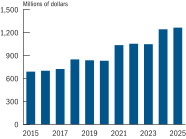
Note: All years represent the sum of single-cycle operating costs and multicycle projects. For 2025, budgeted.
BEP Single-Cycle Operating Costs
The proposed 2025 budget to fund the BEP printing and support costs is $976.9 million, which is $0.3 million, or 0.03 percent, higher than 2024 actual expenses.
The budget for fixed printing costs is $688.6 million, which is $29.0 million, or 4.4 percent, higher than 2024 actual expenses. Fixed costs are growing to support cybersecurity efforts and information technology upgrades, and to fund increased staffing levels for manufacturing support.
The budget for variable printing costs is $283.4 million, which is $29.6 million, or 9.4 percent, lower than 2024 actual expenses. The decrease is primarily a result of fewer expected note deliveries in 2025.
BEP Multicycle Project Operating Costs
The 2025 budget includes two multicycle projects: the BEP's Washington, D.C., replacement facility (DCRF) and modernization of BEP note production equipment. The combined lifetime project budget for DCRF and note production equipment is $3,049.1 million. The Fort Worth, Texas, western currency facility expansion project was successfully completed in 2024 and is therefore no longer reflected in the 2025 budget. The Board has reimbursed the BEP $272.6 million for the project.
As of May 2024, there is a total of $3,049.1 million in approved multicycle project funding, which includes $1,784.1 million for the new DCRF facility and $1,265.0 million for a generational upgrade of note production equipment for both BEP facilities. Within the lifetime project budget for note production equipment, there is $40.2 million remaining in contingency funding that has not been released and requires additional review and approval by the director of RBOPS when funding is required. The lifetime project budget of $1,265.0 for note production equipment funds the replacement of nearly all the production equipment at the BEP through 2033.19
The multicycle project budget includes 2025 components for each of the two budgeted projects: $117.9 million to complete the DCRF design and prepare for the awarding of the construction contract, and $105.6 million for note production equipment to support the BEP and Board's joint commitment to replacing aging equipment.
Board Single-Cycle Operating Costs
The Board costs budget is $63.1 million, which is $6.4 million, or 11.3 percent, higher than 2024 actual costs. The year-over-year change is primarily driven by increases to support the U.S. currency program's strategic initiatives.
The currency issuance budget increases are primarily attributable to increased transportation costs due to updated contract pricing, increased shipments to rebalance Reserve Bank inventories given the reduced print order, increased shipments to support Reserve Bank cash offices during renovations to support deployment of new currency processing machines, and development of a new currency ordering application.
The banknote development decrease is primarily attributable to the successful completion of a counterfeit-detection project and reduced contractual support for overseeing and identifying risks in executing major cross-program initiatives. The decrease is slightly offset by increased Central Bank Counterfeit Deterrence Group membership fees to fund work that was deferred from 2024.
The currency education program will focus on efforts to protect and maintain confidence in U.S. currency worldwide through public outreach, expansion of domestic and international stakeholder education, and brand strategy to prepare for the release of the next family of notes.
The 2025 currency budget includes funding for three new positions and additional contract resources to support counterfeit threat analysis efforts. The three additional positions will support analyzing and curating intelligence analysis in support of the Board's currency issuance role, which includes banknote issues such as security features and circulation patterns. The additional contract resources will assist with assessing options for counterfeit processing performed by the Reserve Banks and U.S. Secret Service and identifying ways to better respond to counterfeiting threats.
The currency issuance, banknote development, currency education, and counterfeit threat analysis budget categories also include personnel, travel, training, and support and overhead costs.20
Footnotes
1. Before 2013, information about the budgeted expenses of the Board and Reserve Banks was presented in a separate report titled Annual Report: Budget Review. The report is available at https://www.federalreserve.gov/publications/budget-review/default.htm. Each budget covers one calendar year. Return to text
2. Substantially all employees of the Board and Reserve Banks participate in the Retirement Plan for Employees of the Federal Reserve System (System Plan). Reserve Bank employees at certain compensation levels participate in the Benefit Equalization Plan, and certain Reserve Bank officers participate in the Supplemental Retirement Plan for Select Officers of the Reserve Banks. The operating expenses of the Reserve Banks presented in this section do not include expenses related to the retirement plans; however, the 2024 claims for reimbursement include the allocated portion of the pension. Additional information about these expenses can be found in Appendix G, "Statistical Tables." Board employees also participate in the Benefit Equalization Plan, and Board officers participate in the Pension Enhancement Plan for Officers of the Board of Governors of the Federal Reserve System (PEP). The operating expenses of the Board presented in this section include expenses related to Board participants in the Benefit Equalization Plan and PEP but do not include expenses related to the System Plan. Return to text
3. The System is implementing a strategy to transition the current fleet of high-speed currency processing machines and the associated sensor suite from the Banknote Processing System platform to the future NextGen processing technologies (machines and sensor technologies). Return to text
4. In July 2023, the Federal Reserve launched a new round-the-clock, real-time payment and settlement service called the FedNow Service to support faster payments in the United States. The initiative to modernize the ACH processing platform was completed in early 2021. Return to text
5. The capital budget reported for the Board includes single-year capital expenditures and 2025 expected capital expenditures from multiyear projects of the Board and the OIG. The capital budget reported for the Reserve Banks includes the amounts budgeted for the National Information Technology support function. Return to text
6. The Board approved the plan published in December 2023 and is located at https://www.federalreserve.gov/publications/files/2024-2027-gpra-strategic-plan.pdf. Return to text
7. Monetary Policy and Financial Stability, Supervision and Regulation, Payment System and Reserve Bank Oversight, Consumer Protection and Community Development, and Mission Advancement. Return to text
8. The five umbrella committees are (1) Governance and Risk; (2) People; (3) Payments; (4) Technology and Operations; and (5) Research, Banking, Communities, and Communications. Return to text
9. Additional information about the operating expenses of each of the Reserve Banks can be found in Appendix G, "Statistical Tables." (see "Table G.9. Income and expenses of the Federal Reserve Banks, by Bank"). Return to text
10. On December 15, 2024, the Board approved the 2025 Reserve Bank operating budgets totaling $6,382.5 million. Additional information is available at https://www.federalreserve.gov/foia/budgets.htm. Return to text
11. FedCash is transitioning the existing fleet of high-speed currency processing machines and the sensor suite from the Banknote Processing System platform to the future NextGen processing infrastructure. Return to text
12. FRIT is the portion of National IT, at the Richmond Bank, that supplies national infrastructure and business line technology services to the Federal Reserve System. Return to text
13. The salary administration program includes a budgeted pool for merit increases, equity adjustments, and promotions. Return to text
14. Generally, capital expenditures that are designated for conditional approval include certain building projects, District expenditures that substantially affect or influence future System direction or the manner in which significant services are performed, expenditures that may be inconsistent with System direction or vary from previously negotiated purchasing agreements, and local expenditures that duplicate national efforts. Return to text
15. As mandated by the Federal Reserve Act, section 16, the Board reimburses the BEP for all necessary costs related to the production of Federal Reserve notes. Section 16 of the Federal Reserve Act also requires that all costs necessarily incurred for the issuing of notes shall be paid for by the Board and included in its assessments to the Reserve Banks. BEP operations expenses and capital investments have been generally financed by a revolving fund that is reimbursed through product sales, nearly all of which are sales of Federal Reserve notes to the Board to fulfill its annual print order. Return to text
16. The Board delivers the annual print order to the BEP director every year which is available on the Board's website at https://www.federalreserve.gov/paymentsystems/coin_currency_orders.htm. Return to text
17. USCP stakeholders include the Federal Reserve, BEP, Treasury Department, and U.S. Secret Service. Return to text
18. For 2025, the Board approved a $50,000 single-cycle capital budget to replace aging adversarial laboratory equipment. Return to text
19. BEP staff estimates that the equipment will have a life expectancy of 15 to 20 years and will require mid-lifecycle upgrades 7 to 10 years after it has been placed in service. Return to text
20. The currency budget includes support and overhead costs for enterprise IT, facilities, law enforcement, human resources, and other services. Return to text