


Supervision and Regulation
The Federal Reserve promotes a safe, sound, and efficient banking and financial system that supports the growth and stability of the U.S. economy. The Federal Reserve carries out its supervisory and regulatory responsibilities and supporting functions primarily by
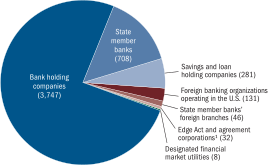
- supervising the activities of financial institutions to promote their safety and soundness (see figure 4.1);
- developing regulatory policy (rulemakings, supervision and regulation letters, policy statements, and guidance) and acting on applications filed by banking organizations; and
- monitoring trends in the banking sector by collecting and analyzing data (see box 4.1).
Figure 4.1. The Federal Reserve oversees a broad range of financial entities
Bank holding companies constitute the largest segment of institutions supervised by the Federal Reserve, but the Federal Reserve also supervises state member banks, savings and loan holding companies, foreign banks operating in the United States, and other entities. See "Supervised and Regulated Institutions" in this section.
Accessible Version | Return to text
1 Edge Act and agreement corporations are subsidiaries of banks or bank holding companies, organized to allow international banking and financial business.
Box 4.1. Banking Sector Conditions
For information on banking sector conditions, see the Supervision and Regulation Report, which is generally submitted semiannually to the Senate Committee on Banking, Housing, and Urban Affairs and to the House Committee on Financial Services. The reports are available on the Board's website at https://www.federalreserve.gov/publications/supervision-and-regulation-report.htm.
Supervised and Regulated Institutions
The Federal Reserve categorizes banking organizations into portfolios by size and entity type, as described in table 4.1.
Table 4.1. Summary of supervised institutions (as of December 31, 2024)
| Portfolio | Definition | Number of institutions | Total assets ($ trillions) |
|---|---|---|---|
| Community banking organizations (CBOs) | Total assets less than $10 billion | 3,408* | 3.0 |
| State member banks (SMBs) | SMBs within CBO organizations | 651 | 0.6 |
| Regional banking organizations (RBOs) | Total assets between $10 billion and $100 billion | 105** | 3.0 |
| SMBs | SMBs within RBO organizations | 43 | 1.2 |
| Large and foreign banking organizations (LFBOs) | Non-LISCC U.S. firms with total assets $100 billion and greater and foreign banking organizations (FBOs) | 172 | 10.4 |
| Large banking organizations (LBOs) | Non-LISCC U.S. firms with total assets $100 billion and greater | 18 | 5.1 |
| Large FBOs (with intermediate holding companies (IHC)) | FBOs with combined U.S. assets $100 billion and greater | 11 | 3.1 |
| Large FBOs (without IHC) | FBOs with combined U.S. assets $100 billion and greater | 6 | 1.0 |
| Small FBOs (excluding rep offices) | FBOs with combined assets less than $100 billion | 105 | 1.2 |
| Small FBOs (rep offices) | FBO U.S. representative offices | 32 | 0.0 |
| SMBs | SMBs within LFBO organizations | 10 | 1.1 |
| Large Institution Supervision Coordinating Committee (LISCC) | Eight U.S. global systemically important banks (G-SIBs) | 8 | 15.2 |
| SMBs | SMBs within LISCC organizations | 4 | 1.2 |
| Insurance and commercial savings and loan holding companies (SLHCs) | SLHCs primarily engaged in insurance or commercial activities | 5 insurance 3 commercial | 0.5 |
* Includes 3,360 holding companies and 48 state member banks that do not have holding companies.
** Includes 103 holding companies and 2 state member banks that do not have holding companies.
State Member Banks
At year-end 2024, a total of 1,402 banks (excluding non-depository trust companies and private banks) were members of the Federal Reserve System, of which 708 were state chartered. Federal Reserve System member banks operated 47,434 branches, accounting for 35 percent of all commercial banks in the United States and 70 percent of all commercial banking offices. State-chartered commercial banks that are members of the Federal Reserve, commonly referred to as state member banks, represented approximately 18 percent of all insured U.S. commercial banks and held approximately 18 percent of all insured commercial bank assets in the United States.
Bank Holding Companies
At year-end 2024, a total of 3,747 U.S. bank holding companies (BHCs) were in operation, of which 3,362 were top-tier BHCs. These organizations controlled 3,421 insured commercial banks and held approximately 95 percent of all insured commercial bank assets in the United States.
BHCs that meet certain capital, managerial, and other requirements may elect to become financial holding companies (FHCs). FHCs can generally engage in a broader range of financial activities than other BHCs. As of year-end 2025, a total of 497 domestic BHCs and 46 foreign banking organizations (FBOs) had FHC status. Of the domestic FHCs, 23 had consolidated assets of $100 billion or more; 59 between $10 billion and $100 billion; 190 between $1 billion and $10 billion; and 225 less than $1 billion.
Savings and Loan Holding Companies
At year-end 2024, a total of 281 savings and loan holding companies (SLHCs) were in operation, of which 146 were top-tier SLHCs. These SLHCs controlled 153 depository institutions. Approximately 97 percent of SLHCs engage primarily in depository or broker-dealer activities. These firms hold approximately 63 percent ($853.8 billion) of the total combined assets of all SLHCs. The Office of the Comptroller of the Currency (OCC) or the Federal Deposit Insurance Corporation (FDIC) is the primary federal regulator for subsidiary savings associations of SLHCs. Some SLHCs are engaged primarily in nonbanking activities, such as insurance underwriting (five SLHCs) and commercial activities (three SLHCs). The 25 largest SLHCs accounted for almost $1.3 trillion of total combined assets.
Supervised Insurance Organizations
At year-end 2024, the Federal Reserve supervised five companies that own depository institutions and are significantly engaged in insurance activities (supervised insurance organizations). All five of these institutions were SLHCs, although one has made the covered savings association election and is therefore treated as a BHC. As of December 31, 2024, they had approximately $450 billion in total assets. Two of these firms have total assets greater than $100 billion, and insured depository assets represent less than half of total assets for four of the five supervised insurance organizations. Supervision of these insurance organizations follows the risk-based approach described in supervision and regulation (SR) letter 22-8, "Framework for the Supervision of Insurance Organizations."
Financial Market Utilities
Financial market utilities (FMUs) manage or operate multilateral systems for the purpose of transferring, clearing, or settling payments, securities, or other financial transactions among financial institutions or between financial institutions and the FMU. The Federal Reserve supervises FMUs that are chartered as member banks or Edge Act corporations, and coordinates with other federal banking supervisors to supervise FMUs considered bank service providers under the Bank Service Company Act.
In July 2012, the Financial Stability Oversight Council (FSOC) voted to designate eight FMUs as systemically important under title VIII of the Dodd-Frank Wall Street Reform and Consumer Protection Act (Dodd-Frank Act). As a result of these designations, the Board assumed an expanded set of responsibilities related to these designated FMUs that includes promoting uniform risk-management standards, playing an enhanced role in the supervision of designated FMUs, reducing systemic risk, and supporting the stability of the broader financial system. For certain designated FMUs, the Board established risk-management standards and expectations that are articulated in the Board's Regulation HH.
In addition to setting minimum risk-management standards, Regulation HH establishes advance notice requirements for proposed material changes to the rules, procedures, or operations of a designated FMU for which the Board is the supervisory agency under title VIII. Finally, Regulation HH also establishes minimum conditions and requirements for a Federal Reserve Bank to establish and maintain an account for, and provide services to, a designated FMU.1 Where the Board is not the title VIII supervisory agency, the Federal Reserve works closely with the Securities and Exchange Commission (SEC) and the Commodity Futures Trading Commission to promote robust FMU risk management and monitor systemic risks across the designated FMUs.
In March 2024, the Board approved a final rule that updates operational risk-management requirements in Regulation HH. The final updates provide additional clarity and specificity to existing requirements in four key areas of operational risk management: (1) incident management and notification, (2) business continuity management and planning, (3) third-party risk management, and (4) review and testing of operational risk-management measures.
International Activities
Foreign operations of U.S. banking organizations. At the end of 2024, a total of 26 member and nonmember banks were operating 243 branches in foreign countries and overseas areas of the United States. Ten national banks were operating 190 of these branches, 11 state member banks were operating 42 of these branches, and 5 nonmember banks were operating the remaining 11.
Edge Act and agreement corporations. At year-end 2024, out of 32 banking organizations chartered as Edge Act or agreement corporations, 3 such organizations operated 6 Edge Act and agreement branches. These corporations are examined annually.
U.S. activities of foreign banks. As of September 30, 2024, 131 foreign banks from 47 countries operated U.S. banking offices. These banking offices included 135 state-licensed branches and agencies, of which 6 were insured by the FDIC, and 49 OCC-licensed branches and agencies, of which 4 were insured by the FDIC. These foreign banks also owned 6 Edge Act and agreement corporations. In addition, they held a controlling interest in 33 U.S. commercial banks. Altogether, the U.S. offices of these foreign banks controlled approximately 16.4 percent of U.S. commercial banking assets. These 131 foreign banks also operated 91 representative offices; an additional 33 banks operated in the United State through a representative office.
The Federal Reserve conducted or participated with state and federal regulatory authorities in 678 examinations of foreign banks in 2024.
Supervisory Developments
Supervisory Activities
Efforts noted in the following sections reflect work completed by the Federal Reserve in 2024 exclusively.
The Federal Reserve's supervision activities include examinations and inspections to help ensure that financial institutions operate in a safe and sound manner and comply with laws and regulations, including with certain ones relating to consumer protection. These include an assessment of a financial institution's risk-management systems, financial conditions, governance and controls, and compliance. The Federal Reserve tailors its supervisory approach based on the size and complexity of firms. Supervisory oversight ranges from a continuous supervisory presence with dedicated teams of examiners for large firms to regular point-in-time and targeted periodic examinations for small, noncomplex firms.
Supervisory priorities are focused on core and material financial risks, previously identified supervisory findings, and emerging concerns arising from changing economic conditions. Examiners monitor and assess a supervised institution's remediation of supervisory findings in areas, such as independent risk management and controls, compliance, operational and cyber resilience, and information technology.
In 2024, the Federal Reserve conducted 316 examinations of state member banks, 2,894 inspections of bank holding companies, and 120 inspections of savings and loan holding companies. Tables 4.2 and 4.3 provide information on examinations and inspections conducted by the Federal Reserve during the past five years.
Table 4.2. Savings and loan holding companies, 2020–24
| Entity/item | 2024 | 2023 | 2022 | 2021 | 2020 |
|---|---|---|---|---|---|
| Top-tier savings and loan holding companies | |||||
| Assets of more than $1 billion | |||||
| Total number | 48 | 48 | 50 | 47 | 50 |
| Total assets (billions of dollars) | 1,326 | 1,334 | 1,741 | 1,856 | 2,026 |
| Number of inspections | 46 | 51 | 50 | 63 | 55 |
| By Federal Reserve System | 46 | 51 | 50 | 63 | 55 |
| Assets of $1 billion or less | |||||
| Total number | 98 | 100 | 102 | 107 | 119 |
| Total assets (billions of dollars) | 38 | 39 | 36 | 37 | 39 |
| Number of inspections | 67 | 69 | 74 | 78 | 91 |
| By Federal Reserve System | 67 | 69 | 74 | 78 | 91 |
Table 4.3. State member banks and bank holding companies, 2020–24
| Entity/item | 2024 | 2023 | 2022 | 2021 | 2020 |
|---|---|---|---|---|---|
| State member banks | |||||
| Total number | 708 | 706 | 701 | 705 | 734 |
| Total assets (billions of dollars) | 4,174 | 3,894 | 3,997 | 4,016 | 3,568 |
| Number of examinations | 540 | 559 | 524 | 471 | 502 |
| By Federal Reserve System | 327 | 316 | 289 | 288 | 263 |
| By state banking agency | 213 | 243 | 235 | 183 | 239 |
| Top-tier bank holding companies | |||||
| Assets of more than $1 billion | |||||
| Total number | 844 | 824 | 809 | 795 | 746 |
| Total assets (billions of dollars) | 26,495 | 25,979 | 25,275 | 25,185 | 23,811 |
| Number of inspections | 1,029 | 1,051 | 966 | 996 | 875 |
| By Federal Reserve System1 | 956 | 989 | 891 | 919 | 814 |
| By state (or other) banking agency | 73 | 62 | 75 | 77 | 61 |
| Assets of $1 billion or less | |||||
| Total number | 2,552 | 2,613 | 2,672 | 2,762 | 2,887 |
| Total assets (billions of dollars) | 875 | 886 | 883 | 900 | 883 |
| Number of inspections | 1,765 | 1,694 | 1,768 | 1,801 | 1,967 |
| By Federal Reserve System | 1,640 | 1,589 | 1,699 | 1,727 | 1,890 |
| By state (or other) banking agency | 125 | 106 | 69 | 74 | 77 |
| Financial holding companies | |||||
| Domestic | 497 | 502 | 505 | 504 | 502 |
| Foreign | 46 | 45 | 46 | 45 | 44 |
1. For bank holding companies subject to continuous, risk-focused supervision, includes multiple targeted reviews. Return to table
Specialized Examinations
The Federal Reserve conducts specialized examinations of supervised financial institutions in the areas of capital planning and stress testing, fiduciary activities, transfer agent activities, government and municipal securities dealing and brokering, Bank Secrecy Act and anti-money laundering, operational resilience, information technology, cybersecurity, and shared national credits, among other things.
Capital Planning and Stress Testing
Since the 2007–09 financial crisis, the Federal Reserve has instituted supervisory stress testing to strengthen capital positions of the largest banking organizations. In March 2020, the Board integrated the supervisory stress test with its non-stress capital requirements through the stress capital buffer.
In June 2024, the Federal Reserve released the results of its annual stress test, which showed that the large banking firms tested had sufficient levels of capital and could continue lending to households and businesses during a severe recession. In August 2024, the Federal Reserve announced the individual capital requirements for large banks, which include the stress capital buffer requirement based on the results of the 2024 stress test. These requirements became effective as of October 1, 2024.
The Federal Reserve also published an exploratory analysis of risks to the banking system.2 The exploratory analysis offered further insight into the resilience of the U.S. banking system by providing information about vulnerabilities of the financial system under a wider range of stresses than the supervisory stress test. Consistent with the nature of an exploratory exercise, the exploratory analysis did not contribute to the capital requirements set by the 2024 stress test. For stress testing publications released in 2024, see box 4.2.
In December 2024, the Board notified the public that it would soon seek public comment on significant changes to improve transparency of the stress test and reduce the volatility of the resulting capital buffer requirements.3 The announcement noted the Board's intention to propose changes that include, but are not limited to, disclosing and seeking public comment on all of the models that determine the hypothetical losses and revenues of banks under stress; averaging results over two years to reduce the year-over-year changes in the capital requirements that result from the stress test; and ensuring that the public can comment on the hypothetical scenarios used annually for the test, before the scenarios are finalized.
Box 4.2. Stress Testing Publications Released in 2024
More details on the 2024 stress test scenarios are available at https://www.federalreserve.gov/publications/files/2024-stress-test-scenarios-20240215.pdf.
More details on the 2024 exploratory analysis parameters are available at https://www.federalreserve.gov/publications/files/exploratory-analysis-of-risks-to-the-banking-system-20240215.pdf.
More details on the 2024 stress test model methodologies are available at https://www.federalreserve.gov/publications/files/2024-march-supervisory-stress-test-methodology.pdf.
More details on the 2024 stress test results are available at https://www.federalreserve.gov/publications/files/2024-dfast-results-20240626.pdf.
More details on the 2024 exploratory analysis results are available at https://www.federalreserve.gov/publications/files/exploratory-analysis-results-20240626.pdf.
More details on the stress capital buffer requirements published in 2024 are available at https://www.federalreserve.gov/publications/files/large-bank-capital-requirements-20240828.pdf.
Return to textFiduciary Activities
In 2024, Federal Reserve examiners conducted 79 fiduciary examinations of state member banks and non-depository trust companies.
Transfer Agents
During 2024, the Federal Reserve conducted transfer agent examinations at two state member banks and one BHC, each of which were registered as transfer agents.
Government and Municipal Securities Dealers and Brokers
The Federal Reserve is responsible for examining state member banks and foreign banks for compliance with the Government Securities Act of 1986 and with the U.S. Treasury regulations governing dealing and brokering in government securities. During 2024, the Federal Reserve conducted five examinations of government securities activities at these organizations.
The Federal Reserve is also responsible for ensuring that state member banks and BHCs that act as municipal securities dealers comply with the Securities Act Amendments of 1975. Municipal securities dealers are examined, pursuant to the Municipal Securities Rulemaking Board's rule G-16, at least once every two calendar years. During 2024, the Federal Reserve examined three entities that dealt in municipal securities.
Bank Secrecy Act and Anti-Money-Laundering Compliance
The Federal Reserve is responsible for examining institutions for compliance with the Bank Secrecy Act (BSA) and applicable anti-money-laundering (AML) laws and regulations and conducts examinations in accordance with the Federal Financial Institutions Examination Council's (FFIEC) Bank Secrecy Act/Anti-Money-Laundering Examination Manual. During 2024, the Federal Reserve continued to participate in an ongoing interagency effort to update this manual. Many of the revisions are designed to emphasize and enhance the risk-focused approach to BSA/AML supervision and to continue to provide transparency into the BSA/AML and Office of Foreign Assets Control examination process.
To implement a significant part of the Anti-Money-Laundering Act of 2020 (AML Act), Financial Crimes Enforcement Network (FinCEN) and the federal banking agencies issued proposed rules in 2024 to amend AML/CFT program requirements for financial institutions.4
The Federal Reserve continued to participate in the U.S. Treasury-led BSA Advisory Group, which includes representatives of regulatory agencies, law enforcement, and the financial services industry.
Operational Resilience, Information Technology, and Cybersecurity
Effective operational risk management and resilience are vital to the safety and soundness of financial institutions and the stability of the U.S. financial system.5 The Federal Reserve examines and monitors supervised institutions for operational risks as part of its safety and soundness supervision. For example, in 2024
- Federal Reserve examiners, in close coordination with the other federal banking agencies, conducted examinations of information technology (IT) activities (inclusive of cyber risk-management activities) and targeted cybersecurity assessments of the large financial institutions, and service providers.
- Federal Reserve examiners also conducted tailored cybersecurity assessments at community and regional banking organizations.
- Under the authority of the Bank Service Company Act, the federal banking agencies examined regulated technology service providers that provide services subject to the Act for their regulated client financial institutions.
- Examiners also conducted a coordinated review of the IT and cybersecurity activities of supervised insurance organizations.
The Federal Reserve collaborated with other financial regulators, U.S Treasury, and private industry to promote effective safeguards against operational and cyber risks to the financial services sector and its critical infrastructure. This included contributions to the FFIEC's Information Technology Subcommittee and Cybersecurity and Critical Infrastructure Subcommittee, the Financial and Banking Information Infrastructure Committee (FBIIC), the Cybersecurity Forum for Independent and Executive Branch Regulators, the Department of Homeland Security's Cybersecurity and Infrastructure Security Agency's Cyber Incident Reporting Council, and Cyber Incident Reporting for Critical Infrastructure Act-related deliberations. The Federal Reserve, together with the other members of the FBIIC and the Financial Services Sector Coordinating Council, collaborated on financial sector resilience initiatives, including participation in the Cloud Executive Steering Group.6
The Board led or contributed to cybersecurity activities undertaken by various international groups. Board staff continued to participate in the work of the Financial Stability Board (FSB) to address current and emerging operational risks. This resulted in the publication of the policy documents, Final Report on Enhancing Third-Party Risk Management and Oversight: A Toolkit for Financial Institutions and Financial Authorities and Recommendations to Achieve Greater Convergence in Cyber Incident Reporting: Final Report.7
Complex Bank-Fintech Arrangements
There has been an increase in the number and complexity of banks' arrangements with nonbank entities, such as financial technology companies that provide access to, or facilitate the provision of, banking products and services to customers (bank-fintech arrangements). Bank-fintech arrangements have the potential to increase competition and efficiency by enabling banking organizations to meet evolving customer expectations, deploy products and services to the market more effectively, and access new or expanded customers and resources.
In July 2024, the agencies published a joint statement on arrangements with third parties to deliver bank deposit products and services (statement).8 The statement notes potential risks related to such arrangements and highlights examples of risk-management practices by banks to manage such risks. The agencies contemporaneously issued a request for information (RFI) on bank-fintech arrangements.9 The RFI sought information on a broad range of such arrangements, including with respect to deposit, payment, and lending products and services. Commenters offered valuable insights on these arrangements' risks and effective practices.
Shared National Credit Program
The Shared National Credit (SNC) program is an interagency review and assessment of risk in the largest and most complex credits shared by multiple regulated financial institutions. The SNC program is governed by an interagency agreement among the Board, FDIC, and OCC. SNC reviews were completed in the first and third quarters of the 2024 calendar year. More information on the 2023 Shared National Credit review is available at https://www.federalreserve.gov/newsevents/pressreleases/bcreg20240216a.htm.
Securities Credit Lenders
Under the Securities Exchange Act of 1934, the Board is responsible for regulating credit in certain transactions involving the purchasing or carrying of securities. As part of its general examination program, the Federal Reserve examines the banks under its jurisdiction for compliance with the Board's Regulation U. In addition, the Federal Reserve maintains a registry of persons other than banks, brokers, and dealers who extend credit subject to Regulation U. Throughout the year, Federal Reserve examiners conducted specialized examinations of these lenders if they were not already subject to supervision by the Farm Credit Administration or the National Credit Union Administration.
Enforcement Actions
The Federal Reserve has enforcement authority over the financial institutions it supervises and their affiliated parties. Enforcement actions may be taken to address unsafe or unsound practices and violations of law or regulation. Formal enforcement actions include cease and desist orders, written agreements, prompt corrective action directives, removal and prohibition orders, civil money penalties, and letters sent pursuant to 12 U.S.C. § 1829, known as Section 19 letters. Informal enforcement actions include memoranda of understanding, commitment letters, supervisory letters, and board of directors' resolutions.
In 2024, the Federal Reserve completed 58 formal enforcement actions. Civil money penalties totaling $372,065,956 were assessed. As directed by statute, all civil money penalties are remitted to either the U.S. Treasury or the Federal Emergency Management Agency. The Reserve Banks completed 113 informal enforcement actions.
Formal enforcement actions are made public and posted on the Board's website (https://www.federalreserve.gov/apps/enforcementactions/search.aspx).
Financial Disclosures by State Member Banks
Under the Securities Exchange Act of 1934 and the Federal Reserve's Regulation H, certain state member banks are required to make financial disclosures to the Federal Reserve using the same reporting forms that are normally used by publicly held entities to submit information to the SEC.10
In 2023, one state member bank was required to submit data to the Federal Reserve. These data are made available upon request and are primarily used for disclosure to the bank's shareholders and public investors.
Internal Appeals of Material Supervisory Determinations
The Board is committed to maintaining an independent, intra-agency process to review appeals of material supervisory determinations (MSDs) that complies with section 309 of the Riegle Community Development and Regulatory Improvement Act of 1994.11 The appeals process includes two levels of review. A panel of Federal Reserve staff not employed by the Reserve Bank with supervisory responsibility of the financial institution that issued the appealed MSD conducts the initial review. This panel determines whether the appealed MSD is consistent with applicable laws, regulations, and policy, and is supported by a preponderance of the evidence in the record. If the appealing institution disagrees with the initial review panel's decision, the institution may request a final review of the MSD. A panel of senior Board staff conducts the final review. The final review panel determines whether the decision of the initial review panel is reasonable. Additional information is available regarding the Federal Reserve Board's appeals process and Ombuds policy on the Board's website.12
In 2024, the Board received four safety and soundness MSD appeals—one from a regional bank holding company, one from a community bank holding company, and two from state member community banking organizations. One of the four safety and soundness MSD appeals received went to final review.
Assessments for Supervision and Regulation
BHCs and SLHCs with total consolidated assets of $100 billion or more, as well as any nonbank financial companies designated by the FSOC for supervision by the Board, are subject to assessments for the cost of the Board's supervision and regulation. As a collecting entity, the Board does not recognize the supervision and regulation assessments as revenue, nor does the Board use the collections to fund Board expenses; the funds are transferred to the U.S. Treasury. The Board collected and transferred to the U.S. Treasury $777,662,355 from 52 institutions for the 2023 S&R Regulation TT assessment in 2024.
Training and Technical Assistance
The Federal Reserve provides training and technical assistance to foreign supervisors and minority-owned depository institutions as well as engages in industry outreach in connection with supervisory objectives.
International Training and Technical Assistance
The Federal Reserve provides training and technical assistance on supervisory matters to foreign central banks and supervisory authorities. Technical assistance normally involves visits by Federal Reserve staff members to foreign authorities as well as consultations with foreign supervisors who visit the Board of Governors or the Reserve Banks. In 2024, the Federal Reserve organized 27 training seminars, held both onshore and overseas, for the benefit of foreign supervisory authorities. Approximately 900 financial institution supervisors from foreign central banks and supervisory agencies attended these training events.
In 2024, Federal Reserve staff also collaborated with the International Monetary Fund and the World Bank to organize two training events for senior supervisory officials. The Federal Reserve also collaborated with the Association of Bank Supervisors of the Americas and the European Central Bank on training events.
Efforts to Support Minority-Owned Depository Institutions
The Federal Reserve System implements its congressionally mandated responsibilities under section 367 of the Dodd-Frank Act primarily through its Partnership for Progress (PFP) program.13 Established in 2008, this program promotes the viability of minority depository institutions (MDIs) by facilitating activities designed to strengthen their business strategies, maximize their resources, and increase their awareness and understanding of supervisory expectations.
The Federal Reserve maintains the PFP website, which supports MDIs by providing them with technical information and links to useful resources.14 Representatives from each of the 12 Federal Reserve Districts, along with staff from the Divisions of Supervision & Regulation and Consumer & Community Affairs at the Board of Governors, offer technical assistance tailored to MDIs by providing targeted supervisory guidance, identifying additional resources, and fostering mutually beneficial partnerships between MDIs and community organizations and/or other banks. As of 2024:Q4, the Federal Reserve's MDI portfolio consisted of 16 state member banks.
Throughout 2024, the System supported MDIs and conducted a number of outreach initiatives, webinars, and conferences specific to MDIs.
Staff Development Programs
The Federal Reserve's staff development program supports the ongoing development of nearly 4,200 professional supervisory staff, ensuring that they have the requisite skills necessary to meet their evolving supervisory responsibilities. The Federal Reserve also provides certain programs to staff at state banking agencies. Training activities in 2024 are summarized in table 4.4.
Table 4.4. Training for supervision and regulation, 2024
| Course sponsor or type | Number of enrollments | Instructional time (approximate training days)2 | Number of course offerings | |
|---|---|---|---|---|
| Federal Reserve personnel | State and federal banking agency personnel1 | |||
| Federal Reserve System | 1,126 | 0 | 250 | 78 |
| FFIEC (virtual)3 | 746 | 1,871 | 600 | 150 |
| FFIEC (in-person) | 237 | 196 | 244 | 61 |
| Rapid Response4 | 18,040 | 1,247 | 4.5 | 35 |
1. State personnel reflects total state attendees, sponsored by each federal agency. Return to table
2. Training days are approximate. System courses were calculated using five days as an average, with FFIEC courses calculated using four days as an average. Return to table
3. Virtual training is offered through three alternative delivery methods: (1) virtual, instructor-led classes; (2) the FFIEC Examiner Exchange Program; and (3) self-study programs. Return to table
4. Rapid Response is a virtual program created by the Federal Reserve System as a means of providing information on emerging topics to Federal Reserve and state bank examiners. Return to table
Examiner Commissioning Program
An overview of the Federal Reserve System's Examiner Commissioning Program for assistant examiners is set forth in SR letter 17-6/CA letter 17-1, "Overview of the Federal Reserve's Supervisory Education Programs." Three examiner commissioning tracks are available: (1) community banking organization, (2) consumer compliance, and (3) large financial institutions (LFI). On average, individuals move through a combination of in-person training, self-paced learning, virtual instruction, and on-the-job training over a period of about three to four years. Achievement is measured by completing the required course content, demonstrating on-the-job knowledge, and passing a professionally validated proficiency examination.
In 2024, 73 examiners passed proficiency examination (34 in community bank organization, 11 in consumer compliance, and 28 in LFI), becoming eligible to earn a commission from the Federal Reserve.
Continuing Professional Development
The Federal Reserve provides supervisory staff (and, in many cases, state examiners through existing partnerships with the Conference of State Banking Supervisors and FFIEC) with opportunities to maintain job knowledge after commissioning, learn about emerging concepts and practices, and expand knowledge into highly specialized supervisory topics. A number of learning and communication solutions are developed or curated, including Rapid Response webinars, podcasts, self-guided learning plans on specialty topics, and other content produced for just-in-time communication to supervisory staff about emerging issues and regulatory policy.
Regulatory Developments
The Federal Reserve carries out its regulatory responsibilities by developing regulatory policy (rulemakings, supervision and regulation letters, policy statements, and guidance) and reviewing and acting on a variety of applications filed by banking organizations.
Rulemakings and Guidance
The Federal Reserve issues new regulations or revises existing regulations in response to laws enacted by Congress or because of evolving conditions in the financial marketplace. Over 2024, the Federal Reserve, working with the other federal banking agencies, announced a variety of policy actions to promote the safety and soundness, transparency, and efficiency of the financial system. The Federal Reserve issued the following rules and statements in 2024 (see table 4.5).
Table 4.5. Federal Reserve or interagency rulemakings/statements/guidance (proposed and final), 2024
| Date issued | Rulemaking/statement/guidance |
|---|---|
| 1/17/2024 | Agencies extend resolution plan submission deadline for some large financial institutions. Joint press release: https://www.federalreserve.gov/newsevents/pressreleases/bcreg20240117a.htm |
| 1/22/2024 | Federal Reserve Board announces it will extend the comment period on its interchange fee proposal until May 12, 2024, and published additional related data. Press release: https://www.federalreserve.gov/newsevents/pressreleases/bcreg20240122a.htm |
| 2/6/2024 | Federal bank regulatory agencies seek comment on interagency effort to reduce regulatory burden. Press release: https://www.federalreserve.gov/newsevents/pressreleases/bcreg20240206a.htm |
| 2/15/2024 | Federal Reserve Board releases hypothetical scenarios for its annual stress test. Press release: https://www.federalreserve.gov/newsevents/pressreleases/bcreg20240215a.htm |
| 2/16/2024 | Agencies issue 2023 Shared National Credit Program report. Joint press release: https://www.federalreserve.gov/newsevents/pressreleases/bcreg20240216a.htm |
| 3/8/2024 | Federal Reserve Board announces final rule that updates risk management requirements for certain systemically important financial market utilities (FMUs) supervised by the Board. Press release: https://www.federalreserve.gov/newsevents/pressreleases/bcreg20240308a.htm |
| 3/21/2024 | Agencies extend applicability date of certain provisions of their Community Reinvestment Act final rule. Press release: https://www.federalreserve.gov/newsevents/pressreleases/bcreg20240321a.htm |
| 4/24/2024 | Federal Reserve Board announces it will extend through May 31, 2024, the public comment period for the application by Capital One Financial Corporation to acquire Discover Financial Services. Press release: https://www.federalreserve.gov/newsevents/pressreleases/bcreg20240424a.htm |
| 5/3/2024 | Federal Reserve Board requests comment on proposal to expand the operating days of the Federal Reserve Banks' two large-value payments services, Fedwire Funds Service and the National Settlement Service, to include weekends and holidays. Press release: https://www.federalreserve.gov/newsevents/pressreleases/bcreg20240503a.htm |
| 5/3/2024 | Agencies issue guide to assist community banks to develop and implement third-party risk management practices. Press release: https://www.federalreserve.gov/newsevents/pressreleases/bcreg20240503b.htm |
| 5/7/2024 | SR 24-2 / CA 24-1: Third-Party Risk Management: A Guide for Community Banks. Release: https://www.federalreserve.gov/supervisionreg/srletters/SR2402.htm |
| 5/9/2024 | Federal Reserve Board releases summary of the exploratory pilot Climate Scenario Analysis (CSA) exercise that it conducted with six of the nation's largest banks. Press release: https://www.federalreserve.gov/newsevents/pressreleases/other20240509a.htm |
| 5/13/2024 | Agencies announce inflation-adjusted dollar thresholds for Regulation CC funds availability. Press release: https://www.federalreserve.gov/newsevents/pressreleases/bcreg20240513a.htm |
| 5/14/2024 | Agencies announce public meeting on proposed acquisition by Capital One of Discover; public comment period extended. Joint press release: https://www.federalreserve.gov/newsevents/pressreleases/other20240514a.htm |
| 5/17/2024 | Federal Reserve Board announces its denial of two rulemaking petitions due to legal and policy considerations. Joint press release: https://www.federalreserve.gov/newsevents/pressreleases/bcreg20240517a.htm |
| 5/31/2024 | Agencies issue host state loan-to-deposit ratios. Joint press release: https://www.federalreserve.gov/newsevents/pressreleases/bcreg20240531a.htm |
| 6/6/2024 | Federal Reserve Board announces that results from its annual bank stress tests will be released on Wednesday, June 26, at 4:30 p.m. EDT. Press release: https://www.federalreserve.gov/newsevents/pressreleases/bcreg20240606a.htm |
| 6/21/2024 | Agencies announce results of resolution plan review for largest and most complex banks. Joint press release: https://www.federalreserve.gov/newsevents/pressreleases/bcreg20240621a.htm |
| 6/21/2024 | Federal Reserve Board announces it will extend until September 6, 2024, the comment period on proposal to expand operating days of the Federal Reserve Banks' two large-value payments services, Fedwire Funds Service and the National Settlement Service. Press release: https://www.federalreserve.gov/newsevents/pressreleases/bcreg20240621b.htm |
| 6/26/2024 | Federal Reserve Board annual bank stress test showed that while large banks would endure greater losses than last year's test, they are well positioned to weather a severe recession and stay above minimum capital requirements. Press release: https://www.federalreserve.gov/newsevents/pressreleases/bcreg20240626a.htm |
| 7/12/2024 | Agencies release list of distressed or underserved nonmetropolitan middle-income geographies. Joint press release: https://www.federalreserve.gov/newsevents/pressreleases/bcreg20240712a.htm |
| 7/17/2024 | Agencies issue final rule to help ensure credibility and integrity of automated valuation models. Joint press release: https://www.federalreserve.gov/newsevents/pressreleases/bcreg20240717a.htm |
| 7/18/2024 | Agencies finalize interagency guidance on reconsiderations of value for residential real estate valuations. Joint press release: https://www.federalreserve.gov/newsevents/pressreleases/bcreg20240718a.htm |
| 7/18/2024 | SR 24-3 / CA 24-4: Interagency Guidance on Reconsiderations of Value of Residential Real Estate Valuations. Release: https://www.federalreserve.gov/supervisionreg/srletters/SR2403.htm |
| 7/19/2024 | Agencies request comment on anti-money laundering/countering the financing of terrorism proposed rule. Joint press release: https://www.federalreserve.gov/newsevents/pressreleases/bcreg20240719a.htm |
| 7/22/2024 | SR 24-4: Interagency Statement on the Issuance of the AML/CFT Program Notices of Proposed Rulemaking. Release: https://www.federalreserve.gov/supervisionreg/srletters/SR2404.htm |
| 7/25/2024 | Federal bank regulatory agencies seek comment on interagency effort to reduce regulatory burden. Joint press release: https://www.federalreserve.gov/newsevents/pressreleases/bcreg20240725a.htm |
| 7/25/2024 | Agencies announce public outreach meeting as part of their review of regulations. Joint press release: https://www.federalreserve.gov/newsevents/pressreleases/bcreg20240725b.htm |
| 7/25/2024 | Agencies remind banks of potential risks associated with third-party deposit arrangements and request additional information on bank-fintech arrangements. Joint press release: https://www.federalreserve.gov/newsevents/pressreleases/bcreg20240725c.htm |
| 7/25/2024 | SR 24-5: Joint Statement on Banks' Arrangements with Third Parties to Deliver Bank Deposit Products and Services. Release: https://www.federalreserve.gov/supervisionreg/srletters/SR2405.htm |
| 8/2/2024 | Federal Reserve Board requests comment on a proposed rule that would establish data standards for certain information collections. Press release: https://www.federalreserve.gov/newsevents/pressreleases/bcreg20240802a.htm |
| 8/5/2024 | Federal Reserve Board issues final joint guidance to help certain large banks further develop their resolution plans. Press release: https://www.federalreserve.gov/newsevents/pressreleases/bcreg20240805a.htm |
| 8/28/2024 | Federal Reserve Board announces final individual capital requirements for all large banks, effective on October 1. Press release: https://www.federalreserve.gov/newsevents/pressreleases/bcreg20240828a.htm |
| 8/29/2024 | SR 24-6: FFIEC Information Technology Examination Handbook – Development, Acquisition, and Maintenance. Release: https://www.federalreserve.gov/supervisionreg/srletters/SR2406.htm |
| 9/5/2024 | Federal Reserve Board requests comment around operational practices of the discount window. Press release: https://www.federalreserve.gov/newsevents/pressreleases/bcreg20240905a.htm |
| 9/13/2024 | Agencies extend comment period on request for information on bank-fintech arrangements. Joint press release: https://www.federalreserve.gov/newsevents/pressreleases/bcreg20240913a.htm |
| 10/4/2024 | Agencies announce dollar thresholds for smaller loan exemption from appraisal requirements for higher-priced mortgage loans. Joint press release: https://www.federalreserve.gov/newsevents/pressreleases/bcreg20241004a.htm |
| 10/4/2024 | Agencies announce dollar thresholds for applicability of truth in lending and consumer leasing rules for consumer credit and lease transactions. Joint press release: https://www.federalreserve.gov/newsevents/pressreleases/bcreg20241004b.htm |
| 11/13/2024 | Federal Reserve Board invites comment on a report, as prescribed by law, that discusses the impact of a proposed international capital standard. Press release: https://www.federalreserve.gov/newsevents/pressreleases/bcreg20241113a.htm |
| 11/22/2024 | Federal Reserve Board announces pricing, effective January 1, 2025, for payment services the Federal Reserve Banks provide to banks and credit unions. Press release: https://www.federalreserve.gov/newsevents/pressreleases/other20241122a.htm |
| 11/22/2024 | SR 24-7: FFIEC Cybersecurity Assessment Tool Sunset Statement. Release: https://www.federalreserve.gov/supervisionreg/srletters/sr2407.htm |
| 12/3/2024 | Federal bank regulatory agencies seek further comment on interagency effort to reduce regulatory burden. Joint press release: https://www.federalreserve.gov/newsevents/pressreleases/bcreg20241203a.htm |
| 12/4/2024 | Agencies issue statement on elder financial exploitation. Joint press release: https://www.federalreserve.gov/newsevents/pressreleases/bcreg20241204a.htm |
| 12/5/2024 | SR 24-8 / CA 24-6: Interagency Statement on Elder Financial Exploitation. Release: https://www.federalreserve.gov/supervisionreg/srletters/sr2408.htm |
| 12/9/2024 | Federal Reserve Board provides technical clarification that its account access guidelines apply to excess balance accounts. Press release: https://www.federalreserve.gov/newsevents/pressreleases/bcreg20241209a.htm |
| 12/19/2024 | Agencies release annual asset-size thresholds under Community Reinvestment Act regulations. Joint press release: https://www.federalreserve.gov/newsevents/pressreleases/bcreg20241219a.htm |
| 12/23/2024 | Due to evolving legal landscape & changes in the framework of administrative law, Federal Reserve Board will soon seek public comment on significant changes to improve transparency of bank stress tests & reduce volatility of resulting capital requirements. Press release: https://www.federalreserve.gov/newsevents/pressreleases/bcreg20241223a.htm |
| 12/27/2024 | SR 24-9: Status of Certain Investment Funds and their Portfolio Investments for Purposes of Regulation O and Reporting Requirements under Part 363 of FDIC Regulations. Release: https://www.federalreserve.gov/supervisionreg/srletters/SR2409.htm |
Banking Applications
The Federal Reserve reviews applications submitted by BHCs, state member banks, SLHCs, foreign banking organizations, and other entities for approval to undertake various transactions and to engage in new activities. In 2024, the Federal Reserve acted on 807 applications filed under the six relevant statutes.
The Federal Reserve publishes the Semiannual Report on Banking Applications Activity, which provides aggregate information on proposals filed by banking organizations and reviewed by the Federal Reserve. The current report as well as historical reports are available at https://www.federalreserve.gov/publications/semiannual-report-on-banking-applications-activity.htm.
Public Notice of Federal Reserve Decisions and Filings Received
The Board's website provides information on orders and announcements (https://www.federalreserve.gov/newsevents/pressreleases.htm) as well as a guide for U.S. and foreign banking organizations that wish to submit applications (https://www.federalreserve.gov/bankinforeg/afi/afi.htm).
Participation in Financial Standards-Setting Bodies and Other Organizations
As a member of the FSB and several international financial standard-setting bodies, the Federal Reserve actively participates in efforts to share information and advance sound supervisory policies for internationally active financial organizations and to enhance the strength, stability, and resilience of the international financial system.
Financial Stability Board
In 2024, the Federal Reserve continued its participation in a variety of activities of the FSB, an organization whose mission is to promote international financial stability. The FSB helps coordinate the work of national financial authorities and international standard-setting bodies and shares information on supervisory and regulatory practices. Priority areas for the year included enhancing cross-border payments, finalizing recommendations for regulating and supervising crypto-assets and stablecoins, and revising recommendations to address vulnerabilities of open-ended funds. The full range of the Federal Reserve's FSB activities is discussed in section 3, "Financial Stability."
The FSB also produces a variety of publications, including progress reports, monitoring reports, guidance, consultative documents, and compendia of better practice. A comprehensive list of FSB publications is available at https://www.fsb.org/publications.
Basel Committee on Banking Supervision
During 2024, the Federal Reserve contributed to Basel Committee on Banking Supervision (BCBS) supervisory policy recommendations, reports, papers, and consultations designed to improve the supervision of banking organizations' practices.15 In 2024, the BCBS was particularly focused on supporting the implementation of Basel III reforms, reviewing the 2023 banking turmoil, analyzing the digitalization of finance, and tracking emerging risks to the banking system. A comprehensive list of BCBS publications is available at https://www.bis.org/bcbs/publications.htm.
International Association of Insurance Supervisors
In 2024, the Federal Reserve continued its participation in the development of international supervisory standards for the insurance industry. The Federal Reserve participates actively in standard-setting at the International Association of Insurance Supervisors (IAIS) in consultation and collaboration with state insurance regulators, the National Association of Insurance Commissioners, and the Federal Insurance Office. The Federal Reserve's participation focuses on financial stability and standards that have the potential to significantly impact the U.S. insurance market.
In 2024, the IAIS adopted the Insurance Capital Standard (ICS) and recognized that the U.S.-developed Aggregation Method (AM) "provides a basis for implementation of the ICS to produce comparable outcomes."16 The ICS is a risk-based capital measure to evaluate the financial soundness of internationally active insurance groups. U.S. state insurance regulators plan to implement the AM in place of the ICS. Further information can be found in a joint Federal Reserve and U.S. Department of the Treasury study on the ICS's potential impact on U.S. consumers and markets.17
The IAIS also made progress on other projects in 2024. The IAIS completed its five-year strategic plan, which will cover the period from 2025 to 2029. Notably, this strategic plan envisions the IAIS pivoting significantly towards implementation issues after the finalization of the revision of standards in response to the global financial crisis. The IAIS also issued its annual Global Insurance Market Report (GIMAR) detailing the results of its Global Monitoring Exercise and highlighting insurance sector's key risks and trends. The IAIS also revised and updated several Insurance Core Principles and elements of its Common Framework for the Supervision of Internationally Active Insurance Groups.
International Coordination on Sanctions, Anti-Money-Laundering, and Counter-Terrorism Financing
The Federal Reserve participated in a number of international coordination initiatives related to sanctions, money laundering, and terrorism financing. The Federal Reserve continued to monitor and share information with relevant groups regarding the changing sanctions landscape.
Additionally, the Federal Reserve has a long-standing role in the U.S. delegation to the intergovernmental Financial Action Task Force and its working groups, contributing a banking supervisory perspective to the formulation of international standards. The Federal Reserve also continued to participate in the work of the FSB that resulted in publication of several reports, including
- G–20 Roadmap for Enhancing Cross-border Payments Consolidated Progress Report for 2024;18
- Recommendations to Promote Alignment and Interoperability Across Data Frameworks Related to Cross-Border Payments: Final Report;19 and
- Recommendations for Regulating and Supervising Bank and Non-Bank Payment Service Providers Offering Cross-Border Payment Services: Final Report.20
The Federal Reserve also continued to participate in committees and subcommittees through the BIS. Specifically, the Federal Reserve actively participated in the AML Experts Group under the BCBS that focuses on AML and CFT issues. The Federal Reserve participated in meetings and roundtables during the year to discuss AML/CFT issues with delegations from countries and regions, such as Australia, Canada, the European Union, Japan, Mexico, New Zealand, the United Kingdom, and member countries of the Pacific Islands Forum. These dialogues are designed to promote information sharing and understanding of AML/CFT issues between U.S. and country-specific financial sectors.
Regulatory Reports
The Federal Reserve, along with the other member FFIEC agencies, requires banking organizations to periodically submit reports that provide information about their financial condition and structure.
Federal Reserve Regulatory Reports
The Federal Reserve requires that U.S. holding companies periodically submit reports that provide information about their financial condition and structure.21 For more information on the various reporting forms, see https://www.federalreserve.gov/apps/reportforms/.
The following regulatory reporting forms had substantive revisions that became effective in 2024:
- Financial Statements for Holding Companies (FR Y-9 series)—The Board revised the Consolidated Financial Statements for Holding Companies (FR Y-9C) effective December 31, 2024, to align with the U.S. generally accepted accounting principles (GAAP) treatment of modifications to borrowers experiencing financial difficulty.22 Additionally, the Board updated the FR Y-9C effective March 31, 2024, to remove references to the allowance for loan and lease losses under the incurred loss methodology.23 This change was consistent with Accounting Standards Update (ASU) 2016-13, "Measurement of Credit Losses on Financial Instruments," which introduced the current expected credit losses methodology for estimating allowances for credit losses. In addition to the FR Y-9C, the Parent Company Only Financial Statements for Large Holding Companies (FR Y-9LP) and Parent Company Only Financial Statements for Small Holding Companies (FR Y-9SP) were revised as a result of ASU 2016-13, effective March 31, 2024, and June 30, 2024, respectively.
- Capital Assessments and Stress Testing (FR Y-14)—The Board revised the FR Y-14 to incorporate changes consistent with ASU 2016-13, effective March 31, 2024.
- Financial Statements of U.S. Nonbank Subsidiaries of U.S. Holding Companies (FR Y-11), Financial Statements of Foreign Subsidiaries of U.S. Banking Organizations (FR 2314), and Financial Statements of U.S. Nonbank Subsidiaries Held by Foreign Banking Organizations (FR Y-7N)—The Board revised the FR Y-11, the FR 2314, and the FR Y-7N to incorporate changes consistent with ASU 2016-13, effective March 31, 2024.
- Holding Company Report of Insured Depository Institutions' Section 23A Transactions with Affiliates (FR Y-8)—The Board revised the FR Y-8 to incorporate changes consistent with ASU 2016-13, effective March 31, 2024.
- Quarterly Savings and Loan Holding Company Report (FR 2320)—The Board revised the FR 2320 to incorporate changes consistent with ASU 2016-13, effective March 31, 2024.
- Domestic Finance Company Report of Consolidated Assets and Liabilities (FR 2248)—The Board revised the FR 2248 to incorporate changes consistent with ASU 2016-13, effective March 31, 2024.
- Weekly Report of Selected Assets and Liabilities of Domestically Chartered Commercial Banks and U.S. Branches and Agencies of Foreign Banks (FR 2644)—The Board revised the FR 2644 to incorporate changes consistent with ASU 2016-13, effective April 3, 2024.
- Consolidated Report of Condition and Income for Edge and Agreement Corporations (FR 2886b)—The Board revised the FR 2886b to incorporate changes consistent with ASU 2016-13, effective March 31, 2024. Additionally, the Board revised the FR 2886b to incorporate changes consistent with ASU 2022-02, effective December 31, 2024.
- Annual Report of Foreign Banking Organizations (FR Y-7)—The Board revised the FR Y-7 report by adding an electronic submission option and adding standard templates for reporting (1) financial statements, (2) organizational charts, (3) information about shares and shareholders, (4) eligibility as a qualified FBO, and (5) compliance with prudential standards. The effective date for the electronic submission option and the revised due date was December 31, 2024. The effective date for the standard templates is December 31, 2025. The effective date for the automation of the FR Y-7 report is December 31, 2026.
FFIEC Regulatory Reports
The Federal Reserve works with the other FFIEC member agencies to develop various uniform regulatory reports submitted by financial institutions.24 This information is essential to formulating and conducting supervision and regulation and for the ongoing assessment of the overall soundness of the nation's financial system. For more information on FFIEC reporting forms, see https://www.ffiec.gov/ffiec_report_forms.htm.
During 2024, the FFIEC member agencies revised FFIEC reports to improve the monitoring of certain exposures and to incorporate changes to U.S. GAAP. Each revision included requests for public comment and approval by the Office of Management and Budget (OMB).
- Consolidated Reports of Condition and Income (FFIEC 031, 041, 051)—Effective March 31, 2024, the FFIEC member entities incorporated accounting changes related to ASU 2016-13. The FFIEC member agencies also incorporated accounting for loan modifications to borrowers experiencing financial difficulty as required under U.S. GAAP, clarified and adjusted the reporting of internet website addresses of depository institution trade names, and adopted standards for electronic signatures, which may be used as an alternative to physical signatures. These revisions were effective as of June 30, 2024. Finally, the agencies implemented the collection of additional data on loans to nondepository financial institutions and other loans to improve the consistency and granularity of reporting these exposures, and adjusted the reporting on certain structured financial products that are guaranteed by the U.S. government or government-sponsored agencies. These revisions were effective as of December 31, 2024.25
- Report of Assets and Liabilities of U.S. Branches and Agencies of Foreign Banks (FFIEC 002)—In addition to incorporating changes for ASU 2016-13, effective March 31, 2024, the FFIEC member agencies revised the FFIEC 002 to be consistent with changes made to the Call Reports, as applicable, resulting from other changes to U.S. GAAP and reporting of loans for purchasing or carrying securities. These changes were effective as of December 31, 2024.26
- Foreign Branch Report of Condition/Abbreviated Foreign Branch Report of Condition (FFIEC 030)— The FFIEC agencies revised the FFIEC 030 to incorporate changes related to ASU 2016-13, effective March 31, 2024, and in December 2024 received OMB approval to add line items related to the Board's Quarterly Report of Assets and Liabilities of Large Foreign Offices of U.S. Banks (FR 2502q).27 The line item additions will assist the agencies in analyzing lending by foreign branches of U.S. banks and are scheduled to become effective March 31, 2025.
- Regulatory Capital Reporting for Institutions Subject to the Advanced Capital Adequacy Framework (FFIEC 101)—The agencies revised the FFIEC 101, effective March 31, 2024, to incorporate changes consistent with ASU 2016-13.
Footnotes
1. The Federal Reserve Banks maintain accounts for and provide services to several designated FMUs. Return to text
2. The exploratory analysis included four elements: bank funding stress under moderate and severe stagflation, and two exploratory market shocks with different interest rate movements and a hedge fund default component. Return to text
3. For more information, see Board of Governors of the Federal Reserve System, "Due to Evolving Legal Landscape & Changes in the Framework of Administrative Law, Federal Reserve Board Will Soon Seek Public Comment on Significant Changes to Improve Transparency of Bank Stress Tests & Reduce Volatility of Resulting Capital Requirements," press release, December 23, 2024, https://www.federalreserve.gov/newsevents/pressreleases/bcreg20241223a.htm. Return to text
4. See Anti-Money Laundering and Countering the Financing of Terrorism Programs, 89 Fed. Reg. 55,428 (proposed July 3, 2024), https://www.federalregister.gov/documents/2024/07/03/2024-14414/anti-money-laundering-and-countering-the-financing-of-terrorism-programs and Anti-Money Laundering and Countering the Financing of Terrorism Program Requirements, 89 Fed. Reg. 65,242 (proposed August 9, 2024), https://www.federalregister.gov/documents/2024/08/09/2024-16546/anti-money-laundering-and-countering-the-financing-of-terrorism-program-requirements. Return to text
5. Operational risk management includes risk management of information technology, cyber, and third-party risks. Return to text
6. See U.S. Department of the Treasury, "U.S. Department of the Treasury Kicks Off Public–Private Executive Steering Group to Address Cloud Report Recommendations," news release, May 25, 2023, https://home.treasury.gov/news/press-releases/jy1503. The Federal Reserve and other members of the FBIIC contributed to a Treasury report that assesses the opportunities and challenges the financial sector faces by adopting cloud-based technologies, in which this working group was first announced. Return to text
7. See Financial Stability Board, Final Report on Enhancing Third-Party Risk Management and Oversight – A Toolkit for Financial Institutions and Financial Authorities (Basel: FSB, December 2023), https://www.fsb.org/2023/12/final-report-on-enhancing-third-party-risk-management-and-oversight-a-toolkit-for-financial-institutions-and-financial-authorities/ and Recommendations to Achieve Greater Convergence in Cyber Incident Reporting: Final Report (Basel: FSB, April 2023), https://www.fsb.org/2023/04/recommendations-to-achieve-greater-convergence-in-cyber-incident-reporting-final-report/. Return to text
8. See https://www.federalreserve.gov/supervisionreg/srletters/SR2405.htm. Return to text
9. See https://www.federalregister.gov/documents/2024/07/31/2024-16838/request-for-information-on-bank-fintech-arrangements-involving-banking-products-and-services. Return to text
10. Under section 12(g) of the Securities Exchange Act, certain companies that have issued securities are subject to SEC registration and filing requirements that are similar to those that apply to public companies. Per section 12(i) of the Securities Exchange Act, the powers of the SEC over banking entities that fall under section 12(g) are vested with the appropriate banking regulator. Specifically, state member banks with 2,000 or more shareholders and more than $10 million in total assets are required to register with, and submit data to, the Federal Reserve. For more information on the Board's Regulation H policy action, see appendix E, "Record of Policy Actions." Return to text
11. U.S.C. § 4806. Return to text
12. See https://www.federalreserve.gov/supervisionreg/srletters/SR2028.htm and https://www.federalreserve.gov/aboutthefed/ombpolicy.htm. Return to text
13. Section 367 of the Dodd-Frank Act requires the Board to submit an annual report to Congress detailing the actions taken to fulfill the requirements outlined in section 308 of the Financial Institutions Reform, Recovery, and Enforcement Act (FIRREA) of 1989, as amended by the Dodd-Frank Act in 2010. In addition to the annual reporting requirement, FIRREA section 308 requires the Federal Reserve System to devote efforts toward preserving and promoting minority ownership of MDIs. See also "Annual Report on Promoting Minority Depository Institutions," Board of Governors of the Federal Reserve System, last modified April 8, 2025, https://www.federalreserve.gov/publications/preserving-minority-depository-institutions.htm. Return to text
14. See https://www.fedpartnership.gov. Return to text
15. The BCBS provides a forum for regular cooperation on banking supervisory matters. Its 45 members comprise central banks and bank supervisors from 28 jurisdictions. Return to text
16. International Association of Insurance Supervisors, "IAIS Adopts Insurance Capital Standard and Other Enhancements to Its Global Standards to Promote a Resilient Insurance Sector," news release, December 5, 2024, https://www.iais.org/2024/12/iais-adopts-insurance-capital-standard-and-other-enhancements-to-its-global-standards-to-promote-a-resilient-insurance-sector/. Return to text
17. Board of Governors of the Federal Reserve System, The Impact of the International Insurance Capital Standard on Consumers and Markets in the United States (Board of Governors, November 2024), https://www.federalreserve.gov/publications/files/ics-impact-report-202411.pdf. Return to text
18. See https://www.fsb.org/2024/10/g20-roadmap-for-enhancing-cross-border-payments-consolidated-progress-report-for-2024/. Return to text
19. See https://www.fsb.org/2024/12/recommendations-to-promote-alignment-and-interoperability-across-data-frameworks-related-to-cross-border-payments-final-report/. Return to text
20. See https://www.fsb.org/2024/12/recommendations-for-regulating-and-supervising-bank-and-non-bank-payment-service-providers-offering-cross-border-payment-services-final-report/. Return to text
21. Holding companies are defined as BHCs, intermediate holding companies (IHCs), SLHCs, and securities holding companies. Return to text
22. The revisions are consistent with Accounting Standards Update (ASU) No. 2022-02, Financial Instruments—Credit Losses (Topic 326) Troubled Debt Restructurings and Vintage Disclosures (ASU 2022-02). Return to text
23. 84 Fed. Reg. 11,783 (March 28, 2019), https://www.govinfo.gov/content/pkg/FR-2019-03-28/pdf/2019-05933.pdf. Return to text
24. The law establishing the FFIEC and defining its functions requires the FFIEC to develop uniform reporting systems for federally supervised financial institutions. See 12 U.S.C. § 3305. Return to text
25. 89 Fed. Reg. 45,046 (May 22, 2024), https://www.govinfo.gov/content/pkg/FR-2024-05-22/pdf/2024-11221.pdf. Return to text
26. 89 Fed. Reg. 45,046 (May 22, 2024), https://www.govinfo.gov/content/pkg/FR-2024-05-22/pdf/2024-11221.pdf. Return to text
27. 89 Fed. Reg. 81,137 (October 7, 2024), https://www.govinfo.gov/content/pkg/FR-2024-10-07/pdf/2024-23125.pdf. Return to text