


Payment System and Reserve Bank Oversight
The Federal Reserve performs key functions to maintain the integrity of the U.S. payment and settlement system. These functions help keep cash, check, and electronic transactions moving reliably through the U.S. economy on behalf of households and businesses and the U.S. Treasury.
This section discusses the key payment system and Reserve Bank oversight activities undertaken by the Federal Reserve during 2024:
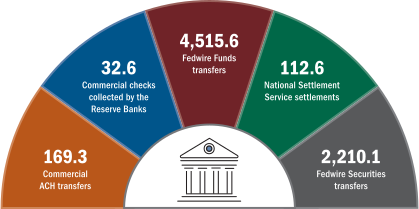
- providing payment services to depository and certain other institutions, including the new FedNow® Service to support instant payments (see figure 5.1)
- distributing the nation's currency and coin to depository institutions
- serving as fiscal agents and depositories for the U.S. government and other entities
- serving as a catalyst for payment system improvements
- conducting Reserve Bank oversight to ensure effective internal controls, operations, and management
Figure 5.1. Average daily value of Federal Reserve payment services to depository and other institutions (Billions of dollars)
The Federal Reserve provides "priced services" to depository and other institutions (see "Payments Services to Depository and Other Institutions"). These payment and related services are operated as separate business lines and costs are tracked accordingly (see box 5.1).
Payment Services to Depository and Other Institutions
Reserve Banks provide a range of payment and related services to depository and certain other institutions under an integrated organization within the Federal Reserve known as Federal Reserve Financial Services (FRFS); these "priced services" include collecting checks, operating an automated clearinghouse (ACH) service, transferring funds and securities, providing a multilateral settlement service, and operating a round-the-clock payment and settlement service to support instant payments in the United States (see box 5.1).1
In addition to implementing the FedNow Service to support instant payments in 2023, the Reserve Banks have been focused on technology initiatives that will enhance their priced-services processing platforms. These initiatives are expected to enhance efficiency, the overall quality of operations, and the Reserve Banks' ability to offer additional services, consistent with the long-standing principles of fostering efficiency and safety, to depository institutions. The Reserve Banks continued to enhance the resiliency and information security posture of wholesale payment systems through Reserve Bank-led cyber initiatives to respond to environmental threats and cyber threats. In 2024, the Reserve Banks advanced the safety and security of FedLine Solutions by making progress on key infrastructure upgrades, as well as through proactive monitoring of an evolving threat environment.
Box 5.1. Priced Services and Cost Recovery
The Federal Reserve must (under the Monetary Control Act of 1980) establish fees for "priced services" to recover, over the long run, all the direct and indirect costs associated with its payment and settlement system services. Costs include those actually incurred as well as the imputed costs that would have been incurred—including financing costs, taxes, and certain other expenses—and the return on equity (profit) that would have been earned if a private business firm had provided the services.1 The imputed costs and imputed profit are collectively referred to as the private-sector adjustment factor (PSAF).
From 2015 through 2024, the Reserve Banks recovered 103.5 percent of the total priced services costs, including the PSAF (see table A). In 2024, Reserve Banks recovered 110.6 percent of the total priced services costs, including the PSAF. The Reserve Banks' operating expenses and imputed costs totaled $464.2 million. Revenue from operations totaled $524.3 million, resulting in a net income from priced services of $60.1 million. In 2024, all services achieved full cost recovery. The FedNow Service revenue and expenses were excluded from the overall performance projections because new services initially do not have stable volumes, costs, and revenues.2
Table A. Priced services cost recovery, 2015–24
Millions of dollars, except as noted
| Year | Revenue from services1 | Operating expenses and imputed costs2 | Targeted return on equity | Total costs | Cost recovery (percent)3 |
|---|---|---|---|---|---|
| 2015 | 429.1 | 397.8 | 5.6 | 403.4 | 106.4 |
| 2016 | 434.1 | 410.5 | 4.1 | 414.7 | 104.7 |
| 2017 | 441.6 | 419.4 | 4.6 | 424.0 | 104.1 |
| 2018 | 442.5 | 428.1 | 5.2 | 433.3 | 102.1 |
| 2019 | 444.0 | 441.2 | 5.4 | 446.5 | 99.4 |
| 2020 | 446.9 | 434.0 | 5.9 | 439.9 | 101.6 |
| 2021 | 456.0 | 452.8 | 4.4 | 457.2 | 99.7 |
| 2022 | 466.8 | 462.8 | 7.2 | 470.0 | 99.3 |
| 2023 | 507.3 | 467.1 | 8.4 | 475.5 | 106.7 |
| 2024 | 524.3 | 464.2 | 9.7 | 473.9 | 110.6 |
| 2015–24 | 4,592.9 | 4,378.0 | 60.5 | 4,438.5 | 103.5 |
Note: Here and elsewhere in this section, components may not sum to totals or yield percentages shown because of rounding. Excludes amounts related to development of the FedNow Service, reported as $545 million: https://www.federalreserve.gov/paymentsystems/fednow_faq.htm.
1. For the 10-year period, includes revenue from services of $4,589.4 million and other income and expense (net) of $3.5 million. Return to table
2. For the 10-year period, includes operating expenses of $4,312.2 million, imputed costs of $9.6 million, and imputed income taxes of $56.1 million. Return to table
3. Revenue from services divided by total costs. For the 10-year period, cost recovery is 102.9 percent, including the effect of accumulated other comprehensive income (AOCI) reported by the priced services under ASC 715, Compensation—Retirement Benefits. Return to table
1. According to the Accounting Standards Codification (ASC) Topic 715 (ASC 715), Compensation—Retirement Benefits, the Reserve Banks recognized a $574.5 million reduction in equity related to the priced services' benefit plans through 2024. For details on how implementing ASC 715 affected the pro forma financial statements, refer to note 3 to the pro forma financial statements at the end of this section. Return to text
2. The Board communicated in its 2019 Notice Federal Reserve Actions to Support Interbank Settlement of Instant Payments that it expects the FedNow Service to achieve its first instance of long-run cost recovery outside the 10-year time frame typically applied to mature services. See Federal Reserve Actions to Support Interbank Settlement of Instant Payments, 84 Fed. Reg. 39,297 (August 9, 2019), available at https://www.govinfo.gov/content/pkg/FR-2019-08-09/pdf/2019-17027.pdf. Return to text
Commercial Check-Collection Service
The commercial check-collection service provides a suite of electronic and paper processing options for forward and return collections.2
In 2024, the Reserve Banks recovered 104.2 percent of the total costs of their commercial check-collection service, including the related private-sector adjustment factor (PSAF). The Reserve Banks' operating expenses and imputed costs totaled $104.5 million. Revenue from operations totaled $111.1 million, resulting in a net income of $6.6 million. Reserve Banks handled 2.98 billion checks in 2024, a decrease of 5.4 percent from 2023 (see table 5.1). The average daily value of checks collected by the Reserve Banks in 2024 was approximately $32.6 billion, a decrease of 3.6 percent from the previous year. The Reserve Banks expect volumes to continue to decline because of substitution away from checks to other payment instruments, although the rate of decline is uncertain.
Table 5.1. Activity in Federal Reserve priced services, 2022–24
Thousands of items, except as noted
| Service | 2024 | 2023 | 2022 | Percent change | |
|---|---|---|---|---|---|
| 2023–24 | 2022–23 | ||||
| Commercial check | 2,977,825 | 3,146,474 | 3,373,580 | −5.4 | −6.7 |
| Commercial ACH | 20,109,461 | 18,858,315 | 18,517,858 | 6.6 | 1.8 |
| Fedwire funds transfer | 209,917 | 193,317 | 196,052 | 8.6 | −1.4 |
| National settlement | 586 | 582 | 586 | 0.7 | −0.8 |
| Fedwire Securities | 28,876 | 25,373 | 3,410 | 13.8 | 644.2 |
Note: Activity in commercial check is the total number of commercial checks collected, including processed and fine-sort items; in commercial ACH, the total number of commercial items processed; in Fedwire funds transfer and securities transfer, the number of transactions originated online and offline; and in national settlement, the number of settlement entries processed. Before 2023, the priced component of the Fedwire Securities Service consisted of revenues, expenses, and volumes associated with the transfer of all non-Treasury securities. Starting in 2023, the revenues, expenses, and volumes associated with the transfer of Treasury securities are also included in the priced component of this service.
Commercial Automated Clearinghouse Service
The commercial ACH service provides batched payment options for same-day and next-day settlement, enabling depository institutions and their customers to process large volumes of payments through electronic batch processes.
In 2024, the Reserve Banks recovered 111.7 percent of the total costs of their commercial ACH services, including the related PSAF. The Reserve Banks' operating expenses and imputed costs totaled $166.5 million. Revenue from operations totaled $190.0 million, resulting in a net income of $23.5 million. The Reserve Banks processed 20.1 billion commercial ACH transactions in 2024, an increase of nearly 6.6 percent from 2023 (see table 5.1). The average daily value of commercial FedACH transfers in 2024 was approximately $169.3 billion, an increase of 7.2 percent from the previous year.
FedNow Service
The FedNow Service, which launched in July 2023, is a new interbank service for instant payments, or payments that can be made at any hour of the day, every day of the year, with immediate funds availability for receivers. Depository institutions that elect to join the service can offer new payment capabilities to their consumer and business customers, for a wide variety of needs. Instant payments provide tangible benefits for consumers and businesses, such as in cases where rapid access to funds is critical or where just-in-time payments help manage cash flows in bank accounts.
By the end of 2024, 1,192 institutions—including large banks, community banks, and credit unions—joined the service, an increase of 33.5 percent from the end of 2023 (see figure 5.2).
Figure 5.2. FedNow Service quarterly volume and participants
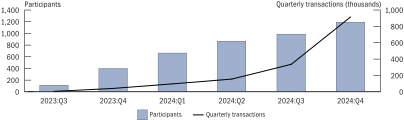
The Reserve Banks processed 1.5 million FedNow transactions in 2024, the first full year of the FedNow Service. The average daily value of FedNow transactions in 2024 was approximately $104.1 million. The number and the value of transactions processed by the FedNow Service in 2024 are consistent with the Federal Reserve's expectation for a new service line, and the Board expects volume to accelerate over time as more financial institutions join the network.
In 2024, the Reserve Banks' operating expenses and imputed costs for the FedNow Service totaled $231.1 million.
Fedwire Funds and National Settlement Services
In 2024, the Reserve Banks recovered 110.1 percent of their costs of the Fedwire Funds and National Settlement Services, including the related PSAF. The Reserve Banks' operating expenses and imputed costs totaled $151.7 million. Revenue from operations totaled $170.3 million, resulting in a net income of $18.6 million.
Fedwire Funds Service
The Fedwire Funds Service allows depository institutions and their customers to send or receive domestic time-critical, and often high-value, payments using their balances at Reserve Banks to transfer funds interbank in real time.
From 2023 to 2024, the number of Fedwire funds transfers originated by depository institutions increased 8.6 percent, to approximately 210 million (see table 5.1). The average daily value of Fedwire funds transfers in 2024 was $4.5 trillion, an increase of 3.8 percent from the previous year.
National Settlement Service
The National Settlement Service (NSS) is a multilateral settlement system that allows participants in private-sector clearing arrangements to settle transactions using their balances at Reserve Banks.
In 2024, NSS processed settlement files for 13 private-sector arrangements that have been established by financial market utilities, check clearinghouse associations, and automated clearinghouse networks. The Reserve Banks processed 8,526 files that contained about 586,000 settlement entries (see table 5.1). Settlement file activity in 2024 decreased 0.5 percent from 2023, while settlement entry activity increased 0.7 percent from 2023. The total value of settlement processed by NSS increased 6.6 percent, to $28.2 trillion.
Fedwire Securities Service
The Fedwire Securities Service is a central securities depository and real-time securities settlement system that allows its participants to transfer electronically to other service participants certain securities issued by the U.S. Department of the Treasury, federal government agencies, government-sponsored enterprises, and certain international organizations. It also provides for the issuance, safekeeping, and maintenance of those securities. The Reserve Banks provide transfer services for securities issued by the U.S. Treasury, federal government agencies, government-sponsored enterprises, and certain international institutions. Before 2023, the priced component of this service consisted of revenues, expenses, and volumes associated with the transfer and safekeeping of all non-Treasury securities. Starting in 2023, the revenues, expenses, and volumes associated with the transfer of Treasury securities are also included in the priced component of this service.
In 2024, the Reserve Banks recovered 124.8 percent of the costs of their Fedwire Securities Service, including the related PSAF. The Reserve Banks' operating expenses and imputed costs totaled $41.6 million. Revenue from operations totaled $53.0 million, resulting in a net income of $11.4 million. In 2024, the number of securities transfers processed via the service increased approximately 13.8 percent from 2023, to approximately 28.9 million (see table 5.1). The average daily value of all Fedwire Securities transfers in 2024 was more than $2.2 trillion, an increase of approximately 27.2 percent from the previous year.
The Reserve Banks, as fiscal agents for Fedwire Securities issuers, facilitate the principal and interest payments to the Fedwire Securities Service participants holding securities. In 2024, the total cash value of principal and interest payments was $37.9 trillion (an increase of 25.5 percent from 2023).
The Fedwire Securities Service is the central securities depository for securities issued over the Fedwire Securities Service. At the end of 2024, there was approximately $114 trillion (par value) of Fedwire Securities held in securities accounts maintained by the Reserve Banks as part of the service, a 4.0 percent increase from 2023. At the end of 2024, there were approximately 1.58 million unique securities outstanding on the service, an increase of 5.0 percent from 2023.
FedLine Solutions: Access to Reserve Bank Services
The Reserve Banks' FedLine Solutions provide depository institutions with a variety of connections for accessing the Reserve Banks' payment and information services.
For priced services, the Reserve Banks charge fees for these connections and allocate the associated costs and revenue to the various services. There are currently five FedLine Solutions through which depository institutions can access the Reserve Banks' priced services. These FedLine Solutions are designed to meet the individual connectivity, security, and contingency requirements of depository institution customers.
Federal Reserve Intraday Credit
The Federal Reserve Board governs the use of Federal Reserve Bank intraday credit, also known as daylight overdrafts.3 A daylight overdraft occurs when an institution's account activity creates a negative balance in the institution's Federal Reserve account at any time in the operating day. Daylight overdrafts enable an institution to send payments more freely throughout the day than if it were limited strictly by its available intraday funds balance, increasing efficiency and reducing payment system risk.
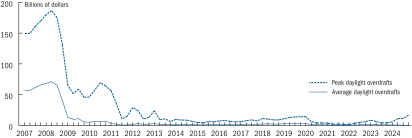
Given the high level of overnight balances institutions hold at the Federal Reserve Banks, daylight overdrafts have remained relatively low, as shown in figure 5.3.4
Figure 5.3. Aggregate daylight overdrafts 2007–24
Accessible Version | Return to text
Source: Payment Data Repository data, Federal Reserve quarterly payment system risk data.
Fees collected for daylight overdrafts are also at low levels. These fees as well as the use of intraday credit are expected to remain relatively low given the high levels of overnight balances under the ample reserves regime. Additionally, a 2011 policy revision that eliminated fees for collateralized daylight overdrafts has further contributed to the decrease in fees.5
Currency and Coin
The Federal Reserve Board issues the nation's currency (in the form of Federal Reserve notes) to the 12 Federal Reserve Banks. The Reserve Banks, in turn, distribute Federal Reserve notes to depository institutions in response to public demand and the needs of commerce. Together, the Board and Reserve Banks work to maintain the integrity of and confidence in Federal Reserve notes.
In 2024, Board staff continued to work with the Reserve Banks and Bureau of Engraving and Printing (BEP) on several strategic initiatives to modernize the U.S. Currency Program over the next decade. These updates are crucial to ensuring the ongoing security and availability of U.S. currency to meet public demand (see box 5.2).
The Reserve Banks distributed 30.6 billion Federal Reserve notes into circulation in 2024, a 0.8 percent decrease from 2023, and received 29.8 billion Federal Reserve notes from circulation, a 1.6 percent decrease from 2023. The greater decrease in receipts relative to payments resulted in an increase in net payments of 0.2 billion notes, or 41.2 percent from 2023. However, net payments remain about half of 2019 levels, primarily because of decreased net payments of $100 notes. The continued positive net payments contributed to the continued growth of currency in circulation. The value of Federal Reserve notes issued and outstanding at year-end 2024 totaled $2.3 trillion, a 1.1 percent increase from 2023.
The Reserve Banks also distribute coin to depository institutions on behalf of the U.S. Mint.6 In 2024, Reserve Banks distributed 44.1 billion coins into circulation, a 0.5 percent decrease from 2023, and received 37.0 billion coins from circulation, no change compared with 2023.
Box 5.2. U.S. Currency Program Initiatives
The Federal Reserve Board of Governors is the issuing authority for Federal Reserve notes. Its staff works closely with the Bureau of Engraving and Printing (BEP) and Reserve Banks to ensure that the production of U.S. currency remains secure and that the notes circulated are high quality and in a quantity sufficient to meet public demand, supporting the Board's mission to provide a variety of safe and secure payment methods for the public.1
To meet our statutory responsibility as issuing authority of Federal Reserve notes, the Federal Reserve has been collaborating with the BEP and Reserve Banks on several multiyear initiatives to ensure the public continues to have confidence in the security and availability of U.S. currency, and that the Federal Reserve can respond to a range of demand scenarios.
For example, the NextGen Program is a multiphase, multiyear program to replace the current fleet of Reserve Bank banknote-processing equipment that is more than 30 years old with next-generation processing machines and improved sensors for authenticating currency deposited at Reserve Banks. This equipment plays a critical role in the Federal Reserve's ability to maintain currency quality and integrity. During 2024, the Federal Reserve began the pilot-testing phase of the project in four cash offices to test the high-speed banknote-processing equipment. As part of implementing the new machines, the Federal Reserve is assessing the potential strategic benefits of realigning some cash-processing activities, which could offer increased resiliency, sustainability, and efficiency in operations.
Long-term planning for vault and processing capacities with a regional and national perspective is also driving updates to individual facilities, including the Federal Reserve Bank of New York's East Rutherford Operations Center that is undersized for the scope of necessary operations. The facility serves the New York metro area market, processes the highest volume of currency in the Federal Reserve System, and is one of two key offices that services international distribution and circulation of U.S. currency and coin. A new facility located in Warren, New Jersey, will replace the East Rutherford Operations Center.
The Miami Branch of the Federal Reserve Bank of Atlanta serves a prominent role as a partner for the Federal Reserve Bank of New York's international cash function, provides international cash services to certain central banks, and is the third-largest cash operation in the Federal Reserve System. To accommodate the volume of cash that flows through the facility, the vault is undergoing expansion and automation. The Branch's currency operations currently use a manual currency vault that has not been updated in over four decades.
The U.S. Currency Program is developing the next family of U.S. banknotes. The goal of the development process is to produce banknotes that are secure, manufacturable, and functional in commerce for each denomination. The notes must be secure against identified and anticipated counterfeiting threats, with easily recognizable security features that are authenticatable by domestic and international users, and must be manufacturable to meet anticipated demand. Following Treasury's guidance on the release of new note designs, the first denomination planned for production will be the $10 note, with targeted issuance at the end of 2026.
1. Currency issuance is a mission essential function of the Board, and U.S. currency is the dominant reserve currency in the world. Under the Federal Reserve Act, the Board reimburses the BEP for their expenses necessarily incurred by producing U.S. currency for the Board to issue into commerce. Return to text
Banknote Development
During 2024, Federal Reserve Board staff continued to support efforts related to the development of the next family of U.S. currency. For example, the Advanced Counterfeit Deterrence Steering Committee, composed of the Treasury, the U.S. Secret Service, and Federal Reserve System staff, provided advice on currency design changes to the Secretary of the Treasury, who has sole statutory authority to approve the final currency design.
Over the past year, Federal Reserve Board staff, alongside other U.S. Currency Program partners (the Bureau of Engraving and Printing (BEP), FRFS, and the U.S. Secret Service), collaborated on banknote and technology development. Banknote development focuses on meeting requirements based on user needs, security needs, and manufacturing capabilities. Technology development focuses on security features that can further bolster the counterfeit resistance of U.S. currency. To support these efforts, and like many other central banks, the Federal Reserve Board led an adversarial analysis program to increase the counterfeit resilience of U.S. currency and to research counterfeit-deterrence technologies. These activities work in concert to meet the goal of developing the next family of banknotes with new, robust security features effectively integrated into their design, features that are easy to authenticate and difficult for counterfeiters to simulate. The first denomination in the new family of banknotes, the $10, will be ready for issuance at the end of 2026.
Currency Education
The Federal Reserve Board's U.S. Currency Education Program (CEP) is responsible for building confidence in U.S. currency by providing education, training, and information about Federal Reserve notes to the global public. The CEP works closely with the U.S. Secret Service, the U.S. Department of State, and the BEP to raise awareness about the designs and security features of Federal Reserve notes.
In 2024, the CEP increased engagement with stakeholders who play a critical role in blocking counterfeit currency from entering circulation. In response to the needs of the program's domestic and international audience, the CEP hosted 10 virtual outreach programs and 7 in-person events, garnering more than 1,400 attendees from three continents (North America, South America, and Africa).
Coverage on both traditional and social media contributed to ongoing engagement with the CEP's website and mobile applications. Uscurrency.gov ended 2024 with more than 3 million web visitors and more than 5.8 million pages viewed on the website. More than 264,000 resources were downloaded from the website. In addition to website resource downloads, 321,300 print resources were shipped out to the global public. CEP's Cash Assist mobile application was downloaded more than 40,000 times, bringing the lifetime total downloads to more than 317,000.
External Engagements
Federal Reserve Board staff continued to serve on the Central Bank Counterfeit Deterrence Group and the Five Nations and chaired the United States Cash Machine Group. The Central Bank Counterfeit Deterrence Group is a group of central banks that collaborates to develop and deploy measures to combat digital counterfeiting. The Five Nations is a group of central banks, including the Board, that works on common projects and shares lessons learned in banknote development, distribution, public education, and circulation. The United States Cash Machine Group works closely with manufacturers of cash authentication machines to ensure that new and existing banknotes function in commerce. The Board collaborates with these domestic and international partners to maintain worldwide confidence in U.S. currency.
Fiscal Agency and Government Depository Services
The Federal Reserve Banks, upon the direction of the Secretary of the Treasury, act as fiscal agents of the U.S. government.7 The Reserve Banks, in their role as fiscal agents, develop, operate, maintain, or host a number of applications that support Treasury's payment services, debt financing and securities services, and financial accounting and reporting services. To support these fiscal agent services, the Reserve Banks provide associated technology infrastructure services.
As fiscal agent, the Reserve Banks also maintain the Treasury's operating cash account, commonly referred to as the Treasury's general account, or TGA. Additionally, the Reserve Banks provide certain fiscal agency and depository services to other entities.
Reserve Bank expenses for providing fiscal agency and depository services totaled $859.3 million, an increase of $88.9 million, or 11.5 percent (see table 5.2). This increase is primarily attributable to Treasury's request that the Reserve Banks, as fiscal agents, modernize legacy applications or migrate applications to a cloud platform for all fiscal agent services in alignment with the federal government's cloud computing strategy.8 The Treasury and other entities reimburse the Reserve Banks for the expense of providing fiscal agency and depository services. Costs for Treasury-related programs accounted for 98.6 percent of expenses, and costs for other entities accounted for the remaining 1.4 percent.
Table 5.2. Expenses of the Federal Reserve Banks for fiscal agency and depository services, 2022–24
Thousands of dollars
| Agency and service | 2024 | 2023 | 2022 |
|---|---|---|---|
| Department of the Treasury | |||
| Payment services | 339,597 | 336,377 | 375,606 |
| Debt financing and securities services | 244,194 | 194,413 | 207,805 |
| Financial accounting and reporting services | 86,550 | 81,136 | 73,481 |
| Technology infrastructure services | 177,052 | 143,598 | 147,856 |
| Total, Treasury | 847,392 | 755,524 | 804,748 |
| Services provided to other entities | 11,930 | 14,849 | 16,130 |
| Total reimbursable expenses | 859,322 | 770,374 | 820,878 |
Note: Service costs include reimbursable pension costs, where applicable. Previous versions of the Annual Report provided a separate line item for pension expenses.
Payment Services
The Reserve Banks, as fiscal agents, support the Treasury's payment services by developing, operating, maintaining, or hosting applications that allow the public to receive payments from the Treasury and other federal agencies. In general, agencies send payment instructions to the Treasury, which in turn sends the payment instructions to the Reserve Banks. The Reserve Banks then process those payment instructions, primarily through the Federal Reserve's FedACH Service, and then settle those payments in the TGA. These payment instructions can include payments to the public such as federal payroll, Social Security benefits, and income tax refunds. The Reserve Banks, as fiscal agents, also develop, operate, maintain, or host applications that allow Treasury and other federal agencies to detect and prevent improper payments.
Additionally, the Reserve Banks, as fiscal agents, develop, operate, maintain, or host applications that allow the public to make payments to the Treasury and other federal agencies. The public can send payment instructions to the Treasury and other federal agencies, who in turn send those payment instructions primarily to the Federal Reserve's FedACH Service and then those payments settle in the TGA. These instructions can include fees, taxes, and non-tax payments owed to the government.
In 2024, the Federal Reserve's ACH service processed nearly 1.8 billion Treasury payments valued at approximately $8.5 trillion.
Reserve Bank expenses for providing Treasury payment services were $339.6 million in 2024, an increase of $3.2 million, or 0.9 percent, which is primarily attributable to migrating applications to a cloud platform.
Financing and Securities Services
The Reserve Banks, as fiscal agents, work closely with the Treasury to raise the financing needed to operate the federal government, which includes functions such as cash forecasting, auction operations, and retail securities support. The Treasury uses the Federal Reserve's Fedwire Securities Service to issue, maintain, transfer and settle all marketable Treasury securities (bills, notes, and bonds). In 2024, the Treasury, supported by the Reserve Banks, conducted 440 auctions that resulted in the Treasury awarding $28.5 trillion in wholesale Treasury marketable securities to investors. Additionally in 2024, the Treasury issued and serviced $612.0 billion in marketable securities to retail investors, which the Reserve Banks supported through contact center operations. The Reserve Banks also supported the Treasury's issuance and servicing of $18.0 billion in U.S. savings bonds in 2024 through contact center operations and fulfillment services.
Reserve Bank expenses for financing and securities services were $244.2 million in 2024, an increase of $49.8 million, or 25.6 percent, which is primarily attributable to development efforts to modernize legacy applications.
Accounting and Reporting Services
The Reserve Banks, as fiscal agents, develop, operate, maintain, or host applications to support Treasury's accounting and reporting services. Specifically, the Reserve Banks, as fiscal agents, manage the TGA by forecasting, monitoring, reconciling, and reporting the government's overall cash requirements and cash flow. The Reserve Banks, as fiscal agents, also support the Treasury's publication of Your Guide to America's Finances; the daily and monthly Treasury statements; the Combined Statement of Receipts, Outlays, and Balances of the United States Government; and the Financial Report of the United States Government.9
Reserve Bank expenses for accounting and reporting services were $86.6 million in 2024, an increase of $5.5 million, or 6.8 percent, which is primarily attributable to migrating applications to a cloud platform.
Infrastructure and Technology Services
The Reserve Banks design, build, and maintain the technology infrastructures and environments that host the majority of applications that the Reserve Banks develop, operate, or maintain as fiscal agent.
To align with Treasury's cloud computing strategy, the Reserve Banks, as fiscal agents, continued to build out and migrate applications to a cloud platform. The Reserve Banks, as fiscal agents, continued to effectively operate infrastructures, plan for end-of-life issues, increase automation, and strengthen their applications against a host of new and evolving cybersecurity threats.
Reserve Bank expenses for infrastructure and technology services were $177.0 million in 2024, an increase of $33.4 million, or 23.3 percent, which is primarily attributable to ongoing investments in a cloud platform.
Services Provided to Other Entities
The Reserve Banks, when permitted by federal statute or when required by the Secretary of the Treasury, also provide fiscal agent services to other domestic and international entities with U.S.-dollar-denominated banking services, which include funds, securities, and gold safekeeping; securities clearing, settlement, and investment; and correspondent banking.
The Reserve Banks, as fiscal agents, also issue and maintain, in electronic form, many federal agency, government-sponsored enterprise, and certain international organizations securities. The majority of securities services are performed for the Government National Mortgage Association (Ginnie Mae).
Reserve Bank expenses for services provided to other entities were $11.9 million in 2024, a decrease of $3.0 million, or 20.1 percent, primarily because these other entities paid lower fees for their use of Federal Reserve Financial Services.
Evolutions and Improvements to the System
In addition to its role as payment system operator, the Federal Reserve performs several other functions in the payment system, including supervisor and regulator of financial institutions and systemically important financial market utilities, researcher, and catalyst for payment system improvements.
Payment System Research and Analysis
The Federal Reserve conducts research on a wide range of topics related to the design and activities of payment, clearing, and settlement systems and financial market infrastructures, as well as the role of these systems in the commercial activities of consumers, businesses, and governments.
In 2024, topics examined in Federal Reserve research included the following:
- measurement and analysis of short-run developments and long-run trends in the use of new and established payment methods10
- drivers and potential effects of innovations in the payment system
- design, oversight, and regulation of financial market infrastructures
- developments related to payments fraud
For more information, see the Board's Payments Research website at https://www.federalreserve.gov/paymentsystems/payres_about.htm.
Digital Innovations Research
Federal Reserve staff conducts policy and analytical research to provide perspectives on the future of money and payments shaped by innovation. Staff research covers market developments that could materially impact the payment system in the future such as stablecoins, tokenization, crypto-assets, and AI in payments, as well as new technologies and business models to improve cross-border payments or to facilitate the settlement of wholesale payment transactions.
To carry out this work the Federal Reserve engages with a wide variety of domestic and international stakeholders, such as those from the private sector, academia, and the government, to gather perspectives and expertise on innovations topics such as tokenization, distributed ledger technology, application programming interfaces, and digital payments. This includes engagement with multilateral institutions, such as the Bank for International Settlements, G7, and Financial Stability Board, and bilateral engagements with other central banks.
Payment System Regulation
Congress has assigned to the Board responsibility for implementing the Federal Reserve Act and certain other laws pertaining to a wide range of banking and financial activities, including those related to the payment and settlement system. The Board implements those laws in part through its regulations (see the Board's website at https://www.federalreserve.gov/supervisionreg/reglisting.htm).
In October 2023, the Board requested comment on proposed revisions to Regulation II. Pursuant to the Durbin Amendment to the Dodd-Frank Act, Regulation II is the Board's rule concerning debit card transactions. The proposal would lower the maximum interchange fee that a large debit card issuer can receive for a debit card transaction. The proposal would also establish a regular process for updating the maximum amount every other year going forward. The Board received more than 3,500 public comments on the proposed revisions and is considering the input received.
In December 2022, Congress passed legislation requiring the Board to create and maintain a public database of entities with access to Reserve Bank master accounts and services as well as entities that submit requests for access moving forward. In June 2023, the Federal Reserve Board introduced the Master Account and Services Database, a comprehensive and searchable resource that discloses information on financial institutions' access to master accounts and financial services provided by the Federal Reserve Banks. Detailed information on the guidelines used by Reserve Banks in evaluating access requests can be found in the associated FAQ.
Other Improvements and Efforts
The improvement of the efficiency, effectiveness, and security of information technology (IT) services and operations continued to be a central focus of the Reserve Banks. This included continuing priorities for moving applications to the cloud, building out co-location sites with the purpose of closing data centers, aligning IT direction and resources to meet key System objectives, and ensuring that IT leaders and team members are working toward a common set of goals. The highest-level goals—security, agility, and value—guide a set of priorities focused on operating secure and reliable systems, accelerating business outcomes, and enhancing the business-driven digital experience and collaboration. A key enabler in achieving these goals is a multiyear modernization effort launched in 2023, which aims to contemporize infrastructure and improve application delivery and management.
In 2024, the Board of Governors collected public input on a proposal to expand the operating days of the Fedwire Funds Service from 22 hours per day, Monday–Friday to 22 hours per day, 7 days per week, every day of the year (22x7x365) and to correspondingly expand the operating days of NSS, with NSS closing 30 minutes earlier than the Fedwire Funds Service.11 As technological advancements and globalization of commerce continue to drive change in the large-value payment landscape, expanding the availability of the Fedwire Funds Service and NSS would support the Board's long-standing policy objective to foster a safe and efficient U.S. payment system by extending the hours in which settlement in risk-free central bank money can occur. The Board is currently evaluating public comments on the proposal and plans to announce a decision on expanded operating hours in a subsequent Federal Register notice.
The Reserve Banks maintained a robust cybersecurity posture throughout 2024, avoiding disruptions from major cybersecurity events and breaches. The Banks remain steadfast in their commitment to combating cyber threats with emphasis on risk mitigation, proactive monitoring, and conducting thorough assessments of cyber risks to enterprise operations and data protection. Over the past year, the Federal Reserve System has significantly bolstered security capabilities through a series of high-priority information security initiatives. Key achievements include the completion of multifactor authentication implementation across all applications in its environment, the enhancement of policies and practices to address Insider Risk Management, and adoption of advanced automated tools to strengthen vulnerability management efforts. These accomplishments reflect the Reserve Banks ongoing dedication to collaborating with business partners to further elevate the overall state of information security across the Federal Reserve System.
Oversight of Federal Reserve Banks
The combined financial statements of the Reserve Banks and the financial statements of each of the 12 Reserve Banks are audited annually by an independent public accounting firm retained by the Board of Governors.12 In addition, the Reserve Banks are subject to oversight by the Board of Governors, which performs its own reviews.
The Reserve Banks use the 2013 framework established by the Committee of Sponsoring Organizations of the Treadway Commission (COSO) to assess their internal controls over financial reporting, including the safeguarding of assets. The management of each Reserve Bank annually provides an assertion letter to its board of directors that confirms adherence to COSO standards.
The Federal Reserve Board engaged KPMG LLP (KPMG) to audit the 2024 combined and individual financial statements of the Reserve Banks and the financial statements of one limited liability company (LLC) that is associated with the Board of Governors' actions to address the coronavirus pandemic and is consolidated in the statements of the Federal Reserve Bank of Boston.13 In 2024, KPMG also conducted audits of internal controls over financial reporting for each of the Reserve Banks. Fees for KPMG services totaled $9.0 million, of which approximately $0.2 million was for the audit of the LLC.14 The audits are conducted in accordance with the Public Company Accounting Oversight Board and auditing standards generally accepted in the United States. To ensure auditor independence, the Board of Governors requires that KPMG be independent in all matters relating to the audits. Specifically, KPMG may not perform services for the Reserve Banks or affiliated entities that would place it in a position of auditing its own work, making management decisions on behalf of the Reserve Banks, or in any other way impairing its audit independence. In 2024, the Reserve Banks did not engage KPMG for significant non-audit services.
The Board's reviews of the Reserve Banks include a wide range of oversight activities, conducted primarily by its Division of Reserve Bank Operations and Payment Systems. Division personnel monitor, on an ongoing basis, the activities of each Reserve Bank, National Information Technology, and FRFS. The oversight program identifies the most strategically important Reserve Bank current and emerging risks and defines specific approaches to achieve a comprehensive evaluation of the Reserve Banks' controls, operations, and management effectiveness.
The comprehensive reviews include an assessment of the internal audit function's effectiveness and its conformance to the Institute of Internal Auditors' (IIA) International Standards for the Professional Practice of Internal Auditing, applicable policies and guidance, and the IIA's code of ethics.
The Board also reviews the System Open Market Account (SOMA) annually to
- determine whether the Federal Reserve Bank of New York, while conducting the related transactions and associated controls, complies with the policies established by the Federal Open Market Committee (FOMC); and
- assess the SOMA-related IT project management and application development, vendor management, and system resiliency and contingency plans.
In addition, KPMG audits the year-end schedule of the SOMA participated asset and liability accounts and the related schedule of participated income accounts. The FOMC is provided with the external audit reports and a report on the Board review.
Income and Expenses
Annually, the Board releases the combined Reserve Banks financial statements with financial information as of December 31, which include the accounts and results of operations of each of the 12 Reserve Banks.
In 2024, current income was $159.3 billion, compared with $175.1 billion in 2023; expenses totaled $236.9 billion, compared with $289.5 billion in 2023; and net loss before providing remittances to the Treasury totaled $77.6 billion, compared with $114.3 billion in 2023.
In accordance with the Federal Reserve Act, the Reserve Banks remit excess earnings to the Treasury after providing for the cost of operations, payment of dividends, and reservation of an amount necessary to a maintain aggregate surplus. During a period when earnings are not sufficient to provide for those costs, a deferred asset is recorded. A deferred asset represents the shortfall in earnings from the most recent point that remittances were suspended and is the amount of net excess earnings Reserve Banks will need to realize in the future before remittances to the Treasury resume. The Reserve Banks continued to accumulate a deferred asset during 2024 and 2023. Nonetheless, some Reserve Banks continued to periodically remit excess earnings to the Treasury during 2024 and 2023 because remittances are calculated weekly on an individual Reserve Bank basis.15
Table 5.3 summarizes the income, expenses, and distributions of the Reserve Banks for 2024 and 2023. Appendix G of this report, "Statistical Tables," provides more detailed financial information on the Reserve Banks, including the consolidated LLC.16 Additionally, appendix G summarizes the Reserve Banks' 2024 budget performance and 2025 budgets, budgeting processes, and trends in expenses and employment.
Table 5.3. Income, expenses, and distribution of net earnings of the Federal Reserve Banks, 2024 and 2023
Millions of dollars
| Item | 2024 | 2023 |
|---|---|---|
| Current income | 159,324 | 175,136 |
| Loan interest income | 5,121 | 10,438 |
| SOMA interest income | 153,635 | 164,087 |
| Other current income1 | 568 | 611 |
| Net expenses | 232,365 | 286,480 |
| Operating expenses | 5,864 | 5,648 |
| Reimbursements | −886 | −812 |
| System pension service cost | 621 | 548 |
| Interest paid on depository institutions deposits and others | 186,478 | 176,755 |
| Interest expense on securities sold under agreements to repurchase | 40,288 | 104,341 |
| Current net (loss) | −73,041 | −111,344 |
| Net additions to (deductions from) current net income | −1,222 | −130 |
| Treasury securities (losses), net | −37 | −32 |
| Federal agency and government-sponsored enterprise mortgage-backed securities (losses), net | −70 | −56 |
| Foreign currency translation (losses), net | −1,478 | −67 |
| Other additions or deductions | 363 | 25 |
| Assessments by the Board of Governors2 | 3,343 | 2,912 |
| For Board expenditures | 1,438 | 1,144 |
| For currency costs | 1,242 | 1,047 |
| For Consumer Financial Protection Bureau costs3 | 663 | 721 |
| Reserve Bank net (loss) from operations | −77,606 | −114,386 |
| Consolidated variable interest entities: Income, net | 22 | 1,124 |
| Consolidated variable interest entities: Non-controlling interest (income), net | −37 | −1,038 |
| Reserve Bank and consolidated variable interest entities net (loss) before providing for remittances to the Treasury | −77,621 | −114,300 |
| Earnings remittances to the Treasury | −79,104 | −116,063 |
| Net income after providing for remittances to the Treasury | 1,483 | 1,763 |
| Other comprehensive income (loss) | 140 | −276 |
| Comprehensive income | 1,623 | 1,487 |
| Total distribution of net (loss) | −77,481 | −114,576 |
| Dividends on capital stock | 1,623 | 1,487 |
| Remittances transferred to the Treasury4 | 3,533 | 670 |
| Deferred asset (increase) | −82,637 | −116,733 |
| Earnings remittances to the Treasury, net | −79,104 | −116,063 |
1. Includes income from priced services and securities lending fees. Return to table
2. A detailed account of the assessments and expenditures of the Board of Governors appears in the Board of Governors Financial Statements (see https://www.federalreserve.gov/aboutthefed/audited-annual-financial-statements.htm). Return to table
3. The Board of Governors assesses the Reserve Banks to fund the operations of the Consumer Financial Protection Bureau. Return to table
4. Represents excess earnings remitted to the Treasury after providing for the cost of operations, payment of dividends, and reservation of surplus. On a weekly basis, if earnings become less than the cost of operations, payment of dividends, and any amount necessary to maintain surplus, the Reserve Banks suspend weekly remittances to the Treasury and record a deferred asset. Return to table
SOMA Holdings
The FOMC has authorized and directed the Federal Reserve Bank of New York to execute open market transactions to the extent necessary to carry out the domestic policy directive adopted by the FOMC. The Federal Reserve Bank of New York, on behalf of the Reserve Banks, holds in the SOMA the resulting securities, which include U.S. Treasuries, federal agency and government-sponsored enterprise debt securities, federal agency and government-sponsored enterprise mortgage-backed securities, investments denominated in foreign currencies, and commitments to buy or sell related securities.17
Table 5.4 summarizes the average daily assets (liabilities), current income (expenses), and average interest rate of the SOMA holdings for 2024 and 2023.
Table 5.4. System Open Market Account holdings of the Federal Reserve Banks, 2024 and 2023
Millions of dollars, except as noted
| Item | Average daily assets (+)/liabilities (−) | Current income (+)/expense (−) | Average interest rate (percent) | |||||
|---|---|---|---|---|---|---|---|---|
| 2024 | 2023 | Year-over-year change | 2024 | 2023 | Year-over-year change | 2024 | 2023 | |
| System Open Market Account (SOMA) holdings | ||||||||
| Securities purchased under agreements to resell | 16 | 3,925 | −3,909 | 1 | 195 | −194 | 5.29 | 4.96 |
| U.S. Treasury securities, net1 | 4,672,913 | 5,335,243 | −662,330 | 100,518 | 106,479 | −5,962 | 2.15 | 2.00 |
| Federal agency and government-sponsored enterprise mortgage-backed securities, net2 | 2,385,935 | 2,593,972 | −208,037 | 52,648 | 57,017 | −4,369 | 2.21 | 2.20 |
| Government-sponsored enterprise debt securities, net 1 | 2,543 | 2,570 | −27 | 130 | 131 | −1 | 5.11 | 5.11 |
| Foreign currency denominated investments3 | 18,116 | 18,399 | −283 | 328 | 246 | 82 | 1.81 | 1.34 |
| Central bank liquidity swaps4 | 201 | 354 | −153 | 10 | 19 | −8 | 5.37 | 5.32 |
| Other SOMA assets5 | * | 1 | −1 | * | * | * | 0.00 | 0.00 |
| Total SOMA assets | 7,079,724 | 7,954,464 | −874,740 | 153,635 | 164,087 | −10,452 | 2.17 | 2.06 |
| Securities sold under agreements to repurchase: primary dealers and expanded counterparties | −391,162 | −1,747,804 | 1,356,642 | −19,636 | −87,341 | 67,705 | 5.02 | 5.00 |
| Securities sold under agreements to repurchase: foreign official and international accounts | −378,540 | −336,897 | −41,643 | −20,652 | −17,000 | −3,652 | 5.46 | 5.05 |
| Total securities sold under agreements to repurchase | −769,702 | −2,084,701 | 1,314,999 | −40,288 | −104,341 | 64,053 | 5.23 | 5.01 |
| Other SOMA liabilities6 | −2 | −2 | * | n/a | n/a | n/a | n/a | n/a |
| Total SOMA liabilities | −769,704 | −2,084,703 | 1,314,999 | −40,288 | −104,341 | 64,053 | 5.23 | 5.01 |
| Total SOMA holdings | 6,310,020 | 5,869,761 | 440,259 | 113,347 | 59,746 | 53,601 | 1.80 | 1.02 |
1. Face value, net of unamortized premiums and discounts. Return to table
2. Face value, which is the remaining principal balance of the securities, net of unamortized premiums and discounts. Does not include unsettled transactions. Return to table
3. Foreign currency denominated assets are revalued daily at market exchange rates. Return to table
4. Dollar value of foreign currency held under these agreements valued at the exchange rate to be used when the foreign currency is returned to the foreign central bank. This exchange rate equals the market exchange rate used when the foreign currency was acquired from the foreign central bank. Return to table
5. Cash and short-term investments related to the federal agency and government-sponsored enterprise (GSE) mortgage-backed securities (MBS) portfolio. Return to table
6. Represents the obligation to return cash margin posted by counterparties as collateral under commitments to purchase and sell federal agency and GSE MBS, as well as obligations that arise from the failure of a seller to deliver securities on the settlement date. Return to table
n/a Not applicable.
* Less than $500,000.
Lending
In 2024, the average daily balance and the average rate of interest earned for Reserve Bank lending programs were as follows:
- Primary, secondary, and seasonal credit extended was $3,774 million and 5.41 percent.
- Bank Term Funding Program (BTFP) was $101,647 million and 4.83 percent.
- Paycheck Protection Program Liquidity Facility (PPPLF) was $2,704 million and 0.35 percent.
In addition, the Federal Reserve Bank of Boston provided loans to a special purpose vehicle (SPV), Main Street Lending Program, that was established in response to the coronavirus pandemic. This SPV provided liquidity to market participants through the purchase of assets in accordance with the terms of the liquidity program.
Pro Forma Financial Statements for Federal Reserve Priced Services
Table 5.5. Pro forma balance sheet for Federal Reserve priced services, December 31, 2024 and 2023
Millions of dollars
| Item | 2024 | 2023 | ||
|---|---|---|---|---|
| Short-term assets (note 1) | ||||
| Imputed investments | 1,089.8 | 556.3 | ||
| Receivables | 49.3 | 47.2 | ||
| Inventory | 0.1 | 0.1 | ||
| Prepaid expenses | 29.0 | 37.8 | ||
| Items in process of collection | 88.2 | 67.6 | ||
| Total short-term assets | 1,256.5 | 709.0 | ||
| Long-term assets (note 2) | ||||
| Premises | 97.4 | 94.7 | ||
| Furniture and equipment | 54.3 | 34.9 | ||
| Leases, leasehold improvements, and long-term prepayments | 71.7 | 72.5 | ||
| Prepaid pension costs | 93.2 | 115.1 | ||
| Deferred tax asset | 132.6 | 130.4 | ||
| Total long-term assets | 449.2 | 447.6 | ||
| Total assets | 1,705.7 | 1,156.6 | ||
| Short-term liabilities (note 3) | ||||
| Deferred-availability items | 1,178.0 | 623.8 | ||
| Short-term debt | 27.4 | 36.2 | ||
| Short-term payables | 51.0 | 48.9 | ||
| Total short-term liabilities | 1,256.5 | 709.0 | ||
| Long-term liabilities (note 3) | ||||
| Long-term debt | 91.5 | 102.2 | ||
| Accrued benefit costs | 272.4 | 274.7 | ||
| Total long-term liabilities | 363.9 | 376.9 | ||
| Total liabilities | 1,620.4 | 1,085.9 | ||
| Equity (including accumulated other comprehensive loss of $574.5 million and $548.6 million at December 31, 2024 and 2023, respectively) | 85.3 | 70.7 | ||
| Total liabilities and equity (note 3) | 1,705.7 | 1,156.6 | ||
Note: Components may not sum to totals because of rounding. The accompanying notes are an integral part of these pro forma priced services financial statements.
Table 5.6. Pro forma income statement for Federal Reserve priced services, 2024 and 2023
Millions of dollars
| Item | 2024 | 2023 | ||
|---|---|---|---|---|
| Revenue from services provided to depository institutions (note 4) | 524.3 | 505.3 | ||
| Operating expenses (note 5) | 457.2 | 462.7 | ||
| Income from operations | 67.2 | 42.5 | ||
| Imputed costs (note 6) | ||||
| Interest on debt | 5.7 | 1.2 | ||
| Interest on float | −17.2 | −11.6 | ||
| Sales taxes | 4.5 | −6.9 | 5.3 | −5.1 |
| Income from operations after imputed costs | 74.1 | 47.7 | ||
| Other income and expenses (note 7) | ||||
| Investment income | 0.0 | 2.0 | ||
| Income before income taxes | 74.1 | 49.7 | ||
| Imputed income taxes (note 6) | 14.0 | 9.6 | ||
| Net income | 60.1 | 40.1 | ||
| Memo: Targeted return on equity (note 6) | 9.7 | 8.4 | ||
Note: Components may not sum to totals because of rounding. The accompanying notes are an integral part of these pro forma priced services financial statements.
Table 5.7. Pro forma income statement for Federal Reserve priced services, by service, 2024
Millions of dollars
| Item | Total | Commercial check collection | Commercial ACH | Fedwire funds | Fedwire securities |
|---|---|---|---|---|---|
| Revenue from services (note 4) | 524.3 | 111.1 | 190.0 | 170.3 | 53.0 |
| Operating expenses (note 5)1 | 457.2 | 100.4 | 174.6 | 144.1 | 38.1 |
| Income from operations | 67.2 | 10.7 | 15.4 | 26.2 | 14.9 |
| Imputed costs (note 6) | −6.9 | 2.6 | −13.6 | 3.3 | 0.9 |
| Income from operations after imputed costs | 74.1 | 8.1 | 29.0 | 22.9 | 14.1 |
| Other income and expenses, net (note 7) | 0.0 | 0.0 | 0.0 | 0.0 | 0.0 |
| Income before income taxes | 74.1 | 8.1 | 29.0 | 22.9 | 14.1 |
| Imputed income taxes (note 6) | 14.0 | 1.5 | 5.5 | 4.3 | 2.6 |
| Net income | 60.1 | 6.6 | 23.5 | 18.6 | 11.4 |
| Memo: Targeted return on equity (note 6) | 9.7 | 2.1 | 3.7 | 3.0 | 0.9 |
| Cost recovery (percent) (note 8) | 110.6 | 104.2 | 111.7 | 110.1 | 124.8 |
Note: Components may not sum to totals because of rounding. Excludes amounts related to development of the FedNow Service. The accompanying notes are an integral part of these pro forma priced services financial statements.
1. Operating expenses include pension costs, Board expenses, and reimbursements for certain nonpriced services. Return to table
Notes to Pro Forma Financial Statements for Priced Services
(1) Short-Term Assets
Receivables are composed of fees due the Reserve Banks for providing priced services and the share of suspense- and difference-account balances related to priced services.
Items in process of collection are gross Federal Reserve cash items in process of collection (CIPC), stated on a basis comparable to that of a commercial bank. They reflect adjustments for intra-Reserve Bank items that would otherwise be double-counted on the combined Federal Reserve balance sheet and adjustments for items associated with nonpriced items (such as those collected for government agencies). Among the costs to be recovered under the Monetary Control Act is the cost of float, or net CIPC during the period (the difference between gross CIPC and deferred-availability items, which is the portion of gross CIPC that involves a financing cost), valued at the federal funds rate. Investments of excess financing derived from credit float are assumed to be invested in federal funds.
(2) Long-Term Assets
Long-term assets consist of long-term assets used solely in priced services and the priced-service portion of long-term assets shared with nonpriced services, including a deferred tax asset related to the priced services pension and postretirement benefits obligation. The tax rate associated with the deferred tax asset was 18.8 percent for 2024 and 19.3 percent for 2023.
Long-term assets also consist of an estimate of the assets of the Board of Governors used in the development of priced services.
(3) Liabilities and Equity
Under the matched-book capital structure for assets, short-term assets are financed with short-term payables and imputed short-term debt, if needed. Long-term assets are financed with long-term liabilities, imputed long-term debt, and imputed equity, if needed. To meet the Federal Deposit Insurance Corporation (FDIC) requirements for a well-capitalized institution, in 2024 equity is imputed at 5.0 percent of total assets and 11.8 percent of risk-weighted assets, and 2023 equity is imputed at 6.1 percent of total assets and 11.4 percent of risk-weighted assets.
The Board's Payment System Risk policy reflects the international standards for financial market infrastructures developed by the Committee on Payment and Settlement Systems and the Technical Committee of the International Organization of Securities Commissions in the Principles for Financial Market Infrastructures. The policy outlines the expectation that the Fedwire Services will meet or exceed the applicable risk-management standards. Although the Fedwire Funds Service does not face the risk that a business shock would cause the service to wind down in a disorderly manner and disrupt the stability of the financial system, in order to foster competition with private-sector financial market infrastructures, the Reserve Banks' priced services will hold six months of the Fedwire Funds Service's current operating expenses as liquid net financial assets and equity on the pro forma balance sheet and, if necessary, impute additional assets and equity to meet the requirement. The imputed assets held as liquid net financial assets are cash items in process of collection, which are assumed to be invested in federal funds. In 2024 and 2023, there were sufficient assets and equity such that additional imputed balances were not required.
In accordance with ASC 715, Compensation–Retirement Benefits, the Reserve Banks record the funded status of pension and other benefit plans on their balance sheets. To reflect the funded status of their benefit plans, the Reserve Banks recognize the deferred items related to these plans, which include prior service costs and actuarial gains or losses, on the balance sheet. This results in an adjustment to the pension and other benefit plan liabilities related to priced services and the recognition of an associated deferred tax asset with an offsetting adjustment, net of tax, to accumulated other comprehensive income (AOCI), which is included in equity. The Reserve Bank priced services recognized a pension asset, which is a component of accrued benefit costs, of $93.2 million in 2024 and $115.1 million in 2023. The change in the funded status of the pension and other benefit plans resulted in a corresponding decrease in accumulated other comprehensive loss of $25.9 million in 2024.
(4) Revenue
Revenue represents fees charged to depository institutions for priced services and is realized from each institution through direct charges to an institution's account.
(5) Operating Expenses
Operating expenses consist of the direct, indirect, and other general administrative expenses of the Reserve Banks for priced services (that is, Check, ACH, Fedwire Funds, and Fedwire Securities) and the expenses of the Board related to the development of priced services. Board expenses were $7.6 million in 2024 and $6.8 million in 2023. Operating expenses exclude amounts related to the FedNow Service.
In accordance with ASC 715, the Reserve Bank priced services recognized qualified pension-plan service costs of $30.9 million in 2024 and $30.3 million in 2023. Operating expenses also include the nonqualified service costs of $2.2 million in 2024 and $2.1 million in 2023. In 2019 Reserve Banks adopted an update to ASC 715 requiring disaggregation of other components of net benefit expense from service costs. The adoption of ASC 715 does not change the systematic approach required by generally accepted accounting principles to recognize the expenses associated with the Reserve Banks' benefit plans in the income statement. As a result, these expenses do not include amounts related to changes in the funded status of the Reserve Banks' benefit plans, which are reflected in AOCI.
The income statement by service reflects revenue, operating expenses, imputed costs, other income and expenses, and cost recovery. The tax rate associated with imputed taxes was 18.8 percent in 2024 and 19.3 percent for 2023.
(6) Imputed Costs
Imputed costs consist of income taxes, return on equity, interest on debt, sales taxes, and interest on float. Many imputed costs are derived from the PSAF model. The 2024 cost of short-term debt imputed in the PSAF model is based on nonfinancial commercial paper rates; the cost of imputed long-term debt is based on Merrill Lynch Corporate and High Yield Index returns; and the effective tax rate is derived from U.S. publicly traded firm data, which serve as the proxy for the financial data of a representative private-sector firm. The after-tax rate of return on equity is based on the returns of the equity market as a whole.18
Interest is imputed on the debt assumed necessary to finance priced-service assets. These imputed costs are allocated among priced services according to the ratio of operating expenses for each service to the total expenses for all services.
Interest on float is derived from the value of float to be recovered for the check and ACH services, Fedwire Funds Service, and Fedwire Securities Service through per-item fees during the period. Float income or cost is based on the actual float incurred for each priced service.
The following shows the daily average recovery of actual credit float by the Reserve Banks for 2024 and 2023, in millions of dollars:19
| Daily average recovery of actual float | 2024 | 2023 |
|---|---|---|
| Total float | −340.8 | −239.9 |
| Float not related to priced services1 | −10.3 | −11.9r |
| Float subject to recovery through per-item fees | −330.5 | −228.0 |
r. Revised. Return to table
1. Float not related to priced services includes float generated by services to government agencies and by other central bank services. Return to table
Float that is created by account adjustments due to transaction errors and the observance of nonstandard holidays by some depository institutions was recovered from the depository institutions through charging institutions directly. Float subject to recovery is valued at the federal funds rate. Certain ACH funding requirements and check products generate credit float; this float has been subtracted from the cost base subject to recovery in 2024 and 2023.
(7) Other Income and Expenses
Other income consists of income on imputed investments. Excess financing resulting from additional equity imputed to meet the FDIC well-capitalized requirements is assumed to be invested and earning interest at the 3-month Treasury bill rate.
(8) Cost Recovery
Annual cost recovery is the ratio of revenue, including other income, to the sum of operating expenses, imputed costs, imputed income taxes, and after-tax targeted return on equity.
Footnotes
1. Depository institutions are defined as commercial banks, thrifts, and credit unions. Besides playing an important role in the broader economy by providing transaction accounts, such as checking accounts, to consumers, households, and businesses, these institutions play an important role in the Federal Reserve System's payment and settlement system function. Return to text
2. Forward check collection services provide financial institutions with the ability to deposit checks drawn on other institutions when initially presented for payment. Return check collection services allow financial institutions to send the check back to the bank where it was first deposited if the bank the check is drawn on decides not to pay the check. Return to text
3. See the Payment System Risk policy: https://www.federalreserve.gov/paymentsystems/psr_about.htm. The Payment System Risk policy recognizes explicitly the role of the central bank in providing intraday balances and credit to healthy institutions; under the policy, the Reserve Banks provide collateralized intraday credit at no cost. Return to text
4. Increases in the overnight balances institutions held at the Reserve Banks have decreased the demand for intraday credit. Use of intraday credit is expected to remain low given the FOMC's decision to continue to implement monetary policy within a regime of ample reserves. Return to text
5. See the September 30, 2010, press release available on the Board's website at https://www.federalreserve.gov/newsevents/pressreleases/other20100930a.htm. Return to text
6. The Federal Reserve Board is the issuing authority for Federal Reserve notes, while the U.S. Mint, a bureau of the U.S. Treasury, is the issuing authority for coin. Return to text
7. In accordance with section 15 of the Federal Reserve Act, the Treasury and Reserve Banks operate under a principal-agent relationship where the Treasury, as principal, provides direction to the Reserve Banks, as agent, and monitors the Reserve Banks' progress against Treasury's priorities. See https://www.federalreserve.gov/aboutthefed/section15.htm. Return to text
8. The Federal Cloud Computing Strategy—Cloud Smart—is a long-term, high-level strategy to drive federal agency cloud adoption. Additional information can be found at https://www.cio.gov/policies-and-priorities/cloud-smart/. Return to text
9. Your Guide to America's Finances provides data on federal revenue, spending, deficit, and the national debt and can be found at https://fiscaldata.treasury.gov/americas-finance-guide/. The Daily Treasury Statement summarizes the U.S. Treasury's cash and debt operations for the federal government on a modified cash basis and can be found at https://fiscal.treasury.gov/reports-statements/dts/. The Monthly Treasury Statement summarizes the financial activities of the federal government and off-budget federal entities and can be found at https://www.fiscal.treasury.gov/reports-statements/mts/. The Combined Statement of Receipts, Outlays, and Balances of the United States Government is recognized as the official publication of the government's receipts and outlays and can be found at https://fiscal.treasury.gov/reports-statements/combined-statement/. The Financial Report of the United States Government provides the President, Congress, and the American people with a comprehensive view of the federal government's finances and can be found at https://fiscal.treasury.gov/reports-statements/financial-report/. Return to text
10. In particular, see information about recent releases by the Federal Reserve Payments Study, available at https://www.federalreserve.gov/paymentsystems/fr-payments-study.htm. Return to text
11. The Board collected public comments during a comment period that lasted from May 3, 2024, to September 6, 2024. Return to text
12. See "Federal Reserve Banks Combined Financial Statements" at https://www.federalreserve.gov/aboutthefed/audited-annual-financial-statements.htm. Return to text
13. In March 2024, two LLCs were terminated after all holdings were liquidated, final obligations were satisfied, and final distributions of proceeds were made.
In addition, KPMG audited the Retirement Plan for Employees of the Federal Reserve System (System Plan), and the Thrift Plan for Employees of the Federal Reserve System (Thrift Plan). The System Plan and the Thrift Plan provide retirement benefits to employees of the Board, the Federal Reserve Banks, and the Consumer Financial Protection Bureau. Return to text
14. The LLC will reimburse the Board of Governors for the fees related to the audit of its financial statements from the entity's available assets. Return to text
15. The Reserve Banks transferred $3.5 billion and $670 million to the Treasury during 2024 and 2023, respectively. Return to text
16. Table G.8A is a statement of condition for each Reserve Bank, table G.9 details the income and expenses of each Reserve Bank for 2024, table G.10 shows a condensed statement for each Reserve Bank for the years 1914 through 2024, and table G.12 gives the number and annual salaries of officers and employees for each Reserve Bank. Return to text
17. See table G.2 in appendix G for a list of Federal Reserve holdings of U.S. Treasuries and federal agency securities. Return to text
18. See Federal Reserve Bank Services Private-Sector Adjustment Factor, 77 Fed. Reg. 67,007 (November 8, 2012), https://www.gpo.gov/fdsys/pkg/FR-2012-11-08/pdf/2012-26918.pdf, for details regarding the PSAF methodology. Return to text
19. Credit float occurs when the Reserve Banks debit the paying bank for checks and other items before providing credit to the depositing bank. Return to text