


Monetary Policy and Economic Developments
The Federal Reserve conducts the nation's monetary policy to promote maximum employment, stable prices, and moderate long-term interest rates in the U.S. economy. This section reviews U.S. monetary policy and economic developments in 2024, with excerpts and select figures from the Monetary Policy Report published in February 2025 and July 2024.1 The report, submitted semiannually to Congress, is delivered concurrently with testimony from the Federal Reserve Board Chair.2
February 2025 Summary
Inflation moderated a little further last year after having slowed notably in 2023, but it remains somewhat above the Federal Open Market Committee's (FOMC) objective of 2 percent. The labor market appears to have stabilized following a period of easing, with the unemployment rate flattening out at a relatively low level over the second half of last year. Real gross domestic product (GDP) increased solidly last year, supported by strength in consumer spending.
As labor market tightness continued to ease and inflation moderated a bit further, the FOMC lowered the target range for the policy rate by a cumulative 100 basis points over its September, November, and December meetings, bringing it to the current range of 4-1/4 to 4-1/2 percent. The Federal Reserve has also continued to reduce its holdings of Treasury and agency mortgage-backed securities. The FOMC is strongly committed to supporting maximum employment and returning inflation to its 2 percent objective, and it remains attentive to the risks to both sides of its dual mandate. In considering the extent and timing of additional adjustments to the target range for the federal funds rate, the Committee will carefully assess incoming data, the evolving outlook, and the balance of risks.
Recent Economic and Financial Developments
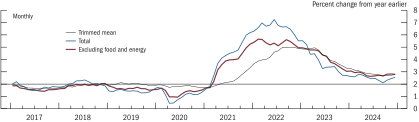
Inflation. After stepping down notably in 2023, consumer price inflation eased a bit more last year, although recent progress has been bumpy and inflation remains somewhat above 2 percent. The price index for personal consumption expenditures (PCE) rose 2.6 percent over the 12 months ending in December, down from a peak of 7.2 percent in 2022 (figure 2.1). The core PCE price index—which excludes often-volatile food and energy prices and is generally considered a better guide to the future of inflation—rose 2.8 percent last year, only a little less than its increase in 2023, as core services price inflation remained elevated. However, some other approaches to removing the influence of volatile components of inflation, such as the trimmed mean PCE measure produced by the Federal Reserve Bank of Dallas, showed more marked deceleration in prices last year. Measures of longer-term inflation expectations are within the range of values seen in the decade before the pandemic and continue to be broadly consistent with the FOMC's longer-run objective of 2 percent inflation.
Figure 2.1. Personal consumption expenditures price indexes
Accessible Version | Return to text
Note: The horizontal line indicates the Federal Open Market Committee's objective of 2 percent. The data extend through December 2024.
Source: For trimmed mean, Federal Reserve Bank of Dallas; for all else, Bureau of Economic Analysis; all via Haver Analytics.
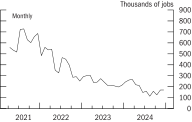
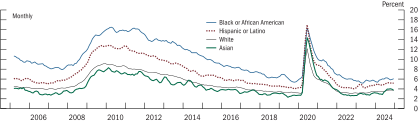
The labor market. The labor market remains solid and appears to have stabilized after a period of easing (figure 2.2). The unemployment rate moved up over the first half of last year but was mostly flat thereafter, ending the year at 4.1 percent—still low by historical standards—while job vacancies, which had been trending down, also flattened out over the second half at a solid level (figure 2.3). As labor demand cooled somewhat further last year, monthly job gains slowed to a moderate pace on average. Labor supply likely increased less robustly than in previous years, with immigration appearing to have slowed over the second half of last year. Given the further rebalancing of labor demand and supply last year, the labor market no longer appears especially tight. Reflecting this further balancing, nominal wage gains continued to slow in 2024 and are now closer to the pace consistent with 2 percent inflation over the longer term.
Figure 2.2. Nonfarm payroll employment
Accessible Version | Return to text
Note: The data shown are a 3-month moving average of the change in nonfarm payroll employment and extend through December 2024.
Source: Bureau of Labor Statistics via Haver Analytics.
Figure 2.3. Unemployment rate, by race and ethnicity
Accessible Version | Return to text
Note: All data displayed are 3-month moving averages. Unemployment rate measures total unemployed as a percentage of the labor force. Persons whose ethnicity is identified as Hispanic or Latino may be of any race. Small sample sizes preclude reliable estimates for Native Americans and other groups for which monthly data are not reported by the Bureau of Labor Statistics. The data extend through December 2024.
Source: Bureau of Labor Statistics via Haver Analytics.
Economic activity. Real GDP is reported to have increased last year by 2.5 percent, a little slower than in 2023. Consumer spending continued to grow robustly, supported by a solid labor market and rising real wages, while real business fixed investment increased moderately. In the housing market, new home construction was solid but existing home sales remained depressed, with mortgage rates still elevated. In contrast to GDP, manufacturing output was little changed, in part reflecting weak production in interest-sensitive sectors.
Financial conditions. Financial conditions continue to appear to be somewhat restrictive on balance. Short-term Treasury yields declined, in line with the easing of monetary policy since September; however, the market-implied path for the federal funds rate over the next year shifted up notably, and long-term Treasury yields increased markedly in the fourth quarter. Broad equity prices continued to increase despite the rise in longer-term Treasury yields, and yields on corporate bonds were little changed, as spreads narrowed. Credit continued to be broadly available to large-to-midsize businesses, most households, and municipalities but remained relatively tight for small businesses and households with lower credit scores. Bank lending to households and businesses continued to decelerate in the second half of 2024, likely reflecting still-elevated interest rates and tight lending standards.
Financial stability. The financial system remains sound and resilient. Valuations remained high relative to fundamentals in a range of markets, including those for equity, corporate debt, and residential real estate. Total debt of households and nonfinancial businesses as a fraction of GDP continued to trend down to a level that is very low relative to that in the past two decades. Most banks continued to report capital levels well above regulatory requirements and have reduced their reliance on uninsured deposits, but fair value losses on fixed-rate assets were still sizable for some banks. In terms of funding risks, while the 2023–24 Securities and Exchange Commission reforms on money market funds (MMFs) have partially mitigated vulnerabilities of prime MMFs, other less regulated short-term investment vehicles remain vulnerable and somewhat opaque, and their assets have been growing. Meanwhile, hedge fund leverage appears to be high and concentrated. (See the box "Developments Related to Financial Stability" on pages 32–33 of the February 2025 Monetary Policy Report.)
International developments. Foreign growth remained modest in the second half of 2024. Foreign manufacturing in general was weak, as the cumulative effects of restrictive monetary policy weighed on the sector and, in Europe, energy-intensive industries continued to grapple with elevated energy costs. That said, high-tech manufacturing and exports remained strong in Asia on robust U.S. artificial intelligence (AI) and data center demand. In China, while exports were strong, domestic demand remained sluggish despite stimulus measures to shore up the ailing property sector. Meanwhile, foreign headline inflation continued to decline, but progress on inflation reduction was uneven across economies.
Many foreign central banks cut policy rates further since mid-2024, citing declining inflationary pressures, easing labor markets, and concerns about economic growth. Policymakers generally stressed the importance of maintaining vigilance amid persistent geopolitical risks and, in some economies, still-somewhat-elevated services inflation and wage pressures. Since mid-2024, the trade-weighted exchange value of the U.S. dollar has increased significantly, on net, reflecting widening gaps of U.S. interest rates over those of major advanced foreign economies, the relative strength of the U.S. economy, and political and fiscal developments in some foreign economies.
Monetary Policy
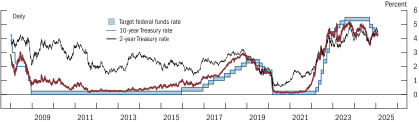
Interest rate policy. After having held the target range for the policy rate at 5-1/4 to 5-1/2 percent between late July 2023 and mid-September 2024, the FOMC lowered the target range for the policy rate by a cumulative 100 basis points over its September, November, and December meetings, bringing it to the current range of 4-1/4 to 4-1/2 percent (figure 2.4). The FOMC's decision to begin reducing the degree of policy restraint reflected the FOMC's greater confidence in inflation moving sustainably toward 2 percent and the judgment that it was appropriate to recalibrate the policy stance. The FOMC remains attentive to the risks to both sides of its dual mandate. In considering the extent and timing of additional adjustments to the target range for the federal funds rate, the Committee will carefully assess incoming data, the evolving outlook, and the balance of risks.
Figure 2.4. Selected interest rates
Accessible Version | Return to text
Note: The 2-year and 10-year Treasury rates are the constant-maturity yields based on the most actively traded securities. The data extend through February 4, 2025.
Source: Department of the Treasury; Federal Reserve Board.
Balance sheet policy. The Federal Reserve has continued the process of significantly reducing its holdings of Treasury and agency securities in a predictable manner. Beginning in June 2022, principal payments from securities held in the System Open Market Account have been reinvested only to the extent that they exceeded monthly caps. Under this policy, the Federal Reserve has reduced its securities holdings by $297 billion since June 2024, bringing the total reduction in securities holdings since the start of balance sheet reduction to about $2 trillion. The FOMC has stated that it intends to maintain securities holdings at amounts consistent with implementing monetary policy efficiently and effectively in its ample-reserves regime. To ensure a smooth transition, the FOMC slowed the pace of decline of its securities holdings in June 2024 and intends to stop reductions in its securities holdings when reserve balances are somewhat above the level that the FOMC judges to be consistent with ample reserves.
Special Topics
Employment and earnings across groups. The tight labor market in recent years has been beneficial across all demographics of workers, and many of the disparities in employment and wages by sex, race, ethnicity, education, and geography have narrowed. Over the past year, even as labor market conditions have eased, employment disparities continue to be near their recent lows, while wage growth has remained solid across many groups despite slowing a bit from post-pandemic highs. Even so, in absolute levels, significant disparities in groups remain. (See the box "Employment and Earnings across Demographic Groups" on pages 11–14 of the February 2025 Monetary Policy Report.)
Strong productivity growth. Labor productivity in the business sector increased 1.8 percent per year, on average, since the fourth quarter of 2019, stronger than its 1.5 percent average annual pace over the previous expansion. Should this faster pace of productivity growth persist, it can support stronger GDP growth without adding inflationary pressure. Some factors that have boosted productivity growth recently may continue providing support, such as new business formation, which surged early into the pandemic and has remained strong. Other factors may have had more short-lived influences on productivity growth, including a temporary burst in worker reallocation across jobs earlier in the pandemic. Any measured productivity gains from integration of AI technologies into production processes have likely been small so far, but productivity gains may grow as AI use becomes more widespread. (See the box "Labor Productivity since the Start of the Pandemic" on pages 18–20 of the February 2025 Monetary Policy Report.)
Federal Reserve's balance sheet and money markets. The size of the Federal Reserve's balance sheet has declined since June as the FOMC has continued to reduce its securities holdings. Usage of the overnight reverse repurchase agreement facility decreased further, while reserve balances were little changed. Conditions in money markets remained stable. (See the box "Developments in the Federal Reserve's Balance Sheet and Money Markets" on pages 42–44 of the February 2025 Monetary Policy Report.)
Framework review. The Federal Reserve has begun its periodic public review of the monetary policy framework it uses to pursue its dual-mandate goals of maximum employment and price stability. The review is focused on the FOMC's Statement on Longer-Run Goals and Monetary Policy Strategy, which articulates the Committee's approach to monetary policy, and the Committee's policy communications tools. Like the Federal Reserve's 2019–20 review of its monetary policy framework, the current review will include outreach and public events attended by policymakers, community leaders, experts from outside the Federal Reserve System, and other members of the public. (See the box "Periodic Review of Monetary Policy Strategy, Tools, and Communications" on page 45 of the February 2025 Monetary Policy Report.)
Monetary policy rules. Simple monetary policy rules, which prescribe a setting for the policy interest rate in response to the behavior of a small number of economic variables, can provide useful guidance to policymakers. With inflation easing and the unemployment rate having increased somewhat, the policy rate prescriptions of most simple monetary policy rules have generally declined since 2023. Currently, most of the rules call for levels of the federal funds rate that are within the current target range. (See the box "Monetary Policy Rules in the Current Environment" on pages 46–48 of the February 2025 Monetary Policy Report.)
July 2024 Summary
Inflation eased notably last year and has shown modest further progress so far this year, but it remains above the Federal Open Market Committee's (FOMC) objective of 2 percent. Job gains have been strong, and the unemployment rate is still low. Meanwhile, as job vacancies continued to decline and labor supply continued to increase, the labor market moved into better balance over the first half of the year. Real gross domestic product (GDP) growth was modest in the first quarter, while growth in private domestic demand remained robust, supported by slower but still-solid increases in consumer spending, moderate growth in capital spending, and a sharp pickup in residential investment.
The FOMC has maintained the target range for the federal funds rate at 5-1/4 to 5-1/2 percent since its July 2023 meeting. In addition, the Committee has continued to reduce its holdings of Treasury securities and agency mortgage-backed securities. The Committee does not expect it will be appropriate to reduce the target range until it has gained greater confidence that inflation is moving sustainably toward 2 percent. Reducing policy restraint too soon or too much could result in a reversal of the progress on inflation. At the same time, reducing policy restraint too late or too little could unduly weaken economic activity and employment. In considering any adjustments to the target range for the federal funds rate, the Committee will carefully assess incoming data, the evolving outlook, and the balance of risks.
The FOMC is strongly committed to returning inflation to its 2 percent objective. The Committee remains highly attentive to inflation risks and is acutely aware that high inflation imposes significant hardship, especially on those least able to meet the higher costs of essentials.
Recent Economic and Financial Developments
Inflation. Although personal consumption expenditures (PCE) price inflation slowed notably last year and has shown modest further progress this year, it remains above the FOMC's longer-run objective of 2 percent. The PCE price index rose 2.6 percent over the 12 months ending in May, down from the 4.0 percent pace over the preceding 12 months and a peak of 7.1 percent in June 2022. The core PCE price index—which excludes food and energy prices and is generally considered a better guide to the direction of future inflation—also rose 2.6 percent in the 12 months ending in May, down from 4.7 percent a year ago and slower than the 2.9 percent pace at the end of last year. On a 12-month basis, core goods price inflation and housing services price inflation continued to ease over the first part of the year, while core nonhousing services price inflation flattened out after slowing notably last year. Measures of longer-term inflation expectations are within the range of values seen in the decade before the pandemic and continue to be broadly consistent with the FOMC's longer-run objective of 2 percent.
The labor market. The labor market continued to rebalance over the first half of this year, and it remained strong. Job gains were solid, averaging 248,000 per month over the first five months of the year, and the unemployment rate remained low. Labor demand has eased, as job openings have declined in many sectors of the economy, and labor supply has continued to increase, supported by a strong pace of immigration. With cooling labor demand and rising labor supply, the unemployment rate edged up to 4.0 percent in May. The balance between labor demand and supply appears similar to that in the period immediately before the pandemic, when the labor market was relatively tight but not overheated. Nominal wage growth continued to slow in the first part of the year but remains above a pace consistent with 2 percent inflation over the longer term, given prevailing trends in productivity growth.
Economic activity. Real GDP growth is reported to have moderated in the first quarter after having increased at a robust pace in the second half of last year. Much of the slowdown was due to sizable drags in the volatile categories of net exports and inventory investment; growth in private domestic final purchases—which includes consumer spending, business fixed investment, and residential investment—also moved a little lower in the first quarter but remained solid. Real consumption growth slowed in the first quarter from a strong pace in the second half of last year, reflecting a decline in goods spending. Real business fixed investment grew at a moderate pace in the first quarter despite high interest rates, supported by strong sales growth and improvements in business sentiment and profit expectations. Activity in the housing sector picked up sharply in the first quarter as a result of a jump in existing home sales and rising construction of single-family homes.
Financial conditions. Financial conditions appear somewhat restrictive on balance. Treasury yields and the market-implied expected path of the federal funds rate have moved up, on net, since the beginning of the year, while broad equity prices have increased. Credit remains generally available to most households and businesses but at elevated interest rates, which have weighed on financing activity. The pace of bank lending to households and businesses increased in the first five months of the year but continues to be somewhat tepid. Delinquency rates on small business loans stayed slightly above pre-pandemic levels, and delinquency rates for credit cards, auto loans, and commercial real estate loans continued to increase in the first quarter of 2024 to levels above their longer-run averages.
Financial stability. The financial system remains sound and resilient. The balance sheets of nonfinancial businesses and households stayed strong, with the combined credit-to-GDP ratio standing near its two-decade low. Business debt continued to decline in real terms, and debt-servicing capacity remained solid for most public firms, in large part due to strong earnings, large cash buffers, and low borrowing costs on existing debt. However, there were also signs of vulnerabilities building in the financial system. In asset markets, corporate bond spreads narrowed, equity prices rose faster than expected earnings, and residential property prices remained high relative to market rents. Moreover, in the banking sector, some banks' fair value losses on fixed-rate assets remained sizable, despite most of them continuing to report solid capital levels. Additionally, parts of banks' commercial real estate portfolios are facing stress. Some banks' reliance on uninsured deposits remained high. Even so, liquidity at most domestic banks remained ample, with limited reliance on short-term wholesale funding. Bond mutual funds' exposure to interest rate risk stayed elevated, and data through the third quarter of 2023 show that hedge fund leverage had grown to historical highs, driven primarily by borrowing by the largest hedge funds. (See the box "Developments Related to Financial Stability" on pages 33–34 of the July 2024 Monetary Policy Report.)
International developments. Foreign economic activity appears to have improved in the first quarter after a soft patch in the second half of last year. In advanced foreign economies, growth rates returned to moderate levels despite the effects of restrictive monetary policy as lower inflation improved real household incomes. In emerging market economies, growth was supported by a recovery in exports and rising global demand for high-tech products, with the rise in activity in China in the first quarter being particularly outsized. Nonetheless, other factors continued to weigh on economic growth: Data indicated ongoing weakness in China's property sector, and in Europe, energy-intensive sectors continue to struggle, reflecting their ongoing adjustment to past increases in energy prices following Russia's 2022 invasion of Ukraine.
Foreign headline inflation has continued to decline since the middle of last year, but the pace of disinflation has been gradual and uneven across countries and economic sectors. Still, many foreign central banks have noted this progress in lowering inflation, and some have begun to cut their policy rates. A notable exception is Japan, which ended its negative interest rate policy and yield curve control in March amid persistently high inflation. The trade-weighted exchange value of the dollar rose significantly, consistent with widening gaps between U.S. and foreign interest rates.
Monetary Policy
Interest rate policy. The FOMC has maintained the target range for the policy rate at 5-1/4 to 5-1/2 percent since its July 2023 meeting. The Committee judges that the risks to achieving its employment and inflation goals have moved toward better balance over the past year. The Committee perceives the economic outlook to be uncertain and remains highly attentive to inflation risks. The Committee has indicated that it does not expect it will be appropriate to reduce the target range until it has gained greater confidence that inflation is moving sustainably toward 2 percent. Policy is well positioned to deal with the risks and uncertainties the Committee faces in pursuing both sides of its dual mandate. In considering any adjustments to the target range for the federal funds rate, the Committee will carefully assess incoming data, the evolving outlook, and the balance of risks.
Balance sheet policy. The Federal Reserve has continued the process of significantly reducing its holdings of Treasury and agency securities in a predictable manner.3 Beginning in June 2022, principal payments from securities held in the System Open Market Account have been reinvested only to the extent that they exceeded monthly caps. Under this policy, the Federal Reserve has reduced its securities holdings about $1.7 trillion since the start of balance sheet reduction. The FOMC has stated that it intends to maintain securities holdings at amounts consistent with implementing monetary policy efficiently and effectively in its ample-reserves regime. To ensure a smooth transition from abundant to ample reserve balances, the FOMC slowed the pace of decline of its securities holdings at the beginning of June and intends to stop reductions when reserve balances are somewhat above the level that the Committee judges to be consistent with ample reserves.
Special Topics
Housing services inflation. The PCE price index for housing services started accelerating in 2021, notably increasing its contribution to core PCE inflation. Because this index calculates average rent for all tenants—both new tenants and existing tenants—its changes tend to lag changes in market rent measures for new leases. Therefore, measures of market rent growth for new leases can help predict future changes in the PCE price index. Since mid-2022, market rents have decelerated and returned to a growth rate similar to or below their average pre-pandemic pace, while the PCE index continues to show elevated inflation, reflecting the gradual pass-through of market rates to existing tenants. As this process continues, PCE housing services inflation should gradually decline, though much uncertainty remains about the extent and timing. (See the box "Housing Services Inflation and Market Rent Measures" on pages 9–11 of the July 2024 Monetary Policy Report.)
Employment and earnings across groups. A strong labor market over the past two years has been beneficial across all demographics of workers. Moreover, many of the long-standing disparities in employment and wages by sex, race, ethnicity, and education have narrowed, and some gaps reached historical lows in 2023 and the first half of 2024. However, despite this narrowing, significant disparities in absolute levels across groups remain. (See the box "Employment and Earnings across Demographic Groups" on pages 16–19 of the July 2024 Monetary Policy Report.)
Monetary policy independence, transparency, and accountability. Congress has established a statutory framework that specifies the long-run objectives of monetary policy—maximum employment and stable prices—and gives the Federal Reserve operational independence in conducting monetary policy. In this framework, the Federal Reserve makes determinations about the monetary policy actions that are most appropriate for achieving the dual-mandate goals that Congress has assigned to it. The Federal Reserve recognizes that independence is a trust given to it by Congress and the American people and that with independence comes the need to be transparent about, and accountable for, its monetary policy decisions. Transparency also improves monetary policy's effectiveness. The Federal Reserve promotes transparency by providing information about FOMC decisions through policy communications and a variety of publications. The means by which the Federal Reserve informs the American people about its monetary policy decisions include official FOMC statements, monetary policy reports, and Committee meeting minutes and transcripts, as well as speeches, press conferences, and congressional testimony given by Federal Reserve officials. (See the box "Monetary Policy Independence, Transparency, and Accountability" on pages 42–44 of the July 2024 Monetary Policy Report.)
Federal Reserve's balance sheet and money markets. The size of the Federal Reserve's balance sheet has continued to decrease since February as the FOMC has reduced its securities holdings. Reserve balances, the largest liability on the Federal Reserve's balance sheet, and usage of the overnight reverse repurchase agreement facility—another Federal Reserve liability—both declined. (See the box "Developments in the Federal Reserve's Balance Sheet and Money Markets" on pages 47–49 of the July 2024 Monetary Policy Report.)
Monetary policy rules. Simple monetary policy rules, which prescribe a setting for the policy interest rate in response to the behavior of a small number of economic variables, can provide useful guidance to policymakers. With inflation easing over the past year, the policy rate prescriptions of most simple monetary policy rules have decreased recently and now call for levels of the federal funds rate that are close to or below the current target range for the federal funds rate. (See the box "Monetary Policy Rules in the Current Environment" on pages 50–52 of the July 2024 Monetary Policy Report.)
Footnotes
1. Those complete reports are available on the Board's website at https://www.federalreserve.gov/publications/files/20250207_mprfullreport.pdf (February 2025) and https://www.federalreserve.gov/monetarypolicy/files/20240705_mprfullreport.pdf (July 2024). Return to text
2. As required by section 2B of the Federal Reserve Act, the Federal Reserve Board submits written reports to Congress that contain discussions of "the conduct of monetary policy and economic developments and prospects for the future." Return to text
3. See the May 4, 2022, press release regarding the Plans for Reducing the Size of the Federal Reserve's Balance Sheet, available on the Board's website at https://www.federalreserve.gov/newsevents/pressreleases/monetary20220504b.htm. Return to text